UFO over Moreno, California USA March 9, 2026 UAP paranormal sighting news.

UFO over Moreno, California USA March 9, 2026 UAP paranormal sighting news.

UFO over Moreno, California USA March 9, 2026 UAP paranormal sighting news.

McDonald's is testing humanoid ROBOTS in Shanghai – and they even wear the uniform
Humanoid robots are serving up meals and entertaining customers at a McDonald's in Shanghai – and they even wear the famous uniform.
The machines, supplied by Chinese firm Keenon Robotics, have been deployed as part of a trial and hint at a future where bots handle routine tasks at fast food restaurants.
In videos posted online, diners can be seen interacting with cyborgs dressed in the iconic red and yellow uniforms behind counters.
One humanoid, wearing a black uniform with the word 'chef', greets members of the public as they arrive.
Others make the famous 'M' sign synonymous with the brand and showcase some dancing moves.
Meanwhile, children can be seen chasing other robots disguised as cute animals as they deliver food and clean floors around the restaurant.
'Watch the robot squad suit up and enjoy the McDonald's party!' Keenon Robotics wrote online. 'Our humanoid series are leading the squad and hitting the streets.
'It's a showcase of how service automation is becoming a seamless part of global dining, and how technology brings more smiles to every mealtime.'

In the video, one robot can be seen touching its thumb and index finger together to make an 'okay' sign at a customer
In the video, one robot can be seen touching its thumb and index finger together to make an 'okay' sign at a customer.
A smaller, cube-shaped 'cleaning' bot features a touchscreen and has been designed to look as if it is wearing a tie.
Jon Banner, the executive vice president of McDonald's, explained the robots were there for a 'temporary greeting'.
'Just to be clear – the robots were part of the grand opening of the Shanghai Science and Technology Museum restaurant,' he wrote on social media.
'The robots were requested by the museum to draw attention. Mission accomplished!'
He added that the robots 'were not involved in any service or operational functions'.
While the machines were part of a trial – and were only around for about five days – some people believe it won't be long until they're rolled out more widely.
'Shanghai is the test market,' one person wrote on X. 'If the unit economics work the rollout does not stay in China.'

The machines, supplied by Chinese firm Keenon Robotics, have been deployed as part of a trial and hint at a future where bots handle routine tasks at fast food restaurants
Another said that this is the 'real future', adding: 'Humanoid robots greeting customers and delivery bots bringing your food – automate the kitchen a bit more and boom, McDonald's stores basically run themselves with zero staff.'
However, others warned the robots would be 'destroyed' if rolled out elsewhere.
According to Keenon Robotics, its 'Dinerbot T10' boasts 3D vision for 'safer obstacle avoidance in complex environments'.
It comes with open-access trays to allow diners to easily pick up their food, and features a six-wheel shock-absorbing chassis to prevent spillage during sudden stops.
Its screen can be programmed to display different animal faces, including a cat, bunny and deer, while a range of voices can be picked from.
Meanwhile, their 'Kleenbot C40' features a triple-brush system for separating dry and wet spillages. It has been designed to 'easily handle crowds and irregular obstacles', and can pick up objects including hair, paper scraps, dust, coffee and juice.
While the Keenon website does not list prices, these models retail for around £11,500 to £16,000 online.
Their recently-released 'XMAN-R1' humanoid was designed specifically to interact with people – but appears to come with a $100,000 price tag online.


Their recently-released 'XMAN-R1' humanoid was designed specifically to interact with people – but appears to come with a $100,000 price tag online
Last week, the shocking moment a dancing robot went berserk at a restaurant was caught on camera.
Customers at the Haidilao hotpot restaurant in San Jose, California, were enjoying their meals when a humanoid started showing off some moves.
While performing a dance routine, involving waving its arms and shaking its hips, the robot suddenly slams its hands down on a table.
This sends chopsticks and bright yellow sauce flying into the air, while staff race over to try and turn it off.
But the humanoid continues to dance throughout the altercation – which saw three employees wrestle with the robot and try to drag it away by the scruff of its neck.
RELATED VIDEOS
Mysterious 'hum' heard across several US states as residents report vibrating homes and sleepless nights
A mysterious humming noise has been reported in neighborhoods across several US states, rattling homes and leaving residents struggling to sleep.
The latest reports come from Vineland, New Jersey, where locals say the sound began after construction started on a massive 2.5-million-square-foot data center, though officials have not confirmed a direct link.
Residents say the constant noise is disrupting daily life. 'That is not construction, and that monstrosity is only partially built,' Scott Montgomery told ABC 6. 'It is infringing on our peace of mind and our tranquility.'
Similar complaints have surfaced in parts of Virginia, home to hundreds of data centers, and in Connecticut earlier this year, though officials in those areas have yet to identify a confirmed source.
Experts noted that data centers can produce continuous low-frequency humming caused by powerful cooling systems and electrical equipment operating around the clock.
Thousands of servers generate intense heat, requiring large fans and chillers that can produce noise levels between 55 and 85 decibels, often described as a low-pitched roar capable of traveling long distances.
'It's not even fully built yet. That's the scary part,' Montgomery added.
'If it sounds like this now, what's it going to be like when everything's up and running?'

The latest reports come from Vineland, New Jersey, where locals say the sound began after construction started on a massive 2.5-million-square-foot data center
Cumberland County Department of Health has acknowledged the noise concerns in the New Jersey town, noting it does not play a role in planning, zoning, or approving construction projects.
The agency added that it will investigate the construction site to determine if it is the source of the noise.
'If our inspectors find that noise levels are higher than those allowed under the code, we follow the enforcement guidelines under which a penalty may be issued if compliance is not obtained within a certain timeframe,' the agency shared on Facebook.
'While the Cumberland County Department of Health does not have the legal authority to shut down a facility, we do work collaboratively with those involved to resolve any confirmed violations of the Noise Control Act.'
The 2.4 million-square-foot data center is being built on South Lincoln Avenue and is owned by the company Data One.
In a statement, the company said the facility is complying with local regulations.
'Our site is operating in full compliance with Vineland City noise ordinance limits,' the company said. 'We will continue deploying sound reduction measures to minimize any impact on our neighbors.'
While authorities have yet to blame the data center for the noise, locals are sure it is the source.

The 2.4 million-square-foot data center is being built on South Lincoln Avenue and is owned by the company Data One
One local shared on social media: 'I live about two miles away, and it's definitely there. Sounds like a huge engine idling all the time.'
Montgomery, who lives about a half a mile from the facility, said: 'It keeps you up at night, as you can hear it coming through the house.'
Another local, Theresa Lewis, expressed the same concern, saying that even when her doors and windows are closed, she still hears a constant humming.
'It's like someone is using some type of machinery around my house,' Lewis told ABC 6.
Montgomery posted a video of the noise on social media. In the recording, a humming sound can be heard.
'We're afraid it's even going to get worse, so it's just maddening to listen to this all the time. It's hard to fall asleep at night,' he said.
Similar reports from Connecticut surfaced earlier this year, but locals said they have been bothered by a humming noise since 2020.
A persistent low-frequency hum has disrupted life in West Haven, with residents describing the sound as both mysterious and, at times, unbearable.

Similar reports from Connecticut surfaced earlier this year, but locals said they have been bothered by a humming noise since 2020
After collecting more than 140 signatures on a petition, residents persuaded city leaders to approve $16,000 to hire an independent acoustic firm to investigate the source, which many believe may be linked to nearby industrial activity.
'For years, our community has been plagued by a constant or intermittent humming noise and low-frequency vibrations affecting multiple areas of town,' the petition notes. 'This disturbing phenomenon occurs at all hours, disrupting our ability to sleep, concentrate and enjoy life to its fullest.
'Many residents have reported increased levels of stress, anxiety and physical discomfort due to this incessant noise and vibration.'
While Connecticut authorities have yet to confirm the source, there are several data centers near West Haven, primarily in nearby New Haven, Wallingford, and the surrounding southern Connecticut area.
Lumen New Haven Data Center is about three to five miles from West Haven, while Fibertech Networks is about four miles away, and Cloudsmart Data Center and ChimeNet Data Center are up to 20 miles from the town.

West Haven Commissioner of Human Services John Carrano shared that the City Council approved a $16,000 budget to hire a third-party acoustics firm to pinpoint the source of the 24/7 noise
Similar humming complaints have emerged across parts of Virginia, where hundreds of large data centers operate around the clock.
Residents have described hearing a deep, low-frequency buzz, sometimes accompanied by vibrations, fueling speculation about whether expanding data center infrastructure could be contributing to the unexplained noise.
Dale Brown from Great Oak told WUSA9: 'We're about 700 feet from the data center right here. It's just really, really loud.'
Residents living near the Amazon Web Services data center in Manassas and nearby facilities report both a persistent hum and low rumbling sounds that have sparked ongoing complaints.
Local Roger Yackel said: 'These data centers are loud, noisy beasts and they are being built too close to residential areas. That's not something that we should have to live with.'
John Lyver, a retired NASA analyst, has begun tracking noise coming from data centers near his neighborhood.
'I'm finding that the noise is far worse than anybody ever figured it was going to be,' he said.
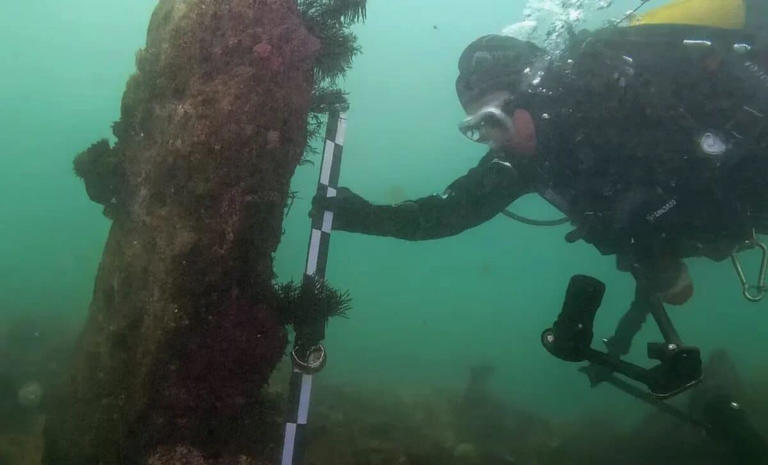
Divers discovered a 60,000-ton stone structure underwater, and no one knows why it was builtA massive stone structure discovered beneath the Sea of Galilee is challenging archaeologists, with its purpose and age still unknown. Weighing an estimated 60,000 tons, the formation stands out as one of the largest underwater features of its kind in the region.
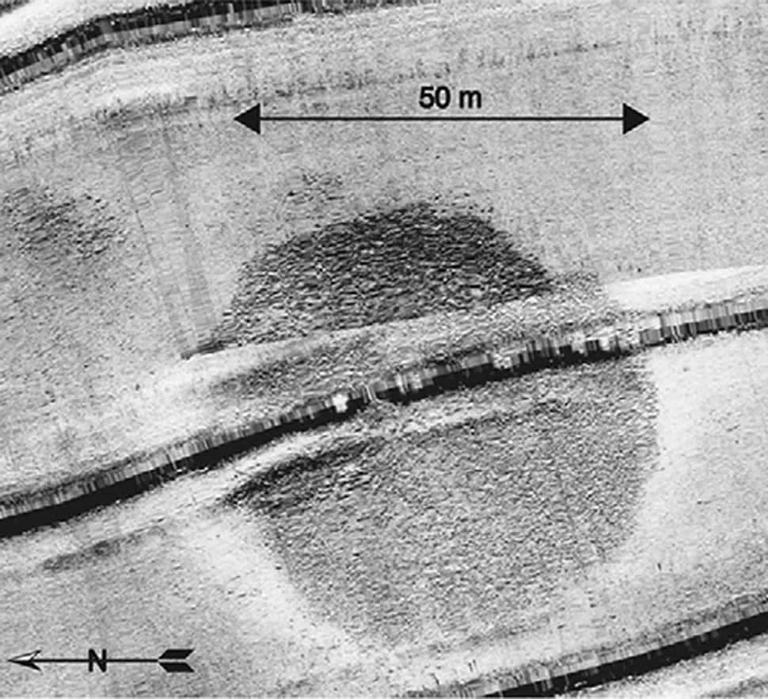
The structure was first detected during a 2003 sonar survey in the southwest part of the lake. Its cone-like shape and scale quickly drew attention, prompting further investigation by divers. Its proximity to known ancient sites has led scientists to explore possible links with early urban societies in the area.

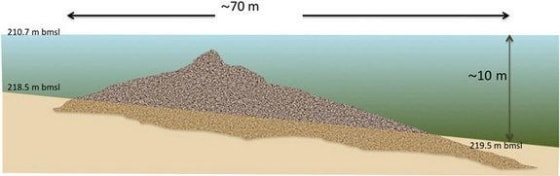
The structure rises nearly 10 meters (32 feet) high and spans approximately 70 meters (230 feet) in diameter. According to a press release published by the International Journal of Nautical Archaeology, it is composed of unhewn basalt cobbles and boulders, some measuring up to 1 meter in length. Divers reported no evidence of cutting or shaping. The stones appear randomly arranged, without walls or clear architectural patterns.
“The boulders have natural faces with no signs of cutting or chiselling. Similarly, we did not find any sign of arrangement or walls that delineate this structure.”
Researchers describe the structure as a cairn, a type of man-made pile of stones known from other regions and sometimes associated with burial practices, though no direct evidence confirms such a use here.
The structure does not resemble any natural geological formation. As explained by the research team, its shape and composition point clearly to human construction.
They propose that it was built on dry land and later submerged as the Sea of Galilee expanded. This interpretation is consistent with known environmental changes affecting the region over thousands of years. The scale of the structure implies a high level of organization. In the researchers’ view:
“This is such a huge structure that it truly is something unusual. It could have been a big ceremonial structure, or a ramp. There could have once been statues on top of people in certain rituals. I mean, I’m really going wild here. The truth is we don’t know how it was constructed, what its exact age is, how it was used, or how long ago it was used. We have several speculations, but we don’t know much except that it’s there and it’s huge.”
Archaeologist Yitzhak Paz, from the Israel Antiquities Authority and Ben-Gurion University, saidthat the stone structure may date to the third millennium B.C.. He noted that similar megalithic phenomena have been identified in nearby areas.
One example cited in the study is Khirbet Beteiha, located about 30 kilometers to the northeast, which features concentric stone circles. These parallels suggest the underwater structure could belong to the same cultural context.
If this dating is confirmed, the structure would have been located near Bet Yerah (or Khirbet Kerak), a major settlement of the time. ArchaeologistRaphael Greenberg noted that the city covered 30 hectares and had up to 5,000 inhabitants, with fortified defenses and organized urban planning.
No underwater excavation has yet been carried out, leaving the structure’s function and exact age uncertain.
“If the site was inland, it would be much easier to investigate. By now we would have excavated, but because it’s submerged we haven’t yet been able to. It is a much harder process, both physically and financially. It is very expensive to raise support for such an enterprise,” noted Yitzhak Paz.
RELATED VIDEOS
UAP NEWS & EVIDENCE | NJ DRONES SUSPECTED CHINESE TECH? BALL LIGHTING FIRES INTO THE SKY + MORE!

In a recent episode of the YouTube channel UndercoverET, host Ross Coulthart and his team examined a series of recent reports involving unidentified aerial phenomena (UAP) and drone activity across the United States and the United Kingdom. The broadcast focused on three main items: the disputed drone sightings over New Jersey that some analysts attribute to Chinese “electro‑gravitic” technology, a Kentucky video that appears to show ball‑lightning launching into the sky, and a set of orb‑type sightings captured over England. By juxtaposing official statements, social‑media commentary, and the visual evidence itself, the program attempted to separate verifiable data from speculation.
The centerpiece of the discussion was the 2024 New Jersey drone incidents, which have sparked a heated debate among intelligence analysts and aviation officials. Coulthart, a veteran investigative journalist with NewsNation, cited unnamed sources suggesting that the Chinese military may have achieved a breakthrough in “electro‑gravitic” propulsion and that the initial drones observed over New Jersey were of Chinese origin. He warned that the United States may have responded by deploying its own advanced platforms to obscure the foreign presence. By contrast, the UAP Reporting Center on X (formerly Twitter) publicly refuted these claims, stating that the craft were definitively American. The Federal Aviation Administration’s (FAA) mixed messaging—first denying any knowledge, then later asserting ownership without detailed specifications—added to the confusion, underscoring a lack of transparency that hampers public understanding.
The episode also scrutinized two video clips that have circulated widely on social media. The first, recorded in Kentucky, shows a luminous orb near the ground that suddenly rockets upward. While the UAP Reporting Center interpreted the event as a possible energy‑based UAP, the UndercoverET host highlighted technical inconsistencies: a sudden shift from loud mechanical noise to quiet cricket sounds and a conspicuous lens flare that may indicate post‑production editing. He concluded that the footage “leans toward a fabricated or hoaxed” scenario. The second clip, posted by the user “Red Panda Koala,” depicts multiple white orbs moving erratically through clouds over England. Here, the host found the evidence more compelling, noting that the orbs maintained altitude despite a lack of wind (evidenced by stationary trees) and exhibited flight patterns that do not match known aircraft or natural debris. This contrast illustrates the difficulty of assessing UAP reports without rigorous, standardized documentation.
Several senior figures were referenced to provide broader context. Former NORAD and NORTHCOM commander General Glen VanHerck—who testified before the Senate Intelligence Committee and was featured on 60 Minutes—has previously acknowledged the presence of “unknown technology” operating over the continental United States. Senator Mike Rounds was also mentioned as part of the growing political dialogue on UAP transparency. Their statements lend institutional weight to the claim that anomalous objects are not merely fringe curiosities but may intersect with national security concerns. However, analysts caution that attributing these sightings to any specific nation’s program remains speculative without corroborating radar data or classified briefings.
The broadcast concluded by framing the situation as a nascent “UAP technology race” among major powers, suggesting that both foreign and domestic advanced systems could be operating in restricted airspace. While some footage—particularly the Kentucky ball‑lightning video—appears dubious, the persistence of unexplained aerial activity warrants continued scientific scrutiny. UndercoverET’s host urged citizen observers to capture “high‑quality, landscape‑oriented, zoomed‑in” recordings, emphasizing that reliable visual data are essential for verification by investigators. As agencies like the FAA and the Department of Defense work to integrate UAP reporting into existing frameworks, the demand for transparent, peer‑reviewed evidence will be critical to separating genuine technological breakthroughs from misidentified conventional craft or deliberate misinformation.
The Amarna Anomaly: Did Akhenaten’s DNA Carry the Signature of the Gods?

When Amenhotep IV ascended the throne in the 14th century BC, he was not meant to be king. The unexpected death of his older brother thrust him into power, and within a few short years, he changed his name to Akhenaten, meaning "effective for the Aten." He moved the capital to a new, isolated city in the desert, Akhetaten (modern Amarna), and declared himself the sole intermediary between humanity and the divine. Even today, researchers debate whether the ancient Egyptian Akhenaten plague may have been a historical myth designed to explain the sudden abandonment of this utopian city.
But it is the art of the Amarna period that has left the most indelible mark on history. Unlike the idealized, rigid, and muscular depictions of previous pharaohs, Akhenaten ordered his artisans to portray him and his family exactly as they were. The result was a shocking departure from tradition. Statues and reliefs show the pharaoh with a mix of masculine and feminine traits, including visible gynecomastia (breast tissue) and a distended belly. His wife, whose fate remains tied to the mysterious disappearance of Nefertiti and their daughters, was also depicted with dramatically elongated skulls.

llustration of the more realistic art of the Amarna period.
According to a comprehensive 2025 medical review published in the Journal Cureus, experts have proposed numerous diagnoses to explain these features, ranging from Marfan syndrome to aromatase excess syndrome and Klinefelter syndrome. Marfan syndrome, a genetic disorder affecting connective tissue, could explain the elongated face and spindly limbs, but it does not account for the female characteristics. Conversely, aromatase excess syndrome could explain the gynecomastia, but it falls short of explaining the cranial deformities. The study ultimately concluded that while these medical theories are fascinating, it is highly unlikely that a single disease could account for the entirety of the Amarna royal family's bizarre physiques.
The mystery deepened in 1907 when archaeologists discovered a small, unassuming tomb in the Valley of the Kings, designated KV55. Inside, they found a desecrated coffin. The golden face mask had been violently ripped away, and the cartouches bearing the occupant's name were chiseled out, a deliberate act of damnatio memoriae intended to erase the individual from the afterlife.

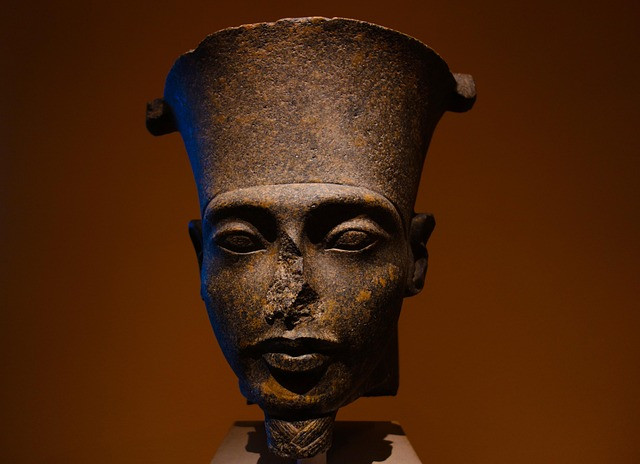
A striking close-up of a dark stone bust depicting Pharaoh Akhenaten, showcasing the distinctive elongated facial features and the tall crown of the 18th Dynasty.
(Bowzergod/Pixabay)
For over a century, the identity of the KV55 mummy was fiercely debated. Was it Queen Tiye, the enigmatic Smenkhkare, or Akhenaten himself? In 2010, a landmark DNA study published in the Journal of the American Medical Association (JAMA) provided a stunning revelation. Genetic fingerprinting of the royal mummies confirmed that the KV55 skeleton was the father of King Tutankhamun and the son of Amenhotep III. By all genealogical accounts, this was the heretic king, Akhenaten, finally unmasking the identity of the controversial mummy KV55.
However, the physical examination of the KV55 skeleton presented a glaring paradox. The bones did not show the extreme deformities depicted in the Amarna art. There was no evidence of severe craniosynostosis (premature fusing of the skull bones) or the skeletal markers of Marfan syndrome. This has led many mainstream historians to conclude that the Amarna art style was purely symbolic, a propagandistic choice to depict the pharaoh as the "mother and father of all mankind," reflecting the androgynous nature of the Aten itself.
What if this conclusion is missing the larger picture? What if the art was not an exaggeration, but a deliberate homage to an ancestral truth that the pharaoh was trying to resurrect?
To understand the Amarna anomaly, one must look beyond the confines of traditional Egyptology and into the broader mythos of the ancient world. Across various ancient cultures, from the Sumerian texts of Mesopotamia to the biblical accounts of the Nephilim, there are persistent records of "Watchers" or "gods" who descended from the heavens and mingled their seed with humanity.

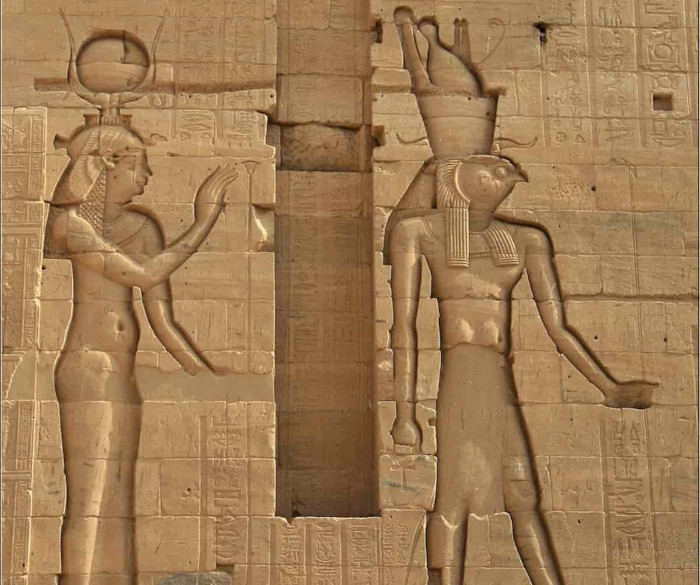
Ancient Egyptian relief at a temple complex, showcasing the monumental scale and detailed hieroglyphic carvings of the Amarna period.
(Pixabay)
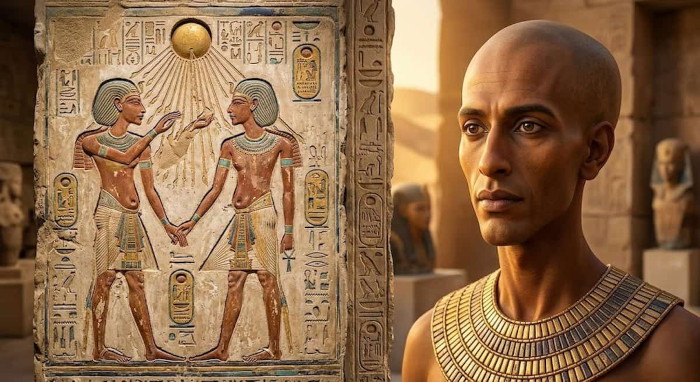
Akhenaten’s religious revolution was not just about monotheism; it was about direct, unmediated contact with the divine. The Aten was not a human-like god; it was depicted as a celestial disc extending rays of light that ended in hands, offering the ankh (the breath of life) directly to the royal family. Akhenaten bypassed the traditional priesthoods because he claimed a direct, biological, and spiritual link to this celestial force.
If we view the Amarna period through the lens of ancient hybridization narratives, the physical anomalies of Akhenaten and his family take on a new meaning. The elongated skulls, the androgynous features, and the bizarre proportions may not have been the result of a random genetic disease, but rather the manifestation of a dormant, ancient gene, the biological blueprint of the "gods" from the First Time (Zep Tepi).

Elongated skulls on display at Museo Regional de Ica in the city of Ica in Peru.
(Marcin Tlustochowicz from Poland/CC BY 2.0)
This theory aligns with the global phenomenon of artificial cranial deformation, practiced by cultures from the Americas to the Black Sea. Why would disparate, unconnected ancient societies deliberately bind the heads of their infants to achieve an elongated shape? The most logical conclusion is that they were imitating a ruling elite or a "divine" race that naturally possessed these cranial features. Akhenaten and his daughters may have been the last visible resurgence of this authentic, un-deformed genetic lineage in the ancient Near East.
The debate over Akhenaten’s DNA and his physical form is not just an academic exercise; it touches upon the sensitive issue of how history is curated. Just as the successor pharaohs, including Horemheb and even Akhenaten’s own son, Tutankhamun, systematically smashed the Amarna statues and erased the heretic’s name from the king lists, modern institutions have often been accused of downplaying discoveries that challenge the established narrative of human origins.
While there is no direct evidence of a modern "cover-up" regarding the KV55 mummy, the intense resistance within orthodox academia to entertain theories outside of standard medical diagnoses reflects a broader reluctance to engage with the uncomfortable anomalies of our past. The 2010 DNA results were groundbreaking, yet they left many questions unanswered, particularly regarding the exact nature of the genetic markers found within the 18th Dynasty lineage.
Akhenaten’s reign was a brief, blinding flash of radical departure in the long, conservative history of ancient Egypt. He attempted to pull his civilization back to a purer, more direct connection with the cosmos, bypassing the corrupt human institutions of the priesthood. In doing so, he may have revealed the true, hidden face of the ancient rulers, a face that was deliberately obscured by those who came after him.

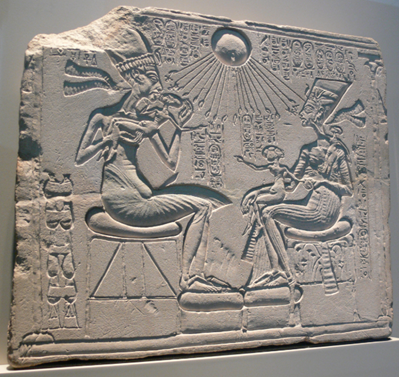
House altar Akhenaten Nefertiti Berlin showing Akhenaten, Nefertiti and three of their daughters. (Egyptian Museum of Berlin/Public domain)
The Amarna anomaly remains one of the most compelling mysteries of antiquity. Whether viewed as a tragic medical case study, an alternative view of the heretic king, or the startling re-emergence of a divine genetic blueprint, Akhenaten continues to challenge our understanding of who we are and where we came from. As science advances and our ability to sequence ancient DNA improves, the sands of Egypt may yet yield the final truth about the bloodline of the gods.
The golden sands of Egypt hold many secrets, but few are as enduring or as controversial as the mystery of the Amarna period. Over 3,300 years ago, a radical pharaoh upended seventeen centuries of religious tradition, plunging the most powerful empire in the ancient world into chaos. He abolished the powerful priesthoods, erased the names of the old gods, and established the worship of a single, faceless deity, the Aten. But it was not just his religious revolution that shocked subsequent generations; it was the bizarre, almost otherworldly physical appearance of the pharaoh himself.
Akhenaten, the "Heretic King," was depicted with a severely elongated skull, a long sinewy neck, a narrow upper torso, broad hips, and spindly limbs. For decades, Egyptologists and medical professionals have debated whether these depictions were mere artistic stylization or the result of a profound genetic mutation. Yet, as modern science attempts to retroactively diagnose this ancient ruler, a more profound question emerges: Could the physical anomalies of the Amarna royals be a reflection of a much older, divine bloodline, a genetic signature from the "first time" of the gods?
RELATED VIDEOS
This Mysterious Metal Could Be Alien Technology, UFO Hunters Say—And Now We Know the TruthThe unusual specimen raised eyebrows because it appeared capable of causing levitation. An official investigation has not settled the matter, some UFO enthusiasts say.
Here’s what you’ll learn in this story:
As Earthlings, we’re curious about whether alien civilizations like ours are out there, or if they exist at all. That’s why scientists were intrigued when a mysterious shard of metal found on Earth exhibited signs that it might have come from intelligent minds on a distant planet.
This peculiar specimen fell to Earth around 1947 in the supposed UFO wreck. It seemed linked to the infamous Roswell incident, in which members of the general public believed was a flying saucer had crashed to Earth. However, the debris found in Roswell actually turned out to be from a U.S. Air Force balloon meant to spy on Soviet nuclear experiments.
The true origins of the metallic specimen, were debated for decades. The sample had an apparently unprecedented material structure that could indicate an extraterrestrial technosignature, or sign of alien technology.
Eventually, Blink-182 frontman and UFO enthusiast Tom DeLonge’s To the Stars Academy, an organization that independently researches possible alien phenomena, got a hold of it. Then, the All-Domain Anomaly Resolution Office (AARO), which investigates unidentified anomalous phenomena (UAP) for the U.S. government, took over the investigation. It was seeking to learn of any physical and chemical properties that made the object potentially capable of inertial mass reduction—levitation.
It turned out that the object was a magnesium alloy whose main components are magnesium and zinc. It also contains bismuth, lead, and other trace elements.
AARO asked Oak Ridge National Laboratory (ORNL) to conduct an analysis in 2022 because scientists were especially interested in whether the sample was of terrestrial origin and if its bismuth content meant it could have possibly been used by aliens as a terahertz waveguide, a metal object that directs electromagnetic waves emitted by an energy source. ORNL was originally established during WWII to investigate things such as atomic weapons, and most of what its scientists investigate is still energy-related. However, the lab has also studied materials suspected to be extraterrestrial.
This metal shard specimen “purportedly exhibits extraordinary properties,” according to AARO and ORNL’s recently published findings on the object.
ORNL scientists looked for evidence of life beyond our planet by studying the sample for possible biosignatures, which are naturally occurring substances associated with life, and technosignatures, which are signs of extraterrestrial technology that scientists seek out especially when searching for intelligent life.
Some UAPs might have both.
In looking for alien biosignatures, ORNL scientists wanted to see whether the metals in this alloy were from Earth. That meant investigating their isotopic signatures, which represent the ratios of different element isotopes—different atomic mass versions of the same element.
Analysis showed that the isotopic signatures of magnesium and lead indicated a terrestrial origin. The magnesium’s isotopic signature had undergone some separation of lighter and heavier isotopes, probably due to stress from heat and physical or chemical manufacturing processes. However, it was still within the normal range for magnesium that forms on Earth—not an alien biosignature.
The magnesium in this sample also showed a proportion of isotopes that occurs only in our solar system, strengthening the case for a local origin. Scientists know this because the isotopic signature of magnesium originally comes from a particular star-forming region and so is unique to each star system. Magnesium is an extremely common element in the universe, produced in great amounts by larger, older stars that scatter it into space when they die and go supernova. It is often recycled by young star systems, where it forms a unique isotopic signature, depending on the conditions.
The lead in the object also matched the isotopic signatures for lead that originates on Earth. These signatures are so distinct that there is no way they could have come from any other body—even the moon.
With no alien biosignatures present in the sample, the ORNL scientists turned their attention to technosignatures. Scanning transmission electron microscopy revealed that the crystalline structure of the magnesium was similar to the magnesium in alloys manufactured on Earth. With that confirmed, they tried to determine if the sample could have been part of a terahertz waveguide.
Waveguides are metal objects that transmit electromagnetic waves. For example, the magnetron in your microwave oven transmits waves to the main oven cavity, where they heat up leftovers. A terahertz waveguide levels up this technology with much more intense terahertz waves, hypothetically enough to levitate an object if built using the right methods and materials.
“Based on the technologies developed by humans, waveguides can only channel radiation for purposes of communication, data collection, or heating but the conjecture for the UAP was that they were used for levitation,” says Harvard University theoretical physicist Avi Loeb, PhD, who was not involved in the study. “That would represent a technology unknown to humans.”
To qualify as a piece of alien technology, the sample would need to have a single layer of pure bismuth between layers of the magnesium alloy. This is because unadulterated bismuth can guide energy just like the magnetron in your microwave. Unlike anything in your microwave, bismuth is capable of directing terahertz waves. The problem is that the bismuth in this sample is neither pure nor in a single layer. There are multiple layers of bismuth between the magnesium layers, and the bismuth itself contains lead, both of which would disrupt its functioning as a waveguide.
“ORNL has a high level of confidence that all data indicate the material was manufactured terrestrially—albeit using an uncommon mixture of elements by today’s standards—and then incurred damage caused by mechanical and heat stressors,” according to the report.
After seeing the analysis, To the Stars released a statement on its website, anticipating a meeting between its own scientists and the ORNL team. In particular, To the Stars is hoping to learn more because “the reports do not offer a firm conclusion as to the origin and purpose of the material along with other seeming anomalies. [To the Stars] has more questions about both reports.”
While we still don’t know exactly where on Earth the mysterious sample came from, all indications show that it belongs to our own planet. There is a likely origin story behind this object—it might be a product of post-WWII magnesium alloy research for lighter and stronger aircraft. Back then, magnesium alloys were poorly understood, according to the report.
Maybe this artifact wasn’t part of a larger piece of technology manufactured by alien hands, or whatever appendages and machines they might use. Still, this was a valuable exercise, because ruling out objects that originated on Earth only gives us a better idea of what could be truly extraterrestrial.
UFO Hunters Thought They Found Alien Metal, But Scientists Discovered Something Else
A metal shard tied to one of the most famous UFO crashes in history has finally been analyzed. The results? They might not be what you think.

© Credit: To The Stars
A mysterious metal shard, once thought to be a piece of a UFO that crashed in 1947, has sparked years of wild speculation. UFO enthusiasts and alien theorists hoped it could be a clue that would finally prove extraterrestrial life. But after scientific analysis, it turns out the shard’s origins are far more down-to-Earth than anyone expected.
The piece of metal gained attention after some linked it to the infamous Roswell incident, where an alleged UFO crash in New Mexico sent shockwaves through the public’s imagination. Over the decades, many believed that Roswell held secrets about alien visitors, and this particular shard became a symbol of those hopes. But a deeper look into its composition has now revealed a far more mundane explanation.
When it comes to UFOs, few events are as iconic as the Roswell crash. In 1947, reports surfaced claiming that a “flying saucer” had crashed in New Mexico. The U.S. military later said it was just a weather balloon, but many conspiracy theorists refused to accept that explanation. Some believed that the wreckage contained not just ordinary metal, but fragments of a spacecraft from another world.
In recent years, the metal shard caught the attention of Tom DeLonge’s To the Stars Academy, a group dedicated to studying Unidentified Aerial Phenomena (UAP). The organization has been involved in numerous investigations and has even worked alongside the U.S. government’s All-Domain Anomaly Resolution Office (AARO), which focuses on UAPs. They hoped that the shard might hold answers to questions about UFOs, possibly revealing how extraterrestrial tech might work, or if such tech even exists at all. But in a twist no one saw coming, a much more terrestrial explanation has emerged.
Scientists from Oak Ridge National Laboratory (ORNL) concluded that the metal shard had a very earthly origin. According to a report by the All-domain Anomaly Resolution Office (AARO), the shard was made primarily of magnesium and zinc, with traces of bismuth, lead, and other elements. The question was whether it had any bizarre properties that could indicate alien technology, especially considering earlier theories that it might somehow be involved in levitation. But unfortunately for UFO enthusiasts, the findings suggest the sample is just a weird piece of earthly metal, likely created by humans rather than extraterrestrials.
Analysis of extraterrestrial material at ORNL.
Credit: Oak Ridge National Laboratory (ORNL)
The ORNL team examined the isotopic signatures of the materials, essentially looking at the “fingerprints” of the elements within the shard. These signatures matched those found in Earth’s metals. For example, the magnesium had isotopic ratios consistent with those found in our solar system, which means it didn’t come from outer space. There was no trace of alien biosignatures either, which are naturally occurring substances associated with life from other planets.
“Based on the technologies developed by humans, waveguides can only channel radiation for purposes of communication, data collection, or heating, but the conjecture for the UAP was that they were used for levitation,” As stated by Avi Loeb, PhD, a theoretical physicist from Harvard University, who did not participate in the research.
Even though the shard was shown to be terrestrial, the mystery of its exact origin remains. Some scientists speculate that the metal might be a product of experimental research on magnesium alloys, which were being developed for aircraft in the post-WWII era.
At the time, magnesium alloys were relatively new, and researchers were experimenting with them to create stronger, lighter materials for military and civilian aircraft. It’s possible that the shard is a relic from these early aerospace experiments, especially considering the time period in which it emerged.
Researchers Discover Evidence of a Massive Underground Water System on Mars
What if Mars never truly lost its water? New research is beginning to reveal a story that scientists didn’t fully anticipate.

© Credit: Shutterstock
Mars was once far wetter than it appears today, and new research suggests much of that water did not disappear but migrated beneath the surface. Evidence from deep crater basins points to a planet-wide groundwater system that may have persisted long after surface conditions declined.
Scientists have been debating for years just how much water Mars had and how long it lasted. By looking at specific geological features, a new study in the Journal of Geophysical Research: Planets showed solid proof of how water evolved across the planet over billions of years.
The research, led by Dr. Francesco Salese of Utrecht University, analyzed 24 enclosed craters in the Martian northern hemisphere. These basins lie about 2.5 miles (4 km) below Martian “sea level,” where distinct geological features were identified.
According to the findings, the craterschannels carved into walls, groundwater-formed valleys, delta-like deposits, and terraced structures. Each of these features indicates the sustained presence of water. Many formations occur at similar depths, between 4 and 4.5 km, suggesting a stable water table across multiple sites.
As stated by Salese, this consistency supports the existence of a widespread groundwater system rather than isolated water pockets.
“We traced this water in our study, as its scale and role is a matter of debate, and we found the first geological evidence of a planet-wide groundwater system on Mars.”
Three-stage evolution of groundwater-fed craters on Mars, from flooding to erosion.
Credit: NASA / JPL-Caltech / MSSS / F. Salese & al.
The uniform depth of water-related formations indicates the existence of a global water table beneath the Martian surface. Dr. Gian Gabriele Ori, co-author of the study, stated that this system may have been connected to a large ocean thought to have existed around 3 to 4 billion years ago.
“We think that this ocean may have connected to a system of underground lakes that spread across the entire planet,” Ori explained.
These subsurface lakes likely formed a vast, interconnected hydrological network during a period when Mars was more geologically active. The proposed model suggests that as surface water diminished, it migrated downward, stabilizing within the crust and feeding these underground reservoirs over long timescales.
Surface structures identified across several basins.
Credit: Journal of Geophysical Research: Planets
In five of the analyzed craters, researchers identified clays, carbonates, and silicates, minerals associated with water-rich environments and, on Earth, with life-supporting conditions. The study found that, these basins were deep enough to intersect water-saturated regions of the Martian crust for long periods. This increases the possibility that traces of past life could still be preserved within buried sediments.
Dr. Dmitri Titov, project scientist for ESA’s Mars Express mission, noted that such findings help identify the most promising targets in the search for past life.
“Findings like this are hugely important; they help us to identify the regions of Mars that are the most promising for finding signs of past life.”
What could go wrong? Scientists are about to LAND on a 'potentially hazardous' asteroid as it skims past Earth
A private space company will try to land on the 'potentially hazardous' asteroid Apophis when it skims past Earth in three years' time.
In echoes of the film Armageddon – when a team are sent to touch down on an asteroid and blow it up – scientists hope to send two 'landers' to explore the space rock during its flyby.
Apophis, which measures 340 metres (1,115 feet) across, was first discovered in 2004 and is heading in our direction from 140 million miles (225 million km) away.
Calculations initially showed that it had a high chance of hitting our planet – up to 2.7 per cent – in April 2029, potentially destroying an area the size of a city.
While the threat has now been downgraded, with no chance of impact for at least 100 years, it will still pass extremely close to Earth.
As it flies by just 19,800 miles (32,000km) above our planet, two landers will attempt to touch down on the asteroid.
These cube–shaped devices will take pictures of the celestial rock as they slowly approach and gently land on its surface, collecting information on the asteroid's composition and surface structure.
'The goal is to gain images from the surface of the asteroid,' Miguel Pascual, chief science officer and co–founder of US company ExLabs told New Scientist. 'There's some really exciting science that can happen.'

A private space company will try to land on the 'potentially hazardous' asteroid Apophis when it skims past Earth in three years' time (artist's impression)

Apophis, which measures 340 metres (1,115 feet) across, was first discovered in 2004 and is heading in our direction from 140 million miles (225 million km) away
ExLabs has announced that its mothership spacecraft, named ApophisExL, has passed an important review phase ahead of a planned launch in 2028.
It will carry up to 10 spacecraft and instruments from different companies, including the two landers.
One is from an unnamed source, while the other is from Japan's Chiba Institute of Technology where it is being developed with the help of students.
ExLabs will deploy the lander, which is the size of a shoebox, from 400 metres (1,312 feet) above Apophis where it will then descend at 10 centimetres per second.
Its camera will continue to take images as it gently touches down around an hour later.
The landing will take place up to a week after Apophis's flyby of Earth, to ensure that it doesn't interfere with the asteroid's trajectory.
'Giving students the opportunity to design and fly hardware that will land on an asteroid is transformative,' Joi Ito, president of the Chiba Institute, said.
'It reshapes how they see engineering, science and their role in humanity's future in space.'

As shown in this diagram, the asteroid 99942 Apophis will skim by Earth at just 20,000 miles (32,000km) – one–tenth of the distance to the Moon
The mission, described as the 'world's first commercial deep–space rideshare', is being supported by NASA's Jet Propulsion Laboratory.
Historically, missions to asteroids have been limited to large, multi–billion dollar programmes led by national space agencies.
ExLabs says its model can dramatically reduce costs and barriers to participation.
'We're working to overcome the barriers that have long kept deep–space exploration in the hands of only the largest space agencies,' said Keiko Nakamura–Messenger, vice president of Mission Development at ExLabs and a former NASA mission scientist.
'There are likely dozens of advanced, space–qualified instruments sitting in cleanrooms around the world, flight spares, experiments from missions that never launched, or amazing instruments developed by college students.
'ExLabs is building the affordable, flexible spacecraft needed to give these payloads real flight opportunities to the inner solar system.
'Our collaboration with Chiba Tech embodies our vision of deep space exploration: internationally collaborative, commercially enabled, and open to the next generation for the future space exploration.'
No private company has ever landed on an asteroid, although there may be an attempt later this year by US asteroid mining firm Astroforge.
When Apophis skims past Earth, its trajectory will take it so low that it will pass under geostationary satellites used to monitor the weather.
It will be 10 times closer to Earth than the moon and is expected to be visible to the naked eye for billions of people.
READ MORE

Experts have described the flyby as a 'once–in–a–lifetime event, providing an 'unprecedented opportunity' to study an asteroid up close. It could also improve planetary defence models.
Multiple spacecraft from the US, Europe, Japan and China are planning to study the asteroid before, during the after the flyby.
ExLabs has been contacted for more detail.
RELATED VIDEOS