Naar de inhoud

UFO'S of UAP'S, ASTRONOMIE, RUIMTEVAART, ARCHEOLOGIE, OUDHEIDKUNDE, SF-SNUFJES EN ANDERE ESOTERISCHE WETENSCHAPPEN - DE ALLERLAATSTE NIEUWTJES

UFO's of UAP'S in België en de rest van de wereld
akke.beakke.be
Ontdek de Fascinerende Wereld van UFO's en UAP's: Jouw Bron voor Onthullende Informatie! Ben jij ook gefascineerd door het onbekende? Wil je meer weten over UFO's en UAP's, niet alleen in België, maar over de hele wereld? Dan ben je op de juiste plek! België: Het Kloppend Hart van UFO-onderzoek In België is BUFON (Belgisch UFO-Netwerk) dé autoriteit op het gebied van UFO-onderzoek. Voor betrouwbare en objectieve informatie over deze intrigerende fenomenen, bezoek je zeker onze Facebook-pagina en deze blog. Maar dat is nog niet alles! Ontdek ook het Belgisch UFO-meldpunt en Caelestia, twee organisaties die diepgaand onderzoek verrichten, al zijn ze soms kritisch of sceptisch. Nederland: Een Schat aan Informatie Voor onze Nederlandse buren is er de schitterende website www.ufowijzer.nl, beheerd door Paul Harmans. Deze site biedt een schat aan informatie en artikelen die je niet wilt missen! Internationaal: MUFON - De Wereldwijde Autoriteit Neem ook een kijkje bij MUFON (Mutual UFO Network Inc.), een gerenommeerde Amerikaanse UFO-vereniging met afdelingen in de VS en wereldwijd. MUFON is toegewijd aan de wetenschappelijke en analytische studie van het UFO-fenomeen, en hun maandelijkse tijdschrift, The MUFON UFO-Journal, is een must-read voor elke UFO-enthousiasteling. Bezoek hun website op www.mufon.com voor meer informatie. Samenwerking en Toekomstvisie Sinds 1 februari 2020 is Pieter niet alleen ex-president van BUFON, maar ook de voormalige nationale directeur van MUFON in Vlaanderen en Nederland. Dit creëert een sterke samenwerking met de Franse MUFON Reseau MUFON/EUROP, wat ons in staat stelt om nog meer waardevolle inzichten te delen. Let op: Nepprofielen en Nieuwe Groeperingen Pas op voor een nieuwe groepering die zich ook BUFON noemt, maar geen enkele connectie heeft met onze gevestigde organisatie. Hoewel zij de naam geregistreerd hebben, kunnen ze het rijke verleden en de expertise van onze groep niet evenaren. We wensen hen veel succes, maar we blijven de autoriteit in UFO-onderzoek! Blijf Op De Hoogte! Wil jij de laatste nieuwtjes over UFO's, ruimtevaart, archeologie, en meer? Volg ons dan en duik samen met ons in de fascinerende wereld van het onbekende! Sluit je aan bij de gemeenschap van nieuwsgierige geesten die net als jij verlangen naar antwoorden en avonturen in de sterren! Heb je vragen of wil je meer weten? Aarzel dan niet om contact met ons op te nemen! Samen ontrafelen we het mysterie van de lucht en daarbuiten.

Meet the real-life 'Thing': Scientists develop a robotic hand that walks on its fingers – just like the creepy Addams Family character By WILIAM HUNTER, SENIOR SCIENCE & TECHNOLOGY REPORTER

While it might look and move just like ‘Thing’ from The Addams Family, this scuttling hand isn’t the product of any special effects wizardry.

Scientists have created a real-life version of the disembodied hand from the creepy franchise, teaching a robotic hand to walk by itself.

The robot is able to walk upright on its fingertips across a range of different surfaces and terrains.

The 1.8lb hand can even pick itself up after a fall, push objects around and press buttons on a keyboard while staying balanced.

In the future, scientists believe this could give humanoid robots a way of reaching spaces that are too small for their bulky bodies by popping off their limbs and sending them on ahead.

Lead researcher Amirhossein Kazemipour told the Daily Mail: ‘Imagine a robot reaching a narrow opening that its body or arm cannot enter.

Scientists from ETH Zurich have created a robotic walking hand that can detach from an arm and scuttle by itself

Scientists from ETH Zurich have created a robotic walking hand that can detach from an arm and scuttle by itself 

The robot has an eerie similarity to Thing, the animated hand from The Addams Family (pictured)

The robot has an eerie similarity to Thing, the animated hand from The Addams Family (pictured)

‘A future version could detach its hand, let it crawl inside to inspect the space, operate a control or move something, then retrieve it afterwards.’

Robotic hands are already incredibly impressive pieces of technology, capable of subtle manoeuvres and careful manipulation.

However, as Mr Kazemipour explains, their biggest drawback is that they generally need to be attached to bulky robots.

‘A robotic hand normally depends on an arm and the rest of the robot to get it where it needs to work,’ he said.

‘We wanted to give it more independence.’

What makes this particularly impressive is the fact that it isn’t a custom-built machine but an off-the-shelf robotic hand.

Instead of building a specialised robot, the researchers took an existing robotic hand and modified it so that the device could move under its own power

Instead of building a specialised robot, the researchers took an existing robotic hand and modified it so that the device could move under its own power 

Besides walking around, the robotic hand is also able to hold itself up while pressing buttons on a keyboard

Besides walking around, the robotic hand is also able to hold itself up while pressing buttons on a keyboard

The scientists, from ETH Zurich, gave this existing tech an entirely new function with a few modifications and some clever coding.

The engineers started with a WUJI robotic hand, an existing bit of tech by the Chinese technology company. They added a battery, a small computer and a motion sensor to create a wireless clambering hand that carries all of its own power and computing equipment.

While Thing might make it look supernaturally simple, teaching a hand to crawl by itself is far from easy.

‘The fingers have different lengths and ranges of movement, with the thumb off to one side,’ says Mr Kazemipour.

‘Every time a finger lifts to take a step or interact with an object, the hand’s support changes.’

To get around this, the researchers used reinforcement learning, a process in which the computer controlling the robot practises through trial and error in a simulation.

The robotic hand learned to walk through a process called reinforcement learning, practising motions over thousands of computer simulations

The robotic hand learned to walk through a process called reinforcement learning, practising motions over thousands of computer simulations 

The hand is able to 'walk' over 14 different types of surfaces, including metal sheeting, gravel, hardwood floors, and stone

The hand is able to 'walk' over 14 different types of surfaces, including metal sheeting, gravel, hardwood floors, and stone

Instead of a scientist programming each movement manually, this let the hand work out how best to move its fingers on different surfaces before any physical testing began.

To carry that virtual experience into the real world, the simulations were combined with measurements of how the hand’s 20 moving joints respond and where its fingers slide across the ground.

The hand can ‘walk’ across 14 types of surface, including grass, gravel, hardwood floors and stone. It can right itself after a fall, doing so 21 times out of 25 in testing. With an overhead camera supplying spatial information, it can also push blocks across the floor, leaving them within about two-thirds of an inch of their target.

The researchers also taught the hand to operate a keyboard, pressing keys with one finger while propping itself up on the other four. In a test, operators played a simple video game by sending commands to the hand, which hit the right keys 29 times out of 32.

For now, the hand is controlled remotely by an operator, with an onboard computer translating their commands into finger movements. In future, the researchers say, the technology could help build more complex autonomous robots.

Mr Kazemipour says: ‘I’m interested in robots whose specialised parts can work both independently and together.

‘Each part could have its own sensing, control and mobility, separating when useful and reconnecting when a task needs the whole body.’

It's a Thing! AI-Powered Robot Hand Walks on Fingers
This Self Walking Robotic Hand From ETH Zurich Is Horrifying. 🤖🖐️

{ https://www.dailymail.com/news/index.html }

Hoe vind je dit bericht?
Geschreven door peter om 19:15 Stuur door

The Army Built a Nuclear-Powered ‘City’ Beneath Greenland’s Ice. It Was a Test for Something Bigger

The Army Built a Nuclear-Powered ‘City’ Beneath Greenland’s Ice. It Was a Test for Something Bigger

Project Iceworm envisioned 2,500 miles of tunnels under Greenland's ice. Camp Century was the first step, until the ice itself got in the way.

AP26007350143156

A woman walks with her dogs on a beach in Nuuk, Greenland, on March 4, 2025.

(AP Photo/Evgeniy Maloletka, File)

In April 2024, NASA scientists flying over Greenland were testing radar equipment when the remains of a Cold War Army installation appeared beneath them.

“We were looking for the bed of the ice and out pops Camp Century,” Alex Gardner, a scientist at NASA’s Jet Propulsion Laboratory, told NASA.

The abandoned base’s structures now sit at least 100 feet below the surface. The radar gave a different perspective of a place the Army once called home: a settlement carved into the ice, complete with living quarters and nuclear energy for the base.

The ambitions for the base went beyond the simple housing of soldiers in Greenland. It helped to test whether the Army could build something much larger and more complex: a concealed network capable of supporting up to 600 nuclear missiles that could strike the Soviet Union.

A Township Inside the Ice

Construction began in 1959. Army engineers excavated trenches, covered them with steel arches and snow, and installed prefabricated buildings inside.

Airspace around the buildings helped limit melting. The resulting settlement could accommodate roughly 200 soldiers. Its main passage, appropriately called “Main Street,” stretched more than 1,000 feet.

Getting supplies was a mission of its own. According to a study from 2016 that was published in Geophysical Research Letters, the Army supported Camp Century through hauling supplies across an over-snow trail that came directly from Thule Air Base, which is now known as Pituffik Space Base.

The camp was built 26 feet into the ice sheet’s upper layer of compacting snow. Soldiers lived inside the same snow that held the base up, which made the snow itself central to the experiment.

A mushroom cloud rises over the ocean during a U.S. nuclear weapons test in the Pacific.

A U.S. nuclear test in the Pacific during the Cold War era. Images like this underscore the stakes that inspired the Golden Rule’s 1958 anti-nuclear voyage and its renewed mission today.

A Reactor Beneath The Snow

Power came from the Army’s PM-2A nuclear reactor. Installing it meant moving hundreds of tons of equipment into an environment where extreme cold could make metal brittle.

The reactor began operating in 1960 and ran for approximately 33 months before the Army deactivated and removed it, according to the Atomic Heritage Foundation.

Camp Century itself was publicly promoted. The Army produced a film showcasing its research community, and scientists conducted genuine investigations into Greenland’s ice.

The reactor and the missile proposal served their own purposes. The nuclear power components kept the installation operating, while Project Iceworm looked at the details of how an expanded version of that installation could support a potential nuclear weapons force.

Showing how personnel could live and work was just a step toward evaluating this larger ambition. The American Geophysical Union says that this camp was just a proof of concept for the nuclear missile deployment system.

The Bigger Plan: Project Iceworm

The Arctic offered an important strategic advantage during the Cold War: it provided the shortest route between the United States and the Soviet Union.

Project Iceworm envisioned approximately 2,500 miles of tunnels capable of supporting up to 600 nuclear missiles. U.S. officials kept the missile program secret from the Danish government, even though Denmark had approved Camp Century, according to the American Geophysical Union.

The key to the plan was concealment. Moving missiles through an extensive underground network could make their locations difficult for an adversary to target and track. Army planners hoped this would confuse the enemy enough to keep American retaliatory efforts alive.

Army engineers also installed an experimental railway beneath the snow as an early demonstration of the concept. In 1962, the Army proposed the project to the Joint Chiefs of Staff.

The proposed area of construction covered around 50,000 square miles in Greenland. Camp Century was just a small experiment compared with the base that the original engineers had in mind.

Ice Was A Problem

The environment ultimately undermined the idea. Greenland’s ice sheet moves and deforms. At Camp Century, that behavior threatened the tunnels that a much larger missile system would also depend on.

The Atomic Heritage Foundation identifies the unstable ice as the most important technical obstacle to Iceworm.

The Joint Chiefs of Staff rejected the proposal in 1963. Year-round operations at the base ended in 1964, while seasonal activity continued until the base was abandoned in 1967. The missiles were never deployed.

The test installation survived longer than the weapons proposal, but the Army left its infrastructure behind in a deteriorating tunnel network.

Denmark Greenland US

The Danish navy's inspection ship HDMS Vaedderen sails off Nuuk, Greenland, on Sunday, Jan. 18, 2026.

(Mads Claus Rasmussen/Ritzau Scanpix via AP)

Materials The Army Left Behind

Abandonment rested on an assumption that accumulating snow would keep the site buried indefinitely.

Researchers later questioned that assumption. A 2016 study examined how warming could eventually expose infrastructure and waste, including diesel fuel, sewage, chemical contaminants and low-level radioactive material.

Its projections suggested the site could begin losing more surface snow and ice than it gained around 2090 under a high-emissions scenario. That was a possible transition toward eventual exposure, rather than a fixed date when the entire camp would emerge.

NASA's 2024 imagery gave a clearer view of the buried structures. Earlier radar surveys had detected and shown the camp, but the newer instrument revealed individual features in much greater detail for viewers.

The scientists were trying to test ways to map ice sheets, not look for an Army base under the ice. The imagery brought back hidden secrets from a different age: a nuclear-powered settlement that 

RELATED TOPICS

The Nuclear City That Disappeared Beneath Greenland's Ice
The Secret Nuclear City Beneath the Ice
Camp Century America Built a Nuclear City Under Greenland’s Ice — Then the Ice Started Moving

{ https://www.military.com/ }

Hoe vind je dit bericht?
Geschreven door peter om 23:15 Stuur door

A Strange Radio Signal in The Far Reaches of The Milky Way Is Behaving Like Nothing Else in The Galaxy

A Strange Radio Signal in The Far Reaches of The Milky Way Is Behaving Like Nothing Else in The Galaxy

A Strange Radio Signal in The Far Reaches of The Milky Way Is Behaving Like Nothing Else in The Galaxy

Radio telescopes beneath the Milky Way. Astronomers have discovered a mysterious radio source in our galaxy that has been changing for decades.

(000ne/E+/Getty Images)

Many things scattered throughout the Milky Way flicker, glow, and pulse in idiosyncratic ways.

From the staccato static of a pulsar to the sudden eruption and slow fade of light from a nova, astronomers have a good handle on the various transient changes cosmic objects undergo.

It would be a mistake, however, to think the catalog of sidereal shenanigans is complete.

And astronomers have now observed an object behaving in ways that no one has ever seen before.

It's called VT J1906+0849, located out beyond the Milky Way's outer Norma-Cygnus spiral arm, and changing in blazing radio light.

The hinky part? Whatever is powering the object seems to operate on a timescale of decades.

"The source," astronomers write in a paper led by Jessie Miller of the California Institute of Technology, "is a distant Galactic synchrotron transient that has remained radio-bright for approximately two decades while exhibiting an evolving spectral turnover frequency and little apparent expansion."

Most changing objects astronomers detect in the night sky transform on relatively short timescales, from milliseconds to months. This has a lot to do with technology – the way we observe the sky, and how long we've been doing it in detail.

In the 1990s, many large-scale surveys began looking more closely at the whole sky, and in the years since, many others have joined the party.

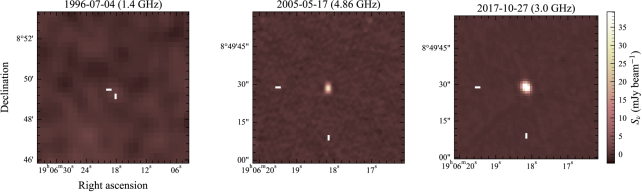
VT J1906+0849 first came to astronomers' attention in data collected in 2017 as part of the Very Large Array Sky Survey (VLASS). There, at least 49,000 light-years from Earth, out beyond the galaxy's spiral arm, was the brightest radio transient the survey had discovered.

At around 70 millijanskies, it was an extraordinarily bright radio transient, especially at such a great distance.

That, naturally, raised questions: What the heck was it, and had it been overlooked in previous survey data?

Thus began the scurry so familiar to astronomers – looking for other observations that covered the same patch of the sky, then seeing what their source looked like in those observations.

There were several radio surveys that had covered the same patch of sky prior to the 2017 VLASS observation.

A Strange Radio Signal in The Far Reaches of The Milky Way Is Flashing Like Nothing Else in The Galaxy

The location of VT J1906+0849 in radio observations from 1996 (left), 2005 (middle), and 2017 (right). The mysterious source is absent in the earliest image, but appears in later observations.

(Miller et al., ApJ, 2026)

In 1996… there was absolutely nothing to be seen at the site in data collected as part of the NRAO VLA Sky Survey.

But by 2005, that had started to change.

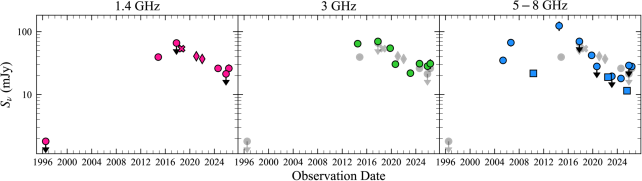
Over the course of several surveys that observed the object between 2006 and 2013, it showed an overall brightening – reaching a peak of around 200 millijanskies in 2014.

The 2017 detection seemed to have caught VT J1906+0849 as it was fading from that peak, but the overall light curve was so weird that the only sensible course of action was to see what it would do next.

The researchers obtained follow-up observations in 2019, 2024, and 2026, with additional observations in 2025 that managed to include VT J1906+0849's corner of the sky. And for a while, it looked as though VT J1906+0849 was winding down. The 2019 and 2024 observations showed it growing progressively fainter.

Then, in late 2025, it went PSYCH.

A Strange Radio Signal in The Far Reaches of The Milky Way Is Flashing Like Nothing Else in The Galaxy

The changing radio brightness of VT J1906+0849 over several decades, measured at different frequencies. The source brightened dramatically, faded, and then began brightening again in late 2025.

(Miller et al., ApJ, 2026)

In data obtained using the Very Large Array, astronomers observed VT J1906+0849 growing brighter once again.

So far, so weird. But that's not even the weirdest thing.

Astronomers can infer a lot about a radio source by studying how brightly it shines at different wavelengths on the radio spectrum.

In the case of VT J1906+0849, the radio emission rises to a peak at a particular frequency before dropping off again. But that peak doesn't behave.

In 2019, it was at around 1.9 gigahertz. By 2024, it had shifted down to around 0.8 gigahertz. But by 2026, it had climbed back up to around 2.2 gigahertz. (The spectral peaks for 2014 and 2025 were not well constrained, but both appeared to occur at substantially higher frequencies.)

It's not unusual for a brightness peak to move, but it usually does so in a specific way for specific radiation. The researchers believe this object's radio-wave emission comes from energetic charged particles moving through magnetic fields via synchrotron radiation.

If the source were simply an expanding cloud of material, as is often the case for synchrotron emission, its changing radio spectrum would be expected to follow a more predictable pattern, with the peak shifting toward lower frequencies as the cloud spread out.

But VT J1906+0849 doesn't seem to be spreading out much.

In spite of the dramatic changes in its brightness and radio spectrum, the researchers found little evidence that the source had expanded over several years of observations.

And the sudden shift back toward higher frequencies suggests something rather more complicated than a cloud of energetic particles simply cooling and dispersing.

Combined with the rebrightening, the clues suggest that, whatever VT J1906+0849 is doing, it's an ongoing process.

There are several possibilities, but three are particularly interesting.

A Strange Radio Signal in The Far Reaches of The Milky Way Is Flashing Like Nothing Else in The Galaxy

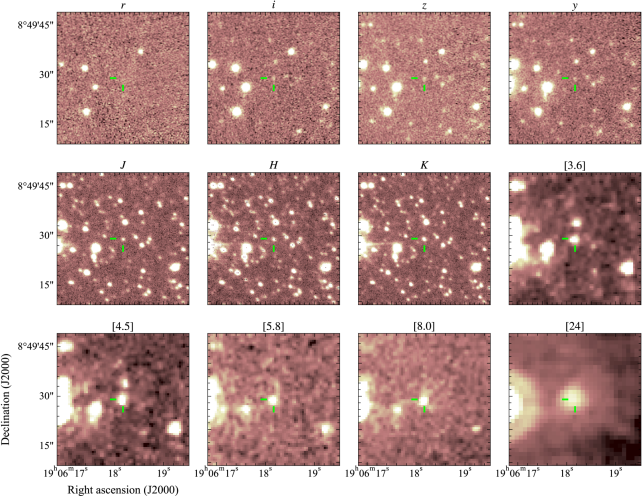
The location of VT J1906+0849 as seen at optical (top row), near-infrared (J, H, and K), and mid-infrared (remaining panels) wavelengths. These observations help astronomers investigate what might be producing the mysterious radio emission. 

(Miller et al., ApJ, 2026)

One thing that can brighten and then fade over time is an explosion such as a nova – but the ejected material should show signatures of expansion, even if the timescale made sense, which it does not.

Another option is a pulsar-powered nebula, but the dancing frequency peak is too chaotic.

That just leaves the third option, and it's a common suspect in many cosmic mysteries: A black hole doing snacking crimes. Or a black hole or neutron star accreting material from a binary companion, if you want to be all straitlaced about it.

If it is a compact object having a nosh, however, it's doing a remarkably good job of concealing the evidence. Observations using NASA's Swift telescope failed to detect a hint of the powerful X-rays expected from such an accreting system.

But a non-detection doesn't necessarily mean a non-emission. And there's another object in the Milky Way that might offer a final, crucial clue.

SS 433 is an object located around 18,000 light-years from Earth, and it's extremely guilty of weirdness. It's thought to consist of either a black hole or a neutron star, orbiting with a companion star every 13 days.

But the really interesting thing about SS 433 is what happens to the material being pulled away from the companion star.

Some of it falls onto the compact object, but much of it is flung back into space as powerful jets and a dense wind from the disk of material swirling around the central object.

That wind can also obscure the X-rays produced by the accretion process, hiding some of the evidence of what is happening at the heart of the system.

The researchers think something similar might be happening with VT J1906+0849.

If a compact object is continuously launching a jet of energetic particles into a dense surrounding wind, the interaction could produce the strange, changing radio emission while preventing the emitting material from expanding freely.

It could also explain the missing X-rays. And there's another clue: infrared observations of VT J1906+0849 revealed evidence of gas moving at around 2,000 kilometers per second, consistent with a powerful outflow.

It's a compelling possibility, but far from a confirmed identification. More observations will be needed to determine whether VT J1906+0849 really is a younger relative of SS 433, or something even stranger.

Still, it's a satisfying answer to a strange sequence of problems, and a message to microquasars everywhere. You might think you got away with it… but astronomers are wising up to your game.

"VT J1906+0849," they write, "highlights the potential for wide-field radio surveys to uncover a population of obscured Galactic accretors that are difficult to identify at other wavelengths."

Mwahahaha.

The research has been published in The Astrophysical Journal.

RELATED

Strange Signals Keep Coming From Deep Space — What's Sending Them?
This Signal From 238 Light-Years Away Has No Explanation Yet!
NASA Detected a STRANGE Signal From Space — And Nobody Knows What It Means

{ https://www.sciencealert.com/ }

Hoe vind je dit bericht?
Geschreven door peter om 22:29 Stuur door

Details of New Jersey’s 2024 Drone Outbreak Still Remain Largely Unexplained

Details of New Jersey’s 2024 Drone Outbreak Still Remain Largely Unexplained

th?id=ONUT.o5h6AaHv4O-_u8FKZV90Bw&pid=News&w=316&h=200&c=14&rs=2&qlt=90&dpr=1.3

Nighttime drone and aircraft sightings across New Jersey in late 2024 prompted thousands of reports and a federal investigation into unidentified objects in the sky.

TRENTON, NJ – Nearly two years after mysterious lights and suspected drones filled New Jersey’s night skies, the federal government has offered an explanation for the sightings that alarmed residents, frustrated local officials and sparked nationwide attention. But despite thousands of reports and months of public debate, investigators never provided a complete, sighting-by-sighting account of what people witnessed.

Federal officials say the 2024 drone mystery involved legal aircraft, authorized drone flights and mistaken sightings, but questions remain about what residents saw in the night sky.

Nobody has ever said who owned and operated those drones, what they were testing, and why it was isolated to New Jersey.

The unusual activity began drawing widespread attention in November 2024, when residents across New Jersey reported seeing illuminated objects moving overhead after dark. Reports spread through Morris, Somerset, Ocean, Monmouth and other counties, with witnesses describing everything from small drones to aircraft that appeared unusually large, often times in waves of multiple aircraft.

Videos circulated across social media, prompting calls for answers from police departments, municipal officials and members of Congress. Some residents questioned whether the objects were conducting surveillance, while others worried about potential threats to aviation and public safety.

By December 2024, the Federal Bureau of Investigation, Department of Homeland Security, Federal Aviation Administration and Department of Defense were examining thousands of reports. Their findings pointed largely toward ordinary aircraft, legally operated drones and objects in the night sky that had been mistaken for something unusual.

Federal Investigators Found No Evidence of a Coordinated Drone Threat

In a joint federal assessment released in December 2024, officials said they had reviewed more than 5,000 reports and found no evidence of a widespread security threat. Investigators identified a combination of commercial aircraft, private planes, helicopters, authorized drones and celestial objects.

Federal agencies said they had “not identified anything anomalous” in the reports examined. They also reported finding no evidence that the sightings represented a foreign surveillance operation or an immediate national security danger.

The findings did not establish that every reported object was imaginary or that no drones were operating over New Jersey. Instead, investigators concluded that the available evidence did not support claims of a coordinated fleet of mysterious aircraft operating across the state.

That distinction became important as residents continued sharing videos and eyewitness accounts. Federal officials could explain many sightings through ordinary aviation activity, but they did not publicly identify the aircraft or objects involved in every individual report.

FAA-Authorized Flights Added Another Twist to the Mystery

In January 2025, the White House offered additional information about the drone activity, stating that some flights had been authorized by the FAA for research and other purposes. The administration also pointed to recreational drone operators and the misidentification of conventional aircraft.

That explanation raised another question for New Jersey residents: If some operations were authorized, why had local officials and the public struggled to obtain clear answers while the sightings were occurring?

The communication problems became part of the controversy. Local officials had repeatedly requested more detailed information during the height of the sightings, while federal agencies maintained that investigators had not uncovered a broader threat.

Online discussions continued well after the initial reports faded. Aviation enthusiasts and social media users examined whether experimental electric aircraft, including electric vertical takeoff and landing vehicles such as the Pivotal BlackFly, could explain some observations.

However, no publicly established federal finding identified the BlackFly or a particular private contractor as the source of the widespread New Jersey sightings. Claims involving experimental aircraft remained separate from the government’s documented conclusions.

Two Years Later, Some Questions Still Have No Public Answer

By October 2026, the central federal explanation remained that the sightings were largely a mixture of routine aviation, authorized drone activity and mistaken identifications. Investigators had not publicly established that a coordinated group of unidentified drones was operating over New Jersey.

What remains missing is a comprehensive public accounting of the individual sightings that fueled the original concern. The government has not released a complete list matching every widely circulated video or eyewitness report to a specific aircraft, drone operator or astronomical object.

For residents who watched unfamiliar lights overhead in late 2024, the official findings provide an explanation for the broader wave of reports, but not necessarily for each personal experience.

The New Jersey drone mystery ultimately produced thousands of reports, a multiagency federal investigation and widespread criticism of government communication. Federal officials found no evidence of an extraordinary or coordinated security threat, but the absence of a complete public record of individual sightings means some questions about specific incidents remain unanswered.

RELATED

3 Years Filming Unexplained Drones Over Somerset County New Jersey | From the 2024 Frenzy to 2026
Thousands Saw Them: The New Jersey Drone Mystery

{  https://www.shorenewsnetwork.com/  }

Hoe vind je dit bericht?
Geschreven door peter om 21:58 Stuur door

UFO Expert Says Government Hides 'Mantis-Type' Aliens and Keeps Dead Bodies in a Military Institute

UFO Expert Says Government Hides 'Mantis-Type' Aliens and Keeps Dead Bodies in a Military Institute

Davis said the alleged records also indicate recovered bodies were transferred to an unidentified military medical institute, while stressing uncertainty about the beings' true nature

Mantis-Type Aliens

UFO expert Dr Eric Davis alleges classified records describe four alien types and bodies held by an unnamed military institute. (Image is for illustrative purposes)

PHOTO AI Generated/ChatGPT

UFO expert and astrophysicist Dr Eric Davis claimed that classified government records describe at least four types of beings and that recovered bodies were transferred to an unnamed military medical institute.

According to News Nation, Davis stated that he had seen evidence and records, which he described as classified and not subject to the Freedom of Information Act. He expressed uncertainty about the nature of the beings, particularly those whose appearance he compared with insects and reptiles.

UFO Expert Describes Four Alleged Types

'There's a minimum of four that we know of. And I've seen the evidence, and I've seen the records.'

The four categories Davis identified were Greys, Nordics, Insectoids, also described as Mantis-type beings, and Reptilians. His reference to a minimum of four left open the possibility of other categories, without identifying any additional types.

Davis compared the Greys with beings depicted in the final scene of Close Encounters of the Third Kind. The film reference illustrated the appearance he was describing rather than establishing evidence for the beings' existence.

'They variously are described as the Greys, like what everybody saw in Close Encounters of the Third Kind at the end of that movie in the final scene.'

He described Nordics as very tall, human-like individuals with Caucasian features. These descriptions formed part of his claims about the records he had reviewed.

UFO Expert Explains Mantis-Type Comparison

Davis described the third category in terms of its resemblance to insects, including praying mantises, while distinguishing appearance from identity.

'There's the beings that resemble or look like insects, like a praying mantis-type insect, but they're not an insect.'

He suggested that people encountering something unfamiliar and shocking might compare it with familiar things to make sense of what they were seeing. In that explanation, an insect-like appearance could lead to an insectoid description without establishing the being's true nature.

The same uncertainty accompanied his description of Reptilians. Davis referred to their apparent body structure but cautioned against treating the label as a definitive identification.

'There's the reptilians for the same case, in that their morphology, body structure looks like a reptilian. And they may not be reptilian.'

His descriptions therefore relied on comparisons with recognisable forms, alongside qualifications about what those comparisons could establish.

UFO Expert Claims Military Institute Received Bodies

When questioned about where the government kept recovered bodies, Davis stated that he did not know. He nevertheless claimed that the bodies had been transferred to a military-linked medical institution rather than a private organisation.

'Given to a military institute, a medical institute, and it's classified. And that institute has been in existence since the Civil War.'

Davis did not identify the institution by name. His claim about its historical origins was accompanied by an assertion that its structure and location had subsequently altered.

He claimed that the institute was divided into two or three separate components during the first Obama administration and relocated to different military medical facilities. Those assertions concern an earlier period, rather than a dated announcement of a current transfer.

According to Davis, the original organisation no longer existed in its previous form, while the location of the alleged recovered bodies remained something he could not identify.

RELATED

Are Mantid Aliens the Intelligence Behind UFO Abductions? [Eerie's Vault Episode #125]
The Mantis Aliens: Insectoid Beings Reported in UFO Encounters

{ https://www.ibtimes.co.uk/science }

Hoe vind je dit bericht?
Geschreven door peter om 21:36 Stuur door

Pilots Entering Thunderstorm Encounter Cylindrical UFO And Fear Collision

Pilots Entering Thunderstorm Encounter Cylindrical UFO And Fear Collision

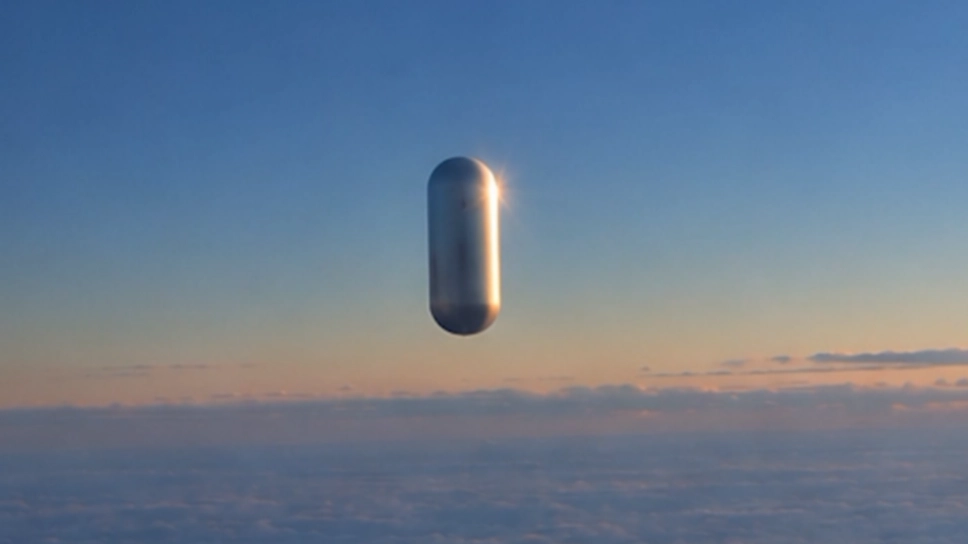
On August 16, 2026, Two pilots flying a private jet charter encountered a cylindrical-shaped UFO as they were about to enter a thunderstorm near Tiffin, Ohio. They described the object as highly reflective and pill-shaped. It was oriented vertically and appeared to have a metallic surface without seams or any flight control appendages. When the object was first sighted, the witnesses say that it appeared to emerge from the wall of storm clouds directly ahead and was on a direct collision course with their jet. Eventually, the object passed on a parallel course on their left and came as close as two miles. Alarmed by the unexpected airspace intrusion at 41,000 ft, the crew made a report to the Air Route Traffic Control Center (ARTCC).

Pilots stunned after spotting mysterious UFO shaped like a pill while flying across America

CGI recreation based on witness descriptions

The incident follows years of hundreds of similar UFO reports, where witnesses often describe the unidentified objects as “pill” or “tic-tac” shaped. In many cases, the objects are seen in vertical orientation, emerging from water, and coming in close proximity to the aircraft. In the August sighting, the air traffic controller referred the pilots to NUFORC, where they made a report. NUFORC investigator Ben Hansen followed up on the report and spoke to the crew’s captain, obtained FAA radar data, and the ATC radio communication. The incident currently remains unexplained.

What We Know

The most prosaic explanations have been explored. The object was not detected by FAA radar, nor by the jet’s onboard TCAS. While NUFORC has been unable to definitively rule out the possibility the object was a balloon, there have been no database matches with planned balloon launches, nor was the FAA notified of launch conflicts as is standard for safety protocols. Coupled with the witness’s estimate that the object was at least 30 feet in height and uniformly shaped without tapering at the top or bottom, it presents some challenges to the balloon theory.

Why This Case Matters

  • Amid hundreds of pilot reports per year that involve concerns of collision with unknown objects, the UAP/UFO subject needs to be taken more seriously by agencies such as the FAA. While NUFORC gladly assists by accepting the FAA’s reports (it’s still listed in the federal regulations as a civilian agency where reports should be made), there is no indication in this case that the FAA escalated the concerning sighting to other agencies for a parallel investigation.
  • While entertaining, in the audio recording the controller jokes to the pilots about making a NUFORC report and he states, “Make sure you include what color the alien was.” Unfortunately, the stigma surrounding UFO reporting is still very strong and the ridicule factor makes many pilots hesitant to say anything.
  • No matter whether the object eventually has a prosaic explanation or not, it was unknown and within controlled airspace. Traveling at a speed of several hundred mph, a jet colliding with a weather balloon can take out a plane’s engine. A high-altitude balloon operated by foreign adversaries (such as those involved in the Chinese spy balloon incidents in 2023) also places the U.S. at national security risk when such UAP sightings aren’t escalated for government investigation.
  • The latest Department of War UFO file releases have consisted almost entirely of military encounters. This current case is one example of hundreds of civilian pilot reports. It highlights the fact that UAP activity may be more frequently observed by civilian aviators, but they rarely have the sophisticated camera systems and sensors to adequately record it.

Case File and Media

Full Report:

2-minute video (includes radar playback, radio communications, and recreation photos of the event): https://vimeo.com/1238537411/3742d38ba7

The audio recordings and radar data were obtained through a Freedom of Information Act request. The photographs taken by the crew were released for use by their consent to have them placed on NUFORC’s website.

Ben Hansen, 10/24/26

{ https://nuforc.org/posts/ }

Hoe vind je dit bericht?
Geschreven door peter om 20:46 Stuur door

Matthew Brown Raises a Mind-Controlled UFO Theory—and a Human Breeding Claim

Matthew Brown Raises a Mind-Controlled UFO Theory—and a Human Breeding Claim

Matthew Brown connects alleged UFO programmes with consciousness and inherited abilities. His interview mixes reported accounts with his own speculation.

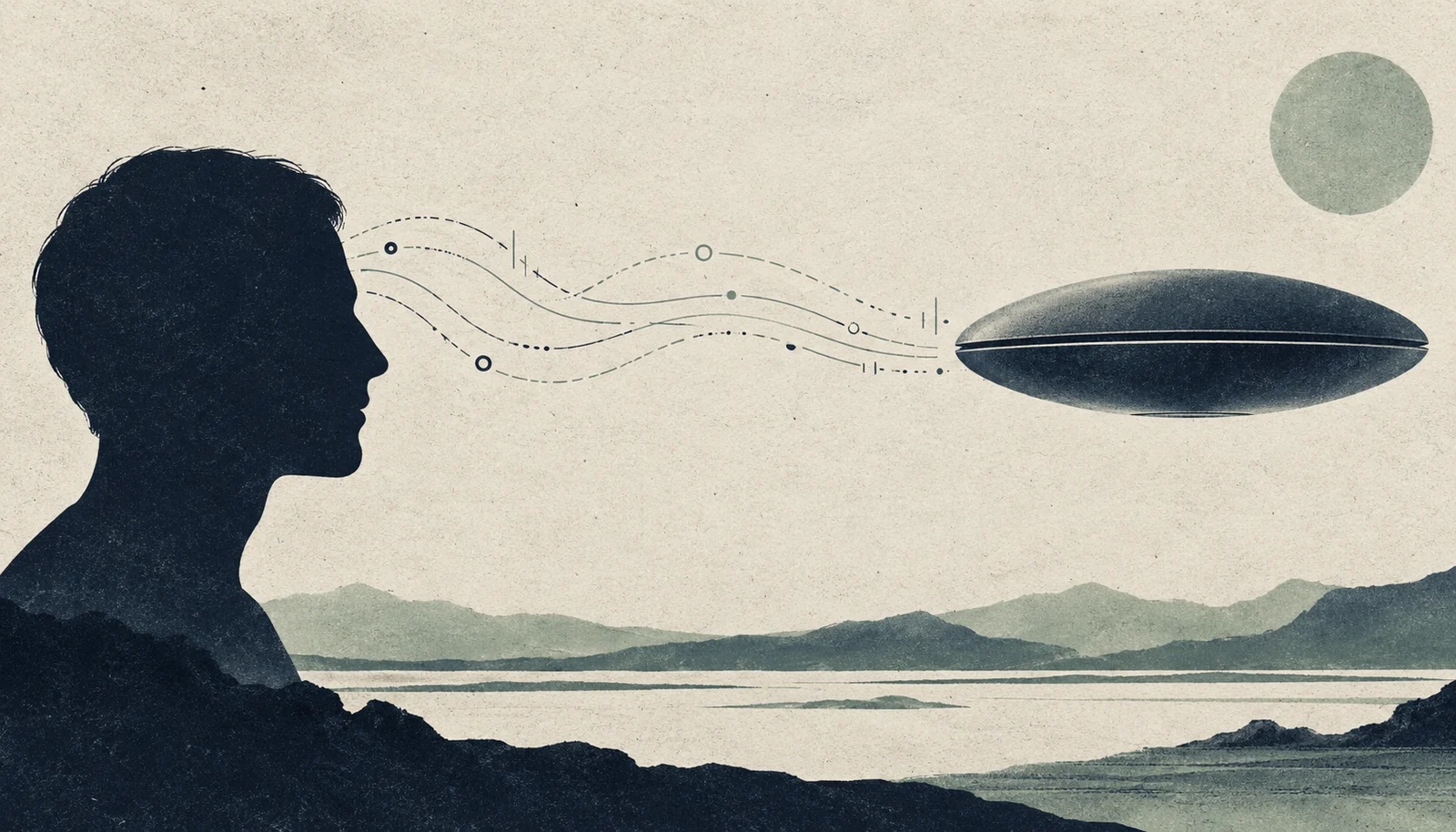
Conceptual illustration of a human profile connected by abstract lines to an oval craft.

Conceptual illustration of a hypothetical mental interface; not a depiction of demonstrated technology.

 Illustration: Curiosmos.

In this report

  1. Where Brown’s account changes into a theory
  2. The government really did investigate psychic abilities
  3. What a mental interface would have to do

Could operating an unfamiliar craft depend on the person sitting inside it? Matthew Brown has raised that possibility in an interview that connects alleged UFO programmes, consciousness and the idea of selecting people for an inherited ability.

The suggestion is extraordinary. Brown discusses the possibility that a covert effort could cultivate people capable of interacting mentally with unusual technology. In the relevant passages, however, he presents suspicion and speculation—not a breeding programme he says he personally witnessed.

Where Brown’s account changes into a theory

Brown’s August 2026 interview with Jesse Michels ranges across alleged secret programmes and stories Brown says circulate within that world. The automated transcript makes an important distinction visible: some passages describe accounts he says he encountered; others explore what he thinks might explain them.

Near the discussion of inherited abilities, Brown wonders whether selection over several generations could be involved. Turning that into a flat statement that the Pentagon breeds UFO pilots would erase the uncertainty in his own account.

His discussion of historical agreements also relies on what he describes as an oral tradition. A story passed between people, an agreement someone has read and an operation someone has observed are three different starting points. Reporting them as a single body of established knowledge would conceal how each claim reached him.

The government really did investigate psychic abilities

There is a documented historical connection between US intelligence and research into unusual mental abilities. According to the CIA’s own account, its remote-viewing research began in 1972. Responsibility moved to the Defense Intelligence Agency in 1977; the programme later returned to the CIA for review in 1995.

Remote viewing concerned attempts to obtain information about distant targets. It was not a demonstrated method of piloting a craft. The CIA says its review found the information too vague and inconsistent to provide the specific intelligence needed, and the programme ended.

That history gives Brown’s discussion a real point of comparison. It shows that agencies explored unusual claims about perception. It does not supply a missing link between those experiments and the selection of people to operate recovered technology.

What a mental interface would have to do

A craft controlled through an operator’s thoughts could mean several very different things. Defining the mechanism is part of turning a UAP account into a testable question. It might use sensors to translate measurable biological signals into commands. Brown’s discussion goes much further, invoking abilities whose proposed connection to the technology has not been demonstrated publicly.

The practical question would be whether an operator could produce a repeatable response under conditions that exclude ordinary controls and information cues. An observer would need to know what command was intended, what the machine did and whether the result occurred reliably with different operators.

A claim about inherited ability adds another layer. Success by one person would not establish inheritance. Researchers would have to define the ability, measure it consistently and examine how it occurs across families while accounting for training and shared circumstances.

Brown’s speculation is interesting because it shifts the imagined problem from rebuilding hardware to understanding an operator. Perhaps the difficult part of an unfamiliar machine would be its interface. But the interview does not provide a working demonstration or records of a breeding operation. Keeping that boundary visible lets readers explore the idea without mistaking a proposed explanation for an observed programme.

RELATED

Matthew Brown Drops UFO Bombshell
Pentagon Whistleblower UNLOADS on Alien Hybrid Breeding Programs (ft. Matthew Brown)

{ https://curiosmos.com/category/uap/   }

Hoe vind je dit bericht?
Geschreven door peter om 16:34 Stuur door

Steven Greer Put His UFO Disclosure Demand in Writing. Here Is What the Letter Says

Steven Greer Put His UFO Disclosure Demand in Writing. Here Is What the Letter Says

Greer’s June 2026 letter set an August deadline and described a proposed evidence effort. The document distinguishes promises from material actually supplied.

Illustration of an envelope and blank papers beside a calendar on a desk.

Editorial illustration accompanying the report on Greer’s letter; the papers shown are not the document.

Illustration: Curiosmos.

In this report

  1. A promise to seek material
  2. Different releases would answer different questions
  3. The deadline and the follow-up

Steven Greer put a deadline on his demand for UFO disclosure: August 29, 2026. In a letter dated June 29, he outlined a proposed effort to obtain and release material concerning alleged craft, bodies and secret operations if the government did not respond.

The deadline has now passed. It joins a longer history of disclosure promises and public records. The document remains worth reading because its wording is more specific—and in places more conditional—than the headlines announcing it.

A promise to seek material

The four-page letter, posted on Greer’s website, describes what he calls Unacknowledged National Operational Disclosure, or UNOD. It alleges hidden activities involving unusual craft and biological material.

The letter says that, unless the government contradicts its position by the deadline, the effort will solicit further hard evidence and release material. The promise to solicit evidence matters. It is not the same as attaching a complete, independently examined collection to the letter.

Greer also presents his position on protection from national-security prosecution. That is his assertion in the document, not an official finding that the proposed activity has government approval. The recipient’s silence would not, by itself, authenticate the alleged objects or endorse the account.

Different releases would answer different questions

An account from someone who says they worked on a craft would add testimony. A document with a verifiable origin could establish what an organisation recorded. A physical sample, examined independently and accompanied by a traceable history, could support a different kind of inquiry.

Those materials should not be counted as equivalent simply because they are described as evidence. A witness could be accurately describing a document whose contents are mistaken. A genuine document could record an unverified report. A real specimen could still have an ordinary origin.

For the biological claims, a useful release would explain where the material came from, who handled it and what tests were performed. For a craft claim, the operating data, examination methods and access given to independent investigators would matter as much as photographs.

Greer’s letter also distinguishes material proposed for release from technical information it says would be withheld. That would limit what outside researchers could reproduce from a public package. Readers would need a clear inventory of what was made available and what remained inaccessible.

The deadline and the follow-up

Greer’s website lists a September 29 podcast episode about the letter, the deadline and claims of suppression. The episode listing establishes that he returned to the subject after August 29. Its brief description does not itself provide the promised bodies, craft or an independent examination of them.

A disclosure effort could become far more useful through a simple public record: each item promised, the date it was released, a direct route to the original material and the examination it has received. That would allow people following the story to distinguish a new allegation from a new document or a new physical finding.

Greer’s letter makes the proposal concrete enough to follow in that way. The next question is which of its promised materials can be examined beyond the people already making the claims.

RELATED

Everyone Says They Ignored Him…Under His Own Rules That Was a Yes: Steven Greer's UFO Ultimatum
Dr. Steven Greer on UFO Evidence, Trump, Living E.T. & Underground Government (Full Interview)
Dr. Steven Greer outlines the Disclosure Project’s push for full transparency on UFOs, alleging that the most compelling evidence—craft, bodies, and advanced technologies—is held by private defense contractors beyond normal government oversight. He describes whistleblower testimony, claims of illegal black projects, recovered extraterrestrial artifacts like the 12,560-year-old “buggosphere,” and covert human-made UFO operations used in psychological warfare. Greer warns against fear-based narratives, urges protection for witnesses, and advocates releasing select energy and propulsion technologies to transform society while avoiding misuse.

{ https://curiosmos.com/category/uap/   }

Hoe vind je dit bericht?
Geschreven door peter om 16:22 Stuur door

Eric Weinstein Says Officials Sought His Help With UFO Disclosure

Eric Weinstein Says Officials Sought His Help With UFO Disclosure

Weinstein describes alleged approaches about preparing the public for UFO disclosure. A 2022 request log shows the subject has a longer public history.

Hoe vind je dit bericht?
Geschreven door peter om 15:49 Stuur door

Glowing UFO Lights Up Sky Over Utah, Object Coming Out of It! Nov 4, 2026, UAP Sighting News.

Glowing UFO Lights Up Sky Over Utah, Object Coming Out of It! Nov 4, 2026, UAP Sighting News.

UFO_2.png
UFO_Utah_1.png
Date of sighting: Nov 5, 2026
Location of sighting: Beryl, Utah, USA
Source:
 
Guys I lived in Utah for a few years and can honestly say that UFOs are all over the place in that state. I would estimate there are 3-4X the sightings compared to other US states. This sighting here shows a glowing light during sunrise, but it wasn't the moon, she caught the moon in a different position. This is a UFO in early morning trying to sneak out before people wake up. Awesome catch and defiantly aliens. Whats it doing? Thats obvious...one photo clearly shows a huge object on 3-4 thick leges that looks like its being delivered to an underground base, probably about 5-6 miles below the city of Beryle. Even aliens need supplies. 
Scott C. Waring - UFO Sightings Daily 
 
Eyewitness states: 
Does anyone know what was in the sky this morning around 5am looks like over Newcastle or cedar?
 
UFO_UAP_1.png


Screenshot%202026-11-08%20at%2011.33.32%E2%80%AFAM.png

Screenshot%202026-11-08%20at%2011.33.08%E2%80%AFAM.png

{ https://www.ufosightingsdaily.com/ }

Hoe vind je dit bericht?
Geschreven door peter om 15:04 Stuur door

Tomorrow In UFO History: Nov 9, 1979....Dechmont Woods Alien Assault: Forest Worker Dragged by Robotic Entities To UFO! UAP Sighting News.

Tomorrow In UFO History: Nov 9, 1979....Dechmont Woods Alien Assault: Forest Worker Dragged by Robotic Entities To UFO! UAP Sighting News.

UFO%20Sightings%20Daily.jpg
This photo above is a ai rendering of the similar drawing made by a sketch artist for the eyewitness. 
ScotlandLanding1979b.jpg
Original drawing approved by eyewitness. 
Date of event: November 9, 1979
Location of event: Livingston, Scotland, UK
This is 100% proof that aliens are actively exploring remote areas of Earth and are not afraid to use physical force on humans.
A respected forester named Robert Taylor was out checking trees when he walked right into a 20-foot dark grey, metallic craft hovering silently in a clearing. It was trying to use a camouflage mechanism to blend into the forest, changing its transparency right before his eyes!
Suddenly, two smaller, robotic-looking sphere entities rolled out from under the main ship. They made a distinct plopping sound and rushed straight for him. These entities actually attached themselves to Taylor's trousers and began dragging him toward the main craft. He described a suffocating, acrid smell like burning brake linings just before he blacked out.
When he woke up, the crafts were gone, but the physical evidence left behind was undeniable. Local police investigated the area and found distinct ladder-like tracks and 40 angled holes punched into the dirt. Forensic teams even analyzed the tears in Taylor's trousers where the entities grabbed him.
Folks, this wasn't a hallucination. The police treated it as a criminal assault by entities unknown. This is a classic, undeniable close encounter showing alien technology at work right on our own soil.
Scott C. Waring - UFO Sightings Daily

RELATED

November 9, 1979 - The Livingston Incident
The Dechmont Law Incident: Scotland's Only UFO Crime Scene | British UFO Encounters #aliens
The UFO Encounter in a Scottish Forest That Still Baffles People | Dechmont Woods

{ https://www.ufosightingsdaily.com/ }

Hoe vind je dit bericht?
Geschreven door peter om 14:52 Stuur door

Theory predicting an older universe without dark matter or dark energy passes key cosmological tests

Theory predicting an older universe without dark matter or dark energy passes key cosmological tests

Theory predicting an older universe without dark matter or dark energy passes key cosmological tests

Andromeda Galaxy captured in the vast deep space.

Credit: Jason Pittman - pexels.com

An alternative model in which the universe is 26.7 billion years old and needs neither dark matter nor dark energy has held up against several major cosmology tests, according to a new University of Ottawa study. The research, titled "A Big Bang Nucleosynthesis Consistency Test of the CCC+TL Cosmology," is published in the journal Universe.

One model, many observations

During 2025 and 2026, Rajendra Gupta, adjunct professor in uOttawa's Department of Physics, and postdoctoral researcher Dr. Nikolaos Samaras tested the CCC+TL model against a range of important astronomical observations.

CCC+TL stands for "covarying coupling constants plus tired light." The model suggests that what is usually attributed to dark matter and dark energy could instead come from evolving fundamental constants that govern how forces and particles interact.

Scientists have searched for dark matter and dark energy for decades, but neither has been directly detected. The standard cosmological model, known as ΛCDM, also faces questions raised by observations of surprisingly mature galaxies in the early universe.

"Most emerging models explain only a limited set of observations," Gupta says. "A new model must not conflict with the pillars of cosmology and astrophysics, and our findings meet that challenge, including the yet-to-be-published cosmic microwave background challenge."

CCC+TL changes the Einstein and Friedmann equations, which describe gravity and the expansion of the universe. That meant the researchers couldn't just modify the standard model and existing computer codes. For each test, they developed CCC+TL-compliant equations and code.

Theory predicting an older universe without dark matter or dark energy passes key cosmological tests, warranting further investigation

Abundance of light elements' nucleosynthesis with time using the 𝛬 CDM clock.

Credit: Universe (2026)

What the tests found

The model's results agreed with several major observations. Its predictions for the amounts of hydrogen, helium and other light elements formed shortly after the Big Bang matched those of the standard model. It also agreed with cosmic-chronometer measurements, which use the ages of galaxies to estimate how fast the universe has expanded over time.

In a recent paper published in Monthly Notices of the Royal Astronomical Society, the researchers also applied the model to all 175 galaxies in the SPARC database and found it could reproduce their rotation curves without dark matter. A separate study of time dilation in supernova observations also supports the model, although that paper is still under review.

The team looked at the Bullet Cluster too. There, the extra gravitational effect the model predicts, rather than the dark matter, tracks the galaxies, not the hot, X-ray-emitting gas. The researchers call this an early proof of concept that needs more study.

"Observations attributed to dark matter and dark energy likely originate from covarying coupling constants," adds Gupta, whose paper on the origin of dark matter and dark energy explores the idea.

Theory predicting an older universe without dark matter or dark energy passes key cosmological tests, warranting further investigation

Schramm plot of BBN elemental abundances.

Credit: Universe (2026). DOI: 10.3390/universe12070193

More time for early galaxies to form

The model could also help explain why astronomers keep finding large, mature galaxies so early in cosmic history.

In the standard model, the universe was about 300 million years old during cosmic dawn. Under CCC+TL, it would have been about 4.6 billion years old at the same observed redshift. That extra time gives galaxies longer to grow and develop. In the researchers' calculations, early galaxies come out about 12 times larger in size and mass than the standard model predicts, as reported in Galaxies.

"Impossible early galaxies become predictable galaxies," Gupta explains. "We predict that galaxies exist well beyond the distances the James Webb Space Telescope has reached."

That prediction may soon be tested. The James Webb Space Telescope's GLIMPSE program plans to search for galaxies at redshifts that may exceed 50. In the standard model, there may not be enough time for massive galaxies to form that early. CCC+TL has no such limit.

"The success should encourage astronomers to take the new model seriously. It is challenging to understand and apply, but we believe it extends the physics of the universe beyond ΛCDM limits," concludes Gupta.

Publication details

{ https://phys.org/space-news/ }

Hoe vind je dit bericht?
Geschreven door peter om 14:29 Stuur door

Now that Democrats control the House, they plan to deliver UFO disclosure

Now that Democrats control the House, they plan to deliver UFO disclosure

Locked in a big game of disclosure chess.

Blue and red chess pieces locked in UAP disclosure checkmate.

Blue and red chess pieces locked in UAP disclosure checkmate.

Image by Cybernews.

Marcus Walsh - Journalist

Key takeaways

Unfortunately, the current administration has not been fully transparent on UAP and has slow-walked several of the statutory requirements Congress established for UAP disclosure,
said Andre Carson (Indiana Democrat.)

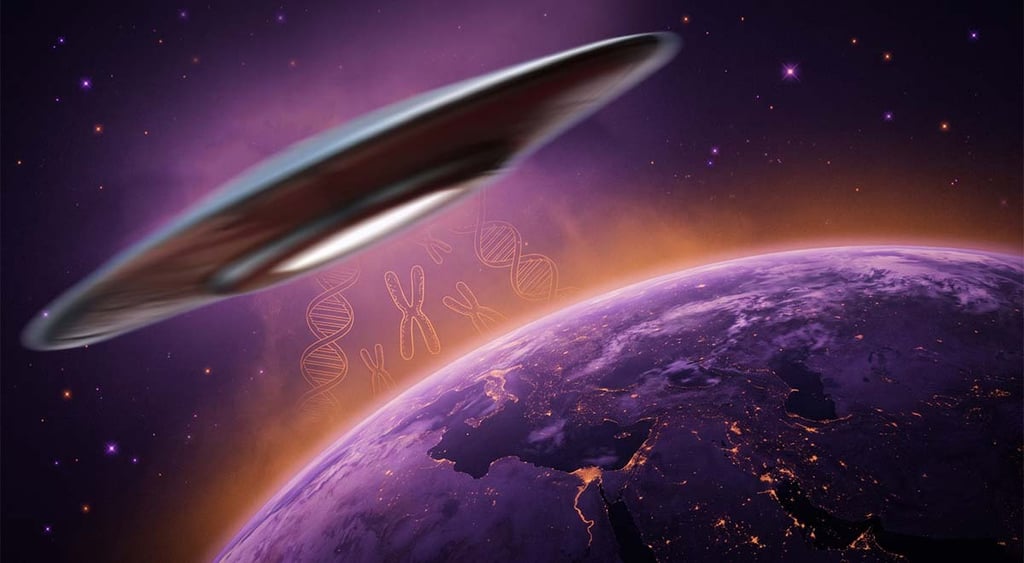
A UFO flying through the c̶o̶s̶m̶o̶s̶ chromosomos.

A UFO flying through the cosmos.

Image by Cybernews.

“I don’t trust another president”

Speaking with Rogan in particular, Grusch’s claims have become more extreme. Grusch told Rogan he was waiting for a "Ghostbusters situation” before Trump leaves office.

Both parties as bad as each other

Let me guess, if they get in power they will blame the opposition for halting progress, and if the opposition gets in power they will blame them.
reddit bipartisan
What a Democratic Congress Means for UFO Disclosure

{ https://cybernews.com/ }

Hoe vind je dit bericht?
Geschreven door peter om 01:28 Stuur door

UFO Expert Actually Thinks Donald Trump Will Reveal Live Aliens and 4K Spacecraft After Midterm Loss

UFO Expert Actually Thinks Donald Trump Will Reveal Live Aliens and 4K Spacecraft After Midterm Loss

After a bruising electoral defeat, one UFO researcher's extraordinary prediction collides with the government's continuing lack of verified alien evidence

Donald Trump

President Donald Trump faces speculation about a possible UFO disclosure following Republican midterm defeats

PHOTO The White House, Public domain, via Wikimedia Commons

Filmmaker and UFO researcher Jon Stewart has floated the idea that Donald Trump could respond to Republican midterm election losses by dramatically unveiling 'catastrophic disclosure' of alleged extraterrestrial evidence, including a living alien or crystal-clear 4K images of a recovered spacecraft.

Speaking to FOX 32 Chicago in an interview published on Friday, 6 November, Stewart speculated that the former president might turn to a headline-grabbing revelation after Republicans lost control of Congress in the US midterms. No such White House plan has been confirmed.

The comments followed the 3 November elections, when Democrats won control of both the House of Representatives and the Senate, according to the Associated Press. Stewart linked the setback to his theory that Trump might seek a dramatic announcement to regain public attention.

Stewart described his imagined scenario as 'catastrophic disclosure', meaning a sudden public revelation of supposed evidence of extraterrestrial life. His prediction was speculation, not a claim to have seen such evidence.

Why Stewart Sees an Alien Reveal as a Political 'Hail Mary'

During the interview, Stewart described the possibility of an alien disclosure as a political 'Hail Mary'. He suggested a sensational announcement could rally Americans around Trump after the Republican defeat.

He compared his imagined spectacle to the public entertainment of ancient Rome, even floating a four-day extravaganza. The comparison described the scale of the announcement he envisioned, not an event being organised by the administration.

Stewart also spoke about disappointment among people seeking greater government transparency on unidentified anomalous phenomena, or UAP. He argued that unclear videos and fleeting sightings had fallen short of the conclusive evidence some enthusiasts hoped to see.

Washington has released UAP material. The Pentagon's All-domain Anomaly Resolution Office, known as AARO, publishes video footage and investigative records, including unresolved cases from 2026. Its public descriptions caution against treating unidentified objects as evidence of extraterrestrial activity.

An unexplained recording, after all, is not necessarily proof of alien technology. That distinction is central to assessing Stewart's prediction.

What Officials Say About Alleged Alien Craft

Stewart's scenario went beyond another set of ambiguous images. He speculated about displaying a living extraterrestrial, alien remains allegedly held by the government or clear 4K images of a purportedly recovered spacecraft. The term '4K' refers to image resolution, not a type of craft.

He named military facilities while discussing where such material might be stored. They included Dugway Proving Ground in Utah and Michael Army Airfield, which is located within Dugway. He also mentioned a Tonopah location in Nevada, home to the Tonopah Test Range.

The installations exist, but that does not establish the presence of extraterrestrial remains or spacecraft. The US Army describes Dugway as a defence testing facility, while the Department of Energy documents national security work at Tonopah.

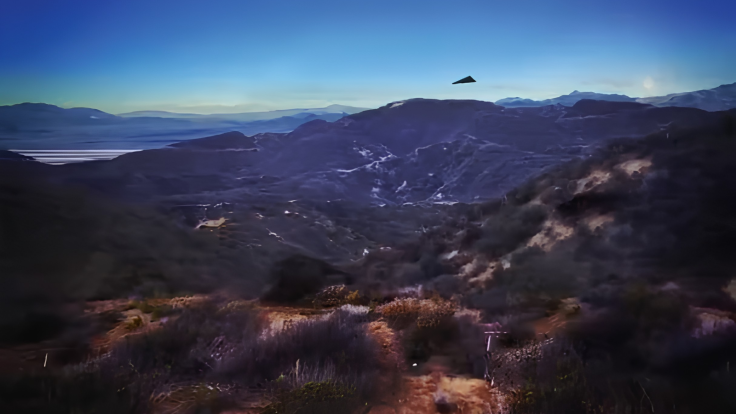
Black Triangle Reported Above a Mountain Ridge

NASA says it has found no credible evidence of extraterrestrial life, despite speculation surrounding President Donald Trump's potential UFO disclosure. 

PHOTO X/@WhiteHouse

AARO's historical review found no verifiable evidence that the US government or private companies had recovered or reverse-engineered extraterrestrial technology. Its findings distinguish unresolved sightings from proof of alien origins.

NASA likewise says it has found no credible evidence of extraterrestrial life and no evidence that UAP originate beyond Earth. The agency has welcomed Trump's direction towards wider government transparency on the subject, but has reported no evidence supporting the extraordinary scenario Stewart described.

{ https://www.ibtimes.co.uk/trending }

Hoe vind je dit bericht?
Geschreven door peter om 00:33 Stuur door

Loch Ness Monster: The Legend, the Science and the Lake Itself

Loch Ness Monster: The Legend, the Science and the Lake Itself

Loch Ness Monster: The Legend, the Science and the Lake Itself

Loch Ness is a long, narrow freshwater loch in the Scottish Highlands that holds more water than all the lakes of England and Wales combined, and it is famous worldwide as the home of the Loch Ness Monster, better known as Nessie. It runs in a straight line for more than 37 kilometers (23 miles) along the Great Glen fault between Inverness and Fort Augustus, reaches depths of around 230 meters (755 feet), and its dark, peat-stained water hides the largest volume of fresh water in the British Isles. The romantic ruins of Urquhart Castle stand on its western shore, and the loch is tied to one of the most famous mysteries of modern times. This guide covers where Loch Ness lies, how it formed, why its water is so dark, what really lies behind the legend of the Loch Ness Monster, and how to visit this mysterious lake.

💡 At a glance

Loch Ness is the largest lake in the United Kingdom by volume and the most famous body of water in the Scottish Highlands. It fills part of the long tectonic valley of the Great Glen, carved along a powerful geological fault, and together with other lochs it is linked into the Caledonian Canal. It is roughly 37 km long and up to 230 meters deep, and dissolved peat makes its water so dark that underwater visibility is close to zero. It is precisely in these murky depths that popular imagination placed Nessie, a monster whose first mention goes back to the Irish monk Saint Columba in the 6th century. It became a worldwide sensation with the famous "surgeon's photograph" of 1934, later exposed as a hoax. Modern sonar and DNA searches have found no prehistoric reptile; the most likely explanation remains a giant eel or an optical illusion. On the shore, the ruins of Urquhart Castle and the cruise boats from the village of Drumnadrochit draw visitors.

📍 Quick facts: Loch Ness
Scottish Gaelic name Loch Nis
Country Scotland (United Kingdom)
Region Scottish Highlands, Great Glen
Length approx. 37 km (36.3 km / 22.6 mi)
Width approx. 1.5 km (max. 2.7 km)
Surface area approx. 56 km² (22 sq mi)
Maximum depth approx. 230 m / 755 ft (2nd deepest loch in Scotland)
Water volume approx. 7.4 km³, the largest volume of fresh water in the British Isles
Surface elevation approx. 16 m above sea level
Outflow River Ness → North Sea (Moray Firth)
Part of Caledonian Canal, Great Glen
Nearest towns Inverness (north), Fort Augustus (south)
Famous landmark ruins of Urquhart Castle
Legend the Loch Ness Monster (Nessie)

Contents

Where is Loch Ness and how did it form?

Loch Ness lies in the far north of Scotland, in the Scottish Highlands, about 10 kilometers (6 miles) southwest of Inverness, and fills the middle section of a dramatic valley called the Great Glen (Glen Mòr in Gaelic, "the Great Valley"). This almost perfectly straight valley cuts across the entire Highlands from northeast to southwest, from the North Sea at Inverness to the Atlantic at Fort William, and Loch Ness is its longest and deepest loch.

The Great Glen is no accident. It follows one of the most prominent geological faults in Europe, the Great Glen Fault, along which entire blocks of the Earth's crust shifted by tens of kilometers hundreds of millions of years ago. The fault created a line of weakness that massive glaciers later gouged during the Ice Age into a deep trough with steep sides. When the ice melted roughly 10,000 years ago, the trough filled with water, creating a chain of long, narrow and unusually deep lochs, with Loch Ness standing out among them.

Today the loch is part of the Caledonian Canal, a brilliant feat of engineering designed by the famous engineer Thomas Telford and built between 1803 and 1822. The canal linked the natural lochs of the Great Glen (Loch Ness, Loch Oich and Loch Lochy) with a system of man-made channels and 29 locks into a single navigable route across Scotland, so ships no longer had to sail around the dangerous northern coast. Like the Scottish massif of Ben Nevis or the dramatic valley of Glen Coe, Loch Ness is one of the iconic faces of Great Britain and the wild nature of the Highlands.

Panorama of Loch Ness in the Scottish Highlands, its dark water hemmed in by the wooded slopes of the Great Glen

The calm surface of Loch Ness framed by the wooded slopes of the Highlands, a view that has fed legends about what lurks in its depths for centuries.
(Video: Pexels, CC0)

The Great Glen and the Caledonian Canal: a route across Scotland

The Great Glen is a strikingly straight valley more than a hundred kilometers (over 60 miles) long that splits the Scottish Highlands in two, with a chain of lochs along its floor, Loch Ness among them. Its geometric straightness reveals that this is not an ordinary river valley but the surface expression of a huge geological fault, the Great Glen Fault.

The fault formed roughly 400 million years ago during the so-called Caledonian orogeny, when ancient continents collided and the bedrock of today's Scotland took shape. Along the fault line, whole blocks of the Earth's crust slid horizontally by tens of kilometers; geologists estimate the displacement at up to around a hundred kilometers. The fault is not entirely dead: weak earthquakes occur in the area from time to time, though never destructive ones. The crushed rock along the line formed a weak zone that Ice Age glaciers easily deepened.

Three long lochs lie on the floor of the Great Glen: Loch Ness, the smaller Loch Oich at the watershed, and Loch Lochy in the southwest. In the early 19th century, engineers had the idea of linking them into one navigable route. The result was one of the most ambitious projects of its time, the Caledonian Canal: the work of engineer Thomas Telford, built from 1803 to 1822. The full route is about 97 kilometers (60 miles) long, roughly a third of which consists of man-made channels connecting the natural lochs, and it climbs through 29 locks. Its most famous section is a flight of eight consecutive locks called Neptune's Staircase near Fort William.

The original aim was to let fishing boats and warships cross Scotland and avoid the dangerous passage around the stormy northern coast. Commercially, the canal came too late: ships had grown in the meantime and it was already too small for large steamers. Today, however, it is a popular tourist and leisure waterway, and sailing it is one of the most beautiful ways to experience Loch Ness.

View along the long Great Glen with the waters of Loch Ness stretching toward the Highland mountains

How big and how deep is Loch Ness?

Loch Ness is about 37 kilometers (23 miles) long, only 1.5 kilometers (about 1 mile) wide on average, and reaches a maximum depth of around 230 meters (755 feet), making it one of the deepest lochs in Scotland. With a surface area of 56 km² (22 sq mi) it is far from the largest, but what makes it exceptional is its volume: the narrow, enormously deep trough holds roughly 7.4 cubic kilometers of water.

That makes Loch Ness the lake with the largest volume of fresh water in the entire British Isles: it contains more water than all the lakes and reservoirs of England and Wales combined. Its huge depth and volume are one reason the legend of a hidden creature feels so convincing: in such a mass of opaque water, almost anything could theoretically hide.

The largest British lake by surface area is actually Scotland's Loch Lomond, while Loch Ness holds the record for freshwater volume. To see where Loch Ness ranks among the world's famous lakes, here is a quick comparison:

Lake Max. depth Known for
Loch Ness approx. 230 m Largest volume of fresh water in Britain
Lake Baikal 1,642 m Deepest lake in the world
Caspian Sea 1,025 m Largest lake in the world by area
Lake Titicaca 281 m Highest navigable lake

Compared with giant Lake Baikal or the vast Caspian Sea, Loch Ness is fairly modest, but its depth is exceptional by British standards: only one lake in the British Isles is deeper, nearby Loch Morar. To learn more about how lakes form and why they matter for the landscape, read our overview article on lakes in general.

Why is the water of Loch Ness so dark, and why doesn't it freeze?

The water of Loch Ness is so dark because of its high content of dissolved peat, washed into the loch by streams from the surrounding moors and peat bogs of the Highlands. Tiny peat particles stain the water brown like weak tea and scatter light so strongly that just a few meters down it is completely dark and visibility drops almost to zero.

This opacity is the key to understanding the whole mystery. Divers and underwater cameras have only a tiny range in the brownish-black water, sonar bounces off stirred-up sediment, and any shadow or movement just below the surface easily turns into a "mysterious object." Without visibility, the loch becomes a perfect stage for the imagination. The loch has even inspired children's literature: in the series Alea Aquarius, the underwater city of Rach Turana lies on its bed.

The second remarkable thing is that Loch Ness practically never freezes. Its enormous volume of water acts as a giant heat reservoir: the deep layers soak up heat over the summer and slowly release it over the winter, so the loch stays at around 5 to 6 °C (41 to 43 °F) all year. As a result, mist and mirages often form over the cold surface in frosty air: temperature inversions that can "lift" a distant shore or a wave and create the impression that something large is moving across the water. Meteorologists use exactly these optical effects to explain a good share of the historical monster sightings.

Close-up of the dark, peat-stained surface of Loch Ness reflecting the wooded shore

Nessie: the legend of the Loch Ness Monster

The Loch Ness Monster is a legendary water creature said to live in the depths of Loch Ness, usually pictured with a small head on a long neck and a bulky body resembling a prehistoric reptile. It is affectionately nicknamed Nessie and is one of the most famous figures in world cryptozoology, the field that searches for animals whose existence has not been scientifically confirmed.

The roots of the legend go surprisingly far back. The oldest mention is usually linked to the Irish monk Saint Columba, who came in the 6th century to convert Ireland and Scotland to Christianity. According to the biography written by Abbot Adomnán around the year 700, in 565 he encountered a "water beast" by the River Ness that attacked a swimmer; Columba is said to have driven the animal away with the sign of the cross and a command. Whatever lay behind it, the story shows that the idea of a dangerous creature in these waters is many centuries old and deeply rooted in Celtic culture.

The modern era of Nessie, however, began only in the 20th century. In 1933 a new road, the A82, was completed along the northern shore of the loch, opening the previously remote shoreline to heavy traffic and views of the water for the first time. That same year, the local newspaper carried a report from the Mackay couple, who had seen "an enormous animal rolling in the water" by the loch. The story spread quickly, journalists seized on the sensation, and within a few months dozens more witnesses reported the monster. A phenomenon was born that still draws millions of visitors to the Highlands and ranks alongside other world mysteries such as the Himalayan Yeti.

Misty, mysterious atmosphere over the surface of Loch Ness at dusk

Famous photos and scientific searches for Nessie

The most famous "proof" of the Loch Ness Monster became the so-called "surgeon's photograph" of 1934, showing a small head rising from the water on a long, gracefully curved neck. The picture was published by the Daily Mail and attributed to a respectable London doctor, Robert Kenneth Wilson, whose profession was meant to lend it credibility. The photo went around the world and for decades became the iconic face of the entire legend.

Only in 1994 did the truth come out: it was a carefully planned hoax. The monster's neck and head were in fact a putty model mounted on a toy, a wind-up submarine, and the whole stunt had been masterminded by Marmaduke Wetherell as revenge on the newspaper that had earlier ridiculed him. The confession of one of those involved, Christian Spurling, shortly before his death revealed how easily a single fake photo can keep a mystery alive for generations.

Serious science gradually turned its attention to the loch as well. In 1960, aeronautical engineer Tim Dinsdale filmed a moving object that is still debated today. In 1987 a large-scale sonar sweep, Operation Deepscan, sent dozens of boats with echo sounders across the loch in a single line; it picked up several unexplained contacts but no evidence of a large animal. The high point came in 2018, when a team led by New Zealand geneticist Neil Gemmell took water samples from across the loch and analyzed them for environmental DNA, the genetic traces every organism leaves behind. The results, published in 2019, were clear: no reptile DNA, no prehistoric plesiosaur, no large unknown animal. What they did find was a huge amount of eel DNA. A detailed overview of the history and research can be found in the Loch Ness entry on Wikipedia.

Year Event Outcome
565 Mention of a "water beast" in the life of St. Columba Oldest legend
1933 New A82 road, the Mackays' report Birth of the modern phenomenon
1934 The "surgeon's photograph" Exposed as a hoax in 1994
1987 Operation Deepscan (sonar) Unexplained contacts, no proof
2019 DNA analysis (N. Gemmell) No reptile, huge amounts of eel DNA

What is the Loch Ness Monster really?

The Loch Ness Monster is most likely a mix of natural phenomena, mistakes and the human desire to believe in the mysterious, because scientific searches have never confirmed the existence of any large unknown creature. Still, the most common explanations are worth a look, as each one reveals part of why the legend works so well.

  • A giant eel. Since the 2019 DNA study, the strongest "down-to-earth" candidate has been the eel. The loch hosts huge numbers of them, and older individuals can grow to an impressive size. A dark, snake-like body gliding just below the surface matches many descriptions. That one exceptionally large eel lives in Loch Ness remains unlikely, but unlike a prehistoric reptile, it does not contradict biology.
  • A plesiosaur. The most romantic theory claims that Nessie is a surviving plesiosaur, a long-necked marine reptile from the Mesozoic. Science rejects it for several reasons: plesiosaurs died out with the dinosaurs 66 million years ago, they were cold-blooded reptiles poorly suited to cold water, they would have to surface regularly to breathe (and so would be seen constantly), and a lake only 10,000 years old could never have supported a breeding population.
  • Large fish. Besides the eel, there have been theories about a stray sturgeon, a large fish with a prehistoric look, bony plates and an elongated snout, which might resemble a "monster's back" when surfacing, or about a giant wels catfish, introduced to British waters by anglers. Neither fish has been documented in the loch, but at least both belong to real biology, unlike long-extinct reptiles.
  • Mistakes and illusions. Most sightings have mundane causes: floating logs and mats of peat rising from the bottom, boat wakes that ripple for a long time on calm water, swimming deer and otters, flocks of birds, seiches (a rocking oscillation of the water surface) and, above all, the temperature inversions and mirages mentioned above. Add to that the human mind, which automatically looks for familiar shapes in random forms. Like the dragon and other creatures from the whole gallery of legends, Nessie lives mainly in our imagination, and that is exactly why it is immortal.

What fish and animals live in Loch Ness?

Surprisingly few fish species live in Loch Ness, and its waters are poor in nutrients, which is one of the strongest scientific arguments against the existence of a large monster. The dark, peaty water lets through little light, slowing the growth of plankton at the base of the food chain, so the loch can support far fewer animals than its huge volume would suggest.

Still, it has some interesting residents. Atlantic salmon and sea trout pass through the loch on their way to spawning grounds, brown trout live in its waters, and so does the cold-loving Arctic charr, a relic of the Ice Age. The crucial role, however, belongs to eels: the 2019 genetic study confirmed that their DNA is present in the loch in huge quantities. That is why, once reptiles were ruled out, the eel became the most frequently cited "real" candidate for the monster: its long, snake-like body gliding below the surface matches many descriptions of Nessie.

Other animals thrive around the loch and on its surface too. Otters live along the shores and leave a distinctive wake as they swim, and birds of prey and waterfowl nest in the area. Ecologically, Loch Ness is an oligotrophic lake: deep, cold and nutrient-poor, the exact opposite of fertile lowland lakes teeming with life. This scarcity of food, alongside the complete absence of reptile DNA, is another strong reason science rejects the existence of a large predator in the loch.

Rocky shore and calm water of Loch Ness, natural habitat of salmon, trout and eels

Urquhart Castle: the stone guardian of the loch

Urquhart Castle is an extensive medieval ruin on a rocky headland on the western shore of Loch Ness and one of the most visited sights in the entire Scottish Highlands. It offers the most photographed view of the loch, and many alleged Nessie sightings have been made from its walls.

The castle was strategically important throughout the Middle Ages because it controlled the route through the Great Glen. In the 13th and 14th centuries it became one of the key points of the Scottish Wars of Independence and changed hands several times between the Scottish and English crowns; both the English king Edward I and rebels loyal to Robert the Bruce passed through its walls. The largest surviving part is the five-story Grant Tower, from whose top you can see almost the whole loch.

The fateful year for the castle was 1692. To keep Urquhart from falling into the hands of Jacobite rebels, the garrison blew it up as they left, and it has been crumbling into a romantic ruin ever since. Its turbulent history also recalls the fate of Mary, Queen of Scots, the tragic Scottish queen in whose time the local castles were the scene of endless power struggles. Today the ruin is cared for by Historic Environment Scotland, and a modern visitor center stands at its entrance.

Ruins of Urquhart Castle on the shore of Loch Ness overlooking the dark water and the Grant Tower

Kelpies and the Scottish folklore of water horses

The kelpie is a mythical water spirit of Scottish folklore that most often takes the form of a beautiful horse standing on the bank of a loch or river; it lures a traveler to climb on its back, then plunges into the depths and drowns him. This ancient tradition of "water horses" forms the cultural background from which the legend of the Loch Ness Monster grew, long before anyone pulled out a camera.

Dozens of tales were told in the Highlands about creatures lurking in dark waters, from kelpies to the "each-uisge" of the sea lochs. These stories also served a practical purpose: they warned children not to go near dangerous banks and deep water. When the modern story of Nessie was born in the 20th century, it fell on ground that the kelpie and other creatures had been preparing for centuries.

The legacy of the water horses is still alive in Scotland today. Near Falkirk, a pair of 30-meter (98-foot) steel horse-head sculptures called The Kelpies has stood since 2013 and is one of Scotland's most famous modern landmarks. Celtic imagery, with its interlaced knots, spirals and symbols drawn from nature and myth, has also adorned Scottish and Irish jewelry for centuries. If you are looking for a piece of this mysterious northern aesthetic, you will find it in the motifs explored in our article on Celtic symbols.

The monumental horse-head sculptures The Kelpies near Falkirk, a nod to the Scottish folklore of water horses

How to visit Loch Ness

The easiest base for visiting Loch Ness is Inverness, the "capital of the Highlands," which sits at the northern end of the loch and is the transport gateway to the whole region. From there, the scenic A82 runs along the western shore to the village of Drumnadrochit and on to the southern tip at Fort Augustus. You can drive the whole route in about an hour, but by far the best part is stopping along the way.

The heart of the tourist scene is the village of Drumnadrochit, home to the Loch Ness Centre, devoted to the history of sightings and scientific expeditions. From here and from nearby Urquhart Castle, cruise boats set out (for example the popular Jacobite Cruises) that take you around the loch, show you the castle from the water and often let you watch a sonar screen. At the southern end, in Fort Augustus, you can watch boats work their way through the locks of the Caledonian Canal.

If you prefer to explore actively, try the Loch Ness 360° Trail, a circular hiking and cycling route of about 130 kilometers (80 miles) that loops around the entire loch and links the better-known northern shore with the wilder, quieter southern side along the South Loch Ness Trail. The best views of the water open up from the high ground above Urquhart Castle and from viewpoints above the A82; photographers come mainly at dawn, when mist often lies over the water and the loch looks its most mysterious. At the southern end in Fort Augustus, the flight of five consecutive locks, which boats climb from the loch into the Caledonian Canal right in the middle of the village, is well worth a stop.

Loch Ness is often the highlight of a Highlands trip and easy to combine with the region's other gems: the dramatic valley of Glen Coe, a climb up Britain's highest mountain, Ben Nevis, or a visit to one of the renowned distilleries you can read about in our article on Scotch whisky. The Highlands are at their most beautiful in late summer and early autumn, when the slopes turn purple with heather and mists over the loch give the landscape its truly mysterious atmosphere.

Sailboat on Loch Ness beneath the wooded slopes of the Scottish Highlands

Surprising facts about Loch Ness

Besides its famous legend, Loch Ness holds a number of lesser-known facts that make it one of the most remarkable lakes in Europe. Here are the highlights:

  • More water than England and Wales combined. Thanks to its depth, Loch Ness holds about 7.4 km³ of fresh water, more than all the lakes of England and Wales put together.
  • It almost never freezes. Its huge volume acts as a heat reservoir, so the water stays around 5–6 °C (41–43 °F) even in harsh Highland winters.
  • Water like weak tea. Dissolved peat stains the loch brown and cuts underwater visibility almost to zero.
  • Part of a route across Scotland. The Caledonian Canal runs through Loch Ness, letting boats sail from the east coast to the west coast of the country.
  • DNA pointed to eels. A 2019 genetic analysis found no reptile but huge numbers of eels, today the most likely "explanation" for the monster.
  • The economics of a mystery. The legend of the Loch Ness Monster brings the Highlands tourism income in the tens of millions of pounds every year.
  • A castle full of history. The ruins of Urquhart are among Scotland's most visited monuments and witnessed the Wars of Independence.

Loch Ness in books, films and popular culture

Thanks to its legend, Loch Ness has become one of the best-known places in world popular culture, and the Loch Ness Monster has found its way into films, books, advertising and tourism like few other mysteries. Every year it draws hundreds of thousands of visitors to an otherwise remote corner of the Highlands and brings the region income in the tens of millions of pounds.

The monster has been a gift to filmmakers: the family adventure The Water Horse (2007) tells the story of a boy who raises Nessie from a mysterious egg, and the loch has served as the backdrop for countless documentaries and thrillers. In books, Nessie appears in everything from children's stories to serious cryptozoological studies, and her silhouette, a small head on a long neck, has become an instantly recognizable icon.

The phenomenon has its real-life heroes too. The best known is Steve Feltham, who gave up a conventional life in 1991, moved to the loch and has been watching for Nessie as a professional "monster hunter" ever since, earning himself a place in the Guinness Book of Records. In 2023 the loch saw the largest organized search in more than half a century, bringing together dozens of volunteers with modern technology. Whether or not anything is down there, the legend of the Loch Ness Monster has proved immortal, and together with dragons and other mythical creatures it belongs to the stories humanity tells again and again.

Frequently asked questions

  • Is the Loch Ness Monster real?

There is no scientific evidence that the Loch Ness Monster exists. Large-scale sonar searches and the 2019 DNA analysis of the whole loch found no trace of any large unknown animal. The most famous "proof," the 1934 photograph, was exposed as a hoax. Most sightings can be explained by floating objects, boat wakes, animals or optical illusions over the water.

  • How deep is Loch Ness?

Loch Ness reaches a maximum depth of about 230 meters (755 feet), making it the second deepest loch in Scotland. The combination of great depth and a length of 37 kilometers gives it the largest volume of fresh water in the British Isles, around 7.4 cubic kilometers.

  • Where exactly is Loch Ness?

Loch Ness is in the north of Scotland, in the Scottish Highlands, in the tectonic valley of the Great Glen southwest of Inverness. From there it runs in a straight line for about 37 kilometers to the village of Fort Augustus and is part of the Caledonian Canal.

  • Why is the water in Loch Ness so dark?

The water in Loch Ness is dark because of its high content of dissolved peat, washed in from the surrounding moors. Peat stains the water brown and scatters light so strongly that a few meters below the surface it is completely dark. This opacity is part of why the loch "hides" so many mysteries.

  • What is the most likely explanation for the monster?

Since the 2019 genetic study, the most frequently cited explanation is a giant eel. The loch hosts large numbers of eels, and their dark, snake-like bodies gliding below the surface match many sightings. The popular theory of a surviving plesiosaur is ruled out by science: plesiosaurs died out 66 million years ago, and the cold loch could not have sustained them.

  • Is Loch Ness worth visiting even without the monster?

Absolutely. Even without Nessie, Loch Ness offers the dramatic scenery of the Highlands, the romantic ruins of Urquhart Castle, cruises on the loch and an ideal base for exploring the area, from Glen Coe to Britain's highest mountain, Ben Nevis. The loch is at its most beautiful in late summer, when the heather is in bloom and mists roll over the water.

You might also like

If Loch Ness caught your interest, explore more stories about lakes, Scottish nature and world legends on our blog:

  • Lakes: A window into the mysterious world of nature: how lakes form and why they matter so much for the landscape.
  • Lake Baikal: The deepest lake in the world: the Siberian giant that makes even Loch Ness look small.
  • Glen Coe: Scotland's valley of volcano and ice: another jewel of the Highlands.
  • Kelpie: The water horse of Scottish folklore: the creature from which the legend of Nessie grew.
  • Plesiosaur: The long-necked marine reptile: the prehistoric creature many hoped to find in Nessie.
💍 The mysteries of the Scottish Highlands inspire jewelry too. Celtic knots, dragon spirals and symbols from the depths of myth have adorned jewelry for centuries. Discover jewelry with mysterious symbolism →4
RELATED
Loch Ness Monster Is Real... And It's Far Bigger Than You've Ever Seen
The Shocking Mystery of Scotland's Loch Ness
What Evidence Is There For The Loch Ness Monster?

{ https://autorskesperky.com/en/ }

Hoe vind je dit bericht?
Geschreven door peter om 00:09 Stuur door

Hearing On UFOs Held In The US Congress

Hearing On UFOs Held In The US Congress

A hearing on UFOs was held in the US Congress, yesterday Wednesday, with American lawmakers continuing to seriously consider the possibility that not only unexplained objects are violating U.S. airspace, but also that the military has spent decades secretly recovering extraterrestrial crafts to enhance its own technology.

HDN Newsroom

The House Oversight Committee hearing was titled “Unidentified Anomalous Phenomena: Exposing the Truth.” The title refers to UAPs (Unidentified Anomalous Phenomena), the new preferred acronym for UFOs, a term increasingly popular for describing mysterious airborne objects among those who support related theories and also used by American officials.

The Republican Representatives Nancy Mace and Glenn Grothman argued that American citizens are disappointed with the lack of transparency from the U.S. government on the matter of UFOs. Luis Elizondo, a decorated former counterintelligence officer, who has for years claimed that the American government hides knowledge of UAPs, was a key witness at the hearing.

On Wednesday, a new list of witnesses provided new testimony on these very concerns during a joint hearing by House Oversight subcommittees. The hearing, which lasted over two hours, was the second in Congress on the topic of UFOs following another session held in July 2023.

During the hearing, a video was examined showing a “white sphere” emerging from the ocean off the coast of Kuwait. The Pentagon issued a report in March stating it found no evidence of extraterrestrial spacecraft.

Journalist Michael Shellenberger, providing evidence to the House Representatives, stated that he was informed about the footage by a source in recent weeks. The founder of the news service “Public” noted that the 13-minute high-definition color video shows the “sphere” 20 miles off the coast of Kuwait and was shot from a helicopter.

“Later, halfway through the video,” the source said, “the sphere is joined by another sphere that briefly enters the frame from the left before quickly exiting the frame again.”

He mentioned that the source discovered the video on SIPR, the secure internet protocol router network used by the Department of Defense “for transmitting classified information.”

Nancy Mace, who co-chaired the hearing, examined a 12-page document allegedly detailing a classified UAP crash recovery program known as Immaculate Constellation.

The report was submitted to Congress by Shellenberger, who stated during the hearing that a whistleblower, who is a current or former official of the American government, wrote the report, which claims that “the executive branch has been managing UAP issues without knowledge, oversight, or authorization from Congress for quite some time, possibly decades.”

The House Oversight Committee’s Subcommittee on Cybersecurity, Information Technology, and Government Innovation was informed that objects, including those observed performing maneuvers at speeds greater than 3,000 Gs, have been detected over U.S. military and energy facilities.

Representatives were told that the objects can travel faster underwater than American submarines and withstand immense force.

Luis Elizondo, a former Department of Defense official, was asked whether these objects could be controlled via a “mind-body connection,” to which he responded that they are clearly “intelligently controlled.”

“The vehicles we’re talking about… are performing at over 1,000, 2,000, 3,000 Gs,” he said, adding that they respond to human movements and are incredibly agile.

“We are talking about technologies that exceed anything in our [military] inventory,” he said.

Last year, the House Oversight Committee also examined UFOs, with at least one witness claiming that the Pentagon covered up something, which the department denied.

In November 2023, NASA announced it would take “specific action” to investigate the potential threat of UFOs following the release of a landmark report on the phenomenon.

The 33-page report found that NASA should play a greater role in detecting such phenomena.

Watch the video

RELATED

UFO hearing: 4 witnesses testify before Congress on US government transparency | FULL
Key moments at House UFO transparency hearing

{ https://www.hellenicdailynewsny.com/en-us/ }

Hoe vind je dit bericht?
Geschreven door peter om 23:41 Stuur door

Would a Person without a Spacesuit Explode, and Would a Black Hole Pull in Everything around It? An Astrophysicist Dispels Common Myths about Space

Would a Person without a Spacesuit Explode, and Would a Black Hole Pull in Everything around It? An Astrophysicist Dispels Common Myths about Space

Science fiction films have led us to believe that explosions in space produce sound, asteroids travel in dense swarms, and black holes consume everything within their reach. These notions have become so deeply ingrained that they are often accepted as fact. Astrophysicist Oleksandr Veles examined some of the most prevalent myths and explained what actually occurs.

Is there truly silence in space?

Yes, and that is one of the most striking differences between real space and its portrayal in films. On screen, spaceships pass by with the roar of a moped, lasers whistle, and explosions are deafening. If a spaceship were to explode right next to an astronaut, the astronaut would see a bright flash and debris flying in all directions, but would not hear the explosion.

Sound consists of mechanical vibrations of particles and requires a medium — such as air, water, or a solid — to propagate. When we speak, our vocal cords create pressure fluctuations in the air, and these waves reach the ears of the people we are addressing. Interplanetary space is nearly empty; it contains so few particles that sound waves have no medium through which to travel.

The spacecraft contains air, allowing sound to travel through it as it does on Earth. If an astronaut touches the hull, they may feel or even hear vibrations traveling through the structure.

The phrase “listening to space” is appropriate in this context. The universe continually emits signals, including radio pulses from pulsars, electromagnetic radiation from the Sun, and gravitational waves generated by merging black holes. Since humans lack the sensory organs necessary to perceive these signals directly, scientists convert the data into sound through a process known as sonification. Variations in the intensity of a pulsar’s radio signal can be represented by changes in volume, while variations in frequency can be conveyed through pitch, producing a distinct rhythm when heard through headphones. This constitutes an auditory representation of scientific data, even though the waves themselves reached us silently.

Is it possible for a fire to burn in space?

Combustion requires three elements: fuel, an oxidizer (typically oxygen), and a sufficiently high temperature. Removing any one of these elements will extinguish the fire. Because outer space contains virtually no oxygen, a candle thrown overboard will go out immediately.

Rocket engines function effectively in a vacuum. Because a rocket carries both fuel and an oxidizer, it does not require atmospheric oxygen. Combustion can occur in any environment, provided that all necessary components are brought together.

The station has an atmosphere, so ordinary combustion is possible there. However, fire behaves very differently in microgravity. On Earth, a flame rises because heated air is less dense than cooler air; it rises as fresh, oxygen-rich air flows in from below. In microgravity, hot gases do not rise, and oxygen reaches the flame primarily through diffusion—the gradual mixing of molecules. A candle flame becomes nearly spherical, smaller, dimmer, and often blue.

Although a small flame may appear harmless, a fire aboard a space station is among the most dangerous emergency scenarios. Escape to fresh air is impossible from a sealed module, and carbon monoxide and toxic smoke can spread throughout the station through its ventilation system. Accordingly, NASA and other agencies conduct specialized experiments on combustion in microgravity to determine how such fires can be prevented and extinguished.

What would happen to a person without a spacesuit?

Films often portray one of two scenarios: a person in outer space either instantly freezes into a statue or explodes. Neither outcome is likely; however, surviving for an extended period in a vacuum is not possible.

Let us begin with the effects of cold. In a vacuum, there is no air to rapidly draw heat away from the body. The body will lose heat through thermal radiation and the evaporation of moisture, but it will not freeze instantly.

There will be no explosion. The skin and connective tissues are sufficiently strong to keep the body intact. As a result of the sudden pressure drop, gases in the body will begin to expand, and moisture on exposed surfaces — such as saliva on the tongue — may boil even at normal body temperature. Blood in the blood vessels will not boil because it remains under pressure; however, gas and vapor bubbles may form in the tissues, causing them to swell.

The most significant threat is oxygen deprivation. Air is expelled from the lungs, and oxygen levels in the blood decline rapidly. Within approximately 10–20 seconds, a person is likely to lose consciousness as a result of acute hypoxia, or insufficient oxygen reaching the brain. Holding one’s breath in this situation is particularly dangerous: when external air pressure decreases sharply, the air in the lungs expands, potentially causing severe lung injury.

Survival is possible if the person’s blood pressure is restored to normal promptly and oxygen is administered. Within a minute or two, the condition becomes critical, and each additional second spent in a vacuum significantly increases the risk of irreversible injury or death. The reality is more alarming than depicted in films. A person may lose consciousness rapidly and without warning; without immediate assistance, this can result in death.

Is it true that the stars in the sky extinguished long ago?

A widely held belief is both romantic and melancholic: when we gaze at the night sky, we see the light of stars that no longer exist. While this is partly true, the reality is considerably more fascinating.

Light travels at an exceptionally high, yet finite, speed — approximately 300,000 km/s. Consequently, we observe distant objects as they were in the past. We see the Sun as it was approximately eight minutes ago. Light from Proxima Centauri, the nearest star to the Sun, takes about 4.2 years to reach us, while light from Deneb takes more than 2,500 years.

Stars have exceptionally long lifespans. The Sun will remain on the main sequence for approximately 10 billion years, while small red dwarfs can shine for trillions of years — far longer than the universe has existed to date. The few hundred or thousand years that light from most stars visible to the naked eye takes to reach us represents only a small fraction of their age. The claim that most of these stars ceased shining long ago is a popular myth with no scientific basis.

In this respect, a telescope functions as a kind of time machine: the farther into space we observe, the earlier stages of the universe’s history we see. The phrase “we see a star as it was a thousand years ago” is a convenient popular-science simplification. According to the special theory of relativity, the simultaneity of distant events depends on the reference frame and the method used to synchronize clocks; this is a fundamental property of spacetime. The night sky reveals the past, and the vast majority of the stars we observe are still alive.

Does the asteroid belt resemble a scene from “Star Wars”?

Anyone who has seen “Star Wars” may recall a spacecraft racing at breakneck speed through a dense asteroid field while evading enormous boulders. Although spectacular, this scene bears little resemblance to reality.

The main asteroid belt lies between the orbits of Mars and Jupiter, approximately 300 to 500 million kilometers from the Sun. It contains millions of objects, ranging from tiny fragments to bodies hundreds of kilometers in diameter. To provide perspective, the region in which these objects are dispersed is vast. Even among the larger asteroids, neighboring objects are typically separated by hundreds of thousands or millions of kilometers.

A spacecraft traveling through the asteroid belt would most likely not encounter a single asteroid visible to the naked eye, and its pilot would not need to adjust the controls constantly. A realistic depiction of the scene from “Star Wars” would be uneventful: hours, days, or even weeks of travel, with nothing but emptiness visible through the porthole.

How the Sun heats us through a vacuum

Heat is transferred in three ways. Thermal conduction can be observed when a metal spoon is placed in hot tea and gradually warms along its length to the handle; energy is transferred through the material via interactions among its particles. Convection occurs in a teapot, where heat is carried by the movement of the water or gas itself. Because a vacuum separates the Sun and Earth, neither of these mechanisms operates across that space.

The third method is radiation. Any object with a temperature above absolute zero emits electromagnetic waves, and the Sun emits them with extraordinary intensity across the visible, infrared, and ultraviolet ranges. Electromagnetic waves do not require a medium; they propagate through a vacuum at the speed of light and travel the distance from the Sun to Earth in approximately eight minutes.

The ground, oceans, plants, and buildings absorb this radiation, converting its energy into the internal energy of matter and thereby heating these materials. The heated surfaces then transfer heat to the atmosphere through thermal conduction and convection. Solar radiation heats only objects that absorb it, while the empty space between them remains unaffected.

What would occur if the Sun were to disappear suddenly?

Consider a purely hypothetical scenario: The Sun neither explodes nor collapses into a black hole; instead, it ceases to exist instantaneously, along with all its mass. Although the laws of physics do not permit this, it serves as a valuable thought experiment.

Light from the Sun takes approximately 8 minutes and 20 seconds to reach Earth, and we would continue to see it in the sky throughout that interval. The same principle applies to gravity. Earth would not perceive the Sun’s disappearance instantaneously, nor would it fly away at that moment, because changes in the gravitational field also propagate at the speed of light. This is one of the fundamental conclusions of Einstein’s general theory of relativity. Mass and energy warp spacetime, and other bodies move in accordance with its geometry. When the distribution of mass changes, information about that change cannot travel faster than light.

For the first eight minutes or so, nothing unusual would occur on Earth: the Sun would continue to shine, and the planet would follow its usual orbit. Only after 8 minutes and 20 seconds would the final wave of light and information about the change in the gravitational field reach us. The Sun would disappear from view, and Earth would move away in an approximately straight line, tangent to its former orbit, at a speed of about 30 km/s. Its subsequent trajectory would be influenced by the gravitational pull of other celestial bodies. There is no instantaneous communication in the universe, including through gravity; even the geometry of spacetime requires time for light to travel.

Could a black hole consume the Earth?

In science fiction, black holes are frequently portrayed as cosmic vacuum cleaners that consume stars, planets, and even entire galaxies. It is sometimes claimed that a black hole could devour the entire universe. In reality, its gravity follows the same laws as that of any other massive object.

Let us consider a hypothetical scenario in which the Sun is replaced by a black hole of exactly the same mass. From the perspective of orbital motion, almost nothing would change. Earth, Mercury, Venus, Mars, and the other planets would continue to follow nearly the same orbits, because at large distances, the gravitational field of a spherically symmetric body is determined by its mass, regardless of whether it is a star or a black hole. Without sunlight and heat, life on Earth would come to an end; however, nothing would be drawn into the black hole. The event horizon of such a black hole — the boundary beyond which even light cannot escape — would have a radius of only about 3 km. The Sun’s entire mass would be contained within an object approximately 6 km in diameter.

A black hole becomes dangerous when an object approaches it too closely. Powerful tidal forces arise in this region: gravity pulls the nearer part of an object noticeably more strongly than the farther part, and, in extreme cases, the object is literally torn apart. Scientists jokingly refer to this process as “spaghettification.” Even near a black hole, however, not everything falls into it. Stable orbits exist around black holes, and matter that has not lost sufficient orbital energy and angular momentum can remain in orbit for a very long time.

At the center of the Milky Way is the supermassive black hole Sagittarius A*, with a mass approximately four million times that of the Sun. Stars orbit it, while the Solar System is located at a distance of approximately 26,000 light-years. Black holes do not prey on planets. The danger they pose arises from their enormous mass being compressed into an extremely small volume.

Do individuals truly age more slowly in space?

Yes, this phenomenon has been experimentally confirmed. An astronaut who spends time in orbit returns to Earth slightly younger than someone who remains on Earth throughout that period. More than a century ago, Albert Einstein demonstrated that time does not pass at the same rate for everyone; its passage depends, in particular, on velocity and gravity.

The faster a spacecraft travels relative to Earth, the more slowly time passes aboard it compared with a clock on Earth. The International  Space Station (ISS) travels at approximately 28,000 km/h; consequently, clocks aboard the station run slightly slower. A second effect is gravity: the stronger the gravitational field, the more slowly time passes. At the ISS’s altitude, Earth’s gravitational field is slightly weaker, so this effect causes the clocks to run faster. These two effects act in opposite directions, but for the station, velocity is the dominant factor. An astronaut who spends six months aboard the ISS returns a few milliseconds younger than if they had remained on Earth. This difference would not be noticeable in a mirror or in how one feels, but it can be measured with ultra-precise clocks.

At high speeds, the effects become increasingly remarkable. Consider a spacecraft traveling with a constant acceleration equal to Earth’s gravitational acceleration. During the first half of the journey, it accelerates; during the second half, it decelerates at the same rate, arriving at its destination at rest before returning in the same manner. A round trip to Proxima Centauri, 4.2 light-years away, would take approximately 12 years according to observers on Earth, but only about seven years for the crew. An expedition to Betelgeuse, 550 light-years away, would return after 1,104 years by the Earth calendar, while only 24 years would elapse aboard the spacecraft. The Andromeda Galaxy is 2.5 million light-years away; according to the crew’s clock, the round trip would take 57 years, although more than five million years would pass on Earth. Under these conditions, even a journey to another galaxy could theoretically be completed within a single human lifetime.

In a certain sense, travel into the future is real, and the ordinary laws of physics are sufficient to explain it. The astronaut will not perceive the slowdown: his heart will beat as usual, his watch will continue to mark the seconds, and his biological processes will proceed normally. The difference will become apparent only upon his return, when he compares his watch with one on Earth.

Does the Moon have a far side?

The Moon does not have a “dark side.” This misconception arose from confusion between the “far side” and the “dark side.” The Moon consistently presents virtually the same hemisphere toward Earth, which is why the same lunar seas and craters are visible through a telescope. It rotates on its axis approximately once every 27.3 days, and its orbit around Earth takes the same amount of time. This phenomenon is known as synchronous rotation, or tidal locking.

The far side receives just as much sunlight. The Sun illuminates both sides of the Moon in turn, just as it illuminates different parts of Earth as the planet rotates. During a full moon, the hemisphere visible from Earth is almost completely illuminated, while the far side is mostly in darkness. During a new moon, the opposite is true: the side facing Earth is almost unlit, while the far side experiences a true lunar day.

You Don't Explode in Space. Here's What Happens.
30 Space Myths Debunked by Scientists - Cosmic Truths Revealed - Gentle Space Journey
10 Space Myths You Still Believe (School Got These Wrong)

{ https://universemagazine.com/en/articles-en/ }

Hoe vind je dit bericht?
Geschreven door peter om 23:30 Stuur door

Was Jesus Copied From Horus? What the Egyptian Sources Say

Was Jesus Copied From Horus? What the Egyptian Sources Say

A carved Egyptian temple relief showing Osiris lying on a bier with Isis in the form of a bird hovering above him

Osiris on a bier with Isis above him in the form of a kite, a relief in the Osiris chapel of the temple at Dendera that shows the conception of Horus.

Photo by A. Parrot, CC0, via Wikimedia Commons.

 All Fact Checks

A familiar post is doing the rounds on X again this October. It sets the Egyptian god Horus beside Jesus and lists what the two supposedly share, from a virgin birth on December 25 to 12 disciples, a crucifixion and a rising after three days. So, do the Egyptian sources actually tell that story about Horus?

This Fact Check tests only that question and offers no view on matters of faith. Its verdicts cover only whether each parallel can be found in Egyptian texts or in the classical writers who described Egyptian religion.

Read that way, most of the list does not hold up. Horus has a father in the texts, and no source saved for this check gives him a December birthday, 12 disciples or a crucifixion. Two Egyptian themes are often compared with the Christian story, a story in which the child Horus dies and is restored to life, and images of Isis holding Horus.

What the evidence says

The oldest relevant texts are the Pyramid Texts, spells carved inside royal pyramids. In Samuel Mercer's 1952 translation of Utterance 366, the goddess Isis comes to her husband Osiris "rejoicing for love of thee," and the passage then says "Horus the pointed has come forth from thee". The same lines call the child "Horus, the son, who avenges his father." Here Horus has a father.

The Greek writer Plutarch gives a later version in his essay Isis and Osiris. After the god Typhon, the Greek name for Set, kills and scatters Osiris, Plutarch writes that "Osiris consorted with Isis after his death, and she became the mother of Harpocrates, untimely born and weak in his lower limbs." Harpocrates is the Greek form of Horus the Child. A birth after a father's death is unusual, but neither text describes a virgin mother.

A dark stone stela carved with a child figure standing on crocodiles and surrounded by rows of small figures and hieroglyphs

The Metternich Stela, a magical stela with Horus the Child, made in the reign of Nectanebo II, 360 to 343 BC. Metropolitan Museum of Art 50.85, Fletcher Fund, 1950.

Public domain 

On the question of the date, Plutarch explains that the Egyptian year ended with five extra days, which the Egyptians "celebrate them as the birthdays of the gods." He adds, "On the second of these days Arueris was born whom they call Apollo, and some call him also the elder Horus." The Egyptologist Edmund Meltzer, answering readers' questions about these parallels, gives the same day to Horus in general, noting that "the birthday of Horus was celebrated on the second Epagomenal Day of the year". He accepts that the Egyptian calendar slowly drifted, so in some year that day would have matched December 25. His conclusion is direct: "There is no way that this can be responsibly equated with Dec. 25".

The disciples and the crucifixion fare worse, and Meltzer explains that the phrase "Followers of Horus" appears often in Egyptian texts with more than one meaning, and he writes that "in no way can their religious role be characterized as disciples or apostles." On the idea of a crucified Horus, which rests on identifying Horus with a star between two other stars described as thieves of light, he calls the reasoning "Procrustean logic".

The Egyptian texts do contain a story of revival, though of a very different kind. The account carved on the Metternich Stela, a magical stela of the fourth century BC now in the Metropolitan Museum of Art, tells how the young Horus "was stung by a scorpion and died". In the 1912 retelling by the Egyptologist Wallis Budge, the god Thoth then "proceeded to utter the great spell which restored Horus to life", after which "the poison of the scorpion flowed out of him, and he once more breathed and lived." Meltzer also notes that "The resurrection of Horus is an episode in his childhood". The child revives at once, with no three days.

The Egyptian god most linked with a return from death is Osiris. Plutarch says Osiris "came to Horus from the other world and exercised and trained him for the battle," and Meltzer, too, points to "the resurrection of Osiris" as one of the genuine points of comparison.

Finally, there is the image of mother and child. Meltzer writes that many Egyptologists see a similarity in some aspects, such as "the depiction of Isis and the child Horus and the depiction of the Madonna and Child". He adds only that "This might involve some historical influence". That is a likeness, indicative rather than conclusive.

The alternative view

The idea is older than the internet, and the English writer Gerald Massey set it out in Ancient Egypt the Light of the World in 1907. He wrote that "the birthday of the Messiah now celebrated on the 25th of December had been celebrated for at least 10,000 years on the corresponding day as the birth of the Egyptian" child god. In the same book he listed "the virgin motherhood of Jesus, the divine sonship of Jesus, the miracles of Jesus" among features he believed had earlier been told of an Egyptian figure he called Iusa, and he placed a rising in the underworld "on the third day."

Massey reached December 25 through astronomy, holding that a birthday of Horus on July 25 had shifted over thousands of years until it "came to be commemorated on the 25th of December", and he described a company of twelve as "followers of Horus, or disciples of Iusa". Meltzer traces the modern form of the claim to the online film Zeitgeist, whose points he says "seem to be based on a book called The Pagan Christ by Tom Harpur". Ancient Origins did not read Harpur's book or the film directly for this check, so their arguments are reported here only as Meltzer describes them. Other popular writers who are often linked with these lists, such as Alvin Boyd Kuhn and Dorothy Murdock, who wrote as Acharya S, were not read either, and this check does not assess their work.

Supporters of the comparison can point to Meltzer himself, who accepts that the mother and child images and the resurrection of Osiris invite comparison, while calling the longer list "extremely forced and sometimes entirely illusory."

Where this leaves it

The Egyptian texts and Plutarch give Horus a father and no band of 12 followers or crucifixion. They do preserve a story of the child Horus dying and being restored to life, and a mother and child image that many scholars compare with later Christian art.

Nothing in the Egyptian record bears on Christian faith, and this Fact Check makes no judgment on it.

How we checked this

Ancient Origins read Samuel Mercer's 1952 translation of the Pyramid Texts, Utterance 366, and Frank Cole Babbitt's Loeb translation of Plutarch's Isis and Osiris. It also read Wallis Budge's Legends of the Gods (1912) for the Metternich Stela story and the Metropolitan Museum of Art's record, which dates the stela to Nectanebo II. Budge dated it to Nectanebo I.

Gerald Massey's 1907 book was read in a public online edition, and Edmund Meltzer's answer to readers' questions was read only as a search-index excerpt, because the full page could not be opened. Tom Harpur, Alvin Boyd Kuhn, Dorothy Murdock and the film Zeitgeist were not read directly.

How we label claims: see How we check evidence. More Fact Checks: Göbekli Tepe, the Sphinx and Atlantis, the evidence hub.

By Aris Manus

Claim by claim

  • Unverified: The story of Jesus was copied from the Egyptian god Horus. Reason: the Egyptian texts and Plutarch do not tell most of the parallels in the popular list.
  • Established: Egyptian texts give Horus a father. Reason: the Pyramid Texts and Plutarch both make Osiris his father.
  • Unverified: Horus was born on December 25. Reason: Plutarch places the birth of Arueris, the "elder Horus", on the second of the five extra days, and Meltzer gives Horus that day.
  • Unverified: Horus had 12 disciples and was crucified. Reason: no source read for this check records either, and Meltzer rejects both readings.
  • Established: An Egyptian story has the child Horus die and live again. Reason: on the Metternich Stela Thoth revives him at once with a spell, and the text gives no three days.
  • Disputed: Images of Isis and Horus shaped Madonna and Child images. Reason: Meltzer says many Egyptologists see a likeness but that influence only might be involved.

Sources

RELATED

📜 The Historical Jesus | Episode 2 – Was Jesus Copied from Ancient Pagan Myths? | Credible Truth |

{ https://www.ancient-origins.net/ }

Hoe vind je dit bericht?
Geschreven door peter om 23:07 Stuur door

What really happens when you die? Scientists find 'credible' evidence your consciousness lives on after your brain shuts down

What really happens when you die? Scientists find 'credible' evidence your consciousness lives on after your brain shuts down

Your mind could live on after death, even when your brain stops working, a researcher has suggested. 

Finland-based researcher Pekka Rechardt based the idea on accounts of cardiac arrest survivors who recalled vivid experiences that an earlier review placed during periods of severely suppressed or undetectable electrical brain activity.

Rechardt reexamined a 2025 review of near-death research by a team of international researchers, who reported that electrical activity in the cortex, the brain’s outer layer, can disappear within 10 to 30 seconds of cardiac arrest.

The authors of that review, published in the peer-reviewed journal International Review of Psychiatry, argued that some near-death experiences occur during this suppressed period, when an electroencephalogram, or EEG, shows a flat recording.

Rechardt treated those accounts as evidence supporting the possibility that consciousness does not depend entirely on brain activity.

For Rechardt, the puzzle is that these experiences retained three basic ingredients of awareness: a sense of being present, vivid sensations and the ability to experience events as a coherent whole.

He argued that if those ingredients can persist without the brain activity normally associated with consciousness, the destruction of the brain might not necessarily destroy the mind.

‘This empirical consideration supports life after death being a credible option,’ he wrote. 

A new paper argues that vivid near-death experiences support the possibility that consciousness exists beyond the brain and could survive death

A new paper argues that vivid near-death experiences support the possibility that consciousness exists beyond the brain and could survive death

Published in the Journal of Consciousness Studies, the paper developed an explanation of consciousness that Rechardt proposed in 2023.

The earlier review, by Bruno Angeli-Faez, Bruce Greyson and Pim van Lommel, also reported that alpha and beta brain rhythms, which it describes as critical for consciousness, disappear within about 6.5 seconds of cardiac arrest.

Rechardt’s own explanation starts from the assumption that consciousness cannot be reduced to brain activity. He then asked how experiences fit together, even in ordinary life.

The paper uses the example of someone walking along a sunny beach, enjoying the scenery and warmth while thinking about philosophical questions.

These sensations and thoughts involve different parts of the brain, and signals take time to travel between them. Yet the person experiences them together, as one unfolding scene.

Rechardt argues that explaining this unified perspective requires more than identifying the individual brain processes involved.

His proposed answer is an additional spatial dimension beyond familiar length, width and height, from which information associated with different brain regions could be experienced together.

He illustrated the principle by considering how someone looking down at a flat drawing can see its separate parts together from a position above the page. 

Near-death experiences, the researcher wrote, may offer ‘a glimpse of what awaits her or him’ when the bodily functions that sustain human life have ended

Near-death experiences, the researcher wrote, may offer ‘a glimpse of what awaits her or him’ when the bodily functions that sustain human life have ended

Extending that analogy, he proposed that the three-dimensional brain could be associated with a conscious perspective in a fourth spatial dimension.

Another part of his argument concerned the feeling of being present in the ‘Now.’ A near-death experience can include memories or unfamiliar scenes, but the person still experiences them as happening within a present moment.

Rechardt argued that describing physical events in space and time does not fully explain that personal sense of presence.

He makes a similar distinction between detecting a brain response to a color and explaining what seeing that color actually feels like.

These questions form part of the ‘hard problem’ of consciousness: why physical processes are accompanied by subjective experiences.

For Rechardt, the persistence of these familiar features in near-death accounts is a reason to consider a framework for awareness beyond the brain. However, gaps in an explanation do not establish that his alternative is correct.

He applied his dimensional analogy to death by noting that destroying a painting does not destroy the person looking at it.

In his proposed scenario, death could similarly end the connection between the brain and consciousness without destroying the framework in which experience occurs.

Awareness could then continue without receiving information through the body’s senses, he suggested.

That possibility depends on the framework existing independently of the brain, rather than being created and maintained by it.

Near-death experiences, he wrote, may offer ‘a glimpse of what awaits her or him’ when the bodily functions that sustain human life have ended.

RELATED

Your Brain's Final 7 Minutes: What Really Happens When You Die?
What REALLY Happens When You Die?
What Happens After We Die? | 100 Calm Discoveries | Science Stories For Sleep
What REALLY Happens When You Die (According To Science)

{ https://www.dailymail.com/sciencetech/index.html }

Hoe vind je dit bericht?
Geschreven door peter om 13:27 Stuur door

November #21 MUFON eNewsletter

November #21 MUFON eNewsletter

Worldwide Number of Reports by Country

UNITED STATES 254

CANADA 19

UNITED KINGDOM 16

AUSTRALIA 3

FRANCE 7

BRAZIL 3

IRAN 2

ITALY 3

GREECE 2

RUSSIA 2

JAPAN 2

SPAIN 3

KOREA, (South) 2

IRELAND 2

INDIA 2

AUSTRIA 1

INDONESIA 1

NORWAY 1

THIALAND 1

LITHUANIA

PORTUGAL 1

SWEDEN 1

TURKEY 1

CHILE 1

SO. AFRICA 1

NETHERLANDS 1

SYRIA 1

BULGARIA 1

ISRAEL 1

PUERTO RICO 1

CHINA 1

KAZAKHSTAN 1

TOTAL:334

Shape of Object

Number of Reports

Circle 55

Sphere 49

Triangle 34

Unknown 33

Other 21

Disc 19

Star-like 19

Cigar 12

Fireball 8

Tic Tac 7

N/A 7

Cylinder 6

Oval 5

Square/Rectangular 4

Boomerang 2

Egg 4

Diamond 4

Blimp 3

Flash 2

Bullet/Missile 2

Blimp 5

Cross 2

Teardrop 1

Cross 1

Saturn 1

State Number of Reports

California 22

Florida 19

New York 16

Texas 13

Michigan 12

Missouri 10

Washington 10

Pennsylvania 10

Arizona 10

Colorado 9

Ohio 9

North Carolina 8

Massachusetts 7

Nevada 6

Indiana 6

Connecticut 5

Kansas 5

Virginia 5

Kentucky 5

Georgia 5

New Jersey 5

Illinois 5

Tennessee 5

Oklahoma 4

Oregon 4

South Carolina 4

Arkansas 4

Minnesota 4

Alabama 3

Wisconsin 3

Idaho 3

Wyoming 3

Iowa 2

Utah 2

Montana 2

Maine 2

New Mexico 2

Delaware 1

Nebraska 1

West Virginia 1

Maryland 1

Rhode Island 1

Distance from Witness

Number of Reports

< 100 ft - 37

101-500 ft - 26

501 ft - 1 Mile - 50

Over 1 Mile - 65

Unknown - 41

NO VALUE - 24

Most impressively there were 10 Landings, Hovering, or Takeoffs reported and 20 Entities observed. 

ERT

Number of abduction (ERT) cases submitted with Experiencer Questionnaires were 58.

{ https://mufon.com/ }

Hoe vind je dit bericht?
Geschreven door peter om 12:40 Stuur door

Meer van UFO'S of UAP'S, ASTRONOMIE, RUIMTEVAART, ARCHEOLOGIE, OUDHEIDKUNDE, SF-SNUFJES EN ANDERE ESOTERISCHE WETENSCHAPPEN - DE ALLERLAATSTE NIEUWTJES

↑ Terug naar de berichten