Naar de inhoud

UFO'S of UAP'S, ASTRONOMIE, RUIMTEVAART, ARCHEOLOGIE, OUDHEIDKUNDE, SF-SNUFJES EN ANDERE ESOTERISCHE WETENSCHAPPEN - DE ALLERLAATSTE NIEUWTJES

UFO's of UAP'S in België en de rest van de wereld
akke.beakke.be
Ontdek de Fascinerende Wereld van UFO's en UAP's: Jouw Bron voor Onthullende Informatie! Ben jij ook gefascineerd door het onbekende? Wil je meer weten over UFO's en UAP's, niet alleen in België, maar over de hele wereld? Dan ben je op de juiste plek! België: Het Kloppend Hart van UFO-onderzoek In België is BUFON (Belgisch UFO-Netwerk) dé autoriteit op het gebied van UFO-onderzoek. Voor betrouwbare en objectieve informatie over deze intrigerende fenomenen, bezoek je zeker onze Facebook-pagina en deze blog. Maar dat is nog niet alles! Ontdek ook het Belgisch UFO-meldpunt en Caelestia, twee organisaties die diepgaand onderzoek verrichten, al zijn ze soms kritisch of sceptisch. Nederland: Een Schat aan Informatie Voor onze Nederlandse buren is er de schitterende website www.ufowijzer.nl, beheerd door Paul Harmans. Deze site biedt een schat aan informatie en artikelen die je niet wilt missen! Internationaal: MUFON - De Wereldwijde Autoriteit Neem ook een kijkje bij MUFON (Mutual UFO Network Inc.), een gerenommeerde Amerikaanse UFO-vereniging met afdelingen in de VS en wereldwijd. MUFON is toegewijd aan de wetenschappelijke en analytische studie van het UFO-fenomeen, en hun maandelijkse tijdschrift, The MUFON UFO-Journal, is een must-read voor elke UFO-enthousiasteling. Bezoek hun website op www.mufon.com voor meer informatie. Samenwerking en Toekomstvisie Sinds 1 februari 2020 is Pieter niet alleen ex-president van BUFON, maar ook de voormalige nationale directeur van MUFON in Vlaanderen en Nederland. Dit creëert een sterke samenwerking met de Franse MUFON Reseau MUFON/EUROP, wat ons in staat stelt om nog meer waardevolle inzichten te delen. Let op: Nepprofielen en Nieuwe Groeperingen Pas op voor een nieuwe groepering die zich ook BUFON noemt, maar geen enkele connectie heeft met onze gevestigde organisatie. Hoewel zij de naam geregistreerd hebben, kunnen ze het rijke verleden en de expertise van onze groep niet evenaren. We wensen hen veel succes, maar we blijven de autoriteit in UFO-onderzoek! Blijf Op De Hoogte! Wil jij de laatste nieuwtjes over UFO's, ruimtevaart, archeologie, en meer? Volg ons dan en duik samen met ons in de fascinerende wereld van het onbekende! Sluit je aan bij de gemeenschap van nieuwsgierige geesten die net als jij verlangen naar antwoorden en avonturen in de sterren! Heb je vragen of wil je meer weten? Aarzel dan niet om contact met ons op te nemen! Samen ontrafelen we het mysterie van de lucht en daarbuiten.

Archief

AI Could Make Alien Contact More Likely for SETI's 'Project Hail Mary'

AI Could Make Alien Contact More Likely for SETI's 'Project Hail Mary'

An astronaut ventures outside his ship near an alien planet in "Project Hail Mary." (Sony Pictures / Amazon MGM) An astronaut ventures outside his ship near an alien planet in "Project Hail Mary." (Sony Pictures / Amazon MGM)

“Project Hail Mary,” a science-fiction novel that’s just been turned into a big-budget, big-screen movie, tells the story of an unlikely astronaut who unexpectedly encounters an alien during a desperate mission to save their respective civilizations.

The astronaut (played by Ryan Gosling in the movie) and the alien have to figure out on the spot whether they’re friends or foes. They also have to come up with a translation system that can accommodate two completely different ways of communicating.

That all makes for a do-or-die space drama reminiscent of “Apollo 13” — but the day is fast approaching when advances in astronomy and artificial intelligence could take a lot of the drama out of alien contact.

Seth Shostak, senior astronomer for the SETI Institute, says he wouldn’t be at all surprised if our first encounter with aliens came in the form of AI-to-AI contact.

“My guess is that the aliens are going to be machines, because that’s what we’re doing, right?” he says in the latest episode of the Fiction Science podcast. “We’re just in the early days of building machines that can do things that humans have had to do in the past. I’m sure that 100 years from now, the most capable intelligence on this planet will not be some sort of soft and squishy biological thing. That’s going to be a machine. And so, if we hear the aliens, I suspect that it’s more than likely that they, too, will be machines.”

If you’re worried that talking about AI and the search for aliens will require delving deeply into spoilers, never fear: Artificial intelligence doesn’t really play a role in the “Project Hail Mary” movie. It’s mentioned only once in the Andy Weir novel on which the movie is based — merely to explain why the planners of the do-or-die mission opted not to use AI. (We do get into spoilers toward the end of this post, however, so consider yourselves warned.)

For more than 65 years, astronomers have been searching the skies for radio signals that might have been sent out by extraterrestrial civilizations. “The usual approach is to build a receiver that can monitor thousands — well, today, millions of different channels simultaneously,” Shostak says. “And you can just look at how that capability has improved over time. It turns out it follows what’s called Moore’s Law … which says that the speed of electronics more or less doubles every two years.”

It takes a lot of computing power to monitor millions of channels, and Shostak says he’s certain that AI will accelerate the search for extraterrestrial intelligence, better known as SETI.

There’s already evidence of that: Last November, the Breakthrough Listen Initiative reported that an AI system developed in partnership with NVIDIA could process real-time data from telescopes searching for fast radio bursts at a rate more than 600 times faster than the current data pipeline. The system improved detection accuracy by 7% and reduced false positives by nearly an order of magnitude.

“This technology doesn’t just make us faster at finding known types of signals — it enables us to discover completely unexpected signal morphologies,” Andrew Siemion, principal investigator for the Breakthrough Listen Initiative, said in a news release. “An advanced civilization might use burst-like communications, modulated signals or transmission schemes we haven’t even imagined. This AI system can learn to recognize patterns that a human might miss entirely.”

Several years ago, another team of astronomers used a machine language algorithm to identify potential alien signals that were overlooked by other data-processing systems. (But don’t get too excited: Follow-up observations didn’t confirm that the signals came from extraterrestrial civilizations. You would have heard if they did.)

AI tools could help astronomers overcome some of the obstacles facing the SETI quest. For example, one group of researchers recently reported that signals from alien civilizations could be scrambled by stormy space weather. Improved pattern-recognition software just might be able to pick out the signal hidden in the cosmic noise.

AI models could also come into play for interpreting alien messages once they’re found. But Shostak isn’t focusing so much on that challenge. “Even if we never understand what the aliens are saying, just the fact that we pick up the signal and can tell that it’s an artificial signal — in other words, made by some technology — that’s very interesting, because we’ve proved that they’re there,” Shostak says.

Understanding what the aliens are saying “would be interesting to know, but I would consider that a secondary benefit of finding their presence,” he says.

Seth Shostak is senior astronomer at the SETI Institute. (SETI Institute Photo)

Seth Shostak is senior astronomer at the SETI Institute.

(SETI Institute Photo)

Shostak compares the challenge of deciphering alien messages to the challenge that archaeologists faced when they unearthed Egyptian hieroglyphs. “The best way to decipher the hieroglyphics is to have lots of people working on the problem, so just make them known,” he says. “I think the same sort of logic applies here.”

Douglas Vakoch, the president of METI International, has spent a lot of time working on the message translation problem. You can tell that from his organization’s acronym, which stands for “Messaging Extraterrestrial Intelligence.” He says AI can play a supporting role in detecting and decoding alien messages, but not the starring role.

“We need to realize that when we humans try to find patterns hidden in radio static, we may start out with some cut-and-dried guidelines that are very similar to the clear rules used by AI. But often we fail to realize exactly how our rules fall short, because we don’t lay them out clearly,” Vakoch told me via email. “AI forces us to get clear about how we are attempting to solve problems, and simply learning from AI how it is attempting to solve a problem can make us say, ‘You’ve missed something critical. You need to do this instead.’ ”

In his view, discovering an alien message is only half the battle.

“An even greater challenge will be understanding what it means. And that’s where humans will continue to play a role, even as AI becomes more computationally sophisticated in the years to come,” Vakoch said. “Deciphering a message from extraterrestrials will be much more ambiguous. AI might help us detect patterns in alien messages that humans would miss, but we’ll still need people to figure out what the message means.”

How long will it take to make alien contact? Will we need to wait for a do-or-die mission to a faraway star system? More than 20 years ago, Shostak predicted that we’d find evidence of aliens by 2025 or so. And for more than 15 years, he’s been betting a cup of coffee on it.

Now Shostak is acknowledging that he might have to pay up. “Next time I see you, I’ll buy you a cup of coffee,” he says. “We haven’t found them yet. … Maybe it was just wishful thinking, but honestly, I think that it was more based on the known rate of improvement in the experiments to find the aliens.”

Maybe SETI astronomers just need more time to take advantage of Moore’s Law and AI. Maybe it’ll take another 20 years, or 200 years, to follow through on the promise of “Project Hail Mary” and connect with alien travelers. But in the meantime, I’ll take that cup of coffee.

Here come the spoilers

If you haven’t already read “Project Hail Mary,” it can be tricky to keep track of the movie’s scientific twists and turns. Some of those plot twists have interesting parallels to real-world science, and I can’t resist pointing them out.

“Project Hail Mary” is scheduled for theatrical release on March 20, and it’s already getting rave reviews. For more from Seth Shostak, check out Big Picture Science, the podcast he co-hosts; and look for his columns in Astronomy magazine.

My co-host for the Fiction Science podcast is Dominica Phetteplace, an award-winning writer who is a graduate of the Clarion West Writers Workshop and lives in San Francisco. To learn more about Phetteplace, visit DominicaPhetteplace.com.

This report was originally posted on Cosmic Log, the home base for the Fiction Science podcast. Stay tuned for future episodes of Fiction Science via Apple, Spotify, Player.fm, Pocket Casts and Podchaser. Fiction Science is included in FeedSpot's 100 Best Sci-Fi Podcasts. If you like Fiction Science, please rate the podcast and subscribe to get alerts for future episodes.

RELATED VIDEOS

{ https://www.universetoday.com/ }

Hoe vind je dit bericht?
Geschreven door peter om 12:04 Stuur door

Mars Hit by Massive Solar Storm Delivering 200 Days of Radiation in 64 Hours

ESA/ATG medialab; Mars: ESA/DLR/FU Berlin,CC BY-SA 3.0 IGO

Mars Hit by Massive Solar Storm Delivering 200 Days of Radiation in 64 Hours

Mars endured an unprecedented solar superstorm, and European Space Agency (ESA) orbiters, the Mars Express and ExoMars Trace Gas Orbiter, captured the chaos, highlighting the Red Planet’s radiation dangers.

When the storm hit Earth in May 2024, it produced brilliant auroras remarkably close to the equator, and its impact on Mars was no less significant. ESA’s Mars orbiters recorded massive doses of radiation, delivering 200 days’ worth in a mere 64 hours, according to a new paper published in Nature Communications—far more than has ever been recorded before.

Mars Flooded with Solar Radiation

“The impact was remarkable: Mars’s upper atmosphere was flooded by electrons,” says lead author and ESA Research Fellow, Jacob Parrott. “It was the biggest response to a solar storm we’ve ever seen at Mars.”

The storm consisted of three separate events, all of which the team observed. These included a radiation flare, a high-energy particle burst, and a coronal mass ejection. As the high-energy, magnetized plasma and radiation from these events hit the Martian atmosphere, they stripped electrons from neutral atoms, filling the sky with charged particles.

The solar storm’s effects were most clearly felt in two layers of the Martian atmosphere, one at 110 kilometers above the surface and the other at 130 kilometers. The lower level saw a 45% increase in electrons, while the higher layer experienced an unprecedented 278% increase.

“The storm also caused computer errors for both orbiters – a typical peril of space weather, as the particles involved are so energetic and hard to predict,” adds Parrott. “Luckily, the spacecraft were designed with this in mind, and built with radiation-resistant components and specific systems for detecting and fixing these errors. They recovered fast.”

Radio Occultation

ESA is pioneering a technique called radio occultation, utilizing multiple platforms to investigate the Martian atmosphere. Presently, the technique is used with Earth-orbiting satellites, but the team is working to bring it to other planets in our solar system.

The radio occultation process begins with Mars Express sending a signal to the Trace Gas Orbiter just as it vanishes over the horizon. That disappearance is key to the process, bending the signal through layers of the atmosphere on its way to the Trace Gas Orbiter and providing information about those layers along the way. To complete the work, the team confirmed their electron density measurements using NASA’s MAVEN orbiter.

“This technique has actually been used for decades to explore the Solar System, but using signals beamed from a spacecraft to Earth,” said co-author Colin Wilson, ESA project scientist for Mars Express and TGO. “It’s only in the past five years or so that we’ve started using it at Mars between two spacecraft, such as Mars Express and TGO, which usually use those radios to beam data between orbiters and rovers. It’s great to see it in action.”

Earth and Mars

Analyzing the data brings differences between our world and its neighbor, Mars, into clearer focus. Earth’s magnetic field shields our planet, mitigating some of space weather’s strongest effects. That shielding minimized the effects of the 2024 storm in the upper atmosphere while diverting many particles either to the poles or away from the planet entirely.

“Being exposed to the solar flare covered in the article whilst being unprotected would be like getting the worst sunburn of your life in a couple of seconds,” Parrott explained to The Debrief. “However, people are not going to be walking around in short sleeves on the Martian surface for many centuries. So whilst we have our space suits, a thicker ionosphere doesn’t affect the safety of humans much.”

“However, the ionosphere is critical for communications. Sometimes our links to the surface are blocked by ionospheric phenomena,” Parrott continued. “So future missions must be equipped with relay equipment capable of totally different frequency bands, as the frequency of the transmission can affect how a signal travels through the ionosphere.”

“Possible other refinements might be implementing “solar flare blackout” periods in communication scheduling as there is no point using power to transmit to a rover or base on the surface when the ionosphere is going to block all the signals,” Parrott concluded.

“If Mars’s upper atmosphere is packed full of electrons, this could block the signals we use to explore the planet’s surface via radar,” Colin said, “making it a key consideration in our mission planning – and impacting our ability to investigate other worlds.”

With life support infrastructure necessary for mere survival on Mars, this highly radiation- and space-weather-susceptible environment will require further study ahead of any crewed missions.

The paper, “Martian Ionospheric Response During the May 2024 Solar Superstorm,” appeared in Nature Communications on March 5, 2026.

  • Ryan Whalen covers science and technology for The Debrief. He holds an MA in History and a Master of Library and Information Science with a certificate in Data Science. He can be contacted at ryan@thedebrief.org, and follow him on Twitter @mdntwvlf.


{ https://thedebrief.org/category/space/ }

Hoe vind je dit bericht?
Geschreven door peter om 11:42 Stuur door

What’s Hidden Inside 3I/ATLAS? Astronomers Reveal Another Unexpected Discovery About Our Latest Interstellar Visitor

An artist's depiction of 3I/ATLAS surrounded by its hazy coma
(Image Credit: NSF/AUI/NSF NRAO/M.Weiss).

What’s Hidden Inside 3I/ATLAS? Astronomers Reveal Another Unexpected Discovery About Our Latest Interstellar Visitor

3I/ATLAS, the unusual interstellar comet that continues to fascinate astronomers, appears to be keeping an intoxicating cosmic secret, new research has revealed.

The latest findings come courtesy of the Atacama Large Millimeter/submillimeter Array (ALMA), which has revealed evidence supporting an unusually large amount of methanol, a form of alcohol, hidden away within the ancient icy interstellar wanderer, which was first discovered last summer.

The discovery suggests that 3I/ATLAS may contain more of the organic molecule than any other comet known in our solar system.

Fingerprints of the Distant Cosmos

Nathan Roth, who led the recent research and is the primary author on a new study detailing his team’s findings, compares observing the oddball comet 3I/ATLAS to “taking a fingerprint from another solar system.”

“The details reveal what it’s made of, and it’s bursting with methanol in a way we just don’t usually see in comets in our own solar system,” said Roth, who is presently a professor at American University.

The recent detections were made possible with ALMA’s Atacama Compact Array in Chile, thanks to observations spanning several dates late last year while 3I/ATLAS approached its closest distance from the Sun.

As the comet’s surface grew warmer, gas and dust were released from its surface, which caused its surrounding coma to increase and brighten, forming a halo-like luminous appearance. Based on studies of the comet’s coma, Roth and his colleagues were able to collect information they liken to the chemical “fingerprints” of its material components—offering a rare look at an object that was assembled long ago by cosmic forces in a far-distant planetary system.

An Intoxicating Discovery

The team’s observations produced faint submillimeter fingerprints of the molecule hydrogen cyanide (HCN), which is a nitrogen-bearing organic molecule common in the composition of comets. That isn’t all the team’s observations revealed, however: there was also a surprising abundance of methanol (CH₃OH), a type of alcohol, present in the comet’s coma.

More specifically, ALMA’s observations indicate that the interstellar interloper seems to possess quite a lot of methanol in contrast to the amounts of hydrogen cyanide it carries, which Roth and his colleagues say is far greater than what “native” comets from within our solar system tend to display. Based on separate measurements on multiple dates, the team says that the methanol to hydrogen cyanide ratios they observed were about 70 and 120.

In short, 3I/ATLAS not only has a lot of methanol; it probably has a significant amount more than most other comets.

A Unique Formation Process

What the current evidence suggests is that 3I/ATLAS is very different from comets in our solar system, given that the conditions under which it was made appear to have been so alien compared with those which give rise to comets in our own solar system.

Based on past observations made by NASA’s James Webb Space Telescope, 3I/ATLAS appeared to possess a coma consisting mostly of carbon dioxide while it was still a significant distance from the Sun. The addition of the new ALMA data adds methanol into the mix, and a surprising abundance of it, at least as far as comets are concerned.

Additionally, the high-resolution imaging made possible by ALMA’s sensitive array of telescopes also helped to reveal the movement of molecules escaping from 3I/ATLAS, which pointed to some unique observations involving the differences between how the hydrogen cyanide and methanol molecules behaved during this process. Namely, while the former appears to originate mostly from the core of the comet, the methanol it produces seems to be abundant not only in its nucleus, but also in the ice particles populating its coma.

As 3I/ATLAS neared the sun, these individual ice particles each began to sublimate, effectively functioning like an untold number of miniature comets themselves, releasing their methanol stores in the process. While such processes are known from past observations of comets originating from within our solar system, these phenomena had never been observed in relation to an interstellar object before the historic journey of 3I/ATLAS.

As 3I/ATLAS neared the sun, these individual ice particles each began to sublimate, effectively functioning like an untold number of miniature comets themselves, releasing their methanol stores in the process. While such processes are known from past observations of comets originating from within our solar system, these phenomena had never been observed in relation to an interstellar object before the historic journey of 3I/ATLAS.

With the discovery of additional confirmed interstellar objects in the years ahead, astronomers hope that observations of their unique behavior and composition can help to unravel many of the existing mysteries associated with distant planetary systems, their origins, and their formation processes.

Roth and his colleagues’ recent paper, “CH3OH and HCN in Interstellar Comet 3I/ATLAS Mapped with the ALMA Atacama Compact Array: Distinct Outgassing Behaviors and a Remarkably High CH3OH/HCN Production Rate Ratio,” was accepted for publication in The Astrophysical Journal Letters.

  • Micah Hanks is the Editor-in-Chief and Co-Founder of The Debrief. A longtime reporter on science, defense, and technology with a focus on space and astronomy, he can be reached at micah@thedebrief.org. Follow him on X @MicahHanks, and at micahhanks.com.


{ https://thedebrief.org/category/space/  }

Hoe vind je dit bericht?
Geschreven door peter om 11:25 Stuur door

Fireball over Europe: telescopes missed a meteorite fall

Fireball over Europe: telescopes missed a meteorite fall

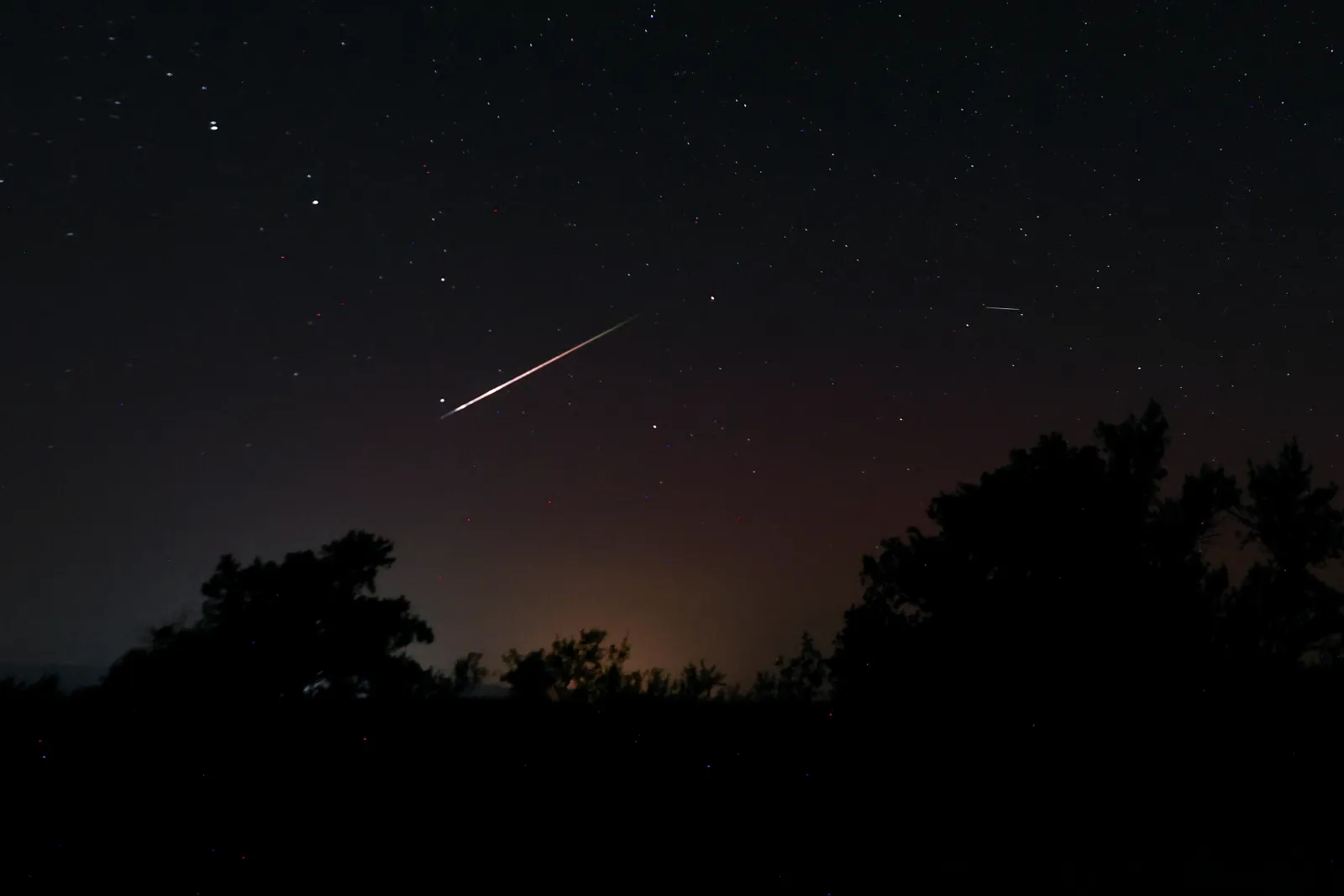
On Sunday, March 8, 2026, at 6:55 p.m. Central European Time (7:00 p.m. Kyiv time), as most Europeans were preparing to end their weekend, a dazzling flash lit up the night sky. The object, moving from southwest to northeast, was visible for approximately six seconds.

During this short period of time, the space traveler managed to leave behind a bright trail (“tail”) that was observed by thousands of people in Belgium, France, Germany, Luxembourg, and the Netherlands. The flight ended with a spectacular breakup into several fragments, accompanied by a sound effect similar to distant thunder or an explosion, which was clearly audible on the surface. 

Thanks to an extensive network of special meteor observation cameras, in particular the European AllSky7 system, the flight was recorded with high accuracy. In addition to professional equipment, the internet is filled with hundreds of amateur videos shot on smartphones and dashcams.

GettyImages-2166635428.jpg?w=1600&quality=80&webp=1

VARIOUS CITIES, SPAIN – AUGUST 12: Meteors are seen along the Milky Way in the sky on August 12, 2024 in Madrid, Spain. The Perseid meteor shower is reaching peak visibility in the coming days.

(Photo by Aldara Zarraoa/Getty Images)

A Spiralling Smoke Trail Lingered In The Sky For Minutes After The Blast.

A spiralling smoke trail lingered in the sky for minutes after the blast.

Credit:  Marcel W. via IMO

“Space landing” in Koblenz

Although most such objects burn up completely in the atmosphere, this case turned out to be special. Small pieces of debris — meteorites — were reported to have fallen in Koblenz-Güls (Germany). One of them pierced the roof of a private house, according to DW.

Found fragments of the meteorite. Photo: merkurist.de Fragments of the meteorite collected by eyewitnesses to the explosion. Photo: merkurist.de

Despite the dramatic nature of the situation, there were no reports of casualties or significant damage. However, the very fact that the debris reached the surface in a densely populated area aroused great interest among meteorite researchers.

Why were the telescopes silent?

The most interesting question in this story is: why did none of the large survey telescopes that scan the sky around the clock for asteroid threats warn of the approach of this object?

The answer lies in the physics and geometry of lighting. The object approached Earth from the “bright part of the sky,” which made it virtually invisible to ground-based optical instruments. The situation was exacerbated by the time of the event — almost dusk, when atmospheric illumination is at its maximum for detecting dim celestial bodies.

To date, astronomers have only managed to detect 11 objects before they entered the atmosphere. This shows that small bodies measuring several meters remain an extremely difficult target for modern astronomy, especially if they are “hidden” in the sun’s rays.

The scale of the planetary defense problem

From a global security perspective, objects of this size (up to 5-10 meters) do not pose an existential threat. They usually disintegrate in the upper layers of the atmosphere, turning into dust and small debris. However, as the case in Koblenz shows, even small fragments can reach the ground.

Infographic explaining the scale of the disaster in comparison with the size of asteroids. Source: ESA

ESA notes that such events are part of the natural life cycle of our planet. Space rocks of this size enter Earth’s atmosphere quite frequently — from once every few weeks to once every few years. However, most of them fall into oceans or desert areas, remaining unnoticed.

Scientists are now collecting data from all available sensors to determine the mass and composition of the meteorite. The debris found in Koblenz will be sent for laboratory analysis. This will allow us to learn more about the object’s origin: whether it came from the main asteroid belt between Mars and Jupiter, or was a fragment of a comet.

Earlier, we reported on how a meteorite older than Earth exploded and fell on a house.

  • According to ESA

RELATED VIDEOS


{ https://universemagazine.com/en/news-en/science-en/ }

Hoe vind je dit bericht?
Geschreven door peter om 22:54 Stuur door

What Flew Over Dubnica, Slovakia? 😱 👀 Feb 2026, UAP Or TR3B? UFO Sightings Daily.

What Flew Over Dubnica, Slovakia? 25 Feb 2026, UAP Or TR3B? UFO Sightings Daily.

UAP,%20%E0%A4%89%E0%A4%AB%E0%A5%8C%20,%20%E0%A6%87%E0%A6%89%E0%A6%8F%E0%A6%AB%E0%A6%93,%20%C4%91i%CC%83a%20bay,%20MUFON,%20%E7%9B%AE%E6%92%83%E3%80%81%E3%82%A8%E3%82%A4%E3%83%AA%E3%82%A2%E3%83%B3,%20%20UFO,%20UFOs,%20%D0%9D%D0%9B%D0%9E%20,%20NLO,%20sighting,%20sightings,%20alien,%20aliens,%20ET,%20anomaly,%20anomalies,%20ancient,%20astrobiology,%20vreemdelinge,%20%203%20copy%208.png

Location: Dubnica nad Váhom, Trenčiansky kraj, Slovakia 
Date of sighting: February 25, 2026
Source: NUFORC
Wow did you see that? This security cam footage caught a triangle UFO flying over the area of Slovakia toward the mountains. They heard it, but didn't see it...why? Because the infrared security camera can see things the human eye cannot. We can't see infrared, it's just a fact. This is not three orbs, it's a single craft and it's big! About the size of two city buses or more. 
 
Scott C. Waring - UFO Sightings Daily, now back in Taiwan
Eyewitness states: 
I was with two other friends on a hill in Prejta, and when I was next to the car, I heard something from the village that sounded like something disturbing the local geese. But when I walked towards the car, the sound grew louder and was still like geese, but it was also synchronized and artificial, and it passed over us and was loud, but we didn't see anything, even though we kept looking at the sky, we didn't see anything, even though it was a clear night and the moon was shining, so everything was clearly visible. This happened at 11:15 p.m. on February 25, 2026.
 

{ https://www.ufosightingsdaily.com/ }

Hoe vind je dit bericht?
Geschreven door peter om 22:35 Stuur door

“Plots veegt een asteroïde je stad weg en niemand zag het aankomen”: waarom we volgende keer misschien minder geluk hebben

Waar astronomen eerder wakker van liggen en de hemel naar afspeuren, zijn de ‘kleintjes’. Die vormen het grootste gevaar voor ons. In de astronomie spreken we van een ‘potentieel’ gevaarlijk object als het aan twee voorwaarden voldoet. Zo moet het 140 tot 1.000 meter groot zijn, groot genoeg om een stad te verwoesten. De kans op zo’n inslag bedraagt niet langer honderdduizenden tot miljoenen jaren, maar slechts tienduizenden jaren. De andere voorwaarde is dat de ruimterots de aarde dicht genoeg nadert. Bij ‘gevaarlijk’ dichtbij spreken wetenschappers over 7,5 miljoen kilometer, knuffelafstand in ruimtejargon.

Op dit moment hebben astronomen wereldwijd 11.573 asteroïden van die grootte ontdekt. Een op de vijf (2.532) komt dicht genoeg bij de aarde en krijgt het label ‘gevaarlijk’ van ruimtevaartagentschappen. Gelukkig slaat meer dan 99% de komende 100 jaar met zekerheid niet in. Er is echter een grote ‘maar’ in dit hele verhaal. Volgens wetenschappers hebben we slechts 40% van de asteroïden tussen de 140 en 1.000 meter groot ontdekt. Met andere woorden, er zweven er duizenden rond die ‘gevaarlijk’ zijn en waarvan we het bestaan niet kennen.

Hoe komt dat? Wel, ze zijn goed in verstoppen. We nemen asteroïden waar met behulp van weerkaatst zonlicht. Vaak is dat bitter weinig. Een ruimterots van enkele honderden meters waarnemen tegen een donkere achtergrond is daarom een ware nachtmerrie voor wetenschappers.

Een ander probleem is dat we enkel de hemel afspeuren tijdens de nacht. Heel wat onontdekte asteroïden bevinden zich nabij de zon. Naderen ze ons van de dagkant, dan zien we ze pas voor het eerst als ze ons voorbijvliegen. Tot slot zijn er ook moeilijkheden door technische beperkingen van telescopen en onze atmosfeer. Wetenschappers hopen hier wel verandering in te brengen met nieuwe telescopen in de ruimte, zoals de NEO Surveyor van NASA en de NEOMIR van ESA.

Maar wat met asteroïden die 30 tot 140 meter groot zijn? Zijn die dan niet gevaarlijk? En hoeveel zijn er? Ook die kunnen een stevige impact hebben wanneer ze de atmosfeer binnenvliegen. Bestaan ze voor het grootste deel uit steen, dan barsten ze uit elkaar. Is het vooral ijzer en nikkel, dan overleven ze de tocht door de atmosfeer en slaan ze in. Maar zelfs bij een ontploffing hoog in de lucht ontstaat er schade op de grond door de schokgolf en de hitte. En het probleem bij deze asteroïden is dat we nog geen 3% van de naar schatting half miljoen exemplaren hebben ontdekt. Het risico op een inslag ligt hier op één per enkele honderden jaren.

Er zijn waarschuwingssystemen zoals ATLAS (Asteroid Terrestrial-impact Last Alert System) die de nachtelijke hemel in de gaten houden voor deze kleine onruststokers. Maar zij kunnen ons slechts enkele dagen tot weken voorbereidingstijd geven. De asteroïde van baan veranderen is niet meer mogelijk, maar we kunnen wel de impactzone evacueren. Tenminste, als de asteroïde ons niet vanaf de zon nadert. Nog niet zo lang geleden maakten we dit mee. Op 15 februari 2013 ontplofte onverwacht een asteroïde van 20 meter boven Tsjeljabinsk in Rusland. Duizenden gebouwen raakten beschadigd en 1.500 mensen raakten gewond.

De conclusie is duidelijk. Het zijn de kleine ruimterotsen waarvoor we moeten oppassen. We hebben wel een voordeel in dit hele verhaal: het grootste deel van de aarde is bedekt met water en slechts een klein deel van het landoppervlak is bewoond.

KIJK.

  • How Meteors and Meteorites Form: A Journey from Space to Earth


  •  Comets, Asteroids, and Meteors | Learn all about what they are made of and how they differ

{ https://www.hln.be/nieuws/ }

Hoe vind je dit bericht?
Geschreven door peter om 21:05 Stuur door

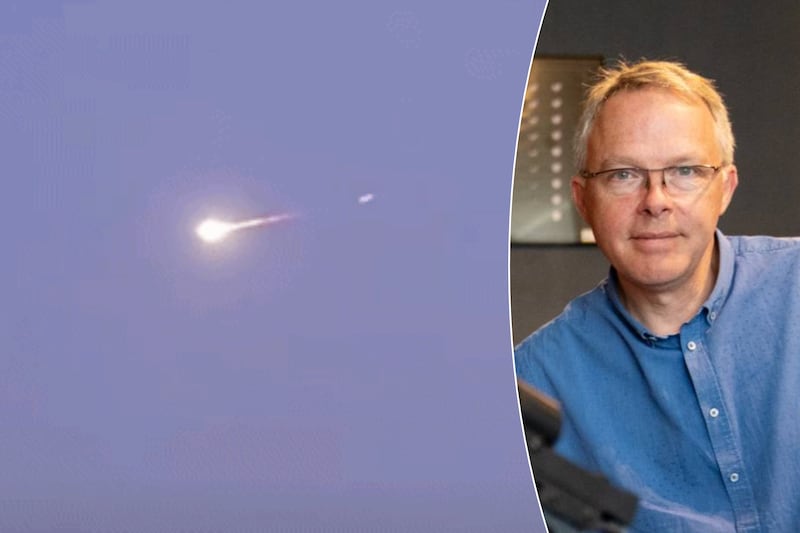
Vuurbal die gisteravond door de hemel kliefde, richtte ook ravage aan in Duitsland: wat was dat precies? En kan er nog iets volgen?

Hoe vind je dit bericht?
Geschreven door peter om 20:38 Stuur door

DARPA Reveals the X-76: The X-Plane Aims to Combine Helicopter Freedom With Jet Speed

X-76_2_888dbe.jpg?strip=all&quality=85&amp%3Bw=1024

A DARPA artist’s concept for the X-76. The latest DARPA renderings likely incorporate a degree of artist’s license but make an interesting comparison with Bell renderings. 
DARPA

DARPA Reveals the X-76: The X-Plane Aims to Combine Helicopter Freedom With Jet Speed

On modern battlefields, speed and unpredictability increasingly determine survival, and as we’ve seen in the current U.S.-Iran conflict, fixed airbases and long concrete runways that once enabled airpower are starting to look like strategic vulnerabilities.

On Monday, DARPA revealed its newest X-plane, the X-76, an experimental aircraft designed to combine the “go anywhere” flexibility of vertical lift with cruise speeds typical of conventional fixed-wing aircraft.

The latest addition to the legendary X-plane family is Bell Textron’s demonstrator for the Speed and Runway Independent Technologies (SPRINT) program. The chosen X-76 designation (for the year 1776) is intended to reflect the 250th anniversary of the United States. Meanwhile, there is much hope that HSVTOL could eventually provide the U.S. military, and potentially other operators, with a high-speed, runway-independent special operations airlifter.

The X-76 is the centerpiece of DARPA’s Speed and Runway Independent Technologies program, or “SPRINT,” a joint effort with U.S. Special Operations Command. The program is designed to overcome one of aviation’s oldest trade-offs. Helicopters and other VTOL aircraft can reach tight spaces, but they are slower. Meanwhile, traditional fixed-wing aircraft are faster, but they require runways, which limit their operating range and survivability in contested environments.

DARPA has announced that, following a critical design review, Bell Textron has been selected to begin building the X-76 demonstrator, marking the program’s transition into manufacturing, integration, and ground testing ahead of a planned flight-test phase in early 2028.

“For too long, the runway has been both an enabler and a tether, granting speed but creating a critical vulnerability,” DARPA SPRINT program manager, Commander Ian Higgins, said in a press release. “With SPRINT, we’re not just building an X-plane; we’re building options.”

X-76

Concept art rendering of the X-76.

(Image Source: Bell Textron)

DARPA’s public renderings reveal the X-76 is not an operational aircraft meant to be fielded as-is. Rather, it is a proof-of-concept technology demonstrator meant to show that the underlying engineering can work at full scale, and to generate real-world data that could shape what comes next.

According to DARPA, the X-76 is intended to mature technologies needed for runway-independent operations while cruising at speeds exceeding 400 knots. The aircraft would also be capable of hovering and operating from unprepared surfaces. Together, those capabilities would blur the line between the roles traditionally filled by helicopters, tiltrotors, and fixed-wing aircraft.

SPRINT’s ambitions are also a window into how the U.S. military’s priorities have shifted as precision weapons and long-range surveillance proliferate.

As we saw in the opening days of the U.S.-Israeli war against Iran, fixed airfields can be mapped, targeted, and logistics hubs can become predictable choke points. Given this reality, having vertical lift capabilities is no longer about convenience. It is about dispersal, resilience, and keeping forces moving even when the infrastructure they once depended on becomes an enemy 

The X-76 announcement is also notable for what it signals about the program’s maturity. SPRINT began Phase 1 in late 2023, then moved to Phase 1B in 2024 with contracts to two performers: Aurora Flight Sciences and Bell.

In 2025, DARPA selected Bell for the next stages, awarding it the contract for Phases 2 and 3 to complete design, build the X-plane, and move toward flight testing. The Critical Design Review completed this year marks a milestone that often separates promising concepts from hardware that can actually be assembled, tested, and flown.

In a release by Bell Textron, the company emphasized the symbolic and practical weight of the experimental plane’s designation. “Bell is honored to receive the X-76 designation and continue the spirit of American innovation, honoring the founding of the United States in 1776,” Bell’s senior vice president of engineering, Jason Hurst, said.

That 1776 reference is not subtle. DARPA says the X-76 designation was chosen specifically to coincide with the United States’ 250th anniversary, framing it as a “deliberate nod to the revolutionary spirit of 1776.”

X-76

Concept art rendering of the X-76. (Image Source: DARPA, Colie Wertz)

So what exactly is the X-76 trying to prove?

Publicly, DARPA and Bell are focused on the outcomes rather than the engineering schematics.

DARPA’s announcement highlights the aircraft’s target performance envelope. The demonstrator is designed to hover in austere environments and take off and land without prepared runways. At the same time, it is expected to sustain cruise speeds above 400 knots—roughly the territory of many turboprops and some regional jets, but far beyond conventional helicopter performance.

“The goal of the program is to provide these aircraft with the ability to cruise at speeds from 400 to 450 knots at relevant altitudes and hover in austere environments from unprepared surfaces,” DARPA’s SPRINT program description reads.

Bell, for its part, points to a specific enabling approach using “stop/fold” technology. In a statement, the company describes the X-76 build phase as a move toward a “brand-new X-plane with first-of-its-kind stop/fold technology,” intended to support runway independence with jet-like speeds.

stop-fold-rotor-wind-tunnel.webp?strip=all&quality=85

A wind tunnel model of one of Bell’s fold-away rotor design concepts. 

Bell

Concept art of the X-76 shows an aircraft equipped with folding rotor blades that can be stowed after transitioning to forward flight, reducing drag and enabling higher cruise speeds than traditional rotorcraft.

That basic idea—getting the lift of rotors without paying the aerodynamic penalty of carrying them through high-speed cruise—has been a recurring theme in vertical-lift engineering for decades. Rotors are incredibly efficient at hovering and low-speed flight, but they become a drag and vibration problem as speed climbs.

bell-sprint-concepts.webp?strip=all&quality=85

Crewed and uncrewed design concepts utilizing fold-away proprotor technology that Bell unveiled in 2024 as part of its work on DARPA’s SPRINT program. 

Bell

Tiltrotors like the V-22 Osprey pushed that boundary, yet still live with compromises because the rotors remain a dominant feature at all speeds. If initial renderings are any indication, the X-76 demonstrator will be built around a more radical transition—vertical lift when you need it, streamlined cruise when you don’t—which could open a new design space.

DARPA’s own messaging puts it in operational terms. When Cmdr. Higgins calls the runway a “tether,” he is highlighting a modern vulnerability: speed is valuable, but speed tied to predictable basing can be strategically limiting.

By aiming for runway-independent operation, DARPA is implicitly pursuing a future in which aircraft can disperse, relocate, and operate from austere locations—complicating an adversary’s targeting problem while improving response times for time-sensitive missions.

The SPRINT’s partnership structure also hints at where this could matter first. Special operations forces routinely operate at the edge of infrastructure—short on time, long on distance, and often constrained by where aircraft can safely land.

A platform that could move people or critical cargo quickly without relying on long runways could, in theory, compress timelines for infiltration, resupply, or medical evacuation, while expanding the number of usable launch and recovery sites.

DARPA’s program description stresses that the demonstrator is meant to validate integrated concepts that “can be scaled to different-sized military aircraft,” suggesting that the endgame is not a single airframe, but a portfolio of possible derivatives.

bell-fold-away-rotor-trio.webp?strip=all&quality=85

An earlier (2021) Bell rendering showing three related design concepts with fold-away rotor blades. 

Bell

There are good reasons DARPA is pursuing this as an X-plane effort rather than a direct acquisition program. “Runway-independent” and “high speed” are not especially difficult goals on their own. The challenge is combining them in a single aircraft with useful payload capacity, manageable complexity, and a transition mode that is both safe and repeatable.

The hardest part comes during the transition from hovering to fast forward flight. That is when mechanical stress, heat, and tricky aerodynamic forces all come into play at once. That is why the X-76 is being built as a test aircraft first. DARPA wants to find out what can actually be built, controlled, and reproduced reliably before considering large-scale production.

With its Critical Design Review now complete, DARPA says the SPRINT program is shifting to manufacturing, integration, assembly, and ground testing of the X-76 demonstrator. Flight tests under Phase 3 are scheduled to begin in early 2028.

For now, though, the X-76 is not really a new operational jet. It is a high-stakes experiment meant to answer a larger question: can the runway become optional without sacrificing speed or survivability?

HSVTOL.webp?strip=all&quality=85&amp%3Bw=1024

A computer-generated image of a Bell future tiltrotor carrying out a personnel recovery mission over the sea. This was schemed under the HSVTOL project, which is closely related to SPRINT. 

Bell

If the X-76 demonstrator succeeds, it will give the Pentagon something it increasingly values in an era of long-range precision fires and contested logistics: more ways to move fast without being predictable.

As SPRINT program manager, Cmdr. Higgins notes, “We’re working to deliver the option of surprise, the option of rapid reinforcement, and the option of life-saving speed, anywhere on the globe, without needing any runway.”

  • Tim McMillan is a retired law enforcement executive, investigative reporter and co-founder of The Debrief. His writing typically focuses on defense, national security, the Intelligence Community and topics related to psychology. You can follow Tim on Twitter: @LtTimMcMillan.  Tim can be reached by email: tim@thedebrief.org or through encrypted email: LtTimMcMillan@protonmail.com 
RELATED VIDEOS


{ https://thedebrief.org/category/space/ }

Hoe vind je dit bericht?
Geschreven door peter om 17:02 Stuur door

An interstellar comet packed with alcohol? What ALMA found in 3I/ATLAS

An interstellar comet packed with alcohol? What ALMA found in 3I/ATLAS

An artist's impression of 3I/ATLAS is shown as it passes near the sun, illuminating one side of the comet. On the side of the comet closer to the sun, the methanol gas is shown in blue, with icy dust grains still present in the gas. On the dark side of the comet, the hydrogen cyanide is shown in orange. Credit: NSF/AUI/NSF NRAO/M.Weiss

Comet 3I/ATLAS continues to make astonishing headlines, thanks to new findings from astronomers using the Atacama Large Millimeter/submillimeter Array (ALMA). This new research reveals that 3I/ATLAS is packed with an unusually large amount of the organic molecule methanol—more than almost all known comets in our own solar system.

"Observing 3I/ATLAS is like taking a fingerprint from another solar system," shares Nathan Roth, lead author on this research, and a professor with American University. "The details reveal what it's made of, and it's bursting with methanol in a way we just don't usually see in comets in our own solar system." The findings are posted on the arXiv preprint server.

ALMA observations of an interstellar visitor

Using ALMA's Atacama Compact Array in Chile, on multiple dates in late 2025, the team observed 3I/ATLAS as it approached our sun. As sunlight warmed its icy surface, 3I/ATLAS released gas and dust, forming a glowing halo (or coma) around its core. By analyzing this coma, astronomers revealed the chemical fingerprints of the material it is composed of, allowing them to study how objects might be made in another planetary system, without leaving our own.

The team focused on the faint submillimeter fingerprints of two molecules: methanol (CH₃OH), a type of alcohol, and hydrogen cyanide (HCN), a nitrogen-bearing organic molecule commonly seen in comets. The ALMA data reveal that 3I/ATLAS is heavily enriched in methanol compared to hydrogen cyanide, far beyond what is typically seen in comets born in our own solar system. On two observing dates, the team measured methanol-to-HCN ratios of about 70 and 120, placing 3I/ATLAS among the most methanol-rich solar system comets ever studied.

What the chemistry reveals about origins

These measurements imply that the icy material from 3I/ATLAS was formed by (or experienced) very different conditions than those that shape most comets in our own solar system. Previous work with the James Webb Space Telescope has shown that 3I/ATLAS had a coma dominated by carbon dioxide when it was far from the sun, and these new ALMA results add methanol as another unusual detail in its chemical inventory.

ALMA's high resolution for imaging also allowed the team to see how different molecules move away from the comet, revealing surprising differences between methanol and hydrogen cyanide. Hydrogen cyanide appears to come, for the most part, directly from the comet's core, or nucleus, which is typical for comets in our solar system. Methanol, on the other hand, appears to come from both the nucleus and from ice particles in the coma.

These tiny, icy grains act like mini-comets: as the object moves closer to the sun, where ice turns into gas, they also release methanol. Similar behavior has been observed in some solar system comets, but this is the first time the physics of such detailed outgassing has been traced in an interstellar object.

Comet 3I/ATLAS is only the third confirmed object ever seen passing through our solar system from interstellar space, after 1I/'Oumuamua and 2I/Borisov. Observations of these objects also revealed unusual properties. As astronomers continue to discover and study more interstellar objects, our understanding of planet formation in other planetary systems continues to grow more interesting.

Publication details

Nathan X. Roth et al, CH3OH and HCN in Interstellar Comet 3I/ATLAS Mapped with the ALMA Atacama Compact Array: Distinct Outgassing Behaviors and a Remarkably High CH3OH/HCN Production Rate Ratio, arXiv (2025). DOI: 10.48550/arxiv.2511.20845

Nathan X. Roth et al, CH3OH and HCN in Interstellar Comet 3I/ATLAS Mapped with the ALMA Atacama Compact Array: Distinct Outgassing Behaviors and a Remarkably High CH3OH/HCN Production Rate Ratio, The Astrophysical Journal Letters (2026). DOI: 10.3847/2041-8213/ae433b , iopscience.iop.org/article/10. … 847/2041-8213/ae433b

Journal information: arXiv 

RELATED VIDEOS

Hoe vind je dit bericht?
Geschreven door peter om 16:22 Stuur door

Consequences of the collision: strange patterns discovered on the surface of the asteroid Dimorphos

Consequences of the collision: strange patterns discovered on the surface of the asteroid Dimorphos

For a long time, space was considered a static and cold place, where huge chunks of rock flew through the void without any changes for millions of years. However, a recent study by astronomers at the University of Maryland (UMD) paints a very different picture. It turns out that binary asteroid systems are veritable “cosmic sandboxes” where objects constantly interact, exchanging material in a remarkable way reminiscent of a slow game of snowballs.

The boulder-covered moon Dimorphos 8.55 seconds before colliding with the DART spacecraft. On the right is the same image after correcting the lighting conditions of the surface and shadows cast by the boulders, revealing a fan-shaped pattern of stripes (highlighted in color for emphasis). Source: NASA/JHU-APL/UMD

Do you know that approximately one in six asteroids, or about 15%, flying past Earth are not actually “lone wolves”? These are binary systems where a smaller companion orbits a larger object. Previously, scientists believed that these pairs simply existed side by side under the influence of gravity, but data published in the Planetary Science Journal proves that there is a fairly close connection between them. 

The research team discovered that asteroids constantly “throw” rocks and dust at each other. These are not catastrophic collisions that tear celestial bodies apart, but gentle, almost delicate touches. These “cosmic kisses” gradually change the landscape of both bodies, transforming their surface into a dynamic environment that is constantly evolving.

Photographic evidence: a fan of dust and rocks

The key to the discovery was unique footage taken by a NASA spacecraft as part of the DART (Double Asteroid Redirection Test) mission in 2022. Before deliberately crashing into the asteroid Dimorphos, the spacecraft managed to transmit extremely clear images of the surface to Earth. 

This image of the asteroids Didymos and Dimorphos was taken by NASA’s DART mission seconds before the spacecraft crashed into Dimorphos on September 26, 2022. The impact on the smaller asteroid had a noticeable effect on the orbit of the larger one. Source: NASA/Johns Hopkins APL

While analyzing these images, Professor Jessica Sunshine and her team noticed something strange — bright fan-shaped stripes stretching across the entire surface of Dimorphos. At first, scientists blamed camera defects or errors in data processing. But after carefully cleaning up the images, it became clear: what they were looking at was the first visual confirmation in history of the natural transfer of material from one asteroid to another.

The Italian Space Agency’s LICIACube recorded the collision of the spacecraft with Dimorphos. This LICIACube image, taken seconds after the collision on September 26, 2022, shows rocky debris flying off the smaller asteroid. Source: ASI/NASA

“It looked as if someone had thrown space snowballs at the asteroid,” Professor Sunshine shares his impressions. These stripes are nothing more than “scars” from low-speed impacts left by material flying in from a neighboring asteroid.

Solar engine

Where does this “traveling rock” come from? Scientists explain this phenomenon as the YORP effect (the Yarkovsky–O’Keefe–Radzievsky–Paddack effect). This is a complex term for a fairly simple process: solar radiation heats the uneven surface of a small asteroid, causing it to spin faster and faster. 

When the rotational speed becomes critical, centrifugal force begins to exceed the weak gravity of the asteroid. Rock fragments, dust, and boulders lying on the surface of Didymos’ parent body simply fly off into open space. And since Dimorphos is nearby, a significant portion of this “debris” falls into its gravitational trap and gently settles on its surface. Thus, the Sun acts as an invisible engine, spinning asteroids into cosmic sprinklers.

Detective work with pixels

Finding these stripes was a real challenge. In the original DART images, they were almost invisible due to complex lighting and the play of shadows from numerous boulders. Tony Farnham and Juan Rizos from the University of Maryland have developed special algorithms to “remove” excess light and shadows.

The Didymos-Dimorphos binary asteroid system in Space Engine

The probe’s flight itself complicated the task: it approached its target in almost a straight line, which meant that the angle and lighting angle remained virtually unchanged. This created the illusion that the stripes might just be an optical effect. However, the creation of a 3D model of the asteroid put everything in its place. The more accurate the model became, the clearer the fan-shaped structures appeared. They were concentrated along the equator of Dimorphos — precisely where, according to the laws of physics, the material ejected from Didymos should have landed.

Physics of “soft” collisions

We are used to cosmic speeds of thousands of kilometers per hour, but in the world of double asteroids, everything is different. Harrison Agrusa’s research showed that debris from Didymos traveled toward the moon at a speed of only 30.7 cm/s. This is three times slower than a person walking at a normal pace in a park.

The Didymos-Dimorphos binary asteroid system in Space Engine

It is precisely thanks to this “turtle-like” speed that unique patterns are formed. Instead of creating huge craters, the rocks gently sink into the loose soil (regolith), leaving long rays of deposits. This is not destruction, but a gradual “increase” in the mass of the moon due to its “big brother.”

Checking the theory with sand

To finally confirm their hypothesis, scientists led by Esteban Wright conducted a series of experiments on Earth. At the UMD Institute of Physical Sciences and Technology, a special setup was created: balls were thrown at different angles into a container filled with sand mixed with colored gravel (simulating the surface of Dimorphos). 

High-speed cameras captured an incredible resemblance: when the “stranger” hit the boulders on the surface, some of the matter was deflected, while other matter penetrated through the cracks, forming the very fan-shaped rays that we see in photographs from space. Computer modeling at Lawrence Livermore National Laboratory confirmed these results.

Next stop: the Hera mission

This discovery radically changes our understanding of how to protect Earth from asteroid threats. If we want to change the trajectory of an asteroid, we need to understand how dynamic it is and how it exchanges mass with its moons.


The next major event will take place in December 2026, when the European Space Agency (ESA) mission called Hera will arrive at the Didymos-Dimorphos system. It will conduct a thorough “inspection of the scene” after the DART impact. Scientists hope to see the very stripes that may not have been completely destroyed by the explosion and gain new insights into how this amazing cosmic conveyor belt works.

Earlier, we reported on how Hubble photographed the double tail of the asteroid Dimorphos.

RELATED VIDEOS

{ https://universemagazine.com/en/news-en/science-en/ }

Hoe vind je dit bericht?
Geschreven door peter om 23:15 Stuur door

Meer van UFO'S of UAP'S, ASTRONOMIE, RUIMTEVAART, ARCHEOLOGIE, OUDHEIDKUNDE, SF-SNUFJES EN ANDERE ESOTERISCHE WETENSCHAPPEN - DE ALLERLAATSTE NIEUWTJES

↑ Terug naar de berichten