Naar de inhoud

UFO'S of UAP'S, ASTRONOMIE, RUIMTEVAART, ARCHEOLOGIE, OUDHEIDKUNDE, SF-SNUFJES EN ANDERE ESOTERISCHE WETENSCHAPPEN - DE ALLERLAATSTE NIEUWTJES

UFO's of UAP'S in België en de rest van de wereld
akke.beakke.be
Ontdek de Fascinerende Wereld van UFO's en UAP's: Jouw Bron voor Onthullende Informatie! Ben jij ook gefascineerd door het onbekende? Wil je meer weten over UFO's en UAP's, niet alleen in België, maar over de hele wereld? Dan ben je op de juiste plek! België: Het Kloppend Hart van UFO-onderzoek In België is BUFON (Belgisch UFO-Netwerk) dé autoriteit op het gebied van UFO-onderzoek. Voor betrouwbare en objectieve informatie over deze intrigerende fenomenen, bezoek je zeker onze Facebook-pagina en deze blog. Maar dat is nog niet alles! Ontdek ook het Belgisch UFO-meldpunt en Caelestia, twee organisaties die diepgaand onderzoek verrichten, al zijn ze soms kritisch of sceptisch. Nederland: Een Schat aan Informatie Voor onze Nederlandse buren is er de schitterende website www.ufowijzer.nl, beheerd door Paul Harmans. Deze site biedt een schat aan informatie en artikelen die je niet wilt missen! Internationaal: MUFON - De Wereldwijde Autoriteit Neem ook een kijkje bij MUFON (Mutual UFO Network Inc.), een gerenommeerde Amerikaanse UFO-vereniging met afdelingen in de VS en wereldwijd. MUFON is toegewijd aan de wetenschappelijke en analytische studie van het UFO-fenomeen, en hun maandelijkse tijdschrift, The MUFON UFO-Journal, is een must-read voor elke UFO-enthousiasteling. Bezoek hun website op www.mufon.com voor meer informatie. Samenwerking en Toekomstvisie Sinds 1 februari 2020 is Pieter niet alleen ex-president van BUFON, maar ook de voormalige nationale directeur van MUFON in Vlaanderen en Nederland. Dit creëert een sterke samenwerking met de Franse MUFON Reseau MUFON/EUROP, wat ons in staat stelt om nog meer waardevolle inzichten te delen. Let op: Nepprofielen en Nieuwe Groeperingen Pas op voor een nieuwe groepering die zich ook BUFON noemt, maar geen enkele connectie heeft met onze gevestigde organisatie. Hoewel zij de naam geregistreerd hebben, kunnen ze het rijke verleden en de expertise van onze groep niet evenaren. We wensen hen veel succes, maar we blijven de autoriteit in UFO-onderzoek! Blijf Op De Hoogte! Wil jij de laatste nieuwtjes over UFO's, ruimtevaart, archeologie, en meer? Volg ons dan en duik samen met ons in de fascinerende wereld van het onbekende! Sluit je aan bij de gemeenschap van nieuwsgierige geesten die net als jij verlangen naar antwoorden en avonturen in de sterren! Heb je vragen of wil je meer weten? Aarzel dan niet om contact met ons op te nemen! Samen ontrafelen we het mysterie van de lucht en daarbuiten.

Archief

NASA bosses are grilled as the Artemis II moon mission is pushed back yet AGAIN following a failed dress rehearsal - 'how can you still be having the same problem three years later?'

NASA's bosses have been grilled after the Artemis II moon mission was pushed back following a failed wet dress rehearsal.

The decision to delay until March at the earliest was made when ground crews were unable stop the rocket's super–cooled hydrogen fuel leaking.

This same problem has plagued every single hydrogen rocket since the Apollo Era, and was a well–known issue during the launch of Artemis I in 2022.

At a press conference discussing the aborted test, Marcia Dunn, of the Associated Press, pressured NASA to explain: 'How can you still be having the same problem three years later?'

In response, John Honeycutt, Chair of the Artemis II Mission Management Team, admitted: 'This one caught us off guard.'

He added: 'The technical team felt like we either had some misalignment or some deformation or debris on the seal.'

Lori Glaze, NASA's Exploration Systems Development Mission Directorate acting associate administrator, added: 'Everyone's aware of some of the challenges with the hydrogen tanking from Artemis 1.

'We really did learn a lot from the Artemis 1 mission, and we implemented a lot of the lessons learned yesterday through wet dress.'

NASA bosses have been grilled after the Artemis II moon mission was pushed back to March following a failed wet dress rehearsal. Pictured: (left to right) Amit Kshatriya, Lori Glaze,  Charlie Blackwell-Thompson, and John Honeycutt

NASA bosses have been grilled after the Artemis II moon mission was pushed back to March following a failed wet dress rehearsal. Pictured: (left to right) Amit Kshatriya, Lori Glaze,  Charlie Blackwell–Thompson, and John Honeycutt

The dress rehearsal failed just five minutes from completion after a hydrogen leak spiked beyond safe levels as ground crews filled the Space Launch System (SLS) rocket with over 2.6 million litres of liquid hydrogen and liquid oxygen

The dress rehearsal failed just five minutes from completion after a hydrogen leak spiked beyond safe levels as ground crews filled the Space Launch System (SLS) rocket with over 2.6 million litres of liquid hydrogen and liquid oxygen

During the wet dress rehearsal, NASA simulated a launch by filling the Space Launch System (SLS) rocket with over 2.6 million litres of liquid hydrogen and liquid oxygen.

The operation began at 01:13 GMT (20:13 EST) on January 31, and the fuelling operation initially went smoothly.

However, the space agency soon found a major hydrogen leak in a component called the 'tail service mast umbilical quick disconnect'.

These are roughly nine–metre–tall pods which attach to the base of the rocket and route propellant lines up into fuel tanks, before disconnecting during launch.

What is most concerning is that this is the exact same place where the SLS rocket used in Artemis I experienced leaks during its wet dress rehearsal three years ago.

Those leaks ultimately required the SLS to be removed from the launchpad three separate times for repairs, pushing back the eventual launch of Artemis I by six months.

This raises the question of why NASA hadn't managed to fix this well–known issue ahead of the Artemis II wet dress rehearsal.

On social media, space enthusiasts were outraged that the space agency had failed to get a handle on its hydrogen problems.

The leak came from a component called the 'tail service mast umbilical quick disconnect' (pictured), which attaches the rocket to the tower. This is the exact same place that caused hydrogen leaks during Artemis I

The leak came from a component called the 'tail service mast umbilical quick disconnect' (pictured), which attaches the rocket to the tower. This is the exact same place that caused hydrogen leaks during Artemis I 

John Honeycutt (pictured), Chair of the Artemis II Mission Management Team, admitted: 'This one caught us off guard'

John Honeycutt (pictured), Chair of the Artemis II Mission Management Team, admitted: 'This one caught us off guard'

On social media, space enthusiasts bemoaned the fact that NASA had not fixed an error, which had been well known since Artemis I in 2022

On social media, space enthusiasts bemoaned the fact that NASA had not fixed an error, which had been well known since Artemis I in 2022

One social media user complained that hydrogen leaks have been an issue since the Apollo era, and NASA still has not managed to get them under control

One social media user complained that hydrogen leaks have been an issue since the Apollo era, and NASA still has not managed to get them under control 

Why does NASA use hydrogen fuel?

The SLS rocket uses a mixture of liquid hydrogen and liquid oxygen.

Since hydrogen is such a small molecule, it is extremely prone to leaking.

However, hydrogen is also cheap, naturally abundant, and produces a phenomenal amount of energy.

According to NASA this mix gives the 'highest specific impulse, or efficiency in relation to the amount of propellant consumed, of any known rocket propellant'.

Another important factor is that the SLS rocket inherits a lot of its hardware and systems from the Shuttle era rockets.

These engines were built to run on hydrogen, so NASA can't change fuels without an expensive redesign of the entire rocket and engine system.  

One commenter wrote: 'Couldn't fix it in three years, how can they fix it in three weeks?'

'In essence – the three year issue has no solution in the near future. This is all a sham,' complained another.

Meanwhile, one frustrated commenter added: 'You would think by now they would realize, hydrogen is very difficult to seal plumbing for.'

Mr Honeycutt told reporters the issue stemmed from the fact that NASA hadn't been able to test the entire rocket stack in more realistic conditions.

He said: 'After Artemis I and the challenges we had with the leaks, we took a pretty aggressive approach to do some component–level testing with these valves and the seals.

'But on the ground, we're pretty limited as to how much realism we can put into the test.'

Likewise, Amit Kshatriya, NASA Associate Administrator, pointed to the fact that the SLS rocket is a highly complicated machine that has only been flown a handful of times.

Mr Kshatriya said: 'This is the first time this particular machine has borne witness to cryogens, and how it breathes and how it vents and how it wants to leak is something we're going to have to characterise.'

Amit Kshatriya, NASA Associate Administrator, said the issues came from the fact that the SLS rocket is a very complicated machine that has only been flown a few times

Amit Kshatriya, NASA Associate Administrator, said the issues came from the fact that the SLS rocket is a very complicated machine that has only been flown a few times 

This is an opinion shared by NASA Administrator Jarred Issacman, who wrote in a post on X that 'the flight rate is the lowest of any NASA–designed vehicle, and that should be a topic of discussion'.

To NASA's credit, the Artemis II rocket performed significantly better than its predecessors.

Hydrogen is such a small molecule that it can pass through the microscopic pores in welds and is, therefore, almost impossible to contain.

However, since liquid hydrogen and oxygen provide so much power, NASA tolerates an acceptable amount of hydrogen leaking on the ground.

These leaks proved debilitating for Artemis I after multiple wet dress rehearsals failed to fill the fuel tanks.

Likewise, during the Space Shuttle era, a particularly bad run of hydrogen leaks in 1990 shut down NASA's launch operations for more than six months.

Even the Apollo 11 mission was nearly scuppered after a massive hydrogen leak sprang in the rocket's second stage, with engineers working to seal it even as the astronauts boarded.

During the Artemis II wet dress rehearsal, ground crews were able to completely fill the SLS's fuel tank while keeping the leak just about within these safe limits.

Unlike during Artemis I, NASA bosses also maintain that these problems can be fixed on the launchpad and won't require bringing the Artemis II rocket (pictured) back to the hangar

Unlike during Artemis I, NASA bosses also maintain that these problems can be fixed on the launchpad and won't require bringing the Artemis II rocket (pictured) back to the hangar

It was only with about five minutes left in the countdown, as crews started to pressurise the fuel tanks, that the lead spiked beyond this threshold.

Charlie Blackwell–Thompson, Artemis Launch Director, said: 'As we began that pressurisation, we did see that the leak within the cavity came up pretty quick.'

However, Ms Blackwell–Thompson also insists that: 'If we were within our parameters on launch day and you had not had the issue when you pressurised during terminal count, you would have been within your launch commit criteria and certainly could have been go for launch.'

Unlike during Artemis I, NASA bosses also maintain that these problems can be fixed on the launchpad and won't require bringing the rocket back to the hangar.

article image

If true, this means Artemis II might be able to iron out its hydrogen problems in time for the next scheduled wet dress rehearsal.

NASA officials didn't specify when this next rehearsal would take place, adding that it would take time to go through the data from this week's test.

However, Artemis II is currently targeting its second launch window from March 6 to March 9 and March 11.

If the launch is delayed again, the mission will be pushed back another month to the final proposed window between April 1 and April 6.

Artemis II: Key facts

Launch date: NASA has identified three possible launch windows for Artemis II in the coming months: From February 6 to February 11, from March 6 to March 11, and from April 1 to April 6.

Mission objective: To complete a lunar flyby, passing the 'dark side' of the moon and test systems for a future lunar landing.

Total distance to travel: 620,000 miles (one million km)

Mission duration: 10 days 

Estimated total cost: $44 billion (£32.5 billion)

  • NASA Space Launch System rocket: $23.8 billion (£17.6 billion)
  • Orion deep–space spacecraft: $20.4 billion (£15 billion)

Crew: 

  • Commander Reid Wiseman
  • Pilot Victor Glover
  • Mission Specialist Christina Koch
  • Mission Specialist Jeremy Hansen

Mission Stages:

  1. Launch from Kennedy Space Centre Launch Pad 39B
  2. Manoeuvre in orbit to raise the perigee using the Cryogenic Propulsion Stage
  3. Burn to raise apogee using the Cryogenic Propulsion Stage
  4. Detach from Cryogenic Propulsion Stage and perform translunar injection
  5. Fly to the moon over four days
  6. Complete lunar flyby at a maximum altitude of 5,523 miles (8,889 km) above the moon's surface
  7. Return to Earth over four days.
  8. Separate the crew module from the European Service Module and the crew module adapter
  9. Splashdown in the Pacific Ocean  

{ https://www.dailymail.co.uk/sciencetech/index.html }

Hoe vind je dit bericht?
Geschreven door peter om 21:07 Stuur door

Armageddon was RIGHT! Simulation confirms we really could nuke an asteroid if it was heading for Earth

Armageddon was RIGHT! Simulation confirms we really could nuke an asteroid if it was heading for Earth

The 1998 sci-fi classic Armageddon might not have a reputation as a scientifically accurate film. 

But scientists now say the Hollywood blockbuster got one thing right – we really could nuke an asteroid out of its deadly collision course if it were heading towards Earth.

This technique is called nuclear deflection and, unlike in the movies, the goal is not to blow the approaching asteroid into smithereens.

Instead, a precisely timed nuclear explosion could give the asteroid just enough of a nudge to sail harmlessly past Earth.

Until now, experts have raised concerns that nuclear deflection would shatter an asteroid into many pieces, which would collectively pose an even greater risk.

However, a new simulation shows that asteroid material is actually far more resilient to extreme forces than previously thought.

Researchers from the University of Oxford found that some asteroid material actually gets stronger when subjected to an intense impact.

This means we could use huge nuclear weapon to deflect an incoming asteroid, without shattering it into deadly shrapnel.

The 1998 sci-fi classic Armageddon (pictured) might not have a reputation as a scientifically accurate film. But scientists now say the Hollywood blockbuster got one thing right – we really could nuke an asteroid out of its deadly collision course if it were heading towards Earth

The 1998 sci-fi classic Armageddon (pictured) might not have a reputation as a scientifically accurate film. But scientists now say the Hollywood blockbuster got one thing right – we really could nuke an asteroid out of its deadly collision course if it were heading towards Earth 

The researchers used CERN's 4.3 mile (7km) Super Proton Synchrotron to blast a fragment of a meteor with a stream of high-energy protons – stable positively charged particles found inside atoms

The researchers used CERN's 4.3 mile (7km) Super Proton Synchrotron to blast a fragment of a meteor with a stream of high-energy protons – stable positively charged particles found inside atoms

For the study, the researchers teamed up with nuclear deflection startup, the Outer Solar System Company (OuSoCo), to find out what would happen to a metal-rich asteroid if it was nuked.

Unsurprisingly, it isn't possible to let off a nuclear weapon inside a lab, so the scientists turned to the next best thing: a massive particle accelerator.

The researchers used CERN's 4.3 mile (7km) Super Proton Synchrotron to blast a fragment of a meteor with a stream of high-energy protons – stable positively charged particles found inside atoms.

A piece of the Campo del Cielo meteorite, a metal-rich iron-nickel body, was exposed to 27 successive short bursts from the particle accelerator to simulate the impact of a nuclear blast.

Bizarrely, the researchers watched as the asteroid material softened, flexed, and then unexpectedly strengthened without breaking.

Co-lead author Melanie Bochmann, co-founder of OuSoCo, says: 'The material became stronger, exhibiting an increase in yield strength, and displayed a self-stabilising damping behaviour.'

Overall, while being hit with the force of a nuclear blast, the asteroid's strength actually increased by a factor of 2.5.

This new evidence is a strong suggestion that nuclear deflection could be a viable option for planetary defence.

A piece of the Campo del Cielo meteorite (pictured), a metal-rich iron-nickel body, was exposed to 27 successive short bursts from the particle accelerator to simulate the impact of a nuclear blast. Bizarrely, the researchers watched as the asteroid material softened, flexed, and then unexpectedly strengthened without breaking

A piece of the Campo del Cielo meteorite (pictured), a metal-rich iron-nickel body, was exposed to 27 successive short bursts from the particle accelerator to simulate the impact of a nuclear blast. Bizarrely, the researchers watched as the asteroid material softened, flexed, and then unexpectedly strengthened without breaking 

Thousands of pieces of space rock hit the Earth every single year, but the vast majority of these are so small that they simply burn up in the Earth's atmosphere.

However, asteroids large enough to cause serious damage do arrive with surprising frequency.

Most recently, the Chelyabinsk explosion injured thousands of people in 2013 when an 18-metre (59ft) asteroid broke up in the atmosphere.

To protect Earth from an even bigger strike, NASA and the European Space Agency (ESA) are currently researching a technique called a 'kinetic impactor'.

This very simply involves slamming a spacecraft into the side of an asteroid as fast as physically possible so that the transferred kinetic energy moves it off course.

NASA's 2022 DART mission, which smashed a spaceship into the asteroid Dimorphos, proved that this could move an asteroid enough to save Earth.

However, kinetic impactors only work if astronomers have spotted the asteroid years before its arrival, to give time for the small changes in trajectory to build up.

Ms Bochmann told the Daily Mail: 'Space agencies already recognise the necessity of nuclear deflection.

Nuclear deflection could be a viable alternative to the kinetic impactor technique, tested by NASA during the DART mission (pictured), which involves ramming a spaceship into an asteroid as fast as possible

Nuclear deflection could be a viable alternative to the kinetic impactor technique, tested by NASA during the DART mission (pictured), which involves ramming a spaceship into an asteroid as fast as possible 

'For large objects or scenarios with short warning times, it is widely regarded by space agencies and experts as the only viable deflection option.'

The fact that metal-rich asteroid material is so resilient to high-energy impacts is a good sign for the prospects of nuclear deflection, since it suggests that nuking a space rock won't cause fragmentation.

'The paper shows that significantly more energy can be delivered by a nuclear explosion without causing catastrophic fragmentation of the object than previously assumed,' says Ms Bochmann.

article image

However, before NASA starts launching nuclear warheads into space, a lot more research will be needed.

This paper only looks at one very specific type of asteroid – metal-rich iron-nickel – whereas world-ending threats come in all shapes and sizes.

The researchers now plan to repeat the study with samples from a more complex class of asteroid.

These could include meteorites called pallasites, which are similar to the samples already studied but with centimetre-sized, magnesium-rich crystals embedded inside.

WHAT COULD WE DO TO STOP AN ASTEROID COLLIDING WITH EARTH?

Currently, NASA would not be able to deflect an asteroid if it were heading for Earth but it could mitigate the impact and take measures that would protect lives and property.

This would include evacuating the impact area and moving key infrastructure.

Finding out about the orbit trajectory, size, shape, mass, composition and rotational dynamics would help experts determine the severity of a potential impact.

However, the key to mitigating damage is to find any potential threat as early as possible.

NASA and the European Space Agency completed a test which slammed a refrigerator-sized spacecraft into the asteroid Dimorphos.

The test is to see whether small satellites are capable of preventing asteroids from colliding with Earth.

The Double Asteroid Redirection Test (DART) used what is known as a kinetic impactor technique—striking the asteroid to shift its orbit.

The impact could change the speed of a threatening asteroid by a small fraction of its total velocity, but by doing so well before the predicted impact, this small nudge will add up over time to a big shift of the asteroid's path away from Earth.

This was the first-ever mission to demonstrate an asteroid deflection technique for planetary defence.

The results of the trial are expected to be confirmed by the Hera mission in December 2026.

{ https://www.dailymail.co.uk/sciencetech/index.html }

Hoe vind je dit bericht?
Geschreven door peter om 20:21 Stuur door

Theory about what NASA found on the moon 57 years ago

Theory about what NASA found on the moon 57 years ago

Story by Chris Melore, Assistant Science Editor For Dailymail.Com

Theory about what NASA found on the moon 57 years ago

{ Daily Mail }

Hoe vind je dit bericht?
Geschreven door peter om 19:57 Stuur door

Should Halley’s Comet Be Renamed?

Should Halley’s Comet Be Renamed?

Despite interesting historical arguments, the chances of the astronomical community accepting this change remain minimal.

Hoe vind je dit bericht?
Geschreven door peter om 23:51 Stuur door

For the First Time, Scientists Detect Molecule Critical to Life in Interstellar Space

For the First Time, Scientists Detect Molecule Critical to Life in Interstellar Space

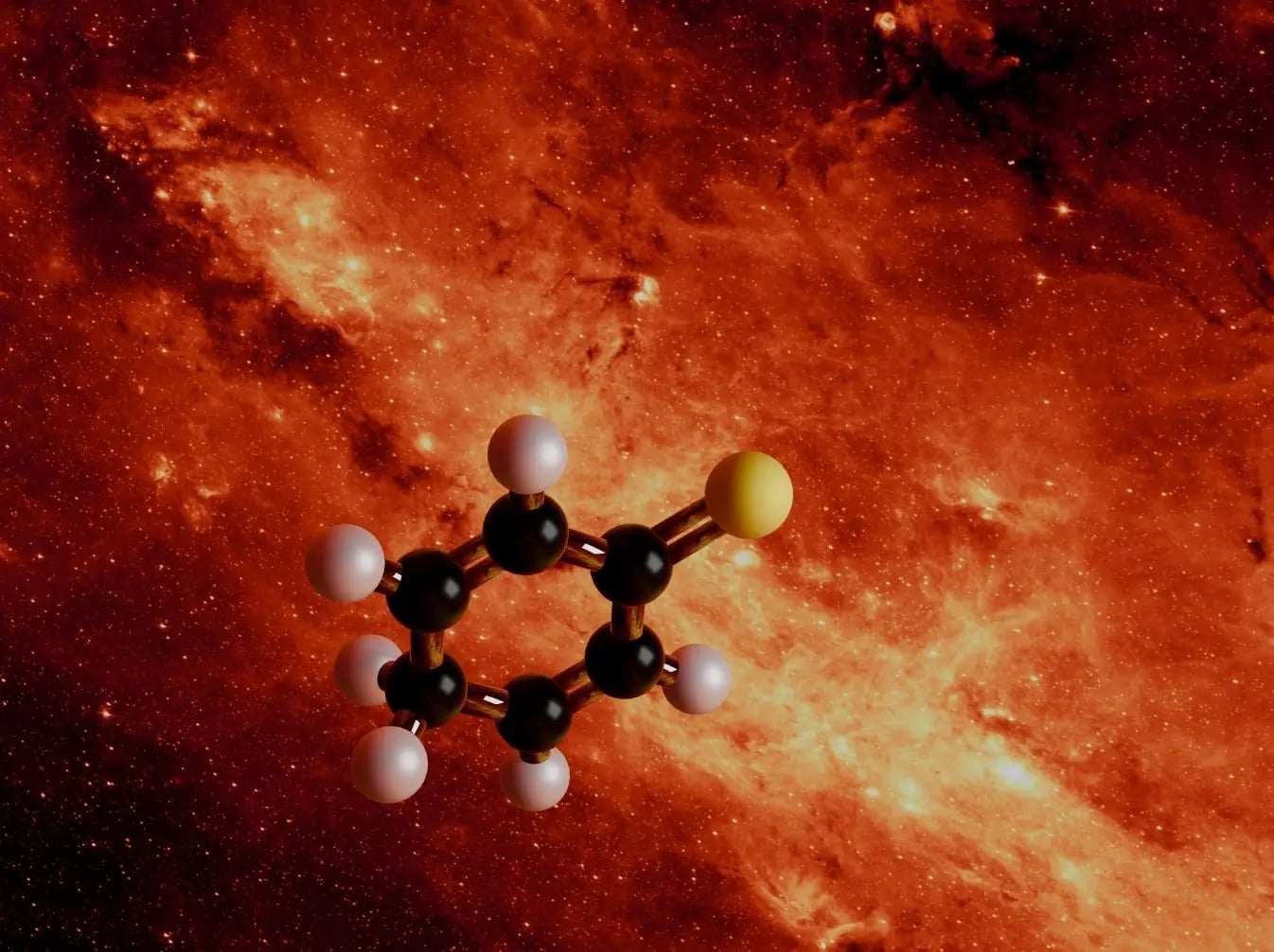
In the heart of our Galaxy, scientists discovered the first sulfur-bearing six-membered ring molecule hiding in an interstellar cloud. Credit & ©: MPE/ NASA/JPL-Caltech In the heart of our Galaxy, scientists discovered the first sulfur-bearing six-membered ring molecule hiding in an interstellar cloud. Credit & ©: MPE/ NASA/JPL-Caltech

The chemical is known as thiepine, or 2,5-cyclohexadiene-1-thione (C₆H₆S), a ring-shaped sulfur-bearing hydrocarbon produced in biochemical reactions. When examining the molecular cloud G+0.693–0.027, a star-forming region about 27,000 light-years from Earth near the center of the Milky Way, astronomers from the Max Planck Institute for Extraterrestrial Physics (MPE) and the CSIC-INTA Centro de Astrobiología (CAB) detected this complex molecule in space for the first time. This detection represents the largest sulfur-bearing molecule ever detected beyond Earth, with significant implications for the study of the cosmic origins of life.

By combining astronomical observations with laboratory experiments, they confirmed the presence of this six-membered, 13-atom molecule in a region of space similar to the cloud of gas and dust (nebula) from which new star systems form. The team synthesized the molecule in the laboratory by subjecting liquid thiophenol (C₆H₅SH), a related hydrocarbon, to a 1,000-volt electrical discharge and then examined the results using a custom-built spectrometer. This enabled them to measure the precise radio-frequency emission of the resulting thiepine molecules.

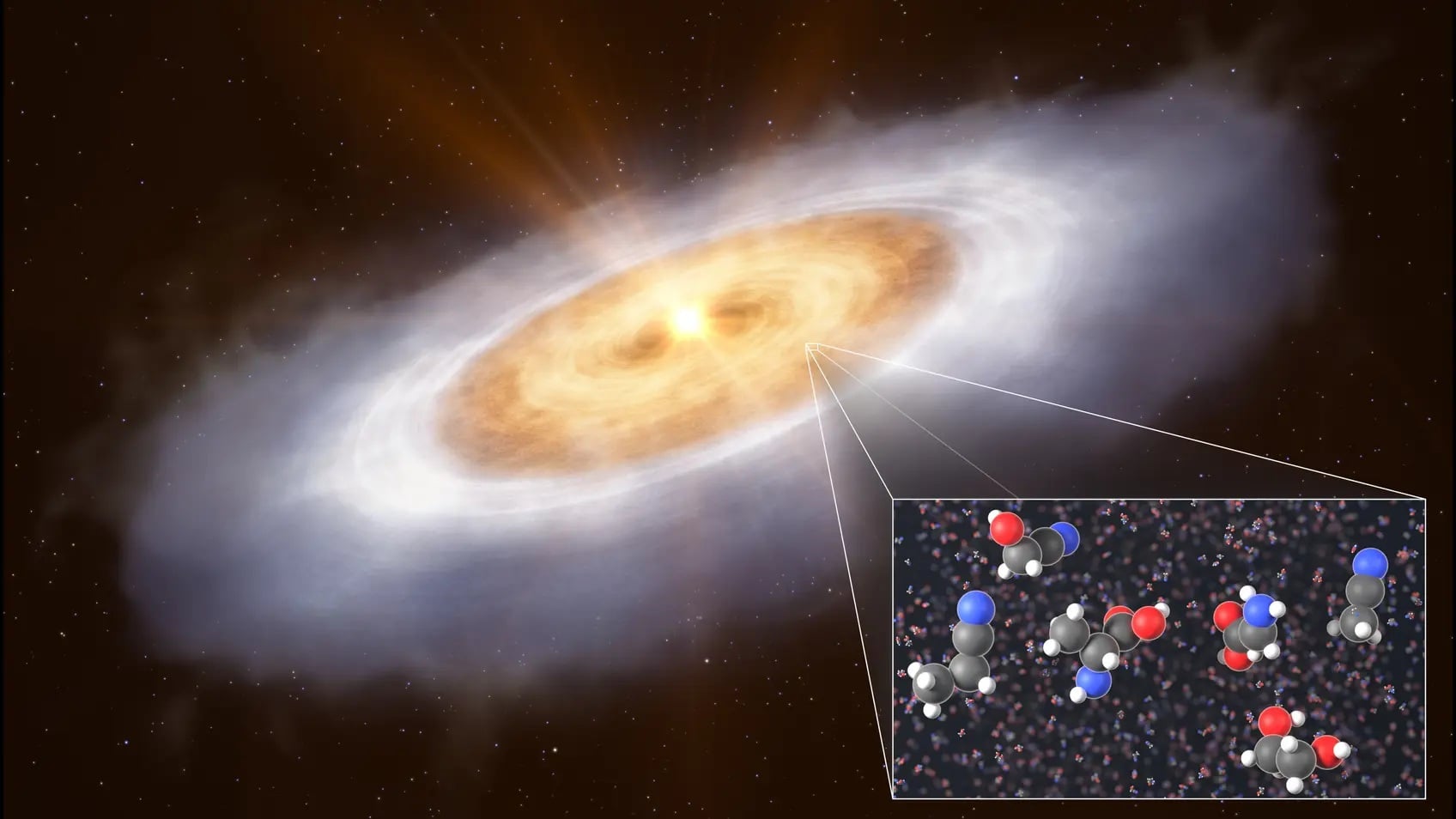
The chemical structure of complex organic molecules detected in a protoplanetary disc. © Credit: ESO/L. Calçada/T. Müller (MPIA/HdA)

The chemical structure of complex organic molecules detected in a protoplanetary disc.

© Credit: ESO/L. Calçada/T. Müller (MPIA/HdA)

They then compared this spectral signature to data obtained by CAB astronomers using the IRAM 30-meter and the Yebes 40-meter radio telescopes in Spain. Until now, astronomers had only detected small sulfur compounds of six atoms or fewer in interstellar space, which play an essential role in proteins and enzymes. Meanwhile, larger sulfur-bearing molecules like thiepine remained elusive, so the gap between the types of organics found in meteorites and the chemistry observed in space persisted. The newly discovered thiepine molecule is structurally related to molecules found in meteorite samples.

This demonstrates, for the first time, a connection between astrochemistry and life on Earth. "This is the first unambiguous detection of a complex, ring-shaped sulfur-containing molecule in interstellar space—and a crucial step toward understanding the chemical link between space and the building blocks of life”, said lead author Mitsunori Araki, a researcher at MPE. "Our results show that a 13-atom molecule structurally similar to those in comets already exists in a young, starless molecular cloud. This proves that the chemical groundwork for life begins long before stars form”, added co-author Valerio Lattanzi, a scientist at MPE.

The discovery suggests that many more complex sulfur-bearing molecules likely remain undetected in interstellar space. The results also bolster recent findings from Aarhus University and the Institute for Nuclear Research that showed how peptides, another crucial ingredient for life, can form in interstellar space spontaneously. These and other findings indicate that the origins of life reside in space, and are far more plentiful than previously thought!

Further Reading: 

RELATED VIDEOS

{ https://www.universetoday.com/ }

Hoe vind je dit bericht?
Geschreven door peter om 22:52 Stuur door

Perseverance Rover Discovers an Ancient Martian Beach, Complete with Waves

Perseverance Rover Discovers an Ancient Martian Beach, Complete with Waves

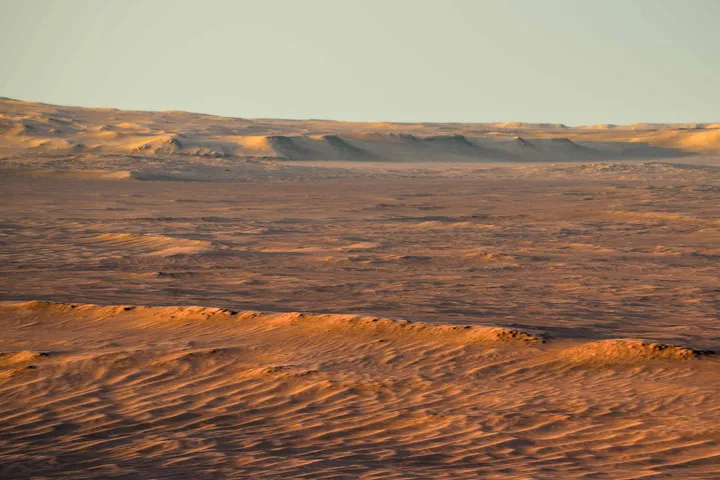
Image of Perseverance's landing site in Jezero crater. Credit - Kevin Gill Image of Perseverance's landing site in Jezero crater. Credit - Kevin Gill

When the rover now named Perseverance landed in Jezero crater in early 2021, scientists already knew they had picked an interesting place to scope out. From space, they could see what looked like a bathtub ring around the crater, indicating there could once have been water there. But there was some debate about what exactly that meant, and it’s taken almost five years to settle it. A new paper from PhD student Alex Jones at Imperial College London and his co-authors has definitively settled the debate on the source of that feature - part of it was once a beach.

Admittedly, there is some nuance to that finding. The particular feature they looked at was something called the Margin Unit - a band of olivine- and carbonate-rich rocks ringing the inner edge of the crater. The paper actually splits this into two different sub-segments, the Western Margin Unit (WMU) and the Eastern Margin Unit (EMU).

The WMU is located close to the crater rim, and is made up of a type of igneous rock. Most likely it was formed when lava actively ran through the crater. It’s largely structureless, and is made up primarily of olivine that has been transformed into carbonate and silica. Most likely that was caused by carbon-dioxide rich fluids (probably water) reacting with the rock itself.

NASA video describing Perseverance’s exploration of Jezero Crater.
Credit - NASA Jet Propulsion Laboratory YouTube Channel

That carbon dioxide rich water potentially could have been caused by hydrothermal vents, which makes this area particularly interesting for astrobiology, since hydrothermal vents are one of the places theorized to have been the formation place of the first life forms. That’s not to say the same process happened on Mars, but it seems the WMU is as good a place as any to take a look for it.

But perhaps more interestingly, the EMU looks a lot more like - to put it bluntly - a beach. This feature is farther down the crater rim, but shows signs of cross-stratification. That means there are layers at an off-set angle from the main bed, indicating they were deposited there by some sort of liquid flow. There were also surfaces that had clearly been eroded, and sandstone grains that were rounded in shape, indicating they had been subjected to wave motion.

All of this indicates that the EMU is a “high-energy lacustrine shore zone” that formed when Jezero crater was filled with water. Which is amazing for a variety of reasons, but perhaps most importantly is the clear indication of waves.

Fraser discusses the original plans for the Mars Sample Return mission.

For waves to form, the water must not be frozen, which has been a point of contention in the Mars climatology community. It appears that at least for a period of time, the water on the surface of Jezero crater was not frozen. But what’s more, waves in a lake need wind, and Mars’ current sparse atmosphere wouldn't provide enough oomph to form them. That implies that, again at least for a time, Mars had an atmosphere thick enough to cause waves.

Which makes the case for an astrobiological search of these areas all the more pressing. The minerals found in these areas (carbonates and silica) can capture bacteria living in the sand or water and preserve them as microscopic fossils. Theoretically, even billions of years later, we would still be able to see them, if they exist.

There’s one particular sample the paper mentions called Comet Geyser, which Perseverance took in the WMU. According to NASA, this sample has the highest potential for finding preserved signs of ancient life of any taken during Perseverance's mission.

7NASA Video describing Comet Geyser - perhaps the most interesting of the Mars Samples from an astrobiological perspective.
Credit - NASA Jet Propulsion Laboratory YouTube Channel

However, recent news has put a damper on those hopes. The Mars Sample Return mission, which was originally intended to go to Mars and get those samples back to Earth, has officially been cancelled by NASA. It happened so recently that a press release supporting the release of the paper still mentions it as a possible future for some of the samples. But Congress cut the program due to cost overruns in the last few weeks. So, at least for now, those samples must remain in their dried up former lake, awaiting the day when someone or something will come pick them up.

Maybe the cause will be taken up by a rich individual - like the recent announcement that Eric Schmidt is privately supporting a flagship-class telescope mission. So, if any billionaires happen to be interested, there’s a tiny cylinder of rock sitting on Mars that might tell us whether we are alone in the universe or not. That sounds like a worthwhile legacy project.

Learn More:


{ https://www.universetoday.com/ }

Hoe vind je dit bericht?
Geschreven door peter om 22:16 Stuur door

Hidden giants: mountain structures at the base of the mantle influence the Earth’s magnetic field

Hidden giants: mountain structures at the base of the mantle influence the Earth’s magnetic field

Scientists from the University of Liverpool have reported finding evidence of two giant super-hot mountain structures located at the base of the mantle. These structures influence the Earth’s magnetic field.

A sensational discovery

Exploring the Earth’s interior is a much more difficult task than exploring the Solar System. While the Voyager 1 probe has already traveled 25 billion kilometers away from our planet, the deepest borehole has only reached a depth of 12 kilometers. As a result, very little is known about the conditions existing at the boundary between the mantle and the core. But this is a very important place of interaction in the Earth’s interior, where recent studies have revealed interesting magnetic activity.

Illustration of the Earth’s internal structure. Source: Science Photo Library

In a study published in the journal Nature Geoscience, scientists from the University of Liverpool presented evidence of the existence of two enormous super-hot mountain structures in this region. They are located at the base of the Earth’s mantle at a depth of about 2,900 km beneath Africa and the Pacific Ocean. Research shows that these huge chunks of solid, superheated material, surrounded by a ring of cooler rock from pole to pole, influence the underlying liquid outer core, shaping the Earth’s magnetic field over millions of years.

Reconstruction of the ancient magnetic field of the Earth

Both measuring ancient magnetic fields and simulating the processes that generate them are technically challenging tasks. To explore the Earth’s interior, the research team combined paleomagnetic observations with advanced computer simulations of the geodynamo — the flow of liquid iron in the outer core that generates the Earth’s magnetic field, much like a wind turbine generates electricity.

Source: University of Liverpool

Numerical models have enabled scientists to reconstruct key observations of magnetic field behavior over the past 265 million years. Even with the help of a supercomputer, conducting such simulations, especially over long periods of time, is a huge computational task.

The results show that the upper boundary of the outer core is far from homogeneous in temperature. On the contrary, it exhibits strong thermal contrasts with localized hot spots covered by continent-sized mountain structures.

It has also been demonstrated that some parts of the magnetic field appear to have remained relatively stable for hundreds of millions of years, while others have changed significantly over time.

Earth’s magnetic field and ancient climate

Andy Biggin, a professor of geomagnetism at the University of Liverpool, commented on the study as follows:

“These findings suggest that there are strong temperature contrasts in the rocky mantle just above the core and that, beneath the hotter regions, the liquid iron in the core may stagnate rather than participate in the vigorous flow seen beneath the cooler regions. Gaining such insights into the deep Earth on very long timescales strengthens the case for using records of the ancient magnetic field to understand both the dynamic evolution of the deep Earth and its more stable properties.”

The findings are also important for questions related to ancient continental configurations, such as the formation and breakup of Pangaea, and may help resolve longstanding uncertainties in the fields of paleoclimate, paleobiology, and natural resource formation. Previously, it was believed that the Earth’s magnetic field, on average over long periods, behaved like an ideal bar magnet aligned with the planet’s axis of rotation. Now it has become clear that this may not be entirely true.

RELATED VIDEOS

{news https://universemagazine.com/en/-en/science-en/ }

Hoe vind je dit bericht?
Geschreven door peter om 22:01 Stuur door

The enigma of Zhuque-3: pinpointing the landing site of the Chinese rocket

The enigma of Zhuque-3: pinpointing the landing site of the Chinese rocket

The second stage of China’s Zhuque-3 rocket left orbit and fell to Earth, doing so… twice. Before this, many European countries feared that it might fall on their territory.

What is “Zhuque-3”?

The Zhongyue-3 rocket was developed by the Chinese company LandSpace. It is a partially reusable rocket that uses methane as fuel and liquid oxygen as an oxidizer. In a fully disposable configuration, the rocket is capable of delivering up to 12 tons of cargo into low orbit, and up to 8 tons in a version with a returnable first stage.

Launch of the Zhuque-3 rocket. Source: Landspace

Zhuque-3 was launched on December 3, 2025. This was its maiden flight. After separation, the first stage successfully performed a braking maneuver and entered the atmosphere. However, during the final stage of descent, it caught fire and ultimately crashed just a few meters from the landing site.

As for the second stage of the Zhuque-3, it successfully reached orbit and remained in space thereafter. As a rule, launch operators attempt to remove spent stages from orbit to prevent them from becoming space debris and posing a threat to spacecraft. However, for some reason, LandSpace did not do this. So the uncontrolled stage remained in space.

Panic in Europe

Over the next two months, the altitude of the second stage of Zhuque-3 gradually decreased due to deceleration in the upper layers of the Earth’s atmosphere. This process was significantly accelerated by increased solar activity, accompanied by a series of powerful flares that caused bright polar auroras.

Radar image of the second stage of the Zhuque-3 rocket. It was obtained by the TIRA radar one day before it fell to Earth. Source: Fraunhofer FHR

By the end of January, the altitude of Zhuque-3 had decreased so much that it became clear that it would soon enter the Earth’s atmosphere. Since the stage weighed 7.5 tons (not counting the payload simulator, which weighed several more tons), this naturally raised concerns that its unburned debris could fall in a populated area and cause damage.

The situation caused the greatest concern in Europe. On January 30, the British government asked mobile operators to ensure the operability of the warning system in preparation for a possible rocket crash. Concerns about the consequences of the Zhuque-3 crash were also expressed in the media of other countries, such as Poland and Belgium.

However, in reality, until the very last hours, there was no way to predict where exactly the Chinese rocket would fall. The process of space debris falling is influenced by many factors, ranging from its orbit to the shape and strength of its components. The only thing that could be said with certainty was that it would happen somewhere between 57° north latitude and 57° south latitude.

A rocket that crashed twice

In the end, everything ended well. On January 30, at 12:39 p.m. UTC, the debris from Zhuque-3 fell into the southern Pacific Ocean. At least, that was the initial report. Both simulation results and data from the US military, whose satellite recorded a fireball in the region at an altitude of 80-90 km, indicated that the Chinese rocket fell at this point. This corresponds to the final stage of entry into the atmosphere.

However, nine hours later, the US Space Force released final data indicating that Zhuque-3 had fallen to Earth… twice. The first time, as reported, it happened at 12:39 p.m. UTC in the southern Pacific Ocean. However, one hour and four minutes later, a second fireball was recorded along the trajectory of Zhuque-3, this time over the Indian Ocean.

Map showing the two locations where the Chinese Zhuque-3 rocket fell. Source: SatTrackCam Leiden

According to satellite spotter Marco Langbroek, there are two possible explanations for the situation. The first is a simple mistake or confusion. However, in his opinion, another, very rare scenario took place. The apogee of Zhuque-3’s last orbit was 211 km, while its perigee was 102 km. According to Langbroek, when the stage passed perigee, it began to disintegrate and broke into several pieces. The less durable components disintegrated over the Pacific Ocean, while the more durable and massive piece survived. After that, it managed to make another half-turn, after which it finally entered the atmosphere over the Indian Ocean. This fragment was probably a payload simulator, which was more durable than the stage.

The case of Zhuque-3 demonstrates once again that even with modern technology, it is extremely difficult to predict the location of space debris. That is why all participants in the space market must remove spent rocket stages from orbit to prevent such situations from recurring.

You can find out more about the most famous cases of space debris falling from our article.

{ https://universemagazine.com/en/news-en/science-en/ }

Hoe vind je dit bericht?
Geschreven door peter om 21:26 Stuur door

Hidden for Centuries, “Lost” Portions of a Mysterious Ancient Star Map Have Been Revealed Using X-Rays

A portion of the Codex Climaci Rescriptus
(Image Credit: Denysmonroe81/Wikimedia CC 3.0).

Hidden for Centuries, “Lost” Portions of a Mysterious Ancient Star Map Have Been Revealed Using X-Rays

Researchers at the SLAC National Accelerator Laboratory in Menlo Park, California, have used X-ray beams to reveal once-hidden references to an ancient star map from a centuries-old document.

The ancient palimpsest—a portion of the Codex Climaci Rescriptus—has been revealed to contain fragmentary references to an ancient star catalog once used by the Greek astronomer Hipparchus. The ancient star maps in question were created by the astronomer as early as 150 B.C., copies of which were made several centuries later.

Now, the “lost” ancient writing has been made discernible as bright orange markings the X-rays have revealed, according to Minhal Gardezi, a physicist at the University of Wisconsin–Madison who was involved in the research.

Hipparchus A stylized woodcut depicting Hipparchus at Alexandria observing the night sky. Scholars are unaware of any visits by the ancient astronomer to Alexandria, and the image above depicts the anachronistic use of a telescope well before its invention (Public Domain).

A “Phaenomena” Emerges

The text revealed by SLAC researchers comprises portions of the poem “Phaenomena,” which dates to around 275 B.C. and is attributed to the Greek poet Aratus of Soli. The copies of the poem the SLAC team studied had likely been made sometime in the 6th century, at which time the unknown scribe also included sections comprising appendices relating to the positions of stars in various constellations, which were a perfect match for work known to have been undertaken by Hipparchus.

Originally transcribed on portions of animal hide, the remnants of the ancient poem were held within Saint Catherine’s Monastery in Egypt’s Sinai desert for centuries. At some point between the 9th and 10th centuries, the original text on the palimpsest appears to have been erased and reused to record a series of monastic treatises, seemingly destroying the ancient scientific information the ancient record once contained.

SLAC’s particle accelerator has now revealed these “lost” portions of the ancient poem using powerful X-rays, making the invisible records from long ago visible again for the first time in centuries (images of which can be seen here).

In the past, very little from Hipparchus’s writings has been recovered, and most of our knowledge of the ancient Greek astronomer stems from secondhand sources. Based on such information, scholars are aware that he can be credited with the creation of one of the earliest star catalogs, as well as early mathematical innovations that include the invention of trigonometry.

The team’s discovery is important, since it offers a rare glimpse at such records from the ancient world, which were often recorded on perishable materials like papyrus, which seldom survive through the ages.

Going beyond even the surprise discovery of these ancient astronomical records, the SLAC team’s process reveals a promising new means by which researchers may be able to retrieve similar “lost” information from surviving ancient records, especially those kept on more rugged materials that were often reused throughout time.

The recent discovery represents a veritable cornucopia of ancient information related to a crucial period in the emergence of science close to two millennia ago. However, this is not the first indication that traces of earlier ancient writing had been present on the palimpsest. In the past, earlier use of advanced imaging techniques had already shown that some form of writing was discernible.

One theory as to why traces of the earlier text remain involves chemicals within the ink used by the earlier scribe, which caused very subtle alterations to how the material absorbs light.

Thanks to the presence of these chemical residues that have remained throughout the ages, exposing the faint markings to light at various wavelengths helps to reveal them. In this case, focused direction of intense X-rays onto the manuscript caused the ancient ink’s remnants to fluoresce, allowing the SLAC team to discern them.

Going forward, the team says they will examine the codex’s complete collection of palimpsests, which may likely reveal additional “lost” knowledge about early science from the world of 2000 years ago.

Additional details about the team’s discoveries, as well as imagery of the palimpsests and videos detailing the use of the Stanford Synchrotron Radiation Lightsource used to recover the once-lost astronomical text, can be found here.

  • Micah Hanks is the Editor-in-Chief and Co-Founder of The Debrief. A longtime reporter on science, defense, and technology with a focus on space and astronomy, he can be reached at micah@thedebrief.org. Follow him on X @MicahHanks, and at micahhanks.com.

RELATED VIDEOS


{ https://thedebrief.org/category/space/ }

Hoe vind je dit bericht?
Geschreven door peter om 21:12 Stuur door

Did NASA Just Find ET’s Home? Scientists Detect an Earth-like Planet Orbiting a Sun-like Star

Artist's concept of exoplanet HD 137010 b
(Image credit: NASA/JPL-Caltech/Keith Miller (Caltech/IPAC)).

Did NASA Just Find ET’s Home? Scientists Detect an Earth-like Planet Orbiting a Sun-like Star

NASA scientists have announced the detection of an Earth-like planet orbiting a Sun-like star with a size and orbital period similar to Earth’s. Dubbed HD 137010 b, the newly spotted exoplanet may also lie within the star’s habitable zone, adding to its list of similarities to Earth.

Although future observations are needed to confirm the candidate Earth-like planet’s existence, the quality of data originally captured over a decade ago by the Kepler Space Telescope has the research team behind the discovery optimistic about any potential follow-up studies.

“This is the first planet candidate with Earth-like radius and orbital properties transiting a Sun-like star bright enough for substantial follow-up observations,” they explain in their recently published study.

Elusive Search for Earth-like Planets in Habitable Zone of Sun-like Stars

According to a NASA statement, a team led by astrophysics Ph.D. student Alexander Venner of the University of Southern Queensland, Australia, began searching for Earth-like exoplanets orbiting Sun-like stars within the habitable zone (HZ) by taking a fresh look at Kepler data captured during its 4-year operational period.

“The search for Earth-sized exoplanets in the HZs of Sun-like stars was “the core scientific aim” of the Kepler mission,” the NASA statement explains.

During its ‘quasi-continuous’ northern sky observation period, Kepler made several key discoveries, including the first potential Earth-sized HZ planet orbiting a Sun-like star. However, the researchers note, the majority of the stars targeted during the Kepler mission were faint. As a result, detecting these planets as they pass in front of their host star (the transit method) lies “close to the detection limits” for Sun-like exoplanets.

“The validity of some of these planets has been questioned,” the study authors note, adding that the lack of data was “exacerbated” by Kepler’s premature demise at the end of 2013 due to instrument failure.

Now, Venner and colleagues have employed new techniques to reanalyze data collected during Kepler’s operational period, resulting in a planet candidate similar to Earth in several critical ways.

New Analysis and Observations ‘Strongly Indicate’ Astrophysical Event

During the search, the team spotted the tell-tale signs of a planetary transit around a Sun-like star roughly 146 light-years from Earth. Although the signal strength of the candidate planet was comparatively shallow, the researcher said it was detected at a high signal-to-noise ratio “thanks to the exceptionally high photometric precision” of the observation.

“Our analysis of the K2 photometry, historical and new imaging observations, and archival radial velocities and astrometry strongly indicate that the event was astrophysical, occurred on-target, and can be best explained by a transiting planet candidate, which we designate HD 137010 b,” they write.

Further analysis revealed a planet transiting across its star’s face for approximately 10 hours. For comparison, an Earth transit to an outside observer would take around 13 hours.

To exclude false positives that can mimic the presence of a planet, the team said they performed a “comprehensive analysis of the K2 observations, historical low-resolution imaging and new high-resolution speckle imaging data, archival HARPS RVs, and Hipparcos–Gaia astrometry,” resulting in a transiting exoplanet as the ‘most plausible explanation’ for Kepler’s detected signal.

New Planet Shares Several Features with Earth

Along with a similar orbit to Earth, which models suggest the new planet 355 takes days to complete, the new analysis found numerous other striking similarities. For example, the planet is likely only a few percent larger than Earth. It is also orbiting a star similar to ours. The majority of Earth-sized exoplanets have been discovered orbiting much dimmer red and brown dwarf stars, and few of those have an orbital period close to Earth’s. If confirmed, the new candidate planet would be the first to boast all three characteristics.

Another potential similarity to Earth that requires further analysis involves the possibility that it lies within its host star’s habitable zone. A star’s habitable zone is defined as an orbital distance where life-sustaining liquid water can exist on an orbiting planet’s surface.

When modelling the star’s habitable zone, the researchers suggested that its slight dimness compared to our Sun (about 80%) may mean the new planet’s average surface temperature is closer to that of Mars. Specifically, they note that the planet’s surface high could be “no higher than minus 90 degrees Fahrenheit (minus 68 degrees Celsius).” For comparison, the average surface temperature on Mars is about minus 85 degrees Fahrenheit (minus 65 degrees Celsius).

Still, the researchers say many of their models suggest the planet could still have liquid water on its surface. For example, if HD 137010 b has an atmosphere richer in carbon dioxide than Earth, it could maintain surface liquid water.

After modelling the possibilities, the team gave their new planet a 40% of falling within the conservative estimate of the star’s habitable zone. When they expanded that to include the “optimistic” habitable zone, the odds increased to 51%.

“We estimate that the planet candidate receives a low incident flux, which may place it near the outer edge of the HZ, or potentially even beyond,” they explained.

A Small Milestone in the Search for Earth-like Exoplanets

Due to the planet’s nearly year-long orbit, follow-up observations that could confirm its presence and further characterize its composition and orbit are not likely to come soon. For example, the team notes that finding the types of planets that share so many similarities with Earth is “largely beyond the reach” of NASA’s Transiting Exoplanet Survey Satellite (TESS).

The team also suggested that the European Space Agency’s CHEOPS (CHaracterising ExOPlanets Satellite) could confirm the discovery. If not, NASA said that gathering any additional data on HD 137010 b “might have to wait for the next generation of space telescopes.”

“In the near future, missions such as PLATO and Earth 2.0 aim to detect Earth-sized planets orbiting in the HZs of Sun-like stars through a Kepler-like ‘stare’ observing strategy,” the research team writes. “If past Kepler results provide a comparable benchmark, the detection of planets with Earth-like orbital periods will require several years of observations.”

When discussing the implications of locating an exoplanet with an unprecedented number of similarities to Earth, the researchers said their finding represents a ‘significant addition’ to the relatively small sample of previously discovered cool Earth-sized exoplanets, and “presents a small milestone in the search for Earth-like exoplanets around nearby Sun-like stars.”


{ https://thedebrief.org/category/space/ }

Hoe vind je dit bericht?
Geschreven door peter om 20:52 Stuur door

Meer van UFO'S of UAP'S, ASTRONOMIE, RUIMTEVAART, ARCHEOLOGIE, OUDHEIDKUNDE, SF-SNUFJES EN ANDERE ESOTERISCHE WETENSCHAPPEN - DE ALLERLAATSTE NIEUWTJES

↑ Terug naar de berichten