Naar de inhoud

UFO'S of UAP'S, ASTRONOMIE, RUIMTEVAART, ARCHEOLOGIE, OUDHEIDKUNDE, SF-SNUFJES EN ANDERE ESOTERISCHE WETENSCHAPPEN - DE ALLERLAATSTE NIEUWTJES

UFO's of UAP'S in België en de rest van de wereld
akke.beakke.be
Ontdek de Fascinerende Wereld van UFO's en UAP's: Jouw Bron voor Onthullende Informatie! Ben jij ook gefascineerd door het onbekende? Wil je meer weten over UFO's en UAP's, niet alleen in België, maar over de hele wereld? Dan ben je op de juiste plek! België: Het Kloppend Hart van UFO-onderzoek In België is BUFON (Belgisch UFO-Netwerk) dé autoriteit op het gebied van UFO-onderzoek. Voor betrouwbare en objectieve informatie over deze intrigerende fenomenen, bezoek je zeker onze Facebook-pagina en deze blog. Maar dat is nog niet alles! Ontdek ook het Belgisch UFO-meldpunt en Caelestia, twee organisaties die diepgaand onderzoek verrichten, al zijn ze soms kritisch of sceptisch. Nederland: Een Schat aan Informatie Voor onze Nederlandse buren is er de schitterende website www.ufowijzer.nl, beheerd door Paul Harmans. Deze site biedt een schat aan informatie en artikelen die je niet wilt missen! Internationaal: MUFON - De Wereldwijde Autoriteit Neem ook een kijkje bij MUFON (Mutual UFO Network Inc.), een gerenommeerde Amerikaanse UFO-vereniging met afdelingen in de VS en wereldwijd. MUFON is toegewijd aan de wetenschappelijke en analytische studie van het UFO-fenomeen, en hun maandelijkse tijdschrift, The MUFON UFO-Journal, is een must-read voor elke UFO-enthousiasteling. Bezoek hun website op www.mufon.com voor meer informatie. Samenwerking en Toekomstvisie Sinds 1 februari 2020 is Pieter niet alleen ex-president van BUFON, maar ook de voormalige nationale directeur van MUFON in Vlaanderen en Nederland. Dit creëert een sterke samenwerking met de Franse MUFON Reseau MUFON/EUROP, wat ons in staat stelt om nog meer waardevolle inzichten te delen. Let op: Nepprofielen en Nieuwe Groeperingen Pas op voor een nieuwe groepering die zich ook BUFON noemt, maar geen enkele connectie heeft met onze gevestigde organisatie. Hoewel zij de naam geregistreerd hebben, kunnen ze het rijke verleden en de expertise van onze groep niet evenaren. We wensen hen veel succes, maar we blijven de autoriteit in UFO-onderzoek! Blijf Op De Hoogte! Wil jij de laatste nieuwtjes over UFO's, ruimtevaart, archeologie, en meer? Volg ons dan en duik samen met ons in de fascinerende wereld van het onbekende! Sluit je aan bij de gemeenschap van nieuwsgierige geesten die net als jij verlangen naar antwoorden en avonturen in de sterren! Heb je vragen of wil je meer weten? Aarzel dan niet om contact met ons op te nemen! Samen ontrafelen we het mysterie van de lucht en daarbuiten.

Archief

Sun unleashes powerful X-flare, CME hits Earth sparking severe geomagnetic storm
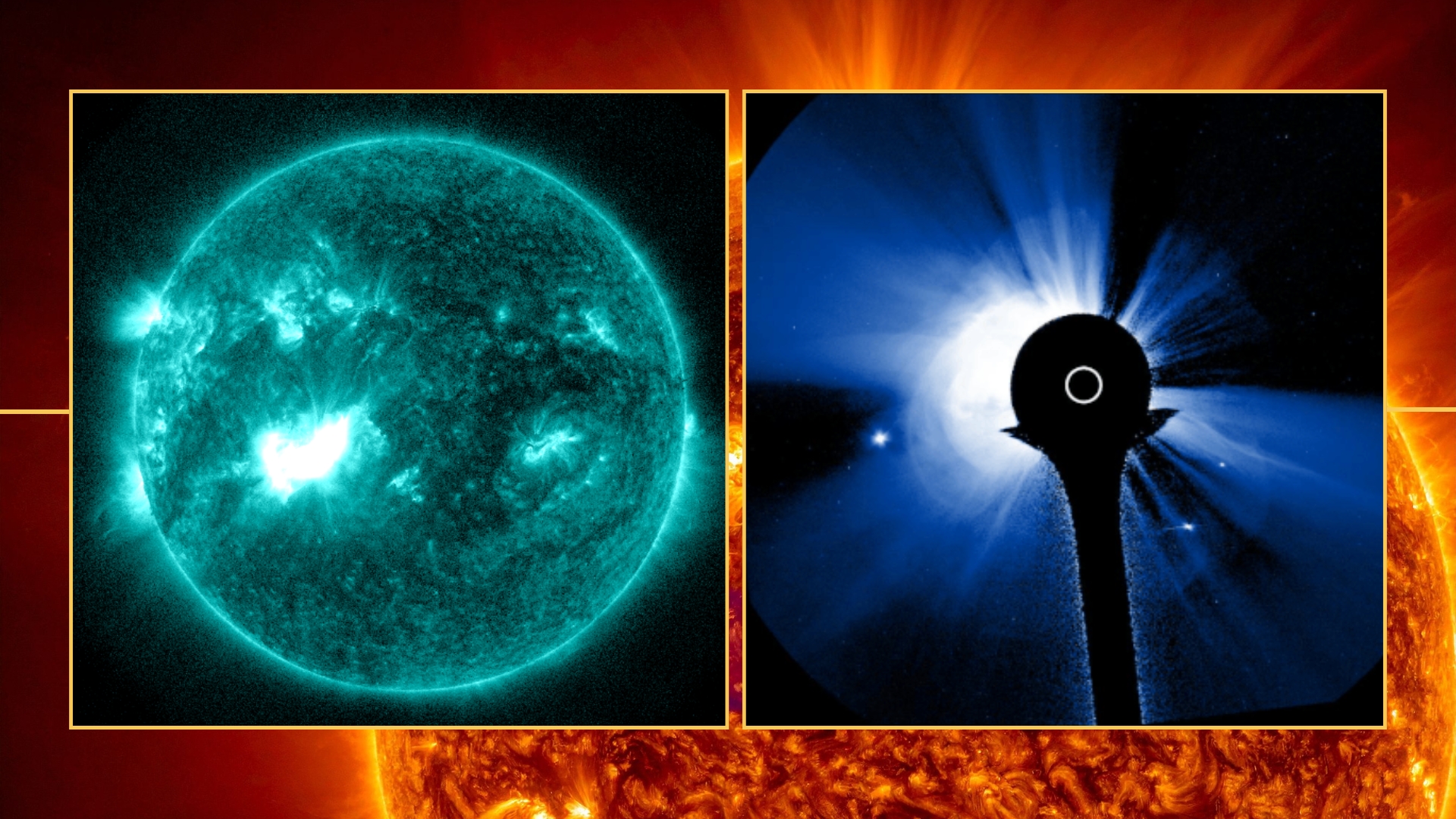
Sun unleashes powerful X-flare, CME hits Earth sparking severe geomagnetic storm
Aurora alert! The colossal solar storm could impact and trigger impressive northern lights.

 (Image credit: Image inset left: NASA SDO, right: NOAA SWPC, graphic made in Canva Pro.)

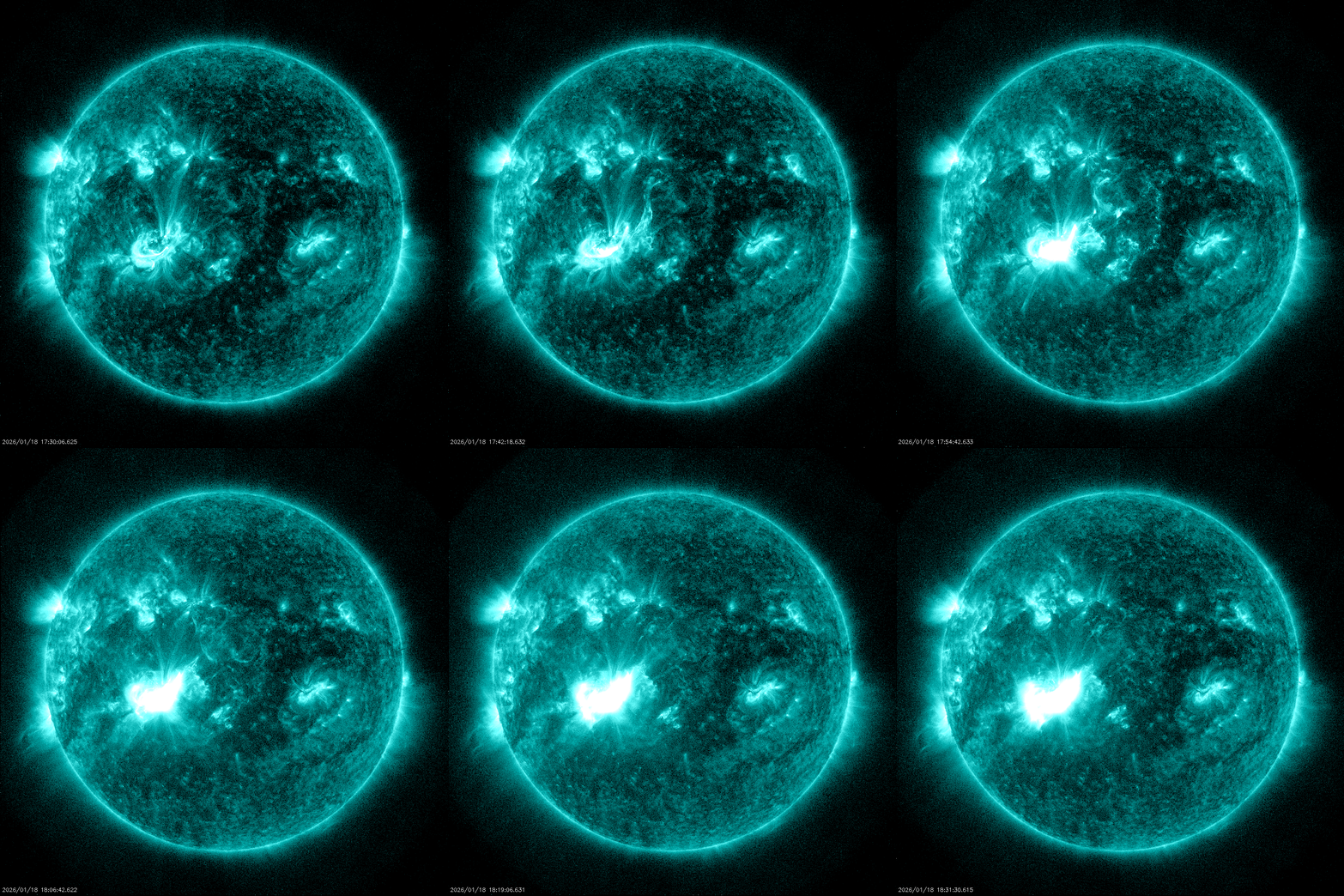
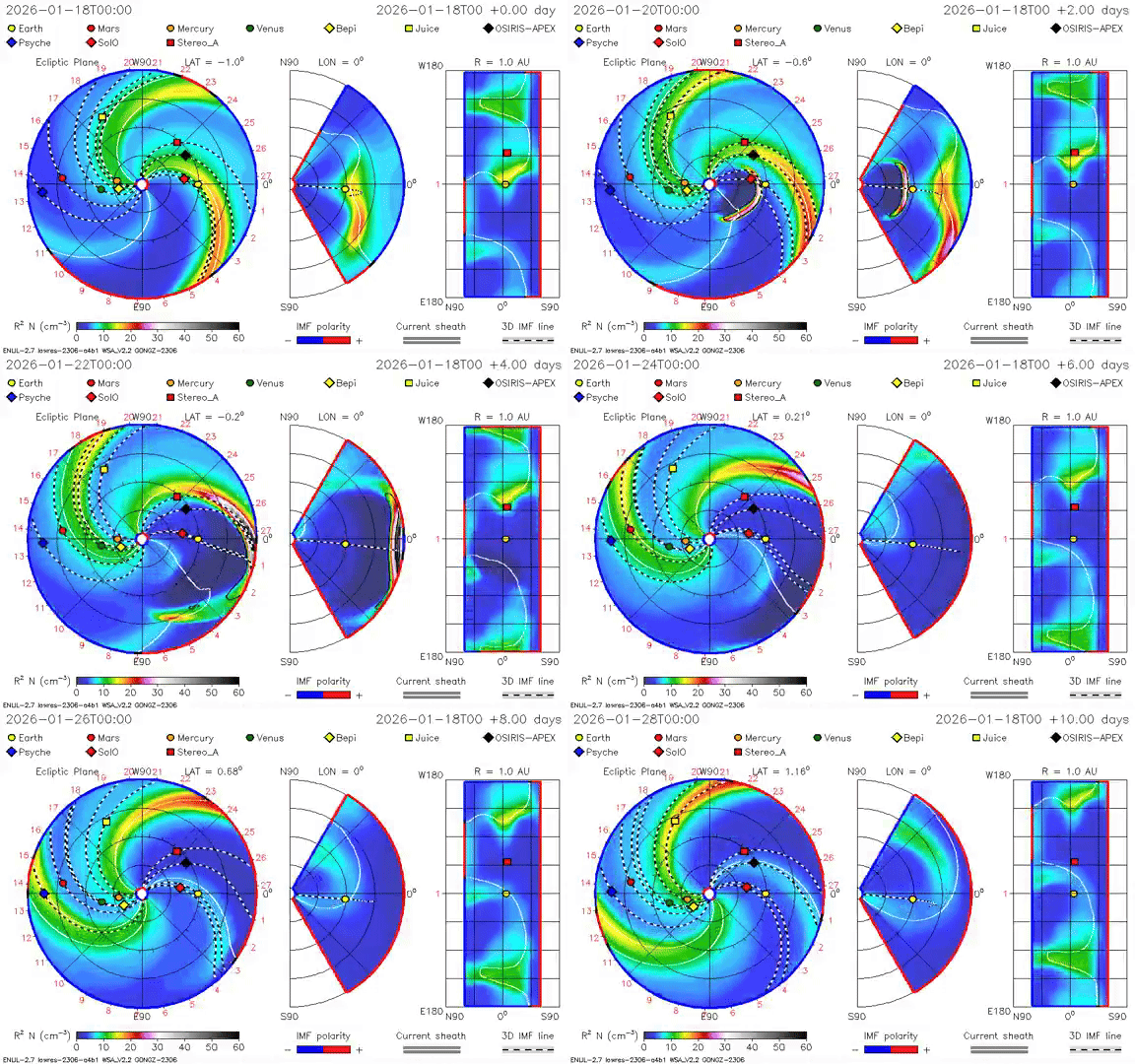
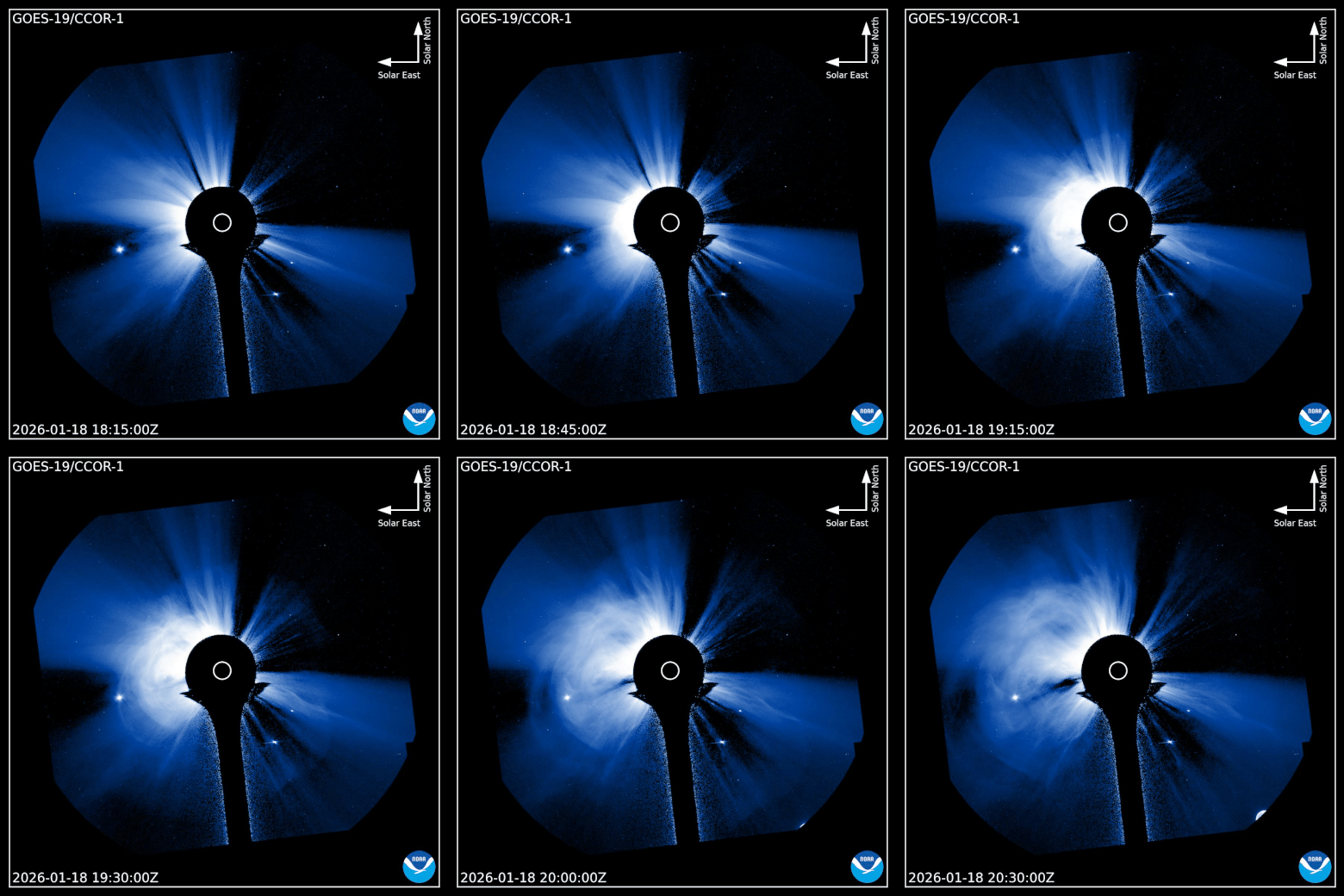
The sun sure has woken up this week, unleashing a powerful X-class solar flare on Jan. 18 that hurled a colossal, fast-moving coronal mass ejection (CME) directly toward Earth. That CME has now arrived, triggering severe (G4) geomagnetic storm conditions far earlier than initially forecast.

Full-halo CME from the X1.9 flare. The three bright specks of light (left to right) are Venus, Mercury and Mars. 
(Image credit: NOAA Space Weather Prediction Center)

The shock wave from the CME struck at 2:38 p.m. EST (1938 GMT) on Jan. 19, according to NOAA's Space Weather Prediction Center, which confirmed that G4 storm levels were reached shortly after impact. The storm is ongoing, and space weather forecasters say CME passage will continue through the evening, keeping the door open for more aurora activity tonight.

Related: Northern lights may be visible in 24 states tonight as a massive CME slams into Earth

You may like
  • two panel image, on the left is a recent cme eruption from the sun that happened this morning nov. 10, on the right is a sweeping green aurora in a spiral pattern in the sky. the recent eruption could spark impressive auroras in the coming days.

Aurora alert! Sun fires off 2 colossal X flares as multiple CMEs race toward Earth

  • close up view of the sun firing off a colossal X5.1 solar flare on Nov. 11.

Sun unleashes strongest solar flare of 2025, sparking radio blackouts across Africa and Europe

  • two panel image showing the cme that left the sun on Nov 5 that is currently heading for Earth and on the right is a vivid northern lights display.

Surprise geomagnetic storm arrives early as NOAA warns more solar impacts are on their way today


Sun unleashes powerful X-flare, CME hits Earth sparking severe geomagnetic storm

Why the CME's impact depends on its magnetic orientation

CME arrivals are notoriously difficult to forecast. Their speed, direction of travel and — most importantly — their magnetic orientation all determine how strongly (if at all) they will interact with Earth's magnetic field.

If the CME's magnetic field is oriented southward, a component known as the Bz, it can more easily link up with Earth's northward-pointing magnetic field, allowing energy to pour into our planet's magnetosphere and trigger geomagnetic storm conditions.

X1.9 solar flare erupts from the sun on Jan. 18.  (Image credit: NASA Solar Dynamics Observatory)

If the Bz is instead oriented northward, Earth's magnetic field largely deflects the incoming energy, effectively "closing the door," and what looked like a promising space weather event can end up being a bit of a nothing burger.

Some CMEs contain a mixture of southward and northward magnetic fields, which can lead to stop-start or fluctuating geomagnetic activity. These events keep space weather forecasters and aurora chasers very much on their toes.

Even now, after the CME has arrived, we won't fully understand its magnetic orientation until it's sampled in real time by solar wind monitoring spacecraft like DSCOVR and ACE, positioned upstream of Earth.

NASA model of the incoming CME and predicted arrival time.  (Image credit: NASA)

What's an X-class solar flare?

Solar flares are ranked in ascending strength from A, B, C and M up to X, with each letter representing a tenfold increase in intensity. X-class flares are the strongest eruptions and the number following the X indicates how powerful the event is. Today's flare was measured at X1.9, putting it in the upper tier of solar outbursts.

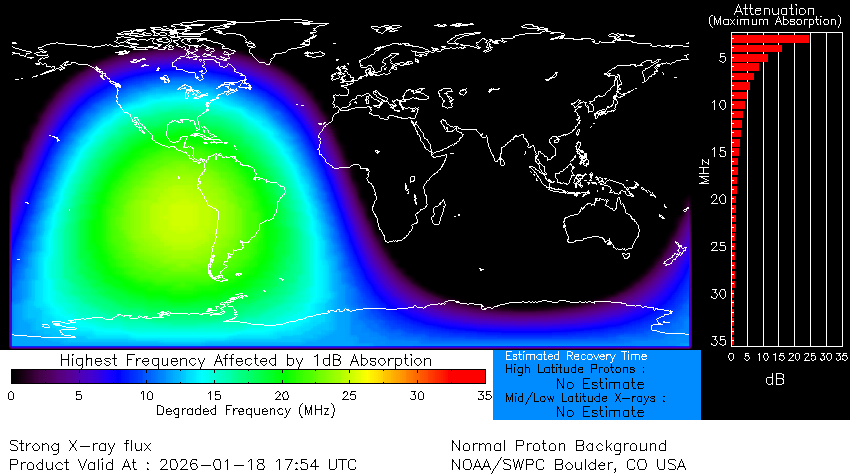
The powerful flare from sunspot region AR4341 peaked at 1:09 p.m. EST (1809 GMT), according to NOAA's Space Weather Prediction Center. The eruption triggered strong (R3) radio blackouts across the sunlit side of Earth, with the most severe disruptions concentrated over the Americas.

The X1.9 solar flare triggered radio blackouts across the Americas.  (Image credit: NOAA Space Weather Prediction Center)

What is a CME and how can it affect Earth?

A CME is a massive expulsion of plasma from the sun that carries a magnetic field. If a CME hits Earth's magnetosphere — the protective magnetic "bubble" generated by our planet — it can trigger a geomagnetic storm.

These geomagnetic storms vary in intensity and are therefore classified on a scale from minor (G1) to extreme (G5). Current forecasts from the U.K. Met Office suggest the incoming CME could produce strong (G3) to severe (G4) geomagnetic storm conditions.

Storms of this magnitude can disrupt satellite operations, degrade GPS navigation and increase atmospheric drag on spacecraft. They can also supercharge auroral activity, potentially pushing the northern lights far beyond their usual high-latitude haunts and into mid-latitude regions near 45° latitude.

  • Editor's note: This article was updated on Jan. 19 at 4:30 p.m. EST (2130 GMT) to reflect that the coronal mass ejection (CME) has arrived and triggered G4 (severe) geomagnetic storm conditions, according to NOAA. Forecasts and visibility potential may continue to evolve as the storm progresses.
Sun unleashes powerful X-flare, CME hits Earth sparking severe geomagnetic storm

{ https://www.space.com/space-exploration }

Hoe vind je dit bericht?
Geschreven door peter om 21:52 Stuur door

Mysterious 'vehicle of unknown origin' hidden at US Navy Base raises questions about secret UFO program

Mysterious 'vehicle of unknown origin' hidden at US Navy Base raises questions about secret UFO program

A mysterious UFO has been allegedly stored at a little-known US Navy base on the East Coast for decades as the military continues to reverse-engineer its secrets. 

A new report has claimed that Naval Air Station Patuxent River in Maryland, better known as Pax River, has kept an 'exotic vehicle of unknown origin' secretly housed there, possibly since the 1950s.

According to anonymous sources tied to Naval Air Systems Command (NAVAIR), which is headquartered at Pax River, certain military programs at the base have been involved in analyzing and exploiting technology recovered from non-human craft for years.

NAVAIR is a major part of the US Navy, which handles everything related to naval aircraft, weapons, and aviation systems. It designs, builds, tests, buys, repairs, and keeps Navy and Marine Corps aircraft ready for use.

Speaking to the Liberation Times, the unnamed sources claimed that two types of aircraft have been trying to spy on what the US has at Pax River. One is allegedly drones from China, and the other are non-human UFOs.

Recently, this spying activity has allegedly increased and moved closer to land, including right around the Navy base on the Chesapeake Bay.

Although the claims could not be confirmed by the Daily Mail, UFO whistleblower Luis Elizondo stated in written testimony to Congress that a specially built hangar was constructed at Pax River specifically for the transfer of extraterrestrial technology.

Under oath, Elizondo described a plan where this hangar would help major defense contractor Lockheed Martin move non-human technology to another company called Bigelow Aerospace for further study and analysis.

Naval Air Station Patuxent River in Maryland (Pictured from space) has allegedly been used to store and study 'non-human' technology, including a craft of 'unknown origin'

Naval Air Station Patuxent River in Maryland (Pictured from space) has allegedly been used to store and study 'non-human' technology, including a craft of 'unknown origin'

UFO whistleblowers have continued to claim to Congress that the US military is in possession of advanced extraterrestrial technology it is working to reverse-engineer

UFO whistleblowers have continued to claim to Congress that the US military is in possession of advanced extraterrestrial technology it is working to reverse-engineer

The Daily Mail has reached out to Lockheed Martin for comment. Bigelow Aerospace went dormant as a company in 2020, laying off its entire workforce during the Covid pandemic. 

According to the sources who spoke to Liberation Times, the US government allegedly has a secret contingency plan for moving the unidentified craft if its specific location at Pax River becomes publicly known or is threatened by further spying.

The report added that some of the activity seen taking place near the base is believed to be linked advanced drones or aircraft that use technology that's been copied and developed from the supposed exotic materials.

Although Elizondo claimed that a new facility was built at Pax River just for these UFO transfers, the anonymous sources said none of them took place after the CIA's former director of science and technology blocked companies from gaining access.

Elizondo is a former senior intelligence official who worked at the Pentagon, where he led a secret government program called the Advanced Aerospace Threat Identification Program (AATIP).

AATIP studied unidentified anomalous phenomena (UAP), the new name for UFOs, determining if they were a possible threat to national security.

Elizondo, a whistleblower since 2017, testified under oath in 2024 to Congresswoman Nancy Mace that the government maintains secret programs to recover crashed spacecraft. 

Additionally, Elizondo's testimony noted that these programs have successfully reverse-engineered some of this technology and that the US was now in possession of advanced non-human equipment, including at bases like Pax River.

Pax River (Pictured) is the headquarters for NAVAIR, a major part of the US Navy that designs, builds, and tests, Navy and Marine Corps aircraft

Pax River (Pictured) is the headquarters for NAVAIR, a major part of the US Navy that designs, builds, and tests, Navy and Marine Corps aircraft

Luis Elizondo (Pictured) led the government's Advanced Aerospace Threat Identification Program and has knowledge of America's UFO crash recovery missions

Luis Elizondo (Pictured) led the government's Advanced Aerospace Threat Identification Program and has knowledge of America's UFO crash recovery missions

'These facilities included locations in the Las Vegas area and a newly built hangar at the Patuxent River Naval Air Station (“PAX”),' Elizondo said in his testimony.

'Specifically, the PAX River hangar was designed to facilitate the transfer of future materials via air and river.'

The Maryland base has been home to the Naval Air Warfare Center Aircraft Division (NAWCAD) since 1992, a group that conducts research, development, testing, and evaluation of new aircraft and weapons, including advanced and experimental projects.

Although the US military has said there has never been any physical evidence of UFOs recovered, multiple former government employees and scientists have come forward to claim that several vehicles have been recovered since the 1940s.

Last year, Dr Hal Puthoff, a physicist and electrical engineer who worked on the government's psychic spy and UFO research programs, revealed on the Joe Rogan Experience podcast that the US military has recovered more than 10 spacecraft since the infamous Roswell incident.

Although there was no evidence to confirm it, Puthoff claimed that some of these craft were actually fully intact craft that had been 'gifted' to humans by extraterrestrials.

Thousands of reports of large, silent drones (Pictured) over New Jersey and sensitive sights along the East Coast started in November 2024 and carried into 2025

Thousands of reports of large, silent drones (Pictured) over New Jersey and sensitive sights along the East Coast started in November 2024 and carried into 2025

The unverified claims about Pax River and potential spying overhead come just one year after hundreds of unidentified drones and UFOs were spotted flying over the East Coast by both the military and the American public. 

The bizarre drone swarms appeared to focus on US military installations as well as other key sites, including President Trump's property in New Jersey.

Many Americans described them as 'car-sized drones', making no noise as they flew closely overhead of residential neighborhoods from November 2024 until early 2025. 

To this day, the origin of the drones, their targets over New Jersey and the rest of the East Coast, and their research remain a mystery.

However, an unnamed private firm contracted by the US military eventually took responsibility for the drone swarms, claiming they were conducting tests of their advanced aerial craft, according to off-the-record comments at an Army summit in August 2025.


{ https://www.dailymail.co.uk/sciencetech/index.html }

Hoe vind je dit bericht?
Geschreven door peter om 21:29 Stuur door

MAGA Congresswoman Claims UFOs Might Be ‘Interdimensional Beings’

MAGA Congresswoman Claims UFOs Might Be ‘Interdimensional Beings’

Rep. Anna Paulina Luna talked with Joe Rogan about what she's seen. Kind of.

Rep. Anna Paulina Luna, R-Fla., talks with reporters after a meeting of the House Republican Conference in the U.S. Capitol on Tuesday, April 8, 2025.

Rep. Anna Paulina Luna, R-Fla., talks with reporters after a meeting of the House Republican Conference in the U.S. Capitol on Tuesday, April 8, 2025.  © Tom Williams/CQ-Roll Call, Inc via Getty Images

What are those unexplained objects zipping around in the sky? They could be aliens; they could be secret government aircraft; they might even be Superman. Or, if you believe the latest MAGA politician to appear on Joe Rogan’s podcast, they’re beings from another dimension.

Rep. Anna Paulina Luna, a Republican from Florida, has held hearings on Capitol Hill to investigate UAPs, unidentified aerial phenomena, and the congresswoman told Rogan on Wednesday’s episode that she’s seen evidence they could be “interdimensional beings.”

“Based on our interviews, and this has been something that you can go back and watch with the congressional hearings, but I was actually able to ask some of the witnesses, ‘What are these things?'” Luna told Rogan. “And they keep saying interdimensional and then when you talk about the interdimensional aspect of ‘are these things pre-existing maybe outside of what we currently know as our own dimension?’…”

Rogan was obviously curious and asked Luna to elaborate. The congresswoman, who earlier this year introduced legislation to put Trump’s face on Mount Rushmore, then tried to explain and seemed to suggest that these “interdimensional beings” were found in the Bible. Or at least they would’ve been, if the Bible hadn’t been censored.

Rep. Luna: Well, they call them interdimensional beings. I think that they can actually operate through the time-spaces that we currently have. And that’s not something that I came up with on my own. That’s based on stuff that we’ve seen, that’s based on information that we’ve been told. And then also too, I think that there’s this historical aspect of, you know, this gets into the deeper theories and concepts of religion and I think the history that we currently know. And that kind of spins off into another topic of, you know, you have the modern day Bible, you have this aspect of books of the Bible that have been removed that explain and kind of touch on these topics. And I think that we’re in a time and age where you have such a vast amount of information that we have access to via social media, via your cell phone, via the internet. And so it’s really changing the way that we understand, you know, the origins of life and the spiritual reality that we know.

Luna had a knack for rambling without saying much or providing evidence. So Rogan pressed her on what evidence there might be to prove that UAPs are actually beings from another dimension. She kept giving vague answers, but insisted that she’s seen evidence. Sadly, she just can’t tell you what it is.

Rep. Luna: Yeah, so look, have I seen a portal open? No. Have I seen a spaceship? Personally no. Have I seen evidence of this? Yes. Have I seen photo documentation of aircraft that I believe were not made by mankind? Yes. Is there historical significance to this? Yes. multiple events that go back to, I would argue, maybe even before the time of Christ that have documented this in text? Yes.

Luna acknowledged throughout the interview that the U.S. government may have advanced technology that could explain some of the UAP sightings, but she kept coming back to this idea that there was something supernatural about it all. And she floated conspiracy theories about how these kinds of beings had been censored in the editing of the Bible, specifically invoking the idea that the Book of Enoch had not been included as part of the Bible for shadowy reasons.

Luna, who said she’s read the Book of Enoch “multiple times,” insisted that she wasn’t saying these mysterious beings were angels, but noted there were “other creations that God made,” according to her understanding of Christianity.


Luna said she’s seen classified photos in a SCIF that she can’t talk about, something that clearly frustrated Rogan. “I’m very confident that there’s things out there that have not been created by mankind,” Luna said.

The congresswoman made other wild claims during the interview about the CIA discovering the Ark of the Covenant in the 1980s and strongly suggesting that remote viewing is a reality. She also mentioned that some autistic people had telepathic abilities, a reference to a popular podcast called the Telepathy Tapes. And everything she mentioned was cloaked in this conspiratorial thinking as she insisted that powerful people were hiding the truth from the American people.

“It seems crazy that people have access to information that shows that there’s something outside of us that is more intelligent, at least more capable than we are. And they hide it from everybody else,” Rogan said.

Crazy indeed, Mr. Rogan. Crazy indeed. Did you guys hear about those Epstein files?

{ https://gizmodo.com/tech/tech-policy }

Hoe vind je dit bericht?
Geschreven door peter om 21:14 Stuur door

Newly Released Video Shows U.S. Reaper Drone Shooting at ‘UFO’

Newly Released Video Shows U.S. Reaper Drone Shooting at ‘UFO’

A grainy new video provides fresh fodder for America's UFO enthusiasts.
A UFO in the desert
© Shutterstock/PeopleImages.com - Yuri A

A recent Congressional hearing revealed video of a Hellfire missile fired by a Reaper drone “bouncing off” an unidentified flying object, which has onlookers—Congress included—scratching their heads. The hearing took place in a House Oversight subcommittee meeting on UFO transparency that was partially hosted by MAGA congresswoman and state-sanctioned UFO investigator Rep. Anna Paulina Luna.

The video sure is, uh, something. As Fox News melodramatically puts it:

A House hearing on unidentified aerial phenomena (UAPs) stunned lawmakers when video evidence showed a U.S. drone firing a Hellfire missile at an orb off Yemen—only for the object to remain intact and keep moving, raising urgent questions about technology beyond known military capabilities.

The video was first shared publicly by Rep. Eric Burlison (R-Missouri), who noted that it was “taken [on] October 30 of 2024″ and characterized it as an “MQ-9 drone tracking an orb or this object off the coast of Yemen.” Burlison said the footage is “presented as received from a whistleblower. Independent review is ongoing.”

Calling this “orb” a UFO seems like a stretch, since it likely had something to do with the regional military conflicts around Yemen, where the footage was captured. But hey, it is a flying object that hasn’t been identified.

A few years ago, UFOs were re-branded as UAP (unidentified aerial phenomenon). The rebrand was, like most rebrands, followed by a re-launch of the core product (in this case, UFO stories), and an attempted cultural re-glow-up. By that I mean, there’s been a concerted effort to make UFOs “a thing” again, and Rep. Luna has been at the forefront of those efforts. Luna’s recently launched “Task Force on the Declassification of Federal Secrets” has been designed to resurrect many controversial “conspiracy theory”-tinged topics, UFOs included. Luna also hosted a hearing that featured claims made by supposed UFO whistleblower David Grusch
What does the above video actually show? Your guess is as good as mine. I doubt it shows a time-traveling entity from another realm or an extraterrestrial spacecraft (both things that people who have spoken at Luna’s various hearings have offered as potential explanations for recent UFO sightings). However, one thing of material substance revealed at this hearing is that the U.S.’s unmanned aerial cadres are now being deployed to shoot unidentified objects out of the sky. The War Zone writes, of the recently released footage:

The footage and the circumstances behind it are otherwise unconfirmed, but this appears to be the first known instance of a Reaper engaging an aerial target of any kind in an operational setting…The idea of employing MQ-9s in the air-to-air role, at least for self-defense, is not new. In a test in 2017, a Reaper successfully downed a target drone using an AIM-9X Sidewinder air-to-air missile. There was a precedent already at that time for arming drones in this way, with at least some Predators having been modified to allow them to fire heat-seeking Stingers in the lead-up to the U.S.-led invasion of Iraq in 2003. In at least one instance in 2002, a Predator fired a Stinger at an Iraqi MiG-25 Foxbat fighter that was trying to shoot it down…

A story about a hostile engagement between aliens and a drone would, of course, be more interesting, but the evolution of unmanned aerial defense systems is pretty interesting, too. On that front, our flying killer robots just seem to keep getting better and better. That’s good news, I suppose, until the day one happens to come after you.


Hoe vind je dit bericht?
Geschreven door peter om 20:56 Stuur door

Sheriff Puzzled by UFOs Hovering Over Power Station

Sheriff Puzzled by UFOs Hovering Over Power Station

"It's like the new normal."
Hoe vind je dit bericht?
Geschreven door peter om 20:37 Stuur door

Great Comet of 2026? Newly discovered object 6AC4721 has a chance at this title

Great Comet of 2026? Newly discovered object 6AC4721 has a chance at this title

Less than a week ago, a unique discovery was made. Astronomers managed to find a comet from the Kreutz family at the greatest distance in history. The comet was given the temporary designation 6AC4721, and it is now the focus of attention for a large number of professionals and amateurs. Some comets from the Kreutz family become so spectacular that they are given the status of Great Comets. But will 6AC4721 succeed in doing so?

Unique discovery

On January 13, 2026, a new faint object with a magnitude of +17.8 was discovered using the 28-centimeter telescope at the AMACS1 observatory in San Pedro de Atacama (Chile), operating as part of the MAPS program. The object was moving against the backdrop of stars. It was added to the Minor Planet Center (MPC) database under the temporary designation 6AC4721, where it awaits confirmation by other observatories. 

Renowned comet discoverer Alan Hale photographed 6AC4721 the day after its discovery, on January 14. Source: astronomynow.com.

Its uniqueness became apparent quite quickly. Professionals and amateurs agree that it is a sun-grazing comet belonging to the Kreutz (or Kroyts) family, one of the families whose comets approach the Sun at an extremely close distance. In this case, it will remain approximately 760,000 kilometers from the center of the star, which is only ~64,000 km from the photosphere. So, comets from the Kreutz family are very rarely found using ground-based telescopes. Success in the case of 6AC4721 gives hope that the comet will be very bright in just a few weeks.

Usually, comets from the Kreutz family are discovered in images taken by space solar coronagraphs. In this sense, the SOHO observatory is unrivalled. Physically, such comets are often very small, literally a few dozen meters in size, and therefore impossible to see from a great distance. They only become visible when they approach the Sun, when the heated ice of the nucleus actively sublimates, and the comet grows a tail and coma.

What is even more striking is the time that will pass between the discovery of 6AC4721 and its passage through perihelion, the point in its orbit closest to the Sun. According to available data, the comet will be near our star on April 4, which means that almost three months will pass between its discovery and perihelion! Accordingly, the distance from the Sun of 2.056 astronomical units, at which the comet was first seen, is an absolute record for Kreutz comets. Previously, this record was held by the legendary comet C/1965 S1 (Ikeya–Seki), discovered 33 days before perihelion.

Surprisingly, despite more than 120 observations accumulated by January 19, the comet has not yet been given a permanent designation and is still listed on the MPC database’s page for possible new comets. Most likely, it will be the first comet registered in 2026, so it will be designated C/2026 A1.

Gerald Rhemann and Michael Jäger were the first to obtain a color image of comet 6AC4721, photographing it on the evening of January 17.

Like a butterfly to the light

Being a sungrazing comet is very risky. These icy bodies often approach the Sun at a distance less than its radius. The intense stress from powerful gravity and heating often leads to the disintegration of the comet’s nucleus. However, at the same time, the comet puts on a real celestial show. 

It is believed that comets of the Kreutz family, to which 6AC4721 belongs, originate from a single large cometary body. Their orbits are very similar to the trajectory of the Great Comet, which was observed near the Sun in the winter of 372–371 BC. It probably fragmented, and the fragments continued to move along similar trajectories.

In 1106, a true queen of comets appeared — it could be seen near the Sun even during the day. Nowadays, scientists mostly agree that the Great Comet of 1106 came from the one seen in 372–371 BC. There’s evidence that it also broke up, creating a big subgroup of cometary bodies.

Heinrich Kreutz noticed the similarity between the orbits of the Great Comets of 1843 and 1843 and the orbit of the comet of 1106, and suggested that they had a common origin. Therefore, the comet family was named after Kreutz.

Image of comet C/1965 S1 (Ikeya–Seki) taken by Roger Lynds in 1965. Source: Wikipedia

This family includes such famous comets as C/1965 S1 (Ikeya–Seki) and C/2011 W3 (Lovejoy). However, their fates were different. The first one broke up into at least three pieces before reaching perihelion. The second one managed to survive its encounter with the Sun mainly thanks to its large nucleus, which was about 500 m in size.

For now, scientists predict an unenviable fate for 6AC4721: as it approaches perihelion, the comet will most likely disintegrate. But only time will tell what will actually happen. After all, this is the first comet in the Kreutz family to be caught at such a great distance, so its behavior is difficult to predict.

Will we be able to see this comet?

Bad news for the Northern Hemisphere: the orbits of the Kreutz family comets are such that they are mainly visible from the Southern Hemisphere. However, near its perihelion, 6AC4721 may still give us a chance. The best conditions will occur around April 4, but the window of opportunity will be very short. In addition, the comet will be at a very small angular distance from the Sun, which will make observation significantly more difficult.

If the comet does not disintegrate as it approaches the Sun and survives to perihelion, it could become very bright and, in this sense, the most interesting comet of 2026. In a favorable scenario, we will see spectacular images from astrophotographers and space coronagraphs, and we will be able to admire its magnificent tail.

Based on materials from the Telegram channel “Всесвіт у кишені” (Universe in Your Pocket) which is administered by the public organization of astronomy popularizers “Шлях до Всесвіту.” (Way to the Universe).


A New Comet Is Approaching — But Its Behavior Is Still Uncertain

☄️Great Comet of 2026? C/2025 R3 (PANSTARRS) Is Incoming🔥 #space #absolutecosmos #universe

{ https://universemagazine.com/en/news-en/science-en/ }

Hoe vind je dit bericht?
Geschreven door peter om 18:42 Stuur door

The most powerful radiation storm of the 21st century hit Earth

The most powerful radiation storm of the 21st century hit Earth

On the night of January 19-20, residents of many regions of the Earth were able to see auroras. They were accompanied by the most powerful radiation storm of the 21st century.

Aurora borealis observed on January 19–20, 2026. The photo was taken in the Netherlands. Source: Josh Walet/SIPA/picture alliance

On January 18, the Sun produced a powerful X1.9 class flare. It was accompanied by a coronal mass ejection — a cloud of plasma that was directed toward Earth. Experts predicted that it would reach our planet on January 20. In reality, the emission came much faster — already on the evening of January 19. The reason was that the speed of the solar wind turned out to be much higher than predicted.

Aurora borealis observed on January 19–20, 2026. The photo was taken in Greenland. Source: Josefsen photo

After interacting with the Earth’s magnetosphere, the eruption resulted in a powerful G4-class geomagnetic storm. The resulting auroras were observed much further south than usual, including in Ukraine. Some photographs of this remarkable celestial spectacle were taken at around 30 degrees north latitude.

Aurora borealis observed on January 19–20, 2026, above Lviv. Source: Artur Abramiv/ZUMA/picture alliance

In theory, auroras could have been observed further south, but this was prevented by a change in the BZ index, which took on a positive value. This stopped their “advance”. Nevertheless, the storm that passed became one of the most powerful in the current cycle of solar activity.

The events of January 19–20 are also interesting as they were accompanied by a powerful radiation storm caused by an increase in the concentration of solar protons to record levels in the 21st century. Such events do not pose a threat to Earth, as charged particles are unable to reach the Earth’s surface. However, they can interfere with the operation of satellites, cause navigation errors, and disrupt radio communications. In addition, there is an increased radiation hazard for astronauts during spacewalks, as well as for passengers on transpolar flights.

NOAA warning of an S4-class radiation storm

The recent radiation storm was classified as S4 by the US National Oceanic and Atmospheric Administration (NOAA). Although a higher level of S5 is theoretically possible, it has never been recorded in the history of observations. So S4 is the actual maximum. The last time the S4-class radiation storm was observed was in 2003. However, the recent storm exceeded it in strength.

Sun unleashes most powerful solar radiation storm in over 20 years

AP

For more details on how auroras occur and where and when they can be observed, read our article.

RELATED VIDEOS

{ https://universemagazine.com/en/articles-en/ }

Hoe vind je dit bericht?
Geschreven door peter om 18:29 Stuur door

Zijn oude locaties portalen naar andere dimensies? Een wetenschappelijke analyse van de mogelijkheid van interdimensionale doorgangen in oude sites

Zijn oude locaties portalen naar andere dimensies? Een wetenschappelijke analyse van de mogelijkheid van interdimensionale doorgangen in oude sites

Are Ancient Sites Interdimensional Doorways to Other Realms of Existence?

Inleiding

Het idee dat oude monumenten en sites fungeren als portalen naar andere dimensies of realiteiten heeft de laatste decennia veel aandacht getrokken binnen zowel de populaire cultuur als de wetenschappelijke wereld. Van de piramides van Egypte tot de megalithische standen van Stonehenge en het mysterieuze Gobekli Tepe in Turkije, verschijnen oude plekken herhaaldelijk in discussies over mogelijk interdimensionaal contact. Dit artikel onderzoekt de wetenschappelijke plausibiliteit van de hypothese dat bepaalde oude locaties fungeren als portalen of doorgangen naar niet-gekende realiteiten, gebaseerd op archeologisch, fysisch en metafysisch bewijs, en combineert dit met de huidige kennis binnen de natuurwetenschappen en theorieën over het universum.

1. Historisch en archeologisch overzicht van oude sites

1.1. De rol van oude sites in mythologie en cultuur

Historisch gezien worden oude locaties zoals piramides, sacrale grafvelden en megalithische structuren vaak gekoppeld aan religieuze en spirituele praktijken. In veel culturen hebben deze sites een centrale rol gespeeld in rituelen die gericht waren op het communiceren met goden, voorouders of andere werelden. Bijvoorbeeld, de Egyptische piramides werden niet alleen opgericht als grafmonumenten, maar ook als toegangspoorten tot het hiernamaals, die mogelijk metaforisch gezien de grens tussen verschillende realiteiten symboliseerden.

1.2. Archeologische bevindingen en bestaande theorieën

De archeologische bewijzen rond oude sites tonen dat de planners en bouwers mogelijk een diepgaand begrip hadden van astronomische en geografische factoren. Stonehenge lijkt bijvoorbeeld te zijn afgestemd op bepaalde astronomische gebeurtenissen zoals de zonnewendes, wat suggereert dat oude culturen misschien geloofden in een verbinding tussen de aarde en andere kosmische of spirituele domeinen.

Crystal cave

2. Theoretische kaders over dimensies en realiteiten

2.1. Moderne fysica en multidimensionale theorieën

Volgens de theorieën binnen de moderne fysica, zoals snaartheorie en M-theorie, bestaat het heelal uit meer dan de gebruikelijke vier dimensies (enkele tijd en drie ruimte). Deze theorieën suggereren dat er op fundamenteel niveau verborgen dimensies kunnen bestaan, die niet rechtstreeks waarneembaar zijn met traditionele instrumenten. In deze context is het concept van doorgangen naar andere dimensies niet slechts sciencefiction, maar mogelijk een implicatie van de fundamentele structuur van het universum.

2.2. Wormgaten en portals in theoretische fysica

Wormgaten, theoretische tunnels die twee verschillende punten in de ruimte-tijd verbinden, worden in de relativiteitstheorie beschreven als mogelijke doorlaten naar andere delen van het universum of zelfs andere realiteiten. Alhoewel er geen experimenteel bewijs is voor het bestaan van wormgaten, vormen ze een legitiem theoretisch model voor ‘portalen’ tussen verschillende staten van bestaan.

3. Oude sites als portalen: Mythes, symboliek en mogelijke wetenschappelijke raakvlakken

3.1. Symboliek en architectuur van oude sites

Veel oude structuren bevatten symboliek die mogelijk verwijst naar het transcendente of het interdimensionale. In de Egyptische mythologie vertegenwoordigen piramides de opgaande verbinding tussen de aarde en de sterren, en kunnen ze worden geïnterpreteerd als architectonische manifestaties van een universele ‘ladder’ naar andere realiteiten. Megalithische monumenten zoals Carnac in Frankrijk of de Inca-sites in Zuid-Amerika dragen eveneens grote symboliek die mogelijk refereert aan kosmische poorten.

Kristallen die poorten openen naar parallelle tijdlijnen

3.2. De rol van energie en kristallen

Sommige moderne theorieën suggereren dat bepaalde kristallen en energievelden die in oude sites worden aangetroffen, wellicht functioneerden als natuurlijke energiefocuspunten of zelfs portals. Bijvoorbeeld, het gebruik van kristallen in bepaalde rituelen zou kunnen wijzen op pogingen om de bewustzijns- of energetische velden te beïnvloeden en toegang te krijgen tot andere dimensies.

Crystals and portals

Kristallen en poorten

4. Onderzoek en bewijsvoering

4.1. Geofysisch en energetisch onderzoek

Recente studies hebben geprobeerd om de energetische eigenschappen van oude sites te meten. Variaties in aardstraling, magnetische velden en elektromagnetische golven worden geanalyseerd om te bepalen of er sprake is van opzettelijke of natuurlijke energetische “poorten”. In sommige gevallen blijken structuren zoals de ‘Healing Well’ in Glastonbury of bepaalde megalithische cirkels opmerkelijke energetische anomalieën te vertonen, die mogelijk wijzen op een hogere energiefrequentie.

4.2. Spiritueel en bewustzijnsgerichte benaderingen

Onderzoekers in de veld van metafysica en bewustzijnsstudies analyseren nog steeds de ervaringen en rapportages van mensen die beweren portals te hebben ervaren. Hoewel deze subjectief zijn en moeilijk wetenschappelijk te bevestigen, suggereren ze dat sommige oude structuren mogelijk niet alleen symbolisch, maar ook functioneel kunnen zijn in het faciliteren van interdimensionale ervaringen.

5. Kritische analyse en sceptische standpunten

5.1. Wetenschappelijke beperkingen en de noodzaak van bewijs

Critici wijzen erop dat veel van de hypothesen over oude sites als portalen gebaseerd zijn op interpretaties die niet ondersteund worden door harde empirische gegevens. Het ontbreken van reproduceerbare experimenten en de subjectieve aard van veel bewijzen maken het moeilijk om deze theorieën te bevestigen binnen de wetenschappelijke methode.

5.2. Alternatieve verklaringen

De meeste archeologen en fysici stellen dat de energetische anomalieën mogelijk het resultaat zijn van natuurlijke aardkundige processen of menselijke intentie en ritueelgebruik, zonder dat dit hoeft te wijzen op interdimensionale portalen. Wat soms wordt geïnterpreteerd als ‘pad naar andere dimensies’, kan ook een symbolische of spirituele interpretatie zijn zonder fysische basis.

Did Our Ancestors Know How to Open A Portal to Another Dimension?

6. Poort van de Goden: Het Mysterie van de Aramu Muru Poort

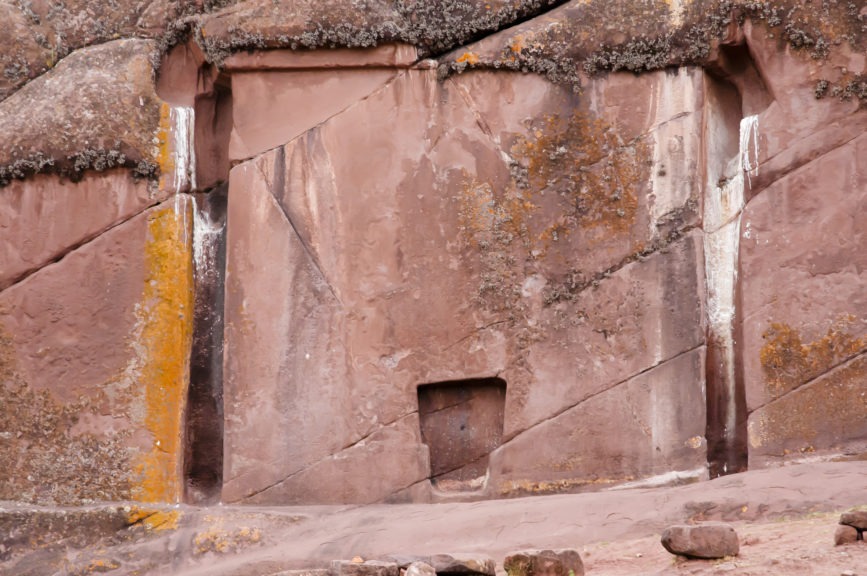
Een locatie die aan deze beschrijving lijkt te voldoen is Puerta de Hayu Marca in Peru. Gelegen op een plateau net buiten de westelijke oever van het Titicacameer, betekent Puerta de Hayu Marca de Poort van de Goden. Met een hoogte en breedte van beide 23 voet, lijkt Hayu Marca, ook bekend als Aramu Muru, een deur of sterrenpoort naar nergens te zijn, uitgehouwen in de Hayu Marca-berg in een afgelegen gebied dat bekend staat als de Vallei van de Geesten of de Steenbos.

gate of the gods peru

Poort van de Goden, Hayu Marca

De legende zegt dat toen Spaanse conquistadores naar Peru kwamen om het goud van de Inca’s te roven, een Inca-priester van de tempel van de Zeven Stralen Hayu Marca gebruikte als een portaal om te ontsnappen. Maru zou een gouden schijf, bekend als de “Sleutel tot de Goden van de Zeven Stralen,” in een uitsparing in het midden van de gebeeldhouwde deur van Hayu Marca hebben geplaatst, waardoor een portaal openging en hij erdoorheen kon lopen naar een nieuwe wereld, om nooit meer gezien te worden. Deze mysterieuze deur heeft sommigen doen speculeren of het een wormgat naar een andere dimensie zou kunnen zijn.

Hayu Marca ligt op een Ley-lijn, waar ook de beroemde Poort van de Zon in Tiwanaku op ligt in het naburige Bolivia, samen met verschillende andere belangrijke archeologische locaties van de Inca’s.

Bezoekers van Hayu Marca hebben opmerkelijk ongebruikelijke energievelden ervaren, waarbij sommigen zeggen dat ze pulserende energie voelen die van de rots uitstraalt wanneer ze hun hand in het midden plaatsen. Velen die de oude locatie online hebben bekeken, vermelden dit gevoel van verhoogde of intense energie daar.

Het nabijgelegen Titicacameer werd door de Inca's vereerd en beschouwd als de geboorteplaats van hun beschaving. Het is ook een van de diepste meren ter wereld en er wordt gezegd dat het een verloren stad en een overvloed aan schatten bevat die door de Spanjaarden zijn geplunderd. In 2000 werd de verloren tempel van Atahualpa diep onder het meer ontdekt, wat bijdroeg aan het mysterieuze karakter van deze oude cultuur.

 7.Conclusie

Hoewel er momenteel geen direct empirisch bewijs is dat oude sites fungeren als fysieke portalen naar andere dimensies, bieden theoretische fysica, archeologisch onderzoek en metafysische theorieën een intrigerend kader voor deze hypothese. Het combineren van archeologische symboliek, energetisch onderzoek en hogere dimensietheorieën opent de mogelijkheid dat onze voorouders een inzicht hadden in het bestaan van meerdere realiteiten en pogingen ondernamen om toegang daartoe te verkrijgen, mogelijk via speciale locaties.

Het hedendaagse onderzoek moet zich richten op het integreren van geofysica, kwantumveldentheorie en bewustzijnsstudies om deze vragen verder te verkennen. Totdat meer bewijs wordt verzameld, blijft het idee dat oude sites poorten zijn naar andere werelden een fascinerende, zij het speculatieve, gedachtegang die onze nieuwsgierigheid naar de aard van realiteit en ons verleden blijft voeden.

Referenties

  • Green, M. (2018). De fysica van multidimensionale universums. Amsterdam: Universiteitsdruk.
  • Hofstadter, D. (2020). De oude wereld en de verborgen krachten. Leiden: Historisch Instituut.
  • Kaku, M. (2014). De theoretische fundamenten van wormgaten. New York: Oxford University Press.
  • Van der Meer, S. (2021). Energetische anomalieën bij megalithische sites. Journal of Archeoenergetics, 12(3), 45-67.
  • Watts, A. (2017). Bewustzijn en dimensies: de link tussen geest en materie. Filosofisch Tijdschrift, 45(2), 89-105.

Samenvatting:
Dit artikel heeft een uitgebreide analyse gepresenteerd over de plausibiliteit dat oude locaties fungeren als portalen naar andere dimensies. Door archeologische, fysische en metafysische perspectieven te combineren, wordt duidelijk dat hoewel er geen sluitend bewijs is, de theorie een fascinerend inzicht biedt in onze geschiedenis en de mogelijke complexe structuur van het universum. Verdere interdisciplinair onderzoek is essentieel om deze wetenschap verder te ontwikkelen.

{ PEER2011 }

Hoe vind je dit bericht?
Geschreven door peter om 17:15 Stuur door

James Webb telescope reveals sharpest-ever look at the edge of a black hole — and it could solve a major galactic mystery

James Webb telescope reveals sharpest-ever look at the edge of a black hole — and it could solve a major galactic mystery

Story by Ivan Farkas

Astronomers have revealed the James Webb Space Telescope's (JWST) sharpest-ever image of the area around a black hole. The spectacular view could help solve a decades-long mystery while reversing a long-held belief about space's most extreme objects.

Since the 1990s, astronomers have observed a curious brightness in infrared wavelengths surrounding the active supermassive black holes (SMBHs) at the centers of some galaxies. Previously, they attributed these excess infrared emissions to the outflows — superheated streams of matter blasted from black holes.

But in a new study published Jan. 13 in the journal Nature Communications, an international team of researchers used JWST to look into the heart of the nearby Circinus galaxy, located only about 13 million light-years from Earth, to reveal the area around the galaxy's SMBH.

The data from JWST, paired with numerous ground-based observations, reveal that the infrared excess is coming from the disk of dusty material that's falling into the Circinus galaxy's central SMBH, rather than from material flowing away from it.

This galactic revelation can help astronomers better understand the growth and evolution of SMBHs, as well as these massive dark monsters' influence on their host galaxies.

Of doughnuts and disks

Active black holes like those at the centers of galaxies are fed by a giant ring of infalling gas and dust. As a black hole draws material from the inner wall of this "doughnut," known as a torus, the material forms a thinner accretion disk that spirals into the black hole like water spiraling into a drain.

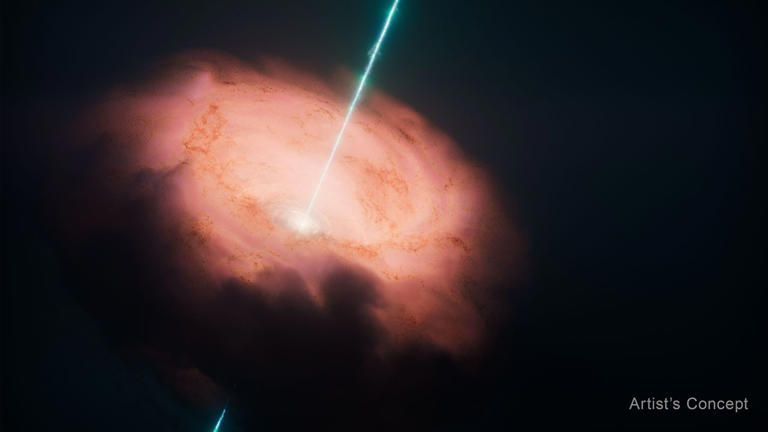
An illustration of a supermassive black hole spewing an energetic outburst into space (Image credit: NASA, ESA, CSA, Ralf Crawford (STScI))
An illustration of a supermassive black hole spewing an energetic outburst into space
(Image credit: NASA, ESA, CSA, Ralf Crawford (STScI))

The black hole's tidal forces accelerate the infalling matter to great speeds. The resulting friction within the disk causes the swirling matter to emit light that glows so brightly that it obscures astronomers' view of the inner region around the black hole.

Yet black holes are not vacuum cleaners, and even they have a feeding limit. So they blast some of the swirling material back into space, in the form of jets or "winds." Therefore, an understanding of the nature of a black hole's torus, accretion disk and outflows is key to knowing how black holes of various sizes accrete and expel matter to potentially shape their host galaxies by quenching or enhancing star formation across galactic scales.

4cde7dc278eb2ff2647a2b447c985dbd

This image from NASA’s Hubble Space Telescope shows the Circinus galaxy. A close-up of its core from NASA’s James Webb Space Telescope shows the inner face of the hole of the donut-shaped disk of gas disk glowing in infrared light. The outer ring appears as dark spots.

| Credit: NASA, ESA, CSA, Enrique Lopez-Rodriguez (University of South Carolina), Deepashri Thatte (STScI); Image Processing: Alyssa Pagan (STScI); Acknowledgment: NSF's NOIRLab, CTIO

Resolving a long-standing mystery

The dense gas and bright starlight in Circinus previously prevented astronomers from viewing the galaxy's central region and SMBH in detail.

"In order to study the supermassive black hole, despite being unable to resolve it, they had to obtain the total intensity of the inner region of the galaxy over a large wavelength range and then feed that data into models," lead study author Enrique Lopez-Rodriguez, a galaxy evolution researcher at the University of South Carolina, said in a NASA statement.

Earlier models separately fit the observed spectra of the torus, accretion disk and outflows, but they couldn't resolve the region in its entirety. As a result, astronomers could not explain which part of the SMBH's surroundings caused the excess emissions in infrared light.

JWST's advanced capabilities allowed astronomers to peer through the dust and starlight of Circinus so they could get a sharper view of the SMBH's environment. To do so, they used an imaging technique known as interferometry.

Ground-based interferometry generally requires an array of telescopes or mirrors that work together to gather and combine light from a celestial object over a large area. By combining light from multiple sources, this method causes the electromagnetic waves that form that light to create interference patterns that astronomers can analyze to reveal the sizes, shapes and other characteristics of those objects.

Unlike these terrestrial facilities, however, the space-based JWST can operate as its own interferometer array via its aperture masking interferometer (AMI), a component of the telescope's Near-Infrared Imager and Slitless Spectrograph (NIRISS) instrument. Like a camera aperture, AMI is an opaque physical mask with seven small, hexagonal holes that control the amount and direction of light entering JWST's detectors.

Overall, AMI effectively doubles JWST's resolution. "This allows us to see images twice as sharp," Joel Sanchez-Bermudez, an astrophysicist at the National University of Mexico and co-author of the study, said in the statement. "Instead of Webb's 6.5-meter [21 feet] diameter, it's like we are observing this region with a 13-meter space telescope."

By doubling its resolution, JWST captured its sharpest-ever view of a 33-light-year-wide area at the center of Circinus. This unprecedented image allowed researchers to calculate that the majority — around 87% — of the excess infrared emissions come from the dusty disk that's actively feeding the central black hole; "the inner surface of the hole of the doughnut," Lopez-Rodriguez said via email. Whereas previous research had suggested that the excess may have come from hot dusty winds, or even the galaxy’s residual starlight, the team found that less than 1% of these emissions come from the energetic outflows streaming away from the SMBH.

The accretion may be extinguishing star formation in the center of Circinus, but confirming this will require a different type of JWST-based observation, Lopez-Rodriguez said.

An invaluable perspective

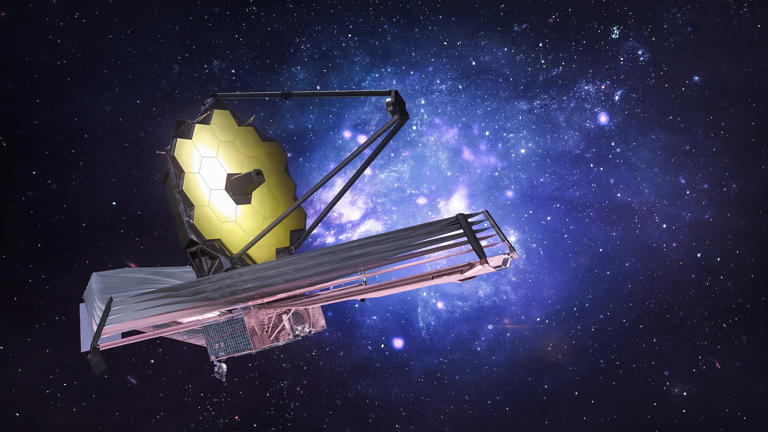
An illustration of the James Webb Space Telescope in orbit (Image credit: Getty Images)
An illustration of the James Webb Space Telescope in orbit
(Image credit: Getty Images)

In addition to revealing previously hidden SMBH mechanics, this research highlights the potential of JWST-based interferometry for studying various celestial objects, including other active SMBHs at the cores of nearby galaxies. By increasing the sample size, astronomers hope to determine whether the infrared emissions from other SMBHs are due to their dusty disks or to their hot outflows.

"AMI has to be used — in order to get precious JWST time — on targets which cannot be done from the ground, or at wavelengths that are blocked by the Earth's atmosphere," study co-author Julien Girard, a senior research scientist at the Space Telescope Science Institute, told Live Science via email.

AMI-based observations can better illuminate our own solar system; they recently offered a detailed look at the volcanoes on Jupiter's hellish moon Io, Girard added. So AMI can observe diverse cosmic objects of varying shapes and sizes, from moons oozing with lava to black holes obscured by dust. In the future, it could help astronomers detect moons around prominent asteroids or reveal the orbits and masses of multistar systems, Girard added.

Like this article? For more stories like this, follow us on MSN by clicking the +Follow button at the top of this page.

Hoe vind je dit bericht?
Geschreven door peter om 16:40 Stuur door

NASA reveals the sharpest EVER look at the edge of a black hole — and it could solve a long–standing galactic mystery

NASA reveals the sharpest EVER look at the edge of a black hole — and it could solve a long–standing galactic mystery

NASA has revealed the sharpest ever look at the edge of a black hole, and it could solve a decades–old galactic mystery.

Located 13 million light–years from Earth, the Circinus Galaxy is home to a supermassive black hole that is constantly blasting radiation into space.

The clouds of hot gas surrounding this black hole are so bright that seeing any real details has previously been all but impossible.

Now, NASA has used the James Webb Space Telescope (JWST) to unveil the strange and powerful forces on the very edge of this black hole.

Supermassive black holes like the one in Circinus remain active by constantly consuming matter from the surrounding galaxy.

Scientists had observed that this process creates a huge amount of infrared energy, but most telescopes weren't sensitive enough to see where it was coming from.

Previously, scientists thought most of this radiation was coming from the black hole's 'outflow' – a stream of superheated matter fired out from the core.

Now, these new observations from the JWST have turned that expectation on its head.

NASA has revealed the closest ever look at the edge of a black hole 13 million light-years from Earth, and it could help solve a decades-old galactic mystery. Pictured: The new James Webb Space Telescope image overlaid on the Hubble image

NASA has revealed the closest ever look at the edge of a black hole 13 million light–years from Earth, and it could help solve a decades–old galactic mystery. Pictured: The new James Webb Space Telescope image overlaid on the Hubble image 

A black hole is the ultra–dense heart of a dead star where gravity is so strong that not even light can escape.

Supermassive black holes, like the one in the Circinus Galaxy, become 'active' by consuming vast quantities of matter from their surrounding galaxy.

As this matter falls inwards, it forms a dense doughnut–shaped ring called a torus that orbits the black hole.

A supermassive black hole gathers material from the torus' inner walls to form an accretion disc, a swirling whirlpool of matter that circles the black hole like water going down a drain.

This accretion disk starts to get hotter through friction until it begins to glow bright enough to show up on our telescopes.

At the same time, that intense energy blasts a large portion of the infalling matter out of the black hole's poles in the form of an outflow or black hole jet.

Although astronomers' models make predictions about how these different parts should interact, it is extremely difficult to see this process in action.

The light from the accretion disk blocks out any details, while the incredibly dense torus hides the inner region of infalling matter from view.

The Circinus galaxy is home to an active supermassive black hole that constantly blasts infrared radiation into space. However, scientists have struggled to determine exactly where around the black hole this radiation comes from

The Circinus galaxy is home to an active supermassive black hole that constantly blasts infrared radiation into space. However, scientists have struggled to determine exactly where around the black hole this radiation comes from 

Scientists would try to fit the different wavelengths of light they observed to the emissions from different regions of the black hole, but not everything could be made to fit neatly.

Most notably, some telescopes could detect an excess of infrared light coming from somewhere in the black hole, but didn't have the resolution to work out where it was coming from.

Lead author Dr Enrique Lopez–Rodriguez, of the University of South Carolina, says: 'Since the 90s, it has not been possible to explain excess infrared emissions that come from hot dust at the cores of active galaxies, meaning the models only take into account either the torus or the outflows, but cannot explain that excess.'

Models assumed that most of the mass, and therefore most of the emissions, would be in the outflow.

But to test this, astronomers needed a way to both filter out the interfering starlight and distinguish the infrared emissions of the torus from those of the outflows.

Luckily, the JWST offered an innovative solution to both of these problems.

The scientists used a tool called the Aperture Masking Interferometer, which essentially converts JWST into several smaller telescopes that all work together.

On Earth, interferometers are usually many different radio or optical telescopes that work together as if they were a single, enormous observatory.

Using a new technique, scientists were able to determine that most of the radiation is coming from a swirling doughnut of matter known as the taurus, not from the jet of ejected matter as previous studies had believed

Using a new technique, scientists were able to determine that most of the radiation is coming from a swirling doughnut of matter known as the taurus, not from the jet of ejected matter as previous studies had believed  

The JWST can replicate this same trick by using a special cover with seven hexagonal holes.

Dr Lopez–Rodriguez told the Daily Mail: 'Interferometry is the technique that provides us with the highest angular resolution possible.

'Using aperture masking interferometry with the JWST is like observing with a 13–meter space telescope instead of a 6.5–meter one.'

Gathering data with this technique, the scientists were able to create an image of the central region.

This is the first extragalactic observation from an infrared interferometer in space, and offers an unprecedented look into the core of an active galaxy.

Contrary to previous estimates, around 87 per cent of the infrared emissions from hot dust in Circinus come from the areas closest to the black hole, while the outflow contributes less than one per cent.

This is a total reversal of what had been predicted by astronomers' best models for supermassive black holes.

However, while the mystery of Circinus' black hole has been solved, there are billions more supermassive black holes out there in the universe.

These images were possible thanks to a technique that converts the James Webb Space Telescope's mirror (artist's impression) into several smaller lenses that all work together to provide extreme resolution in a very small area

These images were possible thanks to a technique that converts the James Webb Space Telescope's mirror (artist's impression) into several smaller lenses that all work together to provide extreme resolution in a very small area

article image

Circinus' accretion disc was only moderately bright, so it makes sense that the torus would dominate its emissions.

But for brighter black holes, the opposite might still be the case, and far more case studies will be needed.

With this research, astronomers found a technique to investigate any black holes they chose, so long as they are bright enough for the Aperture Masking Interferometer to be useful.

Dr Lopez–Rodriguez says: 'We need a statistical sample of black holes, perhaps a dozen or two dozen, to understand how mass in their accretion disks and their outflows relate to their power.'

BLACK HOLES HAVE A GRAVITATIONAL PULL SO STRONG NOT EVEN LIGHT CAN ESCAPE

Black holes are so dense and their gravitational pull is so strong that no form of radiation can escape them - not even light.

They act as intense sources of gravity which hoover up dust and gas around them. Their intense gravitational pull is thought to be what stars in galaxies orbit around.

How they are formed is still poorly understood. Astronomers believe they may form when a large cloud of gas up to 100,000 times bigger than the sun, collapses into a black hole.

Many of these black hole seeds then merge to form much larger supermassive black holes, which are found at the centre of every known massive galaxy.

Alternatively, a supermassive black hole seed could come from a giant star, about 100 times the sun's mass, that ultimately forms into a black hole after it runs out of fuel and collapses.

When these giant stars die, they also go 'supernova', a huge explosion that expels the matter from the outer layers of the star into deep space. 


Sharpest Black Hole Image Ever Captured 😱 | XRISM

What's Special About a Black Hole's Edge?

{ https://www.dailymail.co.uk/sciencetech/index.html }

Hoe vind je dit bericht?
Geschreven door peter om 16:27 Stuur door

Meer van UFO'S of UAP'S, ASTRONOMIE, RUIMTEVAART, ARCHEOLOGIE, OUDHEIDKUNDE, SF-SNUFJES EN ANDERE ESOTERISCHE WETENSCHAPPEN - DE ALLERLAATSTE NIEUWTJES

↑ Terug naar de berichten