Naar de inhoud

UFO'S of UAP'S, ASTRONOMIE, RUIMTEVAART, ARCHEOLOGIE, OUDHEIDKUNDE, SF-SNUFJES EN ANDERE ESOTERISCHE WETENSCHAPPEN - DE ALLERLAATSTE NIEUWTJES

UFO's of UAP'S in België en de rest van de wereld
akke.beakke.be
Ontdek de Fascinerende Wereld van UFO's en UAP's: Jouw Bron voor Onthullende Informatie! Ben jij ook gefascineerd door het onbekende? Wil je meer weten over UFO's en UAP's, niet alleen in België, maar over de hele wereld? Dan ben je op de juiste plek! België: Het Kloppend Hart van UFO-onderzoek In België is BUFON (Belgisch UFO-Netwerk) dé autoriteit op het gebied van UFO-onderzoek. Voor betrouwbare en objectieve informatie over deze intrigerende fenomenen, bezoek je zeker onze Facebook-pagina en deze blog. Maar dat is nog niet alles! Ontdek ook het Belgisch UFO-meldpunt en Caelestia, twee organisaties die diepgaand onderzoek verrichten, al zijn ze soms kritisch of sceptisch. Nederland: Een Schat aan Informatie Voor onze Nederlandse buren is er de schitterende website www.ufowijzer.nl, beheerd door Paul Harmans. Deze site biedt een schat aan informatie en artikelen die je niet wilt missen! Internationaal: MUFON - De Wereldwijde Autoriteit Neem ook een kijkje bij MUFON (Mutual UFO Network Inc.), een gerenommeerde Amerikaanse UFO-vereniging met afdelingen in de VS en wereldwijd. MUFON is toegewijd aan de wetenschappelijke en analytische studie van het UFO-fenomeen, en hun maandelijkse tijdschrift, The MUFON UFO-Journal, is een must-read voor elke UFO-enthousiasteling. Bezoek hun website op www.mufon.com voor meer informatie. Samenwerking en Toekomstvisie Sinds 1 februari 2020 is Pieter niet alleen ex-president van BUFON, maar ook de voormalige nationale directeur van MUFON in Vlaanderen en Nederland. Dit creëert een sterke samenwerking met de Franse MUFON Reseau MUFON/EUROP, wat ons in staat stelt om nog meer waardevolle inzichten te delen. Let op: Nepprofielen en Nieuwe Groeperingen Pas op voor een nieuwe groepering die zich ook BUFON noemt, maar geen enkele connectie heeft met onze gevestigde organisatie. Hoewel zij de naam geregistreerd hebben, kunnen ze het rijke verleden en de expertise van onze groep niet evenaren. We wensen hen veel succes, maar we blijven de autoriteit in UFO-onderzoek! Blijf Op De Hoogte! Wil jij de laatste nieuwtjes over UFO's, ruimtevaart, archeologie, en meer? Volg ons dan en duik samen met ons in de fascinerende wereld van het onbekende! Sluit je aan bij de gemeenschap van nieuwsgierige geesten die net als jij verlangen naar antwoorden en avonturen in de sterren! Heb je vragen of wil je meer weten? Aarzel dan niet om contact met ons op te nemen! Samen ontrafelen we het mysterie van de lucht en daarbuiten.

Archief

The Amazon is shifting into a 'hypertropical state' not seen for MILLIONS of years, scientists warn

The Amazon is shifting into a 'hypertropical state' not seen for MILLIONS of years, scientists warn

The Amazon rainforest is shifting into a 'hypertropical state' that has not been seen for tens of millions of years, scientists have warned.

This new, hotter climate could be commonplace by 2100, and will see the rainforest experience more frequent and intense droughts.

Worryingly, experts from the University of California, Berkeley, say this could lead to widespread tree die–off.

In turn, this will impair Earth's ability to remove carbon dioxide in the atmosphere, since tropical rainforests absorb more carbon emissions than any other biome.

The only way to prevent the hypertropical state from occurring is to curb greenhouse gas emissions, according to Jeff Chambers, lead author of the study.

'It all depends on what we do,' he said.

'It's up to us to what extent we're actually going to create this hypertropical climate.

'If we're just going to emit greenhouse gasses as much as we want, without any control, then we're going to create this hypertropical climate sooner.'

The Amazon rainforest is shifting into a 'hypertropical state' that has not been seen for tens of millions of years, scientists have warned. This new, hotter climate could be commonplace by 2100, and will see the rainforest experience more frequent and intense droughts

The Amazon rainforest is shifting into a 'hypertropical state' that has not been seen for tens of millions of years, scientists have warned. This new, hotter climate could be commonplace by 2100, and will see the rainforest experience more frequent and intense droughts

However, Professor Chambers explained that it has a cumulative impact on the forest – meaning over time, it could be catastrophic.

What's more, the researchers say that hypertropical conditions are also likely to appear outside the Amazon in rainforests in western Africa and across Southeast Asia.

As global temperatures continue to rise, extreme droughts will increasingly occur throughout the entire year, the researchers added.

'Present–day hot droughts are harbingers of this emerging climate, providing windows of opportunity to better understand tropical forest responses to increasingly extreme future conditions,' the authors wrote.

THE PARIS AGREEMENT: A GLOBAL ACCORD TO LIMIT TEMPERATURE RISES THROUGH CARBON EMISSION REDUCTION TARGETS

The Paris Agreement, which was first signed in 2015, is an international agreement to control and limit climate change.

It hopes to hold the increase in the global average temperature to below 2°C (3.6ºF) 'and to pursue efforts to limit the temperature increase to 1.5°C (2.7°F)'.

It seems the more ambitious goal of restricting global warming to 1.5°C (2.7°F) may be more important than ever, according to previous research which claims 25 per cent of the world could see a significant increase in drier conditions. 

The Paris Agreement on Climate Change has four main goals with regards to reducing emissions:

1)  A long-term goal of keeping the increase in global average temperature to well below 2°C above pre-industrial levels

2) To aim to limit the increase to 1.5°C, since this would significantly reduce risks and the impacts of climate change

3) Governments agreed on the need for global emissions to peak as soon as possible, recognising that this will take longer for developing countries

4) To undertake rapid reductions thereafter in accordance with the best available science

Source: European Commission 

{ https://www.dailymail.co.uk/sciencetech/index.html }

Hoe vind je dit bericht?
Geschreven door peter om 15:13 Stuur door

Blind psychic Baba Vanga's prophecy reveals the exact year of humanity's 'absolute doomsday'

Blind psychic Baba Vanga's prophecy reveals the exact year of humanity's 'absolute doomsday'

A blind psychic who allegedly foretold 9/11 and the Covid pandemic gave an exact date the world would end before her death nearly 30 years ago.

Baba Vanga, known as the 'Nostradamus of the Balkans,' predicted humanity's ultimate demise in the year 5079, when a cosmic event of 'unimaginable' proportions would bring about the complete destruction of the universe.

Her vision follows a detailed timeline depicting humanity's evolution, technological advancements, conflicts and eventual extinction. 

According to multiple reports, her prophecy showed humans expanding across the solar system, achieving immortality and even interacting with extraterrestrial civilizations before facing a final, catastrophic event.

Key milestones in the centuries leading up to 5079 include a war on Mars in 3005, a Moon-collision in 3010 and the extinction of life on Earth in 3797, by which point humans have already colonized a new planet. 

By the 4300s, humanity is advancing technologically and morally, curing all diseases and even increasing brain capacity to eliminate concepts like evil and hatred.

Civilization reaches its peak in 4674, with a population of 340 billion across planets and early integration with alien species.

In the final years, humans discover the boundary of the known universe and debate whether to venture beyond it. By 5079, this decision, or some associated catastrophe, triggers 'absolute doomsday,' ending human civilization and the universe.

Baba Vanga, known as the 'Nostradamus of the Balkans,' predicted humanity's ultimate demise in the year 5079, when a cosmic event of 'unimaginable' proportions would bring about the complete destruction of the universe

Baba Vanga, known as the 'Nostradamus of the Balkans,' predicted humanity's ultimate demise in the year 5079, when a cosmic event of 'unimaginable' proportions would bring about the complete destruction of the universe

Baba Vanga left no written records of her predictions. Most of the accounts come from her niece, Krasimira Stoyanova, or other followers who documented her alleged visions after her death, and who have been accused of misinterpreting what she said.

Born in 1911 as Vangeliya Pandeva Dimitrova, she was a famous blind Bulgarian mystic, clairvoyant and herbalist.

She lost her sight at age 12 after being caught in a tornado, an event that coincided with the emergence of her purported psychic abilities.

After turning 30, her powers of foresight, healing, and fortune-telling became prominent, attracting believers who sought her guidance.

She made numerous prophecies, often vague, about natural disasters, political shifts and future technologies, some of which supporters claim foretold events like the Kursk submarine disaster, Brexit and the rise of ISIS.

One of her most famous predictions was the attack on New York City's Twin Towers on September 11, 2001.

'Two metal birds will crash into our American brothers, wolves will howl from the bushes and the blood of the innocent will flow in the rivers,' she predicted.

While she has legions of followers, experts warn her prophecies are speculative and not grounded in fact.

Key milestones in the centuries leading up to 5079 include a war on Mars in 3005, a Moon-collision in 3010 and the extinction of life on Earth in 3797, by which point humans have already colonized a new planet

Key milestones in the centuries leading up to 5079 include a war on Mars in 3005, a Moon-collision in 3010 and the extinction of life on Earth in 3797, by which point humans have already colonized a new planet

According to Baba Vanga's alleged prophecies, humanity's path toward its ultimate end begins far beyond Earth. 

By the year 3005, humans are said to have expanded into space to such an extent that war erupts on Mars, a conflict so severe it alters planetary trajectories. 

Just five years later, in 3010, a comet or asteroid is believed to collide with the moon, sending debris into orbit and forming a visible ring around Earth, dramatically changing the planet's night sky.

article image

By 3797, all life on Earth is said to be extinguished, forcing humanity to survive by establishing colonies on a new planet elsewhere in the cosmos. 

That survival, however, comes at a high cost. Between 3803 and 3805, scarce resources spark devastating wars among the remaining population, wiping out more than half of humanity and pushing civilization toward collapse, according to Baba Vanga's predictions.

In the aftermath, progress grinds to a halt. From roughly 3815 through 3878, humanity regresses into tribal societies, living

 in scattered groups until the emergence of a new prophet who restores moral order. This figure is said to have founded a powerful church that not only spreads religious teachings but also revives forgotten scientific knowledge, laying the groundwork for a slow recovery.

By the early 4300s, civilization enters a renewed golden age. 

New cities rise, scientific breakthroughs accelerate, and humanity succeeds in curing all known diseases. 

Advances in genetics and neuroscience allow humans to dramatically expand their brain capacity, eliminating concepts such as hatred and evil altogether. 

By 4509, humanity reaches what the prophecy describes as an unprecedented moral state, enabling direct communication with God.

The timeline grows even more extraordinary by the late 45th century. 

In 4599, humans are said to achieve immortality, fundamentally reshaping society. 

Civilization reaches its absolute peak in 4674, with an estimated population of 340 billion spread across multiple planets, and early stages of assimilation with extraterrestrial beings already underway.

In the final years before the end, humans make a discovery that ultimately seals their fate. 

Between 5076 and 5078, explorers locate the boundary of the known universe, a mysterious edge whose true nature remains unknown. 

The revelation divides humanity, with a significant portion opposing attempts to move beyond it. 

Despite the warnings, humanity presses forward, and in 5079, Baba Vanga's prophecy culminates in what she described as 'absolute doomsday,' bringing about the destruction of human civilization, and possibly the universe itself.

RELATED VIDEOS

{ https://www.dailymail.co.uk/sciencetech/index.html }

Hoe vind je dit bericht?
Geschreven door peter om 15:00 Stuur door

Blind psychic Baba Vanga's prophecy reveals the exact year of humanity's 'absolute doomsday'

Blind psychic Baba Vanga's prophecy reveals the exact year of humanity's 'absolute doomsday'

A blind psychic who allegedly foretold 9/11 and the Covid pandemic gave an exact date the world would end before her death nearly 30 years ago.

Baba Vanga, known as the 'Nostradamus of the Balkans,' predicted humanity's ultimate demise in the year 5079, when a cosmic event of 'unimaginable' proportions would bring about the complete destruction of the universe.

Her vision follows a detailed timeline depicting humanity's evolution, technological advancements, conflicts and eventual extinction. 

According to multiple reports, her prophecy showed humans expanding across the solar system, achieving immortality and even interacting with extraterrestrial civilizations before facing a final, catastrophic event.

Key milestones in the centuries leading up to 5079 include a war on Mars in 3005, a Moon-collision in 3010 and the extinction of life on Earth in 3797, by which point humans have already colonized a new planet. 

By the 4300s, humanity is advancing technologically and morally, curing all diseases and even increasing brain capacity to eliminate concepts like evil and hatred.

Civilization reaches its peak in 4674, with a population of 340 billion across planets and early integration with alien species.

In the final years, humans discover the boundary of the known universe and debate whether to venture beyond it. By 5079, this decision, or some associated catastrophe, triggers 'absolute doomsday,' ending human civilization and the universe.

Baba Vanga, known as the 'Nostradamus of the Balkans,' predicted humanity's ultimate demise in the year 5079, when a cosmic event of 'unimaginable' proportions would bring about the complete destruction of the universe

Baba Vanga, known as the 'Nostradamus of the Balkans,' predicted humanity's ultimate demise in the year 5079, when a cosmic event of 'unimaginable' proportions would bring about the complete destruction of the universe

Baba Vanga left no written records of her predictions. Most of the accounts come from her niece, Krasimira Stoyanova, or other followers who documented her alleged visions after her death, and who have been accused of misinterpreting what she said.

Born in 1911 as Vangeliya Pandeva Dimitrova, she was a famous blind Bulgarian mystic, clairvoyant and herbalist.

She lost her sight at age 12 after being caught in a tornado, an event that coincided with the emergence of her purported psychic abilities.

After turning 30, her powers of foresight, healing, and fortune-telling became prominent, attracting believers who sought her guidance.

She made numerous prophecies, often vague, about natural disasters, political shifts and future technologies, some of which supporters claim foretold events like the Kursk submarine disaster, Brexit and the rise of ISIS.

One of her most famous predictions was the attack on New York City's Twin Towers on September 11, 2001.

'Two metal birds will crash into our American brothers, wolves will howl from the bushes and the blood of the innocent will flow in the rivers,' she predicted.

While she has legions of followers, experts warn her prophecies are speculative and not grounded in fact.

Key milestones in the centuries leading up to 5079 include a war on Mars in 3005, a Moon-collision in 3010 and the extinction of life on Earth in 3797, by which point humans have already colonized a new planet

Key milestones in the centuries leading up to 5079 include a war on Mars in 3005, a Moon-collision in 3010 and the extinction of life on Earth in 3797, by which point humans have already colonized a new planet

According to Baba Vanga's alleged prophecies, humanity's path toward its ultimate end begins far beyond Earth. 

By the year 3005, humans are said to have expanded into space to such an extent that war erupts on Mars, a conflict so severe it alters planetary trajectories. 

Just five years later, in 3010, a comet or asteroid is believed to collide with the moon, sending debris into orbit and forming a visible ring around Earth, dramatically changing the planet's night sky.

article image

By 3797, all life on Earth is said to be extinguished, forcing humanity to survive by establishing colonies on a new planet elsewhere in the cosmos. 

That survival, however, comes at a high cost. Between 3803 and 3805, scarce resources spark devastating wars among the remaining population, wiping out more than half of humanity and pushing civilization toward collapse, according to Baba Vanga's predictions.

In the aftermath, progress grinds to a halt. From roughly 3815 through 3878, humanity regresses into tribal societies, living

 in scattered groups until the emergence of a new prophet who restores moral order. This figure is said to have founded a powerful church that not only spreads religious teachings but also revives forgotten scientific knowledge, laying the groundwork for a slow recovery.

By the early 4300s, civilization enters a renewed golden age. 

New cities rise, scientific breakthroughs accelerate, and humanity succeeds in curing all known diseases. 

Advances in genetics and neuroscience allow humans to dramatically expand their brain capacity, eliminating concepts such as hatred and evil altogether. 

By 4509, humanity reaches what the prophecy describes as an unprecedented moral state, enabling direct communication with God.

The timeline grows even more extraordinary by the late 45th century. 

In 4599, humans are said to achieve immortality, fundamentally reshaping society. 

Civilization reaches its absolute peak in 4674, with an estimated population of 340 billion spread across multiple planets, and early stages of assimilation with extraterrestrial beings already underway.

In the final years before the end, humans make a discovery that ultimately seals their fate. 

Between 5076 and 5078, explorers locate the boundary of the known universe, a mysterious edge whose true nature remains unknown. 

The revelation divides humanity, with a significant portion opposing attempts to move beyond it. 

Despite the warnings, humanity presses forward, and in 5079, Baba Vanga's prophecy culminates in what she described as 'absolute doomsday,' bringing about the destruction of human civilization, and possibly the universe itself.

RELATED VIDEOS

{ https://www.dailymail.co.uk/sciencetech/index.html }

Hoe vind je dit bericht?
Geschreven door peter om 15:00 Stuur door

Europa Clipper Reveals a New Perspective on Comet 3I/ATLAS

Europa Clipper Reveals a New Perspective on Comet 3I/ATLAS

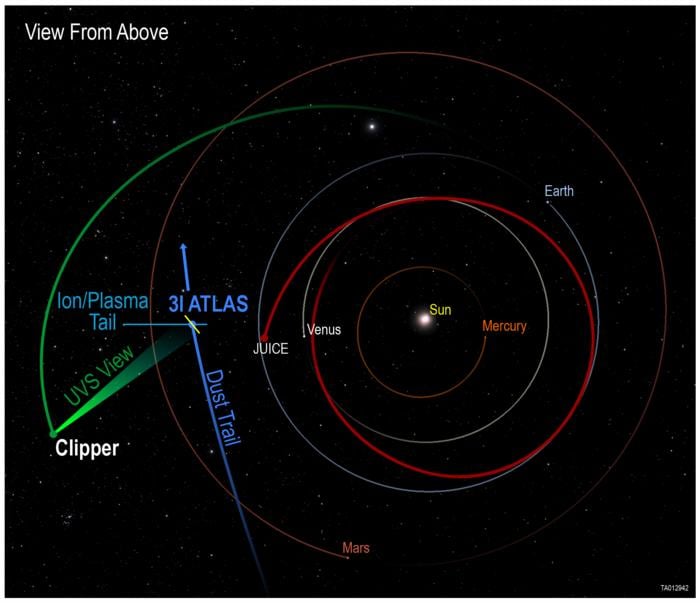
Map of how 3I/ATLAS is traveling through out solar system, compared to the inner planets, JUICe, and Europa Clipper. Credit - NASA/JPL-Caltech/APL/SwRI Map of how 3I/ATLAS is traveling through out solar system, compared to the inner planets, JUICe, and Europa Clipper. Credit - NASA/JPL-Caltech/APL/SwRI

Researchers have been trying to look at interstellar object 3I/ATLAS from every conceivable angle. That includes very unconventional ones. Recently, while 3I/ATLAS passed out of view of the Earth, it moved into a great vantage point for one of our interplanetary probes. Europa Clipper, whose main mission is to explore Jupiter’s active moon, turned its gaze during its six year journey back towards the center of the solar system and observed 3I/ATLAS as it was reaching its perihelion, and out of sight from the Earth.

Realizing that it could do so did not take long. Only a week after first finding this interstellar visitor, rocket scientists at NASA’s Jet Propulsion Laboratory had mapped its entirely trajectory through the solar system. Armed with that information, Europa Clipper’s operational team realized the craft would have a unique vantage point during the later part of this year.

As it makes its way to Jupiter, it is currently curving slightly outside the orbit of Mars. 3I/ATLAS is making its way past the Red Planet, passing slightly inside its orbit, and has already garnered plenty of attention from instruments based there. But, Europa Clipper has some instruments that are uniquely well suited to studying the intricacies of the comet, and it just so happened to be able to observe it after it had moved out of sight from Mars, but before it was again visible from Earth.

The Ultraviolet Spectrograph (UVS) was originally designed to analyze the composition of Europa’s atmosphere and surface. But for the purposes of comet observation, it can detect transitions from atoms and molecules, such as when water breaks into hydrogen and oxygen.

Fraser discusses the actual science behind 3I/ATLAS

Insights like those are particularly critical, as from its vantage point, Europa Clipper was able to see the comet’s two “tails”. One, which follows behind the comet’s path, is made up primarily of dust parts that have fallen off the comet itself. The other, which extends from the comet directly away from the Sun, is made up of particles that have been directly plasmatized by the Sun’s rays.

Both of these tails are of interest to scientists, as they offer some of the best clues both to what 3I/ATLAS is made of, but also the chemical processes that are happening on the comet as it passes close to a star for the first time in potentially billions of years. Tracking how closely those processes conform to expectations of how they work in our own solar system is one of the critical insights that 3I/ATLAS can give us about the makeup of the galaxy outside our own neighborhood.

Europa Clipper also won’t be the only craft observing our visitor during that critical gap in observations from Earth and Mars-based platform. The Jupiter Icy Moon Explorer (JUICE), operator by ESA, also happened to be in position to observe 3I/ATLAS at the same time, but from a more typical view looking away from the Sun, as it passes back through Earth’s orbit on its way out to Jupiter. JUICE has its own version of the UVS instrument, and the additional data from a different angle will inherently complement that taken by Europa Clipper.

Fraser discusses 3I/ATLAS's perihelion, around the time of the Europa Clipper observations.

This extra observational time from these two space probes is honestly just lucky - if they happened to be further on in their journey, they wouldn’t have such a front-row seat to this once in a life-time flyby. While the results and analysis from this event haven’t yet been published, it likely will be in the next few months. Granted, they probably won’t stop sensationalists from continuing to claim that 3I/ATLAS is some sort of alien space craft, but as we continue to gather more evidence that it’s not, both Europa Clipper and JUICE will play a critical role in proving that something unforeseen didn’t happen when the object was blocked from out sight from other vantage points. And before long, Europa Clipper itself will pass through the comet's dust tail - who knows what additional observations it will be able to make from that unique vantage point.

Learn More:

RELATED VIDEOS


{ https://www.universetoday.com/ }

Hoe vind je dit bericht?
Geschreven door peter om 22:12 Stuur door

“Dream turned into a nightmare”: a scientist suffered depression after flying to the edge of space

“Dream turned into a nightmare”: a scientist suffered depression after flying to the edge of space

Activist and researcher Amanda Nguyen, who flew on Blue Origin’s all-female spaceflight in April 2025, has admitted to suffering from severe psychological distress after the mission. After months of battling depression, she has reported feeling better and shared her experience of overcoming severe trauma.

Activist and researcher Amanda Nguyen emotionally exits the New Shepard capsule immediately after landing. Photo: Blue Origin

Dream that turned into a challenge

In her Instagram post, Amanda revealed the deep depression that overwhelmed her after returning to Earth.

“Another dream turned into a nightmare,” she wrote. Nguyen described feeling that all her achievements – her scientific work, her historic status as the first Vietnamese woman in space – were “buried under an avalanche of misogyny” and hostile comments in the media.

A 34-year-old woman, the child of refugees who fled Vietnam by boat, felt like a “collateral victim.” She couldn’t get out of bed for weeks, and a month after the flight, she couldn’t speak through her tears during a call from a Blue Origin employee.

The star-studded crew of the Blue Origin NS-31 space tourism mission. Photo: Blue Origin

Despite her experiences, Amanda emphasized the positive outcomes of the mission. The flight drew attention to her breast cancer research and helped achieve the goal of using science as a tool for diplomacy. She recalled the symbolism: when Neil Armstrong was on the moon, bombs were falling on Vietnam, and now her family had seen a Vietnamese woman in space.

“We arrived in boats, and now we are in spaceships,” she wrote.

The road to recovery

Eight months later, Nguyen felt that “the fog of grief had begun to lift.” In her diary, she wrote, “I am happy to report that my depression is gone.” She concluded that the past never completely leaves us, but she is proud that she kept her promise to fight for her dreams and focus on kindness.

“The best gift this season is that I feel the fog lifting. I can say that it won’t take years,” Amanda Nguyen summed up.

Earlier, we reported on how a space tourist “saw death” after flying on New Shepard.

RELATED VIDEOS

{ https://universemagazine.com/en/articles-en/ }

Hoe vind je dit bericht?
Geschreven door peter om 21:56 Stuur door

The Star of Bethlehem might have actually been a comet described in an ancient Chinese text

The Star of Bethlehem might have actually been a comet described in an ancient Chinese text

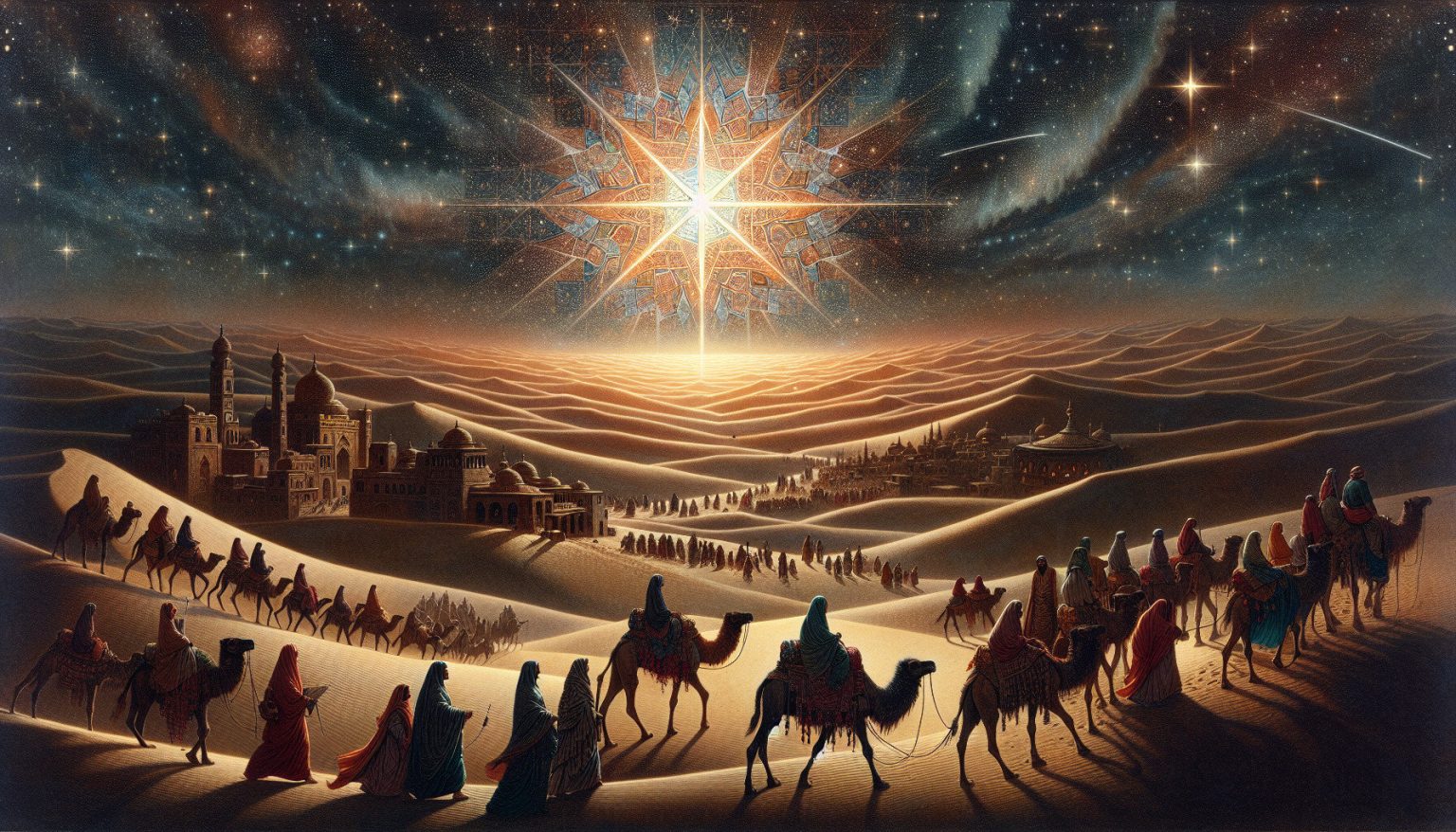
Star of Bethlehem

Image generated by the editorial team using DALL·E for illustrative purposes.

Many researchers have spent decades attempting to decode biblical descriptions and link them to verifiable historical events. One such description is that of the Star of Bethlehem—a bright astronomical body that was said to lead the Magi to Jesus shortly after his birth.

Although many attempts have been made to link the Star of Bethlehem to astronomical bodies, the unique motion of the "star" did not quite fit any known object. However, a new research study, published in Journal of the British Astronomical Association, describes a likely candidate for the bright object seen above Bethlehem over 2000 years ago—a comet described in an ancient Chinese text.

Nonsensical motion

The biblical text in question occurs in the book of Matthew and describes a "star," which the authors of the study suggest may be any celestial object. The text says that the star "went before them, till it came and stood over where the young child was." The star is described as being in the eastern sky. The study authors meticulously analyzed the context and potential meaning of the story.

They write, "The passage indicates that after the Star appeared to precede the Magi on their short journey to Bethlehem, it reached a position over the town, perhaps overhead near the zenith, where its motion came to a noticeable stop for a period coincident with their arrival."

The Star of Bethlehem might have actually been a comet described in an ancient Chinese text

This is a simplified diagram of a hypothetical interplanetary object ("C") traveling near Earth. The subscripts refer to its position at time steps t1 to t7. For a fixed position ("P") on the rotating Earth, the object would appear to remain stationary directly overhead as a "temporary geosynchronous object" for several hours (t3 to t5). Credit: Journal of the British Astronomical Association (2025). DOI: 10.64150/193njt

Of course, this motion is not typical of most astronomical objects, like stars and planets. Instead, most astronomical objects simply appear to rise in the east and set in the west, due to the rotation of Earth. This led to three interpretations: the story is simply a myth used to make a point and no such object existed, it was an actual miracle or there is a natural (although, rare) astronomical event that explains the motion.

Some researchers held onto the idea that there is a physical explanation. After all, there are some situations where an object might appear to stop temporarily in the sky. In particular, an object that is in geosynchronous motion with Earth will appear to be motionless in the sky. This can theoretically occur with a comet if it is in the right place and moving at the right velocity.

A few different comets have been suggested, such as Halley's Comet, but these did not fit the timing or placement needed for the Star of Bethlehem. And so, the authors of the new study conducted a search of many historical documents to find mention of any other observed astronomical events during the time period.

A potential match

A passage in a Chinese document known as the Han Shu (History of the Former Han Dynasty), caught the attention of the study authors with the mention of a "broom star"—known to be a term for a comet—in the "second month" of the "second year."

"The 'second month' of the 'second year' corresponds to the Chinese lunar month spanning 5 BCE [from] March 9 to April 6, which falls neatly within the estimated window for Jesus's birth. Being visible 'for over 70 days' suggests that the object was likely bright," the study authors explain.

The researchers also say that period fits with the life of King Herod, who ordered a massacre of male children under two years old in an attempt to kill Jesus. Herod ruled Judea as a Roman client king from 37 BCE to 4 BCE.

Simulations were conducted to generate possible comet orbits fitting the observations. The numerical modeling showed that this comet could have passed close enough to Earth in June of 5 BCE, to exhibit the "temporary geosynchronous" motion needed to make it appear to pause overhead for several hours. The best-fit orbit showed the comet would have appeared nearly stationary over Bethlehem for about two hours.

Positive omens and Magi motivations

The team also asked the question: "How could a comet appearing in Capricornus in March/April of 5 BCE have convinced the Magi that a king had been born in Judea, prompting them to undertake a long journey?"

To attempt to better understand their motivations, the researchers examined ancient astrological and cultural beliefs that the Magi may have been exposed to in order to explain why they would interpret the comet as a sign indicating the birth of Jesus. They found mentions of comets signifying both good and bad omens in both Greco-Roman and Mesopotamian texts.

"A major criticism of the comet hypothesis is that ancient astrologers interpreted the omens associated with their appearance as harbingers of evil, rather than as signs of good tidings such as a new king. However, closer examination of comet omens will show that interpretations of comet appearances were not always negative," the study authors explain.

They found that some omens in Mesopotamian texts could even have been interpreted to link a comet's appearance with events in the royal families of client kingdoms and that it is possible that this influenced the Magi's belief that the birth of a new Judean king had occurred.

Whether or not the comet mentioned in the Han Shu was the same celestial body witnessed over Bethlehem, the study authors say that this study has proven that such an object could exist that would explain the event.

They conclude by saying, "This study shows that it is no longer justifiable to claim that 'no astronomical event' could possibly have behaved in the manner described by Matthew."

RELATED VIDEOS


{ https://phys.org/space-news/ }

Hoe vind je dit bericht?
Geschreven door peter om 21:42 Stuur door

The Star of Bethlehem could have been a comet from Chinese chronicles

The Star of Bethlehem could have been a comet from Chinese chronicles

The star described in the Gospels, which heralded the appearance of Jesus Christ in Bethlehem, behaves extremely strangely for a celestial body. However, scientists have calculated that under certain conditions, a comet could exhibit similar behavior. They even found a possible candidate.

The Star of Bethlehem. Source: phys.org

The Star of Bethlehem

Recently, the Journal of the British Astronomical Association published an article in which scientists attempted to explain the nature of the star that, according to the Bible, heralded the birth of Jesus Christ in Bethlehem and guided the three wise men from the East to him. Surprisingly, they found a completely rational explanation for it.

This is not the first time scientists have tried to understand whether there is any real astronomical event behind the Gospel myth. And it is clear that the word “star” can actually mean any celestial body. However, in the Gospel of Matthias, where it is described in the most detail, its behavior seems too strange.

Based on the text, the star of Bethlehem was initially somewhere in the east, then, overtaking the Magi, it flew west and hovered somewhere at the zenith above the city where Jesus was born. And it is precisely its stopping in one place that seems most strange. Whether it is a planet, a comet, or something else in space, its rotation should be affected by the rotation of our planet; that is, one way or another, it should rise and set during the day.

But in reality, there is one object that truly seems to hover above one place – a satellite in geostationary orbit. Of course, it actually moves, but its linear velocity is such that its angular velocity coincides with the Earth’s rotation.

Comet from Chinese sources

And now scientists have calculated that the same suspension effect could have occurred when a comet flew close to Earth. Of course, it did not enter geosynchronous orbit. But it moved much faster than a satellite in geostationary orbit. This means that at some point, it could have actually hovered over Bethlehem for a couple of hours.

And the most interesting thing is that the authors have already found a good candidate for the role of the Star of Bethlehem – a comet mentioned in the Chinese chronicle “Han Shu,” also known as the History of the Former Han Dynasty. According to this document, the comet appeared in the second month of the second year and was visible for 70 days. This means that it was indeed very bright.

The specified time period is March-April 5 BC. And this coincides perfectly with assumptions about the true date of Jesus’ birth. After all, King Herod, the same one who is credited with the mass murder of infants, ruled Judea from 37 to 4 BC. So, from this point of view, everything is indeed reliable.

However, opponents of the “comet” theory have another argument. In the tradition of Eastern mystics, which theoretically included the three wise kings, the comet was associated with something bad. However, researchers have recently discovered that this is not entirely true, as its appearance could also be linked to events in the royal family. So it could indeed have been perceived as a sign of the birth of a new king.

{ https://universemagazine.com/en/articles-en/ }

Hoe vind je dit bericht?
Geschreven door peter om 21:30 Stuur door

Europa’s radioactive ocean: what could alien life feed on?

Europa’s radioactive ocean: what could alien life feed on?

NASA scientists have proposed a new, unexpected source of energy that could sustain life in the deep ocean of Jupiter’s moon Europa. It may not be deep heat, but radioactive elements seeping from the ocean floor.

Jupiter rising over Europa. Illustration: Space Engine

A revolutionary model was presented at the annual conference of the American Geophysical Union. It suggests that the key to life may lie not in the moon’s interior, but in the rocks at the bottom of its ocean. Radioactive decay of uranium and potassium in these rocks could provide the energy necessary for biology.

The scale of the possible biosphere

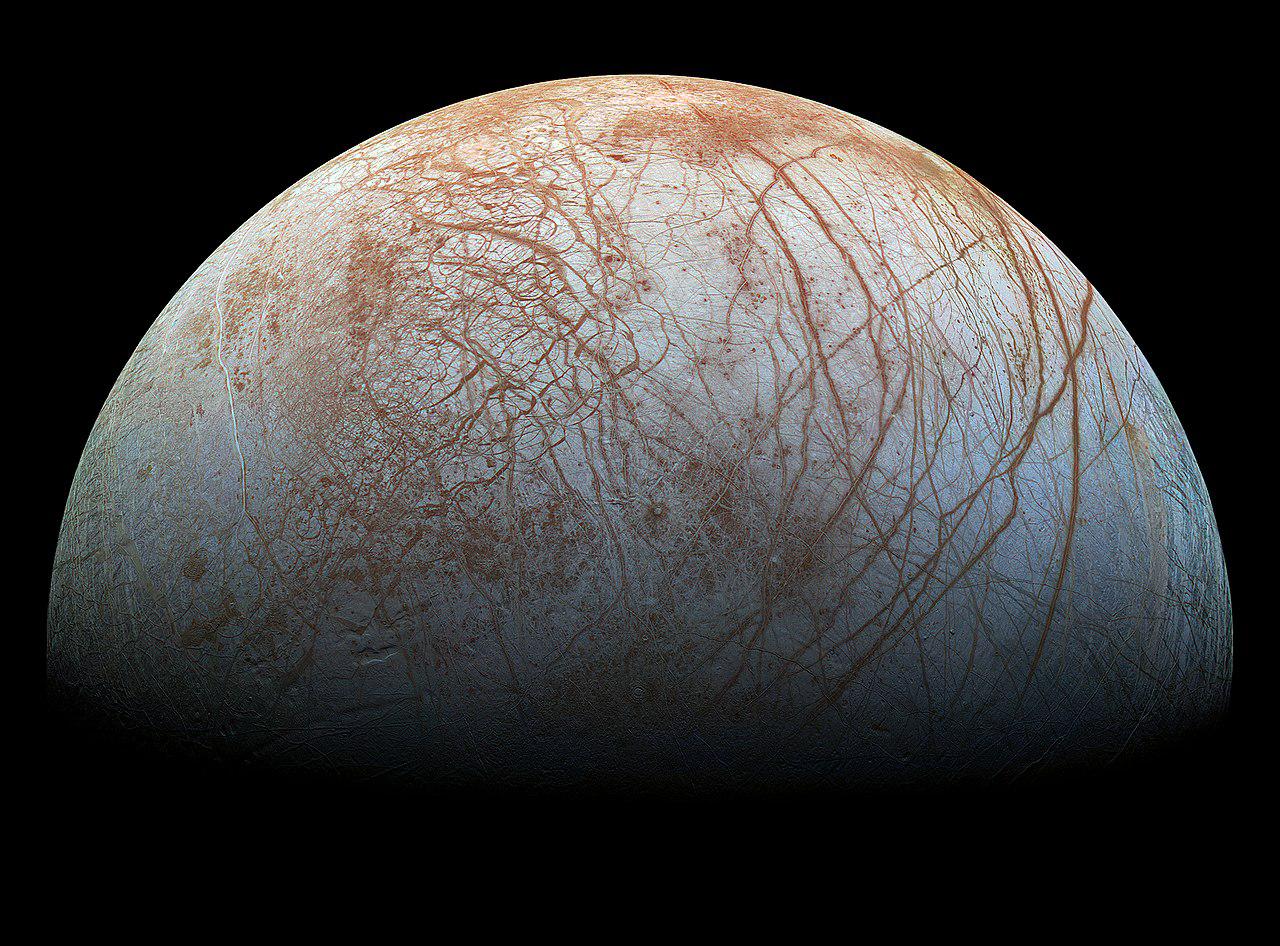
Europa (moon). Source: NASA/JPL-Caltech/SETI Institute

Researchers were inspired by terrestrial ecosystems in deep-sea hydrothermal vents, where microorganisms exist thanks to chemosynthesis – the process of obtaining energy from chemical reactions. A similar process may occur on Europa. Radioactive decay splits water molecules into hydrogen and oxygen ions, which can become “fuel” for microbes.

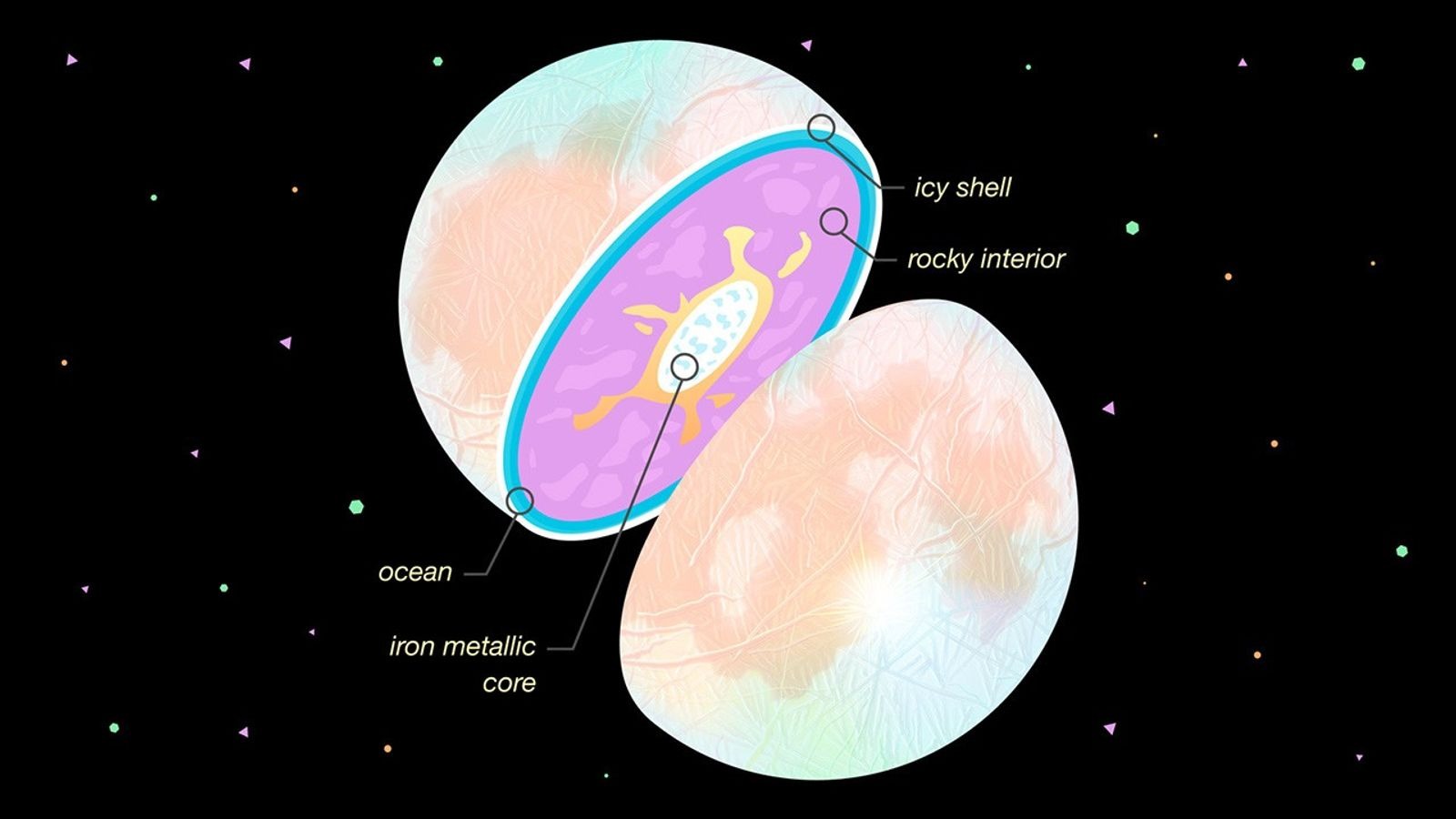
The depth of the ocean on Europa can reach 100 km. Illustration: NASA
Internal structure of Jupiter’s moon Europa. Illustration: NASA

A team led by planetary scientist Ngoc Tuan Truong has modeled the concentration of radioactive isotopes in Europa’s ocean. Calculations showed that the energy released is sufficient to sustain biomass equivalent to a thousand blue whales. This discovery is particularly important in light of new data on Europa’s thick ice crust, which may insulate the ocean from the heat of the core.

Checking the theory

Evidence for this theory may be found by NASA’s Europa Clipper mission, which will reach Jupiter’s system in 2030. The spacecraft will study the composition of the ice and the deep processes of the moon. If the hypothesis is confirmed, Europa will be revealed as a world where life can feed on the energy of radioactive decay – a rather original scenario for the search for extraterrestrial intelligence.

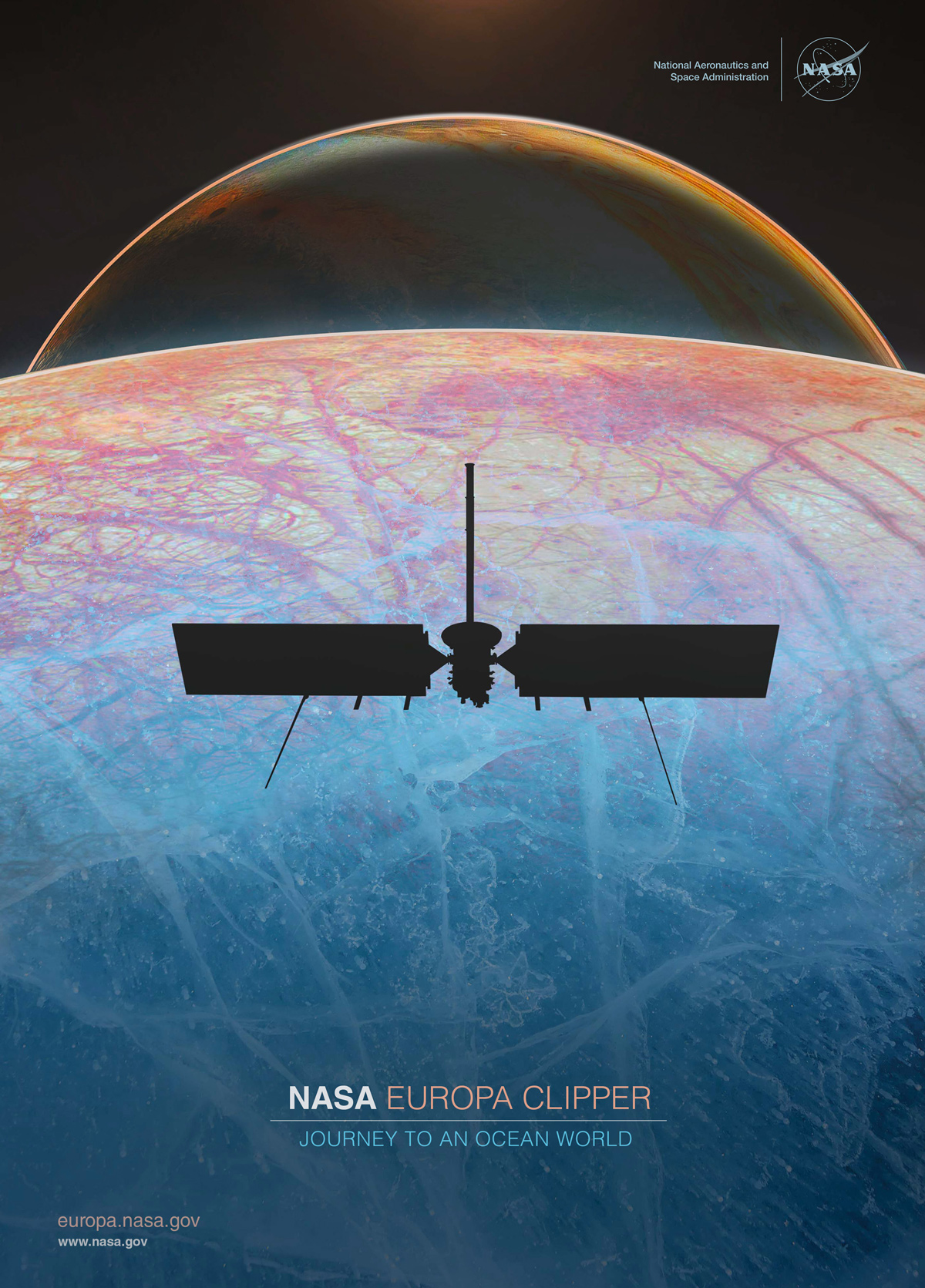
Poster Europa Clipper: Journey to an Ocean World. Source: NASA/ Jet Propulsion Laboratory-Caltech

Earlier, we explained whether Europa will be habitable when the Sun becomes old and red.

RELATED VIDEOS

{ https://universemagazine.com/en/articles-en/ }

Hoe vind je dit bericht?
Geschreven door peter om 21:22 Stuur door

Are we Martians? An interesting idea that life on Earth began on the red planet

Are we Martians? An interesting idea that life on Earth began on the red planet

It is quite possible that Mars was the first planet in the solar system where life originated. And only later did microorganisms from Mars reach Earth. So, from a certain point of view, we may be all Martians.

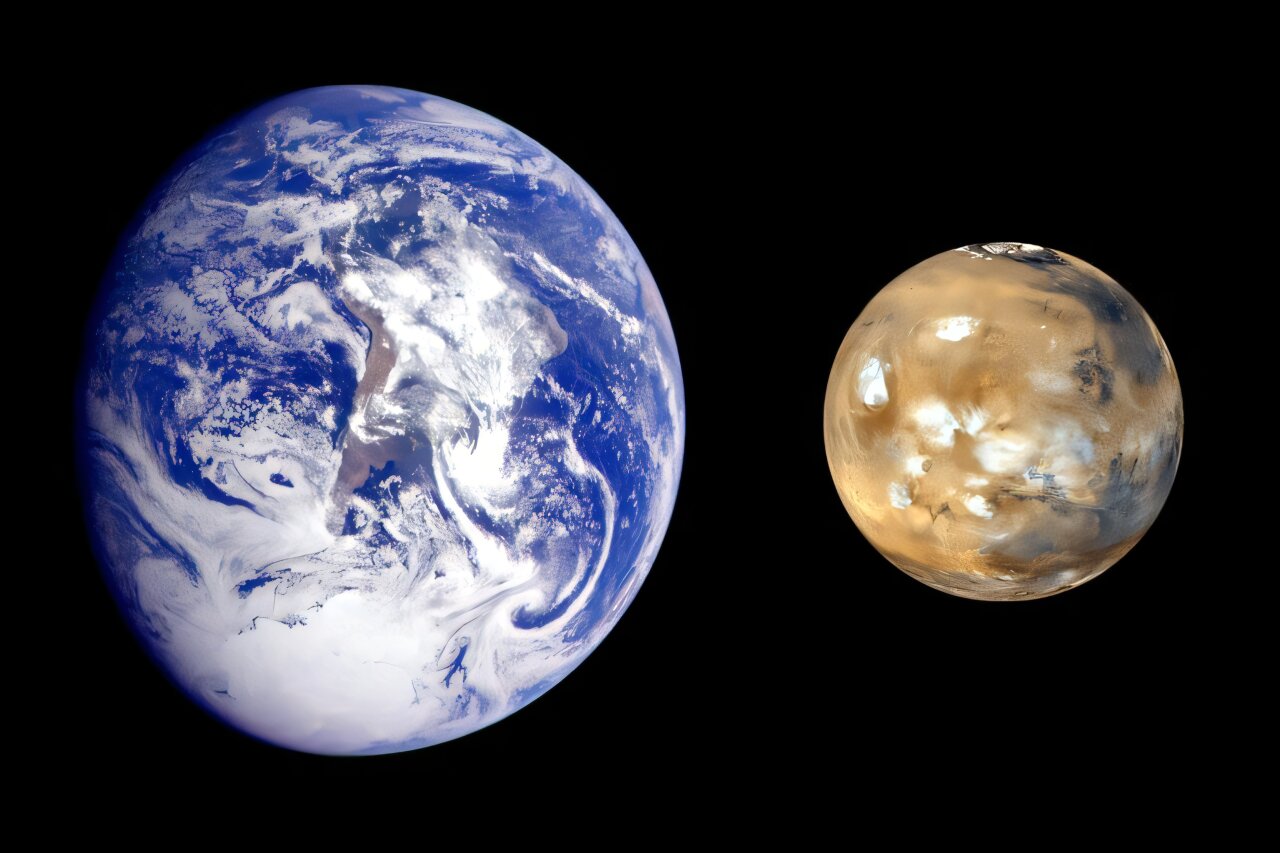
Earth and Mars. Source: phys.org

A bold hypothesis

How did life begin on Earth? While scientists have theories, they don’t yet fully understand the precise chemical steps that led to biology, or when the first primitive life forms appeared.

But what if Earth’s life did not originate here, instead arriving on meteorites from Mars? It’s not the most favored theory for life’s origins, but it remains an intriguing hypothesis. Here, we’ll examine the evidence for and against.

Timing is a key factor. Mars formed around 4.6 billion years ago, while Earth is slightly younger at 4.54 billion years old. The surfaces of both planets were initially molten, before gradually cooling and hardening.

Life could, in theory, have arisen independently on both Earth and Mars shortly after formation. While the surface of Mars today is probably uninhabitable for life as we know it, early Mars probably had similar conditions to early Earth.

The possibility of life forming on Mars

Early Mars seems to have had a protective atmosphere and liquid water in the form of oceans, rivers, and lakes. It may also have been geothermally active, with plenty of hydrothermal vents and hot springs to provide the necessary conditions for the emergence of life.

However, about 4.51 billion years ago, a Mars-sized, rocky planet called Theia crashed into proto-Earth. This impact caused both bodies to melt together and then separate into Earth and its moon. If life had begun before this event, it certainly would not have survived it.

Mars, on the other hand, probably didn’t experience a global remelting event. The red planet had its fair share of impacts in the violent early solar system, but evidence suggests that none of these would have been large enough to destroy the planet, and some areas could have remained relatively stable.

So if life arose on Mars shortly after the formation of the planet 4.6 billion years ago, it could have continued evolving without major interruptions for at least half a billion years. After this time, Mars’ magnetic field collapsed, marking the beginning of the end for Martian habitability. The protective atmosphere disappeared, leaving the planet’s surface exposed to freezing temperatures and ionizing radiation from space.

The time required for life to emerge

But what of Earth: how soon did life appear after the impact that formed the moon? Tracing the tree of life back to its root leads to a microorganism called Luca – the last universal common ancestor. This is the microbial species from which all life today is descended. A recent study reconstructed Luca’s characteristics using genetics and the fossil record of early life on Earth. It is inferred that Luca lived 4.2 billion years ago – earlier than some previous estimates.

Luca was not the earliest organism on Earth, but one of multiple species of microbe existing in tandem on our planet at this time. They were competing, cooperating, and surviving the elements, as well as fending off attacks from viruses.

If small but fairly complex ecosystems were present on Earth around 4.2 billion years ago, life must have originated earlier. But how much earlier? The new estimate for the age of Luca is 360 million years after the formation of Earth and 290 million years after the moon-forming impact. All we know is that in these 290 million years, chemistry somehow became biology. Was this enough time for life to originate on Earth and then diversify into the ecosystems present when Luca was alive?

A Martian origin for terrestrial life circumvents this question. According to the hypothesis, species of Martian microorganism could have traveled to Earth on meteorites just in time to take advantage of the clement conditions following the moon’s formation.

The timing may be convenient for this idea. However, as someone who works in the field, my hunch would be that 290 million years is plenty of time for chemical reactions to produce the first living organisms on Earth, and for biology to subsequently diversify and become more complex.

Surviving the journey

Luca’s reconstructed genome suggests that it could live off molecular hydrogen or simple organic molecules as food sources. Along with other evidence, this suggests that Luca’s habitat was either a shallow marine hydrothermal vent system or a geothermal hot spring. Current thought in the origin of life field is that these kinds of environments on early Earth had the necessary conditions for life to emerge from non-living chemistry.

Luca also contained biochemical machinery that could protect it from high temperatures and UV radiation – real dangers in these early Earth environments. However, it’s far from certain that early life forms could have survived the journey from Mars to Earth. And there’s nothing in Luca’s genome to suggest that it was particularly well adapted to space flight.

To have made it to Earth, microorganisms would need to have survived the initial impact on Mars’ surface, a high-speed ejection from the Martian atmosphere, and travel through the vacuum of space while being bombarded by cosmic rays for at least the best part of a year.

They would then have needed to survive the high-temperature entry through Earth’s atmosphere and another impact onto the surface. This last event may or may not have deposited it in an environment to which it was even remotely adapted.

The chances of all of this seem pretty slim to me. However difficult the transition from chemistry to biology may appear, it seems far easier to me than the idea that this transition would occur on Mars, with life forms surviving the journey to Earth, and then adapting to a completely new planet.

The resilience of microorganisms in space

It’s useful to look at studies of whether microorganisms could survive the journey between planets. So far, it looks like only the hardiest microorganisms could survive the journey between Mars and Earth. These are species adapted to preventing damage from radiation and capable of surviving desiccation through the formation of spores.

But maybe, just maybe, if a population of microorganisms were trapped in the interior of a sufficiently large meteorite, they could be protected from most of the harsh conditions of space. Some computer simulations even support this idea. Further simulations and laboratory experiments to test this are ongoing.

This raises another question – if life made it from Mars to Earth within the first 500 million years of our solar system’s existence, why hasn’t it spread from Earth to the rest of the solar system in the following four billion years? Maybe we’re not the Martians after all.

{ https://universemagazine.com/en/articles-en/ }

Hoe vind je dit bericht?
Geschreven door peter om 21:08 Stuur door

An eerie sound has haunted Cincinnati for weeks and no one can explain it

An eerie sound has haunted Cincinnati for weeks and no one can explain it

For several weeks, residents across multiple Cincinnati neighborhoods have reported a persistent and unusual eerie sound that appears to have no clear point of origin. 
eerie%20sound%20Cincinnati.jpg

This is not the first time people have reported hearing strange sounds. Over the years, unexplained noises have been documented around the world, from mysterious sky booms and trumpet-like blasts to The Hum, a persistent low-frequency tone heard by only a small percentage of the population. 
Such phenomena are often tentatively linked to geological activity, industrial operations, or unusual atmospheric conditions. Some have even suggested a connection to unidentified aerial phenomena (UAP/UFO) in our skies. Despite decades of reports, these sounds continue to baffle both scientists and residents alike, and to this day, no definitive explanation for their sources exists.  
The noise Cincinnati is described as an oscillating, siren-like tone rising and falling in pitch, sometimes lasting for extended periods, sometimes stopping abruptly. Those who hear it say it is impossible to locate, yet difficult to ignore. 
While unexplained sounds are not uncommon in dense urban environments, what has drawn attention in this case is the lack of a confirmed explanation despite weeks of reports. 
One potential explanation involves aging locomotive equipment operating at a nearby rail yard. Certain engines are known to produce low-frequency acoustic effects that can travel considerable distances under specific atmospheric conditions. 
However, a spokesperson for the rail company has stated that they are unable to confirm the rail yard as the source of the sound. 
As of now, no person, agency or company has publicly identified the origin of the mysterious noise.

{ http://ufosightingshotspot.blogspot.com/ }

Hoe vind je dit bericht?
Geschreven door peter om 20:58 Stuur door

Meer van UFO'S of UAP'S, ASTRONOMIE, RUIMTEVAART, ARCHEOLOGIE, OUDHEIDKUNDE, SF-SNUFJES EN ANDERE ESOTERISCHE WETENSCHAPPEN - DE ALLERLAATSTE NIEUWTJES

↑ Terug naar de berichten