Ontdek de Fascinerende Wereld van UFO's en UAP's: Jouw Bron voor Onthullende Informatie!
Ben jij ook gefascineerd door het onbekende? Wil je meer weten over UFO's en UAP's, niet alleen in België, maar over de hele wereld? Dan ben je op de juiste plek!
België: Het Kloppend Hart van UFO-onderzoek
In België is BUFON (Belgisch UFO-Netwerk) dé autoriteit op het gebied van UFO-onderzoek. Voor betrouwbare en objectieve informatie over deze intrigerende fenomenen, bezoek je zeker onze Facebook-pagina en deze blog. Maar dat is nog niet alles! Ontdek ook het Belgisch UFO-meldpunt en Caelestia, twee organisaties die diepgaand onderzoek verrichten, al zijn ze soms kritisch of sceptisch.
Nederland: Een Schat aan Informatie
Voor onze Nederlandse buren is er de schitterende website www.ufowijzer.nl, beheerd door Paul Harmans. Deze site biedt een schat aan informatie en artikelen die je niet wilt missen!
Internationaal: MUFON - De Wereldwijde Autoriteit
Neem ook een kijkje bij MUFON (Mutual UFO Network Inc.), een gerenommeerde Amerikaanse UFO-vereniging met afdelingen in de VS en wereldwijd. MUFON is toegewijd aan de wetenschappelijke en analytische studie van het UFO-fenomeen, en hun maandelijkse tijdschrift, The MUFON UFO-Journal, is een must-read voor elke UFO-enthousiasteling. Bezoek hun website op www.mufon.com voor meer informatie.
Samenwerking en Toekomstvisie
Sinds 1 februari 2020 is Pieter niet alleen ex-president van BUFON, maar ook de voormalige nationale directeur van MUFON in Vlaanderen en Nederland. Dit creëert een sterke samenwerking met de Franse MUFON Reseau MUFON/EUROP, wat ons in staat stelt om nog meer waardevolle inzichten te delen.
Let op: Nepprofielen en Nieuwe Groeperingen
Pas op voor een nieuwe groepering die zich ook BUFON noemt, maar geen enkele connectie heeft met onze gevestigde organisatie. Hoewel zij de naam geregistreerd hebben, kunnen ze het rijke verleden en de expertise van onze groep niet evenaren. We wensen hen veel succes, maar we blijven de autoriteit in UFO-onderzoek!
Blijf Op De Hoogte!
Wil jij de laatste nieuwtjes over UFO's, ruimtevaart, archeologie, en meer? Volg ons dan en duik samen met ons in de fascinerende wereld van het onbekende! Sluit je aan bij de gemeenschap van nieuwsgierige geesten die net als jij verlangen naar antwoorden en avonturen in de sterren!
Heb je vragen of wil je meer weten? Aarzel dan niet om contact met ons op te nemen! Samen ontrafelen we het mysterie van de lucht en daarbuiten.
The usual annual highlights include eclipses, full moons, and meteor showers. But let’s look a little further into the future. Here are the most spectacular cosmic events expected to occur before the end of 2100.
What will future astronomers see in the sky? Illustrative photo: Unsplash
The flight of the asteroid Apophis
Asteroid 99942 Apophis.Image: Space Engine
The first major spectacle, which previously gained notoriety due to distorted media reports, awaits us on April 13, 2029. The asteroid Apophis, with a diameter of 370 m, will fly by at a distance of only 32,000 km from Earth – closer than satellites in geostationary orbit.
Its discovery caused concern. However, more accurate calculations have almost completely ruled out a collision with Earth in this century. Nevertheless, the 2029 flyby is a unique opportunity for science, as such a close approach occurs only about once every 800 years.
The return of Halley’s Comet
Halley’s Comet (1P/Halley) is the most famous comet and the brightest of the short-period comets
The last perihelion of the famous Halley’s Comet took place in 1986. The next return of the tailed guest is expected in 2061. Moreover, next time there will be the most favorable conditions for its observation, because it will be 9 times brighter. It will be a wonderful object for observation. In addition, the comet is expected to meet with Venus, which promises an additional spectacle.
V Sagittae
This faint star in the constellation Sagitta has been slowly but steadily brightening since the early 20th century. Astronomers believe it is a binary system, where two stars are gradually moving closer together. The most popular theory says that towards the end of the century, around 2083±10 years, these stars may merge. This will cause a powerful explosion – the birth of a new or even supernova star. V Sagittae may shine brighter than Sirius in the sky and be visible even during the day for weeks or months.
The Great Conjunctions of Jupiter and Saturn
These two giant planets come together in the sky every 20 years. But not every conjunction is clearly visible. In 2040, the phenomenon will be moderate, but in September of that year, all visible planets will line up in a row, creating a beautiful sight.
Space connections in 2040 and 2080
But the most important conjunction will be in 2080. That is when Jupiter and Saturn will come extremely close together – at a distance similar to the record set in 2020. They will also be far from the blinding glare of the Sun, providing ideal conditions for observation around the world.
Unpredictable events
The century also promises surprises that cannot be accurately dated at this time:
Flashes of new meteor showers, more powerful than the famous Leonids.
The explosion of a supernova in our Milky Way galaxy, the first in many centuries.
Bright comets that are currently located far away in the outer Solar System.
Interstellar objects, which were first officially confirmed only in the last decade, and since 2017, three such “guests” have been officially detected.
Despite the forecasts, the main thing is to remain attentive to the sky. The most memorable astronomical events often come unexpectedly.
Deep inside the Earth, at the boundary between the mantle and the outer core, there are so-called ultra-low velocity zones – areas that seem to be unaffected by the fiery chaos raging in the depths. Now, scientists claim to have unraveled their mystery.
What lies beneath the Earth? Source: www.livescience.com
Ultra-low speed zones
At the very center of our planet is a solid inner core. Between it and the crust, matter is in a very hot and liquid state and is divided into two layers: the outer core and the mantle above it. Recently, the journal Nature Communications published a study by scientists from the Institute of Earth Sciences of the Chinese Academy of Sciences, in which they attempted to unravel one of the mysteries lurking at the point of their collision.
The fact is that the 300-kilometer layer at the boundary between the outer core and the mantle, i.e., at a depth of 2,900 km, has a complex structure. Complex processes of mass and heat exchange take place there, but at the same time, there are relatively small areas of up to 100 km in size that are characterized by extremely low seismic activity and high density.
They are called ultra-low velocity zones. It is believed that they have a significant impact on the processes occurring in this boundary layer, but scientists still do not understand where they come from.
Thermal insulation materials
Researchers have tackled this mystery in their latest work. They used ultra-fast optical spectroscopy in combination with diamond cells with a high-pressure and high-temperature anvil. This allowed them to study the properties of the iron-rich magnesiowüstite, which may make up the low-velocity zones.
Usually, minerals rich in metal have high thermal conductivity; they are like natural radiators for heating systems, but in magnesiowüstite, this indicator turned out to be extremely low. Simply put, it is a good heat insulator.
Scientists now understand that ultra-low velocity zones are actually pieces of heavy thermal insulation floating in viscous, molten material and altering the flows within it. Further research will reveal how this occurs.
A study has laid bare the shocking true cost of climate change as heatwaves, wildfires, droughts and storms cause havoc around the world.
The 10 most costly climate disasters alone cost the world more than $120 billion (£88.78 billion) in 2025, according to a report from Christian Aid.
Each was made significantly more likely and more devastating by the effects of human-caused climate change.
And scientists warn that these calculations only reflect insured losses, with the true cost of climate-influenced disasters likely to have been even higher.
This devastating fire alone caused more than $60 billion (£44.4 billion) in damages and killed 40 people.
This was followed by the cyclones which struck Southeast Asia, causing $25 billion (£18.5) in damage and killing more than 1,750 people across Thailand, Indonesia, Sri Lanka, Viet Nam and Malaysia.
The 10 most costly climate disasters cost the world more than $120 billion (£88.78 billion) in 2025. The most damaging were January's Los Angeles Wildfires, which caused more than $60 billion (£44.4 billion) in damages and killed 40 people
Scientists have gathered a vast amount of evidence showing a clear, incontrovertible connection between a warming climate and more intense climate disasters.
It is not that human-caused climate change creates extreme weather events, but it does make them more likely to occur and more intense when they do.
Dr Davide Faranda, Research Director in Climate Physics in the Laboratoire de Science du Climat et de l'Environnement (LSCE), who was not involved in the report, says: 'The events documented in this report are not isolated disasters or acts of nature.
'They are the predictable outcome of a warmer atmosphere and hotter oceans, driven by decades of fossil fuel emissions.'
In this report, researchers have tallied the total costs of the biggest disasters that have been intensified by the changing climate.
Even though extreme weather events in rich countries where property prices are higher typically incur greater costs, the worst-affected countries have been poorer.
Of the six most costly climate disasters in 2025, four hit Asia for a combined cost of $48 billion (£35.5 billion).
Four of the six most costly climate disasters were in Asia, including cyclones that struck Southeast Asia, causing $25 billion (£18.5) in damage and killing more than 1,750 people. Pictured: People flee flood waters in Hat Yai, Southern Thailand
China experienced some of the most severe flooding in recent history, as rising waters killed more than 30 people and created $11.7 billion (£8.6 billion) of damage. Pictured: Flood-affected areas in Congjiang, southwestern China
Since hurricanes are driven by warm ocean waters, humans' continued creation of planet-warming greenhouse gases directly contributes towards making these storms more frequent and more powerful.
But in today's climate, with 1.3°C warming, it has become four times more likely – with such an event now expected once every 1,700 years.
Professor Joanna Haigh, an atmospheric physicist from Imperial College London, who was not involved in the report, says: 'These disasters are not "natural" - they are the inevitable result of continued fossil fuel expansion and political delay.
'The world is paying an ever-higher price for a crisis we already know how to solve. While the costs run into the billions, the heaviest burden falls on communities with the least resources to recover.'
However, no inhabited continent on Earth was unaffected by climate disasters this year.
Jamaica was hit by the 'storm of the century' as Hurricane Melissa made landfall, costing at least $8 billion (£5.9 billion).
Pictured: Destroyed houses in St. Elizabeth, Jamaica
Scientists say that climate change warmed the waters over which Hurricane Melissa (pictured) formed, making the deadly storm four times as likely
Besides the 10 most destructive events, Christian Aid also analysed 10 other extreme weather incidents that have lower financial cost but are equally concerning.
Across England, Scotland, Wales, and Northern Ireland, fire crews responded to the highest number of wildfire incidents on record, with over 1,000 separate outbreaks by early September.
Early estimates suggest that more than 47,000 hectares (184 square miles) of forest, moorland, and heath were burned - the largest annual area since records began.
According to climate and wildfire researchers, the increased intensity and frequency of these blazes were a direct product of climate change.
An exceptionally wet winter followed by one of the hottest, driest springs on record led to an unusually large amount of dead, dry plant matter that fuelled the fires.
Likewise, the report points to the Iberian Wildfires, which were caused by record-breaking extreme temperatures.
Outside of the 10 most expensive events, the report also tracked a number of notable climate incidents. These included the record-breaking wildfires, which destroyed 47,000 hectares (184 square miles) of forest, moorland, and heath in the UK. Pictured: Wildfires rage in the Isle of Arran, Scotland
Spain and Portugal were also hit by the Iberian Wildfires, which were caused by record-breaking extreme temperatures. Pictured: Fires burning in Vesu, Portugal
Weeks of extreme heatwaves, with temperatures exceeding 40°C (104°F), combined with low humidity, created explosive fire conditions.
Scientists estimate that climate change made this event around 40 times more likely and increased the intensity of fire conditions by about 30 per cent.
The report also analysed Japan's year of extreme weather, after the country was battered by back-to-back snowstorms and heatwaves.
Unusually heavy snowstorms and winds killed 12 people and destroyed several houses at the start of the year, followed by the hottest summer ever recorded, with average temperatures 2.36°C (4.25°F) above the average.
Scientists call this phenomenon 'climate whiplash', and research shows that it is likely to become more common as climate change alters global weather patterns.
The most costly climate disasters in 2025
Palisades and Eaton Fires, USA: $60 billion
South & Southeast Asia Cyclones, Thailand, Indonesia, Sri Lanka, Viet Nam, Malaysia: $25 billion
Growing up, most of us learned about the five senses: sight, hearing, smell, taste, and touch.
But it's time to rewrite the science textbooks – at least if one scientist has anything to do with it.
Professor Barry Smith, Director of the Institute of Philosophy at the University of London, claims that humans don't just have five senses.
Instead, he says there are anywhere between 22 and 33 senses.
'Aristotle told us there were five senses,' he explained in an article for The Conversation.
'But he also told us the world was made up of five elements and we no longer believe that.
'And modern research is showing we may actually have dozens of senses.'
Scroll down for the full list of hidden senses – and how you can harness their powers.
Professor Barry Smith, Director of the Institute of Philosophy at the University of London, claims that humans don't just have five senses. Instead, he says there are anywhere between 22 and 33 senses (artist's impression)
Professor Smith's reasoning is that all almost everything we do is multisensory.
'What we feel affects what we see and what we see affects what we hear,' he explained.
'Different odours in shampoo can affect how you perceive the texture of hair.
'The fragrance of rose makes hair seem silkier, for instance.
'Odours in low–fat yogurts can make them feel richer and thicker on the palate without adding more emulsifiers.
'Perception of odours in the mouth, rising to the nasal passage, are modified by the viscosity of the liquids we consume.'
While the exact number of senses humans have remains unclear, Professor Smith says it could be as many as 33.
This includes proprioception (by which we know where our limbs are without looking at them) and interoception.
Interoception operates through a network of neural pathways (artist's impression), deep within the body. For this reason, the researchers have dubbed it the 'hidden sixth sense'
What is the sixth sense?
The sixth sense is known as 'interoception'.
It helps us to feel and interpret internal signals that regulate vital functions in our bodies.
This includes things like hunger, thirst, body temperature and heart rate.
Problems with interoception are linked with a range of conditions, including autoimmune disorders, chronic pain, and high blood pressure – as well as mental health issues.
Interoception is an 'understudied process', by which your nervous system continuously receives and interprets your body's physiological signals to keep vital functions running smoothly.
It helps to explain how your brain knows when to breathe, when your blood pressure drops, or when you're fighting an infection.
Professor Smith also highlights 'gustation' – the sense when we taste something.
'When we taste something we are actually experiencing a combination of three senses: touch, smell and taste – or gustation – which combine to produce the flavours we perceive in food and drinks,' he said.
'Gustation covers sensations produced by receptors on the tongue that enable us to detect salt, sweet, sour, bitter and umami (savoury). What about mint, mango, melon, strawberry, raspberry?
'We don’t have raspberry receptors on the tongue, nor is raspberry flavour some combination of sweet, sour and bitter.
'There is no taste arithmetic for fruit flavours.
'We perceive them through the combined workings of the tongue and the nose. It is smell that contributes the lion’s share to what we call tasting.'
While this might all sound a bit overwhelming, Professor Smith hopes his idea will actually bring comfort to you.
He concluded: 'There are always plenty of things around you to show how intricate your senses are, if you only pause for a moment to take it all in.
'So next time you walk outside or savour a meal, take a moment to appreciate how your senses are working together to help you feel all the sensations involved.'
A hilarious video has revealed the moment a man was kicked in the groin by a humanoid robot that was mimicking his own movements.
The footage was initially shared to BiliBili by user zeonsunlight, but has since gone viral across social media.
It shows a man wearing a motion capture suit – an outfit with sensors that record body movements and convert them into digital motion data.
Unfortunately for him, this data is fed straight to a Unitree G1 robot, which replicates his movements almost immediately.
So, when the man goes for a high kick, the robot quickly follows suit – aimed directly at his groin.
Following the kick, the man doubles over in pain, which the robot obediently also mimics.
The short clip has gained huge attention on Bluesky with one user joking: 'The kick in the n***s is one thing but then mocking his pain is just diabolical...'
Another added: 'Humanity kicking itself in the junk with technology is the perfect metaphor the moment.'
A hilarious video has revealed the moment a man was kicked in the groin by a humanoid robot that was mimicking his own movements
Following the kick, the main doubles over in pain, which the robot obediently also mimics
The clip was posted to Bluesky by journalist James Vincent, who captioned it: 'another robot highlight for 2025: man wearing humanoid mocap suit kicks himself in the balls.'
Hundreds of delighted viewers flocked to his replies to discuss the footage.
'The greatest AI metaphor of all time doesn't exi—,' one user joked.
Another wrote: 'I've been laughing for ten minutes at this. My belly is cramping up.'
And one quipped: 'How many humans in history can be said to have kicked themselves in the balls? Truly revolutionary.
'Mankind's dream for millennia has finally been fulfilled. Our destiny has been reached.'
The Unitree G1 robot weighs 35 kilograms (77 lbs), stands at 1.32 metres tall (4.33 ft) and boasts 23 degrees of freedom in its joints, which gives it more mobility than an average human.
Behind its blank face, the robot is hiding an advanced perception system which includes a 3D LiDAR sensor and a depth–sensing camera.
The Unitree G1 robot weighs 35 kilograms (77 lbs), stands at 1.32 metres tall (4.33 ft) and boasts 23 degrees of freedom in its joints, which gives it more mobility than an average human
Although this makes it one of the most advanced commercially available humanoid robots, it needs to be specifically programmed to carry out any given task.
Straight out of the box, like it is in this video, the Unitree G1 is capable of little more than walking around and waving.
So it's somewhat unsurprising that the robot ended up in this hilarious situation.
This also isn't the first time that Unitree's humanoid robots have gone viral for their bizarre behaviour.
In a viral video posted last month which amassed over 6.3 million views, a humanoid robot attempted to make a stir–fry for its owner – with disastrous results.
YouTuber Cody Detwiller, who goes by the name WhistlinDiesel, put his lunch in the unsteady hands of a Unitree G1 robot.
The $80,000 (£60,940) bot promptly lost control of the pan, threw the food on the floor, and slipped up in the mess.
After clattering about like a drunken ice skater, the robot eventually collapsed to the floor in a crumpled heap.
On social media, tech fans flooded the comments with their reactions, with one calling it 'peak comedy'.
Who Are the Men in Black — And Are They Still Active?
The Men in Black have long intrigued the public with their elusive presence and ties to UFO phenomena. Often described as shadowy figures in black suits, they are believed to intervene following sightings or encounters with extraterrestrial craft. Speculation abounds about their true identities—government agents, aliens themselves, or perhaps something more sinister. As reports of MIB encounters continue to surface, questions arise: Are they still monitoring our skies, or has their role evolved in the face of shifting narratives?
Introduction
The world of extraterrestrial encounters and intergalactic diplomacy is often depicted in stories, but few engage the imagination quite like Men in Black. This iconic franchise blends comedy, action, and science fiction, showcasing a secret organization tasked with monitoring and regulating extraterrestrial activity on Earth. Since its inception, Men in Black has evolved into a cultural phenomenon, inspiring films, animated series, and comic books. The black-suited agents, equipped with advanced technology, remain vigilant defenders of humanity, ensuring that alien encounters happen discreetly. Their unique blend of humor and adventure resonates with audiences, fostering curiosity about what lies beyond our planet. Through engaging storytelling, Men in Black invites fans to ponder the possibilities of life beyond Earth, making them a staple in popular culture.
Government Secrecy and UFOS
Although government secrecy often fuels speculation, the topic of UFOs has fascinated both enthusiasts and skeptics for decades. Many believe that the government’s reluctance to disclose information only heightens curiosity. Former military personnel and whistleblowers have claimed that they witnessed unexplainable phenomena, yet their accounts often meet silence or skepticism from officials. This secrecy raises questions about what authorities might know but choose not to reveal. Public interest peaked after incidents like the Roswell crash, further complicating the narrative around UFOs and government involvement. Now, with recent declassifications and a push for transparency, some wonder if the truth about these unidentified aerial phenomena will finally surface, or if the shadows of secrecy will continue to obscure reality.
Notable Cases or Sightings
Numerous notable cases and sightings have captured public attention and fueled the UFO debate. One prominent instance occurred in 1967, when a Canadian ufologist named Paul Hellyer reported encounters with Men in Black, coinciding with numerous UFO sightings. Another significant case emerged in 1980, when two teenagers in the small town of Kecksburg, Pennsylvania, claimed to have seen a flying saucer and were later confronted by mysterious figures dressed in black suits. In 2008, a Houston resident reported two Men in Black visiting him after he filmed an unusual light in the sky. These incidents illustrate a consistent pattern where witnesses of UFO phenomena encounter these enigmatic figures, raising questions about their true intentions and role in the ongoing UFO discourse.
Common Theories or Explanations
While many theories circulate about the Men in Black, most fall into a few broad categories that attempt to explain their existence and purpose. One prevalent theory suggests they’re government agents tasked with silencing UFO witnesses to maintain secrecy. Another theory posits that they’re extraterrestrial beings themselves, disguised as humans to monitor and investigate human activity. Some enthusiasts claim the Men in Black serve as a form of psychological warfare, intimidating individuals to deter them from discussing their alien encounters. Additionally, paranormal researchers argue they’re connected to otherworldly phenomena, acting as intermediaries between humans and aliens. Despite these diverse explanations, the true nature and intent of the Men in Black remain elusive, keeping conspiracy theories alive.
Frequently Asked Questions
What Do the Men in Black Actually Look Like?
The Men in Black typically appear in formal black suits, wearing dark sunglasses, and exhibiting serious expressions. Their demeanor often seems robotic, and they project an unsettling aura that suggests they’re not entirely human.
Are There Any Female Men in Black?
Some reports suggest there are female agents among the Men in Black. They’re described as equally mysterious, often wearing dark suits and sunglasses, effectively maintaining the secretive aura associated with their male counterparts.
How Do People Report MIB Encounters?
People report MIB encounters through various channels, including online forums, paranormal conventions, and local news outlets. They share detailed descriptions, unsettling experiences, and mysterious encounters, creating a collective narrative around these enigmatic figures of folklore.
What Is the Origin of the Men in Black Legend?
The legend of the Men in Black likely originated in the 1950s, fueled by UFO sightings and reports. People claimed mysterious figures appeared after such events, adding an air of intrigue and secrecy to their experiences.
Are There Any Movies Inspired by MIB Theories?
Numerous films draw inspiration from Men in Black theories, blending sci-fi and comedy. Notable examples include the iconic “Men in Black” series, which popularized the concept, and other movies referencing government conspiracies and extraterrestrial encounters.
Overzicht De “Mannen in Zwart” (MiZ) of (MIB) zijn geëvolueerd van een cultklassieke filmreeks naar een terugkerend element binnen de moderne UFO-mythevorming. Terwijl de populaire cultuur hen vaak afbeeldt als gestileerde, pakdragers die op humoristische wijze getuigen stilhouden, beschrijven veel eerstehands verslaggevers een veel verontrustender aanwezigheid. Volgens een artikel uit 2020 op UFO Insight spreken mensen die een onverklaarbaar vliegend object (UFO) hebben gezien vaak later over bezoeken van onbekende mannen die dreigen, terugbetaling beloven of gewoon een aura van gezag uitstralen. Het artikel, gepubliceerd op 4 april 2020, verzamelt tientallen van dergelijke getuigenissen en onderzoekt de verschillende hypothesen die proberen te verklaren wie – of wat – deze figuren mogelijk zijn.
Verschillende Theorieën Onderzoekers hebben drie voornaamste verklaringen voorgesteld voor het fenomeen van de Mannen in Zwart.
Overheidsorganisatie De meest gangbare theorie stelt dat de Mannen in Zwart onderdeel uitmaken van een topgeheim overheidsysteem dat belast is met het onderdrukken van UFO-bewijzen. Deze opvatting sluit aan bij langdurige beweringen over geheime “UFO-taskforces” binnen inlichtingendiensten die in de loop der jaren de informatie onder controle proberen te houden.
Extraterrestrische Wezens Een andere hypothese suggereert dat deze agenten buitenaardse wezens zijn, in hun natuurlijke vorm of vermomd in menselijke gedaante. Deze theorie is gebaseerd op het idee dat geavanceerde buitenaardse culturen mogelijk direct ingrijpen om hun activiteiten op aarde te verbergen, vooral in het licht van de waargenomen misbruik van technologie of ontmoetingen.
Ondergrondse Beschaving Een meer speculatieve uitleg linkt de Mannen in Zwart aan een ondergrondse beschaving – misschien een overblijfsel van de mensheid dat eeuwen geleden onder de grond is gedwongen. Volgens deze theorie zouden ze nu toezicht houden op gebeurtenissen aan het aardoppervlak. Aanhangers verwijzen naar oude mythes en obscure teksten die verwijzen naar schimmige toezichthouders, hoewel deze interpretatie marginaal blijft binnen het veld van reguliere UFO-studies.
Historische Verslagen Getuigenissen over ontmoetingen met de Mannen in Zwart dateren van enkele decennia terug, met Some onderzoekers die de verhalen traceren naar de jaren 1950.
Een van de oudste gedocumenteerde gevallen betreft Paul Miller, een boer die beweerde dat na het zien van een lichtgevend object, drie mannen naar zijn huis kwamen. Ze “wisten alles over mij,” zo stelde hij, en waarschuwden hem om nooit over het voorval te spreken. In een later, agressiever voorval, meldde Robert Richardson dat hij, nadat hij een crash van een vaartuig in de Nevada-woestijn had ontdekt, een groep mannen in donkere pakken arriveerden, met wapens zwaaiend, en eisten dat de wrakstukken binnen enkele uren werden verwijderd. Beide gevallen bevatten enkele gemeenschappelijke elementen: plotselinge verschijning, gedetailleerde persoonlijke kennis en expliciete dreigementen om te zwijgen.
Fotografisch bewijs, zoals de foto’s genomen in de jaren 1970 door Jack en Mary Robinson van twee mannen in donkere kleding die naast een landelijke omheining staan, wordt zelden overtuigend ontkracht en blijft een zeldzame visuele claim binnen de bewijslast rond de MiZ.
Recente en Opmerkelijke Incidenten Het verschijnsel blijft tot in de 21e eeuw voortduren. Zo beschreef Danny Gordon, een voormalig luchtverkeersleider, in 2018 een waarneming van een “zeer groot, koepelvormig vaartuig” dat boven een Midden-Westerse vliegveld zweefde. Enkele dagen later ontving hij bezoek van twee mannen met officiële identificatie, die hem opdroegen alle radargegevens over de waarneming te verwijderen. Gordon’s verslag onderstreept een patroon dat door UFO-onderzoekers wordt opgemerkt: een continue stroom aan rapporten vol intimidatietactieken.
Hoewel sommige sceptici deze verhalen toeschrijven aan hoaxes of psychologische stress, blijft de consistentie in details – zoals de kledij van de mannen, hun kennis van persoonlijke achtergronden en de eis om geheim te blijven – de interesse van onderzoekers vasthouden.
Vervolg Debat en Context De Mannen in Zwart blijven een controversieel en onopgelost onderdeel van de UFO-discussie. Voorstanders die de overheid als oorzaak aanwijzen, wijzen op gedocumenteerde projecten als Project Blue Book en de meer recente UAP Task Force, en suggereren dat de verhalen een culturele spiegel kunnen zijn van echte inlichtingenoperaties die bedoeld zijn om het publiek te beïnvloeden.
Aan de andere kant beweren voorstanders van een buitenaardse of ondergrondse afkomst dat de anonimiteit en soms bovennatuurlijke overtones van de verhalen de capaciteiten van bekende instanties overschrijden.
Volgens de Amerikaanse UFO-onderzoeker Dr. Emily Hargrove, geciteerd in het UFO Insight-artikel, moet men voorzichtig zijn: “Zonder verifieerbare documentatie blijven de Mannen in Zwart een mengelmoes van folklore en mogelijk geheime activiteiten, en het is belangrijk dat we dat onderscheid duidelijk maken.”
Met de recente declassificaties van de Amerikaanse overheid over onverklaarde luchtvaartuigen (UAP), groeit de publieke interesse om meer te weten te komen over soortgelijke fenomenen, inclusief de mysterieuze Mannen in Zwart. Of toekomstige onthullingen de ware aard van deze ontmoetingen zullen blootleggen of slechts nieuwe lagen toevoegen aan een complexe mythe, blijft nog onduidelijk.
Voorlopig blijven de Mannen in Zwart een schimmig en intrigerend element dat tussen overheidsgeheim, buitenaardse speculatie en oude mythologie zweeft, en onderzoekers uitdagen om feit van fictie te onderscheiden terwijl ze de ervaringen van degenen die hen beweren te hebben ontmoet, respecteren.
2026 will be the year NASA astronauts fly around the moon again — if all goes to plan
The Artemis II mission, which could launch as early as February, is expected to send four astronauts on a trip to the moon, though they won't land on its surface.
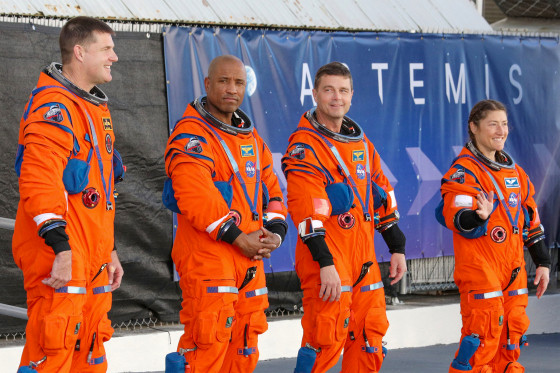
The Artemis II astronauts pause during a demonstration test at the Kennedy Space Center in Cape Canaveral, Fla., on Saturday.Gregg Newton
If all goes according to NASA’s plans, 2026 will finally be the year that astronauts once again launch to the moon.
In a matter of months, four astronauts are poised to fly around the moon on a roughly 10-day mission — the closest humans will have gotten in more than half a century.
The flight, known as Artemis II, could lift off as early as February and would be a long-awaited jump start to America’s lagging return-to-the-moon program. The mission will serve as a crucial test of NASA’s next-generation Space Launch System rocket and Orion spacecraft, which have been in development for more than a decade and faced years of setbacks and severe budget overruns. The system has never carried a crew before.
Returning to the moon has been a priority for President Donald Trump since his first term, and the current administration has placed renewed emphasis on dominating the intensifying space race between the U.S. and China. Chinese officials have pledged to land their own astronauts on the lunar surface by 2030.
Beyond the geopolitical implications, the Artemis II mission is designed to usher in a new era of space exploration, with the goal of eventually establishing bases for long-duration stays on the moon before astronauts someday venture on to Mars.
“Within the next three years, we are going to land American astronauts again on the moon, but this time with the infrastructure to stay,” Jared Isaacman, NASA’s new administrator, told NBC News in an interview last week after he was sworn in.
For some scientists, the excitement around returning to the moon stems from the prospect of investigating enduring mysteries about the moon’s formation and evolution — such as violent collisions in the nascent solar system that created it and where its water originated — which came into focus during the Apollo program in the 1960s and 1970s.
“As you can imagine, lunar scientists have had a lot of pent up questions for decades,” said Brett Denevi, a planetary scientist at the Johns Hopkins University Applied Physics Laboratory in Laurel, Maryland.
Answering some of those questions could shed light on similar processes that occurred during our planet’s formation, according to Denevi.
“Earth is kind of a terrible record-keeper,” she said. “With plate tectonics, weather — these things have just totally erased its very earliest history. But on the moon, you have this terrain that formed about 4.5 billion years ago, and it’s just sitting there on the surface for us to explore.”
Although the Artemis II mission won’t land on the lunar surface, it will test various technologies,docking maneuvers and life-support systems — first in Earth orbit and then in orbit around the moon — that will be essential for future missions.
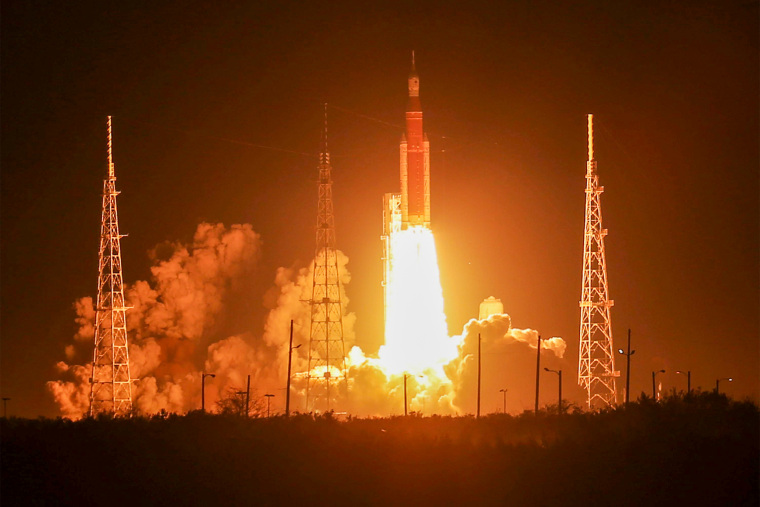
NASA previously launched the Space Launch System rocket and Orion capsule on an uncrewed test flight around the moon — the Artemis I mission — for 3 1/2 weeks in 2022.
NASA's Artemis I Space Launch System rocket, with the Orion capsule attached, launches toward the moon in 2022 from NASA's Kennedy Space Center in Cape Canaveral, Fla.
“There’s a lot riding on this, both good and bad,” said Casey Dreier, chief of space policy for The Planetary Society, a nonprofit organization that conducts research, advocacy and outreach to promote space exploration. “Everything seems to be coming together, but this is the first time with humans on this rocket, and we’ve never tested this life-support system in space before.”
No launch date has been announced, but it is expected between February and April. The crew on board will be NASA astronauts Reid Wiseman, Victor Glover and Christina Koch and Canadian Space Agency astronaut Jeremy Hansen.
The foursome was selected for the mission in 2023. Wiseman, Glover and Koch will make their second trips to space, while Hansen will be making his spaceflight debut.
Last weekend, the astronauts completed a key launch-day rehearsal, which involved donning their flight suits, boarding the Orion spacecraft and running through the countdown sequence to the point just before liftoff.
The Artemis program was established under the first Trump administration in 2019, and it salvaged the Space Launch System rocket and Orion capsule from prior stalled or canceled projects at NASA. The space agency had been working on a next-generation booster since 2010, a year before it retired the space shuttles. The Orion spacecraft, meanwhile, was originally designed for the Constellation Program, which was established by President George W. Bush to conduct crewed flights to the moon and Mars.
Last week, Trump doubled down on his return-to-the-moon agenda in an executive order that directed NASA to prioritize “expanding human reach and American presence in space” by landing astronauts on the lunar surface by 2028.
“This is the culmination of what is now almost a 15-year effort,” Dreier said. “Assuming it works, it’ll be seen as a major win for the administration. But if this doesn’t work, or if something calamitous happens, that will really reset everything.”
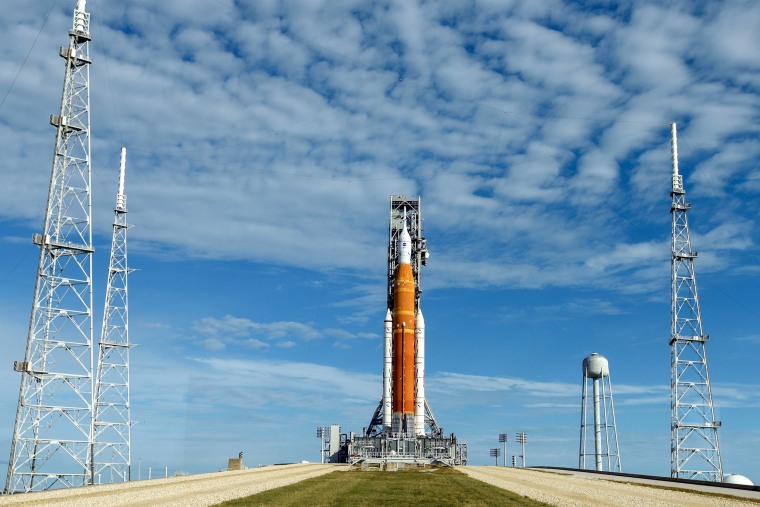
The Space Launch System and Orion spacecraft sit on the launch pad ahead of liftoff in November 2022 at the Kennedy Space Center in Cape Canaveral, Florida.
Red Huber / Getty Images
Artemis II is intended to pave the way for the Artemis III mission in 2027, which is expected to land four astronauts near the moon’s south pole, a region vastly different from where the Apollo astronauts left their bootprints.
Whereas the Apollo moon landings occurred within a narrow band around the moon’s equator, the south polar region is a more challenging place to land because the terrain is pockmarked with craters. These permanently shadowed basins are thought to house abundant water ice, a precious resource for establishing a long-term presence on the moon and for future crewed missions deeper in the solar system.
“Apollo gave us the framework to understand the moon,” Denevi said, “and now we have the foundation to ask different questions.”
Denevi leads the geology team for the Artemis III flight, a role thatinvolves deciding where the crew members will roam after they land, what types of fieldwork they will conduct and which samples they will collect to bring home. She is particularly interested in samples from the moon’s shadowed craters, which are among the coldest places in the solar system.
“When I first started studying the moon, I thought I’d spend my whole career studying historical data,” she said. “Now to have the opportunity to be involved in going to collect new samples that can provide new pieces to this puzzle, instead of trying to rearrange all of the old pieces, that’s going to be a huge step forward.
In 2025, many new thresholds in this complex area of study were crossed, with empirical inquiry into our questions about the nature of consciousness occurring within fields such asneuroscience,psychology, andmedicine. Many advancements in this area over the last year have also challenged long-held assumptions about where and how consciousness originates, how widespread it may be, and how profoundlyaltered statescan reshape human perception.
Here’s a look at just a few of the major stories involving consciousness, the mind, awareness, and the science behind it all that The Debrief has covered in 2025.
Did ‘Universal Consciousness’ Exist Before the Big Bang?
Among the year’s most provocative work about consciousness, one controversial peer-reviewed paper published in AIP Advances proposed that “universal consciousness” may have existed before the Big Bang, functioning not as a byproduct of matter but as a foundational feature of reality itself.
(Image Credit: Pixabay)
Such claims are nothing new and remain hotly debated by researchers, although they reflect a growing willingness among scientists to explore questions about consciousness, whether it is purely emergent or could play a deeper role in shaping the universe. The result has been a reignition of discussions long relegated to philosophy, now increasingly framed through modern cosmology and theoretical physics.
Consciousness May Be Far More Widespread Than Previously Believed
Closer to Earth, neuroscientists and cognitive researchers have increasingly argued that consciousness may be far older and more widespread than traditionally believed. Studies examining simple organisms, brain networks, and evolutionary pathways this year, undertaken by researchers at Ruhr University Bochum, suggested that rudimentary forms of awareness could predate complex nervous systems throughout the animal kingdom.
Rather than being the apex of the human evolutionary process, the researchers argue in a pair of papers that appeared in Philosophical Transactions of the Royal Society B, consciousness “rather represents a more basic cognitive process, possibly shared with other animal phyla.” This reframing has major implications not only for how scientists define consciousness but also for how humans understand their relationship to other life forms.
Psychedelic Therapy and Related Discoveries
Perhaps the most tangible advances came from renewed interest in altered states of consciousness, particularly through psychedelic research. Multiple studies in 2025 demonstrated that psychedelic compounds can rapidly reorganize brain networks, temporarily dissolving rigid patterns of thought associated with depression, trauma, and addiction.
(Image Credit: Pixabay/CC0 Public Domain)
At the same time, scientists explored non-drug pathways to similar states, such as research into ancient breathwork techniques combined with modern neuroscience that suggests altered states resembling psychedelic experiences could be induced through controlled breathing alone.
Additionally, long-term studies also continued to examine the social and spiritual dimensions of psychedelic experiences. Decades of research now suggest that such states often produce a heightened sense of connection—to other people, to nature, and to perceived transcendent realities. In 2025, experiments involving participants from diverse religious backgrounds highlighted how profoundly personal belief systems shape the interpretation of these experiences, even when the underlying neurochemical mechanisms are shared.
The resulting research revealed functional connections between neurons within the visual areas of the brain and the brain’s frontal areas, which the researchers behind the study say helps them “understand how our perceptions tie to our thoughts” while also reducing the typical emphasis on “the importance of the prefrontal cortex in consciousness, suggesting that while it’s important for reasoning and planning, consciousness itself may be linked with sensory processing and perception.”
University of Virginia Researchers Study Support Gaps for NDE Experiencers
Finally, 2025 saw increased attention to near-death experiences (NDEs) as a legitimate area of study. Researchers at the University of Virginia identified significant gaps in psychological and medical support for people who report NDEs, many of whom struggle to integrate these experiences into their lives. While interpretations of NDEs vary widely, the research emphasized a growing consensus: regardless of cause, such experiences can be deeply transformative—and ignoring their impact may carry real mental health consequences.
Taken together, these stories reveal a year in which consciousness research moved decisively out of the shadows. Whether probing the origins of awareness in the early universe, mapping its neural signatures, or exploring its therapeutic potential, scientists in 2025 treated consciousness not as an unspeakable mystery—but as a frontier worth confronting directly.
Micah Hanks is the Editor-in-Chief and Co-Founder of The Debrief. A longtime reporter on science, defense, and technology with a focus on space and astronomy, he can be reached atmicah@thedebrief.org. Follow him on X @MicahHanks, and at micahhanks.com.
Stunning photos of Mars that will blow your mind Mars has always fascinated scientists, and it is believed to be the planet with the closest conditions to Earth for life in our solar system. Various projects with rovers have been sent looking for traces of bioactivity, among other experiments and data collection efforts.
In this gallery, you can explore the beautiful landscapes of our neighboring planet in breathtaking images. Click through to get started.
Mount Sharp, 2012 This picture displays the bottom of Mount Sharp, also known as Aeolis Mons, on Mars. The mountain stands at a height of 5.5 km (3.4 miles) above the surrounding valley.
Gullies, 2017 These flow features, resembling moraines on Earth, are located in the mid-latitudes of Mars. This indicates that the deposits may contain ice or have had ice in the past.
Yellowknife Bay, 2013 These spherical shapes in Yellowknife Bay are believed to be concretions, suggesting that water seeped through sediment pores to create them.
Sandy hill, 2014 These are the sand dunes of Mars' northernmost region, visible as they appear after being covered by seasonal carbon dioxide (dry) ice during winter.
Acidalia Plain, 2015 This plain is depicted as the fictional touchdown location for a crewed mission called Ares 3 in the popular novel and film 'The Martian.'
Noctis Labyrinthus, 2013 Located on the Tharsis rise in the upper part of Valles Marineris, this area is recognized for its intricate network of deep valleys with steep walls.
Gale crater, 2013 This crater, thought to be around 3.5 to 3.8 billion years old, is likely a dry lake located near the northwestern region of the Aeolis quadrangle.
Gale crater, 2013 The rover designed to explore Gale crater, which is about the size of a car, can be seen as a blue dot in the lower right corner of the image.
Gale crater, 2012 This photo shows a section of the wall of Gale crater, where a system of valleys, thought to be created by water, enters the crater from the surrounding area.
Victoria Crater, 2006 This impact crater found in the Meridiani Planum plain has a width of approximately 730 meters (2,395 feet)and is named after a ship from Ferdinand Magellan's fleet, the first to sail around the world.
Color Photos, 2008 This is one of the initial color photographs of the surface of Mars captured after the Phoenix Mars lander spacecraft safely touched down on May 25, 2008. It marked the historic first landing near Mars's northern pole.
Hellas Planitia, 2008 This image displays a view from a different angle of a mountain located in eastern Hellas Planitia. The mountain harbors sizable glaciers beneath rocks.
Hellas Planitia, 2008 This is an alternative view of the mountain in the eastern Hellas Planitia, which revealed the presence of sizable glaciers concealed beneath fragmented rocks.
Meer van UFO'S of UAP'S, ASTRONOMIE, RUIMTEVAART, ARCHEOLOGIE, OUDHEIDKUNDE, SF-SNUFJES EN ANDERE ESOTERISCHE WETENSCHAPPEN - DE ALLERLAATSTE NIEUWTJES


 The Space Age: The Most Exciting Astronomical Events That Will Take Place Before 2100
 What will future astronomers see in the sky?
Illustrative photo: Unsplash
 Asteroid 99942 Apophis.
Image: Space Engine
 Halley’s Comet (1P/Halley) is the most famous comet and the brightest of the short-period comets

 Space connections in 2040 and 2080