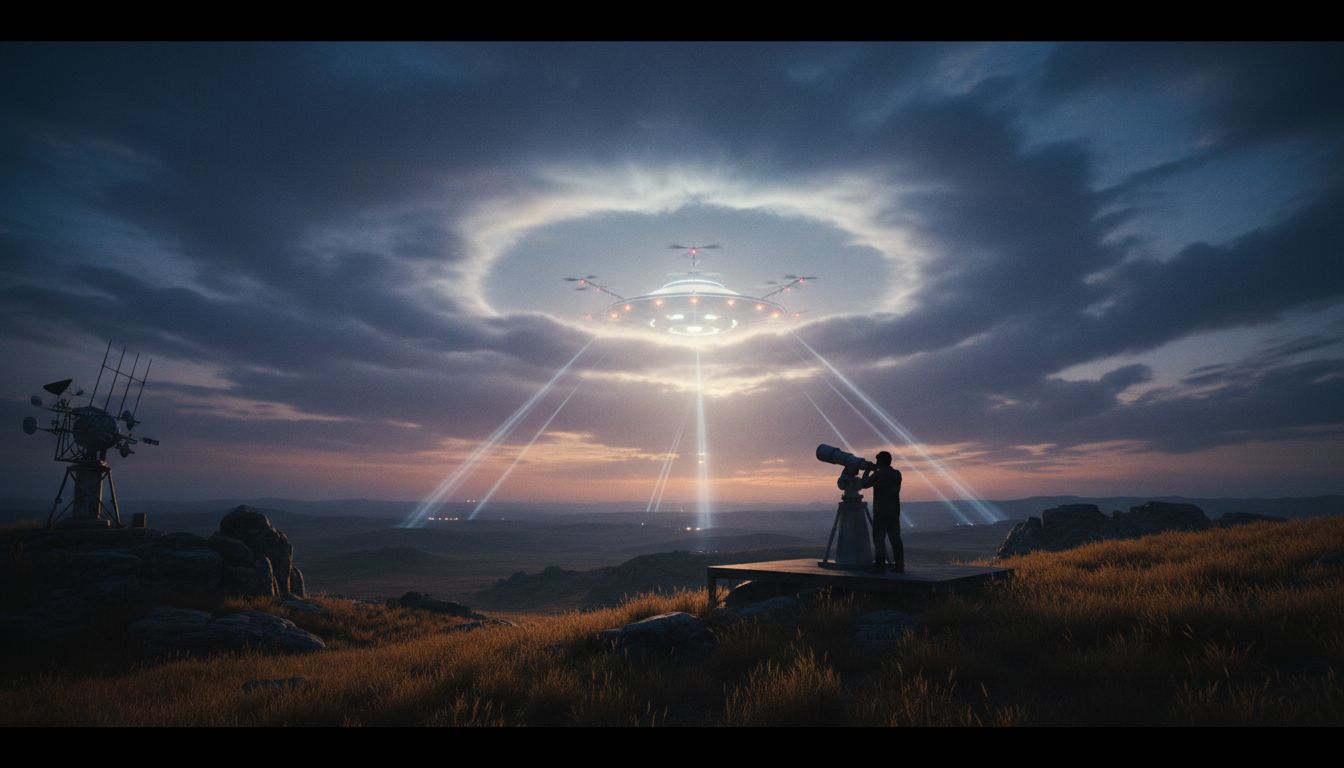
Ontdek de Fascinerende Wereld van UFO's en UAP's: Jouw Bron voor Onthullende Informatie!
Ben jij ook gefascineerd door het onbekende? Wil je meer weten over UFO's en UAP's, niet alleen in België, maar over de hele wereld? Dan ben je op de juiste plek!
België: Het Kloppend Hart van UFO-onderzoek
In België is BUFON (Belgisch UFO-Netwerk) dé autoriteit op het gebied van UFO-onderzoek. Voor betrouwbare en objectieve informatie over deze intrigerende fenomenen, bezoek je zeker onze Facebook-pagina en deze blog. Maar dat is nog niet alles! Ontdek ook het Belgisch UFO-meldpunt en Caelestia, twee organisaties die diepgaand onderzoek verrichten, al zijn ze soms kritisch of sceptisch.
Nederland: Een Schat aan Informatie
Voor onze Nederlandse buren is er de schitterende website www.ufowijzer.nl, beheerd door Paul Harmans. Deze site biedt een schat aan informatie en artikelen die je niet wilt missen!
Internationaal: MUFON - De Wereldwijde Autoriteit
Neem ook een kijkje bij MUFON (Mutual UFO Network Inc.), een gerenommeerde Amerikaanse UFO-vereniging met afdelingen in de VS en wereldwijd. MUFON is toegewijd aan de wetenschappelijke en analytische studie van het UFO-fenomeen, en hun maandelijkse tijdschrift, The MUFON UFO-Journal, is een must-read voor elke UFO-enthousiasteling. Bezoek hun website op www.mufon.com voor meer informatie.
Samenwerking en Toekomstvisie
Sinds 1 februari 2020 is Pieter niet alleen ex-president van BUFON, maar ook de voormalige nationale directeur van MUFON in Vlaanderen en Nederland. Dit creëert een sterke samenwerking met de Franse MUFON Reseau MUFON/EUROP, wat ons in staat stelt om nog meer waardevolle inzichten te delen.
Let op: Nepprofielen en Nieuwe Groeperingen
Pas op voor een nieuwe groepering die zich ook BUFON noemt, maar geen enkele connectie heeft met onze gevestigde organisatie. Hoewel zij de naam geregistreerd hebben, kunnen ze het rijke verleden en de expertise van onze groep niet evenaren. We wensen hen veel succes, maar we blijven de autoriteit in UFO-onderzoek!
Blijf Op De Hoogte!
Wil jij de laatste nieuwtjes over UFO's, ruimtevaart, archeologie, en meer? Volg ons dan en duik samen met ons in de fascinerende wereld van het onbekende! Sluit je aan bij de gemeenschap van nieuwsgierige geesten die net als jij verlangen naar antwoorden en avonturen in de sterren!
Heb je vragen of wil je meer weten? Aarzel dan niet om contact met ons op te nemen! Samen ontrafelen we het mysterie van de lucht en daarbuiten.
The 'alien comet' is on the way: 3I/ATLAS to make rare Earth pass
Story by Ariana Garcia
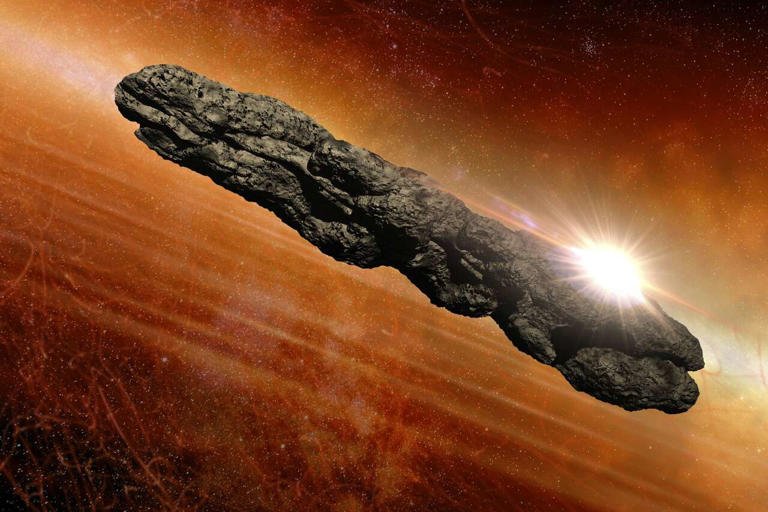
An illustration shows 'Oumuamua. 3I/ATLAS is the latest interstellar comet lighting up the solar system, and it will make its closest approach to Earth on Dec. 19.
(Getty Images)
Comet 3I/ATLAS, only the third known object from interstellar space to pass through our solar system, is about to make its closest approach to Earth. On Friday, Dec. 19, it will come within about 170 million miles of the planet while moving on the far side of the Sun. The alignment should give Earth and space-based telescopes one of their best opportunities to study it, and NASA says it poses no threat.
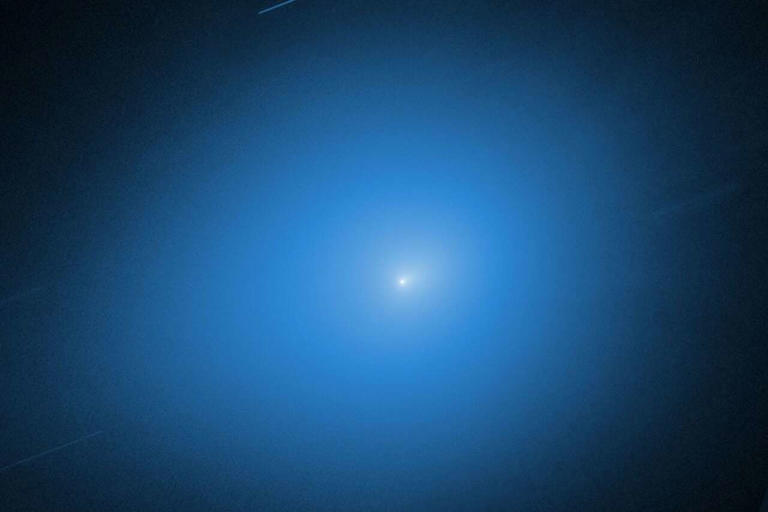
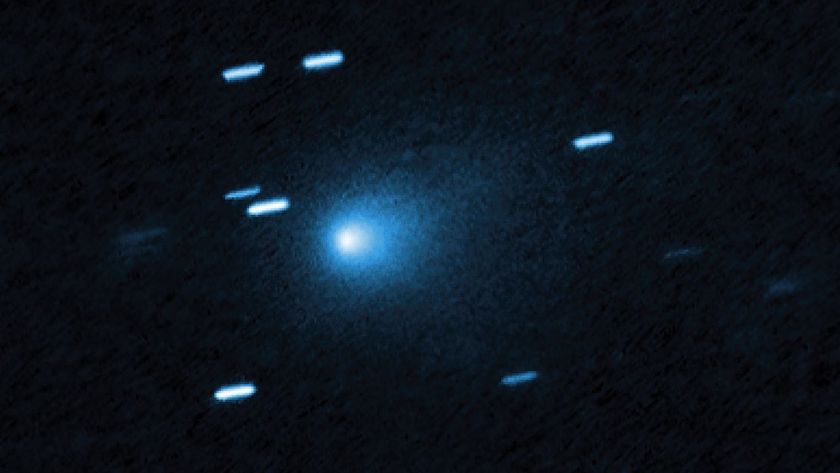
Astronomers have followed 3I/ATLAS since its discovery on July 1. Hubble photographed it on July 21 from 277 million miles away, revealing a teardrop-shaped cloud of dust wrapped around its icy core. The comet stayed visible through September before slipping too close to the Sun to be observed.
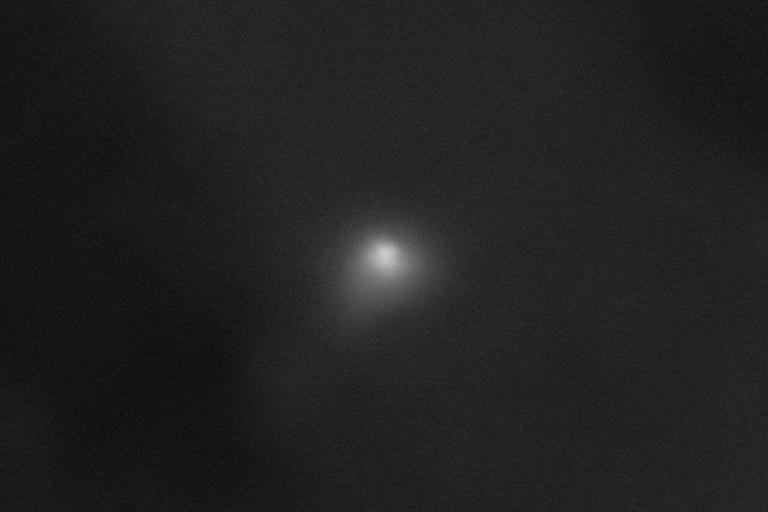
In early October, three NASA spacecraft at Mars-MRO, MAVEN, and Perseverance-picked it up again. MRO's HiRISE camera, usually aimed at the Martian surface, captured the clearest view: a tiny, pixel-like puff representing the coma, the dusty envelope created as sunlight warms the nucleus.
Comet 3I/ATLAS as seen through the High Resolution Imaging Science Experiment (HiRISE) aboard the agency's Mars Reconnaissance Orbiter (MRO), during its close pass by Mars on Oct. 3, when it swept within 18 million miles of the planet.
(NASA/JPL-Caltech/University of Arizona)
Ongoing observations will help scientists refine estimates of the comet's size and composition and better understand the dust particles in its coma. Current measurements suggest it could span anywhere from 1,444 feet to 3.5 miles.
3I/ATLAS follows two earlier interstellar objects, 1I/'Oumuamua and 2I/Borisov. Unlike 'Oumuamua, which behaved more like a rocky object, 3I/ATLAS displays classic comet activity. Even so, some of its traits have generated debate. Harvard astrophysicist Avi Loeb, who previously raised the possibility that 'Oumuamua might be artificial, has again questioned whether this object could have a technological origin, though most scientists continue to interpret it as a natural comet.
Loeb wrote that comets shed gas and dust when sunlight warms icy pockets on their surfaces, which produces a small push similar to a rocket. He noted that an artificial object could experience similar non-gravitational forces, either through propulsion or by collecting material as it moves through interstellar space, making it appear comet-like in low-resolution images.
"Given these features, it may resemble a comet in unresolved images like the ones we have of 3I/ATLAS," he wrote. "However, a spacecraft could also display artificial lights, release excess heat from its engine or maneuver in unusual ways."
NASA's Hubble Space Telescope reobserved interstellar comet 3I/ATLAS Nov. 30, with its Wide Field Camera 3 instrument. (NASA, ESA, STScI, D. Jewitt (UCLA), M.-T. Hui (Shanghai Astronomical Observatory).
Image Processing: J. DePasquale (STScI))
He highlighted several other features he considers unlikely for a natural object, including the comet's trajectory. Loeb wrote that its path is aligned with the plane of the planets to within five degrees, something he calculates as having only a 0.2 percent chance of occurring by accident.
He also pointed to a jet of material directed toward the Sun before and after perihelion, which he calls unusual for familiar comets. He argued that its timing placed it unusually close to Mars, Venus, and Jupiter while keeping it unobservable from Earth at perihelion. He also contends that the object's estimated mass and high speed make it unlikely to be a naturally occurring rock randomly entering the inner solar system.
Scientists will continue studying the comet after its closest approach. "Observations are expected to continue for several more months as 3I/ATLAS heads out of the solar system," NASA noted.
The European Space Agency's JUICE spacecraft also observed 3I/ATLAS last month and saw intense activity as sunlight heated the comet, causing its ices to sublimate. ESA expects most of JUICE's data to arrive in late February.
After passing Earth, 3I/ATLAS will move on toward Jupiter in spring 2026, providing another chance to examine this rare visitor from beyond the solar system.
A study suggesting the exoplanet K2-18b shows potential signs of alien life has been met with skepticism from the scientific community. Here’s the truth about what the James Webb Space Telescope saw.
An artist's interpretation of the exoplanet K2-18b. Could the alien world contain a biosphere?
(Image credit: A. Smith, N. Madhusudhan (University of Cambridge))
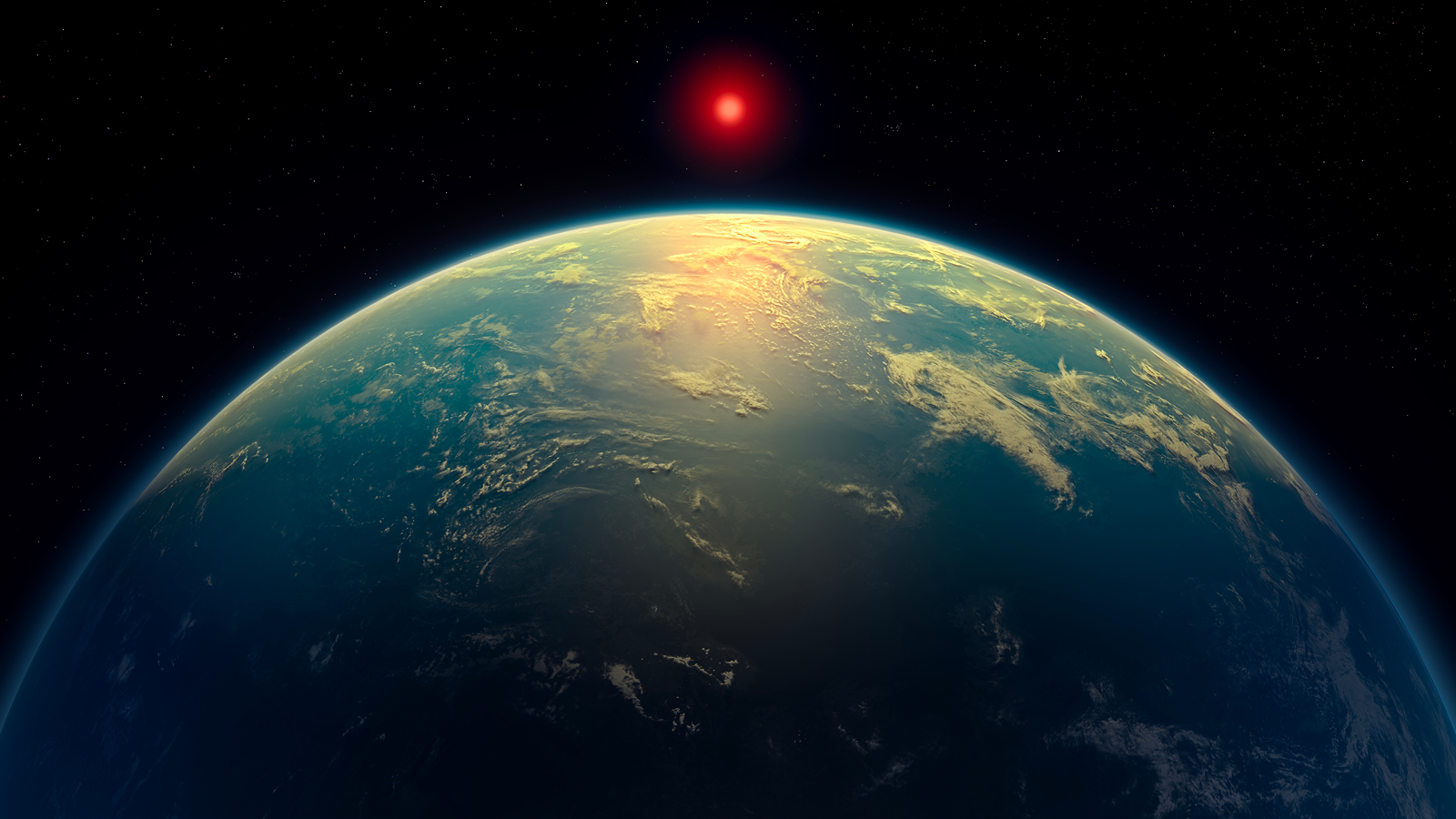
The trendiest planet in the universe right now is K2-18b, a potentially habitable world swirling around a small, red star in the constellation Leo. Located 124 light-years from Earth, the mysterious planet will never host human visitors — but a recent glimpse with the James Webb Space Telescope(JWST) hints that alien life may already thrive there in a vast, warm ocean.
In a University of Cambridge-led study published April 17, scientists using JWST reported the detection of possible signs of life in the alien planet's atmosphere, offering what a Cambridge statement called the "most promising" evidence yet of life beyond Earth. However, in the week since the study's publication, a growing number of scientists are already pushing back on this big claim.
"The statistical significance of the detection is marginal," Eddie Schwieterman, an assistant professor of astrobiology at the University of California, Riverside who was not involved in the research, told Live Science in an email. "There are some reasons to be skeptical."
"It's almost certainly not life," Tessa Fisher, an astrobiologist at the University of Arizona who was not involved in the research, told Nature.com.
So what did JWST actually find on K2-18b, and how close are we to solving the ultimate mystery of space? Here's everything you need to know.
What did JWST find on K2-18b?
Unlike optical telescopes such as Hubble, JWST cannot image the surfaces of distant planets directly; instead, its infrared instruments hunt for chemical signs of life — or biosignatures — in planetary atmospheres by mapping how starlight is absorbed or reemitted by molecules in those atmospheres. The resulting graphs of light, called spectra, can reveal the composition of that planet's atmosphere, providing clues about its surface conditions.
In the new Cambridge-led study, scientists using JWST's Mid-Infrared Instrument (MIRI) peered into K2-18b's atmosphere to detect traces of two sulfur-based molecules called dimethyl sulfide (DMS) and dimethyl disulfide (DMDS) — compounds that are known to be produced only by microscopic life-forms like phytoplankton on Earth. If DMS can be produced by some natural mechanism, scientists currently don't know about it, and will have to run extensive tests to uncover it.
The findings add to earlier observations made by the same team using two different JWST instruments in 2023, which also reported possible traces of DMS in the planet's atmosphere.
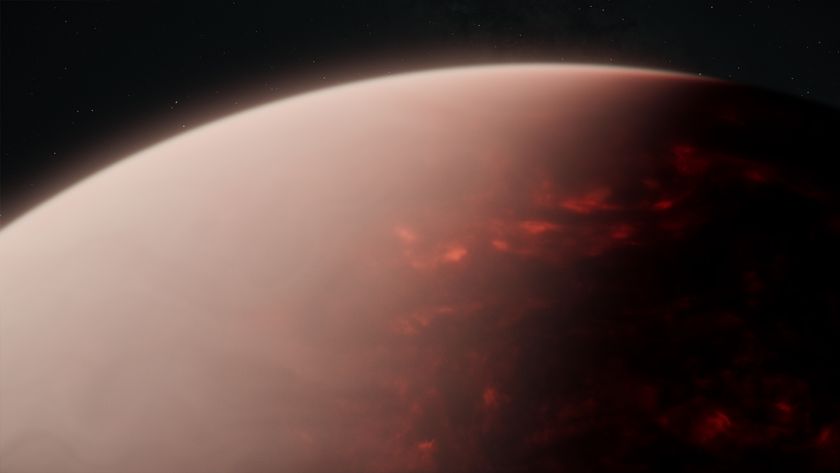
One interpretation of K2-18b's spectra suggests it could be a lifeless lava world. (Image credit: Alex Boersma)
While the Cambridge team admitted in the statement that they are "deeply sceptical" of their own results, the same release also trumpeted these detections as the "most promising" evidence yet of life beyond Earth, painting a picture of an oceanic planet that could be "teeming with life." (Other studies have argued that K2-18b's ocean may, in fact, be made of magma.)
Nikku Madhusudhan, lead author of both Cambridge studies, stressed that no actual life has been detected on K2-18b yet.
"That's not what we're claiming," Madhusudhan, a professor of astrophysics at Cambridge, told Live Science. "But in the best-case scenario, it's the potential for life."
The team's DMS detection reached the three-sigma level of statistical significance, meaning there is a 0.3% probability that the signals occurred by chance. However, this still falls far short of the required five-sigma level that denotes a statistically significant scientific discovery.
Responding to criticism that the team may have overstated their study's significance, Madhusudhan said it's in the public interest to know how this research is progressing.
"This is the taxpayer paying us, and they have a right to enjoy the process," Madhusudhan added. "If we're sending a robot to Mars, we're not waiting until it goes and finds life to celebrate the act of sending it. We announced that we are sending robots to Mars, and we're excited about the possibility. This is the equivalent of that."
"No strong evidence"
For now, the public has little more than the Cambridge team's study to go on. The complete set of MIRI data on which the team based their discovery will become publicly available April 27, according to NPR, at which point outside researchers can begin to comb through it and formulate peer-reviewed responses.
In the meantime, various researchers have already attempted to re-create the findings using their own data models and have come up short.
In January, a team of scientists independently analyzed K2-18b's atmosphere using the same JWST instruments used in the 2023 study. The team found "no statistically significant or reliable evidence" of DMS on K2-18b, the researchers wrote in a paper published to the preprint server arXiv.
More recently, on April 22, University of Oxford astrophysicist Jake Taylor reanalyzed the JWST spectra shared in the new Cambridge study, using a simple data model that's routinely utilized in exoplanet studies. Taylor's analysis, also published to arXiv, found no traces of DMS, either.
The transmission spectra for K2-18b suggests it may contain traces of dimethyl sulfide or dimethyl disulfide, but not the decay products of those molecules. (Image credit: A. Smith, N. Madhusudhan (University of Cambridge))
"There is no strong evidence for detected spectral features in K2-18b's MIRI transmission spectrum," Taylor wrote.
Looking only at the Cambridge team's study, Schwieterman also saw cause for hesitation in proclaiming that biosignatures exist on K2-18b.
"When DMS interacts with ultraviolet light from the star, it splits apart into components that reform into other molecules like ethane (C2H6) and ethylene (C2H4)," Schwieterman said. "The paper does not report the detection of these molecules, which is puzzling because you'd expect these gases to appear together."
What comes next?
Everyone, including the Cambridge team, agrees that more observations of K2-18b are necessary to bring clarity to this puzzle. This means researchers will have to request more time with JWST to observe the alien planet as it swoops in front of its star.
Luckily, this is a near-monthly occurrence, with K2-18b completing a transit of its star every 33 days. Budgeting more time to watch these transits should be "trivial" for the telescope, Madhusudhan said.
"One transit is eight hours, roughly," Madhusudhan added. "You only need about 16 to 24 hours of JWST time. To give you a sense of scale, JWST observes thousands of hours every year."
If additional observations can increase the statistical significance of the team's DMS detection, the next step will be to prove that some unknown natural process isn't producing the molecule instead, Schwieterman said. This will take rigorous experimentation and some creative thinking here on Earth. Finally, scientists will need to look at planets that are similar to K2-18b to see if DMS is a common signature around the cosmos.
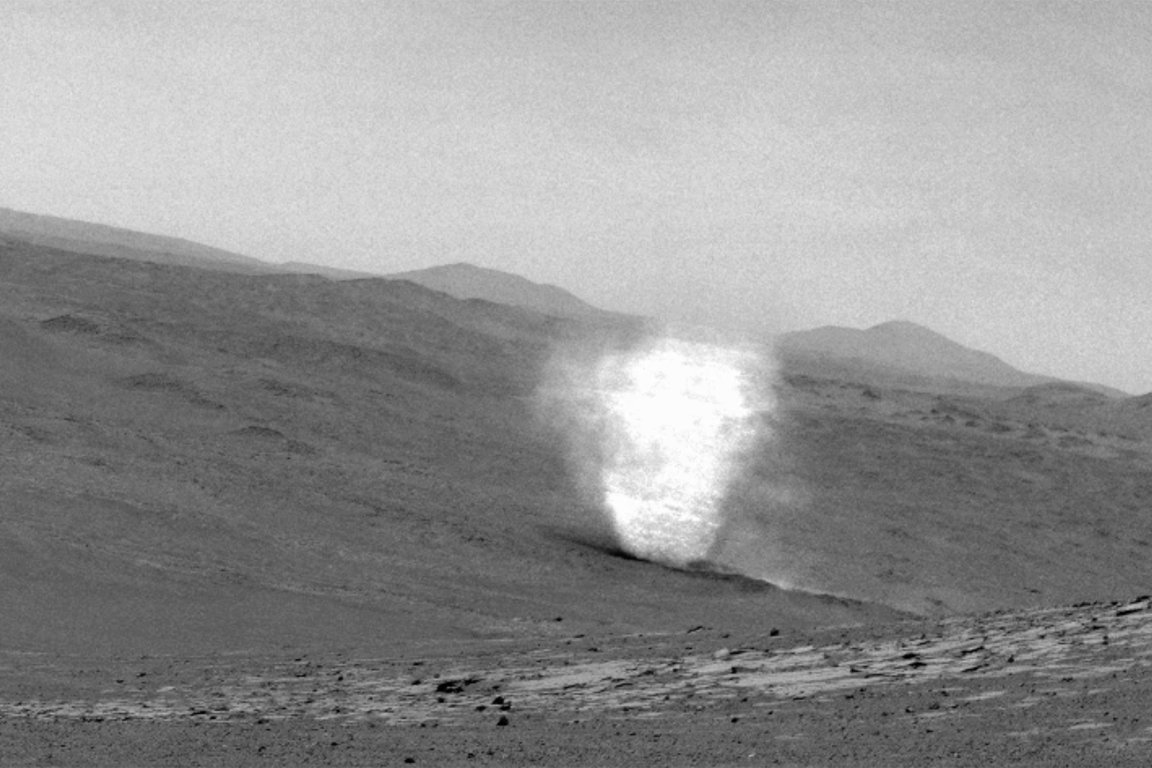
There’s an electrifying new development in Mars science. NASA’s Perseverance rover has just captured proof of a weather phenomenon that was long suspected, but until now, never observed: electric discharges that brew within the dust devils that torment Mars’ surface.
The discovery, described in a new study in the journal Nature, confirms that lightning discharges occur in the Martian atmosphere. The dust devils that the discharges appear in are a common fixture on the Red Planet. Like on Earth, they’re whirlwinds created by rapidly rising columns of warm air heated by their proximity to the ground, shooting their way through the cool air which falls to take the rising warm air’s place.
On Mars specifically, it was suspected that dust trapped in this whirlwind whips together to create a static charge through friction, a manifestation of the same so-called triboelectric effect that causes a spark after you shuffle across a carpet and touch a metal doorknob.
“Triboelectric charging of sand and snow particles is well documented on Earth, particularly in desert regions, but it rarely results in actual electrical discharges,” lead author Baptiste Chide, a member of the Perseverance science team and a planetary scientist at L’Institut de Recherche en Astrophysique et Planétologie in France, said in a NASA statement about the research. “On Mars, the thin atmosphere makes the phenomenon far more likely, as the amount of charge required to generate sparks is much lower than what is required in Earth’s near-surface atmosphere.”
That lightning on Mars had eluded detection until now was a long source of frustration to Mars scientists, as it had already been established to take place on other planets like Saturn and Jupiter, which are far more distant and aren’t observed up close by robots as we do the Red Planet.
The finding required some astonishing good luck. The detection was made by a microphone on the rover’s SuperCam instrument designed to analyze the acoustics of Martian rocks zapped by the SuperCam laser — or in other words, to record sound, not zips of static discharges.
But the instrument kept picking up more and more electrical disturbances, in all logging 55 since its mission began in 2021, NASA said. Sixteen of them were recorded when a dust devil passed directly over the rover. Because the the number of discharges didn’t increase during the planet’s frequent dust storms, the scientists surmise that it must be coming from the dust devils instead — which, in another fortunate twist, happened to pass by the rover more often than anyone anticipated, allowing them to confirm the suspicion.
The discovery has exciting implications. Lightning can cause unique chemical reactions and affect the chemical balance of the planet’s surface, perhaps altering the odds of creating complex compounds — and possibly even organic molecules.
Maya Lassiter / Miskin Lab / University of Pennsylvania
We’re far from realizing the kind of nanomachines envisioned in media like “The Diamond Age” and Metal Gear Solid, but scientists have just taken a meaningful step towards the next best thing.
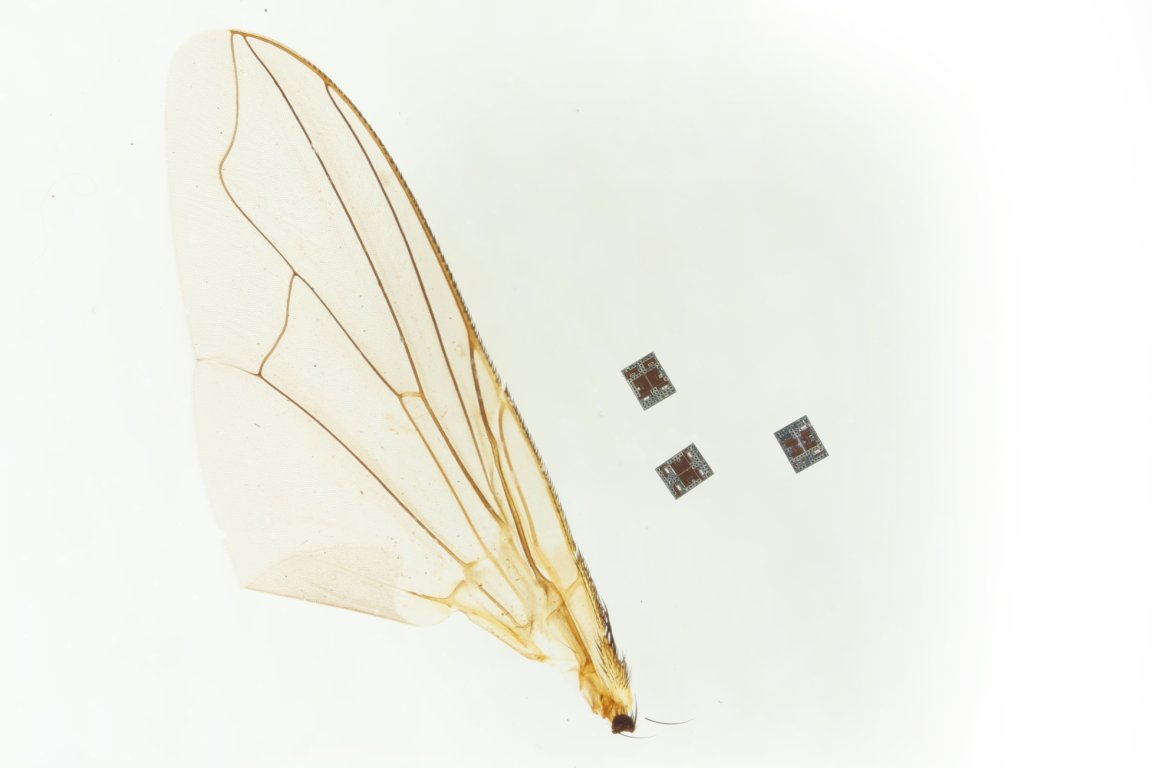
A team of researchers from the University of Pennsylvania and University of Michigan say they’ve built a sub-millimeter sized robot packed with a computer, motor, and sensors, the Washington Post reports. It’s not an actual billionth of a meter in size, but being smaller than a grain of salt, it is still outrageously tiny: a microrobot.
The work, described in a new study in the journal Science Robotics, could be a platform for one day building microscopic robots that could be deployed inside the human body to perform all sorts of medical miracles, like repairing tissues or delivering treatment to areas difficult for surgeons to access.
“It’s the first tiny robot to be able to sense, think and act,” coauthor Marc Miskin, assistant professor of electrical and systems engineering at UPenn, told WaPo.
At present, the device is still highly experimental and isn’t suited to be used inside a human body — but “it would not surprise me if in 10 years, we would have real uses for this type of robot,” coauthor David Blaauw from U-M told the newspaper.
Building a microscopic robot that can move, sense its surroundings, and make decisions on its own has evaded scientists for decades. According to the team, roboticists have typically relied on externally controlling the microrobots so they can operate at smaller scales, but sacrificing their ability to process information. That prevents the robots from reacting with their environment, leaving them with a limited number of pre-programmed behaviors they can carry out — and as a result, limited real-world usefulness.
Having a robot on the scale of microns, or one millionth of a meter, would give us access to what corresponds to the smallest units of our biology, Miskin told WaPo.
“Every living thing is basically a giant composite of 100-micron robots, and if you think about that it’s quite profound that nature has singled out this one size as being how it wanted to organize life,” he said.
Visually, the researchers’ robot resembles a microchip, and is made of the same kinds of materials, including silicon, platinum, and titanium, WaPo noted. It’s sealed in a layer of what is essentially glass, Miskin said, protecting it from fluids.
The robot uses solar cells to convert energy that powers its onboard computer and its propulsion system, which uses a pair of electrodes to generate a flow in the water particles surrounding it. In a word, the robot swims. Its onboard computer is less than a thousandth of the speed of a modern laptop, per WaPo, but it’s enough to let it respond to changes it detects in its environment like temperature.
“At this scale, the robot’s size and power budget are comparable to many unicellular microorganisms,” the team wrote in the study.
Crucially, the robot is designed to still communicate with its human operators.
“We can send messages down to it telling it what we want it to do,” using a laptop, Miskin told WaPo, “and it can send messages back up to us to tell us what it saw and what it was doing.”
But the next step? Inter-microrobot communication.
“So the next holy grail really is for them to communicate with each other,” Blaauw told WaPo.
Millions of buildings and even more Americans could be at risk of sinking underwater by the end of the century.
Researchers from McGill University in Canada warned rising sea levels, resulting from continued greenhouse gas emissions, threaten to wipe out coastal cities worldwide.
Sea level rise measures the ocean's surface height over time. Level increases can cause flooding in areas that sit near or below the waterline.
Greenhouse gas emissions, such as carbon dioxide from cars and factories, trap heat in the Earth's atmosphere, making the planet warmer. Those increased temperatures melt ice caps and glaciers, and also cause ocean water to expand as it heats up.
The McGill team revealed that even in the best-case scenarios, where sea levels rise just 1.6 feet by 2100, three million buildings in the Southern Hemisphere alone would be underwater by then.
The study is the first large-scale, building-by-building assessment of how long-term sea level rise could affect coastal infrastructure across the Global South, including Africa, Southeast Asia and Central and South America.
Researchers used satellite imagery and elevation data to map how many buildings could be inundated under different scenarios, providing critical insights for urban planners and policymakers.
While the estimate didn't account for potential damage in the US, Europe and much of northern Asia, where over two billion people live, maps have provided people with the worst-case scenarios for their hometowns.
The Sea Level Submergence Explorer map revealed how 65 feet of sea level rise could impact New York in a doomsday climate scenario
Major cities, including Washington, DC, (pictured) could see historic landmarks submerged by rising sea levels over the next 75 years
The data suggested that if emissions are unchecked, sea levels could rise by as much as 65 feet in the examined timeframe.
In this doomsday climate scenario, major cities like New York, Washington, Baltimore, Miami, New Orleans, Houston, Oakland and Sacramento could be submerged within the next 75 years.
Millions would be impacted in New York City and Washington, DC
While the McGill team did not focus on Earth's Northern Hemisphere, its Sea Level Submergence Explorer map painted a grim picture for America's most famous metropolis.
New York City would see much of Manhattan, Brooklyn, Queens, Staten Island and the Bronx end up below the higher sea level.
More than 8.5 million people live and work in over a million buildings in New York, all of which could be severely impacted by a dramatic increase in flood risks.
The nation's capital, Washington, DC, would also be dramatically affected by out of control sea level rise.
The map estimated that the White House and other government buildings would be submerged if sea levels rose by 65 feet over the next century.
Professor Natalya Gomez, a study co-author from McGill University, said in a press release: 'Sea level rise is a slow, but unstoppable consequence of warming that is already impacting coastal populations and will continue for centuries.
'People often talk about sea level rising by tens of centimeters, or maybe a meter. But, in fact, it could continue to rise for many meters if we don't quickly stop burning fossil fuels.'
Even if the global emissions reduction goals of the Paris Agreement are met, researchers found sea levels would still rise by three feet and flood five million buildings in Africa, Southeast Asia and South America by 2100.
The worst case scenario from the Sea Level Submergence Explorer map warned that more than half of the state of Florida could end up underwater by 2100
The entire state of Delaware was submerged in a map showing sea level rise reaching its estimated peak of 65 feet over the next century
Florida and Delaware would be devastated
This worst-case scenario also projected that several East Coast states, including the Carolinas, Virginia, Maryland and New Jersey, would have their beachfront communities wiped off the map.
In Delaware, a small state along the Atlantic with roughly one million residents and 200,000 buildings, the damage was projected to be even worse, with almost the entire state falling below sea level.
Farther south, Florida's landmass would shrink to just a tiny fraction of what it is today. Cities like Miami, Tampa, Fort Myers, Fort Lauderdale, Boca Raton, West Palm Beach and Jacksonville would be submerged by the rising Atlantic.
Eric Galbraith, another McGill professor involved in the study, said in a statement: 'Everyone of us will be affected by climate change and sea level rise, whether we live by the ocean or not.'
In the Gulf, both New Orleans, Louisiana, and Houston, Texas, would be submerged by catastrophic sea level rise
Although the West Coast did not see as much flooding in models of sea level rise, California's capital of Sacramento along with the Bay Area were still pictured as casualties in flooding maps
The Gulf states and California would be crippled by floods
New Orleans and Houston, two major cities along the Gulf Coast, would also become submerged in this projected nightmare climate situation.
New Orleans, home to more than 360,000 people, has already been devastated by regular flooding during hurricane season.
A 2024 study published in the Hydrogeology Journal discovered that a large portion of the city sits on soft, squishy soils (peat and clay) that sink when drained or built on.
Much of this soil has already rotted after being exposed to the air or has been compacted under the weight of local buildings and roads.
Houston has also been significantly affected by flooding during hurricane season on multiple occasions - most notably during Hurricane Harvey in August 2017.
The record-breaking rainfall caused catastrophic flooding that inundated over 160,000 homes, killed 68 people and caused $125 billion in damage across southeast Texas.
On the West Coast, the Sea Level Submergence Explorer found much less damage even if sea levels rose by the map's maximum estimates.
However, California's capital, Sacramento, would be in an area devastated by climate-related floods.
The doomsday scenario showed the city of more than 500,000 people would be completely submerged.
Nearby coastal cities in the Bay Area, such and San Francisco and San Jose, would also be severely affected.
Scientists have used satellite maps to work out how many buildings would be destroyed if sea levels rise between 0.5 metres (red) and 20 metres (yellow). In the worst-case scenario, over 100 million buildings would be flooded in the global south alone
The US has been heavily impacted by both flash floods and coast flooding in recently years, particularly in areas near or below sea level. Pictured: A drone view of vehicles partially submerged in flood water following flash floods along the Concho River in San Angelo, Texas, on July 4, 2025
A separate team launched a detailed map revealing US counties most at risk of flooding, pollution, chronic illness and other factors linked to climate change
Study authors noted that this would be an extreme situation that could also take much longer to fully play out than anticipated - possibly taking until the year 2300.
However, they warned that meeting emissions goals may be the only way of slowing this potential global flooding event.
Lead study author Maya Willard-Stepan said in a press release: 'There is no escaping at least a moderate amount of sea level rise.
'The sooner coastal communities can start planning for it, the better chance they have of continuing to flourish.'
Climate change advocates think sea level rise can be prevented by using cleaner energy sources like wind or solar power, planting more trees to absorb carbon dioxide, and building sea walls to protect flood-prone areas.
Gigantic sinkholes hundreds of feet deep have been opening up throughout Turkey, mirroring a biblical prophecy.
The Book of Numbers, Chapter 6, describes the earth opening up and swallowing people as divine punishment for rebellion, a connection that some are drawing after the massive collapses in the Konya Plain, a key wheat-growing region.
Many have interpreted the growing phenomenon as a sign that 'God is on the move.'
However, scientists point to far more earthly causes. Turkey's Disaster and Emergency Management Authority has reported 648 massive sinkholes in the Konya Plain, primarily the result of severe drought and excessive groundwater pumping.
Researchers at Konya Technical University have discovered more than 20 new sinkholes in the past year alone, adding to the nearly 1,900 sites already mapped by 2021 where the ground was slowly sinking or starting to cave in.
Before 2000, only a handful of sinkholes appeared each decade, but climate change and prolonged drought are blamed for the dramatic increase over the past 25 years.
Today, dozens of enormous collapses occur annually, some more than 100 feet wide.
Falling groundwater tables are driving the problem, causing drier wells, stressed ecosystems, dwindling crops, and land subsidence. Farmers pumping more water to save sugar beet and corn crops are further exacerbating the situation.
Scientists warn that similar risks could emerge in parts of the US, Asia, the Middle East, the Mediterranean, and Australia, where declining groundwater levels threaten communities and ecosystems.
A massive sinkhole in Turkey. Researchers have discovered nearly 700 similar-sized openings in the country's Konya Plain caused by drought and groundwater pumping
Turkey Today reported that some farmers have already lost crops or had to abandon fields deemed too dangerous
According to NASA's Earth Observatory, Turkey's water reservoirs reached their lowest levels in 15 years in 2021.
The groundwater table in parts of Konya has dramatically dropped over the past few decades, according to Turkish geological studies.
The same issues are plaguing the US, with major declines seen in the Great Plains, Central Valley and Southeast.
Parts of Texas, Florida, New Mexico, and Arizona could be affected by major sinkholes if drought conditions worsen and groundwater pumping is not carefully regulated.
The US Drought Monitor noted that pockets of Washington, Oregon, Idaho, Utah, Colorado, and Wyoming have also reached this severe level of drought.
Massive sinkholes form in drought-ridden areas when farmers and cities pump massive amounts of groundwater from limestone rock layers to survive the dry years, emptying the underground caves that were once filled with water.
When that water support vanishes, the cave roofs collapse, creating huge holes that swallow farmland and roads overnight, just like in Turkey and parts of Texas, Arizona, and New Mexico.
The sinkholes in Turkey (Pictured) have opened up near many farms, which have been battling drought conditions believed to be intensified by climate change
Currently, the nation's Drought Monitor system found that the worst conditions in 2025 were found along the US-Mexico border in western Texas, measuring at 'D4' - the most severe drought rating.
Several other regions in northern Florida and southern Georgia, New Mexico, Arizona, Colorado, and Utah were all graded in December 2025 as being in severe drought (D2) or extreme drought (D3).
US officials have revealed that several areas of the Southwest are at risk of similar sinkholes as severe drought conditions worsen in the coming century
In Upton County, Texas, a massive sinkhole formed around an abandoned 1950s oil well near McCamey, measuring about 200 feet wide and 40 feet deep in March.
In southeastern Arizona's Cochise County, land subsidence (ground sinking) from groundwater pumping has led to multiple fissures and sinkholes this year.
These sinkholes have varied from 10 to 30 feet across, with local areas reportedly sinking by more than six inches per year across hundreds of acres, creating pockets of unstable ground in farming areas.
In southern New Mexico, a 30-foot-deep sinkhole opened in May 2024 near homes in Las Cruces, swallowing two cars and forcing nearby homes to evacuate.
Officials cited unstable soil from recent droughts as the key factor, though no statewide pumping cutbacks were enacted in response.
In Texas, over 100 public water systems have imposed restrictions on groundwater pumping this year, as new drought rules have limited groundwater pumping for agriculture and in cities across central Texas.
A new discovery has rewritten the timeline of Egypt's early dynasties, placing the rise of the New Kingdom nearly a century later than previously thought.
The New Kingdom, which lasted from 1550 to 1070 BCE, was Egypt's peak of power, wealth, and territorial expansion, the era of famous rulers like Tutankhamun.
It began with the 18th Dynasty, founded by Pharaoh Ahmose I, who reunited Egypt and expelled the Hyksos invaders, restoring central authority after a period of fragmentation.
Now, scientists have confirmed that the massive Santorini (Thera) volcanic eruption occurred before the reign of Ahmose, meaning the 18th Dynasty, and the New Kingdom itself, rose later than previously believed.
Until now, historians had often assumed the eruption might have coincided with the early New Kingdom, and some researchers even tried to link it to specific pharaohs, including Hatshepsut, Thutmose III or Ahmose I.
The breakthrough comes from radiocarbon dating of Egyptian artifacts from the 17th and early 18th Dynasties.
Researchers examined a mudbrick stamped with Ahmose's name, a linen burial cloth, and wooden funerary figures called shabtis, all of which were directly tied to known pharaohs and their temples.
Because these objects are anchored to specific historical contexts, their ages provide a reliable snapshot of the period. The study shows that the eruption predates these artifacts, reshaping how historians understand the rise of Egypt's most powerful period.
By reanalyzing ancient Egyptian artifacts, like a brick stamped with a pharaoh's seal, scientists were able to change the timeline
Scientists have confirmed that the massive Santorini (Thera) volcanic eruption occurred before the reign of Ahmose, meaning the 18th Dynasty, and the New Kingdom itself, rose later than previously believed
The Santorini volcano, located about 75 miles north of Crete, is surrounded by the small islands of Thera, Therasia, and Aspronisi.
Over time, it has produced many large, explosive eruptions, but the most famous occurred during the Late Minoan IA period, around 1600 to 1480 BC.
This eruption buried the town of Akrotiri on southern Thera under thick layers of volcanic ash.
Fine ash was carried by winds and fell as far away as eastern Crete, demonstrating the eruption's enormous regional impact.
Traditionally, the Thera eruption has been linked to Egypt's 18th Dynasty, with scholars using it as a rough marker for dating early New Kingdom events.
However, the new radiocarbon analysis showed the eruption actually occurred earlier, during the Second Intermediate Period, a time before Egypt had fully reunited under Ahmose.
This means that previous assumptions tying the eruption directly to the early New Kingdom were incorrect.
'This study provides the first direct radiocarbon comparison between the Thera eruption and Egyptian artifacts from this transitional period,' said the researchers from Ben-Gurion University of the Negev and the University of Groningen.
Researchers examined a mudbrick stamped with Ahmose's name, a linen burial cloth, and wooden funerary figures called shabtis (pictured), all of which were directly tied to known pharaohs and their temples
'It allows us to anchor one of the most dramatic natural events in the eastern Mediterranean to Egypt's own historical timeline for the first time.'
The findings carry broader implications for our understanding of the ancient world.
By showing that the eruption happened earlier than previously thought, historians and archaeologists can now reassess cultural and trade interactions between Egypt, Crete, and other Mediterranean regions.
This includes everything from the movement of goods and ideas to migrations prompted by natural disasters.
The research also demonstrated the power of modern science to reshape what we know about ancient history.
Even civilizations studied for thousands of years, like Ancient Egypt, can have their timelines refined through new techniques and careful analysis.
The results support the 'low chronology' model, which positions the start of the 18th Dynasty a bit later than previously thought.
Photograph published in 1916, showing four 12th Dynasty shabtis and one shabti attributed by him to the 17th Dynasty
Pictured is the Khufu Pyramid, also known as the Great Pyramid, in Giza Pyramid Complex.
As lead author Hendrik J Bruins put it, “Our findings indicate that the Second Intermediate Period lasted considerably longer than traditional assessments, and the New Kingdom started later.”
Although the adjustment is modest in years, it carries major historical significance.
Ahmose’s reunification of Egypt marks a critical turning point, and moving its date reshapes how scholars understand the political and cultural transformation that ushered in Egypt’s New Kingdom.
Officials have revealed an odd turn of events involving ongoing investigations into a mysterious crash in the Nevada desert last month, which occurred near the classified U.S. Air Force facility Area 51.
On September 23, 2025, a non-fatal crash involving an aircraft was reported northeast of Las Vegas near the famous high-security facility, prompting the Federal Aviation Administration (FAA) to issue a temporary flight restriction (TFR) covering a five-nautical-mile area east of the secretive base.
The TFR advised that the restriction was in place for reasons involving “national security,” and the site of the crash was subsequently cleared by U.S. Air Force officials.
“There were no fatalities, injuries or property damage,” read a statement provided by 432d Air Expeditionary Wing Public Affairs in response to inquiries made by The Debrief on September 30, 2025.
“The incident is under investigation,” the statement read, adding that no additional details were available about the situation at that time.
That all changed last weekend, when the 432d Wing issued a new release providing the first official update on the situation in several days, which included a series of puzzling new developments.
“During a follow-on site survey on October 3rd, investigators discovered signs of tampering at the mishap location,” the October 4 release stated, “including the presence of an inert training bomb body and an aircraft panel of unknown origin that were placed on the site post-incident.”
The Debrief reached out to 432d Air Expeditionary Wing Public Affairs again on October 10, seeking any additional details that could be provided about the situation, but had received no response to our query as of the time of publication.
The aircraft involved in the initial September 23 incident has not been officially identified, although it is believed to have been an unmanned aerial vehicle (UAV), according to Dreamland Resort, a website that has chronicled news and discussions related to Area 51 and U.S. government black projects for decades.
Joerg Arnu, the site’s founder and webmaster, traveled to the area where the crash occurred shortly after officials had cleared the site, documenting his visit in a video that appeared on his YouTube page on September 29.
In an article about the incident posted on his website on October 10, Arnu wrote that while the official statements provided by the U.S. Air Force attribute the aircraft crash to a unit operating from Creech AFB, security radio communications reportedly overheard shortly after the incident may have potentially linked it to a hangar at Area 51.
Arnu said that based on his investigations, the incident was likely related to a large nighttime military operation occurring in the region in the early morning hours on September 23, as indicated in radio communications occurring at that time.
In its statement issued over the weekend, 432nd Wing/432d Air Expeditionary Wing Public Affairs said that the investigation into the origin of the aircraft panel of unknown origin and training bomb subsequently discovered at the site remains underway.
“The matter is under investigation by Air Force Office of Special Investigations (OSI) and the FBI,” the statement read.
“No further details are available at this time,” it concluded.
Micah Hanks is the Editor-in-Chief and Co-Founder of The Debrief. A longtime reporter on science, defense, and technology with a focus on space and astronomy, he can be reached atmicah@thedebrief.org. Follow him on X @MicahHanks, and at micahhanks.com.
Most of us are familiar with the attitude of the U.S. Air Force toward potential UFO sightings and the subject of potential alien visitors starting with the close of Project Blue Book in 1969. ‘Nothing to see here. Move along.’ But in the earliest days of their investigations into this phenomenon, their approach was significantly different. When the Air Force was in the midst of Project Sign (the predecessor of Project Grudge), they were keenly interested in not only studying the reported objects in the skies but also who might be piloting them. And they did not take the possibility of visitors from another world off the table.
As part of Project Sign, Brigadier General Donald Leander Putt, director of Research and Development for Materiel at Air Force headquarters, Washington, D.C., sent a letter on November 18, 1948, to Franklin R. “Frank” Collbohm, founder of the RAND Corporation. He spoke of “the flying object problem” and requested a scientific study on the possibilities as to not only what the objects might be, but the feasibility of aliens from another planet in our solar system or even another star system being responsible. Collbohm agreed to the request and assigned the task to James E. Lipp, a scientist who would go on to produce many technical reports for the United States government in the field of space travel, including “Utility of a Satellite Vehicle for Reconnaissance” in the early 1950s.
Lipp completed his nine-page report and submitted it to the Air Force on December 13, 1948. It was included in the full Project Sign report. The most legible copy of the full report can be viewed at the NICAP website. The Debrief reviewed the full RAND Corporation report and found a number of interesting observations about prevailing theories about potential extraterrestrial lifeforms and the technologies they might possess. There is no reason to mock some of the assumptions and conclusions in the report as they reflect the current state of knowledge of the solar system in the forties. But the results are certainly instructive as to the approach the Air Force was taking regarding this topic at the time.
MARTIANS, VENUSIANS, AND SPACEMEN, OH MY!
Lipp’s report includes multiple references to the current work of scientists and even science fiction writers of the time who had been considering the possibilities of intelligent life on planets other than earth and the technologies that would be required to engage in space travel. On the subject of possible intelligent, non-human civilizations elsewhere in our solar system, Lipp states that “astronomers are largely in agreement that only one member of the solar system (besides Earth) can support higher forms of life. It is the planet Mars.
(Image Credit: NASA.gov)
He goes on to quote the 1941 book “Earth, Moon and Planets” by Fred Lawrence Whipple. The passage from the book concludes that advanced life likely did arise on Mars, but the Martians either moved underground as the surface conditions deteriorated, evolved to survive in the harsher conditions, or simply perished. The passage concludes by stating that the existence of intelligent life on Mars is “not impossible, but it is completely unproven.”
Lipp also briefly speculates on the possibility of intelligent life on Venus, saying that it would be “strange to us” because of the wildly different conditions on the surface. But he then suggests that the cloudy atmosphere of Venus “would discourage astronomy, hence space travel.”
The report then speculates that if a technologically advanced race of Martians were visiting the Earth, they would have already established direct communications with mankind. “It is hard to believe that any technically accomplished race would come here, flaunt its ability in mysterious ways and then simply go away.” This is only one of many similarities seen between Lipp’s analysis in 1948 and the debates currently taking place among those investigating the UAP phenomenon.
THE MOTIVES AND ORIGINS OF THE ALIENS WERE HOTLY DEBATED
If technologically advanced Martians were actually coming to Earth, Lipp offers a fascinating reason as to their motivation. He notes the recent development of atomic weapons by humans, leading the potential Martians to see the mushroom clouds erupting from our planet as “evidence that we are warlike and on the threshold of space travel.” This is quite similar to current speculation regarding sightings of UAP near American nuclear weapons facilities over the years, suggesting that they may be interested in disarming us. Yet he concludes that the technological challenges of travel between the planets are so great that “the odds are at least a thousand-to-one against it.”
Lipp also explores the possibility that the aliens might be coming from a different star system. For some reason, he limits the search for their homeworld to a distance of 16 light-years from Earth. He eliminates all binary and trinary systems as lacking the conditions required for stable planetary orbits, something we now know to be incorrect. He also eliminates white dwarf stars (along with red giants) as being the wrong size to host habitable planets. This has also proven to be untrue.
Of the remaining 22 “suitable” stars in our vicinity, Lipp offers what he admits is “personal intuition” and concludes that each star likely has either one or two habitable planets and nearly all of them should host some form of life. Of those, he predicts that eleven of them should be home to intelligent civilizations that are more advanced than humans and already engaging in space travel. But he next breaks down a very scientific-looking analysis of the mechanical designs and fuel requirements for spaceships that would ferry passengers between the stars, concluding that the amount of energy needed to achieve the speeds required “is completely beyond the reach of any predicted level of rocket propulsion.” And even if a “super-race” capable of the feat is out there, they would be unlikely to stumble upon our sun, “a fifth-magnitude star in the rarefied outskirts of the galaxy.”
THE AIR FORCE DIDN’T SEE THE UFO ISSUE AS A GLOBAL PROBLEM
Also of interest is Lipp’s assertion that, as far as he knows, all incidents of sightings of unidentified flying objects “have occurred in the United States.” But if there are “visiting spacemen” showing up they should be expected to visit all the nations of our world. Of course, we now understand that UFOs are sighted all around the world, but Lipp’s team was clearly thinking of the problem in American-centric terms.
Lipp further questioned “the lack of purpose” of the spacecraft, suggesting that the only obvious motive the spacemen might have is to “feel out our defenses without wanting to be belligerent.” This also bears a striking resemblance to the current UAP debate in Washington which tends to focus on the national security aspect of the situation and the potential threat these craft might present.
Lipp’s final conclusion is that while visits from outer space are believed to be possible, “they are believed to be very improbable” and the actions attributed to the flying saucers were “inconsistent with the requirements for space travel.”
CONCLUSIONS
The longstanding silence of the United States Air Force when it comes to the subject of UAP, as recently eloquently characterized at The Debrief by Christopher Mellon, represents a challenge to those seeking more governmental transparency when it comes to investigations into this matter. This is a subject that some elected representatives such as Kirsten Gillibrand continue to hammer home in a variety of investigative activities.
But in the early days of the United States’ military investigations into the subject, that obviously wasn’t the case. The Air Force was examining a seemingly intractable problem that may or may not have represented a valid concern in terms of the security of not only America but the entire world. What changed after the close of Operation Blue Book? The governmental records that have been revealed thus far offer clues, but little of substance to suggest who the primary actors were or how they reached their conclusions.
As this analysis suggests, however, the questions being posed today are eerily reminiscent of the debates that were taking place inside of the American military more than seventy years ago. A very famous person once proclaimed that those who cannot remember the past are condemned to repeat it. Hopefully, that’s not what we are witnessing today.
Zijn UFO’s het gevolg van menselijke misverstanden? De onopgeloste mysteries achter de X-Files
Introductie
Al decennia lang blijft de wereld geboeid door mysterieuze waarnemingen in de lucht, bekend als UFO’s, oftewel “Unidentified Flying Objects.” Deze term verwijst naar verschijnselen die door getuigen worden gezien, maar die niet onmiddellijk kunnen worden verklaard. Vaak worden deze waarnemingen gekoppeld aan buitenaardse bezoekers, maar wat als de meeste waarnemingen gewoon menselijke interpretaties zijn van natuurlijke of door de mens gemaakte fenomenen?
Recent onderzoek en nieuwe literatuur wijzen erop dat veel van deze waarnemingen kunnen worden verklaard door factoren die niets met buitenaardse beschavingen te maken hebben. Dit artikel brengt een gedetailleerde analyse van deze theorieën, ondersteund door historische context, wetenschappelijke inzichten, classificaties van fenomeengroepen en de meest bekende onbeantwoordegevallen. Het doel is om een genuanceerd en compleet beeld te schetsen van de { UFO|UAP}-onderwerpen en de mogelijkheid dat menselijke misverstanden de belangrijkste oorzaak zijn achter deze mysterieuze verschijnselen.
Historische Context: De Koelperiode en de Toename van Waarnemingen
De zoektocht naar UFO’s kreeg vorm tijdens de Koude Oorlog, een periode waarin technologie sneller evolueerde dan ooit tevoren. Radar, stealth-technologie en geheime wapens resulteerden in een golf van waarnemingen van onverklaarbare vliegende objecten.
In de jaren 40 en 50 van de 20e eeuw waren de Verenigde Staten en de Sovjet-Unie volop bezig met het ontwikkelen van nieuwe vliegtuigen en raketten. Voor het publiek en de militaire inlichtingendiensten vormden deze tests vaak een mysterie. Zo waren er bijvoorbeeld talloze meldingen van zogenaamde “saucer-shaped” objecten die snel en zonder duidelijk patroon door de lucht bewogen. Dit leidde tot populaire verhalen en complottheorieën over buitenaardse invasies.
Daarnaast creëerde de geheime aard van militaire projecten een zenuwslopende atmosfeer van wantrouwen. De Amerikaanse overheid hield veel rapporten en observaties verborgen vanwege nationale veiligheid, waardoor geruchten over geheime superwapens en buitenaardse aanwezigheid de ronde deden. Een belangrijk voorbeeld zijn de beroemde “Roswell Incident” uit 1947, waarbij een hypothese ontstond over een neergestort buitenaards vaartuig, ondanks dat officiële rapporten later verklaarden dat het gewoon een weerballon was.
Na het uiteenvallen van de Sovjet-Unie in de jaren 90 en de technologische vooruitgang in hypersonische drones en stealth vliegtuigen, nam het aantal waarnemingen opnieuw toe. Vaak waren deze incidenten moeilijk te verklaren omdat ze werden gedaan onder het bewind van geheime militaire operaties die de informatie niet toegankelijk maakten voor het publiek of onderzoekers. Het resultaat: een voortdurende golf van speculaties en theorieën.
Wetenschappelijke Herziening: Van Sensatie tot Empirisch Onderzoek
In de afgelopen jaren heeft de Amerikaanse overheid de terminologie aangepast van “UFO” naar “UAP” (Unidentified Aerial Phenomena). Deze verandering is niet slechts cosmetisch; het drukt de gewenste verschuiving uit van sensationele verhalen naar een meer wetenschappelijke en gesofisticeerde aanpak.
Het gebruik van “UAP” benadrukt dat het niet zozeer gaat om “voorwerpen” die per definitie buitenaards zouden zijn, maar om fenomenen die nog verder onderzocht moeten worden. Dit perspectief ondersteunt een empirische aanpak waarbij waarnemingen worden getoetst aan wetenschappelijke methoden, zoals het verzamelen van data, het herhaalbaar maken van observaties en het sluiten van hypothesen.
Een uitstekend voorbeeld hiervan is NASA’s SETI-programma, dat zich niet richt op het zoeken naar buitenaardse bezoekers in de atmosfeer, maar naar technosignatures – tekenen van geavanceerde buitenaardse beschavingen in de ruimte. De zoektocht naar buitenaards leven wordt dus weliswaar voortgezet, maar gescheiden gehouden van de observaties van UAP’s in de dampkring.
Het is belangrijk te benadrukken dat het bestaan van buitenaards leven nog steeds een open vraag is. De veelvuldige waarnemingen leiden niet automatisch tot de conclusie dat buitenaardse wezens bestaan, maar ze vragen wel om verdere studie. Volgens Graff, de auteur van recent onderzoek, is de enige juiste houding: “We weten het niet. Maar onze moeite om dat te weten te komen moet blijven bestaan.”
Classificatie van UAP’s: Vier Groepen voor een Betere Begrip
Om de vele waarnemingen op een systematische wijze te begrijpen en te onderzoeken, is het nodig om ze te classificeren. De nieuwe inzichten uit de literatuur en data-analyse leiden tot een indeling van UAP’s in vier belangrijke categorieën:
1. Atmosferische en Meteorologische Fenomenen
Veel waarnemingen worden veroorzaakt door natuurlijke fenomenen die door het menselijke oog anders geïnterpreteerd kunnen worden. Voorbeelden hiervan zijn:
- Ball Lightning: Zeldzame maar spectaculaire elektrische verschijnselen die bestaan uit korte, vlamachtige balvormige lichten die door de lucht zweven en na enige tijd verdwijnen.
- Plasma- en Optische Effects: Optische illusies of atmosferische verschijnselen zoals lichtbogen, spiegelingen of zonsverduisteringen, die bij niet goed geïnformeerde getuigen de indruk kunnen wekken van een gestructureerd of bewegend object.
Voorbeeld: Een waarneming van een helder verschijnsel dat beweegt langs de horizon, maar daadwerkelijk een combinatie van spiegelingen en atmosferische gloed blijkt te zijn.
2. Geavanceerde Militaire Technologie
Een aanzienlijk deel van de waarnemingen kan worden toegeschreven aan geheime militaire technologieën. Denk aan:
- Reconnaissance Drones: Onbemande luchtvaartuigen die door militaire diensten worden ingezet;
- Stealth-vliegtuigen en Raketplatformen: Geavanceerde vliegtuigen die moeilijk te detecteren zijn door radar, en die in het verleden zijn getest zonder dat de publieke hiervan op de hoogte was.
Voorbeeld: Tijdens de NAVO-oefeningen en vrijwaringen worden regelmatig objecten waargenomen die exact voldoen aan de kenmerken van stealth-technologieën, maar deze worden niet altijd erkend door de autoriteiten.
3. Door de Mens Gemaakt Objecten die Worden Verward met UFO’s
Veel waarnemingen worden veroorzaakt door menselijke creaties die zonder context of goede informatie worden waargenomen en daardoor verkeerd worden geïnterpreteerd:
- Satellieten en Starlink-netwerken: Vooral bij het opstijgen en neerzetten van satellieten kunnen groepen lichtende lijnen worden waargenomen, die lijken op structuren of bewegende objecten;
-Weerballonsystemen en Ballonnen: Hoge zwevende ballonnen voor weeronderzoek, high-altitude luchtballonnen of hobbyballonnen worden vaak verkeerd begrepen als buitenaardse zakken.
Voorbeeld: ‘Starlink’ satellietlaningen die in de avond helder zichtbaar zijn en in de lucht verschillende patronen vormen, wat bij onwetende getuigen kan leiden tot UFO-waarnemingen.
4. Fenomenen die Nog Onverklaard Blijven
Naast bovengenoemde categorieën blijven een klein aantal waarnemingen over die niet makkelijk te verklaren zijn door natuurlijke of menselijke oorzaken. Dit betreft een uiterst klein percentage, maar deze incidenten worden vaak als de meest intrigerende beschouwd en krijgen veel aandacht in theorieën over buitenaardse ontmoetingen.
Voorbeeld: De ‘Tic-Tac’ video uit 2004, waarin een onregelmatig gevormd object door Amerikaanse marine radar en radarbeelden wordt gevolgd, en dat tot op heden niet volledig verklaard kan worden.
De Onopgeloste Zaken en de Toekomst van Onderzoek
Top 20 UFO Sightings That MIGHT BE REAL
Ondanks het gestructureerde kader blijven een aantal bekende onopgeloste incidenten bestaan. Bijvoorbeeld:
De Phoenix Lights (1997): Een grote formatie van lichtgevende objecten die door duizenden waarnemers over Arizona en Nevada werden gezien en die niet konden worden verklaard door conventionele middelen.
USS Nimitz Radar-Encounter (2004): Een ontmoeting tussen Marines en geheime vliegtuigen met een ongewone bewegingsvrijheid.
De Tic-Tac-video (2023): Een aanvulling op eerdere incidenten die door de Amerikaanse marine werd gedocumenteerd en dat nog steeds tot nieuwe vragen leidt.
Volgens Graff liggen veel van deze onbeantwoorde gevallen in de beperkte beschikbaarheid van data, geheime bronnen en de korte duur van waarnemingen. Tegelijkertijd pleit hij voor meer transparantie en het verzamelen van systematische en objectieve gegevens.
De snelle groei van satellietnetwerken, slimme drones, en andere autonome systemen maakt dat misverstanden bij waarnemingen kunnen toenemen, tenzij er een robuust classificatiesysteem wordt toegepast. Het belang van goed geoutilleerde en transparante databanken wordt daarom benadrukt.
Onderzoek naar ufo's: is er al wat gevonden?
Conclusie: Een Nuchtere Enquête in De Wereld van het Onbekende
Het boek en de analyse omvatten niet de pretentie om de ultieme waarheid over buitenaardse bezoekers te vinden. Wat het wel doet, is een gestructureerde en rationele aanpak bieden waarin menselijke interpretaties en natuurlijke fenomenen worden onderscheiden van de echt onverklaarbare gevallen.
Door de verschijnselen te classificeren in vier groepen – natuurlijke opmerkelijkheden, militaire technologie, misinterpretaties van civiele objecten en nog onbekende fenomenen – krijgen onderzoekers en het grote publiek een helderder taalgebruik. Dit lastige proces van scheiden van feiten en percepties is essentieel om de juiste vragen te blijven stellen en niet te verzanden in ongefundeerde beschuldigingen of complottheorieën.
De houding die vanuit Graff en de wetenschappelijke gemeenschap wordt uitgedragen, is die van voorzichtig optimisme. Men erkent de onzekerheid, maar blijft geloven in voortdurende studie en onderzoek. De grote vraag “Zijn wij alleen in het universum?” blijft onbeantwoord. Maar misschien is de grootste ontdekking – en het belangrijkst – dat wij onze waarnemingen en interpretaties kritisch blijven bekijken.
Samenvatting
Dus, zijn UFO’s het resultaat van menselijke misverstanden? Op basis van recent onderzoek en de analyse van verschillende fenomenen lijkt het antwoord te ‘ja’ te kunnen zijn voor de meeste incidenten. Het merendeel van de waarnemingen kan worden verklaard door natuurlijke verschijnselen, geheime militaire experimenten of civiele objecten die verkeerd begrepen worden. Alleen een klein percentage blijft echt onverklaard en vormt de basis voor speculaties over buitenaardse beschavingen.
In plaats van te focussen op buitenaardse bezoeken, is het dus belangrijker om de juiste terminologie te gebruiken, objectief te blijven, en vooral te investeren in transparantie, standaardisatie van data en interdisciplinair onderzoek. Zo kunnen we hopelijk in de toekomst meer duidelijkheid krijgen en misschien zelfs de grootste mysteries van de kosmos ontrafelen – maar op een manier die wetenschappelijk verantwoord en gebaseerd op bewijs is.
Ufo's bestaan écht en dit is waarom | UITGEZOCHT #14
Meer van UFO'S of UAP'S, ASTRONOMIE, RUIMTEVAART, ARCHEOLOGIE, OUDHEIDKUNDE, SF-SNUFJES EN ANDERE ESOTERISCHE WETENSCHAPPEN - DE ALLERLAATSTE NIEUWTJES


 The 'alien comet' is on the way: 3I/ATLAS to make rare Earth pass