Naar de inhoud

UFO'S of UAP'S, ASTRONOMIE, RUIMTEVAART, ARCHEOLOGIE, OUDHEIDKUNDE, SF-SNUFJES EN ANDERE ESOTERISCHE WETENSCHAPPEN - DE ALLERLAATSTE NIEUWTJES

UFO's of UAP'S in België en de rest van de wereld
akke.beakke.be
Ontdek de Fascinerende Wereld van UFO's en UAP's: Jouw Bron voor Onthullende Informatie! Ben jij ook gefascineerd door het onbekende? Wil je meer weten over UFO's en UAP's, niet alleen in België, maar over de hele wereld? Dan ben je op de juiste plek! België: Het Kloppend Hart van UFO-onderzoek In België is BUFON (Belgisch UFO-Netwerk) dé autoriteit op het gebied van UFO-onderzoek. Voor betrouwbare en objectieve informatie over deze intrigerende fenomenen, bezoek je zeker onze Facebook-pagina en deze blog. Maar dat is nog niet alles! Ontdek ook het Belgisch UFO-meldpunt en Caelestia, twee organisaties die diepgaand onderzoek verrichten, al zijn ze soms kritisch of sceptisch. Nederland: Een Schat aan Informatie Voor onze Nederlandse buren is er de schitterende website www.ufowijzer.nl, beheerd door Paul Harmans. Deze site biedt een schat aan informatie en artikelen die je niet wilt missen! Internationaal: MUFON - De Wereldwijde Autoriteit Neem ook een kijkje bij MUFON (Mutual UFO Network Inc.), een gerenommeerde Amerikaanse UFO-vereniging met afdelingen in de VS en wereldwijd. MUFON is toegewijd aan de wetenschappelijke en analytische studie van het UFO-fenomeen, en hun maandelijkse tijdschrift, The MUFON UFO-Journal, is een must-read voor elke UFO-enthousiasteling. Bezoek hun website op www.mufon.com voor meer informatie. Samenwerking en Toekomstvisie Sinds 1 februari 2020 is Pieter niet alleen ex-president van BUFON, maar ook de voormalige nationale directeur van MUFON in Vlaanderen en Nederland. Dit creëert een sterke samenwerking met de Franse MUFON Reseau MUFON/EUROP, wat ons in staat stelt om nog meer waardevolle inzichten te delen. Let op: Nepprofielen en Nieuwe Groeperingen Pas op voor een nieuwe groepering die zich ook BUFON noemt, maar geen enkele connectie heeft met onze gevestigde organisatie. Hoewel zij de naam geregistreerd hebben, kunnen ze het rijke verleden en de expertise van onze groep niet evenaren. We wensen hen veel succes, maar we blijven de autoriteit in UFO-onderzoek! Blijf Op De Hoogte! Wil jij de laatste nieuwtjes over UFO's, ruimtevaart, archeologie, en meer? Volg ons dan en duik samen met ons in de fascinerende wereld van het onbekende! Sluit je aan bij de gemeenschap van nieuwsgierige geesten die net als jij verlangen naar antwoorden en avonturen in de sterren! Heb je vragen of wil je meer weten? Aarzel dan niet om contact met ons op te nemen! Samen ontrafelen we het mysterie van de lucht en daarbuiten.

Archief

Scientists Release Details About Moon's New Massive Crater
Scientists Release Details About Moon's New Massive Crater

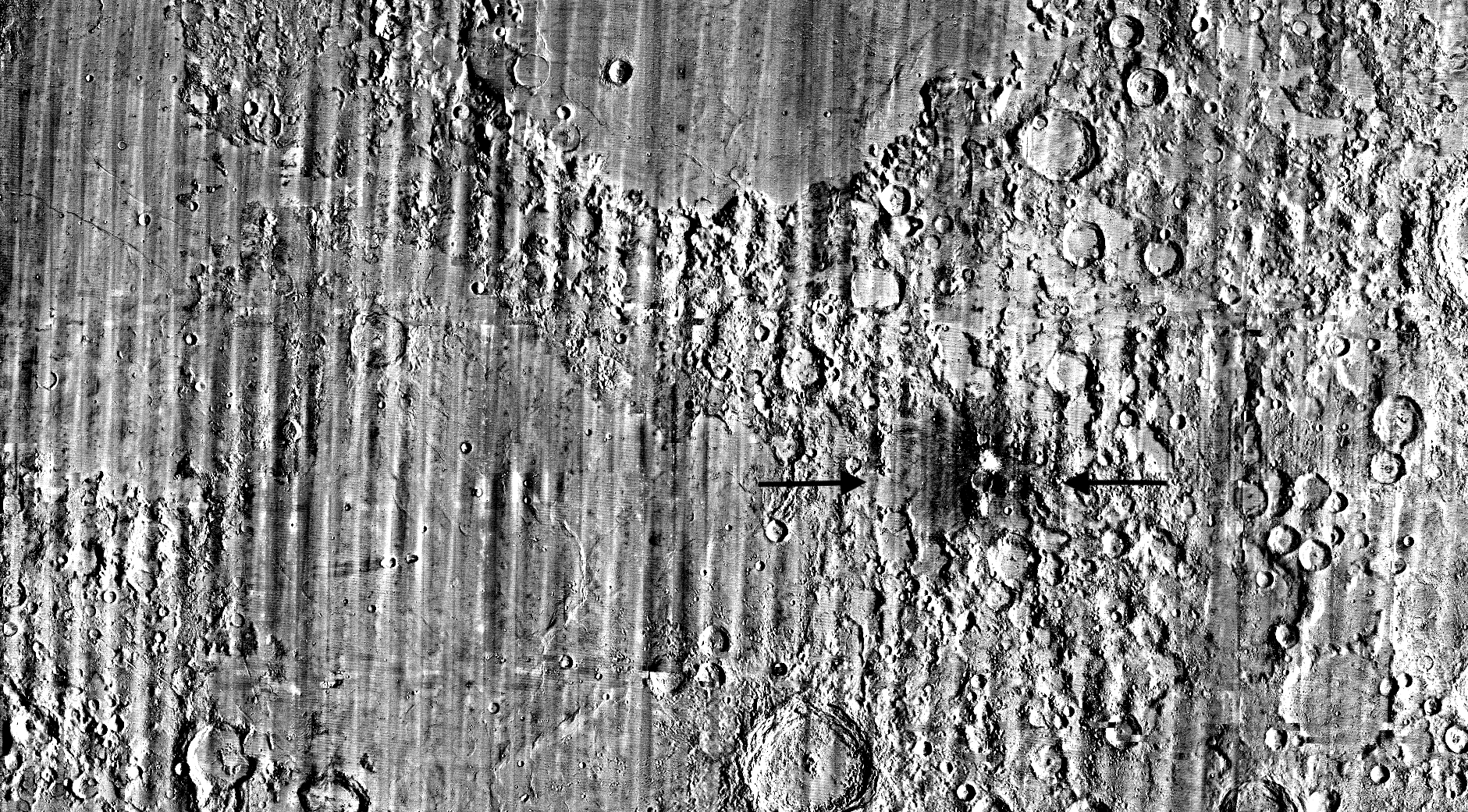
Image of the new McGetchin crater. Credit - NASA Goddard / Intuitive Machines / Robert Wagner

It's easy to think of the Moon as the static constant companion in the night sky. Its face hasn’t visibly changed in millennia, and always faces us with the same side. But looks can be deceiving, as our closest companion is constantly bombarded by asteroids and comets that make small craters across the lunar landscape. While they might not be large enough for us to see with our naked eye, professional Moon watchers can pick up on them. And a recent paper published in Science Advances, describes the largest ever found in modern times.

That crater, which is now named McGetchin, after Tom McGetchin, a celebrated lunar scientist, was formed somewhere between April 11th and May 22nd, 2024. But it wasn’t discovered until October of 2025, when Robert Wagner, an image-processing specialist with Intuitive Machines, happened to notice a dramatic change when stitching together a global difference map.

Doing so involves comparing “before” and “after” images to see what’s changed on the lunar surface, and according to a quote from a press release, Wagner immediately knew he had found something unique. “I just stopped, dropped everything, and started looking into what that spot was,” Wagner said. “It was by far the most obvious impact debris pattern I’ve ever seen in one of those images.”

Fraser reports on the crater found in LRO imaging

The images he’s referring to were taken by the Lunar Reconnaissance Orbiter (LRO), which takes both wide-angle and extreme close-ups of the lunar surface. These are occasionally stitched together to generate the global difference maps, with anything that stayed the same displayed as a dull grey color, whereas changes can show up in either very light or very dark patches.

McGetchin stood out like a sore thumb in those images, and prompted a wider effort to characterize what had caused it. After examining some close-ups taken of the impact site, they found the crater was 222m across and around 43m deep. It was likely caused by an asteroid or comet around the size of a three to six story building. And, crucially, they estimated that this size of an impact only happens about once every 132 years.

It is certainly the largest new impact site ever discovered in the solar system to date. But its broader impact was even larger. The researchers turned LRO’s thermal imaging system, known as Diviner, towards the crater and discovered a 6.4 km thermal anomaly surrounding the site. During the lunar night, a broad halo around the newly formed crater stayed about 9℃ colder than the surrounding area.

Fraser describes how big of a problem meteorites are for the Moon.

Most likely, that temperature differential was caused by regolith that had been “fluffed” by the impact. That’s a very nice way of saying that it had been blasted loose from its more compacted counterparts nearby and ended up much less dense than the surrounding area, allowing it to hold on to less heat during the lunar night cycle.

Ultimately, studying this larger crater in detail will allow scientists to better understand both how impacts themselves shape the lunar terrain and also the mechanical properties of that terrain itself. As we move towards more intensive lunar exploration, understanding both of those features of lunar life will be critical for everything from designing wheels that grip the ground to habitats that can withstand a direct meteorite hit. It’s really lucky that we got a once in a century chance to look at a big one before all of those design choices were finalized.

Learn More:

RELATED

NASA spacecraft discovers a huge new crater on the moon

NASA Just Found a New Crater on the Moon

NASA Just Discovered a Brand-New Crater on the Moon! 🌕🚀| #BrainBridge

{ https://www.universetoday.com/ }

Hoe vind je dit bericht?
Geschreven door peter om 20:27 Stuur door

Mars Was Supposed to Be Red, But ESA Just Revealed a Purple Landscape Hidden at the Planet’s South Pole

Mars Was Supposed to Be Red, But ESA Just Revealed a Purple Landscape Hidden at the Planet’s South Pole

Scientists uncover the unexpected colours of Mars after a spacecraft reveals a rare purple ice world hidden near the planet’s southern pole.

Mars Was Supposed To Be Red, But Esa Just Revealed A Purple Landscape Hidden At The Planet’s South Pole

© Credit: ESA/DLR/FU Berlin

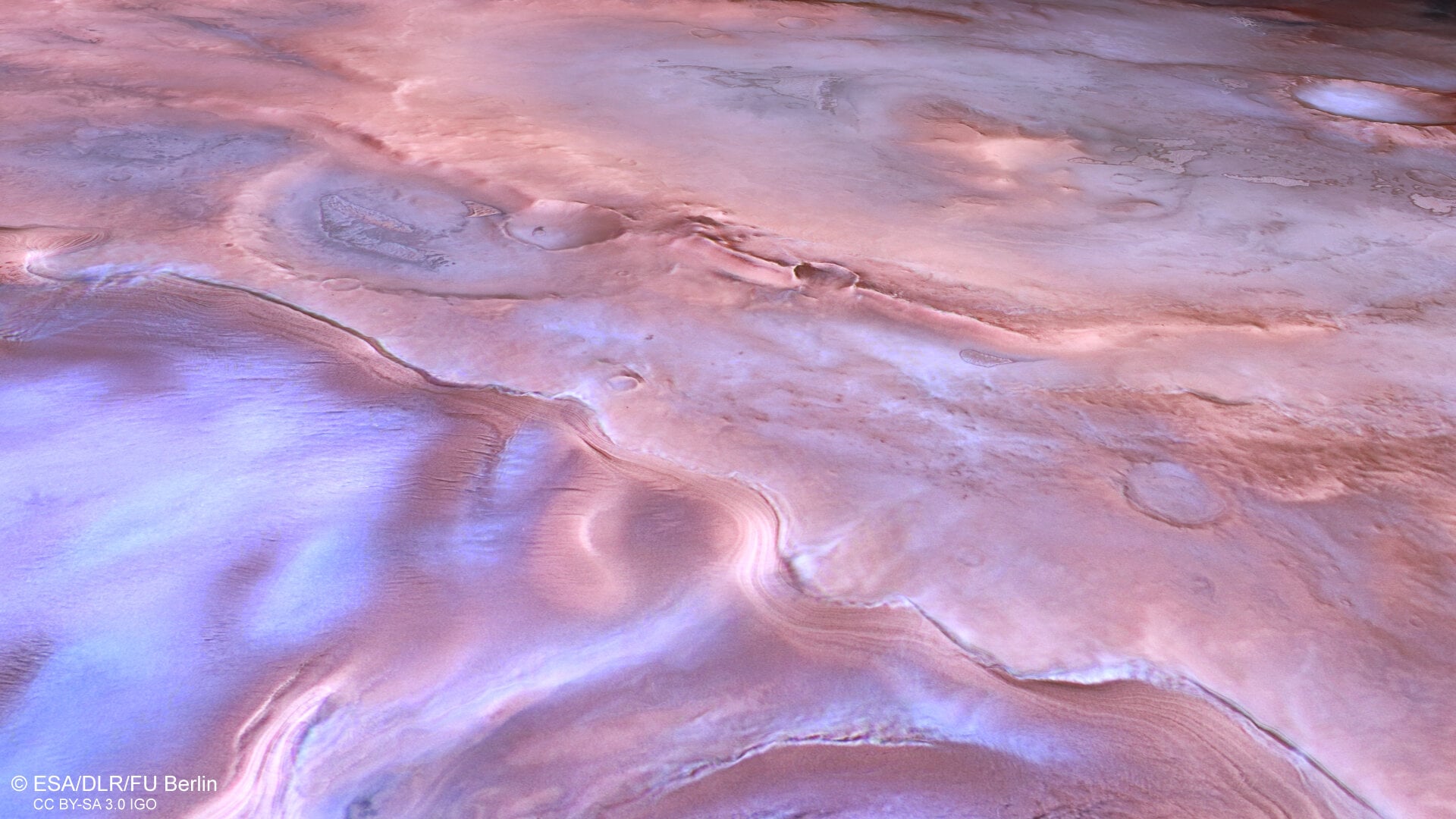
Mars has revealed a side of itself rarely seen from space. A new image captured by the European Space Agency’s Mars Express shows an icy landscape near the south pole covered in purple, pink and red shades.

The image focuses on Thyles Rupes, a cliff formation located in the southern highlands of Mars. Taken by the spacecraft’s High Resolution Stereo Camera (HRSC), the view offers an unusual perspective of a planet usually associated with rusty deserts.

The European Space Agency (ESA) explains that Mars owes its famous red appearance to oxidised iron spread across its surface. However, detailed observations from Mars Express have repeatedly shown that the planet contains a much wider range of materials, from volcanic minerals to frozen deposits.

A Hidden Colour Palette

The purple and pink tones visible in the new image are not produced by a single substance. They come from the interaction of several elements across the Martian surface, including ice, dust, frost and sunlight.

ESA scientists attribute the unusual appearance of Thyles Rupes to a combination of soft morning light, dust particles suspended in the atmosphere and frost covering large areas of the terrain. Patches where ice and dust have mixed together also contribute to the berry-like colours captured by Mars Express.

The darker regions of the image reveal another part of Mars’s geological story. These areas contain volcanic material rich in mafic minerals such as olivine and pyroxene. On Earth, these minerals are commonly found in the mantle, the layer of rock beneath the planet’s crust.

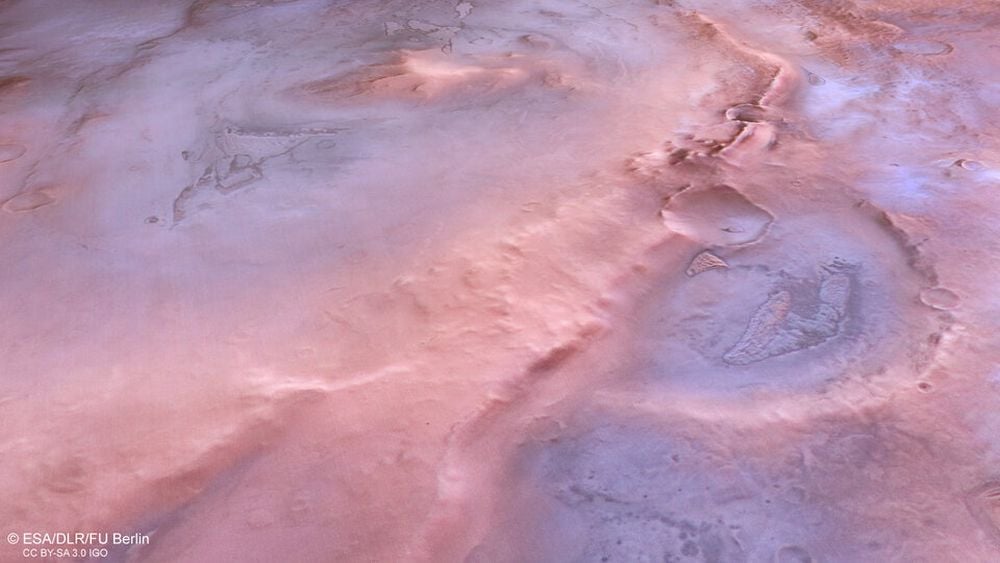
Aerial View Of Thyles Rupes And Mars’s Craters

Aerial view of Thyles Rupes and Mars’s craters.

Credit: ESA/DLR/FU Berlin

The lighter sections are linked to frozen carbon dioxide deposits that remain visible during Martian spring, the season when this region was photographed. These icy layers appear across sand dunes and inside craters, while a section of glacier connected to Mars’s south polar ice cap can be seen as a pale area near the bottom of the image.

The colours captured by the HRSC also demonstrate how different conditions can transform the appearance of the Martian surface. Changes in lighting, atmospheric dust and frost coverage can create views of Mars that look completely different from the traditional red landscapes seen in many images.

Thyles Rupes Preserves Evidence Of Ancient Mars

Beneath the purple surface lies a geological structure that records major changes in Mars’s distant past. The cliff system extends across the southern highlands, a region heavily marked by impact craters. In some areas, the cliffs rise more than 1 km above the surrounding terrain.

Scientists studying the formation believe the cliffs were created by tectonic processes that occurred billions of years ago. As its interior cooled, the planet contracted, putting pressure on its crust and forcing some blocks of surface material upward. Unlike Earth, the Red Planet no longer experiences active tectonic movements. However, structures such as Thyles Rupes preserve evidence of the forces that once shaped its surface.

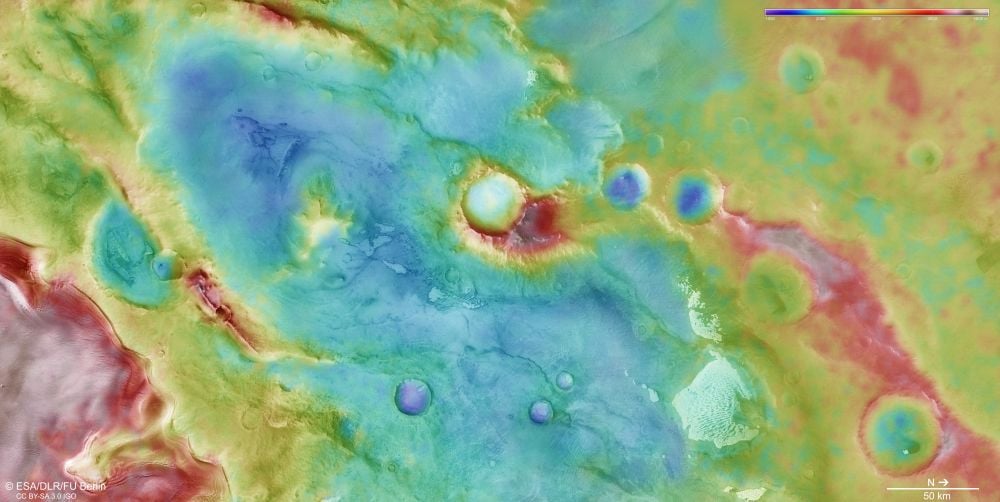
A Detailed Topographic View Of Mars’s Thyles Rupes Region
A detailed topographic view of Mars’s Thyles Rupes region.
Credit: ESA/DLR/FU Berlin

The surrounding craters provide additional information about the order of events in the region. Some craters are interrupted by the cliffs, meaning they existed before Thyles Rupes formed. Others appear on top of the structure, showing that they developed afterwards.

Mars Express Continues To Map A More Complex Planet

The new image comes from Mars Express’s High Resolution Stereo Camera, one of eight instruments aboard the spacecraft. Since its launch in 2003, the mission has been studying the planet in colour and three dimensions, producing detailed maps of the planet’s surface.

The observation also reveals a variety of dunes surrounding Thyles Rupes. Wind activity has moved sand across the region, creating several dune forms, including longitudinal dunes, transverse dunes and curved barchanoid ridges

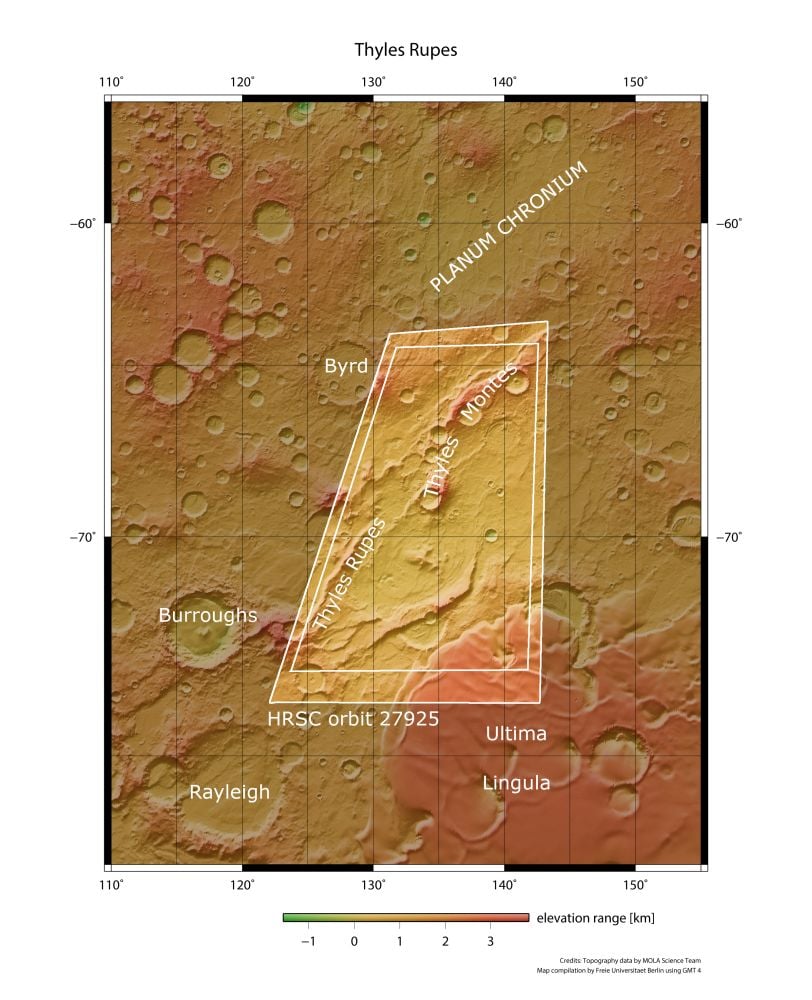
Topographic Map Of Thyles Rupes On Mars, Showing The Region’s Terrain, Elevation Changes And Nearby Geological Formations.
Topographic map of Thyles Rupes on Mars, showing the region’s terrain, elevation changes and nearby geological formations.
Credit: NASA/USGS
The European Space Agency highlights that Mars Express has transformed scientists’ understanding of the planet by documenting landscapes that were previously impossible to study in such detail. Earlier HRSC images have shown strong contrasts between dark volcanic sands and lighter areas containing clays and sulphates.

Mars Express Found Purple Swirls Near the Red Planet’s South Pole

{ https://dailygalaxy.com/category/space/ }

Hoe vind je dit bericht?
Geschreven door peter om 18:48 Stuur door

The Red Planet Has a Purple Side

The Red Planet Has a Purple Side

Mars is known for its reddish colour palette, a result of ancient iron oxides. But these striking pinks and purples are much different from the rest of the red planet. This orbital image shows Thyles Rupes, its cliff face, and a nearby glacier, where the atypical colours come from a mix of dust and frost. The image is from the High-Resolution Stereo Camera on the ESA's Mars Express orbiter. Image Credit: ESA/DLR/FU Berlin. Licence: CC BY-SA 3.0 IGO or ESA Standard Licence

Mars is known for its reddish colour palette, a result of ancient iron oxides. But these striking pinks and purples are much different from the rest of the red planet. This orbital image shows Thyles Rupes, its cliff face, and a nearby glacier, where the atypical colours come from a mix of dust and frost. The image is from the High-Resolution Stereo Camera on the ESA's Mars Express orbiter.

Image Credit: ESA/DLR/FU Berlin. Licence: CC BY-SA 3.0 IGO or ESA Standard Licence

Oxidized iron dominates the Martian colour palette. The dusty reds, ochres, browns, and tans give the planet its nickname: the Red Planet. But new images of Mars' south pole region show something different. Swirls of pink, purple, and red highlight the region and a feature named Thyles Rupes, an icy crag with cliffs higher than 1 km. Rupes means cliff in Latin, while Thyles is a mythical northern land spoken about in the ancient world.

All of the different colored materials in this region have different sources. Volcanoes both created and spread the darker material. That means that material is rich in minerals like olivine and pyroxene, both of which are also plentiful in Earth's mantle. Olivine is made of magnesium, iron, and silicate. Pyroxenes are a group of silicate minerals made mostly of silicon and oxygen, also common in Earth's upper mantle.

The pale bluish areas, like in the crater, are covered in frozen carbon dioxide. Near the south pole, this material persists, even in springtime when this image was captured. The pale patch on the lower left is actually part of the south polar cap. The main cap never melts, but a seasonal CO2 frost cap expands and contracts with the seasons.

The overall blueberry/purple hue of the region is from a combination of dust and frost. But the region doesn't always look like this and changes throughout the day. Dust in the air, soft morning light, frost covering the ground, and patches of ice and dust mixed together combine to create the purplish scene.

This image shows Thyles Rupes in context. Ultima Lingula, in the lower right, is about 550 km in diameter. Lingula means 'little tongue' in Latin, and in astrogeology, it classifies a plateau-like structures that ends in rounded, lobed shapes. Burroughs crater is named after author Edgar Rice Burroughs and is about 100 km in diameter. Image Credit: NASA/USGS. Licence: ESA Standard Licence

This image shows Thyles Rupes in context. Ultima Lingula, in the lower right, is about 550 km in diameter. Lingula means 'little tongue' in Latin, and in astrogeology, it classifies a plateau-like structures that ends in rounded, lobed shapes. Burroughs crater is named after author Edgar Rice Burroughs and is about 100 km in diameter.

Image Credit: NASA/USGS. Licence: ESA Standard Licence

Different types of dunes are also visible in the image. Due to mixed up winds, there are no finely sculpted dunes like the ones found elsewhere on Mars. There are even what are called barchanoid ridges, arc-shaped dunes common on Earth's sandy deserts that have two downwind facing "horns."

This image shows Thyles Rupes from directly above. It sits above some craters and under others, with older ones being under it. The crater on the right, the largest in the image, is older than Thyles Rupes and has been cut in half by it. Two smaller craters are visible, and they're from impacts that happened after the feature formed. Image Credit: ESA/DLR/FU Berlin. Licence: ESA Standard Licence

This image shows Thyles Rupes from directly above. It sits above some craters and under others, with older ones being under it. The crater on the right, the largest in the image, is older than Thyles Rupes and has been cut in half by it. Two smaller craters are visible, and they're from impacts that happened after the feature formed.

Image Credit: ESA/DLR/FU Berlin. Licence: ESA Standard Licence

Thyles Rupes, which extends for hundreds of kilometers, formed in a similar way as mountains do on Earth, when two plates push against one another. On Earth, tectonic plate movement is ongoing, forming new mountains on geological timescales. But not on Mars; it has no tectonics. It's a single-plate, stagnant lid planet. So Thyles Rupes mostly likely formed when the planet's interior was cooling. As the crust contracted, some parts were thrust upwards.

This topographic map of the region shows how tall Thyles Rupes is, more than 1 km high. Image Credit: ESA/DLR/FU Berlin. Licence: CC BY-SA 3.0 IGO or ESA Standard Licence

This topographic map of the region shows how tall Thyles Rupes is, more than 1 km high.

Image Credit: ESA/DLR/FU Berlin. Licence: CC BY-SA 3.0 IGO or ESA Standard Licence

Orbiters like Mars Express, featuring powerful cameras, have opened a window onto the Martian surface. Over the last couple of decades, Mars Express (and NASA's Mars Reconnaissance Orbiter) have delivered a steady stream of images of the planet's various regions. Though the planet may be dead, its surface is still intriguing, and holds many lessons about how different rocky planets can be.

{ https://www.universetoday.com/ }

Hoe vind je dit bericht?
Geschreven door peter om 18:35 Stuur door

Tower structure with gold orb hovering over it, in crater on Moon, UFO UAP Sighting News.

Tower structure with gold orb hovering over it, in crater on Moon, UFO UAP Sighting News.

UFO,%20UFOs,%20UAP,%20UAPs,%20UFO%20sighting,%20UFO%20files,%20UFO%20video%20UAP%20files,%20UAP%20video,%20department%20of%20war,%20alien,%20aliens,%20infrared%20UFO,%20IR%20UFO,%20official%20UFO,%20Gov%20UFO,%20USA%20UFO%20copy%202.png
Date of discovery: Sept 20, 2026
Location of discovery: Dark side of moon Lobachevskiy crater
NASA photo:
I was looking through the nasa index of photos from Apollo 11 mission and came across this anomaly that was just amazing. There is a tower structure coming out of the darkness of a crater floor and near the top of the tower and not connected is a golden orb. This really reminds me of The Shard from 1996 that Richard Hoagland discovered, except his was on the opposite side of the moon. The one I found is on the dark side of the moon. I found the anomaly in both the NASA index and on Google moon map. Its does appear to be a docking area for some types of ships and may even act as a transmitting tower for intergalactic communication. 
Scott C. Waring - UFO Sightings Daily 

{ https://www.ufosightingsdaily.com/ }

Hoe vind je dit bericht?
Geschreven door peter om 18:16 Stuur door

Orb Suddenly makes 180 turn, then hard right turn shooting away! Louisiana, UFO Sightings Daily News.

Orb Suddenly makes 180 turn, then hard right turn shooting away! Louisiana, UFO Sightings Daily News.

UFO_2.png

UFO_1.png
Date of sighting: Sept 16, 2026
Location of sighting: Central, Louisiana, USA
Source: NUFORC site 200979
 
This one is special folk. It literally gave me chills down my back when I saw the video the first time. Not because of the glowing orbs passing over the persons house, but because the last orb suddenly changed directions, did a 180 decree turn, going back from where it came, then suddenly after 10 seconds, made a hard right turn and disappeared in the horizon moving incredibly fast. Right there...I knew...this is an alien craft we were seeing. 
 
Please leave a comment under the video on Youtube to let me know your thoughts on this and if you have ever seen anything like it. Thanks friends. 
Scott C. Waring - UFO Sightings Daily
 
Eyewitness states: 
On my phone looked up and saw them approaching over my neighborhood as the first two disappeared quickly the third trailed behind. Were round, reddish orange orbs moving in slow motion low to the tree tops they made no sound at all. After flying past my house they all disappeared quickly into the sky. No cloud formation just clear skies that night.
 

Orb Suddenly makes 180 turn, then hard right turn shooting away! Louisiana, UFO UAP Sighting News.

{ https://www.ufosightingsdaily.com/ }

Hoe vind je dit bericht?
Geschreven door peter om 18:11 Stuur door

EXCLUSIVE - CIA's top psychic spy saw an ancient city on Mars... then something terrible happened to the beings living there

EXCLUSIVE - CIA's top psychic spy saw an ancient city on Mars... then something terrible happened to the beings living there

In May 1984, a CIA psychic spy claimed he traveled through space and time to see the end of a thriving civilization on Mars. Now, more people who claim they have seen the same vision are sharing the horrific ending of the Martian race.

A man who identified himself only as 'Brady' told the Daily Mail he possessed the ability to practice astral projection - where your awareness leaves your physical body and travels elsewhere while you remain connected to it.

Using this technique, Brady claimed he found himself in a terrifying vision on Mars, but a Mars that was inhabited by alien creatures in the distant past.

The man claimed the experience was 'heartbreaking and drastic' as an apocalyptic blue wave wiped out the Martian civilization.

Brady said: 'Everyone suddenly panicked, most looked up, others ran. There were screams and panic echoing off the side of buildings, I stared up and pierced my eyes through the bright daylight and there was a celestial body hurling towards the planet.'

'It was circular in shape, profoundly large, I felt a sigh of desperation and acceptance of fate,' he continued.

At this point, Brady claimed he watched in horror as the ground shook and a giant wave emerged from the horizon, swallowing up everything in its path.

Brady and others over the years have claimed they saw this destruction on Mars, describing the apocalypse with almost the exact same details as CIA remote reviewer Joe McMoneagle - who was tasked with seeing life on Mars one million years ago.

Remote viewers and others with psychic visions have claimed that a thriving civilization once lived on Mars (Stock Image)

Remote viewers and others with psychic visions have claimed that a thriving civilization once lived on Mars

(Stock Image)

In the 1970s and 1980s, the CIA carried out repeated experiments with individuals who had allegedly been trained to perceive information about distant places, locations or people - calling these operatives 'remote viewers.'

The Cold War effort mainly targeted Russia's Soviet Union, and McMoneagle has widely been regarded as the agency's best remote viewer, using his ability to see inside top-secret facilities - like a Soviet hangar building a new type of submarine in 1979.

During the 1984 experiment, which was part of the CIA's Project Stargate, the secretive US military program to weaponize remote viewing abilities, McMoneagle was handed a paper card with a new target printed on it.

This time, his target to psychically visit was: 'The planet Mars. Time of interest, approximately one million years BC.'

McMoneagle has said in interviews since the operation that he was not told what he would be looking at, adding that his visions of a civilized Mars came spontaneously.

Guided by coordinates on the Martian surface given to him by intelligence officials, McMoneagle 'visited' the Cydonia Mensae region - the location of the 'Face on Mars' photo taken by the Viking orbiter.

McMoneagle told his supervisor in a now-declassified report: 'I kind of got an oblique view of a pyramid or pyramid form. It's very high. It's kind of sitting in a large, depressed area. It's yellowish, okra colored.'

Instructed to 'move in time,' McMoneagle then encountered visions of what seemed to be a dying alien race on the Red Planet.

Pictured: Joe McMoneagle, a former CIA remote viewer during the Cold War

Pictured: Joe McMoneagle, a former CIA remote viewer during the Cold War

article image

McMoneagle added in his remote viewing transcript: 'I'm seeing... it's like a perception of a shadow of people, very tall... thin. It's only a shadow. It's as if they were there and they're not, not there anymore.'

The psychic spy described pyramid structures, carved canyons and obelisks, dust storms and atmospheric breakdown - suggesting that the inhabitants of Mars may have been ready to move to another world.

In the decades since McMoneagle’s vision, others have claimed they visited the planet, with Brady describing how he 'chased the experience' by attempting to project his consciousness over and over again onto the Red Planet.

He told the Daily Mail that addiction reached a point where all he cared about was returning to his vision of Mars.

Brady described the city that was destroyed as looking similar to Dubai. 'However, the atmosphere and environment seemed to look like England on a summer's day,' he added.

'Where I was it was bustling, vibrant and active with people everywhere. Everyone was around six to seven feet tall, really slim, with pale white blueish skin tone.'

The unusual stone mesas of the Cydonia region on Mars where McMoneagle allegedly visited in a remote viewing session in 1984

The unusual stone mesas of the Cydonia region on Mars where McMoneagle allegedly visited in a remote viewing session in 1984

Brady is not the only person who claimed to have visited something resembling McMoneagle’s Mars remote vision.

Remote viewer Courtney Brown described his own visions of Mars in two books, Cosmic Voyage and Cosmic Explorers.

Brown, an associate professor of political science at Emory University, claimed to have conducted large-scale experiments with multiple remote viewers examining the surface of Mars.

Brown said he 'visited' the Cydonia region McMoneagle visited and saw a civilization of ancient Martians with prominent eyes and delicate bone structure.

Like McMoneagle, he claimed that the Martian civilization was subjected to a catastrophic event, but suggested that survivors may have found homes elsewhere in the solar system.

Brown wrote: 'At its peak, Martian society compared technologically to that of ancient Egypt. They were people who lived under harsh conditions. But they could feed their families, live in towns and participate in community life. Martian society experienced some major catastrophe. Many Martians died.'

McMoneagle’s strange vision has attracted attention for decades in part because some of his other remote viewing experiments were so accurate.

The 1979 incident with the Soviet submarine is among his most famous sessions, as McMoneagle claimed to have 'seen' a large warehouse 100 yards from the White Sea in northern Russia.

He described a never-before-seen type of submarine with slanted missile tubes and a unique double-hull structure.

His claims were dismissed by the intelligence community, but defense officials later confirmed the Soviet Union was building a new class of submarine, the Typhoon, which was unveiled in 1980.

RELATED

The CIA Sent a Psychic to Mars in 1984... What He Found Is Terrifying

In 1984 a Military Psychic Was Sent to Mars a Million Years Ago and Found Them Dying

{ https://www.dailymail.com/sciencetech/index.html }

Hoe vind je dit bericht?
Geschreven door peter om 17:59 Stuur door

5 Creepiest Episodes Of The X-Files, Ranked

5 Creepiest Episodes Of The X-Files, Ranked

BY JAMES GREBEY

Scully on the phone in a phone booth

All you need to do is listen to the opening music of "The X-Files," one of the greatest theme songs of the '90s, to know that the paranormal series can get scary. For all its sci-fi trappings, horror is an essential part of the show's DNA. 

Alien abduction sits at the heart of the show's larger mythology, while many of its one-off "Monster of the Week" episodes venture even further into horror. What scares one viewer might not faze another, but these five episodes of "The X-Files" are undeniably chilling. The threats include a death-obsessed killer, a slug-like parasite worshipped by a cult, a deadly high-speed drive, a cannibal with a knack for tight squeezes, and, of course, the Peacock family.

Not every episode of "The X-Files" aims for horror, of course, but the following five are more likely to have you covering your eyes than laughing. 

5. Drive

Patrick Crump looking distressed in the backseat of a car

This Season 6 episode is widely praised, and even doubles as a sneak preview of "Breaking Bad" because it was written by Vince Gilligan and guest-stars Bryan Cranston. However, "Drive" isn't always appreciated for how scary it is.

"Drive" follows Cranston's Patrick Crump, a bigoted man living in Nevada who is arrested following a high-speed chase that ends with his wife's head exploding in the back seat. When Mulder (David Duchovny) investigates, he soon discovers that Crump is suffering from the same deadly head pressure. The excruciating pain only abates if he moves west, forcing the two onto a desperate drive to save Crump's life while Scully (Gillian Anderson) uncovers the possible source: low-frequency waves from an antenna on a United States Navy base.

The body horror of the painful, deadly pressure combined with the stress of the road makes "Drive" an unsettling watch. As Crump writhes in pain, it's hard not to imagine feeling a little something off inside your own head. Perhaps even more terrifying is Mulder's helplessness; all he can do is drive, and the moments when he somberly announces they're running out of gas — or highway — are chilling.

4. Irresistible

A hand caressing a corpse in an open casket

Unlike most episodes of "The X-Files," this Season 2 installment features no direct paranormal elements. The lack of UFOs, cryptids, or ghosts only makes "Irresistible" more unnerving. The episode follows Donnie Pfaster (Nick Chinlund), an assistant funeral director who is obsessed with death and begins mutilating bodies before turning to murder. In the original script, Pfaster was meant to be a necrophiliac, but Fox rejected that pitch.

Scully is especially disturbed by Pfaster's crimes and has demonic dreams about him. Those dreams are the only borderline paranormal aspects of the story; what happens next is all too real when Pfaster kidnaps her. Mulder rescues Scully in time, but afterward, the typically stoic agent breaks down in his arms. Seeing one of the show's protagonists in such a vulnerable state only makes Pfaster feel more terrifying.

In the book "X-Files Confidential," episode director David Nutter said series creator Chris Carter, who also wrote "Irresistible," wanted the episode to show that "not all terror comes from the paranormal. It could come from the person next door."

3. Squeeze

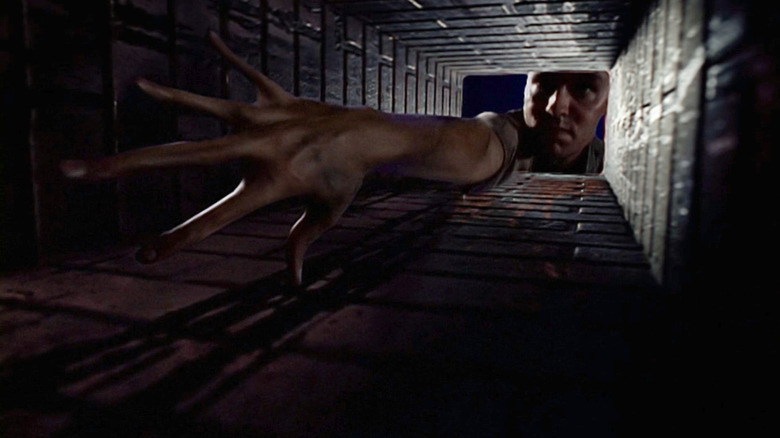
Eugene Tooms reaching his hand deep inside a chimney

The first Monster of the Week episode of "The X-Files" is also one of the best and scariest. As just the show's third episode, and the first that wasn't focused on UFO-centric mythology, "Squeeze" was important in establishing what the series could be. It wasn't just a sci-fi conspiracy show; it could also be a horror program.

In "Squeeze," Mulder and Scully investigate a series of killings that Mulder believes are awfully similar to murders that happened 30 years earlier — and another spree from 60 years before that. The culprit is revealed to be Eugene Tooms (Doug Hutchison), a man with a strange mutation that allows him to squeeze and contort his body to slip through narrow spaces to kill his victims and consume their livers. Tooms emerges every three decades to consume five livers before entering another long period of hibernation, making him functionally immortal.

Hutchison's performance reminds one of Anthony Hopkins' Oscar-winning turn in "The Silence of the Lambs," as he makes for a profoundly creepy villain. It's little wonder that Tooms became one of only a handful of Monster of the Week baddies to return for a second episode. That return, "Tooms," aired later in Season 1.

2. Roadrunners

Scully looking horrified among a group of people

"Roadrunners" is certainly one of the more gruesome installments of "The X-Files," and one of the scarier ones. The Season 8 episode has Scully investigating a murder in a small town in the Utah desert. She soon discovers that all of the residents are sacrificing hitchhikers and other drifters in the hopes that a large slug-like creature they worship as the Second Coming of Jesus Christ will accept the victim as a suitable host. Scully finds herself captive to the townsfolk, and it's only when her new partner John Doggett (Robert Patrick), who was assigned to the X-Files following Mulder's disappearance, arrives and cuts the creature out of her that she's saved.

The slug, a complex animatronic modeled after a banana slug, is disgusting, as are the scenes where it's inserted or removed from a victim's flesh. In a behind-the-scenes featurette originally included on the Season 8 DVD release, producer Paul Rabwin said that camera operators started to "lose it" because the scene was so gross and intense.

1. Home

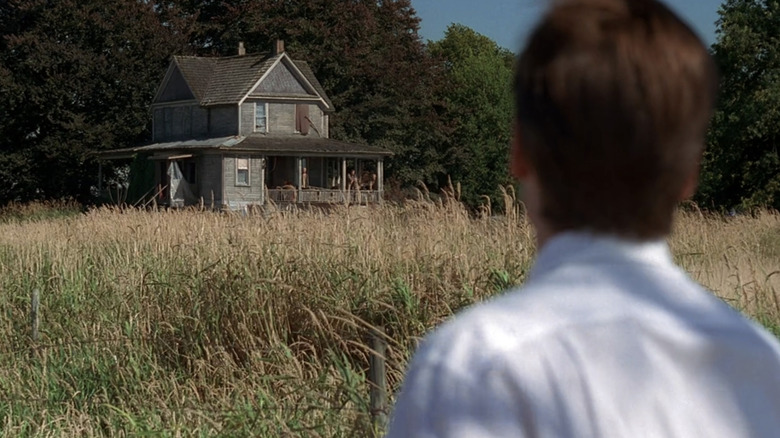
Mulder looking at the Peacock home

"Home" is widely regarded as one of the scariest episodes of "The X-Files," and rightly so. In a behind-the-scenes featurette, director Kim Manners said when he first read the script, he thought it was "as classic a horror script as I'm ever going to see." 

The episode has Mulder and Scully head to the town of Home, Pennsylvania, to investigate a deformed corpse that might be linked to the Peacock family — a reclusive group who have been living in an off-the-grid farmhouse for decades and are allegedly inbreeding murderers. When the duo enter the farmhouse, they discover booby traps, fend off attacks from the three Peacock brothers, and find their quadruple-amputee mother living under the bed.

"Home" technically doesn't feature any paranormal elements, but the Peacock family is so much in the mold of iconic horror villains from "The Texas Chain Saw Massacre" and "The Hills Have Eyes" that they certainly don't feel mundane. It is extremely intense, disturbing, and grotesque horror. Chris Carter recalled in a behind-the-scenes documentary that producer Joseph Patrick Finn wondered if they'd "gone too far this time," and "Home" became the only "X-Files" episode to earn a TV-MA rating. Despite, or perhaps because of, its infamous scares, "Home" became an acclaimed fan-favorite episode.

RELATED


TOP 5 Scariest X-Files episodes

10 Scariest X-Files Episodes Ever!

The Most DISTURBING X Files Episodes Not For The Weak Of Heart

{ https://www.tvline.com/category/primetime-tv/ }

Hoe vind je dit bericht?
Geschreven door peter om 23:22 Stuur door

Pentagon Releases 6th Batch Of UFO Files, Including New Details About Infamous 1952 UFO Sighting In Utah

Pentagon Releases 6th Batch Of UFO Files, Including New Details About Infamous 1952 UFO Sighting In Utah

Content media
Department of War

The Pentagon released a sixth batch of UFO files on Friday. The documents include a 2008 expense report detailing a nearly $22 million federal inquiry into unexplained aerial phenomena, along with film of UFOs appearing to swarm over Utah in 1952.

“Today, the Department of War is publishing the sixth release of declassified and historical Unidentified Anomalous Phenomena (UAP) files as part of the Presidential Unsealing and Reporting System for UAP Encounters (PURSUE). The collection continues to be housed on WAR.GOV/UFO, and the Department will release additional files on a rolling basis,” Assistant to the Secretary of War for Public Affairs and Chief Pentagon Spokesman Sean Parnell, said in a statement.

Never-before-seen details about an infamous 1952 UFO sighting in Utah

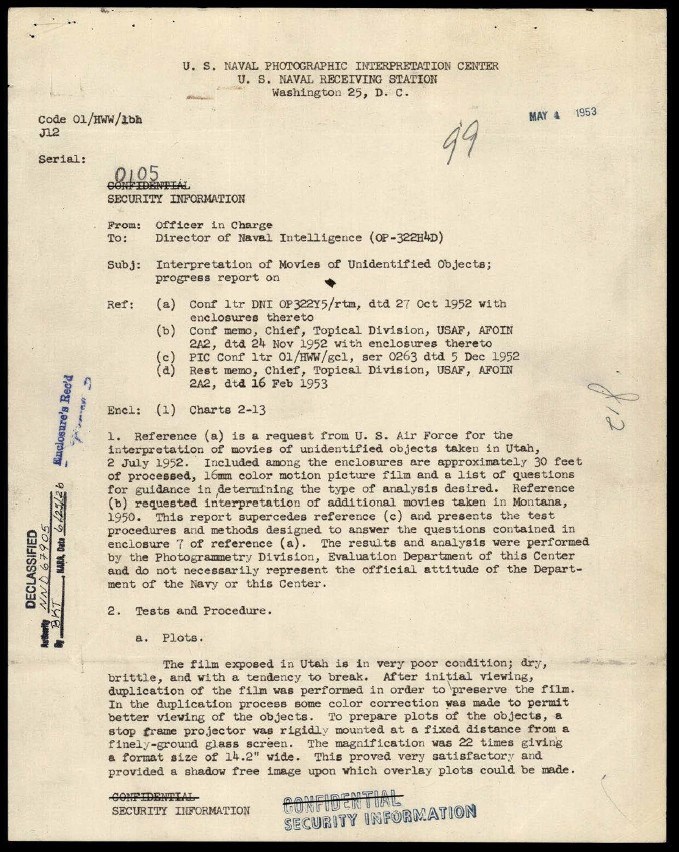
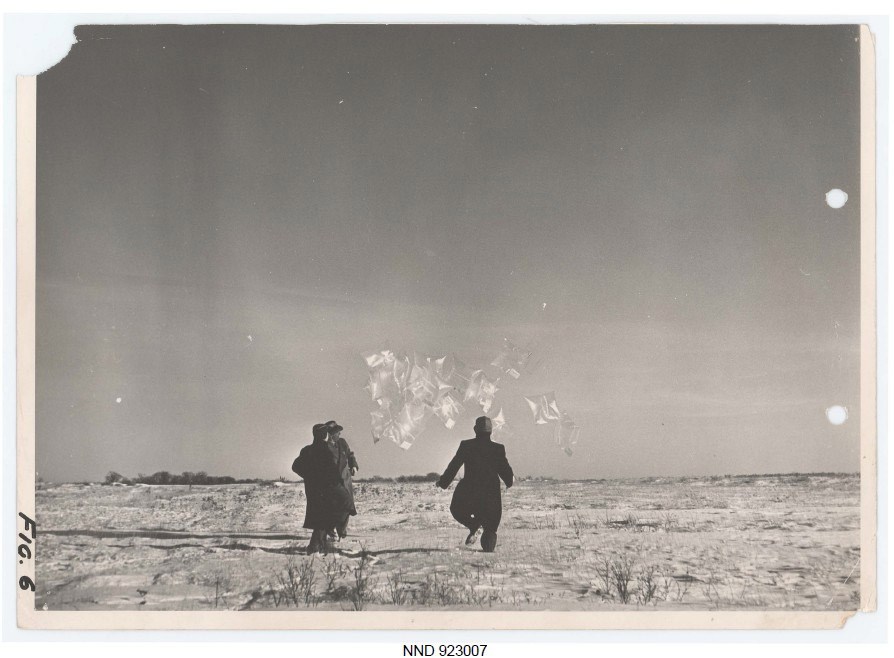
The latest document release includes a 1952 video shot near Tremonton, Utah, by Navy Chief Warrant Officer Delbert C. Newhouse, who claimed to have seen a cluster of brilliant flying objects. The Air Force’s Project Blue Book later examined the film, but experts said its limited detail and lack of established reference points made it impossible to reach a firm conclusion.

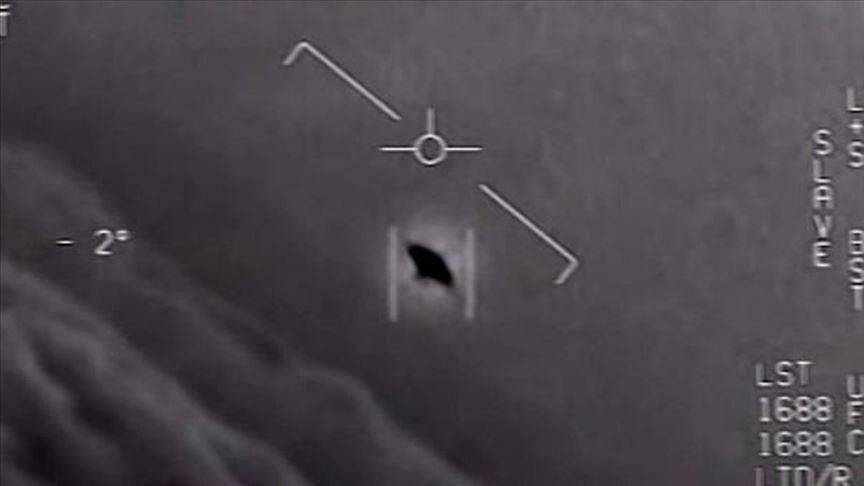
Ten to fourteen objects were visible in a clear sky in the recently released footage. They resembled two disks stacked on top of one another, forming a “flying saucer” shape, according to Newhouse, who was on vacation with his family at the time.

In incident reports, he stated that the UFOs moved in a loose circle, usually heading west, and had a shiny metallic or gunmetal hue.

Utah-UFO-report-1952

Department of War

“In late December 1952, Project Blue Book personnel, balloon specialists, and representatives from General Mills reviewed the Tremonton footage,” the Department of War states. “The group’s consensus was that the objects closely resembled pillow balloons in flight and behaved consistently with that explanation. One General Mills representative was less convinced, noting that the objects appeared somewhat too bright and seemed to maneuver too rapidly.”

Pentagon-UFO-files-Utah-1952-photo

Department of War

What else did the sixth batch of declassified UFO files include?

Also included in the newly declassified Pentagon files are numerous witness testimonies, videos of UFO sightings, and documents detailing how the Pentagon hired a private business owned by billionaire Robert Bigelow to investigate UFO sightings and futuristic technologies.

The files included expense reports from the Defense Intelligence Agency, the Pentagon’s military intelligence agency that examines foreign military technologies and potential threats. The records describe how the Advanced Aerospace Weapon System Applications Program, or AAWSAP, which operated from 2008 to 2012, received tens of millions of dollars in funding.

In one declassified recording, an Air Force briefing discusses hundreds of alleged UFO sightings that date back to 1947. Officials talk about accounts from scientists, civilians, military personnel, and airline pilots. They also discuss photos, the Lubbock Lights, unusual radar returns, and unexplained objects seen near key military locations.

In the audio, they admit that a large percentage of the reports remained unaccounted for and repeatedly acknowledge that some credible reports simply had no explanation.


Additional files include a 1952 presentation by Capt. Edward J. Ruppelt, the former head of Project Blue Book, who stated that after examination, about 20% of the 800 incidents the Air Force evaluated remained unexplained.

This latest release of declassified UFO files by the Pentagon comes just a few days after the Department of War announced it will grant a legal waiver allowing civilian workers, contractors, and current and former military personnel to provide information about Unidentified Anomalous Phenomena, better known by the public as UFOs.

RELATED


Watch: Pentagon releases 15 new UFO videos

JUST IN: Pentagon releases 6th batch of UFO files, audio recording

{ https://brobible.com/ }

Hoe vind je dit bericht?
Geschreven door peter om 22:54 Stuur door

EXCLUSIVE - I investigated 700 UFO abductions. I started believing in God after survivors claimed two words saved them from 'demonic' entities

EXCLUSIVE - I investigated 700 UFO abductions. I started believing in God after survivors claimed two words saved them from 'demonic' entities

A UFO researcher says he became a Christian after investigating hundreds of alleged alien abductions that were miraculously stopped when those involved claimed they invoked the power of Jesus.

Joe Jordan, 72, is a safety professional for the Blue Origin Rocket Factory in Florida and has also researched UFO sightings and abduction claims for 32 years.

Jordan told the Daily Mail he has investigated roughly 700 abduction cases, finding that those who called out to either Jesus or God claimed the supernatural incident immediately ended without further harm.

His research not only convinced him in the existence of a higher power, but also that sightings of extraterrestrials may actually be spiritual visitations - a belief which has spread amongst the religious community, who claim aliens are actually demons.

Jordan said: 'The way it changed my life is seeing that the power and the name and authority of Jesus Christ convinced me 100 percent that God is real, the Bible is real, Jesus was real... You call on him for help; he's there for help.'

The US government has maintained for decades that there has never been any evidence recovered that proves UFOs or alien life exists. That stance has not changed even as the Pentagon continues its highly publicized UFO disclosure rollout.

With skepticism over alien contact remaining high, the researcher noted that even non-religious groups have begun to broaden the discussion surrounding UFOs, moving away from calling everything extraterrestrial and focusing more on 'non-human' phenomena.

'They're saying that what used to be always about extraterrestrial biological entities from other worlds, they're now calling interdimensional, extradimensional, and ultradimensional,' Jordan explained.

Joe Jordan told the Daily Mail he has researched about 700 alleged alien abductions (Stock Image)

Joe Jordan told the Daily Mail he has researched about 700 alleged alien abductions

(Stock Image)

After 30 years of research, Jordan now says it is clear to him that the true nature of these abductions appears to have a demonic connection - which he claimed often started with the person seeing these entities engaging in some form of the occult.

He revealed that UFO abduction experiences often happen after the alleged victim opens a door to these entities by dabbling in areas that the Bible deemed to be contrary to the word of God.

'Every person that I found that unknowingly opened the door to the experience, they have been dabbling in the occult, the paranormal, even the UFO phenomenon itself. But that is what triggered the opportunity for them to be affected by this,' Jordan expl

'I had experiencers coming and saying that they had been taken aboard craft, things had been done to them,' he continued.

However, the UFO researcher-turned-Christian believed these entities were spirits from another realm which the Bible would deem as hostile to humanity, and the 'abduction' simply took on the disguise of a UFO encounter.

'Nobody's getting taken anywhere. This experience is a demonic vision, demonic spiritual visionary experience that's given to them,' Jordan claimed.

Jordan began researching UFOs in the 1990s after reading a book about the 1947 Roswell UFO incident and eventually became a member of the UFO research organization MUFON in 1992, working as a field investigator and state section director.

MUFON has 700 investigators in the US and is one of the world’s oldest UFO research organizations, having collected evidence of extraterrestrial encounters since the 1960s.

A video released in the first wave of UFO files appeared to show a glowing object resembling an 'eight-pointed star' with uneven arms that has been compared to a craft from biblical times

A video released in the first wave of UFO files appeared to show a glowing object resembling an 'eight-pointed star' with uneven arms that has been compared to a craft from biblical times

Joe Jordan (Pictured) has been a Mutual UFO Network (MUFON) field investigator since 1992

Joe Jordan (Pictured) has been a Mutual UFO Network (MUFON) field investigator since 1992

Rather than focus on encounters where people saw UFOs, Jordan’s research focused on people who claimed they had been abducted.

It was around this point that Jordan encountered a case that changed the whole course of his research, and his life.

The experiencer, named 'Bill D,' talked about an abduction experience which he described as dark and with satanic overtones.

He cried out, 'Jesus, Jesus, help me!' and reported to Jordan that the experience immediately stopped and he woke up in his bed.

Jordan said: 'I thought this just doesn't make sense because all the leading researchers at the time in the early mid 90s were saying that these abduction experiences could not be stopped, but I had one that just said he had stopped it.'

Every UFO researcher Jordan said he has contacted claimed they came across cases where people had said a prayer, sang a hymn or called out to Jesus - and the experience stopped.

However, he claimed that UFO researchers never share such stories publicly, with one alleging that sharing the story would damage their standing in the UFO community.

article image

'For 30 years that I've been doing this, all we hear is cover up, cover up, cover up. That is supposedly from the government. The cover up [is] coming from the researchers themselves that we've been relying on for the truth!' Jordan alleged.

Jordan explained that before he embraced Christianity, he started working with MUFON as a 'crystal-ball rolling' New Age practitioner. However, a fellow investigator warned him that he was dabbling with sinister and dark forces.

'I told her I got these crystals that protect me from this and that. She said, "I mean, real protection.” And then she handed me a Bible. In November '96, I became a Christian,' he recalled.

The idea that UFOs might be demonic has gained growing support in recent years. Vice President JD Vance said on a podcast in March, 'I don’t think they’re aliens, I think they’re demons.'

Experts such as parapsychologist Hal Puthoff and ufologist Jacques Vallee have championed the demonic UFO hypothesis for decades.

RELATED


What "They" Don't Want You To Know About The Alien Abduction Phenomenon – Michael Heiser
Hoe vind je dit bericht?
Geschreven door peter om 22:34 Stuur door

Wetenschappers stuurden robot 4,5 km diep de oceaan in — wat hij aantrof is een waarschuwing

Wetenschappers stuurden robot 4,5 km diep de oceaan in — wat hij aantrof is een waarschuwing

Artikel door Alyce Collins
Wetenschappers stuurden robot 4,5 km diep de oceaan in — wat hij aantrof is een waarschuwing
© Picture Alliance

Honderden kilometers van de kust en duizenden meters onder het oppervlak van de oceaan hebben wetenschappers opmerkelijk bewijs gevonden dat de omvang van de menselijke voetafdruk laat zien.

Een team van onderzoekers dat de Mar del Plata Submarine Canyon voor de kust van Argentinië verkende, ontdekte zwerfvuil verspreid over de diepzeebodem, wat aantoont dat zelfs enkele van de meest afgelegen omgevingen niet immuun zijn voor vervuiling.

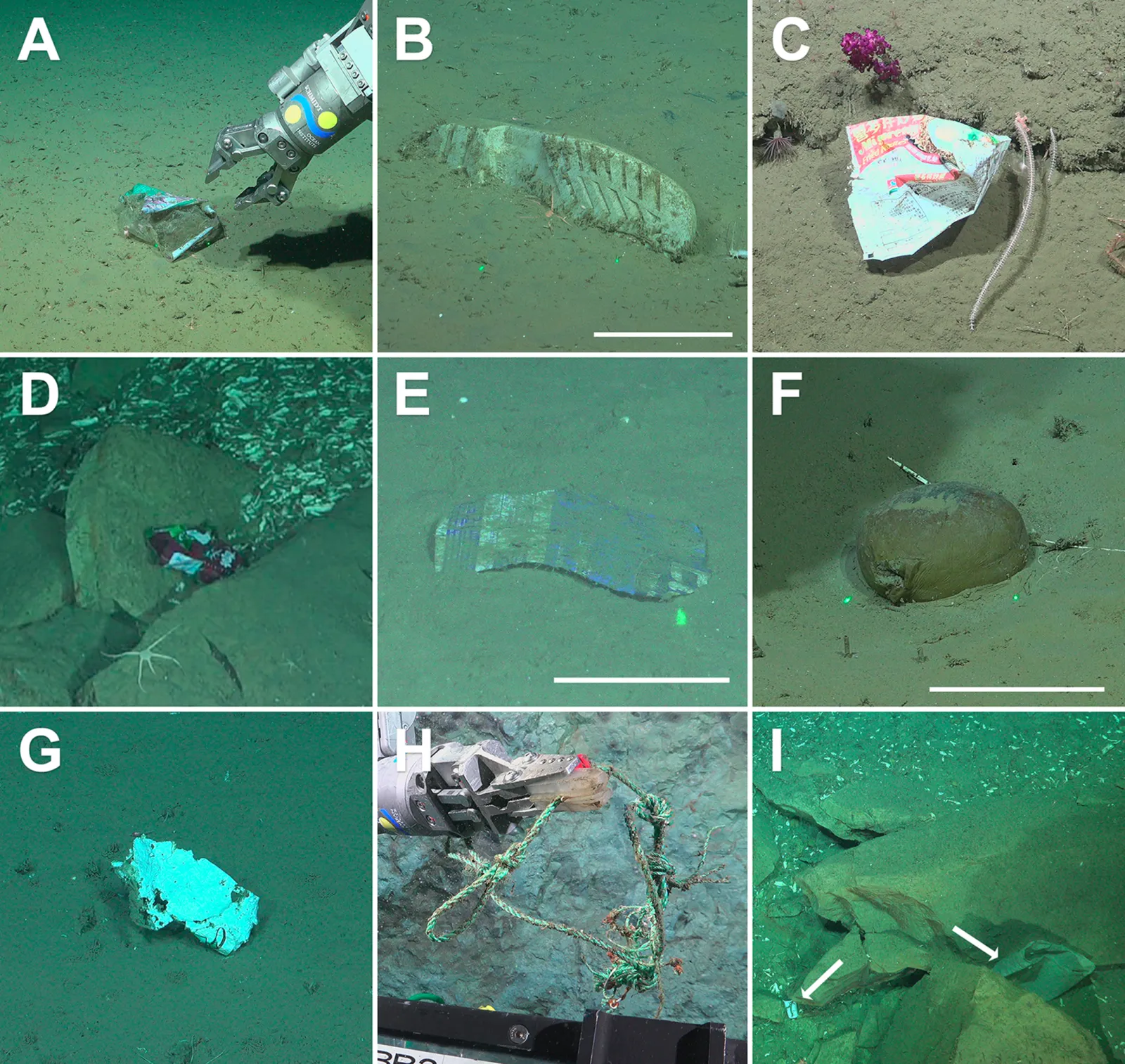
De bevindingen, gepubliceerd door de non-profitorganisatie PLOS One, waren gebaseerd op onderzoeken met een op afstand bedienbaar voertuig (ROV) dat tot een diepte van 4.500 meter kon afdalen—bijna vijf kilometer onder het oppervlak. Puin dat op de zeebodem werd aangetroffen, werd in kaart gebracht en vervolgens gecategoriseerd in afzonderlijke stukken afval, zoals plastic folies, zakken, voedselverpakkingen en visuitrusting.

Hoofdonderzoeker Daniel Lauretta van het Museo Argentino de Ciencias Naturales en de Deep Sea Studies Group of Argentina (GEMPA) vertelde Newsweek dat de resultaten duidelijk maken dat “zelfs zeer afgelegen en diepe omgevingen niet volledig geïsoleerd zijn van menselijke activiteiten.”

“De diepzee lijkt misschien afgelegen en losgekoppeld van ons dagelijks leven, maar zij staat nog steeds in verbinding met activiteiten die aan het oceaanoppervlak plaatsvinden”, zei hij.

Mede-auteur Diego Urteaga merkte verder op dat het afval dat ze vonden beter overeenkwam met “afval dat wordt gegenereerd door schepen die offshore opereren”, zoals vissersschepen.

“Het meest verrassende is dat objecten die verbonden zijn met onze dagelijkse activiteiten op zulke diepten kunnen worden aangetroffen”, vertelde Urteaga aan Newsweek. “Wanneer je naar de zeebodem kijkt op bijna drie kilometer onder het oppervlak, is het gemakkelijk om je een wereld voor te stellen die volledig gescheiden is van menselijke activiteit. En dan kom je ineens een stuk visgerei of een ander vervaardigd object tegen.”

Submariene canyons zijn uitgestrekte onderwaterdalen die in het continentale plat zijn uitgesleten. Wetenschappers beschouwen ze als hotspots voor biodiversiteit omdat ze een overvloed aan zeeleven kunnen ondersteunen.

De Mar del Plata Submarine Canyon ligt ongeveer 300 km van de Argentijnse kust. Onderzoekers merkten echter op dat oceaanstromingen afval over enorme afstanden kunnen vervoeren, wat betekent dat sommige objecten een behoorlijk lange weg kunnen hebben afgelegd voordat ze de canyon bereikten.

Examples of deep-sea litter found in the Mar del Plata Submarine Canyon.

Voorbeelden van zwerfvuil uit de diepe zee gevonden in de Mar del Plata Submarine Canyon.

Teso et al., 2026, PLOS One

Urteaga zei dat het meest memorabele moment kwam toen er plotseling een vislijn voor de ROV opdook, waardoor de operators moesten ingrijpen om een aanvaring te voorkomen.

Voor Lauretta was de “meest opvallende” vondst een eenzame laars die op de zeebodem lag. Wat Lauretta echter het meest verraste, was de relatief lage hoeveelheid afval die ze aantroffen.

“De relatief geringe hoeveelheid afval die we hebben waargenomen in vergelijking met sommige andere submariene canyons is zeker een belangrijke bevinding. We zouden echter terughoudend zijn om dit eenvoudigweg te interpreteren als bewijs dat de canyon onaangetast is of dat er geen reden tot zorg is”, zei Lauretta.

Het is echter van cruciaal belang om rekening te houden met de geografische kenmerken van de Mar del Plata Submarine Canyon. Ondanks de relatief afgelegen ligging heeft menselijk afval toch de weg gevonden naar de diepten van de canyon.

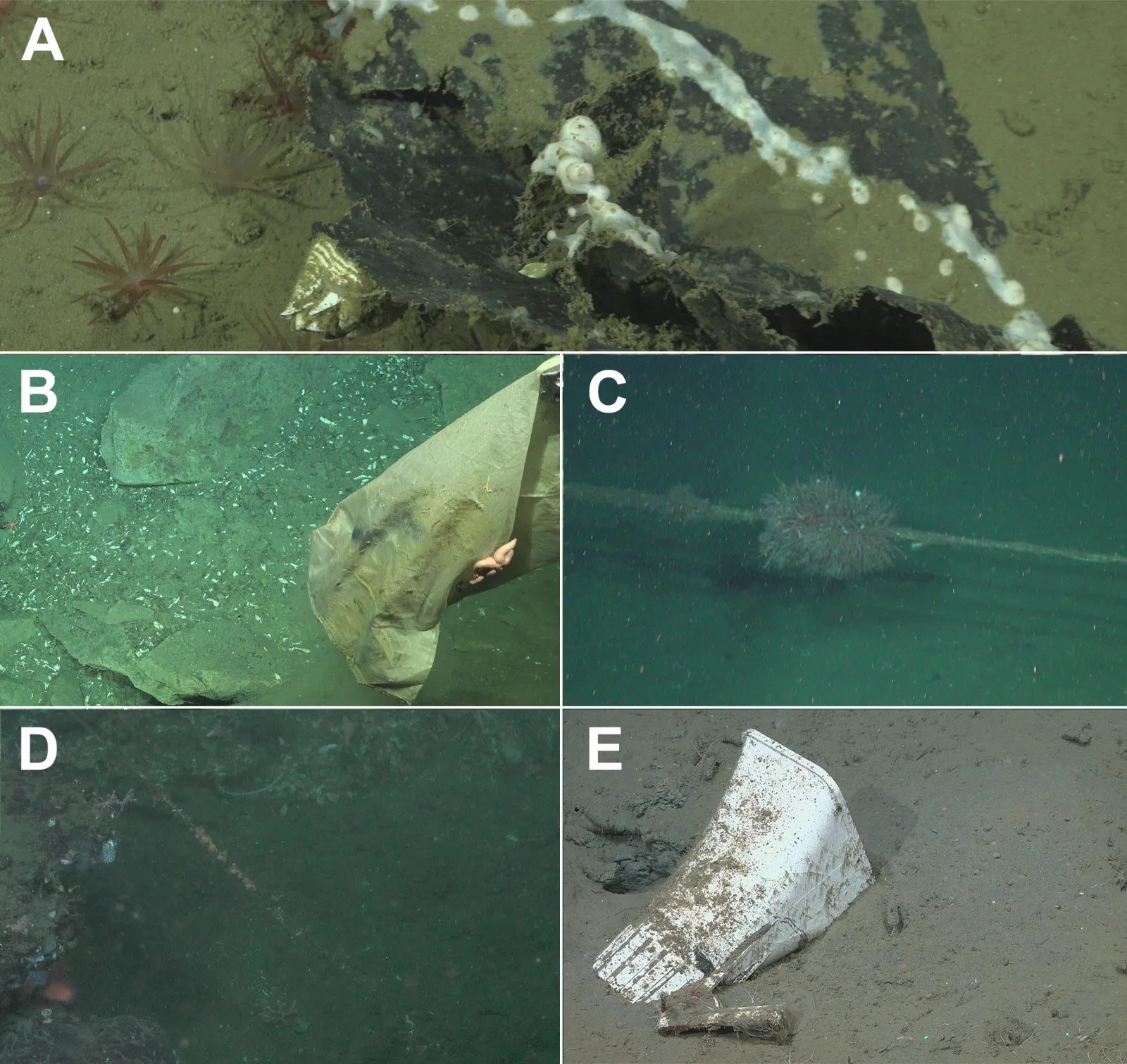
Faunal interactions with anthropogenic litter in the Mar del Plata Submarine Canyon.

Faunale interacties met door de mens gemaakt afval in de Mar del Plata Submarine Canyon.

Teso et al., 2026, PLOS One

In een gesprek met Newsweek over de bevindingen zei Sian Sutherland, mede-oprichter van A Plastic Planet, dat dit “het bewijs is dat er geen ‘weg’ bestaat als het om plastic gaat.” Haar organisatie werkt samen met overheden en bedrijven om duurzame alternatieven voor plastic te bieden om de vervuiling terug te dringen.

“Plastic is ontworpen om lang mee te gaan. Het kan enorme afstanden afleggen via rivieren en oceaanstromingen voordat het zinkt, vast komt te zitten in onderwatercanyons en daar decennialang of nog langer blijft. Wat wij voor een paar minuten weggooien, kan generaties lang deel uitmaken van een ecosysteem.” zei Sutherland.

De studie vond ook aanwijzingen dat zeeorganismen zich aan weggegooide objecten hechtten, waarvan wetenschappers waarschuwen dat ze afval kunnen transformeren tot kunstmatige habitats, die mogelijk diepzee-ecosystemen veranderen.

Hoewel de hoeveelheid waargenomen afval lager was dan in veel andere submariene canyons elders in de wereld, hopen de onderzoekers dat de bevindingen dienen als een herinnering dat vervuiling zelfs de meest geïsoleerde uithoeken van de oceaan kan bereiken.

“We zijn nog steeds aan het ontdekken hoe deze diepzee-ecosystemen functioneren en hoeveel soorten er leven, en toch bereiken sporen van onze activiteiten deze omgevingen nu al”, vertelde Urteaga aan Newsweek. “De diepe oceaan is geen lege of verre ruimte. Het is een levende omgeving, en onze handelingen aan het oppervlak kunnen plekken bereiken die onvoorstelbaar ver weg lijken.”

Hoe de canyon er in de komende jaren uit zou kunnen zien, blijft onbekend, maar het belang van het voorkomen dat afval in onze oceaan terechtkomt, mag niet worden onderschat. Lauretta en Urteaga zijn van mening dat preventieve maatregelen veel effectiever zijn dan proberen afval te verwijderen zodra het de zeebodem heeft bereikt.

Aangezien deze studie een momentopname biedt van de onderwateromstandigheden, merken ze op dat herhaalde observaties van diepzeegebieden essentieel zijn om veranderingen en de verspreiding van afval te herkennen. Ze zijn van plan om soortgelijke onderzoeken uit te breiden naar andere diepzee-canyons rond Argentinië om een beter inzicht te krijgen in de omvang van de vervuiling in de regio en een ijkpunt vast te stellen voor toekomstige monitoring.

Referentie

  • Teso, V., Urteaga, D., Bozzano, G., Bigatti, G., Brogger, M. I., Brusa, F., et al. (2026). Out of sight, hidden into the deep: Marine litter in the Mar del Plata Submarine Canyon (southwestern Atlantic) revealed by ROV survey. PLOS One, 21(9), e0357098. https://doi.org/10.1371/journal.pone.0357098
RELATED 

Scientists Sent a Robot 31,000 Feet to the Ocean Floor — The Footage Left Everyone Speechless!

Scientists Sent a Robot 31,000 Feet to the Ocean Floor — The Footage Left Everyone Speechless!
Hoe vind je dit bericht?
Geschreven door peter om 22:16 Stuur door

Meer van UFO'S of UAP'S, ASTRONOMIE, RUIMTEVAART, ARCHEOLOGIE, OUDHEIDKUNDE, SF-SNUFJES EN ANDERE ESOTERISCHE WETENSCHAPPEN - DE ALLERLAATSTE NIEUWTJES

↑ Terug naar de berichten