Naar de inhoud

UFO'S of UAP'S, ASTRONOMIE, RUIMTEVAART, ARCHEOLOGIE, OUDHEIDKUNDE, SF-SNUFJES EN ANDERE ESOTERISCHE WETENSCHAPPEN - DE ALLERLAATSTE NIEUWTJES

UFO's of UAP'S in België en de rest van de wereld
akke.beakke.be
Ontdek de Fascinerende Wereld van UFO's en UAP's: Jouw Bron voor Onthullende Informatie! Ben jij ook gefascineerd door het onbekende? Wil je meer weten over UFO's en UAP's, niet alleen in België, maar over de hele wereld? Dan ben je op de juiste plek! België: Het Kloppend Hart van UFO-onderzoek In België is BUFON (Belgisch UFO-Netwerk) dé autoriteit op het gebied van UFO-onderzoek. Voor betrouwbare en objectieve informatie over deze intrigerende fenomenen, bezoek je zeker onze Facebook-pagina en deze blog. Maar dat is nog niet alles! Ontdek ook het Belgisch UFO-meldpunt en Caelestia, twee organisaties die diepgaand onderzoek verrichten, al zijn ze soms kritisch of sceptisch. Nederland: Een Schat aan Informatie Voor onze Nederlandse buren is er de schitterende website www.ufowijzer.nl, beheerd door Paul Harmans. Deze site biedt een schat aan informatie en artikelen die je niet wilt missen! Internationaal: MUFON - De Wereldwijde Autoriteit Neem ook een kijkje bij MUFON (Mutual UFO Network Inc.), een gerenommeerde Amerikaanse UFO-vereniging met afdelingen in de VS en wereldwijd. MUFON is toegewijd aan de wetenschappelijke en analytische studie van het UFO-fenomeen, en hun maandelijkse tijdschrift, The MUFON UFO-Journal, is een must-read voor elke UFO-enthousiasteling. Bezoek hun website op www.mufon.com voor meer informatie. Samenwerking en Toekomstvisie Sinds 1 februari 2020 is Pieter niet alleen ex-president van BUFON, maar ook de voormalige nationale directeur van MUFON in Vlaanderen en Nederland. Dit creëert een sterke samenwerking met de Franse MUFON Reseau MUFON/EUROP, wat ons in staat stelt om nog meer waardevolle inzichten te delen. Let op: Nepprofielen en Nieuwe Groeperingen Pas op voor een nieuwe groepering die zich ook BUFON noemt, maar geen enkele connectie heeft met onze gevestigde organisatie. Hoewel zij de naam geregistreerd hebben, kunnen ze het rijke verleden en de expertise van onze groep niet evenaren. We wensen hen veel succes, maar we blijven de autoriteit in UFO-onderzoek! Blijf Op De Hoogte! Wil jij de laatste nieuwtjes over UFO's, ruimtevaart, archeologie, en meer? Volg ons dan en duik samen met ons in de fascinerende wereld van het onbekende! Sluit je aan bij de gemeenschap van nieuwsgierige geesten die net als jij verlangen naar antwoorden en avonturen in de sterren! Heb je vragen of wil je meer weten? Aarzel dan niet om contact met ons op te nemen! Samen ontrafelen we het mysterie van de lucht en daarbuiten.

Archief

Why is the constellation of Scorpius so weird?

Why is the constellation of Scorpius so weird?

Scorpius is the most amazing of the zodiac constellations. Although astrology divides the year into 12 almost equal parts, astronomers know that in reality the Sun is only in it for 8 days. However, it also has numerous attractions.

Constellation Scorpius

Scorpius, who dislikes the Sun

On November 22, the Sun will enter the constellation Scorpius. As is almost always the case in such situations, astrologers strongly disagree with astronomers, claiming that our star entered the constellation on October 23 and left it on November 21.

The main reason for this is the shift in the vernal equinox due to the precession of the Earth’s axis of rotation. You can read more about this in this article. In fact, there is at least one more reason why astrologers disagree with astronomers about the time the sun is in different zodiac constellations, but for most of them, it is secondary.

But not for Scorpius. We are referring to the clarification of constellation boundaries, which occurred at the beginning of the 20th century. And in the case of this constellation, they were drawn in such a way that the Sun actually crosses it only along a narrow strip through its “head” and “claws.”

The constellation Scorpius. The blue line is the ecliptic. Source: Wikipedia

As a result, of all the constellations, it is in Scorpius that the Sun actually spends the least amount of time – only 8 days. On November 29, it will leave the poisonous multi-legged celestial being and move on to its neighbor, Ophiuchus, where it will stay longer than in Scorpius, but which is not considered a zodiacal constellation.

In general, November is the worst month for observing Scorpius. The reason for this is the same as for other zodiac constellations: it rises and sets with the Sun at this time of year and hides behind the horizon at night. The best time to observe it is in May and June, when it rises above the southern horizon.

The mythical monster

There are several myths about how Scorpius appeared in the sky. But in all of them, he appears as the embodiment of evil, whose actions lead to extremely bad consequences. The most common of these myths links Scorpius with Orion.

Scorpius in May. Source: stellarium-web.org

Orion was supposedly the most outstanding of human hunters, but his thirst for prey led him astray. According to one version of the myth, he began to pursue the Pleiades and chased them for seven years until the Scorpion, sent by Gaia or Poseidon, stung him, causing him to die in terrible agony.

According to another version, Orion demanded the goddess of the hunt, Artemis, herself. But she did not reciprocate his feelings, yet he continued to pursue her until she sent a poisonous messenger to kill him. Be that as it may, Orion and Scorpius are indeed located far apart in the sky, as if the former were hiding from the latter.

Another myth says that the celestial Scorpius is actually the one that frightened the horses pulling the golden chariot of Helios, the sun god. It was driven by his inexperienced son Phaethon, and the horses carried it too close to Earth, causing a worldwide fire. To stop this, Zeus had to kill the boy and the horses with a thunderbolt, and Phaethon fell into the river Eridanus.

The myth of Phaethon. Source: globalpowerelite.com

Antares and other bright stars

Although the Sun is in Scorpius for only a short time, there are more interesting objects in it than scary myths about it. The most notable of these is Alpha Scorpii, known as Antares. Among all the stars that make up the zodiacal constellations, it is second only to Alpha Tauri, Aldebaran.

At the same time, Antares is very noticeable due to its red color. Thanks to this, it got its name “anti-Ares,” meaning the enemy of Mars. In reality, it is much farther away from us than the Red Planet and incomparably larger than it.

It is a red supergiant located 550 light-years away from us. In fact, it is a binary system. Its main component, which we can actually see, has a mass of 12.4 solar masses, but has already used up almost all of its hydrogen and swelled to a size 400 times larger than our sun. It emits 75,900 times more energy than the Sun. However, all these measurements are actually quite approximate, because the giant star pulsates, changing its radius by 19%.

Antares compared to other stars. Source: www.statesman.com

The main component of the system is orbited by its companion, which is also a fairly large star. Despite having a mass 7.2 times that of the Sun, it has not yet exhausted its thermonuclear fuel and therefore has a blue color. Its diameter is 5.2 times that of the Sun.

There is still no consensus among scientists regarding the distance between the two components and, accordingly, their orbital period. The most accurate measurements to date indicate a distance of about 220 AU and an orbital period of approximately 1,218 years.

In any case, the Antares system is very young. Its age ranges from 11.8 to 17.3 million years. After some time, the larger of the stars will finally exhaust its thermonuclear fuel and turn into a supernova, and then into a black hole. Then, after a few million years, the same fate will befall the second star.

Lambda Scorpii. Source: www.star-facts.com

The second brightest star in Scorpius is its Lambda, which is called Shaula, derived from the Arabic word for “raised tail.” It is indeed located on the tail of the celestial arthropod and has an apparent magnitude of 1.62.

In fact, it is a triple system located 570 light-years away from us. The main component is a variable star of the Beta Cephei type. Explosive processes occur inside these hot and heavy blue stars, inflating their outer shells. In the case of Shaula, the mass of the main component exceeds that of the Sun by 10.4 times, and its luminosity by 36,000 times.

Around it, at a distance of 7,500 AU, there’s a smaller blue star. It’s about twice as heavy as our Sun. And around this pair, at a distance of 17,000 AU, there’s a third star that’s eight times heavier than our Sun.

The third brightest star in Scorpius is its Theta, Sargas. It is a double system located 329 AU away from us. What the smaller component of the system is and whether it exists at all remains unclear. But here is the main object of interest.

It is a star of spectral class F, which means it is slightly hotter than the Sun. Its mass is about three times greater than that of our star, its polar radius is 26 times greater than that of the Sun, and its equatorial radius is 36 times greater. In other words, it is flattened, and there is only one explanation for this: it was once a pair of stars that merged.

Theta Scorpii. Source: www.flickr.com

Nearby stars

The closest star to us in the constellation of Scorpius is Gliese 682. It is a rather dull red dwarf located 16.3 light-years away from us. Its mass is 27% and its radius is 30% of the Sun’s. In 2016, it was reported that two planets had been discovered around it, but their existence has now been disproved.

Next is the Gliese 667 system, located 23 light-years away from us. It consists of two orange dwarfs and one red dwarf. The first two have masses of 69% and 73% of the Sun and revolve around a common center of mass in a highly elongated orbit with a semi-major axis of 12.6 AU, completing one revolution every 42 Earth years.

And around them orbits a third star – a red dwarf with a mass of 31% of the Sun’s. And it is this object that is the most interesting in the entire system. At one time, scientists reported that Gliese 667 C had as many as six planets, but now the existence of two of them is recognized.

Planet Gliese 667 Cc. Source: Wikipedia

The first is Gliese 667 Cb. With a mass of 5.6 Earths and an orbital period of 7.2 days, it is most likely a large hot super-Earth or an equally hot mini-Neptune. This world must have a powerful hydrosphere and a dense atmosphere, the boundary between which is quite arbitrary.

But the second planet, Gliese 667 Cc, is much more interesting. Its mass is 4.1 times that of Earth, and it orbits its star once every 28 Earth days. Calculations show that the star can heat it to 4.3 °C, which is slightly higher than on Earth. Most likely, Gliese 667 Cc is significantly warmer than our planet due to a powerful greenhouse effect. However, it may still be the case that the temperature on it is not high enough for life to exist. But there is another problem: like many red dwarfs, Gliese 667 C experiences powerful flares. Whether they rule out the possibility of life on the planet is still an open question.

Other interesting stars

There are plenty of other interesting objects in the constellation of Scorpius. For example, the star U Scorpii is located here. It is a repeating nova with one of the shortest periods. The flares repeat every 12 years.

Like all similar objects, U Scorpii is a binary system consisting of a normal star and a white dwarf, which orbit each other in a very close orbit around a common center of mass. Matter flows from the first component to the second, and when a large amount accumulates on the latter, a thermonuclear explosion occurs, after which the process repeats itself.

U Scorpii. Source: Wikipedia

Another interesting object is the dawn of AH Scorpii. It is barely visible in our sky, but that is only because it is 7,400 light-years away from us. In fact, it is a red supergiant, compared to which even Antares looks small. This monster is 20 times more massive than the Sun, 1,411 times larger in diameter, and 329,000 times more luminous.

Also in the constellation of Scorpius is the object Scorpius X-1, which is the second brightest object in the sky when viewed in the X-ray range. The first is the black hole Sagittarius A* in the center of the Milky Way. As for this mysterious source of radiation, in the visible range, there is a hot blue star in its place. Scientists believe that it forms a pair with a neutron star, onto which matter falls from it, serving as a source of energy for such a powerful emitter.

There is also an object called a microquasar in the constellation Scorpius. Ordinary quasars are supermassive black holes at the centers of galaxies that intensively absorb matter, part of which is converted into relativistic jets emanating from their poles. This makes them visible across the entire universe.

Microquasar. Source: Wikipedia

So, something like this, only on a much smaller scale, exists right here in our galaxy. The object GRO J1655−40 is a binary system containing a stellar-mass black hole. The second component is a normal star, and it is its material that is used to form a microquasar with jets shooting out from the poles of the black hole.

Globular clusters and galaxies

In addition to all of the above, the constellation of Scorpius is rich in objects that are neither stars nor black holes. First and foremost are the Butterfly Cluster, or Messier 6, and Ptolemy’s Cluster, or Messier 7. Both belong to open clusters. The first contains about 120 stars and is located at a distance of 1,590 light-years, while the second contains about 80 stars. The distance to it is 735 light-years.

There are also two noticeable globular clusters in Scorpius: Messier 4 and Messier 80. The first is the closest object of its kind to us. It is located about 6,000 light-years away. It is a region of space with a diameter of 35 light-years, containing stars with a total mass 84,000 times greater than that of the Sun.

Messier 4. Source: Wikipedia

In addition to star clusters, Scorpius also contains several nebulae. For example, NGC 6302, or the Bug Nebula. It really does resemble an insect with its antennae spread out on either side. In reality, it is a bipolar planetary nebula formed as a result of a red giant star shedding its outer layers.

Or NGC 6334, known as the Cat’s Paw Nebula or Bear’s Paw Nebula. It is a huge cloud of interstellar hydrogen illuminated by nearby bright stars. Intense star formation processes are taking place within it.

And, of course, there are plenty of galaxies in the constellation Scorpius. One example is NGC 6000, a barred spiral galaxy. It is about 112 million light-years away, but it appears relatively bright due to its active core.

{ https://universemagazine.com/en/articles-en/ }

Hoe vind je dit bericht?
Geschreven door peter om 16:27 Stuur door

Earth and Theia were neighbors

Earth and Theia were neighbors

Scientists have reproduced the chemical composition and size of Theia. It is believed that at the beginning of the Solar System’s existence, it collided with Earth. Research shows that, like our planet, it formed not too far from the Sun.

How were Earth and Theia formed? Source: phys.org

Theia

In a study published in the journal Science, researchers led by the Max Planck Institute for Solar System Research (MPS) and the University of Chicago have discovered where the planet Theia might have come from. It is believed that this small body collided with Earth only a few tens of millions of years after it was formed.

This theory was put forward to explain where the Moon came from. And in principle, it is consistent. However, to this day, no one has been able to definitively say where this mysterious body came from. Did it follow the same orbit as Earth? Or did it follow a different orbit within the inner Solar System? Could it have come from beyond Jupiter’s orbit?

The answers to these questions could be found in the isotopic composition of the Earth and the Moon. Atoms of the same element can have different weights. And they were already separated in the protoplanetary disk around the Sun. The inner parts had one set, while the outer parts had another.

Chemical analysis

Theoretically, the origin of Theia can be determined by the differences in the isotopic composition of its material from that of Earth. To this end, researchers analyzed 15 samples of Earth rocks and six more brought back from the Moon. It is believed that most of Theia’s material may remain on our moon.

Scientists were interested in the ratio of iron isotopes, as well as chromium, molybdenum, and zirconium. And they found no particular differences. It seems that Theia did not come to us from the vicinity of the Solar System, but formed somewhere nearby?

But how close? Simple isotopic analysis cannot answer this question. Scientists resorted to modeling how Earth and Theia could have formed. It turns out that the chemical composition of our planet can easily be reproduced as a combination of different types of meteorites.

However, Theia should have contained a small but noticeable impurity of unknown origin. Scientists believe that this can be explained by assuming that this body formed closer to the Sun than Earth.

According to phys.org

{ https://universemagazine.com/en/articles-en/ }

Hoe vind je dit bericht?
Geschreven door peter om 16:03 Stuur door

Moss spores survive for nine months in the vacuum of space

Moss spores survive for nine months in the vacuum of space

Recently, scientists have confirmed the incredible resilience of living organisms to space conditions. Moss spores, which spent nine months outside the International Space Station in a vacuum and under intense radiation, were successfully grown into full-fledged plants.

Moss. Source: Tomomichi Fujita

Moss survival ability

Mosses thrive in the most extreme conditions on Earth: from the peaks of the Himalayas to the sands of Death Valley, from the Antarctic tundra to the lava fields of active volcanoes. Inspired by the resilience of moss, researchers sent moss sporophytes—reproductive structures containing spores—to the most extreme environment: space.

The results of the study, published on November 20 in the journal iScience, show that more than 80% of the spores survived for nine months outside the International Space Station (ISS) and returned to Earth while retaining their ability to reproduce. This is the first time that early terrestrial plants can survive after prolonged exposure by space elements.

“Most living organisms, including humans, cannot survive even briefly in the vacuum of space,” says lead author Tomomichi Fujita of Hokkaido University. “However, the moss spores retained their vitality after nine months of direct exposure. This provides striking evidence that the life that has evolved on Earth possesses, at the cellular level, intrinsic mechanisms to endure the conditions of space.”

Simulation of space conditions

To find out whether a plant such as moss could survive in space, Fujita’s team subjected Physcomitrium patens, a well-studied moss known as spreading earth moss, to simulated space conditions, including high levels of ultraviolet radiation and extremely high and low temperatures.

They tested three different moss structures—protenemata, or young moss; brood cells, or specialized stem cells that appear under stressful conditions; and sporophytes, or encapsulated spores—to find out which ones had the best chance of surviving in space.

Researchers found that ultraviolet radiation was the most challenging element for survival, and sporophytes were the most resilient of the three parts of moss. None of the young mosses survived under high levels of ultraviolet radiation or extreme temperatures. The brood cells had a higher survival rate, but the spores in the shell showed approximately 1,000 times greater resistance to ultraviolet radiation. The spores were also able to survive and germinate after exposure to a temperature of -196°C for more than a week, as well as after being kept at a temperature of 55°C for a month.

The team suggested that the structure surrounding the spore serves as a protective barrier, absorbing ultraviolet radiation and physically and chemically protecting the inner spore from damage. Researchers note that this is likely an evolutionary adaptation that allowed bryophytes—a group of plants that includes mosses—to transition from aquatic to terrestrial plants 500 million years ago and survive several mass extinctions since then.

“Space Travel” by moss

To test whether this adaptation could make sporophytes viable in real space conditions, the team sent spores beyond the stratosphere.

In March 2022, researchers sent hundreds of sporophytes to the ISS aboard the Cygnus NG-17 spacecraft. Upon arrival, astronauts attached the sporophyte samples to the exterior of the ISS, where they remained in open space for a total of 283 days. The moss then returned to Earth aboard SpaceX CRS-16 in January 2023 and was brought back to the lab for testing.

More than 80% of the spores survived the space journey, and all but 11% of the remaining spores were able to germinate in the laboratory. The team also checked the chlorophyll levels in the spores and found normal levels for all types, except for a 20% reduction in chlorophyll a, a compound that is particularly sensitive to changes in visible light, but this change did not appear to affect the health of the spores.

“This study demonstrates the astonishing resilience of life that originated on Earth,” says Fujita.

Mathematical model of moss survival in space

Interested in how long spores could survive in space, Fujita’s team used data from before and after the moss expedition to create a mathematical model. They estimated that spores in their shells could survive up to 5,600 days — approximately 15 years — in space. However, they emphasize that this figure is only an estimate and that a larger data set is needed for more realistic predictions of how long moss could survive in space.

Researchers hope that their work will contribute to the development of research into the potential of extraterrestrial soils to promote plant growth and inspire the use of moss to develop agricultural systems in space.

“Finally, we hope that this work will open up new horizons for building ecosystems in extraterrestrial environments such as the Moon and Mars,” says Fujita. “I hope that our research on moss will serve as a starting point.”

{ https://universemagazine.com/en/articles-en/ }

Hoe vind je dit bericht?
Geschreven door peter om 15:44 Stuur door

Interstellaire komeet 3I/ATLAS onthult zijn geheimen

ExoMars_Trace_Gas_Orbiter_observes_comet_3I_ATLAS_static_1.png

Interstellaire komeet 3I/ATLAS onthult zijn geheimen

Sinds zijn ontdekking in juli 2025 raast de interstellaire komeet 3I/ATLAS door ons zonnestelsel. Een armada van telescopen en ruimtesondes heeft de mysterieuze bezoeker vastgelegd, wat leidt tot een verrassende ontdekking over zijn samenstelling.

Het is een zeldzaam kosmisch spektakel: een bezoeker van ver buiten ons zonnestelsel. Na Oumuamua en Borisov is komeet 3I/ATLAS pas het derde bevestigde interstellaire object dat door onze kosmische achtertuin suist. Sinds wij in juli al schreven over zijn ontdekking, heeft een hele batterij aan observatoria de komeet bestudeerd. De nieuwste beelden en eerste onderzoeksgegevens schetsen een fascinerend portret van deze kosmische reiziger…

Een visuele reis langs de komeet

De eerste aanwijzing dat er iets bijzonders aan de hand was, kwam van het ATLAS-systeem in Chili op 1 juli 2025. De waarneming toonde een vaag, bewegend object dat niet in een gebonden baan om de zon bleek te draaien.

De ontdekkingsopname van 3I/ATLAS, gemaakt door het Asteroid Terrestrial-impact Last Alert System (ATLAS) in Chili op 1 juli 2025. Het zwakke, bewegende object (aangegeven met pijlen) was de eerste hint van een nieuwe interstellaire bezoeker. Foto-animatie: ATLAS/University of Hawaii/NASA

Nog geen maand later, op 21 juli, bevestigde de Hubble ruimtetelescoop de komeetachtige aard van het object. Een animatie van de waarnemingen toonde een heldere, traanvormige coma van stof en gas die van de kern afkomstig was.

Animatie van meerdere foto’s genomen door de Hubble ruimtetelescoop op 21 juli 2025, waarop de beweging en de stofcoma van 3I/ATLAS duidelijk zichtbaar zijn. De komeet bevond zich op dat moment op 446 miljoen kilometer van de Aarde. Foto-animatie: NASA, ESA, David Jewitt (UCLA); bewerking: Joseph DePasquale (STScI)

De James Webb ruimtetelescoop bracht op 6 augustus de samenstelling in kaart. Een drieluik in verschillende infrarood golflengten onthulde de aanwezigheid van koolstofdioxide (CO₂) en water (H₂O) in de coma van de komeet.

Drieluik van 3I/ATLAS, vastgelegd door NIRCam van de James Webb ruimtetelescoop. De beelden tonen de totale helderheid (links), emissie van koolstofdioxide (midden) en emissie van water (rechts) op 6 augustus 2025. Foto’s: NASA/James Webb Space Telescope

Eind augustus legde de Gemini South-telescoop in Chili een prachtig overzichtsbeeld in kleur vast, waarop de coma te zien was die zich duizenden kilometers het heelal in uitstrekte.

Diepteopname van 3I/ATLAS door de Gemini South-telescoop op 27 augustus 2025. De afbeelding toont de brede coma met een lengte van ongeveer 1/120e graad aan de hemel. Foto: International Gemini Observatory/NOIRLab/NSF/AURA/Shadow the Scientist. Beeldbewerking: J. Miller & M. Rodriguez (International Gemini Observatory/NSF NOIRLab), T.A. Rector (University of Alaska Anchorage/NSF NOIRLab), M. Zamani (NSF NOIRLab)

Marssondes grijpen hun kans

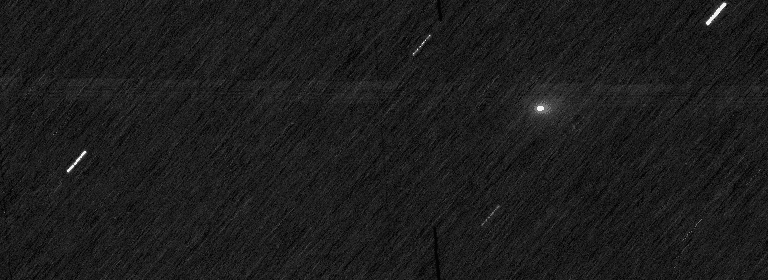
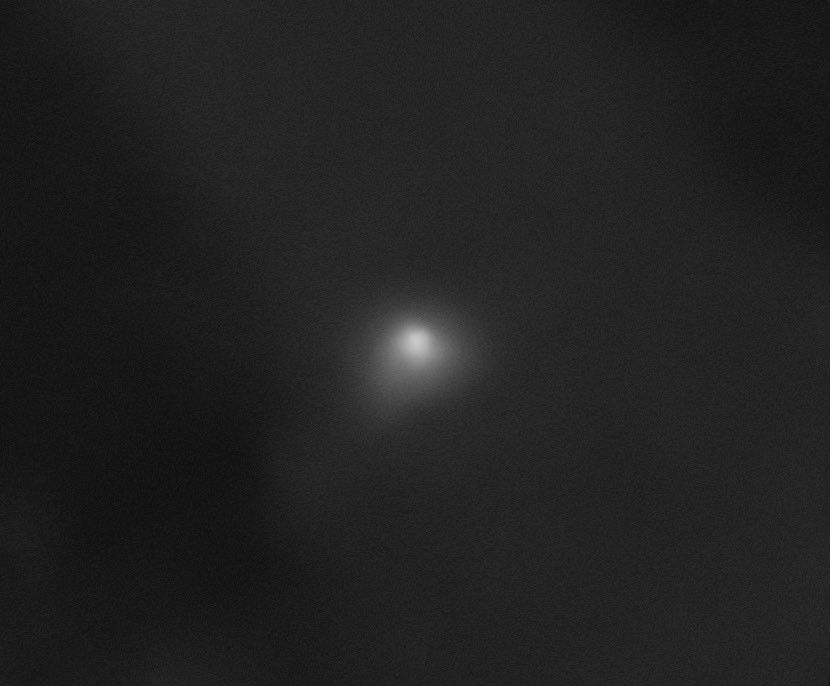
Toen 3I/ATLAS op 3 oktober 2025 dicht langs Mars scheerde, veel dichter dan deze ooit bij Aarde kwam, grepen twee orbiters rond de rode planeet hun unieke kans. ESA’s ExoMars Trace Gas Orbiter (TGO) legde vanaf zo’n 30 miljoen kilometer afstand de komeet vast als een heldere, wazige vlek. Bijna gelijktijdig deed ook China’s Tianwen 1 orbiter waarnemingen, waarbij de kern en coma duidelijk van elkaar te onderscheiden waren.

Gestapelde opnames van 3I/ATLAS (de bewegende wazige vlek), vastgelegd door de CaSSIS-camera aan boord van ESA’s ExoMars Trace Gas Orbiter op 3 oktober 2025, vanuit een baan om Mars. Foto/animatie: ESA/TGO/CaSSIS 3I/ATLAS gefotografeerd door de High-Resolution Imaging Camera (HiRIC) van China’s Tianwen 1 orbiter, eveneens op 3 oktober 2025, vanuit een baan rond Mars. De afstand bedroeg alhier circa 29 miljoen kilometer. Foto/animatie: CNSA

Een komeet met een kosmisch litteken

Wat kunnen we uit al deze data afleiden? Een opvallende bevinding is dat de kleur van de komeet niet mysterieus veranderde, zoals soms werd vermoed. Volgens wetenschapper Qicheng Zhang is er geen bewijs voor kleurveranderingen van de gassen in de coma. “Onze analyses tonen aan dat de coma sinds de eerste detectie van een coma nog altijd aanwezig is, substantieel bijdraagt aan de waargenomen helderheid van het object, maar kleurveranderingen of een veranderende samenstelling van de uitgestoten gassen werd niet geobserveerd”, zo stelde hij. De karakteristieke blauwgroene tint werd al in september door observatoria maar ook amateurastronomen waargenomen.

Qicheng Zhang, postdoctoraal astronoom aan de Lowell Observatory in Arizona fotografeerde ook zelf het interstellaire object met een 6-inch (152-mm) Ritchey–Chrétien reflector door dunne bewolking heen in de ochtend van 1 november vanuit Arizona, V.S. Foto: Qicheng Zhang

De meest revolutionaire inzichten komen van de eerste onderzoeksgegevens. Metingen van de James Webb ruimtetelescoop onthullen een extreem hoge verhouding koolstofdioxide ten opzichte van water. Dit unieke kenmerk wijst erop dat de buitenste laag van de komeetkern miljarden jaren lang is blootgesteld aan galactische kosmische straling. Deze intense straling heeft de oorspronkelijke materialen omgezet in een soort verweerd, aan organisch materiaal rijke korst. We kijken dus niet naar een ongerepte tijdcapsule uit een ver gelegen zonnestelsel, maar naar een object dat de littekens draagt van een lange, eenzame reis door de Melkweg.

Schematische weergave van de naar verwachting gelaagde structuur van de kern van 3I/ATLAS, waaruit het effect van galactische kosmische straling blijkt. De buitenste ~15-20 meter is verrijkt met koolstofdioxide (CO₂) en organisch materiaal, terwijl de ongerepte, oorspronkelijke samenstelling zich eronder bevindt. Afbeelding: Romain Maggiolo et al., Royal Belgian Institute for Space Aeronomy (BIRA-IASB), Science Systems and Application Inc. Hampton, Nasa Langley Research Center, Hampton, Centre for mathematical Plasma Astrophysics, Heverlee, Belgium. arXiv:2510.26308 De geplotte banen van 3I/ATLAS en ons zonnestelsel in ons sterrenstelsel (van bovenaf bezien). De baan van onze zon is weergegeven in gele stippellijn, die van de komeet in rood. Begrepen kan worden dat de komeet een excentrischer baan volgt om het centrum van de Melkweg dan ons zonnestelsel zelf. Afbeelding: M. Hopkins/Ōtautahi-Oxford team. Base map: ESA/Gaia/DPAC, Stefan Payne-Wardenaar

Slot

3I/ATLAS blijft zich, zoals gepland, haastig van ons verwijderen. De komende weken zal hij echter nog zichtbaar blijven voor telescopen, waarbij zijn reis perfect te volgen is in bijvoorbeeld NASA’s ‘Eyes on the Solar System’ app. Elke nieuwe waarneming biedt een zeldzame kans om de geschiedenis van deze kosmische zwerver verder te ontcijferen.

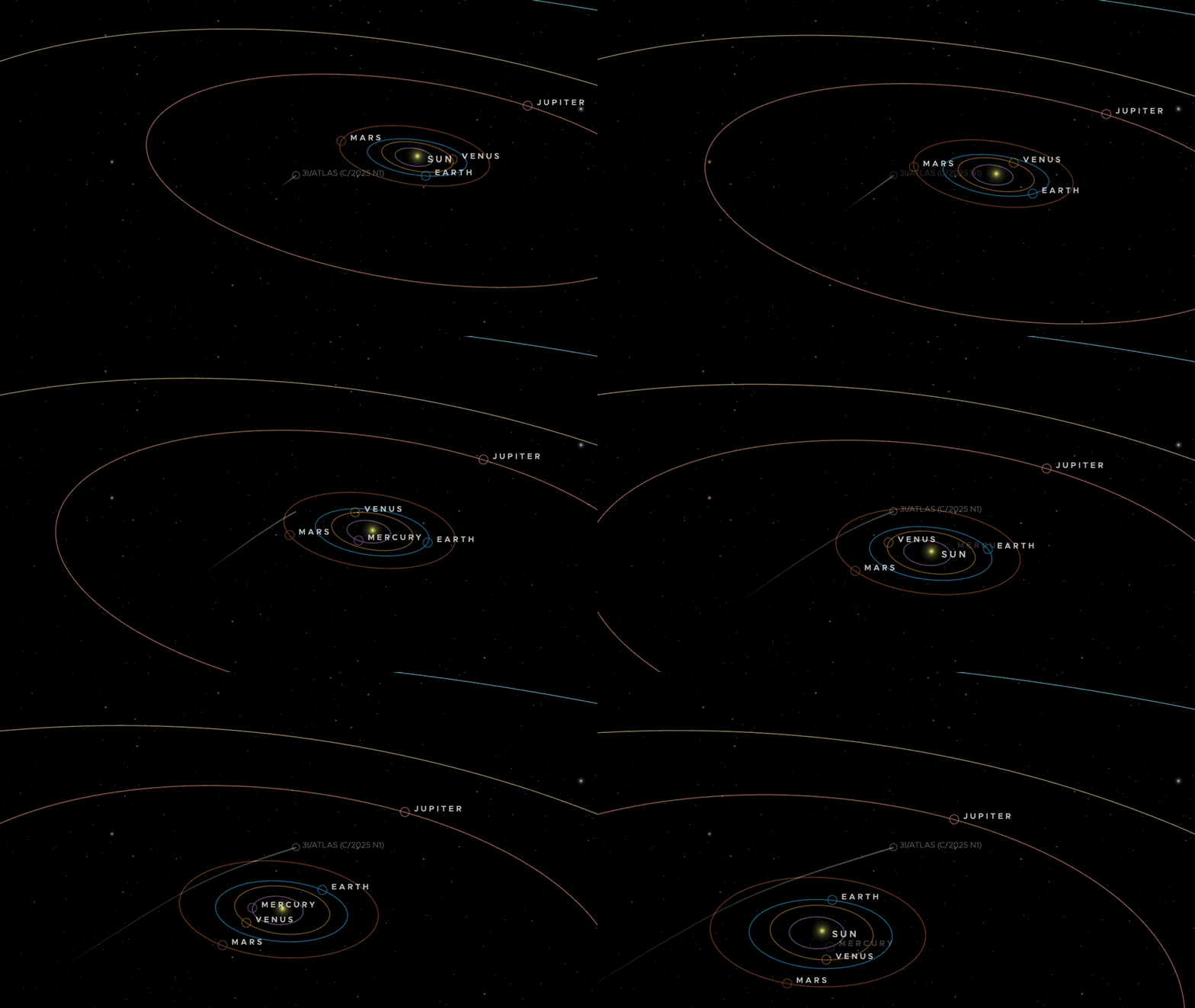
Animatie van de hyperbolische baan van 3I/ATLAS door ons zonnestelsel. De baan bevestigt dat het object niet door de zwaartekracht van de Zon is gebonden en ons stelsel weer zal verlaten. Afbeelding: NASA/JPL De komende weken staan nog observaties met ESA’s sonde JUICE gepland, momenteel onderweg naar Jupiter. Afbeelding: ESA/ATG Europe

Bronmateriaal

{ https://scientias.nl/nieuws/astronomie-ruimtevaart/ }


Hoe vind je dit bericht?
Geschreven door peter om 23:38 Stuur door

NASA scientists are baffled to discover a rock on Mars that 'doesn't belong there'

NASA scientists are baffled to discover a rock on Mars that 'doesn't belong there'

NASA's scientists have been baffled after discovering a mysterious rock on Mars that 'doesn't belong there'.

The Perseverance rover found the strange boulder near the rim of the 28-mile-wide (45 kilometres) Jezero crater, which experts think could have once hosted life.

The rock measures 31 inches (80 centimetres) across and initially stood out due to its 'sculpted' appearance.

Now, experts say that it likely originated from somewhere else in the solar system.

Perseverance used its SuperCam instrument to measure the rock's composition by heating a small section of the surface with a powerful laser.

This revealed that the object, which has been named Phippsaksla, has an exceptionally high iron and nickel content.

This is unusual since Perseverance has not found a single rock with such high metal content anywhere else in Jezero crater.

Dr Candice Bedford, a geologist from Purdue University and Perseverance operator, wrote in a NASA blog: 'This element combination is usually associated with iron-nickel meteorites formed in the core of large asteroids, suggesting that this rock formed elsewhere in the solar system.'

NASA scientists have spotted a mysterious rock on Mars which 'shouldn't be there' due to its unusual metallic composition and 'sculpted' appearance. This image of the rock was taken using the Perseverance rover's Mastcam-Z camera

NASA scientists have spotted a mysterious rock on Mars which 'shouldn't be there' due to its unusual metallic composition and 'sculpted' appearance. This image of the rock was taken using the Perseverance rover's Mastcam-Z camera

Phippsaksla rock on Mars

NASA has discovered an interesting rock it's called Phippsaksla. 

(NASA/JPL-Caltech/ASU)

Since landing on Mars in February 2021, Perseverance has been exploring the geology of Mars' northern Jezero crater.

This is an area of particular interest to scientists, who believe the crater may have once been filled with water, making it one of the best places to search for signs of life.

Recently, Perseverance climbed into a region known as the Vernodden, high on the crater's rim, where it spotted Phippsaksla.

Finding a meteor on Mars' cratered surface isn't unexpected, but the high metal content is much rarer.

Professor Gareth Collins, an expert on meteor impacts from Imperial College London, told the Daily Mail that Mars is hit by meteors 'all the time'.

'At some point in time, the entire Martian surface has been shaped by impacts,' he explained.

'Meteors are expected on Mars on a daily basis; we don’t know the number precisely, but there should be lots each day'.

The vast majority of the meteorites falling on Mars are rocky, while only about one in 20 are rich in iron and nickel.

The rock, which has been named Phippsaksla, measures 31 inches (80 centimetres across) and has an unusually high iron and nickel content. Experts say this means it could be a meteorite which formed elsewhere in the solar system

The rock, which has been named Phippsaksla, measures 31 inches (80 centimetres across) and has an unusually high iron and nickel content. Experts say this means it could be a meteorite which formed elsewhere in the solar system 

The different types of space rock

Asteroid: A chunk of rock left over from collisions in the early solar system.

Comet: A ball of ice, rock, methane, and other compounds.

Meteoroid: A piece of rock which burns up in the atmosphere.

Meteor: What astronomers call a flash of light in the atmosphere when debris burns up 

Meteorite: Rock that makes it through the atmosphere to the planet's surface.  

These metallic meteorites are typically forged in the hearts of large asteroids, as the heavy minerals sank to the centre of heated rocks during the solar system's formation.

Phippsaksla's composition suggests that it might have had a similar origin elsewhere in the solar system, rather than forming on Mars.

Dr Gareth Dorrian, of the University of Birmingham, told the Daily Mail: 'It is quite likely this one on Mars came from the asteroid belt.

'These particular meteorites are quite resistant to chemical weathering and are more likely to survive the fiery fall through a planetary atmosphere.'

However, despite being rarer than rocky meteorites, the sheer volume of meteorites hitting Mars means that all other Mars rovers have found iron-nickel rocks.

The Curiosity rover has found many iron-nickel meteorites in the Gale crater, including a massive 39-inch (one metre) metallic meteorite dubbed 'Lebanon'.

Likewise, both the Curiosity and Spirit rovers found similar iron-nickel meteorites during their own missions.

Dr Bedford writes: 'As such, it has been somewhat unexpected that Perseverance had not seen iron-nickel meteorites within Jezero crater, particularly given its similar age to Gale crater and number of smaller impact craters suggesting that meteorites did fall on the crater floor, delta, and crater rim throughout time.'

The Mars rover Perseverance (pictured) spotted the strange rock while exploring a region known as Vernodden, high on the rim of the Jezero Crater. This is a particular area of interest, since scientists think the crater may once have been filled with water

The Mars rover Perseverance (pictured) spotted the strange rock while exploring a region known as Vernodden, high on the rim of the Jezero Crater. This is a particular area of interest, since scientists think the crater may once have been filled with water

This is not the first time rovers have found iron and nickel meteorites. In 2014, the Curiosity rover found a massive 39-inch (one metre) metallic meteorite dubbed 'Lebanon' (pictured)

This is not the first time rovers have found iron and nickel meteorites. In 2014, the Curiosity rover found a massive 39-inch (one metre) metallic meteorite dubbed 'Lebanon' (pictured)

This comes after Perseverance spotted an unusual 'helmet' rock in the Jezero crater, which may have been formed by volcanic activity

This comes after Perseverance spotted an unusual 'helmet' rock in the Jezero crater, which may have been formed by volcanic activity  

Due to Phippsaksla's exotic nature, NASA's scientists say they will need more time to analyse it to confirm whether it is a meteorite.

If it is proven that the rock fell from space, then Perseverance can finally be ranked among the rovers to have investigated these rare and fascinating Martian visitors.

However, this is not the first unusual discovery that Perseverance has made on its journey through the Jezero crater.

article image

In August, Perseverance snapped a picture of a bizarre 'helmet' on the Martian surface.

A closer look reveals it was covered from top to bottom with small bobbles, which are known by geologists as 'spherules'.

On Earth, spherules are formed by the rapid cooling of molten rock droplets during a volcanic eruption, or by the condensation of rock vaporised by a meteorite impact.

This suggests it might have been formed some time in the distant past when Mars' surface was dotted with active volcanoes.

MARS: THE BASICS

Mars is the fourth planet from the sun, with a 'near-dead' dusty, cold, desert world with a very thin atmosphere. 

Mars is also a dynamic planet with seasons, polar ice caps, canyons, extinct volcanoes, and evidence that it was even more active in the past. 

It is one of the most explored planets in the solar system and the only planet humans have sent rovers to explore.

One day on Mars takes a little over 24 hours and a year is 687 Earth days.

Facts and Figures 

Orbital period: 687 days

Surface area: 55.91 million mi²

Distance from Sun: 145 million miles

Gravity: 3.721 m/s²

Radius: 2,106 miles

Moons: Phobos, Deimos

RELATED VIDEOS


{ https://www.dailymail.co.uk/sciencetech/index.html }

Hoe vind je dit bericht?
Geschreven door peter om 23:07 Stuur door

UFO Lessons from Lacatski – The Doctor of Disclosure

UFO Lessons from Lacatski – The Doctor of Disclosure

Overview

In the latest episode of the “UFO Lessons from Lacatski – The Doctor of Disclosure” podcast, hosts Jeremy Miller and George Keller dissect a series of revelations offered by Dr. James Lacatski, the former director of the Advanced Aerospace Weaponry and Surveillance Assessment Program (AAWSAP). AAWSAP, described by the Pentagon as the largest government‑funded investigation into unidentified aerial phenomena (UAP), concluded its classified work in 2022. Lacatski’s third book, released this month, draws directly from the program’s declassified files and has reignited debate over the extent of the U.S. government’s knowledge of “retrieved” craft.

Key Revelations

Lacatski’s new manuscript claims that, during his tenure, he personally observed “government‑stashed, recovered UFOs” stored at undisclosed locations. He provides limited, non‑technical descriptions—metallic hulls with propulsion systems that defy conventional aerodynamics—and notes that these objects were examined by a coalition of DIA analysts, aerospace engineers, and select congressional staff. While he stops short of releasing visual evidence, Lacatski says the data is “sufficiently robust to merit a formal briefing to the Senate Intelligence Committee.” He also alleges that the All‑Domain Anomaly Resolution Office (AARO), inaugurated in 2023, operates primarily as a disinformation conduit rather than a genuine investigative body, a claim that contradicts official statements from the Department of Defense.

Credibility and Government Context

Dr. Lacatski’s background bolsters the weight of his assertions. A career officer with the Defense Intelligence Agency (DIA) and a trained rocket scientist, he oversaw AAWSAP’s analytical framework, which integrated radar, infrared, and pilot‑report data from multiple services. Former colleagues, speaking on condition of anonymity, describe him as “meticulous, skeptical, and fiercely protective of classified material.” Their testimony aligns with Lacatski’s own insistence that his disclosures are “carefully vetted to avoid jeopardizing ongoing national‑security operations.” Nevertheless, skeptics point out that his critique of AARO lacks corroborating documentation, urging caution before accepting the program’s purportedly deceptive role.

Motivation for Disclosure

When asked why he chose to go public, Lacatski cited the late Senator Harry Reid, a long‑time advocate for UAP transparency. “Senator Reid’s relentless pressure convinced me that the public’s right to know outweighs the bureaucratic impulse to bury the truth,” Lacatski told the hosts. He further explained that a series of internal briefings in early 2024, which were repeatedly postponed, prompted him to consider alternative avenues for disclosure. According to Jeremy, Lacatski indicated a willingness to share additional classified material directly with congressional oversight committees, provided proper security protocols are observed.

Public Reaction and Outlook

The episode has generated a spectrum of responses across UFO‑interest forums and mainstream media. Some commentators praise Lacatski as the “Doctor of Disclosure,” arguing that his insider status lends unprecedented credibility to claims of extraterrestrial technology. Others caution that his allegations could be part of a strategic narrative aimed at influencing defense funding or political capital. Social‑media sentiment, measured through Twitter hashtags #LacatskiLeaks and #UFOTruth, shows a near‑even split between supportive believers and critical analysts demanding hard evidence. As George noted, the conversation “has shifted from speculative to substantive,” with lawmakers now reportedly requesting a formal briefing on Lacatski’s findings.

Next Steps

While the full impact of Lacatski’s disclosures remains to be seen, the episode underscores a growing willingness among former intelligence officials to engage the public on UAP matters. The forthcoming congressional briefing, if it occurs, could set a precedent for how classified aerospace anomalies are handled in the future. Until then, the balance between transparency and national security will continue to shape the discourse, and journalists like us will keep monitoring the evolving story with a critical, evidence‑based lens.

RELATED VIDEOS


{  https://usubjects.com/  }

Hoe vind je dit bericht?
Geschreven door peter om 22:36 Stuur door

'From another world': 3I/ATLAS photobombs a galaxy and shows off its multiple tails in stunning new image

'From another world': 3I/ATLAS photobombs a galaxy and shows off its multiple tails in stunning new image

Overview

The interstellar visitor 3I/ATLAS—the third confirmed object of its kind—has once again captured the attention of astronomers and the public alike. First spotted in early July 2025 as it barreled toward the Sun at more than 130,000 mph, the object is thought to have originated from the distant “frontier” region of the Milky Way and could be as old as seven billion years. After passing perihelion on 29 October, 3I/ATLAS emerged from behind the Sun and, on 16 November, was photographed by amateur astrophotographer Satoru Murata with a modest 0.2‑meter telescope. The resulting image not only showcases the comet’s striking green coma and twin tails but also inadvertently “photobombs” the barred spiral galaxy NGC 4691, which appears in the top‑left corner of the frame.

The Photographic Capture

Murata’s long‑exposure shot reveals a bright green coma—a hallmark of ionized carbon monoxide and cyanogen gases fluorescing under solar ultraviolet radiation. Extending from the nucleus is a long ion tail that points directly away from the Sun, indicating the influence of the solar wind. A shorter, broader anti‑tail trails behind the comet, a feature created by excess dust particles that lag in the comet’s orbital path and become illuminated from Earth’s perspective. The image also shows smaller jets erupting from the nucleus, suggesting localized outgassing regions.

“The moment I realized the galaxy was in the frame, I knew we had something special,” Murata told Live Science. “It’s rare to have an interstellar comet and a distant galaxy share the same field of view—like a cosmic coincidence.” The photograph, posted to the astronomy community’s forums, quickly garnered over 12,000 likes and sparked discussion about the object’s unusual morphology.

Scientific Context and Anomalies

Since its discovery, 3I/ATLAS has exhibited a series of anomalous behaviors that set it apart from typical solar‑system comets. After perihelion, the comet brightened more rapidly than models predicted, prompting speculation about a volatile‑rich interior. Spectroscopic observations recorded a temporary color shift from green to a faint blue hue, hinting at changes in the composition of the coma as different ices sublimated. Moreover, the comet’s surface appears highly irradiated, with an overabundance of carbon‑bearing molecules such as C₂ and CN, which are rarely seen in such quantities in other comets.

These characteristics have led a small contingent of researchers to propose more exotic explanations, including the provocative—but widely contested—hypothesis that 3I/ATLAS could be an artificial probe or “alien spaceship.” Dr. Elena Mendoza of the Institute for Interstellar Studies remarked, “While the data are intriguing, the bulk of evidence aligns with natural cometary processes. Extraordinary claims require extraordinary evidence, and we have yet to see any definitive signs of technology.” The majority of planetary scientists concur, emphasizing that the observed phenomena can be explained by thermal stresses, heterogeneous composition, and solar‑wind interactions typical of icy bodies entering the inner solar system at high speed.

Trajectory and Upcoming Close Approach

3I/ATLAS will make its closest approach to Earth on 19 December 2025, passing within roughly 0.23 AU (about 34 million kilometers). At that distance, the comet’s apparent magnitude is expected to reach +6, making it visible to the naked eye under dark skies for observers in the northern hemisphere. Astronomers worldwide are coordinating a series of observations—including high‑resolution spectroscopy, polarimetry, and radio measurements—to capture the comet’s activity as it recedes from the Sun.

The object’s hyperbolic orbit confirms its interstellar origin; calculations indicate an incoming velocity of ~30 km s⁻¹ relative to the Sun, far exceeding the escape velocity of the solar system. Its trajectory suggests it entered from a direction roughly aligned with the galactic anti‑center, supporting the hypothesis that it originated in the sparsely populated outer regions of the Milky Way.

Significance for Interstellar Research

The third confirmed interstellar visitor offers a rare laboratory for studying material that formed around another star. The multiple tails captured in Murata’s image provide clues about the distribution of volatile ices and dust, while the spectral signatures of unusual chemicals may reflect a different chemical pathway in its natal system. Comparative analysis with the first two interstellar objects—‘Oumuamua (2017) and 2I/Borisov (2019)—will help refine models of planetary system formation across the galaxy.

As Dr. Ravi Kumar, a cometary physicist at the University of Arizona, noted, “Each interstellar object is a messenger from a distant world. 3I/ATLAS, with its vivid tails and unexpected chemistry, expands our understanding of the diversity of planetary building blocks beyond our own solar system.” The upcoming observations, combined with the striking visual record of its encounter with NGC 4691, ensure that 3I/ATLAS will remain a focal point of scientific inquiry and public fascination well into the next year.

{  https://usubjects.com/  }

Hoe vind je dit bericht?
Geschreven door peter om 22:23 Stuur door

NASA Releases Long-Delayed Image of 3I/ATLAS

NASA Releases Long-Delayed Image of 3I/ATLAS

Finally.
NASA finally released an early "peek" at the observations of its spacecraft of interstellar object 3I/ATLAS during a livestream today.
NASA

Mysterious interstellar object 3I/ATLAS made an astonishingly close pass of Mars last month, allowing scientific instruments in the planet’s orbit to get a tantalizing glimpse.

Yet thanks to the US federal government shutdown that ended earlier this month, NASA was forced to delay the release of images taken by the HiRISE camera attached to its Mars Reconnaissance Orbiter, prompting outrage from lawmakers and astronomers alike.

Fortunately, NASA finally released some of the observations during a livestream today.

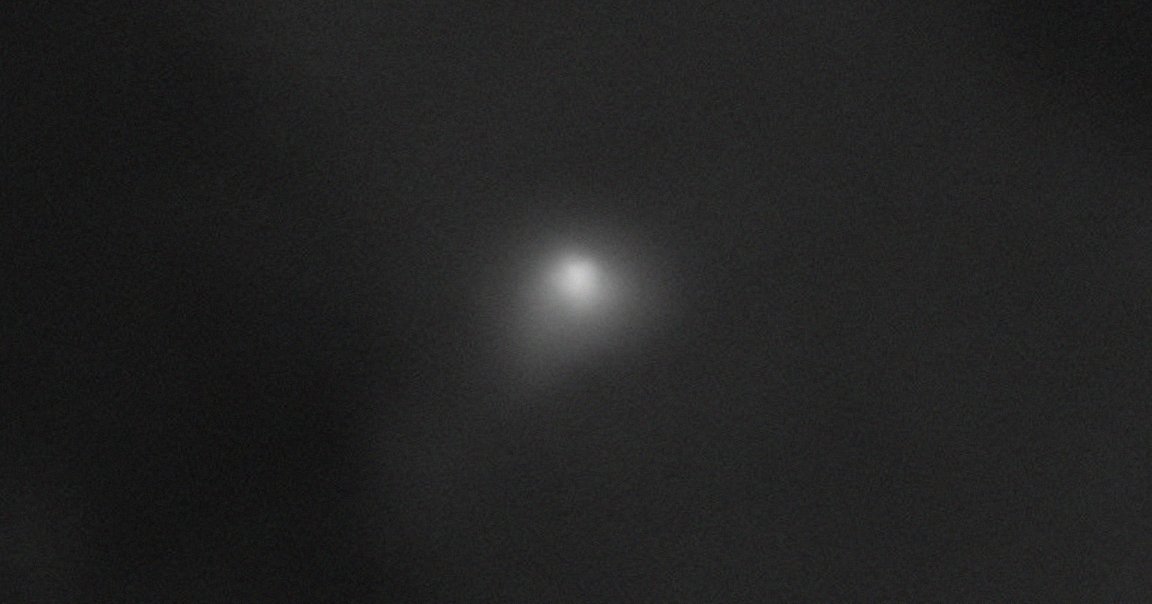
One image, taken by HiRISE on October 2, shows a “fuzzy white ball,” as NASA associate administrator Amit Kshatriya described it. At the time, 3I/ATLAS was just 19 million miles away from the instrument.

“That ball is a cloud of dust and ice called the coma, which is shed by the comet,” Kshatriya said.

Image of 3I/ATLAS taken by NASA's HiRISE instrument on the Mars Reconnaissance Orbiter.

NASA also released images of the comet taken by the Mastcam-Z instrument attached to its Perseverance Mars rover, taken on October 4, showing the object whipping by at around 137,000 mph.

Image of 3I/ATLAS taken by NASA's HiRISE Perseverance Mars rover.

Separate ultraviolet spectrograph observations by NASA’s MAVEN spacecraft show the comet emitting hydrogen gas as it approached Mars in late September.

Before getting to the latest observations during today’s livestream, Kshatriya chose to “address the rumors right at the beginning,” publicly denouncing a prevalent theory — prominently championed by Harvard astronomer Avi Loeb in the media — that 3I/ATLAS could be an alien spacecraft that came to visit.

“This object is a comet,” Kshatriya said. “It looks and behaves like a comet, and all evidence points towards it being a comet.”

Fortunately, 3I/ATAS is expected to make its closest pass of the Earth on December 19, giving NASA spacecraft yet another chance to observe it.

More on 3I/ATLAS:

RELATED VIDEOS

{  https://futurism.com/category/science-energy }

Hoe vind je dit bericht?
Geschreven door peter om 22:13 Stuur door

NASA’s Perseverance Has Seen a Lot of Rocks—But Not One Like This

NASA’s Perseverance Has Seen a Lot of Rocks—But Not One Like This

In a first for the Perseverance rover, it appears to have found an iron-nickel meteorite near the Jezero Crater.

This exotic rock was discovered near the rim of the Jezero Crater by NASA's Perseverance rover. Named "Phippsaksla," preliminary analysis suggests it could be an iron-nickel meteorite

This exotic rock was discovered near the rim of the Jezero Crater by NASA's Perseverance rover. Named "Phippsaksla," preliminary analysis suggests it could be an iron-nickel meteorite  © NASA/JPL-Caltech/ASU
NASA’s Perseverance rover has seen its fair share of rocks, and most are unremarkable. Once in a while, however, Perseverance stumbles upon something exotic. That’s precisely what happened during the rover’s recent investigation of the bedrock at “Vernodden.”

While exploring this site along the rim of the Jezero Crater, Perseverance encountered an oddly shaped rock about 31 inches (80 centimeters) wide, according to NASA. Now named “Phippsaksla,” it caught the attention of Perseverance’s handlers due to its sculpted, high-standing appearance, rising sharply above the flat, fragmented rocks surrounding it.

Further investigations are required to determine the true nature of Phippsaksla, but a preliminary analysis of its composition suggests it may be a meteorite rich in iron and nickel. This type of meteorite is less commonly found on Earth but dominates the small number of meteorites that rovers have found on Mars. Still, finding one near the Jezero Crater is a first for Perseverance.

A possible sample from an ancient asteroid

Perseverance used its SuperCam instrument to reveal Phippsaksla’s composition. This tool examines rocks and soils with a camera, laser, and spectrometers to identify their chemical and mineral components.

The combination of elements Perseverance found is typically associated with iron-nickel meteorites, suggesting Phippsaksla hails from somewhere else in the solar system.

A zoomed-out image of an exotic rock found on Mars

This image of Phippsaksla (upper left), captured by Perseverance from farther away, showcases its distinct shape © NASA/JPL-Caltech/ASU

These meteorites are samples from the cores of ancient worlds. Asteroids that melted early on in their history formed iron and nickel cores as these dense elements sank to the center. Iron-nickel meteorites are fragments of those cores, freed by collisions between their parent asteroid and other celestial bodies.

Other Mars rovers have found several while exploring the Red Planet. Curiosity has identified many in the Gale Crater, including the one-foot-wide “Cacao” meteorite found in 2023. Both of the twin Mars Exploration Rovers, Spirit and Opportunity, also found iron-nickel meteorites during their missions.

A surprising first for Perseverance

It’s somewhat surprising that it took Perseverance this long to find an iron-nickel meteorite, especially considering that its primary exploration area, the Jezero Crater, is roughly the same age as the Gale Crater. What’s more, a number of smaller impact craters within Jezero suggest meteorites did impact the crater floor, delta, and rim throughout its history.

But again, additional analysis will need to confirm that Phippsaksla is actually an iron-nickel meteorite. In addition to SuperCam, Perseverance is equipped with other instruments capable of analyzing rock samples in situ, such as PIXL (Planetary Instrument for X-Ray Lithochemistry). This tool could provide a more refined picture of Phippsaksla’s chemistry.

Perseverance is also the first Mars rover capable of collecting and caching rock samples for a potential return to Earth, and it’s possible that it could add a chunk of Phippsaksla to its collection. NASA has tentative plans to retrieve Perseverance’s samples, but the future of the Mars Sample Return mission is currently uncertain.

Phippsaksla has certainly caught NASA’s attention, and we should learn more about this specimen as the Perseverance team continues to probe its exotic chemistry.  With no end in sight to the rover’s mission, there’s no telling what this intrepid explorer will find next.

RELATED VIDEOS

{ https://gizmodo.com/science }

Hoe vind je dit bericht?
Geschreven door peter om 21:50 Stuur door

Webb Captures a Stunning Cosmic Structure We’ve Never Seen Before

Webb Captures a Stunning Cosmic Structure We’ve Never Seen Before

The aging pair of stars swing by one another once every 190 years, producing four spirals of dust.
Webb’s mid-infrared image shows four coiled shells of dust around a pair of Wolf-Rayet stars.

Webb’s mid-infrared image shows four coiled shells of dust around a pair of Wolf-Rayet stars.
NASA, ESA, CSA, STScI; Science: Yinuo Han (Caltech), Ryan White (Macquarie University); Image Processing: Alyssa Pagan (STScI)
The Webb telescope has unlocked a mystery in an exotic star system located approximately 8,000 light-years from Earth. Using its mid-infrared observation capabilities, the space telescope captured the first image of four swirling spirals of dust encircling two aging stars locked together in an orbital dance.
NASA released the image on Wednesday, confirming the existence of the layered shells of dust surrounding two Wolf-Rayet stars in the Apep system. Previous observations had only detected one dust spiral, while Webb was not only able to see all four, but it also narrowed down how long the binary stars take to orbit one another.
“Looking at Webb’s new observations was like walking into a dark room and switching on the light—everything came into view,” Yinuo Han, a researcher at Caltech in Pasadena, California, and lead author of a new study published in the Astrophysical Journal, said in a statement. “There is dust everywhere in Webb’s image, and the telescope shows that most of it was cast off in repetitive, predictable structures.”

One of a kind

Wolf-Rayet stars are extremely rare, with only about a thousand of them believed to exist in the Milky Way galaxy. They are massive, bright stars in late stages of their stellar evolution. Stars that big don’t last very long; Wolf-Rayets burn through their fuel rather quickly, expelling their mass into space through high-pressure winds.

The pair of stars in Apep, named after the Egyptian god of chaos, have been shedding their outer layers over the past 700 years. The two Wolf-Rayet stars are gravitationally bound to one another, along with a third companion, a massive supergiant star that carves a hole into the clouds of dust from its wider orbit.

Most Wolf-Rayet stars orbit one another within two to 10 years, with the longest recorded orbital period being 30 years. The Apep stars, however, swing by one another every 190 years. The team of researchers behind the new study was able to figure out the orbits of the stars by combining measurements of the location of the rings from Webb’s image with the speed of the shells’ expansion from observations taken by the European Southern Observatory’s Very Large Telescope in Chile over a period of eight years.

With each long orbit, the two stars remain close for 25 years, forming the expanding dust shells. As the stars approach and pass one another, their stellar winds collide and mix, forming the spirals of dust for a period that lasts a quarter of a century. The dust of other star systems lasts for a few months at a time.

Although the Webb image may inspire tranquility, there is nothing chill about the Apep stars. The two stars are emitting dust at 1,200 to 2,000 miles per second (2,000 to 3,000 kilometers per second) while speeding through the cosmos.

The Wolf-Rayet stars were initially more massive than their third companion but have shed most of their mass over the years. Scientists estimate that the two stars are between 10 and 20 times the mass of the Sun, while the supergiant is 40 or 50 times as massive as our host star.

Although scientists have known about the third star in the Apep system, Webb’s observations confirmed that it is gravitationally bound to the system by revealing it slicing through the dust shells. “Webb gave us the ‘smoking gun’ to prove the third star is gravitationally bound to this system,” Ryan White, a PhD student at Macquarie University in Sydney, Australia, and author of another paper published in the Astrophysical Journal, said in a statement.

The two massive stars are on a path to destruction and will eventually explode as supernovas. It’s possible that either of the stars may emit a gamma ray burst before becoming a black hole.

RELATED VIDEOS

Hoe vind je dit bericht?
Geschreven door peter om 21:28 Stuur door

Meer van UFO'S of UAP'S, ASTRONOMIE, RUIMTEVAART, ARCHEOLOGIE, OUDHEIDKUNDE, SF-SNUFJES EN ANDERE ESOTERISCHE WETENSCHAPPEN - DE ALLERLAATSTE NIEUWTJES

↑ Terug naar de berichten