Ontdek de Fascinerende Wereld van UFO's en UAP's: Jouw Bron voor Onthullende Informatie!
Ben jij ook gefascineerd door het onbekende? Wil je meer weten over UFO's en UAP's, niet alleen in België, maar over de hele wereld? Dan ben je op de juiste plek!
België: Het Kloppend Hart van UFO-onderzoek
In België is BUFON (Belgisch UFO-Netwerk) dé autoriteit op het gebied van UFO-onderzoek. Voor betrouwbare en objectieve informatie over deze intrigerende fenomenen, bezoek je zeker onze Facebook-pagina en deze blog. Maar dat is nog niet alles! Ontdek ook het Belgisch UFO-meldpunt en Caelestia, twee organisaties die diepgaand onderzoek verrichten, al zijn ze soms kritisch of sceptisch.
Nederland: Een Schat aan Informatie
Voor onze Nederlandse buren is er de schitterende website www.ufowijzer.nl, beheerd door Paul Harmans. Deze site biedt een schat aan informatie en artikelen die je niet wilt missen!
Internationaal: MUFON - De Wereldwijde Autoriteit
Neem ook een kijkje bij MUFON (Mutual UFO Network Inc.), een gerenommeerde Amerikaanse UFO-vereniging met afdelingen in de VS en wereldwijd. MUFON is toegewijd aan de wetenschappelijke en analytische studie van het UFO-fenomeen, en hun maandelijkse tijdschrift, The MUFON UFO-Journal, is een must-read voor elke UFO-enthousiasteling. Bezoek hun website op www.mufon.com voor meer informatie.
Samenwerking en Toekomstvisie
Sinds 1 februari 2020 is Pieter niet alleen ex-president van BUFON, maar ook de voormalige nationale directeur van MUFON in Vlaanderen en Nederland. Dit creëert een sterke samenwerking met de Franse MUFON Reseau MUFON/EUROP, wat ons in staat stelt om nog meer waardevolle inzichten te delen.
Let op: Nepprofielen en Nieuwe Groeperingen
Pas op voor een nieuwe groepering die zich ook BUFON noemt, maar geen enkele connectie heeft met onze gevestigde organisatie. Hoewel zij de naam geregistreerd hebben, kunnen ze het rijke verleden en de expertise van onze groep niet evenaren. We wensen hen veel succes, maar we blijven de autoriteit in UFO-onderzoek!
Blijf Op De Hoogte!
Wil jij de laatste nieuwtjes over UFO's, ruimtevaart, archeologie, en meer? Volg ons dan en duik samen met ons in de fascinerende wereld van het onbekende! Sluit je aan bij de gemeenschap van nieuwsgierige geesten die net als jij verlangen naar antwoorden en avonturen in de sterren!
Heb je vragen of wil je meer weten? Aarzel dan niet om contact met ons op te nemen! Samen ontrafelen we het mysterie van de lucht en daarbuiten.
Unexpected discovery on Saturn's moon challenges view on chemistry before life emerged
Researchers have long been interested in Saturn's largest moon, Titan, and its icy environment, which harbors lakes, seas, sand dunes and a thick atmosphere full of nitrogen, methane, and complex carbon-based chemistry. Titan share some commonality with the early evolution of our planet and may therefore give researchers clues to the origin of life.
Credit: NASA-JPL-Space Science Institute
Researchers at Chalmers University of Technology in Sweden and the US space agency NASA have made an unexpected discovery that challenges one of the basic rules of chemistry and provides new knowledge about Saturn's enigmatic moon Titan
In its extremely cold environment, normally incompatible substances can still be mixed. This discovery broadens our understanding of chemistry before the emergence of life.
Scientists have long been interested in Saturn's largest, orange-colored moon as its evolution can teach us more about our own planet and the earliest chemical steps towards life. Titan's cold environment, and its thick nitrogen and methane-filled atmosphere, has many similarities to the conditions thought to have existed on the young Earth billions of years ago. By studying Titan, researchers therefore hope to find clues about the origin of life.
Martin Rahm, Associate Professor at the Department of Chemistry and Chemical Engineering at Chalmers, has been working for a long time to understand more about what is happening on Titan. He now hopes that the research group's surprising discovery, that certain polar and nonpolar substances can combine, will inform future studies of Titan.
"These are very exciting findings that can help us understand something on a very large scale, a moon as big as the planet Mercury," he says.
New insights into the building blocks of life in extreme environments
The researchers' paper, which has been published in PNAS, shows that methane, ethane and hydrogen cyanide—which exist in large quantities in the atmosphere and on the surface of Titan—can interact in a manner that was not previously considered possible.
That hydrogen cyanide, an exceptionally polar molecule, can form crystals with completely nonpolar substances such as methane and ethane is surprising because such substances normally remain strictly separate, much like oil and water.
"The discovery of the unexpected interaction between these substances could affect how we understand Titan's geology and its strange landscapes of lakes, seas and sand dunes," says Martin Rahm, who led the study.
"In addition, hydrogen cyanide is likely to play an important role in the abiotic creation of several of life's building blocks, for example, amino acids, which are used for the construction of proteins, and nucleobases, which are needed for the genetic code. So our work also contributes insights into chemistry before the emergence of life, and how it might proceed in extreme, inhospitable environments."
An unanswered question led to NASA collaboration
The background to the Chalmers study is an unanswered question about Titan: What happens to hydrogen cyanide after it is created in Titan's atmosphere? Are there meters of it deposited on the surface or has it interacted or reacted with its surroundings in some way?
To seek the answer, a group at NASA's Jet Propulsion Laboratory (JPL) in California began conducting experiments in which they mixed hydrogen cyanide with methane and ethane at temperatures as low as 90 Kelvin (about -180 degrees Celsius). At these temperatures, hydrogen cyanide is a crystal, and methane and ethane are liquids.
When they studied such mixtures using laser spectroscopy, a method for examining materials and molecules at the atomic level, they found that the molecules were intact, but that something had still happened. To understand what, they contacted Martin Rahm's research group at Chalmers, which had conducted extensive research into hydrogen cyanide.
"This led to an exciting theoretical and experimental collaboration between Chalmers and NASA. The question we asked ourselves was a bit crazy: Can the measurements be explained by a crystal structure in which methane or ethane is mixed with hydrogen cyanide? This contradicts a rule in chemistry, 'like dissolves like," which basically means that it should not be possible to combine these polar and nonpolar substances," says Rahm.
Expanding the boundaries of chemistry
The Chalmers researchers used large scale computer simulations to test thousands of different ways of organizing the molecules in the solid state, in search of answers.
In their analysis, they found that hydrocarbons had penetrated the crystal lattice of hydrogen cyanide and formed stable new structures known as co-crystals.
"This can happen at very low temperatures, like those on Titan. Our calculations predicted not only that the unexpected mixtures are stable under Titan's conditions, but also spectra of light that coincide well with NASA's measurements," he says.
The discovery challenges one of the best-known rules of chemistry, but Martin Rahm does not think it is time to rewrite the chemistry books.
"I see it as a nice example of when boundaries are moved in chemistry and a universally accepted rule does not always apply," he says.
In 2034, NASA's space probe Dragonfly is expected to reach Titan, with the aim of investigating what is on its surface. Until then, Martin Rahm and his colleagues plan to continue exploring hydrogen cyanide chemistry, partly in collaboration with NASA.
"Hydrogen cyanide is found in many places in the universe, for example in large dust clouds, in planetary atmospheres and in comets. The findings of our study may help us understand what happens in other cold environments in space. And we may be able to find out if other nonpolar molecules can also enter the hydrogen cyanide crystals and, if so, what this might mean for the chemistry preceding the emergence of life," he says.
In 2028, the US space agency NASA plans to launch the Dragonfly space probe, which is expected to reach Titan in 2034. The aim is to study prebiotic chemistry, the chemistry that precedes life, and to look for signs of life.
More information: Fernando Izquierdo-Ruiz et al, Hydrogen cyanide and hydrocarbons mix on Titan, Proceedings of the National Academy of Sciences (2025). DOI: 10.1073/pnas.2507522122
Despite making up more than a quarter of the universe, dark matter has remained stubbornly hidden from scientists' telescopes for decades.
But researchers from Johns Hopkins University now believe they have found the evidence they have been searching for.
While the elusive substance doesn't give off any energy of its own, when dark matter particles collide, they produce a burst of gamma–ray radiation.
For this reason, researchers believe the mysterious gamma–ray glow coming from inside our very own galaxy could reveal exactly where dark matter is hiding.
'Dark matter dominates the universe and holds galaxies together,' said Professor Joseph Silk, co–author of the study.
'It's extremely consequential and we're desperately thinking all the time of ideas as to how we could detect it.
'Gamma rays, and specifically the excess light we're observing at the centre of our galaxy, could be our first clue.'
Scientists say that a glow of gamma ray radiation from the Milky Way could be evidence that dark matter exists. In a new paper, researchers argue that this glow is produced by colliding particles of dark matter
Dark matter is an elusive type of particle that makes up a large part of the extra mass that is 'missing' from most galaxies.
In their study, published in the journal Physical Review Letters, the researchers used supercomputers to create a map of where dark matter should be in the galaxy.
What made their approach different was that they took into account how the Milky Way came into existence.
'Our galaxy formed out of a vast cloud of dark matter,' explains Professor Silk.
'The ordinary matter cooled down and fell into the central regions, dragging along some dark matter for the ride.'
Over billions of years, the dark matter from these other systems gravitated to the dense galactic core, and the number of collisions increased.
When Professor Silk took these simulations and compared them to real pictures of the galaxy taken by Fermi, he found that their predictions were a match.
Although this isn't yet a 'smoking gun' for the existence of dark matter, it raises the tantalising possibility that the gamma ray glow really is coming from dark matter.
Speaking to the Daily Mail, Professor Silk said: 'Our key new result is that dark matter fits the gamma ray data at least as well as the rival neutron star hypothesis.
In a new paper, scientists simulated where they thought dark matter should be in the galaxy (illustrated), and worked out what the pattern of gamma rays should look like. When they compared this to the actually distribution of gamma rays they found that the predictions matched
We have increased the odds that dark matter has been indirectly detected.'
It is still possible that the gamma ray glow is being produced by spinning neutron stars.
Professor Silk says his 'great hope' is that the soon–to–be–constructed Cerenkov Telescope Array in Chile will be able to settle the debate once and for all.
This will be the world's most powerful gamma ray telescope, and should have the sensitivity to detect the tiny differences between gamma rays produced by dark matter and radiation from spinning neutron stars.
Alternatively, the telescope could scan nearby dwarf galaxies, which should be made mostly of dark matter.
'Detecting the same signal Fermi found for the galactic centre would confirm the dark matter hypothesis,' says Professor Silk.
The Unidentified Aerial Phenomena (UAP) is not what many think it is. The reality of UAPs goes beyond mere flying machines and space aliens; it is turning into a rabbit hole. Every year, UFO enthusiasts and whistleblowers put more effort into unveiling the secrecy. However, instead of revealing the truth, a new branch of mystery unfolds, adding another chapter to the UFO enigma.
Missouri Republican Eric Burlison attended a classified UAP briefing this month but mentioned that it did not change his beliefs. He said, “There’s nothing that’s been said that’s changed my worldview.” He also added that he believes the claims of people who testified in public but thinks there might be more to the story.
Rep. Burlison has said that UFOs might be angels sent by God. Burlison, who heard secret information about UFOs, shared this idea on “That UFO Podcast.” He said, “They may not fit exactly the Biblical narrative, but whenever I use the term ‘angels,’ to me, it’s synonymous with an extradimensional being.”
In a podcast, Burlison shared his thoughts on UFOs, offering a detailed perspective on various theories surrounding these unidentified phenomena. Burlison discussed a theory he read in a public report by UFO whistleblower David Grusch who alleged that the government secretly recovered alien spacecraft and even dead “pilots” inside them. According to Grusch’s report, one theory suggests that what we are encountering might be beings that exist in higher dimensions, beyond our normal understanding of space and time.
Burlison used the analogy of living on a two-dimensional surface and being encountered by a three-dimensional object to explain the idea of encountering something from a higher dimension. In this case, he suggested that we live in a three-dimensional environment and could be encountering something from a higher dimension, where traditional concepts of distance might become irrelevant.
He expressed skepticism about the probability of being visited by an alien race from a distant planet, emphasizing the vast distances involved. Burlison questioned the likelihood of an advanced alien race traveling such long distances only to crash upon arrival on Earth. He leaned towards the idea that these phenomena are more likely to be extradimensional, existing beyond our usual understanding of dimensions.
Burlison explained that various scriptures, including the Bible, describe messengers of God or angels as existing in dimensions beyond our own. While acknowledging the visual evidence and testimony from pilots regarding UFO sightings, Burlison emphasized the most likely explanation, in his opinion:
“I don’t discount the visual recordings or the testimonies from pilots – I believe they are genuinely witnessing something. There is substantial evidence of these unidentified objects, and although we don’t know what they are, I think the most probable explanation might not be what everyone hopes to hear. It could very well be advanced technology under development and research, possibly involving new propulsion technology.
When discussing this topic, I often refer to the discovery of the Higgs boson particle about ten years ago. We identified the Higgs field, which essentially relates to gravity, and the particle is a wave function within that field. Looking back, shortly after the discovery of nuclear vision, scientists developed the nuclear bomb. This illustrates how scientific theories can be transformed into practical functions. I find it hard to believe that we haven’t capitalized on our knowledge of the Higgs field. It seems likely that our private sector industry and the scientific community have been working to find ways to manipulate the Higgs field for various purposes, potentially including advancements in propulsion technology.”
Burlison is not the only one suggesting a link between UFOs and religious texts. Representative Tim Burchett claimed in 2021 that UFOs were in the Bible, referring to the book of Ezekiel.
According to Mystery Wire, Rep. Burchett talked about UFOs being written about in the Bible, pointing specifically to Ezekiel. This reference is for Ezekiel 1:4-28, in which there is a description of seeing “an immense cloud with flashing lightning and surrounded by brilliant light. The center of the fire looked like glowing metal, and in the fire was what looked like four living creatures. In appearance their form was human, but each of them had four faces and four wings.”
“When the living creatures moved, the wheels beside them moved; and when the living creatures rose from the ground, the wheels also rose. Wherever the spirit would go, they would go, and the wheels would rise along with them, because the spirit of the living creatures was in the wheels.” [Ezekiel 1:4-28, Ezekiel 10]
While Grusch has publicly discussed theories on UAPs that might originate from the higher-order dimensions theorized by physicists, those concepts do not appear in the unclassified version of his complaint.
The ‘extradimensional or interdimensional‘ hypothesis also does not appear in what has been made public from Grusch’s written statements first submitted for approval to the Pentagon’s Defense Office of Prepublication and Security Review (DOPSR).
But Grusch did talk about this theory when he was under oath, answering questions from Rep. Burlison during a public UAP hearing in July 2023.
Rep. Burlison said at the hearing, “It’s a bit hard to believe that an alien species advanced enough to travel billions of light years would come here and somehow not be able to survive.” He then asked Grusch about the “interdimensional potential,” saying, “Could you explain that?”
Grusch said, “No matter how smart you are, accidents happen, like plane crashes and car crashes. A small percentage of missions may fail, as we say in the Air Force.” Talking about multidimensionality, Grusch mentioned the holographic principle. It comes from general relativity and quantum mechanics. He explained it as imagining a 3D object casting a shadow onto a 2D surface.
He said, “You can be projected, sort of projected, from higher dimensional space to lower dimensional space… It’s a scientific idea that you can actually cross dimensions, as far as I understand. But there are probably people with PhDs who could argue about that.”
There has been some speculation about UFOs being connected to religious visits or interdimensional beings since the early 20th century. This idea became more famous with the book “Passport to Magonia: from Folklore to Flying Saucers” by Jacques Vallée in 1969. Vallée later inspired a character in Steven Spielberg’s UFO movie “Close Encounters of the Third Kind.” He spent years studying ancient texts for his book.
Vallée states that UFOs and related events of a paranormal nature involve visitations from other “realities” or “dimensions.” The idea proposes that these alternate realities exist separately yet parallel to our own. In 1975’s The Edge of Reality, Vallée and Hynek considered the possibility of what they call “interlocking universes.”
Daniel Sheehan, a public interest lawyer and activist who was a former Chief Council for the United States Jesuit order, revealed intriguing details about his conversations with the head of the Vatican archives regarding the Vatican’s knowledge of extraterrestrial life. He shed light on his involvement in a groundbreaking initiative to address the theological and philosophical implications of the discovery of extraterrestrial intelligence. (Click here to read the full article)
He proposed the formation of a task force involving all 54 major religious denominations to address the issue from a theological perspective. However, at that time, there was insufficient consensus, and the proposal was declined. Sheehan is currently working through his New Paradigm Institute to organize a global summit conference involving world religious leaders to discuss the recent recovery of an extraterrestrial spacecraft.
“The United States government is in possession of biological evidence and has actually taken into custody alive an extraterrestrial person. They’re keeping this secret, interrogating the being, and distorting the information to justify massive expenditures on weapon development under the guise of a perceived threat.” – Daniel Sheehan
Sheehan highlighted the Vatican’s acknowledgment of the possibility of extraterrestrial life. He referenced a formal statement issued by the Catholic Church on November 10, 2009, authorized by Pope Benedict. The statement, issued by Father Jose Gabriel Alfuz, a director of the Pontifical Observatory in Rome, recognized the increasing discovery of exoplanets and called for a global discussion on the philosophical and theological implications of the imminent discovery of extraterrestrial life.
Sheehan disclosed that the government was telepathically interrogating the extraterrestrial biological entity (EBO) in custody. Despite acknowledging the bizarre nature of the revelation, Sheehan stood by the credibility of the information, having interviewed individuals directly involved in the process. The EBO allegedly conveyed that a coalition of star systems in our galaxy monitors the evolution of life on different planets, including Earth.
“Pope Benedict had a formal statement issued by the Catholic Church, saying that with the discovery of more exoplanets, it has become clear that we will be discovering life elsewhere in the universe. This prompted the need for a global discussion on the philosophical and theological questions posed by the discovery of extraterrestrial life.” – Daniel Sheehan
Since the translation of the Book of Enoch from the ancient texts discovered in Ethiopia in 1768, it has created a stir in the history of mankind that has been told for years. The Book of Enoch tells the story of the Fallen Angels called the Nephilims or the Anunnaki; it is attributed to Enoch, the great-grandfather of Noah.
It is no wonder why the Book of Enoch was not included in the modern biblical version, since its content speaks of wicked angels who became fond of mortal women and mated with them, giving birth to the hybrid race of giant humanoids known throughout secular and Biblical history as the Nephilims.
The Nephilims then taught humans great technologies that made us greedy and awful until God destroyed them with a great flood in order to prevent further harm to creation. This is a massively oversimplified summary, but given these themes, the Book of Enoch has understandably grown in popularity in recent years.
So, what are UFOs? Jeremy Corbell says, “UFOs appear to be part of a larger phenomenon, meaning UFOs are kind of an auxiliary implication of a much larger reality. So this idea that what we’re seeing are machines from other planets. I’m unconvinced what we may be seeing is an alternate reality. You know, maybe it is something closer to dimensional travel.”
Former CIA officer Jim Semivan says, “Yes, there is a force out there that can control our environment.” The UFO phenomenon can be shocking, especially to children.
“You know for humanity. Are we alone or, you know, what happens when we die? Well, I don’t know about that, but are we alone? Well, the answer is we’re not alone. And I know that with 100% certainty, which as an Intel officer, you never say 100%, but all things pointed towards, based on the people I talked to… The phenomenon is real. It’s been going on for thousands of years. People have been seeing strange things, and not everybody’s mass hallucinating. So that’s kind of my long diatribe about what’s happening.”–David Grusch
Earth will travel right in front of the same Taurid meteor stream in 2032 that caused a mass extinction and worldwide flood ~12,800 years ago, plunging Earth into a mini-Ice Age for 1,300 years. Graham Hancock was right all this time but we did not listen to him.
Our solar system is a dangerous place, and every month Earth inches closer to one of its riskier places, the “Taurid swarm” of meteors. Our planet is predicted to pass directly through the “Taurid swarm” in November 2032.
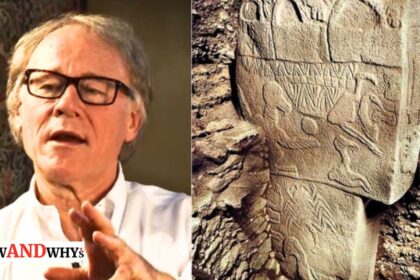
An ancient monument found in Turkey might be more than just a monument—it could be the world’s oldest solar calendar. Researchers from the University of Edinburgh studied symbols carved on the pillars of Göbekli Tepe, a large, ancient site in southern Turkey. They think these carvings were used to track days, seasons, and years, like a calendar. (Source)
The team noticed that each “V” shape carved on the pillars might represent one day. One pillar even had 365 “V”s, the same number as days in a year. They also found that a special “V” around the neck of a bird-like figure could represent the summer solstice—the longest day of the year. This might explain why the “V” symbol shows up on many other statues in the area, often around the necks of figures connected to time and creation.
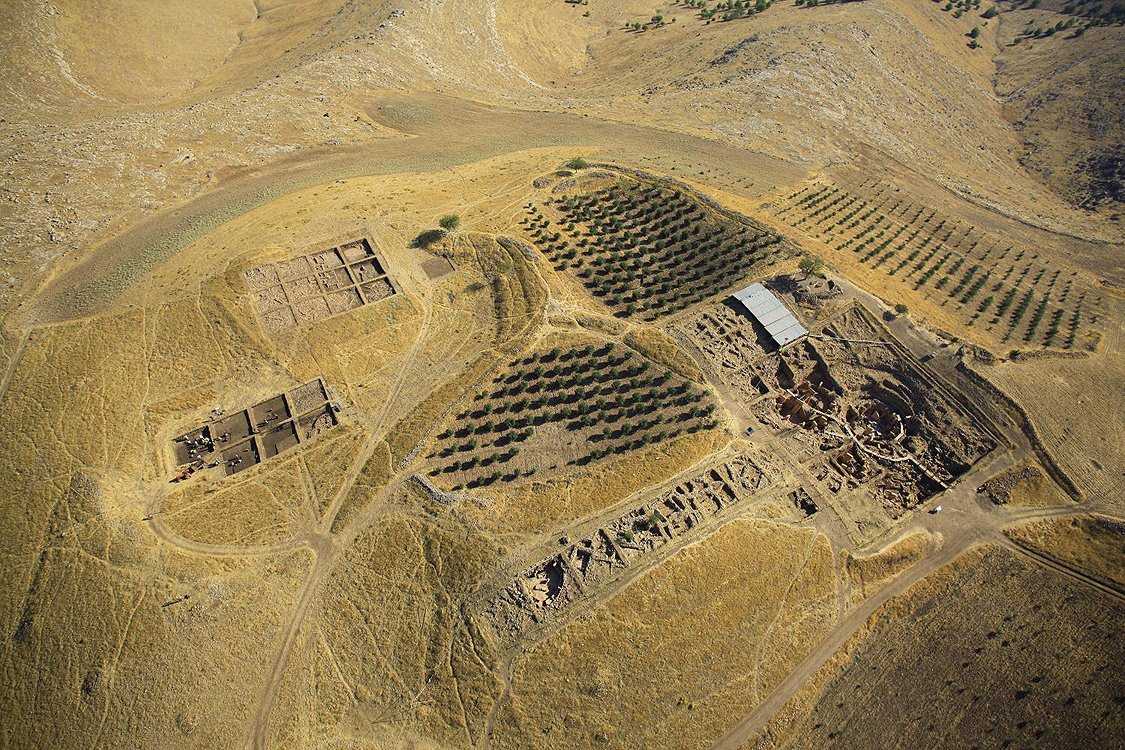
Göbekli Tepe aerial view
Mini Ice Age
The ancient calendar focused on tracking day, night, and seasonal changes, which might have become more important after a major comet hit Earth around 10,850 B.C. This event likely caused a mini-ice age that wiped out many species. According to Martin Sweatman, a researcher from the University of Edinburgh, the people at Gobekli Tepe were careful observers of the sky, possibly because the comet strike had changed their world.
This disaster may have sparked the beginning of civilization by starting new religious beliefs and pushing people to develop agriculture to survive the colder climate. Their carvings might be some of the earliest attempts at writing. These carvings also tracked the cycles of the Moon and Sun, long before similar calendars were made. They may have even shown for the first time that comet strikes are more likely to happen when Earth crosses the path of comet fragments, something that modern scientists have confirmed.
To help support this theory, the team points to another pillar at the site appearing to picture the Taurid meteor stream lasting 27 days, which was quite possibly the source of the ancient comet strike. The researchers believe that the temple carvings show the ancient civilization was recording dates precisely, noting how the movement of constellations across the sky differed based on the time of the year. This would be 10,000 years before Hipparchus of ancient Greece documented the wobble in the Earth’s axis in 150 BC, making this newfound calendar well ahead of its time.
The Younger Dryas boundary (YDB) cosmic-impact hypothesis suggests that around 12,800 years ago, Earth was hit by pieces of a large comet, which broke apart as it entered the inner solar system. This event likely caused a chain reaction, leading to an “impact winter” (a period of intense cold) and a climate change episode called the Younger Dryas (YD). (Source)
The collision is also believed to have caused massive wildfires, the extinction of large animals like mammoths, and changes in human cultures and population decline. Evidence of this impact includes unusually high levels of platinum found at 26 sites across the Northern Hemisphere, including in ice cores from Greenland, which show platinum deposits over a 21-year period.
The start of the Younger Dryas also shows an increase in dust and chemicals linked to wildfires, like ammonium and other burning aerosols, found in ice cores from Greenland, Antarctica, and Russia. These signs point to one of the biggest wildfire events in over 120,000 years, with about 9% of Earth’s forests burned, covering 10 million square kilometers.
This large-scale burning and the cooling effect of the impact may have triggered the Younger Dryas climate change, according to the theory.
A 2021 study (Taurid complex smoking gun) found that 88 near-Earth asteroids, hidden in the debris that creates the Taurid Meteor Shower, likely came from the breakup of a single comet about 20,000 years ago. Astronomers at the University of Antioquia in Colombia studied the ‘Taurid complex’ to learn more about where these objects came from.
In the 1980s, scientists William Napier and Victor Clube noticed large asteroids in the Taurid stream. They suggested these asteroids had the same origin as Comet Encke, which orbits the Sun every three years. However, some asteroids are over a mile wide, meaning they couldn’t have come from Comet Encke itself. Scientists Ignacio Ferrín and Vincenzo Orofino reviewed old research and measured light reflected from the larger asteroids.
They found more evidence that both Comet Encke and the big asteroids came from the breakup of a huge ice comet, 62 miles wide, about 20,000 years ago. The team warned that these asteroids could be dangerous to Earth, and others from the ancient comet might have already hit our planet in the past. Every year, Earth passes through a stream of debris, causing shooting stars to appear in October in the southern hemisphere and November in the north.
Comet Encke, first seen in 1786, left a trail of debris as it got closer to the sun, like other comets. This trail, made up of rocks, dust, and debris, sometimes comes close to Earth, leading to lots of scientific study. Some studies focus on larger asteroids.
Experts think impacts from the Taurid stream may have contributed to the extinction of ancient cultures and global cooling during the Younger Dryas period. The 1908 Tunguska event, where a small asteroid exploded above Russia, destroying millions of trees, is believed to be connected to this debris stream.
In 2013, the Chelyabinsk meteor, which injured over 1,500 people in Russia, may have also come from the Taurid stream. In 2005, NASA astronomer Rob Suggs observed a flash from a meteor hitting the moon, which was part of the Taurid meteor shower.
A team of Colombian researchers, along with astronomers from Italy’s University of Salento, reviewed many studies on space impacts. They confirmed that a group of space objects contains up to 88 large pieces. Using a method called secular light curves, they noticed changes in the brightness of these objects and found that 67% showed signs of “comet-like” activity. This supported the idea that these objects came from a common origin.
Napier, another scientist, supported their findings. He said that these asteroids, which have orbits like Comet Encke, could either be affected by unknown forces or are pieces of a larger, older comet that lost its gases. This original comet may have been a “rubble pile” – a mix of rocks and other materials held together by ice. Over time, this pile could have broken apart, possibly due to forces from the Sun or another object, creating smaller fragments.
One asteroid, Oljato, is an example of a rubble pile. It’s still held together by ice, which gives it comet-like activity, but it’s much smaller than its parent. Bigger inactive objects like Morpheus are similar, but their ice is trapped inside. Smaller objects, like 2006 SO198, might be the original rocky pieces. The team explained that even if an object looks like a regular asteroid, it could still have a comet-like origin.
Taurid meteors, part of this group, are usually larger than normal meteors. They shine brightly and go deeper into the Earth’s atmosphere, sometimes creating fireballs. While this is mostly harmless, the discovery of larger asteroids in one “dangerous” part of the meteor stream could be a real threat.
Earth passes through this risky area every few years, leading to more shooting stars and possibly large objects hitting Earth instead of burning up in the atmosphere. Future encounters are expected in 2022, 2025, 2032, and 2039.
In 2021, David Asher, Armagh Observatory astronomer predicted that in 2032 and 2036 we are likely to pass through the centre of the Taurid complex, where there will be a ‘noticeable enhancement of fireballs.’ According to study [Taurid complex smoking gun] authors Ignacio Ferrín and Vincenzo Orofino, outgassing from comet-like objects within the complex could be hiding smaller, but still potentially dangerous, asteroids that might hit the Earth.
‘The Tunguska cosmic body was 60 to 90 meters in diameter,’ he told Discover Magazine, adding that we ‘now believe the complex may contain many more objects of that size. It is not the tame, simple and innocent complex we thought it was.’
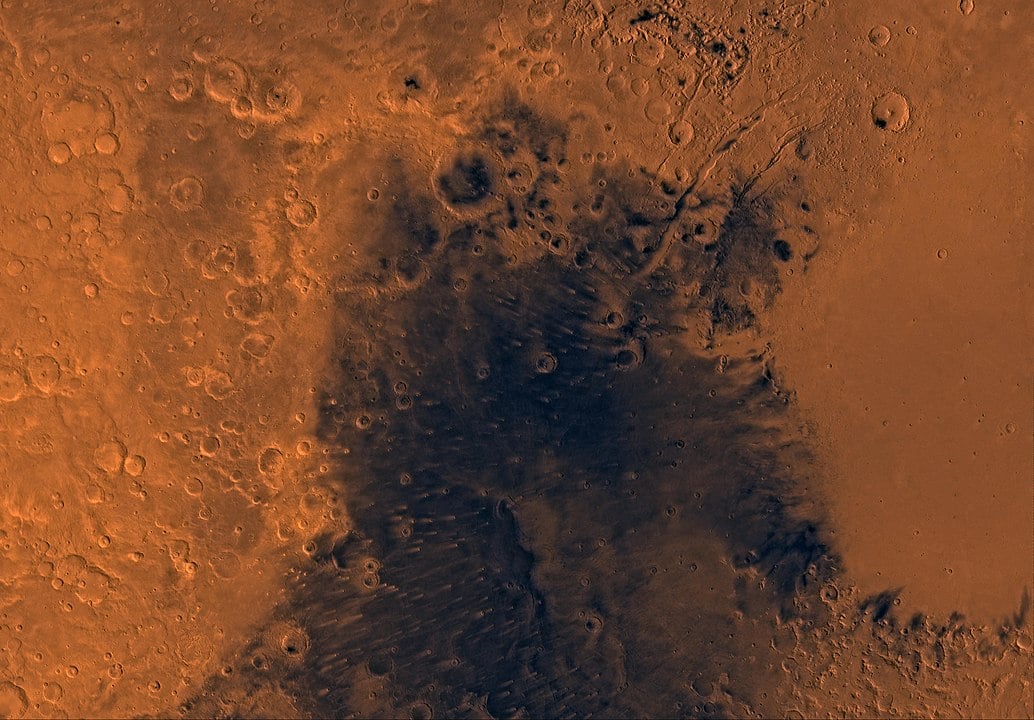
The volcano Syrtis Major region of Mars. The central part is dominated by dark dust and lava flows of Syrtis Major Planitia. This is just one of the volcanoes that may be responsible for ice on Mars (Credit : NASA)
Between 4.1 and 3 billion years ago, Mars was volcanically active. Massive eruptions existed across the planet's surface, throwing material and gases high into the thin Martian atmosphere. A new study uses climate modelling to explore whether these events could have transported water ice to unexpected regions of the red planet. The team, led by Saira Hamid from Arizona State University simulated the ancient volcanic eruptions to see what happened to water vapour during each event. The results from their study were quite surprising.
When water vapour shot into Mars’s cold atmosphere from volcanic eruptions, it froze rapidly, creating ice crystals that fell back to the surface. The simulations showed that a single three day eruption could deposit ice layers up to five metres thick on the Martian surface, building up substantial accumulations over time. But this leaves the crucial question of just how this ice could possibly survive billions of years in equatorial regions where temperatures should cause it to sublimate into a gas and straight into the atmosphere? The answer lies in what happened after the eruptions ended.
Volcano Tavurvur in Papua New Guinea erupting
(Credit : Taro Taylor)
If volcanic debris, dust, or lava flows buried these ice deposits quickly enough, its likely they would have been insulated from direct exposure to sunlight and the thin atmosphere. Protected beneath these layers, the ice could remain stable for geological timescales, even in regions where surface ice would normally be impossible. These eruptions could also have released sulphuric acid into the Martian atmosphere, which could have plunged the entire planet into a prolonged global winter. This extended cold period would have allowed ice to accumulate not just during individual eruptions but over sustained periods, creating even more substantial deposits.
The research team identified a two volcanoes that could explain the ice deposits observed in equatorial regions today; Syrtis Major and Apollinaris Mons. Apollinaris Mons is an ancient volcano situated centrally within the Medusae Fossae Formation, erupted between 3.9 and 3.5 billion years ago. The proximity of these volcanoes to regions showing the highest hydrogen signatures suggests these ancient eruptions may have been directly responsible for creating equatorial ice reservoirs.
False colour Mars Global Surveyor image of Apollinaris Mons. White clouds can be seen hovering above the volcano (Credit : NASA/JPL/MSSS)
Measurements taken from orbit reveal elevated hydro
gen levels around the equatorial regions which aligns well with these new volcanic models. While these hydrogen signatures aren't definitive proof of buried ice, they strengthen the case that ancient volcanic activity may have delivered frozen water to some of the warmest regions of Mars, where it patiently waits beneath the surface for future explorers to discover.
If these ice deposits truly exist beneath the equatorial surface, they could prove invaluable for future human exploration. The equatorial regions on Mars offer more favourable landing sites than the rather more harsh polar environments, and access to water ice would be transformative for any crewed mission. Ice could provide drinking water, be split into oxygen for breathing, or even be converted into rocket fuel for the return journey to Earth. Although any astronaut heading to Mars without enough fuel to get home is made of stronger stuff than I!
The Sun photographed at 304 angstroms by the Atmospheric Imaging Assembly (AIA 304) of NASA's Solar Dynamics Observatory (Credit : NASA/SDO (AIA))
The corona of the Sun is an extraordinary place, with temperatures exceeding one million degrees Celsius, far hotter than the Sun's visible surface below. During solar flares, violent releases of magnetic energy, plasma can cool dramatically and condense into dense blobs that plummet back toward the Sun's photosphere, its visible surface. These falling streams of cooler material create the phenomenon of coronal rain. However, existing solar models couldn't explain the speed at which this cooling happens.
During a total solar eclipse, the Sun's corona and prominences are visible to the naked eye
(Credit : Luc Viatour)
Traditional solar models assumed that the distribution of specific elements throughout the corona remains constant across both space and time. This simplification made calculations manageable but created a significant problem when scientists tried to match their models with actual observations. Earlier theories required heating over hours or even days to produce the conditions necessary for coronal rain, yet solar flares unfold in mere minutes. Something fundamental was clearly missing from the picture.
Luke Benavitz, a graduate student, and astronomer Jeffrey Reep discovered the missing piece. Their research, demonstrates that allowing elemental abundances to vary with time produces models that finally match real solar observations. Elements like iron don't remain uniformly distributed in the corona but shift dynamically as conditions change. When this variation is plugged into the models, coronal rain can form on the timescales actually observed during solar flares.
Material rises from the edge of the Sun during a solar flare, as seen in extreme ultraviolet light by NASA's Solar Dynamics Observatory
(Credit : NASA/SDO)
Scientists use cooling processes to help understand heating mechanisms in the corona, since they cannot directly observe how energy is deposited into this region. If models have been treating the abundance of elements incorrectly as they have been, then estimates of cooling times have likely been wrong as well. This realisation suggests that fundamental assumptions about coronal heating may need revisiting.
Understanding that the distribution of elements change dynamically opens entirely new avenues for research into how the Sun's outer layers behave and how energy travels through its atmosphere. These insights could eventually improve predictions of solar storms, the space weather that can disrupt satellites, power grids, and communications systems on Earth.
What began as an investigation into a curious solar phenomenon has revealed that our models of the Sun's behaviour need considerable refinement. Sometimes the most important scientific breakthroughs come not from discovering entirely new phenomena, but from recognising that familiar assumptions were previously wrong.
Pilots See UFO Over Lon, New Mexico Oct 10, 2025, UAP Paranormal sighting news. Aliens love jet tech.
Date of sighting: Oct 10, 2025
Location of sighting: Between IAH to LAX airports. USA
Source: NUFORC
UFOs come in all shapes, sizes, colors so this one seems to be a barbell shape...yes a shape mentioned in the old Project Blue Book files. Also from the movement of the object past the clouds, it is matching speed with the small jet traveling at between 600-900mph, making this object one very fast craft. Then suddenly the pilot mentions that it just holds still as they pass it by. This means it's intelligently controlled. 100% alien technology in our atmosphere.
Scott C. Waring - UFO Sightings Daily
Eyewitness states:
A teardrop/pin shape object suspending in sky The two of us were flying from IAH to LAX l, i.e. east to west, on October 10th on flight AA 6242. The pilot announced altitude of 28000 ft not long before spotting this object. After checking the location property that came with iPhone photo, it shows that the photo was taken near Lon, New Mexico. The shape of this object is atypical. It resembled a teardrop but a bit different. It seemed to have two compartments - upper one is bigger and lower one is smaller. It also seemed to have a needle shape “stick” below the lower compartment. It is strikingly visible in day light with metallic glow. It looked like it traveled the same speed as our plane, but later stayed still or moved very slowly when we passed by and we could still see it after the plane had traveled on for more than 1 min.
Glowing UFO Over Wauchula, Florida, USA On Oct 13, 2025, Photos, UAP Paranormal Sighting News.
Date of sighting: Oct 13, 2025
Location of sighting: Wauchula, Florida, USA
Source: NUFORC
It's a cloaked UFO, however the propulsion systems of the craft are causing a static glow around it making it visible...until it shot away. Too often people discount glowing disks in the sky as streetlights, party lights ect. The truth of the matter is...there are hundreds of UFO files in Project Blue Book that mention blue glowing haze craft. And this looks like a massive size one, must have come from the ocean and flew close to the ground for a long ways while it was cloaked, but powering up to shoot long distance caused it to be noticed. 100% proof aliens exist and are active in Florida!
Scott C. Waring - UFO Sightings Daily
Eyewitness states:
It was moving 50 mph or faster. Aura or haze around object, Made a sound A big and fast moving sphere! It was going FAST! and big! And then we saw it fade away!
Glowing UFO Seen Above Hollywood, Florida, USA Oct 13, 2025, UAP Paranormal Sighting News.
Date of sighting: Oct 13, 2025
Location of sighting: Hollywood, Florida, USA
Source: NUFORC
I know...this guys description below is lacking...a bit lazy but he did take a great video of the event. The glowing craft is seen passing across the night sky glowing like a comet, but it's not a comet, it's not a meteor because it's moving way too slow. This is something more amazing...coming from the direction of the ocean...which is known by all UFO researchers as a UFO hotspot...caused by the location of an alien base that crosses below all of Florida from the Gulf of America to the ocean on the other side. This is from the Bermuda Triangle area and passing over Florida, the US gov may try to say its a rocket or falling satellite, but we know the US gov lies every time they open their mouths...its an alien ship!
Scott C. Waring - UFO Sightings Daily
Eyewitness states:
Seen at Hollywood, Florida. Above the diplomat Headed towards the oceanLeft a trail I just came out of no where I have the video.
At theAssociation of the U.S. Army (AUSA) 2025 conference on October 13, Boeing unveiled its new Collaborative Transformational Rotorcraft (CxR) concept, underscoring the defense giant’s bold gamble on the future of unmanned rotorcraft warfare.
The rendering of a large unmanned tiltrotor, intended to act as a “wingman” to crewed helicopters, suggests Boeing is seeking to reshape how armies think about blends of manned and unmanned aviation.
Boeing is pitching a new class of unmanned vertical takeoff and landing (VTOL) aircraft — a modular, high-speed tiltrotor — that could operate alongside, support, and even protect crewed platforms like the AH-64 Apache and CH-47 Chinook.
By unveiling the CxR, Boeing is entering a high-stakes race to supply the next generation of collaborative rotorcraft, with the potential to shift tactical aviation paradigms.
According to Aviation Week, the CxR is projected to weigh between 5,000 and 7,000 pounds and will be powered by a single turboshaft engine driving a pair of tilting propellers, enabling speeds of 200 to 250 knots. The aircraft is also expected to have a maximum gross weight between 5,000 and 7,000 pounds, with a payload capacity of 1,000 to 2,000 pounds.
This configuration would make the CxR roughly twice the size of the MQ-1 Predator, giving it significantly more heft and operational flexibility than many of the smaller unmanned systems in the U.S. Army’s current arsenal.
Despite its size, Boeing emphasizes that the CxR is designed to be expeditionary, fitting compactly inside a C-130 Hercules transport to allow for rapid deployment to remote or contested theaters.
Boeing is presenting the CxR as part of a “family of systems” tailored to the Army’s future vertical lift ecosystem, with two specific variants already envisioned to address distinct mission needs.
One variant, dubbed the “Collaborative Combat Rotorcraft” (CCR), would be designed for front-line combat operations. In this configuration, the CxR would be equipped with weapons, sensors, and electronic warfare systems, allowing it to perform strike, reconnaissance, or escort missions.
It could also serve as a “mothership” for smaller launched effects (LEs) — miniature drones that can be deployed mid-flight for surveillance, jamming, or precision attacks deep within enemy territory.
Boeing suggests the CCR variant of the CxR could be specifically designed to integrate seamlessly with the AH-64 Apache attack helicopter, extending its reach and capabilities on the battlefield.
Under the Army’s Manned-Unmanned Teaming-Extended (MUMT-X) architecture, Apache crews can already control sensors and flight paths of assets like the MQ-1C Gray Eagle drone. Boeing aims to extend that control paradigm to the CxR, making it a “true wingman” rather than an autonomous sidecar.
“Our customers understand that winning on the modern battlefield means transforming proven capabilities at the pace of change and ensuring interoperability across the force structure,” Boeing’s vice-president of Attack Helicopter Programs, Christina Upah, said in a statement. “The Apache is critical to securing the future of battlefield dominance, and we’re demonstrating how we can make it even more dominant through integration with autonomous Launched Effects systems and interoperability with other evolving capabilities.”
A second variant, called the “Collaborative Logistics Rotorcraft” (CLR), reconfigures the platform for resupply and transport roles. Instead of a weapons bay, the CLR would feature a modular cargo fuselage, enabling rapid delivery of ammunition, equipment, or medical supplies into contested areas where traditional helicopters might be too vulnerable.
Together, these two initial designs showcase Boeing’s modular vision for the CxR. This single tiltrotor platform could be rapidly adapted for a multitude of missions on the battlefield.
Boeing is leveraging its experience with tiltrotor systems, namely its V-22 Osprey. Engineers acknowledge that lessons from the Osprey program on transition control and switching between vertical lift and forward flight are being applied in the CxR’s design.
That said, significant challenges lie ahead in bringing the CxR from concept to reality. Tiltrotor aircraft are notoriously complex, requiring intricate mechanisms, high-maintenance interfaces, and advanced control systems to manage transitions between hover and forward flight. The V-22 Osprey program, in particular, offers a sobering reminder of the technical and logistical hurdles such designs can face.
To succeed, Boeing will also need to demonstrate that the CxR is not only feasible but also cost-effective, reliable, and resilient in contested environments. And because it’s designed to operate in close coordination with crewed aircraft, the company must also master challenges in cybersecurity, autonomy, bandwidth, and sensor fusion—factors that may ultimately prove just as critical as propulsion or aerodynamics.
Last year, the U.S. Army shelved its Future Attack Reconnaissance Aircraft (FARA) program to focus more intently on unmanned systems. Meanwhile, the Army continues to promote its Future Vertical Lift (FVL) roadmap, including implementation of the MV-75 tiltrotor for assault missions. The CxR could find a role in this evolving architecture, particularly as a sensor and strike multiplier that extends reach without risking crewed assets.
For now, the CxR is firmly at the conceptual stage. Boeing says it is actively soliciting feedback from the U.S. Army to refine performance requirements, operational trade-offs, and mission design.No prototype or firm timeline has been disclosed so far.
Tim McMillan is a retired law enforcement executive, investigative reporter and co-founder of The Debrief. His writing typically focuses on defense, national security, the Intelligence Community and topics related to psychology. You can follow Tim on Twitter:@LtTimMcMillan. Tim can be reached by email: tim@thedebrief.org or through encrypted email:LtTimMcMillan@protonmail.com
Meer van UFO'S of UAP'S, ASTRONOMIE, RUIMTEVAART, ARCHEOLOGIE, OUDHEIDKUNDE, SF-SNUFJES EN ANDERE ESOTERISCHE WETENSCHAPPEN - DE ALLERLAATSTE NIEUWTJES


 Unexpected discovery on Saturn's moon challenges view on chemistry before life emerged