Ontdek de Fascinerende Wereld van UFO's en UAP's: Jouw Bron voor Onthullende Informatie!
Ben jij ook gefascineerd door het onbekende? Wil je meer weten over UFO's en UAP's, niet alleen in België, maar over de hele wereld? Dan ben je op de juiste plek!
België: Het Kloppend Hart van UFO-onderzoek
In België is BUFON (Belgisch UFO-Netwerk) dé autoriteit op het gebied van UFO-onderzoek. Voor betrouwbare en objectieve informatie over deze intrigerende fenomenen, bezoek je zeker onze Facebook-pagina en deze blog. Maar dat is nog niet alles! Ontdek ook het Belgisch UFO-meldpunt en Caelestia, twee organisaties die diepgaand onderzoek verrichten, al zijn ze soms kritisch of sceptisch.
Nederland: Een Schat aan Informatie
Voor onze Nederlandse buren is er de schitterende website www.ufowijzer.nl, beheerd door Paul Harmans. Deze site biedt een schat aan informatie en artikelen die je niet wilt missen!
Internationaal: MUFON - De Wereldwijde Autoriteit
Neem ook een kijkje bij MUFON (Mutual UFO Network Inc.), een gerenommeerde Amerikaanse UFO-vereniging met afdelingen in de VS en wereldwijd. MUFON is toegewijd aan de wetenschappelijke en analytische studie van het UFO-fenomeen, en hun maandelijkse tijdschrift, The MUFON UFO-Journal, is een must-read voor elke UFO-enthousiasteling. Bezoek hun website op www.mufon.com voor meer informatie.
Samenwerking en Toekomstvisie
Sinds 1 februari 2020 is Pieter niet alleen ex-president van BUFON, maar ook de voormalige nationale directeur van MUFON in Vlaanderen en Nederland. Dit creëert een sterke samenwerking met de Franse MUFON Reseau MUFON/EUROP, wat ons in staat stelt om nog meer waardevolle inzichten te delen.
Let op: Nepprofielen en Nieuwe Groeperingen
Pas op voor een nieuwe groepering die zich ook BUFON noemt, maar geen enkele connectie heeft met onze gevestigde organisatie. Hoewel zij de naam geregistreerd hebben, kunnen ze het rijke verleden en de expertise van onze groep niet evenaren. We wensen hen veel succes, maar we blijven de autoriteit in UFO-onderzoek!
Blijf Op De Hoogte!
Wil jij de laatste nieuwtjes over UFO's, ruimtevaart, archeologie, en meer? Volg ons dan en duik samen met ons in de fascinerende wereld van het onbekende! Sluit je aan bij de gemeenschap van nieuwsgierige geesten die net als jij verlangen naar antwoorden en avonturen in de sterren!
Heb je vragen of wil je meer weten? Aarzel dan niet om contact met ons op te nemen! Samen ontrafelen we het mysterie van de lucht en daarbuiten.
With each passing day, you may feel like you're getting further past your peak.
But panic not – as a new study suggests your best days may still lie ahead of you.
Scientists in Australia say that overall mental functioning in the brain actually peaks between the ages of 55 and 60.
People in this age range may be at their best for complex problem–solving tasks and high–ranking leadership roles in the workforce.
'As your youth fades further into the past, you may start to fear growing older,' said study author Gilles Gignac, professor of psychology at the University of Western Australia.
'But our research shows there's also very good reason to be excited.
'For many of us, overall psychological functioning actually peaks between ages 55 and 60.
'Perhaps it's time we stopped treating midlife as a countdown and started recognising it as a peak.'
Scientists have revealed the surprising age at which your brain reaches its peak (stock image)
This graph shows peak performance for reasoning, vocabulary, memory, speed and an overall 'weighted cognitive ability composite' (WCAC)
Previous studies have suggested that humans reach their physical peak in their mid–twenties to early thirties – which is why athletes have such a relatively short career.
But in terms of a cognitive peak, the picture is much less clear.
In their meta–review of previous research, the team identified 16 key cognitive and personality–related traits, all 'with well–documented age trajectories'.
The 16 traits included moral reasoning, memory span, processing speed, knowledge and emotional intelligence.
They also included the so–called 'big five' personality traits – extraversion, emotional stability, conscientiousness, openness to experience, and agreeableness.
'By standardising these studies to a common scale, we were able to make direct comparisons and map how each trait evolves across the lifespan,' said Professor Gignac said in a piece for The Conversation.
When they combined the age–related trajectories of all 16 dimensions, a 'striking pattern' emerged, according to the academic.
'Overall mental functioning peaked between ages 55 and 60, before beginning to decline from around 65,' he said.
According to the experts, overall psychological functioning actually peaks between ages 55 and 60 – which might make people of this especially well–suited to demanding leadership roles (file photo)
Some traits such as moral reasoning continue to peak past the age of 65, the study suggests. In this graph, note the declines in financial literacy and resistance to sunk cost – being able to abandon a strategy or course of action when it is beneficial even after investing heavily in it
Cognitive traits that peak around 55–60
Crystallised intelligence (knowledge from prior learning and experiences)
Emotional intelligence
Moral reasoning
Cognitive empathy
Vocabulary
'That decline became more pronounced after age 75, suggesting that later–life reductions in functioning can accelerate once they begin.'
Several of the traits measured reach their peak much later in life, including conscientiousness (peaking around 65) and emotional stability (around 75).
Less commonly discussed traits, such as moral reasoning, also appear to peak in older adulthood – around 70 and older.
Although overall mental functioning notably declines after age 75, the capacity to resist cognitive biases – mental shortcuts that can lead us to make irrational decisions – may continue improving well into the 70s and even 80s.
The findings, published in the journal Intelligence, may explain why many demanding business leadership roles are often held by people in their fifties and sixties.
People best suited for high–stakes leadership, judgment, or executive roles are likely to be between 55 and 60 – and unlikely to be younger than 40 or older than 65.
However, older workers face greater challenges re–entering the workforce after job losses – perhaps because employers think they're soon to retire.
'Although many studies emphasize early adulthood declines in fluid cognitive abilities, our findings suggest that when broader adaptive traits are considered, human functional capacity peaks in midlife,' the team conclude.
Once you pass the five–year peak period (55–65), aspects of cognitive performance, such as reasoning and memory, may start to decline (file photo)
'This challenges many conventional assumptions about age and capability, and suggests that midlife may represent the true apex of psychological readiness for complex, consequential roles.'
Overall, researchers agree there's a difference between 'fluid intelligence' and 'crystallised intelligence' – concepts introduced in 1943 by Birmingham–born psychologist Raymond Cattell.
Fluid intelligence – described as 'raw processing power' – is the ability to process information quickly and problem solve, while crystallised intelligence is gained through prior learning.
Fluid intelligence typically peaks in the twenties, while crystallised intelligence tends to increase with age as we gain more experience.
'When we look beyond raw processing power, a different picture emerges,' said Professor Gignac.
'Evaluations and assessments should focus on individuals’ actual abilities and traits rather than age–based assumptions.'
Scientists discover the brain's three ageing 'waves'...and it starts before the age of 60
Whether you're turning 60, 70 or 80, everyone starts to feel 'old' at very different times.
A Christian pastor who accurately foresaw the assassination attempt on Donald Trump three months prior has shared a new vision about a threat in the sky.
'A major distraction is about to take place,' Biggs said in a YouTube video. 'I said, 'Lord, are there two of these?' And he said, 'No, it's just one.'
'That's what's going to make everybody freak out because they're going to see it moving across the ocean. It's going to be something that's going to be on TV.'
Biggs shared the vision in July, just weeks after 3I/ATLAS was identified, claiming that it is not aliens, but 'demonic spirits.'
'There is no such thing as aliens. You need to hear me. But there are going to be things in the sky that are going to scare everybody in the days ahead because people are going to go, 'Oh, no. ET really exists.' No, it's fallen angels,' he said.
Biggs admitted he did not know when his vision was set to take place, but warned that it would appear as a 'demonic-looking light' in the night sky.
His prediction has been met with criticisms online, with many users calling Biggs a 'false prophet.'
While there is no scientific or credible evidence to back up the claims, Biggs had accurately predicted the attack on Trump last year.
In April, Biggs posted a video detailing what he saw.
'This bullet flew by his ear, and it came so close to his head that it busted his eardrum,' he said
While there are wild theories about the object, dubbed 3I/ATLAS, NASA has long determined it is nothing more than a comet from another part of the universe
Also during the segment, Biggs said he saw red waves in Michigan and Oklahoma during the 2024 Election, which ultimately occurred in both states.
Now that those predictions have come and passed, social media users fear the last vision could also come true.
Loeb has also floated the idea that it is a mothership set to release tiny probes to intercept Earth.
Read More
Interstellar object spotted carrying mysterious companion that points to 'technological design'
Dr Matthew Genge, a planetary scientist from Imperial College London, dismissed Loeb's claims, telling the Daily Mail that 3I/ATLAS is a natural object.
'Little green men certainly aren't responsible!' he added.
Loeb said this week that the world will soon know the true origins of 3I/ATLAS, as the object will make its closest approach to the sun on October 29.
If it is a comet, it should 'disintegrate into fragments.'
'When a comet gets close to the sun, solar radiation heats its icy nucleus,' Loeb explained.
'Volatile ices like carbon dioxide, carbon monoxide, or water sublimate directly into gas, carrying away dust and small rocks.
'This process can cause the comet to break apart if the mix of ice and dust cannot withstand the thermal stress.'
The European Space Agency's Jupiter probe will have a front-row seat, capturing the moment it either breaks apart or, as Loeb speculated, 'releases mini-probes as a technological mothership.'
Loeb noted there is a 30 to 40 percent chance the object 'does not have a fully natural origin,' noting the possibility it is a 'Trojan Horse,' where a technological object masquerades as a comet.
The ESA's Jupiter Icy Moons Explorer (Juice) craft will have a view of the object when it comes 125 million miles from the planet and monitor it through November.
'During November and December, terrestrial observatories will also be able to monitor 3I/ATLAS and check whether it disintegrated like a natural comet or released mini-probes as a technological mothership,' Loeb explained.
It is a question that has long puzzled historians and theologians... what DID Jesus actually look like?
And it seems casting agents are also prone to getting themselves in a tangle over Christ's appearance.
Mel Gibson's highly-anticipated sequel to The Passion of the Christ has caused outrage from fans after it was revealed it is using a new cast because the original actors have aged since the first film in 2004.
The original movie followed the final 12 hours of Christ's life, and starred Jim Caviezel, 57, as Jesus.
However, The Resurrection of the Christ - which takes place three days after the crucifixion on Good Friday - will now star Finnish actor Jaakko Ohtonen, 36.
Despite the backlash, perhaps the bigger question is does Ohtonen actually look like Jesus? And what did the Messiah really look like in the first place?
According to historians, Jesus would have had short curly hair, brown skin and brown eyes.
However, just like Ohtonen, Jesus would have been strong and lean.
Dr Meredith Warren, senior lecturer on Biblical and religious studies at Sheffield University, told the Daily Mail that muscular depictions of Jesus aren't 'completely off the mark'.
She said: 'Jesus comes from a family where manual labour is the norm, and he certainly gets exercise with all the walking around.'
The original 2004 movie starred Jim Caviezel (left) as Christ, but the sequel will see Finnish actor Jaakko Ohtonen (right) in the role instead
The version of Jesus we are most familiar with often has brown, flowing shoulder-length hair and a full beard. However, neither of these ideas matches up with what we know about the historical figure of Jesus
Beard and hair
The version of Jesus we are most familiar with often has brown, flowing shoulder-length hair and a full beard.
However, neither of these ideas matches up with what we know about the historical figure of Jesus.
One of the few things we know for certain is that Jesus was ethnically Judean and came from the region which is now modern-day Palestine.
This means his hair and beard would have been black and curly rather than brown and straight.
Likewise, it is extremely likely that Jesus would have worn his hair and beard quite short.
Just like today, beards tended to go in and out of fashion in the Roman world over the years.
Around the time of Jesus' life in the first century AD, we think that being clean-shaven was extremely important to Romans but as a Jew, Jesus probably did grow a well-kept beard.
Paintings of Jesus often show a man with pale skin, long hair and a full beard. However, experts say that none of these details is correct
What would Jesus have really looked like?
Beard and hair
Jesus would have had short, curly hair and a well-trimmed beard.
Facial features
Jesus was ethnically Judean and would have been Middle Eastern in appearance. He would have had dark skin and brown eyes.
Body type
Jesus would have been lean and wiry due to manual labour and poor diet.
Clothing
Jesus would have worn a short tunic and an undyed woollen mantle with tassels.
Roman coins from the period show captive Judeans sporting short curly beards, which suggests this might have been the fashion of the time.
Joan Taylor, professor of Christian origins at King's College London, told the Daily Mail: 'To have long hair and a long beard signalled something in ancient Judaism - that you were keeping a special vow and not drinking wine.
'Jesus was actually accused of drinking too much, so he was not keeping such a vow.'
In fact, some of the very first depictions we have of Jesus show him looking distinctly well-groomed.
Paintings dating from the first half of the third century AD found the church in the ruined city of Dura-Europos in Syria show Jesus clean-shaven with hair cut well above his collar.
However, like so many of our modern depictionsof Jesus, these characteristics say more about the culture of the time than they do about the historical figure.
In the first century AD, Professor Taylor says that long hair on men was considered 'rather unseemly'.
However, by the fourth century AD, images of Jesus began to feature long hair and beards depending on what the artists wanted to emphasise.
The very earliest image of Jesus from the church in the ruined city of Dura-Europos shows a man with short hair and no beard. Long hair would have only been worn by Jewish men when they were taking a vow involving abstaining from wine
This third-century image shows Moses parting the Red Sea. Experts think this style of short hair and beard is the most likely way Jesus would have styled himself
Dr Warren says: 'If they want to connect Jesus with the notion of the Good Shepherd or make parallels with Roman ideas about Dionysus or Apollo, he'll have longer hair; likewise if they want to emphasise Jesus as Philosopher, who would have a longer beard.
'Later, when we get the idea of an all-powerful Christ as Creator, his depiction aligns with the way Zeus or Jupiter is imaged: with beard and longer hair.'
Facial features
Strikingly, the Bible does not include many descriptions of Jesus's appearance.
But based on the few biographical details we have experts have pieced together some details of his likely facial features.
Dr Warren says: 'Jesus would have had brown skin, brown eyes, like the local population.
'He died before he was 40. He wasn't rich and would have spent a lot of time outdoors, so some lines on that face, probably. His hands and feet were probably calloused and rough.'
To get more specific details, experts have to look at other people living in the region at the time.
Starting from the fourth century, Byzantine images of Jesus start to show a man with pale skin and Western features
In reality, experts say that Jesus would have looked more like the men shown in the Egyptian mummy paintings from the first century AD (pictured). These show dark-skinned men with brown eyes and curly hair
One of the few things the Bible tells us about Jesus's appearance is how indistinct he appeared to be.
When soldiers come to take him from the Garden of Gethsemane they needed Judas to point him out amongst the crowd of other Judean men.
Likewise, in the Gospel of John, Mary Magdalene mistakes him for a gardener when she goes looking for his body.
From these pieces of information, some scholars have inferred that Jesus might have looked very much like other men of the period and didn't have many distinctive features.
In her opinion, Dr Warren thinks the best representations of how Jesus might have looked come from the Egyptian mummy portraits.
These paintings were made of men who died between 80 and 120 AD in a similar part of the world to Jesus.
They show men with dark eyes, brown skin, short curly hair, beards and facial features which would have been distinctive of people living in what is now Egypt, the Palestinian territories and Israel.
Retired medical artist Richard Neave has recreated the face of a first-century Judean (pictured) using forensic techniques and Semite skulls found in archaeological excavations
Richard Neave's reconstruction shows what a man from the region might have looked like
The portrait revealed a wide face, dark eyes, a bushy beard and short curly hair, as well as a tanned complexion which might have been typical of Jews in the Galilee area.
While this is just a portrait of an adult man living at the same time as Jesus, this reconstruction gives us a better idea of what kind of features he may have had.
Muscles
Across statues and paintings of Christ, one of the most oddly consistent features is that the son of God is often depicted with chiselled abs.
While this might seem like an absurd detail to include, experts say that it's not that crazy when we consider the details of Jesus's life.
Professor Taylor says: 'Jesus did a lot of walking, during his mission, and his trade was as a carpenter or constructor, so he was not a couch potato.
'He and his disciples essentially lived on hospitality, charity and they shared food, so I don't think he ate that much. I see him more as wiry than bulky.'
This means that statues of Jesus with a six-pack probably aren't as far from reality as you might think.
Jesus is often depicted with bulging muscles and chiselled abs. While experts say that Jesus probably wouldn't have been extremely muscly, his manual labour and poor diet would have made him wiry and strong. Pictured: 'It Is Finished', by Sascha Schneider (1895)
However, statues of Jesus on the cross with bulging biceps and pecs definitely miss the mark.
As someone who travelled on foot and ate very little, it would be extremely surprising if Jesus was particularly muscular.
Clothing
When we see paintings of Jesus today, he is often wearing a long white robe which hangs down to his ankles.
However, in first-century Judea, long robes like these would have been seen as women's clothing.
Instead, men from the region would have worn a short woollen tunic made up of two pieces, belted or tied at the waist, with a thinner linen tunic underneath.
Only Roman citizens were permitted to wear a toga but Jesus would have had a thick woollen mantle called a himation to wrap about himself for warmth.
As a Jewish man, Jesus might have had a mantle with knotted tassels called tzitzit on each of the corners.
Jesus would have worn a knee-length tunic tied or belted at the waist with a thick woollen mantle or cloak called a himation over the top (pictured)
These sandals were found in the caves around the Dead Sea and date back to the first century. They are exactly the kind of simple footwear Jesus would have worn
However, this wouldn't have been entirely unique since lots of clothes from the period also had fringes.
The one thing that our modern images of Jesus get right is that everyone in Judea would have worn leather sandals during the time Jesus was alive.
Archaeologists have even found examples of first-century sandles in the caves Dead Sea and Masada.
These show that Jesus's sandals would have been very simple, with the soles made of thick pieces of leather sewn together, and the upper parts made of straps of leather going through the toes.
When it comes to colour, images of Jesus often show him wearing a red or blue mantle over his white robes.
Archaeological evidence from the time shows that people did wear brightly coloured and patterned clothes - but it is more likely that Jesus's clothes would have been a little more muted.
'Many garments were dyed bright colours, but it was considered more manly to wear duller hues or undyed clothing,' says Professor Taylor.
'Appearance and clothing do matter, and Jesus was quite clear about that: he asked those he sent out in his name to wear only one tunic and a pair of sandals, with no money, just like refugees might arrive in a village needing support with nothing on them. He would then have dressed very simply himself.'
No physical description of Jesus is found in the Bible.
He's typically depicted as Caucasian in Western works of art, but has also been painted to look as if he was Latino or Aboriginal.
It's thought this is so people in different parts of the world can more easily relate to the Biblical figure.
The earliest depictions show him as a typical Roman man, with short hair and no beard, wearing a tunic.
It is thought that it wasn't until 400AD that Jesus appears with a beard.
This is perhaps to show he was a wise teacher, because philosophers at the time were typically depicted with facial hair.
The conventional image of a fully bearded Jesus with long hair did not become established until the sixth century in Eastern Christianity, and much later in the West
Medieval art in Europe typically showed him with brown hair and pale skin.
This image was strengthened during the Italian Renaissance, with famous paintings such as The Last Supper by Leonardo da Vinci showing Christ.
Modern depictions of Jesus in films tend to uphold the long-haired, bearded stereotype, while some abstract works show him as a spirit or light.
On October 15–16, the recently discovered asteroid 2025 TP5 made a close flyby of Earth and then the Moon. It flew past our planet at a distance of less than 100,000 km. This is about four times less than the average distance between the Earth and the Sun.
Four times closer than the Moon: A small asteroid flew near Earth
A near-Earth asteroid in an artist’s impression. Source: space.com
Over the past few decades, astronomers have made significant efforts to catalog and search for potentially dangerous asteroids that could pose a threat to Earth. Their detection is handled, in particular, by the ATLAS system, which is funded by NASA. It consists of four automated telescopes, two of which are located in Hawaii, one in Chile, and another in South Africa. It was the ATLAS system that discovered thefamous interstellar comet 3I/ATLAS, which is currently approaching the Sun.
On October 13, ATLAS telescopes discovered a previously unknown asteroid, designated 2025 TP5. Its diameter is 16 meters.
On October 15, 2025, TP5 flew close to Earth. According to NASA’s Jet Propulsion Laboratory, the minimum distance between the two bodies was 97,089 km. This is significantly less than the distance of most similar visits. However, in any case, the approach posed no threat to Earth. And the very next day, 2025 TP5 flew past the Moon at a distance of 120,084 km, which is also quite close by cosmic standards.
Interestingly, in 1979, 2025 TP5 already made a close flyby of Earth. But no one noticed the asteroid at that time. The discovery of 2025 TP5 clearly demonstrates the significantly increased capabilities of astronomers in searching for near-Earth asteroids. Technology has advanced to such an extent that several small asteroids approaching Earth are now detected every month. Recall that one of them flew over Earth at the altitude of the International Space Station in early October.
The structure’s design, which has been compared to a traditional Chinese lantern, was unveiled in a recent study published in Nature Materials. The material’s ability to store and release energyacross the formation of several stable shapes could inspire new approaches in robotics, adaptivefiltration, and responsive material systems.
A Lantern That Comes to Life
The researchers started with a thin polymer sheet, cut into a diamond-shaped parallelogram. Evenly spaced slits were then added to form narrow ribbon patterns connected by solid strips at the top and bottom. When the ends were joined, the sheet folded into a hollow, spherical structure that resembled a paper lantern.
“This basic shape is, by itself, bistable,” said Jie Yin, one of the study’s authors and a professor of mechanical and aerospace engineering at NC State. “It’s stable in its lantern form, but when compressed, it suddenly snaps into a second stable shape that resembles a spinning top.”
When returning to its original form, the structure rapidly releases stored elastic energy, a process the researchers call snapping morphogenesis. By combining twisting and folding, the team produced a variety of additional shapes, including some with four stable states.
Controlling Motion With Magnetism
To enable remote control, the engineers applied a thin magnetic film to the lantern’s lower strip. An external magnetic field could then trigger the structure to twist or compress without direct contact.
In demonstrations, the magnetized lanterns functioned as gentle grippers, able to catch and release live fish unharmed. The devices also operated as fluid-control valves that opened and closed underwater, and as mechanisms that could quickly reopen a collapsed tube. Each of these applications relied on the rapid release of stored elastic energy.
Video footage of the device in operation shows the lanterns snapping and twisting with precise, lifelike motion. The structures almost appear to pulse or breathe, rather than move in a purely mechanical way.
Programming Shape and Energy
To control each shape’s behavior, the team created a mathematical model that connects the geometry of the lantern to stored elastic energy. This model lets researchers design configurations for specific stability and power output.
“This model allows us to program the shape we want to create, how stable it is, and how powerful it can be when stored potential energy is allowed to snap into kinetic energy,” said Yaoye Hong, the paper’s lead author and postdoctoral researcher at the University of Pennsylvania.
Geometry serves as the primary means of control for this system. By modifying angles or folding patterns, engineers can precisely adjust how the structure stores and releases energy to form various shapes.
Shape-Morphing Machines
Each lantern can be reprogrammed and triggered remotely, making the design a potential building block for new smart materials. “Moving forward, these lantern units can be assembled into 2D and 3D architectures for broad applications in shape-morphing mechanical metamaterials and robotics,” Yin said.
Systems like these could be used as the foundation for adaptive robots capable of crawling, swimming, or grasping with magnetically controlled limbs. They could also be applied to practical devices, such as sensors and filters that unfold to adjust the flow of water.
A New Generation of Smart Materials
Multistability, or the ability of a structure to remain stable in several different states, is becoming a central focus in smart materials research. The control of structure demonstrated in this study integrates concepts from physics and engineering, turning what seems like a simple device into a powerful tool for advancing shape-morphing robotics.
Using just a single sheet of polymer, the NC State team has shown how magnetism, geometry, and stored energy can work together to create motion that is adaptable, fast, and repeatable. The team’s research potentially lays the foundation for an all-new generation of adaptive machines.
The study, “Shape-Shifting ‘Chinese Lantern’ Structure Could Pave the Way for the Next Generation of Adaptive Machines,” appeared in Nature Materials on October 10, 2025.
Austin Burgess is a writer and researcher with a background in sales, marketing, and data analytics. He holds a Master of Business Administration and a Bachelor of Science in Business Administration, along with a certification in Data Analytics. His work combines analytical training with a focus on emerging science, aerospace, and astronomical research.
Scientists are interested in the origin of a number of gullies on Mars. They believe that carbon dioxide may be responsible for their formation. More precisely, we are talking about its solid form, which is essentially ice.
Was there really life on Mars? Unfortunately, there is no convincing evidence of this yet. However, some form of life seems to have been the driving force behind the mysterious Martian gullies. Geologist Dr. Lonneke Roelofs from Utrecht University investigated how these gullies were formed. During her experiment, she observed that blocks of CO2 ice “dug” these gullies in a unique way.
Other researchers had previously suggested that these blocks might play a role in the formation of gullies. Roelofs proved this by conducting an experiment in which blocks of CO2 ice actually carved out these gullies — a phenomenon that is unknown on Earth and has never been observed before.
Sublimation process
Ice appears on the dunes during the Martian winter, when temperatures drop to minus 120 degrees Celsius. By the end of winter, the slopes of the dunes heat up and blocks of ice break off, some of which are up to a meter long. Due to the thin atmosphere and the large temperature difference between the warm sand of the dunes and the ice, the lower part of the ice immediately turns into gas — a process called sublimation. Since a kilogram of gas takes up much more space than the same weight of ice, the ice, so to speak, explodes.
As a result of this process, the block gradually moves downward, leaving behind a long, deep gully with small sandy ridges on both sides. Such gullies can also be found on the Red Planet.
Lonneke Roelofs investigates the processes that shape the landscape on Mars. For example, last year she published the results of her research on CO2 ice sublimation as a factor contributing to the formation of Martian debris flows. These flows cut deep gullies into the crater walls. But the gullies discovered during this study looked different. Consequently, there was another phenomenon behind this, but what exactly was it? The researcher decided to find out.
Tests in the Mars chamber
Together with master student Simone Visschers, she traveled to the English city of Milton Keynes to unravel the mystery of these unusual sandy gullies. The Open University has a Mars chamber: a facility for simulating Martian conditions.
“We tried out various things by simulating a dune slope at different angles of steepness. We let a block of CO2 ice fall from the top of the slope and observed what happened,” says the researcher. “After finding the right slope, we finally saw results. The CO2 ice block began to dig into the slope and move downwards just like a burrowing mole or the sandworms from Dune. It looked very strange.”
But how exactly are these ice blocks formed? CO2 ice blocks form on desert dunes halfway to the Southern Hemisphere of Mars. In winter, a layer of CO2 ice forms across the entire surface of the dune field, sometimes reaching a thickness of 70 cm. In spring, this ice begins to heat up and sublimate.
The last remnants of this ice are on the shaded side of the dune tops, and there, blocks break off when the temperature gets high enough. When the blocks reach the bottom of the slope and stop moving, the ice continues to sublimate until all the CO2 has evaporated. A cavity remains in the sand at the bottom of the dune.
Why Mars?
Mars is our closest neighbor. It is the only rocky planet located near the “green zone” of our Solar System. This zone is far enough from the Sun to make liquid water possible, which is a necessary condition for life to exist. Therefore, the question of the origin of life and possible extraterrestrial life can be resolved right here.
Roelofs says: “Also, conducting research into the formation of landscape structures of other planets is a way of stepping outside the frameworks used to think about Earth. This allows you to pose slightly different questions, which in turn can deliver new insights for processes here on our planet.”
A US Air Force nuclear-capable B-52H Stratofortress has been spotted flying over Texas, raising questions about the purpose of the high-profile flight.
Flight tracking data showed the long-range, subsonic strategic bomber departed from Shreveport,Louisiana at 1:18pm ET on Tuesday, soaring up through Arkansas, into Oklahoma and is now flying over Texas.
The US Air Force describes the aircraft as a long-range, heavy bomber that can perform a variety of missions.
The bomber is capable of flying at high subsonic speeds at altitudes of up to 50,000 feet.
It was built during the Cold War to serve as a long-range strategic bomber capable of delivering massive payloads, including nuclear weapons, anywhere in the world.
The B-52 made a loop outside of Oklahoma City and several circles above northern Texas.
While the exact purpose of the flight has not been disclosed, such missions are often part of training exercises, strategic rotations or readiness operations.
The flight, which traveled over Texas at 26,000 feet at speeds exceeding 554 mph, highlights the bomber’s continued role in America’s nuclear and conventional arsenal.
Flight tracking data showed the long-range, subsonic strategic bomber departed from Shreveport, Louisiana at 1:18pm ET on Tuesday
The bomber is capable of flying at high subsonic speeds at altitudes of up to 50,000 feet, while carrying nuclear or precision-guided conventional ordnance with worldwide precision navigation capability
In conventional conflicts, the B-52 can conduct strategic attacks, close-air support, air interdiction, offensive counter-air and maritime operations.
During Desert Storm, B-52s were responsible for 40 percent of all coalition munitions dropped, demonstrating their critical role in large-scale operations.
The bomber is also highly effective in ocean surveillance, assisting the US Navy with anti-ship missions and mine-laying operations.
In just two hours, two B-52s can monitor roughly 140,000 square miles of ocean surface, providing unmatched coverage.
Modern B-52s are equipped with electro-optical viewing sensors, forward-looking infrared, and advanced targeting pods to improve targeting, battle assessment, and flight safety.
Pilots also use night vision goggles (NVGs) to enhance visibility during night operations, improving situational awareness, safety, and the ability to visually track other aircraft.
The current flight has the callsign 'TUFFF72,' which suggests the B-52 would likely be conducting training exercises and complex tactical maneuvers with other aircraft and ground forces.
This includes rehearsing strategic attack, air interdiction and maritime operations.
Flight tracking data spotted another bomber mission on October 8, taking a different route than today's flight
Another bomber took off from Shreveport this month, but its flight details are unknown.
Flight data tracked the aircraft heading east into Mississippi, back around over Baton Rouge, where it made several circles just outside the city before returning to home base.
While the bomber emerged during the Cold War, officials said that America's 76-strong fleet will fly until at least 2050, with a few upgrades along the way.
Rolls-Royce is among the companies competing to provide new fuel-saving engines that will spare the Air Force from having to keep ferreting out parts for existing ones that are no longer manufactured.
The B-52 is versatile, able to fire long-range missiles and launch satellite-guided mines and bombs, and is the only current U.S. bomber that can be equipped with nuclear-tipped cruise missiles.
Terry Lovelace Alien Abduction Is Most Convincing UFO Encounter With Biological Evidence
By Vicky Verma
Due to the lack of evidence, validating abduction accounts is challenging, resulting in abductees often not being taken seriously in the UFO community. Although some stories of abductions can be entertaining and well-crafted, most of them are fabricated. However, there is a particularly compelling incident.
Terry Lovelace, a retired assistant attorney general and lawyer, who served as a media and EMT in the United States Air Force from 1973 to 1979, claims that an extraterrestrial craft took him. Lovelace’s account is fascinating and one of the few plausible and credible abduction stories.
In 1973, Lovelace joined the U.S. Air Force immediately after graduating from high school. He received training as a medic/EMT and was stationed at Whiteman Air Force Base in Missouri, which was previously called Sedalia Air Force Base. The base served as a B-2 bomber base and missile base and was home to the 351st Strategic Missile Wing, with many Minuteman II nuclear-armed ICBM silos scattered across the rural area.
Lovelace was assigned as a base medic and drove an ambulance during the graveyard shift from 11 PM to 8 AM along with his partner, who he referred to as “Toby.” One night in January 1975, while on their regular shift, they were outside the ambulance stargazing when Toby, an amateur astronomer, pointed out the constellations and planets. Typically, their shifts were uneventful, but that night turned out to be very significant, altering the course of their lives.
Lovelace (now 69) went camping with Toby at Devil’s Den state park in northern Arkansas. While conversing near a crackling fire, they had difficulty hearing each other due to the loud sounds of crickets and tree frogs. Suddenly, an eerie silence enveloped them. “That sounds kind of clichéd – out of a movie – but that is exactly what happened to us,” he said.
As they gazed toward the horizon, three bright UFOs emerged and advanced in their direction. As the lights drew closer, the two partners could see that they were emanating from a black triangular prism as wide as two city blocks.
Alien sketch by Terry Lovelace
Terry’s re-drawn sketch originally dated Sep 4, 1977, of the massive 5-story-tall craft he and his friend “Toby” encountered in the clearing at Devil’s Den State Park in June of that year.
Credit: Terry Lovelace
Lovelace noticed a blue laser beam rapidly moving across them, possibly scanning their presence. Soon after it stopped, they lost consciousness. Upon awakening, he noticed Toby gazing outside the tent, and spotted a triangle-shaped object hovering above a group of approximately twelve children who were standing in a meadow below them. Lovelace questioned, “Why are these children out here at this time of night?”
“They aren’t little kids. Don’t you remember they took us and they hurt us?” Toby answered.
According to Lovelace, when Toby uttered those words, he experienced a sudden recall of memories of being inside a UFO. In later years, he resorted to hypnosis to recover his missing memories. Through one of these sessions, Lovelace recollected an incident where he had been taken aboard a spacecraft and subjected to medical experimentation by peculiar entities.
Those entities were humanoid forms, but their characteristics were distorted and almost non-human. They communicated with each other through telepathy and seemed to be performing a medical procedure on Lovelace. During his hypnosis sessions, Lovelace experienced flashes of memory where he was on an examination table and screaming, but no sound was coming out of his mouth. He could hear telepathic messages in his head, urging him to stop screaming because they did not intend to harm him and would take him back.
Lovelace said that they had a terrible experience that left their skin red and sore like a bad sunburn all over their body, even the soles of their feet. They had to go to the hospital at the base for two days because they were very dehydrated.
While they were there, they were questioned many times by some men who said they were from the “Office of Special Investigations.” They searched his home and car for a camera that Lovelace said he did not have, but they did not believe him. They also told him not to see his partner Toby again, who was sent to another base. The whole experience made Lovelace have nightmares and affected him mentally for a long time.
Terry Lovelace was profoundly disturbed by his encounter and left with numerous unanswered queries. Subsequently, he authored a book titled “Incident at Devils Den: A True Story,” with the intention of uncovering the facts about extraterrestrial abductions and inspiring others to share their experiences.
During a routine X-ray of his leg in 2012, it was discovered that Lovelace had a piece of metal embedded in his leg, about the size of a fingernail, with tiny wires protruding from it. This object resembled a computer chip, with two small wires extending toward his head, though it was unclear how far they went.
Crop of top right of above X-ray, showing what looks like a computer chip with two wires.
Credit: Terry Lovelace
Additionally, several other implants of varying shapes were detected, but only six out of the twenty-four images taken were provided to Lovelace, with the remainder claimed to have been destroyed. Moreover, a group of objects arranged in a floral pattern, similar in size to Tic Tacs, were found embedded in his calf muscle.
The most astonishing aspect of this discovery was that there were no signs of incision or surgery on Lovelace’s leg, and the radiologist who detected the object claimed that it was impossible to breach the skin’s integrity without leaving a scar. These implants were seemingly inserted into his body by unconventional means, and the radiologist referred to the situation as “disturbing,” noting that he had never encountered anything similar.
Terry Lovelace with former AATIP manager Luis “Lue” Elizondo, late June, 2019.
Credit: Terry Lovelace
On his personal blog, Lovelace writes: “September of 2017, I was a guest speaker at a UFO event in Houston. It was my first public appearance and opportunity to speak candidly on the topic of alien abduction. This was the time when I decided to write a book. It’s an important topic. We deserve to be informed and not mislead.
I fear we’ve been desensitized about the UFO phenomena by the media especially the motion picture industry. Close Encounters of the Third Kind was released in November 1977. my experience happened in June that same year. Now, YouTube provides a flood of valid information mixed with confabulation and deception. Know the truth. Alien’s really exist and some live and walk among us without so much as a second look. There are probably many species from different worlds or different dimensions here on Earth today.
Some aliens may actually be our ‘benign space brothers’ as some have claimed. Here to join hands and walk mankind into a new era of peace and higher consciousness. Maybe so, but not the ones we met. The beings we met were monsters. They kidnap people and subject them to terror and brutality in pursuit of their agenda. They are 100% purpose-driven and void of empathy for human or animal suffering. We are their lab rats. Once you’re tagged as their specimen you’re tagged for a lifetime. Like a wild animal on the Serengeti Plane.”
Five years ago, Terry Lovelace published a book that caused significant issues, leading to a year-long harassment incident over his home outside Dallas. Lovelace reports that following the book’s publicity, military aircraft, including two and four-seaters, as well as Airbus 350s with no registered “N” numbers, flew over his house. These aircraft, which were drab-olive in color, were spotted making flyovers at least twice a week, often every day. Lovelace captured many photos of the incidents, including one that appears to show a UFO in the same frame as one of the intruding aircraft.
USAF veteran Terry Lovelace suspects a UFO photobombed this helicopter as he tried to document evidence of aerial harassment of his home in Texas. Credit: Terry Lovelace via Bill Cox
After publishing a book about his experience, Lovelace received a call from Tom DeLonge, founder of To The Stars Academy, along with General Neil McCasland and Lue Elizondo, who were interested in the X-rays of Lovelace’s leg, which had been injured during the encounter.
Bill Cox writes:
“I can attest to the fact that TTSA was interested in speaking with Terry regarding possible biological effects that he may have suffered,” states former AATIP manager Elizondo in an email. “Biological effects (are) a potential serious aspect of what we studied in AATIP and we now know that certain elements with the U.S. Government are equally concerned as we were. If Terry is suffering any medical consequences as a result of an alleged encounter with a UAP while serving in the military, then he deserves medical care.
“It is my experience that helicopters of unknown utility have been reported by certain individuals. It is not yet known if this is some sort of intentional harassment or simply a matter of being near a congested flight corridor. Obviously, flying a helicopter is expensive and logistically intense if this were some sort of campaign to intimidate individuals on a regular basis. We would need to do additional research to better determine the nature of these incidents,” he added, “before making any sort of proclamation.
“Terry is a good person who is also credible. I believe Terry and others are convinced their experiences are legitimate.”
Podiatric surgeon and Ufologist Roger Leir investigated alleged alien implants found in Terry Lovelace’s body. The implants were discovered to contain rare elements, some of which are only found in meteorites and do not naturally occur on Earth. This raises questions about how Terry ended up with foreign implants in his body without surgical insertion, and adds credibility to his compelling abduction story.
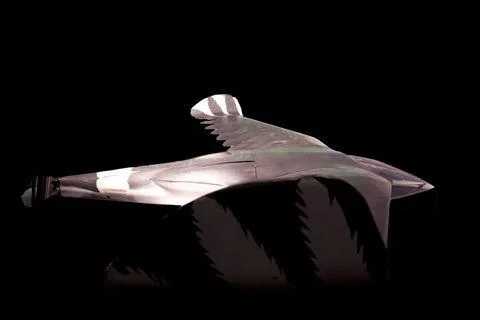
Project Aquiline was one of the most unusual and complex spying projects during the Cold War. The idea was to create 12 bird-shaped drones powered by nuclear energy that could fly for up to a month. These drones were meant to be robotic spy planes and deliver secret items, but the project was never finished.
The CIA wanted Aquiline to be the first uncrewed system for gathering intelligence. Its goal was to gather information in areas where access was restricted secretly. The drone, designed by McDonnell Douglas (a defense company known for fighter jets), was very different from the company’s usual aircraft.
Aquiline was a small drone meant to be kept as close to bird-like size as possible—five feet long, 7.5 feet wide, and a takeoff weight of 83 pounds—under the constraints of the time’s technology. A silent 3.5-horsepower, four-cycle engine would give the drone a speed of 47 to 80 knots and an endurance of 50 hours and 1,200 miles. Aquiline’s maximum altitude was estimated at 20,000 feet. CIA file: https://www.cia.gov/readingroom/collection/aquiline
Project Aquiline. CIA
Nuclear power was supposed to make Aquiline fly even farther. The CIA suggested adding a system that would use the heat from decaying radioactive materials like plutonium to create electricity. This system, made for deep space missions, would allow the drone to stay in the air for up to 30 days or travel 36,000 miles.
Aquiline was built to carry cameras and spy equipment. It could take photos from a lower height than the U-2 spy plane and collect electronic signals from radios, radar, and other devices for later study.
The CIA described Aquiline as a “small, bird-like surreptitious vehicle with sufficiently small acoustic, visible, and radar cross-section to permit it to operate in the natural physical signal environment of living birds.” Radars and human sentries at sensitive sites would mistake Aquiline for a bird and pay little attention to it.
Aquiline would be launched, controlled, and brought back by mobile teams on the ground. These teams could operate Aquiline from areas near the Soviet Union or China, like Taiwan, Turkey, Norway, or other places, to make sure the drone could fly over enemy land for a longer time.
The small drone would send its data to a modified DC-6 (later switched to a U-2R spy plane) flying nearby. This way, the drone wouldn’t need to carry its data storage, since storage at the time was bulky and heavy, using punch cards, tape, or large hard drives, which would use up too much weight and power.
The concept of the Aquiline includes bird feathers painted on its wing. The drone would have been a very radioactive bird.
The bird drone was supposed to be developed at Area 51, with various documents listing the personnel requirements and what it would take to regularly fly engineers to and from the mysterious base. The program was top secret, with access doled out on a strictly “need-to-know” basis. The program was so secret that it recommended personnel be recruited two years before the first flight to ensure enough personnel could pass the necessary security checks.
In 1969, the CIA agreed with the McDonnell Douglas Astronautics Corporation (MDAC) to start working on technologies for the Aquiline program. In 1970, people were sent to Area 51 to begin flight testing. This testing was planned to end in early 1971 when the contract was finished. It was expected that by then, a functioning Aquiline drone would be ready, and the program would become fully active.
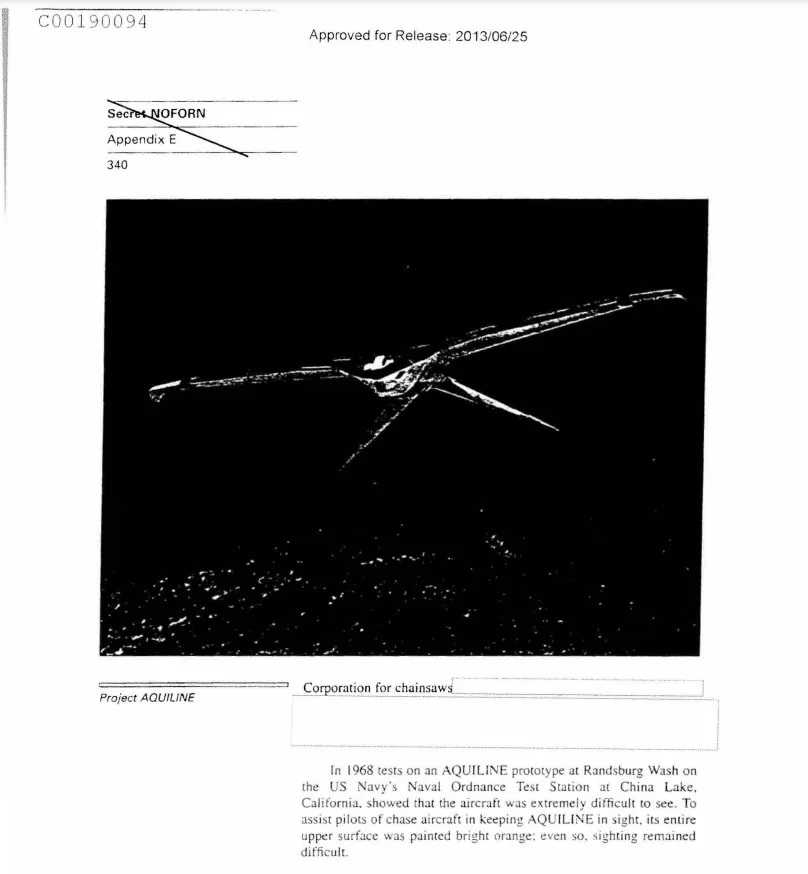
Exact specifications and design details are scarce, but what is known is that Aquiline drones were made to resemble birds and featured a single-tail propeller. Initially, the prototypes were powered by chainsaw motors. In one memo in the CIA’s reading room, the Aquiline drone is referred to as a “high characteristic operating model plane with a lot of expensive gadgetry.”
Sensor systems were embedded in the aircraft’s nose and included optical cameras infrared sensors, and even electronic intelligence packages. The drones were intended to have also been able to drop “black box” sensor systems into hostile territory, as well, so some form of payload-carrying capability must have been included in at least some of the Aquiline designs. Specifically, one of the CIA’s documents states that one of the test drones was designed to carry payloads weighing up to five pounds.
The Aquiline drones were hard to spot during testing, so engineers painted one bright orange to make it easier for a chase plane to see during a test flight. Even with the paint, the chase plane crew still had trouble spotting the drone in the air.
The exact range of the Aquiline drones remains unknown and is redacted in all of the CIA’s declassified documents.
However, one account states that Aquiline was able to fly for 130 miles while obtaining “very high-resolution photography,” while another document states one of the proposed mobile control units would have a range of 1,200 miles. A dedicated satellite was planned to offer a long-distance communications link for Aquiline drones but was never launched.
Aquiline drones had an impressive design, but they had a big problem: they didn’t have landing gear. Instead, they had to land by crashing into nets. This often damaged the drones’ wings and propellers, leading to delays because of constant repairs. Three Aquiline prototypes were destroyed during these landings.
In a personal account hosted on RoadrunnersInternationale.com, a site that preserves “the history of the aviation pioneers and programs that developed the U-2, A-12 ,and YF-12 during the Cold War,” John H. Meierdierck, retired Air Force Lieutenant Colonel, offers a brief recollection of the Aquiline program as he remembered it, writing:
The vehicle was a six-foot-long plane that had a small pusher prop and looked like an Eagle or Buzzard when it was in the air. It was designed to fly at very low levels along communications lines and intercept their messages. It also had a small television in the nose as an aid to navigation and to photograph targets of opportunity. There were several successful flights some crashes [reason unknown] and some lousy landings.
It’s unclear why Aquiline was canceled. It was meant to be a very complicated program, dealing with issues like stealth, data transfer, and propulsion in a tiny design. Using a nuclear power source would have made it even more complicated, and the technology of the 1960s might not have been enough to handle it.
Aquiline also depended on a trick, and if the Soviets or Chinese discovered it, their anti-aircraft weapons or MiG jets could have easily shot it down. In the end, Aquiline was just an idea held by a few people in the intelligence community.
If the rumors are to be believed, there’s a chance an example or two of Aquiline still exists among the other strange birds caged up in the darkness at Area 51.
The Strangest thing about Saturn is that this Man, who worked on the Voyager missions, said he discovered Enormous, Living, Electromagnetic Vehicles inhabiting its Rings.
Dr. Norman Bergrun concluded, based on his analysis of Voyager 1 and 2 data, which he detailed in his 1985 book, Ringmakers of Saturn, that he discovered enormous, living, electromagnetic vehicles inhabiting the rings of Saturn.
Dr. Bergrun, who had worked for NASA, claimed that there were massive alien spacecraft proliferating in the rings of Saturn. He is the author of the books “Ringmakers of Saturn” and “Tomorrows Technology Today,” which document the existence of extraterrestrial vehicles of immense power. A scientist who pioneered the methodology of thermal ice prevention design, he is also credited with roll-stability laws for airplanes and missiles
Dr. Bergrun was manager of test planning and analysis for the Polaris Underwater Launch Missile System and evaluated satellite system applications. Also a director of Information Systems, he founded his own company in 1971 and is cited in “Who’s Who in the World” and other reference works. He was an alumnus of Ames Research Laboratory, NACA (National Advisory Committee for Aeronautics), predecessor of Ames Research Center, NASA, where he worked for 12 years as a research scientist.
Dr. Norman Bergrun played a key role in the Voyager missions, the probes that were sent out to photograph Saturn, its rings, and its moons. There is a photo shown below from that mission, which he was able to obtain from the agency of a large unidentified flying object hovering just outside Saturn’s rings. It is huge, approximately the size of Earth, and is published in his book, “Ringmakers of Saturn.”
Dr. Bergrun claimed that these rings were not made of ice and rock as is commonly believed, but were actually the exhaust from these massive craft, which he calls “ringmakers.” He asserted that these vehicles are proliferating and are now also present at Jupiter and Uranus, creating new rings on planets that previously had none.
He suggested these vehicles had strong nuclear power sources and advanced electromagnetic technology. They appeared capable of creating massive electrical fields, lightning bolts larger than those on Earth, and disturbances across the entire ring system.
Dr. Bergrun recounted his professional history, mentioning his work at Lockheed on the first generation of the Polaris underwater launch vehicle. This had led him to work in a top-secret area behind closed doors, where he had been required to sign a 30-year non-disclosure agreement.
He explained that he eventually left this role due to “claustrophobia,” clarifying that it was not a fear of small spaces but rather the mental strain of being confined to the same secret room day after day.
It was during this period that he received his first clue about unusual things in space after being given a set of data that no one else could make sense of. When he plotted it, he realized that it showed something strange. (Source)
He claimed that he faced significant opposition and cover-ups from official bodies such as NASA. He recounted a story about a source allegedly connected to NASA who asked him how he had found a particular image from the moon, remarking, “I thought we darkened that enough that you wouldn’t find it.”
Dr. Bergrun also stated that his personal data and images, which he had stored in a supposedly impenetrable vault, were tampered with. He claimed that unknown parties had “garbled” his files on laptops and disks, sometimes erasing them completely. Despite this interference, he believed he did not need the old data because he was so familiar with the subject that he could reconstruct his work at any time.
Regarding the purpose of thesevehicles, Dr. Bergrun disagreed with the theory that they were mining the rings. Instead, he suggested that they were “nursing” from the rings, using them as a source of energy to power themselves and to create new, smaller vehicles that later grew, much like living organisms.
He was open to the idea that they might also fly close to the sun to “get pumped up” with energy, since their apparent ability to withstand extreme heat made that possible.
According to him, these could not be fully explained by natural processes. He suggested that the vehicles had electromagnetic capabilities and emitted streams of material, which then formed the rings and gaps seen around Saturn. He gave examples and measurements to support his claims, and pointed to historical observations by Galileo and others that showed unexplained phenomena.
Dr. Bergrun also claimed that similar effects were seen on some of Saturn’s moons. He described mysterious lighting and unusual markings, which he thought were possible “scars” left by the vehicles. He went even further, suggesting that Earth’s Moon, the Tunguska explosion in Siberia, and strange weather events might all be related to visits or actions by these powerful spacecraft.
He argued that these vehicles are evidence of a super-advanced intelligence in the universe and that they have been visiting our solar system for a long time. Bergrun warned that their power could pose risks if not understood, but also noted that they might not necessarily threaten humanity directly.
Dr. Bergrun believed that the situation was becoming “critical” because the activity was increasing, as evidenced by the new rings appearing around Uranus and Jupiter.
His urgency was not necessarily from the idea that the craft were coming to Earth, but from his sense that there was a strong possibility they could, and that the public and the scientific community had to be made to understand that these objects were real.
He noted that his conclusions were too controversial for his professional organization to address. He distinguished between his work, which he said was based on data, and the “theories” of others, such as John Lear’s idea that Saturn was a portal into another dimension.
He also touched on other topics, including his belief that humans were not capable of communicating with these entities, which rendered efforts by organizations like SETI ineffective.
He confirmed that plasma had been scientifically measured in Saturn’s rings, which he saw as supporting his claims. When asked about the hexagonal shape seen at Saturn’s north pole, he acknowledged it but regarded it simply as another geometric form that these advanced entities were capable of creating, rather than holding a special symbolic meaning.
Finally, he revealed that he had spent ten years earning a law degree so that he could better understand the mindset of the people “running the country,” whom he felt often made decisions without comprehending the underlying science.
He died on July 1, 2018, at Tracy Nursing and Rehabilitation Center at the age of 96. Unfortunately, Dr. Bergun was just another name on the list of NASA whistleblowers who are forgotten and ignored due to a lack of followers and media attention
Meer van UFO'S of UAP'S, ASTRONOMIE, RUIMTEVAART, ARCHEOLOGIE, OUDHEIDKUNDE, SF-SNUFJES EN ANDERE ESOTERISCHE WETENSCHAPPEN - DE ALLERLAATSTE NIEUWTJES


 Scientists reveal the surprising age at which your brain reaches its peak – so, are YOUR best days behind you?