Naar de inhoud

UFO'S of UAP'S, ASTRONOMIE, RUIMTEVAART, ARCHEOLOGIE, OUDHEIDKUNDE, SF-SNUFJES EN ANDERE ESOTERISCHE WETENSCHAPPEN - DE ALLERLAATSTE NIEUWTJES

UFO's of UAP'S in België en de rest van de wereld
akke.beakke.be
Ontdek de Fascinerende Wereld van UFO's en UAP's: Jouw Bron voor Onthullende Informatie! Ben jij ook gefascineerd door het onbekende? Wil je meer weten over UFO's en UAP's, niet alleen in België, maar over de hele wereld? Dan ben je op de juiste plek! België: Het Kloppend Hart van UFO-onderzoek In België is BUFON (Belgisch UFO-Netwerk) dé autoriteit op het gebied van UFO-onderzoek. Voor betrouwbare en objectieve informatie over deze intrigerende fenomenen, bezoek je zeker onze Facebook-pagina en deze blog. Maar dat is nog niet alles! Ontdek ook het Belgisch UFO-meldpunt en Caelestia, twee organisaties die diepgaand onderzoek verrichten, al zijn ze soms kritisch of sceptisch. Nederland: Een Schat aan Informatie Voor onze Nederlandse buren is er de schitterende website www.ufowijzer.nl, beheerd door Paul Harmans. Deze site biedt een schat aan informatie en artikelen die je niet wilt missen! Internationaal: MUFON - De Wereldwijde Autoriteit Neem ook een kijkje bij MUFON (Mutual UFO Network Inc.), een gerenommeerde Amerikaanse UFO-vereniging met afdelingen in de VS en wereldwijd. MUFON is toegewijd aan de wetenschappelijke en analytische studie van het UFO-fenomeen, en hun maandelijkse tijdschrift, The MUFON UFO-Journal, is een must-read voor elke UFO-enthousiasteling. Bezoek hun website op www.mufon.com voor meer informatie. Samenwerking en Toekomstvisie Sinds 1 februari 2020 is Pieter niet alleen ex-president van BUFON, maar ook de voormalige nationale directeur van MUFON in Vlaanderen en Nederland. Dit creëert een sterke samenwerking met de Franse MUFON Reseau MUFON/EUROP, wat ons in staat stelt om nog meer waardevolle inzichten te delen. Let op: Nepprofielen en Nieuwe Groeperingen Pas op voor een nieuwe groepering die zich ook BUFON noemt, maar geen enkele connectie heeft met onze gevestigde organisatie. Hoewel zij de naam geregistreerd hebben, kunnen ze het rijke verleden en de expertise van onze groep niet evenaren. We wensen hen veel succes, maar we blijven de autoriteit in UFO-onderzoek! Blijf Op De Hoogte! Wil jij de laatste nieuwtjes over UFO's, ruimtevaart, archeologie, en meer? Volg ons dan en duik samen met ons in de fascinerende wereld van het onbekende! Sluit je aan bij de gemeenschap van nieuwsgierige geesten die net als jij verlangen naar antwoorden en avonturen in de sterren! Heb je vragen of wil je meer weten? Aarzel dan niet om contact met ons op te nemen! Samen ontrafelen we het mysterie van de lucht en daarbuiten.

Archief

WWAT IS DE LANGSTE TIJD DAT IEMAND KLINISCH DOOD WAS - EN DAARNA TERUG TOT LEVEN GEWEKT?

WAT IS DE LANGSTE TIJD DAT IEMAND KLINISCH DOOD WAS - EN DAARNA TERUG TOT LEVEN GEWEKT?

two healthcare providers place defibrillator paddles on a patient's chest in an intensive care unit

Kunnen mensen echt uit de dood terugkeren nadat ze minuten of zelfs uren lang geen hartslag hebben gehad?

(Afbeeldingscredit: Halfpoint Images via Getty Images)

Wat is de langste tijd waarin iemand klinisch dood is geweest en daarna weer tot leven is gebracht? Die vraag lijkt op een paradox: hoe kan iemand die niet ademhaalt, geen polsslag heeft en mogelijk geen hersenactiviteit vertoont, later weer opduikt alsof er niets is gebeurd? Wetenschappelijk gezien gaat het om grenzen tussen klinische dood, hersendood en levende toestand, en om de manieren waarop het menselijk lichaam kan worden teruggebracht tot leven wanneer de condities gunstig blijven. In dit essay verken ik wat “klinische dood” precies betekent, welke voorvallen de geschiedenis sieren, en waarom sommige mensen na lange perioden van stilstand toch weer kunnen opveren. Daarbij geef ik voorvallen en voorbeelden met de meest betrouwbare details die in de medische literatuur terug te vinden zijn. Ik sluit af met wat deze verhalen ons leren over genezende technologieën, ethiek en de menselijke veerkracht.

1. Klinische dood en de grenzen van leven en dood

Klinische dood is de toestand waarin iemands hart en ademhaling zijn gestopt, wat doorgaans ook leidt tot afwezigheid van hersenactiviteit. In de literatuur wordt vaak gesproken over de “noodrem” waar medische ingrepen nog mogelijk zijn: reanimatie, beademing, en een reeks lifesaving-technieken zoals defibrillatie en later mogelijk extracorporale membraanoxygenatie (ECMO). Cruciaal is de korte periode waarin het lichaam kan worden gekoeld of de stofwisseling kan worden afgeremd, zodat cellen minder snel beschadigd raken vanwege gebrek aan zuurstof. Dit fenomeen—waarbij de hersenen en het lichaam lange tijd zonder stroom en zuurstof kunnen overleven als de temperatuur laag genoeg daalt of de stofwisseling tijdelijk wordt teruggebracht—wordt hypothermie genoemd. Hypothermie kan als een soort “verzamelaar” fungeren van tijd: het lichaam vertraagt de inwendige processen en houdt organen in leven, zelfs terwijl de ademhaling en hartslag ontbreekt.

2. Het helderste en meest betrouwbare geval:

Anna Bagenholm Het meest bekende en vaak aangehaalde geval van een extreem lange periode van klinische dood die eindigde in herstel met opmerkelijk goede neurologische uitkomsten, is dat van Anna Bagenholm, een Zweedse arts. In 1999, tijdens een ski-ongeluk in de bergen nabij Åre, raakte zij door een sneeuwlawine of het openen van een geultje onder de sneeuw zo ondiep dat ze in koud water terechtkwam. Haar lichaamstemperatuur daalde naar een recordlage waarde voor een mens die nog leefde: ongeveer 13,7°C (56,7°F). De totale tijd waarin haar lichaam onder extreme onderkoeling verkeerde, werd pas later bestuderd in rapporten van de medische teams en omvatte een lange periode waarin de hartslag en ademhaling afwezig waren. Uiteindelijk werd zij gered; haar hart kwam terug op gang en ze werd met functionele neurologische uitkomsten uit het ziekenhuis ontslagen.

Waarom dit geval zo prominent is, gaat verder dan de toevallige duur van de onderkoelde toestand. In Anna Bagenholms geval speelde een combinatie van factoren een rol: buitengewone onderkoeling verlengt de periode waarin hersenen kunnen overleven bij gebrek aan zuurstof, een snelle medische interventie na redding, en geavanceerde reanimatietechnieken. Dit incident werd uitvoerig gedocumenteerd in de medische literatuur en heeft geleid tot een verhoogde interesse in onderkoeling als een therapeutische strategie in sommige gevallen van hartstilstand. Het geeft ook aan hoe menselijk herstel mogelijk is, zelfs wanneer de klokken lijken te hebben stilgestaan.

3. Andere bekende en gedocumenteerde voorbeelden 

Hoewel Anna Bagenholm een schijnbaar besteendrecord blijft in termen van onderkoelde toestand met herstel, zijn er nog enkele opmerkelijke gevallen waarin mensen na langere perioden van klinische dood weer tot leven kwamen, vaak onder vergelijkbare omstandigheden van onderkoeling of intense medische zorg.

  • Prolonged cardiac arrest op het gebied van onderkoeling: Er zijn meerdere gevallen uit de literatuur waarin personen na tientallen minuten tot meer dan een uur van klinische dood herwonen met minimale of matige neurologische schade. In sommige van deze gevallen werd de toestand vergezeld door diepe onderkoeling en door onmiddellijke, agressieve reanimatiemaatregelen. De conclusies uit deze gevallen zijn vaak afhankelijk van de totale duur van hartstilstand, de temperatuur van het lichaam bij redding, en de snelheid en kwaliteit van de medische zorg, inclusief cardiopulmonale reanimatie (CPR) en later ECMO (extracorporale membraanoxygenatie).

  • Hypothermie als “levensverlengende truc”: De centrale wetenschappelijke les uit deze gevallen is dat hypothermie de metabole behoeften aanzienlijk verlaagt. Hersencellen gebruiken zuurstof en glucose, maar bij lagere temperatuur vertraagt de biochemische snelheid van celprocessen considerably. Daardoor kan hersenschade tijdelijk worden beperkt, zelfs als de zuurstoftoevoer is gestopt. Dit biedt een kans dat, wanneer de bloedtoevoer en ademhaling worden hersteld, de hersenen nog kunnen terugkeren tot functioneel niveau van activiteit.

  • Berichte gevallen met lange CPR- en bewuste perioden: Er zijn gevallen waarin personen na tientallen minuten CPR weer een polsslag en spontane ademhaling kregen, en sommigen vertrokken met geringe neurologische beperkingen, terwijl anderen herstellen tot vrijwel volledig functioneren. Dergelijke gevallen zijn echter zeldzaam en worden met voorzichtigheid geïnterpreteerd vanwege de afhankelijkheid van bijschrijvingen, de definitie van “klinische dood” en de manier waarop volgzwaarte van neurologische uitkomsten wordt beoordeeld.

4. Wat maakt deze verhalen complex en soms controversieel?

  • Definities variëren: Klinische dood kan anders geïnterpreteerd worden afhankelijk van de bronnen. In sommige definities is het de afwezigheid van hartslag en ademhaling voor een korte tijd, in andere definities gaat het om het ontbreken van geen hersenactiviteit of een lange-termijn hersendood. Moderne geneeskunde maakt vaak onderscheid tussen reversible en irreversibele dood. Eigenlijk is de vraag: wanneer is herstel niet meer mogelijk vanwege onherstelbare hersenbeschadiging? Hypothermie kan deze grens tijdelijk verschuiven, maar het blijft een raadsel hoe lang en onder welke omstandigheden herstel volledig of nabij volledig kan plaatsvinden.

  • Neurologische uitkomsten zijn onvoorspelbaar: Zelfs in gevallen waarin lichamelijk leven kan worden hersteld, is de uitkomst voor de hersenen verre van gegarandeerd. Sommige patiënten herstellen tot bijna normaal functioneren, terwijl anderen ernstig cognitief of motorisch beperkt blijven. Dit maakt de verhalen zowel hoopvol als tragisch en roept ethische vragen op over welke interventies wel of niet gepast zijn.

  • Publicatie- en verhalingsbias: Populaire media slurpen vaak de meest spectaculaire gevallen op en herhalen ze als “recorden” of “ondenkbare reddingen”, waardoor het publieke begrip scheefgroeit ten opzichte van de statistische realiteit. Wetenschappelijke artikelen geven doorgaans een meer genuanceerde kijk, maar het bereik van de verhalen blijft beperkt. Het is belangrijk om onderscheid te maken tussen een geval met extreem gunstige omstandigheden en de gemiddelde patiënt.

5. Technologische en medische factoren die invloed hebben op herstelkansen

  • Snelle CPR en defibrillatie: De koppeling van snelle borstcompressies en anti-ritmische defibrillatie kan de kans op terugkeer van spontane ademhaling en circulatie vergroten. Hoe eerder deze ingrepen starten, hoe groter de kans op behoud van hersenfunctie.

  • Onderkoeling (therapeutische hypothermie): In sommige gevallen wordt gecontroleerde onderkoeling toegepast na terugkeer van circulatie om hersenbeschadiging te beperken. Dit wordt soms toegepast bij mensen die na hartstilstand een redelijke kans hebben om te herstellen maar een verhoogd risico op hersenschade hebben.

  • ECMO en geavanceerde reserve-vormen van zuurstofvoorziening: ECMO geeft artsen de mogelijkheid om de bloedcirculatie en zuurstoftoevoer kunstmatig te leveren terwijl de onderliggende oorzaak van de hartstilstand wordt aangepakt. Dit kan vooral belangrijk zijn wanneer borstcompressies alleen niet voldoende zijn om de organen te beschermen.

  • Neurorevalidatie: Herstel is niet alleen een medische of operationele zaak; het omvat ook uitgebreide neurologische zorg. Fysiotherapie, ergotherapie, en cognitieve revalidatie zijn cruciaal voor het terugkrijgen van functies en het terugwinnen van onafhankelijkheid.

6. Leringen en bredere implicaties

  • Medische schattingen zijn altijd schattingen: Zelfs met de beste moderne technieken blijven de uitkomsten probabilistisch. Elke case draagt bij aan wat we weten over de grens tussen leven en dood en de mogelijke genezende kracht van het lichaam wanneer de omstandigheden gunstig zijn. Het leren van deze gevallen helpt bij het verbeteren van protocollen voor reanimatie, onderkoelsector, en post-resuscitatiezorg.

  • Ethiek en besluitvorming: Familie, zorgverleners, en juristen raken in deze arena betrokken bij moeilijke keuzes. Wanneer moet men doorgaan met reanimatie? Welke uitkomsten zijn acceptabel of gewenst? Daarnaast komen er vragen op over wat “kwaliteit van leven” betekent als de kans op neurologische normalisatie laag lijkt. Dit soort gesprekken is niet alleen medisch maar ook menselijk, cultureel en ethisch van aard.

  • Publieke perceptie en hoop: Verhalen van reddingen die lijken te trotseren wat mogelijk is, geven hoop aan patiënten en families, maar kunnen ook misleidend zijn als ze uit meer algemene statistieken worden gehaald. Het is essentieel om realistisch te blijven: de meerderheid van hartstilstanden wordt niet gered met volledig herstel, en elk geval moet door de lens van wetenschappelijke kans en individuele variabiliteit worden bekeken.

7. Wat betekent dit vandaag voor jou en voor toekomstige generaties?

  • Voor medische professionals: Het blijft van vitaal belang om reanimatieprotocollen bij te houden, kennis van hypothermie te verdiepen, en te investeren in geavanceerde ondersteunende technologieën zoals ECMO en post-reanimatiezorg. Ook de ethische dimensie van besluitvorming vraagt voortdurend om dialoog en scholing.
  • Voor de samenleving: Draagvlak voor medische onderzoeksfinanciering, betere data-infrastructuur over uitkomsten na reanimatie en betere voorlichting aan het publiek over wat wel en niet realistisch is in termen van hervatting van leven is belangrijk. Dit helpt families te helpen maken wat voor hen de beste keuzes zijn in tijden van crisis.
  • Voor toekomstige onderzoekers: De intrinsieke vraag blijft bestaan: hoe lang kan een mens onder kritieke omstandigheden in leven blijven en toch hersenfunctie behouden? Geavanceerde bewakingssystemen, betere definities van hersenfunctie, en de combinatie van hypothermie met andere neuroprotectieve strategieën zullen naar verwachting de overleving en functionele uitkomsten blijven verbeteren.

8. Reflecties op wat het ons vertelt over menselijkheid en wetenschap

Deze verhalen van herstel herinneren ons aan twee tegengestelde maar harmonieuze ideeën: ten first, de menselijkheid van de genezende artsen die met ruim hart en verstand opereren onder extreme druk; ten seconde de wonderbaarlijke veerkracht van het menselijk lichaam, dat in staat kan zijn tot herstel onder omstandigheden die ooit als onmogelijk werden beschouwd. De grens tussen leven en dood is minder strikt dan men soms denkt. Door de combinatie van snelle interventie, hypothermie, geavanceerde technologie en onwrikbare menselijke wil lukt het in zeldzame gevallen toch om te genezen wat ooit als definitief werd beschouwd.

Conclusie Hoewel er geen eenvoudige of eenduidige antwoorden zijn op de vraag “wat is de langste tijd dat iemand klinisch dood was en daarna weer tot leven kwam?”, is het duidelijk dat er in de annalen van de moderne geneeskunde bemoedigende voorbeelden bestaan van opmerkelijke redingen. Anna Bagenholm blijft een van de krachtigste illustraties van wat mogelijk is wanneer een combinatie van extreme onderkoeling, snelle en doeltreffende medische zorg, en sterk klinisch inzicht samenkomen. Haar verhaal en die van andere gelijkaardige gevallen geven hoop en richting aan artsen, patiënten en families die met de onzekere realiteit van hartstilstand en reanimatie te maken hebben.

Maar ze herinneren ons ook aan de grenzen van wat we weten. Elk herstel is een complex samenspel van factoren, en neurologische uitkomsten kunnen variëren van volledig herstel tot aanzienlijke beperkingen. Het veld blijft zich ontwikkelen, met de hoop op betere overlevingskansen en eerlijkere verwachtingen in elk individu dat te maken krijgt met een hartstilstand en de kans op terugkeer van ademhaling en circulatie. In die zin vertellen deze verhalen een verhaal over de menselijke veerkracht, de grenzen van wetenschap en de voortdurende zoektocht naar betere zorg voor iedereen die ooit “klinisch dood” lijkt te zijn geweest en toch ergens verder aandrong in het pad naar herstel.

{PETER2011}

Hoe vind je dit bericht?
Geschreven door peter om 21:58 Stuur door

First Human Face Carved on Ancient T-Pillar Discovered at Karahantepe

First Human Face Carved on Ancient T-Pillar Discovered at Karahantepe

A 12,000-year-old T-shaped pillar featuring a carved human face discovered at Karahantepe in southeastern Turkey.

Gary Manners

A groundbreaking archaeological discovery at Karahantepe has shattered expectations about Neolithic symbolic expression, as researchers uncovered the first T-shaped pillar ever found with a distinctly carved human face. This historic find, announced by Turkey's Minister of Culture and Tourism Mehmet Nuri Ersoy, represents a revolutionary moment in understanding how our ancestors first began depicting themselves in stone over 12,000 years ago.

The discovery was made during ongoing excavations as part of the Taş Tepeler (Stone Mounds) Project, which explores the earliest known monumental sites in human history across southeastern Turkey. Located approximately 35 kilometers (22 miles) east of the more famous Göbekli Tepe, Karahantepe has emerged as a rival to its more celebrated neighbor, potentially offering even more sophisticated examples of Neolithic architecture and artistry reports Turkey Today.

Revolutionary Leap from Abstract to Realistic Representation

For decades, archaeologists have recognized that the massive T-shaped pillars found throughout the Taş Tepeler sites symbolized human figures, evidenced by the carved arms and hands visible along their shafts. However, this new discovery at Karahantepe marks the first instance where a pillar directly portrays recognizable human facial features, transforming abstract symbolism into direct representation.

The newly unearthed monolith features sharply defined facial contours, deep-set eye sockets, and a broad, flattened nose. These artistic elements closely mirror the stylistic characteristics found in other human sculptures previously discovered at the site, suggesting a shared cultural and symbolic language among early Anatolian communities around 12,000 years ago.

A close-up view of the 12,000-year-old T-shaped pillar featuring a human face

A close-up view of the 12,000-year-old T-shaped pillar featuring a human face discovered at Karahantepe in southeastern Turkey.

(Ministry of Culture and Tourism)

Experts describe this development as a major cognitive leap in understanding the emergence of self-awareness and identity in the prehistoric mind.

"This artistic style closely resembles other human statues previously found in Karahantepe, suggesting a shared cultural and symbolic language among early Anatolian communities around 12,000 years ago," according to the archaeological report, relates Arkeonews.

Karahantepe Emerges as Archaeological Superstar

Located in the heart of southeastern Turkey's archaeological treasure trove, Karahantepe is rapidly establishing itself as one of the most significant Neolithic sites ever discovered. The site forms part of the ambitious Taş Tepeler Project, which encompasses 12 interconnected Neolithic locations representing the earliest known monumental architecture built by hunter-gatherer societies before the advent of agriculture.

Current excavations at Karahantepe have revealed more than 250 T-shaped pillars arranged within enclosed communal structures, along with intricately carved sculptures depicting both humans and animals. Archaeological evidence suggests that Karahantepe offers a more advanced architectural layout than even Göbekli Tepe, with clear indications of early forms of settlement and sophisticated social organization.

Some of the other T-shaped pillars at Karahan Tepe

Some of the other T-shaped pillars at Karahantepe.

(Vincent Vega/(Vincent Vega/CC BY-SA 4.0)

The newly discovered human-faced pillar reinforces the growing understanding that these ancient communities possessed not only remarkable technical skills but also profound spiritual and symbolic comprehension of their world. The find provides tangible evidence of how early humans began representing themselves and their beliefs through art, architecture, and ritual practices that would influence human civilization for millennia to come.

Window into Humanity's Symbolic Awakening

The Taş Tepeler Project continues to reshape our understanding of the Neolithic Revolution - the crucial period when humans transitioned from nomadic hunter-gatherer lifestyles to permanent settlements. This human-faced T-shaped pillar represents potentially one of the earliest known depictions of humanity itself, bridging the evolutionary gap between abstract symbolism and portrait-like representation.

This discovery reinforces theories that southeastern Turkey served not only as a cradle of agricultural development but also as the birthplace of symbolic thought—the foundation upon which all subsequent human artistic and religious expression would be built. The human face gazing out from this 12,000-year-old pillar represents nothing less than one of humanity's first attempts to see itself reflected in stone, marking a pivotal moment in our species' journey toward self-awareness and cultural expression.

By Gary Manners

References

{ https://www.ancient-origins.net/history-}

Hoe vind je dit bericht?
Geschreven door peter om 21:24 Stuur door

3I/ATLAS's Coma Proves Another Cometary Formation Theory

3I/ATLAS's Coma Proves Another Cometary Formation Theory

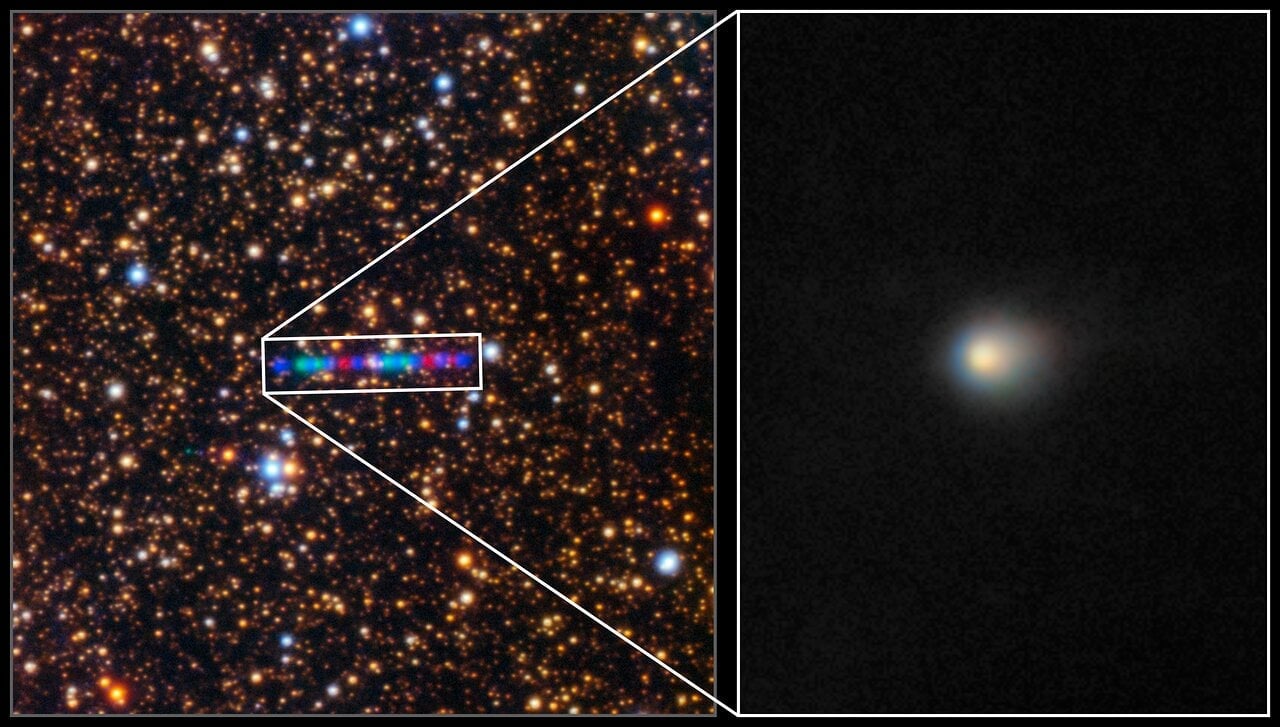
Image of 3I/ATLAS amongst a sea of stars and in isolation. Credit - NOIRLab/AURA/Gemini North/IfA University of Hawaii Image of 3I/ATLAS amongst a sea of stars and in isolation. Credit - NOIRLab/AURA/Gemini North/IfA University of Hawaii

Interstellar visitor 3I/ATLAS has been constantly changing as it makes its way through our solar system. That’s to be expected, as, for the first time in potentially billions of years, it's getting close to the energy put out by a star. Scientists have been keeping a close watch on those changes, both to ensure there’s nothing unexplainable by our current understanding, but also to compare 3I/ATLAS to both previous interstellar visitors as well as comets in our own solar system. A recent paper from European researchers describes how the changes in a particular material ratio in 3I/ATLAS’ coma fit with our current understanding of cometary geology.

That ratio is the nickel to iron (Ni/FE) abundance ratio. It has been measured for two decades, including on twenty in-system comets as well as 2I/Borisov, the last known interstellar visitor our solar system had. However, the fact that either of those materials is even present at all in the coma has puzzled scientists, as the temperatures on their surfaces typically aren’t enough to sublimate the silicates or sulfides that are thought to hold these metals on cometary surfaces.

The Ni/Fe ratio from studying 2I/Borisov were similar to those of in-system comets. But that ratio is also about 10 times higher than the Ni/Fe of the Sun itself. So the fact that one of our interstellar visitors and our in-system comets had the same high ratio pointed to some common process in cometary formation that was agnostic to the materials available in the star it formed around.

Fraser answers a bunch of questions about comet 3I/ATLAS.

3I/ATLAS, though, was different, as it has been in so many ways, from both in-system comets and 2I/Borisov. The researchers used the European Southern Observatory’s (ESO’s) Very Large Telescope (VLT) in Chile to watch the comet between August and September, while it was traveling from 3.14 AU to 2.14 AU and started to get increasingly warmed by the Sun.

They noted that the spectral absorption line for nickel captured by the VLT’s UV-Visual Echelle Spectrograph (UVES) was present the entire time. However, the absorption lines for iron only appeared once 3I/ATLAS got within 2.64 AU of the Sun. This discrepancy caused a Ni/Fe ratio much higher than those seen in previous comets, but it was actively changing dramatically as 3I/ATLAS got closer to the Sun. No other study had shown that much of a dramatic change.

It also might explain why there is nickel and iron in the comet’s coma in the first place. Researchers had previously developed a theory that the metals they were seeing were tied to carbonyl groups, forming high volatile organometallic compounds. In that scenario, the nickel would be tied up as nickel tetracarbonyl (Ni(CO)4), and iron would be tied up as iron pentacarbonyl (Fe(CO)5). Both of those organometallic materials have sublimation points low enough to do so when still far from the Sun.

Fraser discusses 3I/ATLAS growing a "tail".

Importantly for this data set, nickel tetracarbonyl has a lower melting point than iron pentacarbonyl, which would explain why there was no iron spectra early in the observational period, but there was later when the comet grew closer to the Sun. The temperature gradient over that journey must have crossed the threshold where iron pentacarbonyl started sublimating, causing the dramatic drop in the Ni/Fe ratio seen in the data. The researchers also found that the amount of nickel production in the coma closely matches the theoretical sublimation rate of nickel tetracarbonyl.

The researchers put forth one other important data point about 3I/ATLAS - it can be classified as a “C2-depleted” comet. That means the ratio of diatomic carbon (C2) compared to the cyanogen radical (CN) in its coma is very small. This classification points to 3I/ATLAS’s “primoridalness”, as it was given that ratio billions of years ago when it was formed, and hints that it was formed in a different part of its home system protoplanetary disc than other, more common comets.

More data is coming out about our third known interstellar visitor on a daily basis. That would likely include more studies of its Ni/Fe ratio as it gets even closer to the Sun, and before it moves out of view for a few months. Expect more papers from as many telescopes and research groups as can find observational time to watch this once in a lifetime cometary visitor.

Learn More:

RELATED VIDEOS

{ https://www.universetoday.com/ }

Hoe vind je dit bericht?
Geschreven door peter om 21:09 Stuur door

EXCLUSIVE - NASA goes dark hours before first look at interstellar object moving closer to Earth

EXCLUSIVE - NASA goes dark hours before first look at interstellar object moving closer to Earth

NASA has gone dark just hours before humans get the closest look at the mysterious object barreling through our solar system. 

The interstellar object dubbed 3I/ATLAS will come within 18 million miles of Mars on October 3, its closest flyby of any planet this year.

Two space probes orbiting the Red Planet, Mars Express and ExoMars, are preparing to take Earth's best picture and closest scans of the strange visitor, which scientists have widely concluded is an unusual comet from a distant solar system. 

However, when those readings come in, America's space agency may remain completely silent about what the object really is.

NASA has announced that its official website will not be updated during the government shutdown, which has resulted in thousands of federal employees being sent home without pay.

It's unclear whether NASA staff will make any announcements regarding the object's close pass by Mars, similar to the history-making press conference that revealed the discovery of microbial life on Mars in September.

The shutdown couldn't have come at a worse time, as scientists say Friday's flyby could answer many questions about the mysterious comet, including whether it's actually an object of extraterrestrial origin.

Harvard astrophysicist Avi Loeb has maintained that 3I/ATLAS has too many confounding characteristics to be a simple comet streaking through the solar system.

NASA's website has announced that no new updates will take place during the government shutdown when start on October 1

NASA's website has announced that no new updates will take place during the government shutdown when start on October 1

3I/ATLAS will come within 18 million miles of Mars on Friday, and two space probes have already started observing it

3I/ATLAS will come within 18 million miles of Mars on Friday, and two space probes have already started observing it

'Hopefully, we will learn much more about 3I/ATLAS in the coming days,' Loeb told the Daily Mail on Thursday.

The professor added that both Mars Express and ExoMars started their observations of the object on October 1 and will continue studying it until Tuesday, October 7.

Loeb noted that he's interested in several of the findings the space probes should be able to compile while in such close range to 3I/ATLAS, adding that the readings could determine once and for all whether it's a comet or an artificial structure.

'The image and composition would be the top two findings of interest,' Loeb revealed.

Since its discovery by an amateur astronomer this summer, the prevailing theory has been that 3I/ATLAS is a comet with a chemical composition that is unlike anything created within our solar system.

In September, scientists from Michigan State University announced that 3I/ATLAS was spewing gas or dust into space long before it started approaching our sun, something highly unusual for a distant comet.

Their study in the Astrophysical Journal Letters concluded that this meant it was filled with a unique collection of molecules, including carbon monoxide, an odorless gas often produced by burning wood or fossil fuels.

However, Loeb and his researchers have found even more clues that point to the interstellar object being something else, including its incredibly unusual course through the solar system and its potentially massive size.

The interstellar object will make close passes by three separate planets, something Harvard Professor Avi Loeb has declared as highly unusual and possibly a sign of alien influence

The interstellar object will make close passes by three separate planets, something Harvard Professor Avi Loeb has declared as highly unusual and possibly a sign of alien influence

A new study found 3I/ATLAS was emitting gases into space long before it got close enough to our sun to melt normal gas and dust seen coming from other comets

A new study found 3I/ATLAS was emitting gases into space long before it got close enough to our sun to melt normal gas and dust seen coming from other comets

article image

Based on earlier scans and photos of the alleged comet, Loeb calculated that 3I/ATLAS may be over three miles long.

However, NASA has noted that it could be as small as 1,444 feet in length, which is still considered a 'city-killer' if it were to strike Earth.

'The new data during the Mars encounter will certainly help in clarifying some of the anomalies of 3I/ATLAS, like its anomalous size and composition, but it will not explain its rare alignment with the ecliptic plane of the planets and rare timing in arriving close to Mars, Venus, and Jupiter,' Loeb explained.

NASA and the European Space Agency have said that Friday's historic meeting over Mars should also clear up questions about the suspected comet's trajectory through space and its physical properties. 

High-resolution images and spectral data will provide more information about the object's nucleus, tail, and coma - the bright, fuzzy cloud of gas and dust forming around it.

However, some scientists have already dismissed alternative theories about 3I/ATLAS. 

Jonathan McDowell, an astronomer and astrophysicist working at the Harvard–Smithsonian Center for Astrophysics, said: 'It is clearly a natural comet; suggestions to the contrary are laughed at by people who are actual comet experts.'

RELATED VIDEOS

{ https://www.dailymail.co.uk/sciencetech/index.html }

Hoe vind je dit bericht?
Geschreven door peter om 20:56 Stuur door

Mysterious interstellar visitor spotted above Mars appears as 'massive cylindrical craft'

Mysterious interstellar visitor spotted above Mars appears as 'massive cylindrical craft'

New extraordinary images of the interstellar object flying through our solar system have been released, sparking fresh theories about its origins. 

Although most scientists have concluded that the mysterious object is a comet, NASA's Perseverance rover on the Martian surface sent back photos showing what appears to be a massive cylindrical shape.

Stargazers on social media shared color-enhanced images of the object, dubbed 3I/ATLAS, which showed the interstellar visitor having a green glow as it passed Mars and heads closer to the sun. 

Harvard astrophysicist Avi Loeb, who has been convinced that the object could be an alien craft or probe, analyzed the Perseverance rover's photos by calculating its distance, speed, and camera settings.

According to his initial study, Loeb was not convinced 3I/ATLAS is actually a massive cylindrical object, noting that the strange shape might have been a trick of the rover's camera stretching out its shape.

He explained that the apparent cylinder from the rover's 'Navcam' was likely caused by the camera stacking hundreds of images of 3I/ATLAS over a period of about 10 minutes, making it look more like a log than a ball.

The professor added that 3I/ATLAS is likely smaller and rounder, but still massive, with a potential diameter of more than 28 miles across.

Dr Horace Drew, a retired senior researcher at Australia's Commonwealth Scientific and Industrial Research Organization (CSIRO), noted that the mysterious green glow seen in some images could be a result of the object being an interstellar spacecraft coated in nickel.

The Perseverance rover on Mars captured new images of the interstellar object 3I/ATLAS as it passed by the planet this weekend

The Perseverance rover on Mars captured new images of the interstellar object 3I/ATLAS as it passed by the planet this weekend

Color-enhanced images shared by multiple social media users revealed a strange green glow around 3I/ATLAS

Color-enhanced images shared by multiple social media users revealed a strange green glow around 3I/ATLAS

Drew explained that humans use the same practice on Earth-made space technology on a much smaller scale.

'It is not a 'comet,''  Drew declared on a post on X Monday morning. 

Drew disagreed with Loeb's conclusion that the cylindrical shape was a result of the Mars rover sending back a stretched image over several minutes, claiming that an amateur astronomer on Earth captured a similar shape with their telescope.

'We can see an extended white shape, with a green coma outside. Not a small white ball,' Drew explained in a post about the astronomer's photograph.

Drew, who earned his PhD in chemistry from the California Institute of Technology, added that previous images of the interstellar object were allegedly from a 'head-on view' and didn't capture its shape from the side, like the new photos from Mars. 

Loeb said he's excited about another image taken by a different Mars camera, called HiRISE, which has better resolution and could show 3I/ATLAS more clearly.

That image is being sent back to Earth by the Mars Reconnaissance Orbiter (MRO) and has yet to be released by NASA.

Loeb has previously theorized that 3I/ATLAS could be a second craft sent by an extraterrestrial intelligence, following the strange cylindrical object known as Oumuamua, which passed Earth in 2017.

3I/ATLAS came within 18 million miles of Mars on October 3. Two space probes from Earth have been observing it for a week

3I/ATLAS came within 18 million miles of Mars on October 3. Two space probes from Earth have been observing it for a week

Dr Horace Drew said an amateur astronomer's photo of the 3I/ATLAS (bottom 3 images) prove the object has a cylindrical shape and is not a comet

Dr Horace Drew said an amateur astronomer's photo of the 3I/ATLAS (bottom 3 images) prove the object has a cylindrical shape and is not a comet

article image

Loeb told the Daily Mail on Thursday that clear images and a scan of the supposed comet's composition were the key findings that could definitively tell scientists what 3I/ATLAS is.

Despite images emerging from NASA, space agencies around the world have still not commented by their initial findings from the Mars flyby.

Daily Mail reached out to NASA for comment and received a message noting that the space agency 'is currently closed due to a lapse in government funding.'

The European Space Agency (ESA) used the Mars Express and ExoMars Trace Gas Orbiter to successfully observe 3I/ATLAS, but it's expected to take days or even weeks to process all the data.

Meanwhile, some on social media have claimed that the global silence surrounding 3I/ATLAS adds proof that governments are covering up what they know about the alleged craft.

'NASA's shutdown is suspicious. The ESA's delay is strange. But China's silence, when they have every geopolitical reason to publish and show off, is the sign that something is happening behind closed doors,' one X user said on Monday.

'All eyes are on 3I/ATLAS — but suddenly, the silence is deafening,' another person posted.

RELATED VIDEOS

{ https://www.dailymail.co.uk/sciencetech/index.html }

Hoe vind je dit bericht?
Geschreven door peter om 20:41 Stuur door

Supermassive Black Hole or Galactic Consciousness?

 Supermassive Black Hole or Galactic Consciousness?

Supermassive Black Hole or Galactic Consciousness?

Astronomy news sources, these days, state in a matter-of-fact manner that the centers of galaxies harbor supermassive black holes, which emit vast quantities of electromagnetic energy and high-speed plasma jets that power the entire galaxy. This is the reason why supermassive black holes are regarded as the “central engines” of galaxies.

However, when we delve a bit deeper into the observational data, we find that there is little evidence that the high-energy physics that is associated with the cores of galaxies has any relation to the “black holes” that came out of Einstein’s equations. 

When I was writing Yuga Shift, I had used the term “black hole” to refer to the cosmic entity that generates the powerful energetic emissions from the Galactic Center. However, that does not mean that I was convinced that the galactic core is, indeed, a black hole. In fact, when we look back at how the idea of black holes originated from Einstein’s equations, and how they were expected to behave, it becomes obvious that galactic cores simply do not behave in the manner that is expected of a black hole. Something else is going on, and scientists seem to have no clue as to what it is. 

What are Black Holes?

American physicist Michio Kaku, in his lucidly written book, Parallel Worlds,[1] has provided an illuminating look into the origins of the world of black holes. 

It all began in the year 1916, when Karl Schwarzschild, a German physicist serving in the German army on the Russian front, found a weird solution to Einstein’s equations for a large star. He calculated that, if an object the size of our Sun were to be compressed down to 2 miles, it would turn into a “dark star” and its gravity would be so powerful that not even light could escape from it. If any object crossed the “Schwarzschild radius” or “event horizon” of this dark star (which is the radius of the dark star i.e., 2 miles in this example) it would get sucked into the star, never to be seen again.

Interestingly, Einstein never liked the idea of a dark star or a “singularity” where gravity becomes infinite and the laws of physics cease to operate. In a paper authored in 1939, he posited that dark stars cannot be formed by natural processes. “The essential result of this investigation is a clear understanding of why the “Schwarzschild singularities” do not exist in physical reality,” he wrote. 

Unfortunately, Einstein’s opinion did not prevail in this matter. Robert Oppenheimer – the father of the atomic bomb - and his student proposed an idea that caught the fancy of other physicists. They said that an old massive star that has used up its nuclear fuel could implode under the force of its gravity and get compressed within its Schwarzschild radius. “Black holes, they suggested, were not only possible, they might be the natural endpoint for billions of dying giant stars in the galaxy.”

All of a sudden, black holes became ubiquitous celestial objects, with countless numbers of them lurking unseen in every cosmic neighborhood like giant, open manholes, waiting patiently to suck in an unsuspecting cosmic voyager into their dark underbelly, never to return again to the world of light.

In 1963, New Zealand mathematician Roy Kerr added another weird attribute to this enigmatic object. He proposed that, as a star collapses under gravity, it will spin faster to conserve its angular momentum. A spinning star will collapse into a “ring of neutrons,” which would remain stable due to the centrifugal force pushing outward. Thus, if you fell into the Kerr black hole, you would not be crushed. Instead, you will be transported through a “wormhole” to a parallel universe. 

“Pass through this magic ring and – presto! – you’re in a completely different universe where radius and mass are negative!” Kerr exclaimed to a colleague.
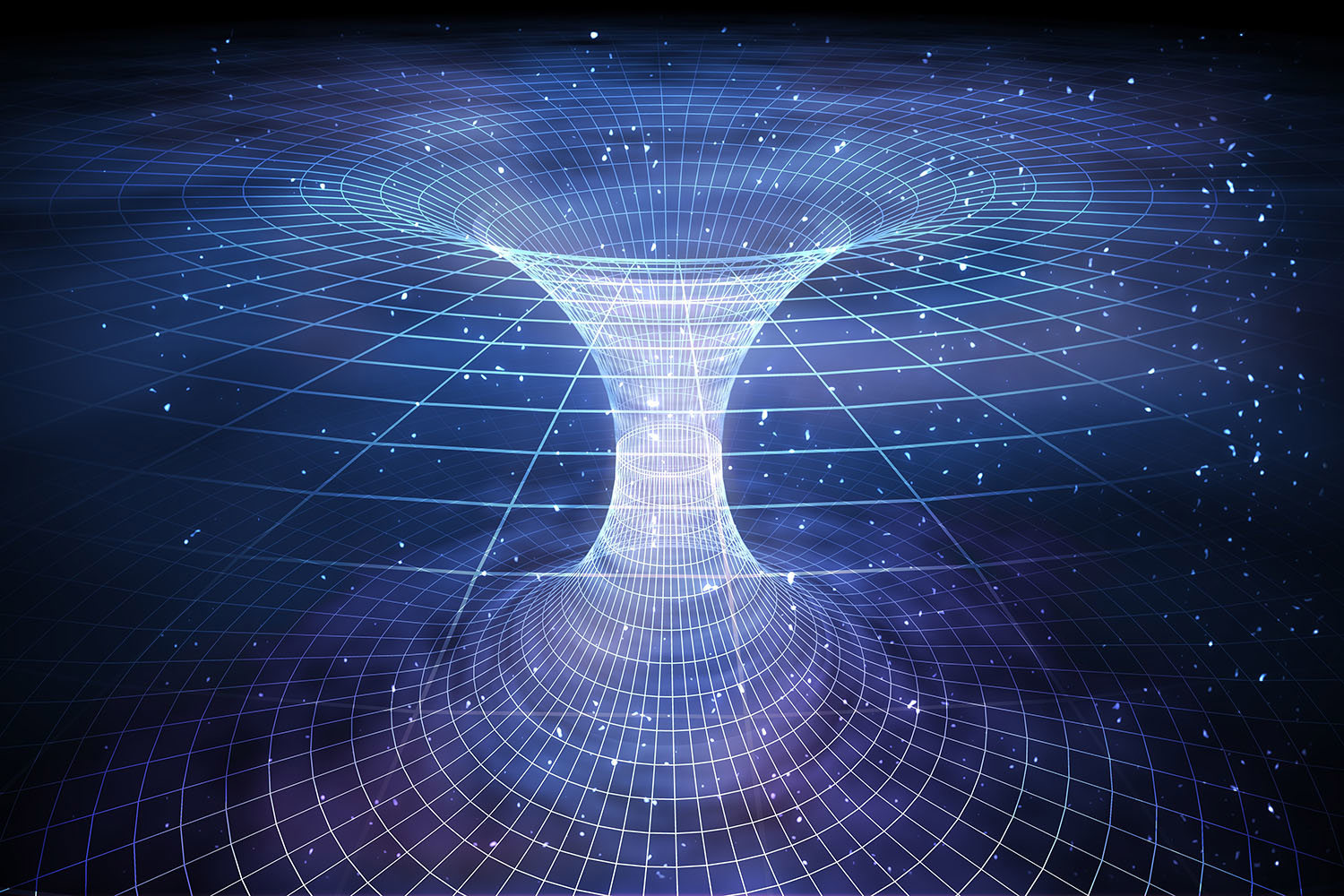
Figure 1: A wormhole leading from a black hole to another universe. Source: Adobe Stock

Thus, black holes came to be visualized as a dark star with enormous gravitational pull, which was formed when a dying star imploded under its own gravity and got compressed within its Schwarzschild radius. Its gravitational force is so powerful that it sucks in any matter passing near its event horizon, either crushing and transforming it or transporting it via a wormhole to a radically different universe.

In spite of all the mathematical wizardry that went into its formulation, till around the 1990s, most astronomers regarded black holes as science fiction. But things began to change with the discovery of Sgr A*, the powerful radio source at the heart of the Milky Way.

A Supermassive Black Hole at the Galactic Center?

For a long time, astronomers had been observing a powerful radio source at the center of the Milky Way, which they termed Sgr A*, since the radio source was located in the direction of the Sagittarius constellation. They began to think that the only cosmic object that could generate such powerful radiation in the radio frequency (RF) is a black hole. It was proposed that Sgr A* could be a supermassive black hole, nearly 4.3 million times the mass of the sun, squeezed into a tiny space only ten times bigger than the sun. 

Astronomers further speculated that when the nuclear bulge was forming, a small fraction of the mass lacking orbital momentum collapsed in the middle to form the supermassive black hole. The radio waves from Sgr A* are not coming from the black hole itself, they said, but from the “accretion disk” that surrounds the black hole. The accretion disk was believed to consist of rings of superheated hot gas, dust and stars that surround a black hole and spiral towards the event horizon, being pulled by the powerful gravity of the black hole. 

Subsequent observations of many other galaxies, including our own, revealed that galactic cores are not only emitting intense electromagnetic radiation at all frequencies – from radio waves to gamma rays – but they are also ejecting relativistic plasma jets from their north and south poles.
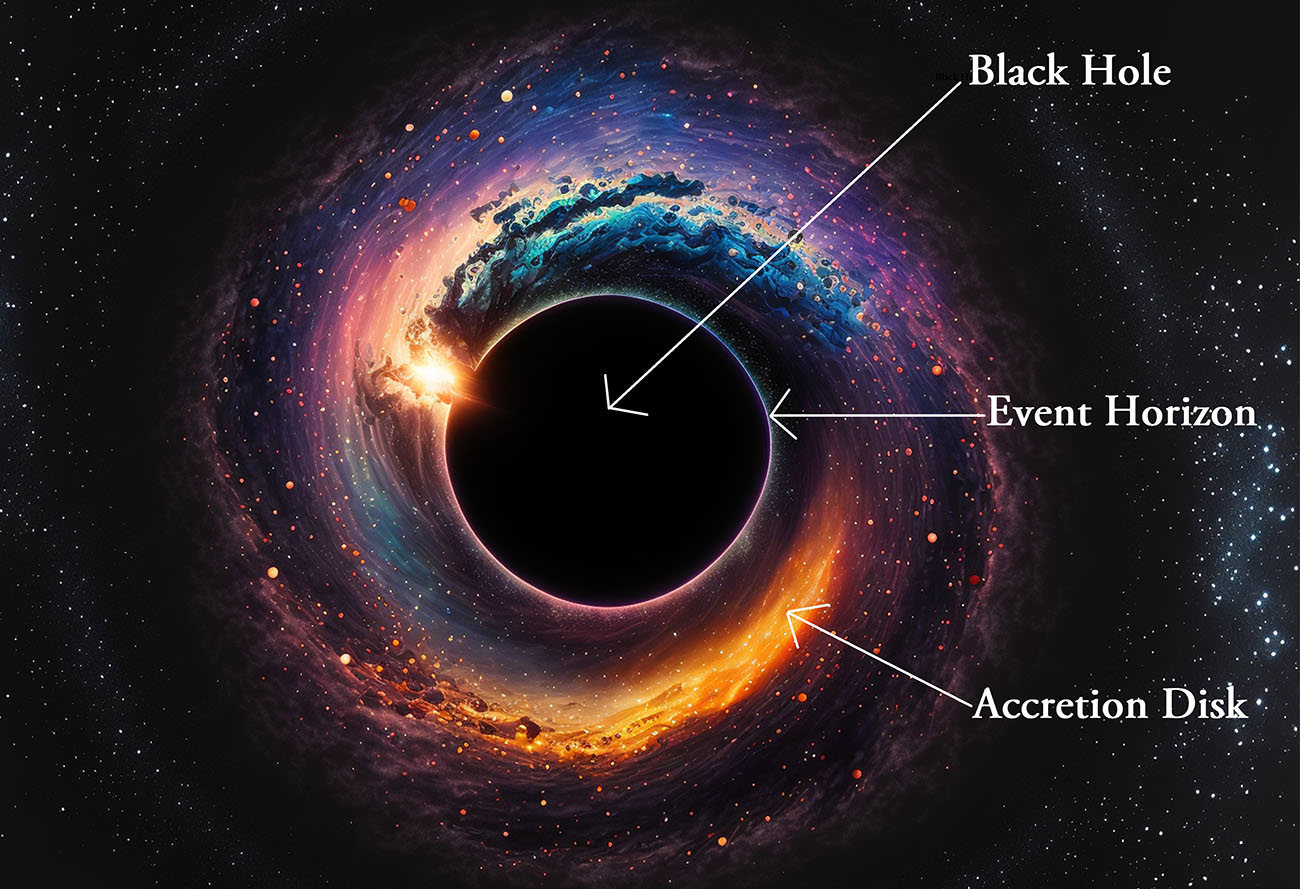
Figure 2: A Schematic of a black hole. Source: Adobe Stock.

As time went on, and more observational data came in, however, it was noticed that Sgr A* was not behaving as expected of a black hole. But, since no one seemed to know that Sgr A* could otherwise represent, astronomers stuck to the same story. And as it happens so often in science, a faulty hypothesis turns into a theory simply by virtue of repetition, and all the anomalies are quietly filed away.

So what are the anomalous behaviors of Sgr A* that undermine the supposition that it is a black hole? Firstly, astronomers always said that the region near the center of the galaxy, close to Sgr A*, would be too volatile for active star formation, due to the tremendous gravitational pull of Sgr A*. But when they got a good, hard look into the region of the Galactic Center with Hubble's NICMOS infrared camera, they found that, 

“The Galactic Center is a hotbed of star formation activity, containing the most massive star formation site and three of the most massive young star clusters in the galaxy.”[2]

This is the exact opposite of what had been posited by scientists! The region of the Galactic Center is a prolific site of star formation, not at all what you would expect if a monstrous black hole were lurking nearby and trying to rip apart the clouds of gas and dust. But this anomaly did not deter our perseverant astronomers. It was just an oddity that needed to be handled later, perhaps when the stars were perfectly aligned. 

It’s quite stunning how big and dense the star clusters in the Galactic Center are. A Hubble Telescope image of a pair of star clusters called Arches and Quintuplet, located less than 100 light-years from the center of our galaxy, shows that the clusters are 10 times larger than typical young star clusters scattered throughout the Milky Way galaxy. The Arches cluster is so dense that over 100,000 stars will fit into the space between our sun and its nearest neighbor, the star Alpha Centauri, 4.3 light-years away. Only 1 out of every 10 million stars in the galaxy is as luminous as the Arches cluster stars. At least a dozen of the stars weigh about 100 times the mass of our sun.[3]

In other words, the stars near the Galactic Center are much bigger, far more luminous, and a lot more densely packed than those found in the spiral arms. 
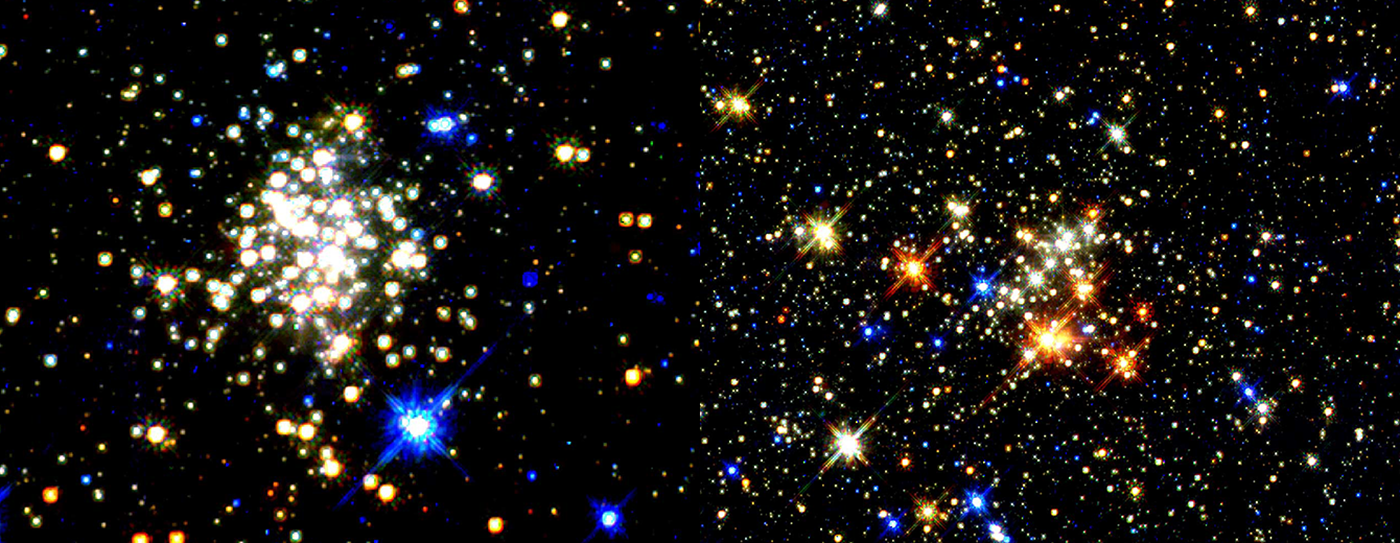
Figure 3: Hubble Telescope image of a pair of dense star clusters, less than 100 light-years from the center of our galaxy. Credit: NASA and STSI, Public Domain Image.

The other claim that astronomers had made about Sgr A* is that it must be gobbling up passing stars and molecular clouds on a routine basis, and whenever it does so, it emits powerful X-ray flares. But, despite careful observations over long periods of time, Sgr A* has never been seen to suck in nearby matter. One example stands out from the rest, thanks to all the hullabaloo that was generated in the years leading up to the grand non-event.

In 2011, astronomers discovered a cloud of gas termed G2, heading towards Sgr A*. It was predicted to pass within about 36 light-hours of the black hole in 2014 and be tidally disrupted, causing much of its material to accrete onto Sgr A*, thereby causing a bright X-ray outburst. Guess what happened? Nothing! To the utter shock of astronomers - who were eagerly observing Sgr A* like a bunch of kids gathered around an aquarium during shark feeding time - G2 wafted past Sgr A*, and continued merrily along its orbit, without even pausing to exchange courtesies. Needless to say, the much-anticipated fireworks of X-ray emissions from Sgr A* did not happen either.[4]

But did this little setback inspire our astronomers to revisit the hypothesis that Sgr A* is a black hole? Of course not! Why would you topple a perfectly good story for want of corroborating data and get into everyone’s bad books? That’s a sure shot way to get your telescope time taken away from you.
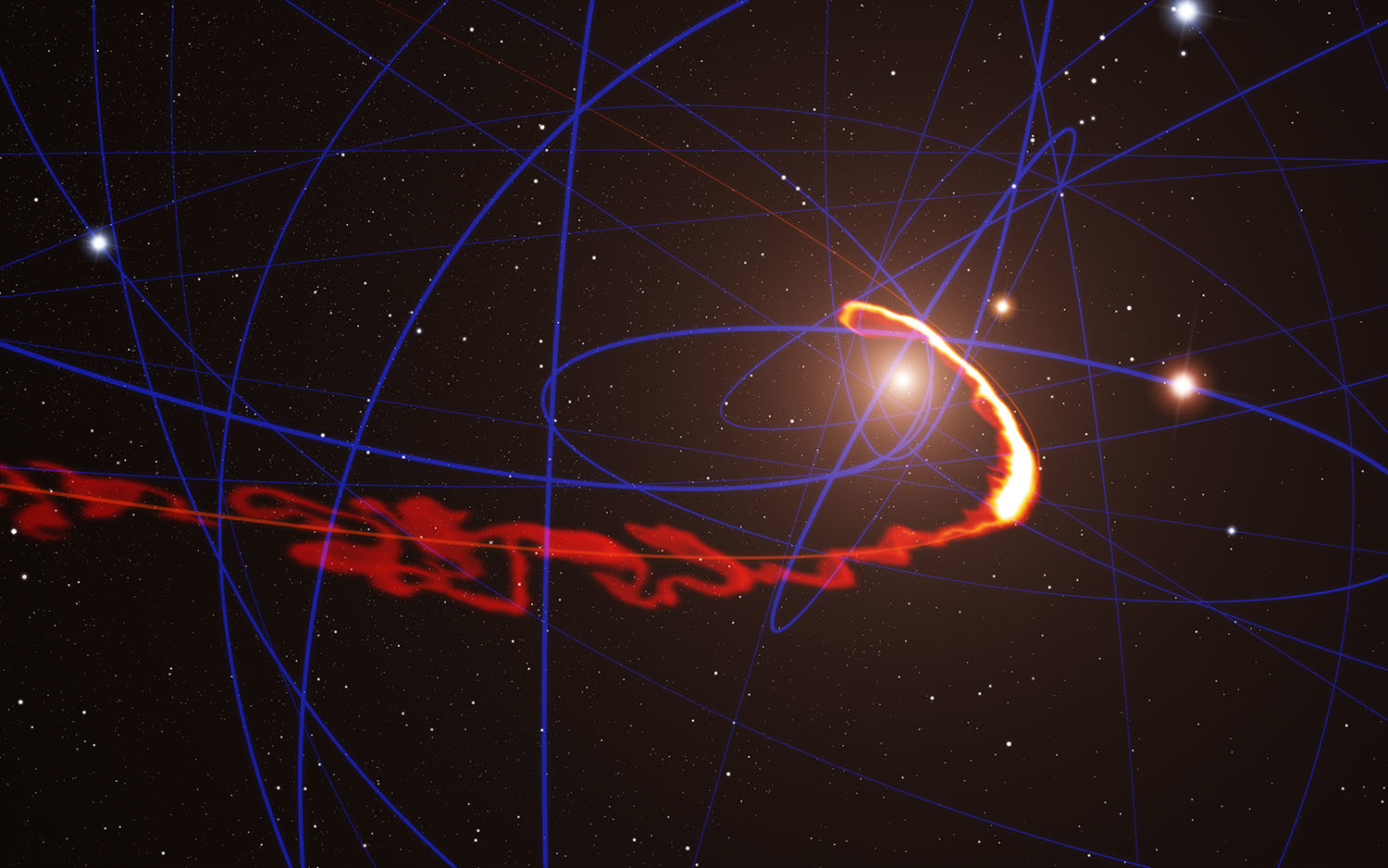
Figure 4: Simulation of the gas cloud G2 passing close to Sgr A* in 2013. Credit: ESO/S. Gillessen/MPE/Marc Schartmann, Public Domain

Astronomers had also contended that the powerful electromagnetic emissions from Sgr A* are being emitted by the “accretion disk” around the black hole. But new observations reveal that Sgr A* does not even have an accretion disk! Instead, it is encircled by strong and organized magnetic fields, which sustain filaments of gas. This is consistent with observations from other galaxies as well.

In 2008, astronomer Andrew Fabian of Cambridge University in the UK, looked at the Hubble Telescope images, and found that, “Long-lived magnetic fields are sustaining a mammoth network of spaghetti-like gas filaments around a black hole…at the heart of a large galaxy known as NGC 1275.”[5]

In 2015, the Event Horizon Telescope detected magnetic fields just outside the event horizon of Sgr A* at the center of the Milky Way galaxy. A report by the Harvard-Smithsonian Center for Astrophysics published in ScienceDaily states, 

“Most people think of black holes as giant vacuum cleaners sucking in everything that gets too close. But the supermassive black holes at the centers of galaxies are more like cosmic engines, converting energy from infalling matter into intense radiation that can outshine the combined light from all surrounding stars…For the first time, astronomers have detected magnetic fields just outside the event horizon of the black hole at the center of our Milky Way galaxy...In the case of Sgr A*, polarized light is emitted by electrons spiraling around magnetic field lines. As a result, this light directly traces the structure of the magnetic field…The team found that magnetic fields in some regions near the black hole are disorderly, with jumbled loops and whorls resembling intertwined spaghetti. In contrast, other regions showed a much more organized pattern.”[6]

In March 2024, the Event Horizon Telescope (EHT) collaboration unveiled a new image of Sgr A* in polarized light, which revealed strong, twisted, and organized magnetic fields near the edge of Sgr A* in the center of the Milky Way galaxy, very similar to that seen around the M87* black hole.[7]
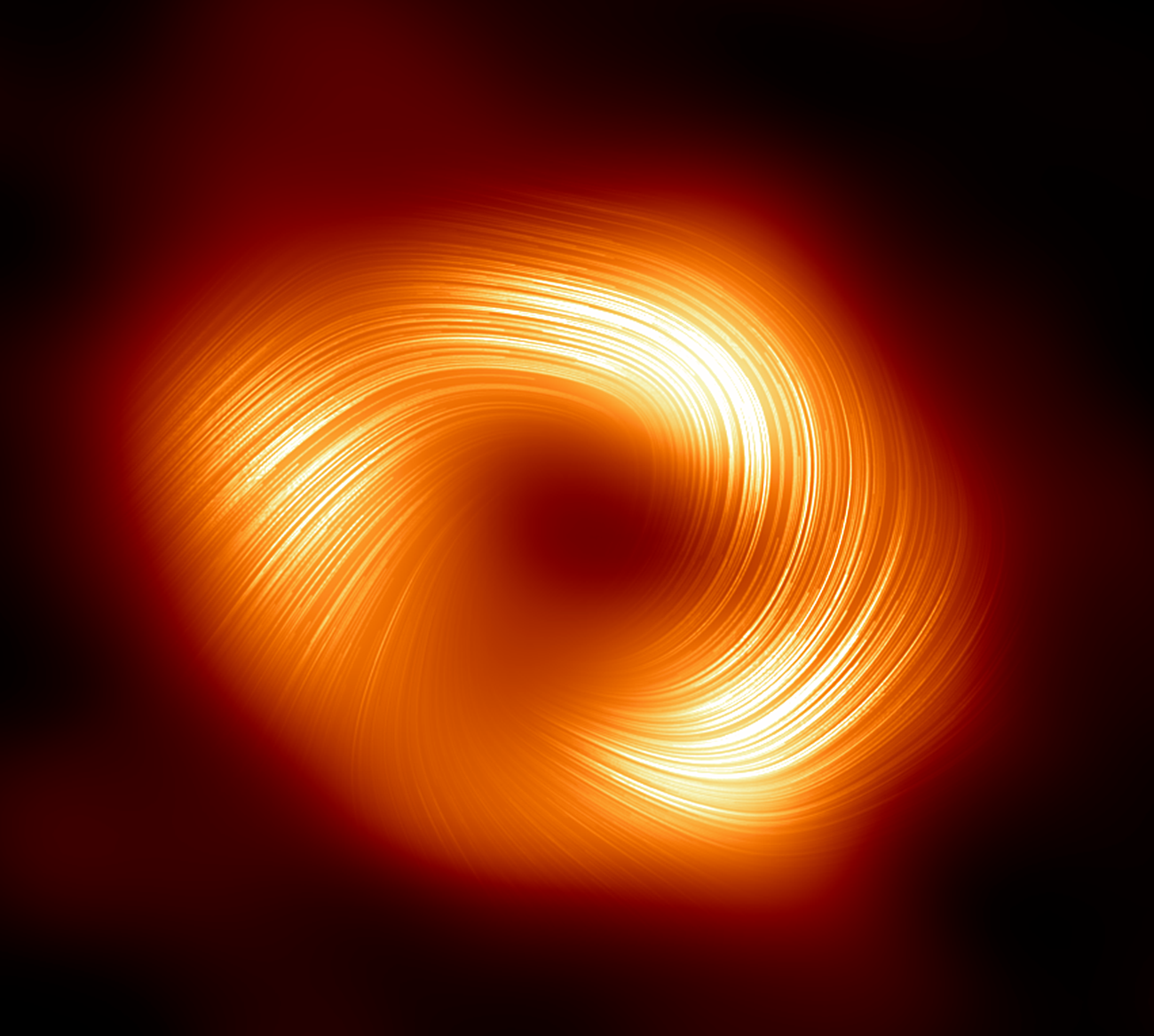
Figure 5: An image of Sgr A*, the central black hole of the Milky Way, in polarized light, showing the organized magnetic fields around it. Image Credit: EHT Collaboration, Public Domain.

So, instead of an accretion disk, Sgr A* is encircled by strong, twisted, organized magnetic fields, which, quite possibly, support filaments of gas. Therefore, the EM radiation and plasma jets cannot be coming from an accretion disk surrounding a black hole. They must be emitted by Sgr A* itself! 

It should be evident from these observations that Sgr A* bears no similarity to the black hole that came out of Einstein’s equations. Not only does it not gobble up nearby matter by means of its gravitational force or disrupt star formation in regions close to it, it does not even have an accretion disk. Moreover, Sgr A* emits enormous amounts of EM radiation and plasma jets, while a black hole was visualized as a dark star from which nothing ever came out, not even light.

Which brings us to an important question: If Sgr A*, the galactic core, is not a black hole, then what could it be?

If we go by the observational data, then Sgr A* appears to be functioning as the “central engine” of our galaxy. It could be drawing in matter from the rest of the galaxy (or even from outside it) through filaments of gas, which are supported by powerful magnetic fields, and transforming this matter into EM radiation and plasma jets to support galactic functions. Which means, Sgr A* must be imbued with a “cosmic intelligence” that allows it to know what needs to be done to support, organize, and regulate our galaxy.

It would not be amiss to argue that Sgr A*, the galactic core, is the central, creative, and organizing consciousness of our galaxy. It is this galactic soul or galactic consciousness that orchestrated the evolution of our galaxy over eons and continues to regulate its vital functions. All the high-energy physics that we see around it is the manifestation of this consciousness. We are observing consciousness in action, but we are unable to recognize it as such, since we don’t have the mathematical tools to describe consciousness, nor do we have a well-established reference point to compare it against. 

Interestingly, many ancient cultures knew about the central organizing consciousness of our galaxy, and referred to it in their texts and traditions as the Supreme Creator or Great Spirit. Their descriptions of this ultimate creative entity resonate with what has been discovered about Sgr A* till now. Let me begin with the Vedic descriptions of the unformed, creative spirit known as Brahma, and then I will move on to other religious and spiritual traditions, which have a similar philosophical outlook.

Sgr A* - The Galactic Consciousness

The Vedic sages believed that our world was brought forth by the supreme creative principle Brahma, who exists in an unformed, unmanifested state at the “navel of Vishnu,” i.e., Vishnunabhi; whereas, Vishnu, the god of preservation, was said to recline in the “middle of the cosmic milky ocean” on his serpent couch. 

In Yuga Shift and prior articles, I had contended that the enormous central bar of our galaxy, which stretches across the middle of our galaxy for nearly 27,000 light-years, is what the Vedic sages knew as Vishnu, while the “navel of Vishnu” or Vishnunabhi – around which our sun revolves, as Sri Yukteswar had claimed - is the Galactic Center, since the navel is the center point of the human anatomy, and we also know that our sun revolves around the Galactic Center.

The only cosmic entity in the vicinity of the Galactic Center deserving of the epithet Brahma, the unmanifested creative spirit, is Sgr A*, which astronomers believe is a supermassive black hole.
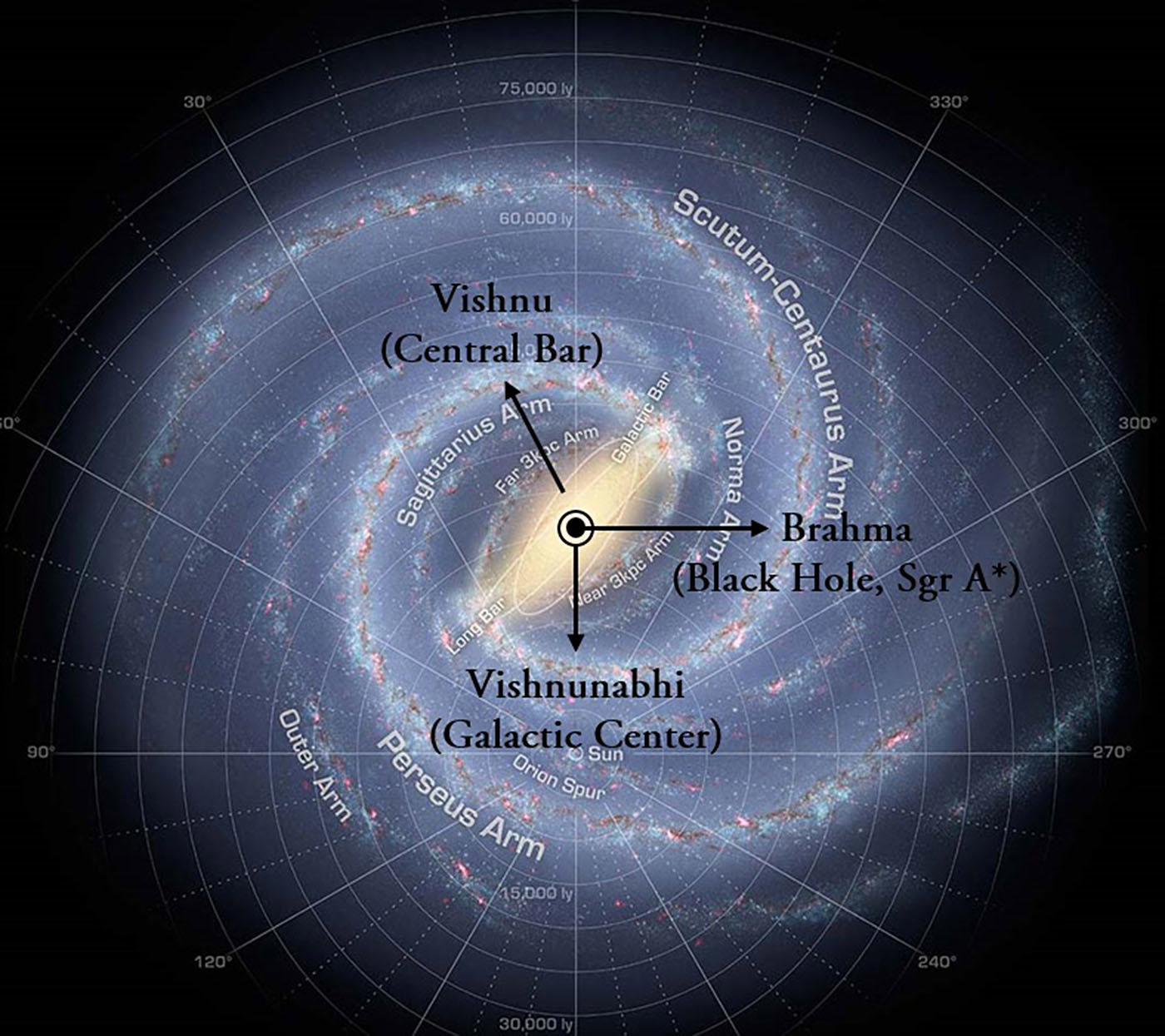
Figure 6: The Milky Way galaxy has a long central bar, which the Vedic sages knew as Vishnu; the region of the Galactic Center was the “navel of Vishnu” or Vishnunabhi; while Sgr A*, the central black hole, was Brahma, the creative spirit. Adapted from an image by NASA/JPL-Caltech/R. Hurt, Public Domain.

As per the Vedic texts, Brahma is the unformed spirit who brings forth the world of forms. He is the eternal, omniscient consciousness, who multiplies himself and lives in the heart of all living beings as their immortal soul. What this implies is that Sgr A*, the galactic soul or galactic consciousness, produces small “packets of consciousness” that we call the soul or self, which animates all life. 

In other words, all souls emanate from Sgr A* and return there after the completion of their reincarnation cycles. The Vedic texts also tell us of a very long cycle of time called the “Day of Brahma” (spanning 12.9 million years), following which there is a cosmic reset. This is when Brahma withdraws all souls back inside himself, and the entire galaxy becomes lifeless for another 12.9 million years, which comprises the “Night of Brahma”. Consider the following hymns from the collection of Vedic texts called the Upanishads, which elucidate these ideas.

“In the beginning was only Being (Brahma), 
One without a second.
Out of himself he brought forth the cosmos 
and entered into everything in it.
There is nothing that does not come from Him.
Of everything, He is the inmost Self.”8 (CU 6.2.2)
    
“The ruler Supreme (Brahma), inner Self of all,
 Multiplies his oneness into many.”9 (KU 2.2.12)

“He (Brahma) is the inner ruler in all beings. 
He projects the cosmos from himself, maintains and withdraws it back into himself at the end of time.”10 (SU 3.2)

This is the basic understanding of the Vedic philosophical tradition: “The Atman (i.e., individual soul) is Brahma (i.e., Universal Soul)”. Our soul is of the same essence as the Creator, and therefore, our bodies are the sacred Temple of God. In order to find joy and fulfilment, we need not search around aimlessly in the world, but tap into our inner divine essence, i.e., our self or soul, which is the repository of love, bliss, joy, contentment, truth and wisdom. Those who can do this break free from the reincarnation cycle. 

“Wherever the mind wanders, restless and diffuse in its search for satisfaction without, lead it within; train it to rest in the Self. Abiding joy comes to those who still the mind.” (BG 6.26-27)
“He (Self) is formless, and can never be seen with these two eyes. But he reveals himself in the heart made pure through meditation and sense-restraint. Realizing him one is released from the cycle of birth and death.” (KU 2.3.9)

The Vedic texts also tell us that, when a person exits the reincarnation cycle on attaining self-realization, he returns to the Brahmaloka or Brahma-world, where he dwells for immortal years in bliss and love, free of grief or suffering. If Sgr A* is Brahma, the galactic soul, then the Brahma-world or Brahmaloka is likely to be the effulgent central bulge of our galaxy, i.e., the galactic nucleus, which contains Sgr A* in its center. 

In other words, the Milky Way’s nucleus is the heavenly domain of the primordial Creator, the “paradise in the center of the world” that so many ancient traditions speak of, where the sages and virtuous souls dwell in eternal bliss. This was the exalted afterlife destination sought by the saints of the past. Thanks to our ever-evolving awareness of the universe, it is now becoming possible to bring these esoteric concepts out of the metaphysical realm and relate them to a tangible, physical reality.

As to what Sgr A*, the galactic consciousness, may be composed of is, of course, hard to guess. The Bhagavad Gita, the spiritual poem of India, provides some clues to the nature of the soul or self, which is of the same essence as Brahma, the galactic consciousness. The poem states,

"The Self cannot be pierced by weapons or burned by fire; water cannot wet it, nor can the wind dry it. The Self cannot be pierced or burned, made wet or dry. It is everlasting and infinite, standing on the motionless foundations of eternity. The Self is unmanifested, beyond all thought, beyond all change.” (BG 2.23-25)[11]

What we can gather from these descriptions is that the soul or self is likely to be made up of an invisible, exotic form of energy, which does not react with other types of energies or matter, and therefore, it cannot be dissipated or transformed, although it is capable of making copies of itself. This energy is aware, intelligent, and capable of storing massive amounts of information, and is completely unlike any other form of energy.

The Judaic philosophy has similar thoughts about the cosmos and the nature of souls. In the book, Tree of Souls: The Mythology of Judaism, Howard Schwartz writes that all souls in Paradise are stored in a “Treasury of Souls” or Guf, until it is time for them to be born into this world. Regarding the “Treasury of Souls”, which is also called the “Chamber of Creation”, Howard says that it is located,

“In the highest heaven, known as Aravot...The Guf is found near the Throne of Glory, and a dazzling brilliant light emanates from the many souls in repose there. Those souls are in their pristine state, untainted by existence in this world. Some of them flicker like a small candle and some shine like a torch, and there are some whose radiance rivals the sun…
When the time comes for it to descend into this world, an angel is issued along with it, who accompanies it...As soon as the soul leaves the Guf, it divests itself of its heavenly garment, and is clothed in a garment of flesh and blood.”[12]

Judaic philosophy further states that once a soul has been born in this world and is tainted by its sins, it is extremely difficult for it to go back to Paradise, the original place where it was born. “Those who stray from there, exiled into the fallen world, eventually find themselves naked and in need of repair by the field master...For even the greatest soul has difficulty reentering the field once it has departed.”[13]

I would argue that the “Treasury of Souls” or “Chamber of Creation” in Judaism refers to the central bulge or galactic nucleus, also called Paradise or the highest heaven, Avarot. Since the “Treasury of Souls” is said to be located near the “Throne of Glory”, i.e., the seat of God in Paradise, my interpretation is that Sgr A*, the galactic soul or galactic consciousness, is the “Throne of Glory” in Judaism. 

The “Treasury of Souls” or the galactic nucleus is also the original Garden of Eden, where the soul of man was fashioned, and where he lived in eternal bliss until he was exiled from Paradise and sent to the fallen world outside; and it is only after he has regained his original purity and attained self-realization, can he return to the galactic nucleus.

The Judaic doctrine makes an interesting statement about the newly born souls that are kept in the “Treasury of Souls”. It states that a brilliant light emanates from the many souls in repose there. Some of them flicker like a small candle, and some shine like a torch, and there are some whose radiance rivals the sun. 

Let’s recall here that most ancient societies believed that the souls of their ancestors appeared as “stars” in the sky. Therefore, going by this Judaic doctrine, the central bulge should contain faint, young stars in addition to massive, brilliant ones. Isn’t that exactly what scientists have found in recent years – that, in proximity to Sgr A*, intense star formation activity is going on, and massive young star clusters are present there, containing stars that are bigger and brighter than our sun?

It’s amazing how things begin to fall in place and make sense, and esoteric doctrines reveal their secrets, once you find a clue to the whole mystery. A lot of observational data about our galaxy and the universe has been amassed over the past few decades by astronomers, and when we try to correlate them to the information in the ancient esoteric and cosmological doctrines, we can arrive at surprising realizations.

Christian mysticism - such as Franciscan mysticism – speaks of the “Eternal, Cosmic Christ” or the “Christ Consciousness”, which activates the heart center and inspires men and women towards oneness with all of creation. But who or what is the “Eternal, Cosmic Christ”, many have wondered? Before attempting to answer that question, let’s remember that “Christ” was not Jesus’s last name. It was a title given to Jesus. The term Christ derives from the Greek word Christos, which means “Anointed One” or “Messiah”. The term Christos precedes Jesus and the Christian religion by millennia, and was typically given to someone who was perceived to be a human incarnation of the “Eternal, Cosmic Christ,” i.e., someone who has willingly descended on the mortal plane to guide the suffering humanity to salvation. 

I believe that it is Sgr A*, the galactic soul or the galactic consciousness, whom the Vedic sages revered as Brahma and the Hebrews called the “Throne of Glory”, that is the “Eternal, Cosmic Christ” or the “Christ Consciousness”. It is from this Source that all souls are born into this world; they return to the Source after attaining liberation. The liberated beings who dwell in the galactic bulge – such as Jesus or Buddha - can willingly reincarnate on earth from time to time as the teachers and guides of humanity.

Jesus often referred to this galactic soul as his “Father” in heaven, since all souls emanate from it. When he told his disciples that, “If you loved me, you would be glad that I am going to the Father, for the Father is greater than I,”[14] he was, in all likelihood, talking about returning to the galactic nucleus, which was the Paradise in the center of the world and the original Garden of Eden.
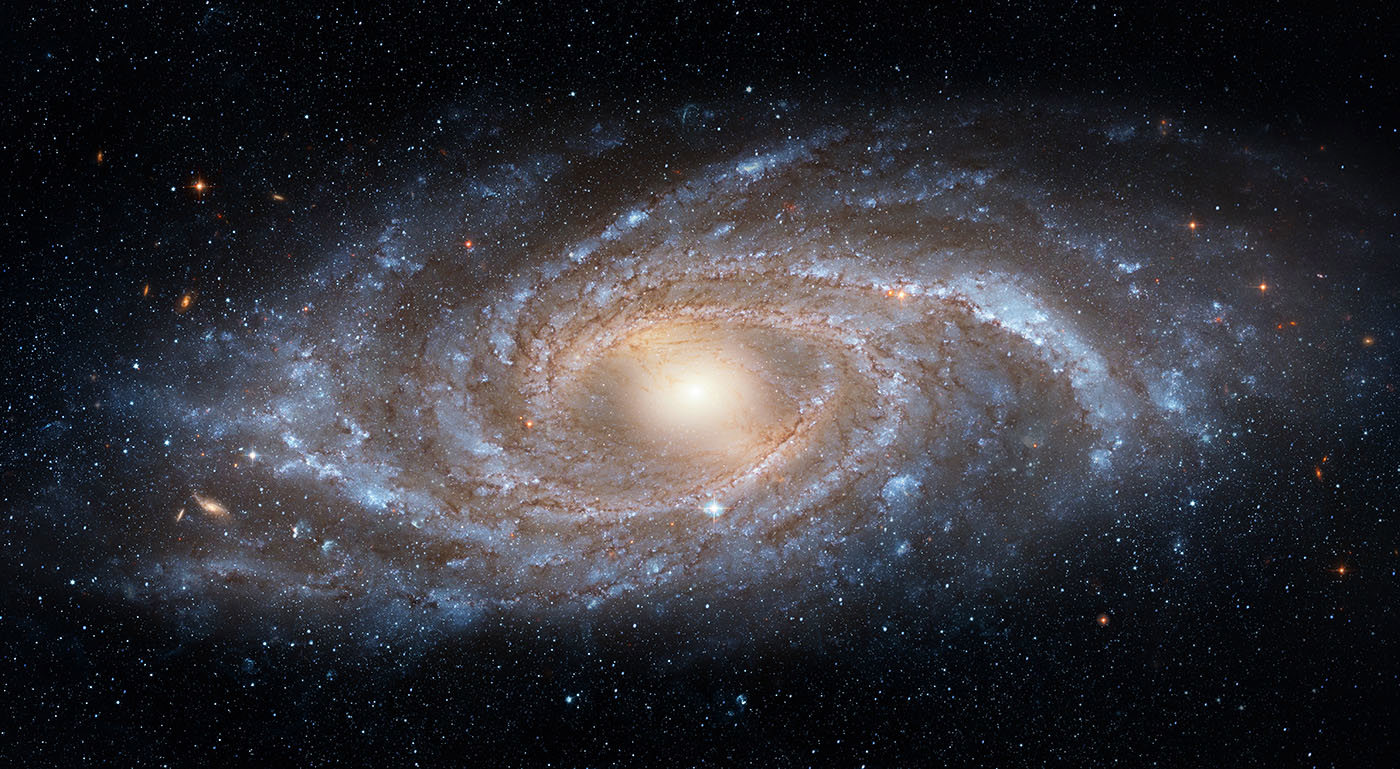
Figure 7: The brilliant central bulge or galactic nucleus of the Milky Way galaxy. This was the afterlife destination of saints, the paradise at the center of the world, and the original Garden of Eden. Source: Adobe Stock

It is well-known that the Greeks had an enviably large pantheon of gods. But there was also a prevailing belief that all life derives from a single, omniscient Source, which is fixed in space and regulates all affairs by the power of its mind. The earliest account of such a Supreme Being comes to us from a travelling poet and sage of ancient Greece called Xenophanes of Colophon, who lived in the 6th century BCE. There are 45 surviving fragments of his poetry, which offer glimpses into the fundamental tenets of his philosophy. Some of the extant fragments describe the Supreme God:  

“One god is greatest among gods and men,
Not at all like mortals in body or in thought. (frag. 23)
…whole he sees, whole he thinks, and whole he hears. (frag. 24)
…but completely without toil he shakes all things by the thought of his mind. (frag. 25)
…always he abides in the same place, not moving at all,
nor is it seemly for him to travel to different places at different times. (frag. 26)”[15]

The Supreme Being described by Xenophanes is “not at all like mortals in body,” i.e. not made up of matter, “always abides in the same place”, and “shakes all things by the thought of his mind.” These attributes have obvious correlations with Sgr A*, the galactic consciousness, for Sgr A* is not made up of matter, remains fixed in the center of the galaxy, and it regulates all galactic functions by means of its powerful energetic emissions. 

In Cicero’s Prior Academics, there is a passage claiming that the eternal, unchanging One God is spherical in shape. This strengthens the association of the One God with Sgr A*, which is a spherical cosmic entity: 

“(Xenophanes said that) all things are one, that this is unchanging, and is god, that this never came into being and is eternal, and has a spherical shape.” (2.18)[16] 

In many Native American tribes, the supreme creative spirit was known as the Great Spirit or Great Mystery, which, I believe, also refers to Sgr A*, the galactic consciousness. The Great Spirit was known by different names by different tribes – such as Wakan Tanka in the Lakota tradition or Gitche Manitou in the Algonquian tradition - but in all cases, the overarching beliefs were the same: that the Great Spirit was the Supreme Being, who infused everything with a life force or soul. He is the Creator who lives in all of us. Chief Luther Standing Bear (1868–1939) of the Lakota Nation explained it eloquently:

“From Wakan Tanka, the Great Spirit, there came a great unifying life force that flowed in and through all things – the flowers of the plains, blowing winds, rocks, trees, birds, animals – and was the same force that had been breathed into the first man. Thus all things were kindred, and were brought together by the same Great Mystery.”[17]

In some cultures, the name of the Creator revealed his location in space. For instance, in the Popul Vuh, which recounts the mythology and history of the K’iche Maya people of Guatemala, the Creative Spirit is called Huracan, the Heart of Heaven. It is Huracan who dreams the world into existence in the darkness of the night and breathes life into all creatures. The term “Heart of Heaven” is not incompatible with Sgr A*, the galactic consciousness, which lies in the heart of the Milky Way. 

Another example is the foundational figure of Shinto creation myths, called Ame-no-Minaka-Nushi-no-Mikoto, whose name translates as “Deity of the August Center of Heaven”. The Kojiki portrays him as the first deity to appear during the creation of the world. He was the divine source from which the later kami (gods) originated. Incidentally, Ame-no-Minaka-Nushi-no-Mikoto hid his form upon coming into existence. This is consistent with our understanding of Sgr A*, which is not only hidden from our view (only its outline is visible using sophisticated telescopes) but is also located at the cosmic center.

Evidently, many ancient conceptions regarding the Supreme Being have a strong correlation to what we know about Sgr A*, the galactic core. The connections are striking and persuasive. It isn’t far-reaching to propose that we live in a conscious, living galaxy that is constantly creating, growing and transforming. This is not a new idea by any means. The sages and philosophers of antiquity believed that the heavenly bodies, such as the sun, moon, and the planets, were imbued with souls and intelligences. The currently used scientific term for this belief system is panpsychism, which posits that consciousness is a fundamental and ubiquitous feature of our reality. 

The Conscious Sun

A well-known proponent of panpsychism is British author and biologist Rupert Sheldrake, who believes that the Sun’s complex electromagnetic rhythms might be indicative of a form of awareness. 

In a paper titled, “Is the Sun Conscious?”[18] Sheldrake argued that, “nervous systems in general, and brains in particular, function electromagnetically.” Within the brain, rhythmic patterns of electrical activity emerge from the activities of countless neurons - such as alpha waves, theta waves, and gamma waves - which can be measured through electrodes placed on the skull, as in electroencephalographs (EEG). These electrical waves set up oscillating magnetic fields.

Sheldrake referred to various studies in the “field theory of consciousness”, all of which agree that consciousness is related to the electromagnetic activity of the brain. Some researchers have gone further and proposed that the brain’s electromagnetic fields actually are conscious. According to John Joe McFadden, “the brain’s EM field is in fact the physical substrate of consciousness, and conscious volition results from the influence of the brain’s EM field on neurons that initiate motor actions.”

Now, the sun is an extraordinarily complex electromagnetic system, whose effects permeate the solar system. The movements of electrified plasma on the solar surface create a magnetic field, which extends throughout the body of the sun to the limits of the solar system. The changing magnetic fields within and beyond the sun give rise to electrical currents in the plasma. During times of solar maxima, there are many sunspots on the solar surface from where extraordinarily strong magnetic fields emerge from the sun’s interior, loop around above the photosphere, and re-enter the sun through spots of opposite magnetic polarity. Sometimes these extraordinarily powerful loops of magnetic energy break and rejoin, emitting enormous amounts of energy in the form of solar flares and coronal mass ejections.

Figure 8: A Coronal mass ejection (CME) erupted on the Sun on 31 August 2012 and caused auroras to appear on Earth three days later. Credit: NASA Goddard Space Flight Center, Public Domain Image.

Sheldrake argued that, if the electromagnetic activity of the brain is indicative of a conscious mind, “then the electromagnetic activity of the sun may well be the principal interface between the physical activity of the sun and the solar mind… The mind of the sun, though centered in the sun itself, may integrate information from the entire heliosphere, just as our minds, centered in brains, integrate information from our own bodies and the world around us.” Sheldrake, then, went on to speculate what would be the principal preoccupations of the solar mind:

“The sun would be able to sense what is going on throughout the solar system through the electromagnetic field that pervades the heliosphere, which could act as its primary sense organ. Thus, the sun’s mind could, in principle, know about all events within the solar system…
In the first place, the sun is presumably concerned with the regulation and preservation of its own body, the sun itself, and its extended body, the solar system, right out to the heliopause… influencing it through the intensity of the solar wind, through directional solar flares, and most dramatically through coronal mass ejections pouring billions of tons of charged particles towards anything in their path… 
Secondly, the sun may be aware of its position and interactions with other stars and solar systems in its immediate neighborhood, and ultimately throughout the entire galaxy. These systems may in turn be part of a galactic mind, like neurons within a galactic brain. They are literally interconnected through the plasma permeating the arms of the galaxy, through which vast electric currents flow, spiraling around enormous magnetic field lines radiating out through the galactic arms that are tens of thousands of light years long. The sun is part of a vastly greater electromagnetic system…
At the center of our galaxy is a supermassive black hole that emits huge amounts of energy, with a galactic wind passing along the spiral arms extending outwards from it...The sun is influenced by the electromagnetic patterns of activity within the galaxy as a whole, which could in turn be closely connected with a galactic mind, perhaps centered in or around the supermassive black hole at the galactic center. The galactic mind could influence what happens here on earth through its effects on the sun and the solar mind.”

Sheldrake’s proposition that the activities of the conscious sun may be regulated by a “galactic mind” centered in the supermassive black hole at the galactic center is very similar to what I have proposed - except that I now no longer believe that there are any black holes. Every so-called black hole is a galactic soul. Remember that Sgr A* is enclosed by “strong, twisted, and organized magnetic fields”, and as per the field theories of consciousness, Sheldrake presents in his paper, EM fields are associated with consciousness. 

Soul Consciousness

There is another thing that I need to discuss here. Sheldrake talks about the EM field of the brain and posits that this EM field is the means through which the brain senses the nerve stimuli and carries out its conscious actions. But the human heart also generates a very powerful EM field, which is 5000 times more powerful than the brain’s EM field. The heart's energy is said to reach about three feet outside of the physical body and can be detected in another person sitting nearby via an electrocardiogram (ECG).[19]

Figure 9: The magnetic field of the heart reaches 3 feet outside the body. Source: Adobe Stock

This means consciousness also resides inside our heart, and it is this consciousness that the ancients called the self, soul, or soul consciousness. It is the soul that is the source of the mind and our sense faculties. In various Vedic texts, it has been repeatedly stressed that the faculties of vision, audition, thought, etc. are not ours but “only the names given to forces that He (Self) projects and reabsorbs.”[20]

At the time of death, the soul draws the mind and sense faculties within itself before exiting the body. This is the reason why some people enter into a coma before death. That’s when the soul reabsorbs the mind and sense faculties within itself, and then waits for the conditions within the body to deteriorate to a sufficient extent to allow the soul to exit. This is also the reason that when a person has a Near-Death Experience (NDE) and hovers above his own body, he is able to see, hear, feel, and think with perfect clarity. The soul is the ultimate source; it contains everything it needs within itself. The physical body is simply a vehicle through which the mind is cleansed of the egoic dross that it tends to accumulate.

Therefore, Sgr A* is not just the galactic mind; it is the galactic soul, which is capable of seeing, hearing, feeling, and knowing everything within the galaxy, and orchestrating all actions within the galaxy by means of its EM field and the powerful plasma jets. It is the source from where all of us have sprung as packets of consciousness called souls, and to live in proximity to this Source within the galactic nucleus in the afterlife was the desire of the great saints and prophets of the earlier ages. 

References

[1] Michio Kaku, Parallel Worlds, Anchor Books, 2006, pp. 114 – 125. 
[2] D. F. Figer, “Massive Star Formation in the Galactic Center”, arxiv.org, 11 Mar 2008, https://arxiv.org/abs/0803.1619
[3] Hubble Spies Giant Star Clusters Near Galactic Center, HUBBLESITE, September 16, 1999, https://hubblesite.org/contents/news-releases/1999/news-1999-30.html
[4] Deborah Byrd, "How G2 survived the black hole at our Milky Way’s heart", EarthSky 4 Nov 2014, https://earthsky.org/space/how-g2-survived-the-black-hole-at-our-milky-ways-heart/
[5] Rachel Courtland, "Galactic 'spaghetti monster' powered by magnetic fields", NewScientist, 20 August 2008, https://www.newscientist.com/article/dn14573-galactic-spaghetti-monster-powered-by-magnetic-fields/
[6] "Event Horizon Telescope reveals magnetic fields at Milky Way's central black hole", ScienceDaily, December 3, 2015, https://www.sciencedaily.com/releases/2015/12/151203150233.htm
[7] “Astronomers Unveil Strong Magnetic Fields Spiraling at the Edge of Milky Way’s Central Black Hole" Event Horizon Telescope, 27 March 2024, https://eventhorizontelescope.org/blog/astronomers-unveil-strong-magnetic-fields-spiraling-edge-milky-way%E2%80%99s-central-black-hole
[8] Chandogya Upanishad 6.2.2, from “The Upanishads”, tr. by Eknath Easwaran.
[9] Katha Upanishad 2.2.12, “The Upanishads”, tr. by Eknath Easwaran. 
[10] Shvetashvatara Upanishad 3.2, “The Upanishads”, tr. by Eknath Easwaran.
[11] Bhagavad Gita 2.23-25, tr. Eknath Easwaran, Penguin Books, 1996.
[12] Howard Schwartz, Tree of Souls: The Mythology of Judaism, Oxford University Press, 2004, p. 166
[13] Howard Schwartz, Tree of Souls: The Mythology of Judaism, Oxford University Press, 2004, p 168
[14] John 14:28, New International Version
[15] Michael Patzia, Internet Encyclopedia of Philosophy, 2009, http://www.iep.utm.edu/xenoph/
[16] Ibid
[17] Kent Nerburn, The Wisdom of the Native Americans, MJF Books, 1999, pg 15.
[18] Rupert Sheldrake, "Is the Sun Conscious?" Journal of Consciousness Studies, Vol.28, No.3–4, 2021, pp. 8–28, https://www.sheldrake.org/files/pdfs/papers/Is_the_Sun_Conscious.pdf
[19] Jessica I. Morales CHt./EFT, "The Heart's Electromagnetic Field Is Your Superpower", Psychology Today, 29 November 2020, https://www.psychologytoday.com/us/blog/building-the-habit-of-hero/202011/the-hearts-electromagnetic-field-is-your-superpower
[20] BU I.4.7; I.5.2; I.6.3 etc. taken from Symbolism of the Stupa, p 63


{ https://mysteriousuniverse.org/ }

Hoe vind je dit bericht?
Geschreven door peter om 20:24 Stuur door

Amazing Lesser Known UFO Crashes

Amazing Lesser Known UFO Crashes

Amazing Lesser Known UFO Crashes

The annals of UFO lore and the field of UFOs in general are littered with cases of supposed crashes of these crafts. For whatever reason, despite their incredibly mind-boggling technology, these things just sometimes go down, and they always make for a spectacular case that leaves many mysteries in its wake. Many UFO crashes are world famous, such as obviously the one that allegedly happened at Roswell, New Mexico, but some others are not nearly as well known, yet are just as mysterious and perplexing. 

One rather obscure supposed UFO crash, considering its location, is the time one apparently exploded and crashed right on the fringes of the neon-studded gambling capital of the world, Las Vegas. The whole odd affair actually began all the way across the country, over in Oneida, New York, where on April 18, 1962, military radar stations began picking up an anomalous object that seemed to be moving west rapidly. As it did so, there began a series of reports marking its progress, as panicked witnesses from across the country saw what looked like a glowing red ball or "flaming sword" that was at times bright enough to make night seem like day. 

These reports came from several states along its trajectory, including Colorado, Kansas, Arizona, and, most remarkably of all, in Eureka, Utah, where there would be a report that it had actually landed and caused massive electrical disruptions before taking to the sky again. Throughout all of this, the object was reportedly largely completely silent, and there was such a deluge of calls to authorities that fighter jets were even scrambled and put on alert at Luke Air Force Base in Arizona. The object headed towards Nevada, where it continued to be seen by hundreds of people as it approached Reno, then was witnessed to make a turn to head in the direction of Las Vegas, and this is where things would get even stranger. There was reportedly heard an enormous rumbling and then a thunderous boom and blinding flash of light, after which the object vanished both visually and off radar somewhere over Nellis Air Force Base, right out in the badlands just past the lights of Las Vegas.

The sheriff’s office for Clark County, Nevada, was apparently so flooded by calls from terrified residents who had heard the boom that it was thought that there had been an explosion and that perhaps an aircraft had gone down. A sheriff’s search party was sent out to the area where the object was last seen, yet there could be found no sign of a downed aircraft, and there were furthermore no reports of a missing aircraft from any airports in the region. Considering this, it was assumed that what had been seen was a meteor that had exploded in midair, and the military was quick to use this explanation as well. There was only a single newspaper article related to the odd incident at the time, which appeared the next day in The Las Vegas Sun with the headline “Brilliant Red Explosion Flares In Las Vegas Sky,” and for the most part, everyone just sort of forgot about it. Even though thousands of people across the country had seen the mysterious object and several hundred had heard the massive explosion, it seemed the meteor explanation was good enough. Case closed. Or so it seemed.

It would not be until decades later that anyone would blow the dust off the case, when UFO researcher Kevin Randle began snooping around for more information in military reports and declassified reports from the Air Force’s Project Blue Book UFO investigation, and he also went about interviewing numerous witnesses to the events to shed more light on what happened on that evening, which would all be covered in his book A History of UFO Crashes. What Randle would manage to uncover would begin to paint a picture of something perhaps quite a bit stranger than a meteor, and which the military quite possibly knows more about than it is letting on.

Even a casual look at the old reports began pointing out oddities. One declassified military report that was completely free to read by anyone who cared came from Captain Herman Gordon Shields, who, on the evening of the incident, had been flying a C-119 aircraft near La Van, Utah. He would report that both he and his co-pilot had witnessed a very bright light that continued to get brighter even as they maneuvered their plane to get away from it. Whatever it was, it was apparently “as bright as daylight,” completely illuminating the landscape, and as they tried to further evade and avoid what they felt might be an incoming collision, they were able to get a clear look at the source of the light. According to pilot Shields, it was a long, cigar-shaped object with a yellow top surface and the bottom of which was an extremely bright light. Shields would say in his report of the object:

“And this object which I saw was illuminated. It had a long slender appearance comparable to a cigarette in size, that is, the diameter with respect to the length of the object. The fore part, or the lower part of the object was very bright, intense white such as a magnesium fire. The second half, the aft section, was a clearly distinguishable yellowish color. I would say the object was just about divided in half, the fore part being intensely white, the aft section having a more yellow color to it. There was no exhaust, no trail following after it. It was clearly defined. I saw it for a period of maybe one to two seconds.”

Both the pilot and co-pilot were certain that this was no meteor. Another very curious report uncovered by Randle was that of witnesses Bob Robinson and Floyd Evans, who saw it fly low as they were driving along a highway near Eureka, Utah. The witnesses said it was clearly some sort of flaming cylinder with a “series of windows” along its side, and that its approach caused their vehicle to stall. They also claimed that it slowed to a stop to hover momentarily over them before continuing on its way, after which their engine promptly started up again. Other witness reports seemed to point towards something under intelligent control as well, including reports of the object making turns, speeding up or slowing down, reversing its course, and even landing, all things that you might realize meteors do not do. Another interesting eyewitness report uncovered by Randle comes from the declassified Blue Book files from a witness whose name had been redacted, and which reads:

“As the object passed over Robinson [Utah), it slowed down in [the] air, and after, [a] gasping sound was heard, the object spurted ahead again. After this procedure was repeated three or four times, the object arched over and began descending to earth after which the object turned bluish color and then burned out or went dark. After the object began to slow down it began to wobble or "flshtail" in its path.”

Military reports also showed some other intriguing details surrounding the case. It would turn out that not only had there been significant military activity in the area of Nellis Air Force Base after the explosion, including the scrambling of jets, but an investigator, Douglas Crouch, from Hill Air Force Base, would interview many witnesses and officially state that he did not believe the object seen to be a meteor. Crouch would also confirm that there had been no military tests in the area at the time, nor any unusual atmospheric phenomena on the night in question, and additionally, no aircraft in the area that could have caused the disturbances. Far from the official government stance that this was a meteor, Crouch would clearly state that “no explanation has been developed for the brilliant illumination of the area, the object itself, or the explosion.”

Another detail that seems not to fully line up is that Air Force investigation reports state that an orange, glowing object in Eureka, Utah, was so low and bright that it actually knocked out photoelectric cells in the area. There was plenty of other evidence offered up by Randle that did not fit into the meteor theory either, such as that the directions of the various reports across states often described it going in a different direction, the speed was too slow to be that of a meteor, and on many occasions it was far too low to be a meteor, often wildly changing altitude in mid-course. Also, the official reports show that fighter jets had indeed been scrambled in response to the event, so would they do that for a simple meteor? Regardless, a follow-up investigation made by J. Allen Hynek and Lieutenant Colonel Robert Friend would come to the conclusion that the object had been a rare type of bright meteor called a “bolide,” and Friend would say of this:

“This investigation was completed in one full day and it was concluded that the object was a bolide. An attempt was made to locate the object but this effort failed due to the general nature of the data. Further study of this sighting indicates that the meteor probably struck in the area of the Wasatch National Forest; however, the Air Force has made no further at tempts to recover it.”

One day to come up with that, and that seemed to be the end of it as far as the Air Force was concerned, but there were also some ominous hints of a cover-up found speckled throughout these files that did not add up. Randle noticed that Nellis Air Force Base first labeled the object as "Unidentified," but it was later changed to "Insufficient Data for a Scientific Analysis" without further explanation. Perhaps even weirder is the assertion in the report that "no visual" was made of the object captured on radar, despite the fact that there were literally thousands of reports made to police of people seeing this thing. It was also found that the Air Force reports were intentionally and deceptively dated to make it seem as if the Utah accounts and Nevada accounts had happened on different days, possibly to make them seem like two separate events and throw off anyone snooping around. Randle says of this:

“The reports, as filed in Project Blue Book, were deceptively dated. The Utah case had the time logged in "Zulu," or Greenwich Mean Time, which means it was advanced at that time of the year by six hours. Add six hours to the 8:15 time, and you advance it to early morning the next day. A quick glance at the file shows the Utah case dated April 19, and the Las Vegas case logged in local time as April 18. On paper it looks as if they take place on separate days when, in reality, they happened within minutes of each other on the same day.”

There were also inconsistencies throughout, such as the files at differing points claiming that the object was a weather balloon or a U-2 spy plane, before coming back to meteors again, almost as if they couldn't decide which explanation to go with. It must also be remembered that at the time, U-2s and balloons were tracked very carefully, and there were none scheduled to be in the area at the time of the events. Much of this suggested to Randle that the military was being misleading at best, and downright lying at worst, in an effort to muddy the waters and promote a mundane, palatable explanation. Randle believes that this was no meteor or balloon, or conventional aircraft, and that somewhere out there in the desert outside of Las Vegas, an alien craft of some sort crashed and is being covered up. He says of this in his book:

“It is a case that demonstrates the air force's policy of explaining UFO sightings, even if they have to change dates to make the explanations work. It shows that the air force would lie to the public about the UFO situation. And it shows that air force investigators, when handed a solution, wouldn't ask the basic questions. They accepted the solution quickly. This also reveals that the air force was not interested in investigation or solving riddles. They were interested in clearing cases, slapping a label on them and letting it go at that. They ignored the information that didn't fit with the bolide theory. Something extremely extraordinary happened on the night of April 18, 1962. The air force offered a series of explanations ignoring the facts. But the witnesses who were there know the truth. They saw something from outer space, and it was not a meteor. It was a craft from another world.”

We are ultimately left to wonder just what happened out there on that night back in 1962. Was this just a meteor, or was something more mysterious going on? If so, what could it have been? Did a UFO actually crash right outside of Las Vegas, perhaps, as some conspiracies say, because it was actually engaged and shot down by the fighter jets that had been scrambled? Did the government willingly cover it all up? In the end, there is no evidence at all to fall back on either way, and that time a UFO supposedly exploded out into the Las Vegas desert will likely remain for some time to come.

Our next case takes us out to the cold, gray expanse of the Arctic Ocean, north of mainland Europe, where there is the remote Norwegian archipelago of Spitzbergen, now mostly known as Svalbard. It is a frigid, somewhat hostile domain once used as a base of operations for whalers and miners, with most of the land covered by glaciers and intersected by numerous fjords, and enveloped in a near-eternal night during the frigid winter months. It is a sparsely inhabited, largely untouched, and unspoiled realm of majestic natural beauty, and it is also the location of a series of very bizarre supposed UFO crashes.

The first of two supposed UFO crashes in the area of Spitzbergen supposedly began in 1946, when General James H. Doolittle was allegedly sent to the region by the Shell Oil Company for the purpose of investigating aerial phenomena in the area that were being called “ghost rockets.” Journalist Dorothy Kilgallen would then claim that a crashed UFO had been recovered in the area by the British and U.S. governments, claiming that sailors serving aboard the U.S.S. Alabama had told her that the mysterious craft had been recovered by Doolittle in Spitzbergen and whisked away to the U.S. for study. The story would basically end here, with her taking the truth to her grave when she died in 1965, but it would not be the last time something like this would be reported from the region.

In June of 1952, a squadron of six Norwegian jet planes had just started summer maneuvers over Spitsbergen. As they sped over the Hinlopen Straits, their radios began crackling and emitting static before anomalously cutting out entirely to leave them with no way to communicate with each other. In the meantime, radar showed that an unidentified object was fast approaching, but the pilots themselves could see nothing visually. The fighters circled the area for some time, when Air Captain Olaf Larsen purportedly looked down to see a metallic disc lodged into the snow-frosted landscape down below, measuring 40 to 50 meters in diameter and shiny and bright enough to stand out in the snowy landscape. Further inspection would reveal that machinery and cables could be seen, as well as a series of jets around the side and what appeared to be a broken cockpit protruding from the icy ground. When they were finally able to get back to base and report what they had found, an expedition was sent to the apparent crash site, and a report in the German newspaper, Saarbrücker Zeitung, would say of what was found:

“A precise inspection of the remote-controlled flying disc that landed on the Nordaustlandet of Spitsbergen due to interference problems, led to the following indisputable information. The flying object, which has a diameter of 48.88 meters and slanting sides, is round and was unmanned. The circular steel object, is made out of an unknown metal compound, resembles a silver disc. After ignition, 46 automatic jets, located at equal distances on the outer ring, rotate the disc around a plexiglassed center ball, that contains measuring and control devices for remote control. The measuring instruments (gauges) have Russian symbols. The action radius of the disc seems to be more than 30.000 km, and the altitude over 160 km. The flying object, which resembles one of the legendary "flying saucers", has sufficient room for high explosive bombs, possibly nuclear bombs.

In the wreck of the apparatus an expert is said to have discovered a radio piloting transmitter with a nucleus of plutonium transmitting on all wavelengths with 934 hertz, a measure that has been unknown so far. The investigation has also shown that the flying saucer crashed because of a defect in its radio piloting system. The saucer carried no crew. The steel used in the construction is an unknown alloy. It consists of an exterior disc provided at its peripheral with 46 automatic jets. This disc pivots around the central sphere which contains the measurement and remote-control equipment. The Norwegian specialists assumed that the disc had started from the Soviet Union and had gone down over Spitsbergen due to a mistake in transmitting or receiving, being incapacitated because of the hard landing. The strange, remote-controlled, unmanned jet plane will be brought to Narvik on board a ship for further investigation.”

OK, so although weird, this was obviously just some sort of Russian experimental aircraft of some sort, right? Well, that is what it would seem to be at first, yet the story would continue to pick up new information and evolve. As the story got out into the open, it would pick up new details, such as that of a report that supposedly came forth from Colonel Gernod Darnhyl, of the Norwegian General Staff, who supposedly made the statement:

“The Spitsbergen crash was very rewarding. True enough, our science still faces many riddles. I am sure, however, that they can soon be solved by these remains from Spitsbergen. A misunderstanding developed, some time ago, when it was stated that the flying disc was probably of Soviet origin. It has - this we must state emphatically - not been built by any country on earth. The materials are completely unknown to all experts, either not to be found on Earth, or processed by physical or chemical processes unknown to us. We must tell the public what we know about the unknown flying objects. A misplaced secrecy may well one day lead to panic! We now have material at hand, on which we can start. That means laboratories can start the work right away and they might give us preliminary results shortly. Norwegian scientists think that the material from Spitsbergen can only give away its secrets by nuclear crushing; this because it does not change either at absolute zero, when air is liquified, or at the highest temperatures technically possible with our technology. Also, every chemical treatment has been tried. Scientific results will only be released subsequent to a UFO conference in London or Washington.”

So now it is not a Russian aircraft? Curiouser and curiouser. Before long, there were ever more fantastical stories surrounding the purported UFO crash, such as a report in Uruguayan newspaper El Nacional of Montevideo. In the report, it is claimed that the Norwegian scientist Hans Larsen Løberg had made clear that the craft had actually come down at the German island of Helgoland, in the North Sea, and was definitely not Russian, having no discernible engine, nor any rivets, fuses or bolts, and speculated to have operated on “magnetic forces.” Løberg also apparently stated that the craft had some sort of “beam weapon” on board, as well as the remains of actual alien bodies, or at least a crew of some sort. The report reads in part:

“The material used was as light as aluminum, but very much harder, and probably much heat-resistant. Of the things found in its interior, they noticed some water that was three times as heavy as normal water, and a few pills which were taken to be food. There was also an apparatus which probably was a radio. It was quite small and had no antenna. They also found some books, probably navigational instructions, in a completely unknown writing. The doors of the spaceship were open. Just inside of the doors were 7 bodies, burned beyond recognition. Scientists are of the opinion, according to Larsen Løberg, that the bodies were of men at the age of between 25 and 30 years, about 1,65 m tall. All had perfect sets of teeth. The reason for the crash of this saucer, he thought, had to be that it was affected by the American hydrogen-bomb explosions. The material of the spaceship, and its apparatus, resisted the enormous heat, but the crew burned to death.”

And just like that, the story has gone from a mysterious crash that could be anything or nothing at all to a downed alien spaceship with dead crew, alien or otherwise, on board. After this, the whole story becomes hazy, and there is not much to corroborate any of it, with many different versions offered up over the years that only further serve to muddy the waters as to what is going on. Indeed, there seems to be little to link any of this to an actual factual basis, and it lurks within the realm of strange cases that will probably be discussed over and over again, but which have no concrete evidence that can ever lead us in the direction of a real answer. The verdict of many in the UFO field is that this is an obvious hoax that has gotten out of control to take on a life of its own, with Norwegian ufologist Ole Jonny Brænne concluding:

“The conclusion therefore has to be that the Spitsbergen story (and the Helgoland story too, for that matter) is nothing but a classic H-O-A-X! The original authors, mainly J.M.M. and Sven Thygesen (if that was their real names), had a cursory knowledge of Norwegian military aircraft, but far from good enough. Even if this case does not hold any water, I will venture my way with a little prophecy: This story will, with great certainty, continue to be the subject of books as well as magazines during the 1990s. There will always be "researchers" who think this story deserves their enthusiastic attention, and cannot settle down with factual arguments which clearly show the story to lack any basis in reality.”

Was this a hoax, or was there something more to it? Opinions seem to be divided on this case, which only further fuels speculation and debate. Did something crash out there in that snowy wilderness, and was it covered up? Why has it evolved to add new details over time? It this the truth slowly coming out or the result of mere embellishment? Just what happened out there in the wilds of that remote place? The mystery remains, and we may never know for sure.

Moving on to our next case, on the evening of November 9, 1974, police in the quiet town of Carbondale, Lackawanna County, Pennsylvania, got a curious call from some scared teens. The group of friends, consisting of John Lloyd, 14, William Lloyd, 16, and Robert Gillette, 15, claimed that they had been outside playing in a park when they saw a fiery object “like a shooting star” come speeding over the nearby Salem Mountain to plummet to earth behind some trees, showering a trail of sparks behind it and emitting a “whistling noise” the whole way. When the curious boys excitedly ran over to see what had happened, they realized that the object had come down into a pond, or more accurately, a large coal breaker pit filled with water. When they approached the pond’s edge, they claimed to have seen something down in the depths, eerily glowing in the water about 20 feet from shore. They also claimed that there was a fizzing sound from the pond for a few minutes, as if “someone had thrown a cigarette in the water.” Police at first thought it was an obvious prank, but officers were sent to check it out anyway. This would be the beginning of one of the strangest UFO cases in Pennsylvania history.

When police arrived, they were surprised to see that there indeed was something out under the surface, emanating a spooky glow, with the teens even claiming that it seemed to have changed positions since they had first called it in. The police had no idea what it could be, and they quickly cordoned off the area just to be safe. It seems as if they still sort of thought of it as a joke, though, because one policeman even apparently fired off four shots into the pond at the mysterious object, to no effect. A closer look at the glow seemed to suggest that it was coming from a circular or spherical object, perhaps 5 feet in diameter, and that this glow seemed to be pulsating with a white-yellowish light. Police speculated that it was perhaps a downed plane, but the speed with which it had hit the water and the description from the boys seemed to discount this. Another idea was that it was a meteorite, some sort of space junk or even a downed Soviet missile. However, none of these explanations can explain one police report that a boat sent to investigate had seen the light seemingly rush towards them before returning to its original resting spot. What was going on here? No one had a clue. By the next morning, the glowing had stopped.

Before long, word had gotten out about a “UFO crash” at the pond, and police had their hands full trying to keep the flow of hundreds of congregating gawkers from approaching the water. In the meantime, Dr. J. Allen Hynek's Center for UFO Studies in Evanston, Illinois, was contacted by police about the strange incident, and he suggested that it was likely a meteor or a meteor fragment, as well as recommending that Geiger counter readings be taken at the site just in case. Hynek would also send a UFO field investigator to the site. Another investigator who would be called in was M.J. Graeber, ufologist and founder of UFORIC, a Philadelphia-based UFO Report and Information Center. By this time, the area was flooded with thousands of curiosity seekers and UFO enthusiasts, with many more clogging up the roads leading into the city, and all sorts of rumors were heavily making the rounds. Graeber would say of the scene and the flying rumors:

“It looked just like a scene from a science fiction movie and fears grew that emergency vehicles could not have got through if they were needed. To make matters worse, although we hadn't a ghost of an idea of what was actually in the water, rumors were spreading like a brush-fire and a few very vocal UFO enthusiasts who were milling about at the site were questioning the effectiveness of the police, fire companies and UFO researchers' retrieval efforts. There was a rumor that an alien space ship had landed - not crashed - in the silt pond and that the military had managed to recover whatever was in the water and spirit it away before anyone had an opportunity to see it. In one rumor scenario, the UFO was loaded upon a flatbed railcar that was brought to the site on a nearby (albeit, long abandoned) railroad spur - and in another account, two military helicopters were used to lift the object from the water and place it in an armored truck. Curiously, I too became linked to a rather ridiculous rumor which placed me at the scene as a government agent or high ranking Air Force officer disguised as a UFO field investigator. But the truth was that I was just a guy who had an interest in the UFO phenomenon and had been investigating sighting reports for about two years prior to the incident.”

Curiously, Graeber would report that there were only police at the scene and a single Air Force officer, with no armed military men present, despite what others would later claim. While the investigation was being carried out, the local Fire Department made efforts to pump and drain the pond to find out if anything was in there, but they faced many difficulties with debris and silt, making the process extremely slow going and basically useless. Another idea was to try and use a crane fitted with a magnet to lift whatever it was out, but this proved to be impractical, and there was still the fear that whatever it was could be leaking dangerous substances. They ended up calling in a diver by the name of Mark Stamey to come in and take a look, and in the meantime, some of the UFO investigators were being interviewed about their thoughts on the matter. Most of them were beginning to think this was perhaps a hoax, or at most a meteor. Graeber would say:

“The UFO researchers were being interviewed by the press and a TV station's helicopter circled the pond churning up the water. Although we still hadn't any solid information on what the object in the water might be, Dr. Hynek's representative and I were starting to suspect that the incident might be a prank that the teens had perpetrated on a nothing else to do Saturday night whim. We thought that perhaps their hoax simply got out of control and took on a life of its own - and that the boys may have been too scared to fess up to what they had done. Of course, it may have been that the boys had witnessed a meteor or a bolide (a large and occasionally exploding meteor) streaking across the night sky and mistakenly assumed that it was the same luminous object that they discovered moments later in the pond. This seemed to be a reasonable notion, as the boys' description of the aerial phenomenon they had observed was absolutely meteoric in character. However, my inspection of the alleged crash site revealed that there were no topographical indicators to suggest that something like a plane, a large piece of space junk or a meteor had impacted the pond or the area surrounding it. There wasn't any obvious displacement of earth; there was no displacement of water from the pond; there were no indicators of a fire, downed tree limbs or skid marks creating a gouge in the soil.”

It is quite possible that this is correct, as when Stamey finally suited up and dove in, he returned a short while later with a 12‐inch miner’s lantern. After this, the whole thing would fall apart. Robert Gillette Jr. would admit that he had thrown the lantern into the water to scare his sister, although the other two boys insisted that what they had seen was true, that an object really had come down from the sky. Nevertheless, the news soon hit that it was all a hoax, the disappointed crowds quickly dissipated, and the UFO researchers packed their bags and went home. However, there were still many who believed that a UFO, or at least something strange, had really come down, and there were many reports from people who insisted that they had seen a big flatbed truck on the road near the pond with something large on it and surrounded by the military, with the lantern planted there to make people go away and cover up the fact that they had retrieved an alien ship. This whole conspiracy would be fueled when, years later, Gillette would recant his confession to throwing the lantern into the pond and admit that something larger had been removed, although he shies away from aliens and thinks it was likely some Soviet tech. Gillette has said of this:

“My girlfriend broke up with me, so I was in a bad mood. I just told them what they wanted to hear, that it was a lantern. It wasn’t a lantern. Something was pulled out of the pond. I don’t think it was aliens. Some people do. I never called it a UFO. The official people did.”

The case has become quite the piece of lore in the area, and there are still plenty of people who think there is more to it than meets the eye. While it seems on the surface that it must surely be just a prank that got out of control, is that really what is going on here? Did these kids just pull off a hoax that managed to pretty much shut the whole town down? If so, why are there so many other reports of something strange going on? Did something come down into that pond or not, and if so, what was it? Was this a plane, meteor, satellite, or something altogether stranger? Was there someone who wanted to cover it all up by orchestrating it as a hoax? The case is so long ago now, and so written off as just a prank, even by many ufologists, that it hasn't really been investigated any further, and so it is left up to the imagination.

The small mining town of Dalnegorsk, Russia, is a rather bleak, stark, and frigid place. Indeed, the name Dalnegorsk literally means “far in the mountains,” and the unforgiving landscape here is fitting for such a name. It is a remote, rugged place of near perpetual cold, just a speck on the map and unknown to most of the outside world. Yet this forgotten place has one claim to fame, as it was once supposedly the site of a UFO that crashed to earth, which would then spawn stories of conspiracies and cover-ups, as well as usher in a whole series of UFO phenomena and strangeness.

In the cold, dark morning hours of January 29, 1986, hundreds of locals had their attention drawn skyward by an unusual sight. Streaking across the sky was seen a glowing reddish ball, travelling in a parallel, controlled manner at a speed of around 120 mph, described as being about the size of “half of the moon’s disc” and with a metallic surface like “hot stainless steel.” The object was obviously not a meteor, as it appeared to slow down to a speed of only around 50 mph as it approached Izvestkovaya Mountain, also called “Height 611.” It was thought at first that this was perhaps something from the military base nearby, but whatever it was did not make the slightest sound as it flew over at a height of around 700 feet. As the villagers looked on in astonishment, the object suddenly jerked and dipped sharply, before plummeting to earth behind the trees and hitting the mountain beyond in a ball of flame, producing a blindingly bright flash, yet there was oddly no expected boom of an explosion. For several hours, the glow of what looked from a distance like a forest fire could be seen emanating from where the mysterious object had gone down, yet no one dared approach.

It would not be until a few days later that anyone would arrive at the remote site to actually check it out, when a team from the Academy of Sciences came to investigate the odd reports. They discovered a circular spot in the forest that had obviously been charred, and to their amazement, there were numerous shards of metal, mesh fragments, beads, and an anomalous black film over everything. There were some odd magnetic readings at the site, an unidentifiable chemical odor lingering everywhere, and a certain charge to the air like static electricity, yet no abnormal radiation was detected. Some reports say that those who examined the area experienced various health issues, such as nose bleeds, headaches, nausea, and blood pressure fluctuations, and inexplicably, all photos taken of it would later come out completely blank. Samples of the materials were gathered, and things would get stranger still.

Scientists allegedly found that the beads were composed of lead, silicon, gold, nickel, and iron, but when melted down, their composition anomalously changed into such elements as titanium and molybdenum. The mesh-like material was also found to have many oddities. For one, its structure was bizarre to say the least, made of microscopic twisted fibers of carbonic and metal threads only 17 microns wide, beyond anyone's capabilities to make at the time. Some of the fragments featured an incredibly high density of gold, inconsistent with the surrounding area. The mesh also proved to be well-nigh indestructible, unable to be damaged by soaking in strong acids or solvents, and only able to be cut with the hardest diamond cutting tools. Scientists were apparently dumbfounded by all of this, but rather than explain it as aliens, it was thought to perhaps be from an American satellite or aircraft displaying some unknown advanced technology, although the United States would later deny having anything to do with it. In later years, some of these fragments made their way to the United States, and some would even be displayed. One such exhibit of some of these alleged fragments was shown at the National Atomic Testing Museum in Las Vegas, and the description at the exhibition reads:

“Three Soviet academic centers and 11 research institutes analyzed the objects from this UFO crash. The distance between atoms is different from ordinary iron. Radar cannot be reflected from the material. Elements in the material may disappear and new ones appear after heating. One piece disappeared completely in front of four witnesses. The core of the material is composed of a substance with anti-gravitational properties.”

In the days after the Dalnegorsk incident, the area, and in particular Height 611, would allegedly become ground zero for intense waves of UFO sightings, with dozens of subsequent instances of mysterious objects in the sky. On some occasions, the objects were reported as hovering over the mountain and illuminating the forest below with beams, as if looking for something, and such reports would carry on all the way into the following year and beyond, given by people from all walks of life, including traditionally reliable witnesses such as doctors, policemen, officials, and military personnel. In some instances, people even claimed to have found more of the mysterious fragments in the area, as well as patches of a strange oil-like substance.

Although it is all a rather spectacular tale, the Dalnegorsk incident managed to be sort of brushed under the carpet, hidden away by what was then the Soviet Union, and it was not until years later that outside ufologists would begin uncovering the tale and making its existence known through articles and TV shows, such as a notable segment on a 1995 episode of Sightings. Unfortunately, there does not seem to be much remaining in the way of corroborating evidence, and the vast majority of the supposed material from the crash has gone missing over the decades. While it is all very intriguing and seems promising on some levels, with plenty of eyewitnesses and potential physical evidence, we are forced to relegate it to the files of other cases that have been lost to history, with no way of proving them true or not, one way or the other. What happened at that cold, lonely mountain? We may never know.

This is pretty much what we are left with on all of these cases. These tantalizing supposed crashes of extraterrestrial spaceships have plenty of intriguing stories surrounding them, sometimes even alluring supposed evidence, but in the end, nothing to concretely confirm that they ever happened at all, or if they did, what they were. These stories have sort of faded away, any evidence that may have been gained lost or whisked away to remain unreachable, launching them firmly into the limbo of speculation and debate. 

RELATED VIDEOS


{ https://mysteriousuniverse.org/ }

Hoe vind je dit bericht?
Geschreven door peter om 18:36 Stuur door

Key North Atlantic current is on the brink of COLLAPSING – plunging Europe into a 'Little Ice Age', scientists warn

Key North Atlantic current is on the brink of COLLAPSING – plunging Europe into a 'Little Ice Age', scientists warn

A key ocean current in the North Atlantic Ocean is weakening to the point of total collapse due to climate change, a new study warns. 

Scientists say the North Atlantic Subpolar Gyre – a massive system of rotating ocean currents south of Greenland – has been losing stability since the 1950s.

It is now approaching a 'tipping point' – a critical threshold in the system which, if passed, could cause sudden and dramatic climate changes. 

The North Atlantic Subpolar Gyre moves heat from the tropics to the North Atlantic, helping to regulate temperatures in Europe and North America. 

But this movement slowing down or 'weakening' could plunge Europe into another 'Little Ice Age', a dramatic period of regional cooling like the one between around 1300 to 1850.

During the last Little Ice Age, rivers froze over and crops were decimated when average temperatures dropped by about 3.6°F (2°C).

Study author Dr Beatriz Arellano Nava, a lecturer in physical oceanography at the University of Exeter, called the findings 'highly worrying'. 

'Our results provide independent evidence that the North Atlantic has lost stability, suggesting that a tipping point could be approaching, although it remains uncertain when this threshold might be reached,' she said. 

The North Atlantic Subpolar Gyre is a massive system of rotating ocean currents that transports heat from the tropics to the North Atlantic, helping to regulate temperatures in Europe and North America

The North Atlantic Subpolar Gyre is a massive system of rotating ocean currents that transports heat from the tropics to the North Atlantic, helping to regulate temperatures in Europe and North America

In oceanography, a gyre is a large system of ocean surface currents moving in a circular fashion driven by wind movements. 

The North Atlantic Subpolar Gyre is one of five major subtropical gyres around the world that are part of the Atlantic Meridional Overturning Circulation (AMOC) – the vast system of ocean currents that distributes heat around the world, as well as transferring nutrients and carbon dioxide to deeper ocean parts.

Described as 'the conveyor belt of the ocean', AMOC delivers warm water near the ocean's surface northwards from the tropics up to the northern hemisphere, keeping Europe and the US east coast 'temperate' – neither very hot nor very cold. 

But due to climate change, both systems could pass a tipping point and even collapse, which would mean much of the northern hemisphere, including Europe and North America, could experience harsh, freezing cold winters. 

For the study, the researchers analysed data from clams found around the North Atlantic region, which have secrets hidden in their shells. 

They focused on shells of the ocean quahog and dog cockle, two species of clam that live buried in the North Atlantic seabed. 

The clam forms a new shell growth band every year and the width of this band reflects environmental conditions for hundreds of years – much like the concentric rings within a tree trunk. 

In other words, the chemical composition of the shells encodes information about the state of the seawater in which the clam was growing. 

In the Hollywood blockbuster The Day After Tomorrow (pictured), ocean currents around the world stop as a result of global warming, triggering a new ice age on Earth

In the Hollywood blockbuster The Day After Tomorrow (pictured), ocean currents around the world stop as a result of global warming, triggering a new ice age on Earth

Researchers based their findings on clam shells recovered from around the North Atlantic region. In this colour map, redness indicates greater loss of current stability preceding rapid circulation changes

Researchers based their findings on clam shells recovered from around the North Atlantic region. In this colour map, redness indicates greater loss of current stability preceding rapid circulation changes

What is the North Atlantic Subpolar Gyre?

The North Atlantic Subpolar Gyre is a massive system of rotating ocean currents in the North Atlantic. 

It transports heat from the tropics to the North Atlantic, helping to regulate temperatures in Europe and North America.

It also helps to power the Atlantic Meridional Overturning Circulation (AMOC) – a key part of the global ocean conveyor belt that moves heat and nutrients around the world.

Crucially, oxygen and carbon isotopes in the shells provide insights on a range of processes in the marine environment, such as regional changes in circulation. 

'We don't have ocean observations going back into the distant past, but the bands in clam shells give us an unbroken annual record covering hundreds of years,' said Dr Nava. 

The data revealed that the North Atlantic Subpolar Gyre has had two 'destabilisation episodes' over the past 150 years where it has lost stability – suggesting that a tipping point could be approaching. 

The first destabilisation episode happened in the early 20th century before the 1920s, while the second stronger episode began around 1950 and continues to the present day. 

This suggests that the North Atlantic Subpolar Gyre is moving toward a tipping point that could lead to a cascade of 'catastrophic, irreversible changes' to our climate, such as more extreme weather events, particularly in Europe, and changes in global precipitation patterns. 

While it would be less catastrophic than the collapse of the AMOC, it would still bring substantial impacts including more frequent extreme weather in the North Atlantic region and deep freezes in Europe. 

The UK and northern Europe could experience much harsher winters typical of parts of Canada, while the east coast of the US could see dramatic sea level rises due to changes in ocean circulation. 

While the North Atlantic Subpolar Gyre looks likely to 'weaken abruptly', it 'would not completely collapse' as it is also driven by winds, Dr Nava said. 

North Atlantic Subpolar Gyre is part of, and helps power, the Atlantic Meridional Overturning Circulation  Earth's vast system of ocean currents that distributes heat and nutrients around the world. The new study finds evidence of 'stability loss' that suggests the region is 'moving towards a tipping point'

North Atlantic Subpolar Gyre is part of, and helps power, the Atlantic Meridional Overturning Circulation  Earth's vast system of ocean currents that distributes heat and nutrients around the world. The new study finds evidence of 'stability loss' that suggests the region is 'moving towards a tipping point'

The Little Ice Age was a period of major mountain-glacier expansion that spanned from around the early 14th century through to the mid-19th century, when rivers froze over and crops were decimated

The Little Ice Age was a period of major mountain-glacier expansion that spanned from around the early 14th century through to the mid-19th century, when rivers froze over and crops were decimated 

article image

'Such a weakening would reduce the northward flow of heat carried by ocean currents, likely triggering a chain of climate changes including more frequent extreme weather events, stronger seasonal contrasts in Europe, and shifts in global rainfall patterns,' she told the Daily Mail.

However, a weakening North Atlantic Subpolar Gyre is what occurred during the early years of the Little Ice Age – suggesting similar climate effects could be seen again even if the wider AMOC doesn't collapse. 

The study, published in the journal Science Advances, offers independent evidence that the North Atlantic has 'lost stability over recent decades and is vulnerable to crossing a tipping point'. 

'Melting of polar ice due to climate change is certainly contributing to the weakening of ocean currents and pushing them closer to a tipping point, so rapidly reducing greenhouse gas emissions is the best way to prevent tipping points in the Atlantic Ocean,' the expert added. 

How does global warming affect global currents?  

Scientists think melting glaciers could cause the collapse of the Atlantic Meridional Overturning Circulation or AMOC, the system of ocean currents.

Described as 'the conveyor belt of the ocean', the AMOC transports warm water near the ocean's surface northwards – from the tropics up to the northern hemisphere.

When the warm water reaches the North Atlantic (Europe and the UK, and the US east coast), it releases the heat and then freezes. As this ice forms, salt is left behind in the ocean water.

Due to the large amount of salt in the water, it becomes denser, sinks, and is carried southwards – back towards the tropics – in the depths below.

Eventually, the water gets pulled back up towards the surface and warms up in a process called upwelling, completing the cycle.

Scientists think AMOC brings enough warmth to the northern hemisphere that without it, large parts of Europe could enter a deep freeze.

Prior studies have already shown that due to climate change, the AMOC is weakening (meaning the movement of heat is slowing down)

The engine of this conveyor belt is off the coast of Greenland, where, as more ice melts from climate change, more freshwater flows into the North Atlantic and slows everything down. 

RELATED VIDEOS

{ https://www.dailymail.co.uk/sciencetech/index.html }

Hoe vind je dit bericht?
Geschreven door peter om 18:08 Stuur door

Revealed: The scientific breakthroughs that could allow same–sex couples to have their OWN biological children

Revealed: The scientific breakthroughs that could allow same–sex couples to have their OWN biological children

Becoming a parent is something that many people dream of – but for gay couples, the reality can be complicated. 

As it stands, same–sex partners must rely on a surrogate mother or father – but this means only one of the couple passes on their genes. 

However, this could soon be about to change. 

In a stunning breakthrough this week, scientists revealed they've been able to create human eggs from skin cells. 

The technique opens the possibility for DNA from a man's skin cells being placed inside a donor egg, before being fertilised by another man. 

In theory, this could allow two men to have a baby, without any DNA from a woman. 

This is not the only cutting–edge advance in the last few years that could allow same–sex couples to have their own biological children – with other researchers looking at everything from lab–grown sperm and eggs to 'virgin births'.

So in mere decades, gay people could have a multitude of options to choose from on their journey to parenthood. 

Becoming a parent is something that many people dream of – but for gay couples, the reality can be complicated (stock image)

Becoming a parent is something that many people dream of – but for gay couples, the reality can be complicated

(stock image)

Sperm cell insertion 

During heterosexual reproduction, genetic material carried by the sperm combines with genetic material from a female contained in the egg.

A biological baby to be born to a same–sex couple would of course have to have genetic material from both parents – from two sets of sperm, for example.

While this may sound like an impossibility, scientists in China have excitingly demonstrated that it is feasibly possible.  

The experts managed to insert two sperm cells – one from each father – into a mouse egg whose nucleus had been removed. 

A gene editing technique was then used to reprogram parts of the sperm DNA to allow an embryo to develop – a process called androgenesis. 

The embryo (featuring the genetic material from two fathers) was transferred to a female womb and allowed to grow to term. 

Finally, the resulting offspring managed to grow to adulthood and become a parent after mating conventionally with a female, suggesting that a baby born to two dads would be able live and breed as normal. 

Although promising, experts caution that we are not ready to start such experiments in humans, which could be deeply unethical. 

Christophe Galichet, research operations manager at the Sainsbury Wellcome Centre in London, points out that the success rate of the experiments was very low. 

Of 259 mice embryos that were transferred to female mice, just two survived, grew to adulthood and then fathered their own offspring. 

Genetically modified eggs 

Sperm cell insertion would theoretically allow two fathers to have a biological baby, but how about two mothers? 

A hallmark experiment in Japan in 2004 created the first ever 'bimaternal' mouse using eggs from two female parents. 

Experts at the Tokyo University of Agriculture managed the feat by genetically modifying eggs from a female mouse to make them act like sperm. 

The resulting miracle mouse, named Kaguya, was the first mammal born from two genetic mothers. 

However, ethical concerns and technological limitations pose barriers to duplicating the technique in people, the experts cautioned. 

These adult male mice, which each have the genetic material of their two fathers, have gone on to have offspring of their own

These adult male mice, which each have the genetic material of their two fathers, have gone on to have offspring of their own

Human eggs from skin cells 

An exciting future scenario is where anyone, man or woman, could have their genetic material in an egg.

And earlier this week, scientists offered fresh hope that such an eventuality could soon be possible. 

The experts at Oregon Health & Science University revealed that they'd used human skin cells to create eggs ready for fertilisation. 

The technique involves removing the nucleus from a woman's skin cell and inserting it into an egg from which the nucleus has been removed.  

The breakthrough opens the possibility for DNA from a man's skin cells being placed inside a donor egg, before being fertilised by another man. 

In theory, this could allow two men to have a baby, without any DNA from a woman. 

While further research is needed to ensure safety and efficacy before clinical trials can go ahead, experts have described the news as a 'major advance'. 

Experts from Oregon Health & Science University have created fertilizable eggs from human skin cells for the very first time. Pictured, a human oocyte with visible spindle (bright spot inside) before fertilisation

Experts from Oregon Health & Science University have created fertilizable eggs from human skin cells for the very first time. Pictured, a human oocyte with visible spindle (bright spot inside) before fertilisation 

Lab-grown sperm and eggs 

It sounds like something from a Mary Shelley novel, but some scientists think babies could be grown from scratch in a lab as soon as this decade. 

They're pinning their hopes on in vitro gametogenesis (IVG), a new lab technology that's breaking the rules of reproduction. 

IVG works by taking cells from a person's blood or skin and reprogramming them to become induced pluripotent stem cells.

In theory, pluripotent stem cells can become any cell in the body, including egg and sperm cells that could be used to make embryos and then implanted into women's wombs.

Scientists have been able to make very basic human eggs and sperm this way, but have not yet been able to make embryos. 

One California–based startup called Conception is working on IVG to 'give families the opportunity to still have children at much older ages, eliminate barriers for couples suffering from infertility, and allow everyone to have biological children'.

Professor Katsuhiko Hayashi, a Japanese geneticist at the University of Osaka, expects the first viable lab–grown human sperm by about 2030. 

Professor Katsuhiko Hayashi of Kyushu University (pictured), a Japanese scientist who has already figured out how to do IVG in mice, guessed it would take five years to produce egg-like cells from humans

Professor Katsuhiko Hayashi of Kyushu University (pictured), a Japanese scientist who has already figured out how to do IVG in mice, guessed it would take five years to produce egg–like cells from humans

Sperm cells from bone marrow 

It was nearly 20 years ago that scientists revealed they'd used human bone marrow to create early–stage sperm cells for the first time. 

The experts from the UK and Germany took stem cells from the bone marrow – the soft, spongy tissue in the centres of bones – of male volunteers. 

Usually, such samples would be developed into cells that form part of muscle tissue, but the team developed them into spermatogonial cells, which become mature sperm cells. 

The 2007 achievement heralded the possibility of using 'artificial sperm', removing men from the process of creating life.

In theory, one member of a lesbian couple could used their bone marrow sample to grow sperm that could fertilize their partner's egg. 

Scientists said their next goal was to get the spermatagonial stem cells to progress to mature sperm in the lab, although it's unclear if they're still working on this. 

Their paper, published in the journal Reproduction: Gamete Biology, was redacted two years later due to claims of plagiarism. 

Today, gay couples who want to have children usually rely on a surrogate mother or father to bring a child into the world (file photo)

Today, gay couples who want to have children usually rely on a surrogate mother or father to bring a child into the world (file photo)

Virgin births 

In the animal kingdom, a seemingly miraculous phenomenon of Biblical proportions exists in nature that offers hope to millions of gay couples. 

Known as parthenogenesis or virgin birth, it allows a baby to be born without any kind of sexual intercourse. 

Parthenogenesis usually happens when the female has been isolated for a long time and has little hope of finding a male to mate with. 

By this logic, women who are living alone should be able to get pregnant even if they are not having sexual intercourse with a man. 

Virgin births have been observed in sharks, snakes, crocodiles, crustaceans, scorpions and wasps – but scientists say they might be possible in humans. 

Dr Louise Gentle, lecturer in zoology at Nottingham Trent University, said parthenogenesis in humans is 'technically possible', but it would require humans with similar genetic tweaks or mutations to breed together. 

'To get parthenogenesis in humans, you would need to have individuals with the same chance mutations (there would have to be many mutations) breeding together,' she said. 

Just a few years ago, parthenogenesis was thought to be impossible in mammals – but recent experiments have changed all that. Scientists in China reported in 2022 that parthenogenesis had been achieved with mice using the clever but controversial gene-editing tool CRISPR

Just a few years ago, parthenogenesis was thought to be impossible in mammals – but recent experiments have changed all that. Scientists in China reported in 2022 that parthenogenesis had been achieved with mice using the clever but controversial gene–editing tool CRISPR 

'It's an extremely long shot, with a tiny probability, but it is technically possible.' 

Likewise, Tiago Campos Pereira, a professor of genetics at the University of São Paulo in Brazil, said there are 'biological barriers' established by our genetic makeup that prevents parthenogenesis in humans.

article image

But this genetic makeup may be 'altered by natural mutations', he told the Daily Mail.  

All babies born due to parthenogenesis are essentially 'identical' genetic clones of their mother right down to their sex, but long–term this could be disastrous for the survival of a certain species due to a lack of genetic diversity. 

Would it be worth it? 

Lluís Montoliu, a biotechnologist based in Spain, said such procedures would 'revolutionize fertility treatments' if they were ever to successfully and safely produce human embryos. 

He said such methods could potentially 'be optimised to the point where we can consider offering them in fertility clinics'. 

'For the moment, these human applications remain in the realm of science fiction,' he said in a piece earlier this year for The Conversation. 

'We must ask ourselves, as a society, whether we would be willing to ethically and legally accept these techniques.' 

HOW DOES CLONING HAPPEN IN NATURE?

Asexual reproduction – when an organism reproduces without fertilisation – only requires one parent, unlike sexual reproduction, which needs two parents.

Since there is only one parent, sec cells (sperm and eggs) don't fuse and no genetic mixing takes place.

Because of this, the offspring of asexual reproducing organisms are genetically identical to the parent and to each other – they are clones.

For instance, female marble crayfish can induce her own eggs to start dividing into embryo .

Normal sex cells contain a single copy of each chromosome. But the mutant crayfish sex cell has two.

The two sex cells fuse and produce a female crayfish embryo with three copies of each chromosome instead of the normal two.

Some other examples of organisms that can clone themselves include:

- Cockroaches

- Aphids

- Hammerhead sharks

- Jellyfish

- Marmokrebs (marbled crayfish)

- Desert grassland whiptail lizards

- Gall wasps

- Komodo dragons

{ https://www.dailymail.co.uk/sciencetech/index.html }

Hoe vind je dit bericht?
Geschreven door peter om 17:36 Stuur door

Scientist finds evidence of 'alien DNA' in humans

Scientist finds evidence of 'alien DNA' in humans

A wild new study claims to have found evidence of alien genetic manipulation in human DNA, with large sections of genes seemingly 'inserted' into people, potentially affecting millions of humans. 

If confirmed, the discovery could fundamentally alter our understanding of human evolution and the future of the human race, said lead researcher Dr Max Rempel, the founder and CEO of the DNA Resonance Research Foundation.

The study, which has not yet undergone peer review, analyzed DNA from both ordinary people and self-reported alien abductees. 

In an examination of 581 complete families from the 1,000 Genomes Project, Rempel found 'large sequences' of DNA in 11 families that appeared to match neither parent. 

These anomalies include a cluster of 348 non-parental genetic variants, some of which were from children born before 1990, ruling out human gene-editing technologies like CRISPR, which only emerged in 2013.

Rempel cautioned that his findings are preliminary and require more rigorous analysis. 

'No conclusive evidence yet, because we need better datasets, which are available only on approval. That takes time and effort,' he said. 

Nevertheless, he believes the implications could be staggering. 'Humanity may be undergoing genetic transformation. If confirmed, it could be possible to detect which humans carry alien DNA, essentially identifying hybrids,' he explained.

Rempel told the Daily Mail that he analyzed 581 complete families in the 1,000 Genomes project (Stock Image)

Rempel told the Daily Mail that he analyzed 581 complete families in the 1,000 Genomes project

(Stock Image)

The researcher's hypothesis resonates with fringe theories long circulating among UFO enthusiasts and conspiracy theorists. 

Some have suggested that alleged alien-human hybrids exist, citing examples such as the so-called Nazca mummies, which purportedly contain both human and alien DNA. 

Rempel's findings, while not conclusive, could lend scientific credence to these theories if validated. However, both NASA and the US Pentagon have admitted that alien life does not exist.

In addition to analyzing publicly available family DNA datasets, Rempel reviewed 23andMe results from individuals who self-identify as alien abductees. 

He found that some families showed strings of non-parental markers, though others did not. 

Rempel noted that current commercial genotyping services, which rely on array-based data, are insufficiently precise to confirm such radical claims. Instead, he advocates for next-generation sequencing (NGS) or whole-genome sequencing (WGS), which can detect novel variants with much higher resolution.

According to Rempel, if he can access DNA from parents and children who self-report as alien abductees, high-resolution sequencing could definitively identify alien insertions. 

He suggested that future studies might reveal astonishing possibilities, including humans developing unusual abilities such as telepathy as a result of genetic modifications.

Rempel now hopes to conduct further research with self-reported alien abductees (Stock Image)

Rempel now hopes to conduct further research with self-reported alien abductees (Stock Image)

article image

Rempel emphasized the need for high-quality, non-cultured genetic data to avoid artifacts caused by cell culturing. 

'Most public DNA databases contain old data from cultured cells. Culturing can produce genomic changes, so we cannot treat these results as proof,' he said. Moving forward, he hopes to secure funding and access to public DNA repositories for further research.

While Rempel's work remains controversial, he insists it is driven by genuine scientific curiosity. 

He has a PhD from the Institute of Gene Biology but is known for exploring unconventional fields, including DNA resonance, which investigates subtle fields around human bodies.

Skeptics, including UFO researchers, have urged caution. 

Nigel Watson, author of Portraits of Alien Encounters Revisited, highlighted the small sample size and the inherent challenges of studying self-reported abductees. 

'Alien abduction experiences can stem from a variety of terrestrial factors. We need to carefully verify these accounts before drawing conclusions about DNA,' he said. 

Watson added that technical errors or unknown biological mechanisms could also explain the anomalies.

To this point, there has been no conclusive evidence ever revealed which confirms the existence of extraterrestrials (Stock Image)

To this point, there has been no conclusive evidence ever revealed which confirms the existence of extraterrestrials (Stock Image)

Despite the skepticism, both Rempel and Watson agreed that further genetic research involving volunteer abductees could provide groundbreaking insight. 'If proven, this would be as world-shattering as recovering a flying saucer,' Watson said.

Rempel's study also raises ethical questions. If alien DNA can be identified in humans, how should the rights of those individuals be protected? 

He noted that a high percentage of people with neurodivergent traits, such as autism, ADHD, and Asperger's, could potentially carry these genetic insertions, though this remains speculative.

The study underscores the urgent need for rigorous, high-resolution genetic analysis. Rempel has expressed interest in collaborating with families willing to provide DNA samples and pay for sequencing. 

He believes that such research could definitively show whether extraterrestrial forces are influencing human genetics.

In the meantime, Rempel continues to advocate for literacy in 'alien hybridization' and DNA resonance, suggesting that understanding these phenomena could inform major decisions about humanity's future. 

'We need to consider how much alien hybridization is healthy for the planet, and which alien races we might give priority,' he said.

RELATED VIDEOS


{ https://www.dailymail.co.uk/sciencetech/index.html }

Hoe vind je dit bericht?
Geschreven door peter om 17:03 Stuur door

Meer van UFO'S of UAP'S, ASTRONOMIE, RUIMTEVAART, ARCHEOLOGIE, OUDHEIDKUNDE, SF-SNUFJES EN ANDERE ESOTERISCHE WETENSCHAPPEN - DE ALLERLAATSTE NIEUWTJES

↑ Terug naar de berichten