Ontdek de Fascinerende Wereld van UFO's en UAP's: Jouw Bron voor Onthullende Informatie!
Ben jij ook gefascineerd door het onbekende? Wil je meer weten over UFO's en UAP's, niet alleen in België, maar over de hele wereld? Dan ben je op de juiste plek!
België: Het Kloppend Hart van UFO-onderzoek
In België is BUFON (Belgisch UFO-Netwerk) dé autoriteit op het gebied van UFO-onderzoek. Voor betrouwbare en objectieve informatie over deze intrigerende fenomenen, bezoek je zeker onze Facebook-pagina en deze blog. Maar dat is nog niet alles! Ontdek ook het Belgisch UFO-meldpunt en Caelestia, twee organisaties die diepgaand onderzoek verrichten, al zijn ze soms kritisch of sceptisch.
Nederland: Een Schat aan Informatie
Voor onze Nederlandse buren is er de schitterende website www.ufowijzer.nl, beheerd door Paul Harmans. Deze site biedt een schat aan informatie en artikelen die je niet wilt missen!
Internationaal: MUFON - De Wereldwijde Autoriteit
Neem ook een kijkje bij MUFON (Mutual UFO Network Inc.), een gerenommeerde Amerikaanse UFO-vereniging met afdelingen in de VS en wereldwijd. MUFON is toegewijd aan de wetenschappelijke en analytische studie van het UFO-fenomeen, en hun maandelijkse tijdschrift, The MUFON UFO-Journal, is een must-read voor elke UFO-enthousiasteling. Bezoek hun website op www.mufon.com voor meer informatie.
Samenwerking en Toekomstvisie
Sinds 1 februari 2020 is Pieter niet alleen ex-president van BUFON, maar ook de voormalige nationale directeur van MUFON in Vlaanderen en Nederland. Dit creëert een sterke samenwerking met de Franse MUFON Reseau MUFON/EUROP, wat ons in staat stelt om nog meer waardevolle inzichten te delen.
Let op: Nepprofielen en Nieuwe Groeperingen
Pas op voor een nieuwe groepering die zich ook BUFON noemt, maar geen enkele connectie heeft met onze gevestigde organisatie. Hoewel zij de naam geregistreerd hebben, kunnen ze het rijke verleden en de expertise van onze groep niet evenaren. We wensen hen veel succes, maar we blijven de autoriteit in UFO-onderzoek!
Blijf Op De Hoogte!
Wil jij de laatste nieuwtjes over UFO's, ruimtevaart, archeologie, en meer? Volg ons dan en duik samen met ons in de fascinerende wereld van het onbekende! Sluit je aan bij de gemeenschap van nieuwsgierige geesten die net als jij verlangen naar antwoorden en avonturen in de sterren!
Heb je vragen of wil je meer weten? Aarzel dan niet om contact met ons op te nemen! Samen ontrafelen we het mysterie van de lucht en daarbuiten.
Researchers have made a discovery involving how the Earth’s core initially froze and crystallized millions of years ago, suggesting that a previously unexpected amount ofcarbon, as revealed in a new paper published in Nature Communications.
Accounting for 3.8% of the Earth’s interior, such a percentage is far higher than researchers believed was likely to exist in the planet’score, which is primarily believed to be rich in iron. Presently, it continues to grow as more of its molten surroundings cool to join the core’s mass in a process that scientists have debated for decades.
Understanding The Earth’s Inner Core
Forming a solid inner core requires more than just cooling—it depends on the precise chemistry of the molten material. The process can be compared to hail formation: water droplets in clouds must reach temperatures well below water’s normal freezing point before crystallizing into ice. Similarly, molten iron in Earth’s core must become “supercooled,” dropping roughly 800–1000 °C below its normal freezing point to solidify.
However, geological evidence suggests Earth’s core has never cooled this far. Simulations show such extreme cooling would have caused runaway core growth and likely collapsed the planet’s magnetic field—an event that never appears to have happened. Data instead indicate the core cooled by less than 250 °C below its melting point.
Reconciling A Warm Core
To explain how the core could crystallize without extreme supercooling, researchers from the University of Oxford, the University of Leeds, and University College London turned to computer simulations. Lacking direct access to the planet’s center, they modeled how elements like carbon, oxygen, sulfur, and silicon—known to exist in the mantle—would influence crystallization if present in the core.
“Each of these elements exist in the overlying mantle and could therefore have been dissolved into the core during Earth’s history,”said co-author Associate Professor Andrew Walkerof the University of Oxford. “As a result, these could explain why we have a solid inner core with relatively little supercooling at this depth. The presence of one or more of these elements could also rationalise why the core is less dense than pure iron, a key observation from seismology.”
A diagram of the Earth’s inner and molten cores, displaying how convection generates the magnetic field.
Credit: Dr Alfred Wilson
The First Steps Of Freezing
The team simulated atomic-scale interactions, tracking how roughly 100,000 atoms behaved under high pressure and supercooled conditions similar to those in the inner core. They focused on “nucleation,” the moment when small crystal clusters first form, marking the beginning of freezing.
The results were striking. Elements like silicon and sulfur, once thought to be major components of the core, actually slowed freezing and required greater supercooling. Carbon, by contrast, accelerated freezing, bringing models closer to observed conditions. A 2.4% carbon mixture still fell short, but at 3.8% carbon, the simulations aligned perfectly with expectations—producing an inner core temperature requiring just 266 °C of supercooling. No other combination reproduced the core’s observed nucleation and size.
Continuing to Investigate the Core
“It is exciting to see how atomic-scale processes control the fundamental structure and dynamics of our planet,” said lead author Dr Alfred Wilson of the University of Leeds. “By studying how Earth’s inner core formed, we are not just learning about our planet’s past. We’re getting a rare glimpse into the chemistry of a region we can never hope to reach directly and learning about how it could change in the future.”
The study also lends new data to the ongoing debate over the age of Earth’s core. Some scientists argue it began crystallizing more than two billion years ago, while others suggest it solidified less than half a billion years ago. The new evidence, pointing to carbon’s crucial role, may help resolve this long-standing question.
Ryan Whalen covers science and technology for The Debrief. He holds an MA in History and a Master of Library and Information Science with a certificate in Data Science. He can be contacted at ryan@thedebrief.org, and follow him on Twitter @mdntwvlf.
With the recent discovery of the mysterious space object 3I/ATLAS, the third-known interstellar object directly observed by astronomers, debate over its origins—and even the possibility that it might be of technological origin—has captured the public imagination.
Now, an international team of astronomers suggests that the rare appearances of interstellar objects passing through our solar system could provide scientists with an opportunity to search for signs of extraterrestrial technology.
While the available evidence strongly supports the view that 3I/ATLAS is a comet, albeit one bearing some rather unusual qualities, the team behind the recent study nonetheless suggests that there are good reasons to consider interstellar objects passing through our solar system as potential candidates in the search for alien technosignatures.
3I/ATLAS: A Comet, or Alien Technology?
Following the discovery of 3I/ATLAS on July 1, 2025, speculations about the object’s nature and origin have entertained a range of possibilities based on some of its unusual characteristics. Among these is the idea proposed by Harvard astronomer Avi Loeb and colleagues in a preprint paper earlier this year, which examined whether the object’s trajectory and non-gravitational motion through the solar system might suggest that it bears the qualities astronomers could expect from an intelligently controlled spacecraft.
Notably, Loeb and his co-authors stated in the paper that their examination of the potentially technological origins of 3I/ATLAS had been largely pedagogical, although they maintained that such views should not be dismissed outright, even if the likeliest interpretation by far remains that the object is an interstellar comet.
Now, in a new study by an international team of scientists that reviews decades of speculation and outlines concrete strategies for examining interstellar comets and asteroids, the paper’s authors similarly argue that 3I/ATLAS and its predecessors, 1I/‘Oumuamua and 2I/Borisov, bore all the qualities of comets, but that the search for genuine alien technosignatures associated with interstellar objects that make our way to our solar system is not unwarranted.
Cosmic Hitchhikers
“Since humanity has sent many of our own spacecraft on interstellar trajectories, we know that it is possible to send probes to other stars,” the study’s authors write. Equally, they argue that a range of different types of technosignatures could essentially “hitchhike” across interstellar distances and arrive with an interstellar object.
“Technology could either be active throughout an object’s interstellar journey, or wake from a dormant state upon arrival in the Solar System,” the authors write. “Defunct technology may also be found, such as spacecraft whose power supplies have long since become inactive.”
Other possibilities include technology that might be buried beneath the surface of an interstellar object. According to this premise, as the surface material begins to sublimate as the object begins to approach our Sun—the same processes producing the Sun-facing coma or “halo” of cometary material currently surrounding 3I/ATLAS—any alien technologies may be revealed through such natural processes. This would allow for the deployment of a once-buried probe, but only if its interstellar carrier manages to reach the vicinity of a star like our Sun.
Other possibilities include interstellar asteroids that are modified to produce “world ships, objects which may include natural structures and other technological features that would allow any “interstellar nomads” on board to utilize generational habitats that could be carried along with any prospective comets capable of spanning interstellar distances.
“Given the extreme distance between star systems, sending physical objects between stars may be advantageous for an extraterrestrial civilization, compared with direct communication,” the authors note.
Four Avenues for Technosignature Searches
In their paper, the team examines four primary categories of potential searches for technosignatures, which include
1) anomalous trajectories (the presence of unexpected accelerations or maneuvers that can’t be explained by natural outgassing or radiation pressure),
2) spectral or coloration anomalies (including unusual reflectance, coatings, or waste heat detectable in the infrared),
3) objects with unnatural shapes such as cylinders or thin “light-sails,” and
4) any detectable transmissions in the form of narrowband radio or optical signals, including lasers, that could indicate intentional or incidental communication.
Interestingly, such observations were made of ‘Oumuamua and Borisov, although no detectable signatures were discernible. As it continues its journey through our solar system, 3I/ATLAS has already been targeted by the Allen Telescope Array and observed by multiple observatories, including NASA’s Webb and Hubble telescopes. Based on all the available data, everything astronomers have observed thus far suggests that these objects have natural origins.
Nonetheless, the authors of the new paper emphasize that there remains a chance that even a few mundane observations—such as monitoring a comet’s rotation, its color, or how it accelerates—could still provide some critical context that may be helpful in identifying potential outliers that might arrive in the future.
Why Technosignature Searches Matter
Currently, with the Rubin Observatory’s Legacy Survey of Space and Time expected to discover anywhere from six to more than 50 interstellar objects in the next decade, the team behind the new study argues that technosignature investigations should not be overlooked and must be incorporated into routine follow-ups. Coordinated campaigns that scour radio, optical, infrared, and radar frequencies could maximize the chances of spotting anything unusual, in the unlikely event that it existed.
For now, although speculation about alien probes captures public imagination, the real value of taking such studies seriously lies in building a systematic framework for distinguishing natural phenomena from any potential anomalies we might find.
“Any potential detection of technosignatures from an [interstellar space object] will require the most stringent and detailed confirmation possible,” the paper’s authors write, underscoring the need for rigorous protocols and independent verification if—or perhaps when—we spot something truly anomalous.
The team’s paper, “Technosignature Searches of Interstellar Objects,” by James R.A. Davenport, et al, appeared on the preprint arXiv.org server on August 22, 2025.
Micah Hanks is the Editor-in-Chief and Co-Founder of The Debrief. A longtime reporter on science, defense, and technology with a focus on space and astronomy, he can be reached atmicah@thedebrief.org. Follow him on X @MicahHanks, and at micahhanks.com.
The U.S. Air Force is currently developing a “Freeze Ray” to keep computers and other systems from overheating in the harsh environment of outer space.
Working with researchers at the University of Virginia, the Air Force is hoping that the secret properties of plasma, the fourth known state of matter, can be a critical solution to heat issues where conventional cooling methods are unavailable or insufficient.
This is Not Your Grandfather’s Freeze Ray
When Batman’s newest villain, Mr. Freeze, burst onto comic book pages in 1959, his weapon of choice was a deadly freeze ray that, like the name sounds, could freeze his enemies in their tracks. Of course, he was initially known as Mr. Zero, but in 1966 he came into his own as Mr. Freeze, bringing his reign of terror and his namesake weapon into the streets of Gotham City.
Now, a team of researchers working for the U.S. Air Force says they have developed a Freeze Ray of their own. However, unlike the aptly named frigid firearm toted by Bruce Wayne’s 20th Century rival, this freeze ray could solve a critical problem for space travel that is only expected to get worse as humanity ventures deeper and more frequently into the cosmos.
Magical Properties of Plasma Make the Real-World Freeze Ray Possible
Space travel is hard on humans, but it is also hard on electronics. Like systems on Earth, they can become severely damaged if overheating occurs. But unlike Earth-based systems, they don’t always have access to the chemicals or equipment that could keep them from overheating.
“That’s the primary problem right now,” said University of Virginia Mechanical and Aerospace Engineering Professor Patrick Hopkins. “A lot of electronics on board heat up, but they have no way to cool down.”
The same issue plagues high-altitude aircraft, which operate in thin air conditions that are often unable to keep key systems cool.
“With the Air Force and Space Force, you’re in space, which is a vacuum, or you’re in the upper atmosphere, where there’s very little air that can cool,” Hopkins explained. “So what happens is your electronics keep getting hotter and hotter and hotter. And you can’t bring a payload of coolant on board because that’s going to increase the weight, and you lose efficiency.”
Hoping to bridge that divide, Hopkins is tapping into the seemingly magical properties of plasma. Most people may know that the three common states of matter are liquid, solid, and gas. But many may not know that there is a fourth state of matter known as plasma. In fact, plasma is the most common substance in the known universe, as it is the material that stars are made of.
Oddly, this matter, which often reaches the temperature of the sun’s surface, has the unexpected ability, when used correctly, to cause cooling. It was a phenomenon Hopkins stumbled upon when trying to measure the heat changes caused by a helium-based plasma laser.
“So when we turned on the plasma,” Hopkins said, “we could measure temperature immediately where the plasma hit, then we could see how the surface changed. We saw the surface cool first, then it would heat up.”
This result was not only unexpected but seemed to violate the second law of thermodynamics.
“We were just puzzled at some level about why this was happening because it kept happening over and over,” Hopkins explained. “And there was no information for us to pull from because no prior literature has been able to measure the temperature change with the precision that we have. No one’s been able to do it so quickly.”
Some more research using equipment borrowed from the U.S. Navy yielded a surprising result. The plasma seemed to be vaporizing material on the surface and actually releasing heat in the process, much like sweat cools down the body like evaporation.
Doctoral candidates Sara Makarem Hoseini and Daniel Hirt observe the plasma ray setup. Image Credit: Tom Cogill.
That breakthrough allowed Hopkins to refine the process until they could repeat the results using a precision laser. This would allow him to target that cooling ability directly onto the surface of electronics and other sensitive components using an actual freeze ray.
“This plasma jet is like a laser beam; it’s like a lightning bolt,” Hopkins said. “It can be extremely localized.”
Such precision, and the ability to generate plasma on a spacecraft without having to bring along coolant or other chemicals, is what makes the idea of a practical freeze ray possible. It is also the reason why the Air Force has funded Hopkins and his team to the tune of $750,000 over the next three years to work out the operational details of the technology and then come up with a plan to make their own freeze ray a viable tool.
The Next Steps Toward a Viable Space-Based System
With their funding in hand, and their initial theories laid out in the journal ACS Nano, Hopkins and his two doctoral candidates, Sara Makarem Hoseini and Daniel Hirt, have already moved on from the equipment borrowed from the U.S. Navy, where Hopkins performed his initial plasma cooling experiments, and have constructed their own facility thanks to the Air Force. Next, they plan to begin testing with gases, metals, and surface coatings that the plasma can target.
“Since the plasma is composed of a variety of different particles, changing the type of gas used will allow us to see how each one of these particles impacts material properties,” Hirt said.
“We haven’t really explored the use of different gasses yet, as we’re still working with helium,” he added. “We have experimented so far with different metals, such as gold and copper, and semiconductors, and each material offers its own playground for investigating how plasma interacts with their different properties.”
The results of this work will likely not be known for another three years. But if they succeed, Mr. Freeze won’t be the only one toting a sub-zero sidearm, much less one that can operate in space.
Christopher Plain is a Science Fiction and Fantasy novelist and Head Science Writer at The Debrief. Follow and connect with him on X, learn about his books at plainfiction.com, or email him directly at christopher@thedebrief.org.
CAPE CANAVERAL, Fla. (AP) — Telescope observations reveal a growing tail on the comet that’s visiting from another star.
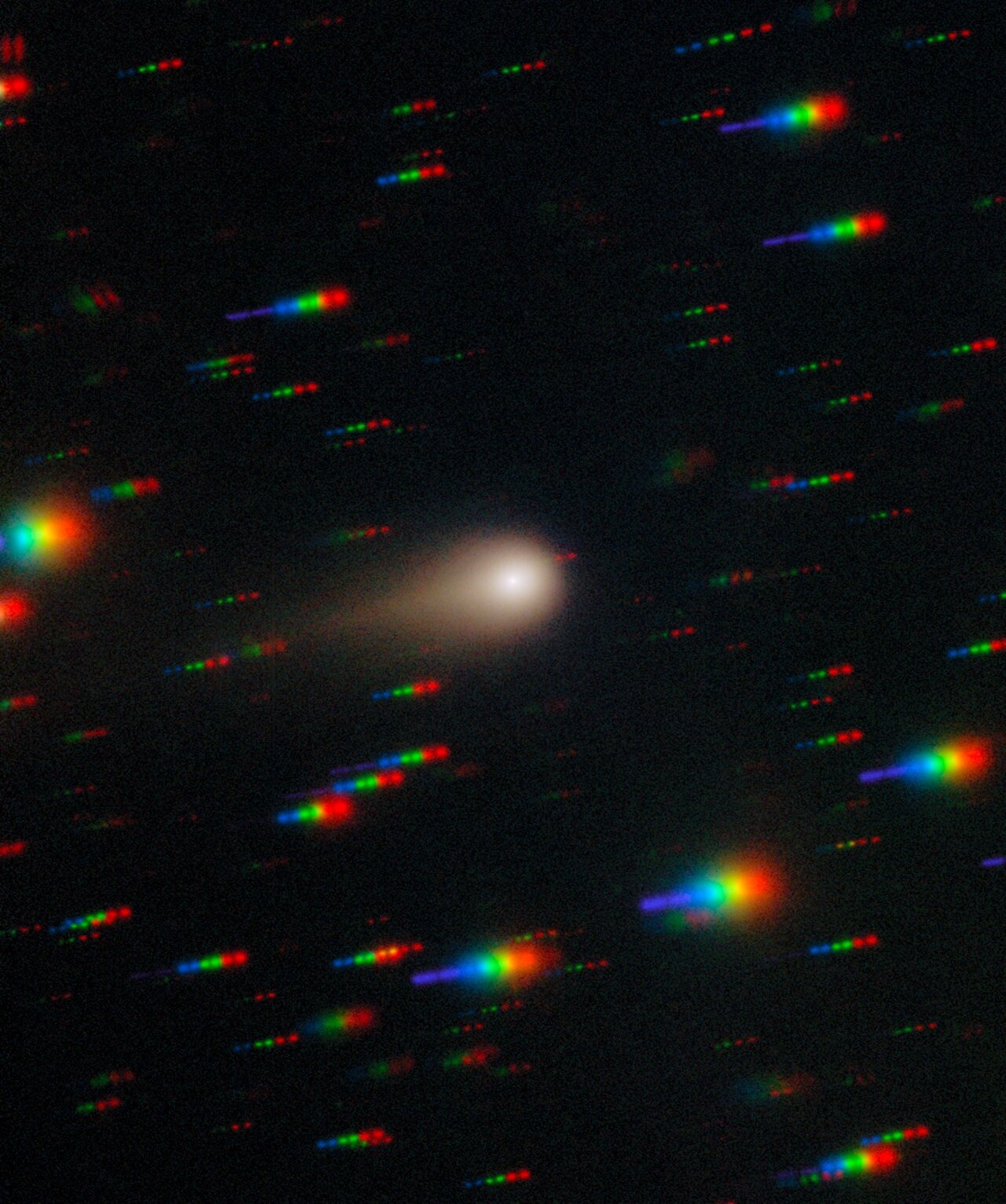
Released Thursday, the pictures taken by the Gemini South telescope in Chile late last month are the most detailed yet of the recently discovered comet. They show a wide coma of dust and gas around the ice ball as it speeds toward the sun, and also a tail that’s more extended than it was in previous shots.
These new images confirm that the comet is becoming more active as it plows harmlessly through our solar system, according to the National Science Foundation's NoirLab, which operates the telescope. It’s only the third known interstellar object to venture our way.
As of Thursday, the comet known as 3I-Atlas was 238 million miles (384 million kilometers) from Earth and growing ever nearer, according to NASA. It will make its closest approach to the sun at the end of October and then pass closest to Earth in December from 167 million miles (269 million kilometers) away — farther from Earth than the sun.
This story was first published on Sep. 4, 2025. It was updated on Sep. 5, 2025 to correct the name of the agency that operates the telescope. It is the National Science Foundation, not the National Space Foundation.
The Associated Press Health and Science Department receives support from the Howard Hughes Medical Institute’s Department of Science Education and the Robert Wood Johnson Foundation. The AP is solely responsible for all content.
Planeten vinden die lijken op de aarde en waar mogelijk ook leven is: het blijft een ontzettende uitdaging. Wetenschappers hebben echter een methode ontwikkeld waarmee we mogelijk aliens kunnen opsporen.
Tot nu toe hebben wetenschappers nog geen bewijs gevonden voor buitenaards leven. Alle levensvormen die we kennen – van eencellig tot meercellig – komen voor op onze eigen planeet waar vloeibaar water zorgt voor de noodzakelijke chemische reacties. Het opsporen van aarde-achtige exoplaneten is een enorme uitdaging. Een team astrofysici denkt nu een haalbare oplossing te hebben.
Exoplaneten vinden met huidige technologie is moeilijk Exoplaneten met vloeibaar water zenden het meeste licht uit bij golflengtes rond de 10 micrometer, ongeveer de dikte van een dunne mensenhaar en twintig keer de typische golflengte van zichtbaar licht. Om een planeet als de aarde te onderscheiden van een ster op een afstand van 30 lichtjaar, is een telescoop met een spiegeldiameter van minstens 20 meter nodig. Bovendien moet die telescoop in de ruimte worden geplaatst, omdat de aardse atmosfeer het beeld te veel vervaagt. De James Webb Space Telescope (JWST), met een diameter van 6,5 meter, was al een huzarenstukje om te lanceren. Een telescoop van 20 meter is simpelweg niet uitvoerbaar.
Alternatieve opties Daarom zoeken wetenschappers naar alternatieven. Ideeën variëren van zwermen kleinere telescopen die samen één groot geheel vormen, tot het gebruik van kortere golflengtes waarmee kleinere spiegels volstaan. Maar die opties brengen weer andere problemen met zich mee: de precisie die nodig is om meerdere telescopen in de ruimte te laten samenwerken is onhaalbaar en in zichtbaar licht is een zonachtige ster meer dan tien miljard keer helderder dan een planeet als de aarde. Het blokkeren van dat sterlicht ligt nog ver buiten ons technische bereik.
Wel haalbaar Een team onder leiding van Heidi Newberg van het Rensselaer Polytechnic Institute stelt nu een alternatief voor dat dichterbij de huidige mogelijkheden ligt. In Frontiers in Astronomy and Space Sciences presenteren de onderzoekers een ontwerp voor een telescoop met ongeveer hetzelfde formaat als de JWST, maar met een andere vorm: een rechthoekige spiegel van één bij twintig meter, in plaats van een ronde van 6,5 meter.
Die langwerpige spiegel zou het mogelijk maken een ster van een exoplaneet te scheiden. Door de spiegel te draaien kan de lange as telkens worden uitgelijnd met zowel ster als planeet. Volgens berekeningen van het team kan een dergelijke telescoop in minder dan drie jaar tijd de helft van alle aarde-achtige planeten binnen 30 lichtjaar opsporen.
30 veelbelovende planeten vinden Hoewel het ontwerp nog verdere ontwikkeling en optimalisatie vereist, zijn er geen onoverkomelijke technische obstakels. In veel opzichten lijkt de telescoop op de JWST, maar dan met een andere spiegelvorm. Als we veronderstellen dat er sowieso één aarde-achtige planeet draait om de gemiddelde zonachtige ster, dan zouden we ongeveer 30 veelbelovende planeten vinden. Nadat deze ontdekt zijn kunnen we aan de hand van vervolgonderzoek identificeren of er leven aanwezig kan zijn. De onderzoekers dromen er in ieder geval al van om vervolgens een sonde te sturen naar de meest veelbelovende planeet voor verder onderzoek.
Astronomers have obtained a color image of a rare visitor from deep space — comet 3I/ATLAS, which is hurtling through our Solar System at breakneck speed. This scientific photograph reveals the secrets of the formation of celestial bodies in distant star systems.
New images of 3I/ATLAS were obtained by the Gemini South telescope in Chile as part of the Shadow the Scientists program.
In August 2025, the GMOS spectrograph on the Gemini South telescope in Chile took a unique image of comet 3I/ATLAS. This object attracts the attention of scientists around the world because it is an interstellar traveler that has come to us from beyond our planetary system. Its incredible speed — over 200,000 km/h — undeniably confirms its origin in interstellar space.
Scientific value of the photograph
The magnificent color photograph clearly shows the coma — a cloud of gas and dust that surrounds the comet’s nucleus and expands as it approaches the Sun. Astronomers were particularly struck by the comet’s expressive tail, which had grown significantly longer compared to previous observations. Its length in the sky reaches 1/120 of a degree, which is comparable to the width of your pinky finger when you look at it with your arm outstretched.
In addition to its aesthetic appeal, this photograph has enormous scientific value. The main purpose of the observations was to study the colors of the comet and obtain its spectra. By analyzing the wavelengths of light emitted by the comet, scientists can accurately determine the chemical composition of dust particles in its coma and directly measure its chemical composition.
Discovery that brings worlds together
Color photograph 3I/ATLAS without distortion. Photo: noirlab.edu
Despite its exotic origin, spectral analysis of comet 3I/ATLAS revealed something surprising: its composition is very similar to comets that originated in our own Solar System. This discovery leads to a revolutionary assumption: comets in different parts of our galaxy are formed from similar materials and according to the same laws, regardless of their star system.
Karen Meech, an astronomer at the University of Hawaii who led the observations, notes that scientists have for the first time been able to see the chemical composition of such a comet from its spectrum and track changes in its particles.
Space traveler
Comets like 3I/ATLAS are extremely rare. It is only the third confirmed interstellar comet in history, joining the famous comets discovered in 2017 and 2019.
Unlike ordinary comets, which often perish when they approach the Sun, this traveler has a hyperbolic orbit. This means that it has only visited us temporarily and will soon return to the abyss of interstellar space, taking with it new knowledge about the Universe.
Wetenschappelijke Analyse van de Recent Claims over Aliens en UFO’s: Kritisch Evalueren van Bewijs en Logica
Inleiding
De recente verklaringen van voormalig luchtmachtofficier David Grusch, waarin hij beweert bewijs te bezitten dat de militaire overheid een programma voert voor het terughalen en reverse-engineeren van onidentificeerbare luchtverschijnselen (UAP), hebben wereldwijd voor opschudding gezorgd. Hij stelt dat dit programma al decennia bestaat en dat het niet alleen niet-menselijke “biologische materialen” en buitenaardse schepen bevat, maar ook dat deze technologie afkomstig zou zijn van buitenaardse beschavingen. Dit rapport analyseert deze claims kritisch en wetenschappelijk, met gebruikmaking van logische en empirische evaluatiemethoden, in het bijzonder de “SEARCH”-methode van Ted Schick, en benadrukt de noodzaak van bewijs gebaseerd op objectieve waarnemingen en redelijke aannames.
Hypothese en Onderzoeksvraag
De hypothese die centraal staat in dit artikel stelt dat de militaire overheid een actief en gestructureerd programma uitvoert met als doel het verzamelen, analyseren en reverse-engineeren van UFO’s (Onbekende Vliegen Objecten) en biologisch materiaal dat mogelijk afkomstig is van buitenaardse beschavingen. Deze hypothese impliceert dat overheidsinstanties niet alleen waarnemingen registreren, maar ook in staat zijn om geavanceerde technologieën en biologisch materiaal te bestuderen om inzicht te krijgen in buitenaardse technologieën en levensvormen. Daarnaast wordt de bewering gedaan dat er concreet bewijs bestaat dat buitenaardse beschavingen contact met de Aarde hebben gehad, wat suggereert dat er niet alleen observaties zijn gedaan, maar dat er mogelijk interacties of communicatie hebben plaatsgevonden die verder gaan dan louter waarnemingen.
De onderzoeksvraag die uit deze hypothese voortvloeit, richt zich op de validiteit en plausibiliteit van deze beweringen. Specifiek wordt gevraagd: “Is er voldoende en betrouwbaar bewijs dat de militaire overheid daadwerkelijk UFO’s verzamelt en reverse-engineert, en dat dit programma bewijs levert voor het contact tussen buitenaardse beschavingen en de aarde?” Daarnaast wordt onderzocht welke alternatieve verklaringen er bestaan voor de waarnemingen en gegevens die worden gepresenteerd, zoals natuurlijke fenomenen, menselijke technologie of andere niet-buitenaardse oorzaken.
Het onderzoek richt zich verder op het analyseren van beschikbare documenten, getuigenissen van betrokken ambtenaren, geclassificeerde rapporten en andere vormen van bewijs die kunnen ondersteunen of weerleggen dat de overheid een dergelijk programma voert. Ook wordt gekeken naar de betrouwbaarheid en authenticiteit van deze bewijzen, evenals de mogelijke motieven achter het verzwijgen of openbaar maken van informatie over UFO’s en buitenaards biologisch materiaal. Door deze uitgebreide analyse beoogt het artikel duidelijkheid te scheppen over de plausibiliteit van de hypothese en de onderliggende bewijsvoering, en zo bij te dragen aan het publieke debat over buitenaardse aanwezigheid en overheidsgeheimen.
Evaluatie van het Bewijs
Volgens de “SEARCH”-methode begint de evaluatie met het formuleren van de hypothese, gevolgd door het beoordelen van het bewijs.
Het Bewijs voor de Hypothese
Grusch heeft zich gebaseerd op getuigenissen van insiders binnen de militaire en inlichtingendiensten. Hij beweert dat zij toegang zouden hebben tot bewijsstukken zoals niet-menselijke schepen en biologisch materiaal afkomstig van crashplaatsen. Echter, belangrijk is dat deze claims grotendeels gebaseerd zijn op anonieme getuigenissen en persoonlijke verklaringen, zonder dat er openbaar bewijs wordt geleverd dat onafhankelijk is geverifieerd.
Volgens de principes van de empirische wetenschap en de logica van David Hume, is getuigenis op zich niet voldoende om een dergelijke uitzonderlijke claim te rechtvaardigen. Hume stelde dat miraculeuze gebeurtenissen, zoals het contact met buitenaardse wezens, niet geloofwaardig kunnen worden geacht op basis van getuigenissen alleen, omdat menselijke waarnemingen vaak feilbaar en onderhevig aan interpretatie- of geheugenfouten zijn. Bovendien, wanneer het gaat om fenomenen die de natuurlijke wetten schenden, moet het bewijs dat herhaald en direct is, veel sterker zijn dan enkel getuigenverhalen.
Het ontbreken van objectief bewijs
Tot op heden is er geen publiekelijk beschikbaar, onafhankelijk geverifieerd bewijs dat niet-menselijke schepen of biologisch materiaal daadwerkelijk is vastgesteld. Verschillende vermeende bewijzen, zoals foto’s, video’s of “absolute bewijzen,” zijn herhaaldelijk ontkracht of blijken niet overtuigend te zijn na diepgaand onderzoek. Dit onderstreept dat het bewijs dat volgens Grusch wordt aangevoerd, voornamelijk gebaseerd is op indirecte en subjectieve waarnemingen.
Het risico op zelfmisleiding en cognitieve biases
Het is waarschijnlijk dat getuigen en bronnen zichzelf hebben overtuigd van de authenticiteit van hun waarnemingen, ondanks het ontbreken van solide bewijs. Cognitieve biases zoals de Dunning-Kruger-effect, bevestigingsbias en de neiging tot overinterpretatie kunnen leiden tot het verkeerd inschatten van de betrouwbaarheid van waarnemingen. Mensen kunnen bijvoorbeeld biologische materialen of scheepsonderdelen verkeerd interpreteren of overschatten, vooral onder de druk van geheime informatie en geheime programma’s.
Alternatieve Hypothese: Louter Leugens of Misverstanden
De meest waarschijnlijke verklaring voor de claims van Grusch is dat hij of zijn bronnen zich vergissen of zich zelf hebben overtuigd van niet-bestaande bewijsstukken. Mogelijke scenario’s zijn:
Misinterpretatie van natuurlijke of menselijke objecten en materialen.
Contaminatie of fouten in de beoordeling van biologische stoffen.
Opzettelijke misleiding of het uitlokken van misinformatie, mogelijk voor persoonlijke of politieke doelen.
Slechte interpretatie van geheime militaire technologieën die niet buitenaards hoeven te zijn.
Deze alternatieven worden ondersteund door de geschiedenis van UFO-onderzoek, waarin veel vermeende “bewijzen” later werden ontkracht door wetenschappelijk onderzoek en kritische analyse. Het is essentieel om elke claim te beoordelen op basis van het bewijs dat herhaalbaar en onafhankelijk verifieerbaar is.
Logica en Wetenschappelijke Conclusie
De toepassing van logica en wetenschappelijke bewijsvoering vormt de kern van het kritisch beoordelen van beweringen over buitenaardse schepen en biologisch materiaal. Volgens de principes van de wetenschappelijke methode moeten beweringen worden onderbouwd door concreet, herhaalbaar en controleerbaar bewijs. Zonder dergelijke bewijzen is het uiterst onwaarschijnlijk dat de hypothese dat buitenaardse voertuigen en organismen zijn gevonden en geverifieerd, standhoudt.
Vanuit een logisch perspectief is het belangrijk om het bewijs dat wordt aangevoerd kritisch te bekijken. Veel beweringen over buitenaardse ontmoetingen zijn gebaseerd op getuigenissen, waarnemingen zonder fysieke resten of foto's die niet reproduceerbaar of verifiëerbaar zijn. Dit soort bewijs valt vaak onder anekdotisch bewijs, dat volgens de wetenschappelijke standaarden niet volstaat om een definitieve conclusie te onderbouwen. Bovendien moeten claims over het ontdekken van buitenaardse technologie en organismen voldoen aan strikte criteria van validiteit en consistentie, wat in veel gevallen ontbreekt.
Een belangrijke wetenschappelijke overweging betreft de natuurwetten die ons begrip van het universum vormen. Volgens de relativiteitstheorie en de beperkingen die zij oplegt aan reistijden door het heelal, is het zeer onwaarschijnlijk dat buitenaardse beschavingen ons al hebben bezocht. De immense afstanden tussen sterrenstelsels maken reizen met de snelheid van het licht, of zelfs met snelheden die dicht daarbij liggen, praktisch onmogelijk volgens onze huidige kennis. Zelfs als buitenaardse beschavingen geavanceerd genoeg zijn om dergelijke reizen te maken, zouden zij geconfronteerd worden met enorme technologische en energetische uitdagingen die niet eenvoudig kunnen worden genegeerd.
Daarnaast impliceert het bestaan van buitenaardse technologie dat de natuurwetten, zoals de energiebalans, de fysica van de materie en de kwantummechanica, significant zouden worden overtreden of uitgedaagd. Tot op heden ondersteunt het wetenschappelijke paradigma dit niet; er is geen bewijs dat de natuurwetten kunnen worden doorbroken zonder dat dit detecteerbaar is. Het zou betekenen dat er nieuwe fysische principes zouden moeten worden ontdekt die de huidige theorieën ondermijnen, wat een enorme sprong voorwaarts in onze wetenschap zou betekenen.
Verder is het aannemelijk dat veel van de vermeende bewijzen en waarnemingen niet meer zijn dan menselijke interpretaties, misverstanden, of zelfs opzettelijke misleiding. Veel 'buitenaardse' waarnemingen kunnen worden verklaard door natuurlijke fenomenen zoals atmosferische verschijnselen, technische storingen, of optische illusies. Daarnaast kunnen hallucinatietechnieken, psychologische factoren en de menselijke neiging tot patroonherkenning leiden tot het zien van buitenaardse structuren of voertuigen waar die niet zijn.
Samenvattend, op basis van logica en empirisch bewijs is de conclusie dat de hypothese van het vinden en verifiëren van buitenaardse schepen en biologisch materiaal zonder concreet bewijs uiterst onwaarschijnlijk. De huidige natuurwetten en wetenschappelijke paradigma’s ondersteunen deze conclusie. Het is daarom veel waarschijnlijker dat de bewijzen die worden aangevoerd, menselijke interpretaties, fouten of opzettelijke misleiding betreffen, dan dat ze daadwerkelijk bewijs zijn voor buitenaardse aanwezigheid. Alleen met herhaalbare, verificabele en onafhankelijke bewijzen kan deze hypothese serieus worden overwogen en mogelijk worden bevestigd door de wetenschap.
Vergelijking van Hypotheses: Parsimonie en Conservatisme
Bij het evalueren van verschillende verklaringen voor een fenomeen, zoals onverklaarbare waarnemingen van vreemde objecten aan de hemel, wordt vaak gebruik gemaakt van principes uit de wetenschappelijke methode. Twee belangrijke principes in dit proces zijn parsimonie (ook wel Occam’s scheermes genoemd) en conservatisme. Deze principes helpen om te bepalen welke hypothese het meest waarschijnlijk is op basis van eenvoud en consistentie met bestaande kennis.
Het principe van Occam’s scheermes stelt dat, tussen verschillende verklaringen die hetzelfde fenomeen kunnen verklaren, de eenvoudigste meestal de voorkeur verdient. Dit betekent dat men geen onnodige aannames moet doen, zoals het introduceren van complexe, niet-geloofde entiteiten of processen, tenzij het echt niet anders kan. In de context van UFO-waarnemingen en geruchten over geheime buitenaardse technologie, kunnen we twee hypothesen vergelijken:
Hypothese 1:“De militaire overheid bezit buitenaardse schepen en biologisch materiaal en voert een geheim programma uit.” Deze verklaring veronderstelt dat er een uitgebreide, geavanceerde buitenaardse technologie bestaat, die door de overheid wordt geheime gehouden. Het impliceert ook dat de overheid een grootschalig dekmanteloperatie voert, die decennia lang onopgemerkt zou blijven ondanks de controlemechanismen en transparantie in moderne samenlevingen. Deze hypothese vereist het bestaan van technologisch superieure buitenaardse schepen, het bestaan van biologische materialen van buitenaardse oorsprong, en een uitgebreide wereldwijde samenzwering die al die informatie verborgen houdt. Het is hiermee een complex en onconservatief scenario dat veel aannames bevat die niet direct ondersteund worden door bewijs. Volgens het principe van Occam’s scheermes is deze hypothese dus relatief onnodig complex en minder waarschijnlijke verklaring.
Hypothese 2: “De verklaringen zijn gebaseerd op misverstanden, misinterpretaties of opzettelijke leugens.” Deze verklaring stelt dat de waarnemingen en rapportages niet noodzakelijkerwijs buitenaards of geheimzinnig hoeven te zijn, maar het gevolg kunnen zijn van menselijke fouten, verwarring, of misverstanden. Bijvoorbeeld: optische illusies, technische storingen, psychologische factoren zoals suggestie of hysterie, of zelfs bewust gefabriceerde leugens en misleidingen. Deze verklaring sluit aan bij wat we weten over menselijke waarneming en geheugen, en over de neiging tot overdrijven of het maken van fouten bij het rapporteren van onduidelijke gebeurtenissen. Omdat deze verklaring geen ingewikkelde aannames vereist over buitenaardse technologie of geheime overheidsprogramma’s, is ze volgens het principe van Occam’s scheermes eenvoudiger en plausibeler.
Daarnaast speelt het principe van conservatisme een belangrijke rol. Dit principe houdt in dat we het meest conservatief moeten blijven in onze aannames, dat wil zeggen dat we niet meer moeten aannemen dan noodzakelijk is, tenzij er overtuigend bewijs is voor de meer complexe theorieën. In dit geval betekent dat dat we eerst moeten kijken naar verklaringen die het beste passen bij wat we al weten over menselijke waarnemingen en psychologische processen, voordat we uitgaan van exotische oorzaken zoals buitenaardse technologie.
Kortom, de vergelijking tussen deze hypotheses toont dat de verklaring gebaseerd op menselijke fouten en interpretaties niet alleen eenvoudiger is, maar ook meer in overeenstemming met de principes van wetenschappelijke voorzichtigheid. Het gebruik van parsimonie en conservatisme moedigt ons aan om eerst de meest eenvoudige en meest bewijsconforme verklaring te accepteren, voordat we overgaan tot complexere, minder ondersteunde scenario’s. Hierdoor blijven we kritisch en open-minded, maar ook rationeel en gebaseerd op de bestaande kennis en bewijsmateriaal.
Conclusie
Tot op heden is er geen overtuigend, herhaalbaar wetenschappelijk bewijs dat buitenaardse schepen of biologisch materiaal daadwerkelijk zijn ontdekt. De claims die door personen zoals Grusch naar voren worden gebracht, moeten daarom met grote scepsis worden bekeken. In de wetenschap is het cruciaal dat observaties en beweringen worden bevestigd door herhaalbare experimenten en objectieve waarnemingen. Zonder dergelijk bewijs blijven deze beweringen in het rijk van speculatie en theorieën die niet kunnen worden bevestigd.
De meest waarschijnlijke verklaring voor de claims van Grusch en soortgelijke verhalen is dat ze voortkomen uit misverstanden, verkeerde interpretaties of zelfmisleiding. Soms kunnen menselijke percepties worden beïnvloed door verwachtingen, of kunnen verhalen worden overdreven door de behoefte aan sensatie of media-aandacht. Daarnaast bestaat er ook de mogelijkheid dat sommige informatie opzettelijk wordt vervalst of misleidend wordt gepresenteerd om publieke interesse te wekken of andere doelen te dienen.
Het is daarom van groot belang dat de wetenschap en het publiek kritische vragen blijven stellen. Onderzoekers moeten blijven zoeken naar solide bewijs, en de media moeten waakzaam zijn voor het verspreiden van ongefundeerde claims die geen basis hebben in de feiten. Sensationalisme zonder onderbouwd bewijs ondermijnt het vertrouwen in wetenschappelijke methoden en kan leiden tot verwarring en wantrouwen.
Kortom, totdat er overtuigend bewijs wordt geleverd dat buitenaardse schepen en biologisch materiaal bestaan en zijn bevestigd door herhaalbare experimenten, moeten deze claims met de grootste voorzichtigheid worden behandeld. Het is essentieel om een kritische houding te behouden en niet meegesleept te worden door sensationele verhalen die niet op degelijke wetenschap berusten. Alleen door rigoureus onderzoek en verificatie kunnen we de waarheid achter dergelijke claims achterhalen en voorkomen dat onjuiste informatie zich verspreidt.
Aanbeveling
Het is cruciaal dat verder onderzoek en publieke discussies over vermeende ontmoetingen met buitenaardse wezens gebaseerd blijven op bewijs dat objectief verifieerbaar en reproduceerbaar is. Dit betekent dat gegevens en bevindingen onder gecontroleerde omstandigheden herhaald moeten kunnen worden door onafhankelijke onderzoekers, zodat de geldigheid ervan wordt bevestigd en niet het resultaat is van willekeur of subjectieve interpretaties. Het gebruik van wetenschappelijke methoden, zoals gestructureerde observaties, gecontroleerde experimenten en kritische beoordeling van bewijs, is essentieel om nepnieuws, misverstanden en verkeerde conclusies te voorkomen.
Daarnaast is het belangrijk dat onderzoekers transparant zijn over hun methodologie en bevindingen, zodat anderen deze kunnen controleren en valideren. Kritisch denken moet altijd de kern vormen van het proces, waarbij elke bewering zorgvuldig wordt geëvalueerd op haar bewijsvoering en plausibiliteit. Open discussie en het delen van gegevens onder wetenschappelijke consensus kunnen leiden tot een beter begrip van dit fenomeen, zonder dat men zich laat leiden door speculatie of ongefundeerde claims. Alleen door een objectieve en methodische aanpak kunnen we voorkomen dat misleidende of onjuiste informatie zich verspreidt en kunnen we op een rationele en geïnformeerde wijze omgaan met het onderwerp.
Samenvatting
De recente claims over het bestaan van geheime buitenaardse programma’s, gebaseerd op anonieme getuigenissen en zonder concreet bewijs, bieden geen solide wetenschappelijke basis. Deze verhalen worden vaak aangedragen door personen die anoniem blijven, wat het moeilijk maakt om de betrouwbaarheid te beoordelen. Daarnaast ontbreken er verifieerbare documenten of fysiek bewijs dat het bestaan van dergelijke programma’s ondersteunt. Wetenschappelijke studies en empirisch onderzoek wijzen uit dat deze verhalen meestal voortkomen uit menselijke fouten, misverstanden of bewust gemaakte misleiding. Psychologische factoren zoals hallucinerende ervaringen, groepsdruk of het verlangen naar sensatie kunnen eveneens bijdragen aan het ontstaan van dergelijke verhalen.
Het is belangrijk kritisch te blijven nadenken en de wetenschappelijke methode toe te passen bij het evalueren van dergelijke claims. Door feiten te onderzoeken en te verifiëren kunnen we misverstanden en ongefundeerde geruchten voorkomen. Totdat er concreet bewijs wordt geleverd, blijft de meest waarschijnlijke verklaring dat deze verhalen niet gebaseerd zijn op werkelijkheid, maar op menselijke interpretaties en fouten. Het handhaven van scepsis en het stimuleren van wetenschappelijk onderzoek blijven cruciaal om de waarheid rondom deze controverses te achterhalen.
A Harvard professor has proposed that a bizarre interstellar object speeding toward Earth might have been dispatched by aliens to evaluate our intelligence.Professor Loeb has been outspoken about his theories – and now proposes we should take action before it enters our solar system.
Research indicates the enigmatic interstellar object currently traveling through space is now "generating its own light". The peculiar UFO – named 3I/ATLAS – has sparked conjecture that it may be a technologically-sophisticated mothership. Loeb has been outspoken about this prospect, even proposing we should attempt to make contact.
While numerous experts have rejected these concepts as completely inaccurate, Loeb believes it could be worthwhile taking a closer examination. Prevailing theories propose the object is a comet – but Loeb says a photograph of the object reveals that light is emanating in a manner which differs from how comets typically reflect sunlight.
Loeb stated 3I/ATLAS's focused glow was comparable to a "vehicle turning on its headlights" before adding it "could be a spacecraft powered by nuclear energy", reports the Daily Star.
Building on this, Loeb says we should reach out and contact the space vessel – or perhaps intercept it to determine the intentions.
One of the initial recommendations made by Loeb was to utilize NASA's Juno spacecraft that was launched in 2011 to examine Jupiter.
The Harvard professor says if Juno accelerates by 2.6 kilometers per second on September 14, 2025, it could approach 3I/ATLAS and reach out to deliver a message. Loeb conducted calculations to determine the precise date this encounter could occur.
Based on his analysis, if Juno's trajectory can be adjusted, the spacecraft could rendezvous with the interstellar visitor 3I/ATLAS on March 14, 2026.
However, researchers have identified significant obstacles with this proposal. Loeb believes Juno could utilize its scientific equipment to "probe the nature of 3I/ATLAS from a close distance."
The celestial body is hurtling through space at an incredible velocity of 221,000 km/hr. Other experts argue this speed is far too rapid for any successful interception attempt.
Nevertheless, Loeb proposed in his blog that this represents an exceptional opportunity to examine the object. He observed: "The close encounter of 3I/ATLAS to Jupiter provides a rare opportunity to shift Juno from its current orbit around Jupiter to intercept the path of 3I/ATLAS at its closest approach to Jupiter"
Alien looking through the window of a spaceship in earth orbit, illustration
An additional recommendation from Loeb indicates that 3I/ATLAS approaches Mars in October. Loeb proposes utilizing the HiRISE camera aboard the Mars Reconnaissance Orbiter.
On October 3, 3I/ATLAS will be positioned 29 million kilometers from Mars, before closing to just 2.7 million kilometers within several days.
Most of the metallic orbs were reportedly spotted between 1 a.m. and 4 a.m.
(Image: Enigma)
A fresh report from a crowdsourced UFO-spotting app discovered that amongst hundreds of accounts of mysterious metallic spheres between 2022 and 2025, most were observed during the early hours near military facilities in California, New York and Arizona.
Enigma, which enables users to submit their own UFO encounters, recorded over 8,000 reports across the U.S. between Dec. 2022 and June 2025, according to the findings.
Uf these, 422 detailed sightings of a metallic sphere, with the vast majority witnessed between 1 a. m. and 4 a. m. within five miles of military installations. The news comes after a sleepy UK market town was revealed as secretly being a hotbed of mysterious UFO sightings.
Examining such enigmatic aerial objects falls under the Pentagon's All-domain Anomaly Resolution Office (AARO), which documented 757 cases between May 2023 and June 2024, according to the office's yearly report.
'While classic disc-shaped UFOs dominated mid-20th century sightings, orb-shaped UAP have emerged as one of the most frequently reported modern phenomena on Enigma," the report said.
"Often spotted at high altitudes near sensitive infrastructure, these orbs are described as hovering silently or darting across the sky at seemingly impossible speeds.
Enigma users logged more than 8,000 reports in the U.S. between Dec. 2022 and June 2025
(Image: US MQ-9)
'Frequently observed in restricted airspace'
"Consistently seen across the globe, the orbs typically lack visible propulsion systems or control surfaces.
"What makes these orbs especially compelling isn't just how often they appear, but where and how they operate. They are frequently observed in restricted airspace, near nuclear facilities, and have even been tracked on radar or captured by high-resolution infrared systems," the report added.
According to Enigma, former head of the AARO Dr. Sean Kirkpatrick presented a video of one such metallic sphere flying over the Middle East. The 24-second video was taken by an MQ-9, an unmanned aerial vehicle, though it was determined to be a "typical" unresolved UAP.
"While AARO assesses the object in the clip is not exhibiting anomalous behaviour, the object remains unidentified," the AARO report said.
Pentagon baffled by 8,000 mysterious UFO orbs hovering over US military bases An invasion of small
(Image: CC Composite Editor)
Enigma decoded
Of the hundreds of reports of metallic orbs, 43% mentioned the appearance of light and 40% said the object flew very low, according to Enigma. Another 35% said the object flew rapidly, fast or quick, and 38% reported the object was hovering.
A common theory about the metallic orbs paints them as surveillance devices, whether deployed by terrestrial governments or by "non-human intelligences," the Enigma report said.
"Some sceptics argue metallic orbs may be misunderstood weather balloons, optical illusions, or rare atmospheric conditions (like ball lightning)," the report admits. "And others maintain that they are a psychological manifestation, projected by the human mind during altered states or high-stress moments.
"Despite official statements and competing theories, their origin and purpose remain unknown."
Was it aliens, a top-secret government test balloon, or just “hyped up kids” spreading a wild tale of a flying saucer buzzing their playground?
Nearly 60 years on from the incident that has been dubbed “Australia’s Rowell”, the federal government is facing fresh calls to come clean on what it knows about the world-famous Westall UFO mystery.
Next year will mark the 60th anniversary of the incident known as Australia’s largest mass UFO sighting. It’s been the subject of documentaries, books and countless news articles and YouTube videos, with scores of witnesses sharing their stories over the years.
But six decades on, the ageing former students have never been given an official answer about what they saw — or why they were told to keep quiet.
The incident sparked a flurry of headlines.
Picture: Shane Ryan
“They just want to know what it was and why they were told to shut up about it,” said UFO researcher Grant Lavac, who has created a petition to parliament calling for an independent inquiry into the Westall incident.
On Wednesday, April 6, 1966, at around 11am, more than 200 students, teachers and members of the public observed three “metallic discs” or “flying saucers” with no obvious markings moving silently through the sky over Westall High School and Westall State School in Clayton South, about 25km southeast of the Melbourne CBD.
It was just before recess when a girl came running into the Year 9 science class of a young teacher, Andrew Greenwood, 20.
“This student bolted into the classroom and said, ‘Mr Greenwood, Mr Greenwood, there’s a flying saucer outside!’ The recess bell rang and there was a mass exodus of students onto the sports oval,” said Mr Lavac.
Australian UFO researcher Grant Lavac.
Picture: Supplied
Witnesses claim they watched as one of the objects descended towards a wooded area about 1km south of the school, known as The Grange.
The object landed among the pine trees before quickly flying away, leaving large circles of flattened grass with well-defined, discoloured edges behind.
Mr Lavac, who spoke to a number of witnesses for a 2023 YouTube documentary, noted they “all very compellingly recalled that what they saw was not a weather balloon” but rather a classic “flying saucer in the shape of two saucers up-ended and turned facing each other”.
Marilyn Eastwood was 13 when she watched the three objects as she stood on the school sports oval.
“Kids were screaming and so forth, get out into the oval and there was flying saucers,” she told Mr Lavac. “Looked up in the air and there was one just hovering in the playground.”
She said she was among the group of kids who ran over to The Grange.
Flying saucer themed children’s park at The Grange.
Picture: Chris Eastman
“I saw where it actually landed, the grass was flattened in a circular area,” she said.
“The speed that these flying saucers moved at was incredible. It was just unbelievable. Straight up and gone — vertical, horizontal, gone. Just amazing.”
Joy Clarke was 12 at the time and vividly remembers the events of that day.
“I was in class when students rushed in and told us the story,” she told news.com.au in 2016. “We rushed down to the oval and I saw three flying saucers on that day. My personal belief is they weren’t of this world. They were definitely from somewhere else because I have never seen anything like it all.”
Ms Clarke said the army and police then arrived.
“We were told we were hysterical and it didn’t happen, while men in black interviewed some of the other kids,” she said.
Terry Peck was playing cricket on the school oval when she saw the saucer and decided to chase it to The Grange.
“I was about six metres away from it,” she told the Herald Sun.
“It was bigger than a car and circular. I think I saw some lights underneath it. Two girls were there before me. One was terribly upset and they were pale, really white, ghostly white. They just said they had passed out, fainted. One was taken to hospital in an ambulance.”
Coverage in The Dandenong Journal.
Picture: Supplied
Every year on April 6, a number of Westall witnesses gather for a reunion at The Grange.
“They use it as an opportunity to share memories and keep them alive, but also to voice their frustration that the government has not provided an official explanation for what they observed,” Mr Lavac said.
“More importantly they want to know why they were told to shut up about it.”
In the hours after the sighting, the area was flooded with emergency services, military personnel and media outlets.
The Dandenong Journal ran with coverage of the incident on its front page for consecutive issues and Nine News also reported the story on its 6pm bulletin.
Speaking to the Greater Dandenong Leader in 2005, former Year 10 student Ken Stallard described watching the 20-metre round craft fly over the school.
“So many of us saw it,” Mr Stallard said.
“It never occurred to us that it didn’t happen or was an optical illusion. If it was, it was a pretty good optical illusion. It was 1966 … the space race was at its best. It was a mysterious time.”
Witnesses have consistently claimed they were told privately and collectively not to speak about the incident.
Joy Clarke aged 12, standing at the scene of the sighting.
Picture: Supplied
“Shortly after the incident an ad hoc assembly was called and the headmaster told all the students, ‘You’re not to say anything about this event, you’re not to talk about it,’ essentially saying ‘shut up’,” Mr Lavac said.
“That was reiterated individually to a number of students individually by people they thought were government officials or members of the military. That has been a source of their frustration for so long.”
Jacqueline Argent said she was one of the first three kids over the fence to look for the UFO landing site.
“Originally I thought it must have been an experimental-type aircraft, but nothing has emerged like that after all these years,’’ she told the Herald Sun.
Ms Argent claims she was called into the headmaster’s office and interrogated by three men immediately following the incident.
“They had good-quality suits and were well-spoken,” she said.
“They said, ‘I suppose you saw little green men.’ I spoke to my parents about it at the time and they were pretty outraged.’’
In 2021, Mr Greenwood came forward publicly for the first time, confirming he also witnessed the objects — and claiming he was “threatened” to keep quiet.
“I can remember running out into the oval, looking into the sky, and seeing these things, and just standing there absolutely transfixed,” Mr Greenwood told Seven’s Spotlight.
Former Westall science teacher Andrew Greenwood.
Picture: 7News Spotlight
“I haven’t seen anything in my life like it before, haven’t seen anything since.”
However Mr Greenwood, who passed away earlier this year, had a different recollection to the students. “It was a grey, almost cylindrical or cigar shaped object which moved with some degree of precision in the sky,” he said.
According to Mr Greenwood, two weeks later he was visited by two senior Royal Australian Air Force (RAAF) officers, one in a uniform and the other in a civilian suit.
Meer van UFO'S of UAP'S, ASTRONOMIE, RUIMTEVAART, ARCHEOLOGIE, OUDHEIDKUNDE, SF-SNUFJES EN ANDERE ESOTERISCHE WETENSCHAPPEN - DE ALLERLAATSTE NIEUWTJES


 “It Could Change in the Future”: Simulations of Earth’s Mysterious Core Just Revealed Something Unexpected