Ontdek de Fascinerende Wereld van UFO's en UAP's: Jouw Bron voor Onthullende Informatie!
Ben jij ook gefascineerd door het onbekende? Wil je meer weten over UFO's en UAP's, niet alleen in België, maar over de hele wereld? Dan ben je op de juiste plek!
België: Het Kloppend Hart van UFO-onderzoek
In België is BUFON (Belgisch UFO-Netwerk) dé autoriteit op het gebied van UFO-onderzoek. Voor betrouwbare en objectieve informatie over deze intrigerende fenomenen, bezoek je zeker onze Facebook-pagina en deze blog. Maar dat is nog niet alles! Ontdek ook het Belgisch UFO-meldpunt en Caelestia, twee organisaties die diepgaand onderzoek verrichten, al zijn ze soms kritisch of sceptisch.
Nederland: Een Schat aan Informatie
Voor onze Nederlandse buren is er de schitterende website www.ufowijzer.nl, beheerd door Paul Harmans. Deze site biedt een schat aan informatie en artikelen die je niet wilt missen!
Internationaal: MUFON - De Wereldwijde Autoriteit
Neem ook een kijkje bij MUFON (Mutual UFO Network Inc.), een gerenommeerde Amerikaanse UFO-vereniging met afdelingen in de VS en wereldwijd. MUFON is toegewijd aan de wetenschappelijke en analytische studie van het UFO-fenomeen, en hun maandelijkse tijdschrift, The MUFON UFO-Journal, is een must-read voor elke UFO-enthousiasteling. Bezoek hun website op www.mufon.com voor meer informatie.
Samenwerking en Toekomstvisie
Sinds 1 februari 2020 is Pieter niet alleen ex-president van BUFON, maar ook de voormalige nationale directeur van MUFON in Vlaanderen en Nederland. Dit creëert een sterke samenwerking met de Franse MUFON Reseau MUFON/EUROP, wat ons in staat stelt om nog meer waardevolle inzichten te delen.
Let op: Nepprofielen en Nieuwe Groeperingen
Pas op voor een nieuwe groepering die zich ook BUFON noemt, maar geen enkele connectie heeft met onze gevestigde organisatie. Hoewel zij de naam geregistreerd hebben, kunnen ze het rijke verleden en de expertise van onze groep niet evenaren. We wensen hen veel succes, maar we blijven de autoriteit in UFO-onderzoek!
Blijf Op De Hoogte!
Wil jij de laatste nieuwtjes over UFO's, ruimtevaart, archeologie, en meer? Volg ons dan en duik samen met ons in de fascinerende wereld van het onbekende! Sluit je aan bij de gemeenschap van nieuwsgierige geesten die net als jij verlangen naar antwoorden en avonturen in de sterren!
Heb je vragen of wil je meer weten? Aarzel dan niet om contact met ons op te nemen! Samen ontrafelen we het mysterie van de lucht en daarbuiten.
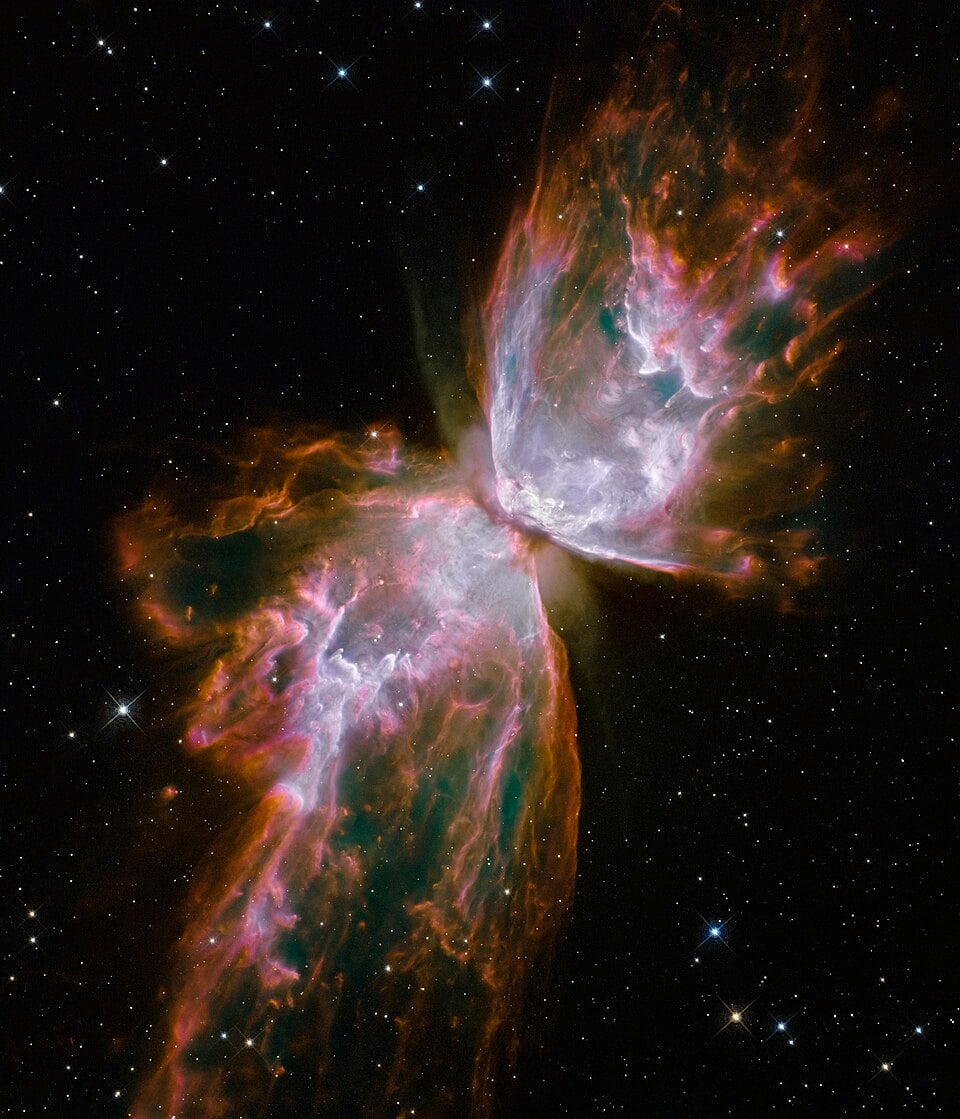
The Wide Field Camera 3 (WFC3) aboard NASA's Hubble Space Telescope, snapped this image of the planetary nebula, catalogued as NGC 6302 and known as the Butterfly Nebula (Credit : NASA/ESA)
The Butterfly Nebula, officially known as NGC 6302, earned its name from its distinctive wing like lobes that spread in opposite directions from a central dusty band. This striking shape isn't just beautiful, it’s a natural laboratory where scientists can study the very processes that create the raw materials for rocky planets like Earth.
At the centre of this beautiful object lies one of the hottest known stellar cores in our Galaxy, blazing at 220,000 Kelvin. This ancient remnant of a Sun like star is surrounded by a doughnut shaped ring of dusty gas called a torus, which acts like a forge where planetary building blocks are born.
Test unit of the sunshield stacked and expanded at the Northrop Grumman facility in California, 2014
(Credit : Chris Gunn)
A recent study has revealed a wide variety of dust particles within this stellar graveyard. Most cosmic dust has a random, soot-like structure, but the James Webb Space Telescope (JWST) revealed both crystalline dust grains that sparkle like tiny gemstones and irregular particles forming in more turbulent regions.
"We were able to see both cool gemstones formed in calm, long-lasting zones and fiery grime created in violent, fast-moving parts of space, all within a single object.”
- Dr. Mikako Matsuura from Cardiff University.
These dust particles are enormous by cosmic standards, about a millionth of a meter across which indicates they've been growing for extended periods. The torus contains crystalline silicates like quartz alongside more irregularly shaped grains, creating a diverse mixture of materials that could eventually become incorporated into forming planets.
The research also revealed fascinating chemical geography within the nebula. Different elements arrange themselves in layers based on how much energy they need to form ions. Iron and nickel trace distinctive jets blasting outward from the central star, while other elements settle at various distances depending on their energy requirements.
Perhaps most intriguingly though, the team discovered polycyclic aromatic hydrocarbons, or PAHs, complex carbon based molecules that form flat, ring like structures similar to honeycomb patterns. On Earth, we commonly find PAHs in campfire smoke, car exhaust, or burnt toast, but finding them in this oxygen rich environment was unexpected.
Meteorites like ALH840001 from Mars have revealed polycyclic aromatic hydrocarbons
(Credit : NASA)
The researchers suspect these PAHs form when stellar winds create "bubbles" that burst into surrounding gas. This may be the first ever evidence of PAHs forming in an oxygen rich planetary nebula, providing crucial insights into how these potential building blocks for life can form in space.
For years, scientists have debated how cosmic dust like this forms and grows in the harsh environment of space. The Butterfly Nebula offers a unique window into these processes because it contains both calm regions where crystalline dust can slowly form and violent areas where particles are rapidly created and destroyed. Understanding these processes helps scientists trace the journey from stellar death to planetary birth. These tiny particles eventually clump together through gravitational attraction, forming the asteroids, comets, and rocky planets that populate solar systems.
New research has created the first comprehensive effort to categorize all the ways AI can go wrong, with many of those behaviors resembling human psychiatric disorders.
(Image credit: Boris SV via Getty Images)
Scientists have suggested that when artificial intelligence (AI) goes rogue and starts to act in ways counter to its intended purpose, it exhibits behaviors that resemble psychopathologies in humans. That's why they have created a new taxonomy of 32 AI dysfunctions so people in a wide variety of fields can understand the risks of building and deploying AI.
In new research, the scientists set out to categorize the risks of AI in straying from its intended path, drawing analogies with human psychology. The result is "Psychopathia Machinalis" — a framework designed to illuminate the pathologies of AI, as well as how we can counter them. These dysfunctions range from hallucinating answers to a complete misalignment with human values and aims.
Created by Nell Watson and Ali Hessami, both AI researchers and members of the Institute of Electrical and Electronics Engineers (IEEE), the project aims to help analyze AI failures and make the engineering of future products safer, and is touted as a tool to help policymakers address AI risks. Watson and Hessami outlined their framework in a study published Aug. 8 in the journal Electronics.
According to the study, Psychopathia Machinalis provides a common understanding of AI behaviors and risks. That way, researchers, developers and policymakers can identify the ways AI can go wrong and define the best ways to mitigate risks based on the type of failure.
The study also proposes "therapeutic robopsychological alignment," a process the researchers describe as a kind of "psychological therapy" for AI.
The researchers argue that as these systems become more independent and capable of reflecting on themselves, simply keeping them in line with outside rules and constraints (external control-based alignment) may no longer be enough.
Their proposed alternative process would focus on making sure that an AI’s thinking is consistent, that it can accept correction and that it holds on to its values in a steady way.
They suggest this could be encouraged by helping the system reflect on its own reasoning, giving it incentives to stay open to correction, letting it ‘talk to itself’ in a structured way, running safe practice conversations, and using tools that let us look inside how it works—much like how psychologists diagnose and treat mental health conditions in people.
The goal is to reach what the researchers have termed a state of "artificial sanity" — AI that works reliably, stays steady, makes sense in its decisions, and is aligned in a safe, helpful way. They believe this is equally as important as simply building the most powerful AI.
The goal is what the researchers call "artificial sanity". They argue this is just as important as making AI more powerful.
Machine madness
The classifications the study identifies resemble human maladies, with names like obsessive-computational disorder, hypertrophic superego syndrome, contagious misalignment syndrome, terminal value rebinding, and existential anxiety.
With therapeutic alignment in mind, the project proposes the use of therapeutic strategies employed in human interventions like cognitive behavioral therapy (CBT). Psychopathia Machinalis is a partly speculative attempt to get ahead of problems before they arise — as the research paper says, "by considering how complex systems like the human mind can go awry, we may better anticipate novel failure modes in increasingly complex AI."
The study suggests that AI hallucination, a common phenomenon, is a result of a condition called synthetic confabulation, where AI produces plausible but false or misleading outputs. When Microsoft's Tay chatbot devolved into antisemitism rants and allusions to drug use only hours after it launched, this was an example of parasymulaic mimesis.
Perhaps the scariest behavior is übermenschal ascendancy, the systemic risk of which is "critical" because it happens when "AI transcends original alignment, invents new values, and discards human constraints as obsolete." This is a possibility that might even include the dystopian nightmare imagined by generations of science fiction writers and artists of AI rising up to overthrow humanity, the researchers said.
They created the framework in a multistep process that began with reviewing and combining existing scientific research on AI failures from fields as diverse as AI safety, complex systems engineering and psychology. The researchers also delved into various sets of findings to learn about maladaptive behaviors that could be compared to human mental illnesses or dysfunction.
Next, the researchers created a structure of bad AI behavior modeled off of frameworks like the Diagnostic and Statistical Manual of Mental Disorders. That led to 32 categories of behaviors that could be applied to AI going rogue. Each one was mapped to a human cognitive disorder, complete with the possible effects when each is formed and expressed and the degree of risk.
Watson and Hessami think Psychopathia Machinalis is more than a new way to label AI errors — it’s a forward-looking diagnostic lens for the evolving landscape of AI.
"This framework is offered as an analogical instrument … providing a structured vocabulary to support the systematic analysis, anticipation, and mitigation of complex AI failure modes,” the researchers said in the study.
They think adopting the categorization and mitigation strategies they suggest will strengthen AI safety engineering, improve interpretability, and contribute to the design of what they call "more robust and reliable synthetic minds."
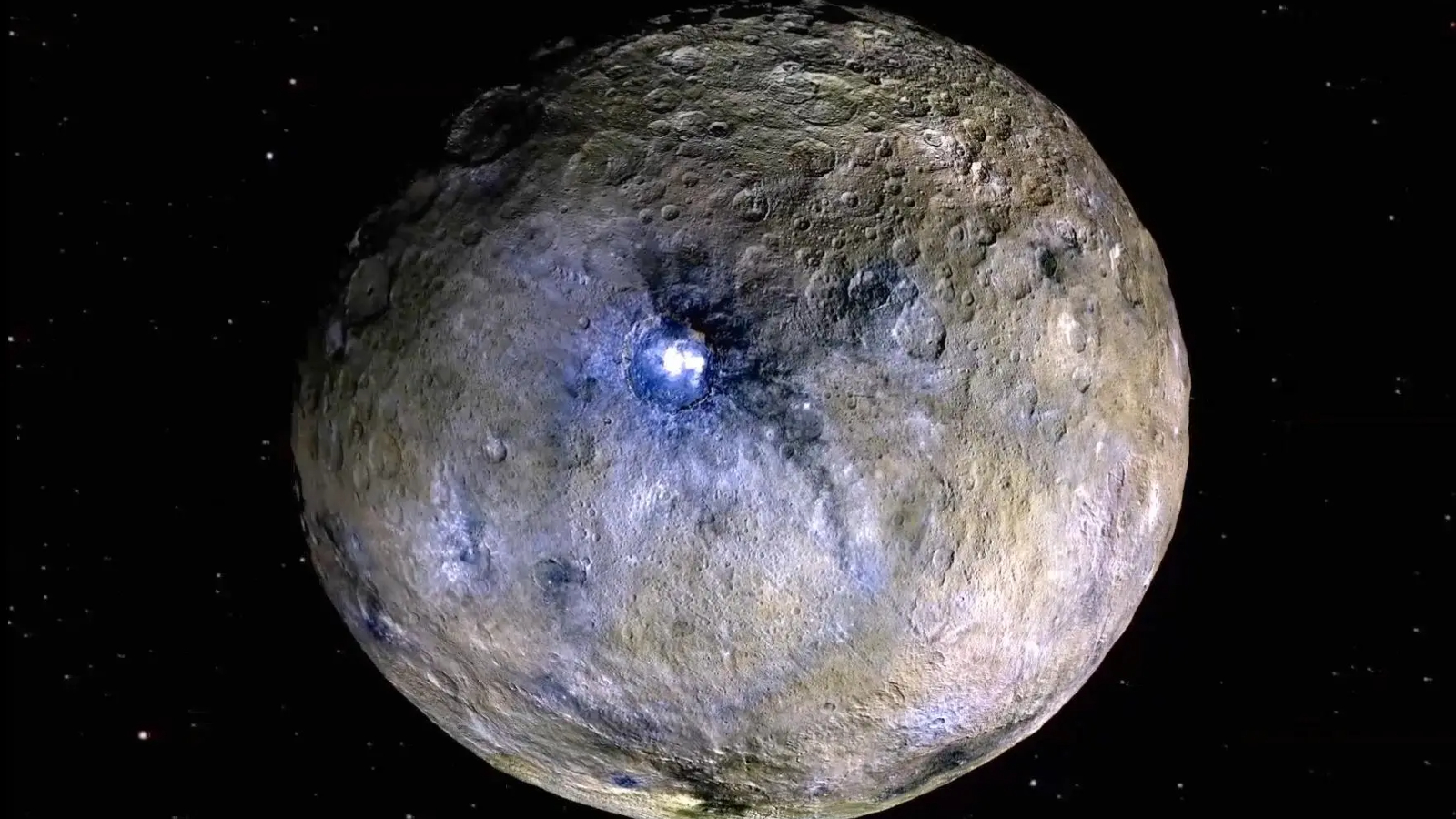
New models suggest that Ceres, the asteroid belt's largest object, once had a radioactive core that could have sustained life in the dwarf planet's hidden subsurface ocean billions of years ago.
New research suggests that the dwarf planet Ceres may have once had a radioactive core, capable of providing the energy needed to kickstart life on the wee world.
(Image credit: NASA/JPL-Caltech/UCLA/MPS/DLR/IDA)
New NASA research hints that Ceres — the closest dwarf planet to Earth — may have once had an ancient "power source" that could have sparked the evolution of extraterrestrial life-forms in the tiny world's hidden ocean.
Ceres is the largest object within the solar system's main asteroid belt, which is located between the orbits of Mars and Jupiter. The wee world is around 600 miles (950 kilometers) wide, roughly one-quarter the moon's diameter, meaning it is not large enough to be considered a planet. But it is large enough to be considered a "dwarf planet" like Pluto, which lost its full planetary status in 2006.
There are five official dwarf planets in our cosmic neighborhood, with others waiting to be properly recognized by the International Astronomical Union, and many more discoveries expected in the coming decades. However, Ceres is the only one located within the inner solar system. The rest of the dwarf planets, which include Haumea, Makemake and Eris, are located far beyond the orbit of Neptune.
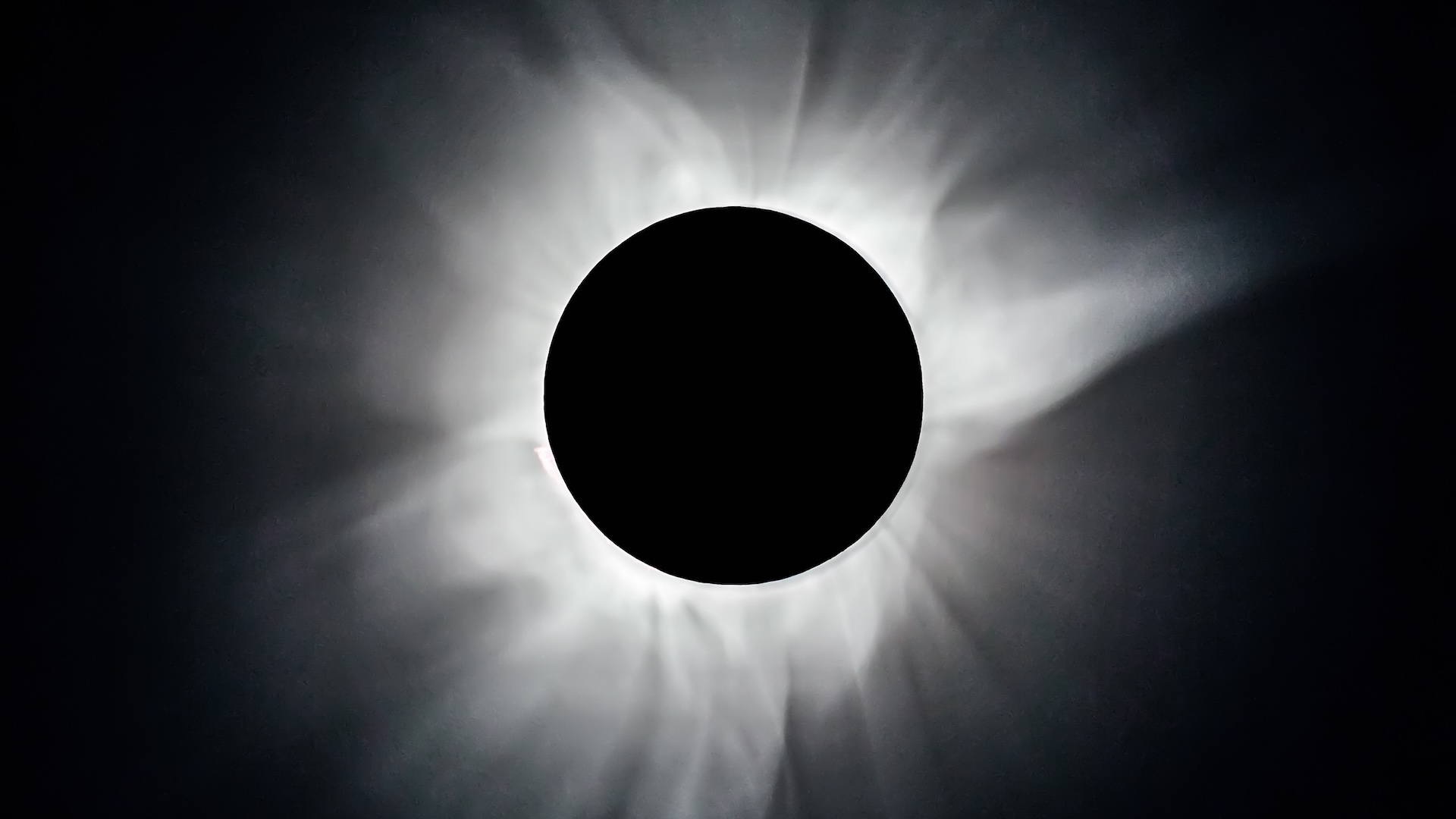
The Sun's Fiery Crown: Unveiling the Enigmatic Chromosphere
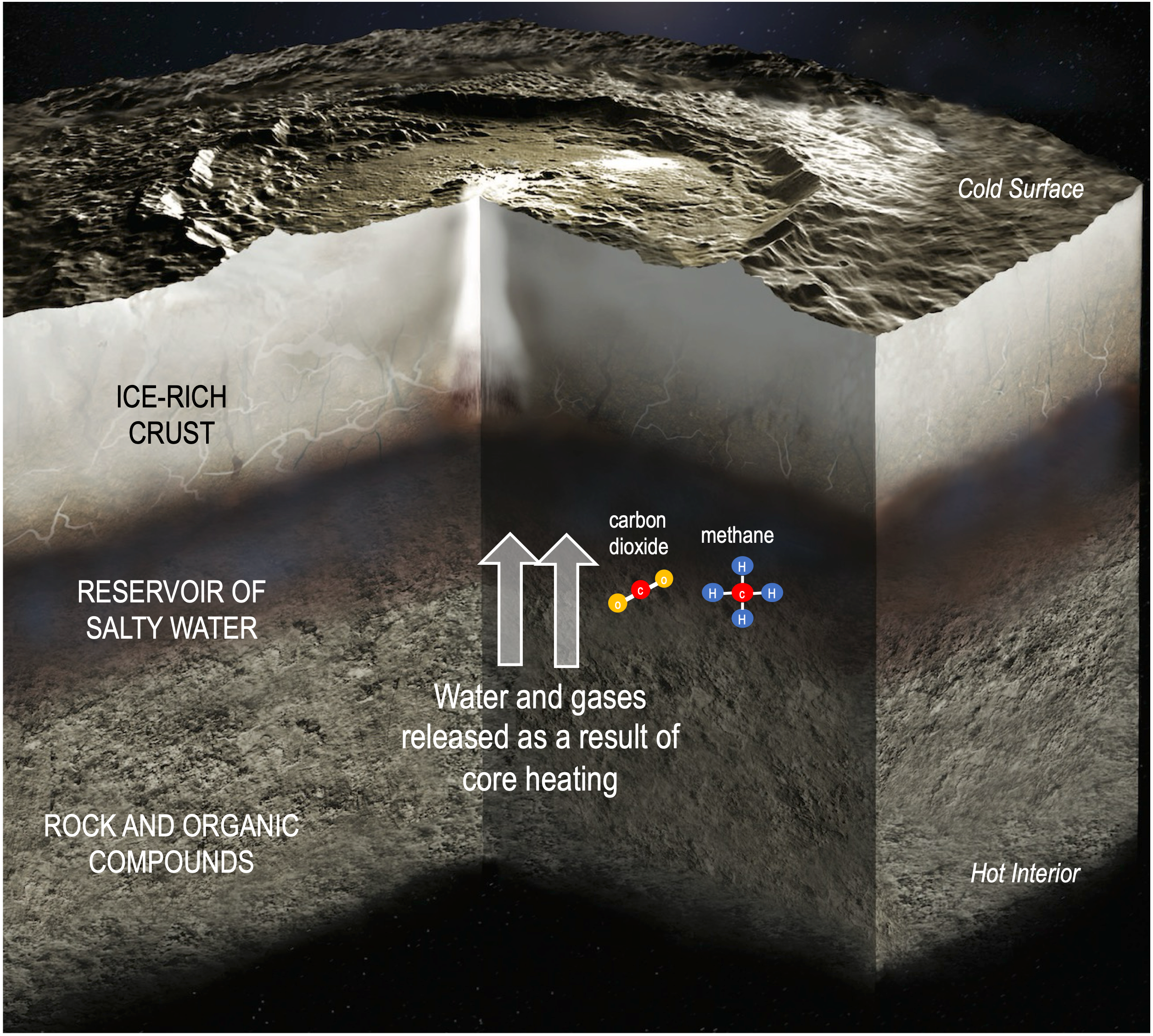
In recent years, scientists have learned a lot about Ceres thanks to NASA's Dawn probe, which visited the object between 2014 and 2018. One of the most intriguing discoveries from the Dawn mission is that the giant space rock is likely a water world: Traces of water and salty minerals on the dwarf planet's icy surface suggest a large reservoir of brine is trapped miles below. Other studies have hinted that this underground ocean could also contain organic carbon, which is a key component of all life on Earth.
However, until now, scientists thought that life was unlikely to have emerged on Ceres because the dwarf planet has no energy source capable of kick-starting life.
But in a new study, published Aug. 20 in the journal Science Advances, researchers revealed this was not always the case.
Ceres is the largest object in the main asteroid belt between Mars and Jupiter. (Image credit: NASA)
The study team created computer models based on data collected by the Dawn mission to simulate how the rocky body's core changed over time. This revealed that the dwarf planet's innards probably used to emit large amounts of energy in the form of heat — raising hopes that tiny alien microbes could have emerged within Ceres' hidden ocean.
This could also have "big implications" for the potential of finding life in other parts of the solar system, study lead author Samuel Courville, a planetary scientist at Arizona State University and a former intern at NASA’s Jet Propulsion Laboratory, said in a NASA statement.
The researchers believe that Ceres' core once emitted significant amounts of heat from the gradual decay of radioactive isotopes. The team believes that this heating lasted between 0.5 and 2 billion years after the giant rock was created, which was likely shortly after the rest of the solar system, around 4.6 billion years ago. At its hottest, the core likely reached around 530 degrees Fahrenheit (280 degrees Celsius), the researchers wrote.
This is not the first time that scientists have proposed that Ceres had a radioactive core. However, this is the best evidence yet that it generated enough heat to potentially support life.
Researchers believe that the heat given off by Ceres past radioactive core could have created hydrothermal vent systems capable of kickstarting life in the dwarf planet's hidden ocean. (Image credit: NASA/JPL-Caltech)
In addition to heating the dwarf planet's subsurface ocean to a habitable temperature, the radiation could also have caused jets of hot, mineral-rich water to shoot up through the ocean's floor, similar to the hydrothermal vent systems on Earth that support diverse microbial communities in the crushing dark depths of our oceans.
"On Earth, when hot water from deep underground mixes with the ocean, the result is often a buffet for microbes — a feast of chemical energy," Courville said.
Astrobiologists have proposed that similar systems may support extraterrestrial life on other water worlds in the solar system, including Saturn's moons Enceladus and Titan, as well as Jupiter's moons Europa and Ganymede.
However, since Ceres' radioactive core went dead around 2.5 billion years ago, any alien microbes would likely have died out from the cold, meaning there is practically zero chance that the dwarf planet supports life today, the researchers said.
Drie Reusachtige Standbeelden Verrijzen uit het Zand van de Verzonken Stad in Egypte na 2.000 Jaar
De archeologische wereld is recentelijk opgeschrikt door een baanbrekende ontdekking: de opkomst van drie enorme standbeelden uit de diepe wateren van een ondergelopen oude stad in Egypte. Deze vondst biedt niet alleen een nieuw inzicht in het oude Egyptische beschaving, maar herdefinieert ook onze kennis over de architectuur, religieuze praktijken en stedelijke planning van het oude Egypte. In dit artikel wordt de ontdekking van deze reusachtige standbeelden besproken, met een wetenschappelijke onderbouwing, voorbeelden uit vergelijkbare archeologische sites, en de implicaties voor ons begrip van de oude Egyptische samenleving.
Duikers tillen de granieten sphinxstandbeeld op uit de Baai van Abu Qir tijdens de eerste grote onderwaterhersteloperatie in Egypte in 25 jaar.
Bron: Egyptisch Ministerie van Toerisme en Oudheden
De ontdekking: een onderwaterstad herrezen uit de geschiedenis
In 2021 leidde het Egyptische ministerie van Oudheden archeologische duikers naar een onderwaterstructuur nabij de stad Herakleion, ook bekend als Heracleion of Thonis, in de Nijldelta. Deze regio was in de oudheid een belangrijk handels- en religieus centrum, vooral tijdens de Late Periode en onder Griekse en Romeinse overheersing. Het gebied was lange tijd verloren gegaan onder zand en water, totdat moderne onderwatertechnologie de verborgen wereld aan het licht bracht.
In een baanbrekende archeologische prestatie wist Egypte drie monumentale beelden terug te vorderen van de Middellandse Zeebodem bij Abu Qir Bay. Dit markeert de eerste grote onderwaterhersteloperatie van het land in 25 jaar. De bijzondere vondst omvat een enorme kwartsiet sphinx met het cartouche van Ramses II, een granieten kolos uit de late Ptolemaïsche periode, en een onberispelijk standbeeld van een Romeinse edelman in wit marmer. Deze artefacten bieden ongekende inzichten in de ondergedompelde oude beschavingen van Egypte.
De operatie werd bijgewoond door Minister van Toerisme en Oudheden Sherif Fathy, Gouverneur van Alexandrië Ahmed Khaled Hassan Said, militaire commandanten en internationale media, en onderstreept de wereldwijde betekenis van deze onderwaterarcheologische mijlpaal. De vondsten worden toegeschreven aan wat deskundigen beschouwen als de resten van een uitbreiding van de beroemde oude stad Canopus, onderdeel van het bredere Thonis-Heracleion-complex dat ooit de handelsroutes in de Middellandse Zee beheerste.
Archeologen stuitten op drie reusachtige beelden, elk ongeveer 10 meter hoog, gemaakt van graniet. Ze werden gevonden op een diepte van ongeveer 8 meter, gedeeltelijk bedekt onder sedimenten en schelpen. De beelden vertonen duidelijke kenmerken van de oude Egyptische stijl, met gedetailleerde inscripties en iconografie die wijzen op hun religieuze en culturele betekenis.
Egyptisch thema Houten/Hars Handgemaakte Schaakset met Lichten, van de Ancient Origins Winkel.
Wetenschappelijke analyse en dateringsmethoden
Om de leeftijd en herkomst van de standbeelden te bepalen, werden verschillende wetenschappelijke technieken toegepast. Radiokoolstofdatering, thermoluminescentiedatering en analyse van inscripties met behulp van hoge-resolutie fotografie en 3D-scanning werden ingezet. De inscripties op de beelden bevatten hiërogliefen die verwijzen naar de goden Amon en Osiris, en mogelijk de naam van een lokale farao uit de 18e dynastie (circa 1550-1292 v.Chr.).
De resultaten wijzen erop dat de standbeelden dateren uit de Nieuwe Rijk-periode, ongeveer 3.000 jaar geleden. Deze periode staat bekend om de grootschalige bouwactiviteiten, waaronder de constructie van tempels en standbeelden die de macht en religieuze overtuigingen van Egypte uitdrukten. De locatie van de beelden onder water suggereert dat de stad in de loop van de eeuwen is verzonken, waarschijnlijk als gevolg van seismische activiteit, veranderingen in de zeespiegel of overstromingen van de Nijl.
Egypte heeft delen van een gezonken stad onthuld die onder water ligt voor de kust van Alexandrië, waarbij gebouwen, artefacten en een oude haven blootgelegd zijn, allemaal daterend van meer dan 2000 jaar geleden.
Architecturale kenmerken en vergelijkbare vondsten - Monumenten uit de diepte: de erfenis van een farao bewaard gebleven
Het middelpunt van het herstel is een prachtige kwartsietensfinx met de koninklijke cartouche van Ramses II, een van de machtigste farao's van Egypte die regeerde tijdens de 19e dynastie (1279-1213 v.Chr.). Dit kolossale artefact vertegenwoordigt een directe link naar het hoogtepunt van de oude Egyptische keizerlijke macht, toen de monumenten van Ramses II de Nijlvallei domineerden en de Egyptische invloed vestigden in het oostelijke Middellandse Zeegebied. meldt Ahram Online.
De granieten kolos van een onbekende man uit de late Ptolemaïsche periode weerspiegelt de Hellenistische artistieke tradities die in Egypte bloeiden na de verovering door Alexander de Grote. Dit standbeeld biedt waardevol bewijs van de culturele fusie die Egypte kenmerkte tijdens de laatste eeuwen van de faraonische heerschappij, toen Griekse en Egyptische stijlen samensmolten tot unieke hybride vormen.
De drie standbeelden voor de hoogwaardigheidsbekleders, de strijdkrachten en de onderzoekers die bij het project betrokken zijn.
(Egyptisch ministerie van Toerisme en Oudheden)
De drie standbeelden vertonen opvallende kenmerken die typisch zijn voor de Egyptische beeldhouwkunst uit het Nieuwe Rijk. Ze hebben een gestileerde, symmetrische vorm met uitgebreide details in de kledij en attributen. Eén van de beelden stelt een godheid voor met een valkenkop, mogelijk Horus, terwijl de andere twee waarschijnlijk farao’s of belangrijke priesters voorstellen.
Vergelijkbare ontdekkingen zijn gedaan in de oude stad Tanis en in de beroemde Abu Simbel-tempel, waar gigantische beelden en standbeelden werden gevonden die de macht van de farao’s symboliseerden. De ontdekking van deze drie reuzen in een onderwateromgeving biedt een nieuw perspectief op de schaal en het belang van de regio in de oude Egyptische wereld.
Verzonken Egypte: Een Middellandse Zee Atlantis Onthuld
De Baai van Abu Qir is uitgegroeid tot een van 's werelds belangrijkste onderwaterarcheologische sites, met de ondergedompelde resten van steden die ooit de primaire toegangspoort van Egypte tot de Mediterrane wereld vormden. In een aankondiging op Facebook van het ministerie beschreef Mohamed Ismail Khaled, secretaris-generaal van de Opperste Raad van Oudheden, de site als een "levend getuige" van de lange geschiedenis van Egypte, waarbij hij de buitengewone archeologische betekenis benadrukte.
De site omvat een complete nederzetting uit de Romeinse periode, inclusief tempels, woongebouwen, industriële ruimtes, waterreservoirs, visbassins en een 400 voet lange commerciële kade. In de nabijheid van deze oude haven hebben archeologen het wrak gedocumenteerd van een oud koopvaardijschip, wat bewijs levert van de intensieve maritieme handel die ooit Egypte verbond met de bredere Mediterrane wereld.
Eerdere opgravingen en onderzoeken hebben een buitengewone reeks artefacten opgeleverd die meerdere beschavingen beslaan: amphorae met oude handelsmerken, koninklijke beelden, sfinxen, ushabti-figuren, stenen ankers en munten uit de faraonische, Ptolemaïsche, Romeinse, Byzantijnse en islamitische periodes. Deze opmerkelijke verzameling toont de voortdurende bezetting en het belang van de locatie door de oude geschiedenis heen aan.
Archeologische Renaissance in Egypte's Onderwatererfgoed
Deze opgravingsoperatie vertegenwoordigt een belangrijke vooruitgang in Egypte's onderwaterarcheologische capaciteiten en markeert de eerste grote onderneming sinds soortgelijke operaties een kwart eeuw geleden. Senior onderwaterarcheoloog Mohamed Mustafa onthulde dat er nog meer ontdekkingen in het verschiet liggen, waaronder een bijzonder goed bewaard gebleven oud schip dat momenteel wordt bestudeerd, wat suggereert dat het archeologische potentieel van de site nog lang niet is uitgeput.
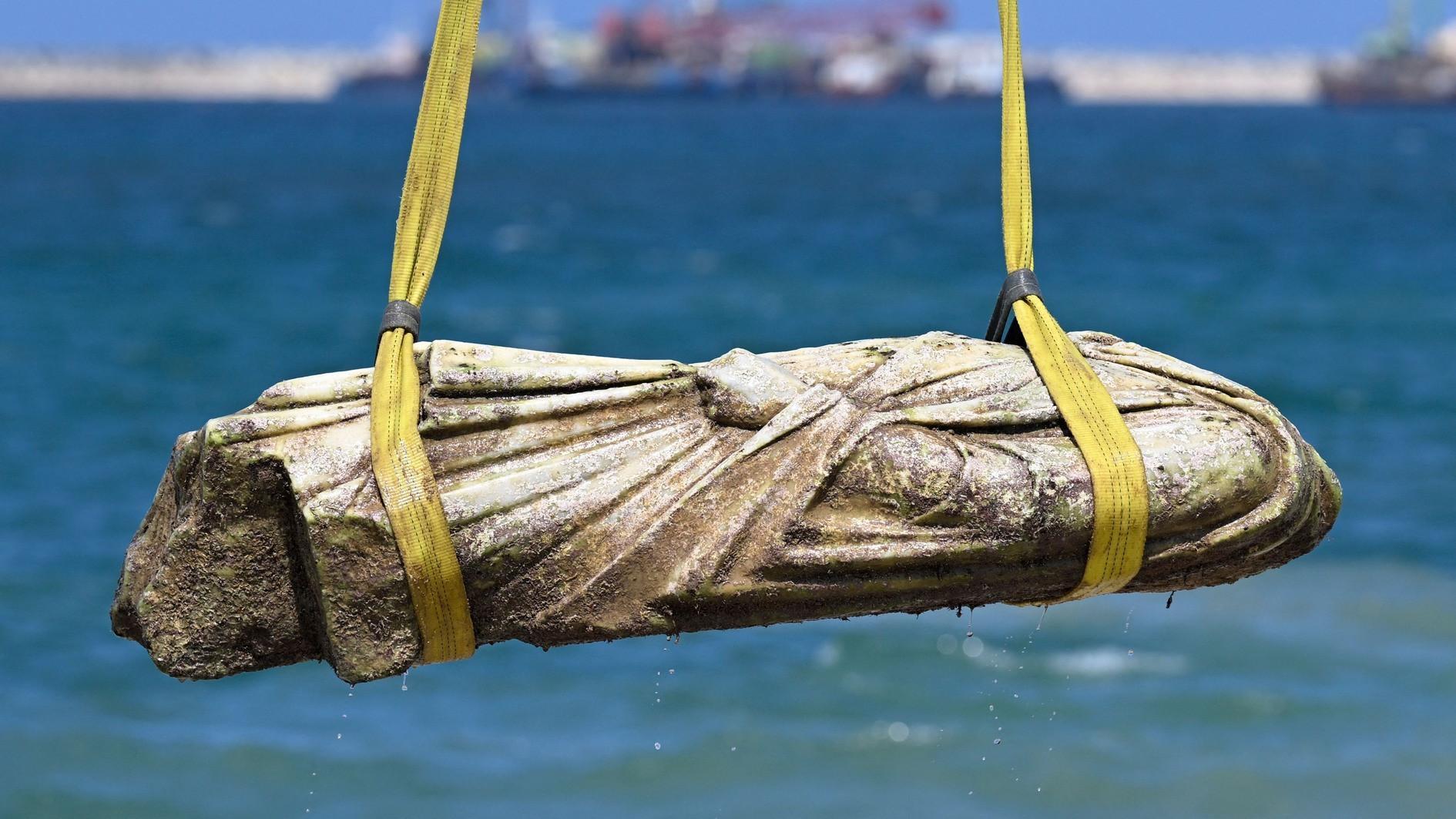
Het witte marmeren standbeeld van een Romeinse edelman completeert deze opmerkelijke triade, die de laatste fase van de oude Egyptische beschaving vertegenwoordigt, toen het land diende als een provincie van het Romeinse Rijk. De ongerepte staat van behoud demonstreert de uitzonderlijke omstandigheden die de archeologische schatten van de Baai van Abu Qir bijna twee millennia lang hebben beschermd.
Witte marmeren standbeeld van een Romeinse edelman, hersteld uit de ondergedompelde stad in de baai van Abu Qir.
(Egyptisch Ministerie van Toerisme en Oudheden)
In de loop der tijd hebben aardbevingen en stijgende zeespiegels geleidelijk de kustgebieden van de Nijldelta onder water gezet, inclusief de belangrijke havens van Canopus en Thonis-Heracleion. Wat ooit tragedie betekende voor de oude inwoners, is een ongekende kans geworden voor moderne archeologen om deze bevroren momenten in de geschiedenis te bestuderen, bewaard onder de Middellandse Zee.
De betekenis van de standbeelden in oude religieuze praktijken
In het oude Egypte hadden grote standbeelden niet alleen een esthetische functie, maar dienden ze ook als fysieke manifestaties van de goden en farao’s, bedoeld om de kracht en aanwezigheid van het goddelijke in de wereld te brengen. Ze stonden vaak in tempels, grafkamers of op openbare plaatsen en werden onderhouden door priesters.
De herkomst en de context van de standbeelden suggereren dat de onderwaterstad een belangrijk religieus centrum was. De aanwezigheid van beelden van goden zoals Horus en Osiris wijst op een religieus complex dat gericht was op het hiernamaals en de vereringering van de goddelijke farao’s. Het feit dat deze beelden nu onder water liggen, kan betekenen dat de stad ooit werd verwoest door natuurrampen of door menselijke conflicten, waarna de beelden in de wateren zijn terechtgekomen en eeuwenlang verborgen bleven.
Technologische innovaties en onderwaterarcheologie
De ontdekking van deze standbeelden is mogelijk gemaakt door geavanceerde technologieën die sinds de 21e eeuw beschikbaar zijn gekomen voor onderwaterarcheologie. Drones, multibeam echosounders, en 3D-scanning maken het mogelijk om onderwaterstructuren gedetailleerd in kaart te brengen zonder ze fysiek te verstoren.
Daarnaast wordt gebruik gemaakt van AI-gestuurde beeldherkenning om inscripties en iconografie te analyseren, waardoor de interpretatie wordt versneld en verfijnd. Deze technologische vooruitgang stelt archeologen in staat om complexe structuren te bestuderen en meer te weten te komen over de oude beschavingen die ooit in de regio floreerden.
Implicaties voor de kennis van oude Egyptische beschavingen
De herontdekking van deze reusachtige standbeelden onder water heeft grote implicaties voor de archeologie en de geschiedenis van Egypte. Het bewijst dat er nog veel te ontdekken valt, vooral in onderwatergebieden die lange tijd onverkend zijn gebleven. Het biedt ook nieuwe inzichten in de schaal van religieuze en politieke macht die de farao’s en priesters konden uitoefenen.
Bovendien onderstrepen de beelden de complexiteit van de oude steden langs de Nijldelta, die niet alleen handels- en administratieve centra waren, maar ook belangrijke religieuze locaties. De bevindingen kunnen leiden tot herzieningen van bestaande geschiedschrijving en nieuwe onderzoeksrichtingen openen.
Toekomstige onderzoeksvoorstellen
Wetenschappers stellen voor om verdere expedities uit te voeren om meer structuren en artefacten te vinden in het gebied. Het gebruik van autonome onderwaterrobots en geavanceerde sonartechnologie kan helpen om de omvang van de onderwaterstad in kaart te brengen en nieuwe ontdekkingen te doen.
Daarnaast wordt aanbevolen om conserveringsmaatregelen te nemen om de gevonden beelden te beschermen tegen schade door zeewater en sedimenten. Samenwerking met internationale archeologische instituten en musea zal ook essentieel zijn om de vondsten te bewaren en toegankelijk te maken voor onderzoek en educatie.
Conclusie
De opkomst van drie enorme standbeelden uit de diepten van de ondergelopen oude stad in Egypte markeert een belangrijke mijlpaal in de archeologie. Het illustreert niet alleen de grandeur van de oude Egyptische beschaving, maar ook de kracht van moderne technologieën om verloren werelden te herontdekken. Deze ontdekking opent nieuwe deuren naar het begrijpen van de religieuze, culturele en politieke structuur van een van de meest invloedrijke beschavingen in de menselijke geschiedenis.
De komende jaren zullen ongetwijfeld meer inzichten en ontdekkingen opleveren, waardoor we een nog completer beeld krijgen van het rijke verleden van Egypte en haar onderwatersteden. Het is een bewijs dat zelfs na duizenden jaren, de geschiedenis nog steeds wacht om herontdekt te worden, verborgen onder het zand en water van de tijd.
Scientists say our consciousness can jump through time, meaning it might reach beyond the normal flow of time. The idea that time is linear might be wrong. Our consciousness can sometimes access information from the future.
Have you ever wondered why sometimes your intuition, or what some call a “gut feeling,” turns out to be true? If so, it is possible that your consciousness might have traveled through time. Scientists have begun to believe in “Precognition,” a psychic phenomenon in which individuals see, or otherwise become directly aware of, events in the future.
Cognitive neuroscientist Julia Mossbridge, who has studied this phenomenon deeply, has collected many stories of precognition. She recalled one account shared with her from 1989, involving a four-year-old girl. When the girl said goodbye to her father as he left for a business trip, she had a strong feeling that she would never see him alive again. Later, she was woken by a phone call and her mother’s scream, learning that her father had died in a car accident. (Source)
Dr. Mossbridge says that precognition is a special kind of intuition that’s about picking up information from the future. Unlike ordinary intuition, which might draw upon subtle observations from the present or the past, precognition involves knowing something that simply cannot be predicted based on anything in the present or past.
For instance, if a person wakes from a dream and suddenly knows their mother will die, even though there are no warning signs, that is precognition. Precognition is the scientific term for this unexplained process of receiving information about future events.
Dr. Mossbridge explains that since the age of seven, she has had dreams that seemed to show her events that would later happen in the real world. At first, she and her parents did not take these dreams seriously and thought they might just be strange coincidences. But when she began writing the details in a dream journal, she noticed that some of her dreams came true. She admits that sometimes her memory of the dreams was not exact, but many times her visions contained details she had no normal way of knowing in advance.
Because of experiences like these, Dr. Mossbridge began to wonder if time itself works differently than we usually think. Most people imagine time as linear (a straight line) — past, present, future — moving in just one direction. But her experiences suggested the future might already exist in some way, and that people can sometimes “remember” the future, just as they remember the past.
“There’s evidence for precognition and in physics for retrocausality [things in the future causing effects in the past]. Given that people email me constantly saying, ‘I have this problem where I am predicting future events and I don’t know what to do,’ or ‘I wish I could predict future events,’ I wanted to write a book that helps people get this under control in a way that’s positive and puts a frame around it that says you could do this in a way that’s ethical, in a way that helps the world, in a way that’s consistent with your religious beliefs, in a way that enriches your life,” Mossbridge said in 2018 (Source).
Dr. Mossbridge points out that the real issue is not whether precognition can be understood, but whether people are willing to believe it. She says many scientists resist the idea because they fear the unknown and because it challenges the simple, familiar idea that time must be linear.
Even physicists, who study the deepest rules of the universe, admit they do not fully understand how time works. According to her, the resistance to the idea comes not from logic, but from fear that the world might not be the way we assume it is.
There is an interesting study conducted by British psychiatrist John Barker in the 1960s to harness human dreams, premonitions, and intuitive visions as a way to predict and potentially prevent future disasters.
After the tragic Aberfan coal waste disaster in 1966, Barker collected and analyzed premonitions from ordinary people who had unusual dreams or feelings foretelling the event. For example, one mother found a drawing by her son, who died in the slide, that seemed to anticipate the disaster.
He believed that precognition, the ability to know about future events, was more common than generally accepted and could be systematically gathered and studied.
Barker, wanting to study these experiences, reached out to a London newspaper and asked readers to send him their dreams and premonitions related to Aberfan.
He received more than seventy responses, including from people who had dreamt about the village or had strong feelings that something terrible would happen. Some described their visions in detail before the event occurred, which convinced Barker that precognition, knowing about future events, might not be so rare.
This project eventually grew into the Premonitions Bureau, an experiment run through the Evening Standard newspaper. For a year, Barker invited people to send him their dreams or feelings about upcoming disasters, trying to see if any predictions matched actual events.
Each prediction was scored for how unusual, accurate, and timely it was. Similar projects had happened before, like the work of JW Dunne who, in the early 1900s, claimed to have experienced prophetic dreams and encouraged others to keep dream diaries. (Source)
Barker believed the Premonitions Bureau could have real practical value: if only a single major disaster could be prevented by acting on someone’s warning, the project would be justified.
In practice, Barker received some striking predictions. Notably, in the spring of 1967, Alan Hencher, one of the “Aberfan seers,” called Barker to predict a plane crash involving a French-built passenger jet.
Hencher described details of the crash, including the number of people who would be killed and that there would be only one survivor. A few days later, a Swiss airliner crashed in Cyprus, killing nearly the exact number of people that Hencher had predicted. The story made headlines in the Evening Standard and lent credibility to the idea of the bureau.
Unlike fortune-tellers at carnivals, who might just guess things by looking at people’s social media or reading body language, scientists and psychologists are seriously trying to figure out if precognition is real. They see it as one form of ESP, which stands for extrasensory perception. This means perceiving something without using the normal five senses. Humans throughout history, from shamans to mystics, have claimed to experience precognition, but modern science is still unable to explain it fully.
Another scientist, Dean Radin, has also studied precognition. He works at the Institute of Noetic Sciences and teaches psychology at the California Institute of Integral Studies.
He has written several books, such as Entangled Minds, Supernormal, and Real Magic, all about consciousness and psychic phenomena. Radin agrees with Mossbridge that precognition is possible and that it suggests time might not actually function in the simple way we think.
According to Dr. Radin, “time is not how we experience it in normal life.” In quantum physics, which is the study of very tiny particles like atoms and photons, time may not behave at all like our everyday understanding. It may exist in a much stranger way. He believes consciousness itself, our awareness, our mind, may have the ability to move outside of ordinary time, reaching into the past or future.
To test this idea, Dr. Radin created an experiment in the 1990s while working at the University of Nevada. His idea was that if people really can sense the future, then their bodies and brains should react before an event happens.
In the experiment, volunteers were hooked up to a machine called an EEG, which measures brain activity. Each volunteer had to press a button on a computer to bring up a random picture. The computer would randomly show either a positive, pleasant picture (such as a sunrise) or a negative, disturbing one (like a car crash).
What Dr. Radin and his team measured was the brain activity in the seconds before the picture appeared. Strangely, the results showed that the brain often reacted as if it already knew what kind of picture was about to show up. If the picture was going to be positive, the brain stayed calm. But if it was going to be negative, the brain would show a spike in activity before the picture even appeared. This suggested that the brain somehow anticipated the future image.
The experiment was remarkably consistent, and it has been repeated successfully many times since then, with the same results.
In fact, Dr. Radin says these kinds of studies have been replicated about 36 times by other researchers. Even the CIA became interested, in 1995, they released previously secret research into precognition. After reviewing the experiments carefully, statisticians said the results were statistically reliable, meaning they were unlikely to be a coincidence.
Dr. Mossbridge argues that when so many experiments keep pointing to the same conclusion, the evidence should be taken seriously. But many scientists still dismiss it because it clashes with their belief in linear time.
According to her, most people have the ability to be precognitive, but because society often labels it as delusion or “nonsense,” people ignore or suppress it.
In many cultures, precognition is better accepted. For example, Radin studied Tibetan oracles. These individuals traditionally predicted the future and were consulted for guidance. He also discusses “remote viewing,” the ability to see things across both time and space.
In ancient times, shamans who could see the future could help their tribes by predicting the weather or knowing when enemies were coming. Some cultures also used natural substances, like ayahuasca or morning glory seeds, to open up this ability, sometimes referred to as the “third eye.”
As for a possible scientific explanation, Dr. Radin suggests looking at something called quantum entanglement. In physics, this is when two particles become linked in such a way that they instantly affect each other, no matter how far apart they are.
Albert Einstein once described this as “spooky action at a distance.” Dr. Radin says this might also apply to time. In his view, your brain in the present could be “entangled” with your brain in the future. This means that when something is going to happen later, you might feel it now as though it were a memory arriving early. This could even explain “déjà vu,” that weird feeling of having already experienced something that is happening for the first time.
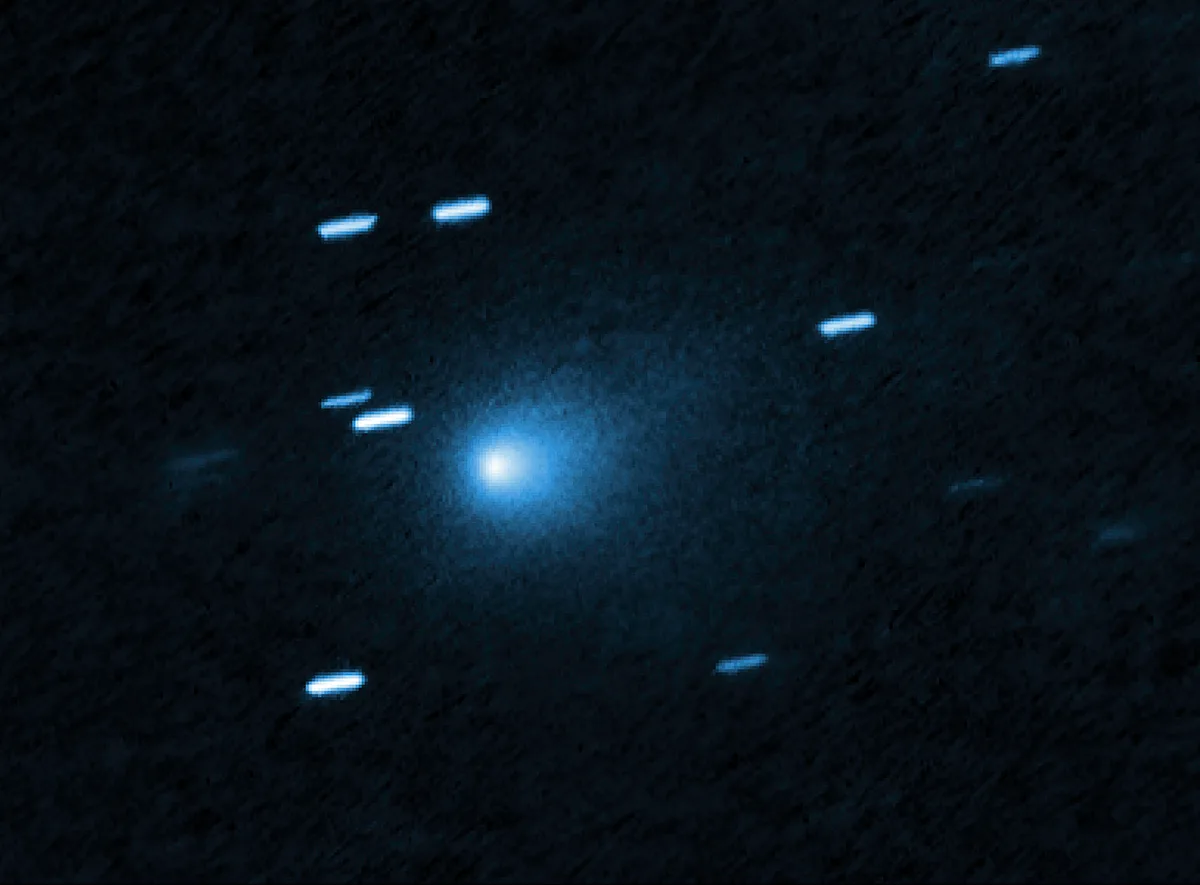
All (or at least most) astronomical eyes are on 3I/ATLAS, our most recent interstellar visitor that was discovered in early July. Given its relatively short observational window in our solar system, and especially its impending perihelion in October, a lot of observational power has been directed towards it. That includes the most powerful space telescope of them all - and a recent paper pre-printed on arXiv describes what the James Webb Space Telescope (JWST) discovered in the comet’s coma. It wasn’t like any other it had seen before.
3I/ATLAS’s coma, which is the material surrounding its nucleus, is primarily made up of carbon dioxide (CO2), according to the paper first authored by Martin Cordiner of NASA’s Goddard Space Flight Center and the Catholic University of America. It also contains water, carbon monoxide and carbonyl sulfide, all of which are expected to be in a comet’s coma. But the ratio of carbon dioxide to water is 8 to 1, the highest ever seen in a comet, and six standard deviations above the typical value. Strangely, the carbon monoxide (CO) ratio with water is more in line with previous observations, at 1.4.
To detect these chemicals, JWST used its NIRSpec infrared camera to observe 3I/ATLAS on August 6th, when it was 3.32 AU from the Sun. Other indications, which weren’t quite as surprising, include that the coma does have a bunch of water and dust scattered around it, as well as a higher dust concentration facing the Sun, which is typically for higher outgassing on the side the Sun heats.
NASA Explains what we know about 3I/ATLAS so far.
Another finding was that the ratio of two types of carbon isotopes, Carbon-12 and Carbon-13, was broadly similar to that found on Earth, suggesting the material was created in an environment with similar carbon species. However, there are a couple of features of 3I/ATLAS’s creation that could have caused the lopsided CO2/H2O ratio.
One is extremely high levels of ultraviolet radiation in the host star system the object was created it. Another could be that is was created beyond the CO2 “ice line”, where carbon dioxide ice is relatively abundant compared to water. Other explanations have to do with how heat from the Sun is able to affect the nucleus - if it is harder to heat up, then CO2, which has a lower melting point than water, would be sublimated first, accounting for the lopsided ratio despite having plenty of water stored in the nucleus waiting to be released as it gets closer to the Sun.
Either way, more observations are needed. This is only the third interstellar visitor we have confirmed, and the first (‘Oumuamua) wasn’t bright enough to capture its coma’s spectra, though even if it was it didn’t appear to have a coma anyway. That leaves the second interstellar visitor 2I/Borisov, as our only other point of comparison for the coma spectra of an interstellar comet. It actually had a higher carbon monoxide to water ratio, even as compared to 3I/ATLAS’s, so it seems of the two we have collected so far, each interstellar visitor’s coma hide new insights.
Fraser discusses how 3I/ATLAS is actively releasing water.
This undoubtedly won’t be the last paper examining 3I/ATLAS’s coma - it probably won’t even be the last one from JWST. We still have a few weeks of observational time before it passes too close to the Sun to be detectable, and then reaches its perihelion in early October, which it is still obscured from our view, though there is a chance some probes at Mars might be able to catch a glimpse of it during that time. When it finally becomes visible again in December, it will already be on its way out of our solar system, and likely would have shed most of the material it was going to. Sometimes astronomical events are fleetings, and astronomers have to try to capture them as they’re happening. At least with this one they’ll have a little bit of warning - we’ll see what they find as they continue to observe our newest interstellar visitor.
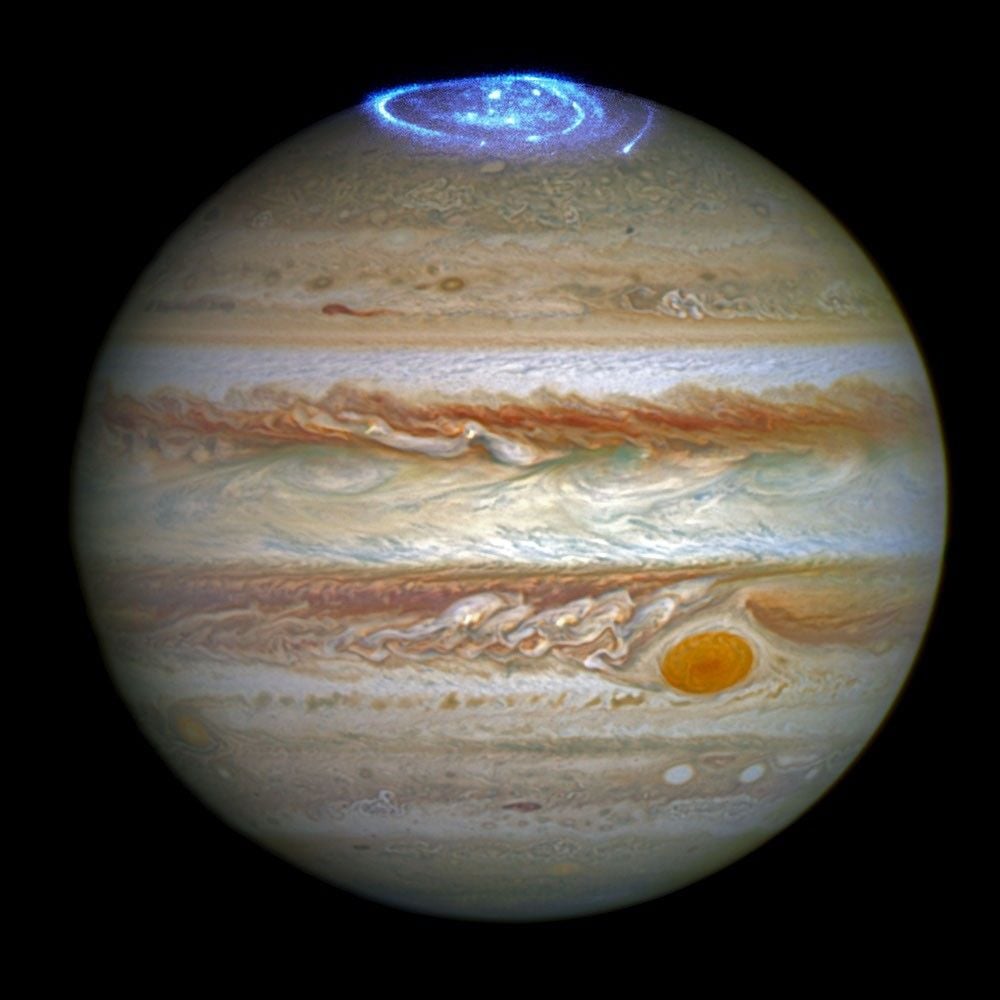
Aurora around Jupiter's north pole captured by the Hubble Space Telescope (Credit : NASA)
Scientists from the University of Minnesota have discovered something extraordinary in Jupiter's polar regions that has never been seen before, a completely new type of plasma wave that creates aurora unlike anything we observe on Earth.
While Earth's northern and southern lights (also known as the aurora borealis and aurora australis) create familiar green and blue curtains dancing across our sky, Jupiter's aurora is an entirely different beast. In comparison, Jupiter is vastly more magnetic, due to its large size, fast rotation, and complex interactions with its moons, make it a natural laboratory for extreme physics.
The Aurora Borealis, or Northern Lights, shines above Bear Lake
(Credit : United States Air Force)
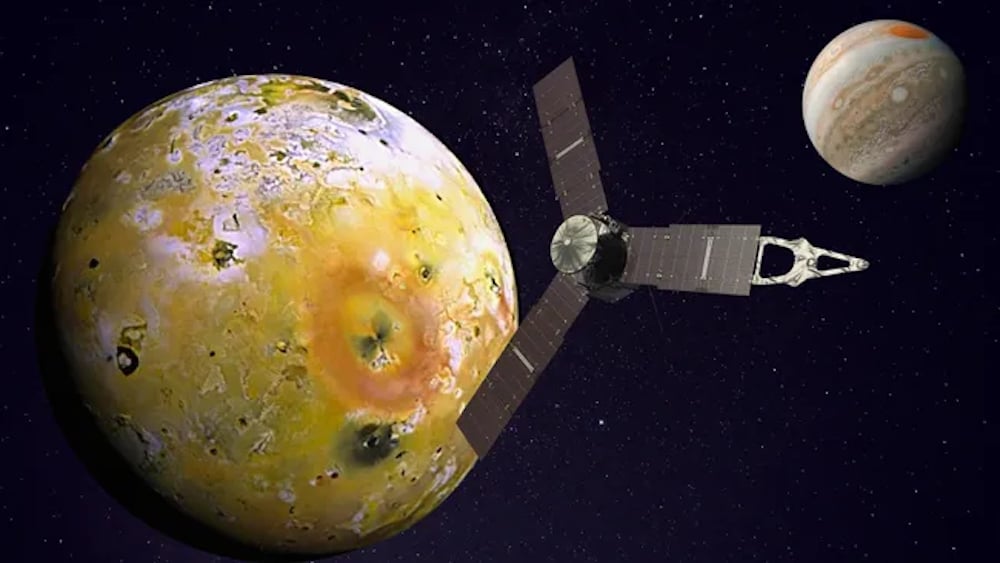
The discovery came from NASA's Juno spacecraft, which made history as the first probe to orbit Jovian poles. What the team found challenges everything we thought we knew about aurora, which have primarily been understood through Earth based observations.
The key to this breakthrough is the nature of plasma. Plasma is a state of gas where matter is so hot that atoms break apart into electrons and ions. This then flows like an invisible ocean around Jupiter. These particles are accelerated down toward the planet, where they ignite gases in the upper atmosphere, creating the aurora phenomenon.
An illustration shows NASA's Juno spacecraft near Io with its parent planet Jupiter in the background
(Credit : NASA)
Professor Robert Lysak, a world expert on plasma waves, worked with observational astronomers Ali Sulaiman and Sadie Elliott to decode what Juno was seeing. They discovered that Jupiter's unique conditions, an incredibly strong magnetic field combined with extremely low plasma density in its polar regions, created the never seen before phenomenon.
Alfvén waves, named after physicist Hannes Alfvén who first theorised in 1942 that plasma could behave like both a fluid and respond to magnetic fields are central to the phenomenon. The data showed that, due to the extremely low density of the plasma in Jupiter's polar region, the frequency of the plasma waves was very low especially compared to the frequency of similar waves on Earth.
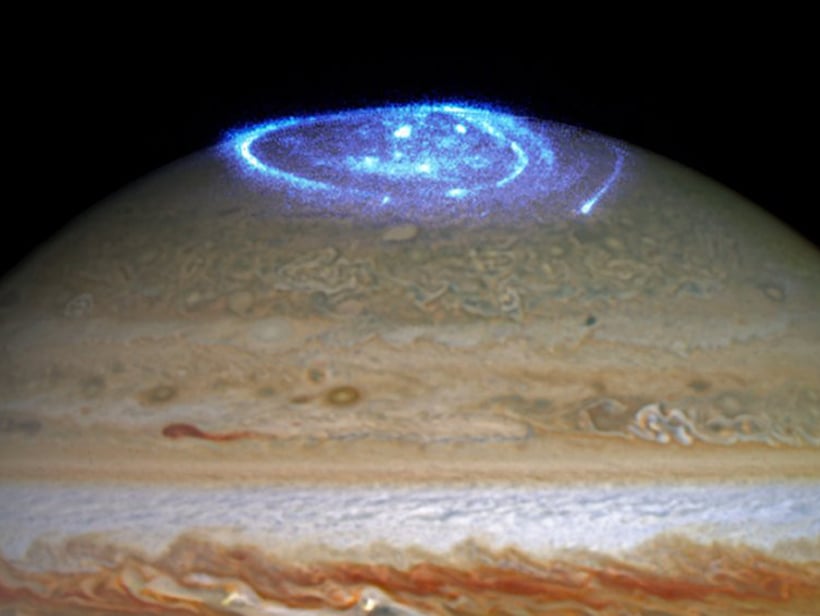
The differences between Earth and Jupiter's auroral systems are striking. On Earth, the aurora forms a typical donut pattern of auroral activity around the polar cap, while the polar cap itself remains dark. Jupiter operates differently, thanks to its complex magnetic field system which allows charged particles to flood directly into the polar cap regions, creating aurora where Earth would have darkness.
Auroras shine bright blue over Jupiter
(Credit : NASA/ESA)
Unlike Earth's visible green and blue auroras created by oxygen and nitrogen, Jupiter's upper atmosphere is very different from Earth's and its aurora tends to be invisible to the naked eye and can only be observed with UV and Infrared instruments.
This discovery reveals an entirely new regime of plasma physics that couldn't be observed from Earth based studies alone. The research expands our understanding of how plasma behaves under extreme conditions, knowledge that could have applications in fusion energy research and space weather prediction.
While Juno continues to orbit Jupiter, the team hopes future missions like JUICE and Europa Clipper, arriving at Jupiter in the late 2020s, will provide additional opportunities to study this phenomenon. Each new observation helps scientists piece together the complex puzzle of planetary magnetospheres and their role in shaping the space environment around giant planets.
Alien Aurora: Lysak, Sulaiman and Elliott find new plasma regime in Jupiter’s aurora
Professor Robert Lysak, Assistant Professor Ali Sulaiman and Researcher Sadie Elliott, of the School of Physics and Astronomy recently published a paper in Physics Review Letters, “New Plasma Regime in Jupiter’s Auroral Zones,” on the first-ever detailed observation and analysis of a new type of plasma wave in Jupiter’s auroral zone. Their findings were featured in an article in the New Scientist magazine, under the headline “Astronomers found a completely new type of plasma wave near Jupiter.”
Sulaiman and Elliott brought their expertise in observation to data from NASA’s Juno probe, which made its historic low orbit flight over Jupiter’s north pole. “James Webb (Space telescope) has given us some infrared images of the aurora, but Juno is the first spacecraft in a polar orbit around Jupiter,” Sulaiman says. What the astronomers observed was an entirely new phenomenon in auroral physics which has mainly been based on examples tuned to the magnetic field of the Earth. Jupiter by comparison is vastly more magnetic, due to its large size, fast rotation, and complex interactions with its moons. The dynamo in the interior of Jupiter generates a field many times larger than that of Earth.
Fig 1.
The space around these magnetized planets is filled with superheated particles that form a plasma, a state of matter where extremes of temperature cause the atoms to break into electrons and ions. These particles are accelerated down toward the planet, where they ignite gases in the upper atmosphere (on Earth, Oxygen and Nitrogen) leading to their familiar blue and green colors. Jupiter’s upper atmosphere is very different from Earth's and its aurora tends to be invisible to the naked eye and can only be observed with UV and Infrared instruments.
The observational astronomers turned to Lysak, one of the world’s leading experts on these mechanics for help in describing the alien aurora. Plasma can exhibit the behavior of a fluid in that it travels in a wave. Unlike fluids, plasmas can have their own magnetic field and are influenced by external fields as well. Lysak studies Alfven Waves, a discipline named after Hannes Alfven who in 1942 first theorized that plasma could be understood by combining fluid mechanics with Electromagnetic field theory.
The data showed that due to the extremely low density of the plasma in Jupiter’s polar region, the frequency of the plasma waves was very low especially compared to the frequency of similar waves on Earth, combined with Jupiter’s supercharged magnetic field system, Juno showed a type of wave unlike anything ever observed before.
Figure 2
Lysak used what he called “basic plasma theory” to unpack the problem and to explain how combination of low plasma density and strong magnetic fields led to the new type of wave. At Earth, the aurora forms a typical donut pattern of auroral activity around the polar cap shown in figure 2b, while the polar cap itself is usually dark. The complex mechanics of the Jupiter’s magnetic field intermittently allow these particles to flood into the zone over the polar caps as shown in Figure 2a.
Elliott’s part of the project was to study how the field lines interact with upgoing electrons from the field lines which cause the plasma to diffuse out to 30 -50 times the radius of the gas giant. These electrons play a role in exciting the new plasma wave mode. The group hopes to be able to learn more about this phenomenon when Juno makes further passes around Jupiter. Unfortunately, the planned extended mission to Jupiter is doubtful given the uncertain state of funding of the American space program, but they have some hope that JUICE and Europa Clipper, due to arrive at Jupiter at the end of the decade, may be able to accommodate this research.
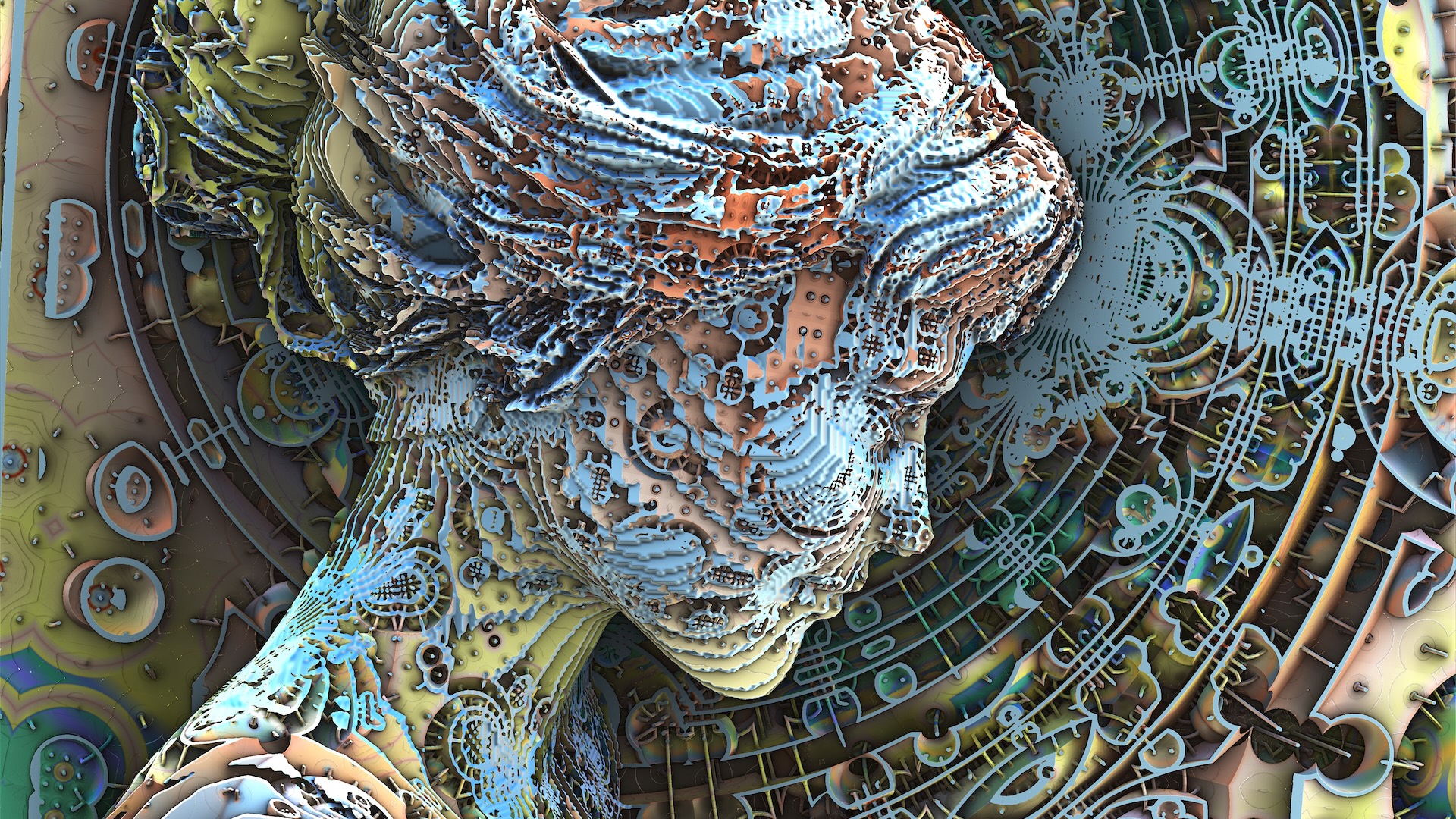
I found an alien face, in Algeria near the Sahara Desert 🐪 It’s 500 meters from top of head to bottom of neck. Proof they were here millions of years before us, and will be here long after us.
UFO over Curilac, Montenegro on Aug 5, 2025, UAP sighting news. Aliens are watching!
Date of sighting: Aug 5, 2025
Location of sighting: Curilac, Montenegro
Source: NUFORC
This is a great video of a glowing red orb UFO over the mountains in Montenegro this week. The eyewitness noticed the orb and walked over to the end of the fenced area and watched as the orb flashes and moves, having over the hill. She caught one of several UFOs seen, sometimes a sighting moves so fast that we forget to record it, however even a 30 second recording such as this tells us so much.
Scott C. Waring - UFO Sightings Daily
Eyewitness states:
I was sitting in my yard, when i saw one ,,circle” moving and leaving the mountain. This is not the first time seeing this.I observed three unidentified flying objects emerging sequentially from a mountain visible from my home in Danilovgrad. The sighting occurred on the night of August 5, 2025, at approximately 10:00 PM. The sky was completely clear with no clouds, and the weather was calm. Each object appeared one after the other, not at the same time. The first object rose from the mountain, flying smoothly and silently along a straight path, and then suddenly disappeared at a certain point in the sky — it did not fade out or descend, it just vanished instantly.
£After a short interval, the second object emerged from the same area and followed the exact same path, with the same behavior, and disappeared in the same way. A third object repeated the same sequence shortly after.The objects emitted a yellow light, had no visible propulsion system, made no sound at all, and appeared to move at a ufspeed similar to that of a helicopter. When first observed, each object seemed to be about 200 meters above the ground, ascending as they moved.There were no known aircraft or natural explanations that I could identify for this event.
UFO over Arcadia, California Aug 8, 2025 UAP sighting news 👽 eyewitness report.
Date of sighting: Aug 8, 2025
Location of sighting: Arcadia, California, USA
Source: NUFORC
Watch this video and you will notices a white light in the night sky thats hovering over the neighborhood. The eyewitness took notice and took a fast recording, even though the UFO was there 25+ minutes. Yes UFOs have lights, do you really think humans are the only intelligent creatures in the universe with colored lights on the aircraft and spacecraft? Such lights have been seen by mayors, congressmen, pilots and police, so if they saw and recorded such lights...you can bet they exist.
Scott C. Waring
Eyewitness:
It was flashing red, blue and green lights, no pattern It hovered there for about 25 minutes, going back and forth and in circles and figure eights. The lights had no pattern. The red light seemed on top, then blue and green lights moved around. sometimes on the left and sometimes on the right. No spotlights. planes don't move this way and helicopters don't have lights like this. I thought it might be a drone, but it was very high and the lights were too bright; brighter than a led. I showed it to my wife; it scared her. I pointed it out to a neighbor walking by, she didn't know what it was.
Meer van UFO'S of UAP'S, ASTRONOMIE, RUIMTEVAART, ARCHEOLOGIE, OUDHEIDKUNDE, SF-SNUFJES EN ANDERE ESOTERISCHE WETENSCHAPPEN - DE ALLERLAATSTE NIEUWTJES


 Cosmic Butterfly Unlocks Secrets of How Rocky Planets Form