Naar de inhoud

UFO'S of UAP'S, ASTRONOMIE, RUIMTEVAART, ARCHEOLOGIE, OUDHEIDKUNDE, SF-SNUFJES EN ANDERE ESOTERISCHE WETENSCHAPPEN - DE ALLERLAATSTE NIEUWTJES

UFO's of UAP'S in België en de rest van de wereld
akke.beakke.be
Ontdek de Fascinerende Wereld van UFO's en UAP's: Jouw Bron voor Onthullende Informatie! Ben jij ook gefascineerd door het onbekende? Wil je meer weten over UFO's en UAP's, niet alleen in België, maar over de hele wereld? Dan ben je op de juiste plek! België: Het Kloppend Hart van UFO-onderzoek In België is BUFON (Belgisch UFO-Netwerk) dé autoriteit op het gebied van UFO-onderzoek. Voor betrouwbare en objectieve informatie over deze intrigerende fenomenen, bezoek je zeker onze Facebook-pagina en deze blog. Maar dat is nog niet alles! Ontdek ook het Belgisch UFO-meldpunt en Caelestia, twee organisaties die diepgaand onderzoek verrichten, al zijn ze soms kritisch of sceptisch. Nederland: Een Schat aan Informatie Voor onze Nederlandse buren is er de schitterende website www.ufowijzer.nl, beheerd door Paul Harmans. Deze site biedt een schat aan informatie en artikelen die je niet wilt missen! Internationaal: MUFON - De Wereldwijde Autoriteit Neem ook een kijkje bij MUFON (Mutual UFO Network Inc.), een gerenommeerde Amerikaanse UFO-vereniging met afdelingen in de VS en wereldwijd. MUFON is toegewijd aan de wetenschappelijke en analytische studie van het UFO-fenomeen, en hun maandelijkse tijdschrift, The MUFON UFO-Journal, is een must-read voor elke UFO-enthousiasteling. Bezoek hun website op www.mufon.com voor meer informatie. Samenwerking en Toekomstvisie Sinds 1 februari 2020 is Pieter niet alleen ex-president van BUFON, maar ook de voormalige nationale directeur van MUFON in Vlaanderen en Nederland. Dit creëert een sterke samenwerking met de Franse MUFON Reseau MUFON/EUROP, wat ons in staat stelt om nog meer waardevolle inzichten te delen. Let op: Nepprofielen en Nieuwe Groeperingen Pas op voor een nieuwe groepering die zich ook BUFON noemt, maar geen enkele connectie heeft met onze gevestigde organisatie. Hoewel zij de naam geregistreerd hebben, kunnen ze het rijke verleden en de expertise van onze groep niet evenaren. We wensen hen veel succes, maar we blijven de autoriteit in UFO-onderzoek! Blijf Op De Hoogte! Wil jij de laatste nieuwtjes over UFO's, ruimtevaart, archeologie, en meer? Volg ons dan en duik samen met ons in de fascinerende wereld van het onbekende! Sluit je aan bij de gemeenschap van nieuwsgierige geesten die net als jij verlangen naar antwoorden en avonturen in de sterren! Heb je vragen of wil je meer weten? Aarzel dan niet om contact met ons op te nemen! Samen ontrafelen we het mysterie van de lucht en daarbuiten.

Archief

The Martian Landscape Reveals Climate Secrets

The Martian Landscape Reveals Climate Secrets

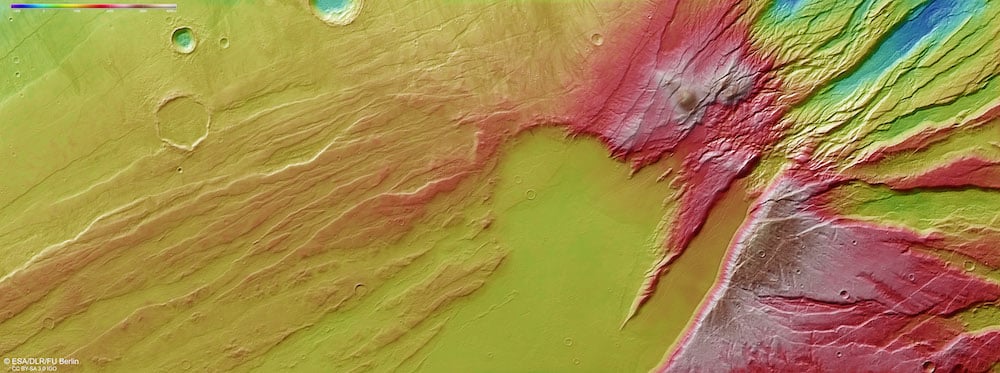
This colour-coded topographic image of Mars shows the Acheron Fossae region of Mars. It was captured by the Mars Express spacecraft (Credit : ESA/DLR/FU Berlin)

This colour-coded topographic image of Mars shows the Acheron Fossae region of Mars. It was captured by the Mars Express spacecraft (Credit : ESA/DLR/FU Berlin)

Mars is a world marked by dramatic landscapes and few regions showcase this better than Acheron Fossae, a spectacular network of deep cracks and valleys that slice through the red planet's surface like ancient scars. Recent images from the European Space Agency's Mars Express spacecraft reveal the western edge of this fascinating geological formation, offering new insights into Mars's violent past and changing climate.

Image of Mars captured by the Hubble Space Telescope between April 27 and May 6, 1999, when Mars was 87 million kilometres from Earth (Credit : NASA/ESA)

Image of Mars captured by the Hubble Space Telescope between April 27 and May 6, 1999, when Mars was 87 million kilometres from Earth

(Credit : NASA/ESA)

Acheron Fossae is an extensive system of deep, fault like cracks (known as fossae), with alternating chunks of raised and lowered ground, a pattern geologists call "horst and graben." Picture a broken chocolate bar where some pieces have been pushed up while others have dropped down, creating a jagged landscape of ridges and valleys that can be hundreds of kilometers long and several kilometers deep.

These features weren't created overnight. Likely dating back over 3.7 billion years to when Mars was most geologically active, such a pattern was created as hot material rose upwards beneath the martian crust. As molten rock pushed upward from deep within Mars, it stretched and cracked the planet's surface creating the deep valleys we see today.

Image of Acheron Fossae in Tharsis region on Mars (Credit : NASA)

Image of Acheron Fossae in Tharsis region on Mars

(Credit : NASA)

What makes Acheron Fossae particularly intriguing isn't just how it formed, but how it continues to change. The valley floors are relatively smooth, marked by gently weaving lines reminiscent of a flowing river. Rather than water, these valleys have been filled by a slow, viscous flow of ice rich rock, a lot like the rock glaciers we see here on Earth.

These Martian rock glaciers act like geological time capsules, preserving evidence of the Martian climatic history. Rock glaciers are very sensitive to changes in climate, and so act as good markers for how a planet's environment has changed over time. Here, they indicate that this region of Mars has experienced alternating periods of cool and warm, freeze and thaw.

The key to understanding these climate swings lies in Mars's unstable tilt. Unlike Earth, which maintains a relatively steady tilt thanks to the Moon's stabilising influence, Mars wobbles dramatically over time. Mars's tilt has swung between 15 and 45 degrees in the last 10 million years, while Earth's has varied between 22 and 24.5 degrees.

These variations, known as the Milankovitch cycles, create alternating ice ages and warm periods on Mars. During extreme tilts, ice can creep near to the planet's equator before shrinking back to its poles during warmer periods.

The images also reveal how erosion has transformed the landscape over millions of years. To the right of the main fossae, the deep cracks transition into flat, dark lowland plains, with a strip of raised mounds and rocky hills in between. These are the remains of what was once a continuous rock layer that has been slowly worn away by flows of ice and rock over time, leaving behind rounded hills called knobs and flat topped plateaus called mesas.

This erosion process creates a distinctive transition visible in the topographical data, from the deep red and yellow tones of higher ground gradually melting into light and darker blues indicating lower elevations. It's like watching a mountain range slowly dissolve into a plain over geological time.

Illustration of ESA's Mars Express spacecraft (Credit : NASA/JPL)

Illustration of ESA's Mars Express spacecraft

(Credit : NASA/JPL)

These remarkable insights come courtesy of ESA's Mars Express spacecraft, which has been capturing and exploring Mars's landscapes since 2003. Using its High Resolution Stereo Camera, the orbiter has mapped the planet's surface in unprecedented detail, colour, and three dimensions for over two decades.

As we continue studying Mars, features like Acheron Fossae serve as natural laboratories for understanding planetary geology and climate evolution. They remind us that planets are dynamic systems, constantly changing over geological time scales. For future Mars missions, both robotic and human, understanding these processes will be crucial for navigation, resource utilisation, and safe exploration of our planetary neighbour.

Source : 

RELATED VIDEOS


{ https://www.universetoday.com/ }

Hoe vind je dit bericht?
Geschreven door peter om 23:43 Stuur door

We ademen dagelijks tot 68.000 microplastics in: 100 keer meer dan eerdere schattingen

We ademen dagelijks tot 68.000 microplastics in: 100 keer meer dan eerdere schattingen

 Jeannette Kras -Redacteur
65612-954x716_1.jpeg

Microplastics vind je inmiddels overal. Het is maar te hopen dat ze niet al te ongezond zijn, want nieuwe metingen wijzen uit dat we er mogelijk een stuk meer van binnenkrijgen dan gedacht.

Onderzoeker Nadiia Yakovenko en collega’s van de Université de Toulouse ontdekten dat de piepkleine plasticdeeltjes die thuis en in je auto in de lucht zweven in enorme hoeveelheden je longen binnendringen.

Uit eerdere studies is al gebleken dat microplastics over de hele wereld voorkomen in de lucht, zowel buiten als binnen. Daardoor zijn er zorgen ontstaan over de mogelijke gevolgen voor de gezondheid. De kleine ingeademde microplasticdeeltjes kunnen je longen binnendringen en daar mogelijk oxidatieve stress veroorzaken en het immuunsysteem en organen aantasten. Eerder onderzoek naar microplastics in de lucht richtte zich echter vooral op grotere deeltjes met een diameter van 20 tot 200 micrometer, die minder snel in de longen terechtkomen dan deeltjes met een diameter van 10 micrometer of minder.

Heel veel plasticdeeltjes
Om meer inzicht te krijgen in het risico van het inademen van microplastics, hebben Yakovenko en haar collega’s luchtmonsters genomen in hun eigen appartement en in hun eigen auto onder realistische rijomstandigheden. Met behulp van een techniek die Raman-spectroscopie wordt genoemd, konden ze de concentraties van microplastics, waaronder die met een diameter van 1 tot 10 micrometer, in 16 luchtmonsters meten.

Ze ontdekten dat er in hun huizen 528 plasticdeeltjes per kubieke meter in de lucht hingen en in hun auto’s 2238 deeltjes per kubieke meter. 94 procent van de gedetecteerde deeltjes was kleiner dan 10 micrometer. Hoewel de concentraties in de auto’s hoger waren dan in de appartementen, was het verschil statistisch niet significant door de grote variabiliteit van de microplasticconcentratie op beide plekken.

Gevolgen voor de gezondheid
De onderzoekers combineerden hun resultaten vervolgens met eerder gepubliceerde gegevens over blootstelling aan microplastics binnenshuis en schatten dat volwassenen dagelijks ongeveer 3200 microplasticdeeltjes met een diameter van 10 tot 300 micrometer inademen en 68.000 deeltjes van 1 tot 10 micrometer per dag. Dat is honderd keer meer dan eerdere schattingen.

Daardoor kunnen ook de gevolgen voor de gezondheid groter zijn dan eerder gedacht. Tegelijkertijd benadrukken de onderzoekers dat vervolgonderzoek nodig is om deze schattingen te bevestigen. “We hebben vastgesteld dat meer dan 90 procent van de microplasticdeeltjes in de binnenlucht in zowel woningen als auto’s kleiner was dan 10 micrometer, klein genoeg om diep in de longen te worden ingeademd. Dit was ook het eerste onderzoek waarin microplastics in de auto werden gemeten. Over het algemeen hebben we concentraties binnenshuis gemeten die tot 100 keer hoger waren dan eerdere extrapolaties, waaruit blijkt dat binnenlucht een belangrijke en tot nu toe onderschatte blootstellingsroute is voor het inademen van fijne microplasticdeeltjes”, legt het onderzoeksteam uit.

“Overal waar we kijken, vinden we microplastics, zelfs in de lucht die we inademen in onze huizen en auto’s. De grootste zorg is dat deze deeltjes zo klein zijn dat ze met het blote oog volledig onzichtbaar zijn. We ademen er elke dag duizenden in zonder dat we het beseffen. Diep in onze longen geven microplastics giftige additieven af die in ons bloed terechtkomen en meerdere ziekten veroorzaken”, klinkt het tot besluit.

Het gevaar van microplastics
Langzaam wordt duidelijker hoe schadelijk microplastics kunnen zijn. Zo schreven we onlangs over een studie waarin onderzoekers een verband vonden tussen microplastics en plaque — vettige ophopingen in de bloedvaten. In plaques in de halsslagader troffen onderzoekers tot wel vijftig keer meer micro- en nanoplastics aan dan in gezonde bloedvaten. Vooral mensen die een beroerte of tijdelijke blindheid hadden gehad, bleken opvallend veel plasticdeeltjes in hun bloedvaten te hebben. Daarbij gold: hoe meer plaque, hoe meer plastic. Bij mensen die een (mini-)beroerte of tijdelijke blindheid hadden doorgemaakt, vonden de onderzoekers zelfs 51 keer meer plastic in de vaatwanden dan bij gezonde personen. Bij proefpersonen met plaque maar zonder klachten, ging het om zestien keer meer plasticdeeltjes.

Bronmateriaal

{ https://scientias.nl/ }

Hoe vind je dit bericht?
Geschreven door peter om 23:21 Stuur door

Ancient Buildings On Planet Mercury, Aug 2025, UFO UAP Sighting News. How Can NASA Hide This So Long?

Ancient Buildings On Planet Mercury, Aug 2025, UFO UAP Sighting News. How Can NASA Hide This So Long?

UFO_Mercury.png

Alien_Mercury.png


Date of discovery: Aug 7, 2025
Location of discovery: Planet Mercury
Source: 
Hey, I was looking over Google Mercury Map and found some cool things that I just wanted to reveal to you all. The structures are often colorful and rainbow like, which other maps also confirmed. Also one huge angelic structure in Brahms crater is almost 10 miles across or more, the crater is 100km or 61 miles across. So many structures and so ancient...they were built to last, not to be disposable and think about the environment. These may be thousands of years old or more. It does look to me, that there are newer structures (seen in my video in the first 1-10 seconds). 
Scott C. Waring - UFO Sightings Daily 
 
 
RELATED VIDEOS


{ https://www.ufosightingsdaily.com/ }

Hoe vind je dit bericht?
Geschreven door peter om 22:24 Stuur door

UFO cloaked in a cloud leaves smokey trail over Reno, Nevada Aug 6, 2025, UAP Sighting News.

UFO cloaked in a cloud leaves smokey trail over Reno, Nevada Aug 6, 2025, UAP Sighting News.

UFO_Alien.png

UFO_Sighting_UAP.png

Date of sighting: August 6, 2025
Location of sighting: Reno, Nevada, USA
Source: 
Hey, check this out. Many residents of Reno phoned into the local news networks and asked about whats going on with the UFO cloud over the city. As always Reno 2 News uses old school science to explain it as a linear cloud. However the truth is far from that. This is an alien craft within this cloud. The ship holds the cloud together by using its shields to force it to stay. However they often produce too much cloud...making trails like we see here. Thats because more cloud cover can allow other ships to hide within it too. Aliens often pride themselves on being superior to humans in every way, but the truth is...they are not. They have flaws and we are seeing through their deception. 
Scott C. Waring - UFO Sightings Daily 
 
Reno 2 News states: 
Did you see a strange-looking cloud in the sky over Reno on Wednesday night? If you did, you aren't alone. After receiving a call from a viewer about the odd cloud, 2 News Nevada Chief Meteorologist Chris Larson shared that what the viewer saw is called a lenticular cloud. More at site.

{ https://www.ufosightingsdaily.com/ }

Hoe vind je dit bericht?
Geschreven door peter om 22:08 Stuur door

Is the Buga Sphere part of a hidden planetary network?

Is the Buga Sphere part of a hidden planetary network?

In March 2025, a perfectly smooth metallic sphere crashed near the city of Buga, Colombia, setting in motion a chain of revelations that could rewrite the story of human history. Weighing just 4.5 pounds, the object has no visible seams, joints, or welds. It remains icy cold to the touch and shows no sign of conventional propulsion or manufacturing methods known to science. 
buga%20sphere%20alien%20planetary%20network.jpg
Buga Sphere
Its surface is etched with intricate markings eerily similar to symbols from ancient Mesopotamia, as well as other civilizations separated by oceans and thousands of years. AI-assisted analysis suggests the glyphs carry profound themes—unity, transformation, and the origins of consciousness, concepts that cannot easily be reconciled within the framework of standard physics. 
Advanced scans have revealed hidden internal structures and an unusually dense core. Even more unsettling, researchers have detected the sphere emitting very low frequency (VLF) and low frequency (LF) radio waves—signals capable of traveling hundreds of kilometers over terrain and far beyond the horizon, often used in navigation, communications, and precise timing synchronization. 
Whispers are now spreading about the discovery of a second, even older sphere, quietly stored in a forgotten museum collection. Meanwhile, the glyphs on the Buga sphere appear to be slowly evolving, forming what some believe are coordinates pointing toward remote and mysterious sites: deep within the Amazon, along the shores of Lake Titicaca, and in the highlands of Peru. 
This has led to a question, is it just an elaborate hoax or are these spheres fragments of a hidden planetary network, and if so… what happens when it awakens?
  

{ https://ufosightingshotspot.blogspot.com/ }

Hoe vind je dit bericht?
Geschreven door peter om 21:59 Stuur door

A mysterious glow from interstellar comet 3I/ATLAS finds an explanation

A mysterious glow from interstellar comet 3I/ATLAS finds an explanation

As interstellar visitor Comet 3I/ATLAS hurtles through the Solar System, scientists from around the world are taking advantage of this rare opportunity to actively study this visitor from distant worlds. The results of two new studies shed light on its remarkable properties, which challenge conventional wisdom about comet behavior.

Illustration of Hubble and the comet 3I/ATLAS generated by Copilot AI

The spectrum obtained by the 4.1-meter SOAR telescope on July 3, 2025, when the comet was far from the Sun, revealed a red tint in the reflected light. However, no signs of radiation from typical cometary gases (CN, C3, C2, CO+) or atomic oxygen were detected. This creates a paradox: the comet became active early, but without the usual sublimation of ice. Scientists suggest that dust release may occur through a different, unusual mechanism characteristic of ancient interstellar “travelers.”

A second study conducted by David Jewitt’s team based on images from the Hubble Space Telescope between July 4 and 5 made it possible to estimate the size of the comet’s nucleus. It turned out to be very compact – only 0.32 to 5.6 kilometers in diameter. This is consistent with preliminary predictions based on the limited availability of durable material in the interstellar medium. However, this tiny nucleus is surrounded by an impressively large cloud of dust, which makes up the bulk of the visible object.

Amazing glow in an unusual place

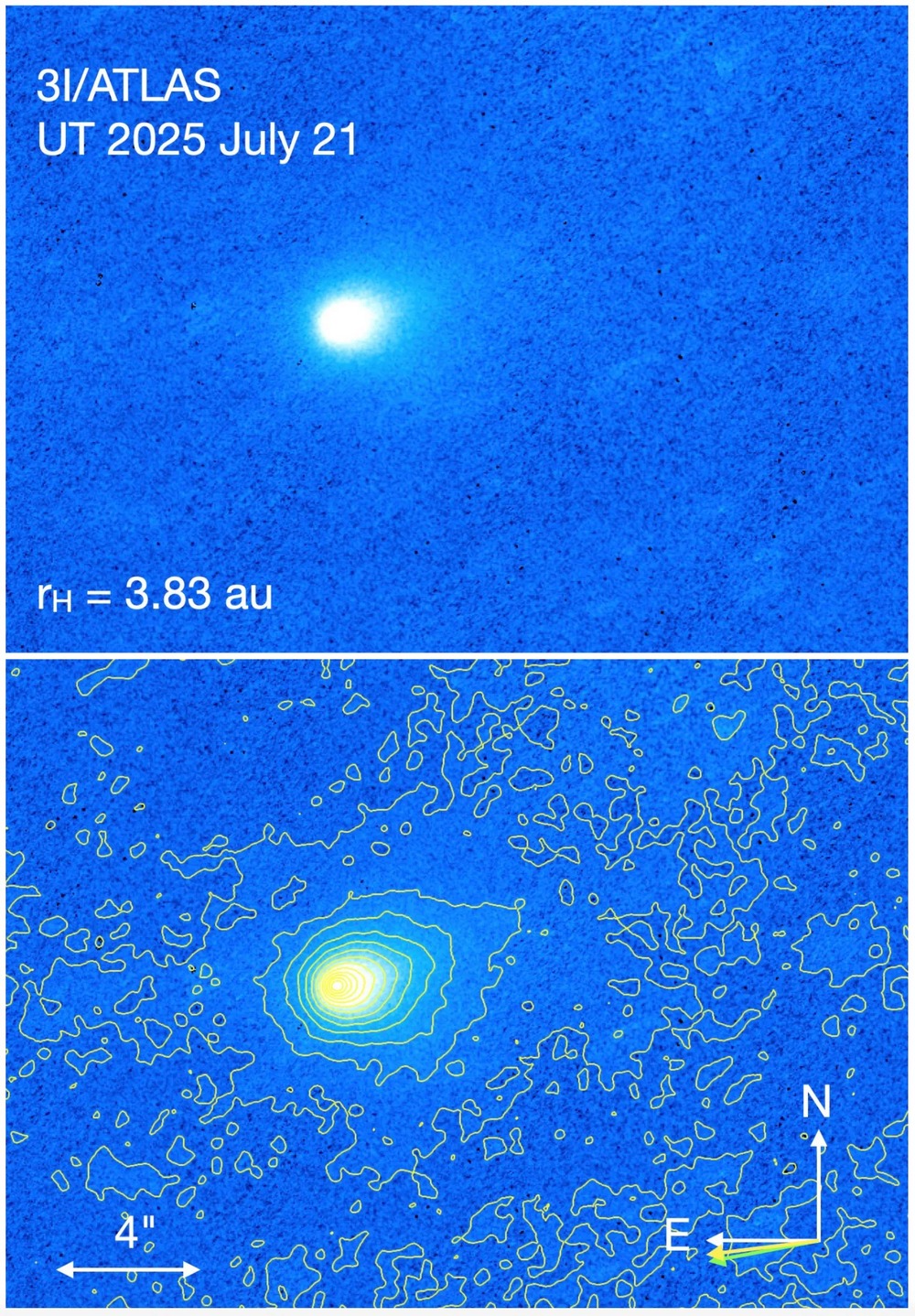
Image from the Hubble Space Telescope showing the diffuse radiation from 3I/ATLAS, which spreads out in front of the object as it approaches the Sun. Image: Jewitt et al. 2025

The most unexpected discovery made by Hubble was the structure of the coma of 3I/ATLAS. Instead of the classic tail extending from the Sun, the telescope detected a diffuse glow ahead of the comet’s movement toward our star. This contradicts the usual picture for comets.

An explanation for this phenomenon was proposed back in early August: the comet’s nucleus rotates very slowly. The sun heats only one side of it. The dust evaporation occurs precisely there. If the nucleus does not rotate fast enough, this hot daytime side does not have time to cool down significantly. Consequently, dust continues to be actively released from the “illuminated” part, creating a glowing effect in front. This hypothesis has been confirmed.

Remaining mystery

The latest ground-based observations complete the picture: the rotation period of 3I/ATLAS is 16.16 hours (±0.01 hours). This means that “night” and “day” on its surface last about 8 hours each. During these 8 hours, dust particles released from the day side are carried away from the nucleus to a distance of up to 10,000 km. In Hubble images, this corresponds to 0.35 arcseconds — the scale at which the elongated forward glow is observed.

Interstellar comet 3I/ATLAS. Source: International Gemini Observatory/NOIRLab/NSF/AURA/K. Meech (IfA/U. Hawaii)

The key point is that the surface of the nucleus has to cool down quickly after it goes into shadow, meaning in less than 8 hours. Otherwise, the release of dust would become more uniform and would not produce a clear frontal effect.

The main mystery that remains is the combination of intense dust release, visible by its glow, with the complete absence of any traces of gases that usually “carry” this dust in comets.

As it approaches the Sun, 3I/ATLAS will become brighter. The greatest hopes for unraveling its mystery are pinned on the James Webb Space Telescope. Its infrared vision will help analyze the comet’s thermal radiation and dust composition in greater detail, possibly finally answering questions about its true nature and the mechanism behind its unusual activity.

Earlier, we reported on how Juno, instead of dying, got a new chance at life by hunting 3I/ATLAS.

RELATED VIDEOS


{ https://universemagazine.com/en/articles-en/ }

Hoe vind je dit bericht?
Geschreven door peter om 21:44 Stuur door

Mars torn apart: Spacecraft reveals the Red Planet’s turbulent past

Mars torn apart: Spacecraft reveals the Red Planet’s turbulent past

The European Space Agency has published a series of new images obtained by the Mars Express spacecraft. They show a region whose geological history holds memories of the Red Planet’s turbulent past. 

Image of the Acheron Fossae region taken by the Mars Express mission. Source: Acheron Fossae

Modern Mars is a cold and desert world where, at first glance, no significant geological processes are taking place. But this was not always the case. Over billions of years of its existence, the Red Planet has gone through periods of water bodies, eruptions of giant supervolcanoes, and numerous glaciation cycles. All of them left distinctive marks on its surface.

One of the most striking examples demonstrating the tumultuous past of Mars is the Acheron Fossae region. It is located 1,200 km from Olympus Mons, the largest volcano in the Solar System, whose formation directly influenced the appearance of this area. Acheron Fossae is a surprisingly diverse mix of rugged and smooth terrain, covered with ancient faults, craters, and solidified lava. In April, Mars Express already photographed its eastern part. Now the vehicle returned to it to show the western edge, where the landscape is equally diverse: deep cracks, valleys, and winding channels carved out and filled by slowly moving streams of ice and rocks.

Context map of the Acheron Fossae region. Source: NASA/MGS/MOLA Science Team

According to scientists, this structure emerged more than 3.7 billion years ago, when Mars was most geologically active, as a result of hot material rising beneath the Martian crust associated with the formation of supervolcanoes. This rise in molten rock stretched and tore the surface, creating cracks and valleys kilometers deep, some of which are hundreds of kilometers long.

After their formation, these valleys continued to transform. Now their bottom is relatively flat, with soft, winding lines reminiscent of a flowing river. It is believed that these valleys were once filled with a slow, viscous flow of ice-rich rock, very similar to the rock glaciers found on Earth. 

Image of the Acheron Fossae region taken by the Mars Express mission. Source: Acheron Fossae

Rock glaciers are very sensitive to climate change and are therefore good indicators of how the planet’s climate has changed over time. Here, they point out that this region of Mars experienced alternating periods of cooling and warming, freezing and thawing. 

These temperature fluctuations are caused by the tilt of Mars’ axis of rotation. Unlike Earth, whose axis maintains a relatively stable and moderate tilt thanks to the stabilizing influence of the Moon, Mars’ tilt varies significantly over time. This leads to alternating warm periods and ice ages, resulting in ice periodically advancing toward the planet’s equator and then retreating back to the poles.

Although our Earth also experiences similar fluctuations, they are much stronger on Mars. Over the past 10 million years, Mars’ tilt has fluctuated between 15 and 45 degrees, while Earth’s tilt has varied between 22 and 24.5 degrees. These regular shifts, known as Milankovitch cycles, play an important role in our planet’s climate, but their influence is more subtle than on Mars. 

  • According to ESA

RELATED VIDEOS

{ https://universemagazine.com/en/articles-en/ }

Hoe vind je dit bericht?
Geschreven door peter om 21:13 Stuur door

Mars Life Explorer Should Include An Agnostic Life Finder

Mars Life Explorer Should Include An Agnostic Life Finder

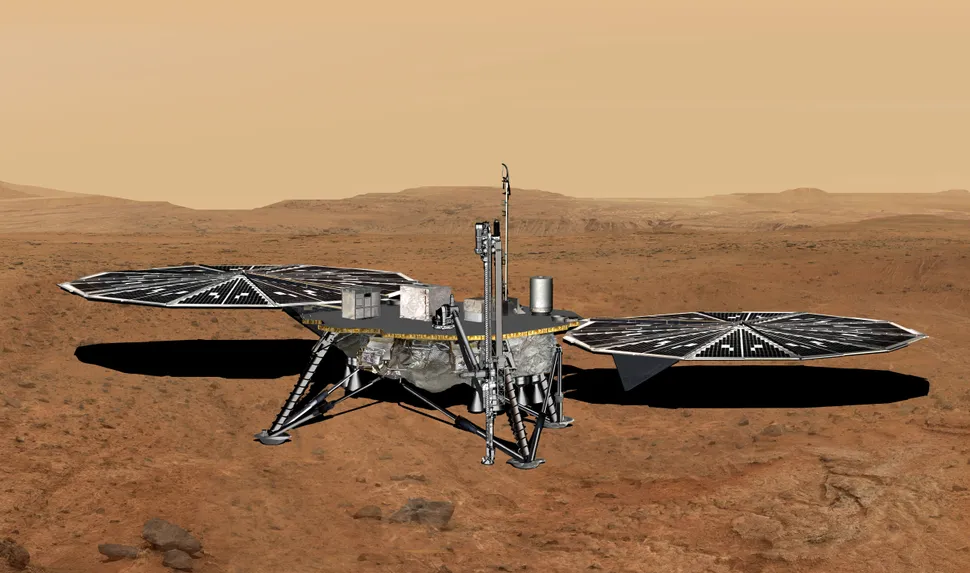
Artist's concept of the Mars Life Explorer. Credit - Amy Williams Artist's concept of the Mars Life Explorer. Credit - Amy Williams

Searching for life on Mars has been an explicit goal of the astrobiological community for decades. However, they have not really had the resources to effectively do so, and they might be running out of time. Crewed missions to Mars are planned for as little as 15 years from now (though those timelines might be changing…again), and by the time that happens it may be too late to separate Martian life from unintentionally transplanted Earth-life. According to a group of researchers from the Agnostic Life Finding Association, there is one final chance to detect Martian life before it is irreversibly contaminated - the Mars Life Explorer (MLE). But to do its job properly, it’s going to need an upgrade.

MLE itself isn’t even a completely funded mission yet. Its objective would be to fly to Mars in the 2030s and search for signs of extant (not ancient) life, mainly by using a drill to drill into some water ice that exists near to the surface at a mid-latitude range on the Red Planet and analyzing that water sample for biological molecules.

It wouldn’t be the first experiment to try to capture those molecules, though. The Viking landers, which landed on Mars almost 50 years ago, also tried to capture biological materials, and provided famously ambiguous results. To this day, there is still debate among the scientific community as to whether or not Viking found life on Mars, yet no one has followed up the ambiguous Label Release experiment it performed with another one.

Fraser discusses the history of the search for life on Mars.

Enter MLE - the express intent of the Mars Life Explorer is in the name. But, according to a new paper from Gabriella Rizzo and Jan Spacek of the Agnostic Life Finding Association (ALFA), its current suggested suite of equipment would only look at the current habitability of Mars, rather than finding any evidence of actual life. More specifically, it would be limited to finding only life like that which appears on Earth. The authors point out that “research in ultra-low-biomass ecosystems on Earth, such as hyper-arid deserts and high-UV environments, has shown that instruments traditionally used in astrobiology often lack the sensitivity needed to detect life under such extreme conditions.”

In other words, the systems that we have previously put in place, and those planned for the MLE, won’t do their job correctly. MLE’s suite of instruments both won’t find life at extremely low concentrations, but it also won’t be able to deal with any life that doesn’t have a biochemistry similar to ours. Assuming there are large amounts of biochemically similar life on Mars are two very large assumptions that the ALFA team hope to eliminate.

Their suggestion is known as the Agnostic Life Finder (ALF), which was originally developed up to a Technology Readiness Level 4, meaning they’ve built a bench-top prototype, by a NASA Institute for Advanced Concepts grant. The ALF itself uses a system of chambers, filters, and an electric charge to separate organic molecules, which are charged, and large, from other potential components in a liquid environment, such as ions or non-charged particulates.


Cross contamination might not be the only reason Earth life could exist on Mars - as Fraser explains, detecting natural cross contamination can only be done prior to human presence.

According to the paper, the best use case for the ALF would be in a tank where massive amounts of Martian water is collected before the first crewed missions. This water collection is widely considered to be a necessary step in the development of a permanent Martian presence, but its unclear when, or if, either the private space companies that seem best placed to do so first, or a government space agency that decides to take that first leap, will prioritize building such a water capture and storage system. In the meantime, joining the payload of MLE, which isn’t necessarily going to the same place as future astronauts might, is the best bet for the system.

Given the budget cuts that are happening throughout NASA, it is unclear at this point whether MLE is even going to be funded at all, despite being one of the highest priority suggestions in the latest Planetary Decadal Survey. While the ALF itself is a relatively simple instrument, it does need to get to Mars somehow, and until it finds a ride the best the ALFA team can do is continue testing and development. But maybe some day someone will pick up the idea and give it a chance to answer one of the most important questions in astrobiology once and for all.

Learn More:

{ htps://www.universetoday.com/ }

Hoe vind je dit bericht?
Geschreven door peter om 23:27 Stuur door

Scientists Crack Earth's Magnetic Field Puzzle

Scientists Crack Earth's Magnetic Field Puzzle

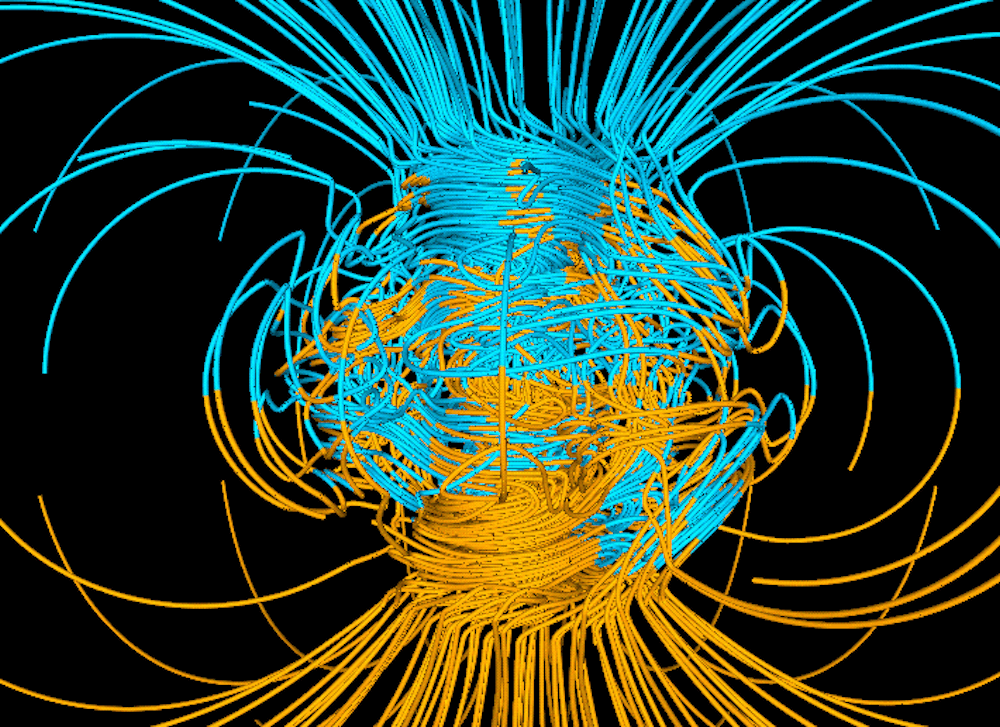
Computer simulation of Earth's field in a period of normal polarity between reversals Computer simulation of Earth's field in a period of normal polarity between reversals

Earth's magnetic field acts like an invisible shield, protecting our planet from harmful cosmic radiation that would otherwise strip away our atmosphere and make life nearly impossible. Unlike Mars, which lost most of its magnetic protection and now faces constant bombardment from space particles, Earth has maintained this critical defence system for billions of years.

Artist impression of the interior structure of the Earth (Credit : CharlesC)

Artist impression of the interior structure of the Earth

(Credit : CharlesC)

But how did this protective field form, and could it have existed when our planet was much younger? New research from scientists at ETH Zurich and Southern University of Science and Technology in China provides answers that fundamentally reshape our understanding of early Earth.

It’s long been understood that Earth's magnetic field comes from what's called the "dynamo effect." Deep inside our planet, the liquid iron and nickel core slowly cools over time, creating circular currents of flowing metal called convection currents. As Earth rotates, these currents twist into screw-like patterns, generating electric currents that produce our magnetic field.

Illustration of the dynamo mechanism that generates the Earth's magnetic field: convection currents of fluid metal in the Earth's outer core, driven by heat flow from the inner core, organised into rolls by the Coriolis force, generate circulating electric currents, which supports the magnetic field (Credit : Andrew Z Colvin)

Illustration of the dynamo mechanism that generates the Earth's magnetic field: convection currents of fluid metal in the Earth's outer core, driven by heat flow from the inner core, organised into rolls by the Coriolis force, generate circulating electric currents, which supports the magnetic field

(Credit : Andrew Z Colvin)

However, there was a significant gap in this theory. About one billion years ago, Earth's inner core began to crystallise and solidify. Before that time, the entire core was completely liquid. The big question was whether this fully liquid core could have generated the magnetic field necessary to protect early life.

The research team developed computer models to simulate whether a completely liquid core could generate a stable magnetic field, using calculations performed on the Piz Daint high-performance computer. What made their study particularly interesting was their ability to minimise the influence of the Earth's core viscosity to negligible levels, something no previous research had achieved. Their simulations demonstrated though that Earth's magnetic field could indeed have been generated billions of years ago in much the same way it operates today.

"Until now, no one has ever managed to perform such calculations under these correct physical conditions.” - lead author Yufeng Lin from the Southern University of Science and Technology in China.

This discovery has far reaching implications for our understanding of how life developed on Earth. Billions of years ago, life apparently benefited from the magnetic shield, which blocked harmful radiation from space, making its development possible in the first place. Without this protection, the it’s believed that the intense radiation would have made Earth's surface far too hostile to the delicate chemical processes that eventually led to living organisms.

The magnetic field essentially gave life on Earth a head start, creating a safer environment where complex molecules could form and evolve without being constantly disrupted by high energy particles from space.

Understanding Earth's magnetic field isn't just about ancient history, it’s crucial for our modern world. The magnetic field plays a crucial role in making satellite communications and many other aspects of modern civilisation possible. GPS systems, power grids, and communication networks all depend on this invisible shield. However, the field has flipped its polarity thousands of times throughout Earth's history, and scientists have recently observed rapid shifts in magnetic north's position. By gaining a better understanding about how the magnetic field works, researchers can make more accurate predictions about future changes and future flips that might affect our technology dependent society.

Source : 

RELATED VIDEOS

{ https://www.universetoday.com/ }

Hoe vind je dit bericht?
Geschreven door peter om 23:15 Stuur door

JWST Traces Details of Complex Planetary Nebula

JWST Traces Details of Complex Planetary Nebula

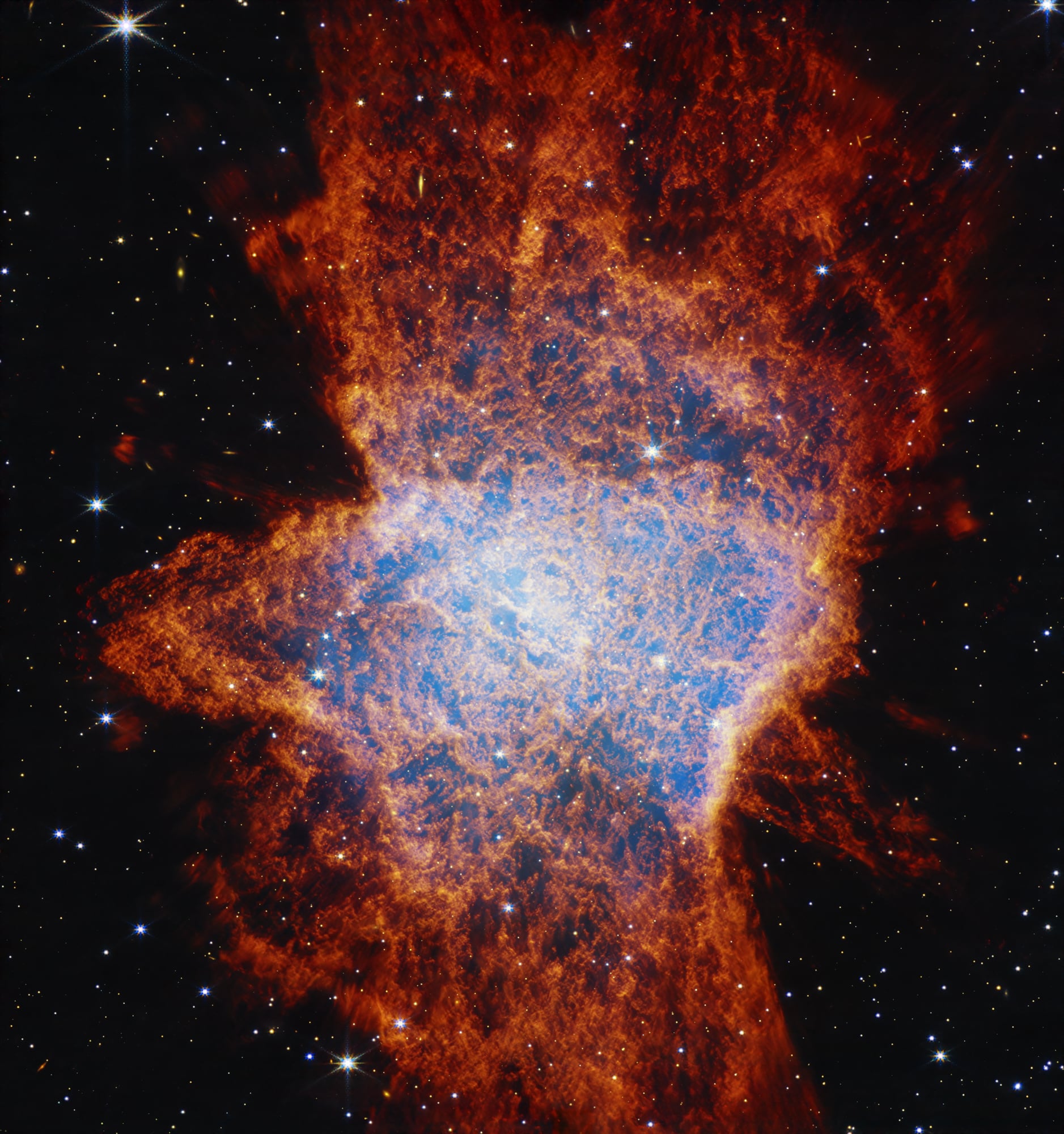
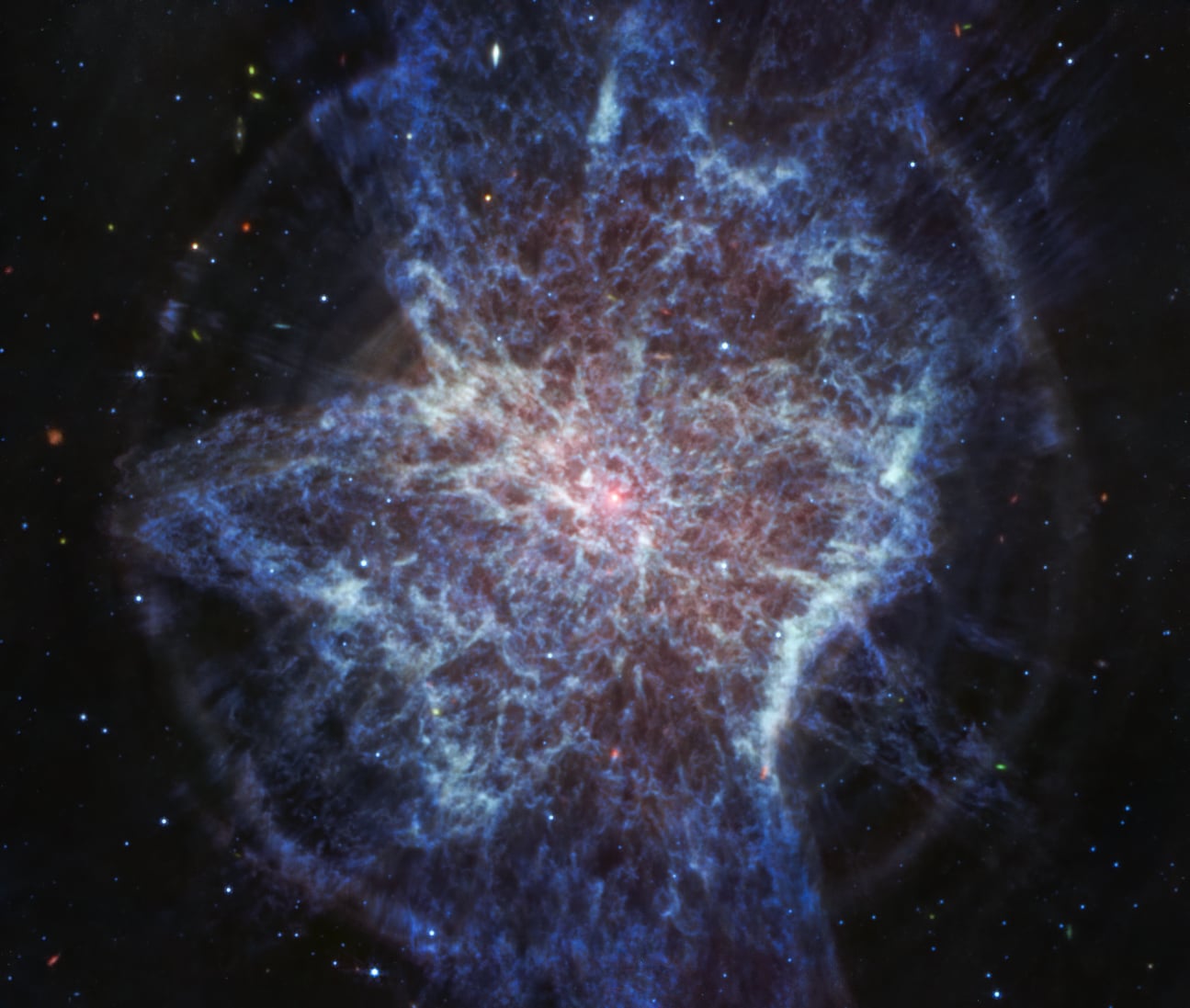
NASA’s James Webb Space Telescope’s view of NGC 6072 shows a complex scene of multiple outflows expanding at different angles from a dying star. Credit: NASA/ESA/CSA/STScI NASA’s James Webb Space Telescope’s view of NGC 6072 shows a complex scene of multiple outflows expanding at different angles from a dying star. Credit: NASA/ESA/CSA/STScI

When low-mass stars approach the end of their main-sequence phase, they expel clouds of gas that expand to form planetary nebulae. Since they were first identified in the late 1700s, astronomers have identified nebulae of all shapes and sizes, with most appearing circular, elliptical, or bipolar. However, some nebulae stray from this pattern, including the NGC 6072 nebula located about 3,060 light-years away in the southern constellation Scorpius. In a new series of high-resolution images taken by the James Webb Space Telescope (JWST), astronomers have noted some peculiar patterns that could provide insight into the lifecycle of stars.

At first glance, the images taken using Webb's Near-Infrared Camera (NIRCam) and Mid-Infrared Instrument (MIRI) suggest that NGC 6072 is a giant mess reminiscent of a bug splattered on a windshield. However, the structure traced by Webb's instruments suggests that some very complex mechanisms are at work within it. The NIRCam data shows a hot central core region glowing brightly with a light blue hue, surrounded by elliptical outflows that give it a multi-polar configuration. These outflows have resulted in two lobes of gas and dust that cross the center at near-vertical angles, while a third extends perpendicularly to form an equatorial plane.

The central region covers a large area of dark pockets surrounded by orange material that grows redder the farther it is from the center. This is consistent with the gas and dust growing colder the farther it ventures from the hot central core. The three-lobe structure could mean that at least two stars are at the nebula's center, likely consisting of a younger companion to the aging star that has already lost most of its material. The MIRI data, meanwhile, captures the longer-wavelength infrared data, which emphasizes the web-like structure created by the outflows of dust.

The NGC 6072 nebula as imaged by Webb's MIRI instrument. Credit: NASA/ESA/CSA/STScI

The NGC 6072 nebula as imaged by Webb's MIRI instrument.

Credit: NASA/ESA/CSA/STScI

This image also reveals the star that could be central to the nebula (which appears as a pinkish-white dot), as well as concentric rings expanding from the central region to the edges of the lobes. This could also be evidence of a secondary star at the center, orbiting the older star and carving out rings in its wake. Alternately, the rings could have been caused by pulsations in the outflows, where gas and dust were expelled at long intervals (every thousand years or so) in all directions. The areas represented by NIRCam (red) and MIRI (blue) both trace the cool gas in the cloud (likely molecular hydrogen), while the central regions trace hot ionized gas.

As the aging star at the center cools, the nebula will dissipate into the interstellar medium (ISM), contributing the heavier elements from which new stars and planetary systems will form. The study of planetary nebulae is a major objective for the JWST, which will provide new insights into the lifecycle of stars and their impact on the surrounding environments. These studies could also shed light on what may become of our Sun when it reaches the end of its main sequence phase, billions of years from now.

Further Reading: 

RELATED VIDEOS


{ https://www.universetoday.com/ }

Hoe vind je dit bericht?
Geschreven door peter om 23:01 Stuur door

Meer van UFO'S of UAP'S, ASTRONOMIE, RUIMTEVAART, ARCHEOLOGIE, OUDHEIDKUNDE, SF-SNUFJES EN ANDERE ESOTERISCHE WETENSCHAPPEN - DE ALLERLAATSTE NIEUWTJES

↑ Terug naar de berichten