Ontdek de Fascinerende Wereld van UFO's en UAP's: Jouw Bron voor Onthullende Informatie!
Ben jij ook gefascineerd door het onbekende? Wil je meer weten over UFO's en UAP's, niet alleen in België, maar over de hele wereld? Dan ben je op de juiste plek!
België: Het Kloppend Hart van UFO-onderzoek
In België is BUFON (Belgisch UFO-Netwerk) dé autoriteit op het gebied van UFO-onderzoek. Voor betrouwbare en objectieve informatie over deze intrigerende fenomenen, bezoek je zeker onze Facebook-pagina en deze blog. Maar dat is nog niet alles! Ontdek ook het Belgisch UFO-meldpunt en Caelestia, twee organisaties die diepgaand onderzoek verrichten, al zijn ze soms kritisch of sceptisch.
Nederland: Een Schat aan Informatie
Voor onze Nederlandse buren is er de schitterende website www.ufowijzer.nl, beheerd door Paul Harmans. Deze site biedt een schat aan informatie en artikelen die je niet wilt missen!
Internationaal: MUFON - De Wereldwijde Autoriteit
Neem ook een kijkje bij MUFON (Mutual UFO Network Inc.), een gerenommeerde Amerikaanse UFO-vereniging met afdelingen in de VS en wereldwijd. MUFON is toegewijd aan de wetenschappelijke en analytische studie van het UFO-fenomeen, en hun maandelijkse tijdschrift, The MUFON UFO-Journal, is een must-read voor elke UFO-enthousiasteling. Bezoek hun website op www.mufon.com voor meer informatie.
Samenwerking en Toekomstvisie
Sinds 1 februari 2020 is Pieter niet alleen ex-president van BUFON, maar ook de voormalige nationale directeur van MUFON in Vlaanderen en Nederland. Dit creëert een sterke samenwerking met de Franse MUFON Reseau MUFON/EUROP, wat ons in staat stelt om nog meer waardevolle inzichten te delen.
Let op: Nepprofielen en Nieuwe Groeperingen
Pas op voor een nieuwe groepering die zich ook BUFON noemt, maar geen enkele connectie heeft met onze gevestigde organisatie. Hoewel zij de naam geregistreerd hebben, kunnen ze het rijke verleden en de expertise van onze groep niet evenaren. We wensen hen veel succes, maar we blijven de autoriteit in UFO-onderzoek!
Blijf Op De Hoogte!
Wil jij de laatste nieuwtjes over UFO's, ruimtevaart, archeologie, en meer? Volg ons dan en duik samen met ons in de fascinerende wereld van het onbekende! Sluit je aan bij de gemeenschap van nieuwsgierige geesten die net als jij verlangen naar antwoorden en avonturen in de sterren!
Heb je vragen of wil je meer weten? Aarzel dan niet om contact met ons op te nemen! Samen ontrafelen we het mysterie van de lucht en daarbuiten.
Why are they now starting to disclose suppressed exotic technologies?
For over 80 years, covert research into exotic propulsion, anti-gravity systems, and spacetime manipulation has been housed within deep black programs, classified efforts shielded from both public and congressional oversight.
Now, on April 14, 2025, Michael Katzios, the new White House science chief, made a bold claim: “Our technologies permit us to manipulate time and space...” Shortly after, he doubled down, promising innovations that would let us “bend time and space” and “drive us further into the endless frontier.” These weren’t offhand remarks, they were published on the official White House site, signaling intent.
What does "Manipulating Spacetime" really mean? Spacetime is the four-dimensional framework of our universe. Per Einstein’s theory, mass and energy warp this fabric, creating gravity and affecting time. To manipulate it would mean bending reality itself, shortening distances, warping time, or enabling faster-than-light travel.
Just days before Katzios’ remarks, President Trump said: “We have a weapon that no one has a clue what it is... more powerful than anything even close.”Was he referencing to a spacetime weapon?
Trump isn’t the first high-level figure to hint at such capabilities. Back in 2019, Lt. Gen. Steve Kwast publicly discussed technology capable of transporting a person anywhere on Earth in under an hour, suggesting real-world applications of physics far beyond current norms. He also touched on wireless, space-based energy transmission.
Rumors have long circulated about transatmospheric vehicles, craft capable of seamless operation both within Earth’s atmosphere and in space. Though unconfirmed, these platforms may represent a technological bridge between known aerospace systems and genuine spacetime engineering. (Consider Gary McKinnon’s 2002 discovery during his hack of U.S. military systems: references to a secret space fleet and "non-terrestrial officers.")
But it is not only about manipulating time and space.
What might they also have:
Anti-Gravity Propulsion:
Altering inertia with plasma or exotic materials, referenced in Navy patents.
Warp Drives:
Bending space around a craft to move without motion.
Zero-Point Energy: Tapping the quantum vacuum for limitless energy, a paradigm-shifting source of power.
But why some groups want to keep it secret? There are compelling reasons for secrecy, none of them rooted in public interest:
Control of Power – Whoever controls this tech controls the future.
Economic Impact – It would collapse the fossil fuel, aviation, and defense sectors.
Weaponization Risk – These tools could be catastrophic in the wrong hands.
Psychological Shock – It would rewrite everything we know about science and our place in the cosmos.
Despite growing testimony and a trove of leaked documents, officials continue to dismiss these claims. The Deep State line remains unchanged: “No empirical evidence exists for reverse-engineering extraterrestrial technology.” But the evidence says otherwise.
Supporting evidence:
Exotic materials reportedly recovered in 1950s, held by Lockheed.
The 1953 Robertson Panel even set the tone for decades of deliberate obfuscation, publicly debunking UFOs while secretly studying their implications. The CIA used Project Blue Book to publicly debunk UFOs.
As early as 1966, the U.S. Air Force reportedly managed over 30 classified anti-gravity projects.
A 1971 Australian Defense report referenced America’s "Advanced Saucer Aircraft" and a Cold War “UFO crash program” into anti-gravity propulsion.
The US government, through its CIA's Office of Global Access (OGA), is reported to have a secret program to retrieve and reverse-engineer crashed UFOs. This program, which began in 2003, is said to have recovered at least nine non-human aircraft, some of which were intact. The OGA works with special operations forces like SEAL teams to conduct these retrievals, keeping the operations highly secret.
CIA allegedly blocked a 2024 transfer of exotic materials from Lockheed to Bigelow Aerospace.
Ben Rich, former head of Lockheed Skunk Works, reportedly stated: “We now have the technology to take ET home.”
Don Phillips, also from Lockheed, confirmed reverse-engineering efforts related to recovered UFO craft, allegedly including materials from the infamous 1947 Roswell incident.
Dr. Salvatore Pais, a Navy scientist, filed patents (2016–2019) for highly unconventional devices, including a Space-Time Modification Weapon. These patents describe the use of electromagnetic fields, plasma, and rotational force fields. Theoretically, this device could create a spacetime modification weapon more powerful than hydrogen bombs. The Navy invested USD 508,000 testing the concept between 2016-2019.
But what could be the reason they are starting to reveal it now? The sudden shift toward public statements about advanced capabilities seems deliberate.
Consider the possible motives:
Strategic Signaling: A subtle warning to adversaries: “We possess technology beyond your reach.”
Controlled Disclosure: Shaping the narrative gradually to maintain public trust and institutional control.
Leaks Are Coming: Private-sector breakthroughs or whistleblowers may soon expose the truth.
Justifying Black Budgets: Revealing exotic tech lends credibility to decades of hidden spending under national security.
But perhaps the most compelling reason: a major event, whether real, staged, or cosmic in nature or eventually an alien contact scenario is on the horizon. This may be phase one of psychological preparation.
Finally; the evidence suggests that these exotic advanced technologies already exist, whether reverse-engineered or the result of disruptive physics breakthroughs. But what’s happening now isn’t full disclosure. It’s a carefully managed narrative operation, an information war cloaked in the language of advanced science.
A previously shared video from the U.S. Navy showed four “tic-tac-shaped” objects emerging from the water before flying away. The U.S. Navy has acknowledged that its personnel have witnessed things that can’t be explained, but sailors “may not want to make waves” and testify.
The mystery of the unmanned aerial systems (UAS) spotted in the skies over New Jersey last year has been attributed to commercial, hobbyist, and law enforcement drones. Misidentified manned aircraft, helicopters, and even stars were also likely culprits. The sightings created a form of mini-hysteria as many looked to the skies over the Garden State.
The FAA has further confirmed that some sightings were likely previously undisclosed research drones. Whether the disclosure puts the matter to rest is unlikely, as there will always be those who believe they saw something unexplainable in the night sky.
Another mystery is gaining traction again, one related to a potential mystery of the deep. That situation is even more complex, as a video captured by United States Navy sailors two years ago is making the rounds online, and there may be no easy answers.
A previously shared video showed four “tic-tac-shaped” objects emerging from the water before flying away. There was no conclusive explanation previously, and we’re surprisingly no closer to determining what the objects may be, even as it was widely seen.
Documentary filmmaker Jeremy Corbell suggested that additional individuals who witness such unexplained phenomena firsthand may be reluctant to come forward.
“It’s a long-haul thing. UFOs have been taboo for so long. It’s now admitted they’re flying without impunity in a restricted airspace, and we have footage like this. Military footage of an unidentified anomalous phenomenon (UAP) from a Navy warship in a critical area, just off the coast of California. It’s gonna take time,” Corbell told NBC News.
Did U.S. Navy Sailors See UAPs Flying at Sea?
Several sailors who served aboard the Independence-class littoral combat ship (LCS) USS Jackson had previously claimed to have witnessed the incident with the objects in 2023. It was just the latest unexplained incident of such objects, with other reports occurring in 2004 and then again in 2019.
The USS Jackson’s Senior Chief Operations Specialist Alexandro Wiggins, a twenty-three-year veteran of the U.S. Navy and a radar expert, recently came forward to offer a few new details about what he saw off the California coast during his shift in the combat information center (CIC). After an object appeared on the screens, Wiggins went to get a closer look.
“To my surprise, which is something I’ve never witnessed, was a light I noticed on the horizon, it looked as if it were surfacing out of the water and going up,” Wiggins explained to 8 News Now.
“We only saw the one, and then we saw the second one. It was only when we zoom out that we realize, holy crap, there’s two more out here, a total of four.”
He added that after returning to the CIC, he employed the ship’s SAFIRE thermal imaging sensor to acquire and track a target. The objects displayed no exhaust signature and produced no thermal trail.
However, Wiggins claimed, no formal incident report was filed because the objects remained at a safe distance and weren’t seen as a threat to the ship.
“I am skeptical about what I saw that day,” Wiggins continued. “Maybe one day I’ll know what that was, and I’ll be like eighty or ninety years old, and it’ll be normalized like… the stealth fighter or Area 51. It’ll be public at some point, but then I’ll be old.”
It may take more witnesses to come forward, but as Corbell noted, sailors may not want to make waves. In the meantime, the U.S. Navy has acknowledged that its personnel have witnessed things that can’t be explained. Is it a top-secret drone program being developed by the Defense Advanced Research Projects Agency (DARPA), an enemy surveillance program, or something else?
NASA's Curiosity Rover has discovered long carbon chains on Mars. On Earth, molecules like these are overwhelmingly produced by biological processes.
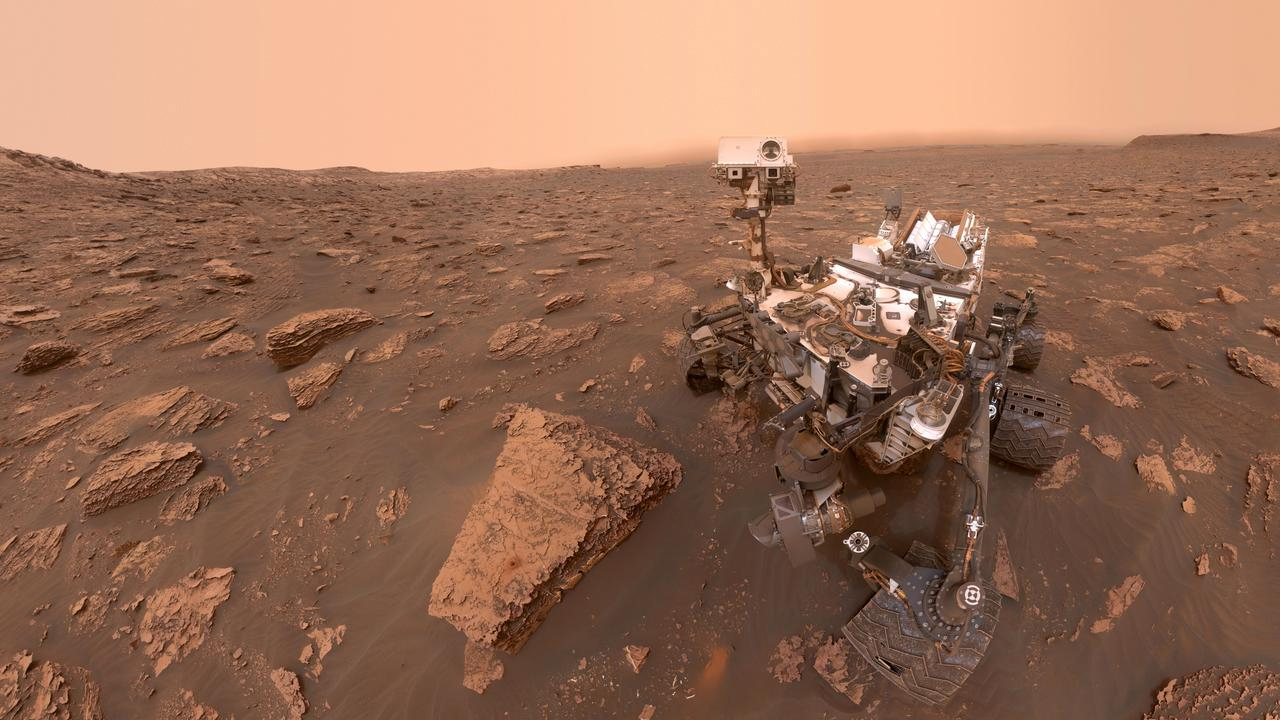
NASA's Curiosity rover took this selfie while inside Mars' Gale crater on June 15, 2018, which was the 2,082nd Martian day, or sol, of the rover's mission.
(Image credit: NASA/JPL-Caltech/MSSS)
The longest molecules ever found onMarshave been unearthed by NASA's Curiosity rover, and they could mean the planet is strewn with evidence for ancient life.
Molecule chains containing up to twelve carbon atoms linked together were detected in a 3.7 billion-year-old rock sample collected from a dried-up Martian lakebed named Yellowknife Bay, according to a study published March 24 in the journal Proceedings of the National Academy of Sciences.
These long carbon chains are thought to have originated from molecules called fatty acids, which, on Earth, are produced by biological activity. While fatty acids can form without biological input, which may be the case on Mars, their existence on the Red Planet means that signs of life may be lurking within its soil.
"The fact that fragile linear molecules are still present at Mars' surface 3.7 billion years after their formation allows us to make a new statement: If life ever appeared on Mars billions of years ago, at the time life appeared on the Earth, chemical traces of this ancient life could still be present today for us to detect," study co-author Caroline Freissinet, an analytical chemist at the French National Centre for Scientific Research in the Laboratory for Atmospheres and Space Observations, told Live Science.
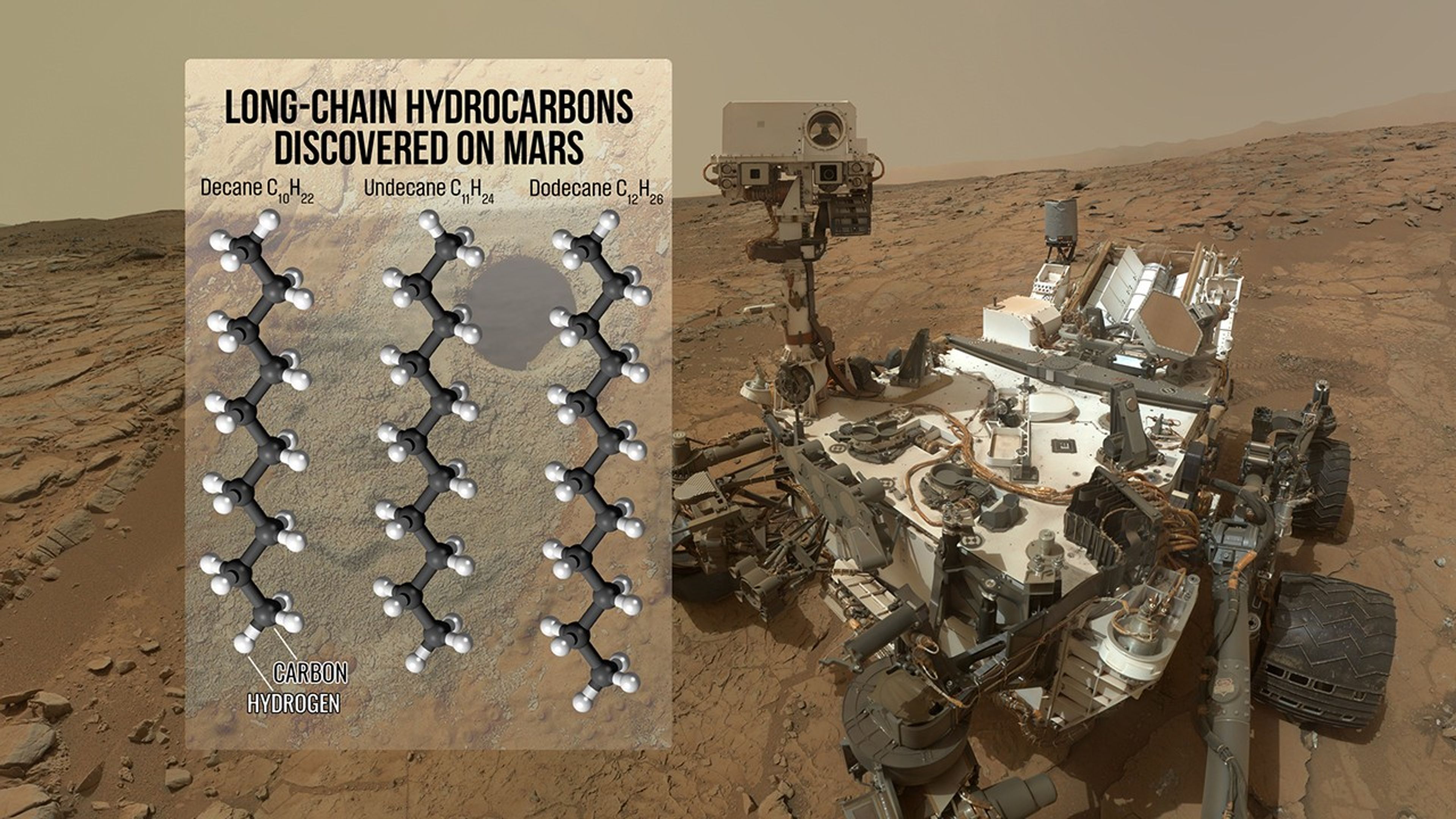
The molecules — hydrocarbon strings of 10, 11 and 12 carbon atoms called decane, undecane, and dodecane — were detected by Curiosity's Sample Analysis at Mars (SAM) instrument.
No stone unturned
The Curiosity Rover arrived on Mars in 2012 at the Gale Crater, a massive 96-mile-wide (154 km-wide) impact crater formed by the planet's collision with an ancient meteorite. In the years since, the rover has traveled about 20 miles (32 km) across the crater, investigating places including Yellowknife Bay and Mount Sharp (Aeolis Mons), a 3.4-mile-high (5.5 km-high) mountain in the center of the crater.
Nicknamed "Cumberland", the sample analyzed for the new study was drilled by Curiosity in 2013 from Yellowknife Bay, and previous analyses found it to be rich in clay minerals, sulfur, and nitrates.
But despite many thorough tests, the hydrocarbon strings in the sample remained undetected for more than a decade. The hydrocarbons were actually discovered by accident as part of an attempt to find the building blocks of proteins — known as amino acids — in the sample.
The researchers behind the new study thought to test out a new method for finding these molecules by pre-heating the sample to 1,100°C (2,012°F) to release oxygen before analysis. Their results showed no amino acids, but, by pure luck, they discovered the fatty molecules hiding there instead.
"The excitement was super high when I saw the peaks on the spectrum for the first time," Freissinet said. "It was both surprising and not surprising. Surprising because those results were found on the Cumberland sample that we had already analyzed many times in the past. Not surprising because we have defined a new strategy to analyze this sample."
"New method, new results," she added.
The researchers suggest that the molecules may have broken off from the long tails of fatty acids named undecanoic acid, dodecanoic acid, and tridecanoic acid, respectively. Fatty acids are long chains of carbon and hydrogen with a carboxyl (-COOH) acid group at the end.
NASA graphic showing the long-chain organic molecules decane, undecane, and dodecane, which are the largest organic molecules discovered on Mars to date.
(Image credit: NASA/Dan Gallagher)
Life-forming chemistry
To test this theory, the researchers mixed undecanoic acid into a Mars-like clay in the lab before performing a test similar to that carried out by the SAM instrument As expected, the undecanoic acid broke down to decane, indicating that the carbon chains could indeed have originated from fatty acids.
On Earth, molecules like these are overwhelmingly produced by biological processes, but they can also occur naturally without life. However, non-biological processes usually only result in fatty acids with fewer than 12 carbon atoms, the researchers say. While the longest carbon chain detected by SAM had 12 carbons, the instrument is not optimized to detect longer molecules, meaning that it is possible longer chains were also present.
"There is evidence that liquid water existed in Gale Crater for millions of years and probably much longer, which means there was enough time for life-forming chemistry to happen in these crater-lake environments on Mars," study co-author Daniel Glavin, a researcher at NASA's Goddard Space Flight Center, said in a NASA statement.
Regardless of what made them, the detection of the carbon chains and their likely origins as fatty acids confirms that Curiosity can detect molecules of this kind, and that the molecules can remain preserved for billions of years in the Martian environment. The researchers hope to one day bring samples of Martian soil back home to Earth to properly analyze the contents, and hopefully solve the mystery of the Red Planet's elusive life once and for all.
"We are ready to take the next big step and bring Mars samples home to our labs to settle the debate about life on Mars," said Glavin.
This article was originally published on March 25, 2025
Was There a Lunar Eclipse on Day of Jesus' Crucifixion? NASA, Bible Say Yes
Despite assertions to the contrary, science and religion are not always at odds. This has been demonstrated once again, as an intriguing NASA discovery appears to offer verification of the Biblical accounts of Jesus’ crucifixion, according to researchers from Oxford University.
Using models that chart the historical positions of the sun, moon, and Earth, NASA confirmed a lunar eclipse took place on Friday, April 3, 33 AD—a date traditionally believed to coincide with Jesus’ death. That evening, observers in Jerusalem would have witnessed the moon rising in a darkened sky, tinted red by the Earth’s shadow. This type of eclipse creates what is known as a blood moon, and this cosmic phenomenon has sparked renewed interest among scholars and Christians alike. The Bible does indeed say that the sun turned dark and a moon that appeared like blood on the day when Jesus was killed—as would actually be expected, if NASA’s calculations are correct.
The words that suggest an ancient lunar eclipse come from a verse that has gained traction again in recent years, particularly on platforms like TikTok, where users are rediscovering ancient prophecies through a modern lens.
“‘Christian texts mention that the Moon turned to blood after Jesus’s crucifixion—potentially referring to a lunar eclipse, during which the Moon takes on a reddish hue,’” NASA noted following their calculations, which were completed several years ago. This idea aligns with this passage in Acts 2:20: “The sun will be turned to darkness and the moon to blood before the coming of the great and glorious day of the Lord.”
Lunar eclipse and blood moon seen over Kuwait in 2018.
Many Biblical historians believe the eclipse described in NASA’s records may be the same one referenced in scripture. Despite being written in the form of a prediction, the verse from Acts is spoken by the apostle Peter during a gathering 50 days after the crucifixion. Because of this timing, some experts interpret Peter’s statement as a direct recollection of recent events, including the eerie sky on the day Jesus died.
However, not all scholars accept such an interpretation. Some argue that Peter’s words in Acts were not an eyewitness account but rather a quote from the Book of Joel, written centuries earlier, and were meant to reference a future time when Christ would return. That passage—Joel 2:28–31—similarly describes cosmic signs: “The sun shall be turned into darkness, and the moon into blood, before the great and terrible day of the Lord comes.”
But Oxford researchers Colin Humphreys and W. Graeme Waddington disagree with this interpretation. They have cross-referenced the Biblical account and the eclipse data to argue that the crucifixion and the lunar eclipse took place at the same time, and that the apostle Peter was not predicting the second coming of Christ but rather emphasizing how prophecy had already been fulfilled in their lifetimes. Their work presents the possibility that a real astronomical event—the April 3 eclipse—could have been seen by witnesses in Jerusalem, adding a dramatic visual component, as well as a prophetic element, to the crucifixion narrative.
Peter preaching the gospel to his followers after Jesus’ death, in painting by Jan Styka from late 19th century.
Humphreys and Waddington also highlight a lesser-known source from the New Testament apocrypha to back up their theory: a document sometimes referred to as the Report of Pilate. Though not part of the canonical Bible, the apocryphal text provides vivid imagery that mirrors Joel’s prophecy. It reads: “At his crucifixion the sun was darkened; the stars appeared and in all the world people lighted lamps from the sixth hour till evening; the moon appeared like blood.” The researchers believe this supports their hypothesis, offering yet another account of unusual atmospheric events occurring at the time of Jesus’ death.
The darkness itself is referenced in Matthew 27:45, which states: “From noon until three in the afternoon darkness came over all the land.” This passage aligns with descriptions of the crucifixion in multiple Gospels and further reinforces the association between celestial disturbances and this pivotal moment in Christian history.
A Magical Melding of Cosmic and Religions Themes
As Good Friday is commemorated around the world, the timing of the holiday remains intricately connected to both religious tradition and astronomical patterns. Good Friday always falls two days before Easter Sunday, which is determined by a formula that tracks the lunar cycle. Specifically, Easter takes place on the first Sunday following the first full moon after the spring equinox. This method of calculation has ancient roots and was designed to maintain Easter’s connection to the Jewish festival of Passover, which is governed by the Hebrew lunar calendar.
Master of the Legend of St. James: The Crucifixion, ca 1480, oil on wood.
Jesus’ crucifixion is believed to have occurred around Passover, and the Gospels describe his resurrection on the Sunday that followed. To reflect this timeline, early Christians sought to establish a calendar that would keep Easter in close relation to both Passover and the spring equinox. This alignment not only preserved theological significance but also highlighted the cosmic themes embedded in the crucifixion story.
As science and scripture continue to intersect, modern tools like NASA’s eclipse data provide a deeper look into the historical contexts behind Biblical events. In this case the total weight of the evidence suggests the Bible can be accurately interpreted as a history book as well as a sacred religious text.
With respect to the ancient lunar eclipse, whether one views such celestial signs as divine miracles or naturally occurring phenomena, their symbolism endures, and will continue to do so regardless of what the ultimate truth might be.
Top image: Multiple phases of a lunar eclipse and blood moon.
Pope Francis has died! However, not many people know that the Vatican has over 50 miles of underground archives containing the world’s history. Let that sink in… 50 miles. And this isn’t even a conspiracy theory.
The Vatican’s Secret Archives are real and located in one of the most famous religious and cultural places in the world—the Vatican. These archives stretch across 53 miles of shelving and include 35,000 volumes of catalogs. They hold documents that are over 1,200 years old.
The name “Secret Archives” adds to their mystery and makes people think of hidden secrets or dark stories. Because the indexes aren’t public and access is limited to certain scholars, many people imagine that the archives hold shocking or even strange things. Some even believe the Vatican is hiding aliens there! (Source)
But in truth, the archives are not actually meant to be “secret.” The word “secret” comes from a Latin word, secretum, which really means “private.” These archives were always meant to store the Pope’s official documents, letters, and important Church records.
Inside, you’ll also find some of the Church’s most valuable historical papers, with some dating back to the 700s. For a long time, not even religious scholars could read them. That changed in 1881 when Pope Leo XIII, a forward-thinking Pope, opened the archives to researchers. Since then, the documents have helped tell the story of both the Church and the wider world.
One of the most important documents in the Vatican’s Secret Archives changed the course of religious history. It’s the official paper that shows the Catholic Church kicking out Martin Luther. Luther was a German man who challenged the Church by writing his famous 95 Theses, which started the Protestant Reformation. In response, Pope Leo X wrote a statement called Decet Romanum Pontificem, officially excommunicating Luther. This allowed Luther to start his own church and created a major split in Christianity that still affects the world today.
Another fascinating document in the archives is called the Chinon Parchment. It records the trial of the Knights Templar, a Catholic military group that was accused of crimes like heresy during the Crusades. The parchment is huge—about the size of a dining table—and was lost for hundreds of years due to a filing error. It wasn’t rediscovered until 2001, hidden in a box with other papers. Once found, it was properly sorted and made available to researchers.
When the Vatican made the Chinon Parchment public in 2007, it revealed something surprising: in 1308, Pope Clement V had actually cleared the Knights Templar of heresy. This new information helped restore the group’s reputation, which had been damaged for centuries.
All these documents—and many more—are stored in a special place near the Vatican Library in Rome. The archives include regular stacks and reading rooms, but also an underground fireproof bunker to protect delicate materials. There’s even a school for clergy to study history, and because it’s the Vatican, there’s sacred art to enjoy as well.
Access to the archives isn’t open to everyone. Only carefully approved scholars are allowed in. Still, the Vatican has become a bit more open in recent years. In 2010, journalists were allowed to visit for the first time—partly due to public interest after Dan Brown’s book Angels and Demons. In 2012, the Vatican held a public exhibition for the archives’ 400th anniversary, showing off some of its most important documents.
In 2019, Pope Francis announced that the Vatican would open up its archives on Pope Pius XII. During an event honoring the 80th anniversary of Pius’s election, Francis said, “The Church is not afraid of history.”
What secrets do you think are hidden in the Vatican’s secret archives?
Throughout history, some people have had a deep knowledge of many subjects. One such person was a Russian man named Genrikh Mavrikiyevich Ludvig. He was very smart and skilled in ancient cultures, architecture, engineering, and old languages. Some people even compared him to Leonardo da Vinci. It’s said that Ludvig was able to access secret files from the Vatican and may have found information about ancient aliens.
Ludvig’s story became more widely known in 2011 when a Russian newspaper called Sovershenno Sekretno published an article about him. The writer described Ludvig as a large man with a bald head, a big forehead, and a beard. His eyes were intense and he often got into trouble with the Soviet government. In 1938, he was accused of being a Vatican spy and sent to a concentration camp.
The writer, who had been one of Ludvig’s students, remembered attending a lecture by him in the 1960s. At first, it seemed interesting, but then it became confusing as Ludvig talked about many different topics like language, history, plants, and science. The writer wasn’t sure if Ludvig was a genius or a mystic. However, he said meeting Ludvig changed his view of the world.
Ludvig claimed that during the 1920s, he was allowed to read secret documents in the Vatican Archives, a huge collection of very old records. These documents are usually hidden from the public for 75 years. He said he found strange texts about ancient codes, alchemy, and even stories about aliens and UFOs visiting Earth long ago. (Source)
According to Ludvig, some of these texts talked about aliens helping early civilizations like the Egyptians, Mayans, and Mesopotamians. He studied the Mayan symbols and believed they showed images of spaceships and astronauts. He even said there were signs of nuclear weapons being used in ancient times, like melted walls in Babylon.
Ludvig also had a deep interest in the Sumerians, one of the first known civilizations. He believed that they suddenly advanced around 4000 BC, learning to build cities, use irrigation, invent the wheel, and create writing. Their early writing was made up of picture-like symbols and dated back to around 3200 BC.
He also believed that the pyramids in Egypt were not just tombs, but tools for spiritual or cosmic communication. Ludvig thought Christian images of angels came from an earlier culture called the Etruscans.
During World War II, even while he was a prisoner in the GULAG, Ludvig worked as an inventor and engineer. Between 1941 and 1943, he created 17 military inventions. Today, many UFO researchers and people who believe in ancient aliens know his name.
In 2016, leaked emails from Hillary Clinton’s campaign showed that her advisor, John Podesta, had received messages about UFOs and extraterrestrial life. One of the emails came from astronaut Edgar Mitchell, who said that the Vatican was aware of alien life. He also spoke about the need to keep peace in space and prevent it from being used for war.
Despite these amazing claims, not everyone believes Ludvig’s story. There is not much solid evidence to prove he really saw the secret Vatican documents or discovered all this information.
Vatican’s involvement in UAPs & Alien life
In his other interview with James Landoli on “Engaging The Phenomenon,” Daniel Sheehan, who was a former Chief Council for the United States Jesuit order, revealed intriguing details about his conversations with the head of the Vatican archives regarding the Vatican’s knowledge of extraterrestrial life. Sheehan shed light on his involvement in a groundbreaking initiative to address the theological and philosophical implications of the discovery of extraterrestrial intelligence.
During the interview, James raised the topic of David Grusch‘s claim that the Vatican possessed knowledge of extraterrestrial phenomena. Sheehan discussed his access to the classified files of the Project Blue Book, where he encountered photos of UFO crash retrievals and concrete evidence of non-human piloted vehicles.
He proposed the formation of a task force involving all 54 major religious denominations to address the issue from a theological perspective. However, at that time, there was insufficient consensus, and the proposal was declined. Sheehan is currently working through his New Paradigm Institute to organize a global summit conference involving world religious leaders to discuss the recent recovery of an extraterrestrial spacecraft.
“The United States government is in possession of biological evidence and has actually taken into custody alive an extraterrestrial person. They’re keeping this secret, interrogating the being, and distorting the information to justify massive expenditures on weapon development under the guise of a perceived threat.”
– Daniel Sheehan
Sheehan highlighted the Vatican’s acknowledgment of the possibility of extraterrestrial life. He referenced a formal statement issued by the Catholic Church on November 10, 2009, authorized by Pope Benedict. The statement, issued by Father Jose Gabriel Alfuz, a director of the Pontifical Observatory in Rome, recognized the increasing discovery of exoplanets and called for a global discussion on the philosophical and theological implications of the imminent discovery of extraterrestrial life.
White Orb Watches Family BBQ Over Lakeland, Florida April 20, 2025, UFO UAP Sighting News.
Date of sighting: April 20, 2025
Location of sighting: Lakeland, Florida, USA
Source: Email Report at scwaring @ yahoo.com
Guys this just in. An eyewitness at a family BBQ were enjoying the day when someone pointed out a white orb in the sky above. Then others came and they noticed it stayed over them as if it were watching them and recording the humans reactions to what they were seeing. You see, aliens love knowledge, like humans like money, knowledge is everything to them. The smaller orb drones are sent out from a mother drone and months later gathered after the orbs have recorded information about anything and everything they saw. Orbs record not just visual things, but also mental things like human feelings, fears, prayers...and yes every thought you have if you are outside with no obstruction between you and the orb above. How do I know? Because I have summoned them, and so have thousands of others worldwide. It validates everything I just said.
Scott C. Waring - Utah
Eyewitness states:
The object is still in the sky as of writing this, it doesn’t move from what we can tell, not even a little. My brother got out his binoculars and it looks circular in shape, almost like you can see through it, and had defined edges visible from the suns light. It was difficult to keep the binoculars steady enough to clearly make out what it is, but I feel like even if I could I couldn’t identify what it was. A high altitude jet flew fairly close to it at one point and it appears to me like the object is at a lower orbit than the jet was, that or it is a massive object. With the naked eye you can clearly tell it’s circular shape, but it doesn’t move with the wind.
Mind-blowing New Pyramid In Antarctica And More, Google Earth Map, UFO UAP Sighting News.
Date of discovery: April 20, 2025
Location of discovery: Antarctica
Source: Me using Google Earth
Coordinates: Under my Youtube video in the description.
Guys I spent a few hours outside pulling weeds, gardening and making sure a chicken hawk didn't grab my tortoise in my yard, but I hope all of you had a great Easter, loved spending mine this way.
I found two newer discoveries in Antarctica that I have not seen before and that nobody else has reported on. The shadow is an old discovery of mine, but I believe it is that of a cloaked alien...a very tall one mind you. Cloaking might hide the object from view, however physics says it will still throw a shadow. Also near it today I found a pyramid and a barrel structure. The pyramid structure is proof of ancient aliens and is about 110 yards along one side and about 85 meters tall. Thats about half the size of the great pyramid in Egypt. The barrel structure almost looks like the old US Marine barracks made of steel, but it might just be an entrance to something deeper, like an alien base. It's hard to say but I sure would love a ground level view of all these three discoveries.
Mass extinctions have shaped life on Earth for millions of years, erasing dominant species and paving the way for new life to thrive. From the asteroid that ended the reign of the dinosaurs to the current biodiversity crisis driven by human activity, each extinction reshapes the evolutionary landscape. As the climate changes and ecosystems degrade, researchers warn that humans could be steering the planet toward another mass extinction.
This sobering possibility raises a fascinating question: which species might inherit the Earth if humanity vanishes? Dr. Tim Coulson, an ecologist at the University of Oxford, suggests an unlikely candidate—octopuses.
Octopuses: Ocean’s Master Survivors
“Octopuses have a distinct advantage in the race for survival,” Coulson explains. Unlike humans, they exist in diverse habitats, from shallow coastal waters to the deep sea. Their adaptability could allow some species to endure even catastrophic changes. “If humans ceased hunting them, octopuses might have the opportunity to diversify and expand their habitats over time,” he adds.
While the notion of octopus civilizations may sound far-fetched, history shows that ocean-dwelling creatures can evolve rapidly after mass extinctions. Dr. Andrew Whiten, a zoologist at the University of St. Andrews, points out that mammals rose to prominence after dinosaurs vanished, paving the way for humans. Could octopuses follow a similar path?
Octopuses already display remarkable problem-solving skills. From using coconut shells as makeshift shelters to escaping aquarium tanks, these marine animals show a level of intelligence rarely seen in other species. Some even use tools to solve puzzles, a trait often associated with advanced cognitive abilities.
“An octopus’s nervous system functions more like a distributed processing network than a central brain,” explains Dr. Andy Dobson from Princeton University. “Their intelligence comes from their ability to coordinate multiple limbs and process vast amounts of sensory data.”
Their dexterity also sets them apart. “Octopuses can manipulate objects with unparalleled precision,” says Coulson. “While crows and other birds exhibit tool use, they don’t match the fine motor skills of an octopus.”
Challenges to Octopus Civilizations
Despite their intelligence, octopuses face significant obstacles in evolving into complex societies. Dr. Peter Godfrey-Smith of the University of Sydney highlights their solitary nature. “Octopuses lack the social structure necessary to build a culture,” he explains. “For them to form communities, they’d need to develop stronger social bonds and nurture their young differently.”
These changes, however, may be a long shot. Octopuses have existed for over 100 million years without evolving significant social behavior. Still, recent studies suggest that some species show signs of communal living, offering a glimmer of hope for their societal potential.
Human Impact and Evolutionary Roadblocks
Ironically, human activity could hinder octopuses’ evolutionary journey before it even begins. Pollution, ocean warming, and overfishing threaten marine life globally. Microplastics, in particular, may harm octopuses in ways scientists are only beginning to uncover.
If not octopuses, who might inherit the Earth? Dobson speculates that nematodes—tiny, resilient worms—could dominate, while Godfrey-Smith places his bets on highly adaptable birds like cockatoos.
Whether or not octopuses ever build underwater cities, their unique traits make them one of nature’s most intriguing survivors. As humanity confronts its impact on the planet, understanding the resilience of other species could offer insights into the future of life on Earth.
Mars Has the Remnants of a Lopsided Magnetic Field
By Andy Tomaswick
Simulation of the magnetic fields that were formerly found surrounding Mars. Credit - Ankit Barik / Johns Hopkins University
Scientists have known for a while that Mars currently lacks a magnetic field, and many blame that for its paltry atmosphere - with no protective shield around the planet, the solar wind was able to strip away much of the gaseous atmosphere over the course of billions of years. But, evidence has been mounting that Mars once had a magnetic field. Results from Insight, one of the Red Planet's landers, lend credence to that idea, but they also point to a strange feature - the magnetic field seemed to cover only the southern hemisphere, but not the north. A team from the University of Texas Institute for Geophysics thinks they might know why - in a recent paper, they described how a fully liquid core in Mars could create a lopsided magnetic field like the one seen in Insight’s data.
The Earth's core isn't completely molten despite what you may have learned in elementary school. There are two distinct cores - a solid "Inner" core and a molten "Outer" core. The inner core remains solid due to the immense pressures on the iron and nickel found there. So, the magnetic field that covers our whole planet is, in fact, created only by the Outer Core.
Researchers have long thought that a similar dynamic, solid inner and molten outer core, was present on Mars when it maintained a magnetic field billions of years ago. After about 3.9 billion years, the rocks that formed some of the large impact basins from that time, such as Hellas and Isidis, would contain rocks that would have magnetized while they were cooling due to the presence of the field. Since they don't, there is little evidence for a strong global magnetic field past that point. The going theory was that, as the planet's core cooled, the entire core became solid, eliminating the spinning molten metal that creates the magnetic field in the first place.
Fraser discusses the question of when Mars' dynamo shut down.
However, there was a strange feature in Mars' magnetic field—a massive difference in strength between the field in the northern and southern hemispheres. This dichotomy was first noticed during the Mars Global Surveyor mission back in 1997, but data from the Insight lander also confirmed a stark difference between the two hemispheres.
Various explanations have been offered for why the dichotomy existed. These ranged from the effects of large asteroid impacts to very early localized tectonic activity. However, the scientific community has not widely accepted previous explanations.
Enter the new theory from Chi Yan of the University of Texas and their co-authors. Theirs is a two-fold explanation. First, the red planet could have had a wholly molten core, and second, a massive temperature difference between the northern and southern hemispheres led to the heat escaping only in the southern hemisphere.
Magnetic fields can be artificial - as Fraser discusses here.
In Mars' case, a molten core would be a primary mover of the process known as a "planetary dynamo," which creates planetary-scaled magnetic fields. With a solid inner core like the Earth's, the dynamo effect could have been disrupted by inefficiencies in the system's fluid dynamics.
It could also explain how the temperature gradients allow such uneven heat extraction. If the southern hemisphere had much higher thermal conductivity, heat would be more likely to flow through it, causing the churning that creates the planetary dynamo to happen primarily on the southern side of the planet.
To prove their point, the authors created a model version of early Mars using a supercomputer at the Maryland Advanced Research Computing Center. They varied the fluid dynamics of Mars as well as the conductivity of its crust. They found that the conditions that most accurately matched the results from Insight and Global Surveyor occurred when Mars' core was wholly molten, and there was a significant difference in the thermal conductivity of the northern and southern hemispheres.
Keeping Mars' any artificial atmosphere Mars has would require a magnetic field - or something similar.
As with all research, there is plenty more left to do. The authors suggest further analysis of some of the seismic data from Insight to see if any additional data was already collected that could align with the molten core theory. Other potential paths forward could include improved modeling for a broader range of internal and external planetary conditions or a deeper understanding of Martian meteorites from various regions and times.
For now, this new theory seems to hold water—or molten iron, depending on who you ask. But there is a lot more work that needs to be done to prove this theory and its implications for the existence of life on Mars.
Artist's impression of water under the Martian surface. Credit: ESA
The surface of Mars is extremely cold, irradiated, and desiccated. But at one time, the planet was much warmer and wetter, with flowing water, lakes, and even an ocean covering most of its northern hemisphere. Because of this, scientists speculate that life may have emerged on Mars billions of years ago and could still be there today. Ever since the Viking 1 and 2 missions landed on the surface in 1976, the search for evidence of past (and maybe present) life has been ongoing.
As missions likeCuriosityand Perseverance continue to explore promising regions that were once lakebeds (the Gale and Jezero craters), there are still questions about where to look next. In a recent paper, researchers proposed searching for photosynthetic bacteria embedded in the snow and ice around Mars' mid-latitudes. Using "radiatively habitable zones" on Earth as a template, they argue that photosynthetically active bacteria could survive within exposed patches of ice.
On Earth, bacteria can survive and thrive in ice, even at depths of several meters. Earth's protective ozone layer protects these organisms from harmful ultraviolet (UV) radiation, allowing them to safely absorb what is known as photosynthetically active radiation (PAR). On Mars, which has a thin atmosphere (less than 1% of Earth's) and no ozone layer, about 30% more damaging UV radiation reaches the surface. However, numerical modeling predicts ice and snow around the equator can melt below the surface.
The presence of this liquid water at these depths could make these subsurface environments the most easily accessible locations for future astrobiology missions. To investigate this possibility, the team developed a radiative transfer model (RTM) based on previous research that employs the Delta-Eddington method (a simplified means of calculating radiative fluxes). This model allowed them to simulate vertically-stacked layers of snow, ice, and Martian dust.
Since solar flux has not yet been measured within ice on Mars, the team employed glacier ice in Greenland as an analog. Their results showed that in all cases, most of the solar radiation is absorbed within the top few meters of the ice, but increases based on grain size. Overall, they found that solar radiation can reach a maximum depth of about 6.5 meters (21.3 ft) in clean ice. At the same time, biologically damaging UV penetrated to about 3 m (~10 ft) in clean granular, packed ice (firn). Their results also indicated that PAR penetration varied considerably based on the amount of dust in the ice.
For ice with 0.01% dust, PAR reached just 25 cm (~10 inches) below the surface, while the peak penetration depth of UV was reduced to about 7 cm (2.75 inches). For ice with 0.1% dust concentrations, this was reduced to only 5 cm (~2 inches), with a peak UV penetration of 1.5 cm (0.6 inches). Overall, they found that Mars may have radiatively habitable zones within exposed patches of mid-latitude ice at depths ranging from a few centimeters for dusty ice to several meters for cleaner ice.
On Earth, microbes require temperatures of more than -18 °C (-0.67 °F) for cell division to occur. Meanwhile, favorable solar radiative conditions and the presence of liquid water are required for photosynthesis. And while conditions within the Martian polar ice are too cold for melting to happen at these depths, numerical models suggest that small amounts of melt and runoff can occur in exposed patches of mid-latitude snowpack just beneath the surface. As the team indicates, this could have significant implications in the search for life on Mars:
"Under similar ephemeral near-freezing conditions, widespread microbial habitats containing cyanobacteria, chlorophytes, fungi, diatoms, and heterotrophic bacteria are found in the shallow subsurface (top few centimeters to meters) of ice sheets, glaciers, and lake ice containing dust and sediment on Earth.
"In the summer, ice in the shallow subsurface melts due to solar heating at these locations. Photosynthesis then occurs in the subsurface, below a translucent ice lid, with nutrients scavenged from the dust and sediment present in the subsurface liquid water. During winter, the subsurface liquid refreezes, and photosynthesis ceases until the next summer."
Therefore, if ice and snow in equatorial regions experience seasonal melting, microbes like cyanobacteria could combine this water with nutrients from Martian dust in the ice to conduct photosynthesis. If such habitats exist, they would constitute the most easily accessible locations for finding evidence of life on Mars.
Meer van UFO'S of UAP'S, ASTRONOMIE, RUIMTEVAART, ARCHEOLOGIE, OUDHEIDKUNDE, SF-SNUFJES EN ANDERE ESOTERISCHE WETENSCHAPPEN - DE ALLERLAATSTE NIEUWTJES