Mysterious perfectly smooth ‘TicTac UFO’ spotted on MARS in Nasa photos sending alien hunters into frenzy online
The unsettling discovery comes after years of increasing UFO discussions at the highest level of government


 MUFON Monthly Sighting Statistics! - FEBRUARY 2025 Sightings Report

MUFON Monthly Sighting Statistics! - FEBRUARY 2025 Sightings Report
|
|
European spacecraft got rare close-up of Mars' lesser-known moon
A European spacecraft on a journey to study NASA's asteroid crash site did a quick pop-in of Mars on its way, capturing unprecedented images of Mars' lesser-known moon, Deimos.
Mars has two moons, Phobos and Deimos, but scientists know relatively little about them, especially the smaller one, Deimos. Nearly all of the images they have of it were taken from the Martian surface by rovers, and because the moon is tidally locked — meaning one full spin matches the amount of time it takes to complete its orbit of Mars — only one side has been seen on the Red Planet.
The Hera mission spacecraft captured views of the moon's far side, swinging within 625 miles of Deimos in space.
While the car-sized spacecraft flew around the Mars system, flight controllers on Earth temporarily lost communication with Hera because the signal was blocked. Though the blackout was planned for the maneuver, Ian Carnelli, the European Space Agency's Hera mission manager, said it was deeply emotional.
"I was almost in tears. I mean, I know probably this is normal for a flight for spacecraft operators, but every time we lose contact with a spacecraft, I'm super nervous," he said during a webcast following the flyby. "Then I was running to the room where the scientists were [watching for images], and as soon as I opened the door, they were screaming — really screaming."
Among those scientists was one of the co-founders of Queen. When Brian May isn't playing guitar riffs, he is an astrophysicist. As part of Hera's science team, May brings his expertise in stereoscopic imaging. That means he helps decipher complex scientific data into 3D pictures.
During a webcast on Thursday, May described some of the topographical details of the moon already brought to life through the raw data. A depression in the city-sized moon was visible, a feature May described as a "saddle" on the left side and some little craters at the bottom.
"You feel like you're there, and you see the whole scene in front of you," he said. "The science that we get from this is colossal, and I think we're all like children."
Hera launched in October 2024 and will rendezvous with Dimorphos, an asteroid previously slammed by a NASA spacecraft, in 2026. Back in 2022, NASA deliberately crashed a spacecraft into a harmless asteroid to practice thwarting a space rock, should a hazardous one ever be on a collision course with Earth. The European Space Agency is providing a follow-up to that test.

The flyby of Mars and Deimos wasn't a detour but a necessary maneuver to put the spacecraft on the right trajectory toward its ultimate destination. Swinging within 3,100 miles of Mars, Hera used its gravity to adjust its course.
Scientists would like to understand where Deimos and its partner Phobos came from — whether they were once asteroids captured in orbit around Mars or are chunks of the planet itself, blown out by a giant impact.
Mysterious perfectly smooth ‘TicTac UFO’ spotted on MARS in Nasa photos sending alien hunters into frenzy online
CREEPY new images of the “Tic Tac UFO” have surfaced after it was spotted on Mars - causing alien fans to draw resemblance to the infamous UFO sighting.
The shocking discovery was made by the NASA Mars Curiosity Rover Cam, before the image was posted to Reddit sending space fanatics into a frenzy.
This AI enhanced image shows a Tic Tac-shaped object on Mars
Credit: NASA

The images were captured by a NASA robot on the planet
Credit: NASA

The user said: “A Tic Tac has been spotted on Mars by the NASA Mars Curiosity Rover Mast Cam on Sol 2692 3 March 2020!
“Check out how it’s casting a shadow on the surface!”
Viewers of the post replied, comparing it to the notorious Tic Tac UFO sighting that went viral a few years ago.
One excited alien-head said: “This is exciting because it's a testable prediction. If that thing ain't there when we come back, it's f*****g aliens.
“If it is there, we either get high res images of an alien craft or the weirdest rock formation in the solar system.
“Someone tell NASA to get back out there.”
Other fans doubted the existence of a UFO sitting on Mars in this image.
One user said: “I'm a believer but this ain't it. Just a smooth rock. If it were a tic tac UFO it would be tiniest, and why is it there?”
The images showed a perfectly smooth "Tic Tac" shaped object, which due to the shading on the photo, appears to be floating above the surface of Mars.
Its colour appears to be a pale white shade, and the user uploaded an AI improved version of the image to provide greater detail.
This caused rampant speculation that this object may be a UFO, floating mid-air, potentially parked on the planet or exploring it too.
It comes after decades of growing UFO speculation, which came to a head in 2023 when the issue was discussed during congressional hearings from ex-military personnel.
Former military official and whistleblower David Grusch shared his testimony in front of the House Subcommittee on National Security, the Border, and Foreign Affairs.
He made bombshell claims about an alleged UFO retrieval program that he said was hidden by the U.S. government.


Other military personnel claimed that they encountered objects in the air which moved in ways they could not understand.
And around this time governments in several different countries such as Mexico revealed “dead alien corpses” which were displayed in Congress.
A groundbreaking report into UFOs was released by NASA in September 2023, in order to improve AI so it can help locate and identify alien life.
Two game changing videos released in 2019 which were reviewed in the report appeared to show three encounters between warplanes and what the navy called “unidentified aerial phenomena”.
The craft was described by one of the pilots mentioned in the report as "solid white, smooth, with no edges... uniformly coloured with no nacelles, pylons or wings", and looked like "an elongated egg or Tic Tac".
The Tic Tac UFO is a mysterious flying object that U.S. pilots and experts have claimed to have witnessed over the last few decades.
The first famous sighting with footage took place off the San Diego coast in 2004, after pilots on the USS Nimitz carrier strike group detected the object.
Commander David Fravor believed it to be something beyond human technology - as it possessed extreme acceleration and no visible propulsion.
Then in 2015, pilots on the USS Roosevelt off the East Coast captured footage of unidentified moving objects.
They also showed no means of propulsion and moved at high speeds.
Speculation online has caused alien fanatics to look for more Tic Tac-shaped space paraphernalia, including a Russian military base which appeared to be a Tic Tac UFO "charging hub".
The Pentagon has also acknowledged other declassified videos of encounters, but have been unable to explain them.
Additionally, Commander Dave Fravor and Lt. Commander Alex Dietrich told of their harrowing experience off the coast of San Diego, which was documented in videos from the Navy.
While flying their plane across the ocean, the pair said they witnessed a "Tic Tac" object above white water.
In 2021, a YouTuber spotted a building on Google Earth that he likened to a Tic Tac UFO base.
Strange footage of the site showed a “charging hub” for the pods, which was later believed to have been a Russian military base.
UFOs have also been spotted in the UK, with ex-MoD investigator Nick Pope claiming that "Tic Tac UFO" clips, like the ones in the US, are being hidden by the British government.


 Finally! NASA and SpaceX launch Crew-10 mission to bring 'stranded' ISS astronauts back to Earth
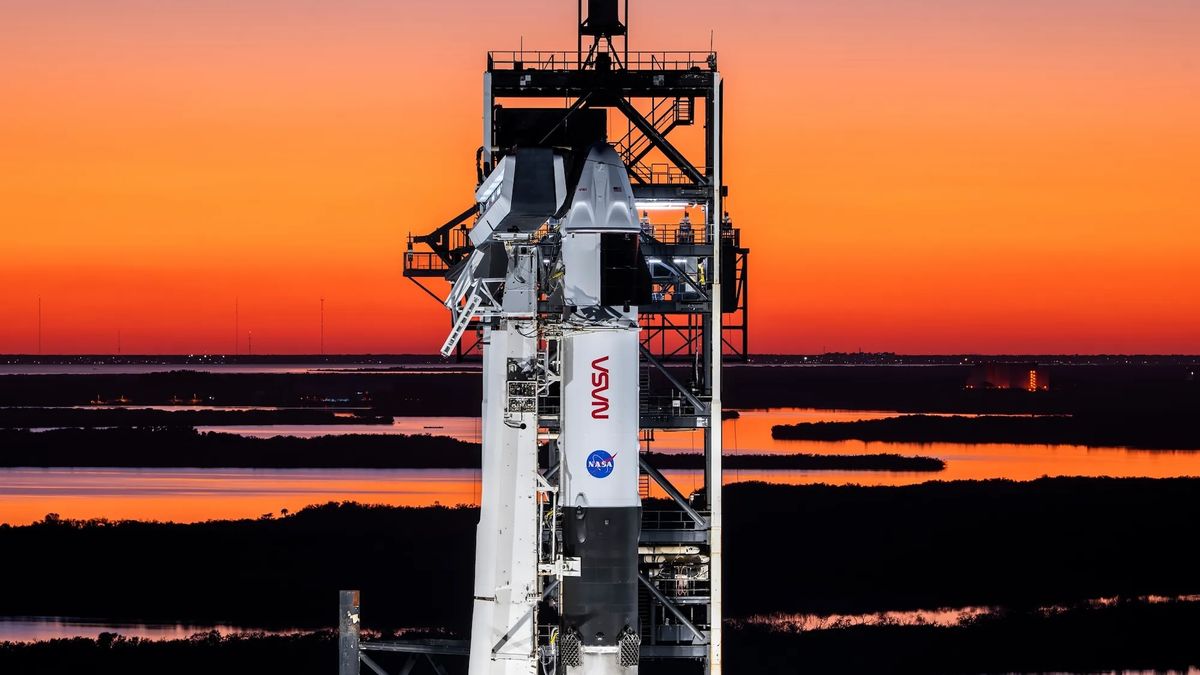
NASA has launched its Crew-10 mission, bringing relief to the U.S. astronauts Butch Wilmore and Suni Williams — who’ve been stuck aboard the International Space Station (ISS) for the last nine months — and finally allowing them to return to Earth.
The Falcon 9 rocket launched from Kennedy Space Center in Florida at 7:04 p.m. EDT on Friday (March 14), as part of a routine ISS staff rotation.
Riding aboard its top-mounted Dragon capsule are four astronauts: NASA’s Nichole Ayers and Anne McClain, Roscosmos astronaut Kirill Peskov and the Japan Aerospace Exploration Agency’s Takuya Onishi. If everything goes to plan, the capsule will dock at the ISS at 11:30 p.m. EDT Saturday (March 15).

Wilmore and Williams arrived at the ISS as part of Boeing's first Starliner Crew Test Flight. Starliner blasted off on its inaugural crewed test flight from Florida's Cape Canaveral Space Force Station on June 5, 2024. But not long after entering orbit, a number of issues cropped up — including five helium leaks and five failures of its reaction control system (RCS) thrusters.
Related:
This caused the mission, originally slated to last as few as eight days, to drag on for more than two months before NASA announced its abandonment on Aug. 24. The Starliner capsule undocked from the ISS on Sep. 6, returning to Earth without a crew.
While awaiting the Crew-10 rotation, Wilmore and Williams have been performing a number of maintenance tasks and participating in scientific projects.
Their stay has been largely safe but not entirely without incident. On June 27, a defunct Russian satellite broke apart in orbit, sending debris toward the ISS and forcing Williams and Wilmore, along with the other seven astronauts on board, to take cover inside their respective space capsules.
Following a handover ceremony from Crew 9 to Crew 10, Wilmore and Williams, along with the NASA astronaut Nick Hague and Roscosmos's Aleksandr Gorbunov, will return home aboard the docked Crew-9 capsule on March 19. The Starliner astronauts’ total time in space will amount to nearly 300 consecutive days — nowhere near the current record of 437 days set by Russian Cosmonaut Valeri Polyakov in 1995, but still a long haul.
Tonight’s launch is the third attempt to launch the Crew-10 mission, the first on Wednesday (March 12) being scrubbed after a hydraulic system issue and the next on Thursday (March 13) being grounded by high winds and precipitation across the rocket’s flight path, according to NASA.

"We came up prepared to stay long, even though we planned to stay short," Wilmore said during a news conference beamed back from the ISS on March 4. "That's what we do in human spaceflight. That's what your nation's human spaceflight program's all about — planning for unknown, unexpected contingencies. And we did that."
The Belgian UFO Wave of 1989/1990: A Comprehensive Analysis
The Belgian UFO wave of 1989-1990 remains one of the most remarkable and thoroughly documented series of sightings in the history of unidentified flying objects (UFOs). This phenomenon captured the attention of the public, military, and scientific communities alike, leading to extensive investigations and debates. The wave is particularly noted for the sightings of triangular-shaped craft, often referred to as the "Belgian triangles." This essay aims to provide a detailed examination of the Belgian UFO wave, exploring its historical context, key events, sightings, theories, and the polarized views surrounding this enigmatic phenomenon.
The Belgian UFO wave began in late 1989 and extended into 1990, marked by a series of sightings across the country. The first reports emerged in November 1989, with witnesses describing large, triangular objects flying silently at low altitudes. Over the following months, thousands of sightings were reported, prompting investigations from both civilian organizations and the Belgian military.
The wave reached a peak in April 1990, when the Belgian Air Force became involved, conducting aerial patrols in response to the numerous reports. This period saw a significant increase in public interest and media coverage, further fueling speculation about the nature and origin of these unidentified objects.
Key Events and Sightings: The Belgian UFO Wave of 1989/1990
The Belgian UFO wave of 1989/1990 remains one of the most documented and intriguing periods of UFO sightings in history. This series of events captured the imagination of the public and sparked significant interest from government and military organizations. The wave was characterized by numerous sightings, military involvement, and extensive media coverage, leading to a cultural phenomenon that persists in UFO discourse today.
The Belgian UFO wave began in late November 1989, primarily in the Walloon region, where residents began reporting unusual phenomena in the sky. On November 29, two police officers in the town of Eupen became the first credible witnesses to what would become a series of extraordinary encounters. They described a large, silent craft gliding overhead, illuminated by brilliant lights that captivated their attention. The officers reported that the object was triangular in shape, a detail that would become a consistent theme in subsequent sightings. Their report set off a chain reaction, as more individuals began to come forward with their experiences, leading to a growing body of evidence surrounding the sightings.
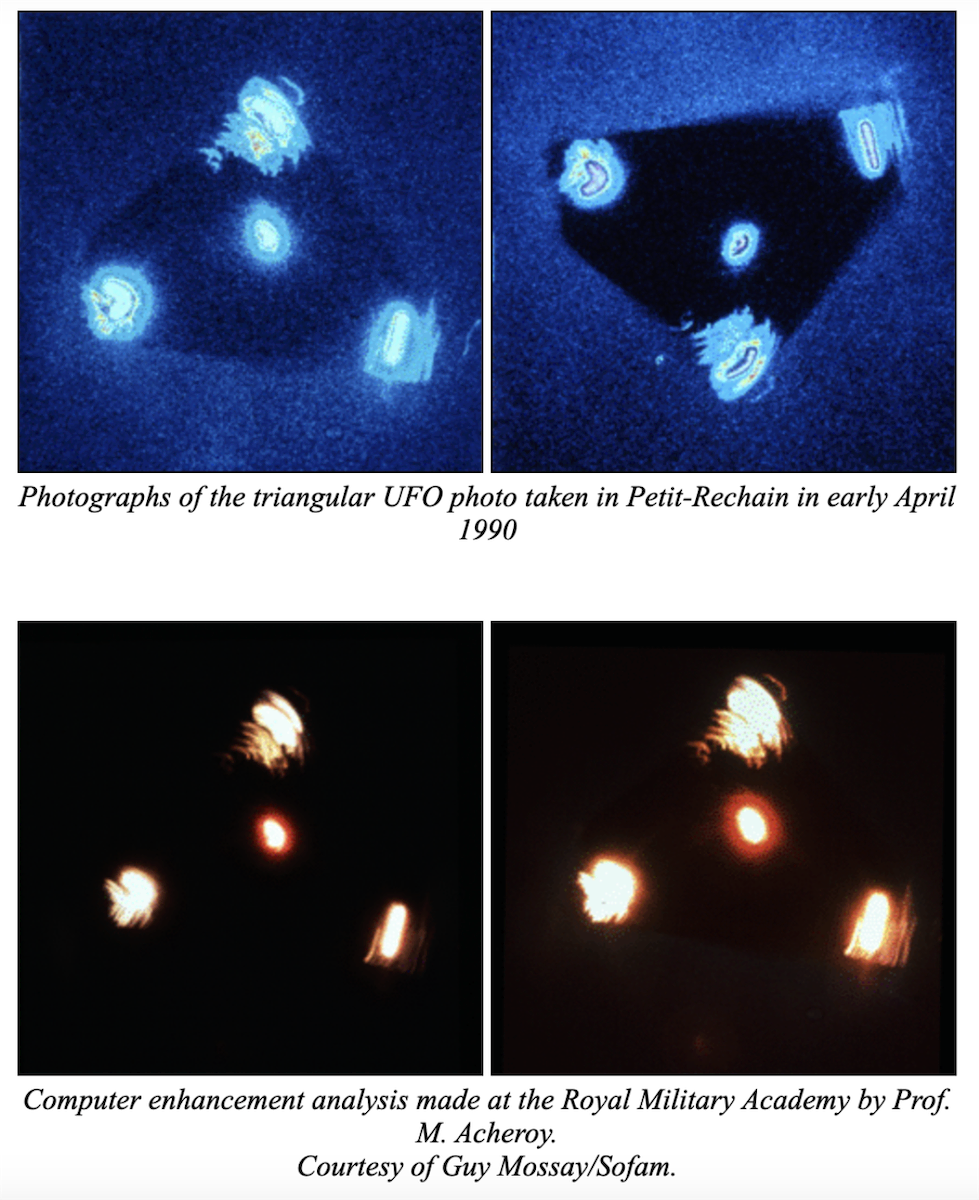
As December rolled in, the number of reported sightings began to escalate dramatically. Citizens from various towns, including Liège and Namur, reported similar encounters with triangular-shaped objects glowing in the night sky. Witnesses described the crafts as having three bright white lights positioned at each corner of the triangle, along with a central red light that pulsated ominously. The consistency in the descriptions provided by different observers lent a degree of credibility to the claims, making it less likely that these sightings were mere figments of imagination or misinterpretations of conventional aircraft. This period saw an influx of reports, with hundreds of individuals claiming to have seen the unidentified flying objects, leading to a sense of urgency and concern among the local population.
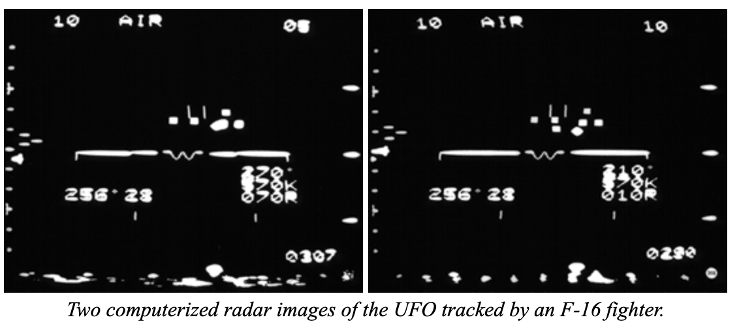
As sightings continued to proliferate, the Belgian government and military took notice, leading to the initiation of a formal investigation. In April 1990, the Belgian Air Force launched Operation "Royal Flush," a dedicated mission aimed at understanding and addressing the surge of UFO reports. This operation involved deploying fighter jets to intercept the unidentified crafts that had been sighted across the country. A pivotal moment occurred on April 30, when radar operators detected an object that did not conform to any known aircraft profiles. The military pilots engaged in a series of high-speed chases, attempting to identify the craft, but were met with baffling maneuvers that seemed to defy conventional aerodynamics. This encounter was documented and later became a key piece of evidence in discussions surrounding the Belgian UFO wave.
The wave of sightings attracted significant media attention, with newspapers, television programs, and radio shows extensively covering the events. The media frenzy not only heightened public interest but also encouraged others who had previously been hesitant to share their experiences. As a result, the number of reported sightings continued to grow, creating a snowball effect that captivated the nation. Various experts and ufologists began to weigh in on the phenomenon, offering their interpretations and theories, some of which ranged from government experiments to extraterrestrial visitors. This period marked a turning point in how UFOs were perceived in Belgium, as the public grappling with the unexplained transformed the UFO narrative from fringe speculation into a serious topic of discussion.
In conclusion, the Belgian UFO wave of 1989/1990 stands out not only for its remarkable series of sightings but also for the robust governmental and military responses it elicited. The initial reports from police officers ignited a wave of public interest, leading to hundreds of sightings across the country. The military’s involvement through Operation "Royal Flush" underscored the seriousness of the phenomenon and added a layer of credibility to the accounts. Ultimately, the media’s extensive coverage fueled public curiosity and ensured that the events of this period would remain a significant chapter in the ongoing exploration of unidentified aerial phenomena.
One of the most intriguing aspects of the Belgian UFO wave that occurred in the late 1980s and early 1990s was the prevalence of triangular-shaped craft. Witnesses across various regions consistently described these mysterious objects, leading to a wealth of accounts that share common characteristics. This phenomenon has captivated the public imagination and sparked numerous investigations. Below, we delve into the defining characteristics of these triangular crafts in greater detail.
1. Shape: A Distinctive Form
The first and most striking feature of the triangular craft is their shape. Witnesses reported these objects as being distinctly triangular, or delta-shaped, often with smoothly rounded edges. This aerodynamic design stood in stark contrast to the more conventional, disc-shaped UFOs that had been reported in earlier decades. The triangular shape, combined with the craft’s sleek profile, suggests an advanced engineering design that is not typically found in known aircraft.
The corners of the triangle were often described as being sharply defined yet elegantly curved, which contributed to the overall appearance of sophistication. The aesthetic quality of these crafts—often described as “stealth-like”—has led some to speculate that they may belong to advanced military technology, potentially even reverse-engineered extraterrestrial vehicles. This theory is fueled by the fact that many sightings occurred near military bases and installations.
2. Lights: An Enigmatic Display
Another defining characteristic of the triangular craft is the arrangement and coloration of their lights. Most witnesses described seeing three bright white lights positioned at each corner of the triangle, which created a striking visual effect during nighttime sightings. These lights were often reported to be exceptionally bright, drawing the attention of observers from great distances.
In addition to the three corner lights, many accounts included the presence of a central red light, which sometimes pulsated or glowed steadily. The combination of bright white lights with a central red light not only added to the craft's otherworldly appearance but also raised questions about the purpose of these lights. Some speculated that the lights could serve navigational purposes or possibly act as a form of communication. The striking contrast between the white and red lights further contributed to the craft’s mystique, making them easily identifiable and memorable to those who witnessed them.
3. Silent Operation: A Mysterious Quietness
One of the most remarkable aspects of the triangular craft is the absence of sound during flight. Many witnesses noted that these objects moved silently through the sky, a feature that starkly contrasts with conventional aircraft, which typically produce recognizable engine noise. This characteristic not only heightened the sense of mystery surrounding the sightings but also raised further questions about the technology behind these crafts.
The silent operation has led to speculation about the propulsion systems employed by these triangular objects. Theories range from advanced anti-gravity technology to some form of electromagnetic propulsion, both of which would allow for silent flight. The absence of noise during flight has also contributed to the eerie and almost surreal experiences reported by witnesses, making the sightings both fascinating and unsettling.
4. Size and Altitude: A Dominant Presence
Reports of the size and altitude of these triangular crafts further distinguish them from conventional aircraft. Many witnesses described the crafts as being significantly larger than typical planes, sometimes estimating their size to be comparable to that of a large commercial airliner or even bigger. This perception of size contributed to the overwhelming presence these crafts held in the sky, often evoking feelings of awe or fear among observers.
In terms of altitude, these crafts were frequently reported to be flying at low elevations, sometimes just above tree line or peering into residential neighborhoods. This low-altitude behavior allowed for closer observation and contributed to the detailed descriptions provided by witnesses. Many noted that the craft appeared to glide smoothly, almost as if they were defying the usual laws of aerodynamics.
In conclusion, the triangular craft observed during the Belgian UFO wave exhibit a range of distinctive characteristics that set them apart from conventional aircraft. Their unique shape, striking lights, silent operation, and significant size at low altitudes have sparked intrigue and speculation about their origins and purpose. The consistency of witness accounts adds credibility to these sightings, creating a rich tapestry of mystery that continues to engage researchers, enthusiasts, and the general public alike. As investigations into these phenomena continue, the triangular craft remain a compelling subject of study in the ever-evolving discourse on unidentified aerial phenomena.

The famous image of an ostensible UFO in the 1990 wave. In 2011, the photographer Patrick Maréchal stated it was a picture of a polystyrene triangle with four lightbulbs.
Theories and Explanations of the Belgian UFO Wave of 1989/1990
The Belgian UFO wave, which unfolded between late 1989 and early 1990, remains one of the most compelling and well-documented clusters of unidentified flying object sightings in history. This phenomenon garnered significant attention not only from the general public but also from the military and the scientific community. As a result, a multitude of theories and explanations have emerged to account for the wave of sightings. These can be broadly categorized into three primary groups: military experiments, natural phenomena, and extraterrestrial hypotheses. Each of these perspectives offers a different lens through which to analyze the events of that period.
1. Military Experiments
One of the most prevalent theories suggests that the UFO sightings during this period may have been linked to secret military experiments or advanced aerial technology. Skeptics of the extraterrestrial explanation argue that given the timing and the nature of the sightings, it is plausible that these unidentified objects were, in fact, advanced military aircraft or experimental technology being tested by the Belgian Air Force or even foreign military forces.
The Belgian military’s active involvement in investigating the sightings, including their collaboration with civilian UFO organizations, has fueled this theory. In particular, the deployment of F-16 fighter jets to intercept the reported UFOs provides a strong basis for the argument that the phenomena could have been man-made. Witnesses reported seeing large, triangular craft that exhibited flight characteristics far beyond conventional aircraft capabilities, leading some to speculate that these could be prototypes of advanced military vehicles.
However, despite the military's engagement, no conclusive evidence has emerged to substantiate claims of secret aircraft or classified projects. The Belgian Air Force conducted investigations but ultimately did not confirm that the UFOs were military in nature. This absence of definitive proof leaves room for skepticism regarding the military experiments theory, as it raises questions about the extent of classified activities and whether the military would be forthcoming about such projects.
2. Natural Phenomena
Another explanation for the Belgian UFO wave centers on natural phenomena. Proponents of this theory argue that many of the sightings could be attributed to atmospheric anomalies, misidentified celestial objects, or other natural occurrences. For instance, some skeptics suggest that what witnesses perceived as UFOs could have been the result of light reflections, weather balloons, or even swamp gas—a phenomenon in which marshy areas emit flammable gases that can create unusual visual effects.
To support this viewpoint, skeptics often point to the potential for misinterpretation of common astronomical events. The period saw clear skies, and various celestial phenomena such as bright planets or meteor showers could have contributed to the confusion. However, the consistent and detailed accounts from numerous witnesses across different locations challenge the idea that these sightings can be explained away as mere misidentifications. Many reported specific details about the craft's shape, size, and behavior, which do not align with typical natural phenomena.
Moreover, atmospheric conditions and the geographical context of Belgium during this time do not sufficiently account for the sheer volume and nature of the sightings. The wave was characterized by multiple reports of large, silent, triangular-shaped objects moving in ways that defied conventional flight patterns. This consistency and specificity in witness testimonies raise questions about the adequacy of natural explanations in accounting for the reported phenomena.
3. Extraterrestrial Hypotheses
The most sensational and captivating explanation for the Belgian UFO wave is the hypothesis that these sightings were indicative of extraterrestrial visitation. Proponents of this theory argue that the large, triangular craft described by numerous witnesses could be vehicles from advanced civilizations beyond Earth. This explanation taps into a broader narrative of humanity’s search for life beyond our planet and has gained significant traction in popular culture.
Advocates of the extraterrestrial hypothesis often highlight the remarkable technological capabilities that would be required for such craft to operate as described—objects that can hover silently, execute sudden maneuvers, and exhibit speeds beyond those of known aircraft. They argue that the level of sophistication displayed by these crafts suggests an origin that cannot be accounted for by human technology. This perspective resonates with a segment of the population that is fascinated by the idea of contact with alien civilizations and the implications such encounters would have for humanity.
Despite its appeal, the extraterrestrial hypothesis is not without its critics. The primary challenge facing this theory is the lack of empirical evidence. While numerous sightings were reported, and some were even captured on video, no definitive proof has been produced to confirm that these objects were of extraterrestrial origin. The absence of physical evidence, such as debris or biological samples, continues to hinder the validation of this theory.
Conclusion
In conclusion, the Belgian UFO wave of 1989/1990 presents a fascinating case study that has sparked diverse theories and explanations. From military experiments to natural phenomena and extraterrestrial hypotheses, each perspective contributes to the ongoing discourse about the nature of unidentified flying objects. While military experiments and natural phenomena provide plausible explanations, the allure of extraterrestrial visitation continues to captivate the imagination of many. Ultimately, the Belgian UFO wave remains an enigmatic chapter in the history of ufology, inviting further investigation and debate as society grapples with the mysteries of the skies. The varying explanations highlight not only the complexity of UFO sightings but also the broader questions about humanity's place in the universe and the potential for life beyond our planet.
The Belgian UFO wave, which spanned from late 1989 to 1990, remains one of the most compelling and thoroughly documented cases of unidentified flying objects (UFOs) in modern history. Unlike many other UFO sightings that tend to rely on anecdotal evidence, the Belgian UFO wave is distinguished by a wealth of documentation, which includes radar data, witness testimonies, and photographic evidence. This multifaceted approach to the phenomenon has allowed researchers to analyze the events from various angles, contributing to ongoing debates about the nature of the phenomena observed during this period.
1. Radar Data
One of the most significant pieces of evidence supporting the Belgian UFO wave is the radar data collected during the events. Military radar operators from the Belgian Air Force, along with civilian radar operators, detected unidentified flying objects that exhibited flight patterns inconsistent with those of known aircraft. The radar returns indicated objects that could accelerate rapidly, perform sharp turns, and hover in place—capabilities far beyond those of conventional aircraft at the time.
A key operation during this period was Operation "Royal Flush," which aimed to investigate and identify the numerous reports of unidentified aerial phenomena. During this operation, radar operators recorded multiple sightings of triangular-shaped crafts flying at high altitudes, sometimes at speeds exceeding 2500 kilometers per hour. The radar data provided a crucial foundation for the investigation, as it not only validated many eyewitness accounts but also raised questions about the type of technology that could produce such extraordinary flight characteristics.

Did they see a UFO on their radar screens?
(Credit: Andrey Semenov via Getty Images)
The military's involvement in tracking these objects adds a layer of credibility to the evidence. The data collected during Operation "Royal Flush" has been subjected to rigorous analysis and remains a focal point for researchers and enthusiasts alike. The fact that well-trained military personnel were involved in the sightings lends additional weight to the claims of unidentified aerial phenomena, as it is unlikely that such experienced individuals would misinterpret conventional aircraft or atmospheric phenomena.
2. Witness Testimonies
Another cornerstone of the Belgian UFO wave is the multitude of witness testimonies that emerged during and after the sightings. Thousands of individuals reported seeing strange lights and craft in the night sky, with many offering detailed accounts of their experiences. These witnesses included civilians, police officers, and even military personnel, all of whom described similar characteristics of the objects they observed.
Many witnesses expressed a deep sense of urgency and concern about the nature of the phenomena they encountered. Accounts frequently mentioned triangular shapes, bright lights, and unusual flight patterns, with some witnesses claiming that the crafts made no sound as they hovered above them. The consistency in descriptions from various witnesses across different locations adds to the credibility of these accounts, suggesting that they were not mere illusions or mass hysteria.
In addition to the sheer volume of testimonies, the emotional weight carried by many of the witnesses contributes to the overall narrative of the Belgian UFO wave. Some individuals reported feeling a sense of fear or apprehension during their encounters, while others described a profound sense of awe and wonder at the sight of the unidentified crafts. These personal experiences provide a human element to the phenomenon, allowing researchers to explore the psychological and sociological impacts of UFO sightings on communities.
3. Photographic Evidence
Photographic evidence is another crucial aspect of the documentation surrounding the Belgian UFO wave. Several photographs claimed to depict the triangular crafts reported by witnesses, yet this evidence is met with mixed reactions. While some photos appear to show distinct shapes and lights in the sky, the authenticity and clarity of these images have often been called into question.
Skeptics argue that many photographs lack the necessary detail to conclusively identify the objects, often attributing the images to misidentified aircraft, atmospheric phenomena, or even hoaxes. The challenge of capturing clear images of fast-moving aerial objects, particularly at night, complicates the analysis of photographic evidence. Despite these criticisms, some researchers maintain that certain photographs display characteristics that are difficult to attribute to known aircraft or conventional explanations.
The debate surrounding the photographic evidence is emblematic of the wider discourse on UFOs and the nature of the phenomena observed during the Belgian UFO wave. While some argue that the photographs support the existence of extraterrestrial technology, others caution against drawing definitive conclusions based solely on images that may lack context. This ongoing discussion highlights the complexity of the investigation and the need for a cautious approach to interpreting evidence.
In conclusion, the Belgian UFO wave represents a unique chapter in the study of unidentified aerial phenomena. The extensive documentation of sightings—including radar data, witness testimonies, and photographic evidence—offers a rich tapestry of information that continues to intrigue researchers and enthusiasts alike. While the radar data provides a technical foundation for understanding the capabilities of the observed objects, the witness testimonies bring a human perspective to the phenomenon, emphasizing the emotional and psychological impact of these encounters.
As the debate continues regarding the nature of the objects observed during this period, the Belgian UFO wave stands as a significant case within the broader context of UFO research. The combination of credible radar data, a multitude of eyewitness accounts, and the contentious nature of the photographic evidence creates an ongoing dialogue that challenges our understanding of aerial phenomena. Whether viewed through the lens of skepticism or belief, the Belgian UFO wave remains a compelling subject of investigation, inviting further exploration into the mysteries of our skies.
The Belgian UFO wave, which unfolded between 1989 and 1990, is one of the most significant episodes in the history of unidentified flying object (UFO) sightings. It captivated not just the local population but also attracted international attention, leading to a robust discourse among enthusiasts, researchers, and skeptics alike. This phenomenon provides a unique case study of how polarized views can emerge around a single subject, illustrating broader themes of belief, evidence, and the human experience of the unknown.
The Belgian UFO wave began in late 1989 and continued into 1990. Reports of sightings surged, with thousands of witnesses claiming to have seen triangular-shaped crafts that exhibited flight characteristics beyond conventional aircraft. The sightings peaked on the night of January 30, 1990, when thousands reported seeing a large, silent craft gliding through the skies. The Belgian Air Force even took the reports seriously enough to scramble F-16 fighter jets to intercept these unidentified objects.
The Evidence: Supporters’ Perspective
For proponents of the existence of Unidentified Flying Objects (UFOs), the Belgian UFO wave of the late 1980s and early 1990s is frequently cited as one of the most compelling cases in the history of ufology. The phenomenon, which saw a significant increase in UFO sightings across Belgium, particularly in the years 1989 and 1990, has become a focal point for discussions around the legitimacy of UFO phenomena. Supporters of the existence of UFOs cite several key pieces of evidence that they believe substantiate the claim that these sightings represent something extraordinary beyond mere misinterpretations or hoaxes.
1. Witness Testimonies
One of the most persuasive elements of the Belgian UFO wave is the sheer volume and credibility of eyewitness accounts. Reports emerged from a diverse group of individuals, including law enforcement officers, military personnel, and ordinary citizens. Notably, many of these witnesses possessed training or experience that lent weight to their observations. For example, police officers are typically trained to observe details accurately and report them reliably. These witnesses consistently described the crafts as triangular in shape, adorned with lights at each corner. This uniformity in descriptions is particularly striking; it provides a cohesive narrative that supporters argue is difficult to dismiss as mere coincidence or collective misperception. The emotional intensity and detail in these testimonies further bolster their credibility, as many witnesses reported feelings of awe and fear, suggesting that they encountered something well beyond their ordinary experiences.
2. Photographic and Video Evidence
In addition to eyewitness accounts, photographic and video evidence captured during the Belgian UFO wave has been presented as significant support for the existence of these unidentified objects. While skeptics argue that some of this media could be hoaxes or misinterpretations, many supporters contend that several images stand out due to their clarity and detail. For instance, the famous photographs taken in 1990 by a group of Belgian citizens show a triangular craft illuminated by bright lights. Supporters argue that the quality of these images, coupled with their consistency with witness descriptions, provides a compelling case for the reality of these sightings. The scrutiny and analysis of this evidence by both enthusiasts and skeptics alike highlight its complexity, and many supporters assert that the technological advancements in image analysis only serve to reinforce the authenticity of these documents.
3. Military Involvement
The role of the Belgian Air Force in the UFO wave adds an air of legitimacy to the claims made by supporters. The military not only acknowledged the presence of UFOs but also took proactive measures to investigate them. Reports indicate that F-16 fighter jets were dispatched to intercept these unidentified objects, which suggests a level of seriousness and concern on the part of the military. The involvement of trained pilots and military radar operators lends credibility to the sightings, as these individuals are skilled in identifying aircraft and anomalous aerial phenomena. This military engagement has led supporters to argue that if the military is concerned enough to intercept these objects, then there must be a substantive basis to the claims of their existence.
4. Radar Tracking
Compounding the evidence presented by eyewitnesses and military involvement is the data from radar operators, who reported tracking objects that corresponded with various eyewitness accounts during the Belgian wave. In several cases, radar systems detected unidentified objects that matched the descriptions given by witnesses, suggesting that these objects were not merely figments of imagination or misidentified conventional aircraft. The fact that these objects appeared on military radar systems adds a layer of scientific scrutiny to the claims. Supporters argue that the corroboration between radar data and eyewitness accounts indicates that something anomalous was indeed occurring in Belgian airspace during this period.
5. Scientific Inquiry
The Belgian UFO wave has also garnered attention from the scientific community, with several researchers and organizations undertaking thorough investigations into the phenomenon. Notably, the Belgian UFO Research Organization (BUFORA) documented and analyzed sightings in a systematic manner. The organization employed methodologies typical of scientific inquiry, including interviews, data collection, and analysis of physical evidence. Supporters assert that this scientific approach lends credibility to the claims surrounding the wave, as it demonstrates that the phenomenon has been taken seriously by individuals trained in research and investigation. The willingness of researchers to explore the evidence rigorously suggests that there may be more to the story than mere speculation or sensationalism.
The Skeptics’ Perspective
While supporters provide a robust case for the Belgian UFO wave, skeptics present a range of counterarguments that seek to debunk these claims. They emphasize the importance of critical thinking and a reliance on empirical evidence, especially when discussing extraordinary phenomena.
1. Psychological Explanations
Skeptics often point to psychological factors as potential explanations for the wave of sightings. They argue that phenomena like mass hysteria can lead individuals to interpret ordinary events as extraordinary, especially in a context where public interest and media coverage are heightened. The social dynamics at play during the Belgian UFO wave could have contributed to a collective misinterpretation of what were, in reality, common aerial phenomena.
2. Mass Delusion or Misidentifications
Many skeptics maintain that a significant number of sightings can be attributed to misidentified aircraft, weather balloons, or astronomical phenomena such as planets or meteorological events. They argue that the vastness of the sky and the limitations of human perception make it relatively easy for individuals to mistake known objects for something unidentified. The skeptics suggest that a more thorough analysis of environmental factors could explain many of the reported sightings without resorting to extraordinary claims.
3. Hoaxes and Fabrication
The possibility of hoaxes cannot be overlooked in the discussion of the Belgian UFO wave. Skeptics assert that some of the photographic evidence circulated during this period could have been staged or manipulated. They argue that the presence of hoaxes undermines the credibility of the entire wave, as it raises questions about the authenticity of other reports. The occurrence of hoaxes in the world of UFOs serves as a reminder to maintain a healthy skepticism and to scrutinize evidence carefully.
4. Lack of Conclusive Evidence
Despite the numerous claims and reports surrounding the Belgian UFO wave, skeptics highlight the absence of definitive evidence that points to the existence of extraterrestrial crafts. They argue that until such evidence is produced—such as physical artifacts or verifiable scientific data—claims of UFO sightings should be treated with skepticism. The need for extraordinary evidence in the face of extraordinary claims remains a cornerstone of the skeptical viewpoint.
5. Scientific Community’s Stance
Finally, the scientific community's general skepticism toward UFO claims further complicates the discussion. Many scientists argue that extraordinary claims require extraordinary evidence, and they often cite the lack of interest in pursuing these sightings within mainstream science as indicative of their dubious nature. The absence of robust scientific inquiry into the Belgian UFO wave, as perceived by skeptics, suggests that the phenomena may not warrant serious consideration in the realm of established science.
In conclusion, the Belgian UFO wave remains a contentious topic, with compelling arguments presented by both supporters and skeptics. While advocates highlight witness testimonies, military involvement, radar tracking, and scientific inquiry as key pieces of evidence, skeptics raise valid concerns about psychological explanations, misidentifications, hoaxes, and the need for conclusive evidence. This ongoing debate exemplifies the complexity of the UFO phenomenon and the challenges inherent in establishing a definitive understanding of such extraordinary claims.
The media plays a significant role in shaping public perception of the Belgian UFO wave. In the early stages of the wave, sensationalist reporting attracted attention and fueled speculation. Supporters argue that the media helped bring legitimacy to the claims by covering them extensively, often interviewing witnesses and experts. This coverage, they argue, helped validate the experiences of those who reported sightings.
Conversely, skeptics contend that media sensationalism contributed to mass hysteria, leading people to report sightings based on what they had read or seen in the news. They argue that the media's tendency to sensationalize stories creates an environment ripe for misinterpretation and exaggeration.
The polarized views surrounding the Belgian UFO wave highlight a deeper psychological and sociological phenomenon. At its core, the debate between supporters and skeptics often reflects broader beliefs about the unknown and humanity's place in the universe.
Supporters of UFOs often possess a worldview that embraces the possibility of extraterrestrial life and advanced technologies beyond our current understanding. They may see the sightings as evidence of a broader cosmic reality, challenging conventional views of human existence and the limits of scientific knowledge.
On the other hand, skeptics often adhere to a more empirical worldview, emphasizing the importance of rationality, evidence, and scientific rigor. They may view UFO claims as distractions from more pressing scientific inquiries or as manifestations of human psychology rather than indications of extraterrestrial visitation.
The division between supporters and skeptics is also influenced by social dynamics. Individuals often align with groups that share their beliefs, creating echo chambers where ideas are reinforced rather than challenged. This social reinforcement can lead to heightened polarization, as individuals become more entrenched in their views and less open to opposing perspectives.
For supporters, being part of a community that believes in UFOs can provide a sense of belonging and purpose. They may feel that they are part of a larger quest for truth, seeking to uncover mysteries that mainstream society has overlooked. This sense of mission can drive individuals to advocate for further investigation into UFO phenomena.
Conversely, skeptics may find camaraderie in their commitment to critical thinking and scientific inquiry. They may view themselves as defenders of rationality against a tide of pseudoscience and misinformation. This sense of moral obligation to uphold standards of evidence can motivate skeptics to engage in public discourse, attempting to educate others on the importance of skepticism.
In a world increasingly characterized by polarized views, the Belgian UFO wave serves as a reminder of the importance of open dialogue. While supporters and skeptics might seem at odds, both perspectives hold value in the quest for understanding. Encouraging respectful conversations can foster a more nuanced understanding of the phenomenon and promote critical thinking.
Both sides can benefit from acknowledging the limitations of their views. Supporters can recognize the need for rigorous standards of evidence, while skeptics can appreciate the human desire to explore the unknown and consider the possibility of phenomena beyond current scientific understanding.
The Belgian UFO wave remains a striking example of how polarized views can develop around a singular phenomenon. Supporters and skeptics each offer compelling arguments, reflecting broader themes of belief, evidence, and the human capacity for wonder. As society grapples with the unknown, the dialogue surrounding UFOs offers an opportunity to explore not just the skies but also the depths of human curiosity and the boundaries of understanding. In the end, the pursuit of truth—whether through belief or skepticism—remains a fundamentally human endeavor, one that invites exploration and inquiry into the mysteries that lie beyond our understanding.
[ PETER2011 }
Het is Tijd om te Stoppen met Verbaasd te Zijn over Verrassend Weer: Een Wetenschappelijke Analyse
Het is Tijd om te Stoppen met Verbaasd te Zijn over Verrassend Weer: Een Wetenschappelijke Analyse
De wereld heeft de afgelopen decennia een opmerkelijke toename in extreme weersomstandigheden ervaren, variërend van ongebruikelijke hittegolven en zware regenval tot intense stormen en droogtes. Dit fenomeen roept de vraag op waarom we nog steeds verrast zijn door deze 'verrassende' weersomstandigheden, vooral gezien de wetenschappelijke consensus rond klimaatverandering. Deze analyse onderzoekt de relatie tussen klimaatverandering en extreme weersomstandigheden, de rol van media en publieke perceptie, en de noodzaak van aanpassingen in de manier waarop we over weer en klimaat denken.
Klimaatverandering verwijst naar langdurige veranderingen in temperatuur en weerspatronen op aarde. Wetenschappelijke studies, waaronder die van het Intergovernmental Panel on Climate Change (IPCC), tonen aan dat menselijke activiteiten, zoals de verbranding van fossiele brandstoffen en ontbossing, de belangrijkste drijfveren zijn van de opwarming van de aarde. Dit leidt tot veranderingen in de atmosfeer, oceanen en landoppervlakken, wat op zijn beurt extreme weersomstandigheden kan veroorzaken. De gevolgen van deze veranderingen zijn verstrekkend en beïnvloeden ecosystemen, menselijke gezondheid, voedselzekerheid en economieën wereldwijd.
Extreme weersomstandigheden zijn het resultaat van complexe interacties tussen verschillende meteorologische factoren. Een voorbeeld hiervan is de toename van de gemiddelde temperatuur, die leidt tot meer verdamping van water en intensere regenval. Deze veranderingen kunnen resulteren in overstromingen en andere natuurrampen die gemeenschappen zwaar kunnen belasten. Evenzo kunnen veranderingen in de zeetemperatuur de frequentie en intensiteit van orkanen beïnvloeden. Warmer zeewater biedt meer energie voor stormen, wat leidt tot krachtigere en destructievere orkanen.
Daarnaast kunnen veranderingen in windpatronen en atmosferische druksystemen ook bijdragen aan extreme weersomstandigheden. De verschuiving van de jetstream, bijvoorbeeld, kan leiden tot langdurige periodes van droogte in sommige gebieden en overmatige neerslag in andere. Dit soort extremen is niet alleen een bedreiging voor de natuur, maar heeft ook directe gevolgen voor de landbouw, infrastructuur en menselijke gezondheid. Het is essentieel dat we deze mechanismen begrijpen om te erkennen dat wat we nu als 'verrassend' beschouwen, steeds vaker zal voorkomen.
De rol van de mens in klimaatverandering kan niet genoeg worden benadrukt. De verbranding van fossiele brandstoffen voor energie, vervoer en industrie is de grootste bron van broeikasgasemissies, met name kooldioxide (CO2) en methaan (CH4). De uitstoot van deze gassen leidt tot een versterking van het broeikaseffect, wat de aarde opwarmt. Ontbossing, een andere belangrijke factor, vermindert de hoeveelheid CO2 die door bomen en andere planten kan worden opgenomen. Hierdoor komt er meer CO2 in de atmosfeer, wat de opwarming verder versnelt.
Daarnaast zijn er ook andere menselijke activiteiten die bijdragen aan klimaatverandering. Landbouwpraktijken, zoals het gebruik van kunstmest en het houden van vee, stoten aanzienlijke hoeveelheden broeikasgassen uit. De productie van voedsel en de bijbehorende logistiek dragen ook bij aan de uitstoot van CO2 en andere schadelijke gassen. Het begrijpen van deze oorzaken is cruciaal voor het ontwikkelen van effectieve strategieën om de impact van klimaatverandering te verminderen.
De gevolgen van klimaatverandering zijn al zichtbaar en zullen naar verwachting in de toekomst verergeren. Eén van de meest zorgwekkende gevolgen is de stijging van de zeespiegel, veroorzaakt door het smelten van gletsjers en ijskappen, evenals de thermische uitzetting van water bij hogere temperaturen. Dit bedreigt laaggelegen kustgebieden en kan leiden tot grootschalige verplaatsingen van mensen en verlies van land.
Daarnaast heeft klimaatverandering invloed op de biodiversiteit. Veel soorten kunnen zich niet snel genoeg aanpassen aan de veranderende omstandigheden, wat leidt tot uitsterven en verstoring van ecosystemen. Dit heeft niet alleen gevolgen voor de natuur, maar ook voor de mensen die afhankelijk zijn van deze ecosystemen voor voedsel, water en andere hulpbronnen.
Extreme weersomstandigheden, zoals hittegolven, droogtes en zware stormen, brengen ook aanzienlijke risico's met zich mee voor de volksgezondheid. Hittegolven kunnen leiden tot een verhoogde sterfte onder kwetsbare bevolkingsgroepen, terwijl de verspreiding van ziekten door insecten zoals muggen kan toenemen door warmer weer en veranderende neerslagpatronen.
Om de gevolgen van klimaatverandering aan te pakken, zijn zowel aanpassing als mitigatie (Mitigatie is een term die vaak wordt gebruikt in de context van risico- en milieubeheer. Het verwijst naar het proces van het verminderen of verzachten van de ernst of impact van een probleem, risico of negatieve gevolgen. In het geval van klimaatverandering bijvoorbeeld, kan mitigatie inhouden dat er maatregelen worden genomen om de uitstoot van broeikasgassen te verminderen, zoals het bevorderen van hernieuwbare energiebronnen of het verbeteren van energie-efficiëntie. Het doel van mitigatie is om de schade die kan ontstaan door bepaalde risico's of negatieve effecten te beperken.) noodzakelijk. Aanpassing houdt in dat we ons aanpassen aan de onvermijdelijke gevolgen van klimaatverandering, zoals het verbeteren van de infrastructuur om overstromingen te weerstaan of het ontwikkelen van droogtebestendige gewassen. Dit vereist samenwerking tussen overheden, gemeenschappen en bedrijven om effectieve strategieën te implementeren die de kwetsbaarheid verminderen.
Mitigatie daarentegen richt zich op het verminderen van de uitstoot van broeikasgassen en het verminderen van de impact van menselijke activiteiten op het klimaat. Dit kan worden bereikt door de overstap naar hernieuwbare energiebronnen, zoals zonne- en windenergie, en door het bevorderen van energie-efficiëntie. Daarnaast is het belangrijk om duurzame landbouwpraktijken te implementeren en ontbossing tegen te gaan.
Technologie en innovatie spelen een cruciale rol in de strijd tegen klimaatverandering. Nieuwe technologieën kunnen helpen bij het verminderen van emissies en het verbeteren van de efficiëntie van energieverbruik. Bijvoorbeeld, elektrische voertuigen en slimme energienetwerken kunnen bijdragen aan een duurzamer transportsysteem en energiebeheer.
Bovendien kunnen innovaties in carbon capture en opslag (CCS) bijdragen aan het verminderen van de hoeveelheid CO2 in de atmosfeer. Door CO2 af te vangen bij de bron en het veilig op te slaan, kunnen we de impact van fossiele brandstoffen verder verminderen. De ontwikkeling van alternatieve eiwitbronnen, zoals plantaardige en kweekvlees, kan ook helpen om de ecologische voetafdruk van de voedselproductie te verkleinen.
Klimaatverandering is een wereldwijd probleem dat samenwerking op alle niveaus vereist. Internationale verdragen, zoals het Klimaatakkoord van Parijs, zijn essentieel om landen te verenigen in de strijd tegen klimaatverandering. Dit akkoord stelt doelstellingen vast voor de vermindering van broeikasgasemissies en stimuleert landen om hun inspanningen te intensiveren.
Daarnaast is het belangrijk dat lokale gemeenschappen en bedrijven ook betrokken worden bij de mitigatie- en aanpassingsstrategieën. Educatie en bewustwording zijn cruciaal om individuen aan te moedigen duurzame keuzes te maken en bij te dragen aan de oplossing. Het creëren van een cultuur van duurzaamheid en verantwoordelijkheidsbesef helpt niet alleen bij het aanpakken van klimaatverandering, maar versterkt ook de sociale cohesie en veerkracht van gemeenschappen.
Klimaatverandering is een complex en urgent probleem dat diepgaande gevolgen heeft voor onze planeet en de mensen die erop leven. Het begrijpen van de mechanismen achter klimaatverandering en extreme weersomstandigheden is essentieel voor het ontwikkelen van effectieve strategieën om deze uitdagingen aan te gaan. Door middel van samenwerking, technologie en innovatieve benaderingen kunnen we werken aan een duurzame toekomst. Het is van vitaal belang dat we nu handelen om de gevolgen voor toekomstige generaties te beperken en ervoor te zorgen dat onze aarde een leefbare plek blijft voor iedereen.

Trajecten van tropische cyclonen in de Noord-Atlantische Oceaan van 1851 tot 2019
(Bron: Niilfanion)
2. Publieke Perceptie en Media
De manier waarop het publiek reageert op extreme weersomstandigheden is vaak beïnvloed door mediarepresentaties en culturele percepties. Wanneer een ongewoon weerfenomeen zich voordoet, kan de media het sensationeel presenteren, wat leidt tot een tijdelijke golf van verontwaardiging en verbazing. Deze sensationele berichtgeving heeft de potentie om de publieke perceptie te vervormen en een gevoel van schok te creëren dat niet in overeenstemming is met de wetenschappelijke realiteit. Bij extreme weersomstandigheden zoals orkanen, overstromingen of hittegolven zien we vaak dat de media de dramatiek van de situatie benadrukken. Dit kan leiden tot angst en bezorgdheid, maar ook tot een kortstondige interesse in het onderwerp.
In de huidige digitale tijdperk wordt deze dynamiek verder versterkt door sociale media. Berichten verspreiden zich in een razendsnel tempo en mensen delen hun ervaringen en reacties, vaak zonder dat ze de tijd nemen om de feiten te verifiëren. Dit kan resulteren in een sneeuwbaleffect van verkeerde informatie en sensatiezucht. Het gevolg is dat de publieke perceptie van extreme weersomstandigheden vaak gebaseerd is op emotie en niet op feitelijke kennis.
2.1. De Rol van de Media
Media spelen een cruciale rol in het vormgeven van de publieke perceptie van weer en klimaat. Sensationele berichtgeving over extreme weersomstandigheden kan bijdragen aan een kortstondige opwinding, maar leidt vaak niet tot diepgaand begrip van de onderliggende wetenschappelijke principes. Dit creëert een kloof tussen wetenschappelijke kennis en publieke bewustwording. Wanneer de media zich richten op de meest schokkende of verontrustende aspecten van een weerfenomeen, kan dit ertoe leiden dat de complexiteit van klimaatverandering en de verschillende factoren die bijdragen aan extreme weersomstandigheden worden genegeerd.
Bijvoorbeeld, in de berichtgeving over een zware storm wordt vaak de focus gelegd op de schade en de onmiddellijke gevolgen voor de bevolking. De oorzaak van de storm, zoals klimaatverandering, wordt zelden in detail besproken. Dit kan een vertekend beeld creëren van de relatie tussen menselijk handelen en de natuur. Het publiek krijgt daardoor een onvolledig beeld van de situatie, wat het moeilijk maakt om weloverwogen beslissingen te nemen over bijvoorbeeld noodmaatregelen of duurzaam gedrag.
Bovendien kunnen media-instanties soms terugvallen op clichématige beelden en verhalen die niet de diversiteit en nuance van de werkelijkheid weergeven. Het gebruik van stereotype beelden kan ook bijdragen aan een simplistisch begrip van de gevolgen van extreme weersomstandigheden. Zo worden mensen in kwetsbare gemeenschappen vaak afgebeeld als passieve slachtoffers, terwijl zij in werkelijkheid actief betrokken zijn bij hun eigen hulp en herstel. Dit kan de publieke perceptie verder vervormen en leiden tot een gebrek aan empathie en begrip voor de complexiteit van de situatie.
2.2. De Impact van Sociale Media
Sociale media hebben de dynamiek van de berichtgeving over extreme weersomstandigheden veranderd. Platforms zoals Twitter, Facebook en Instagram stellen gebruikers in staat om informatie in real-time te delen, wat kan leiden tot een snellere verspreiding van nieuws. Hoewel dit positieve aspecten heeft, zoals het vergroten van het bereik van belangrijke informatie, kan het ook de verspreiding van desinformatie bevorderen. De snelheid waarmee berichten worden gedeeld, maakt het moeilijk om feiten van fictie te onderscheiden.
Bovendien kunnen virale berichten en memes de publieke perceptie verder beïnvloeden. Wanneer een bericht of afbeelding viraal gaat, kan dit de aandacht van het publiek afleiden van de feitelijke situatie en in plaats daarvan leiden tot een focus op sensationele of komische elementen. Dit kan de ernst van de situatie bagatelliseren en het publiek een vertekend beeld geven van de realiteit. Het gebruik van humor of sarcasme kan in sommige gevallen een copingmechanisme zijn, maar het kan ook bijdragen aan een gebrek aan urgentie in de manier waarop mensen extreme weersomstandigheden en de gevolgen daarvan benaderen.
2.3. Oplossingen voor een Betere Informatievoorziening
Om de kloof tussen wetenschappelijke kennis en publieke perceptie te verkleinen, is het essentieel dat media verantwoordelijk omgaan met hun berichtgeving over extreme weersomstandigheden en klimaatverandering. Dit kan onder andere door het aanbieden van diepgaandere analyses en het betrekken van experts bij de berichtgeving. Media kunnen ook educatieve campagnes opzetten om de complexiteit van klimaatverandering beter uit te leggen en het publiek te informeren over de oorzaken en gevolgen van extreme weersomstandigheden.
Daarnaast is het belangrijk dat het publiek zelf kritisch leert omgaan met informatie, vooral op sociale media. Onderwijs over mediawijsheid en het belang van feitelijke verificatie kan bijdragen aan een beter begrip van de werkelijkheid. Door het publiek te stimuleren om verder te kijken dan sensationele koppen en om bronnen te controleren, kan de algehele perceptie van extreme weersomstandigheden en klimaatverandering verbeteren. Op deze manier kan de rol van de media in het informeren van het publiek niet alleen bijdragen aan een beter begrip, maar ook aan een actievere betrokkenheid bij het aanpakken van klimaatgerelateerde uitdagingen.
Mensen zijn van nature geneigd om te reageren op verrassingen met verbazing en ontkenning. Dit psychologische mechanisme kan worden verklaard door cognitieve biases zoals het 'normalcy bias', waarbij individuen de waarschijnlijkheid van ongebruikelijke gebeurtenissen onderschatten. Het idee dat 'dit niet kan gebeuren in mijn leven' leidt tot een gebrek aan voorbereiding en een onvermogen om de ernst van de situatie te erkennen. Wanneer mensen geconfronteerd worden met onverwachte gebeurtenissen, zoals natuurrampen, pandemieën of economische crises, kunnen ze vaak niet direct de impact van deze gebeurtenissen begrijpen. Dit leidt tot een vertraging in de reactie en kan de gevolgen verergeren.
De normalcy bias kan ook voortkomen uit een diepgeworteld verlangen naar stabiliteit en voorspelbaarheid. Mensen zijn sociale wezens die gebaat zijn bij routine en structuur. Wanneer deze structuren plotseling worden verstoord, kan dit leiden tot een gevoel van onbehagen en desoriëntatie. De neiging om terug te vallen op vertrouwde denkpatronen kan voorkomen dat individuen zich aanpassen aan nieuwe realiteiten. Dit is bijzonder problematisch in tijden van crisis, waar snel handelen en flexibiliteit essentieel zijn voor overleving en herstel.
Mensen willen vaak een gevoel van controle over hun omgeving, en het idee van een 'normaal' klimaat biedt deze illusie. Wanneer dat 'normale' klimaat wordt verstoord door extreme weersomstandigheden, zoals hittegolven, overstromingen of orkanen, kan dit leiden tot angst en verwarring. De ervaring van het verliezen van controle over de eigen omgeving kan traumatisch zijn en heeft vaak diepgaande psychologische gevolgen. Het is cruciaal dat individuen de nieuwe realiteit van een veranderend klimaat erkennen om zich aan te passen en veerkracht te ontwikkelen.
Er is een sterke correlatie tussen de perceptie van controle en psychologisch welzijn. Wanneer mensen het gevoel hebben dat ze invloed hebben op hun situatie, zijn ze geneigd om proactiever te reageren op bedreigingen. Dit kan zich uiten in het nemen van preventieve maatregelen, zoals het aanleggen van noodvoorraden of het volgen van weerberichten. Aan de andere kant, wanneer mensen zich machteloos voelen, kan dit leiden tot angst, depressie en zelfs apathie. Dit gebrek aan controle kan hen weerhouden van het ondernemen van noodzakelijke stappen om zichzelf en hun gemeenschappen te beschermen.
In de moderne wereld speelt sociale media een cruciale rol in hoe mensen informatie ontvangen en verwerken, vooral in tijden van crisis. De snelheid waarmee informatie zich verspreidt kan zowel een zegen als een vloek zijn. Aan de ene kant kunnen mensen snel op de hoogte worden gebracht van gevaarlijke situaties, terwijl ze aan de andere kant ook worden blootgesteld aan een overvloed aan desinformatie. Deze desinformatie kan de reeds bestaande cognitieve biases versterken, waardoor het nog moeilijker wordt om de ernst van een situatie te erkennen.
Bovendien kunnen sociale media ook leiden tot een gevoel van groepsdruk. Wanneer mensen zien dat anderen niet reageren op een crisis of de situatie bagatelliseren, kan dit hun eigen perceptie beïnvloeden. Dit kan hen ontmoedigen om hun zorgen serieus te nemen of om actie te ondernemen. Het effect van sociale bevestiging kan de neiging om te ontkennen of te minimaliseren versterken, wat weer bijdraagt aan de normalcy bias.
Het is van groot belang dat individuen strategieën ontwikkelen om beter om te gaan met verrassingen en de daarmee gepaard gaande onzekerheden. Educatie en bewustwording zijn essentieel. Door mensen voor te lichten over de mogelijke gevolgen van klimaatverandering en andere crises, kunnen we hen aanmoedigen om voorzichtiger en proactiever te zijn. Training in crisismanagement kan ook een waardevolle aanvulling zijn, zodat mensen beter voorbereid zijn op onvoorziene gebeurtenissen.
Daarnaast is het bevorderen van een community-geest cruciaal. Samenwerken met anderen kan helpen om een gevoel van controle terug te winnen en de angst te verlichten. Dit kan door lokale initiatieven, zoals buurtpreventieteams of gezamenlijke noodplannen, te ondersteunen. Wanneer mensen zich verenigd voelen in hun inspanningen om zich voor te bereiden op en te reageren op crises, kan dit hun veerkracht aanzienlijk vergroten.
De psychologie van verrassing en de bijbehorende reacties zijn complex en diepgeworteld in onze menselijkheid. Het begrijpen van deze mechanismen is essentieel voor het ontwikkelen van effectieve strategieën om ons voor te bereiden op de uitdagingen van de toekomst. Door de normalcy bias te erkennen en ons bewust te zijn van de rol van sociale media, kunnen we beter voorbereid zijn op de verrassingen die het leven ons kan bieden.

Storm coming
(ZOOEY)
4. Aanpassing en Voorbereiding
Het is cruciaal dat we onze benadering van weer en klimaat veranderen. In plaats van verrast te zijn door extreme weersomstandigheden, moeten we ons voorbereiden op hun frequentie en intensiteit. Dit omvat veranderingen in infrastructuur, beleidsvorming en educatie. De huidige trends wijzen op een toenemende ernst van klimaatverandering, wat ons dwingt om onze strategieën te herzien en aan te passen aan de nieuwe realiteit. Dit is niet alleen een kwestie van overleven, maar ook van het creëren van veerkrachtige gemeenschappen die in staat zijn om de uitdagingen van de toekomst aan te gaan.
4.1. Beleidsaanbevelingen
Overheden en beleidsmakers moeten proactief beleid ontwikkelen dat gericht is op het verminderen van de impact van extreme weersomstandigheden. Dit kan onder meer het verbeteren van de infrastructuur, het versterken van rampenplannen en het investeren in duurzame energiebronnen omvatten. Een belangrijk aspect van dit beleid is het integreren van klimaatrisico's in alle facetten van de beleidsvorming, van stadsplanning tot landbouwbeleid. Dit betekent dat er ook een nauwe samenwerking moet zijn tussen verschillende sectoren, zoals milieu, economie en sociale zaken.
Daarnaast is het van wezenlijk belang dat er financiële middelen beschikbaar komen voor de uitvoering van deze beleidsmaatregelen. Dit kan door middel van subsidies voor innovatieve technologieën, belastingvoordelen voor duurzame initiatieven en investeringen in groene infrastructuur. Het is ook essentieel om publieke en private partnerschappen te stimuleren, zodat de verantwoordelijkheden voor aanpassing en voorbereiding breed worden gedeeld.
4.2. Infrastructuurverbeteringen
De infrastructuur van een land moet bestand zijn tegen de gevolgen van extreme weersomstandigheden. Dit houdt in dat bestaande structuren zoals wegen, bruggen en gebouwen moeten worden versterkt of aangepast aan de nieuwe klimaatrealiteit. Bijvoorbeeld, het aanleggen van waterdoorlatende bestrating kan helpen om overstromingen te verminderen en de afvoer van regenwater te verbeteren. Ook kunnen dijken en andere waterkeringen worden verhoogd en versterkt om beter bestand te zijn tegen stijgende zeespiegels en extreem weer.
Bovendien moet er aandacht zijn voor het herstel van natuurlijke ecosystemen, zoals wetlands en bossen, die als natuurlijke buffer fungeren tegen overstromingen en erosie. Het beschermen en herstellen van deze gebieden kan niet alleen helpen bij het verminderen van de impact van extreme weersomstandigheden, maar ook bijdragen aan de biodiversiteit en het welzijn van lokale gemeenschappen.
4.3. Opvoeding en Bewustwording
Naast infrastructuur en beleid is ook educatie een cruciaal element in onze voorbereiding op extreme weersomstandigheden. Het publiek moet zich bewust zijn van de risico's die klimaatverandering met zich meebrengt en hoe zij zich daarop kunnen voorbereiden. Dit kan door middel van voorlichtingscampagnes, workshops en trainingen die gericht zijn op het verhogen van de weerbaarheid van individuen en gemeenschappen.
Scholen en onderwijsinstellingen spelen hierin een belangrijke rol. Door klimaateducatie te integreren in het curriculum kunnen jongeren worden voorbereid op een toekomst waarin klimaatverandering een centrale rol speelt. Het aanleren van praktische vaardigheden, zoals noodplannen opstellen en duurzaam leven, kan hen helpen om actief bij te dragen aan een veerkrachtigere samenleving.
4.4. Samenwerking en Vernieuwing
Tot slot is samenwerking op zowel lokaal als internationaal niveau van groot belang. Klimaatverandering kent geen grenzen en de aanpak ervan vereist collectieve inspanningen. Het delen van kennis, technologie en middelen tussen landen kan leiden tot innovatieve oplossingen en effectievere aanpassingsstrategieën. De rol van internationale organisaties en samenwerkingsverbanden kan hierdoor niet worden onderschat.
Door een integrale aanpak te hanteren die beleidsvorming, infrastructuurverbeteringen en educatie combineert, kunnen we niet alleen de impact van extreme weersomstandigheden beperken, maar ook een fundament leggen voor een duurzame en veerkrachtige toekomst. Het is tijd om actie te ondernemen en ons voor te bereiden op de uitdagingen die ons te wachten staan.
Het is tijd om te stoppen met verbaasd te zijn over verrassend weer. De wetenschap van klimaatverandering biedt ons de tools en kennis om de realiteit van extreme weersomstandigheden te begrijpen en ons daarop voor te bereiden. Dit is niet alleen een kwestie van wetenschappelijk onderzoek, maar ook van maatschappelijke verantwoordelijkheid. De steeds frequentere en intensere weersomstandigheden, zoals hittegolven, overstromingen, en orkanen, zijn niet langer een ver van ons bed-show. Ze zijn een tastbare realiteit die ons dagelijks leven beïnvloedt. Het is cruciaal dat we deze veranderingen niet alleen herkennen, maar ook actief aanpakken.
Door de kloof tussen wetenschappelijke kennis en publieke perceptie te overbruggen, kunnen we een samenleving creëren die beter is uitgerust om te gaan met de uitdagingen van een veranderend klimaat. Dit vraagt om een gezamenlijke inspanning van wetenschappers, beleidsmakers, en de gemeenschap als geheel. We moeten de wetenschap van klimaatverandering toegankelijk maken voor iedereen, ongeacht hun achtergrond of opleidingsniveau. Dit kan door het organiseren van voorlichtingscampagnes, het ontwikkelen van educatieve programma's en het stimuleren van maatschappelijke betrokkenheid.
Daarnaast is het van groot belang dat we begrijpen dat klimaatverandering niet alleen een kwestie is van milieu, maar ook van sociale rechtvaardigheid. De meest kwetsbare groepen in onze samenleving, zoals mensen met lage inkomens en minderheden, worden vaak het hardst getroffen door de gevolgen van extreme weersomstandigheden. Daarom moeten we bij onze aanpak van klimaatverandering ook aandacht besteden aan de sociale en economische ongelijkheden die het probleem verergeren. Een inclusieve benadering is noodzakelijk om ervoor te zorgen dat iedereen kan profiteren van de oplossingen die we ontwikkelen.
Toekomstig onderzoek moet zich richten op de communicatie van klimaatwetenschap, de rol van onderwijs in klimaatbewustzijn en de ontwikkeling van strategieën voor effectieve aanpassing aan extreme weersomstandigheden. Dit zal ons in staat stellen om de impact van klimaatverandering beter te begrijpen en te mitigeren.
In de eerste plaats moeten we ons concentreren op de manier waarop we klimaatwetenschap communiceren. Dit houdt in dat we jargon en complexe terminologie vermijden die het voor het grote publiek moeilijk maakt om de boodschap te begrijpen. Wetenschappers en communicatiespecialisten moeten samenwerken om duidelijke, beknopte en overtuigende boodschappen te formuleren die mensen aanspreken. Het gebruik van visuele hulpmiddelen, zoals infographics en video's, kan ook helpen om ingewikkelde concepten toegankelijker te maken.
Daarnaast is het cruciaal dat we de rol van onderwijs in klimaatbewustzijn verder onderzoeken. Scholen en universiteiten spelen een sleutelrol in het vormen van de opvattingen van de volgende generatie. Curriculumontwikkeling moet gericht zijn op het integreren van klimaatverandering in verschillende vakken, zodat studenten niet alleen de wetenschap erachter begrijpen, maar ook de sociale en economische impact ervan. Praktische ervaringen, zoals projecten in de lokale gemeenschap, kunnen studenten helpen om klimaatverandering als een urgent probleem te zien dat directe actie vereist.
Een andere belangrijke aanbeveling is het ontwikkelen van strategieën voor effectieve aanpassing aan extreme weersomstandigheden. Dit betekent dat we niet alleen moeten focussen op mitigatie ( afzwakking, beperking ), maar ook op hoe we ons kunnen aanpassen aan de gevolgen van klimaatverandering die al zichtbaar zijn. Dit kan inhouden dat we infrastructuur ontwerpen die beter bestand is tegen extreme weersomstandigheden, zoals waterdichte gebouwen en verbeterde afwateringssystemen. Ook moeten er strategieën worden ontwikkeld voor de bescherming van ecosystemen die ons kunnen helpen bij het bestrijden van de gevolgen van klimaatverandering, zoals natuurgebieden die overstromingen kunnen absorberen.
Verder is het van belang om te kijken naar de rol van technologie in de strijd tegen klimaatverandering. Innovaties zoals hernieuwbare energie, energie-efficiënte technologieën en slimme steden kunnen bijdragen aan zowel mitigatie als aanpassing. Onderzoek naar deze technologieën moet worden gestimuleerd en gefinancierd om ervoor te zorgen dat we gebruik kunnen maken van de beste beschikbare middelen in onze strijd tegen klimaatverandering.
Tot slot moeten we ook kijken naar de internationale samenwerking. Klimaatverandering is een globaal probleem dat niet binnen de grenzen van landen of regio's kan worden opgelost. Effectieve samenwerking tussen landen is cruciaal om de gevolgen van klimaatverandering aan te pakken. Dit omvat het delen van kennis, technologie en middelen, evenals het ontwikkelen van gezamenlijke strategieën voor mitigatie en aanpassing.
De uitdagingen die klimaatverandering met zich meebrengt, zijn groot, maar ze zijn niet onoverkomelijk. Door de wetenschap van klimaatverandering te omarmen en de kloof tussen kennis en publieke perceptie te overbruggen, kunnen we een veerkrachtige samenleving opbouwen. Met de juiste educatie, communicatie en samenwerking kunnen we de weg inslaan naar een duurzame toekomst. Het is aan ons, nu, om actie te ondernemen en de nodige stappen te zetten voor een beter klimaat, zowel voor onszelf als voor de generaties die na ons komen.
{ peter2011 }
Could Exploding Stars Be the Hidden Culprits Behind Earth’s Mass Extinctions?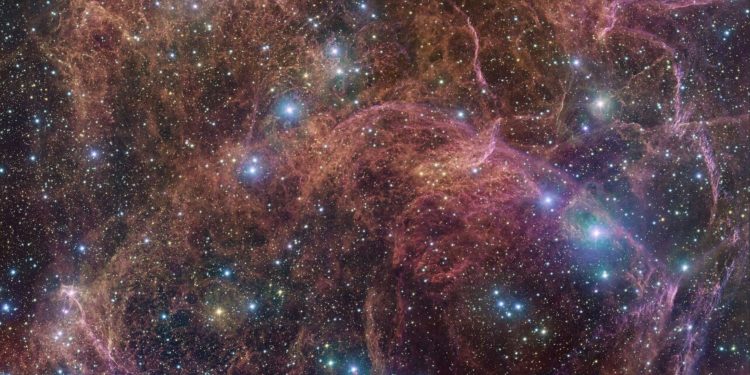
A cropped photo of the Veil supernova remnant.
Image Credit: ESO/VPHAS+ team. Acknowledgement: Cambridge Astronomical Survey Unit.
New research suggests that powerful supernova explosions in our cosmic neighborhood may have triggered at least two of Earth’s most devastating extinction events. These findings add weight to the theory that celestial forces have played a significant role in shaping the planet’s biological history.
Supernovae are the explosive deaths of massive stars, unleashing immense radiation and high-energy particles. If such an event occurred close enough to Earth, it could strip away the ozone layer, exposing life to lethal ultraviolet (UV) radiation. This mechanism has long been considered a possible cause of past extinction events, but a new study led by astrophysicist Alexis Quintana from the University of Alicante strengthens this link.
By analyzing the rate of supernovae in our galaxy, Quintana and his team found that their timing aligns with two of Earth’s most catastrophic mass extinctions: the Late Ordovician (445 million years ago) and the Late Devonian (372 million years ago). These periods saw the disappearance of vast numbers of species, with evidence pointing to a severe depletion of the ozone layer.
To test the plausibility of a supernova-driven extinction, researchers examined a census of massive OB-type stars—short-lived but incredibly energetic stars that frequently end their lives in supernova explosions. The team focused on stars within a 3,260-light-year radius of the Sun, determining that at least 24,706 OB stars exist within this range.
Using this data, they calculated that supernovae occur at a rate of 15 to 30 per million years across the Milky Way. However, for an explosion to significantly impact Earth, it must occur within about 65 light-years. Based on their findings, the researchers estimated that such close-proximity supernovae occur roughly 2.5 times per billion years—matching the timeline of the Ordovician and Devonian extinctions.
A supernova within 65 light-years would bombard Earth with cosmic rays, potentially destroying atmospheric ozone and allowing dangerous levels of UV radiation to reach the surface. This would disrupt ecosystems, severely damaging plant life and marine organisms at the base of the food chain, ultimately leading to a mass extinction.
Notably, previous research has found spikes of radioactive isotopes such as iron-60 in Earth’s geological record—an element produced in supernova explosions. These discoveries further suggest that our planet has been directly exposed to supernova debris in the past.
At present, no nearby stars are poised to explode within a dangerous range. The well-known red giants Betelgeuse and Antares are approaching the end of their lifespans, but they are located hundreds of light-years away—far enough that their eventual explosions will pose no threat to Earth.
Of course, cosmic disasters aren’t the only extinction threats humanity faces. Large asteroid impacts and massive volcanic eruptions are also capable of triggering global devastation. While we have little control over these cosmic events, understanding their effects can provide deeper insight into Earth’s history and the forces that shape life.
Vera Rubin Gets its Camera Installed Using the largest digital camera in the world, Rubin Observatory will soon be ready to capture more data than any other observatory in history
Vera Rubin was a leading American astronomer who provided the first compelling evidence for the existence of dark matter and revolutionised our understanding of the cosmos. She earned the National Medal of Science in1993 and NASA honoured her legacy by naming an observatory in Chile after her. Now, the observatory named in her honour, has reached a significant milestone with the installation of the LSST Camera ahead of first light expected mid-2025.

Vera Rubin at Work, NOIRLab
(Credit : KPNO/NOIRLab/NSF/AURA)
The build of the camera was completed in April 2024, after which it was safely transported to Chile for installation. This 3200-megapixel device forms the centrepiece of the observatory's advanced optical system, which includes an 8.4-meter primary/tertiary mirror and a 3.5-meter secondary mirror. The installation process was complex, requiring months of testing in a clean room before using a platform lift to move the camera gently to the telescope floor. The team then used a custom made lifting device to precisely position this massive instrument on the Simonyi Survey Telescope.

Vera Rubin Observatory with the Milky Way
(Credit : NSF/AURA/B)
The installation of the camera represents the culmination of decades of design and construction work and was mounted on the telescope at Cerro Pachón in Chile in early March. It will shortly enter a period of testing before starting to capture its first images and begin the Legacy Survey of Space and Time (LSST). The project is jointly funded by the U.S. National Science Foundation and the Department of Energy's Office of Science, with operations to be collaboratively managed by NSF NOIRLab and DOE's SLAC National Accelerator Laboratory.
The LSST Camera will undergo final testing and integration before capturing massive night sky images, each one large enough to fill 400 ultra-high-definition TV screens. As someone who has dabbled in astronomical imaging, one decent UHD screen full of an image is impressive but 400! I cannot wait for the first image to be released at a ‘First Look’ event later this year.
LSST Camera Project Manager Travis Lange praised the diverse team behind the world's largest camera, highlighting their incredible achievement, “It has been a treat to watch the biggest camera the world has ever seen being built by such a talented group of people with such a wide range of backgrounds.” He continued “It’s a wonderful example of what teams of scientists and engineers can accomplish when they are called upon to do what has never been done before.”
Source :
RELATED VIDEOS
NASA's Punch and SPHEREx Missions Safely Blast Off Four small suitcase-sized spacecraft, designed and built by Southwest Research Institute headquartered in San Antonio, launched from Vandenberg Space Force Base in California on March 11. NASA’s Polarimeter to Unify the Corona and Heliosphere, or PUNCH, constellation has deployed. When it reaches final configuration in low Earth orbit, it will provide a clear view in all directions for its two-year primary mission.
The SpaceX Falcon 9 is a reusable two-stage orbital launch vehicle that has revolutionised launches into orbit. Standing at 70 meters tall with a diameter of 3.7 meters, it can carry payloads of up to 22,800 kg to low Earth orbit and 8,300 kg to geostationary transfer orbit. Its most recent launch powered off the launchpad at 8:10 p.m. PDT on March 11th taking two separate missions into space.

A Falcon 9 night launch
(Credit : Space X)
NASA's SPHEREx observatory was one of the missions on board the Falcon 9 and its objective is to investigate the universe's origins, galaxy evolution, and search for life-supporting molecules within our galaxy. Its name stands for "Spectro-Photometer for the History of the Universe, Epoch of Reionization and Ices Explorer,” really quite the mouthful so I can see why it’s been shortened to SPHEREx! Sharing the same launch were four small satellites making up NASA's PUNCH mission, the ‘Polarimeter to Unify the Corona and Heliosphere,’ and its objective is to study the transformation of the Sun's outer atmosphere into the solar wind.
The SPHEREx and PUNCH missions will both operate in a Sun-synchronous orbit along Earth's day-night boundary. This keeps the Sun at a constant position relative to the spacecraft making observations far easier for PUNCH and so that SPHEREx is shielded from solar interference. After launch, NASA's Jet Propulsion Laboratory successfully made contact with SPHEREx at 9:31 p.m. PDT, following which there will be a one-month checkout period before its two-year mission. The four PUNCH satellites separated from the rocket about 53 minutes after launch, with ground controllers confirming communication with all spacecraft. PUNCH now enters a 90-day commissioning phase before beginning scientific operations to study the solar wind.

Artist impression of SPHEREx
(Credit : NASA/JPL)
SPHEREx mission is to create complete 3D maps of the sky every six months to complement NASA's more detailed but narrower-view from telescopes like Webb and Hubble. Using spectroscopy, it will measure distances to a whopping 450 million galaxies, providing insights into the inflationary period of the Universe that occurred shortly after the Big Bang. It will also measure the collective glow from all galaxies across the sky to reveal new information about galaxy formation and evolution.
The PUNCH mission on the other hand will conduct three-dimensional observations of the Sun's corona and the inner Solar System to investigate how solar material ejected from the Sun transforms into the solar wind.

Artists impression of one of the four PUNCH satellites
(Credit : NASA)
It will also study the formation and evolution of phenomena like coronal mass ejections, which can create dangerous levels of radiation affecting spacecraft and astronauts in orbit. Understanding more about stellar wind production and the development of hazardous space weather events helps to understand how it impacts our planet but will also highlight that interplanetary space is not empty but filled with solar wind that interacts with our planet.
Source :
If Mars Samples Contain Life, Can We Detect It? NASA’s Perseverance took two drill-core samples from the rock nicknamed "Rochette" on Mars, Sept. 7, 2021. Plans for returning these and other Martian samples to Earth are unclear, but it will likely happen in the next decade. How can we be sure these samples don’t host Martian microbes?
Image Credit: NASA
Many sci-fi plots revolve around alien life reaching Earth and causing problems. In "Invasion of the Body Snatchers," alien pods arrive on Earth and replace humans. In "The Thing," a shape-shifting alien creature takes over an Antarctic research base and begins killing people. While frightening and titillating, these are easily dismissed as highly unlikely.
However, in "Life," a single-celled alien life form arrives in a Mars sample and rapidly evolves into a dangerous hostile creature. While rapid evolution seems unlikely, the premise isn't far-fetched: Mars samples could host microbial life and must be handled carefully.
A mission will likely return Martian samples to Earth in the next decade or so. Scientists hope that those samples will provide conclusive evidence of life on Mars when they arrive. But what if the samples contain actual, extant life? It could be disastrous if Martian life came into contact with Earth.
That's why we need to be sure if anything is alive in those samples. A team of researchers are developing stringent techniques to scan these samples and determine if they contain anything living.
Their method is presented in research titled "Submicron-scale detection of microbes and smectite from the interior of a Mars-analogue basalt sample by optical-photothermal infrared spectroscopy." The lead author is Yohey Suzuki, Associate Professor from the Department of Earth and Planetary Science at the University of Tokyo.
"It’s an exciting time to work in this field. It might only be a matter of years before we can finally answer one of the greatest questions ever asked." - Yohey Suzuki, University of Tokyo
"For near-future missions planned for Mars Sample Return (MSR), an international working group organized by the Committee on Space Research (COSPAR) developed the sample safety assessment framework (SSAF)," the authors explain in their paper. "To prepare for MSR, analytical instruments of high sensitivity need to be tested on effective Mars analogue materials."
The eventual Mars Sample Return mission is classified by COSPAR as a 'Category V restricted Earth return'. That means that any unsterilized samples must be kept strictly contained and subjected to only the most sensitive analytic techniques. To advance this, the sample safety assessment framework (SSAF) was developed.
"The SSAF targets living organisms, their resting states (e.g. spores, cysts), or their remains in Martian materials," Suzuki and his co-authors explain in their research. "The tentative level of safety assurance is a risk value of 1 in a million chance of failing to detect life if it is present." The only way to approach this level of assurance is to study Earthly analogues of Martian rocks.
Earth and Mars are wildly different planets in many ways, but they're similar in their bulk compositions. They share major compositional elements like oxygen, silicon, iron, and magnesium. They also share silicate minerals like olivine and clay minerals like smectites, though Earth has greater mineral complexity. This points out that finding Earthly analogues for Mars sample materials isn't an overwhelming challenge.
Suzuki and his colleagues chose basalt as their Mars analogue in their research. Basalt is common in both worlds and is known to host microbial life on Earth. Perseverance has already sampled basalt on the floor of the Jezero crater. "Two basalt samples with aqueous alteration cached in Jezero crater by the Perseverance rover are planned to be returned to Earth," the researchers write.

The Maaz formation on the floor of Jezero Crater is rich in basaltic lava, and the Perseverance Rover has already collected samples from the formation for return to Earth.
Image Credit: Udry et al. 2023.
In previous research, the researchers developed techniques to examine basalt and detect microbial life. These techniques were based on nanoscale secondary ion mass spectrometry (NanoSIMS) and electron microscopy coupled with energy-dispersive spectroscopy. The authors write that these methods "revealed microbial colonization at clay-filled fractures." However, these methods are destructive testing methods. When your samples come from a different planet that spends most of its time almost 150 million km. away, they're not easily replaced and must be handled carefully.
In this new research, Suzuki and his co-researchers worked on non-destructive testing methods. They focused on Optical-photothermal infrared (O-PTIR) spectroscopy, a non-destructive technique with a higher spatial resolution. O-PTIR is a relatively new and powerful analytical technique. It exploits the fact that when a sample absorbs light, it heats up, changing its refractive qualities. As an added bonus, O-PTIR requires only minimal sample preparation.
"We first tested conventional analytical instruments, but none could detect microbial cells in the 100-million-year-old basalt rock we use as the Martian analogue. So, we had to find an instrument sensitive enough to detect microbial cells, and ideally in a nondestructive way, given the rarity of the samples we may soon see," said lead author Suzuki in a press release. "We came up with optical photothermal infrared (O-PTIR) spectroscopy, which succeeded where other techniques either lacked precision or required too much destruction of the samples."
While not ground up or otherwise destroyed in other methods, samples for O-PTIR must have their outer layers removed and be sliced into pieces only 100 μm thick. While this changes the sample, it leaves plenty of material intact and available for other analytical methods and tools, even ones that have yet to be developed. O-PTIR has a resolution of 0.5 μm, high enough to discern when a sample contains living tissue.
The authors report that their analysis of clay-filled fractures in Earthly basalt delivered "in-situ spectra diagnostic to microbial cells, consistent with our previously published data obtained by NanoSIMS."

These are photographs of a nontronite-bearing fracture in a thin section of the rock core interior (a–c) with increasing magnification. Pink and blue points represent the mineral smectite and peptides indicating microbial cells, respectively. d and e are Intensity maps of optical photothermal infrared (O-PTIR) spectra in a region highlighted with a yellow square in the three photographs. On the right are duplicate O-PTIR spectra of the pink points (bottom two lines) and cultured Archaea, Bacteria, and LR White Resin. There are similar signals in all of the spectra for Amides I and II, indicating microbial cells.
Image Credit: Suzuki et al. 2025.
"We demonstrated our new method can detect microbes from 100-million-year-old basalt rock. But we need to extend the validity of the instrument to older basalt rock, around 2 billion years old, similar to those the Perseverance rover on Mars has already sampled," said Suzuki. "I also need to test other rock types such as carbonates, which are common on Mars and here on Earth often contain life as well. It’s an exciting time to work in this field. It might only be a matter of years before we can finally answer one of the greatest questions ever asked."