Naar de inhoud

UFO'S of UAP'S, ASTRONOMIE, RUIMTEVAART, ARCHEOLOGIE, OUDHEIDKUNDE, SF-SNUFJES EN ANDERE ESOTERISCHE WETENSCHAPPEN - DE ALLERLAATSTE NIEUWTJES

UFO's of UAP'S in België en de rest van de wereld
akke.beakke.be
Ontdek de Fascinerende Wereld van UFO's en UAP's: Jouw Bron voor Onthullende Informatie! Ben jij ook gefascineerd door het onbekende? Wil je meer weten over UFO's en UAP's, niet alleen in België, maar over de hele wereld? Dan ben je op de juiste plek! België: Het Kloppend Hart van UFO-onderzoek In België is BUFON (Belgisch UFO-Netwerk) dé autoriteit op het gebied van UFO-onderzoek. Voor betrouwbare en objectieve informatie over deze intrigerende fenomenen, bezoek je zeker onze Facebook-pagina en deze blog. Maar dat is nog niet alles! Ontdek ook het Belgisch UFO-meldpunt en Caelestia, twee organisaties die diepgaand onderzoek verrichten, al zijn ze soms kritisch of sceptisch. Nederland: Een Schat aan Informatie Voor onze Nederlandse buren is er de schitterende website www.ufowijzer.nl, beheerd door Paul Harmans. Deze site biedt een schat aan informatie en artikelen die je niet wilt missen! Internationaal: MUFON - De Wereldwijde Autoriteit Neem ook een kijkje bij MUFON (Mutual UFO Network Inc.), een gerenommeerde Amerikaanse UFO-vereniging met afdelingen in de VS en wereldwijd. MUFON is toegewijd aan de wetenschappelijke en analytische studie van het UFO-fenomeen, en hun maandelijkse tijdschrift, The MUFON UFO-Journal, is een must-read voor elke UFO-enthousiasteling. Bezoek hun website op www.mufon.com voor meer informatie. Samenwerking en Toekomstvisie Sinds 1 februari 2020 is Pieter niet alleen ex-president van BUFON, maar ook de voormalige nationale directeur van MUFON in Vlaanderen en Nederland. Dit creëert een sterke samenwerking met de Franse MUFON Reseau MUFON/EUROP, wat ons in staat stelt om nog meer waardevolle inzichten te delen. Let op: Nepprofielen en Nieuwe Groeperingen Pas op voor een nieuwe groepering die zich ook BUFON noemt, maar geen enkele connectie heeft met onze gevestigde organisatie. Hoewel zij de naam geregistreerd hebben, kunnen ze het rijke verleden en de expertise van onze groep niet evenaren. We wensen hen veel succes, maar we blijven de autoriteit in UFO-onderzoek! Blijf Op De Hoogte! Wil jij de laatste nieuwtjes over UFO's, ruimtevaart, archeologie, en meer? Volg ons dan en duik samen met ons in de fascinerende wereld van het onbekende! Sluit je aan bij de gemeenschap van nieuwsgierige geesten die net als jij verlangen naar antwoorden en avonturen in de sterren! Heb je vragen of wil je meer weten? Aarzel dan niet om contact met ons op te nemen! Samen ontrafelen we het mysterie van de lucht en daarbuiten.

Archief

Perseverance Takes A Second Look At Some Ancient Rocks

Every Martian rock has something to teach us about the planet's history. NASA's Mars Perseverance rover acquired this image showing the Serpentine Lake abrasion patch on the right-hand-side of the rock, with the Green Gardens sampling location on the left. The rover used its onboard Front Right Hazard Avoidance Camera A, and captured the image on Feb. 16, 2025 (sol 1420, or Martian day 1,420 of the Mars 2020 mission). Image Credit: NASA/JPL-Caltech

Perseverance Takes A Second Look At Some Ancient Rocks

A planet’s history is told in its ancient rock. Earth’s oldest rocks are in the Canadian Shield, Australia’s Jack Hill, the Greenstone Belts in Greenland, and a handful of other locations. These rocks hold powerful clues to our planet’s history. On Mars, the same holds true.

That’s why NASA’s Perseverance rover is revisiting some of them.

Perseverance is exploring Jezero Crater, an ancient paleolake. Its thick layer of sediments may contain evidence of ancient life on Mars. Every crater has a rim, and Perseverance’s current campaign involves studying the rim. The crater rim is different than the sediments. It’s made of ancient rock uplifted and exposed on the surface by the ancient impact that created Jezero.

On Earth, geologists regularly study rock that has made itself easy to examine by coming up from the deeper crust and presenting itself. The same thing happens on Mars, though impacts do the lifting, not plate tectonics. Perseverance is studying the rocks on the crater rim in its current Crater Rim Campaign. The location it’s exploring is an exposed outcrop named Tablelands.

This image shows Perseverance's landing ellipse (green circle) and the different regions in the Jezero Crater. The rover is currently exploring the crater rim, shown in purple. Image Credit: NASA/JPL-Caltech/USGS/University of Arizona This image shows Perseverance’s landing ellipse (green circle) and the different regions in the Jezero Crater. The rover is currently exploring the crater rim, shown in purple. Image Credit: NASA/JPL-Caltech/USGS/University of Arizona

One type of rock that can teach us a lot about Mars’ ancient history is serpentine. It’s common on Earth and Mars and forms in the presence of water. Its presence on Mars is some of our strongest evidence that the planet was once wet.

Perseverance sampled Silver Mountain, a rock in the Tablelands. The rover used its abrasion tool on its robotic arm to create a fresh surface it could analyze. That analysis showed Silver Mountain is rich in pyroxene, a type of silicate found in almost every igneous and metamorphic rock. The rover also collected a core.

After that, it visited a rock named Serpentine Lake that showed telltale signs of serpentine. Perseverance used its abrasion tool to clean the rock for a detailed investigation. Serpentine Lake has an intriguing texture, described in a press release as “cookies and cream.” It’s also high in serpentine and other minerals that form in the presence of water.

Perseverance used its Scanning Habitable Environments with Raman and Luminescence for Organics and Chemicals (SHERLOC) instrument to examine the Serpentine Lake rock. The rock shows a high concentration of serpentine, indicating that it was exposed to water for a long time, a hint of Mars' potential ancient habitability. Its unusual texture also hints at complex geological processes. Image Credit: NASA/JPL-Caltech Perseverance used its Scanning Habitable Environments with Raman and Luminescence for Organics and Chemicals (SHERLOC) instrument to examine the Serpentine Lake rock. The rock shows a high concentration of serpentine, indicating that it was exposed to water for a long time, a hint of Mars’ potential ancient habitability. Its unusual texture also hints at complex geological processes. Image Credit: NASA/JPL-Caltech

After that, Perseverance doubled back to revisit a rock named “Cat Arm Reservoir.”

It was the first rock the rover studied on the canyon rim. The rover analyzed its composition and detected coarse pyroxene and feldspar crystals, indicating an igneous origin. Unfortunately, Perseverance’s sample tube was empty. Sometimes, the rock the rover tries to sample is weak and turns to dust. This is rare, but it did happen during the rover’s very first sampling attempt, and it happened again with Cat Arm Reservoir.

This image from NASA's Perseverance Location Tracker shows the rover's convoluted path as it explores the rim of Jezero Crater. Image Credit: NASA/JPL This image from NASA’s Perseverance Location Tracker shows the rover’s convoluted path as it explores the rim of Jezero Crater. Image Credit: NASA/JPL

Perseverance travelled a small distance and tried to collect a core sample from Cat Arm Reservoir again. That attempt also failed. Then the rover chose a different spot nearby named “Green Gardens” and successfully collected a core sample. It’s next to the abrasion patch on Serpentine Lake.

NASA's Mars Perseverance rover acquired this image of the area in front of it. It shows the Serpentine Lake abrasion patch on the right-hand side of the rock, with the Green Gardens sampling location on the left. The rover used its onboard Front Right Hazard Avoidance Camera A and captured the image on Feb. 16, 2025 (sol 1420, or Martian day 1,420 of the Mars 2020 mission) at the local mean solar time of 16:45:19. Image Credit: NASA/JPL-Caltech NASA’s Mars Perseverance rover acquired this image of the area in front of it. It shows the Serpentine Lake abrasion patch on the right-hand side of the rock, with the Green Gardens sampling location on the left. The rover used its onboard Front Right Hazard Avoidance Camera A and captured the image on Feb. 16, 2025 (sol 1420, or Martian day 1,420 of the Mars 2020 mission) at the local mean solar time of 16:45:19. Image Credit: NASA/JPL-Caltech

Like the Serpentine Lake rock, Green Garden is also green, which is a characteristic of the mineral serpentine. Serpentine forms in the presence of water when hydrothermal vents alter ultramafic rocks. Scientists are interested in these minerals because their structure and composition can reveal the history of water on Mars. On Earth, serpentine rock also hosts microbial life, so the same may have been true on Mars. Unfortunately, it’s not clear how much evidence of this life can be preserved.

Perseverance’s “Green Garden” core sample was collected on February 17th. Image Credit: NASA/JPL-Caltech

Perseverance will spend some more time exploring the Tablelands outcrop. It may re-examine the Serpentine Lake abrasion patch and analyze the debris from the Green Gardens drilling and coring. This could take a couple of weeks.

Next on its agenda is “Broom Point,” further down the crater rim. Broom Point contains a spectacular formation of layered rock, which is also intriguing to scientists.

Mars’ ancient history is told in its ancient rocks, but it’s impossible to know in advance which rock holds which clues and how everything will fall into place.

We don’t know what Perseverance will discover about Broom Point. But the rock will tell us something. It always does.


Perseverance Rover Spots an Unusual Rock in Ancient River Channel (Mars Report)

Perseverance Finds Hints of Life On Mars! This Rock Shocked NASA

{ https://www.universetoday.com/ }

Hoe vind je dit bericht?
Geschreven door peter om 18:48 Stuur door

Jaw-dropping footage from NASA's Blue Ghost spaceship reveals close-up of the Moon - with Earth rising and setting in the background

Since leaving Earth on January 15, NASA's Blue Ghost lander has been sending back some stunning images of space.

Now, the autonomous lander has captured a truly jaw-dropping view as it records a unique close-up of the moon. 

In an incredible video, you can see the distant Earth rising and setting behind the curve of the lunar surface.

Taken on February 18, the timelapse reveals the stunning view from the Blue Ghost lander as it completed its second orbit, from about 75 miles (120 km) away. 

Having now circumnavigated the moon three times, the lander's operator, US private firm Firefly Aerospace, is making final preparations before touchdown on March 2.

In a post on X, formerly Twitter, Firefly Aerospace wrote: 'Earth rise, Earth set, repeat!'

Meanwhile, on social media, space fans have been wowed by the incredible glimpse of our lunar satellite, with its incredible patchwork of deep craters.  

One commenter wrote: 'What a cool time to be alive! The Moon up close once again!'

NASA's Blue Ghost moon lander has captured a jaw-dropping video of the Earth (indicated by red arrow) rising and setting behind the curve of the lunar surface

NASA's Blue Ghost moon lander has captured a jaw-dropping video of the Earth (indicated by red arrow) rising and setting behind the curve of the lunar surface 

Taken on February 18, the timelapse reveals the stunning view from Firefly Aerospace¿s Blue Ghost lunar lander as it completed its second orbit prior to a touchdown

Taken on February 18, the timelapse reveals the stunning view from Firefly Aerospace’s Blue Ghost lunar lander as it completed its second orbit prior to a touchdown 

The close-up images also show the lunar lander's solar panel and some scientific instruments

The close-up images also show the lunar lander's solar panel and some scientific instruments 

The robotic Blue Ghost lunar lander was launched from the Kennedy Space Center in Florida aboard a SpaceX Falcon 9 rocket.

On board are 10 NASA science investigations and technology demonstrations as part of NASA's Commercial Lunar Payload Services (CLPS) initiative.

These include instruments to record data on the lunar surface and experimental GPS tracking systems.

Over a weeks-long journey, the lander travelled roughly 238,855 miles (384,400 km) and entered lunar orbit on February 13 where it was scheduled to wait for 16 days.

On its way, Blue Ghost captured incredible images of Earth as it shrunk into a small pale dot in the distance.

While orbiting the moon, Blue Ghost has been completing a series of engine burns to bring it into a tighter orbit.

On February 18, the lander completed a three-minute and 18-second burn to push itself into a significantly lower elliptical orbit around the moon.

Shortly after lowering itself down, Blue Ghost recorded a flyby of the far side of the moon (usually hidden from Earth) at an altitude of just 75 miles (120km).

Blue Ghost was constructed by Firefly Aerospace and is carrying 10 NASA science and technology payloads as part of NASA's Commercial Lunar Payload Services (CLPS) initiative

Blue Ghost was constructed by Firefly Aerospace and is carrying 10 NASA science and technology payloads as part of NASA's Commercial Lunar Payload Services (CLPS) initiative

Blue Ghost (pictured) is carrying a number of scientific instruments including devices which will gather vital data for NASA's upcoming Artemis missions

Blue Ghost (pictured) is carrying a number of scientific instruments including devices which will gather vital data for NASA's upcoming Artemis missions 

The craft has been designed to conduct the final movements of its landing autonomously and is equipped with advanced navigation instruments and thrusters to control its movement

The craft has been designed to conduct the final movements of its landing autonomously and is equipped with advanced navigation instruments and thrusters to control its movement 

After leaving Earth on January 15, the lander made a weeks-long journey to the moon (seen here above Earth) in order to attempt a landing on the lunar surface

After leaving Earth on January 15, the lander made a weeks-long journey to the moon (seen here above Earth) in order to attempt a landing on the lunar surface

On social media, space fans rushed to share their amazement with the stunning views

On social media, space fans rushed to share their amazement with the stunning views

One commenter called the video 'the coolest thing I've seen in weeks'

One commenter called the video 'the coolest thing I've seen in weeks' 

Another amazed commenter said that the footage of the Earth rising over the moon was their favourite video

Another amazed commenter said that the footage of the Earth rising over the moon was their favourite video 

Although it is commonly referred to as the 'dark side' of the moon because it always faces away from Earth, this side receives just as much light from the sun as the near side.

On social media, many commenters rushed to share their admiration and amazement.

'Good luck! One small landing, one giant leap', one commenter wrote on X.

Another wrote: 'Well this is the coolest thing I've seen in weeks', while one impressed commenter chimed in: 'This is my favorite video now'. 

Of course, not everyone online was so impressed and some conspiratorially-minded commenters even questioned whether the footage was real.

One conspiracy theorist wrote: 'What a joke. gotta be a serious sheep to think this is real footage. hilarious'.

'It looks like cheap plastic moon', wrote one commenter.

Another claimed: 'If you believe this, you are not thinking critically. Good luck.'

Since leaving Earth on January 15, NASA's Blue Ghost lander has been sending back some stunning images of space, including this photo of Earth

Since leaving Earth on January 15, NASA's Blue Ghost lander has been sending back some stunning images of space, including this photo of Earth

As the lander moved further away from Earth, images showed our planet disappearing into the distance

As the lander moved further away from Earth, images showed our planet disappearing into the distance 

Blue Ghost captured its first image of the moon on February 14 after reaching lunar orbit

Blue Ghost captured its first image of the moon on February 14 after reaching lunar orbit

Some conspiracy theorists rushed to share wild claims that the footage had been faked

Some conspiracy theorists rushed to share wild claims that the footage had been faked 

One commenter wildly claimed that people who believed in the reality of space travel were 'not thinking critically'

One commenter wildly claimed that people who believed in the reality of space travel were 'not thinking critically' 

One conspiracy theorist claimed that the footage looked like a 'cheap plastic moon'

One conspiracy theorist claimed that the footage looked like a 'cheap plastic moon' 

The Blue Ghost lunar lander was launched from the Kennedy Space Center in Florida aboard a SpaceX Falcon 9 rocket. Aboard are 10 NASA science investigations and technology demonstrations as part of the Commercial Lunar Payload Services (CLPS) initiative

The Blue Ghost lunar lander was launched from the Kennedy Space Center in Florida aboard a SpaceX Falcon 9 rocket. Aboard are 10 NASA science investigations and technology demonstrations as part of the Commercial Lunar Payload Services (CLPS) initiative

The lander is expected to land on March 2, on the far eastern side of the moon's near side. It will operate for 14 days before the cold lunar night damages its electronics. Pictured, Blue Ghost's view of the moon's far side

The lander is expected to land on March 2, on the far eastern side of the moon's near side. It will operate for 14 days before the cold lunar night damages its electronics. Pictured, Blue Ghost's view of the moon's far side

Blue Ghost completed its third and final lunar orbit as of Monday and is making preparations for its last manoeuvres.

Next, the lander will perform a 16-second burn to enter a very low and nearly circular orbit around the moon.

Finally, once the spacecraft falls to 62 miles (100km) above the surface, it will fire its engines for 19 seconds to drop its path down to the landing site.

article image

Blue Ghost is expected to land on the eastern edge of the moon's Earth-facing side near an ancient volcanic feature called Mons Latreille within the 300-mile-wide (483 km) basin of the Mare Crisium, or 'Sea of Crises'.

From there, it will use its scientific payloads to gather information about the moon.

This includes making use of a lunar sunset to study a phenomenon called 'dust levitation' in which dust appears to float above the surface.

This was first sketched by Apollo 17 astronaut Eugene Cernan during NASA's last mission to the moon over 50 years ago.

Blue Ghost will then operate for 14 Earth days until the near side of the moon is cast into shadow, plunging the lander into the freezing lunar night.

With temperatures as low as -130°C (-208°F) and no light to charge its batteries, this is expected to break the lander's electronics and put an end to the mission.

NASA will land the first woman and first person of color on the moon in 2026 as part of the Artemis mission

Artemis was the twin sister of Apollo and goddess of the moon in Greek mythology. 

NASA has chosen her to personify its path back to the moon, which will see astronauts return to the lunar surface by 2026 -  including the first woman and the next man.

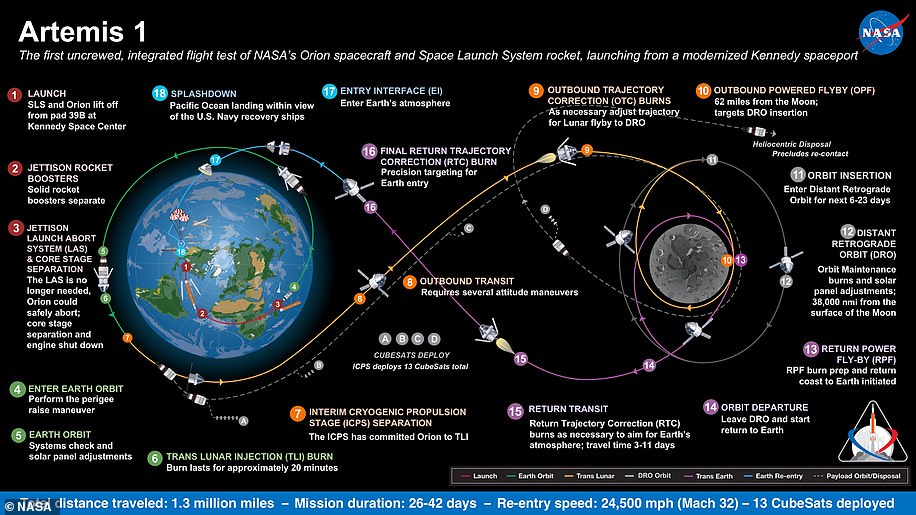
Artemis 1, formerly Exploration Mission-1, was the first in a series of increasingly complex missions that will enable human exploration to the moon and Mars. 

The uncrewed flight, which successfully launched in November last year, travelled more than 1.4 million miles on a path around the moon and back to Earth. It splashed down in the Pacific Ocean in December 2022, 25-and-a-half days after launch.

Artemis 1, formerly Exploration Mission-1, was the first in a series of increasingly complex missions that will enable human exploration to the moon and Mars. This graphic explains the various stages of the mission

Artemis 1, formerly Exploration Mission-1, was the first in a series of increasingly complex missions that will enable human exploration to the moon and Mars. This graphic explains the various stages of the mission

Orion stayed in space longer than any ship for astronauts has done without docking to a space station, while it also returned home faster and hotter than ever before. 

It will now be followed by Artemis II, a manned mission which is scheduled for launch next year.

The crew will fly around the moon and back to prepare for Artemis III, which NASA is targeting as the mission to return humans to the lunar surface. 

Eventually NASA seeks to establish a sustainable human presence on the moon by 2028 as a result of the Artemis programme.

The space agency hopes this colony will uncover new scientific discoveries, demonstrate new technological advancements and lay the foundation for private companies to build a lunar economy. 

Who is Victor Glover? The man set to become NASA's first black astronaut to orbit the moon

Victor Glover (pictured) was selected as an astronaut in 2013 and became the first African American ISS expedition crewmember to live on the ISS seven years later

NASA is set to send the first-ever black astronaut to the moon.

Victor Glover, 46, was selected to take part in the space agency's Artemis II mission — the US' first lunar mission in a half-century.

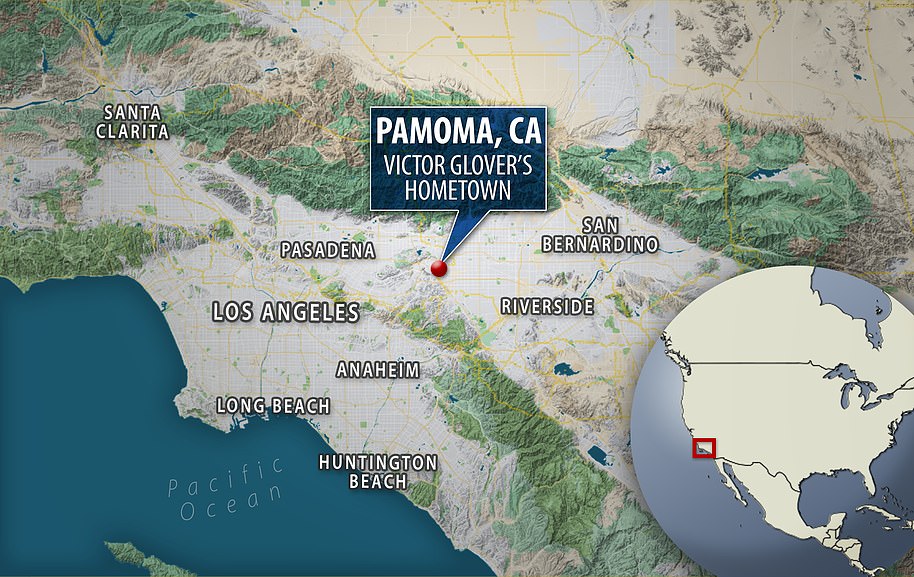
The Pomona, California, native will be the first person of color to travel into deep space, hundreds of thousands of miles beyond the low-Earth orbiting International Space Station (ISS).

NASA officials say the diverse crew assignments signify the cultural shifts that have taken place since the original Apollo missions, which ended in 1972, at a time when white men dominated space exploration.

Glover was also the first black man to ever live on the International Space Station (ISS) in 2020 and is among 15 African Americans to be selected as an astronaut.

In his esteemed career since being selected as an astronaut in 2013, Mr Glover has logged over 3,000 flight hours in 40 different aircraft.

Artemis II - which will launch in November 2024 - will see the four-man crew orbit the moon in the Orion spacecraft but not land.

Their goal is to test new technology, including heat shields that protects Orion as it travels 24,500 mph in 5,000 degrees Fahrenheit on its way back.

If successful, NASA plans to launch an expedition to land on the moon titled Artemis III. Another success would spell out a trip to Mars for NASA. 

‘I wanna thank God for this Amazing opportunity,’ Mr Glover said during a new conference Monday.

‘This is a big day. We have a lot to celebrate. It’s so much more than the four names that have been announced. We need to celebrate this moment in human history.

'Artermis II is more than a mission to the Moon and back. It’s more than a mission that has to happen before we send people to the surface of the moon. It is the next step on the journey that gets humanity to Mars.

‘This crew will never forget that.’

Mr Glover was born in 1976 in Pomona, around 30 miles east of Los Angeles.

The city is far from the glitz and glamour of Hollywood, known for its high poverty rate and relatively high crime. 

Mr Glover grew up in Ponoma, CA, 30 miles east of Los Angeles

Mr Glover grew up in Ponoma, CA, 30 miles east of Los Angeles

He said his parents and teachers served as mentors as him growing up.

'Early on in life it had to be my parents; they encouraged me and challenged me and held me to high standards. Outside of home, I had teachers that did the same,' he told USA Today in 2017.

'They all challenged me, and they encouraged me.'

Mr Glover continued that his teachers and parents urged him to go the engineering school and eventually become a test pilot — leading to him becoming an astronaut. 

He graduated from Southern California's Ontario High School in 1994, and went on to attend California Polytechnic State University, before completing his graduate education at Air University and the US Naval Academy.

'I’m the first person in my family to graduate from college, and being at graduation with my mom and my dad and my stepdad and my little brothers and my grandparents,' he said to USA Today.

'That was unreal, that was cool and it was special for me.'

In 1999 he was commissioned as part of the US Navy. After completing flight training in Corpus Christy, Texas, he was 'given his wings' and awarded the title of pilot in 2001.

He then moved to San Diego to learn to fly the McDonnell Douglas F/A-18 Hornet, known as one of the Navy's more versatile aircraft.

After spending the next two years training in Florida and Virginia, he was deployed to Iraq in 2004 for six months.

Mr Glover was working in the office of the late Sen John McCain as a legislative fellow when he was selected by NASA to become an astronaut in 2013.

NASA only selects a handful of the thousands of people that apply to be a member of the nation's astronaut corps each year. Only 15 black astronauts have ever been selected out of 348.

A vast majority of the 41 current astronauts have a military background, like Mr Glover.

He completed his astronaut training in 2015. Three years later, he was selected to be a part of the first ever operational flight of SpaceX's Crew Dragon, a reusable aircraft designed by the firm Elon Musk found in 2002.

As part of that mission, he would live on the ISS from November 17, 2020 to May 2, 2021.

The nearly six-month-long stay on the station makes him the first black astronaut to inhabit it.

Jeanette Epps, 52, who was selected to be an astronaut in 2009 is set to become the second African American, and first black woman, to live on the ISS after the launch of Boeing Starliner-1 in 2024 or later.

In 2020, Mr Glover said it was an honor to be the first black person selected to the ISS.

'It is something to be celebrated once we accomplish it, and I am honored to be in this position and to be a part of this great and experienced crew,' he said during a news conference. 

'I look forward to getting up there and doing my best to make sure, you know, we are worthy of all the work that's been put into setting us up for this mission.'

In an interview with The Christian Chronicle later that year, he said there were qualified black astronauts that should have earned the honor before him.

'I've had some amazing colleagues before me that really could have done it, and there are some amazing folks that will go behind me,' he said. 

'I wish it would have already been done, but I try not to draw too much attention to it.' 

Who is Christina Koch? The first female NASA astronaut set to orbit the moon

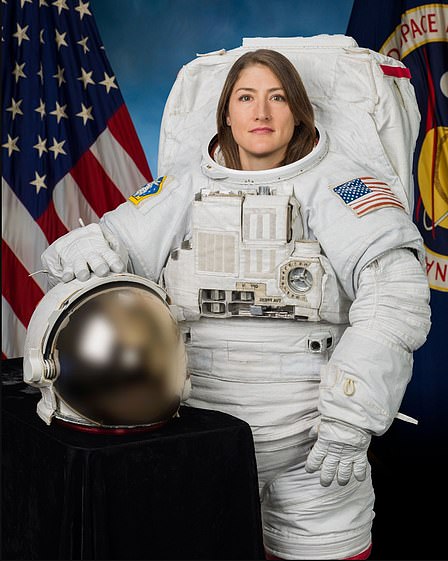
Christina Koch is set to become the first woman to go around the moon when NASA's Artemis II mission takes off next year.

Christina Koch, 44, from Grand Rapids, Michigan, is set to become the first woman to go around the moon

Christina Koch, 44, from Grand Rapids, Michigan, is set to become the first woman to go around the moon

The Grand Rapids, Michigan native, 44, is already the record-holder for the longest amount of time a woman has spent in space, 328 days, and for taking part in the first all-female spacewalk in 2019.

Selected to become an astronaut in 2013, Ms Koch said she has not followed a 'checklist' in order to become an astronaut — but instead chased her passions whether this be rock climbing, sailing or even learning to surf in her 40s.

She said in 2020: 'I really don't remember a time when I didn't want to be an astronaut. 

'For me, I learned that if I was going to be an astronaut, it was because my passions had turned me into someone that could contribute the most as someone contributing to human space flight.'

While she's exploring space, her husband Robert will be left taking care of housework and the couple's puppy, LBD. It is not believed that they have children.

'Am I excited? Absolutely!' she said at a news conference at the crew's announcement Monday.

‘The one thing I'm most excited about is that we will carry your excitement,your aspirations, your dreams, on this mission.’

She also said: ‘We are going to launch from Kennedy space center, we are going to here the words “go for launch” on top of the most powerful rocket NASA’s ever made.’

NASA has sent a total of 355 people to space so far, of which some 55 have been women — or 15 percent. It has also sent 24 people to orbit the moon and 12 to walk on the lunar surface who were all men.

Russian Valentina Tereshkova was the first woman to ever leave the earth's atmosphere — setting off in 1937. American women did not get sent to space until 1983.

Ms Koch, however, will make history on the Artemis II mission when she completes her long-awaited trip around the moon.

She revealed her love of space in a video when she was announced as a member of the Artemis I team in 2020.

The astronaut said: 'I am someone who has loved exploration on the frontier since I was little. 

'I used to be inspired by the night sky and throughout my career,  it's been this balance between engineering for space science missions and doing science in really remote places all over the world.

'I loved things that made me feel small, things that made me ponder the size of the universe, my place in it and everything that was out there to explore.'

She added: 'I didn't necessarily live my life following check boxes of how you could become an astronaut.

'But I followed those passions and one day I looked at what I had become and the skills I had gathered and I asked "could I sit across from a table and present myself as someone who could do this well?". And I thought, I'm going to give this a shot.' 

She went to North Carolina State University in Raleigh to get a bachelor's and a master's in Electrical Engineering.

She then became an Electrical Engineer at NASA Goddard Space Flight Center in Greenbelt, Maryland, before becoming a research associate for the United States Antarctic Program — living an entire year in the Arctic.

Ms Koch was one of eight selected as part of NASA's 21st class of astronauts in 2013. After two years of training, she became a full-fledged astronaut.

Her first space flight came in 2019 when she was sent to the International Space Station (ISS) to work as a flight engineer.

She stayed up there for 328 days, taking the record for the longest spaceflight by a woman. The previous record holder, Peggy Whitson, was in space for 288 days.

While in space she also took the record for the first all-women space walk — when an astronaut gets out of a vehicle while in space — with Jessica Meir.

The pair spent seven hours and 17 minutes on the side of the ISS as they worked to replace a power controller. The walk also included a brief call with President Trump.

Upon her return to Earth in 2020, Ms Koch said she felt 'like a baby' who was two weeks old and working hard to hold up its head.

Back on Earth, she lives in Galveston, Texas, just outside of the Houston area.

Among her interests are backpacking, running, yoga, photography and travel.

Now she will be a part of a groundbreaking mission in NASA's goal towards putting a man on Mars. 

The Artemis II mission marks NASA's first trip to the moon in half a century. It says it will be performed to help test kit in preparation for getting humans onto Mars.

The agency sent an empty Orion capsule around the moon last year before it returned to Earth in a long-awaited dress rehearsal.

If this latest mission goes well, then another flight to land people on the moon will be sent in 2025 — as part of tests ahead of getting people onto Mars.


{ https://www.dailymail.co.uk/ }

Hoe vind je dit bericht?
Geschreven door peter om 23:43 Stuur door

UFO captured above Jesus statue at religious landmark

Christians attending mass at a religious landmark in Mexico were stunned when a mysterious 'UFO' appeared above a Jesus statue.

Visitors at the Cerro del Cubilete in Silao, located northwest of Mexico City, captured images of what they said looked like a 'Saturn-shaped object' in the clear blue sky.

The UFO was seen hanging near the left hand of the 65-foot-tall statue, called Christ the King. One local visiting the landmark said: 'It's an alien navigator.' 

The recent sighting appeared similar to another captured last October at a gas station in Cuernavaca, located south of Mexico City, which is about 275 miles from the Cerro del Cubilete. 

Footage shows at least two motorists gawping at the alleged spacecraft in the sky at 'the corner of Teopanzolco Avenue and Plan de Ayala Avenue.'

While one spectator can be heard saying it was 'wobbling on a piece of string, so it is fake,' another added: 'It's a UFO, they say they live in nearby Tepoztlán.'

Tepoztlán is a mountain town known for its 800-year-old Tepozteco pyramid, an ancient Xochimilca temple built by the Aztecs.

The site, however, has become a place of pilgrimage for UFO enthusiasts, attracted by stories of numerous otherworldly sightings and occurrences. 

Visitors of Mexico's  Cerro del Cubilete in Silao, located northwest of Mexico City, claimed to have seen a UFO soaring near a statue of Jesus

Visitors of Mexico's  Cerro del Cubilete in Silao, located northwest of Mexico City, claimed to have seen a UFO soaring near a statue of Jesus 

They said the UFO appeared like a Saturn-shaped object in the blue sky

They said the UFO appeared like a Saturn-shaped object in the blue sky

The Cerro del Cubilete sits on a mountain more than 8,460 feet above sea level.

The statue represents the figure of Jesus standing with his arms outstretched and an angel at either side, one holding a crown of thorns and the other a royal crown. 

The spherical building that serves as the base of the statue was built in art deco style and houses a circular altar. There is also a museum atop the summit. 

While tens of thousands of people flock to the site each year, the recent UFO sighting may be one of the first.

As the crowd turned to the flying object, spectators feared they were 'going to be abducted, JAM Press reported.

Another local said: 'It sure looks like a UFO.'

While this is the first reported 'Saturn-like' object spotted near the religions site,  another appeared over the the western city of Zitácuaro on September 8, 2024 that looked nearly identical.

Following the videos, some users took to X  to share their belief that aliens had made their way to Mexico.

'That's that eye diamond UFO shape,' one person commented. '(Must) be some kind of organic ship.'

The UFO was seen hanging near the left hand of the 65-foot-tall statue, called Christ the King. One local visiting the landmark said: 'It's an alien navigator'

The recent sighting appeared similar to another captured last October at a gas station in Cuernavaca, located south of Mexico City, which is about 275 miles from the Cerro del Cubilete

The recent sighting appeared similar to another captured last October at a gas station in Cuernavaca, located south of Mexico City, which is about 275 miles from the Cerro del Cubilete

'Spectacular video, contact between humans and alien races is getting closer and closer,' another X user chimed in. 'Anyone who continues to believe that it is a balloon, a drone, a hologram or something else is either blind or does not want to see reality.'

However, others were quick to dispel the claims, pointing out that it was most likely just one of the many sky lanterns that float across the Mexican skies during the Globos de Cantoya festival.

'It may have been a test of a hot air balloon, as these balloons are very common in central Mexico and from a distance they can be confused with other objects,' another user explained.

Another similar sighting was captured in September 2024 over the the western city of Zitácuaro

Another similar sighting was captured in September 2024 over the the western city of Zitácuaro

article image

One X user questioned the quality of the video but conceded that life probably exists outside our solar system.

'So much technology, cell phones with too many mega pixels and images like that,' they said. 'I do believe that there is life on other planets, but some tests like this don't help much.'

Some found humor in the alleged UFO sighting.

'They went searching for atoles,' another X user said, referring to the traditional Mexican beverage that is made with water, masa (corn flour), piloncillo, (unrefined cane sugar), cinnamon and vanilla.

'We will see more and more UFOs. And the government will make contact with them,' another person jokes. 'We will obey in fear as always. But we will never see them.'

{ https://www.dailymail.co.uk/ }

Hoe vind je dit bericht?
Geschreven door peter om 23:21 Stuur door

Pentagon issues bombshell announcement about egg-shaped UFO case

Pentagon issues bombshell announcement about egg-shaped UFO case

The Pentagon has revealed that it is now investigating claims made by a government contractor that he retrieved a crashed 'egg-shaped' UFO.

Jake Barber came out as a whistleblower in January, saying he piloted helicopters during secret missions to collect alien technology.

Speaking to NewsNation, Barber said he flew 150 feet above an 'egg-shaped' object with no engine or thermal signatures.

'I saw an egg, a white egg,' the pilot explained. 'It's inconsistent with anything I'd ever seen before,' Barber said in January.

Now, the US Department of Defense (DoD) has confirmed it is looking into the case.

It's the latest report of UAPs (unidentified anomalous phenomena) the Pentagon admits they're actively investigating - adding this case to 21 others.

Those 21 UAP investigations were part of a stunning report which revealed that the All-domain Anomaly Resolution Office (AARO) received 757 cases of UAP encounters from US authorities mainly between May 1, 2023 and June 1, 2024.

That bombshell total included 272 incidents which occurred prior to 2023 but had never been reported publicly.

AARO is the defense department's group in charge of investigating reports of UFOs and UAPs made by government agencies.

Whistleblower Jake Barber's claims about the egg-shaped UFO he was ordered to retrieve are now being investigated the Pentagon

Whistleblower Jake Barber's claims about the egg-shaped UFO he was ordered to retrieve are now being investigated the Pentagon

Jake Barber, now a chief helicopter pilot in California, said he has witnessed alien craft while working for a secret UFO retrieval program

Jake Barber, now a chief helicopter pilot in California, said he has witnessed alien craft while working for a secret UFO retrieval program

According to AARO, it is the first government office that synchronizes the efforts of the DoD and other agencies to collect, report, and analyze all data on UAPs.

At the moment, only military personnel can make a UAP report to AARO, which must be first sent to their commanding officers or agencies.

For civilian pilots who see a UFO, AARO says they should tell air traffic control and the Federal Aviation Administration (FAA) will send those reports to the DoD.

As for everyday people who see something strange in the sky, AARO does not have a way for them to report their experiences, adding that 'we will announce when a reporting mechanism is available for others to use.'

The public can still send information about their sightings to the National UFO Reporting Center, which is a non-governmental group documenting UFO encounters since 1974.

Not everyone is convinced the Pentagon and AARO will finally reveal everything Washington knows about UFOs and the possibility of alien encounters.

Investigative journalist Ross Coulthart noted that the new director of AARO, Dr. Jon T. Kosloski, has very limited power when it comes to revealing government secrets.

Before taking over AARO, Dr. Kosloski previously worked for the Research Directorate of the National Security Agency and as a subject matter expert, advising several agencies within the DoD.

'The Pentagon dictates what he is allowed to reveal and what he's allowed to say publicly, and there isn't a very proud history of the Pentagon wanting to be very forthcoming,' Coulthart told NewsNation.

AARO, the All-domain Anomaly Resolution Office, is reportedly investigating over 20 cases involving UAPs reported to the US Department of Defense

AARO, the All-domain Anomaly Resolution Office, is reportedly investigating over 20 cases involving UAPs reported to the US Department of Defense

Many military personnel claimed to have witnessed UFOs. This image, obtained April 28, 2020, was taken by Navy pilots in 2017.  Navy Cmdr David Fravor, who saw it, testified under oath in a hearing where he discussed the experience

Many military personnel claimed to have witnessed UFOs. This image, obtained April 28, 2020, was taken by Navy pilots in 2017.  Navy Cmdr David Fravor, who saw it, testified under oath in a hearing where he discussed the experience

article image

Coulthart went on to claim that he believes the US government has been covering up its retrieval of what he called 'non-human technology' for decades.

Moreover, he cited the 'mixed messages' members of the Trump Administration have been putting out when it comes to being transparent about UAP.

That includes the administration's handling of the swarms of mysterious drones over New Jersey and other states in 2024 - which officials dismissed as simply 'FAA-authorized drones.'

As for the 757 UAP reports revealed to the public in November, AARO said it expected to or has already dismissed nearly 300 as balloons, birds, or drones.

Over 400 allegedly didn't have enough data to keep the investigations open, leaving just 21 for AARO to continue probing - along with Jake Barber's egg-shaped craft.

Coulthart noted that a lot of what the public can expect to hear about Barber's encounter will depend on the new Trump Administration.

'It really does rest with the president and also, to some degree, with the Congress whether or not we're going to get any movement on any further disclosure about this alleged covert program,' Coulthart said Sunday.

For those hoping for more disclosure, however, Rep. Anna Paulina Luna of Florida was recently appointed to lead a new task force focused on declassifying 'government secrets' - including the origin of UFOs.

House Oversight Committee Chairman James Comer said, 'Rep. Luna is committed to shining a light on the truth and ending the era of secrecy.'

RELATED VIDEOS

UAP recovery video shows ‘egg-shaped’ object: Exclusive | Reality Check

CONFIRMED: UFO Crash Retrieval Video "Egg Shaped”

{ https://www.dailymail.co.uk/ }

Hoe vind je dit bericht?
Geschreven door peter om 23:00 Stuur door

What would really happen if the Gulf Stream collapsed? Scientists warn major global current is WEAKENING - raising concerns of a real-life Day After Tomorrow

What would really happen if the Gulf Stream collapsed? Scientists warn major global current is WEAKENING - raising concerns of a real-life Day After Tomorrow

As anyone who has seen 'The Day After Tomorrow' can attest, the world would look dramatically different if the Gulf Stream gave way. 

In the 2004 blockbuster film starring Jake Gyllenhaal, an enormous 'superstorm' triggered by the collapse of the Gulf Stream sets off catastrophic natural disasters.

Around the world, people are frozen under layers of snow, drowned in massive tsunamis and dramatically crushed under vehicles thrown by tornados. 

Now, scientists at the Met Office warn that Earth's system of ocean currents is 'weakening', although it is unlikely to collapse this century. 

The Gulf Stream is only a small part of a much wider system of currents, officially called the Atlantic Meridional Overturning Circulation or AMOC. 

Described as 'the conveyor belt of the ocean', it transports warm water near the ocean's surface northwards from the tropics up to the northern hemisphere, keeping Europe, the UK and the US east coast temperate. 

Lead author Dr Jonathan Baker, a senior scientist at the Met Office, said: 'The AMOC has a crucial role in regulating our climate; without it, northwest Europe’s temperatures would be much cooler.

'Although our study shows that collapse over the next 75 years is unlikely, the AMOC is very likely to weaken, which will present climate challenges for Europe and beyond.'

In the 2004 blockbuster film starring Jake Gyllenhaal , an enormous 'superstorm' triggered by the collapse of the Gulf Stream sets off catastrophic natural disasters

In the 2004 blockbuster film starring Jake Gyllenhaal , an enormous 'superstorm' triggered by the collapse of the Gulf Stream sets off catastrophic natural disasters

Characters are frozen under layers of snow, drowned in massive tsunamis and dramatically crushed under vehicles thrown by tornados

Characters are frozen under layers of snow, drowned in massive tsunamis and dramatically crushed under vehicles thrown by tornados

'If the AMOC were to collapse, it could also lead to significant cooling in northwest Europe and chaotic weather patterns worldwide, affecting crops yields and ecosystems,' Dr Baker said. 

The academic stress that his study found the AMOC is unlikely to collapse this century, but a weakened AMOC poses 'serious climate challenges'.

'A weaker AMOC could alter global rainfall patterns, disrupt marine ecosystems, reduce the ocean's ability to store carbon, and accelerate sea level rise along the US east coast,' he said. 

Professor David Thornalley, a climate scientist at University College London who was not involved with the study, said temperatures would plummet if the AMOC collapsed.

'An AMOC collapse could cause more weather extremes, so as well as overall colder-than-average conditions, we also expect that there would be more winter storms caused by stronger westerly winds,' he told MailOnline. 

'Unfortunately people would die due to stronger winter storms and flooding, and many old and young would be vulnerable to the very cold winter temperatures.' 

However, in the UK, the effects would be 'minor' compared with elsewhere around the world, Professor Thornalley added. 

'A collapse in AMOC would cause a shift in the tropical rainfall belt which would massively disrupt agriculture and water supplies across huge swathes of the globe,' he said.

The Gulf Stream is only a small part of a much wider system of currents, officially called the Atlantic Meridional Overturning Circulation (AMOC). This map indicates surface currents (solid curves) and deep currents (dashed curves) that form a portion of the AMOC. Colours of curves indicate approximate temperatures

The Gulf Stream is only a small part of a much wider system of currents, officially called the Atlantic Meridional Overturning Circulation (AMOC). This map indicates surface currents (solid curves) and deep currents (dashed curves) that form a portion of the AMOC. Colours of curves indicate approximate temperatures

In the Hollywood blockbuster The Day After Tomorrow (pictured), ocean currents around the world stop as a result of global warming, triggering a new ice age on Earth

In the Hollywood blockbuster The Day After Tomorrow (pictured), ocean currents around the world stop as a result of global warming, triggering a new ice age on Earth

What is the AMOC? 

The Gulf Stream is a small part of a much wider system of currents, officially called the Atlantic Meridional Overturning Circulation or AMOC. 

Described as 'the conveyor belt of the ocean', it transports warm water near the ocean's surface northwards - from the tropics to the northern hemisphere.

When the warm water reaches the North Atlantic (Europe and the UK, and the US east coast), it releases the heat and then freezes. As this ice forms, salt is left behind in the ocean water.

Due to the large amount of salt in the water, it becomes denser, sinks, and is carried southwards – back towards the tropics – in the depths below.

Eventually, the water gets pulled back up towards the surface and warms up in a process called upwelling, completing the cycle.

Scientists think AMOC brings enough warmth to the northern hemisphere that without it, large parts of Europe could enter a deep freeze.

'Many millions would be affected and suffer from drought, famine and flooding, in countries that are already struggling to deal with these issues. There would be huge numbers of climate refugees, geopolitical tensions would rise.'

Jonathan Bamber, a professor of Earth observation at the University of Bristol, agreed that if the AMOC were to collapse, the climate of northwest Europe would be 'unrecognisable compared to what it is today'. 

'It would be several degrees cooler so that winters would be more typical of Arctic Canada and precipitation would decrease also,' he told MailOnline. 'Very harsh, cold winters would certainly be a threat to life.'

In 'The Day After Tomorrow', a collapse of the AMOC takes place over a matter of days and the fictional weather immediately switches to extreme cold. 

Thankfully, such a rapid transition will not happen in real life, said Penny Holliday, head of marine physics and ocean circulation at the National Oceanography Centre in Southampton. 

'If the AMOC does reach a tipping point it will happen over several decades at least,' she told MailOnline.

'However a slowdown of the AMOC, whether it is fast-acting or takes place over many decades, will lead to the generation of more extreme and violent weather systems that have the potential to cause deaths and major damage.'   

Already, researchers have suggested that AMOC will weaken or collapse at some point in the 21st century as greenhouse gas emissions increase.

This illustration from the new Nature study depicts the AMOC¿s upwelling pathways - where deep, cold water rises toward the surface - in the present day

This illustration from the new Nature study depicts the AMOC’s upwelling pathways - where deep, cold water rises toward the surface - in the present day

Formally known as the Atlantic Meridional Overturning Circulation (AMOC), it powers the Gulf Stream that brings warm water from the Gulf of Mexico to the northeastern US coast

Formally known as the Atlantic Meridional Overturning Circulation (AMOC), it powers the Gulf Stream that brings warm water from the Gulf of Mexico to the northeastern US coast

However, the extent of AMOC weakening is uncertain with wide variation across climate models, according to the researchers at the Met Office. 

To find out more, the team, led by Dr Jonathan Baker, used 34 computer models to assess the AMOC’s response to extreme changes in greenhouse gas concentrations and rising sea levels. 

Their findings, published in the journal Nature, reveal the AMOC would weaken, but is likely to withstand future global warming and won't collapse this century. 

This is because strong Southern Ocean winds act like a powerful pump, continuously pulling deep water to the surface, keeping the system running even under extreme climate change.

Met Office says that the effect of a weaker AMOC is included when making projections of future climate change for the UK. 

Interestingly, a weaker AMOC will bring less warm water northwards, and this will partly offset the warming effect of the greenhouse gases over western Europe. 

For the gradual weakening that is likely over the 21st century, but the overall effect is still a warming. 

Professor Rowan Sutton, director of the Met Office Hadley Centre who was not involved with the study, said it brings 'important new insights' into AMOC's future. 

'The Day After Tomorrow' is based on the 1999 book The Coming Global Superstorm by Art Bell and Whitley Strieber

'The Day After Tomorrow' is based on the 1999 book The Coming Global Superstorm by Art Bell and Whitley Strieber

Professor Rowan Sutton, director of the Met Office Hadley Centre who was not involved with the study, said it brings 'important new insights' into AMOC's future.

article image

'It shows that aspects of the AMOC may be more robust to a changing climate than some previous research has suggested,' he said. 

'However, it doesn’t change our expectation that the AMOC will weaken over the twenty first century, and that this weakening will have important impacts on climate.' 

But study author Geoff Vallis, climate scientist at the University of Exeter, said it does 'not in any way mean that global warming is not a severe problem for society and our planet'. 

'I think it very unlikely that my house will burn down in the coming years; however, I still buy insurance to guard against that risk,' Professor Vallis said. 

What will happen if the AMOC global ocean current collapses?

UK 

Studies suggest that the collapse of AMOC would lead to plummeting temperatures in the UK.

Britain is currently kept toasty by the Gulf Stream which carries warm water from the Gulf of Mexico to the seas around the UK.

If this were to fail, Britain could be plunged into extreme cold with winter temperatures falling by up to 15°C (27°F).

Average summer temperatures would be 3°C to 5°C (5.4°F to 9°F) lower than they are now, while winters could be 10°C to 15°C (18°F to 27°F) colder.

The brunt of this change would be felt by northern areas such as Scotland which will become much colder than the South.

Europe

The effects of an AMOC collapse would be particularly strong in Northwestern Europe and the Nordic regions.

Scientists warn that the 'cold blob', an anomalous region of cold, could expand and deepen over the region.

The area would be gripped by freezing temperatures so cold that sea ice could creep South from the Arctic.

Extreme weather will become more common, with violent storms and intense rainfall becoming more frequent.

The effects could be so strong that scientists warn it could threaten the viability of agriculture in Northern Europe.

US 

The US will avoid most of the freezing consequences of AMOC collapse but will not escape unscathed.

Scientists predict that the failure of the ocean currents would lead to major additional sea-level rises on the Atlantic coastline.

Research has suggested major cities such as New York, New Orleans, and Miami could be threatened by flooding.

Estimates already suggest that up to 448,000 people could be displaced.

Additionally, changing weather patterns could lead to 'upheaval' for coastal ecosystems and fisheries.

Worldwide

If AMOC collapses the tropical rainfall belt, an area of high rainfall positioned around the tropics will shift southwards.

This shift could lead to widespread enormous disruptions to agriculture and water supplies in the region.

That change could trigger widespread famine and drought in some regions with devastating floods in others.

In turn, experts suggest that this will lead to a massive increase in the number of climate refugees fleeing their home countries and escalating geopolitical tensions in the region.

RELATED VIDEOS


JUST 2 DEGREES: WHAT HAPPENS IF THE GULF STREAM COLLAPSES?

Gulf Stream Atlantic oceanic currents could collapse as early as 2025: Study | WION Climate Tracker

Gulf Stream Collapse Could Cause Major Climate Shift

{ https://www.dailymail.co.uk/ }

Hoe vind je dit bericht?
Geschreven door peter om 22:45 Stuur door

Archaeologists find 'extraterrestrial metal' in 2,700-year-old cemeteries

Archaeologists find 'extraterrestrial metal' in 2,700-year-old cemeteries

Archaeologists have discovered 'extraterrestrial metal' in ancient burials in Poland.

They uncovered four artifacts, three bracelets and a pin, containing a metallic iron found only in meteorites.

The pieces were pulled from two Early Iron Age cemeteries, dating between 750 to 600 BC, in southern Poland.

The team used different techniques, including X-rays to peer inside objects and another that uses a beam of electrons to create high-resolution images of objects, to determine the elemental composition of the artifacts.

The results showed high concentrations of smelted ore and meteoric iron that appeared to have come from a single space rock.

The high nickel levels in the iron suggested the jewelry was made from an ataxite meteorite that feature a mirror-like finish.

The researchers also said that the mixing of the iron sources was likely done on purpose to create patterns on the pieces. 

If the hypothesis can be proven, it would make these artifacts the the oldest known version of patterned iron.

Archaeologists identified four artifacts from ancient cemeteries that feature iron from a meteorite

Archaeologists identified four artifacts from ancient cemeteries that feature iron from a meteorite 

Using fallen meteorites to fashion objects was a common practice thousands of years ago, as a similar artifact was found in the tomb of Tutankhamun. 

Meteorite iron is found in certain types of stony meteorites, composed mainly of silicates - a salt made of silicon and oxygen. 

The discovery was made in Poland's Częstochowa Museum collection by Polish and French scientists who analyzed burial objects from two early Iron Age graveyards, Częstochowa-Raków and Częstochowa-Mirów.

Researchers analyzed the jewelry in the 1960s, but the artifacts were reanalyzed by Professor Albert Jambon a meteorite specialist from Sorbonne University and Dr Karol Dzięgielewski from Jagiellonian University.

'This modest number of specimens nevertheless forms one of the biggest collection of meteoritic iron products at one archaeological site worldwide, they shared in the study. 

The team studied a total of 26 artifacts, including bracelets, ankle rings, knives, spearheads, and necklaces, housed at the museum.  

Using several analytical techniques, they were able to determine the artifacts' elemental distribution and material composition, Phys.org reported.

This allowed them to identify four pieces were at least partially composed of meteoric iron.

The pieces were pulled from two Early Iron Age cemeteries, dating between 750 to 600 BC, in southern Poland

The pieces were pulled from two Early Iron Age cemeteries, dating between 750 to 600 BC, in southern Poland

While only four of the artifacts contained meteoric iron, researches said the discovery is on par with some from ancient Egypt where archaeologists have found troves of pieces dating back 5,000 years

While only four of the artifacts contained meteoric iron, researches said the discovery is on par with some from ancient Egypt where archaeologists have found troves of pieces dating back 5,000 years

The bracelets were pulled from Częstochowa-Raków cemetery and the pin from Częstochowa-Mirów.

While only four of the artifacts contained meteoric iron, researches said the discovery is on par with some from ancient Egypt where archaeologists have found troves of pieces dating back 5,000 years. 

Because the type of meteorite used, the team believes the iron was locally sourced. 

'We can conclude that there is a high likelihood that there was a witnessed fall rather than a lucky find,' said Dr Jambon.

'Iron meteorites may be large (hundreds of kg), but this may actually be a problem. 

'Large pieces are not workable, and you need to separate small pieces (less than one kg), which is hardly possible with the tools of the Iron Age (see, e.g., the pieces of iron worked by the Inuits).'

Researchers in Spain made a similar discovery in 2024, finding artifacts were made with 'alien metals' 3,000 years ago

Researchers in Spain made a similar discovery in 2024, finding artifacts were made with 'alien metals' 3,000 years ago 

article image

Researchers in Spain made a similar discovery in 2024, finding artifacts were made with 'alien metals' 3,000 years ago.

Scientists conducted a new analysis of the Treasure of Villena, a hoard of 59 gold-plated objects found in 1963, finding two objects featured meteoric iron. 

A gold-coated cap and bracelet contained the extraterrestrial material from a meteor that crashed into Earth one million years ago, according to the team's estimates. 

The artifacts were discovered by archaeologist José Maria Soler in December 1963, while he and his team were excavating a dry river bed called the 'Rambla del Panadero' - about seven miles from Villena. 

The study explained that meteorite iron is found in certain types of stony meteorites, composed mainly of silicates - a salt made of silicon and oxygen.

'Since they come from outer space, are composed of an iron-nickel alloy with a variable nickel composition greater than five percent by weight,' researchers wrote.

'They also contain other minor and trace chemical elements, cobalt being one of the most significant.'

{ https://www.dailymail.co.uk/ }

Hoe vind je dit bericht?
Geschreven door peter om 22:24 Stuur door

Many Ancient Civilizations Destroyed by Catastrophes, Says Maverick Researcher

Illustration of the landscape of the great lost city of Atlantis

Many Ancient Civilizations Destroyed by Catastrophes, Says Maverick Researcher

Randall Carlson is a geological researcher and renegade scholar with extensive knowledge of ancient mythology, sacred geometry, and the Earth’s history of catastrophes. For over four decades he has been relentlessly pursuing the truth about the history of this planet and its human inhabitants, and his independent and interdisciplinary approach to knowledge synthesis has put him firmly outside the mainstream as a thinker and a theorist.

The breadth and scope of Randall Carlson’s research is immense, and one of his most startling theories that ancient civilizations across the world, such as the Egyptians, Sumerians, Mayans, and Megalithic builders, all had access to a universal system of advanced knowledge. He asserts that this knowledge was not confined to one specific culture, but instead was a shared inheritance passed down through generations.

This idea points to an origin story for human society and culture that predates known history, stretching far back into the remote mists of what we mistakenly refer to as “prehistory.” When researchers are willing to evaluate the evidence without prejudice or fear of being sanctioned by the academic gatekeepers, Carlson argues, the amazing truth about our past becomes obvious.


Mythical History and the Atlantis Connection

Randall Carlson links his ideas to Plato’s account of Atlantis, a story relayed by Solon, an Athenian statesman who traveled to Egypt around 600 BC. According to Solon, Egyptian priests spoke of an advanced civilization, Atlantis, which existed 9,000 years before his time and met its demise in a catastrophic event.

Moving back 9,000 years from Solon’s era, the suggested timeline places Atlantis’s destruction at approximately 11,600 years ago—a time Carlson believes is profoundly significant.

As Carlson points out, this date aligns with findings from geology and climatology that mark the end of the Younger Dryas, a period characterized by sudden cooling followed by rapid warming. Carlson argues that this connection is not coincidental; rather, it serves as evidence that Plato’s Atlantis may have been a real civilization that was lost in a major cataclysm.

Map of the Younger Dryas and its impact on climate in Europe and the surrounding region.

(Offthemapz/CC BY-SA 4.0).

From Carlson’s perspective, Plato’s story of Atlantis plus the geological evidence indicate a shared ancient knowledge that civilizations may have inherited from this glorious but lost era. And his analysis of the legend of Atlantis sets the template for his larger analysis of the planet’s history as a whole, which has included many catastrophic events that had a profound impact on the people living on earth at those times.

Catastrophes and the Disappearance of Historical Records

Carlson’s theory addresses a fundamental question: if anatomically modern humans have existed for at least 150,000 years, why do we lack a continuous historical record of their civilizations? He attributes this absence to repeated catastrophic events that effectively erased entire societies and their accumulated knowledge, leaving virtually nothing behind for archaeologists to find (except perhaps on the ocean floor, where ancient flooding would have left ruins and artifacts hidden but preserved under the earth’s seas).

According to Carlson, modern human skeletons dating back 150,000 to 180,000 years confirm that people of equivalent intelligence to contemporary humans lived through these vast time spans. The lack of surviving records, he states, is due to the overwhelming scale of the destruction caused by these cataclysms. He has identified at least 16 significant catastrophes that have taken place over the last 150,000 years—events powerful enough to dismantle civilizations entirely. He warns that if such disasters were to occur today, modern industrial society would be equally vulnerable to obliteration, potentially leaving behind only minimal traces of its existence for future generations to find.

Cosmic Cycles and the Great Year

Carlson ties these catastrophic events to cosmic cycles, particularly the concept of the Great Year—a 25,920-year cycle corresponding to the Earth’s axial precession. He believes that ancient cultures, including those that built the pyramids and megalithic structures, understood these cycles and encoded their knowledge into their architectural and mythological traditions.

He further suggests that certain disasters, such as the onset of the Younger Dryas around 12,900 years ago, are connected to these cosmic cycles. He theorizes that the Earth’s movement through space influences the periodic arrival of cosmic materials, such as asteroids and comets, into the inner solar system. This process, he posits, follows a predictable rhythm, much like the precessional cycles observed in ancient traditions. Carlson contends that early civilizations recognized these patterns and attempted to warn future generations by preserving this knowledge in their myths, sacred geometries, and monumental structures.

Exposed ice sheet in the Garwood Valley of Antarctica, the type of thick sheet that would have covered huge sections of the planet following the onset of an ice age.

(James O’Connor, USGS/Public Domain).

The Scarcity of Physical Evidence

One of the main challenges in proving the existence of these lost civilizations is the lack of surviving physical evidence. Carlson attributes this scarcity to the sheer magnitude of past disasters, which would hae been truly epic. If modern civilization were to face an event of similar proportions, he theorizes, much of its technological and historical record would be wiped out, leaving only scattered remnants that would be extremely difficult to find.

He illustrates this concept by pointing to modern disasters such as Hurricane Katrina and the 2004 Indian Ocean tsunami. These events, though localized, caused immense destruction. Carlson extrapolates from these examples, asking what would happen if a disaster were 100 times, a 100 times, or even a 1,000 times more severe. He concludes that such large-scale catastrophes could erase nearly all traces of our civilization, burying it or sweeping it out to sea—just as he believes happened in the past, probably many times.

While discovering the remains of these ancient civilizations presents an immense challenge, Carlson is hopeful that modern tools like Google Earth will help researchers identify patterns of destruction and remnants of ancient landscapes that might otherwise go unnoticed. These tools, he argues, provide an opportunity to piece together the effects of these ancient upheavals and uncover evidence of lost worlds.

Significant Catastrophic Events in Human History

Carlson identifies several major events that he believes would have inevitably wiped out ancient human civilizations. Some of the most impactful include:

  • Toba Supereruption (~72,000 BP): A massive volcanic eruption in Sumatra that likely triggered a volcanic winter, reducing human populations to critically low numbers.

  • Heinrich Events (Various Dates): Iceberg discharges into the North Atlantic, disrupting ocean currents and triggering abrupt climate changes, occurring around 65,000, 52,000, 39,000, and 23,000 years ago.

  • Younger Dryas Climate Catastrophe (~12,900 to 11,700 BP): A period of severe cooling, possibly linked to a cosmic impact, which coincides with the proposed timeline for Atlantis’s destruction.

  • Late Wisconsin Ice Age (~26,000 BP): The peak of the last Ice Age, affecting global climate and human migration patterns.

  • End of the Wisconsin Ice Age (~10,000 BP): Marking the transition from hunter-gatherer societies to the rise of early agricultural civilizations.

  • Burckle Crater Event (~4,320 BP): A proposed meteor impact in the Indian Ocean, potentially connected to flood myths from various cultures.

  • Australian Megafauna Extinctions (~40,000 BP to ~26,000 BP): A mass extinction event possibly caused by a combination of human activity and climatic changes.

  • Greenland Blitz (~104,000 BP): A proposed climatic event that Carlson links to significant environmental shifts in the region.

  • Salien Climate Shift (~144,000 BP): A large-scale climate change event that he believes influenced early human development.

  • Osis Events (~52,000 BP and ~8,400 BP): Speculative catastrophic events that may have played a role in shaping early civilizations

Illustration from a book written in 1552 by Hans Burgkmair der Jüngere depicting the great flood written about in Genesis, which from Randall Carlson’s perspective would represent a mythologized version of a flood that wiped out civilization after the end of the last ice age.

(Public Domain).

The Quest for Hidden Knowledge

Based on his decades of research, and the work of other rogue researchers like his good friend Graham Hancock, Carlson is convinced that ancient civilizations were not only aware of catastrophic cycles, but also sought to preserve their knowledge for future generations. He believes that their myths, sacred geometries, and monumental structures serve as a record of past events and a warning of periodic cosmic destruction.

With each disaster, civilizations were wiped out, forcing survivors to rebuild from a near-primitive state. Despite the loss, Randall Carlson contends that fragments of this ancient knowledge endured, passed down through traditions, oral histories, and architectural legacies. By studying geological evidence and ancient records, Carlson suggests that we may yet uncover the lost wisdom of these early civilizations, learning the secrets of creation as we anticipate and prepare for future cosmic events.

  • Top image: Illustration of the landscape of the great lost city of Atlantis.
  • Source: Soothsayer/CC BY-SA 4.0.

By Nathan Falde

RELATED VIDEOS


Randall Carlson's Ancient Catastrophe (Full Documentary)
5 Unexplained Ancient Civilizations that Mysteriously Vanished

The Great Flood: Investigating One of History's Greatest Myths | Full Documentary

Silurian Hypothesis | Advanced Ancient Civilizations On Earth Before Humans | 47 ARENA

{ https://www.ancient-origins.net/human-origins }

Hoe vind je dit bericht?
Geschreven door peter om 22:13 Stuur door

5 Reasons Why Titan Is the Most Intriguing Moon in the Solar System

5 Reasons Why Titan Is the Most Intriguing Moon in the Solar System

Saturn’s moon Titan is one of the most fascinating celestial bodies in our Solar System. Unlike any other moon, Titan possesses a thick atmosphere, liquid lakes, complex organic chemistry, and even a hidden subsurface ocean that could potentially harbour life. These unique characteristics make it a prime target for future space missions.

Titan is often compared to early Earth, as its dense nitrogen-rich atmosphere and organic-rich surface provide a glimpse into the conditions that may have led to life on our planet. With the Cassini-Huygens mission revealing stunning insights about its terrain and weather patterns, and NASA’s upcoming Dragonfly mission poised to explore it further, Titan remains at the forefront of planetary exploration. In this article, we explore five reasons why Titan stands out as the most intriguing moon in the solar system.

A Thick Atmosphere Unlike Any Other Moon

One of Titan’s most distinctive features is its dense atmosphere, which sets it apart from other moons in the solar system. Titan’s atmosphere is primarily composed of nitrogen (about 95%) with traces of methane (around 5%). This composition is remarkably similar to Earth’s atmosphere, making Titan one of the most Earth-like bodies in our solar system in terms of atmospheric conditions.

Infrared views of Titan's surface made from data by the VIMS instrument. Credit: University of Arizona/LPL

Infrared views of Titan’s surface made from data by the VIMS instrument. Credit: University of Arizona/LPL

Titan’s thick atmosphere gives it an orange haze that obscures its surface from direct view. This haze is caused by photochemical reactions in the upper atmosphere, where sunlight breaks down methane into more complex organic molecules. The presence of such an atmosphere makes Titan an excellent natural laboratory for studying atmospheric processes, weather patterns, and potential prebiotic chemistry.

The Role of Atmospheric Pressure and Weather

Unlike the thin atmospheres found on other moons, Titan’s atmospheric pressure is about 1.5 times that of Earth’s at sea level. This means that if a human were to stand on Titan’s surface, they wouldn’t require a pressure suit – only an oxygen mask and protection from the cold. The atmosphere also supports weather patterns, including methane rain, seasonal changes, and even massive storm systems that resemble those found on Earth. This dynamic climate makes Titan an extraordinary candidate for future exploration.

A World with Liquid Lakes and Seas

Titan is the only known celestial body in the solar system, apart from Earth, to have stable liquids on its surface. However, instead of water, these lakes and seas are composed of liquid methane and ethane. The most notable of these bodies of liquid are Kraken Mare, Ligeia Mare, and Punga Mare, located in Titan’s northern hemisphere.

A Geologic map of Titan made with data from the Cassini-Huygens mission. Credit: Arizona State University/JPL

A Geologic map of Titan made with data from the Cassini-Huygens mission. Credit: Arizona State University/JPL

The Hydrological Cycle on Titan

Titan’s hydrological cycle is similar to Earth’s water cycle but operates with hydrocarbons instead of water. Methane and ethane evaporate, form clouds, and eventually precipitate as rain. This cycle plays a crucial role in shaping Titan’s landscape, creating river channels, shorelines, and even seasonal weather patterns. The presence of these liquid reservoirs raises intriguing questions about the possibility of exotic life forms that could survive in liquid methane rather than water.

A Complex Organic Chemistry Resembling Early Earth

Another compelling reason why Titan is so intriguing is its rich organic chemistry. Scientists believe that Titan’s atmosphere and surface processes closely resemble conditions on early Earth before life emerged. The Cassini-Huygens mission provided detailed insights into Titan’s atmospheric chemistry, revealing the presence of complex organic molecules, including hydrocarbons and nitriles, which are essential building blocks for life.

Implications for Prebiotic Chemistry

Titan’s environment provides a unique opportunity to study prebiotic chemistry – the chemical processes that might have led to the emergence of life. The interactions between sunlight, methane, and nitrogen in Titan’s atmosphere result in the production of tholins, complex organic compounds that could play a role in the development of life. By studying Titan, scientists hope to gain a better understanding of how life might arise elsewhere in the universe.

A Subsurface Ocean That Might Harbor Life

While Titan’s surface is dominated by ice and hydrocarbon lakes, evidence suggests the existence of a vast liquid water ocean beneath its icy crust. This subsurface ocean is believed to contain water mixed with ammonia, which acts as an antifreeze, allowing the ocean to remain in a liquid state despite Titan’s frigid temperatures.

Titan's core and subsurface ocean. Credit: NASA Titan’s core and subsurface ocean. Credit: NASA

Comparison with Other Ocean Worlds

Titan is not the only moon suspected to harbour a subsurface ocean – Europa and Enceladus also have hidden oceans beneath their icy shells. However, Titan’s ocean is unique because of its potential interaction with the organic-rich surface. If material from the surface can mix with the subsurface ocean, Titan could have the necessary conditions for life to develop. The presence of a liquid water ocean beneath an organic-rich environment makes Titan an extremely promising target for astrobiology.

Future Missions That Could Unlock Its Mysteries

Titan’s unique characteristics make it a prime target for future space missions. One of the most anticipated upcoming missions is NASA’s Dragonfly, a drone-like rotorcraft designed to explore Titan’s diverse landscapes and search for signs of prebiotic chemistry.

Titan's surface in images from the Huygens probe. Credit: NASA Titan’s surface in images from the Huygens probe. Credit: NASA

What Dragonfly Will Explore

Scheduled for launch in the late 2020s, the Dragonfly mission will land on Titan and travel across its surface, investigating dunes, lakes, and potentially even cryovolcanic regions. The mission’s primary goal is to study Titan’s chemistry and assess its habitability. By directly sampling the organic compounds and surface materials, Dragonfly could provide groundbreaking insights into the building blocks of life beyond Earth.

Dragonfly will also help scientists understand Titan’s meteorology, geology, and potential subsurface interactions. Since Titan’s atmosphere is dense and gravity is low, the drone will be able to fly efficiently, covering long distances to explore multiple sites. This mobility will allow NASA to study various environments and compare their chemical compositions.

The Cassini Mission and Its Impact on Our Understanding of Titan

NASA’s Cassini-Huygens mission, which explored Saturn and its moons from 2004 to 2017, played a crucial role in expanding our knowledge of Titan. The Cassini spacecraft performed over 100 flybys of Titan, using radar to penetrate the thick atmosphere and map the moon’s surface.

The most groundbreaking event was the Huygens probe landing in 2005, the first successful landing on Titan. The probe transmitted data for over 90 minutes, revealing a world with river channels, icy pebbles, and an atmosphere rich in organic compounds. Cassini’s radar also confirmed the existence of methane lakes and provided evidence for Titan’s subsurface ocean.

The Cassini mission fundamentally changed our understanding of Titan, showing it to be one of the most Earth-like worlds in the solar system and a key target for future exploration.

Frequently Asked Questions

Could Humans Survive on Titan?

While Titan’s atmospheric pressure is hospitable, its extreme cold (around -290°F or -179°C) and lack of oxygen make it inhospitable for humans without specialized equipment. However, its dense atmosphere and low gravity make it a relatively easy place to land and explore compared to other celestial bodies.

What Makes Titan Different from Europa and Enceladus?

Europa and Enceladus are known for their subsurface oceans and potential hydrothermal activity. However, Titan stands out due to its thick atmosphere, surface lakes, and complex organic chemistry, making it a unique target for studying both atmospheric and prebiotic processes.

How Does Titan’s Weather Compare to Earth’s?

Titan experiences methane rain, seasonal weather changes, and wind-driven dunes, all of which resemble weather patterns on Earth. However, instead of water, methane dominates the climate, creating a fascinating and alien environment unlike anything else in the solar system.

RELATED VIDEOS

The Mysteries of Titan – Why Saturn’s Moon is Unlike Anything in Our Solar System

Why Titan Is Saturn’s Most Intriguing Moon

The Bizarre Characteristics of Titan | Our Solar System's Moons: Titan

£{ https://curiosmos.com/ }

Hoe vind je dit bericht?
Geschreven door peter om 20:32 Stuur door

New Explanation for Why Mars is Red

Ferrihydrite and basalt powder mixture in a laboratory sample dish. © Adomas Valantinas

 New Explanation for Why Mars is Red

Well that’s ruined all my lectures! I’ve spent years talking about space and a go to fact is the red colour of Mars. It’s been long believed that it was caused by the same chemical process that creates rust on Earth, a new paper suggests this is not the case! The team of researchers simulated conditions of Mars in a lab and now think a chemical called ferrihydrite, an iron oxide that contains water. It now looks like the planet’s characteristic red colour is due to a time when Mars was covered in water! 

Mars, often called the Red Planet is the fourth planet from the Sun. With a thin atmosphere composed mostly of carbon dioxide, Mars features a stark landscape of vast plains, huge volcanoes including Olympus Mons (the largest in our solar system), and deep canyons like Valles Marineris. Its surface has evidence of ancient rivers and lakes, suggesting Mars once had conditions that could have been suitable for microbial life. Its extreme temperature changes and frequent global dust storms are typical of this harsh world. 

Mars seen before, left, and during, right, a global dust storm in 2001. Credit: NASA/JPL/MSSS

The distinctive red colour goes back centuries; the ancient Egyptians called Mars ‘Her Desher’ which translates to ‘the Red One’, the Romans named it after the God of war and the Chinese called it ‘the fire star.’ Even Babylonian records that go back to 2000 BC noted its red colour. In 1610, when Galileo first observed Mars through a telescope, he confirmed its planetary nature but also noted a more red/brown hue. This was largely due to the poor quality optics of the day and it wasn’t until optics improved that its red colour was observed in all its glory.

galileospan-cnd-articleLarge.jpg

A bust of Galileo at the Galileo Museum in Florence, Italy. The museum is displaying recovered parts of his body. Credit Kathryn Cook for The New York Times

A team of researchers led by Dr Adomas Valantinas from Brown University in USA have published a paper in Nature Communications that has analysed the red colouration of Mars and challenge the common view that it’s a rust like material that is responsible. They used data from a number of different Mars missions from NASA’s Reconnaissance Orbiter to ESA’s Mars Express and ExoMars (which has the Colour and Stereo Surface Imaging System onboard.) The data from the orbiters was supported by data from various rovers too and further supplemented by analysis of artificial Mars-like materials in a laboratory.

Mars Express, which is now studying Phobos. An artist’s illustration of the Mars Express Orbiter above Mars. Its MARSIS instrument has been updated so it can study the moon Phobos. Image Credit: Spacecraft: ESA/ATG medialab; Mars: ESA/DLR/FU Berlin, CC BY-SA 3.0 IGO

The analysis, which included experiments and measurements at the University of Grenoble, Brown University and the University of Winnipeg revealed the presence of Ferrihydrite. Not only was it present in the Martian dust, it seemed to be widespread across the Martian landscape. Ferriydrite is an oxyhydroxide mineral (one that contains oxygen, hydrogen and at least one metal.)

The widespread discovery of ferrihydrite on in Martian dust helps us to understand more about the geological history of Mars and its potential habitability. The existence of the ferrihydrite tells us that there were once cooler, wet conditions on Mars since that is a neccessity for the formation of the mineral. It’s an exciting discovery because its one more reason to believe that Mars was once a hospitable world. 

The team are keen to learn more and are now waiting for Martian samples to study directly and for that, they are waiting for the Perseverance rover. It has been systematically collecting core samples of Martian soil from the Jezero Crater and storing them in titanium tubes ready for transport home. Once the team has these, they will be able to check whether their theory about ferrihydrite is correct.

Source : 

RELATED VIDEOS

Why Is Mars Red? I Mars Surface I Mars The Red Planet

Why Does Mars Look Red? Explained! Why Mars look red

THE MARS - Secrets and Facts - Documentary

{ https://www.universetoday.com/ }

Hoe vind je dit bericht?
Geschreven door peter om 18:25 Stuur door

Laser-powered device could reveal hidden fossils of ancient life buried on Mars

Laser-powered device could reveal hidden fossils of ancient life buried on Mars

If integrated into future Mars rovers, this laser technology could transform the search for extraterrestrial life.

Laser-powered device could reveal hidden fossils of ancient life buried on Mars

Perseverance rover exploring Mars, analyzing the terrain for signs of ancient life.

Frontiers

We’re all fascinated with alien life. What if we told you scientists are on their way to proving it?

A groundbreaking study published in Frontiers in Astronomy and Space Sciences has demonstrated that cutting-edge laser technology can detect fossilized microbes in minerals similar to those found on Mars. This means that if life once existed on the Red Planet, we may now have the tool to identify its remains. 

The center stage of this discovery is a laser-powered mass spectrometer, a spaceflight-ready instrument capable of analyzing rocks at an incredibly fine scale.

Scientists recently tested it on Earth by examining gypsum deposits in Algeria, which are similar to Martian sulfate minerals. The result? Fossilized microbial filaments, along with biosignatures, strongly suggest life once thrived in these environments.

If this laser technology can be integrated into future Mars rovers, it could revolutionize the search for extraterrestrial life. 

Detecting ancient microbes with lasers

A mass spectrometer determines the chemical composition of a sample by ionizing its particles and measuring their mass.

The version used in this study takes it a notch ahead by incorporating laser ablation technology, making it more precise and adaptable for space missions. So, how does this technology work? 

  • A high-energy laser is fired at a rock sample, causing a small portion to vaporize. This process is known as laser ablation, it removes only a tiny fraction of the material allowing it to analyze samples with little to no thermal damage. 
  • The vaporized material is then ionized, meaning the atoms are electrically charged. 
  • The mass spectrometer sorts and measures these ions, having the ability to identify their composition down to a micrometer scale. 
  • Scientists then look for specific biosignatures, such as the presence of carbon, minerals associated with biological activity, such as dolomite or clay, and microscopic fossil structures. 

Before sending this technology to Mars, scientists needed to prove that it could detect ancient life here on Earth. They chose gypsum samples from the Sidi Boutbal quarry in Algeria, a region rich in sulfate minerals that formed during the Messinian Salinity Crisis when the Mediterranean Sea partially dried up. This event left behind mineral deposits similar to those found on Mars. 

Geographical and Geological context
Geographical and Geological Context. Source – Frontiers in Astronomy and Space Sciences

Using the mass spectrometer and high-resolution optical microscopy, scientists discovered long, twisting fossil filaments embedded in the gypsum. These filaments were surrounded by dolomite, clay, and pyrite – minerals known to form in the presence of microbial life.

Dolomite typically requires either biological activity or extreme temperatures and pressures to form, thus its presence within the gypsum strongly suggests that microbial life played a role in its development. This strengthens the case that similar signatures on Mars could indicate ancient life. 

What this means for Mars exploration 

“Our findings provide a methodological framework for detecting biosignatures in Martian sulfate minerals, potentially guiding future Mars exploration missions,” said Youcef Sellam, PhD student at the Physics Institute, University of Bern, and first author of the study in Frontiers in Astronomy and Space Sciences.

By proving that a laser-powered mass spectrometer can successfully detect fossilized microbial life in Earth’s sulfate material, this research lays the groundwork for using similar technology on Mars. If future rovers or landers are equipped with this advanced tool, they could analyze Martian sulfate deposits in real-time, searching for biosignatures that might confirm life once existed on Mars. 

Beyond its implications for astrobiology, this study also marks a significant milestone for Algeria, as it is the first research of its kind to use an Algerian terrestrial analog for Mars. Sellam, who dedicated the study to his late father, expressed pride in bringing planetary science to his home country.

As technology advances, one thing is becoming clear – if life ever existed on Mars, we now have the tools to find it.

{ https://interestingengineering.com/ }

Hoe vind je dit bericht?
Geschreven door peter om 17:59 Stuur door

Meer van UFO'S of UAP'S, ASTRONOMIE, RUIMTEVAART, ARCHEOLOGIE, OUDHEIDKUNDE, SF-SNUFJES EN ANDERE ESOTERISCHE WETENSCHAPPEN - DE ALLERLAATSTE NIEUWTJES

↑ Terug naar de berichten