Ontdek de Fascinerende Wereld van UFO's en UAP's: Jouw Bron voor Onthullende Informatie!
Ben jij ook gefascineerd door het onbekende? Wil je meer weten over UFO's en UAP's, niet alleen in België, maar over de hele wereld? Dan ben je op de juiste plek!
België: Het Kloppend Hart van UFO-onderzoek
In België is BUFON (Belgisch UFO-Netwerk) dé autoriteit op het gebied van UFO-onderzoek. Voor betrouwbare en objectieve informatie over deze intrigerende fenomenen, bezoek je zeker onze Facebook-pagina en deze blog. Maar dat is nog niet alles! Ontdek ook het Belgisch UFO-meldpunt en Caelestia, twee organisaties die diepgaand onderzoek verrichten, al zijn ze soms kritisch of sceptisch.
Nederland: Een Schat aan Informatie
Voor onze Nederlandse buren is er de schitterende website www.ufowijzer.nl, beheerd door Paul Harmans. Deze site biedt een schat aan informatie en artikelen die je niet wilt missen!
Internationaal: MUFON - De Wereldwijde Autoriteit
Neem ook een kijkje bij MUFON (Mutual UFO Network Inc.), een gerenommeerde Amerikaanse UFO-vereniging met afdelingen in de VS en wereldwijd. MUFON is toegewijd aan de wetenschappelijke en analytische studie van het UFO-fenomeen, en hun maandelijkse tijdschrift, The MUFON UFO-Journal, is een must-read voor elke UFO-enthousiasteling. Bezoek hun website op www.mufon.com voor meer informatie.
Samenwerking en Toekomstvisie
Sinds 1 februari 2020 is Pieter niet alleen ex-president van BUFON, maar ook de voormalige nationale directeur van MUFON in Vlaanderen en Nederland. Dit creëert een sterke samenwerking met de Franse MUFON Reseau MUFON/EUROP, wat ons in staat stelt om nog meer waardevolle inzichten te delen.
Let op: Nepprofielen en Nieuwe Groeperingen
Pas op voor een nieuwe groepering die zich ook BUFON noemt, maar geen enkele connectie heeft met onze gevestigde organisatie. Hoewel zij de naam geregistreerd hebben, kunnen ze het rijke verleden en de expertise van onze groep niet evenaren. We wensen hen veel succes, maar we blijven de autoriteit in UFO-onderzoek!
Blijf Op De Hoogte!
Wil jij de laatste nieuwtjes over UFO's, ruimtevaart, archeologie, en meer? Volg ons dan en duik samen met ons in de fascinerende wereld van het onbekende! Sluit je aan bij de gemeenschap van nieuwsgierige geesten die net als jij verlangen naar antwoorden en avonturen in de sterren!
Heb je vragen of wil je meer weten? Aarzel dan niet om contact met ons op te nemen! Samen ontrafelen we het mysterie van de lucht en daarbuiten.
Researchers Practice Searching for Life on Enceladus, in the Arctic Ocean
When searching for alien life, it’s not unusual to use Earth as a test bed for theories and even practice runs. Perhaps one of the most tantalising places in the Solar System to look for life is Saturn’s moon Enceladus. It has a liquid water interior and it is here that life may just be possible. A team of researchers want to test techniques for searching for life on Enceledaus by exploring the oceans of Earth. They have collected water and ice samples and hope to find chemicals like methane and hydrogen.
The search for alien life is one of that has fascinated humanity for decades. Scientists explore this vast question through various avenues, including the study of exoplanets within the habitable zones of distant stars but there is still hope that maybe, just maybe we will find life elsewhere in our own Solar System. Some of the moon’s of the outer planets offer tantalising possibilities such as Enceladus, a moon of Saturn. It’s an icy moon where, beneath the icy crust, there is the possibility of the global ocean of liquid water teeming with life.
Saturn’s moon Enceladus isn’t just bright and beautiful. It has an ocean under all that ice that could have hydrothermal vents that create organic chemicals. Image Credit: NASA, ESA, JPL, SSI, Cassini Imaging Team
When the Cassini-Huygens probe visited Saturn in 2004 it sampled the cryogenic plumes that had been ejected over the southern pole, Using its Ion and Neutral Mass Spectrometer and Cosmic Dust Analyser, research teams identified the presence of water ice, methane and other carbon based molecules. Molecular hydrogen, molecular nitrogen and other elements all of which suggest the sub-surface ocean was a salty composition with the necessary elements for primative life. However to date, no evidence has been found.
Artist impression of Cassini Space Probe
It’s thought that the ice crust of Enceladus is anything form a few kilometres to up to 40 km thick. Beneath, and in the depths of the ocean are thought to be hydrothermal vents which, just like oceans on Earth, are a source of energy that could drive entire ecosystems. With all the ingredients for life, missions have been discussed to explore the astrobiological aspects of Enceladus. Mission with mass spectrometers have been proposed to identify biosignatures within the ocean.
In the paper published in Planetary and Space Science and written by a team led by F. French from the Università degli Studi di Bari in Italy, the team look at the technical possibility of detecting methane cycling on Enceladus. If it can be observed, then it would give a strong indication that the sub-surface ocean is currently, or has been habitable in the past. The conclusion can be quite reliably drawn since the methane cycle on Earth is often the result of biological and abiotic processes but is generally considered a byproduct of microbial activity.
NASA and ESA have been discussing possible missions to Enceladus but ahead of that, one way of practicing the ability to detect geochemical signatures of life is to see if it can be detected on Earth using the same technology. The Arctic Ocean is a great analogy to the conditions on Enceladus with vents on the sea floor in an ocean covered with ice for the majority of the year. The team conducted experiments to simulate the processes and techniques future missions are likely to employ on Enceladus and other outer moons.
The team found that they were able to detect and measure emitted concentrations of carbon dioxide, other carbon isotopies and other oxygen isotopes within the water. Their results suggest it will be possible to detect the necessary elements using a mass spectrometer at Enceladus. Further studies are appropriate to refine the processes ahead of a future mission.
An illustration of a Moon base that could be built using 3D printing and ISRU, In-Situ Resource Utilization. Credit: RegoLight, visualisation: Liquifer Systems Group, 2018
In April 2026, NASA will launch a crew of four as part of the Artemis II mission, a circumlunar flight that will last 10 days. This mission will set the stage for Artemis III, the long-awaited return to the Moon, currently scheduled for mid-2027. With the deployment of the Lunar Gateway (also scheduled for 2027), NASA intends to conduct regular missions to the Moon (once a year). With the help of international and commercial partners, NASA then hopes to build a lunar base and the related infrastructure that will allow for a “sustained program of lunar exploration and development.”
However, the current schedule is the result of multiple delays, budget restrictions, and issues with the various mission elements. Given the uncertain nature of politics in the U.S. right now, there are concerns that further delays may be inevitable. Meanwhile, China and its partners continue to push ahead with their plans to create a base in the South Pole-Aitken Basin – the International Lunar Research Station (ILRS) – that will rival NASA’s Artemis Program. Understandably, this situation has raised concerns about who will send crewed missions to the Moon and establish a base there first.
Back to the Moon to Stay!
For NASA, the long-awaited return to the Moon began two decades ago with the passage of the NASA Authorization Act of 2005. In addition to allocating funds for robotic space exploration and Earth Observation programs, the Act also instructed the agency to “establish a program to develop a sustained human presence on the Moon, including a robust precursor program, to promote exploration, science, commerce, and United States preeminence in space, and as a stepping-stone to future exploration of Mars and other destinations.”
Artist’s impression of the Ares I and V rockets. Credit: NASA/MSFC
This led to the creation of the Constellation Program, which would see astronauts return to the Moon for the first time since the Apollo 17 mission in 1972. Since then, NASA’s plans have evolved due to unforeseen circumstances like the Great Recession (2007-2009) and budget shortfalls. By 2010, NASA came back with a new plan known as the Moon to Mars mission architecture, which called for the development of the next-generation Space Launch System (SLS) and the Orion spacecraft.
By 2017, the Artemis Program was inaugurated with the long-term goal of creating a “sustained program of lunar exploration and development.” This plan currently includes returning astronauts to the lunar surface by 2028, followed by the creation of a permanent base around the lunar south pole. Since then, they have enlisted the help of several space agencies and national governments through the Artemis Accords and multiple commercial partners through the Commercial Lunar Payload Services (CLPS) and Human Landing System (HLS) programs to realize this goal.
However, in 2021, China and Roscosmos declared a joint plan to establish their own permanent base in the Moon’s south pole region, the International Lunar Research Station (ILRS). The program’s timetable calls for Russian cosmonauts and Chinese taikonauts to land on the Moon for the first time by 2030. In 2023, China announced this would consist of two Long March 10 rockets launching the Mengzhouspacecraft and the Lanyuelunar lander, the former carrying two taikonauts and the latter ferrying them to the surface and back.
The Gateway & Base Camp
In 2012, NASA proposed a cislunar station to facilitate its “Moon to Mars” mission architecture, dubbed the Deep Space Habitat. By 2018, the design and the program had matured considerably and was renamed Lunar Gateway. This station is now a multinational collaborative project between NASA, the European Space Agency (ESA), the Japan Aerospace Exploration Agency (JAXA), the Canadian Space Agency (CSA), and the UAE’s Mohammed Bin Rashid Space Centre (MBRSC).
By 2020, the surface elements of the Artemis Program, known as the Artemis Base Camp, were announced. This camp was described in detail as part of NASA’s Lunar Surface Sustainability Concept. The plan includes three core elements that would enable a sustained lunar presence, emphasizing mobility and the ability to conduct extensive science operations.
A Lunar Terrain Vehicle(LTV) that will transport crewmembers around the landing zone
A pressurized Habitable Mobility Platform (HMP) that will allow crews to take trips across the lunar surface for up to 45 days
A lunar Foundation Surface Habitat (FSH) that will house as many as four crew members on shorter surface stays
The Space Launch System (SLS) and the Orion spacecraft are vital to this program, which NASA has been developing since 2011. In 2018, then-Administrator Jim Bridenstine and VP Mike Pence directed NASA to expedite the timetable so astronauts would land on the Moon by 2024. This created a problem since the Lunar Gateway would not be ready in time, leading to the Human Landing Systems (HLS) contract. The resulting concepts include the Starship HLS developed by SpaceX and the Blue Moon Mk. 2 developed by Blue Origin.
The ILRS
In June 2021, the China National Space Agency (CNSA) announced they had partnered with the Russian State Space Corporation (Roscosmos). The detailed plan was made public with the release of the International Lunar Research Station (ILRS) Guide for Partnership, which explained how international partners could join. According to the design, five facilities will make up the ILRS. They include:
Cislunar Transportation Facility(CLF): An orbital station that mirrors the purpose of the Lunar Gateway.
Telemetry, Tracking, and Command(TT&C): An energy supply network, a thermal management system, and support modules.
Lunar Transportation and Operation Facility(LTOF): A storage facility where lunar vehicles will be stowed and maintained when not in use.
Lunar Scientific Facility: A support lunar science operations on the surface, in-orbit, or in deep space.
Ground Support and Application Facility (GSAF): An operational support facility for communications and missions and a data center for lunar and deep-space missions.
The timeline for the base’s construction is divided into three phases. Phase I—Reconnaissance, which began in 2021 and will last until the end of 2025, consists of exploring the South Pole-Aitken Basin and sample return missions by the Chang’e missions to scout for potential ILRS sites and verify technologies that will allow for soft landings in the southern polar region. This phase has involved multiple launches using China’s Long March 3B (CZ-3B) and Long March 5 (CZ-5), and the Russian Soyuz-2 rocket.
Visualization of the ILRS from the CNSA Guide to Partnership (June 2021). Credit: CNSA
Phase II—Constructionis planned to last from 2025 to 2030. The goals of this phase include verifying technologies related to the ILRS command center, analyzing the Chang’e samples to narrow the selection of potential sites, and delivering cargo to build the base. Other objectives will include technologies related to ISRU, 3D printing, and others necessary for the construction of the ILRS. For Phase II and III, China and Russia would begin relying on the Long March 9, Long March 10, and the Angara 5M heavy launch vehicles.
Phase III – Utilization, which will run from 2030 to 2035, will involve the completion of all in-orbit and surface facilities that provide energy, communication, research, exploration, and transport services. This phase will consist of five IRLS missions to establish the base architecture:
IRLS-1 – establishment of the command center, basic energy, and telecommunications facilities.
IRLS-2 – establishment of lunar research exploration facilities (sample collection, lunar physics, geology, lava tubes).
IRLS-3 – establishment of lunar ISRU technology verification facilities.
IRLS-4 – verification of general technologies like biomedical experiments, sample collection, and return.
IRLS-5 – establishment of lunar-based astronomy and Earth observation facilities.
Issues and Delays
Long before the Artemis Program was first announced, NASA was experiencing significant delays with the development of mission-critical elements. This includes the SLS, which began development in 2011 with a government-mandated launch set for late 2016. However, cost overruns, management issues, and other challenges delayed this for nearly six years. This also caused delays in the development of the Orion spacecraft, which performed its first successful test flight on December 5th, 2014. The next flight, Artemis I, did not occur until almost eight years later.
On November 16th, 2022, the SLS launched for the first time, sending the Artemis I spacecraft (without crew) on a circumlunar flight. This was to be followed by Artemis II, a crewed circumlunar flight, in 2023 and Artemis III in 2024. In November 2021, due to legal challenges over the HLS contract, NASA declared that Artemis III‘s launch date would be pushed until 2025. On January 2024, NASA Administrator Bill Nelson announced that Artemis II and III would launch no sooner than September 2025 and 2026.
However, by the end of the year, Nelson announced that these missions would be delayed due to the months of engineering investigations into issues with the life support system and heat shield, but should occur no later than April 2026 and mid-2027. There have also been delays on SpaceX’s end. While the company has made several impressive strides with the launch and recovery of the Starship, the first successful orbital test flight took place on June 6th, 2024 – a year after its first crewed launch was scheduled to take place (the dearMoon project) and the same year it was to assist the Artemis III mission.
The complex architecture for that mission also involves orbital refueling, which SpaceX anticipates hopes to test sometime this year. However, concerns have been raised about the number of refuelings needed to allow the Starship to make a Trans-Lunar Injection (TLI) maneuver. At present, the Artemis III and IV missions will involve a Starship HLS docking with a refueling facility in orbit before making a TLI. This facility will be serviced by multiple Starship propellant tankers, but estimates vary on how many launches will be needed to refuel the HLS fully.
Whereas Musk has previously stated that it could be between 4 and 8, others estimate that 16 launches will be needed to fuel a single Starship HLS. SpaceX also hopes to conduct 25 launches with the Starship in 2025, including an orbital refueling followed by an uncrewed TLI and lunar landing in preparation for Artemis III. However, due to the recent loss of a Starship during the most recent flight (January 16th, 2025) and the resulting FAA penalties, these missions may not occur before the year’s end.
Keith Cowing, an astrobiologist and former rocket scientist, is currently the editor of the publications NASA Watch and Astrobiology. As he summarized to Universe Today via messenger:
“The main problem with Artemis as a whole has been poor cost projections, inadequate cost monitoring, bad contract oversight, and over-optimistic schedules that are driven by the need to look like you are making good progress. Any one of these can cause cost overruns and schedule delays. When you have all of them happening, you can have substantial problems.
“The main problems have had to do with the ground infrastructure for launch, issues with the Orion spacecraft, and the impact of earlier cost saving attempts. The most unusual of which was a decision to re-use the avionics from Artemis II Orion in the Artemis III Orion instead of simply building one set of avionics for each. It takes a lot of time to remove things, re-install them, and re-certify them for flight.”
Orion is NASA’s deep space exploration spaceship that will carry astronauts from Earth to the Moon and bring them safely home. Credit: Lockheed Martin
Is Roscomos Out?
However, Roscosmos has also suffered serious setbacks due to Russia’s invasion of Ukraine in February 2022. This includes Roscosmos terminating its involvement in the International Space Station (ISS) and the European Space Agency (ESA) suspending cooperation with Roscosmos for the ExoMars rover mission. Roscosmos has also seen a significant drop in revenue since 2022, reporting financial losses of 180 billion rubles ($2.1 billion) in February 2024 due to canceled contracts.
In addition, Roscosmos has experienced a significant drop in launches per year, a trend that began with the annexation of Crimea in 2014. This includes missions related to the ILRS, like the Luna-25 mission. After a two-year delay, the mission was lost when it crashed on the lunar surface in August 2023. This mission and the subsequent launch ofLuna-26 and Luna-27, originally scheduled for 2024 and August 2025 (respectively), were a key part of Phase I of the IRLS’ development.
Since the loss of Luna-25, these missions have been delayed until 2027 and 2028. The Luna-28mission, meant to play an important role in Phase II of the ILRS’ development, has also been pushed back to 2030. In addition, these three missions, and several payload deliveries in Phase II and III are dependent on Russia’s Angara A5 rocket. The design of this heavy-lift rocket was formalized in 2004, and the first test flight occurred in December 2014, but the next flight did not occur for another six years (December 2020).
The third followed in December 2021, which failed to deliver its payload to the intended orbit. The Angara 5M, unveiled in 2017 to address problems with earlier models, made its maiden flight in April 2024. While multiple launches are scheduled between 2025 and 2030s, none are associated with the Luna program or the ILRS. Said Cowing:
“Russia is cash-strapped and is still isolated from most of the world’s economic systems. In addition, their space sector was already suffering from draconian budget cuts, over-promising things that never happened, and increasingly shoddy workmanship from their contractors. The manufacturing problems with a Soyuz capsule and the malfunction of thrusters in the Nauka module, plus the aging of their part of the ISS, simply serve to exacerbate these challenges further.
The first Long March 5 rocket being rolled out for launch at Wenchang in late October 2016. Credit: Su Dong/China Daily
Despite these setbacks, China continues to pursue the ILRS and there is little doubt that China will be able to continue without Russian involvement. The success of the Chang’e program to date and their progress with the Long March 9 (CZ-9) is certainly an indication of that.
“China, on the other hand, has a rather robust human spaceflight program of its own, including a large space station,” added Cowing. “They also have an ambitious lunar program that has chalked off one success after another. And their robotic and space station programs are all focused on methodically developing the ability to send their astronauts to the Moon. They really do not need the Russians, and the Russians cannot afford to do much anyway.”
Conclusions?
As it stands, China plans to send the first taikonauts to the Moon in 2030, and they appear to be on track to achieve that. This includes the first launch of the Long March 10, slated for 2026, and the successful test of the Mengzhou spacecraft in 2020. In April 2024, the China Manned Space Agency (CMSA) announced that the initial development of the Lanyue lander was complete. This was followed by an announcement in October that a separation test for the lander and its propulsion stage had been carried out. However, unforeseen delays may occur that could cause the target date to be pushed.
Meanwhile, NASA has experienced multiple delays and there are still logistical questions that need to be worked out with the Starship HLS. However, NASA and its commercial partners still have the lead regarding the major mission elements. For instance, they have already built and validated the SLS and Orion spacecraft, while SpaceX has successfully completed multiple orbital flights with the Starship. While the target date of mid-2027 may slip further, they could still make their original (pre-Artemis) target date of 2028.
What’s more, NASA has the benefit of experience, having already sent six missions and 12 astronauts to the Moon. In addition, NASA has launched over 1,000 uncrewed and 250 crewed missions into Earth orbit or beyond since its inception in 1958, plus thousands more through its commercial programs. As of January 23rd, 2025, China has conducted 558 launches using the Long March family of rockets and trails the U.S. significantly in terms of annual launches. As the saying goes, “There’s no substitute for experience.”
So… will China send its first taikonauts to the Moon before NASA can make its long-awaited return? In Cowing’s estimation, the chance of that happening is “doubtful.” However, there is little doubt that their robust space program will be a force to be reckoned with in the coming decades, be it in orbit, on the Moon, and (in all likelihood) on Mars!
RELATED VIDEOS
How NASA Plans to Build a Moon Base for Future Space Exploration?
How NASA Plans to Build the First Moon Base!
China's Trillion Dollar Plan For The Moon!
China's Plan for a CREWED Lunar Landing in 2029
Breakthrough: China's Bold Plan to Build a Moon Base and Explore Habitable Planets Revealed!
Russia and China's Colonization Project on The Moon in 2035
Shapeshifters and Ancient Aliens: Unraveling Humanity’s Mysterious Origins
The enigmatic tales of shapeshifters and ancient alien origins have fascinated humanity for centuries, weaving a complex tapestry of myth, folklore, and speculative theories. From ancient shamanic rituals to modern interpretations of extraterrestrial influence, these mysteries challenge our understanding of reality and humanity’s place in the cosmos. Are shapeshifting legends and ancient alien theories connected? Could they reveal a hidden link between humanity and otherworldly beings? Let’s delve into these unsolved mysteries.
The Shapeshifter Phenomenon
Shapeshifters are beings capable of transforming their physical form, often taking on the appearance of animals, other humans, or even inanimate objects. This phenomenon appears in nearly every culture worldwide, suggesting a universal human fascination with transformation and the supernatural.
Cultural Roots of Shapeshifting:
The earliest depiction of a shapeshifter is found in a cave painting in France, showing a shaman transforming into a deer or elk. This ancient artwork suggests that shapeshifting has been part of human consciousness since prehistoric times.
In Native American traditions, skinwalkers are believed to be witches or shamans who can transform into animals, often for malevolent purposes.
European folklore is rich with tales of werewolves, humans who transform into wolves, often under the influence of a curse or a full moon.
Japanese folklore features yokai, supernatural beings that can shapeshift into animals, objects, or even other humans.
Voluntary vs. Involuntary Shapeshifting:
Voluntary shapeshifters, like skinwalkers or werewolves, are said to control their transformations, often using their abilities for specific purposes.
Involuntary shapeshifters, on the other hand, are transformed against their will, often as a result of divine punishment or curses, as seen in Greek and Roman myths where gods transform mortals into animals or objects.
Shamanic Rituals and Transformation:
Shamans in various cultures, such as the Kalahari Bushmen, use rituals involving dance, percussion, and hallucinogens to enter trance states. During these rituals, they believe they transform into animals, gaining their abilities and perspectives.
These practices suggest that shapeshifting may have roots in altered states of consciousness, where the boundaries between human and animal identities blur.
Ancient Alien Theories and Shapeshifting
The idea that shapeshifting legends might be connected to ancient alien origins has gained traction in recent years. Proponents of this theory argue that these myths could be evidence of extraterrestrial influence on human history.
The Ancient Astronaut Hypothesis:
Popularized by authors like Erich von Däniken (Chariots of the Gods) (Amazon link), the ancient astronaut hypothesis suggests that extraterrestrial beings visited Earth in ancient times, influencing human civilization and leaving behind clues in myths and religious texts.
Shapeshifting legends, such as gods transforming into animals or humans, could be interpreted as encounters with advanced beings capable of altering their appearance.
The Role of Folklore and Fiction:
The connection between ancient alien theories and shapeshifting can be traced back to the works of H.P. Lovecraft, whose horror fiction explored themes of ancient gods, extraterrestrial beings, and transformation.
Lovecraft’s stories, such as The Call of Cthulhu, inspired later writers and researchers, including Louis Pauwels and Jacques Bergier (The Morning of the Magicians), who in turn influenced von Däniken’s work.
Critiques and Skepticism:
While the ancient alien theory is compelling, it faces criticism from scholars who argue that it often misinterprets ancient texts and artifacts.
For example, Zecharia Sitchin’s claim about the planet Nibiru (Amazon link) lacks support from mainstream scholars, who argue that the term likely refers to the ancient city of Nippur rather than a celestial body.
Hybridization: A Recurring Theme
A recurring theme in both shapeshifting legends and ancient alien theories is the idea of hybridization—the blending of human and otherworldly traits.
Ancient Texts and Hybrid Beings:
The Book of Genesis (6:1-4) describes the “sons of God” (interpreted as spiritual beings) interbreeding with human women to produce the Nephilim, a race of giants.
The Book of Enoch expands on this narrative, suggesting that these hybrid beings were part of a larger plan to corrupt humanity.
Modern Interpretations:
Some researchers argue that modern accounts of alien abductions and hybridization experiments could be a continuation of this ancient phenomenon.
These theories propose that extraterrestrial beings are still interacting with humanity, possibly for genetic experimentation or other unknown purposes.
The Intersection of Myth and Reality
The mysteries of shapeshifters and ancient alien origins blur the line between myth and reality, inviting us to question the nature of existence and our place in the universe.
Psychological and Symbolic Interpretations:
Shapeshifting legends may symbolize humanity’s desire to transcend physical limitations or explore different aspects of identity.
Ancient alien theories, while speculative, reflect our fascination with the unknown and the possibility of life beyond Earth.
The Role of Modern Research:
Researchers like John Kachuba (Shapeshifters: A History) (Amazon link) and Derek Gilbert (Destination Earth) (Amazon link) explore these themes through a blend of historical research, folklore, and modern speculation.
Their work highlights the enduring appeal of these mysteries and their potential to reveal deeper truths about humanity’s past and future.
VIDEO:
Unsolved Mysteries of Shapeshifters and Ancient Alien Origins
The unsolved mysteries of shapeshifters and ancient alien origins continue to captivate our imagination, offering a glimpse into the unknown and the extraordinary. Whether rooted in ancient myths, shamanic practices, or encounters with otherworldly beings, these phenomena challenge us to explore the boundaries of reality and consider the possibility that we are not alone in the cosmos. As we continue to investigate these mysteries, we may uncover new insights into the nature of existence and humanity’s connection to the stars.
RELATED VIDEOS
Ancient Aliens: Mankind's Shocking Extraterrestrial Origins
Ancient Aliens: Unbelievable Shapeshifters Across the Globe
Ancient Aliens: Shape Shifting Object Spotted by Alaskan Pilot (Special)
Alien Artifacts - The Outer Dimensions (Full Documentary)
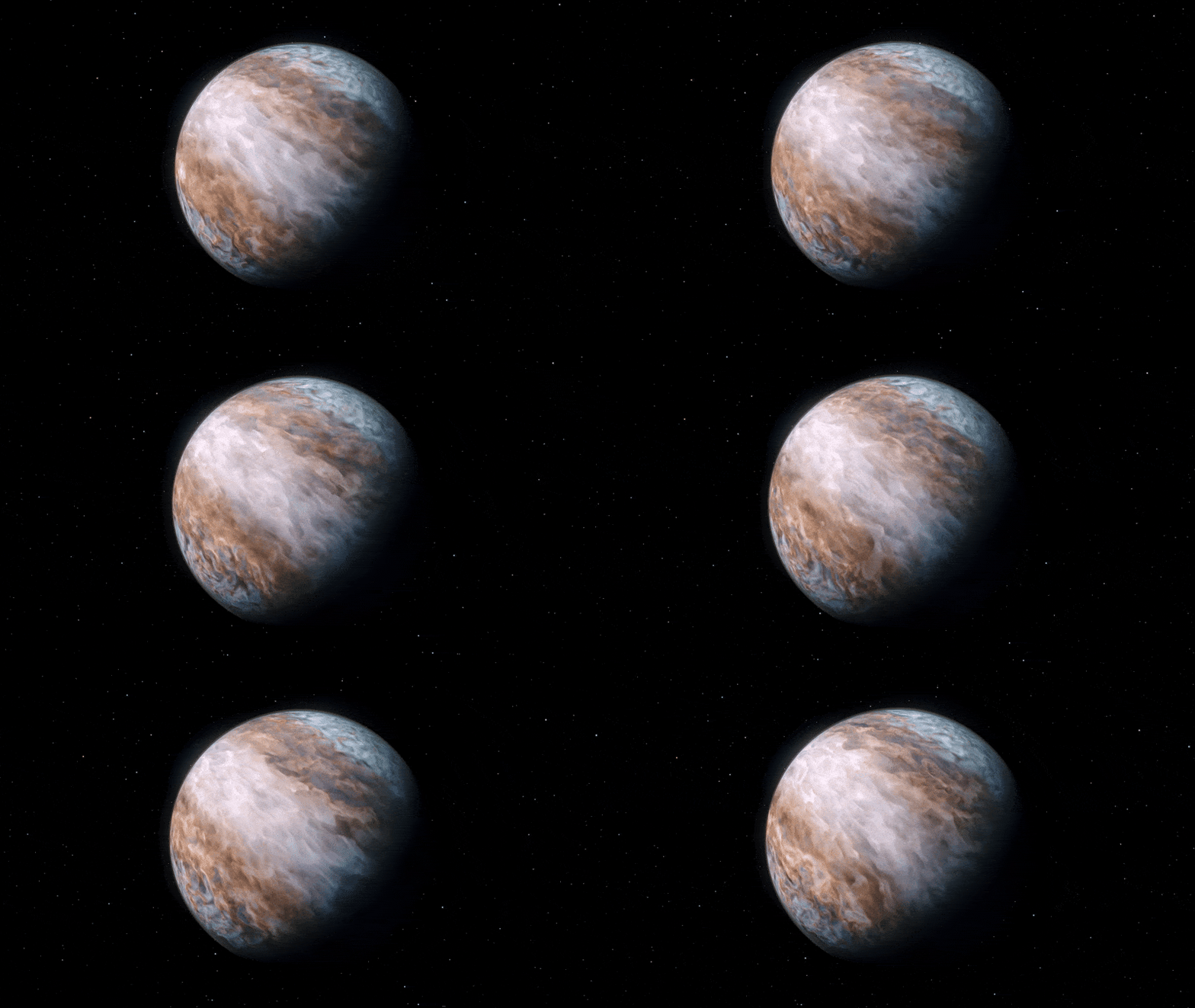
The record-breaking winds are circling the nearby "puffy" exoplanet WASP-127b, and are traveling six times faster than the alien world spins.
The record-breaking jetstream discovered on WASP-127b spins six times faster than the exoplanet does.
(Image credit: ESO/L. Calçada)
Astronomers have spotted a "supersonic jetstream" on a nearby alien world, with winds reaching 20,500 mph (33,000 km/h) — the fastest planetary gusts detected anywhere in the cosmos.
The record-breaking weather is raging on WASP-127b, a "puffy" gas giant around 500 light-years from Earth that is slightly larger than Jupiter but has a fraction of the mass. The exoplanet, discovered in 2016, has a large band of strong winds, or jetstream, circling its equator — similar to the winds that cause the stripes seen on the solar system's gas giants. However, the speed of this jetstream had remained a mystery until now.
But in a new study, published Jan. 21 in the journal Astronomy and Astrophysics, researchers finally determined the jetstream's speed by measuring it against the rest of the exoplanet's spinning atmosphere, using data collected by the European Southern Observatory’s (ESO) Very Large Telescope (VLT) in Chile.
"Part of the atmosphere of this planet is moving towards us at a high velocity while another part is moving away from us at the same speed," study lead author Lisa Nortmann, an astrophysicist at the University of Göttingen in Germany, said in a statement. "This signal shows us that there is a very fast, supersonic, jet wind around the planet’s equator."
The winds in the jetstream are roughly 18 times faster than the strongest gusts recorded in the solar system. (Image credit: ESO/L. Calçada)
The winds on WASP-127b are traveling at 5.6 miles per second (9 kilometers per second), which is around 130 times faster than the threshold for a Category 5 hurricane or roughly 15 times faster than a speeding bullet.
It is also around 18 times faster than the winds in Neptune's largest jetstream, which can hit 1,100 mph (1,800 km/h) — the fastest gusts recorded in the solar system, according to NASA.
WASP-127b's jetstream is traveling roughly six times faster than the exoplanet spins. "This is something we haven't seen before," Nortmann said.
Complex weather
Researchers determined the composition of WASP-127b's clouds by analyzing the light that passed through the puffy planet's atmosphere. This showed that water vapor and carbon dioxide are both present in the spinning clouds. However, while these compounds are both associated with life on Earth, they can also be explained by abiotic processes so are not proof of extraterrestrial life.
Temperature data collected by the VLT showed that WASP-127b's polar regions are colder than the rest of the planet, and that there are slight temperature variations between the day and night sides of the planet. "This shows that the planet has complex weather patterns just like Earth and other planets of our own [solar] system," study co-author Fei Yan, an astronomer at the University of Science and Technology of China, said in the statement.
At the moment, only ground-based telescopes like the VLT can measure distant planetary winds because orbiting observatories, such as the James Webb Space Telescope, do not have the "necessary velocity precision," the researchers wrote.
New ground-based telescopes currently under construction, such as ESO’s Extremely Large Telescope, will "likely resolve even finer details of the wind patterns [on gas giants] and expand this research to smaller, rocky planets," Nortmann said.
RELATED VIDEOS
This animation shows supersonic jet winds pummeling the equator of the giant exoplanet WASP-127b, located about 520 light-years from Earth. With speeds up to 9 km per second (almost 33 000 km/h), it is the fastest jetstream of its kind ever measured in the Universe.
The Planet With Supersonic Winds | The Planets | Earth Science
Exoplanet with Atmosphere Discovered by Scientist WASP 127b
Since Edmund Hillary and Tenzing Norgay first reached the summit of Mount Everest in 1953, conquering the world's highest peak has been a goal of almost every serious mountaineer on the planet.
But this famous peak pales in comparison to two secret mountains, which are more than 100 times taller than Everest's 8,800-metre summit, scientists have discovered.
Reaching heights of around 620 miles (1,000km) these continent-sized 'islands' of rock dwarf anything else found on our planet.
However, confused adventurers can rest easy.
Scientists from Utrecht University have revealed that these gargantuan peaks are not found on our planet's surface.
Instead they are buried some 1,200 miles (2,000km) beneath our feet.
The researchers estimate that the mountains are at least half a billion years old but could date back to the formation of Earth four billion years ago.
Lead researcher Dr Arwen Deuss says: 'Nobody knows what they are, and whether they are only a temporary phenomenon, or if they have been sitting there for millions or perhaps even billions of years.'
Scientists have discovered two hidden mountains more than 100 times larger than Mount Everest (pictured)
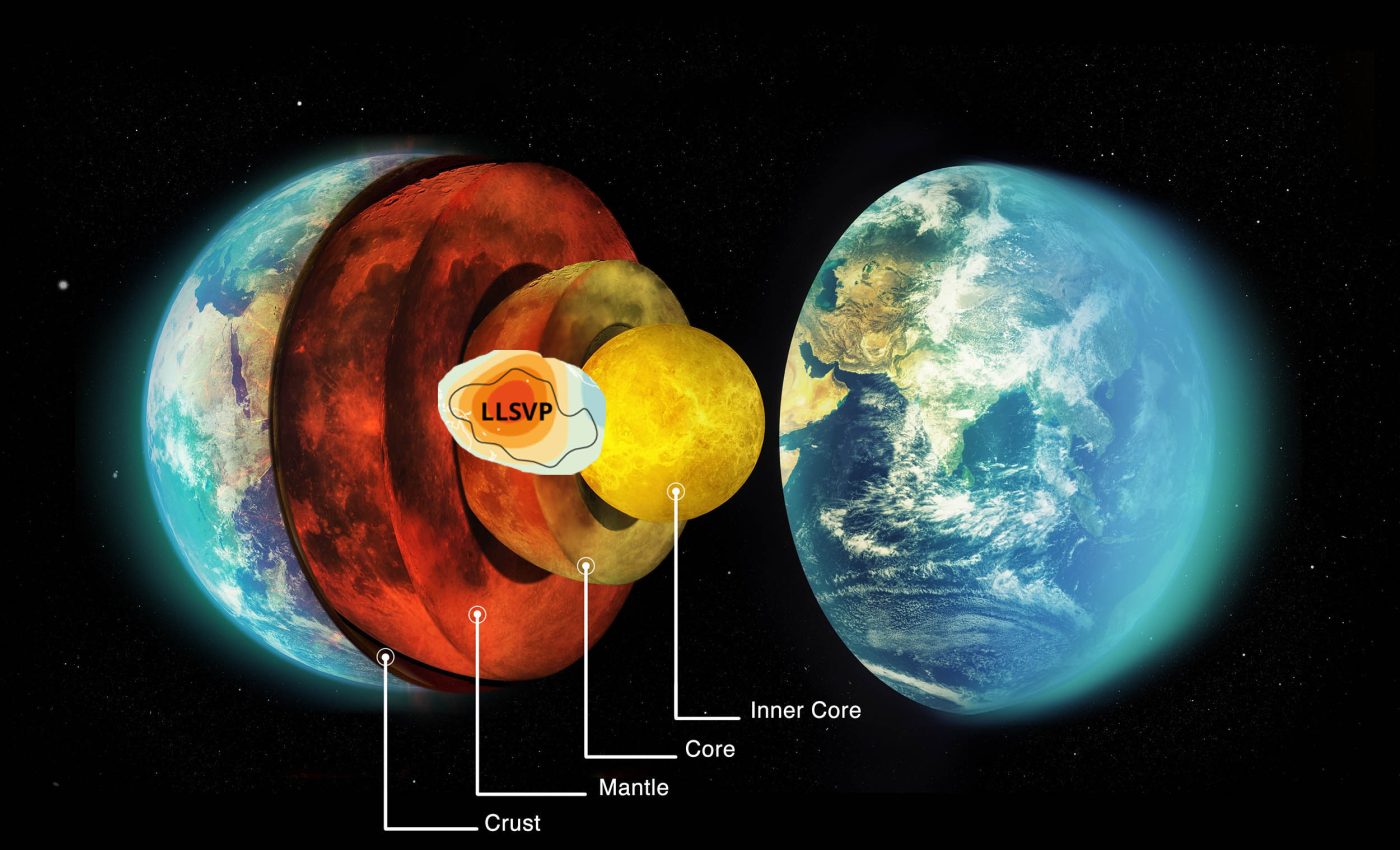
These mountains (red) are hidden beneath the Earth on the boundary between the core and the mantle beneath Africa and the Pacific Ocean
Earth is made up of three layers – the crust, the mantle and the core, which was later separated into 'inner' and 'outer'. These mountains exist in the region where the outer core meets the mantle
The two monstrous structures sit on the boundary between Earth's core and the mantle, the semi-solid area beneath the crust, beneath Africa and the Pacific Ocean.
Around them is a 'graveyard' of sunken tectonic plates which have been pushed down from the surface in a process called subduction.
In a new study, researchers found that the islands are much hotter than the surrounding slabs of the Earth's crust and many millions of years older.
But when these waves pass through something dense or hot, they are slowed down, weakened, or reflected altogether.
So, by listening carefully to the 'tone' that arrives on the other side of the planet, scientists are able to build up a picture of what lies beneath.
The mountains are called Large Low Seismic Velocity Provinces (LLSVPs) because they slow down passing seismic waves. They are located in an area called a 'slab graveyard' where pieces of the crust sink down towards the core. Since these slabs are colder, waves pass through them much faster
Over the years, studies have revealed that there are two enormous regions of the mantle where shockwaves dramatically slow down, dubbed the Large Low Seismic Velocity Provinces (LLSVPs).
Dr Deuss says: 'The waves slow down because the LLSVPs are hot, just like you can't run as fast in hot weather as you can when it's colder.'
When waves pass through a region that is much hotter, they need to expend a lot more energy to make their way through.
Co-author Dr Sujania Talavera-Soza says: 'Just like when the weather is hot outside and you go for a run, you don’t only slow down but you also get more tired than when it is cold outside.'
That means you would expect the tone of a wave passing through the hot LLSVPs to be both out of tune and quieter than other areas, an effect scientists call damping.
However, when the researchers examined the data, they were surprised to find a very different picture.
'Against our expectations, we found little damping in the LLSVPs, which made the tones sound very loud there,' says Dr Talavera-Soza.
'But we did find a lot of damping in the cold slab graveyard, where the tones sounded very soft.'
Scientists used the shockwaves from earthquakes to make an image of the planet's interior. They found that waves passed slowly through the LLSVPs but weren't as quiet, or dampened, as they would expect. This suggests that the LLSVPs are both very hot and have a large grain structure which must have formed over billions of years
Earth's 4 layers
Crust: To a depth of up to 44 miles, this is the outermost layer of the Earth, covering both ocean and land areas.
Mantle: Going down to 1,800 miles with the lower mantle, this is the planet's thickest layer and made of silicate rocks richer in iron and magnesium than the crust overhead.
Outer core: Running from a depth of 1,800 - 3,200 miles, this region is made of liquid iron and nickel with trace lighter elements.
Inner core: Going down to a depth of 3,960 miles at the very centre of planet Earth, this region has been thought to be made of solid iron and nickel. But this new study suggests that it contains both mushy and hard iron.
The pieces of rock from the crust cause lots of damping because they recrystallise into a tight structure as they sink down towards the core.
This suggests that the mountains are made up of much larger grains than the surrounding slabs since these wouldn't absorb so much energy from passing seismic waves.
'Those mineral grains do not grow overnight, which can only mean one thing: LLSVPs are lots and lots older than the surrounding slab graveyards,' says Dr Talavera-Soza.
At the low end, the researchers estimate that these underground mountains are at least half a billion years old.
But they could be much older, potentially even dating back to the formation of the Earth itself.
This goes against the traditional idea that the mantle is in a constant state of movement.
Although the mantle is not actually liquid, it does move like a liquid over extremely long time frames.
Previously, it had been thought that the mantle would, therefore, be 'well mixed' by flowing currents.
Some scientists think that the LLSVPs were formed when a Mars-sized planet called Theia collided with Earth 4.5 billion years ago. Some of Theia became the moon while the rest sunk into the Earth to form these structures
But the fact that these structures are billions of years old shows that they haven't been moved or disrupted by mantle convection, meaning that the mantle is not well mixed after all.
Recently, scientists have suggested that the LLSVPs might be the remnants of an ancient planet which crashed into Earth billions of years ago.
After running a series of simulations, the researchers found that a significant amount of 'Theian' material - around 2 per cent of Earth's mass - would have entered the lower mantle of the ancient planet Earth.
That would explain why these regions seem to be so much denser, hotter, and older than the surrounding slab graveyard.
About 4.45 billion years ago, 150 million years after the solar system formed, Earth was hit by a Mars-size object called Theia.
The collision created the moon, but debate has raged exactly what happened during this event - and a mystery has persisted on why the moon and Earth are so similar in their composition.
The impact of Theia with Earth was so violent, the resulting debris cloud mixed thoroughly before settling down and forming the moon.
This cloud would have been composed of some Earth material, explaining the similarity between Earth and the moon, and other material.
The colliding body is sometimes called Theia, after the mythical Greek Titan who was the mother of Selene, the goddess of the Moon.
But one mystery has persisted, revealed by rocks the Apollo astronauts brought back from the moon - why are the moon and Earth so similar in their composition?
Several different theories have emerged over the years to explain the similar fingerprints of Earth and the moon.
Perhaps the impact created a huge cloud of debris that mixed thoroughly with the Earth and then later condensed to form the moon.
Or Theia could have, coincidentally, been isotopically similar to young Earth.
A third possibility is that the moon formed from Earthen materials, rather than from Theia, although this would have been a very unusual type of impact.
Mountains Taller Than Everest Found Deep Inside Earth
Archaeologists have uncovered two lost settlements of ancient Rome, suggesting the empire's control stretched wider than previously believed.
They found an ancient slab of volcanic rock fashioned into a rectangular artifact, which was used to mark land borders in Galilee, between northern Israel and southern Lebanon.
Carved in Ancient Greek lettering, the stone proclaims that the previously unknown towns of Tirathas and Golgol were under the control of the Roman Empire, and featured the name of four governors in charge of managing the empire's territories abroad.
The etchings date back 1,720 years ago during the reign of Caesar Marcus Aurelius Alexander, the ruler featured in the original 2000 Gladiator movie.
The location showed that people living within the boundary were under imperial rule, being taxed by the Roman Empire located 2,500 miles away in Italy.
The team, from the Hebrew University, emphasized that 'such discoveries provide a unique glimpse into the lives of ancient inhabitants, the pressures they faced and the enduring traces of their communities in the archaeological record.'
Professor Uzi Leibner said: 'Finding a boundary stone like this not only sheds light on ancient land ownership and taxation but also provides a tangible connection to the lives of individuals who navigated these complex systems nearly two millennia ago.'
Archaeologists uncovered a stone (left shows the inscription highlighted) in the region where
The ancient Romans controlled a large portion of the Middle East, including Anatolia, the Levant, parts of Mesopotamia, and Arabia. They also had power over Israel from 63 BC until 135 AD.
The stone was found at the site of Abel Beth Maacah, an ancient city in the Upper Galilee region of Israel.
'The names Tirthas and Golgol are not known from any other boundary stones found in the area, nor from any ancient source,' the team shared in the study, saying that these are two new settlements of the vast Roman Empire.
Archaeologists speculated that a large ruin found in the area in the late 19th century could have resided in Tirthas. The previous excavation recorded the site as Kh. Turritha.
'The resemblance of the names Turritha – Tirthas, located in the same vicinity, can hardly be coincidental and it is likely that the former preserves the ancient name,' researchers wrote.
'The surveyors did not provide any description besides 'large heaps of basalt stones', and we could find no archaeological information on this site, located today on the Lebanese side of the border.'
However, the border stone was made of basalt which is a dark-colored, igneous rock that forms when lava cools quickly at the Earth's surface.
'If the suggestion to identify Tirthas with Kh. Turritha is correct, then the field(s) of Golgol/m could have been located anywhere to the west, south, or north of the original spot of the boundary stone,' reads the study.
Archaeologists unearthed a boundary stone in Galilee that featured ancient Greek inscriptions of previously unknown territories, revealing the Roman Empire's control extended further and for longer than previously believed The stone was found at the site of Abel Beth Maacah
Galilee, located in northern Israel and southern Lebanon, is mentioned in the Bible as the venue for most of Jesus' ministry and where he walked on water and was baptized
Archaeologists speculated that a large ruin found in the area in the late 19th century could have resided in Tirthas. The previous excavation recorded the site as Kh. Turritha
There are some sites with Roman-period remains west of tell Abel Beth Maacah, but none bear a name resembling Golgol.
'However, there is a low, round hill, standing less than a kilometer from the eastern slopes of Abel Beth Maacah that may be identified with it,' said the researchers.
They linked Golgol with Gilgal and Golgotha because of the linguistic, topographical and cultural similarities between the names.
Gilgal, mentioned in the Book of Joshua, was the eastern border of Jericho where the Israelites camped after crossing the Jordan River following their exodus from Egypt.
And Golgotha is the name of the hill in Jerusalem where Jesus was crucified, as described in the Bible's four Gospels. The name translates to 'place of the skull'.
This discovery adds to a unique corpus of over 20 boundary stones concentrated in the northern Hula Valley and surrounding areas.
The stones mark a period of heightened administrative control aimed at standardizing taxation and clarifying land ownership.
This specific find highlights the interconnectedness of historical geography, economic policies and local settlement patterns.
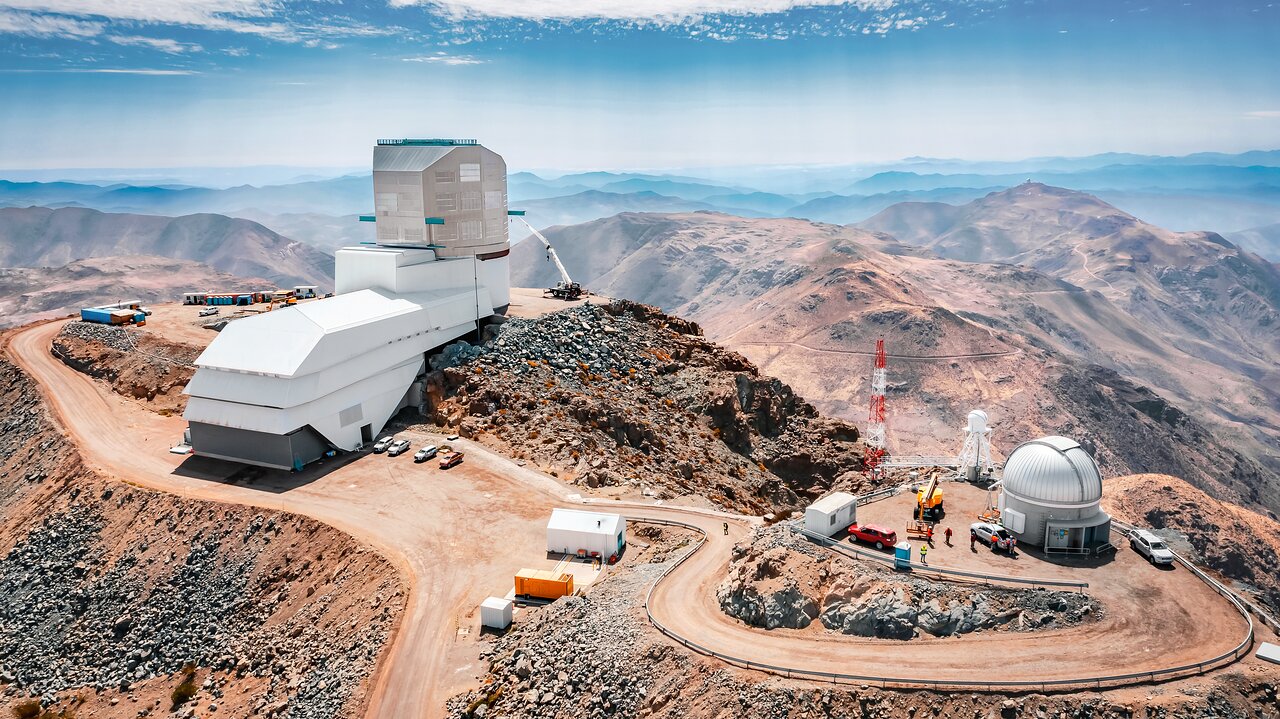
A drone's view of the Rubin Observatory under construction in 2023. The 8.4-meter telescope is getting closer to completion and first light in 2025. The telescope will create a vast amount of data that will require special resources to manage, including AI. Image Credit: Rubin Observatory/NSF/AURA/A. Pizarro D
Vera Rubin Completes its Comprehensive System Tests
The Vera C. Rubin Observatory, previously known as the Large Synoptic Survey Telescope (LSST), will be the first observatory of its kind. Jointly funded by the National Science Foundation (NSF) and the Department of Energy (DOE), Rubin will conduct the Legacy Survey of Space and Time (LSST) – a 10-year survey of the southern hemisphere. The observatory is expected to collect 15 terabytes of data a night, which will be used to create an ultra-wide, ultra-high-definition, time-lapse record of the cosmos, containing tens of billions of stars, galaxies, and astronomical objects.
After ten years of construction, the Vera C. Rubin Observatory is less than one year away from starting this revolutionary observation campaign. In preparation for this, the observatory recently completed a series of full-system tests using an engineering test camera. With this milestone complete, the stage is now set for the installation of the 3200-megapixel LSST Camera (LSSTCam), the world’s largest digital camera. Once mounted on the Simonyi Survey Telescope, the observatory will have finished construction and be ready to collect its first light.
The engineering test camera, the Commissioning Camera (ComCam), is a much smaller version of the LSSTCam. It relies on a mosaic of nine 3.2-megapixel Charge-Coupled Device (CCD) sensors, providing a total area coverage of 144 megapixels – about twice the size of a full Moon. During the ComCam engineering test campaign, which took place from October 24th to December 11th, 2024, the camera acquired approximately 16,000 exposures to test the Rubin Observatory’s hardware, software, and data pipeline.
A single test engineering image from the very first night of the ComCam campaign in the context of the coverage provided by the LSSTCam. Credit: RubinObs/NOIRLab/SLAC/NSF/DOE/AURA.
The tests were conducted by Rubin’s international commissioning team, composed of hundreds of engineers, scientists, and observing specialists. According to a statement issued by the Rubin Observatory, the test included verifying that the telescope’s complex systems were all working together, testing the early image quality in all six of the system’s filters, and running the data processing pipelines. They also verified that the system can transmit large amounts of data from the observatory to the Department of Energy’s SLAC National Accelerator Laboratory.
They also confirmed the Active Optics System (AOS), which maintains the precise positions and shapes of the telescope’s three large mirrors. The Simonyi Survey Telescope, the camera, data systems, networks, and everyone involved in the engineering test were said to have performed exceptionally well. The test delivered high-quality images within the first hours, even though most of the detailed optical adjustments and environmental controls were not fully activated. Per the statement:
“Thanks to the dedicated efforts and talents of thousands of people over many years, the telescope had been assembled with all its complex parts positioned correctly to better than about one millimeter. Equally satisfyingly, the high-speed network connecting Chile and the data center at SLAC, the data systems, and the algorithms for analyzing the data worked well, too.”
The LSSTCam has 189 CCD sensors, giving it a field of view roughly 45 times the size of a full Moon – over 21 times that of the ComCam. For the final phase of construction, the LSSTCam will replace the ComCam on the Simonyi Survey Telescope. When coupled with this 8.4-meter (27.5-ft) telescope, the LSTTCam will capture images of very faint and variable objects at an unprecedented rate. The installation will take a few months, followed by the observatory capturing its “First Look” images of the cosmos.
The complete focal plane of the future LSST Camera shows the 189 individual sensors that will produce 3,200-megapixel images. Credit: Jacqueline Orrell/SLAC National Accelerator Laboratory
“The success of the engineering test phase has given a surge of excitement and anticipation to the team,” said Deputy Director for Rubin Construction Sandrine Thomas. “Reaching this milestone has offered a small taste of what is to come once Rubin Observatory begins its 10-year survey.” Once the final testing and verification phase is complete, the Rubin Observatory will begin the most comprehensive data-gathering mission ever performed in the history of astrophysics.
The observatory is named in honor of American astronomer Dr. Vera C. Rubin, whose work was foundational to the theory of Dark Matter. By repeatedly scanning the southern sky with its cutting-edge instruments for a decade, Rubin will create an ultra-high-definition time-lapse record of the cosmos. This data will allow scientists to investigate Dark Matter, Dark Energy, and other mysteries facing astronomers, astrophysicists, and cosmologists today.
There are Places on Earth Which Could Have Life, but Don’t. What Can We Learn?
Don’t know about you but when I think of Earth my mind is filled with the diversity of life and the rich flora and fauna. In reality, about 99% of Earth is uninhabitable; deep underground places with high pressure and temperature where even the toughest bacteria cannot survive. There are places though where life thrives from tiniest toughest bacteria to the largest elephant. Then there are places that are habitable but devoid of life; lava flows are a great example and the space between microbes. A paper recently released looks at these uninhabited, habitable areas and wonders what we may learn as we search for life in the Universe.
Life on Earth has taken millions of years to evolve to the state we see today and has invaded nearly every corner of the planet. That is, except those places where the environment is so extreme that even the toughest extremophile cannot survive. These regions include places like the Atacama Desert in Chile, one of the driest places on Earth, where rainfall is so rare that even microbial life struggles to survive. Similarly, parts of Antarctica’s dry valleys feature subzero temperatures, minimal liquid water, and high salinity in some soils, creating an environment hostile to most life forms. It raises interesting questions and perhaps pose limitations on life’s ability to survive.
The rocks seen here along the shoreline of Lake Salda in Turkey were formed over time by microbes that trap minerals and sediments in the water. These so-called microbialites were once a major form of life on Earth and provide some of the oldest known fossilized records of life on our planet. NASA’s Mars 2020 Perseverance mission will search for signs of ancient life on the Martian surface. Studying these microbial fossils on Earth has helped scientists prepare for the mission. Image Credit: NASA/JPL-Caltech
We can learn a lot from life on Earth as we hunt for live elsewhere in the Universe. At the moment, there is just one place in the cosmos where we know life has evolved, that’s on Earth. A paper recently authored by Charles S Cockell from the University of Edinburgh explores what we might learn from the inhospitable places on Earth and how that might inform our search for extraterrestrial life. The paper discusses places where active microorganisms cannot be found in particular those places where the physical and chemical conditions are not far from areas that support life.
The physical spaces where microbes cannot sustain the essential metabolic activity or even reproduce can be categorised into two groups: those with uninhabitable conditions and those with habitable but uninhabited spaces, also known as uninhabited habitats. You might need to read that a few times but it does make sense! Uninhabitable conditions occur in environments where life cannot exist due to extreme factors like intense heat, cold, salinity, or acidity. In contrast, uninhabited habitats are environments that are theoretically capable of supporting life but remain unoccupied, often due to barriers to colonisation or the absence of necessary organisms. The paper draws a strong differentiation between these ‘vacant niches.’
Lava cooling after an eruption. This rock has an entrained magnetic field fingerprint from the time it formed. Credit: kalapanaculturaltours.com
These uninhabited habitats, which form on both macroscopic and microscopic scales through diverse processes, offer opportunities for scientific investigation. They can act as negative control environments, helping to reveal how living organisms influence geochemical processes, and how they can provide a framework for studying processes like microbial succession and community development. Despite their potential significance, the occurrence of these habitats in environments at the physical and chemical extremes of life remain poorly understood.
As we continue our search for life across the universe, we may find many more locations like these. Doing so will help to expand our understanding of the distribution of habitable conditions and the potential for life across the universe. They may offer insights into the processes that make a location suitable for life, as well as the factors that have prevented life from arising or persisting there.
Mysterious radio signal is coming from a nearby galaxy - Scientists Shocked by Space Radio Signal 01 22 2025
Scientists have tracked an intense radio signal coming from deep in space to its origin – and been left shocked by what they found.
For years, researchers have been looking to explain fast radio bursts, or FRBs, which are very short and very powerful blasts energy coming from deep in space. Possible explanations have included everything from black holes to alien technology.
Researchers hope to be able to understand more about them by following them back to their original galaxies, in the hope of seeing what extreme conditions might send out such powerful blasts across the universe.
Now, scientists have tracked one of those blasts back to its home galaxy. But that galaxy is very old and dead, as well as being strangely shaped.
Previously, researchers have only found FRBs coming from much younger galaxies. As such, it breaks our existing understanding of where they might be coming from.
The discovery might mean that the mysterious cosmic events are coming from much more diverse places than we ever realised, scientists say.
“This new FRB shows us that just when you think you understand an astrophysical phenomenon, the universe turns around and surprises us,” said Northwestern’s Wen-fai Fong, a senior author on two studies reporting the new findings. “This ‘dialogue’ with the universe is what makes our field of time-domain astronomy so incredibly thrilling.”
The FRB in the new study was first spotted in February 2024. It continued to pulse through July 2024, which helped researchers to find its position in the sky.
Once that was done, researchers turned satellites towards the location – and were surprised by what they saw. Instead of a young galaxy, it was coming from one 11.3 billion years old and just two billion light years from Earth.
Scientists then simulated what conditions might be like in that galaxy. Those simulations showed that the galaxy appears to be very bright and very massive, with 100 billion times the mass of the Sun, making it the most massive FRB host galaxy to date and one of the most massive found of any kind.
The work is described in two new papers, ‘A repeating fast radio burst source in the outskirts of a quiescent galaxy” and “The massive and quiescent elliptical host galaxy of the repeating fast radio burst FRB 20240209A’, published in The Astrophysical Journal Letters.
The Independent is the world’s most free-thinking news brand, providing global news, commentary and analysis for the independently-minded. We have grown a huge, global readership of independently minded individuals, who value our trusted voice and commitment to positive change. Our mission, making change happen, has never been as important as it is today.
ERELATED VIDEOS
Did you hear about the mysterious signals from space?
🚨 "The Most Mysterious Signals From Space: Are Aliens Trying to Contact Us?
Mysterious Radio Signal from Space, Repeating Every 22 Minutes, remained Unnoticed for 35 Years
Meer van UFO'S of UAP'S, ASTRONOMIE, RUIMTEVAART, ARCHEOLOGIE, OUDHEIDKUNDE, SF-SNUFJES EN ANDERE ESOTERISCHE WETENSCHAPPEN - DE ALLERLAATSTE NIEUWTJES


 Researchers Practice Searching for Life on Enceladus, in the Arctic Ocean