Ontdek de Fascinerende Wereld van UFO's en UAP's: Jouw Bron voor Onthullende Informatie!
Ben jij ook gefascineerd door het onbekende? Wil je meer weten over UFO's en UAP's, niet alleen in België, maar over de hele wereld? Dan ben je op de juiste plek!
België: Het Kloppend Hart van UFO-onderzoek
In België is BUFON (Belgisch UFO-Netwerk) dé autoriteit op het gebied van UFO-onderzoek. Voor betrouwbare en objectieve informatie over deze intrigerende fenomenen, bezoek je zeker onze Facebook-pagina en deze blog. Maar dat is nog niet alles! Ontdek ook het Belgisch UFO-meldpunt en Caelestia, twee organisaties die diepgaand onderzoek verrichten, al zijn ze soms kritisch of sceptisch.
Nederland: Een Schat aan Informatie
Voor onze Nederlandse buren is er de schitterende website www.ufowijzer.nl, beheerd door Paul Harmans. Deze site biedt een schat aan informatie en artikelen die je niet wilt missen!
Internationaal: MUFON - De Wereldwijde Autoriteit
Neem ook een kijkje bij MUFON (Mutual UFO Network Inc.), een gerenommeerde Amerikaanse UFO-vereniging met afdelingen in de VS en wereldwijd. MUFON is toegewijd aan de wetenschappelijke en analytische studie van het UFO-fenomeen, en hun maandelijkse tijdschrift, The MUFON UFO-Journal, is een must-read voor elke UFO-enthousiasteling. Bezoek hun website op www.mufon.com voor meer informatie.
Samenwerking en Toekomstvisie
Sinds 1 februari 2020 is Pieter niet alleen ex-president van BUFON, maar ook de voormalige nationale directeur van MUFON in Vlaanderen en Nederland. Dit creëert een sterke samenwerking met de Franse MUFON Reseau MUFON/EUROP, wat ons in staat stelt om nog meer waardevolle inzichten te delen.
Let op: Nepprofielen en Nieuwe Groeperingen
Pas op voor een nieuwe groepering die zich ook BUFON noemt, maar geen enkele connectie heeft met onze gevestigde organisatie. Hoewel zij de naam geregistreerd hebben, kunnen ze het rijke verleden en de expertise van onze groep niet evenaren. We wensen hen veel succes, maar we blijven de autoriteit in UFO-onderzoek!
Blijf Op De Hoogte!
Wil jij de laatste nieuwtjes over UFO's, ruimtevaart, archeologie, en meer? Volg ons dan en duik samen met ons in de fascinerende wereld van het onbekende! Sluit je aan bij de gemeenschap van nieuwsgierige geesten die net als jij verlangen naar antwoorden en avonturen in de sterren!
Heb je vragen of wil je meer weten? Aarzel dan niet om contact met ons op te nemen! Samen ontrafelen we het mysterie van de lucht en daarbuiten.
Physicist Michio Kaku proposes the existence of other dimensions, also known as parallel universes, coexisting alongside our own reality. Within these dimensions, it is plausible that there are beings or entities living alongside us, despite our inability to perceive them. While the concept of alternate dimensions or universes may seem far-fetched to some, it is intricately connected to the subject of Unidentified Aerial Phenomena (UAPs), commonly referred to as UFO phenomena.
We live in a four-dimensional world (if time is included), but scientists propose there are more dimensions. However, they do not believe there can exist more than 11 dimensions because conditions become unstable and particles naturally collapse back down into 10 or 11 dimensions. The 12th dimension, for example, introduces a second time.
“Our understanding of reality is not complete, by far,” says Stanford University physicist Andrei Linde. “Reality exists independently of us.” If they exist, those universes are separated from ours, unreachable and undetectable by any direct measurement (at least so far). And that makes some experts question whether the search for a multiverse can ever be truly scientific.
In the realm of science, our quest for understanding alternate or higher dimensions remains ongoing. However, within the field of UFOlogy, intriguing cases have emerged suggesting the existence of not just other dimensions, but also the presence of entities residing within them. These beings seem to possess the ability to manipulate a bridge connecting their realm to ours, enabling them to embark on regular visits to our world.
Crashed UFO that ‘distorted space and time’
A very strange UFO case has been shared by American attorney Daniel Sheehan with Daily Mail. Sheehan involved in bringing UFO whistleblowers to Congress, claimed that a whistleblower told him a mind-boggling tale about a recovered crashed UFO. He revealed that a crashed UFO recovered by the US military had distorted space-time and was “bigger on the inside.” The whistleblower has reportedly briefed Senate Intelligence Committee staff on the matter.
According to Sheehan, one of the alleged recoveries described by the insider involved a 30-foot saucer partially embedded in the earth. When attempts were made to remove it using a bulldozer, the craft exhibited unusual behavior. As it was being pulled out, it seemingly detached in a pie slice-shaped section, suggesting that it was constructed in a unique way.
The anonymous whistleblower then entered the craft and was astonished to find that the interior was as large as a football stadium, while the exterior was only about 30 feet in diameter. The experience inside caused disorientation and nausea due to the vast size discrepancy. Furthermore, upon exiting the craft in a few minutes, the whistleblower found that four hours had passed outside, indicating time distortion as well.
Sheehan mentions that the craft’s distortion of space and time is consistent with the theories proposed by physicists regarding advanced propulsion systems. These theories suggest that warping space-time could be used to counteract the effects of gravity and achieve advanced forms of propulsion. However, Sheehan does not provide further specific details, such as the location or date of the incident, and admits to being unable to provide concrete evidence to support these claims.
Moreover, on Jesse Michels’ show, astronomer and UFO researcher Jacques Vallee discussed another UFO case that includes experiencing another dimension by the witness. Valle said: “There was one case in San Jose. A woman had seen something over her house. It was a big disc, and I say, ‘How big was it?’ And she says, ‘Well, it was about the same size as her house. It was, you know, just like that.’ Then I say, ‘Well, when you went inside, you said, uh, you know, there was this being, and the being took you on a staircase.’ I say, ‘Where did the staircase go?’ Well, the staircase went up the side of this big round room. I say, ‘How would you compare it?’ Well, like a movie house, you know, like an M5 theater. I said, ‘That’s bigger than your house.’”
Luis Elizondo, the man who managed the UFO program inside the Pentagon, explains how space-time distortion works and hints that we can manipulate this physics for technological advancement. In an interview with George Knapp in 2018, Elizondo explains:
“Space-time is something we observe in the natural world all the time, especially in relation to gravity and GPS satellites. The clocks on these satellites need constant calibration. Even though the clocks on the satellites are identical to the ones on the ground station, they still require regular calibration. The reason for this is the effect of Earth’s gravity on space-time. The clocks on Earth run slightly slower compared to the clocks on the platforms above Earth.
How is this possible if the clocks are the same? Well, it’s because the closer you are to a massive object, like Earth, the more space-time warps. This phenomenon is explained by the theory of general relativity, which boils down to using the equation E=mc². Essentially, it means that a significant amount of mass or energy warps space-time. When you approach a supermassive object like the sun, the distortion becomes even greater. In fact, near a black hole, time becomes so distorted that it virtually stops.
We have observed this phenomenon through gravitational lensing when studying distant galaxies. We can actually see the effects of gravity on space-time with our own eyes, so it’s a scientific fact, not fiction. The question now is how we can manipulate this physics for technological advancement. Potentially, we could warp space-time in a way that allows us to travel from point A to point B more quickly.”
Is it possible that an advanced extraterrestrial civilization has already accomplished this kind of technology and has been using it to visit our world? Or perhaps we already have such technology?
In 2021, leaked documents revealed that the US Navy had conducted experiments on various far-fetched technologies, including a “space modification weapon.” These documents, disclosed by The War Zone, detailed the research carried out by the Naval Air Warfare Center Aircraft Division (NAWCAD) between 2017 and 2019. The most interesting thing is that the technology written in those documents discusses propulsion system that defies gravity, or to devastating weapons that bends the laws of physics and craft that alters the fabric of time and space.
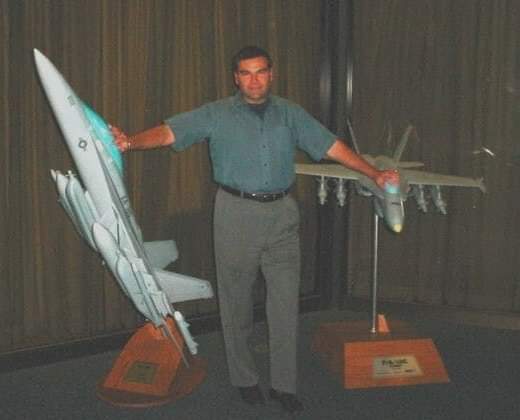
The man behind all the patents is Dr. Salvatore Cezar Pais, who is an aerospace engineer at the Naval Air Warfare Center Aircraft Division (NAWCAD). He has four patents registered in his name that contain the source of technology that would change the world. In these patents, a “Spacetime Modification Weapon” (SMW, a weapon that can make the Hydrogen bomb seem more like a firecracker, in comparison) is mentioned.
Dr. Salvatore Pais is a physicist and aerospace engineer with the US Navy. In 2019 his inventions of 3 highly advanced forms of technology were granted patents.
Are these patents a cover for the reverse-engineered extraterrestrial technology? The Navy’s objective in testing this conceptual system was to keep pace with similar programs being developed in China. The researchers believed that the space modification weapon could revolutionize power and propulsion systems. The technology was based on the “Pais effect” aimed to push the boundaries of science.
Pais made ambitious claims about the potential of this technology, suggesting that it could lead to a propulsion system defying gravity or devastating weapons that bend the laws of physics. He even outlined plans for a “hybrid aerospace-underwater craft” capable of altering the fabric of time and space.
The Navy’s aerospace research enterprise supported Pais’s patents, stating that they filed them to keep up with similar technological advancements being pursued by the Chinese military. The “space modification weapon” described in the documents was envisioned to release extremely high energy levels, surpassing the destructive power of a Hydrogen bomb.
However, the experiments conducted between 2017 and 2019 were inconclusive. The elusive Pais effect was neither observed nor disproven during this period. The Pais effect refers to a theoretical physics concept that involves the controlled movement of highly electrically charged matter. If proven possible, it could enable the creation of powerful energy fields capable of fundamentally engineering the fabric of reality.
It is unclear whether the US Navy is continuing its experiments on the Pais effect or if the project has been discontinued entirely. None of the futuristic technologies described in the leaked UFO patents were developed, leaving the ultimate fate of the space modification weapon and related concepts uncertain.
Global warming is quickly spiralling out of control, the Met Office has warned.
According to the forecaster, Earth is 'off-track' to limit global warming to 1.5°C (2.7°F) - a key goal set out by the Intergovernmental Panel on Climate Change (IPCC) in the Paris Agreement.
Last year, measurements taken at Mauna Loa, Hawaii, revealed the fastest annual rise in carbon dioxide (CO2) since records began back in 1958.
What's more, satellite measurements showed a 'very large rise' of CO2 across the globe.
These were due to widespread hot, dry conditions, partly linked to El Niño and partly to other factors - including climate change, according to the Met Office.
'Last week, it was confirmed that 2024 was the warmest year on record, with annual average temperatures higher than 1.5°C above pre-industrial levels for the first time,' said Professor Richard Betts, who led the production of the forecast.
'While this does not represent a failure to achieve the Paris Agreement target, as that would require breaching warming 1.5°C over a longer period and we may see a slightly cooler year in 2025, the long-term warming trend will continue because CO2 is still building up in the atmosphere.'
Last year, measurements taken at Mauna Loa, Hawaii, revealed the fastest annual rise in carbon dioxide (CO2) since records began back in 1958
The study comes just one week after 2024 was confirmed to have been the hottest year on record. Pictured: wildfires in the West Hills section of Los Angeles on January 9
The measurements taken at Mauna Loa revealed a rise in CO2 of 3.58 parts per million (ppm) in 2024.
This far exceeded the Met Office's prediction of 2.84ppm (± 0.54ppm).
Worryingly, if global warming is to be limited to 1.5°C (2.7°F), calculations by the IPCC indicate that CO2 needs to be slowing by 1.8ppm per year.
It's not all doom and gloom.
Looking ahead, the CO2 rise between 2024 and 2025 is forecast to be less extreme than last year at 2.26 ± 0.56 ppm.
According to the Met Office, this is due to a partial re-strengthening of carbon sinks linked to a shift from El Niño to La Niña conditions.
However, even this slower rise will be too fast to limit global warming to 1.5°C.
'La Niña conditions are expected to cause forests and other ecosystems to soak up more carbon than last year, temporarily slowing the atmospheric CO2 rise,' Professor Betts added.
Worryingly, if global warming is to be limited to 1.5°C (2.7°F), calculations by the IPCC indicate that CO2 needs to be slowing by 1.8ppm per year
Hottest years on record
2024 (59.2°F/15.1°C)
2023 (58.96°F/14.98°C)
2016 (58.66°F/14.814°C)
2020 (58.65°F/14.807°C)
2019 (58.60°F/14.78°C)
2017 (58.50°F/14.723°C)
2022 (58.42°F/14.682°C)
2021 (58.38°F/14.656°C)
2018 (58.35°F/14.644°C)
2015 (58.34°F/14.637°C)
(Figures in brackets refer to global average air temperature for the year)
'However, stopping global warming needs the build-up of greenhouse gases in the air to come to a complete halt and then start to reduce.
'Large, rapid emissions cuts could limit the extent to which global warming exceeds 1.5°C.
'But this needs urgent action internationally.'
The new study comes just one week after a report published by the Copernicus Climate Change Service (C3S), revealed that temperatures last year were 0.12°C (0.22°F) above 2023, the previous warmest year on record.
That makes 2024 the first calendar year on record to exceed 1.5°C above the pre-industrial level.
Although this single year does not mean the targets of the Paris Agreement have already been missed, experts say that humanity is now 'dangerously close' to this milestone.
The data shows that an exceptionally hot start to the year brought the average global air temperature in 2024 to 15.1°C (59.2°F).
While temporary patterns like El Niño helped push temperatures into the extremes, scientists say human-caused climate change remains the 'primary driver' of extreme temperatures.
And with the rate of carbon dioxide entering the atmosphere even higher than in previous years, the planet's warming shows no signs of slowing any time soon.
Dr Friederike Otto, a climate policy expert from Imperial College London, says: 'This record needs to be a reality check.
'The climate is heating to levels we've spent years trying to avoid because countries are still burning huge amounts of oil, gas and coal.'
The Paris Agreement, which was first signed in 2015, is an international agreement to control and limit climate change.
It hopes to hold the increase in the global average temperature to below 2°C (3.6ºF) 'and to pursue efforts to limit the temperature increase to 1.5°C (2.7°F)'.
It seems the more ambitious goal of restricting global warming to 1.5°C (2.7°F) may be more important than ever, according to previous research which claims 25 per cent of the world could see a significant increase in drier conditions.
The Paris Agreement on Climate Change has four main goals with regards to reducing emissions:
1) A long-term goal of keeping the increase in global average temperature to well below 2°C above pre-industrial levels
2) To aim to limit the increase to 1.5°C, since this would significantly reduce risks and the impacts of climate change
3) Governments agreed on the need for global emissions to peak as soon as possible, recognising that this will take longer for developing countries
4) To undertake rapid reductions thereafter in accordance with the best available science
A place of worship sealed up by the ancestors of Jesus has been discovered in the ancient heart of Jerusalem, frozen in time for nearly 3,000 years.
Carved into the rock near Temple Mount, the structure comprises eight rooms, containing an altar, a sacred standing stone, and presses for olive oil and wine.
And experts believe its destruction may have featured in the Bible, which describes how Hezekiah – one of Jesus' ancestors – smashed idolatrous places of worship.
This was one such place, according to Eli Shukron, exacavation director for the Israel Antiquities Authority (IAA), who dated it to Hezekiah's reign.
He said: 'The structure ceased to function during the 8th century BC, possibly as part of king Hezekiah's religious reform.
'According to the Bible, Hezekiah sought to centralise worship at the temple in Jerusalem, abolishing the ritual sites scattered across the kingdom.
'The Bible describes how, during the First Temple period, additional ritual sites operated outside the temple.
'It says two kings of Judah – Hezekiah and Josiah – implemented reforms to eliminate these sites and concentrate worship at the temple.'
A place of worship sealed up by the ancestors of Jesus has been discovered in the ancient heart of Jerusalem , frozen in time for nearly 3,000 years
Carved into the rock near Temple Mount, the structure comprises eight rooms, containing an altar, a sacred standing stone, and presses for olive oil and wine
Experts believe its destruction may have featured in the Bible, which describes how Hezekiah – one of Jesus' ancestors – smashed idolatrous places of worship
Both kings are identified as paternal grandfathers of Jesus by the Gospel of Matthew.
Hezekiah's crackdown against pagan places of worship – or 'high places' – is described in the second book of Kings.
It recounts how he 'removed the high places, smashed the sacred stones' and 'did what was right in the eyes of the lord'.
Remarkably, the sacred standing stone at the site survived his onslaught.
Shukron called it 'the most dramatic and important find in the excavation'.
'This is what makes this place a cultic site,' he said.
'When we uncovered it, we found it standing in its place, with stones around it.
'The standing stone was covered with earth; it was preserved – no one destroyed it.
This was a place of worship, according to Eli Shukron, exacavation director for the Israel Antiquities Authority (IAA), who dated it to Hezekiah's reign
'The Bible describes how, during the First Temple period, additional ritual sites operated outside the temple,' Eli Shukron said
Archaeologists also found a hoard of artifacts from the 8th century BC, sealed behind a stone wall in a cave. These included cooking pots, jars with fragments of ancient Hebrew inscriptions, loom weights, scarabs, stamped seals with decorative motifs, and grinding stones used for crushing grains
'When we found it, it was exactly as it was here 2,800 years ago.'
Another room featured the remains of an altar, identifiable by a drainage channel which still ran from its corner.
And in one part of the site, mysterious v-shaped carvings marked the floor.
Their true purpose is lost to history, but they might once have supported some sort of tripod with ritual use.
Archaeologists also found a hoard of artifacts from the 8th century BC, sealed behind a stone wall in a cave.
These included cooking pots, jars with fragments of ancient Hebrew inscriptions, loom weights, scarabs, stamped seals with decorative motifs, and grinding stones used for crushing grains.
The site lies in the ancient heart of Jerusalem – sometimes called the City of David – just a few hundred metres from Temple Mount, and once co-existed with the First Temple there.
Excavations began in 2010, but the northern part of the ruins was discovered in 1909 by Montague Parker, a British adventurer searching for the Ark of the Covenant and other temple treasures.
A 1585 depiction of king Hezekiah smashing the pagan places of worship
Amichai Eliyahu, Israel's Minister of Heritage, said: 'This unique structure uncovered in the City of David is an exciting testimony to Jerusalem's rich past.
'Such discoveries make our connection and historic roots – going back thousands of years – tangible, in Jerusalem and other sites where the Jewish culture and belief system emerged.'
Shukron published his findings in 'Atiqot, the IAA's in-house journal.
The Church of the Nativity, located six miles (10 km) outside of Jerusalem, is one of the most important religious sites in the world.
It has been recognised as the birthplace of Jesus since at least the Second Century and has been listed as a Unesco world heritage site since 2012.
The original church was built in 339 AD, but was rebuilt after fire in the 6th century and it is one of the oldest churches in the world still in daily use.
An estimated two million people make pilgrimages to the site each year to visit the church and the shrine below, the Grotto, where Jesus of Nazareth is believed to have been born.
But the region is of key importance to other religions as well. Almost 1,000 years before Jesus, Bethlehem was the city of King David.
Today, the site in Bethlehem is part of a large religious complex.
Set in the marble floor of the Grotto is a silver star which represents the spot where Jesus was born, installed in 1717 and surrounded by lamps to represent the different Christian communities.
RELATED INFO AND VIDEOS
The new structure was found carved into the eastern slope of the City of David
Credit: Michael Havis
Various ancient artefacts were found sealed behind a stone wall
Credit: Michael Havis
An artist's impression of how the structure would have looked before it was destroyed
Credit: Michael Havis
When Jesus’ Tomb Was Opened For The First Time, Scientists Made A Groundbreaking Discovery !
Now, one couple's home security camera has recorded something entirely new to science.
For the first time ever, the terrifying sound of a meteorite striking the Earth has been revealed.
The groundbreaking video shows the exact moment a chunk of space rock hit the driveway of a home in Prince Edward Island, Canada.
In July 2024, Laura Kelly and her partner Joe Velaidum had just returned from walking their dogs when they found a mysterious star-shaped mark outside their home.
Checking the recording from their Ring camera, they watched as a rock hurtled out of the sky and exploded into a burst of dust on the ground.
Thinking fast, the couple managed to gather up about seven grams of suspected space rock and sent it to Dr Chris Herd, head curator of the meteorite collection at the University of Alberta.
Dr Herd says: 'No other meteorite fall has been documented like this, complete with sound.'
Residents of Prince Edward Island, Canada were baffled to find that their Ring doorbell had recorded the stunning moment a meteorite slammed into their driveway
The shocking video is the first time that the sound of an asteroid hitting Earth has ever been recorded
When the rock smashed into their home, it was moving so fast that the camera only captured it for a single frame.
However, as soon as Dr Herd looked at the samples, there was no question that this was no ordinary stone.
As luck would have it, Dr Herd already had a trip planned to the area just 10 days after the impact and was able to make a diversion to the site.
There, he found that the meteorite had blasted a 2cm x 2cm hole in the walkway outside the home.
With the help of Joe and Laura, Dr Herd collected 95 grams of asteroid material which is now being held for further study at the University of Alberta.
Dr Herd's analysis shows that the rock, now dubbed the Charlottetown Meteorite after the capital of Prince Edward Island, was made of Chondrite - the most common meteorite material.
Chondrite meteors are leftovers from the formation of the solar system some 4.5 billion years ago and have lurked almost untouched since then in the distant reaches of space.
This particular rock would have begun its long journey to Canada in the asteroid belt between Jupiter and Mars, around 204 million miles (329 million kilometres) from Earth.
In July 2024, Laura Kelly and her partner Joe Velaidum had just returned from walking their dogs when they found a mysterious star-shaped mark outside their home
What is the difference between a meteor and a meteorite?
A meteorite is a small chunk of asteroid or comet which has landed on Earth.
While these rocks are still in space, scientists call them meteoroids.
When it enters Earth's atmosphere it becomes a meteor, fireball or shooting star.
The pieces of rock that hit the ground are meteorites, and are valuable to collectors.
The remnants must be analyzed by a lab to be accredited as meteorites.
This was particularly exciting since this is the only recorded meteorite impact in the island's history.
Dr Herd says: 'As the first and only meteorite from the province of Prince Edward Island, the Charlottetown Meteorite sure announced its arrival in a spectacular way.
'It adds a whole new dimension to the natural history of the Island.'
But most excitingly of all, this is the only time the sound of a meteorite impact has ever been recorded.
Dr Herd told CBC News: 'It's not anything we've ever heard before. From a science perspective, it's new.'
The violent crack of the impact which you can hear in the video is a product of the Charlottetown meteorite's incredible speed.
Meteorites typically arrive at the edge of Earth's atmosphere travelling at over 37,000 miles per hour (60,000 kmph) before slowing down.
Dr Herd estimates that the Charlottetown Meteorite was probably moving at around 125 miles per hour (200 kmph) when it hit the ground.
The meteorite is believed to have hit the ground at around 125 miles per hour (200 kmph), producing enough force to gouge a 2cm hole into the walkway
Although the meteorite wasn't big enough to cause any serious damage to the property, it could have been quite dangerous, had Joe and Laura been nearby.
'The shocking thing for me is that I was standing right there a couple of minutes right before this impact,' says Joe.
'If I'd have seen it, I probably would've been standing right there, so it probably would've ripped me in half.'
Despite being a first for Prince Edward Island, events like this are actually surprisingly common.
Dr Greg Brown, Senior Public Astronomy Officer at the Royal Observatory Greenwich, says: 'Meteors fall into the Earth’s atmosphere very often. Millions of minuscule particles of dust and rock burn up in the atmosphere each day, totalling around 15 thousand tonnes of material over the course of a year.
'If those particles are large enough, they can survive their entry to the atmosphere and impact the Earth with recent estimates suggesting around 17,000 impacts occur each year.'
However, most of those are so small that they arrive at the Earth's surface as grains of dust, having burned away their outer layers.
Although impacts with human settlements are rare, scientists estimate that there are around two 'damaging impacts' every year.
Further analysis at the University of Alberta shows that the meteorite (pictured) is made of Chondrite, a material left over from the formation of the Solar System 4.5 billion years ago
The impact left Ms Hodges with severe bruising and the unique claim to be the only person ever directly injured by a meteor impact.
However, given how large the planet is and how little of it is actually inhabited, there is little reason to worry about these kinds of small impacts.
'The vast majority of meteorites are far smaller, limiting the potential damage they could do,' Dr Brown added.
'What’s more, despite how widespread humanity is, the majority of the surface of the Earth is ocean, desert and other similarly sparsely inhabited places, meaning most impacts aren’t even noticed, let alone pose a threat to life and health.'
Meteors are fragments of space rock that enter the Earth's atmosphere and burn up as a result of the friction created when they pass through, appearing as bright streaks of light in the sky.
As well as light, this friction also creates sound, with some meteors creating a 'sonic boom' as they break the sound barrier, in a similar way to a fast-moving aircraft.
Since meteors can be over a hundred kilometres in altitude, and their sound waves travel much slower than the light they generate, the sonic boom is often not heard until many minutes after the flash is seen.
The boom will also only be loud enough to hear from Earth if the meteor is particularly large, enters the stratosphere below an altitude of about 30 miles (50 km) and explodes as a bolide, or fireball.
As well as the boom, some stargazers claim to have heard hissing and buzzing sounds at the same time as a meteor is seen.
This is because meteors also give off very low frequency radio waves, which travel at the speed of light.
These are inaudible, but can cause physical objects on the Earth's surface to vibrate and produce a sound, which our ears may interpret as hissing.
Sometimes, stargazers are able to hear a meteor as it creates a 'sonic boom', in a similar way that a fast-moving aircraft does
Officials confirmed that the spacecraft was destroyed.
'Starship experienced a rapid unscheduled disassembly during its ascent burn. Teams will continue to review data from today's flight test to better understand root cause,' SpaceX posted on X.
'With a test like this, success comes from what we learn, and today’s flight will help us improve Starship’s reliability.'
Debris, with unclear relations to the spacecraft, was captured on camera flying across the Caribbean just minutes after the flight test.
'Every Starship launch is one more step closer towards Mars,' Musk said before liftoff, as he hopes his ships will be the first to launch humanity into life on Mars.
SpaceX posted on X that today's test flight featured 'significant upgrades.'
The new-generation SpaceX ship launched from Texas on Thursday and successfully flew for around eight minutes, with the teams' second breathtaking booster catch, before contact was lost
The new Starship was rolled out taller - now standing at 403 feet - and with about 300 more tons of propellant than the last test flight ship, with added upgrades for 'reliability and performance'
'Every Starship launch is one more step closer towards Mars,' Musk said before liftoff, as he hopes his ships will be the first to launch humanity into life on Mars
Debris, with unclear relations to the spacecraft, was captured on camera flying across the Caribbean just minutes after the flight test
The new Starship was rolled out taller - now standing at 403 feet - and with about 300 more tons of propellant than the last test flight ship, with added upgrades for 'reliability and performance.'
SpaceX announced there would be 'hardware upgrades to the launch and catch tower to increase reliability for booster catch,' including enhancements to sensor protections on the chopsticks damaged during the last launch.
As well as a redesigned upper-stage propulsion system that can carry 25 percent more propellant, along with slimmer, repositioned forward flaps to reduce exposure to heat during reentry.
The post added that the flight 'set out to attempt Starship's first payload deployment test, fly multiple reentry experiments geared towards ship catch and reuse, and launch and return the Super Heavy booster.'
'Today’s flight test will launch a new generation ship with significant upgrades, attempt Starship’s first payload deployment test, fly multiple reentry experiments geared towards ship catch and reuse, and launch and return the Super Heavy booster.'
SpaceX's last successful launch happened in October on its fifth flight test. The sixth, which was witnessed by President-elect Donald Trump in November, made a controlled splashdown in the Gulf of Mexico.
The test flight launched just after 5.30 EST in Texas across the Gulf of Mexico.
Around six and a half minutes into the flight, Super Heavy returned and was successfully caught by the launch tower for SpaceX's second time
While Stage 1 was successful, contact with the ship was reported to be lost just after the eight-and-a-half-minute mark
'With a test like this, success comes from what we learn, and today’s flight will help us improve Starship’s reliability,' SpaceX posted on X
Just around 3 minutes into the flight, the Super Heavy booster successfully detached and performed a flip maneuver, making its way back to the launchpad.
Around six and a half minutes into the flight, Super Heavy returned and was successfully caught by the launch tower for SpaceX's second time.
'Even in this day and age, what we just saw is magic,' Dan Huot observed from close to the launch site after the booster touched down. 'I am shaking right now.'
'The tower has caught the rocket!!' SpaceX founder and CEO Elon Musk said via X as the spacecraft made the dramatic touchdown.
While Stage 1 was successful, contact with the ship was reported to be lost just after the eight-and-a-half-minute mark.
Just after the twenty-minute mark, it was confirmed that the ship was lost.
Hours earlier, Jeff Bezos' Blue Origin - launched their newest rocket, New Glenn, in Florida. The rocket reached orbit on its first flight, successfully placing an experimental satellite thousands of miles above Earth.
However, the booster was destroyed and missed its targeted landing on a floating platform in the Atlantic.
RELATED VIDEOS
The evolution of SpaceX's Starship (with explosions!)
The Complete Evolution of SpaceX Rockets, From Falcon 1 to Starship, Full Technical Deep Dive Inside
The pair had intended to stay for just eight days after arriving in Boeing's Starliner capsule, but engine failures and helium leaks meant they could not safely return.
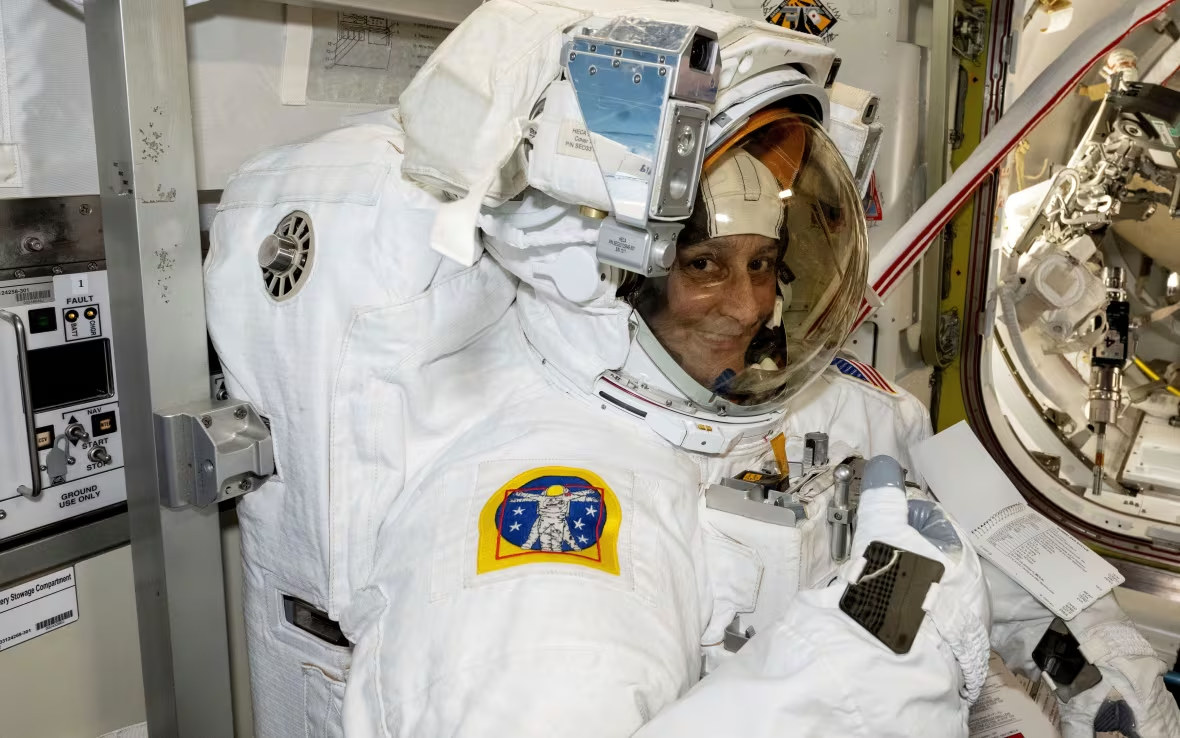
Suni Williams (pictured), one of NASA's stranded astronauts, stepped outside the International Space Station for the first time in seven months
Williams and Wilmore will likely remain on the station until at least March or April after the failure of the Boeing Starliner (pictured)
Mission commander Williams and flight engineer Wilmore took off from Cape Canaveral Space Force Station in Florida on June 5 for a test flight of Boeing's new Starliner capsule.
The plan was to ride Starliner out of the atmosphere, perform a few test manoeuvres, and dock with the ISS for an eight-day stay before returning to Earth in the same capsule.
However, things almost immediately began to go wrong for the problem-plagued capsule as the craft experienced thruster failures and a helium leak.
That choice left the Boeing test crew stuck aboard the ISS without their vehicle until someone could be sent to get them.
That means the pair might not get back to Earth until April at the very earliest - 10 months after they left home.
Since their arrival, yesterday's spacewalk was the first time that Williams has been able to escape the cramped confines of the station.
However, on social media, many expressed their shock and disappointment that Williams and Wilmore had not yet been able to return to Earth.
As Williams enjoyed her first moments outside the station, one commenter dubbed her a 'captive worker' due to the fact she is still trapped in space
Another pointed out that Williams was only meant to have a 'week's vacation' and has now spent the second longest time in space of any American
One commenter angrily demanded to know when Williams and Wilmore would return to Earth
One commenter wrote: 'I appreciate that Suni Williams is just doing sidequests at this point.
'She was meant to be on a week's vacation to the ISS and now she's spent the second longest amount of time in space of an American.'
Another angrily asked: 'When are they going to be back on Earth?'
Meanwhile, other users joked that Williams was 'stepping out to get some fresh air after being unexpectedly cooped up for months.'
'Sometimes you just gotta get outta the house,' one commenter wrote.
Another joked: 'We can understand! Guys get pretty bored holed up inside the station & went out for a garden walk to loosen their limbs a bit!'
Likewise, some commenters suggested that Williams might be taking her resue into her own hands.
One commenter joked: 'Frustrated with NASA, astronauts figure it's easier just to walk home.'
Some commenters joked that Williams was only 'stepping out to get some fresh air' after her seven-month stint inside the ISS
Commenters felt they could relate to the feeling of just needing to get out of the house
One commenter added that Williams had gone 'out for a garden walk' to stretch her legs
While another cheekily added: 'If it'd been me I would've stepped outside and said 'F*** it, I'm walking home".'
Despite the social media reaction, the spacewalk had a more serious purpose which was to perform essential repairs outside of the ISS.
After spending the last few days undergoing rigorous health checks and inspecting their equipment, Williams and Hague donned their suits early Thursday morning.
At 08:00 EST (13:00 GMT), the astronauts switched their suits over to battery power, marking the official start of the spacewalk.
'I'm coming out,' Williams radioed as she emerged from the orbiting lab 260 miles above Turkmenistan in Central Asia.
The astronauts replaced equipment, repaired one of the station's telescopes, and replaced a navigation device on a visiting vehicle.
Williams got a close-up look at the SpaceX capsule that will bring her home this spring, floating just a few feet away from the parked vessel as she struggled with a chore.
However, she managed to safely conduct the repairs without putting any dents in her ride home.
A commenter suggested that Williams was fed up with waiting and decided to make her own way back to Earth
One commenter joked that they would have decided to walk home after remaining trapped in space for so long
Suni Williams (left) arrived at the ISS with Butch Williams (centre) in June last year for what was supposed to be an eight-day stay. On Thursday, Williams was joined by NASA astronaut Nick Hague (right) for her first excursion from the station since arriving
This marks Williams' eighth spacewalk and brings her total cumulative time spent in extra-vehicular activity to 56 hours and 40 minutes
John M. Grunsfeld: 58 hours 30 minutes: 8 spacewalks
Jerry L. Ross: 57 hours 55 minutes, 9 spacewalks
Williams also made important repairs to the 'rate gyro assembly', a key piece of equipment which helps the ISS stay in the same orientation.
At 08:01 EST (19:00 GMT), after six hours of work, NASA announced that the spacewalk was officially over.
This marks Hague’s fourth time working outside the station and the eighth for Williams, making her one of the most experienced spacewalkers in NASA's history.
Williams, who has stayed on the ISS before, has already spent 56 hours and 40 minutes in EVA, making her the 11th most experienced spacewalker ever.
If she spends just four more hours outside the station next week, that will make her the most experienced female spacewalker.
This is the first time that astronauts have undertaken 'extra-vehicular activity' (EVA) from the ISS since November 2023.
Earlier US EVAs were put on hold after astronauts found water leaking into the airlock from the cooling system in one of the space suits.
Williams and Hague spend six hours outside the station to make repairs and perform maintenance. Pictured: the view from Williams' helmet camera as she repairs a navigation device on a visiting spaceship
Williams also made repairs to the 'rate gyro assembly', a key piece of equipment which helps the ISS stay in the same orientation (pictured)
Williams (left) will be joined by Butch Wilmore (right) for another spacewalk on January 23 to make repairs and take samples to see if bacteria are growing on the outside of the ISS
NASA says the issue has now been fixed as has already announced a second EVA to take place next Thursday.
On January 23, Williams will be joined by her fellow stranded astronaut Butch Williams on a second spacewalk.
Their goal will be to remove a radio frequency group antenna assembly from the station’s truss and prepare a spare elbow joint for the Candarm2 robotic arm which is mounted on the station.
Williams and Wilmore will also use the opportunity to take surface samples from the outside of the Destiny laboratory and the Quest airlock to see if any bacteria or fungi are growing on the ISS.
Last year, NASA found 13 strains of bacteria growing on the station that were not found anywhere on Earth.
Understanding bacteria in the harsh environment of space is key to learning how life might flourish on other planets and to protecting future space colonies against new diseases.
However, while Williams and Wilmore might be enjoying the chance to step outside the station, there is still a long way to go before they can return to Earth.
The International Space Station (ISS) is a $100 billion (£80 billion) science and engineering laboratory that orbits 250 miles (400 km) above Earth.
It has been permanently staffed by rotating crews of astronauts and cosmonauts since November 2000.
Crews have come mainly from the US and Russia, but the Japanese space agency JAXA and European space agency ESA have also sent astronauts.
The International Space Station has been continuously occupied for more than 20 years and has been expended with multiple new modules added and upgrades to systems
Research conducted aboard the ISS often requires one or more of the unusual conditions present in low Earth orbit, such as low-gravity or oxygen.
ISS studies have investigated human research, space medicine, life sciences, physical sciences, astronomy and meteorology.
The US space agency, NASA, spends about $3 billion (£2.4 billion) a year on the space station program, with the remaining funding coming from international partners, including Europe, Russia and Japan.
So far 244 individuals from 19 countries have visited the station, and among them eight private citizens who spent up to $50 million for their visit.
There is an ongoing debate about the future of the station beyond 2025, when it is thought some of the original structure will reach 'end of life'.
Russia, a major partner in the station, plans to launch its own orbital platform around then, with Axiom Space, a private firm, planning to send its own modules for purely commercial use to the station at the same time.
NASA, ESA, JAXA and the Canadian Space Agency (CSA) are working together to build a space station in orbit around the moon, and Russia and China are working on a similar project, that would also include a base on the surface.
This image, taken from NASA TV, shows astronaut Suni Williams working on the outside of the International Space Station on Thursday, just feet away from the parked SpaceX spacecraft.
(NASA TV)
In this photo provided by NASA, astronaut Suni Williams tries on and evaluates her spacesuit aboard the ISS on Jan. 9.
(NASA via The Associated Press)
In this image, made from NASA TV, Williams works outside the International Space Station on Thursday. It marked Williams's eighth spacewalk.
Nieuwe waarnemingen van de bekende exoplaneet GJ 1214 b wijzen op een koolstofdioxide-rijke atmosfeer, vergelijkbaar met die van Venus.
The Intriguing Exoplanet GJ 1214 b! Discovering Enaiposha: The Waterworld Exoplanet 🌌🌊
Er zijn inmiddels meer dan 5000 exoplaneten ontdekt rondom sterren buiten ons zonnestelsel. Veel van deze planeten verschillen flink van die in ons eigen zonnestelsel, wat het extra lastig maakt om hun werkelijke aard te doorgronden. Bekende voorbeelden zijn superaardes, hete Jupiters en sub-Neptunussen. In een nieuwe studie hebben onderzoekers een al bekende exoplaneet opnieuw onder de loep genomen om te bepalen in welke categorie deze thuishoort. Hun bevinding is verrassend: deze planeet lijkt namelijk in geen enkele bestaande categorie te passen.
Superaarde of sub-Neptunus? Een van de meest voorkomende typen exoplaneten heeft een grootte tussen die van de aarde en Neptunus. Astronomen zijn er nog niet over uit of het gaat om rotsachtige, aardachtige planeten met dikke waterstofrijke atmosferen, of ijzige, Neptunus-achtige planeten met waterstofrijke atmosferen, ook wel waterwerelden genoemd. Eerdere studies werden bemoeilijkt door dikke wolkenlagen, die vaak voorkomen op dit type planeet en het lastig maken om de atmosfeer eronder te onderzoeken.
The Mysterious World of Gliese 1214 b. What Do We Know about Ocean Planets?
GJ 1214 b Een internationaal team van onderzoekers heeft nu de krachtige James Webb-ruimtetelescoop gebruikt om door het dichte wolkenpak van een voorbeeld van dit type exoplaneet te turen, namelijk GJ 1214 b. Deze planeet, die op slechts 48 lichtjaar afstand van ons zonnestelsel ligt in de richting van het sterrenbeeld Slangendrager, is het ideale voorbeeld om dit type planeet nader te bestuderen.
Meer over GJ 1214 b De exoplaneet GJ1214b werd in 2009 door astronomen ontdekt. Deze planeet heeft een diameter die 2,7 keer zo groot is als die van de aarde en weegt zeven keer zoveel. GJ1214b draait in ongeveer 38 uur om een rode dwergster, op een afstand van slechts 2,09 miljoen kilometer.
Maar in plaats van een waterstofrijke superaarde of een waterwereld, brachten de nieuwe gegevens concentraties koolstofdioxide (CO2) aan het licht. Deze niveaus lijken sterk op die in de dichte CO2-atmosfeer van Venus in ons zonnestelsel. Deze waarnemingen van een koolstofdioxide-rijke atmosfeer, vergelijkbaar met die van Venus, wijzen op de mogelijkheid van een planeetklasse die aanzienlijk verschilt van de superaardes en sub-Neptunussen die astronomen eerder hadden gesuggereerd.
Super-Venus Dit zou kunnen betekenen dat Webb mogelijk een nieuw type planeet heeft ontdekt: de super-Venus. Maar onderzoekers houden vooralsnog een slag om de arm. “Het gedetecteerde CO2-signaal is klein”, legt onderzoeker Kazumasa Ohno uit. “Het vereiste een grondige statistische analyse om te bevestigen dat het echt is.”
‘Wat-als’-scenario’s Om de ware aard van GJ1214b verder te ontrafelen, gebruikte Ohno theoretische modellen om talloze ‘wat als’-scenario’s voor de atmosfeer van de planeet door te rekenen. Van al deze modellen blijken de meest passende scenario’s een koolstofrijke atmosfeer te voorspellen, die lijkt op die van een ‘super-Venus’.
Boek Toch is het laatste woord hier nog niet over gezegd. Onderzoeksleider Everett Schlawin vergelijkt het met het lezen van een boek. “Het is alsof je Leo Tolstojs Oorlog en Vrede leest”, zegt hij. “Stel je voor dat ik je twee exemplaren geef en in één van de boeken één zin verander – zou je die zin dan kunnen vinden?”
Hoewel de resultaten veelbelovend zijn, benadrukken de onderzoekers het belang van aanvullende studies om dit veelvoorkomende, maar mysterieuze type exoplaneet te bevestigen en verder uit te diepen.
In a new exclusive interview with investigative journalist Ross Coutlhart, Jake Barber, a US Air Force Veteran revealed that he saw an object that was white and egg-shaped. Mr. Barber said he has contracted as a helicopter pilot to retrieve all kinds of downed craft, some of which he believes are of nonhuman origin.
He shared the moment when he realized he was involved in recovering non-human technology, or alien technology. He explained that it became obvious when their communication procedures were changed, and when he saw the object on the ground. From its appearance, it was clear that the object was something extraordinary and different from anything human-made.
He was a helicopter pilot, and typically, he would work with a long line of about 150 to 200 feet. This time, he got within 150 feet of the object. When he got close enough, he saw something that looked like a white egg.
He was asked if there was any visible propulsion system on the object, but he said there was nothing like what we would recognize as an engine or any form of propulsion. He was operating at night, using night vision goggles. Even with the goggles, the object’s strange appearance remained clear. He would take the goggles off and on, examining the object from different angles to make sure he wasn’t imagining things.
When asked how he knew the egg-shaped object wasn’t from humans, Jake explained that, based on his experience and everything he had seen before, it looked completely out of the ordinary.
It didn’t match anything he had ever seen. His teammates also had the same reaction—they all knew they were dealing with something far beyond what they were used to.
Ross asked if he had ever been directly told that the craft was of non-human origin. Jake replied that in the years following the event, senior members of the UAP task force had confirmed that the object was, indeed, non-human in origin. He emphasized that this wasn’t a one-time, unique experience; similar things had been encountered before.
“Over the last couple years, it’s been confirmed to me by ranking members of the UAP task force that what we were working with that night was, in fact, NHI (nonhuman intelligence) and it was not a unique experience,” Barber said.
In the history of Ufology, the case of Lonnie Zamora was registered as the most authentic and well-documented UFO sighting in the United States. It is hard not to believe a police officer when he/she claims to have seen something not from this world. A police officer from Socorro named Lonnie Zamora witnessed a white Egg-shaped craft in New Mexico when he was chasing a high-speed vehicle in 1964.
On April 24, 1964, at around 5:45 p.m., Zamora was chasing an overspeed vehicle in his cruiser on the outskirts of his town. Suddenly, he was diverted by a loud roaring sound and noticed a flame in the sky.
Zamora said that the flame had been orange and bluish in color. He described it as “funnel-like.” He explained that he drove for half a mile and saw a white object on the ground.
“Thought that it might be a car that had turned over. Crossed to go out there to investigate, thought maybe somebody might be hurt. At that time, I saw this white, like an egg-shaped looking object.”
Initially, he thought that the object was an overturned car. He could also notice two humans near the object, examining it. As the police officer began approaching them, he understood that they were either large kids or small people. Besides, the object was of white aluminum color.
Illustration of oval-shaped craft witnessed by Lonnie Zamora
He contacted his station and told them about the situation. As soon as he tried to get out of the car, a roar was heard again and the craft started emitting blue flame. This noise scared him, and he thought there might be an explosion. So, he took cover and made his way back to his cruiser while keeping his eyes on the scene.
The craft was moving upward with an increasing sound, and Zamora could once again see an orange-bluish flame coming out from under the craft. He also said that the object had an oval shape without any door or windows.
What Can Explain This New Mexico UFO Sighting?
During his radio interview with Walter Shrode, Zamora said that the two people he had seen near the craft were not humans. The following is the conversation held between Zamora and Shrode.
SHRODE: Did they have helmets on like spacemen or anything?
ZAMORA: No sir, I wouldn’t say they were people, I just… I saw something white, white coveralls, that’s all I can say.
SHRODE: But you couldn’t identify them as actually being an actual human being, like you or I are?
ZAMORA: No sir, I couldn’t.
ZAMORA: It was very low to the ground, at the time I was seeing it, it was very low to the ground up to the perlite mill there, and then it started gaining in altitude.
There is no doubt about what Zamora had seen. Even the FBI investigated the case and discovered burned marks on the site where he had seen the craft land. The Air Force also recorded his case in detail for the Project Blue Book and concluded that they were definitely humans in white suits. What’s more, when the craft disappeared, another police officer Sergeant Sam Chavez arrived at the scene. He found his colleague totally lost and pale.
According to the investigation conducted by NICAP officer Ray Stanford, there were more witnesses who heard the loud roar around the same time as claimed by Zamora. From the police records, he found out that three people had reported seeing a bright object in the sky.
On April 26, 1964, two days after Zamora’s case, a local farmer went to check on his horses as if something was bothering them. He said he had seen an object in the shape of a butane tank. He also noticed a bluish-orange flame, emitting from the bottom of the craft.
Additionally, in the Voronezh UFO landing case 1989, according to eyewitnesses, the object was oval, egg-shaped, approximately 15 meters long, and 6 meters high. The brightly-glowing ship stopped one meter above the ground, rocking back and forth. Four landing pillars emerged from the base of the object and sank to the ground.
After the landing, a hatch slowly opened, and two grim humanlike figures (one of them was 3-4 meters high) came out. The aliens were moving like robots. The shape of the aliens was described as boxes with arms and legs, and buttons were glowing on their chests.
At that very moment, a boy from the group of children playing nearby screamed in fear. The tall alien cast his gaze at him with his central eye, without moving his head. A light came out of his eye and hit the boy, which made him motionless for several minutes.
RELATED VIDEOS
Kevin Knuth - UAP Flight Characteristics: The Five Observables
Caught On Camera - The US Navy UFO
The Global Threat (Full Episode) | UFOs: Investigating the Unknown
Er zijn indrukwekkende beelden gemaakt van het puin van de Starship-raket die gisteren kort na de lancering in de Amerikaanse staat Texas ontplofte. Onder meer SpaceX-baas Elon Musk deelde een video die toonde hoe het ruimteschip uiteenviel in iets wat op een kleurrijke meteorenzwerm leek. “Succes is onzeker, maar entertainment gegarandeerd”, schreef hij erbij.
De (onbemande) raket ontkoppelde na bijna vier minuten vliegen zoals gepland van de Super Heavy draagraket, maar enkele minuten later verloren de missieteams het contact met het ruimteschip. De Super Heavy draagraket keerde zoals gepland terug naar de aarde, maar SpaceX meldde later dat Starship was geëxplodeerd.
Dat gebeurde boven de Turks- en Caicoseilanden, twee eilandengroepen in de Atlantische oceaan, ten zuidoosten van de Bahama’s. Onder meer een piloot van een commercieel vliegtuig en een getuige op de grond maakten indrukwekkende beelden van het vallende puin. Verschillende vliegtuigen in het gebied vertraagden of maakten een omweg om niet geraakt te worden.
Volgens Musk wijzen de eerste vaststellingen in de richting van “een zuurstof-/brandstoflek in de ruimte boven de motorbrandwand van het schip”. Dat was groot genoeg om druk op te bouwen die de ontluchtingscapaciteit overschreed, meldt hij op zijn eigen socialemediaplatform X. “Naast dubbelchecken op lekken, zullen we brandbestrijdingssystemen aan de ruimte toevoegen en waarschijnlijk de ontluchtingsruimte vergroten.”
Normaal gezien zou de volgende lancering niet later dan volgende maand kunnen doorgaan.
Starship wilde gisteren tien objecten in de ruimte brengen die qua grootte, vorm en gewicht de Starlink-satellieten nabootsten. Het is de bedoeling dat Starship-raketten die in de toekomst in een baan om de aarde brengen. Het was de eerste keer dat SpaceX probeerde om met dit type raket vracht in de ruimte te brengen.
De lancering vond enkele uren plaats na de succesvolle lancering van een raket van Blue Origin. Dit bedrijf werd opgericht door Jeff Bezos en wil concurreren met SpaceX, het ruimtevaartbedrijf van Elon Musk.
SpaceX Catches Booster But Loses Ship in Starship Test Flight
SpaceX’s seventh flight test of its massive Starship launch system brought good news as well as not-so-great news.
The good news? The Super Heavy booster successfully flew itself back to the Texas launch site and was caught above the ground by the launch tower’s chopstick-style mechanical arms. That’s only the second “Mechazilla” catch to be done during the Starship test program. The bad news is that the upper stage, known as Ship 33, was lost during its ascent.
“Starship experienced a rapid unscheduled disassembly during its ascent burn. Teams will continue to review data from today’s flight test to better understand root cause,” SpaceX said in a post-mission posting to X. “With a test like this, success comes from what we learn, and today’s flight will help us improve Starship’s reliability.”
Today’s test marked the first use of an upper stage that was upgraded with a redesign of the avionics, the propulsion system and the forward control flaps. Ship 33’s heat shield featured next-generation protective tiles as well as a backup layer of heat-resistant material. SpaceX had removed some of the tiles for this flight as a stress test for the heat shield.
During the webcast, an onscreen graphic suggested that Ship experienced engine problems during its ascent. “We saw engines dropping out on telemetry,” launch commentator Dan Huot said.
In a posting to X, SpaceX founder Elon Musk said preliminary indications were that there was “an oxygen/fuel leak in the cavity above the ship engine firewall that was large enough to build pressure in excess of the vent capacity.”
“Apart from obviously double-checking for leaks, we will add fire suppression to that volume and probably increase vent area,” Musk wrote. “Nothing so far suggests pushing next launch past next month.”
After Ship’s breakup, eyewitnesses posted videos showing a glittering hail of debris falling to Earth. Reuters reported that at least 20 commercial aircraft had to divert to different airports or alter their course to dodge the debris.
In response to an emailed inquiry, the Federal Aviation Administration said it was aware of the anomaly that occurred during today’s flight test and would be assessing the operation. “The FAA briefly slowed and diverted aircraft around the area where space vehicle debris was falling,” the agency said via email. “Normal operations have resumed.”
If Ship had made it to space, it would have deployed 10 Starlink simulators that were about the same size and weight as SpaceX’s Starlink broadband satellites. This was meant to test the procedure that SpaceX plans to use to put scores of Starlink satellites into low Earth orbit during a single Starship mission.
At the end of the flight test, Ship would have made a controlled re-entry and splashdown into the Indian Ocean.
Starship is the world’s most powerful launch system, with the booster’s 33 methane-fueled Raptor engines providing liftoff thrust of 16.7 million pounds. That’s more than twice the thrust of the Apollo-era Saturn V rocket, and almost twice the thrust of NASA’s Space Launch System, which was first launched in 2022 for the uncrewed Artemis I moon mission.
When fully stacked, Starship stands 403 feet (123 meters) tall. The system is meant to be fully reusable. Flight tests began in 2023, and SpaceX has made gradual progress. The first successful catch of the Super Heavy booster thrilled observers last October — and like that catch, today’s catch drew cheers from SpaceX employees watching the launch.
This year, SpaceX aims to demonstrate full reuse of Super Heavy and Ship, and promises to fly “increasingly ambitious missions.” The Starship system would be used for large-scale satellite deployments — and eventually for missions beyond Earth orbit. A customized version of Starship is slated to serve as a crewed lunar landing system for NASA’s Artemis III mission, which is currently scheduled for no earlier than mid-2027.
Musk envisions sending Starships on missions to Mars, perhaps starting in 2026. “These will be uncrewed to test the reliability of landing intact on Mars,” he said last September in a posting to X.
“If those landings go well, then the first crewed flights to Mars will be in 4 years,” Musk said. “Flight rate will grow exponentially from there, with the goal of building a self-sustaining city in about 20 years.”
Meer van UFO'S of UAP'S, ASTRONOMIE, RUIMTEVAART, ARCHEOLOGIE, OUDHEIDKUNDE, SF-SNUFJES EN ANDERE ESOTERISCHE WETENSCHAPPEN - DE ALLERLAATSTE NIEUWTJES


 US Military Recovered UFO That ‘Distorted Space-Time’ & Craft Able To ‘Alter Our Reality’ As Mentioned In Bizarre Navy Docs