Naar de inhoud

UFO'S of UAP'S, ASTRONOMIE, RUIMTEVAART, ARCHEOLOGIE, OUDHEIDKUNDE, SF-SNUFJES EN ANDERE ESOTERISCHE WETENSCHAPPEN - DE ALLERLAATSTE NIEUWTJES

UFO's of UAP'S in België en de rest van de wereld
akke.beakke.be
Ontdek de Fascinerende Wereld van UFO's en UAP's: Jouw Bron voor Onthullende Informatie! Ben jij ook gefascineerd door het onbekende? Wil je meer weten over UFO's en UAP's, niet alleen in België, maar over de hele wereld? Dan ben je op de juiste plek! België: Het Kloppend Hart van UFO-onderzoek In België is BUFON (Belgisch UFO-Netwerk) dé autoriteit op het gebied van UFO-onderzoek. Voor betrouwbare en objectieve informatie over deze intrigerende fenomenen, bezoek je zeker onze Facebook-pagina en deze blog. Maar dat is nog niet alles! Ontdek ook het Belgisch UFO-meldpunt en Caelestia, twee organisaties die diepgaand onderzoek verrichten, al zijn ze soms kritisch of sceptisch. Nederland: Een Schat aan Informatie Voor onze Nederlandse buren is er de schitterende website www.ufowijzer.nl, beheerd door Paul Harmans. Deze site biedt een schat aan informatie en artikelen die je niet wilt missen! Internationaal: MUFON - De Wereldwijde Autoriteit Neem ook een kijkje bij MUFON (Mutual UFO Network Inc.), een gerenommeerde Amerikaanse UFO-vereniging met afdelingen in de VS en wereldwijd. MUFON is toegewijd aan de wetenschappelijke en analytische studie van het UFO-fenomeen, en hun maandelijkse tijdschrift, The MUFON UFO-Journal, is een must-read voor elke UFO-enthousiasteling. Bezoek hun website op www.mufon.com voor meer informatie. Samenwerking en Toekomstvisie Sinds 1 februari 2020 is Pieter niet alleen ex-president van BUFON, maar ook de voormalige nationale directeur van MUFON in Vlaanderen en Nederland. Dit creëert een sterke samenwerking met de Franse MUFON Reseau MUFON/EUROP, wat ons in staat stelt om nog meer waardevolle inzichten te delen. Let op: Nepprofielen en Nieuwe Groeperingen Pas op voor een nieuwe groepering die zich ook BUFON noemt, maar geen enkele connectie heeft met onze gevestigde organisatie. Hoewel zij de naam geregistreerd hebben, kunnen ze het rijke verleden en de expertise van onze groep niet evenaren. We wensen hen veel succes, maar we blijven de autoriteit in UFO-onderzoek! Blijf Op De Hoogte! Wil jij de laatste nieuwtjes over UFO's, ruimtevaart, archeologie, en meer? Volg ons dan en duik samen met ons in de fascinerende wereld van het onbekende! Sluit je aan bij de gemeenschap van nieuwsgierige geesten die net als jij verlangen naar antwoorden en avonturen in de sterren! Heb je vragen of wil je meer weten? Aarzel dan niet om contact met ons op te nemen! Samen ontrafelen we het mysterie van de lucht en daarbuiten.

Archief

Wild thermal video shows 'pair of UFOs over California' rotating in unison

On Friday, Reddit user @louthegoon posted the video to the 'The UFOs Subreddit' - a forum for UFO discussions where people can talk about sightings, experiences, news and investigations.

He recorded the video from Pacifica, California, on November 29 at 10:29 pm, which features 'two solid heat-objects flying in tandem'.

Midway through the video, the scorching hot objects can be seen rotating in unison while maintaining a consistent distance between them.

After the footage went viral, some Reddit users in the comments expressed disbelief.

'They move kind of like birds though,' one user commented, to which @louthegoon responded, 'I'm interested in hearing why you believe they are birds.'

'I don't think it is an osprey because if it was we wouldn't see negative space between these heat-objects,' he said, adding that the way in which the objects moved 'gives off a robotic feeling' when they rotate.

The video comes just weeks after a photo of four gleaming lights above the United States Capitol building sparked fears that an alien invasion may be finally starting to materialize.

A thermal video captured a 'pair of UFOs ' flying over California

A thermal video captured a 'pair of UFOs ' flying over California

The video comes just weeks after a photo of four gleaming lights above the United States Capitol building sparked fears that an alien invasion may be finally starting to materialize

The video comes just weeks after a photo of four gleaming lights above the United States Capitol building sparked fears that an alien invasion may be finally starting to materialize

The photo, captured at night just outside Congress with the Capitol Hill dome in view, was taken by Dennis Diggins, a U.S. Air Force veteran who now works as a licensed tour guide and professional travel director in the Washington, D.C., area.

In the image, the triangular formation of lights appears to hover mere feet above the 'Statue of Freedom' atop the Capitol dome.

As fate would have it, this sighting occurred just weeks after a pair of high-profile public hearings in the U.S. Senate and House of Representatives, where lawmakers questioned current and former Pentagon officials about intelligence regarding what were once called "flying saucers."

During the House hearing, lawmakers reviewed an unsettling report claiming the existence of an illegal "Unacknowledged Special Access Program" named Immaculate Constellation, allegedly designed to "detect, quarantine and transfer" UFO data away from public scrutiny.

While some eagerly sought video evidence to connect this latest sighting to the broader UFO debate on Capitol Hill, others dismissed the speculative frenzy surrounding the mysterious lights.

A week earlier, a 10-minute video was shared on the subreddit, showing a swarm of UFOs near an Afghan military base that appeared completely unaffected after being struck by missiles.

The footage begins with the camera scanning the flat terrain surrounding the base before zooming in on distant mountains, where four black dots hovered in the sky.

Moments later, the camera captured a closer view of the mysterious orbs, which appeared to be dripping fuel beneath them.

A swarm of UFOs were seen completely unaffected after being hit by a missile outside of an Afghanistan military base - and the 10-minute was shared on RedditThe video showed some sort of artillery or missile striking right through two of the levitating orbs before the debris quickly dissipated into the air and left the mysterious orbs back to their original state

A swarm of UFOs were seen completely unaffected after being hit by a missile outside of an Afghanistan military base - and the 10-minute was shared on Reddit

Many Reddit users initially thought the dots were flares, but the camera later switches from FLIR mode to normal vision - revealing that the orbs were glowing multi-colored dots that rigidly moved in a spatial relationship with each other

Many Reddit users initially thought the dots were flares, but the camera later switches from FLIR mode to normal vision - revealing that the orbs were glowing multi-colored dots that rigidly moved in a spatial relationship with each other

A short-range missile then entered the frame from the top right, striking through two of the levitating orbs. 

Despite the apparent impact and brief explosions, the orbs remained unharmed as the debris dissipates into the air.

Initially, many viewers speculated that the peculiar dots were either training targets or flares.

As the video nears the six-minute mark, the camera transitions from FLIR — a thermal imaging technology that creates infrared visuals — to standard vision.

The camera switch showed how the orbs were actually glowing multi-colored dots, with pink, orange, purple, and yellow hues pulsating as they flew across the sky.

{ https://www.dailymail.co.uk/ }

Hoe vind je dit bericht?
Geschreven door peter om 23:51 Stuur door

NASA’s Europa Clipper Spacecraft Deploying Its Instruments

NASA’s Europa Clipper Spacecraft Deploying Its Instruments

by NASA

NASA’s Europa Clipper — the largest spacecraft NASA has ever developed for a planetary mission — is already 20 million km (13 million miles) from Earth.

An artist’s concept of NASA’s Europa Clipper shows the spacecraft in silhouette against the surface of Jupiter’s icy moon Europa, with the magnetometer boom fully deployed at top and the antennas for the radar instrument extending out from the solar arrays. Image credit: NASA / JPL-Caltech.


An artist’s concept of NASA’s Europa Clipper shows the spacecraft in silhouette against the surface of Jupiter’s icy moon Europa, with the magnetometer boom fully deployed at top and the antennas for the radar instrument extending out from the solar arrays.

Image credit: NASA / JPL-Caltech.

Europa Clipper lifted off from NASA’s Kennedy Space Center in Florida on October 14, 2024.

The spacecraft is zooming along at 35 km per second (22 miles per second) relative to the Sun.

Europa Clipper will travel 2.9 billion km (1.8 billion miles) to arrive at Jupiter in 2030 and in 2031 will begin a series of 49 flybys, using a suite of instruments to gather data that will tell scientists if the icy moon and its internal ocean have the conditions needed to harbor life.


Europa Clipper deployment

For now, the information mission teams are receiving from the spacecraft is strictly engineering data, telling them how the hardware is operating.

Shortly after launch, Europa Clipper deployed its massive solar arrays, which extend the length of a basketball court.

NASA's Europa Clipper Unveils Science Tools on Its Way to Jupiter

Next on the list was the magnetometer’s boom, which uncoiled from a canister mounted on the spacecraft body, extending a full 8.5 m (28 feet).

To confirm that all went well with the boom deployment, the team relied on data from the magnetometer’s three sensors.

Once the spacecraft is at Jupiter, these sensors will measure the magnetic field around Europa, both confirming the presence of the ocean thought to be under the moon’s icy crust and telling scientists about its depth and salinity.

After the magnetometer, the spacecraft deployed several antennas for the radar instrument.

Now extending crosswise from the solar arrays, the four high-frequency antennas form what look like two long poles, each measuring 17.6 m (57.7 feet) long.

Eight rectangular very-high-frequency antennas, each 2.76 m (9 feet) long, were also deployed — two on the two solar arrays.

“It’s an exciting time on the spacecraft, getting these key deployments done,” said Europa Clipper project manager Jordan Evans, a researcher at NASA’s Jet Propulsion Laboratory.

“Most of what the team is focusing on now is understanding the small, interesting things in the data that help them understand the behavior of the spacecraft on a deeper level. That’s really good to see.”

The remaining seven instruments will be powered on and off through December and January so that engineers can check their health.

Several instruments, including the visible imager and the gas and dust mass spectrometers, will keep their protective covers closed for the next three or so years to guard against potential damage from the Sun during Europa Clipper’s time in the inner Solar System.

Once all the instruments and engineering subsystems have been checked out, mission teams will shift their focus to Mars.

On March 1, 2025, Europa Clipper will reach Mars’ orbit and begin to loop around the Red Planet, using the planet’s gravity to gain speed.

Mission navigators already have completed one trajectory correction maneuver, as planned, to get the spacecraft on the precise course.

At Mars, they plan to turn on the spacecraft’s thermal imager to capture multicolored images of Mars as a test operation.

They also plan to collect data with the radar instrument so engineers can be sure it’s operating as expected.

The spacecraft will perform another gravity assist in December 2026, swooping by Earth before making the remainder of the long journey to the Jupiter system.

At that time, the magnetometer will measure Earth’s magnetic field, calibrating the instrument.

VIDEOS


NASA's Europa Clipper Is Looking for Life on Ocean Worlds

Europa Clipper Mission, A Potentially Habitable Ocean World!

Europa Clipper: NASA’s Incredible Hunt for Alien Life

ç https://www.sci.news/ }

Hoe vind je dit bericht?
Geschreven door peter om 21:18 Stuur door

Ghostly figure caught on security camera as distressed dogs react

Ghostly figure caught on security camera as distressed dogs react

A security camera recently captured an eerie scene that has left people intrigued and spooked. In the footage, recorded at dawn, a mysterious figure dressed in white appears near a large vehicle. What makes the video even stranger is the reaction of two nearby dogs, who seem unusually distressed and unsettled by the presence. 
ghost%20security%20cam.jpg

While the exact location in Mexico where this happened hasn’t been confirmed, many are already speculating about the figure’s identity. Some believe it could be La Llorona, the legendary weeping woman from Mexican folklore. La Llorona is said to wander in sorrow, mourning her lost children, and has been the focus of countless ghost stories over the years. 
Others have suggested a different explanation, claiming the figure resembles a "nightcrawler," a strange cryptid reportedly known for its bizarre appearance. 
Skeptics, however, argue that it might just be a person caught in an unusual moment, and the dogs’ reactions could be explained by their heightened senses picking up on something out of the ordinary. Still, the dogs' unsettling behavior has sparked debate about whether the encounter might have been something paranormal. 
For now, the true nature of the figure remains a mystery.

{ https://ufosightingshotspot.blogspot.com/ }

Hoe vind je dit bericht?
Geschreven door peter om 20:56 Stuur door

'It's hard not to believe he saw something': Historian Greg Eghigian on how UFOs took over the world

'It's hard not to believe he saw something': Historian Greg Eghigian on how UFOs took over the world

 An artist's impression of UFOs appearing over a small town.

An artist's impression of UFOs appearing over a small town. 
(Image credit: Shutterstock)

Strange lights in the sky, little green men and crashed vessels secreted away to government labs — the relatively modern history of UFOs is replete with conspiracy theories and allegations of coverups.

But beyond the endless arguments between believers and debunkers over what could be behind the phenomena, the fact remains that many people have looked into the sky and reported seeing things they cannot explain. So what do UFO reports tell us about ourselves?

To discuss UFO sightings, how and why they first emerged, and the ways they tie into the cultural and political trends of the past and present, Live Science spoke with Greg Eghigian, a professor of history and bioethics at Penn State University, whose new book, "After The Flying Saucers Came" (Oxford University press, 2024), is one of the first social histories of UFOs, or unidentified anomalous phenomena (UAP). Here's what he had to say.

Ben Turner: A lot of people assume UFOs entered public consciousness with the Roswell incident. But your book says otherwise. When did it all begin?

Greg Eghigian: I think when we look at this as a social phenomenon — not just simply someone saw something strange in the sky, but that the object was made by somebody, and that one of the probable scenarios is they were extraterrestrials — we can mark the moment that starts to evolve in June 24, 1947.

The private pilot Kenneth Arnold sees these objects [that day] over Washington state when he's flying his plane. He lands and reports it to the military and to journalists. When asked how they flew, he answered that these things flew kind of like saucers skipping across the water. Then, within a day or two, a journalist comes up with this great headline: "Flying saucers."

Once we had flying saucers, everything else fell into place.


A history of flying saucers and UFOs

BT: But then Roswell happened just a few weeks later. How did a fairly small city in New Mexico become famous all over the world for UFOs, while Arnold's name remains relatively unknown?

GE: Here's the thing about Roswell that a lot of people don't realize. The story that came out of Roswell is that some material had been retrieved around an Air Force base there that they believe could be from a crashed flying saucer.

Within a day, the Air Force rolls that back, saying that it's not the case, the people who first found it were mistaken. The reality is that the people who were on the ground and found this stuff were not terribly qualified to talk about it.

They didn't understand what they had, literally, in their hands, and the people who usually dealt with the material were actually off at a conference. When they did finally get a chance to look at it, they said, "Oh this is pretty mundane stuff," and they corrected themselves.

So the Roswell thing gets a lot of air play, a lot of global news coverage for about 24 to 48 hours, and then it disappears. It's not really ever talked about, and leaves very little imprint on the UFO world for decades.

It's then only in the late 1970s that some ufologists (and this is a very common thing in the UFO world) go back over the records, dig deeper into the story and believe that they found all these contradictions in it. That's when Roswell became a focal point.

Greg Eghigian

(Image credit: Greg Eghigian)

BT: Looking at the period of history where all of this kicked off, we have growing Cold War rivalry, the new existential threat of nuclear weapons, McCarthyism, fear of communism and Soviet Russia. It seems like a time that's ripe for paranoia and conspiracism. How much is all of the UFO stuff tied into that?

GE: Oh, it's very tied in. I make the point in the book that I don't think the UFO phenomenon as we know it would exist without the Cold War. There are a variety of reasons for that, but one of the often forgotten aspects of this is World War II.

WWII and the Cold War bring a number of critical things to the table for how UFO stories were built. Firstly, you have big governments — big governments and big militaries. You look at the United States federal government in 1900 and it's not a big thing, it's not this monstrosity. By 1945, the U.S. government was a large bureaucracy with a big military.

Secondly, what WWII taught everybody was that this institution can have secret programs that build remarkable technology, like the atomic bomb, as well as new kinds of airplanes such as jets. And of course, both conflicts also have a lot of spying.

So when the UFO phenomenon emerges, the initial thought of just about everybody is that it has to be one of these superpowers. This has to be somebody doing surveillance.

That's also a lot of the ways it's still spoken about today: Who's doing this? Who's keeping it a secret? What are their intentions? And could it harm us? So it's very much a part of it, and it haunts the story of UFOs for decades.

The Roswell Daily Record from July 9, 1947, details the Roswell UFO incident.

The Roswell Daily Record, July 9, 1947. 

(Image credit: Roswell Daily Record)

BT: There are also interesting preludes to the Kenneth Arnold moment in 1947. One thing that flashes to mind is Orson Welles' 1938 radio broadcast of the "War of The Worlds," which caused a mass panic that aliens were actually invading. Why did flying saucers take off in 1947 and not earlier?

GE: I think the game changer is the atomic bomb. That something could be invented that we had no idea about, that is just presented to the world, and has this enormous destructive power that could wipe out all of humanity almost in an instant.

When you ask why now, some people will respond that alien visitors have always been here and we're just noticing them now. But the argument that's usually presented is that it's probably because they [the aliens] saw us explode atomic bombs. This makes us capable of being conversed with, or a possible threat down the road.

The actor Orson Welles explains his radio broadcast of H.G. Wells' The War of the Worlds to reporters after a fake radio bulletin of an alien invasion within the production caused mass panic.

The actor Orson Welles explains his radio broadcast of H.G. Wells' The War of the Worlds to reporters after a fake radio bulletin of an alien invasion within the production caused mass panic.

(Image credit: Getty Images)

BT: There's an appeal to a higher power in it too, right? In a time when religion is falling by the wayside, after all the horrors of the past century, people were looking for something that could save us from ourselves.

GE: There are certainly people who believe exactly that. The figure who lays all of this out is the psychologist Carl Jung. In the late 1950s, he wrote one of the first, and still one of the best, scholarly books on the topic.

It makes this argument that, real or not, what they [UFOs] represent to people is this idea of salvation from something, at least that's the hope. By the early 1950s you see the beginning of UFO religious communities, almost all of them tied to the New Age Movement.

BT: Everything you've said so far makes this seem like a firmly mid-20th century American phenomenon. I confess to having been partial to the History Channel's "Ancient Aliens" back in the day. Do sightings stretch across cultures and into the past, as they claimed? Or is that a post-hoc narrative?

GE: This is a question that people debate pretty vigorously. There's no question that people reported seeing strange things in the sky dating back to ancient times. The most famous example is probably meteorites. For a long time the idea that rocks could fall from the sky seemed patently absurd, until people found out the reason is because there are a lot of rocks in space.

The problem with going backward in time and retrospectively looking at stuff and saying: "Aha! Here's another example of a UFO," is that it's deeply, deeply problematic from a historical standpoint.

Most of the time it involves an unintentional, and sometimes outright deliberate misreading of documents, artifacts or paintings. I've seen very good art historians, for instance, talk about paintings and say: "Oh my gosh, these things are clearly flying saucers!" When the objects they're referring to are objects in a particular religious ritual, or serve as a very symbolic trope. So it's very, very difficult to do that stuff [accurately].

BT: This touches on the methodology in your book. You take an agnostic approach: You don't take reports at face value, but neither do you dismiss them out of hand. How does one go about impartially assessing a UFO report? That's going to seem like a weird concept to people.

GE: Yeah it is strange to people, and I know a lot of people who still don't like that I do that.

For me, as a historian, it's partly the idea that I don't feel qualified to adjudicate some of these matters. I think some of these things have to be done by a meteorologist, a physicist, an astronomer or an engineer — someone who is far better qualified than I am to say what's possible and what's anomalous.

But the other part is that this is the way I get to the things that most interest me, which are human beings. I say in the introduction of the book that UFOs don't make history, people make UFOs make history. That really is the main point; it's that I'm interested in the human part of that history.

As far as we know today, UFOs don't have a natural history, they have a human history. Everything about them is related to our perception of them, our speculations and our discussions about them. The social fact of the UFO is very real, and it needs to be chronicled now. Whether these things also have a natural history I'm going to leave up to the researchers who do that stuff for a living.

BT: When you work through these reports, I'm sure some of them on their surface are obviously bogus. But others come from people, pilots for instance, who have no interest in UFOs and are speaking out at significant personal and professional cost. Have you come across any real headscratchers?

GE: Yeah a lot of them can be, or at least certain elements of them.

Back in the 1950s, there was one case that the U.S. Air Force looked into that really set them back on their heels. These two seasoned civilian pilots for Eastern Airlines, reasonable fellows, who saw this very strange object during a flight, they could even make out details from it and it was like nothing they'd seen before.

That's eerie and strange. They didn't have any explanation for it and certainly had no call to make it up — they weren't seeking fame and that wasn't a time you could make any money off this stuff.

Then there's the case of Lonnie Zamora in the 1960s, he was a police officer in the American Southwest who stopped his vehicle because he thought he saw a crashed car. He sees this strange object with people in a kind of white uniform working around it. Then they flit off in it.

By everybody's assessment at the time, he was a mild mannered guy, very cool headed and with absolutely no interest in publicity. He comes across as very sheepish in the radio interviews. That's another case where you sit there and think it's hard not to believe he saw something. Then you try to come up with explanations for what the possibilities could be.

Socorro Policeman Lonnie Zamora points at one of the rectangular depressions in a gully which he says were left by the landing gear of an egg-shaped flying object.

Socorro Policeman Lonnie Zamora points at one of the rectangular depressions in a gully which he says were left by the landing gear of an egg-shaped flying object. 

(Image credit: Denver Post via Getty Images)

BT: How do the reports evolve over time? Do they change as the culture surrounding them comes into sharper focus?

GE: Some things don't change that much. The overwhelming number of them are seeing patterns of lights, orbs or spheres of some kind that move in a strange way then whoosh away with no sound. That remains relatively unchanged from the beginning. But people also see cigar shaped things or triangles. A lot of these things are common across the world.

What has changed more dramatically over the years and over different areas, has been the description of the occupants of these vessels, the aliens themselves. Early on in the 1950s and 1960s, a very common thing would have been to talk about seeing what appeared to be robots — looking like the Tin Man from the "Wizard of Oz." We don't tend to see robots anymore.

Another very common thing during the 1950s and 1960s were what were dubbed, "little men." They weren't really described as green but little and usually gendered male for some reason. They typically stood at about 4 feet [1.2 meters], and in places like Malaysia, they were under 6 inches [15 centimeters] tall. Another very common thing in their descriptions was they were wearing old divers suits.

Then you get to the 1970s and 1980s, and there's a veritable zoo of creatures: things that look like insects; in South America and [in] the Soviet Union big hairy creatures that look like a Bigfoot or a Sasquatch are particularly common.

The one we have come to know as "the gray" is not all that common until the publication of Whitley Strieber's "Communion" book in 1987, from that point the idea of what an alien looks like really crystallized.

Communion: A True Story by Whitley Strieber. The book is a telling of the supposed experiences of Strieber, whose experiences under hypnosis revealed links to alleged encounters with extraterrestrial beings.

Communion: A True Story by Whitley Strieber. The book is a telling of the supposed experiences of Strieber, whose experiences under hypnosis revealed links to alleged encounters with extraterrestrial beings.  (Image credit: CBW/Alamy Stock Photo)

BT: That's got to be one of the things debunkers point to: the fact that the culture is shaping what people see makes it easier to call it a mass delusion.

GE: Yeah, the debunkers look at it and do that. What debunkers would like to do is to get even more concrete than that and say why somebody would see something at a particular time. They say there was a television show two weeks before someone's sighting. Then the person comes back and says I never watched it, and they go back and forth.

I firmly believe that the media of all sorts plays a formative role shaping the way people think, talk about and even see things. But from my standpoint, this is where I might deviate from the debunkers. I don't think that simply explains things away. It just means that people are human beings, they are doing what we always do.

When something happens to us that is really bizarre or unexplainable, it's not a surprise that what we tend to do is turn to analogies and to metaphors. It helps us to say, "Well, this was a little like this."

BT: These debates persist up to the present day, but things have changed a lot too. We're sitting at the tail end of our own UFO — or should I say UAP — wave. And this time, after U.S. Navy footage of mysterious flying objects was released in 2017, we've seen a very different reaction from officials. There have been Senate hearings, task forces set up, and NASA has even been roped in. What happened? Is it because everyone in the U.S. government now also grew up on UFO lore?

GE: A number of things have changed that have led to this becoming something seen as legitimate to ask questions about, and considered, even in academic circles, to be respectable to discuss. One thing is the reality of new surveillance and sensors to detect surveillance. In the United States, China and Russia there is an awareness of those technologies and, of course, a Keeping up with the Joneses attitude about them.

The proliferation of drones is one thing. Drones are everywhere now. I was speaking to a Swedish ufologist a few years ago and he said that the number of sightings that involve drones has skyrocketed.

On the extraterrestrial dimension, since the late 1990s astronomers have found out that exoplanets are pretty ubiquitous. That introduces the idea that planets are really all over the place, and that habitable planets are really pretty likely. I think that's made it easier to conceive of these things as possible. I've heard debunkers say they believe it's probable that there are extraterrestrial civilizations out there, they just don't think they're visiting us.

You also have people who are actively involved in lobbying people to take this seriously. There's Robert Bigelow, the billionaire, who's funneled a lot of money into this cause. Lobbyists now have the ear of certain politicians in America who see this as a valuable issue to them in some ways.

I think you have to always be a little cynical about politicians — they tend to be very pragmatic, and the fact that they come to this subject doesn't necessarily mean they're interested in UFOs, but in other things they can achieve.

The whistleblowers Ryan Graves, David Grusch, and David Fravor at the House Oversight Committee hearing

The whistleblowers Ryan Graves, David Grusch, and David Fravor at a House Oversight Committee hearing at Capitol Hill 26, 2023 in Washington, D.C.. The three testified about their experience with possible UFO encounters and discussed a potential covert government program to study debris from crashed, non-human spacecraft.  (Image credit: Drew Angerer/Getty Images)

BT: What are politicians trying to achieve by embracing it?

GE: I could conceive of them using this as a way to say they're going to keep money away from the military because they're not being honest brokers about this.

The number one thing I keep hearing over and over again, from people on these committees and those who are maybe less interested, is spending and classification. U.S. military secrecy has been a big priority since at least WWII, certainly since the Manhattan Project, and it's only increased over the years. Then 9/11 really doubled, tripled down on that.

This makes the UFO/UAP thing a great example for all these folks to say, "We've got all these whistleblowers saying all this stuff is going on. We haven't heard anything about it. You're keeping this from us. It's all supposedly classified. So we want in."

BT: One of the frustrating things about covering these questions is that you get task forces that are essentially military task forces. People come out to say all kinds of spooky stuff, and when they're probed further they say we'll tell you the rest behind closed doors, and no we won't allow scientists into the bases where we saw this. Now that NASA's involved, do you have more faith for civilian science projects to get to the bottom of things?

GE: Yeah, spot on. I agree with you completely. It's why I always tell people that, personally, I don't think these military intelligence branches will be key to addressing these questions. I don't think you're ever going to get it from them. I'm also not someone who believes in full transparency, sometimes it's important to keep secrets.

NASA's endorsement of research in this area is unprecedented, and I think it's very welcome. I know a lot of scientists who have started to try to conduct research along these lines. The problem we have is it has not translated into funding yet. A lot of the current efforts are on shoestring budgets and it's unclear whether that money is ever going to be forthcoming. So far, at least in the United States, it has not been.

But there is a hope among a lot of researchers that that will change, because the climate has changed. Civilian scientists and researchers are going to be the key, because we operate in a world of transparency, with an openness that contractors and government don't have.

Mexican journalist Jaime Maussan stands near the two

Mexican journalist Jaime Maussan stands near the two "non-human" beings before a press conference, at the Camino Real hotel, in Mexico City, Mexico on Sept. 13, 2023. Lab tests later revealed that the 'aliens' were actually made from paper, glue, metal and human and animal bones.  (Image credit: Daniel Cardenas/Anadolu Agency via Getty Images)

BT: Do you think we'll ever get a solid answer?

GE: I suspect we will be revisiting and speculating over this for a good long time to come. The world's been at this for over 75 years, and the most seasoned ufology veterans will tell you that not a lot has changed.

If there is an opportunity for serious, empirically driven researchers to get involved, maybe then we'll actually start to see some real progress.

But until that time, it seems to me we're still stuck in a cycle where we largely rely on hearsay and references to evidence that never turns up. Or, as you say, people saying I've got some information, but I can only tell you behind closed doors.

That just leaves us with the mystery, which I know some people are satisfied with.

Editors note: This interview has been condensed and edited for clarity.


UFO Phenomenon Professor Greg Eghigian

{ https://www.livescience.com/ }

Hoe vind je dit bericht?
Geschreven door peter om 01:03 Stuur door

Wat zijn witte gaten precies? En bestaan ze echt?

Wat zijn witte gaten precies? En bestaan ze echt?

Janine image door Janine
Artistieke weergave van een wit gat in de ruimte

Baperookamo/Wikimedia Commons - CC BY-SA 4.0

Zwarte gaten zijn misschien wel de meest fascinerende hemellichamen in het heelal en, ondanks dat ze het onderwerp zijn van enkele van de ontdekkingen van de afgelopen jaren, misschien ook wel het meest mysterieus.

Er zijn echter kosmische objecten voorspeld door de algemene relativiteitstheorie die precies het tegenovergestelde van zwarte gaten vertegenwoordigen: witte gaten.

Wat zijn het precies? Bestaan witte gaten echt? Laten we het samen uitzoeken!

Wat zijn witte gaten? En waarom worden ze zo genoemd?

Om te begrijpen wat witte gaten zijn, moeten we beginnen met hun tegenpool: zwarte gaten.

Tot 2015, toen LIGO zwaartekrachtgolven detecteerde die werden gegenereerd door de fusie van twee zwarte gaten, was hun bestaan slechts een theoretische voorspelling van natuurkundige Albert Einstein en zijn algemene relativiteitstheorie.

Natuurlijk zijn dit geen “gaten” in strikte zin, maar hemellichamen met zo'n dichtheid dat zelfs licht niet aan hun zwaartekracht kan ontsnappen.

Witte gaten vertegenwoordigen hier precies het tegenovergestelde van zwarte gaten: het zijn kosmische lichamen die niets toelaten, maar juist alles afstoten wat in hun buurt komt, inclusief materie en energie.

Het fundamentele verschil tussen de twee kan als volgt worden samengevat:

  • in zwarte gaten kan niets naar buiten, ze trekken alles aan in hun zwaartekrachtveld, zoals een video van NASA laat zien;
  • in witte gaten kan niets naar binnen, alle materie en licht worden naar buiten verdreven, vandaar hun intense witte gloed. Dit is precies de reden voor hun naam.

Dit aspect heeft ertoe geleid dat een wit gat wordt gezien als de tijdomkering van een zwart gat, alsof je naar een video van een zwart gat in omgekeerde richting kijkt.

Maar zijn vergelijkingen en bevestigde theorieën genoeg om te zeggen dat witte gaten echt bestaan?

Bestaan witte gaten echt?

Gesimuleerde weergave van een zwart gat voor de Grote Magelhaense Wolk

Alain r/Wikimedia Commons - CC BY-SA 2.5

Tot nu toe hebben we geen bewijs gevonden voor het bestaan van witte gaten, afgezien van de algemene relativiteitstheorie die ze voorspelt als het spiegelbeeldige tegenovergestelde van zwarte gaten.

Maar de werkelijkheid zou anders kunnen zijn.

Misschien bestaan witte gaten juist niet vanwege het concept van tijdomkering. In feite heeft ons universum een tijdspijl die maar in één richting gaat. Gekoppeld aan het concept van entropie maakt dit in de praktijk terug in de tijd reizen onmogelijk, en dus ook het bestaan van witte gaten, ongeacht wiskundige voorspellingen.

Of ons universum zelf zou het resultaat kunnen zijn van het instorten van een wit gat. Met andere woorden: de oerknal die wij als de oorsprong van het universum beschouwen, zou een wit gat zijn.

Dit zijn niet de enige speculaties.

Voorbij de wiskunde van witte gaten

Omdat er geen experimenteel bewijs is, zijn er veel speculaties die verder gaan dan wiskunde.

Het is niet langer de vraag of witte gaten echt bestaan, maar wat hun plaats zou zijn in een universum zoals het onze.

Volgens sommige wetenschappers zouden witte gaten te instabiel zijn en uiteindelijk in zwarte gaten veranderen. Volgens recent onderzoek zou dit de laatste fase in het leven van een zwart gat zijn, zoals Carlo Rovelli en zijn collega's hebben voorgesteld.

De ongetwijfeld meest fascinerende lezing blijft echter die van Roger Penrose. Volgens de natuurkundige zijn witte gaten portalen naar andere universa of andere delen van ons universum. In de praktijk de uitgang van een wormgat.

Afgezien van dit soort speculaties, is het ontbreken van direct bewijs voor het bestaan van witte gaten misschien te wijten aan een veel eenvoudigere reden. En oneindig veel banaler: we hebben nog niet de middelen om hun bestaan te herkennen.

Nog niet, tenminste.

AANVERWANTE VIDEO'S


Black Hole vs White Hole | What is The Difference?

White Holes in Space

What Is a White Hole? (Opposite of Black Hole)

{ https://www.curioctopus.nl/ }

Hoe vind je dit bericht?
Geschreven door peter om 00:32 Stuur door

Scientists Still Can’t Believe It: Giant Worms Are Hiding in Cavities Beneath the Ocean!

Scientists Still Can’t Believe It: Giant Worms Are Hiding in Cavities Beneath the Ocean!

In a groundbreaking discovery that has left scientists astounded, giant worms have been found lurking in deep-sea cavities beneath the ocean floor. This remarkable finding challenges our understanding of marine ecosystems and opens up new possibilities for life in extreme environments.

Mathias Curl

 scientists-stunned-giant-worms-discovered-hiding-deep-sea-cavities.jpg

Scientists Still Can’t Believe It: Giant Worms Are Hiding in Cavities Beneath the Ocean! © Indian Defence Review

Researchers aboard the Schmidt Ocean Institute’s research vessel Falkor (too) made an unexpected discovery while exploring the East Pacific Rise, an active volcanic ridge located 2,500 meters below the ocean surface. Their initial goal was to collect rock samples from hydrothermal vents to study tubeworm larvae settlement. However, what they found was far more extraordinary.

As the remotely operated vehicle SuBastian lifted plates of oceanic crust, it revealed cavities filled with hydrothermal fluid about 10 centimeters deep. These cavities, known to geologists, maintained a comfortable temperature of 25°C. But the real surprise came when the researchers examined the images more closely.

Hidden within these subterranean chambers was a thriving ecosystem, including :

  • Snails
  • Mussels
  • Giant tubeworms (Riftia pachyptila)

The discovery of these complex life forms in such an unexpected location has stunned the scientific community. It challenges previous assumptions about the limitations of life in extreme environments and hints at the possibility of similar ecosystems existing elsewhere in our solar system.

The giants of the deep : Riftia pachyptila

Among the most fascinating inhabitants of these subterranean cavities are the giant tubeworms, also known as giant beard worms. These remarkable creatures can grow up to three meters in length, making them true giants of the deep sea.

Riftia pachyptila has long been known to thrive around hydrothermal vents on the ocean floor, but their presence beneath the seafloor was entirely unexpected. These worms have adapted to survive in one of the most extreme environments on Earth, devoid of sunlight and subject to crushing pressure.

The discovery of these worms in subsurface cavities raises intriguing questions about their life cycle and adaptation strategies. Researchers suggest that larvae living on the ocean floor may be transported into the subsurface via hydrothermal fluids, establishing a dynamic connection between oceanic, seafloor, and subsurface ecosystems.

CharacteristicDescription
Maximum length 3 meters
Habitat Hydrothermal vents, subsurface cavities
Adaptation Symbiotic relationship with chemosynthetic bacteria

Implications for astrobiology and environmental protection

The discovery of a complex ecosystem beneath the ocean floor has far-reaching implications for our understanding of life on Earth and potentially beyond. It highlights the interconnectedness of marine ecosystems and underscores the importance of protecting these fragile environments.

75736168007-eelpout-tubeworms.jpg?width=2560

These giant tubeworms were photographed near the East Pacific Rise at a depth of 2,500 meters. Tubeworms were discovered for the first time living under the seafloor, where previously it was thought that only microbes and viruses lived.  Show less 

CC BY-NC-SA Schmidt Ocean Institute

This finding could also inform the search for life elsewhere in our solar system. For example, Jupiter’s moon Europa, which is believed to have a subsurface ocean and volcanic activity, might harbor similar conditions to those found around Earth’s hydrothermal vents. The recent launch of NASA’s Europa Clipper mission aims to explore this intriguing moon and search for potential biosignatures.

However, the newly discovered “biomass layer” beneath the ocean floor is already under threat from deep-sea mining projects. Scientists are calling for urgent protective measures to safeguard these unique ecosystems before they are irreparably damaged.

75736167007-looking-under-copy.jpg?width=2560

Giant tubeworms were discovered in a shallow subsurface cavity below deep-sea hydrothermal vents, using a remotely operated vehicle to chisel under rock.  

CC BY-NC-SA Schmidt Ocean Institute

The discovery of giant worms in deep-sea cavities serves as a reminder of how little we know about our planet’s oceans. It also emphasizes the need for continued exploration and research to uncover the secrets hidden in the depths. As we continue to investigate these extreme environments, we may gain valuable insights into the potential dangers and opportunities presented by underwater volcanic activity and its impact on marine life.

As we delve deeper into the mysteries of the ocean floor, it becomes increasingly clear that our planet still holds many surprises. The discovery of giant worms in subsurface cavities is just the beginning of what promises to be an exciting new chapter in marine biology and astrobiology research.

RELATED VIDEOS

The Wonderful World of Deep Sea Worms

Facts: Giant Tube Worms (Riftia pachyptila)

Mysterious Sea 'Worm' Spotted Near New Zealand | National Geographic

{ https://indiandefencereview.com/category/science/ }

Hoe vind je dit bericht?
Geschreven door peter om 23:54 Stuur door

Giant Animal Life in the Oceanic Crust: An Unexpected Discovery

Giant Animal Life in the Oceanic Crust: An Unexpected Discovery

In the depths of the ocean, a groundbreaking discovery has stunned the scientific community. Massive creatures, previously unknown, have been found thriving in the Earth’s crust beneath the sea floor. This unexpected revelation challenges our understanding of deep-sea ecosystems and opens up new frontiers in marine biology research.

Samir Sebti Samir Sebti

Giant Deep Sea Creatures Found Earths Crust Unexpected Discovery Shocks Scientists. 2

Giant Animal Life in the Oceanic Crust: An Unexpected Discovery © The Daily Galaxy --Great Discoveries Channel

At depths exceeding 2,500 meters, researchers aboard the research vessel Falkor have uncovered a bustling ecosystem teeming with life. The Schmidt Ocean Institute’s team utilized advanced submersibles to explore the Pacific Ocean’s seafloor, revealing a diverse array of marine life inhabiting cavities filled with hydrothermal fluids.

Among the most striking discoveries are giant worms reaching lengths of up to three meters. These colossal creatures, along with various gastropods, cephalopods, and previously undocumented mollusks, have adapted to survive in this extreme environment. The presence of larvae in these cavities suggests that juvenile specimens may colonize this habitat through hydrothermal vent fluids, indicating a potential interconnection with seafloor ecosystems.

This revelation is particularly significant as it marks the first time such large animals have been observed in these geological structures. While microorganisms were known to inhabit hydrothermal vents, the presence of complex, macroscopic life forms in the ocean crust was entirely unexpected.

41467 2024 52631 Fig6 Html

The geological marvels supporting life in the deep

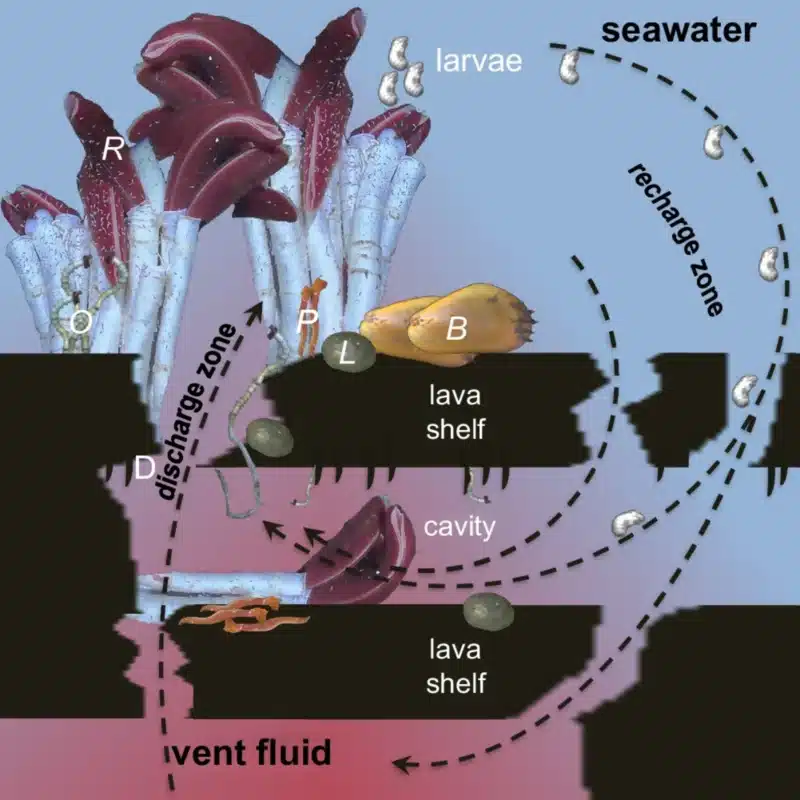
The key to this thriving ecosystem lies in the unique geological formations known as hydrothermal chimneys. These structures create favorable conditions for life to flourish in what was once thought to be an inhospitable environment. The interaction between cold seawater and hot hydrothermal fluids creates a dynamic system that supports a variety of life forms.

A cross-section of the lobate lava formations reveals :

  • Lava plates with interspersed cavities
  • Lava drips on cavity ceilings
  • Fissures throughout the lava plates
  • A recharge zone where cold seawater mixes with hot hydrothermal fluid

This complex geological structure provides niches for various species, including :

SpeciesCharacteristics
Riftia pachyptila Giant tube worms
Paralvinella spp. Mobile worms
Lepetodrilus spp. Limpet-like mollusks
Bathymodiolus thermophilus Deep-sea mussels

Implications for deep-sea research and conservation

This groundbreaking discovery has far-reaching implications for our understanding of marine ecosystems. It suggests that vast portions of the oceanic crust may harbor complex life forms, dramatically expanding the potential habitats for deep-sea creatures. This finding could revolutionize our approach to studying ocean biodiversity and may lead to the discovery of new species adapted to extreme conditions.

The interconnectedness of these subterranean ecosystems with those on the ocean floor raises new questions about the dynamics of deep-sea life. It also highlights the potential vulnerability of these unique habitats to human activities, particularly the growing interest in deep-sea mining. Recent advancements in deep-sea sound analysis have already revealed the presence of elusive ocean predators, further emphasizing the complexity of these underwater ecosystems.

As scientists continue to explore the ocean depths, more surprises may be in store. The recent discovery of a massive blue hole in the ocean depths serves as a reminder of how much remains unknown about our planet’s underwater realms. These findings underscore the importance of continued research and conservation efforts to protect these fragile and unique ecosystems.

41467 2024 52631 Fig5 Html

Future explorations and unanswered questions

While this discovery is groundbreaking, many questions remain unanswered. The full extent of this subterranean habitat is yet to be determined, with some scientists speculating that life could extend much deeper into the Earth’s crust. However, as depth increases, conditions become increasingly extreme, posing challenges for both life forms and scientific exploration.

Future research will likely focus on :

  1. Mapping the extent of these subterranean ecosystems
  2. Studying the adaptations of creatures living in these extreme environments
  3. Investigating the potential for undiscovered species
  4. Assessing the impact of deep-sea mining on these fragile habitats

As we delve deeper into the mysteries of the ocean, it’s clear that our understanding of marine life is constantly evolving. The discovery of giant creatures in the Earth’s crust beneath the ocean floor serves as a powerful reminder of the wonders that still await us in the unexplored corners of our planet.

{ https://dailygalaxy.com/category/science/ }

Hoe vind je dit bericht?
Geschreven door peter om 23:14 Stuur door

The Universe’s Largest Water Reservoir: 140 Trillion Times Earth’s Water in

The Universe’s Largest Water Reservoir: 140 Trillion Times Earth’s Water in

In a groundbreaking discovery, astronomers have unveiled an immense cosmic water reservoir that dwarfs Earth’s water content by an astonishing 140 trillion times. This colossal aqueous expanse, located over 12 billion light-years away, surrounds a distant quasar and challenges our understanding of water’s prevalence in the early universe.

The Universes Largest Water Reservoir 140 Trillion Times Earths Water In

The Universe’s Largest Water Reservoir: 140 Trillion Times Earth’s Water in 

© The Daily Galaxy --Great Discoveries Channel

The identification of this massive water reservoir marks a significant milestone in our exploration of the cosmos. Matt Bradford, a scientist at NASA’s Jet Propulsion Laboratory, emphasizes the uniqueness of this discovery, stating, “The environment around this quasar is producing an unprecedented mass of water.” This finding not only showcases water’s pervasiveness throughout the universe but also provides insights into its presence during the universe’s infancy.

The quasar in question, designated APM 08279+5255, is a cosmic powerhouse driven by an enormous black hole. This celestial behemoth, with a mass 20 billion times that of our sun, generates energy equivalent to a thousand trillion suns. The sheer scale of this cosmic engine creates conditions conducive to the formation and maintenance of vast quantities of water vapor.

While water vapor is not uncommon in our own Milky Way galaxy, the amount detected in this distant quasar is staggering. It surpasses our galaxy’s water vapor content by a factor of 4,000, as most of the Milky Way’s water exists in frozen form. This disparity highlights the exceptional nature of the quasar’s environment and its potential implications for our understanding of cosmic evolution.

The role of water in cosmic environments

Water vapor serves as a crucial trace gas, offering valuable insights into the properties of celestial objects. In the case of APM 08279+5255, the water vapor extends across a gaseous region spanning hundreds of light-years. This expansive distribution indicates that the quasar bathes the surrounding gas in X-rays and infrared radiation, creating unusually warm and dense conditions by astronomical standards.

Despite the vast quantities of water vapor present, the environment remains incredibly cold by terrestrial standards. The gas temperature hovers around a frigid -63 degrees Fahrenheit. However, this is still five times hotter and 10 to 100 times denser than typical galactic environments, showcasing the extreme nature of quasar-influenced regions.

The abundance of water vapor and other molecules, such as carbon monoxide, suggests that there is sufficient gas to fuel the black hole’s growth for an extended period. However, the ultimate fate of this gas remains uncertain. It could potentially condense to form new stars or be expelled from the quasar’s vicinity due to the intense radiation and gravitational forces at play.

Technological marvels behind the discovery

The detection of this massive water reservoir was made possible by cutting-edge observational techniques and instruments. Two teams of scientists, led by Matt Bradford and Dariusz Lis respectively, utilized different observatories to confirm and analyze the water vapor’s presence :

  • Z-Spec at the California Institute of Technology’s Submillimeter Observatory
  • Combined Array for Research in Millimeter-Wave Astronomy (CARMA)
  • Plateau de Bure Interferometer in the French Alps

These advanced instruments allowed the teams to detect multiple spectral signatures of water, providing detailed information about its quantity and distribution. The accidental discovery by Lis’s group in 2010 was further corroborated and expanded upon by Bradford’s team, highlighting the collaborative nature of astronomical research.

The use of these specialized observatories demonstrates the technological prowess required to probe the distant universe and uncover its secrets. As our observational capabilities continue to advance, we may uncover even more surprising findings about the cosmos and its composition.

Implications for our understanding of the universe

The discovery of this massive water reservoir has far-reaching implications for our understanding of the universe and its evolution. It challenges previous assumptions about the distribution of water in the early cosmos and raises intriguing questions about the role of water in the formation and development of celestial structures.

This finding also highlights the potential for new cosmological models that challenge traditional theories about the universe’s origins and evolution. The presence of such vast quantities of water in the early universe may require a reevaluation of our current models of cosmic chemistry and the processes that led to the formation of complex molecules in space.

Furthermore, this discovery underscores the importance of continued exploration and observation of distant cosmic objects. As we peer deeper into space and further back in time, we gain invaluable insights into the conditions that prevailed in the early universe and the processes that shaped the cosmos we observe today.

ComparisonEarthQuasar APM 08279+5255
Water Content 1x 140 trillion x
Distance from Earth 0 light-years Over 12 billion light-years
Temperature Variable -63°F (average)

As we continue to unravel the mysteries of the cosmos, discoveries like this massive water reservoir serve as reminders of the vast and wondrous nature of our universe. They inspire us to push the boundaries of our knowledge and technology, driving us to explore ever further into the cosmic depths in search of answers to our most fundamental questions about existence itself.

VIDEOS

Gigantic Floating Cosmic Ocean Found In Space?140 Trillion Times Larger Than Earth@TheCosmosNews

Largest Reservoir of Water in Space Holds 140 Trillion Times More Water Than Earth's Oceans

Quasar - O Maior Reservatório de Água do Universo

{ https://dailygalaxy.com/category/astronomy/ }

Hoe vind je dit bericht?
Geschreven door peter om 22:31 Stuur door

Voyager 1 Defies the Odds: NASA’s Distant Messenger Makes an Incredible Comeback

Voyager 1 Defies the Odds: NASA’s Distant Messenger Makes an Incredible Comeback

Story by Lydia Amazouz
 
Voyager 1 Defies the Odds: NASA’s Distant Messenger Makes an Incredible Comeback
© Daily Galaxy

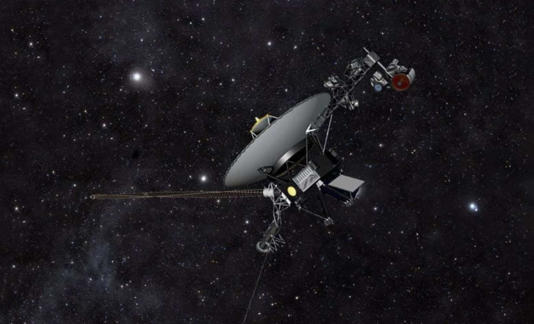
In a remarkable turn of events, NASA’s Voyager 1 spacecraft, which has been silently traveling through space for nearly 50 years, has once again proven its resilience. After a critical communication failure in October 2023, the aging probe has successfully resumed transmitting valuable data back to Earth. The spacecraft, currently more than 24.9 billion kilometers (15.4 billion miles) away, is now working with minimal power to provide groundbreaking insights into the furthest reaches of our solar system. This unexpected recovery is a testament to the extraordinary engineering that keeps Voyager 1 alive and functioning, despite its age and distance.

A Communication Glitch and a Brilliant Recovery

On October 19, 2023,Voyager 1 experienced an unexpected malfunction when its primary communication system failed. The spacecraft’s X-band transmitter, which it uses to send data to Earth, stopped working. This sudden issue left engineers scrambling to restore contact with the spacecraft, which had been operating on limited power for years. The team suspected that the spacecraft’s fault protection system had been triggered, and as NASA’s Tony Greicius explained in the Voyager Blog, “The flight team suspected that Voyager 1’s fault protection system was triggered twice more and that it turned off the X-band transmitter and switched to a second radio transmitter called the S-band.”

While Voyager 1‘s main communication channel was down, the S-band backup system allowed engineers to continue tracking the spacecraft’s position. However, the challenge of detecting this signal at such a vast distance was far from simple. Tony Greicius clarified that “While the S-band uses less power, Voyager 1 had not used it to communicate with Earth since 1981. It uses a different frequency than the X-band transmitters’ signal, which is significantly fainter.” The weak signal from the S-band was a significant challenge for the engineers, who were unsure if it could even be detected from Earth due to the immense distance the spacecraft had traveled. Despite these doubts, the Deep Space Network engineers were able to successfully pick up the faint signal. “The flight team was not certain the S-band could be detected at Earth due to the spacecraft’s distance, but engineers with the Deep Space Network were able to find it,” Greicius noted.

The fact that engineers could detect the S-band signal from Voyager 1—which is currently in interstellar space—is a testament to the advanced capabilities of NASA’s Deep Space Network. After confirming that the faint signal was valid, the team was able to switch back to the X-band transmitter by mid-November, resuming normal operations and allowing Voyager 1 to continue sending back invaluable scientific data from the outer reaches of our solar system.

Power Challenges and the Long Road Ahead

Although Voyager 1‘s communication systems have been successfully restored, the spacecraft’s power supply remains a major concern. After almost 50 years of operation, well beyond its original mission timeline, the spacecraft’s power resources are in steady decline. The radioactive thermoelectric generators (RTGs), which provide power by converting the decay of plutonium into electricity, are gradually losing efficiency. NASA engineers have been carefully monitoring and adjusting Voyager 1’s power usage, making critical decisions to ensure the spacecraft can continue transmitting data. Non-essential systems have been turned off, and the team is managing the spacecraft’s remaining power reserves with precision. However, as the output of the RTGs continues to decrease, Voyager 1 faces the inevitable challenge of running out of power, leaving engineers to work tirelessly to extend its operational life as long as possible.

The spacecraft’s dwindling power is particularly concerning as it means certain instruments and systems can no longer operate. The mission team is constantly faced with the challenge of prioritizing which systems remain active, all while ensuring that Voyager 1 continues to send valuable scientific data back to Earth. As the spacecraft drifts farther from the Sun, its solar power generation capabilities have long since become negligible, making the RTGs the only source of energy. Nonetheless, Voyager 1 has managed to achieve far more than anyone expected, operating for decades beyond its anticipated lifespan.

Voyager 1’s Enduring Legacy

As Voyager 1 continues its journey into the vast unknown of interstellar space, its legacy becomes even more significant. Originally launched in 1977 to explore the outer planets, the spacecraft’s primary mission was completed long ago, but its extended mission continues to provide invaluable insights into deep space. Data from Voyager 1 has helped scientists study the interstellar medium, cosmic radiation, and magnetic fields—subjects that were once beyond the reach of human knowledge. These findings have expanded our understanding of the vast, uncharted territory beyond the influence of our solar system, offering a glimpse into the nature of the cosmos itself.

Even as Voyager 1 nears its 50th anniversary, it remains a symbol of humanity’s drive for exploration. Despite the spacecraft’s aging systems and the enormous distance between it and Earth, every new communication breakthrough represents a triumph of ingenuity and perseverance. NASA’s engineers continue to keep Voyager 1 operational, pushing the limits of space exploration with each passing year. As Voyager 1 sends back data from the farthest reaches of the solar system and beyond, it serves as humanity’s most distant ambassador, continuing to deliver knowledge from the frontiers of space. This extraordinary mission will leave a legacy of scientific discoveries and technological achievements for generations to come, helping future explorers better understand the universe.

Communicating With Deep Space - How It Works | Video

Voyager 1 is Back! NASA's Clever Fix Explained

{ https://dailygalaxy.com/category/space/ }

Hoe vind je dit bericht?
Geschreven door peter om 22:07 Stuur door

Recent Study Suggests That The Surface Of Mars May Be Saturated With Carbon Dioxide That Could Be Converted Into Rocket Fuel

Recent Study Suggests That The Surface Of Mars May Be Saturated With Carbon Dioxide That Could Be Converted Into Rocket Fuel

by Michael Levanduski

Source: Shutterstock

Source: Shutterstock

Planning missions to Mars is very difficult.

Even just getting a rover or other equipment to the red planet has endless challenges, but at least that has been successfully accomplished many times.

As we move closer to the possibility of manned missions to Mars, new hurdles need to be overcome.

One of the biggest ones is how to get people back to Earth. It takes a huge amount of fuel to send a spacecraft to Mars and land on the surface. Having to bring enough to power a trip back as well will be not just hard, but also very inefficient.

Fortunately, it might not be necessary.

According to a new paper that was recently published in the journal Science Advances, there may everything needed to make rocket fuel right there on Mars.

They estimate that about 80% of the carbon dioxide that was formerly in the Martian atmosphere is now trapped in carbon-based organic compounds right near the surface. This carbon could be extracted and converted into rocket fuel.

This is a process that has already been done many times here on Earth, so it is well understood.

Source: Shutterstock

In a statement, MIT geology professor Oliver Jagoutz said:

“Based on our findings on Earth, we show that similar processes likely operated on Mars, and that copious amounts of atmospheric CO2 could have transformed to methane and been sequestered in clays. This methane could still be present and maybe even used as an energy source on Mars in the future.”

The material that they believe holds all this CO2 is called smectite clay, which also exists on Earth. Scientists believe that 3.5 billion years ago, Mars had large amounts of surface water.

The coauthor of the study, Joshua Murray, who is an MIT planetary sciences PhD, explains:

“At this time in Mars’ history, we think CO2 is everywhere, in every nook and cranny, and water percolating through the rocks is full of CO2 too. These smectite clays have so much capacity to store carbon. So then we used existing knowledge of how these minerals are stored in clays on Earth, and extrapolate to say, if the Martian surface has this much clay in it, how much methane can you store in those clays?”

Source: Shutterstock

The answer, it seems, is a lot. While it is unlikely that the first people to travel to Mars will want to fully rely on this as a source of fuel for their return trip, it is certainly a promising option for the future of space travel to and from Mars.

Mars could serve as a ‘gas station’ for travel throughout our solar system.

If you thought that was interesting, you might like to read about a second giant hole has opened up on the sun’s surface. Here’s what it means.


The Mysterious Rocks on Mars That Could Be Something Else Entirely | Perseverance Part 6

Why These Rocks on Mars Shocked Perseverance Scientists the Most | 1st Year Supercut

Mars’ Mysterious Zebra Rock | NASA Perseverance Discovery

{ https://twistedsifter.com/category/naturespace/ }

Hoe vind je dit bericht?
Geschreven door peter om 21:27 Stuur door

Meer van UFO'S of UAP'S, ASTRONOMIE, RUIMTEVAART, ARCHEOLOGIE, OUDHEIDKUNDE, SF-SNUFJES EN ANDERE ESOTERISCHE WETENSCHAPPEN - DE ALLERLAATSTE NIEUWTJES

↑ Terug naar de berichten