


Zaterdag 30 november 2024
 Voyager 1 Defies the Odds: NASA’s Distant Messenger Makes an Incredible Comeback
Voyager 1 Defies the Odds: NASA’s Distant Messenger Makes an Incredible Comeback
Story by Lydia Amazouz
Voyager 1 Defies the Odds: NASA’s Distant Messenger Makes an Incredible Comeback
© Daily Galaxy
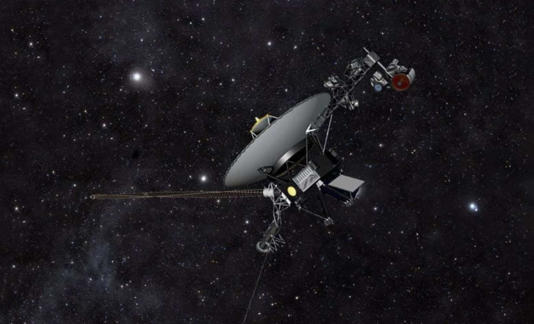
In a remarkable turn of events, NASA’s Voyager 1 spacecraft, which has been silently traveling through space for nearly 50 years, has once again proven its resilience. After a critical communication failure in October 2023, the aging probe has successfully resumed transmitting valuable data back to Earth. The spacecraft, currently more than 24.9 billion kilometers (15.4 billion miles) away, is now working with minimal power to provide groundbreaking insights into the furthest reaches of our solar system. This unexpected recovery is a testament to the extraordinary engineering that keeps Voyager 1 alive and functioning, despite its age and distance.
A Communication Glitch and a Brilliant Recovery
On October 19, 2023,Voyager 1 experienced an unexpected malfunction when its primary communication system failed. The spacecraft’s X-band transmitter, which it uses to send data to Earth, stopped working. This sudden issue left engineers scrambling to restore contact with the spacecraft, which had been operating on limited power for years. The team suspected that the spacecraft’s fault protection system had been triggered, and as NASA’s Tony Greicius explained in the Voyager Blog, “The flight team suspected that Voyager 1’s fault protection system was triggered twice more and that it turned off the X-band transmitter and switched to a second radio transmitter called the S-band.”
While Voyager 1‘s main communication channel was down, the S-band backup system allowed engineers to continue tracking the spacecraft’s position. However, the challenge of detecting this signal at such a vast distance was far from simple. Tony Greicius clarified that “While the S-band uses less power, Voyager 1 had not used it to communicate with Earth since 1981. It uses a different frequency than the X-band transmitters’ signal, which is significantly fainter.” The weak signal from the S-band was a significant challenge for the engineers, who were unsure if it could even be detected from Earth due to the immense distance the spacecraft had traveled. Despite these doubts, the Deep Space Network engineers were able to successfully pick up the faint signal. “The flight team was not certain the S-band could be detected at Earth due to the spacecraft’s distance, but engineers with the Deep Space Network were able to find it,” Greicius noted.
The fact that engineers could detect the S-band signal from Voyager 1—which is currently in interstellar space—is a testament to the advanced capabilities of NASA’s Deep Space Network. After confirming that the faint signal was valid, the team was able to switch back to the X-band transmitter by mid-November, resuming normal operations and allowing Voyager 1 to continue sending back invaluable scientific data from the outer reaches of our solar system.
Power Challenges and the Long Road Ahead
Although Voyager 1‘s communication systems have been successfully restored, the spacecraft’s power supply remains a major concern. After almost 50 years of operation, well beyond its original mission timeline, the spacecraft’s power resources are in steady decline. The radioactive thermoelectric generators (RTGs), which provide power by converting the decay of plutonium into electricity, are gradually losing efficiency. NASA engineers have been carefully monitoring and adjusting Voyager 1’s power usage, making critical decisions to ensure the spacecraft can continue transmitting data. Non-essential systems have been turned off, and the team is managing the spacecraft’s remaining power reserves with precision. However, as the output of the RTGs continues to decrease, Voyager 1 faces the inevitable challenge of running out of power, leaving engineers to work tirelessly to extend its operational life as long as possible.
The spacecraft’s dwindling power is particularly concerning as it means certain instruments and systems can no longer operate. The mission team is constantly faced with the challenge of prioritizing which systems remain active, all while ensuring that Voyager 1 continues to send valuable scientific data back to Earth. As the spacecraft drifts farther from the Sun, its solar power generation capabilities have long since become negligible, making the RTGs the only source of energy. Nonetheless, Voyager 1 has managed to achieve far more than anyone expected, operating for decades beyond its anticipated lifespan.
Voyager 1’s Enduring Legacy
As Voyager 1 continues its journey into the vast unknown of interstellar space, its legacy becomes even more significant. Originally launched in 1977 to explore the outer planets, the spacecraft’s primary mission was completed long ago, but its extended mission continues to provide invaluable insights into deep space. Data from Voyager 1 has helped scientists study the interstellar medium, cosmic radiation, and magnetic fields—subjects that were once beyond the reach of human knowledge. These findings have expanded our understanding of the vast, uncharted territory beyond the influence of our solar system, offering a glimpse into the nature of the cosmos itself.
Even as Voyager 1 nears its 50th anniversary, it remains a symbol of humanity’s drive for exploration. Despite the spacecraft’s aging systems and the enormous distance between it and Earth, every new communication breakthrough represents a triumph of ingenuity and perseverance. NASA’s engineers continue to keep Voyager 1 operational, pushing the limits of space exploration with each passing year. As Voyager 1 sends back data from the farthest reaches of the solar system and beyond, it serves as humanity’s most distant ambassador, continuing to deliver knowledge from the frontiers of space. This extraordinary mission will leave a legacy of scientific discoveries and technological achievements for generations to come, helping future explorers better understand the universe.
Geschreven door peter om 22:07
Stuur door