Naar de inhoud

UFO'S of UAP'S, ASTRONOMIE, RUIMTEVAART, ARCHEOLOGIE, OUDHEIDKUNDE, SF-SNUFJES EN ANDERE ESOTERISCHE WETENSCHAPPEN - DE ALLERLAATSTE NIEUWTJES

UFO's of UAP'S in België en de rest van de wereld
akke.beakke.be
Ontdek de Fascinerende Wereld van UFO's en UAP's: Jouw Bron voor Onthullende Informatie! Ben jij ook gefascineerd door het onbekende? Wil je meer weten over UFO's en UAP's, niet alleen in België, maar over de hele wereld? Dan ben je op de juiste plek! België: Het Kloppend Hart van UFO-onderzoek In België is BUFON (Belgisch UFO-Netwerk) dé autoriteit op het gebied van UFO-onderzoek. Voor betrouwbare en objectieve informatie over deze intrigerende fenomenen, bezoek je zeker onze Facebook-pagina en deze blog. Maar dat is nog niet alles! Ontdek ook het Belgisch UFO-meldpunt en Caelestia, twee organisaties die diepgaand onderzoek verrichten, al zijn ze soms kritisch of sceptisch. Nederland: Een Schat aan Informatie Voor onze Nederlandse buren is er de schitterende website www.ufowijzer.nl, beheerd door Paul Harmans. Deze site biedt een schat aan informatie en artikelen die je niet wilt missen! Internationaal: MUFON - De Wereldwijde Autoriteit Neem ook een kijkje bij MUFON (Mutual UFO Network Inc.), een gerenommeerde Amerikaanse UFO-vereniging met afdelingen in de VS en wereldwijd. MUFON is toegewijd aan de wetenschappelijke en analytische studie van het UFO-fenomeen, en hun maandelijkse tijdschrift, The MUFON UFO-Journal, is een must-read voor elke UFO-enthousiasteling. Bezoek hun website op www.mufon.com voor meer informatie. Samenwerking en Toekomstvisie Sinds 1 februari 2020 is Pieter niet alleen ex-president van BUFON, maar ook de voormalige nationale directeur van MUFON in Vlaanderen en Nederland. Dit creëert een sterke samenwerking met de Franse MUFON Reseau MUFON/EUROP, wat ons in staat stelt om nog meer waardevolle inzichten te delen. Let op: Nepprofielen en Nieuwe Groeperingen Pas op voor een nieuwe groepering die zich ook BUFON noemt, maar geen enkele connectie heeft met onze gevestigde organisatie. Hoewel zij de naam geregistreerd hebben, kunnen ze het rijke verleden en de expertise van onze groep niet evenaren. We wensen hen veel succes, maar we blijven de autoriteit in UFO-onderzoek! Blijf Op De Hoogte! Wil jij de laatste nieuwtjes over UFO's, ruimtevaart, archeologie, en meer? Volg ons dan en duik samen met ons in de fascinerende wereld van het onbekende! Sluit je aan bij de gemeenschap van nieuwsgierige geesten die net als jij verlangen naar antwoorden en avonturen in de sterren! Heb je vragen of wil je meer weten? Aarzel dan niet om contact met ons op te nemen! Samen ontrafelen we het mysterie van de lucht en daarbuiten.

Archief

Thousands of strange white rocks found on Mars. Will they ever be brought to Earth?

Thousands of strange white rocks found on Mars. Will they ever be brought to Earth?

GKQYO6iXQAAOQe_?format=jpg&name=900x900

NASA's Perseverance Mars rover used its dual-camera Mastcam-Z imager to capture this image of "Santa Cruz," a hill within Jezero Crater, on April 29, 2021. 
(Image credit: NASA/JPL-Caltech/ASU/MSSS)

Mars' rusty red surface may have given it its famous "Red Planet" status, but it would also appear that thousands of white rocks are strangely littered on the Martian ground. NASA's Perseverance rover, a robotic geologist that has been exploring the Jezero Crater since early 2021, puzzled scientists when it delivered images of over 4,000 light-toned, pebble-sized rocks scattered all over the crater floor.

"These are very unusual rocks and we're trying to figure out what's been going on," Candice Bedford, a planetary scientist at Purdue University in Indiana and a member of the Mars 2020 science team, said at the Lunar and Planetary Science Conference (LSPC) last month.

The announcement comes as NASA wraps up an architectural review of returning Martian rocks to Earth as part of the agency's ambitious Mars Sample Return (MSR) program.

Related: 

NASA’S Perseverance Rover’s First 360 View of Mars (Official)

The imaged white rocks are what scientists refer to as "floats," meaning they have been removed and transported from their original habitats; some are smooth with pits while others appear to be an amalgamation of multiple layers. Initial analyses, conducted with Perseverance's onboard instruments, revealed the rocks are dehydrated — not only in water content, but also in other minerals including iron, magnesium, calcium and sodium. "These are pretty depleted in a lot of things," Bedford said.

The team is particularly interested in the origins of these unusual rocks as their sources can reveal clues about the Red Planet's past, including precisely when water would've flooded the Jezero crater, which we see as an arid stretch of land today. Despite spotting more than 4,000 such rocks, Perseverance hasn't managed to see even a hint of what's known as an "outcrop" related to the rocks, which is essentially a bedrock of similar properties that'd jut out of the Martian surface. 

The rocks' dehydrated nature suggests they were heated and metamorphosed by either lava flows or asteroid impacts elsewhere on Mars and later dumped onto the crater floor, said Bedford. Whatever the specific process may have been, she and her team suspect it would have occurred relatively recently in terms of Jezero Crater's geologic history.

The Perseverance rover, which has driven more than 15 miles (24.8 kilometers) since its arrival on Mars, celebrated 1,000 days of science last December, which also marked the official completion of the mission it was originally designed to do. It has now filled 26 of its 43 Mars rock sample tubes, mission team members shared at LPSC. "Each sample has innumerable grains that we could potentially study for forever, essentially," said Benjamin Weiss, a professor of planetary sciences at the Massachusetts Institute of Technology and a member of the Mars 2020 team.

As part of a bonus mission that kicked off this spring, Bedford said Perseverance began inching its way toward the Jezero Crater rim, and its long-distance camera has already imaged more light-toned rocks scattered in that area as well.

All of these puzzling rocks, however, are not the only reason why scientists are eager to get Perseverance to the crater rim and possibly beyond. There, they believe a unique geology exists, one that hasn't yet been encountered within the crater floor. That includes pre-Jezero rocks that may have records of the formation of Mars' crust and early climate. It may even hold evidence of biosignatures.

Scientists are currently tagging a variety of interesting sampling locations while mapping the rim itself in more detail, said Lisa Mayhew, a research associate at the University of Colorado, Boulder. Of much interest to scientists is a terrain adjacent to Jezero crater called Nili Planum, whose rocks they think would have formed in warm conditions during a time when life most likely evolved — if it ever existed on the now-barren world, that is. Sampling such rocks "would provide huge added scientific value to the cache that's already existing on Perseverance," said Mayhew.

That scientific value, however, can only be fully realized after those rocks are returned to Earth. 

Scientists need to time-date them using equipment on Earth, without which they wouldn't have a precise timeline for when the Red Planet was habitable and when it became parched. "It doesn't overstate to say it will revolutionize our understanding of Mars," said Weiss.

Questions remain about the MSR program, which NASA is spearheading, including when and how the agency plans to return collected samples to Earth. Last October, NASA commissioned a response team (MIRT) to evaluate alternative approaches to MSR after an independent review board (IRB) found the current architecture would lead to overruns in cost and schedule.

"Much of the work is already complete," said Meenakshi Wadhwa, a planetary scientist at Arizona State University and MSR's principal scientist. The MIRT's recommendation report for a new approach was expected by the end of March, followed by a revised plan and budget by NASA sometime in April, she said.

The agency's fiscal year 2025 budget proposal, made public March 11, allocated $2.7 billion for planetary science but the funding for MSR remained "TBD." NASA's budget this year and next will be announced in April after the MIRT review is completed, NASA Administrator Bill Nelson told reporters at the time.

{ https://www.space.com/ }

Hoe vind je dit bericht?
Geschreven door peter om 01:12 Stuur door

'UK Roswell' UFO debris analysis blows alien mystery open as 'hybrid tech didn't exist'

'UK Roswell' UFO debris analysis blows alien mystery open as 'hybrid tech didn't exist'

Fresh tests on metal debris found at the Europe's Roswell UFO crash site in Wales more than 40 years ago reveals that whatever hit those trees in 1983 was made with metals unavailable at the time

Hoe vind je dit bericht?
Geschreven door peter om 00:55 Stuur door

US Congressman Says Revealing UFO Technology Is a Threat to Energy Sector: It Can Disrupt World Economy

appsNRuC?format=jpg&name=900x900

US Congressman Says Revealing UFO Technology Is a Threat to Energy Sector: It Can Disrupt World Economy

A thought-provoking interview has recently been conducted between Project Unity host Jay Anderson and the U.S. Congressman Andy Ogles. The discussion focused on the implications of complete UAP (Unidentified Aerial Phenomena) disclosure. Anderson asked serious questions to Rep. Ogles about UFOs, revealing that the release of extraterrestrial technology could potentially disrupt the world economy and energy sector.

Rep. Andy Ogles spoke about the difficulty in gathering information due to the compartmentalization of special access projects, emphasizing the need for a methodical and persistent approach to uncover the truth. In the interview, he expressed his concern about UAPs operating in both military and commercial airspace, raising questions about the potential national security threats. He said, “I’m not going to assume I know what it may or may not be. What I do know is there’s a national security issue here.”

He considers various possibilities, including the involvement of experimental aircraft, joint ventures, or foreign adversaries. He emphasizes the importance of avoiding predetermined conclusions and encourages an open-minded investigation to determine the true nature of the UAP phenomenon.

When asked about his personal understanding of UAPs, Rep. Ogles talks about the hope that it might be advanced technology possessed by the United States. He says, “My hope would be… some new technology that we possess… puts us that next generation above our adversaries.” However, he acknowledges the mysterious aspects of UAPs, saying they seem to “defy physics.”

Rep. Ogles then considers the energy implications of the advanced propulsion technology displayed by UAPs. He wonders about the amount of energy needed for such rapid movements and how it could impact the energy sector.

He says, “That being said, these UAPs seem to defy physics. They seem to have some sort of propulsion technology that’s unknown to man as we understand it. So, what does that do to the energy sector? If there’s a new way of thinking about the amount of energy it takes to take a craft that’s hovering and suddenly it’s going Mach one in a matter of seconds – the human body can’t sustain that as we understand it, right? So that craft would have to have next-level technology to protect tissue, if you will, or it’s an unmanned type of craft. Again, there are just a lot of questions that have to be probed. But, if there is this propulsion technology out there and this energy capability out there, not only are we in a renaissance when it comes to aircraft, but we’re in a renaissance in terms of propulsion and energy production consumption. So, again, huge implications across the economic scale, both domestically and internationally.”

He mentions his inquiries in committee about the DOE (Department of Energy), suggesting it could be an ideal place to house top-secret technologies. He says, “If you’re going to house a top-secret Next Level technology, what better place to have it and house it than… nuclear facilities.”

“Everybody knows about Area 51. It’s a testing area… You’ve got this super top-secret, super secure facility that, again, would be ideal to have and to house some new technology, emerging technology that we want to fully master for ourselves and quite frankly control. Because again, as you look at that next generation of warfare, it’s not just tanks and planes. It’s drones. It’s unmanned aircraft. It’s economic. There’s a lot that’s about to happen as we go forward as a superpower and our competitive edge on the global stage.”

Later in the interview, Jay Anderson brings up Congressman Burchett’s positive impression of David Grusch’s testimony during classified briefings. Rep. Ogles says that credible sources have vouched for Grusch’s reliability. He suggests believing what Grusch said, thinking about it carefully, and not trying to say it is wrong without some good proof. Ogles says it is important to keep an open mind, focus on getting answers, and not to try finding faults without good reasons.

Rep. Ogles explains that it does not require unanimous congressional support but rather the speaker’s will to initiate action. He emphasizes the bipartisan interest in addressing the issue and expresses the need for a select committee to ensure transparency and accountability in the investigation. He, along with Congressman Burchett, acknowledges the likelihood of a multi-decade cover-up or compartmentalization due to the secretive nature of special access programs (SAPs) and classified information related to national security.

When asked about evidence suggesting reverse engineering or more exotic propositions, Rep. Ogles mentions the classification of such information and the need for careful consideration. He discusses questions about the origin of technology, whether it is our own creation or recovered from elsewhere, and the potential for reverse engineering.

Read also:

Stephen Bassett, the only registered lobbyist of Washington and founder of Paradigm Research Group, shares the same UFO disclosure concerns that will pose serious implications for the world’s economy.

The PRG researchers claim they have known the reasons why the US authorities were hiding information about UFOs. According to them, disclosing UFO data would lead to the collapse of the entire world economy. Bassett added that all so-called “flying saucers” do not use oil, gasoline, gas, or coal. “They have a different energy system. Without a doubt, a much more complex and deep system based on anti-gravity,” he said.

“Some programs have been removed from the jurisdiction of the White House and Congress and are working somewhere very, very deep, in a ‘hidden mode,'” the researcher emphasized. “I assure you, when the head of state finally officially admits this fact and presents evidence, people will start to worry and want to know more.” But even if the economy stops developing in the current way, it will have new opportunities, Bassett believes.

During an interview with uInterview, he said that UFOs are not unidentified flying objects, as the acronym suggests, but rather alternative energy and propulsion devices. The technology behind UFOs was heavily studied by a team headed by Dr. Vannevar Bush in the 1940s, 1950s, and 1960s, and by 1954, they had developed what is known as “gravity control” and “zero-point energy.”

[Editor’s note] In January 2015, former NASA astronaut Edgar Mitchell sent an email to Podesta, asking him to have an urgent meeting to discuss Disclosure and Zero Point Energy (ZPE). He was concerned about the peace in space. Mitchell wrote: “My Catholic colleague Terri Mansfield will be there too, to bring us up to date on the Vatican’s awareness of ETI. Another colleague is working on a new Space Treaty, citing involvement with Russia and China. However, with Russia’s extreme interference in Ukraine, I believe we must pursue another route for peace in space and ZPE on Earth.” (Click here to read the full article)

However, Dr. Greer stated that the secrecy surrounding this technology went off the rails and became deeply entrenched in compartmented intelligence operations, even causing President Eisenhower to become frustrated with being denied information on the projects.

“The problem became to be, and this is what President Eisenhower warned us about, the secrecy became so enmeshed and compartmented in intelligence operations, that even he as president lost control over it,” Dr. Greer said.

He further stated: “One of our military witnesses, he was a young man working at the White House – which I’m looking at from my place here in Washington, he told us, Mr. Lubkin, who is an attorney, said that Eisenhower was very frustrated that he was being denied information on the projects controlling this issue. So the secrecy went off the rails into these unacknowledged special access projects.”

The disclosure of UFOs would mean the end of oil, gas, coal, and public utilities, as the technology would completely transform the world. Those with trillions of dollars invested in these industries would not be enthused about this possibility. This is the reason for the secrecy, and it has been maintained for 70 years, according to Dr. Greer.

VIDEOS

US Congressman Says Revealing UFO Technology Is a Threat to Energy Sector | UFO Documentary | UAP

US Reverse engineering alien technology | US Congress probes the truth about UFOs

US Air Force TESTING New UFO Technology That Defies Physics

{ https://howandwhys.com/ }

Hoe vind je dit bericht?
Geschreven door peter om 00:29 Stuur door

NASA’s Curiosity Rover Moves Closer to Solving the Mysterious Disappearance of Water on Mars

NASA - Mars Rover Curiosity Landing (Registration Required)

NASA’s Curiosity Rover Moves Closer to Solving the Mysterious Disappearance of Water on Mars

In the distant past, Mars was once a much warmer and wetter planet than its barren red landscape would indicate today. Now, NASA’s Curiosity Rover has begun investigations of an area that could offer significant insights into the disappearance of liquid water on Mars, when that occurred, and whether it could have been host to life on the Red Planet.

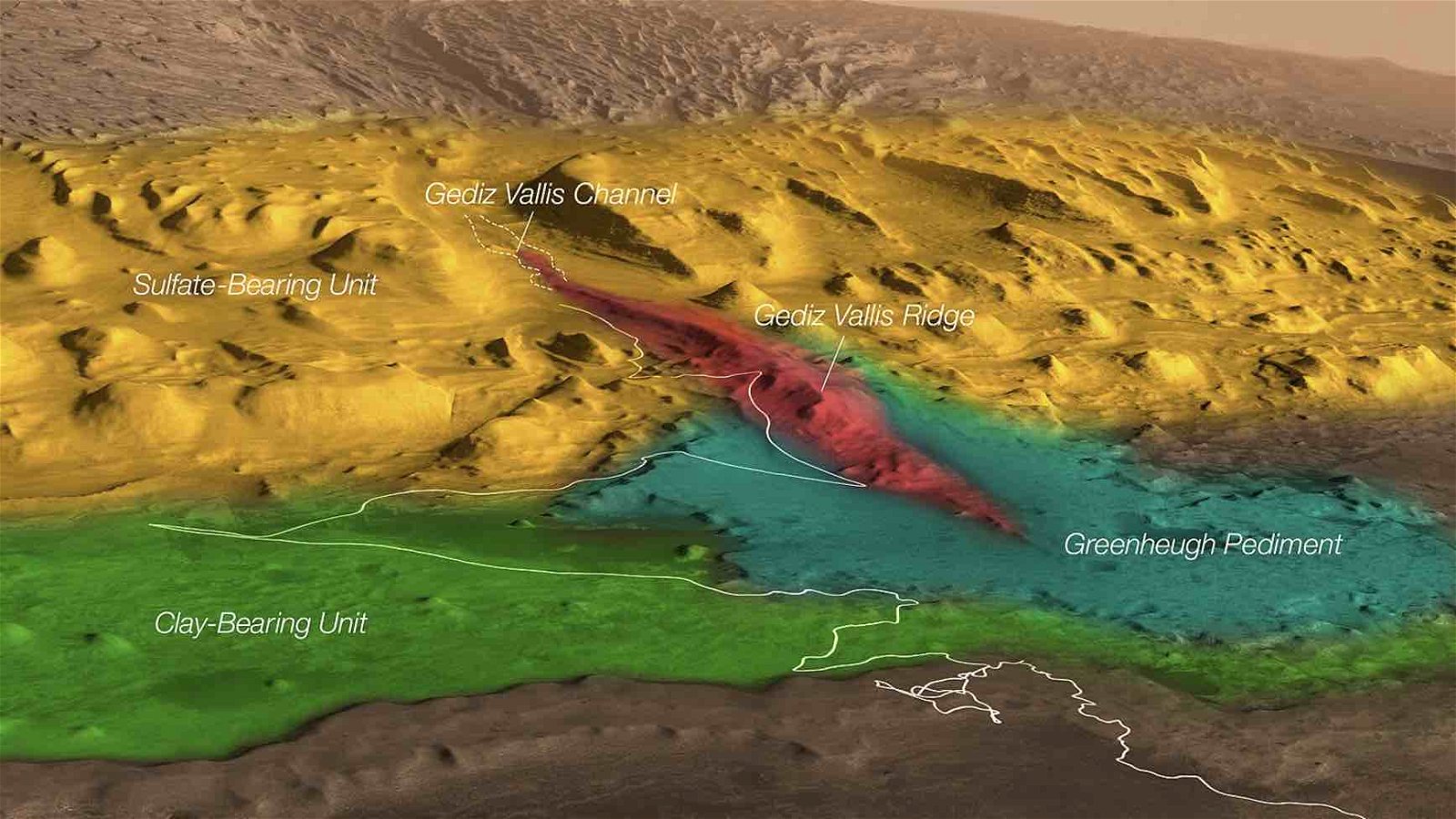
The rover’s investigations have recently brought it to the Gediz Vallis channel, an area that billions of years ago would have looked far more like Earth. Based on the data Curiosity obtains during its explorations, scientists hope to understand how the Gediz Vallis channel formed and whether the ancient channel was indeed the result of the windings of an ancient river that once coursed along the Martian surface.

Map detailing region of Curiosity’s investigations at Mount Sharp, with the Gediz Vallis channel visible near the center, top (Credit: NASA/JPL-Caltech/ESA/Univ. of Arizona/JHUAPL/MSSS/USGS Astrogeology Science Center).

A Decade of Exploration

NASA’s Curiosity rover touched down at the Bradbury Landing site in “Yellowknife” Quad of Aeolis Palus in early August 2012. The following June, it was announced that the rover would begin its roughly five-mile (8 km) trek to the base of Aeolis Mons, otherwise known as Mount Sharp, which forms the central peak of Gale Crater.

Curiosity has spent the last decade making its way up the mountain, traversing the peak’s layered lower foothills and allowing scientists to observe an area that showcases the changes of the Martian landscape over time.

NASA's Curiosity Rover

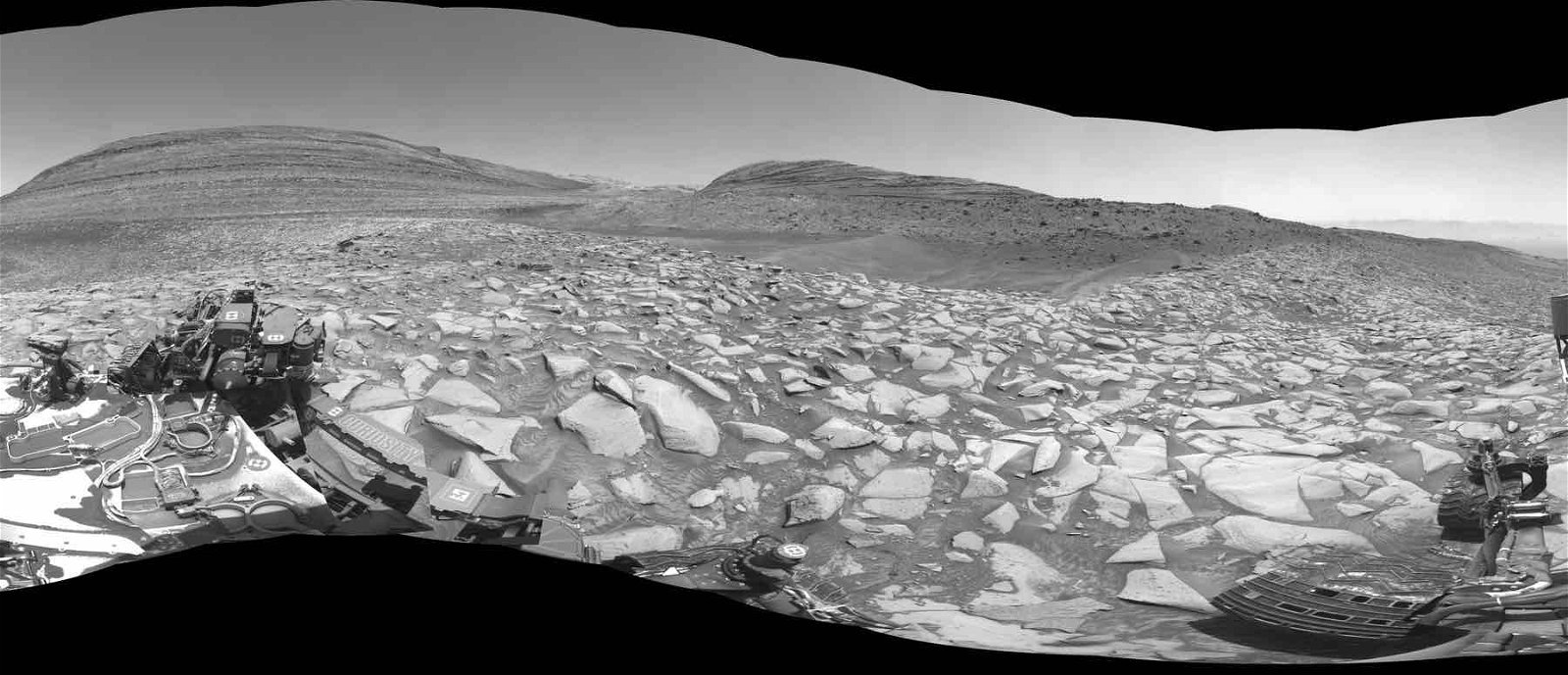
A panorama shot captured from Curiosity’s left navigation camera reveals the Gediz Vallis in 360-Degrees, revealing dark sand and debris within the channel

(Credit: NASA/JPL).

One of Curiosity’s primary objectives is to determine whether water and the chemicals required for life to exist would have been present in the area. The existence of clay minerals already shows that water would have once interacted with the rock on the Martian surface. Current investigations by Curiosity are now looking at the presence of sulfates in the area, which is believed to have formed long ago as the last water in the region finally evaporated.

Signs of Water Flowing on Ancient Mars?

NASA’s Jet Propulsion Laboratory recently said that Curiosity is probing the landscape for signs that the mysterious Gediz Vallis channel might have been slowly carved into the Martian bedrock by the flow of water billions of years ago. Although it was considered that the channel could have been formed by winds that are still prevalent on Mars, the steepness of the channel’s sides is more consistent with the movement of liquid water, either resulting from a sudden flow that carried debris from a landslide, or possibly the constant flow of water from a river.

Today, the channel is packed with stony debris, which the Curiosity team believes could have been relocated into the channel because of dry avalanches, although the possibility that these rocky areas at the base of the formation might have been carried with the help of water long ago is a tantalizing possibility

NASA's Curiosity rover

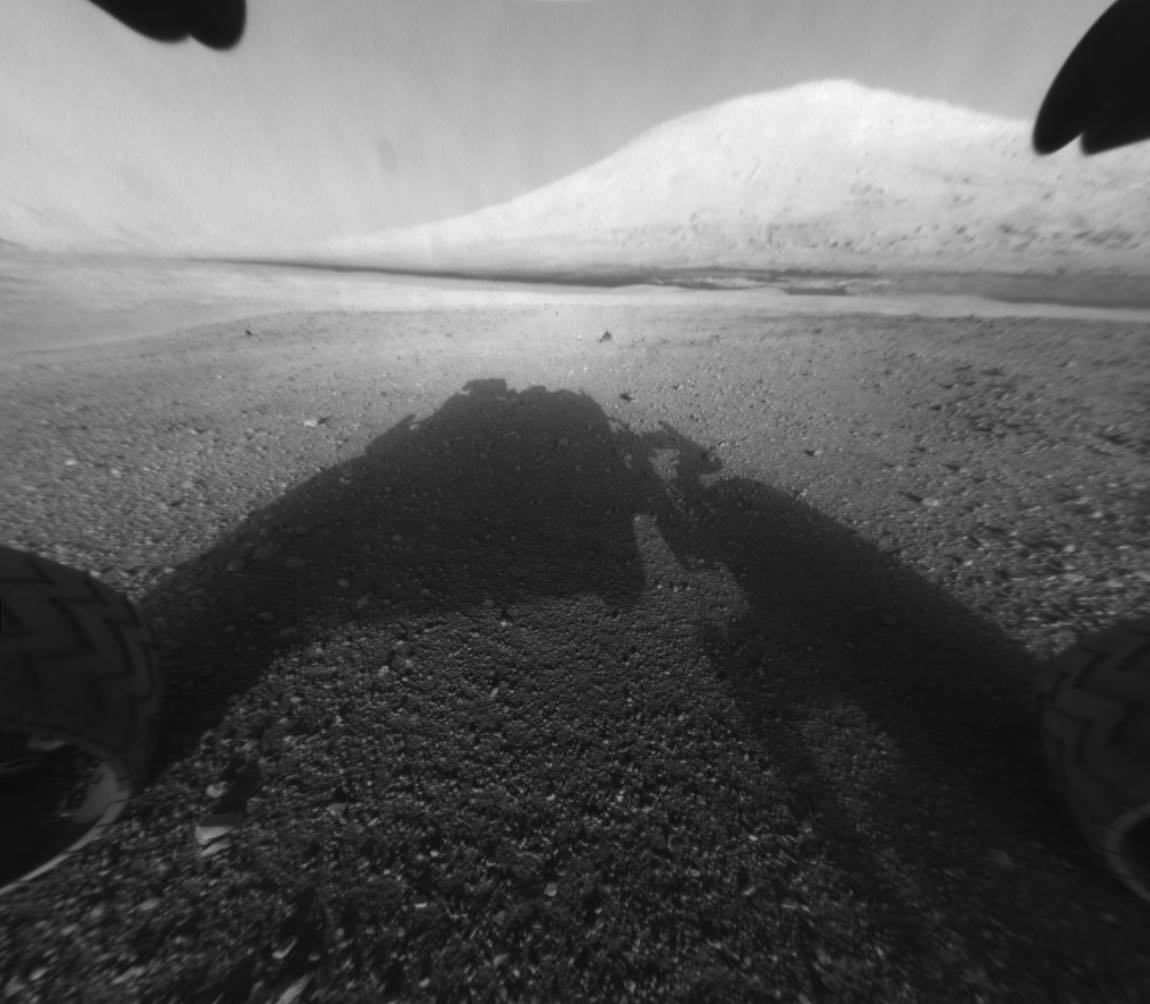
NASA’s Curiosity rover approaches Mount Sharp

(Credit: NASA/JPL/Caltech).

“If the channel or the debris pile were formed by liquid water, that’s really interesting,” said  Ashwin Vasavada, Curiosity’s project scientist with NASA’s JPL. “It would mean that fairly late in the story of Mount Sharp – after a long dry period – water came back, and in a big way.”

Vasavada and the Curiosity team believe that if this were the case, it would match previous findings that indicated water seems to have vanished and reappeared over several phases as the planet gradually became more arid.

Unraveling Mount Sharp’s Mysteries

The Curiosity team says the rover will take several months to explore the channel, which could help lead to new insights—and possibly revisions—to our understanding of the timeline for Mount Sharp’s formation.

NASA's Curiosity rover

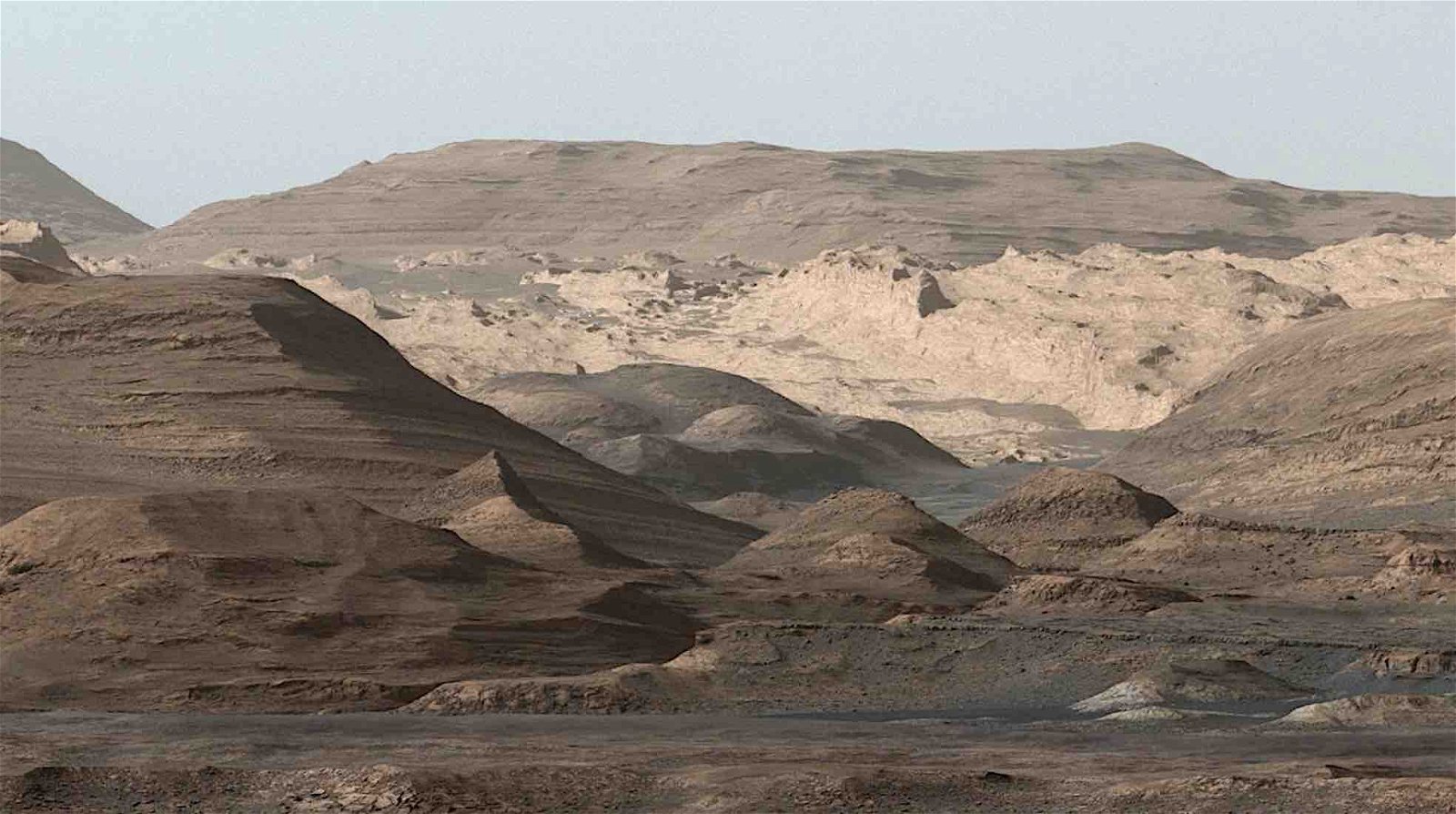
Mount Sharp, as seen from Curiosity

(Credit: NASA/JPL/CalTech/MSSS).

Although the feature’s sedimentary layers were deposited by wind and water, they didn’t initially look like they do today; erosion over long periods gradually revealed the layers that are present today, processes that would have also been required for the formation of the Gediz Vallis channel.

In addition to searching for evidence of water that may have carved the channel, most of the stony debris that now fills its base probably originates from further up Mount Sharp’s slopes, which allows Curiosity a chance to observe the mineral composition of stone from a region that it will never actually visit during its mission.

NASA has made additional information about Curiosity’s investigations available on its Mars Exploration page, which includes its science goals and frequent mission updates on its ongoing exploration of the Red Planet.


The Curious Life of a Mars Rover | Nat Geo Live
Taken by Perseverance’s Mastcam-Z instrument, this video – narrated by Perseverance Project Scientist Ken Farley – features an enhanced-color composite image that pans across Jezero Crater’s delta on Mars. Credits: NASA/JPL-Caltech/ASU/MSSS


NASA’s Curiosity Mars Rover Finds A Changing Landscape

{ https://thedebrief.org/category/space/ } 

Hoe vind je dit bericht?
Geschreven door peter om 00:00 Stuur door

NASA: Black hole’s Death Star-like beam appears to make stars explode

NASA: Black hole’s Death Star-like beam appears to make stars explode

Hoe vind je dit bericht?
Geschreven door peter om 22:26 Stuur door

NASA’s Voyager 1 Fires Dormant Thrusters After Decades

NASA’s Voyager 1 Fires Dormant Thrusters After Decades

Story by Julian James
 

NASA engineers have successfully reactivated a set of thrusters on Voyager 1, unused for decades, to keep the 47-year-old spacecraft communicating with Earth. With the probe billions of miles from our planet, this maneuver was critical to ensuring it stays on course. The aging spacecraft continues to surprise with its resilience.

By Julian James

Voyager 1’s Ongoing Journey

NASA's Voyager 1 Fires Dormant Thrusters After Decades
© Provided by Ever-Growing

Voyager 1, launched in 1977, has far exceeded its expected lifespan, continuing to transmit data from interstellar space. Currently about 15 billion miles from Earth, the probe travels beyond the heliosphere, the Sun’s protective bubble of magnetic fields. As its components age, new challenges arise, requiring NASA engineers to find creative solutions to keep the mission alive. One such challenge emerged this year when the spacecraft’s thrusters started clogging, threatening its ability to communicate.

Thruster Issues Threaten Mission

Voyager 1 relies on its thrusters to maintain its orientation, ensuring its antenna stays pointed at Earth. Earlier this year, NASA detected a clog in the fuel tube of one set of thrusters, reducing their ability to produce the necessary force. If Voyager’s antenna drifts, it would lose contact with Earth, effectively ending the mission. The team had to quickly find a way to switch to an alternative set of thrusters to prevent communication loss.

A Complex Switch Between Thrusters

Voyager 1 has three sets of thrusters: two for attitude control and one for trajectory correction. Over the years, engineers have had to switch between these sets as clogging became an issue. In 2002 and again in 2018, NASA successfully switched thruster sets when clogs appeared. However, when checking the trajectory correction thrusters this year, engineers found them even more clogged than the previous sets, leading to a decision to return to one of the original thruster sets.

Extending Voyager’s Lifespan

After careful planning, NASA engineers successfully transitioned Voyager 1 back to one of its original thruster sets by briefly powering down non-essential systems. This solution is expected to extend the probe’s life by another two to three years. However, once these thrusters are no longer functional, the options for maintaining communication with Earth will become more limited, making future decisions even more complex.

Voyager 1’s continued operation demonstrates both the durability of the spacecraft and the ingenuity of NASA engineers. While the challenges grow as the spacecraft ages, each solution brings hope for extending its mission even further. The data collected by Voyager will continue to deepen our understanding of the universe for as long as it remains operational.

Nauka unexpectedly fires thrusters after docking, tilts space station - NASA explains

Voyager 1 Stuns NASA with Mysterious Encounter in Interstellar Space
Hoe vind je dit bericht?
Geschreven door peter om 21:59 Stuur door

Turkey Kumburgaz UFO Videos Are 100% Real With Clear View Of Alien Entities Sitting Inside Craft

Turkey Kumburgaz UFO Videos

Turkey Kumburgaz UFO Videos Are 100% Real With Clear View Of Alien Entities Sitting Inside Craft

A series of UFO incidents occurred between 2007 and 2009 in the town of Kumburgaz, situated near Istanbul, Turkey. The events stunned the media and UFO enthusiasts after the images and  videos of the sightings went viral on the Internet. The  video evidence of UFOs shared by a nightwatchman named Yalcin Yalman could be another strong evidence of non-human technology.

Back in 2008, Yalcin Yalman worked as a night watchman at the Yenikent facility from where he shot all these amazing videos of UFOs, hovering over the Marmara Sea near Kumburgaz. He even showed his second-hand camera to the media in a press conference held at the Dedeman Hotel in Istanbul.

Yalman said he started recording the strange crafts as a hobby to pass his time in the night. Due to the shaky videos, some skeptics claimed that the mysterious objects over the skies of Turkey could have been a US stealth drone or other aircraft. However, numerous experts confirmed that the videos were authentic. Besides, many people witnessed the same unknown crafts in the sky. The sightings gained attention from locals, national media, and even CNN. Several videos were recorded between June 8 and 12, 2009, showing mysterious objects and lights.

Originally, the video was analyzed and made public by the Sirius UFO Space Sciences Research Center led by researcher Haktan Akdoğan. Haktan said the UFOs were often seen by civilians and military pilots during an International UFO Congress in 2009. (Source)

In 2009, after the conference, there were witnesses of 8-10 people including UFOlogist Dr. Roger Leir, who also witnessed and verified the Kumburgaz UFO sighting. Dr. Leir was present during the filming of one video on May 17, 2009, and confirmed that as the UAP turned, it was similar to the “Roswell” shaped craft (more boomerang-shaped) rather than a traditional disc. Dr. Leir discussed this incident that happened with him after the conference on Coast to Coast with George Knapp.
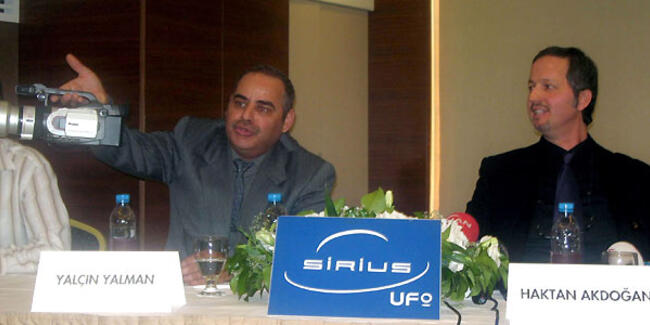
Yalcin Yalman Yalcin Yalman (Left) sitting next to Akdoğan (Right), showing his camera during a press conference in Istanbul in 2009

Dr. Leir told Knapp that he, Yalman and others went to Kumburgaz to film UFOs. The group stayed up from midnight to 4 o’clock in the morning to capture any possible sightings. The conditions were ideal, with clear skies and no obstructions. During the filming, they observed a bright object below the full moon, which initially appeared as a potential star or planet. As they focused on this object, they discovered a semi-circular craft with a multitude of lights, possibly shaped like a boomerang or a cylindrical saucer.

Dr. Leir said, 

“You’d think, ‘Well, gee, a bright sky, bright moon, you’re not going to see anything.’ But in this case, the moon was a big help. It essentially lit up the exterior portion of the craft, which initially, when we saw it, looked a bit like a boomerang because we weren’t seeing it straight on, so we couldn’t tell the exact shape of the craft. But then we went to full film on it, and we could see that it was either a boomerang, or we were looking at a certain portion of a cylindrical craft or a saucer.

Till this day, I don’t know, and I don’t know what the analysts said about the shape. But it was either one of the two: either a boomerang shape with a round front or a complete saucer. It did turn a couple of times, so we were able to see the side, and it looked like it could have been saucer-shaped. But then we got the biggest shock of our lives because we could see light that was emanating from the internal portion of the craft in three areas. One was directly in front, and one was on either side.

This was a full-on front view, and folks can look at the Coast website and they can not only see the  video but please go to the Chilean analysis because there are some still photos there which show what we saw when we looked in the central portion. That was a big shock to look and see, not a Rorschach-type thing, but actual entities that were, whatever they were doing, looking out the front of the craft, just the same as we were looking at them.”

Video Observation

From 2007 to 2009, Yalman recorded approximately 30  videos. The footage was taken with a MiniDV Canon DM-GR1-A based on the NTSC system with a diaphragm set at a maximum of 1.8. It is a 3CCD 20x optic 100x with a teleconverter mounted on a 58 mm adapter. The tele-objective is a Sony VCL HGD 1758 model lens, x 1.7. [2007 to 2009 Original Raw Footage]

The videos were examined by two influential state-sponsored organizations in Turkey, “The Scientific and Technology Research Board of Turkey” and “The TUG National Observatory.” Their objective was to identify any evidence of forgery, but the results supported the authenticity of the videos. The original film cassettes were also studied by individuals from Japan, Chile, Brazil, and Russia, and despite several attempts, no one has been able to conclusively demonstrate evidence of a hoax, fraud, or manipulation, leaving the case unidentified.

Yalman’s camera was equipped with a zoom option which allowed him to even capture the pilots, sitting in one of the crafts. The image is shaky due to the hand movements while zooming. However, with the editing software, the video was stabilized, and the result shocked everyone. Two humanoid figures could be seen in the image with large black eyes and oversized heads.

Haktan Akdoğan noted that these are the most important images in Turkey and in the world, saying: “After doing all the necessary analysis which went on for several weeks, the board came to a definite conclusion with no doubt that these are 100% genuine videos. The objects sighted in the aforementioned footage that have a structure that is made of specific material are definitely not made up by any kind of computer animation nor are they any form of special effects used for simulation in a studio or for a video effect therefore in conclusion it was decided that the sightings were neither a mock up or hoax. It is concluded that these objects in the sightings that have physical and material structures do not belong in any category such as; planes, helicopters, meteors, Venus, Mars, satellites, fireballs, Chinese lanterns, fireballs, weather balloons, natural or atmospheric phenomenon etc. and but rather fall into the category of UFOs.”

“We see the heads of not only one UFO but also of two beings in the images. This is the first in the world.” He further added that those images would have a great impact on UFOlogy. He had been researching UFOs for 22 years and had never seen something like this. He stated: “These are the most remarkable images taken in Turkish history.”

[In translation] Akdoğan stated that “these beings are generally seen in areas rich with resources, volcanic areas, and historical places. They started to come more frequently after nuclear tests. Maybe the released radiation also harms the cosmic neighbors, we disrupt the balance in the universe. Maybe they observe this dangerous process.” (Source)

According to the report issued by the Scientific and Technology Research Board of Turkey, the examination of these frames has yielded the following results:

  • The images were recorded in digital NTSC format by the above-mentioned camera.
  • The date on the  video indicates that the recordings were made during 2007, 2008, and 2009.
  • The footage images of the object that visibly have a certain configuration are not computer animations, special video effects or studio-re-created images or models. The footage is genuine.
  • The first observation made from the footage is that some of the images were recorded in the nighttime sky at a certain altitude from the horizon. The footage also covers images of the moon in some parts which proves that the video was shot in the nighttime and open air. But, the fact that digital date displays show AM in certain frames and PM in others, raises suspicion about the validity of the time in which the recordings were made.
  • Since in some parts, there is no other object that can be featured as a reference in the close-up frames and no observable differences were found on background examination, the actual location, distance, dimensions and nature of the objects could not have been determined.
  • Through the examination of shootings of multiple dates, it is a strong possibility that 2-3 different objects were captured. However, it is difficult to determine whether the objects are moving or not. Their movement is slow even if they do so.
  • The reflections of light on the objects are sometimes caused by the moon which was in a convenient location at that time, and sometimes produced by some other sources of light.
  • The light reflection from the left side of the object which is seen on the August 10th shootings is not produced by the moon. At that time, the moon was in a phase that was pretty close to the “new moon” phase and located approximately at a 10-degree proximity/angle to the horizon. Moreover, the image processing analysis conducted on some parts of the footage revealed that the center of the object has the same density as its background, namely is of a transparent nature.

Not Debunked

Adam Goldstack of UAP Media UK mentions that many debunkers try to explain the craft as cruise ships but according to former F-16 fighter pilot and researcher Chris Letho, it does not add up. Letho analyzed the  videos and case and calculated the object’s size, horizon distance, plus visual angles from the Marmara Sea. He concluded the logistics of a cruise ship did not match the reported UAP. (Source)

Additionally, the triangulation of the UAP in most video cases was calculated to be too high to be a cruise ship or boat, by other researchers. Alternatively, in the fixed/stabilized camera videos (as shown below), we can see that the objects are motionless against a black background in the vast majority of videos. The motionless aspect of the UAP could also discount the “small-boat theory,” given that even on calm waters/oceans floating objects will still move and rock around slightly. Additionally, despite the mass mainstream media coverage in Turkey at the time, no person has ever come forward to state that the objects/boats belonged to them or that they were sailing off the coast in the middle of the night.

Goldstack writes, “From an analytical perspective, the Turkey Kumburgaz UFO case is unique with regards to the clear and multiple  video footage obtained. Through this case, we also have sequential data that display behavioral patterns, times, and dates. We see all of the twenty-five video encounters/incidents at night-time/early morning (with one in the late evening), which is in keeping with the wider range of Ufology data that suggests UAP often appears at night-time.

We also see another significant pattern displaying the encounters around water – in this case, the Marmara Sea. The Sea of Marmara itself is a small sea with an area of 11,350 km2 (4,380 sq mi) and with dimensions of 280 km × 80 km (174 mi × 50 mi). The sea has a greatest depth of 1,370 m (4,490 ft). How significant the Sea of Marmara is to potential UAP has still not been explained. No connection to nuclear facilities or weapons has been linked in this case.”

{ https://howandwhys.com/ }

Hoe vind je dit bericht?
Geschreven door peter om 21:56 Stuur door

Unveiling the Truth: The Roswell Alien Autopsy – Fact or Fiction?

Unveiling the Truth: The Roswell Alien Autopsy – Fact or Fiction?

Unveiling the Truth: The Roswell Alien Autopsy – Fact or Fiction?

The Roswell Incident of 1947 remains one of the most enduring mysteries in UFO lore. Central to this enigma is the so-called alien autopsy footage that captivated millions across the globe with its shocking images of extraterrestrial bodies. For decades, conspiracy theorists, skeptics, and believers have debated the authenticity of the footage, sparking curiosity, research, and government scrutiny. However, in recent years, new revelations and leaked documents have re-opened the debate about whether the footage is genuine or a sophisticated hoax.

A Brief History of the Roswell Incident

On July 8, 1947, headlines around the world reported the discovery of a “flying disc” in Roswell, New Mexico. Initial excitement quickly turned into speculation as the U.S. military retracted their statement, claiming the debris was merely from a weather balloon. This sudden shift in narrative only fueled suspicion, leading to numerous theories that the military had found and was covering up evidence of an extraterrestrial crash.

Years later, in 1995, the so-called alien autopsy footage was released to the public by British entrepreneur Ray Santilli. The grainy black-and-white footage appeared to show an autopsy being performed on an alien body, presumably from the Roswell crash. The footage reignited global interest in UFOs, and the debate over its authenticity has never truly subsided.

The Controversy Surrounding the Footage

For years, Ray Santilli adamantly defended the authenticity of the alien autopsy footage. According to Santilli, the film was genuine but had deteriorated over time. As a result, he claimed that some sections of the footage were “restored,” adding layers of confusion about its credibility. In 2006, Santilli admitted that much of the footage was a recreation based on the degraded original film, though he maintained that key elements were authentic.

This admission raised more questions than it answered. Why would there be two versions of the autopsy footage? If Santilli’s restoration was akin to restoring a historical painting, why were two films necessary? Skeptics quickly jumped on these inconsistencies, questioning whether the entire film was a fabricated hoax designed to capitalize on the public’s fascination with UFOs.

The Role of UFO Researchers and Skeptics

Even in the face of mounting skepticism, some researchers and believers remained convinced that there was more to the Roswell incident than met the eye. UFO researcher Philip Mantle, who had long investigated the alien autopsy footage, pointed out that despite claims of a hoax, many details surrounding the film still remain unexplained. According to Mantle, efforts to debunk the footage, including investigations by major television networks, had not definitively disproven its authenticity.

On the other hand, critics of the alien autopsy film pointed out the discrepancies in Santilli’s story over the years. As more inconsistencies emerged, particularly in relation to Santilli’s handling of the film’s authenticity, doubts increased. Kodak, the company whose film stock was allegedly used, offered to analyze the footage to verify its age, but Santilli never followed through. This further fueled the narrative that the footage was likely a hoax, driven by financial gain.

Government Involvement and the UFO Community

An additional layer to the Roswell story involves government secrecy. The U.S. military’s changing explanations for the crash have led many to believe that a cover-up has been in place since 1947. Initially described as a flying disc, the object was later dismissed as a weather balloon, and then as part of a top-secret project known as “Project Mogul.” This inconsistency has only strengthened suspicions among UFO researchers that the truth about Roswell has yet to be fully revealed.

The release of the alien autopsy footage in the 1990s further complicated matters. Researchers like Robert Bigelow, an American businessman and long-time advocate of UFO research, became deeply involved in examining the film. His organization, the National Institute for Discovery Sciences, conducted studies and employed scientists to investigate the UFO phenomenon, though no definitive conclusion about the alien autopsy footage was reached.

Despite the many doubts about the footage’s authenticity, some believers insist that Santilli’s film contains at least some elements of truth. They argue that if the footage were entirely fake, why have there been so many efforts to discredit it? Supporters of Santilli’s claims point to incidents like the mysterious burglary of his office as evidence that shadowy forces were at work to suppress the truth.

Impact on Popular Culture and the Ongoing Debate

Regardless of its authenticity, the alien autopsy footage has become a staple of popular culture. It has appeared in episodes of The X-Files, The Simpsons, and Seinfeld, and has even been recreated in museums around the world. The footage’s impact on the public’s perception of UFOs has been profound, raising awareness and interest in UFO phenomena across generations.

Interestingly, while the autopsy film itself remains in question, it has not damaged the credibility of the broader Roswell story. If anything, the film has kept the incident alive in public consciousness. Even as skeptics dismiss the footage as a hoax, the core mystery of what happened at Roswell in 1947 remains unsolved.

VIDEO:

The alien autopsy footage continues to fascinate, provoke debate, and fuel conspiracy theories. The footage’s origin may be in dispute, but one thing is clear: it has become an inseparable part of the Roswell mythos. As new leaks and documents emerge, the truth behind the alien autopsy may one day come to light, though for now, the mystery lingers.

In the end, whether the footage is real or fake, the allure of the unknown continues to capture the imagination. The Roswell Incident remains one of the most compelling UFO mysteries in history, and the alien autopsy footage—whether a clever hoax or a glimpse into extraterrestrial life—will undoubtedly remain part of that legacy for years to come.

OTHER VIDEOS

Nurse Who Saw Alien Autopsies In Roswell | Roswell: The Final Verdict

The Roswell Incident (UFO Documentary) & Alien Autopsy Video

"Government Admits There WAS A Cover-Up" | Roswell: The Final Verdict

{ https://www.latest-ufo-sightings.net/ }

Hoe vind je dit bericht?
Geschreven door peter om 20:48 Stuur door

Deze dwergplaneet in ons zonnestelsel was ooit een ‘oceaanwereld’

Deze dwergplaneet in ons zonnestelsel was ooit een ‘oceaanwereld’

th?id=OVFT.OKGVgV6HrvgYr3WokberGS&pid=News&w=300&h=186&c=14&rs=2&qlt=90&dpr=1.5

Astronomen hebben een verrassende ontdekking gedaan over Ceres, de grootste bewoner van de planetoïdengordel. 

De dwergplaneet Ceres blijkt in het verre verleden een zogenoemde ‘oceaanwereld’ te zijn geweest. Dat hebben onderzoekers van de Purdue Universiteit en NASA’s Jet Propulsion Laboratory (JPL) aangetoond. Het hemellichaam herbergde volgens hen waarschijnlijk ooit een enorme oceaan, die in de loop van miljarden jaren is bevroren tot een even gigantische ijsbal.

Een onverwachte samenstelling
Lang werd gedacht dat Ceres, ontdekt in 1801 door de Italiaanse astronoom Giuseppe Piazzi, een relatief droog hemellichaam was. De talrijke kraters op het oppervlak van de dwergplaneet leken namelijk te suggereren dat die niet erg ijzig kon zijn. Immers, als er veel ijs aanwezig zou zijn, zouden de kraters snel vervormen, vergelijkbaar met hoe gletsjers op aarde ‘stromen’. Wetenschappers gingen er om die reden van uit dat het oppervlak voor minder dan 30 procent uit ijs bestond. “Zelfs vaste stoffen stromen over lange tijdschalen en ijs stroomt gemakkelijker dan gesteente”, zegt Ian Pamerleau, hoofdauteur van de studie die in vakblad Nature Astronomy werd gepubliceerd. “Dus de conclusie na NASA’s Dawn-missie (meer hierover onderaan dit artikel, red.) was dat door het gebrek aan ontspannen, ondiepe kraters, de korst niet zo ijzig kon zijn.”

Nieuwe computersimulaties werpen echter een heel ander licht op de zaak. “We hebben met onze simulaties aangetoond dat ijs onder de omstandigheden op Ceres veel sterker kan zijn dan eerder werd voorspeld, als je er maar een klein beetje vast gesteente doorheen mengt”, zegt Mike Sori, een van de auteurs van de studie. Deze bijzondere samenstelling verklaart waarom de kraters op Ceres hun vorm hebben behouden, ondanks de grote hoeveelheid ijs. De wetenschappers denken nu dat het oppervlak voor maar liefst 90 procent uit ijs bestaat. 

Van oceaan naar ijsbal
Het scenario dat de onderzoekers schetsen is fascinerend. Ceres zou ooit een ‘oceaanwereld’ zijn geweest, vergelijkbaar met Jupiters maan Europa. Het grote verschil? De oceaan was in dit geval modderig en vuil. “Onze computersimulaties houden rekening met een nieuwe manier waarop ijs kan stromen met slechts een klein beetje onzuiverheden erin gemengd, waardoor een zeer ijsrijke korst zelfs in miljarden jaren nauwelijks zou stromen. Daarom zouden we een ijsrijke Ceres kunnen krijgen die nog steeds overeenkomt met het waargenomen gebrek aan kraterrelaxatie”, zegt Pamerleau. Deze geleidelijke bevriezing heeft geleid tot een unieke structuur.

Toekomstige onderzoeksmogelijkheden
De ontdekking dat Ceres een bevroren oceaanwereld is, opent nieuwe deuren voor toekomstig onderzoek. “Voor mij is het spannendste van dit alles, als we gelijk hebben, dat we een bevroren oceaanwereld hebben die vrij dicht bij de aarde ligt. Ceres kan een waardevol vergelijkingspunt zijn voor de ijzige manen van het buitenste zonnestelsel die oceanen herbergen, zoals Jupiters maan Europa en Saturnus’ maan Enceladus”, zegt Sori. “Wij denken dat Ceres daarom de meest toegankelijke ijswereld in het heelal is. Daarom is het een geweldig doelwit voor toekomstige ruimtemissies.”

Meer over Ceres en de Dawn-missie
Ceres is een dwergplaneet in de planetoïdengordel tussen Mars en Jupiter. Het is het grootste object in die gordel en werd in 1801 ontdekt. Ceres is vooral interessant omdat het zowel kenmerken van een planeet als van een planetoïde vertoont. Het vermoeden dat er onder zijn ijzige oppervlakte mogelijk water aanwezig is, maakt Ceres relevant in het onderzoek naar de geschiedenis van water in ons zonnestelsel. 

De Dawn-missie van NASA, die in 2007 werd gelanceerd, had als doel om Ceres en een ander groot object in de planetoïdengordel, Vesta, te onderzoeken. Dawn kwam in 2015 aan bij Ceres en onderzocht de samenstelling, de geologie en de aanwezigheid van ijs. De missie ontdekte ook heldere witte plekken op Ceres, die waarschijnlijk bestaan uit zout dat overbleef nadat water verdampte. Dat kan erop wijzen dat er vroeger vulkanen waren op Ceres die geen lava, maar ijs spuwden.

Bronmateriaal


Gravity Assist: The Bright Spot of the Asteroid Belt, with Britney Schmidt

{ https://scientias.nl/ }

Hoe vind je dit bericht?
Geschreven door peter om 00:29 Stuur door

Waar is de atmosfeer van Mars gebleven? Onderzoekers denken het raadsel te hebben opgelost

Waar is de atmosfeer van Mars gebleven? Onderzoekers denken het raadsel te hebben opgelost

Mars-954x603_1.jpg

Een nieuwe studie werpt licht op het intrigerende mysterie van Mars’ ontbrekende atmosfeer. Want mogelijk verbergt die zich wel vol in het zicht…

Mars was niet altijd de kille woestijn die we nu kennen. Er zijn steeds meer aanwijzingen dat er miljarden jaren geleden water over het oppervlak van de rode planeet stroomde. En als er water was, dan moet er ook een dikke atmosfeer zijn geweest om te voorkomen dat het bevroor. Maar zo’n 3,5 miljard jaar geleden droogde het water op en de lucht, die ooit vol koolstofdioxide zat, werd aanzienlijk dunner. Hierdoor wordt onze naaste buur nu nog slechts omhuld door een flinterdunne atmosfeer. Een vraag waar wetenschappers zich al jaren het hoofd over breken, is wat er precies met de Martiaanse atmosfeer is gebeurd. Twee geologen komen nu in het vakblad Science Advances met een verrassende theorie.

Klei
Volgens de twee geologen zou het antwoord mogelijk te vinden kunnen zijn in de klei van de planeet. In hun artikel suggereren ze dat een aanzienlijk deel van de verloren atmosfeer van Mars mogelijk is opgeslagen in de kleiachtige korst. Ze stellen dat het vloeibare water dat ooit zo rijkelijk over Mars stroomde, door bepaalde soorten gesteente had kunnen sijpelen, wat een langzame kettingreactie zou hebben opgestart. Deze reactie zou geleidelijk koolstofdioxide uit de atmosfeer hebben onttrokken en omgezet in methaan — een vorm van koolstof die gedurende lange tijd in de klei van de planeet kan worden opgeslagen.

Aarde
Deze theorie is niet eens zo vergezocht. Vergelijkbare processen komen namelijk ook voor in bepaalde gebieden op aarde. De onderzoekers hebben dan ook hun kennis van de interacties tussen gesteenten en gassen op aarde gebruikt om te begrijpen hoe soortgelijke processen op Mars zouden kunnen werken. Ze ontdekten dat, rekening houdend met de geschatte hoeveelheid klei die het oppervlak van Mars bedekt, deze klei tot 1,7 bar koolstofdioxide zou kunnen vasthouden. Dit zou ongeveer 80 procent van de oorspronkelijke atmosfeer van de planeet vertegenwoordigen.

Deze afbeelding toont de geleidelijke verandering van ijzerrijke rotsen op Mars wanneer deze in contact komen met water dat CO2 uit de atmosfeer bevat. In de loop van miljarden jaren zou dit proces voldoende CO2 in de kleilaag hebben kunnen opslaan, in de vorm van methaan, om het grootste deel van het CO2 te verklaren dat uit de vroege atmosfeer van de planeet is verdwenen. Afbeelding: Courtesy of Joshua Murray, Oliver Jagoutz, et al.

Smectiet
Concreet zou de Martiaanse atmosfeer weleens opgegaan kunnen zijn in een soort oppervlakte-klei mineraal genaamd smectiet, dat bekend staat als een zeer efficiënte opslagplaats voor koolstof. In een enkele korrel smectiet zitten talloze ‘plooien’ waarin koolstof miljarden jaren lang ongestoord kan blijven. De onderzoekers hebben aangetoond dat de aanwezigheid van smectiet op aarde waarschijnlijk het resultaat is van tektonische activiteit. Zodra het aan het oppervlak kwam, konden de kleimineralen genoeg koolstofdioxide uit de atmosfeer opnemen en opslaan, waardoor de planeet gedurende miljoenen jaren afkoelde. Ook Mars blijkt bedekt te zijn met dezelfde smectiet-klei. De onderzoekers vroegen zich daarom af of deze klei op Mars een vergelijkbare functie zou kunnen hebben gehad in het vasthouden van koolstof. En als dat het geval is, hoeveel koolstof zou de klei dan kunnen opslaan?

Smectiet-klei op Mars
Zoals je hierboven kunt lezen, ontstaat smectiet op aarde door de beweging van continentale platen en het naar boven brengen van rotsen uit de mantel. Mars kent echter geen soortgelijke tektonische activiteit. Hoe het kan dat Mars dan toch bedekt is met smectiet-klei? In de loop van ongeveer een miljard jaar zou het water dat door de korst sijpelde geleidelijk reageren met olivijn. Wetenschappers denken dat de Martiaanse korst voornamelijk uit stollingsgesteente bestaat dat rijk is aan olivijn, een mineraal dat een gereduceerde vorm van ijzer bevat. Zuurstofmoleculen in het water zouden zich aan het ijzer hechten, waardoor waterstof vrijkomt en het rode geoxideerde ijzer ontstaat dat de planeet zijn herkenbare kleur geeft. Deze vrijgekomen waterstof zou vervolgens met koolstofdioxide in het water hebben gereageerd om methaan te vormen. Naarmate deze reactie in de loop van de tijd vorderde, zou olivijn langzaam zijn omgevormd tot een ander soort ijzerrijk gesteente, bekend als serpentijn, dat daarna bleef reageren met water om smectiet te vormen.

Na een rekensommetje kwamen de onderzoekers tot een interessante ontdekking. Als Mars bedekt is met een laag smectiet van 1.100 meter diep, zou deze hoeveelheid klei in staat zijn om een enorme hoeveelheid methaan op te slaan. Dit zou overeenkomen met het merendeel van het koolstofdioxide in de atmosfeer dat sinds het opdrogen van de planeet verloren is gegaan. “We constateren dat de schattingen van de wereldwijde klei-volumes op Mars overeenkomen met een groot deel van de oorspronkelijke CO2 van de planeet, dat is vastgelegd als organische verbindingen in de kleirijke korst,” zegt onderzoeker Joshua Murray. “In zekere zin zou de ontbrekende atmosfeer van Mars zich weleens in het volle zicht kunnen verbergen.”

Kortom, de onderzoekers hypothetiseren dat de verloren koolstofdioxide mogelijk is opgeslagen in de kleiachtige oppervlakken van Mars. “Mogelijk hebben zich dus op de aarde en Mars soortgelijke processen voorgedaan,” denkt onderzoeker Oliver Jagoutz. “Grote hoeveelheden atmosferisch CO2 zouden kunnen zijn omgezet in methaan en in de klei zijn opgeslagen.” Deze ontdekking is niet alleen belangrijk voor de wetenschap van Mars, maar heeft ook implicaties voor toekomstige missies naar de planeet. Zo suggereren de onderzoekers dat deze opgeslagen Martiaanse koolstof op een dag weer kan worden teruggewonnen en omgezet in brandstof. “Mogelijk is er nog steeds methaan aanwezig,” stelt Jagoutz. “Dit zou in de toekomst als energiebron op Mars kunnen worden gebruikt.”

Bronmateriaal


Mars lost its atmosphere in 'catastrophic' event

{ https://scientias.nl/ }

Hoe vind je dit bericht?
Geschreven door peter om 23:53 Stuur door

Meer van UFO'S of UAP'S, ASTRONOMIE, RUIMTEVAART, ARCHEOLOGIE, OUDHEIDKUNDE, SF-SNUFJES EN ANDERE ESOTERISCHE WETENSCHAPPEN - DE ALLERLAATSTE NIEUWTJES

↑ Terug naar de berichten