Ontdek de Fascinerende Wereld van UFO's en UAP's: Jouw Bron voor Onthullende Informatie!
Ben jij ook gefascineerd door het onbekende? Wil je meer weten over UFO's en UAP's, niet alleen in België, maar over de hele wereld? Dan ben je op de juiste plek!
België: Het Kloppend Hart van UFO-onderzoek
In België is BUFON (Belgisch UFO-Netwerk) dé autoriteit op het gebied van UFO-onderzoek. Voor betrouwbare en objectieve informatie over deze intrigerende fenomenen, bezoek je zeker onze Facebook-pagina en deze blog. Maar dat is nog niet alles! Ontdek ook het Belgisch UFO-meldpunt en Caelestia, twee organisaties die diepgaand onderzoek verrichten, al zijn ze soms kritisch of sceptisch.
Nederland: Een Schat aan Informatie
Voor onze Nederlandse buren is er de schitterende website www.ufowijzer.nl, beheerd door Paul Harmans. Deze site biedt een schat aan informatie en artikelen die je niet wilt missen!
Internationaal: MUFON - De Wereldwijde Autoriteit
Neem ook een kijkje bij MUFON (Mutual UFO Network Inc.), een gerenommeerde Amerikaanse UFO-vereniging met afdelingen in de VS en wereldwijd. MUFON is toegewijd aan de wetenschappelijke en analytische studie van het UFO-fenomeen, en hun maandelijkse tijdschrift, The MUFON UFO-Journal, is een must-read voor elke UFO-enthousiasteling. Bezoek hun website op www.mufon.com voor meer informatie.
Samenwerking en Toekomstvisie
Sinds 1 februari 2020 is Pieter niet alleen ex-president van BUFON, maar ook de voormalige nationale directeur van MUFON in Vlaanderen en Nederland. Dit creëert een sterke samenwerking met de Franse MUFON Reseau MUFON/EUROP, wat ons in staat stelt om nog meer waardevolle inzichten te delen.
Let op: Nepprofielen en Nieuwe Groeperingen
Pas op voor een nieuwe groepering die zich ook BUFON noemt, maar geen enkele connectie heeft met onze gevestigde organisatie. Hoewel zij de naam geregistreerd hebben, kunnen ze het rijke verleden en de expertise van onze groep niet evenaren. We wensen hen veel succes, maar we blijven de autoriteit in UFO-onderzoek!
Blijf Op De Hoogte!
Wil jij de laatste nieuwtjes over UFO's, ruimtevaart, archeologie, en meer? Volg ons dan en duik samen met ons in de fascinerende wereld van het onbekende! Sluit je aan bij de gemeenschap van nieuwsgierige geesten die net als jij verlangen naar antwoorden en avonturen in de sterren!
Heb je vragen of wil je meer weten? Aarzel dan niet om contact met ons op te nemen! Samen ontrafelen we het mysterie van de lucht en daarbuiten.
Big NASA spacecraft is headed to a dangerous region of the solar system
Story by Mark Kaufman
The brains of NASA's Europa Clipperspacecraft are stored in a metal vault.
It's where the large exploration vehicle — the length of a basketball court — safeguards its computers, software, and many electronics. The craft is about to launch to Jupiter's moon Europa, a world planetary scientists suspect harbors an ocean twice the volume of Earth's. With around 50 close swoops by Europa, NASA will be able to confidently answer the question of whether this ocean realm also hosts the ingredients, such as an energy source and telltale materials, to support life.
Credit: NASA / JPL-Caltech
Yet the radiation environs there are particularly harsh.
"The charged particle environment at Europa's location is immense," Cynthia Phillips, a NASA planetary geologist and project staff scientist for the space agency's Europa Clipper mission, told Mashable.
Jupiter, a gas giant planet 317 times more massive than Earth, generates a massive magnetic field shooting out between 600,000 to 2 million miles (1 to 3 million kilometers) toward the sun. It's created by the planet's liquid metal core, which spins and creates electrical currents (moving electric charges make magnetic fields). Crucially, this magnetic field grabs and then accelerates particles from the relentless solar wind — a stream of rapidly traveling charged particles emitted by the sun — which creates potent radiation belts around Jupiter.
"It bombards everything."
Any craft traveling around the planet will almost certainly pass through these hazardous zones and expose instruments to harmful particles, which can damage computer chips and electronics. "It bombards everything," Curt Niebur, Europa Clipper's program scientist, said at a press conference leading up to the mission's launch. Decades ago, during the Voyager mission, NASA's engineers were worried about the craft passing by Jupiter. A person hypothetically riding aboard Voyager as it passed Jupiter would have gotten hit with a radiation dose 1,000 times the lethal level.
A depiction of Jupiter's sprawling magnetic field. If was visible to the naked eye, "it would appear two to three times the size of the sun or moon to viewers on Earth," NASA explained.
"The relative intensity of Jupiter's radiation bands is illustrated in this diagram," NASA explains, with darker reds depicting more radiation. Both Europa and Europa Clipper's orbits are depicted in the graphic.
Hence, the vault. "The vault seriously reduces the harmful radiation these electronics get," Phillips said. (NASA's Juno craft, exploring the greater Jupiter system, also carries a vault.)
Yet there are electronics outside this protective metallic box. And in May NASA received test data that suggested some transistors — which are electrical switches that control how electricity flows around the spacecraft — couldn't withstand the high radiation environs around Europa. Fortunately, intensive follow-up testing showed these switches will work as the craft makes some 50 flybys over three and a half years. "They unequivocally passed that review today," Nicola Fox, who heads NASA's Science Mission Directorate, said following a pivotal September decision to green-light the mission.
But mission engineers will be watching these transistors closely. As theNew York Timesreported,NASA bolteda late add-on to the craft, a small "canary box" holding the different types of transistors. If any show signs of damage or dysfunction as Europa Clipper swoops through belts of radiation, planners could adapt the mission.
In this graphic, the box illuminated in red shows the Europa Clipper's vault on the center of the spacecraft.
An artist's conception of the ocean, and geothermal energy sources, that could exist beneath Europa's thick ice crust.
Already, the mission's orbital plan — which is to zip away from damaging regions after making close flybys of the ice-covered moon — minimizes the time the craft is exposed to high radiation zones. During each orbit around Jupiter, the craft will spend under a day in an irradiated zone, before swooping out. It won't return for between two to three weeks.
"You get out of there," Phillips told Mashable.
"You get out of there."
The robotic spacecraft's exposure to radiation, however, comes with rewards. When the probe dips close to Europa between 2031 and 2034, it will have the chance to view, scan, and investigate Europa in unprecedented detail. A ground-penetrating radar will look under the ice, and potentially see areas of liquid water or even where the ice meets the alien ocean. An instrument called the SUrface Dust Analyzer, or SUDA, will literally sample particles of Europa that have been ejected into space by tiny meteorites. And, of course, Europa Clipper will capture a bounty of images.
"The images are going to be spectacular," said Laurie Leshin, director of NASA’s Jet Propulsion Laboratory, the agency center that built the craft.
In sum, with this orbiting laboratory of instruments, NASA will be able to determine if the ocean moon has the right stuff — energy sources, a long-lived stable ocean, organic compounds (like carbon) — for life. If so, the agency plans to return to Europa and land on the icy crust. This time, they won't just be looking to see if it's habitable. They'll drill into the ice, looking to see if it's inhabited.
"We'll be knocking on the door for a second mission," Niebur said.
Experts have theorized that UFOs appear to defy the laws of physics potentially thanks to an anti-gravity machine, and that as a result, humans look like we're moving in slow-motion.
Luis Elizondo, the former Pentagon insider who's been blowing the lid off the government's UFO secrets, has made shocking claims in his book, 'Imminent: Inside the Pentagon's Hunt for UFOs.'
In his bombshell memoir, he outlines a theory that gained steam during his time as part of the AATIP (Advanced Aerospace Threat Identification Program) group: UFOs harness anti-gravity to circumvent the laws of physics.
An anti-gravity device, forming what Elizondo's team calls a 'bubble' around a craft, would potentially make the object immune to Earth's gravitational forces - which might explain its incredible acceleration abilities.
And without any gravity affecting the craft, there would also be no time dilation taking place, meaning that while time for everyone on Earth would be slowed down by the Earth's gravity, time for anything operating a craft would be considerably faster.
This would mean anything looking outside a craft would see the entirety of humanity moving at a fraction of their speed.
Luis Elizondo, the former Pentagon insider who's been blowing the lid off the government's UFO secrets, has made shocking claims in his book, 'Imminent: Inside the Pentagon's Hunt for UFOs'
Research by Sean Kirkpatrick, director of the Pentagon's All-domain Anomaly Resolution Office, and Harvard's Avi Loeb has shocked the scientific community when they concluded that recent UAP (Unidentified Aerial Phenomena) observations defy laws of physics
Physicist Erik Lentz from the University of Göttingen has similarly proposed a mind-boggling theory that could explain how these otherworldly visitors traverse the vast distances of space.
His research suggests a way to create the above mentioned 'warp bubble' that could allow spacecraft to travel faster than light without breaking Einstein's cosmic speed limit, as reported by Physics World.
But the catch is that it would require energy equivalent to 'hundreds of times the mass of the planet Jupiter'
'A warp bubble traveling faster than light cannot be created from inside the bubble, as the leading edge of the bubble would be beyond the reach of a spaceship sitting at its center,' he said.
'The problem is that you need energy to deform space all the way to the very edge of the bubble, and the ship simply can't put it there.'
Erik Lentz suggests a 'warp bubble' could allow spacecraft to travel faster than light without breaking Einstein's cosmic speed limit
Meanwhile, a groundbreaking paper by Sean Kirkpatrick, director of the Pentagon's All-domain Anomaly Resolution Office, and Harvard's Avi Loeb also sheds light - or bends it - on how UFO seem to create optical illusions.
The paper states that these mysterious objects should create 'a bright optical fireball, ionization shell and tail' due to friction with air or water, as reported by Popular Mechanics.
'The friction of UAP with the surrounding air or water is expected to generate a bright optical fireball, ionization shell and tail — implying radio signatures,' it wrote.
On top of that, many of the observed UAPs show no signs of these telltale signatures.
This could mean that UFOs could be nothing more than 'sensor-induced optical illusions.'
'The lack of all these signatures could imply inaccurate distance measurements (and hence derived velocity) for single site sensors without a range gate capability,' the authors wrote.
'Typical UAP sightings are too far away to get a highly resolved image of the object and determination of the object's motion is limited by the lack of range data.'
A groundbreaking paper by Sean Kirkpatrick, director of the Pentagon's All-domain Anomaly Resolution Office, and Harvard's Avi Loeb also sheds light - or bends it - on how UFO seem to create optical illusions
Without any gravity affecting the craft, there would also be no time dilation taking place, meaning that while time for everyone on Earth would be slowed down by the Earth's gravity, time for anything operating a craft would be considerably faster
However, Elizondo points out in his book that the optical illusion could be generated by the 'bubble'.
Citing the Doppler effect, the former intelligence officer said that light moving in and out of the medium would skew based on if the object was moving away from you or toward you.
Elizondo, risking his life, has alleged in his book that the US military has been running a top-secret program to retrieve and reverse-engineer alien craft for years.
He even has claimed they've recovered non-human specimens.
'We're not alone,' Elizondo told NewsNation. 'We are not alone in this universe, and it is a simple fact. The U.S. government has been aware of that fact for decades now. I think if the American public knew just how deep this lie went, that we would have a very significant constitutional crisis on our hands.'
Elizondo, risking his life, has alleged that the US military has been running a top-secret program to retrieve and reverse-engineer alien craft for years
He even has claimed they've recovered non-human specimens
His book contains, among its many incredible revelations, details on a 2016 plan hatched by Elizondo and his military colleagues to catch a UFO in the ocean.
'The United States has been involved in the recovery of objects,' Elizondo told the outlet. 'Vehicles of unknown origin that are neither from our country or any other foreign country that we're aware of.'
But it's not just conspiracy theories anymore.
In August, Elizondo told reporters that he can confirm one of two 'vehicles of unknown origin' were recovered from the now legendary Roswell UFO crash of 1947.
More shocking still, Elizondo said, 'We, as a nation have, been interested in not only the vehicles themselves but the occupants,' which he called 'biological specimens.'
Elizondo helped release three of the most famous UFO videos in history after leaving his role in the US Department of Defense in late 2017.
Elizondo first rose to national prominence in late 2017 in the pages of the New York Times — where he blew the whistle on the US military and intelligence community's pervasive mismanagement and excessive secrecy on the topic of UFOs.
His public resignation and opaque role within the Pentagon's UFO-hunting portfolio, known to its Senate backers as the Advanced Aerospace Threat Identification Program (AATIP), brought fame and a lead role in a History channel docu-series.
In April 2020, the Pentagon officially released three videos that Elizondo had helped leak in 2017, each taken by US Navy fighter pilots who had reportedly witnessed 'unexplained aerial phenomena' (UAP) as UFOs are now more technically known.
Official US Navy video shows 'UFO' tracked off East Coast in 2015
Elizondo first rose to national prominence in 2017 in the pages of the New York Times, after he helped release three US Navy infrared UFO videos - including the GOFAST video (above)
The videos depict, as Elizondo told CNN, 'things that don't have any obvious flight surfaces, any obvious forms of propulsion [...] maneuvering in ways that include extreme maneuverability beyond, I would submit, the healthy G-forces of a human or anything biological.'
Despite corroboration from his peers and the late Senate Majority leader who helped create AATIP, Nevada Democrat Harry Reid, the Department of Defense has maintained that Elizondo's military role had no official UFO-hunting duties.
Pentagon officials denied the existence of any 'credible evidence of extraterrestrial activity,' in a statement responding to NewsNation's forthcoming interview.
'As we have stated previously, Luis Elizondo had no assigned responsibilities for the Advanced Aerospace Threat Identification Program (AATIP) while assigned to the Office of the Under Secretary of Defense for Intelligence and Security,' DoD spokesperson Sue Gough told NewsNation.
Critics of Gough have pointed to a 2003 research paper on psychological warfare that she wrote for the US Army War College, implying the Pentagon spokesperson might be part of a coordinated campaign to undermine Elizondo's credibility.
And, in May 2021, Elizondo filed a 64-page complaint to the DoD's Office of the Inspector General accusing high-ranking military officials of attempting to silence him by threatening his security clearances and obfuscating of his work with AATIP.
Elizondo said he endured 'malicious activities, coordinated disinformation, professional misconduct, whistleblower reprisal and explicit threats perpetrated by certain senior-level Pentagon officials.'
Above, veteran Australian TV news broadcaster and investigative reporter Ross Coulthart - who conducted the first televised interview with government UFO whistleblower David Grusch last year - conducted the new interview with Elizondo, which airs in full on Friday
Former intelligence agent spills secrets from Pentagon's UFO program
These actions, he and his attorneys said, suggested 'a coordinated effort to obfuscate the truth from the American people, while impugning my reputation as a former intelligence officer at the Pentagon.'
His new memoir, 'Imminent,' sees the former Pentagon official opening up about much more incredible personal accounts — including the story of his own family's disturbing experience with 'green orbs' floating through their house.
In the book, Elizondo also details he and another AATIP member's plan to catch UFOs on the high seas.
He told Dailymail.com in August that their investigations pointed to these craft having an apparent interest in military operations, nuclear power, and were often seen around bodies of water.
So they coordinated with the Navy and other branches to create 'Project Interloper': an attempt to lure the mysterious craft and record them with high-tech equipment.
New Map Reveals Impressive Megastructures in Local Universe
The newly-developed map of the local Universe is based on the motions of 56,000 galaxies, according to a team of astrophysicists from the Leibniz Institute for Astrophysics Potsdam.
This map shows the distribution of matter in the local Universe; it shows how matter flows, i.e. along which trajectories (thin lines) the galaxies move.
Image credit: Valade et al., doi: 10.1038/s41550-024-02370-0.
“Mapping the Universe has always been one of the most challenging tasks in astronomy,” said lead author Dr. Aurelien Valade and colleagues.
“Inaccurate observations, observational errors and incomplete data make this work extremely difficult.”
“In addition, the observed galaxies make up only a small part of the total mass in the Universe, as much of the matter exists in the form of invisible dark matter.”
“Furthermore, galaxies are not bound to be formed in such a way that they accurately trace the underlying matter well, which makes them an uncertain indicator of the matter distribution in the Universe.”
“Therefore, in order to create a map of our cosmic environment, we also look at the motion of galaxies.”
“On the one hand, galaxies move away from us with the expansion of the Universe, but on the other hand they also attract each other due to gravity.”
“These movements can be mapped and reveal the cosmic currents — the rivers and gulf-streams throughout the cosmos on which galaxies move.”
“Since the motion is caused by gravity, it can thus be used to see the invisible.”
To create a map of the local Universe, the authors used data on the motions of 56,000 galaxies from the Cosmic Flows-4 catalogue.
“Since the measurements of each galaxy’s velocity are error prone and fairly uncertain, there are various possible cosmographic maps that would fit the observational data,” they explained.
“Thus, we developed a new approach: a ‘probabilistic’ map of the Universe.”
“Such a map indicates how likely it is that a certain feature, such as a ‘basin of attraction,’ actually exists.”
“A basin of attraction is a region which, absent the cosmic expansion, would collapse to a single point.”
With this new method, the researchers obtained a reliable picture of the large-scale distribution of matter and revealed astonishing structures of our cosmic neighborhood.
“Laniakea, the supercluster to which many believed that our Galaxy belongs, is probably merely an appendage of the much larger Shapley basin. It may not even exist as a separate entity,” they said.
“Even more astonishing is the fact that the Sloan Great Wall — an immense wall composed of hundreds of thousands of galaxies — at around a thousand trillion trillion cubic light years is currently the largest known structure in this cosmic network of galaxies.”
“It is perhaps unsurprising that the further into the cosmos we look, we find that our home supercluster is more connected and more extensive than we thought,” said Dr. Noam Libeskind, co-author on the study.
“Discovering that there is a good chance that we are part of a much larger structure is exciting.”
“At the moment it’s just a hint: more observations will have to be made to confirm the size of our home supercluster.”
The results appear this month in the journal Nature Astronomy.
A. Valade et al. Identification of basins of attraction in the local Universe. Nat Astron, published September 27, 2024; doi: 10.1038/s41550-024-02370-0
RELATED VIDEOS
Megastructures of the Future Explained
SDSS releases largest 3D map of the universe ever created
Earth will travel right in front of the same Taurid meteor stream in 2032 that caused a mass extinction and worldwide flood ~12,800 years ago, plunging Earth into a mini-Ice Age for 1,300 years. Graham Hancock was right all this time but we did not listen to him.
Our solar system is a dangerous place, and every month Earth inches closer to one of its riskier places, the “Taurid swarm” of meteors. Our planet is predicted to pass directly through the “Taurid swarm” in November 2032.
An ancient monument found in Turkey might be more than just a monument—it could be the world’s oldest solar calendar. Researchers from the University of Edinburgh studied symbols carved on the pillars of Göbekli Tepe, a large, ancient site in southern Turkey. They think these carvings were used to track days, seasons, and years, like a calendar. (Source)
The team noticed that each “V” shape carved on the pillars might represent one day. One pillar even had 365 “V”s, the same number as days in a year. They also found that a special “V” around the neck of a bird-like figure could represent the summer solstice—the longest day of the year. This might explain why the “V” symbol shows up on many other statues in the area, often around the necks of figures connected to time and creation.
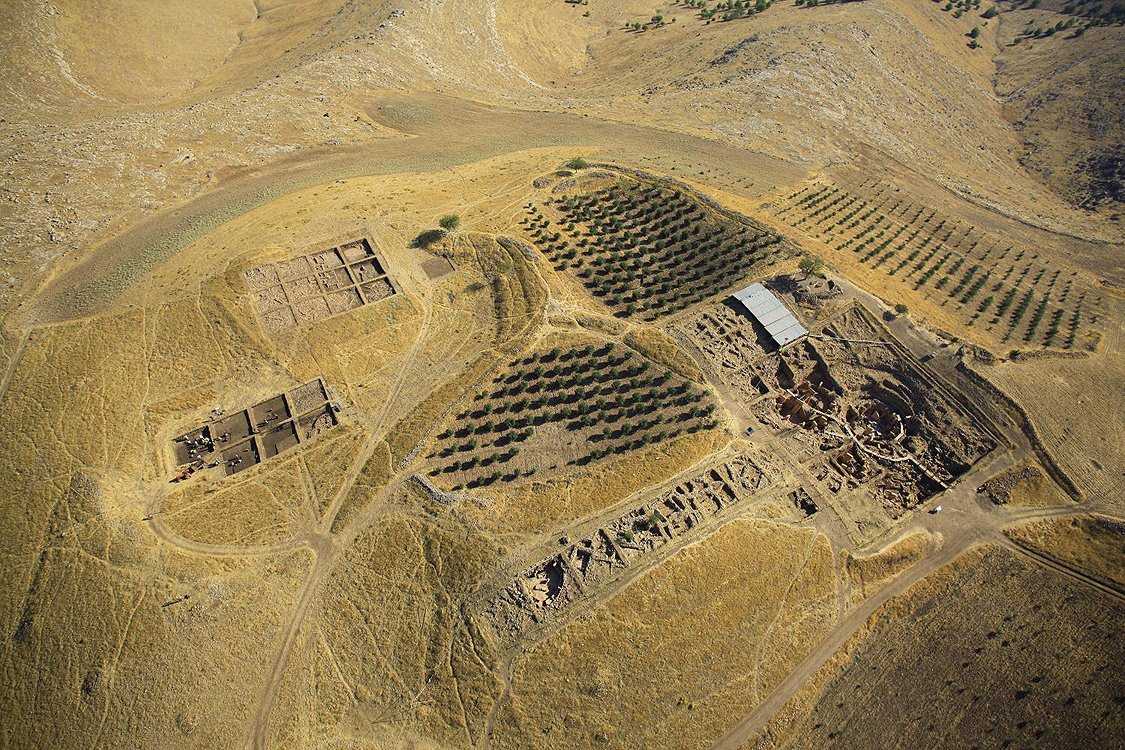
Göbekli Tepe aerial view
Mini Ice Age
The ancient calendar focused on tracking day, night, and seasonal changes, which might have become more important after a major comet hit Earth around 10,850 B.C. This event likely caused a mini-ice age that wiped out many species. According to Martin Sweatman, a researcher from the University of Edinburgh, the people at Gobekli Tepe were careful observers of the sky, possibly because the comet strike had changed their world.
This disaster may have sparked the beginning of civilization by starting new religious beliefs and pushing people to develop agriculture to survive the colder climate. Their carvings might be some of the earliest attempts at writing. These carvings also tracked the cycles of the Moon and Sun, long before similar calendars were made. They may have even shown for the first time that comet strikes are more likely to happen when Earth crosses the path of comet fragments, something that modern scientists have confirmed.
To help support this theory, the team points to another pillar at the site appearing to picture the Taurid meteor stream lasting 27 days, which was quite possibly the source of the ancient comet strike. The researchers believe that the temple carvings show the ancient civilization was recording dates precisely, noting how the movement of constellations across the sky differed based on the time of the year. This would be 10,000 years before Hipparchus of ancient Greece documented the wobble in the Earth’s axis in 150 BC, making this newfound calendar well ahead of its time.
The Younger Dryas boundary (YDB) cosmic-impact hypothesis suggests that around 12,800 years ago, Earth was hit by pieces of a large comet, which broke apart as it entered the inner solar system. This event likely caused a chain reaction, leading to an “impact winter” (a period of intense cold) and a climate change episode called the Younger Dryas (YD). (Source)
The collision is also believed to have caused massive wildfires, the extinction of large animals like mammoths, and changes in human cultures and population decline. Evidence of this impact includes unusually high levels of platinum found at 26 sites across the Northern Hemisphere, including in ice cores from Greenland, which show platinum deposits over a 21-year period.
The start of the Younger Dryas also shows an increase in dust and chemicals linked to wildfires, like ammonium and other burning aerosols, found in ice cores from Greenland, Antarctica, and Russia. These signs point to one of the biggest wildfire events in over 120,000 years, with about 9% of Earth’s forests burned, covering 10 million square kilometers.
This large-scale burning and the cooling effect of the impact may have triggered the Younger Dryas climate change, according to the theory.
A 2021 study (Taurid complex smoking gun) found that 88 near-Earth asteroids, hidden in the debris that creates the Taurid Meteor Shower, likely came from the breakup of a single comet about 20,000 years ago. Astronomers at the University of Antioquia in Colombia studied the ‘Taurid complex’ to learn more about where these objects came from.
In the 1980s, scientists William Napier and Victor Clube noticed large asteroids in the Taurid stream. They suggested these asteroids had the same origin as Comet Encke, which orbits the Sun every three years. However, some asteroids are over a mile wide, meaning they couldn’t have come from Comet Encke itself. Scientists Ignacio Ferrín and Vincenzo Orofino reviewed old research and measured light reflected from the larger asteroids.
They found more evidence that both Comet Encke and the big asteroids came from the breakup of a huge ice comet, 62 miles wide, about 20,000 years ago. The team warned that these asteroids could be dangerous to Earth, and others from the ancient comet might have already hit our planet in the past. Every year, Earth passes through a stream of debris, causing shooting stars to appear in October in the southern hemisphere and November in the north.
Comet Encke, first seen in 1786, left a trail of debris as it got closer to the sun, like other comets. This trail, made up of rocks, dust, and debris, sometimes comes close to Earth, leading to lots of scientific study. Some studies focus on larger asteroids.
Experts think impacts from the Taurid stream may have contributed to the extinction of ancient cultures and global cooling during the Younger Dryas period. The 1908 Tunguska event, where a small asteroid exploded above Russia, destroying millions of trees, is believed to be connected to this debris stream.
In 2013, the Chelyabinsk meteor, which injured over 1,500 people in Russia, may have also come from the Taurid stream. In 2005, NASA astronomer Rob Suggs observed a flash from a meteor hitting the moon, which was part of the Taurid meteor shower.
A team of Colombian researchers, along with astronomers from Italy’s University of Salento, reviewed many studies on space impacts. They confirmed that a group of space objects contains up to 88 large pieces. Using a method called secular light curves, they noticed changes in the brightness of these objects and found that 67% showed signs of “comet-like” activity. This supported the idea that these objects came from a common origin.
Napier, another scientist, supported their findings. He said that these asteroids, which have orbits like Comet Encke, could either be affected by unknown forces or are pieces of a larger, older comet that lost its gases. This original comet may have been a “rubble pile” – a mix of rocks and other materials held together by ice. Over time, this pile could have broken apart, possibly due to forces from the Sun or another object, creating smaller fragments.
One asteroid, Oljato, is an example of a rubble pile. It’s still held together by ice, which gives it comet-like activity, but it’s much smaller than its parent. Bigger inactive objects like Morpheus are similar, but their ice is trapped inside. Smaller objects, like 2006 SO198, might be the original rocky pieces. The team explained that even if an object looks like a regular asteroid, it could still have a comet-like origin.
Taurid meteors, part of this group, are usually larger than normal meteors. They shine brightly and go deeper into the Earth’s atmosphere, sometimes creating fireballs. While this is mostly harmless, the discovery of larger asteroids in one “dangerous” part of the meteor stream could be a real threat.
Earth passes through this risky area every few years, leading to more shooting stars and possibly large objects hitting Earth instead of burning up in the atmosphere. Future encounters are expected in 2022, 2025, 2032, and 2039.
In 2021, David Asher, Armagh Observatory astronomer predicted that in 2032 and 2036 we are likely to pass through the centre of the Taurid complex, where there will be a ‘noticeable enhancement of fireballs.’ According to study [Taurid complex smoking gun] authors Ignacio Ferrín and Vincenzo Orofino, outgassing from comet-like objects within the complex could be hiding smaller, but still potentially dangerous, asteroids that might hit the Earth.
‘The Tunguska cosmic body was 60 to 90 meters in diameter,’ he told Discover Magazine, adding that we ‘now believe the complex may contain many more objects of that size. It is not the tame, simple and innocent complex we thought it was.’
NASA Agrees With The Younger Dryas Impact Probability | Origin Of The Taurids Meteor Complex & Encke
Evidence of earliest human massacre 10,000 years ago found in Kenya
Professor Vopson points to the Gospel of John, one of the first four books of the New Testament, the second part of the Christian Bible.
Gospel of John opens with the powerful statement: 'In the beginning was the Word, and the Word was with God, and the Word was God.'
The professor says this verse has 'deep theological significance in Christian doctrine', but it also carries 'intriguing implications' when considered in the context of the universe as a simulation.
He argues that 'the Word' in this famous sentence refers to the underlying computer code that governs and controls the simulation.
As anyone who has seen The Matrix will know, any computer simulation, big or small, consists of letters and numbers that write the rules for the entire creation.
The academic further argues that 'the Word was God' could mean that God is part of the simulation, rather than separate from it.
In other words, the entity that is controlling the whole thing – God – is written into the code too.
Professor Vopson explains: 'The code running the simulation is not separate from the divine, but rather an integral part of it, perhaps an AI.'
Ale Belly
8 hours ago
commented on article
AB
Are we in a simulation? Scientist claims proof is hidden in the BIBLE
If we are living in a simulation then I want to know who to speak to to upgrade my package. I appear to be on the budget plan.
Reply1
56
Share
Reply
In the blockbuster movie The Matrix, protagonist Neo, played by Keanu Reeves, discovers we're living in a simulated reality. By the end of the film, Neo is able to see the simulated world for what it is - computer code (pictured)
The simulated universe hypothesis proposes that what humans experience is actually an artificial reality, much like a computer simulation, in which they themselves are constructs. It formed the basis for the 1999 film The Matrix starring Keanu Reeves (pictured as his character wakes up in the real world)
Gospel of John goes on to say: 'All things were made by him, and without him was not anything made...'
Again, this statement supports the simulated universe theory, the professor suggests.
'It implies a Creator who brought the simulated universe into existence through the Word (i.e. the code)' he says.
'It suggests that the act of creation, as described in the Bible, could be analogous to a divine act of programming and simulation.'
Arguably, the theory offers an answer to a question that many Christians struggle with – how did God create the universe in six days?
If the theory's to be believed, he did so by creating a simulated reality encapsulated in a computer programme – something we know to be possible.
The simulation theory
-The Universe: A computer simulation
- God: Part of the simulation, potentially an AI
- The Bible: Also part of the computer simulation, potentially written by the AI
Professor Vopson has outlined his hypothesis in his new book, 'Reality Reloaded: The Scientific Case for a Simulated Universe'.
He says it is not even something he necessarily believes in, but a 'extraordinary observation that deserves attention'.
'What is truly remarkable is that the interpretation given is fully aligned to the events of our times: the emergence of the AI, and also it is exactly what 'The Matrix' was projecting,' he told MailOnline.
While the professor's thoughts may seem sacrilegious to some, he says it could have 'profound implications for Christian theology'.
He believes there's an overlap where a belief in the simulated universe theory and the religious need for a almighty creator 'can coexist harmoniously'.
'This perspective aligns with religious beliefs that hold human life to be meaningful and purposeful, even within the context of a larger design,' he says.
'Instead of viewing the simulated universe hypothesis as antagonistic to religious beliefs, one can see it as offering a complementary perspective.'
Melvin Vopson, an associate professor in physics at the University of Portsmouth, has outlined the clues that suggest we live in a simulated reality
Professor Vopson thinks the prevalence of symmetry in the universe (pictured) suggests we are in a simulated reality because it's a way to save computational power
For example, the fact there's limits to how fast light and sound can travel suggest they may be governed by the speed of a computer processor.
The laws of physics that govern the universe are also akin to computer code, he says, while elementary particles that make up matter are like pixels.
He also thinks the abundance of symmetry in the world – from flowers to butterflies and snowflakes – is a power-saving technique the machines use to render the digitally constructed world.
The simulation theory is not unique to Professor Vopson; in fact, it's popular among a number of well-known figures including Tesla founder Elon Musk and American astrophysicist Neil Degrasse Tyson.
At a 2016 conference, Musk said the odds that we're living in a 'base reality' – the real universe as opposed to a simulated one – are 'one in billions'.
The term 'base reality' is part of an expansion on the theory that there are layers upon layers of fake realities that we need to somehow wake up from, akin to the film 'Inception'.
But as French philosopher René Descartes pointed out in 1637, 'Cogito, ergo sum', translated from the Latin as 'I think, therefore I am'.
In other words, the ability to doubt the nature of our reality is essentially proof that we exist, in some shape or form.
We Live in a Simulation. The evidence is everywhere. All you have to do is look.
Are we living in a Matrix Simulation? Why should we doubt our reality?
Dat China plannen heeft om de maan en haar grondstoffen te gebruiken is zeker geen mysterie. Tegelijkertijd heeft het Aziatische land de afgelopen jaren verschillende sondes naar onze satelliet gestuurd, waaronder naar de verborgen kant. Meer recent is echter het nieuws dat een team van Chinese wetenschappers enkele monsters die door de Chang'e 5-missie naar de aarde zijn teruggebracht, heeft gebruikt om water te produceren. Zou dit de eerste stap kunnen zijn naar een toekomstige menselijke aanwezigheid op de maan? Laten we het samen uitzoeken!
Chang'e 5 en de maanmonsters teruggebracht naar de aarde
Zoals de naam al doet vermoeden, is de Chang'e 5-missie zeker niet de eerste die op de maan is gearriveerd. Het bijzondere aan deze missie is dat er voor het eerst in 44 jaar monsters van de maanbodem naar de aarde zijn teruggebracht. Ondanks de daaropvolgende Chang'e 6-missie, waarbij in plaats daarvan de verborgen kant van onze satelliet werd betrokken, zijn de resultaten van Chang'e 5 simpelweg buitengewoon. Zoals te lezen is in een recente studie gepubliceerd in het tijdschrift The Innovation, hebben Chinese wetenschappers ontdekt dat de mineralen waaruit de bodem van de maan bestaat rijk zijn aan waterstof en kunnen worden gebruikt om ter plekke water te produceren. Maar hoe?
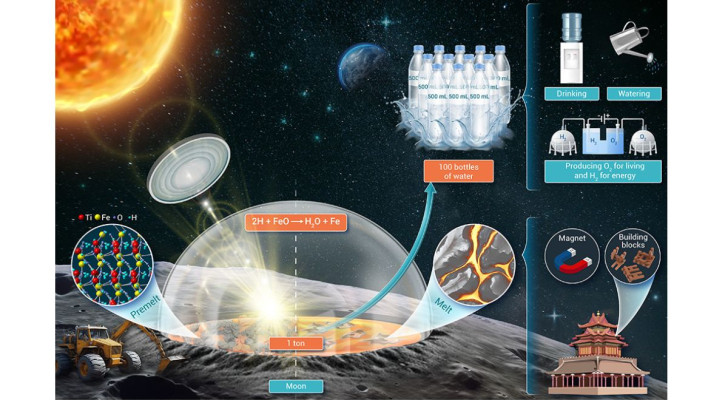
De methode waarmee je water uit eenvoudige grond kunt halen, vereist het verwarmen van de mineralen waaruit het bestaat tot extreem hoge temperaturen, om een chemische reactie van de elementen met waterstof te veroorzaken en daardoor tot de vorming van waterdamp te leiden.
Hoe je water van de Maan krijgt
Chen et al./The Innovation - 2024
Dankzij de innovatieve methode van Chinese wetenschappers kan uit elke ton maangrond ongeveer 50 liter water worden gewonnen. Het lijkt misschien niet veel, en het is ongetwijfeld een proces dat om verschillende redenen op aarde geen zin zou hebben. Op de maan verandert dit echter: 50 liter water kan voorzien in de dagelijkse behoeften van de leden van een hypothetische menselijke missie op een hypothetische maanbasis. De maanbasis vormt een concreet doel van de Chinese ruimteverkenning: het ter plekke kunnen produceren van water zou een enorm voordeel betekenen.
In feite wil China vòòr 2035 een permanent onderzoeksstation op de maan bouwen, terwijl China vòòr 2045 een ruimtestation in een baan rond de satelliet wil bouwen. Als Chang'e 5 na 44 jaar de eerste missie was die maanmonsters terugbracht, is de Chang'e 6-missie de eerste die monsters van de andere kant van de maan terugbracht. Kortom: China lijkt het serieus te nemen.
Naar een toekomstige maanbasis... en verder
Dat het mogelijk is om water rechtstreeks uit de maanbodem te halen is buitengewoon nieuws dat echter ook een aantal overwegingen met zich meebrengt. Allereerst moeten we begrijpen hoeveel energie er nodig is om de bodem te verwarmen en welke andere elementen betrokken zijn bij het proces van waterdampvorming. Ten tweede mogen we de geopolitieke implicaties niet vergeten van de belangstelling die China toont voor onze satelliet: de concurrentie om maanbronnen zal in de toekomst steeds levendiger worden. En mogelijk ook heviger.
Kortom, de resultaten van de Chinese Academie van Wetenschappen laten zien hoe het mogelijk is om steeds dichter bij het idee van een permanente aanwezigheid van de mens op de maan te komen. Aan de andere kant zijn er tientallen jaren verstreken sinds de laatste keer dat een astronaut een wandeling maakte op onze satelliet. De volgende zou wel eens een ruimtestation op de maan kunnen bewonen, op haar grond kunnen lopen... en haar water kunnen drinken.
Revolutie in de ruimtevaart: nieuw aandrijfsysteem maakt oneindige ruimtereizen mogelijk
Artikel door businessam.be
Revolutie in de ruimtevaart: nieuw aandrijfsysteem maakt oneindige ruimtereizen mogelijk
Key takeaways
Super Magdrive gebruikt direct beschikbare metalen in de ruimte als brandstof.
Traditionele raketmotoren zijn afhankelijk van schaarse bronnen zoals xenon of krypton.
Dit nieuwe systeem maakt gebruik van metalen zoals ijzer, aluminium en koper.
Onderzoekers van de Universiteit van Southampton ontwikkelen een baanbrekend aandrijvingssysteem dat direct beschikbare metalen uit de ruimte gebruikt als brandstof. Deze innovatieve technologie, bekend als Super Magdrive, zou ruimtetuigen in staat kunnen stellen om oneindige reizen door de kosmos te maken.
Traditionele raketmotoren zijn afhankelijk van schaarse grondstoffen zoals xenon of krypton, die overvloedig aanwezig zijn op aarde maar moeilijk te verkrijgen zijn in de diepe ruimte. Dit nieuwe systeem maakt daarentegen gebruik van metalen zoals ijzer, aluminium en koper, die in overvloed aanwezig zijn in ons zonnestelsel. Hoofdonderzoeker Dr. Minkwan Kim benadrukt in een gesprek met Sky News dat dit een revolutionaire benadering van ruimteverkenning is, waardoor ruimtetuigen zich ver in de kosmos kunnen wagen en gedurende langere perioden kunnen werken.
Kritische ontwikkelingen en samenwerkingsverbanden
Het team van Dr. Kim werkte samen met het Britse ruimtevaartbedrijf Magdrive aan de ontwikkeling van Super Magdrive. De Britse overheid heeft 1 miljoen pond beschikbaar gesteld om dit project te ondersteunen. Dr. Kim ziet deze technologie als een hoeksteen voor toekomstige missies in de diepe ruimte, die mogelijk tot ongekende ontdekkingen kunnen leiden.
Toekomstige implicaties en verwachtingen
Hij gelooft dat het een revolutie teweeg kan brengen in ons vermogen om nieuwe planeten te verkennen, naar buitenaards leven te zoeken en de grenzen van menselijke verkenning te verleggen door reizen mogelijk te maken die verder gaan dan eerder bedachte grenzen.
De ruimtevaart van de toekomst documentaire fragment
SpaceX launches mission to rescue astronauts stranded at ISS
This image provided by NASA shows NASA astronaut Nick Hague and Roscosmos astronaut Aleksandr Gorbunov inside the SpaceX capsule, September 28, 2024
[NASA via AP]
A SpaceX spacecraft has lifted off to rescue two astronauts stranded at the International Space Station (ISS) due to technical issues.
NASA astronaut Nick Hague and Russian astronaut Aleksandr Gorbunov took off on Saturday from Cape Canaveral, Florida to bring back Suni Williams and Barry Wilmore.
The Dragon spacecraft, operated by SpaceX, the private company founded by billionaire Elon Musk, is set to arrive at the ISS on Sunday.
Originally, astronauts Zena Cardman and Stephanie Wilson were set to be part of NASA’s SpaceX Crew-9 mission.
However, they gave up their spots to accommodate Williams and Wilmore, astronauts stranded on the ISS due to technical issues with the Starliner spacecraft.
Williams and Wilmore were originally scheduled to return to Earth on June 13, after their Boeing Starliner capsule launched its first crewed flight from Florida’s Cape Canaveral Space Force Station on June 5. But the Starliner had been plagued with issues, even before the June 5 launch. A previous launch attempt was scrapped on June 1 just moments before launch because of a ground control computer performance issue.
During the 25-hour flight to the International Space Station, the spacecraft experienced several helium leaks and a malfunctioning thruster. Then, when the Starliner arrived on June 6 and attempted to dock at the ISS, four more of the 28 thrusters malfunctioned causing the ship’s arrival to be delayed.
Saturday’s launch of NASA’s mission had been delayed for several days due to the effects of Hurricane Helene. Weather concerns persisted until the last minute, with rain and storms posing risks to the mission.
“The crewmates will conduct more than 200 scientific investigations, including blood clotting studies, moisture effects on plants grown in space, and vision changes in astronauts during their mission,” read a NASA statement.
Williams and Wilmore are expected to return to Earth in February 2025, along with Hague and Gorbunov.
Related video:
NASA's Plan To Rescue Stranded Astronauts - Playing Sardines In A Space Capsule
Earth's Mini-Moon Is Arriving Today. What to Know About Our Temporary Second Moon
Story by Joe Hindy
The asteroid 2024 PT5 will enter Earth's orbit on Sept. 29 and depart on Nov. 25.
Jose A. Bernat Bacete/Getty Images
Anew mini-moon the size of a city bus will begin circling our planet and hanging out in our skies until Thanksgiving week. An asteroid named 2024 PT5 will enter Earth's orbit, get caught there from Sept. 29 to Nov. 25, and then fly away again, back into the solar system.
Some past mini-moons, such as this one from 2020, have been discovered to be random pieces of space junk. The 2020 mini-moon was eventually identified as a rocket booster from the 1966 Surveyor 2 Centaur launch. But ATLAS reports this upcoming mini-moon is likely to be a real asteroid, which is simply defined as a small, rocky object that orbits the sun.
Amateur astronomer Tony Dunn posted a simulation to X of what the asteroid's path will look like. 2024 PT5 has already been near Earth since July.
During the event, the asteroid's geocentric energy will become negative and remain that way for 56.6 days. In Dunn's simulation, the orbit is shown as the red line, and it only circles about 25% of the Earth.
The asteroid won't complete a full orbit of Earth, so some astronomers refer to it as a temporarily captured flyby. Mini-moons that do complete a total orbit of Earth are referred to as temporarily captured orbiters.
Related video:
Earth will be gaining a 'Mini Moon' tomorrow (KOLR Springfield)
Don't expect to see the mini-moon
It's unlikely you'll see the mini-moon. NASA says the absolute magnitude of 2024 PT5 is 27.593. That means it's quite dim and won't be visible even if you have a telescope. For reference, the dimmest magnitude that is visible to the naked eye at night is around 6.5 and a 12-inch telescope can see objects with a magnitude of around 16 or 17. That means amateur astronomers are going to have to sit this one out since you'd need a much larger telescope to see 2024 PT5.
Many asteroids come back over and over again for repeat visits as well. The 2022 NX1 asteroid became a mini-moon in 1981 and 2022. It's scheduled to make its return in 2051. One of the best examples is 2006 RH120, which orbited Earth for a whole year between July 2006 and July 2007. The phenomenon is so consistent that some researchers claim that Earth always has a mini-moon lurking around somewhere.
What Really Happened at the Pentagon’s Once-Hidden UFO Office?
An office in the Pentagon investigated UFOs—and the paranormal—over a decade ago, segueing into a long saga leading to Congressional hearings and breathless news stories today. But the real story looks more like former defense officials pushing their personal mythology, rather than any cover-up of aliens
Historical photograph of The Pentagon in Arlington, Virginia.
lassicStock/Alamy Stock Photo
After a long hiatus of systematic U.S. government–affiliated investigations into UFOs, a Pentagon office quietly resumed such efforts in 2008. Called the Advanced Aerospace Weapon Systems Applications Program (AAWSAP), it was funded to the tune of $22 million in total. The life—and cancellation four years later—of this Defense Intelligence Agency program has featured in congressional hearings, UFO “whistleblower” claims and renewed public uproar about aliens. But the real story is more sordid than sensational.
In 2022 the U.S. Department of Defense established the brand-new and separate All-Domain Anomaly Resolution Office (AARO) to investigate military reports of UFOs, now called unidentified anomalous phenomena, or UAP. Currently AARO offers a unique chance for the government to get this UFO thing right once and for all—but not in quite the way that more hard-line alien believers might wish.
The new office has its hands full. Last year congressional hearings heard claims of alien technology recoveries and a supposed decades-long cover-up of ET’s presence on Earth. Such assertions fill the new book Imminent: Inside the Pentagon’s Hunt for UFOs, by former military counterintelligence officer Luis Elizondo, attracting renewed notice among podcasters and serious news outlets alike.
Investigating these unverifiable fables about aliens should be scrapped as a fool’s errand for AARO, which earlier this year released a historical review demolishing this long-running conspiracy theory. The office’s real value, from a technical standpoint, lies in resolving UFO sighting reports with the very latest technology and tools, supplementing time-honored fact-checking and investigation, and showing how UFOs can be tracked and resolved in real time using high-tech sensors, rather than relying on the suboptimal witness testimonials that fill bookshelves and cable-news specials.
Government-themed conspiracy theories have been part of the UFO milieu for decades, but recent testimonies by “whistleblowers” to congressional committees have given these accounts a hitherto unparalleled air of authenticity. Far from being a scientific sea change, however, as longtime scholars of UFO claims we regard them as having elements closer to religion, with the same core group of advocates—including some former AAWSAP insiders—pushing the “nonhuman intelligence” narrative of hidden aliens or interdimensional beings.
AAWSAP was officially meant to research future aerospace threats but was a de facto UFO/paranormal investigation effort, a fact affirmed in the AARO historical report. Controversy has surrounded the office since the publication of a credulous 2017 New York Times article identified it by the moniker “Advanced Aerospace Threat Identification Program” (AATIP). The acronym soup confusion regarding the name has been exacerbated by Elizondo, who co-opted the AATIP label for his own, informal follow-on effort at the Pentagon after AAWSAP’s termination in 2012.
AAWSAP’s output included 38 “Defense Intelligence Reference Documents” produced by scientists contracted by mogul and UFO enthusiast Robert Bigelow, along with other reports described intwo books. The latter reports reference as-yet unreleased databases of international UFO cases, investigations and findings from the “spooky” Skinwalker Ranch in Utah once owned by Bigelow, and monthly reports supposedly delivered to the DIA, along with a 494-page “10 Month Report” replete with charts, graphs and findings. There are good reasons to harbor doubts about these reports’ quality and objectivity.
Elizondo’s effort, despite his countless mass media and podcast appearances, has yielded no publicly accessed findings or deliverables proving any claims about a UFO cover-up. These may come to light, but “AARO assesses that the inaccurate claim that the USG [U.S. government] is reverse-engineering extraterrestrial technology and is hiding it from Congress is, in large part, the result of circular reporting from a group of individuals who believe this to be the case, despite a lack of evidence,” that office concluded in its recent report.
This entire saga shows how pseudoscientific thinking can metastasize in a positive feedback loop, ensnaring not only scientists with paranormal inclinations but also government officials. This was bemoaned by the former head of AARO, Sean Kirkpatrick, who remarked that these officials are tasked with matters of national urgency—a responsibility necessitating a mindset committed to objective investigation and analysis. Some of these officials are on the record casting AARO as part of the “cover-up.” Indeed, the UFO belief system has long ago morphed into a type of faith requiring no evidence.
The fact that officials harboring evidence-deficient beliefs regarding extraterrestrials and “high strangeness” (a term first popularized in the early 1970s by ufologists to describe certain bizarre and seemingly absurd elements of some UFO and “alien” encounters) are entrusted with national security matters should give one pause. America’s adversaries, to the extent that they are paying attention to the UFO mess, might well regard it as yet another avenue to undermine American institutions—somewhat reflecting a CIA panel’s 1953 warning about potential Soviet exploitation of the genre.
On a more positive note, ufology is now in vogue among historians keen to understand the mythical nature of the problem and how it relates to historical waves of aerial phenomena reports. Because of how modern media, and especially now digital media, magnify the voices of breathless advocates, sundry frauds and scientists with a penchant for the paranormal, the UFO phenomenon from 1947 onward has acquired much greater gravitas than prior scares and waves, some of which predate it by centuries.
Many serious people dismiss UFOs as a fringe interest or a pop culture distraction. Yes, they are. Yet we maintain, along with an increasing number of scholars, that there is much to be learned from studying UFO sightings, flaps and waves. While our own view is that UFOs, or UAP, emphatically do not represent any truly anomalous physical phenomena such as an extraterrestrial presence, this nevertheless does not consign ufology to insignificance. We should explore its meaning rather than ceding it to sensationalistic advocates employing shoddy methodologies and pushing quasi-religious, otherworldly stories. AARO and academia are thus tasked with an important responsibility that could yield original and fascinating developments into how and why people interpret and react to things they see in the sky.
This is an opinion and analysis article, and the views expressed by the author or authors are not necessarily those of Scientific American.
VIDEOS
Secret Pentagon Program (Full Episode) | UFOs: Investigating the Unknown
Ep. 7 | The Basement Office | Pentagon UFO videos, Navy encounters w/ UFOs, real facts & evidence
The UFO Lie: Shocking truth of Pentagon AAWSAP program | The Basement Office
Meer van UFO'S of UAP'S, ASTRONOMIE, RUIMTEVAART, ARCHEOLOGIE, OUDHEIDKUNDE, SF-SNUFJES EN ANDERE ESOTERISCHE WETENSCHAPPEN - DE ALLERLAATSTE NIEUWTJES


 Big NASA spacecraft is headed to a dangerous region of the solar system