Naar de inhoud

UFO'S of UAP'S, ASTRONOMIE, RUIMTEVAART, ARCHEOLOGIE, OUDHEIDKUNDE, SF-SNUFJES EN ANDERE ESOTERISCHE WETENSCHAPPEN - DE ALLERLAATSTE NIEUWTJES

UFO's of UAP'S in België en de rest van de wereld
akke.beakke.be
Ontdek de Fascinerende Wereld van UFO's en UAP's: Jouw Bron voor Onthullende Informatie! Ben jij ook gefascineerd door het onbekende? Wil je meer weten over UFO's en UAP's, niet alleen in België, maar over de hele wereld? Dan ben je op de juiste plek! België: Het Kloppend Hart van UFO-onderzoek In België is BUFON (Belgisch UFO-Netwerk) dé autoriteit op het gebied van UFO-onderzoek. Voor betrouwbare en objectieve informatie over deze intrigerende fenomenen, bezoek je zeker onze Facebook-pagina en deze blog. Maar dat is nog niet alles! Ontdek ook het Belgisch UFO-meldpunt en Caelestia, twee organisaties die diepgaand onderzoek verrichten, al zijn ze soms kritisch of sceptisch. Nederland: Een Schat aan Informatie Voor onze Nederlandse buren is er de schitterende website www.ufowijzer.nl, beheerd door Paul Harmans. Deze site biedt een schat aan informatie en artikelen die je niet wilt missen! Internationaal: MUFON - De Wereldwijde Autoriteit Neem ook een kijkje bij MUFON (Mutual UFO Network Inc.), een gerenommeerde Amerikaanse UFO-vereniging met afdelingen in de VS en wereldwijd. MUFON is toegewijd aan de wetenschappelijke en analytische studie van het UFO-fenomeen, en hun maandelijkse tijdschrift, The MUFON UFO-Journal, is een must-read voor elke UFO-enthousiasteling. Bezoek hun website op www.mufon.com voor meer informatie. Samenwerking en Toekomstvisie Sinds 1 februari 2020 is Pieter niet alleen ex-president van BUFON, maar ook de voormalige nationale directeur van MUFON in Vlaanderen en Nederland. Dit creëert een sterke samenwerking met de Franse MUFON Reseau MUFON/EUROP, wat ons in staat stelt om nog meer waardevolle inzichten te delen. Let op: Nepprofielen en Nieuwe Groeperingen Pas op voor een nieuwe groepering die zich ook BUFON noemt, maar geen enkele connectie heeft met onze gevestigde organisatie. Hoewel zij de naam geregistreerd hebben, kunnen ze het rijke verleden en de expertise van onze groep niet evenaren. We wensen hen veel succes, maar we blijven de autoriteit in UFO-onderzoek! Blijf Op De Hoogte! Wil jij de laatste nieuwtjes over UFO's, ruimtevaart, archeologie, en meer? Volg ons dan en duik samen met ons in de fascinerende wereld van het onbekende! Sluit je aan bij de gemeenschap van nieuwsgierige geesten die net als jij verlangen naar antwoorden en avonturen in de sterren! Heb je vragen of wil je meer weten? Aarzel dan niet om contact met ons op te nemen! Samen ontrafelen we het mysterie van de lucht en daarbuiten.

Archief

De James Webb-telescoop heeft een enorm vraagteken in de ruimte gevonden: wat betekent het?

De James Webb-telescoop heeft een enorm vraagteken in de ruimte gevonden: wat betekent het?

Janine imagedoor Janine
De cluster van sterrenstelsels met zwaartekrachtlenzen MACS-J0417.5-1154, gezien door Hubble en JWST

NASA

Vergeleken met een paar decennia geleden weten we nu veel meer over het heelal en zijn samenstelling, geschiedenis en toekomst. Maar ondanks de antwoorden die zijn gevonden dankzij de voortdurende ontdekkingen van wetenschappers en de beelden van telescopen, blijven er nog veel vraagtekens bestaan. Letterlijk, soms. In feite is de ontdekking van een vraagteken in de ruimte, gefotografeerd door de James Webb Space Telescope, recent. Wat is het precies? En probeert het universum ons echt iets te vertellen? Laten we het samen ontdekken!

Een ongelooflijke zwaartekrachtlens

Als je naar de foto kijkt die door de JWST is gemaakt, lijkt het echt op een enorm vraagteken in de ruimte. Probeert het universum ook met ons te communiceren? Nou, ja en nee, want het vraagteken dat we zien is in werkelijkheid een geval van pareidolia, dat wil zeggen een illusie die ons ertoe brengt bekende objecten in willekeurige vormen te zien. En in feite bestaat het vreemde kosmische object uit drie sterrenstelsels die dit visuele effect bieden dankzij een zwaartekrachtlens.

Een zwaartekrachtlens, een effect dat al door Einstein werd voorspeld, is een verschijnsel dat optreedt wanneer het pad van licht van een object dat ver van ons vandaan is, wordt vervormd als gevolg van de vervorming van de ruimtetijd. Als licht een enorme massa passeert, buigt de ruimtetijd en dus ook het licht, waardoor gekromde sterrenstelsels, vreemde visuele effecten... en vraagtekens in de ruimte ontstaan.

Drie sterrenstelsels voor een vraag

Het door de JWST gefotografeerde gedeelte van de ruimte waar het vraagteken in de ruimte te zien is

NASA, ESA, CSA, STScI, V. Estrada-Carpenter (Saint Mary's University)

De foto die is gemaakt door de James Webb Space Telescope laat drie sterrenstelsels zien die in onze ogen een vraagteken in de ruimte vormen. Twee daarvan vormen de bovenkant van het bijzondere symbool: de eerste zit vol kosmisch stof en is rood van kleur, terwijl de tweede een wit spiraalvormig sterrenstelsel is. Tot slot is er de stip die wordt gevormd door een derde sterrenstelsel dat perfect is uitgelijnd met de telescoop. Jaren geleden had zelfs de Hubble dezelfde scène gefotografeerd, maar het detailniveau daarvan was veel lager dan dat van de JWST, waardoor het sommige details die we nu kunnen zien, niet kon vastleggen.

Bovendien zijn de eerste twee sterrenstelsels ongeveer 7 miljard lichtjaar van ons verwijderd, dus wat wij zien is wat er ongeveer 7 miljard jaar geleden is gebeurd. Het is heel goed mogelijk dat die twee sterrenstelsels vandaag zijn gefuseerd of al ver weg zijn, maar dat kunnen we niet weten. Nog niet, tenminste.

Voorbij het kosmische vraagteken

De ontdekking van een vraagteken in de ruimte is, afgezien van simpele humor of een subtiele metafoor, buitengewoon. Allereerst laat het opnieuw dat ongelooflijke instrument zien dat de JWST is, zelfs vergeleken met de Hubble-telescoop die ook de hemel blijft afspeuren. Ten tweede is het observeren van een zwaartekrachtlens altijd een kans voor astronomen en astrofysici, omdat het hen in staat stelt verder te kijken dan onoverkomelijke sterrenstelsels en te bestuderen wat daarachter ligt.

Kortom, deze ontdekking lijkt misschien eenvoudig en banaal: het was tenslotte gewoon een kwestie van het analyseren en inkleuren van enkele beelden verkregen op het infraroodspectrum, en het bekijken van de verschillende delen. Maar in werkelijkheid is de reikwijdte ervan veel breder: het toont opnieuw aan dat het vandaag de dag mogelijk is om het universum als nooit tevoren te zien en misschien enkele van de meest ondoorgrondelijke mysteries ervan te beantwoorden. Beginnend met de juiste vraagtekens.

 { https://www.curioctopus.nl/ }

Hoe vind je dit bericht?
Geschreven door peter om 21:06 Stuur door

Mysterious UFO Encounter: Deputy Sheriff Val Johnson’s Unforgettable Experience

Mysterious UFO Encounter: Deputy Sheriff Val Johnson’s Unforgettable Experience

Deputy Sheriff Val Johnson’s Mysterious Experience


On August 27, 1979, a seemingly routine night for Deputy Sheriff Val Johnson of Marshall County, Minnesota, turned into one of the most puzzling and widely discussed UFO encounters in history. What began as a standard patrol near the town of Stephen took a mysterious turn when Johnson experienced an inexplicable encounter with a bright beam of light. This incident has remained one of the most credible and well-documented UFO cases, leaving both investigators and skeptics baffled.

The Mysterious Encounter

In the early hours of the morning, Johnson was patrolling a rural road in northern Minnesota when he noticed an unusual light shining down on the highway ahead of him. Initially, he thought it might be a plane or possibly smugglers dropping cargo, as drug trafficking was not uncommon in the area at the time. But as Johnson drove closer, the beam of light suddenly grew brighter and engulfed his vehicle, blinding him.

At that moment, Johnson lost consciousness. When he regained awareness, he found his patrol car had skidded off the road. His windshield was cracked, his car’s antenna was bent, and both the dashboard clock and his wristwatch were running 14 minutes behind. Johnson also sustained physical injuries, including eye damage resembling welder’s burns—a condition often associated with exposure to intense light.

Investigating the Aftermath

Once Johnson called for help, local authorities quickly arrived at the scene. His injuries and the damage to his patrol car sparked an immediate investigation. The cracks on the windshield and the bent antenna were analyzed by forensic experts and engineers, but no conclusive explanation could be provided for the damage. Moreover, the fact that both his wristwatch and the car’s clock were exactly 14 minutes behind pointed to an electromagnetic anomaly, as UFOs are often linked to disruptions in electronic devices.

This time discrepancy became one of the most puzzling aspects of the case, leading some investigators to speculate that Johnson may have experienced a form of time distortion—a phenomenon sometimes reported in UFO encounters. The detailed physical evidence, combined with the deputy’s injuries, elevated this case to national attention and made it difficult to dismiss as a mere fabrication or hallucination.

Theories and Explanations

Over the years, several theories have been proposed to explain what happened to Val Johnson that night. Some believe Johnson may have collided with a low-flying aircraft, despite there being no evidence of debris or other signs of such an impact. Others have suggested that he may have been struck by lightning, though no storms were reported in the area at the time.

UFO skeptics have tried to rationalize the incident as a misinterpretation of natural phenomena, but these explanations fall short due to the lack of weather anomalies and the unique nature of Johnson’s injuries and the clock discrepancies.

A Credible Witness

One of the key reasons why the Val Johnson UFO encounter has been taken so seriously is the credibility of the witness. As a deputy sheriff, Johnson was a respected figure in the community and known for his professionalism and reliability. His account of the incident remained consistent throughout the investigation, and he showed no signs of trying to gain publicity or financial benefit from the story.

Moreover, Johnson’s injuries were real and documented by medical professionals. His eyes showed symptoms consistent with exposure to a high-intensity light source, and he exhibited signs of physical trauma, including bruising and a concussion. These details make it harder to dismiss his account as a simple hallucination or misjudgment.

The Case That Still Baffles

Despite the extensive investigation into the Val Johnson encounter, no definitive explanation has ever been found. The case remains one of the most perplexing UFO incidents, largely due to the physical evidence and the credible testimony of a law enforcement officer. While some theories have been floated, none adequately account for all the strange phenomena that occurred that night.

Today, the Val Johnson incident stands as one of the most credible and well-documented UFO encounters in history. It is a case that continues to intrigue researchers, UFO enthusiasts, and skeptics alike, as it raises profound questions about what Johnson encountered that night on the lonely rural roads of Minnesota.

VIDEO:

The Val Johnson UFO encounter is a prime example of how some UFO sightings and experiences defy logical explanations. The combination of physical evidence, personal injuries, and a credible witness makes this case stand out in the long history of unexplained aerial phenomena. Even after decades of investigation, the encounter remains shrouded in mystery, reminding us of the complexities and unknowns that still exist in our world.

While no answers have been definitively provided, the incident continues to fuel discussions about the potential existence of extraterrestrial life and unexplained aerial encounters, making it a cornerstone in the annals of UFO research.


Deputy Fired Over UFO Investigation | News First 5

Minnesota’s most notorious UFO sighting remains a mystery four decades later

Finding Minnesota: Deputy's UFO Encounter

{ https://www.latest-ufo-sightings.net/ }

Hoe vind je dit bericht?
Geschreven door peter om 18:51 Stuur door

Ocean Explorers Discovered a Massive Underwater Mountain That's Taller Than Mt. Olympus

Ocean Explorers Discovered a Massive Underwater Mountain That's Taller Than Mt. Olympus

Story by Connor Lagore

the seamount covers an area of about 70 sq km the summit depth is 994m and the base is at 4,103m giving it a prominence of 3,109m over the surrounding seafloor

Courtesy of the Schmidt Ocean Institute

  • Oceanographers explored an area around the Pacific Ocean’s Nazca Ridge and found a massive underwater mountain.
  • Using a sonar system, the researchers digitally mapped the seafloor of the area and observed the rare and largely unknown species of wildlife that make their homes on the underwater mountains’s ridges.
  • Of the 71 percent of the Earth’s surface that is ocean floor, only 26 percent of it has been mapped with the level of resolution used on this expedition by the institute.

Summiting Greece’s towering Mount Olympus is an impressive feet for the 1-million-plus people who have accomplished the climb. But it would be even more impressive if they could do it underwater.

That’s impossible—for now. But oceanographers led by the Schmidt Ocean Institute exploring the depths of the Pacific Ocean just discovered a massive underwater mountain that at least presents the opportunity.

Regardless of climb-ability, the 3,109-meter seamount is a massive find. It’s one of many made during the oceanographers’ 28-day late-summer exploration in the research vessel Falkor (too), whimsically named for the famous luckdragon from The Neverending Story.

The team discovered the mountain along the Nazca Ridge, which is located about 900 miles west of the Chilean coast—a region that itself contains a chain of underwater mountains. But this particular peak was towering above the rest. The submerged mountain is about 200 meters taller from base to peak than Mount Olympus, and roughly four times the size of the tallest building in the world (Dubai’s Burj Khalifa), according to a press release from the institut

The Falkor (too) crew mapped the mountain and the surrounding area using a sonar system on the bottom of the vessel’s hull. “Sound waves go down and they bounce back off the surface, and we measure the time it takes to come back and get measured. From that we get a really good idea (of the seabed topography),” Jyotika Virmani, the institute’s executive director, told CNN.

The area plotted by the expedition is a drop in the ocean (pun intended), but every drop counts. Just under three-quarters of the Earth’s surface (about 71 percent) is ocean floor, but of that expanse, we’ve only mapped about 26 percent in high resolution—including this recent Nazca Ridge mission. The oceanographers also studied nine other features of the area, including a smaller, neighboring mountain’s sprawling coral garden that stretches the size of three tennis courts.

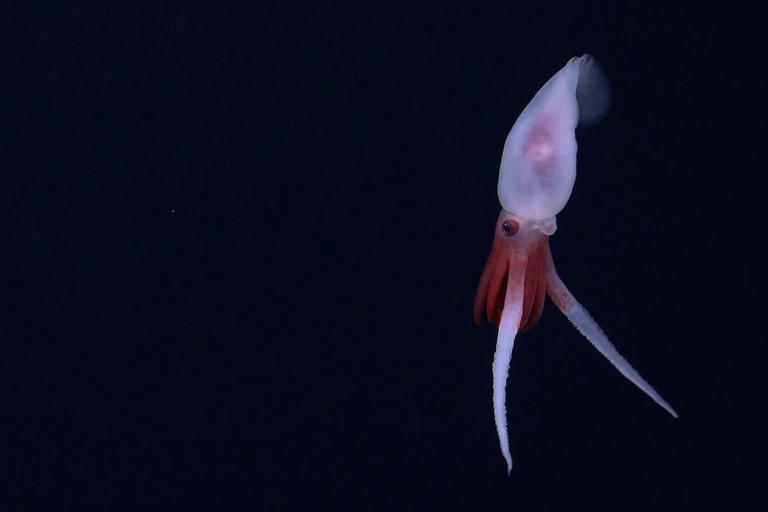
The rocky slopes on the Nazca Ridge mountains, and other mountains like them across the ocean, are perfect homes for ancient coral and sponge gardens in which some sea life can live largely undisturbed. In addition to mapping the mountains, the researchers used a robot to explore the region and made some pretty major wildlife discoveries. This includes the thePromachoteuthis squid, which is so rare that everything we previously knew about it came from the small handful of specimens that were collected as long ago as the late 1800s.

The Promachoteuthis squid, an extremely rare genus of squid known only from a few collected specimens that have been found as long ago as the late 1800s.

The Promachoteuthis squid, an extremely rare genus of squid known only from a few collected specimens that have been found as long ago as the late 1800s.
© Courtesy of the Schmidt Ocean Institute

“The seamounts of the Southeastern Pacific host remarkable biological diversity,” Alex David Rogers, Science Director of Ocean Census, said in a press release from the Schmidt Ocean Institute.

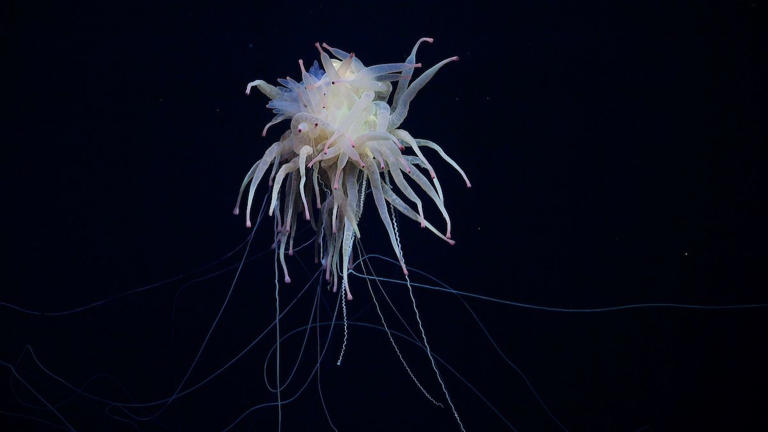
The researchers also spotted a Caspar octopus—the first confirmed appearance of the cephalopod in the southern Pacific Ocean—and Bathyphysa siphonophores, which are more commonly and ridiculously known as “flying spaghetti monsters” (an apt description).

The Bathyphysa siphonophore, which is more commonly and ridiculously known as “flying spaghetti monsters.”

The Bathyphysa siphonophore, which is more commonly and ridiculously known as “flying spaghetti monsters.”
© Courtesy of the Schmidt Ocean Institute

This was the institute’s third expedition of the year to that region of the ocean floor. During the previous two, researchers documented over 150 previously unknown species.

Scientists hope the results of these Nazca Ridge expeditions will help push forward policies to safeguard these areas of the natural world that—despite the fact that we don’t often see them—are no less worth protecting than what we can see.

“We’ve explored around 25 seamounts on the Nazca and Salas y Gómez Ridges,” Co-Chief Scientist and Schmidt Ocean Institute Marine Technician Tomer Ketter said in the press release. “Our findings highlight the remarkable diversity of these ecosystems, while simultaneously revealing the gaps in our understanding of how the seamount ecosystems are interconnected. We hope the data gathered from these expeditions will help inform future policies, safeguarding these pristine environments for future generations.”

VIDEOS


Rare species caught on camera in underwater mountain range

The Hidden World of Seamounts

Stunning Display of Biodiversity on Un-surveyed Seamount | Nautilus Live

{ https://www.msn.com/en-us/feed? }

Hoe vind je dit bericht?
Geschreven door peter om 18:28 Stuur door

SpaceX Drains Air From Spacecraft While Astronauts Are Inside

SpaceX Drains Air From Spacecraft While Astronauts Are Inside

Story by Victor Tangermann
SpaceX Drains Air From Spacecraft While Astronauts Are Inside

One Small Step

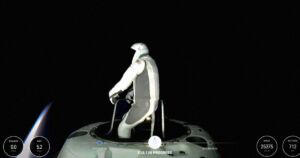
SpaceX's all-civilian Polaris Dawn mission has pulled off an incredible feat: the first-ever commercial spacewalk.

After fully depressurizing their entire spacecraft, billionaire and mission commander Jared Isaacman and crewmate Sarah Gillis carefully clambered outside their Crew Dragon capsule early Thursday morning to have a once-in-a-lifetime peek at the Earth below.

Footage shows Isaacman standing up and stretching his arms while holding onto the spacecraft's "Skywalker" platform, a pool ladder-like structure to ensure he and Gillis could keep in constant contact with the capsule.

The stunt was performed at an altitude of 458 miles, almost twice the height of the International Space Station's usual orbit.

"SpaceX, back at home we have a lot of work to do, but from here it looks like a perfect world," Isaacman told mission control while getting an unparalleled view of Australia.

Giant Private Leap

Another video of the stunt shows a first-person perspective of Isaacman climbing out as SpaceX employees cheered him on at the company's headquarters. In total, Isaacman and Gillis spent roughly eight minutes outside the capsule.

Prior to venturing outside, the crew began slowly lowering the pressure inside the spacecraft to become accustomed to the thin air. Hours into their journey, the cabin pressure was lowered to 8.6 psi, which is just above the conditions at the base camp of Mount Everest. They also began to breathe pure oxygen through the connections of their spacesuits.

SpaceX to launch Polaris Dawn mission featuring 1st commercial spacewalk

By the time Isaacman and Gillis ventured outside, the pressure inside their suits was a mere 5 psi, just below the summit of Mount Everest.

But even with SpaceX's newfangled extravehicular activities (EVA) suit, Isaacman and Gillis were still fully connected to their Dragon spacecraft via an umbilical, providing them with a steady supply of oxygen and thermal controls.

Isaacman and Gillis tested several mobility features of their new spacesuits, including hand and body movements, foot restraints, and the ability to hold tools during their short stints outside the spacecraft.

The mission isn't just historic as the first commercial spacewalk. Just hours into their mission, the Polaris Dawn crew reached an apogee of 869 miles — roughly three times the altitude of the space station — marking the farthest from Earth that any human has ventured since NASA's Apollo missions half a century ago.

The spacewalk is yet another major achievement for the Elon Musk-led SpaceX, setting the stage for similar missions to come.

And NASA is absolutely thrilled as well.

"Today’s success represents a giant leap forward for the commercial space industry and NASA's long-term goal to build a vibrant U.S. space economy," said NASA administrator Bill Nelson in a statement.

More on the mission: 

The post SpaceX Drains Air From Spacecraft While Astronauts Are Inside appeared first on Futurism.

Hoe vind je dit bericht?
Geschreven door peter om 17:25 Stuur door

Japans ruimtevaartbedrijf ispace wil maanlanding herdefiniëren met Hakuto-R Missie 2

Japans ruimtevaartbedrijf ispace wil maanlanding herdefiniëren met Hakuto-R Missie 2

Artikel door businessam.be
 
apans ruimtevaartbedrijf ispace wil maanlanding herdefiniëren met Hakuto-R Missie 2

Key takeaways

  • Tweede maanlandingsmissie, “Hakuto-R Missie 2”, voorlopig gepland voor december.
  • Het ruimtevaartuig zal worden afgeleverd via een SpaceX Falcon 9 raket vanuit Florida en zal proberen de maan te raken na ongeveer vier tot vijf maanden ruimtevlucht.
  • Het doel van de missie is om het goed te maken na de mislukte eerste poging in april 2023 door een misrekening van de hoogte.

Het Japanse ruimteverkenningsbedrijf ispace heeft plannen aangekondigd voor een tweede maanlandingsmissie, voorlopig gepland voor december. De “Hakuto-R Missie 2” zal bestaan uit het afleveren van een ruimtevaartuig via een SpaceX Falcon 9 raket vanuit Florida en een maanlanding proberen te maken na een ruimtevlucht van ongeveer vier tot vijf maanden.

Na de mislukte eerste poging in april 2023 als gevolg van een misrekening met de hoogte, is ispace erop gebrand om zichzelf te verlossen. Het bedrijf is gemotiveerd door het succes van Intuitive Machines, dat in februari ’s werelds eerste particuliere maanlanding realiseerde.

Achtergrond en motivatie

Ispace, opgericht in 2010, heeft ongeveer 300 mensen in dienst in Japan, de Verenigde Staten en Luxemburg. Net als andere landen onderzoekt Japan de maan op zoek naar water, brandstof en andere bronnen die het menselijk leven in de toekomst kunnen ondersteunen.

In de afgelopen jaren zijn verschillende landen, waaronder India, Japan en China, met succes op de maan geland. De Verenigde Staten plannen hun eerste maanlanding met astronauten sinds 1972 als onderdeel van het Artemis-programma, gepland voor 2026.


ispace HAKUTO-R Mission 1: Landing Live Stream

Why Japan's Moon Lander Crashed Due to An Unbelievable Computer Bug
Hoe vind je dit bericht?
Geschreven door peter om 17:07 Stuur door

Scientist Reveals Two Terrifying Underwater UFO Encounters On Nuclear Submarine During Covert Operations

Bob McGwier underwater UFO

Scientist Reveals Two Terrifying Underwater UFO Encounters On Nuclear Submarine During Covert Operations

An unidentified object that was traveling under the ocean at a speed greater than the speed of sound came dangerously close to a nuclear submarine. This claim was made by a researcher who was working on a classified operation aboard the USS Hampton when he made the statement. For many years, Bob McGwier worked in clandestine intelligence. He disclosed two incidents about underwater UFOs or USOs, that he saw while performing covert operations. This claim was made several months after a video had been made public by the United States military, in which it appeared to show an unidentified flying object moving from the sky into the water in the year 2019.

UFO researcher and former fighter pilot Chris Lehto heard the story from Bob McGwire, who said that the submarine passed at incredible speed while “going deep and fast” in the late 1990s. McGwire stated that this encounter was corroborated by a member of the crew who was surprised by the speed of the Unidentified Submerged Object, also known as the USO. (Source)

“We were underway and all of a sudden I hear the sound it was really strange… it was moving so fast. I just cannot believe it because this submarine is limited in the speed it can go by the incompressibility of the water in front of it and this thing blew by us like we were standing still. I’m not going to throw anybody else under the bus here but I guarantee you the following happened: a person with knowledge of onboard systems came out and said ‘oh my God’ this goddamn thing is going faster than the speed of sound underwater but that’s faster than the speed of sound in air.”

Robert G. McGwier is the founder and Technical Advisor at Hawkeye 360. He serves as Technical Director of Federated Wireless, Inc. Dr. McGwier is the Director of Research for the Ted and Karyn Hume Center for National Security and Technology, and Research Professor in the Bradley Department of Electrical and Computer Engineering at Virginia Tech. At Virginia Tech, he leads the overall execution of the Center’s research mission and leads the university’s program development efforts in national security applications of wireless and space systems. His area of expertise is in radio frequency communications and digital signal processing.

Bob McGwier underwater UFO

UFO researcher Chris Lehto with Scientist Bob McGwier: Image credit: YouTube screencap

McGwire had another USO encounter that took place onboard the USS Blue Ridge (LCC-19) in 2008 while it was in a violent Typhoon. “I wanted to look outside and see what I could see and I was on the bridge so I was right up there underneath the American flag looking out the windows. When I noticed that even though we were in a typhoon and it was raining like mad there was no rain hitting the ship and I’m going what the heck and I looked out the window and looked up and I could see a glow above us in the sky. It was not very bright but I could see it and whatever it was blocking off the rain from the entire ship stem to stern.”

McGwire continued: “I believe I was on the port side and the reason I say that is because I took a peek outside and I could do that because I was Leeward in other words the winds were from behind me and the bulkhead of the ship were blocking the winds. So, I could look up easily so anyway it suddenly grew brighter and took off straight up and the rain returned.”

Similar to McGwire’s second encounter, in 1991, USS Kirk FF108 USO Encounter took place off the west coast of South America. The witness stated that at that time, he was a Chief of Operations and Intelligence serving aboard the Knox-class escort destroyer USS Kirk FF1087 and that they were part of a drug interdiction force consisting of the USS Kirk and three other Navy ships. Their main task was to patrol using a network of radars to track and then intercept drug planes flying out of Colombia, Panama and Guatemala, as well as to seize any smuggling ships that they could find. (Source)

US Navy Chilling Underwater UFO Encounters USS Kirk (FF-1087). Image credit: Wikimedia Commons

The witness said that his primary position was at the CIC Combat Information Center, which he and 22 other specialists maintained 24 hours a day, 7 days a week, rotating in two shifts of 11 people.

At 2 a.m. on December 16, he was on duty at CIC. The night was calm and nothing unusual happened. He said he used the break to go up to the bridge. At this time, the entire ship was in a status called “darkened ship,” when all external lights were turned off, as well as on the bridge, that is, everything around was dimly lit only by instrument panels. His friend was on deck duty that night, and they chatted when they had some free time. And suddenly, everything around was lit up in the red color:

“All of a sudden and out of nowhere, like a huge flash from a camera, emanating from the starboard bow sea level upward was a huge flash of red glowing light, which lit up our entire ship. It only lit up our ship, not the surrounding ocean, just our ship. It happened so fast, that the OOD, the navigator and I were speechless for about 5 seconds, at which time I looked at the OOD and asked him if he just saw that light. He stated yes in a sullen voice.

Read also:

I then asked the navigator and he replied yes. I then took the navigator’s sound powered headset, and asked the forward and aft look outs, if they had just seen the same red flash, to which the forward look out stated, “YES! WHAT THE HELL WAS THAT?”

After lookout said yes as well. I then immediately contacted CIC, and asked the CIC officer if we had any aircraft or surface ships in our vicinity, to which he replied clear as a whistle. I asked if we had any submarine activity in the area, to which he replied, no. At this point I looked at the OOD and asked him if we should wake up the captain or as we would call him, The Old Man. The OOD sat there stunned for a minute, as did I and everyone else.

What had just happened did not make any sense. The flash emanated from the sea, directly off of our starboard bow (like it was touching our bow), and ascended upwardly so rapidly, creating the effect of the bright red flash. The other weird aspect of this event was that only our ship was lit up within the red flash, not the surrounding sea, but our vessel only. The OOD elected not to wake the captain, and the entire incident was logged in our ship’s log as an unexplained phenomenon.

Up until this event, I did not believe in UFOss or USOss. I have no doubt that our ship, steaming along at 12 knots, came right up on a submerged unidentifiable aircraft. I don’t think the aircraft or USO had any idea we were sailing up to them. I think whatever it was, took off in a very unplanned and fast manner, and wanted to quickly identify us, thus the flash.”

In the end, after much deliberation, they decided not to wake the captain up, but simply to register it in the ship’s log as an “unexplained phenomenon.”

Many members of the United States Navy have reported fascinating sightings, and video showing UFOs entering water has even been made public. A video that was shot by the sailors of the USS Omaha in July 2019 off the coast of San Diego is one of the pieces of evidence that are being put up to support this claim. A spherical object is seen soaring over the ship and then plunging into the ocean in a video that was shared by UFO researcher and investigative director Jeremy Corbell. During this time, a member of the crew can be heard saying, “Wow, it splashed!”

The video generated considerable interest online, and when Corbell revealed that a Navy submarine had been dispatched to look for the object without success, things got even more intriguing. It is interesting to note that at around the same time, American submarines also spotted other mysterious anomalous objects that defied the laws of physics in the water nearby. The Navy has verified the authenticity of the video but claims to have no explanation for its existence.

More specifically, Luis Elizondo, a former director of the Pentagon’s Advanced Aerospace Threat Identification Program, said:

“Imagine a technology that can do 6-700 g-forces, which can fly at 13,000 miles per hour, which can evade radar and which can fly through air and water and eventually. in the space. And oh, by the way, has no obvious signs of propulsion, no wings, no control surfaces and yet can still defy the natural effects of Earth’s gravity. This is precisely what we are seeing.” (Source)

{ https://www.howandwhys.com/ }

Hoe vind je dit bericht?
Geschreven door peter om 23:58 Stuur door

Nuclear fusion reactor in South Korea runs at 100 million degrees C for a record-breaking 48 seconds

Nuclear fusion reactor in South Korea runs at 100 million degrees C for a record-breaking 48 seconds

Image

The inside of a tokamak fusion reactor. 
(Image credit: Monty Rakusen/Getty Images)

South Korea's "artificial sun" has set a new fusion record after superheating a plasma loop to 180 million degrees Fahrenheit (100 million degrees Celsius) for 48 seconds, scientists have announced. 

The Korea Superconducting Tokamak Advanced Research (KSTAR) reactor broke the previous world record of 31 seconds, which was set by the same reactor in 2021.The breakthrough is a small but impressive step on the long road to a source of near-unlimited clean energy. 

Scientists have been trying to harness the power of nuclear fusion — the process by which stars burn — for more than 70 years. By fusing hydrogen atoms to make helium under extremely high pressures and temperatures, so-called main-sequence stars convert matter into light and heat, generating enormous amounts of energy without producing greenhouse gases or long-lasting radioactive waste. 

Related: 

But replicating the conditions found inside the hearts of stars is no simple task. The most common design for fusion reactors — the tokamak — works by superheating plasma (one of the four states of matter, consisting of positive ions and negatively charged free electrons) and trapping it inside a donut-shaped reactor chamber with powerful magnetic fields.

Keeping the turbulent and superheated coils of plasma in place long enough for nuclear fusion to happen, however, has been a painstaking process. Soviet scientist Natan Yavlinsky designed the first tokamak in 1958, but no one has ever managed to create a reactor that is able to put out more energy than it takes in.

One of the main stumbling blocks has been how to handle a plasma that's hot enough to fuse. Fusion reactors require very high temperatures — many times hotter than the sun — because they have to operate at much lower pressures than where fusion naturally takes place inside the cores of stars. The core of the actual sun, for example, reaches temperatures of around 27 million F (15 million C) but has pressures roughly equal to 340 billion times the air pressure at sea level on Earth.

A photo of South Korea's KSTAR nuclear fusion reactor.  (Image credit: Korea Institute of Fusion Energy (KFE))

Cooking plasma to these temperatures is the relatively easy part, but finding a way to corral it so that it doesn't burn through the reactor without also ruining the fusion process is technically tricky. This is usually done either with lasers or magnetic fields.

To extend their plasma's burning time from the previous record-breaking run, the scientists tweaked aspects of their reactor's design, including replacing carbon with tungsten to improve the efficiency of the tokamak’s "divertors," which extract heat and ash from the reactor.

"Despite being the first experiment run in the environment of the new tungsten divertors, thorough hardware testing and campaign preparation enabled us to achieve results surpassing those of previous KSTAR records in a short period," Si-Woo Yoon, the director of the KSTAR Research Center, said in a statement.

KSTAR scientists are aiming to push the reactor to sustain temperatures of 180 million F for 300 seconds by 2026.

The record joins others made by competing fusion reactors around the world, including one by the U.S. government-funded National Ignition Facility (NIF), which sparked headlines after the reactor core briefly put out more energy than was put into it.

"

{ https://www.space.com/ }

Hoe vind je dit bericht?
Geschreven door peter om 23:39 Stuur door

Bill Tompkins Was In Control Room When Neil Armstrong Met Moon Reptilians

William Tompkins

Bill Tompkins Was In Control Room When Neil Armstrong Met Moon Reptilians

Just two years before his death, William M. Tompkins had written “Selected by Extraterrestrials,” which induced sudden chaos in the UFO community with his incredible testimony about the US Navy’s secret development of space battle groups with the assistance of major aerospace companies beginning with Douglas Aircraft. He can be considered one of the most incredible whistleblowers to step forward and disclose the Secret Space Programs, E.T. Agendas, and hidden governments. He claimed to be part of an operation involving US Navy spies who stole UFO plans and antigravity technological secrets from the Nazis during World War II.

In July 2017, at a press conference, Tompkins made an unprecedented statement. He worked for the Douglas Aircraft Company alongside extraterrestrials (Nordic alien women). It had been 4-7 years before NASA appeared. He claimed about it in his book (mentioned above) that was published in 2015.

William Tompkins William Tompkins of Oceanside, CA displays one of the 307 ships in his fleet. A modeler since age 9, he started in earnest in his teens and built an entire fleet that illustrates naval history throughout America’s history. Image Credit: Craftsmanshipmuseum.com/Tompkins

Additionally, he revealed that the Nazis had already had operational UFOs during the war, and because of the information that the US spies were able to obtain, the US later developed its fleet of UFOs – which then got siphoned off into the black military sphere under the control of Majestic 12, the ultra-secretive group that controlled and managed the UFO/alien issue in the 1940s.

During the time of World War, there were secret societies such as the Thule Society and the Vril Society. Famous British historian Nicholas Goodrick-Clark wrote a whole chapter about Maria Orsic in his book “Black Sun” published in 2001, where he connected her with Vril society.

The author mentioned that Orsic could communicate with alien civilizations and one of them was from the planet Aldebaran, which is located in the Taurus system.

According to Tompkins, the Nazis were in contact with Extraterrestrial Reptilians at the same time

According to Tompkins, Hitler allowed Orsic (and the Nordics with whom she was working) to continue to work on their UFO program because the Nazis were already in contact with the Reptilians, and because Hitler knew he could always take over Orsic’s project at any time.

Robert Wood, who was interviewed alongside William Tompkins by Search4TruthReality (source), claimed that the Nazis’ technology rapidly advanced due to their relationship with the Reptilians so that they got to the far side of the moon before the end of WW2.

Nordics and draco aliens William Tompkins and Dr. Robert Wood during an interview in 2016.

Dr. Wood worked in research and development management in Douglas Aircraft and McDonnell Douglas from 1956 to 1993. Later he became a Board member of MUFON. He was given $500,000 to disseminate UFO documents and $250,000 to make a UFO documentary. Later, Robert and his son Ryan scanned hundreds of MJ-12 documents and made them available on their website MajesticDocuments.com.

According to William Tompkins, he was recruited at a young age by the Navy due to his precocious ability to build highly accurate model ships. After working at North American Aviation and Northrop, he was hired by Douglas Aircraft Company in 1950.

In interviews such as with Project Camelot and in his book “Selected by Extraterrestrials,” Tompkins revealed much of his story. He explained that MJ-12 began in 1942 with the senior Douglas (the man who started the company).

Tompkins stated that right after the Battle of LA in 1942, to handle the implications of UFOs openly showing themselves in the skies, Douglas pulled some key men into a group (or think tank) that later became MJ-12.

Dr. Wood stated that MJ-12 is mostly associated with the Air Force, not other branches of the US military. He explained that the US Navy started back-engineering Nazi UFO crafts in 1942 before MJ-12 came into existence. It took the Navy around a decade to produce functional UFO craft, but they did so eventually.

Tompkins stated that when the first astronauts went to the moon, they were shocked to discover it had already been occupied by Draco Reptilians. He said that the Reptilians, over 9 feet tall, were standing next to their advanced craft.

Bill Tompkins: They were parked around the side of the crater. Okay. They were not parked on it. They were floating above it. So there were hundreds of these nine-foot reptilian guys standing with their legs. Yeah. They were all the way across underneath their vehicles, standing on the crater.

Interviewer: And what do they look like?

Bill Tompkins: They’re ugly-looking lizard, alligator-type people. They got the same skin as the lizards got. Okay. And terrible-looking faces. But then they have the ability to shift and look like a human. All of them do. Okay.

Interviewer. Do you think Von Braun was a reptilian?

Bill Tompkins: No. Your president. Yes.

Interviewer: Oh, which one?

Bill Tompkins: [George Bush senior] And Bill Clinton and this guy you just got rid. Yeah. They all were. Right. Okay. And they all have this ability to make themselves look like real good-looking people.

Interviewer: And you’re saying Trump isn’t one?

Bill Tompkins: No, he’s not. That’s a relief. And he knows more about this subject than people realize. But trying to get back to your earlier question, these groups of extraterrestrials who work together but are at war with other extraterrestrials, okay, have these vehicles that look like a planet, like our moon is a vehicle. It’s a command center for this arm. The easiest way to look at this is to put your arm out like this, and you be the center of the galaxy. (Source)

Read also:

According to both Tompkins and Dr. Wood, the Reptilians had already made a deal with the Nazis. Amazingly, Tompkins himself claimed he saw ancient structures on the far side of the moon and that he saw a floating building – 1.5 miles above the lunar surface.

According to Tompkins, many ET species are interacting with humanity currently, including Dracos/Reptilians and Nordics which have a great influence on the world.

In his Project Camelot interview, Tompkins prevented himself from disclosing more information about Reptilians as it was harmful to his credibility. Tompkins also described the US Military’s concerns about UFOs and alien beings and the Military’s rush to create advanced space-based weapons, which could be used to defend the planet Earth against an ET threat to our civilization.

He revealed US Navy has Battle Groups operating outside the Earth. He designed five spaceships and thirty support ships. Using the latest technology, he designed different spaceships for Northrop Aviation Company. Northrop started building the huge craft underground in Utah.

Tompkins claimed we are now building even better Battle Groups. The Apollo moon landings were also designed to build a base on the moon. We have had bases on the moon along with bases on Mars and Jupiter’s moons.

A month after the shocking conference, Tompkins passed away unexpectedly on August 21, 2017, in San Diego, California, at the age of 94.

  • Bill Tompkins was in the control room when Neil Armstrong met the moon r...

  • Reptilians on the Moon - William Tompkins

{ https://www.howandwhys.com/ }

Hoe vind je dit bericht?
Geschreven door peter om 23:21 Stuur door

NASA’s groundbreaking new solar sail finally spread its wings in space

  • NASA’s groundbreaking new solar sail finally spread its wings in space

What is the Advanced Composite Solar Sail System?

What is the Advanced Composite Solar Sail System?

If humans are ever going to become a spacefaring species then we need to figure out a few more efficient ways to traverse the cosmos. That’s why NASA’s latest futuristic solar sail tech should be raising eyebrows.

More reality than fiction

Photo Credit: Wiki Commons By NASA/Marshall Space Flight Center, Public Domain

More reality than fiction

Solar sails may seem more science fiction than reality, but just four months after a new NASA solar sail project hitched a ride into space, it spread out its sails and proved that the concept could be a viable option for space travel. 

It won’t be taking us to Mars anytime soon

Photo Credit: Wiki Commons By Andrzej Mirecki, Own Work, CC BY-SA 3.0

It won’t be taking us to Mars anytime soon
Obviously, solar sails will not be able to take humans to other planets quite yet, but the technology could be used for a wide variety of missions in space. But how exactly does a sail work in the vacuum of space (a place with no wind)?

What team are you on?

©Provided by Sports Unlimited News

Not like the sails back on Earth
Solar sails aren’t exactly like the sails on a boat here on Earth but the concept is quite similar according to Space.com. Just like how wind can guide a sailboat, solar energy (photons) can be harnessed to help guide vessels through space.

How does a solar sail work?

How does a solar sail work?
“It only takes a slight amount of sunlight to guide solar sails through space,” Space.com noted, adding that although “photons don't have mass, they can force momentum when they hit an object,” which is how solar sails can move objects in space.

Launched into space in April 2024

Photo Credit: Wiki Commons By Scott Andrews, Public Domain

Launched into space in April 2024
On April 24th, the Advanced Composite Solar Sail System (ACS3) headed up to space with Rocket Lab's Electron vehicle, and on August 29th, the ACS3 spread its solar sails in space for the first time, and it was captured by cameras fixed to its sails.

The solar sails are fully deployed

Photo Credit: NASA

The solar sails are fully deployed
NASA published the first image from the ACS3’s sail deployment on September 5th, and it was a sight to see—even if its orientation was a bit confusing, something that NASA noted in its press release alongside the image.

The mission’s success is pretty awesome

Photo Credit: Wiki Commons By NASA Ames Research Center / NASA/Aero Animation/Ben Schweighart

The mission’s success is pretty awesome
“The success so far of this mission is pretty awesome because solar sail technology is an incredibly impressive concept both in practice and in theory,” reported Live Science’s Monisha Ravisetti. But now the real work has begun for NASA's ACS3 team.

The ACS3 will be put to the test

Photo Credit: NASA/Aero Animation/Ben Schweighart

The ACS3 will be put to the test
NASA’s new solar sail system will be put to the test over the next few weeks according to Space.com’s Meredith Garofalo, who reported that the maneuverability of the system will be observed so that more can be learned about how to improve the system.

Valuable information will be gathered

Photo Credit: Wiki Commons By NASA, Public Domain

Valuable information will be gathered
Raising and lowering the orbit of the Advanced Composite Solar Sail System spacecraft will provide valuable information that may help guide future concepts of operations and designs for solar sail-equipped science and exploration missions,” NASA noted.

Half the size of a tennis court

Half the size of a tennis court

The ACS3 spacecraft orbits the Earth at nearly double the altitude of the International Space Station according to NASA, which also pointed out its sails span roughly 860 square feet or about 80 square meters (half the size of a tennis court for reference).

Visible with the naked eye

Photo Credit: NASA/Bill Ingalls

Visible with the naked eye
“Now, with the sail fully extended, the Solar Sail System may be visible to some keen skywatchers on Earth who look up at the right time,” a NASA press release noted. So be sure to try and spot the spacecraft the next time you’re gazing up at the stars! It looks like a diamond according to NASA.

{ https://www.msn.com/en-us/ }

Hoe vind je dit bericht?
Geschreven door peter om 22:55 Stuur door

NASA’s groundbreaking new solar sail finally spread its wings in space

NASA’s groundbreaking new solar sail finally spread its wings in space

What is the Advanced Composite Solar Sail System?

What is the Advanced Composite Solar Sail System?

If humans are ever going to become a spacefaring species then we need to figure out a few more efficient ways to traverse the cosmos. That’s why NASA’s latest futuristic solar sail tech should be raising eyebrows.

More reality than fiction

Photo Credit: Wiki Commons By NASA/Marshall Space Flight Center, Public Domain

More reality than fiction

Solar sails may seem more science fiction than reality, but just four months after a new NASA solar sail project hitched a ride into space, it spread out its sails and proved that the concept could be a viable option for space travel. 

It won’t be taking us to Mars anytime soon

Photo Credit: Wiki Commons By Andrzej Mirecki, Own Work, CC BY-SA 3.0

It won’t be taking us to Mars anytime soon
Obviously, solar sails will not be able to take humans to other planets quite yet, but the technology could be used for a wide variety of missions in space. But how exactly does a sail work in the vacuum of space (a place with no wind)?

What team are you on?

©Provided by Sports Unlimited News

Not like the sails back on Earth
Solar sails aren’t exactly like the sails on a boat here on Earth but the concept is quite similar according to Space.com. Just like how wind can guide a sailboat, solar energy (photons) can be harnessed to help guide vessels through space.

How does a solar sail work?

How does a solar sail work?
“It only takes a slight amount of sunlight to guide solar sails through space,” Space.com noted, adding that although “photons don't have mass, they can force momentum when they hit an object,” which is how solar sails can move objects in space.

Launched into space in April 2024

Photo Credit: Wiki Commons By Scott Andrews, Public Domain

Launched into space in April 2024
On April 24th, the Advanced Composite Solar Sail System (ACS3) headed up to space with Rocket Lab's Electron vehicle, and on August 29th, the ACS3 spread its solar sails in space for the first time, and it was captured by cameras fixed to its sails.

The solar sails are fully deployed

Photo Credit: NASA

The solar sails are fully deployed
NASA published the first image from the ACS3’s sail deployment on September 5th, and it was a sight to see—even if its orientation was a bit confusing, something that NASA noted in its press release alongside the image.

The mission’s success is pretty awesome

Photo Credit: Wiki Commons By NASA Ames Research Center / NASA/Aero Animation/Ben Schweighart

The mission’s success is pretty awesome
“The success so far of this mission is pretty awesome because solar sail technology is an incredibly impressive concept both in practice and in theory,” reported Live Science’s Monisha Ravisetti. But now the real work has begun for NASA's ACS3 team.

{ 

Hoe vind je dit bericht?
Geschreven door peter om 22:41 Stuur door

Meer van UFO'S of UAP'S, ASTRONOMIE, RUIMTEVAART, ARCHEOLOGIE, OUDHEIDKUNDE, SF-SNUFJES EN ANDERE ESOTERISCHE WETENSCHAPPEN - DE ALLERLAATSTE NIEUWTJES

↑ Terug naar de berichten