Naar de inhoud

UFO'S of UAP'S, ASTRONOMIE, RUIMTEVAART, ARCHEOLOGIE, OUDHEIDKUNDE, SF-SNUFJES EN ANDERE ESOTERISCHE WETENSCHAPPEN - DE ALLERLAATSTE NIEUWTJES

UFO's of UAP'S in België en de rest van de wereld
akke.beakke.be
Ontdek de Fascinerende Wereld van UFO's en UAP's: Jouw Bron voor Onthullende Informatie! Ben jij ook gefascineerd door het onbekende? Wil je meer weten over UFO's en UAP's, niet alleen in België, maar over de hele wereld? Dan ben je op de juiste plek! België: Het Kloppend Hart van UFO-onderzoek In België is BUFON (Belgisch UFO-Netwerk) dé autoriteit op het gebied van UFO-onderzoek. Voor betrouwbare en objectieve informatie over deze intrigerende fenomenen, bezoek je zeker onze Facebook-pagina en deze blog. Maar dat is nog niet alles! Ontdek ook het Belgisch UFO-meldpunt en Caelestia, twee organisaties die diepgaand onderzoek verrichten, al zijn ze soms kritisch of sceptisch. Nederland: Een Schat aan Informatie Voor onze Nederlandse buren is er de schitterende website www.ufowijzer.nl, beheerd door Paul Harmans. Deze site biedt een schat aan informatie en artikelen die je niet wilt missen! Internationaal: MUFON - De Wereldwijde Autoriteit Neem ook een kijkje bij MUFON (Mutual UFO Network Inc.), een gerenommeerde Amerikaanse UFO-vereniging met afdelingen in de VS en wereldwijd. MUFON is toegewijd aan de wetenschappelijke en analytische studie van het UFO-fenomeen, en hun maandelijkse tijdschrift, The MUFON UFO-Journal, is een must-read voor elke UFO-enthousiasteling. Bezoek hun website op www.mufon.com voor meer informatie. Samenwerking en Toekomstvisie Sinds 1 februari 2020 is Pieter niet alleen ex-president van BUFON, maar ook de voormalige nationale directeur van MUFON in Vlaanderen en Nederland. Dit creëert een sterke samenwerking met de Franse MUFON Reseau MUFON/EUROP, wat ons in staat stelt om nog meer waardevolle inzichten te delen. Let op: Nepprofielen en Nieuwe Groeperingen Pas op voor een nieuwe groepering die zich ook BUFON noemt, maar geen enkele connectie heeft met onze gevestigde organisatie. Hoewel zij de naam geregistreerd hebben, kunnen ze het rijke verleden en de expertise van onze groep niet evenaren. We wensen hen veel succes, maar we blijven de autoriteit in UFO-onderzoek! Blijf Op De Hoogte! Wil jij de laatste nieuwtjes over UFO's, ruimtevaart, archeologie, en meer? Volg ons dan en duik samen met ons in de fascinerende wereld van het onbekende! Sluit je aan bij de gemeenschap van nieuwsgierige geesten die net als jij verlangen naar antwoorden en avonturen in de sterren! Heb je vragen of wil je meer weten? Aarzel dan niet om contact met ons op te nemen! Samen ontrafelen we het mysterie van de lucht en daarbuiten.

Archief

Will This Killer Asteroid Hit Earth in 2029? Scientists Say They'll Know for Sure by 2027

th?id=OVFT.JbyHNsYFUBDaN_jSnmbh7i&pid=News&w=300&h=186&c=14&rs=2&qlt=90&dpr=1.3

Getty / Futurism

Rocky Future

Don't panic, but the odds of a massive asteroid named Apophis smashing into Earth just got just a smidge higher.

Originally projected to harmlessly fly past us in a close approach, a new study published in The Planetary Science Journal suggests that there's actually a fraction of a chance that the 1,100-foot hunk of rock could collide with our planet after all, in the far off year of 2029.

The odds are less than one in a billion, fortunately, and would require the unfolding of a cosmic pool trick-shot to happen, but going from no chance to slim chance is still unnerving when we're talking about a mini-apocalypse on our hands.

Fortunately, Apophis — ominously named after the ancient Egyptian deity of Chaos — isn't considered big enough to wipe out human civilization outright, but it's certainly big enough to obliterate an entire city. But the real killer, most likely, will be the wait: we can't rule out the possibility of an impact until 2027, according to the study.

Bump Bump

First, we should note that Apophis, which astronomers have been observing since its discovery in 2004, isn't currently on a warpath for Earth. The study's sole author Paul Wiegert, an astronomer at Canada's Western University, found that it's still projected to fly past our planet at a distance of several Earth radii on April 13, 2029. Very close — it'll come between us and the Moon — but no cigar.

What's new, however, is the possibility that the trajectory could change if Apophis collides into another object along the way, like a smaller asteroid. According to Wiegert, almost none of the calculations on its trajectory so far have accounted for this happening since we haven't found any other asteroids that could cross paths with it. Even a study that did investigate this, which Wiegert published in March, found that the odds of this happening were "zero."

He's now recanting that. According to his latest findings, Wiegert says that Apophis could bump into tiny asteroids too small for us to see yet. If one of these wayward objects were just eleven feet across in size, that would be hefty enough to nudge it on a collision course with our planet in 2029.

And if it struck an object even just two feet across, it could also put it on a collision course — but at a later date, perhaps in 2036 or 2068.

Wait and See

Still, these impacts, even if they occur, would have to be perfectly placed to turn Apophis into an Earth-seeking missile. The odds, Wiegert calculated, is less than one in two billion. Even the odds of an impact occurring and causing a significant deflection — that doesn't necessarily put Apophis on a collision course — are less than one in one million.

Because Apophis is currently in the daytime sky, observing it with telescopes won't be possible until 2027. Even with a clear view, however, confirming that it was struck by something will be tricky, since by then most of the visible aftereffects will have dissipated, Wiegert wrote.

Still, he's optimistic that simple, direct observations of the asteroid that year will be enough to safely put the impact risk to rest — or perhaps to confirm our impending doom. Until then, it's out of our hands.

More on asteroids: 

VIDEOS

🔴Scientists Predict That Meteor Will Collide With Earth In 2029 | Discovery UK

Neil DeGrasse Tyson answers: Will Asteroid hit Earth in 2029?

Apophis, The Asteroid That Could Hit Earth In 2029

{ https://futurism.com/the-byte }

Hoe vind je dit bericht?
Geschreven door peter om 22:53 Stuur door

The James Webb telescope found hundreds of 'little red dots' in the ancient universe. We still don't know what they are.

The James Webb telescope found hundreds of 'little red dots' in the ancient universe. We still don't know what they are.

Artist's concept of a supermassive black hole.

Supermassive black holes grow by pulling in matter around them. 
(Image credit: NASA/JPL-Caltech)

Astronomers exploring the faraway universe with the James Webb Space Telescope, NASA's most powerful telescope, have found a class of galaxies that challenges even the most skillful creatures in mimicry — like the mimic octopus. This creature can impersonate other marine animals to avoid predators. Need to be a flatfish? No problem. A sea snake? Easy.

When astronomers analyzed the first Webb images of the remote parts of the universe, they spotted a never-before-seen group of galaxies. These galaxies — some hundreds of them and called the Little Red Dots — are very red and compact, and visible only during about 1 billion years of cosmic history. Like the mimic octopus, the Little Red Dots puzzle astronomers, because they look like different astrophysical objects. They're either massively heavy galaxies or modestly sized ones, each containing a supermassive black hole at its core.

However, one thing is certain. The typical Little Red Dot is small, with a radius of only 2% of that of the Milky Way galaxy. Some are even smaller.

As an astrophysicist who studies faraway galaxies and black holes, I am interested in understanding the nature of these little galaxies. What powers their light and what are they, really?

The mimicking contest

Astronomers analyze the light our telescopes receive from faraway galaxies to assess their physical properties, such as the number of stars they contain. We can use the properties of their light to study the Little Red Dots and figure out whether they're made up of lots of stars or whether they have a black hole inside them.

Light that reaches our telescopes ranges in wavelength from long radio waves to energetic gamma rays. Astronomers break the light down into the different frequencies and visualize them with a chart, called a spectrum.

Related:

Sometimes, the spectrum contains emission lines, which are ranges of frequencies where more intense light emission occurs. In this case, we can use the spectrum's shape to predict whether the galaxy is harboring a supermassive black hole and estimate its mass.

Similarly, studying X-ray emisson from the galaxy can reveal a supermassive black hole's presence.

As the ultimate masters of disguise, the Little Red Dots appear as different astrophysical objects, depending on whether astronomers choose to study them using X-rays, emission lines or something else.

The information astronomers have collected so far from the Little Red Dots' spectra and emission lines has led to two diverging models explaining their nature. These objects are either extremely dense galaxies containing billions of stars or they host a supermassive black hole.

A JWST image showing many stars and distant galaxies

The universe is full of countless galaxies, and the Webb telescope has helped astronomers study some of them.  (Image credit: NASA, ESA, CSA, STScI)

The two hypotheses

In the stars-only hypothesis, the Little Red Dots contain massive amounts of stars — up to 100 billion stars. That's approximately the same number of stars as in the Milky Way — a much larger galaxy.

Imagine standing alone in a huge, empty room. This vast, quiet space represents the region of the universe in the vicinity of our solar system where stars are sparsely scattered. Now, picture that same room, but packed with the entire population of China.

This packed room is what the core of the densest Little Red Dots would feel like. These astrophysical objects may be the densest stellar environments in the entire universe. Astronomers aren't even sure whether such stellar systems can physically exist.

Then, there is the black hole hypothesis. The majority of Little Red Dots display clear signs of the presence of a supermassive black hole in their center. Astronomers can tell whether there's a black hole in the galaxy by looking at large emission lines in their spectra, created by gas around the black hole swirling at high speed.

Astronomers actually estimate these black holes are too massive, compared with the size of their compact host galaxies.

Black holes typically have a mass of about 0.1% of the stellar mass of their host galaxies. But some of these Little Red Dots harbor a black hole almost as massive as their entire galaxy. Astronomers call these overmassive black holes, because their existence defies the conventional ratio typically observed in galaxies..


Unravelling The Mysteries Of Black Holes | Monster Black Hole | Spark
Animation illustrating the James Webb Space Telescope’s discovery of overmassive black holes in the distant Universe. Credit: Timothy Rauch.
There's another catch, though. Unlike ordinary black holes, those presumably present in the Little Red Dots don't show any sign of X-ray emission. Even in the deepest, high-energy images available, where astronomers should be able to easily observe these black holes, there's no trace of them.

Few solutions and plenty of hopes

The fact that the black holes are too big, or overmassive, might not be a problem for our understanding of the universe, but rather the best indication of how the first black holes in the universe were born. In fact, if the first black holes that ever formed were very massive — about 100,000 times the mass of the Sun — theoretical models suggest that their ratio of black hole mass to the mass of the host galaxy could stay high for a long time after formation.

So how can astronomers discover the true nature of these little specks of light that are shining at the beginning of time? As in the case of our master of disguise — the octopus — the secret resides in observing their behavior.

Using the Webb telescope and more powerful X-ray telescopes to take additional observations will eventually uncover a feature that astronomers can attribute to only one of the two scenarios.

For example, if astronomers clearly detected X-ray or radio emission, or infrared light emitted from around where the black hole might be, they'd know the black hole hypothesis is the right one.

Just like how our marine friend can pretend to be a starfish, eventually it will move its tentacles and reveal its true nature.

{ https://www.livescience.com/ }

Hoe vind je dit bericht?
Geschreven door peter om 22:14 Stuur door

Scientists Puzzled by Hundreds of Little Red Dots in James Webb Images of Distant Universe

Scientists Puzzled by Hundreds of Little Red Dots in James Webb Images of Distant Universe

th?id=OVFT.cHrrD_Sl1vQQpropidhXSy&pid=News&w=300&h=186&c=14&rs=2&qlt=90&dpr=1.3

The universe is full of countless galaxies, and the Webb telescope has helped astronomers study some of them. 

(Image credit: NASA, ESA, CSA, STScI)

Red Era

Earlier this year, astronomers revealed one of the James Webb Space Telescope's most spectacular and intriguing discoveries yet — and that's saying something.

Lying in one of the most ancient regions of the observable universe, they found, were hundreds of galaxies that have come to be known as the "Little Red Dots."

These aren't ordinary galaxies. As Smithsonian Institution astrophysicist Fabio Pacucci explains in an essay for The Conversation, these compact red structures, which are only about two percent the size of the Milky Way, puzzle astronomers. The issue is that they can't determine what they are, because observing them through different mediums each points to them being a different kind of object.

Deepening the mystery, the Little Red Dots were only visible for a period of around one billion years, about 600 to 800 million years after the Big Bang. Now, they're nowhere to be found, and determining exactly what they are will be crucial to figuring out where they fit into the evolution of our universe.

Mystery of Interior

There are two leading hypotheses on the Little Red Dots.

One proposes that they're incredibly dense galaxies packed with up to 100 billion stars. That's as many as the Milky Way, despite being just a fraction of the size of our galaxy.

To put that into perspective, Pacucci says this would be like packing the population of China into a huge single room.

"These astrophysical objects may be the densest stellar environments in the entire universe," he wrote (whether that would even be physically possible is unclear.)

The other hypothesis proposes that this ludicrous density can be explained by a supermassive black hole at the center of the Little Red Dots.

Except that observations suggest that these would have to be "overmassive" — or too big for what should be possible based on the scale of the surrounding galaxy, with some being nearly as heavy as them.

Two-Faced

This leads us to one of the Little Red Dots' most puzzling attributes, according to Pacucci: they appear like different objects depending on how you examine them.

A vital indicator of the presence of supermassive black holes are telltale emission lines in light spectra, and when examined this way, the compact galaxies clearly appear to have them — if not be dominated by them.

But if they contain supermassive black holes, the Little Red Dots should also be blasting out x-rays. More recent research, however, has shown that these puzzling galaxies show no sign of such x-rays, favoring the "stars-only" hypothesis. So, black holes or no black holes — which is it?

Pacucci speculates that it's possible that the sheer density of material surrounding the Little Red Dots' black holes are blocking its x-ray emissions, or it could be that they're being emitted in a different spectrum than what we're used to.

In any case, the implications are fascinating. We could be looking at unprecedentedly dense star-filled galaxies, or evidence that "overmassive" black holes may have been the first ones in the universe.

More on James Webb discoveries: 

{ https://futurism.com/the-byte }

Hoe vind je dit bericht?
Geschreven door peter om 21:48 Stuur door

NASA Activates Ancient Thrusters on Voyager 1, the Most Distant Human Object in Existence

NASA Activates Ancient Thrusters on Voyager 1, the Most Distant Human Object in Existence

NASA engineers have pulled off an incredible feat, switching the agency's ancient Voyager 1 probe to a different set of thrusters.

NASA engineers have pulled off an incredible feat, switching the agency's ancient Voyager 1 probe to a different set of thrusters.

Big Money Thrustas

NASA engineers have pulled off an incredible feat: switching the agency's ancient Voyager 1 probe — the farthest human-made object in existence — to a different set of thrusters.

The feat, heavily complicated by the record 15.3 billion miles of outer space separating the probe from ground control, took weeks of careful planning.

Some of the 46-year-old spacecraft's thrusters started getting gunked up with silicon dioxide, the apparent result of a rubber diaphragm breaking down inside its fuel tank. The material reduced the thrusters' efficiency, forcing NASA to come up with a workaround.

Their solution: reactivate a different set of thrusters to keep it going.

The feat, successfully completed in late August, gives Voyager 1 yet another lease on life. The probe has been on life support for quite some time now — but it's still not giving up.

A model of NASA’s Voyager spacecraft

A model of NASA’s Voyager spacecraft. The twin Voyagers have been flying since 1977 and are exploring the outer regions of our solar system.
NASA/JPL-Caltech

Dead Space

Voyager 1 has three sets of thrusters, which were designed to help it perform several planetary flybys. However, now that it's on a straight path away from the solar system, "its thruster needs are simpler, and either thruster branch can be used to point the spacecraft at Earth," according to NASA.

It's not the first time engineers have had to switch to a different set of thrusters. Both in 2002 and 2018, teams swapped the probe to a different branch due to similar material buildup.

The team's latest move was to swap to an attitude propulsion thruster branch, which had already been partially clogged, but to a lesser degree.

Complicating matters are power supply and temperature issues. Having "turned off all non-essential onboard systems, including some heaters" to conserve power, both Voyager 1 and its twin Voyager 2 have grown colder.

Consequently, engineers had to warm up the thrusters before bringing them back online to avoid any damage. However, turning on the heater could put too much stress on the spacecraft's dwindling power supplies.

Fortunately, the team confirmed on August 27 that their final plan — turning off one of the main heaters to free up power for the thruster heaters — had worked, allowing Voyager 1 to keep edging into interstellar space.

"All the decisions we will have to make going forward are going to require a lot more analysis and caution than they once did," said Voyager's project manager Suzanne Dodd in a statement.

Nobody knows how long Voyager 1 will hold on. The spacecraft has more than exceeded expectations, having fulfilled its original mission to explore Jupiter, Saturn, and Saturn's largest moon, Titan, decades ago.

But NASA remains optimistic.

"My motto for a long time was 50 years or bust," astronomer Stamatios Krimigis, who has worked on the Voyager 1 mission since the 1970s, told NPR in March, "but we're sort of approaching that."

More on Voyager 1: 

VOYAGER'S LAST IMAGES
NASA's Voyager 1, the most distant spacecraft from Earth #space #cosmicdiscoveries #spaceexploration

 { https://futurism.com/the-byte }

Hoe vind je dit bericht?
Geschreven door peter om 21:30 Stuur door

Who built these 100,000-year-old megalithic structures in the remote wilderness of Siberia?

Who built these 100,000-year-old megalithic structures in the remote wilderness of Siberia?

In the remote wilderness of the Shoria Mountains in southern Siberia, a long-hidden secret has remained untouched for millennia. Far from the reach of modern civilization, a discovery was made that would challenge our understanding of ancient human history. 
100,000-year-old%20megalithic%20structures%20Siberia.jpg

In 2013, a team of 19 researchers, led by Georgy Sidorov, embarked on an expedition to explore this mysterious region. Their destination was Gora Shoria, a mountain towering 3,600 feet above sea level in a remote part of Russia. Intrigued by reports of strange megalithic structures, the team ventured into this secluded terrain. 
What they found was extraordinary: an immense super-megalith dating back roughly 100,000 years that defied conventional history. These massive stone blocks, later known as the Gornaya Shoria Megaliths, appeared to be made of granite, featuring flat surfaces and precise right angles. The most astounding detail was the weight of the stones, exceeding 3,000 tons—making them the largest megaliths ever discovered. 
The arrangement of these granite blocks suggested a deliberate design, far beyond what could be explained by natural formations. The blocks were carefully stacked, reaching a height of approximately 140 feet. This raised profound questions: how were such massive stones carved, transported, and assembled in this remote and rugged landscape? 
Some researchers have speculated about the existence of a pre-flood civilization, a sophisticated society wiped out by a cataclysmic event. 
Also a deep, narrow vertical shaft was uncovered. The shaft, lined with parallel stone slabs, appeared to be human-made. 
The walls of the shaft were straight and polished, descending 40 meters (around 130 feet) before opening into a vast underground hall, 36 meters (around 118 feet) high. These walls were constructed from large megalithic blocks, perfectly fitted with minimal gaps. Some of the stones resembled columns, reinforcing the idea of deliberate design. The full explored length of the shaft spanned over 100 meters (approximately 350 feet). 
The precision and scale of this structure left no doubt that it was an artificial creation of immense proportions. The polished walls and massive blocks bore a striking resemblance to the shafts within the Great Pyramid of Khufu in Egypt, suggesting a level of architectural sophistication that defies conventional explanations.  
Speculation abounds regarding the shaft’s original purpose. Some believe it served an advanced technological function or was part of a larger, undiscovered structure. The exploration team took over an hour to reach the bottom of the shaft, which required significant climbing expertise and endurance. It is believed that additional chambers and channels, still unexplored, may lie even deeper underground. 
How could these gigantic 200-ton stone blocks have been assembled with such accuracy, deep underground? What kind of technology was used to construct the shaft and underground chamber?  
Some researchers have speculated that it may have been part of an ancient factory, a seismological research device, or even an energy generator. Others believe it was the underground portion of a long-lost pyramid that once stood on the surface of the mountain. 
Despite differing theories, we may wonder what ancient forces or lost civilizations left their mark on this remote corner of the world?
  

{ https://ufosightingshotspot.blogspot.com/ }

Hoe vind je dit bericht?
Geschreven door peter om 20:52 Stuur door

The Pentagon’s New UAP Report is Seriously Flawed - part 3

The Pentagon’s New UAP Report is Seriously Flawed  - part 3

Hoe vind je dit bericht?
Geschreven door peter om 00:37 Stuur door

The Pentagon’s New UAP Report is Seriously Flawed - part 2

The Pentagon’s New UAP Report is Seriously Flawed  - part 2

Hoe vind je dit bericht?
Geschreven door peter om 00:31 Stuur door

The Pentagon’s New UAP Report is Seriously Flawed - part 1

PxXb6_bU?format=jpg&name=900x900

The Pentagon’s New UAP Report is Seriously Flawed  - part 1

Last month the U.S. government’s new UAP investigation office, the All-domain Anomaly Resolution Office (AARO), submitted a report to Congress entitled, “Report on the Historical Record of U.S. Government Involvement with Unidentified Anomalous Phenomena” (UAP, the new term for UFO). This new report is itself anomalous for several reasons.

  • First, who ever heard of a government report being submitted months before it was due? Especially one so rife with embarrassing errors in desperate need of additional fact-checking and revision? Was AARO Director Dr. Sean Kirkpatrick rushing to get the report out the door before departing, perhaps to ensure that his successor could not revise or reverse some of the report’s conclusions?
  • Second, this appears to be the first AARO report submitted to Congress that the Director of National Intelligence (DNI) did not sign off on. I don’t know why, but Avril Haines and her Office were quite right not to in this case, having spared themselves considerable embarrassment in the process.
  • Third, this is the most error-ridden and unsatisfactory government report I can recall reading during or after decades of government service. We all make mistakes, but this report is an outlier in terms of inaccuracies and errors. Were I reviewing this as a graduate student’s thesis it would receive a failing grade for failing to understand the assignment, sloppy and inadequate research, and flawed interpretation of the data. Hopefully, long before it was submitted, the author would have consulted his or her professor and received some guidance and course correction to prevent such an unfortunate outcome.

Another irregularity worth noting is the fact that before its release, Department of Defense (DoD) Public Affairs sponsored a closed-door pre-brief on the report’s findings for a select group of press outlets on an invitation-only basis. Outlets like The Debrief, which closely follow the UAP issue, were excluded. Following the report’s release, most of the news agencies that had participated in the pre-brief went on to publish articles that uncritically parroted the report’s findings. Moreover, they seem to have done so without consulting any of the scholars or experts who have studied and written extensively on this topic as would normally be the case in another field.

What about consulting the famous scientist, author, venture capitalist, and UAP expert Dr. Jacques Vallee, who worked with Air Force astronomer Dr. J. Allen Hynek on Project Blue Book and lived much of the history this UAP report purports to cover? Neither AARO nor the press bothered to speak with him. How about Robert Powell, Director of the Scientific Coalition for UAP Studies and author of the outstanding new book UFOs: A Scientist Explains What We Know (and Don’t Know)? Or professor Alexander Wendt at the Ohio State University? I’m sure these and many other authors and scholars would have been happy to assist AARO or the press, had they been contacted.

That America’s leading press outlets missed the problems and issues identified below and failed to present an alternative perspective, is itself typical of the stigmatized history of UAP press coverage since WWII. Those interested in the role of the press on the UAP topic may want to read Terry Hansen’s provocative book, The Missing Times.

The disappointing lack of critical press coverage of this important report prompted me to begin compiling the insights of UAP scholars and experts who have studied the history of UAP and the US government. I hope the observations below will prove helpful to members of Congress and the public seeking to understand the history of the US government’s involvement with UAP. Perhaps, when AARO publishes Volume II of its report, some effort will be made by the mainstream press to consult UAP subject-matter experts before rushing their articles into print.

One of the other concerns I have about press coverage of this report is the tendency to conflate the UAP topic generally with allegations the government has recovered off-world technology. The UAP issue is distinct and critically important regardless of the truth about allegations of recovered extraterrestrial, nonhuman technology. Asking AARO to investigate that allegation was unfortunate since a subordinate DoD or IC office finding its superiors innocent was never going to satisfy the critics anyway.

Moreover, a disruptive secret of that colossal magnitude affecting every person on the planet would never be revealed in a report to Congress from a mid-level official or organization. Only the President, or an independent Congressional investigation, could reasonably be expected to reveal such a profound and transformative issue. If Congress wants to be confident it knows the truth, it needs to conduct its own independent investigation.

In the meantime, Congress and the public deserve a great deal more transparency and clarity regarding US government data on the UAP issue. Too many well-documented incidents are occurring at too many locations, a problem greatly exacerbated by the rise of sophisticated drone technologies. If you don’t think this is a serious issue, consider that just a few months ago fighter aircraft were transferred from Langley Air Force Base in Virginia to Naval Air Station (NAS) Oceana after weeks of intrusions by unidentified drone-like craft. The Air Force seemed powerless to capture or deter these intruders and has still not been able to identify them. Similar incidents have been afflicting Navy warships and other bases around the country.

If the Air Force can’t defend its own bases, how can it defend the rest of the country? Don’t we need to get on top of this sooner rather than later? As journalist Tyler Rogoway (incidentally a skeptic of ET theories) said in one of his many superb articles at The War Zone (emphasis added here and elsewhere below): “The gross inaction and the stigma surrounding Unexplained Aerial Phenomena as a whole has led to what appears to be the paralyzation of the systems designed to protect us and our most critical military technologies, pointing to a massive failure in U.S. military intelligence.”

In sum, the number of UAP reports and the number of intrusions into US military airspace are both increasing, so we need to embrace the full range of UAP and drone issues and pursue them vigorously, rather than trying to diminish or trivialize the topic the way AARO’s historical report seeks to do.

Hopefully, Volume II of AARO’s history of UAP will be far more accurate and informative, and will also garner more serious, informed, and independent press coverage.

Missing the Target

The new UAP investigative agency of the U.S. Government is currently called the All-domain Anomaly Resolution Office (AARO). It reports jointly to the leaders of DoD and the Intelligence Community (IC). AARO recently sent the classified version of its first historical report, Vol. I, to Congress. Ostensibly, it covers the period from 1945 to October 31, 2023. The administrative cover date is February 2024. Volume II is due on about June 15, 2024.

The Congressional legal mandate, meaning by statutory law, required that this AARO historical report present the detailed history of UAP as recorded in US Government records. However, AARO instead presented a summary history of the records of flawed USG investigations of UAP, rather than what was actually mandated: the history of UAP and “relating to” UAP, meaning the history of UAP sightings and investigations (and to be completed using USG records and other official information).

The law required a “written report detailing the historical record of the United States Government relating to unidentified anomalous phenomena,” and the word “investigations” nowhere appears – the phrase does not say it is to be a historical report solely “relating to” investigations of “unidentified anomalous phenomena.” (NDAA FY2023 Sec. 6802(j)(1)(A), codified statute 50 U.S. Code § 3373(j)(1)(A), as amended.)

In another breach of the explicit terms of the law, AARO failed to compile, itemize, and report on US intelligence agency abuses on UAP (per 50 U.S.C. § 3373, below). The AARO Historical Report was required to:

“(ii) include a compilation and itemization of the key historical record of the involvement of the intelligence community with unidentified anomalous phenomena [UAP], including— …

“(III) any efforts to obfuscate, manipulate public opinion, hide, or otherwise provide incorrect unclassified or classified information about unidentified anomalous phenomena [UAP] or related activities.” [NDAA FY23 Sec. 6802(j)(1)(B); 50 U.S. Code § 3373(j)(1)(B)]

Contrary to Congressional direction, AARO completely omits entire agencies – NORAD, NSA, DIA (prior to 2009), CBP, etc. – agencies with known investigations or activities relating to UAP, and also omits any discussion of “any efforts to obfuscate, [or]… hide … unclassified or classified information about unidentified anomalous phenomena [UAP] or related activities.” AARO omits these agencies even when there are unclassified documents available on those agencies’ records and investigations of UAP (for example, see the approximate 100 pages of CBP Customs & Border Protection agency internal memos of Records on UAP, plus 10 videos, released in August, 2023, but unmentioned by AARO; Also see McMillan, Hanks, Plain, “Incursions at the Border,” The Debrief, May 27, 2022).

Excessive Secrecy

In the past, extreme and excessive secrecy has been displayed in efforts to “hide … unclassified or classified” UAP-related information, illustrated by the AARO predecessor’s UAP Security Classification Guide, first distributed internally on April 16, 2020 (see graphic below) which is itself heavily redacted, removing most indications of the type of UAP report content requiring classification. This is a binding secrecy regulation – don’t be fooled by the word “guide,” it is absolutely mandatory. The secrecy regulation specifically states that only a general statement of an increase in UAP sightings can be released to the public, and “without [releasing] any further information regarding when [or] where” a UAP “sighting [has] been reported” as that is classified. Additionally, the “times and places” of UAP detections are classified and are required to be “unspecified” and can’t be released; it is not “U” (Unclassified) (p. 6, subparagraphs. 4.1b-c).

The internal Pentagon talking points on the UAP subject are a gag order that specifically forbids DoD officials from even revealing to the media and the public the fact that “virtually everything” about UAP is unreleasable, citing the above UAP Security Classification regulation (produced by AARO’s predecessor, the UAP Task Force). Specifically, it states: “Except for its existence, and the mission/purpose, virtually everything else about the UAPTF [UAP Task Force] is classified, per the signed Security Classification Guide.”

Similar UAP security regulations no doubt are applied throughout the US Government. There is not one single item of government information about a UAP sighting that is not classified according to this secrecy regulation. Why is that? How can the US Government be transparent about UAP sighting incidents if nothing will be released? (See John Greenewald of The Black Vault, in “What’s NOT in AARO’s recent “Historical Record” UAP Report?” from his X/Twitter post on March 31, 2024).

How can this be, when DoD itself confirmed, prior to the creation of this (excessive) classification guide, that the three famous Navy UAP videos I provided the New York Times and Washington Post were unclassified, and their release would not damage national security? In fact, by bringing a major intelligence failure occurring in US airspace to the attention of policymakers, the public release of those videos clearly advanced national security. The bureaucratic fiasco of this classification guide occurred despite a broad consensus in government, including among our military and intelligence officials and members of Congress, that over-classification is a major problem that needs to be addressed. As Avril Haines, the Director of National Intelligence (DNI) said in a letter to Congress in 2022, “Over-classification of government secrets both undermines national security by blocking the intelligence community’s ability to share critical information and erodes the basic trust that our citizens have in their government.”
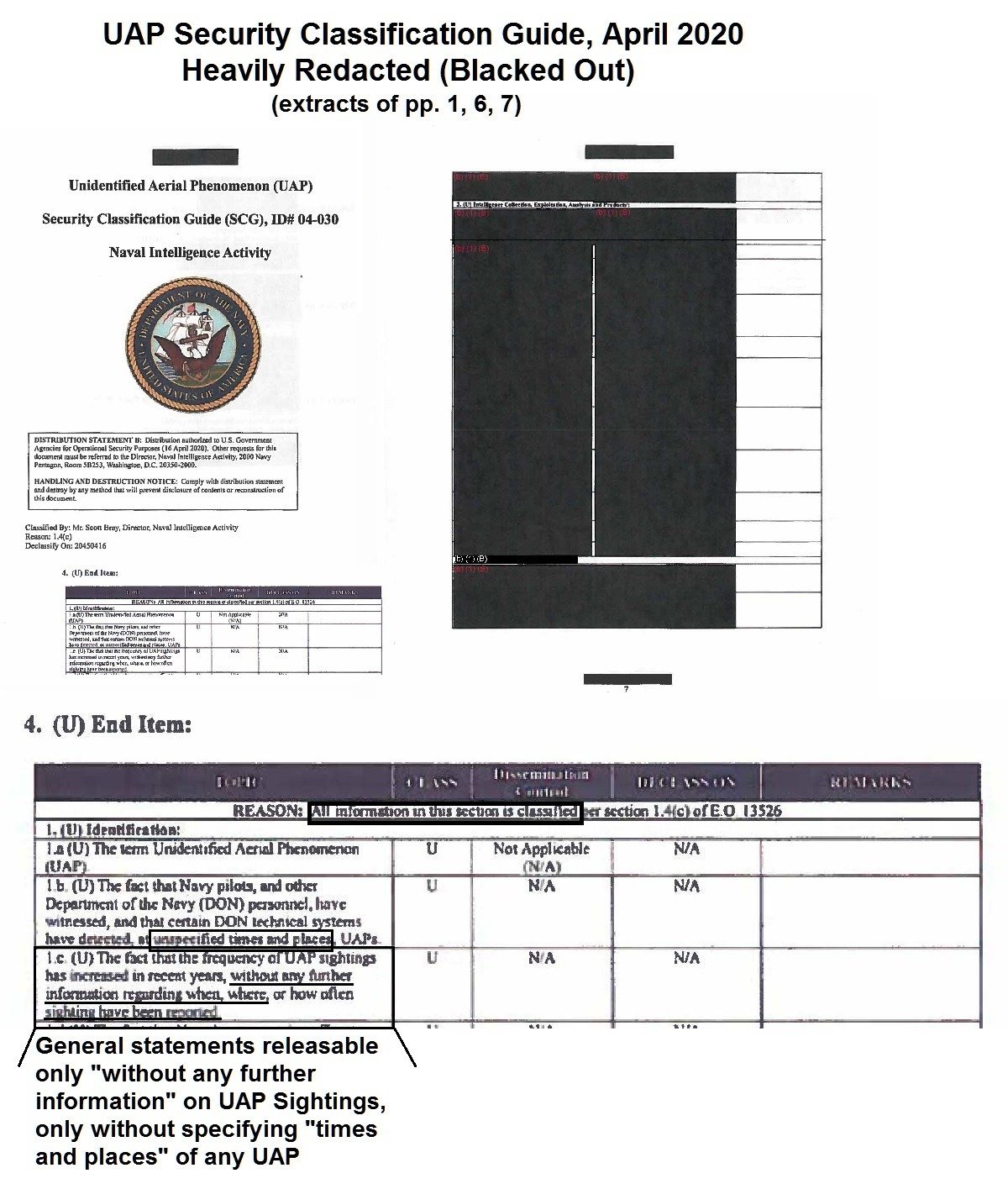
word-image-24600-1.jpeg

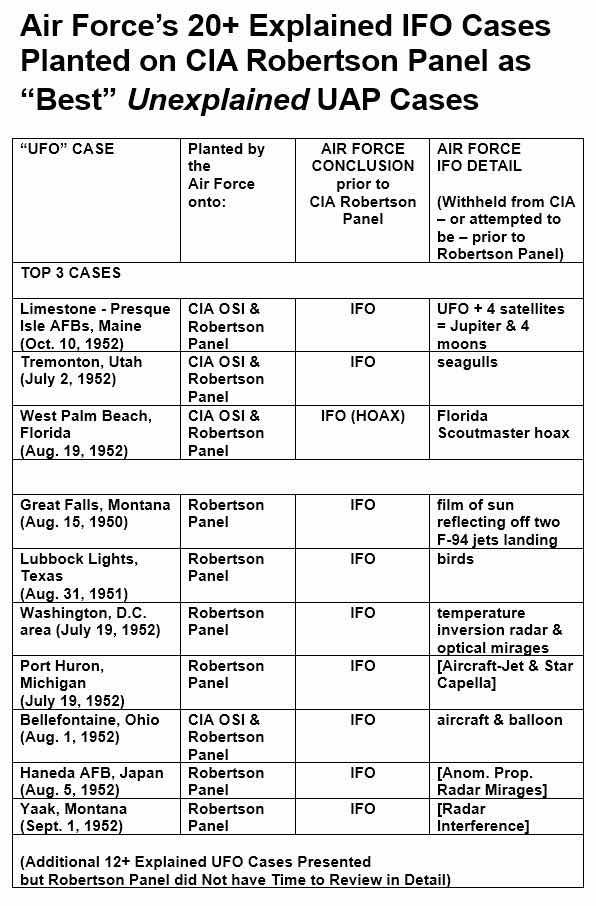
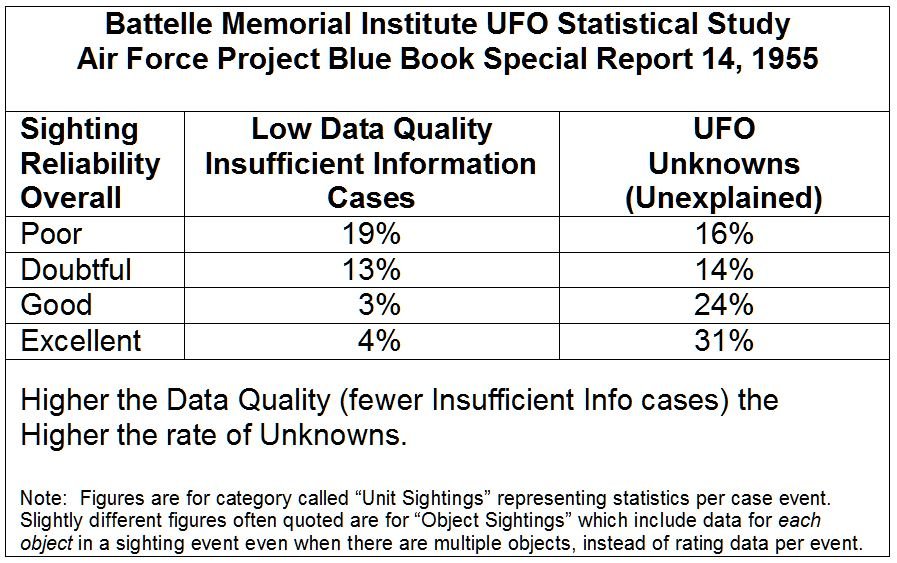
Air Force intelligence agency “efforts to … manipulate public opinion” on UAP since the 1950s are what caused the harsh stigma attached to the entire UFO subject in society. But this powerful anti-UAP stigma is not investigated or historically documented by AARO – or even mentioned – contrary to its legal obligation (more on this below). In addition to the AF-instigated Robertson Panel of 1953, and all that followed after it, there are even admissions by a retired USAF OSI officer of allegedly spying on civilian UFO researchers and spreading disinformation on behalf of the Air Force.

The unclassified version of the historical AARO Report (AAROR) was released on March 8, 2024. But prior to that, AARO quietly released the report 2 days in advance to several friendly media outlets to cultivate favorable media coverage. These outlets, including the New York Times and Washington Post, faithfully carried the government’s message forward, apparently without consulting any of the scholars and researchers who could have helped them understand the report’s numerous errors, omissions, and shortcomings to provide a more balanced assessment. More objective reporting would have uncovered numerous major problems and serious errors in the AARO Report.

What follows are only a select few of the many issues and questions raised by the AARO Historical Report.

The AARO Report is Filled with Hundreds of Errors

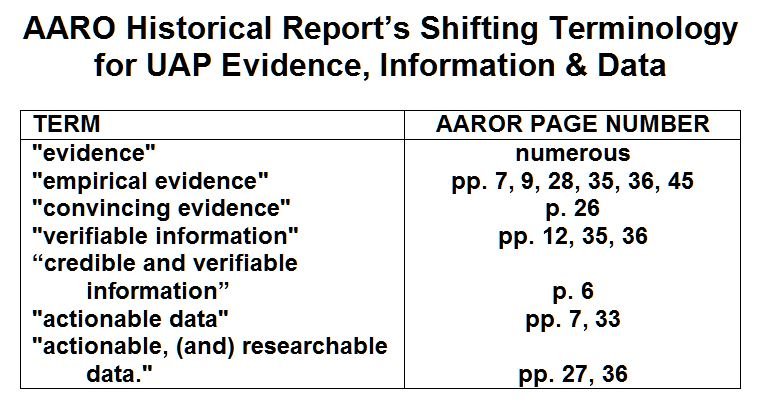
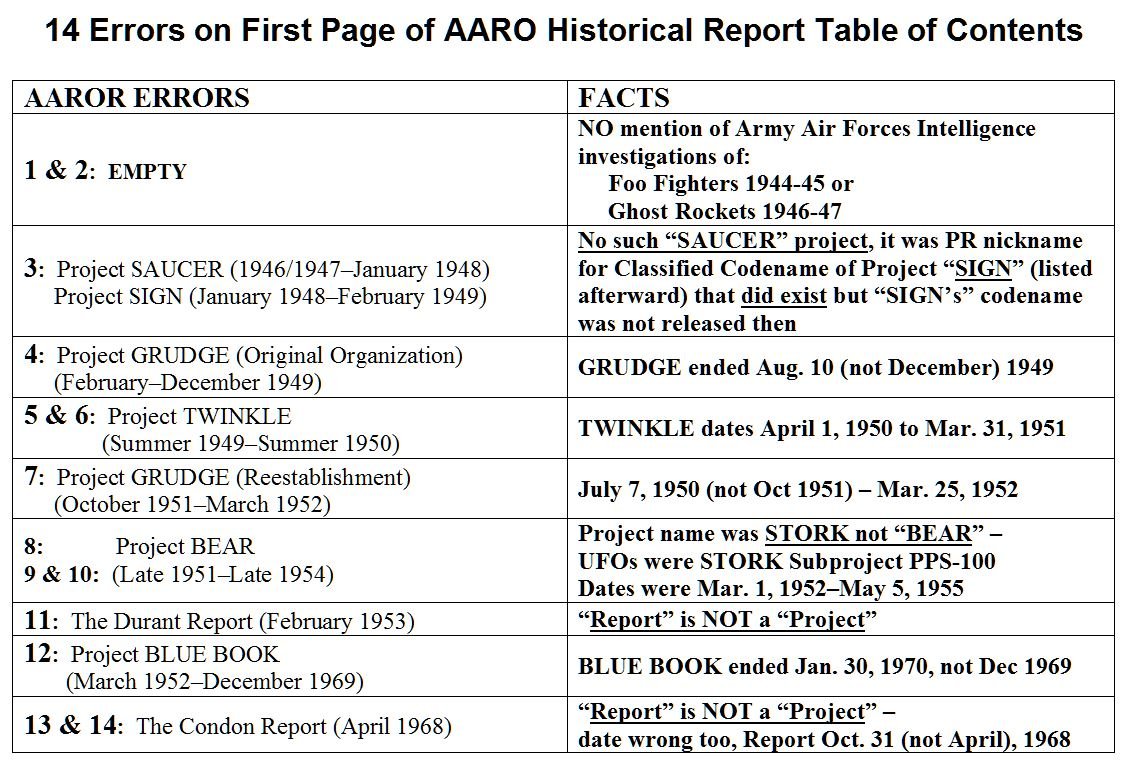
The AARO report (AAROR) is pervaded by hundreds of unfortunate errors and absurdities involving the history, science, and facts presented in its 63 pages, with dozens–or more–errors on some pages (see graphic below of 14 errors alone just on the first page of the Table of Contents).

The report is replete with so many mistakes and misunderstandings that, page for page, it appears to be the greatest single repository of UAP errors, arguably surpassing even the Air Force’s Project Blue Book. Call AARO the New Blue Book. Speaking of which, the report utterly fails to convey any of the fundamental flaws or national controversies that dogged Project Blue Book, including the admission by its own chief scientist that Blue Book was a deeply flawed Air Force public relations effort to dispel public and Congressional concerns, rather than an objective inquiry.

To begin with, AARO asserts the Kenneth Arnold sighting that launched the whole UAP era occurred on June 23, 1947 (AAROR, p. 14).

Simple Googling would have gotten the correct June 24 date and the correct shape (it wasn’t actually “circular,” and neither was the Flying Flapjack which they call the “Flying Pancake” to erroneously emphasize its circularity even more). Arnold insisted the press’s label “flying saucers” for his sighting was a misnomer. Significantly, it is the important watershed event that launched the entire modern age of UAP. It’s not a typo in a minor detail that can just be brushed off.
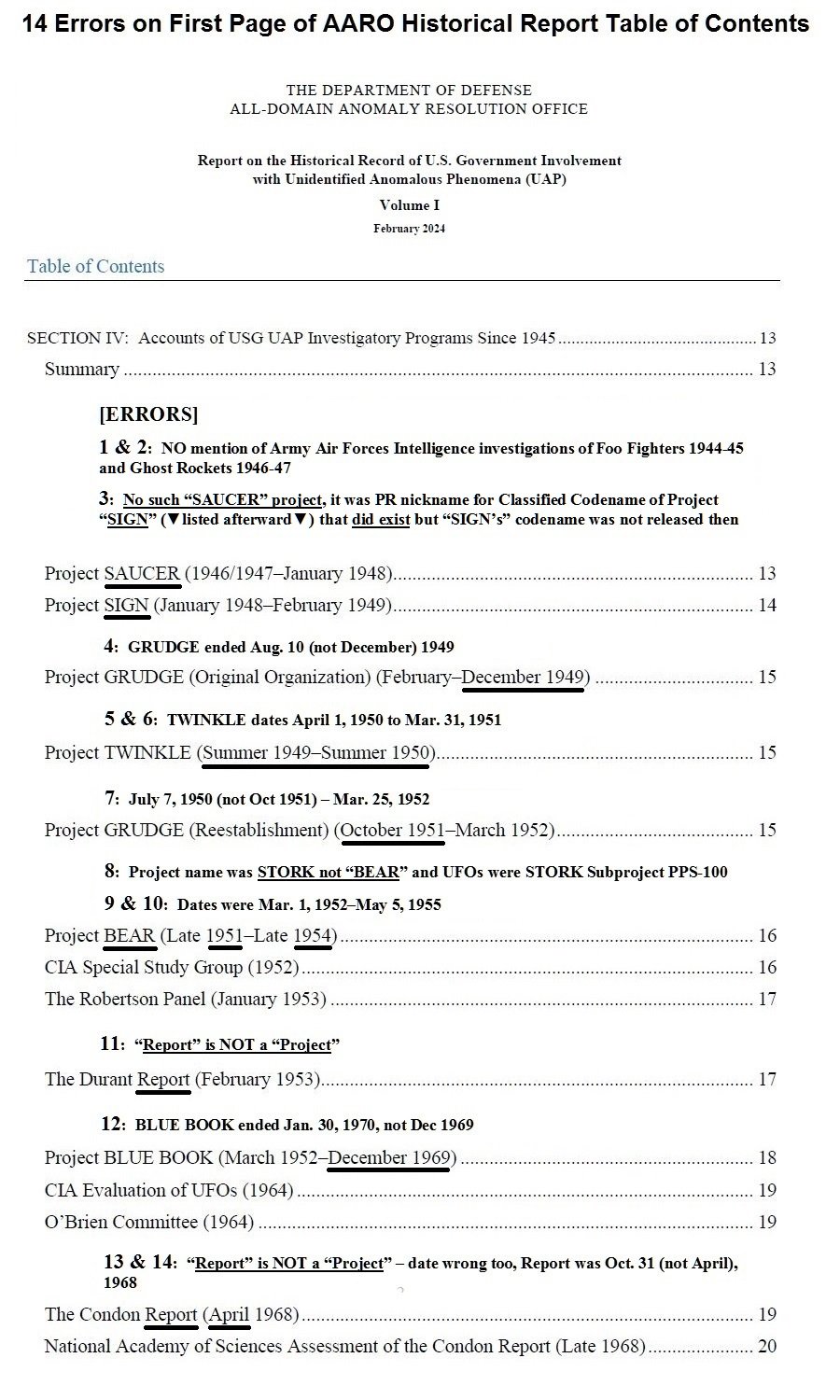
word-image-24600-3.jpeg

There are unbelievable statements and insinuations in the AARO report such as the peculiar claim that the Manhattan Project that built the first atomic bomb somehow caused “sightings” and “erroneous UAP reporting” (AAROR pp. 4, 39-40) and did so even after it terminated on December 31, 1946 (a date they omit because it would not explain the sightings that began the modern UAP era in June 1947). That is a bit like saying trailer parks cause tornadoes. Since the Manhattan Project did not launch special aerial vehicles of any kind that could be “misidentified” as UAP, did the Project’s buildings fly up in the air and cause “sightings” and “erroneous UAP reporting”? This incredible claim is not explained by AARO.

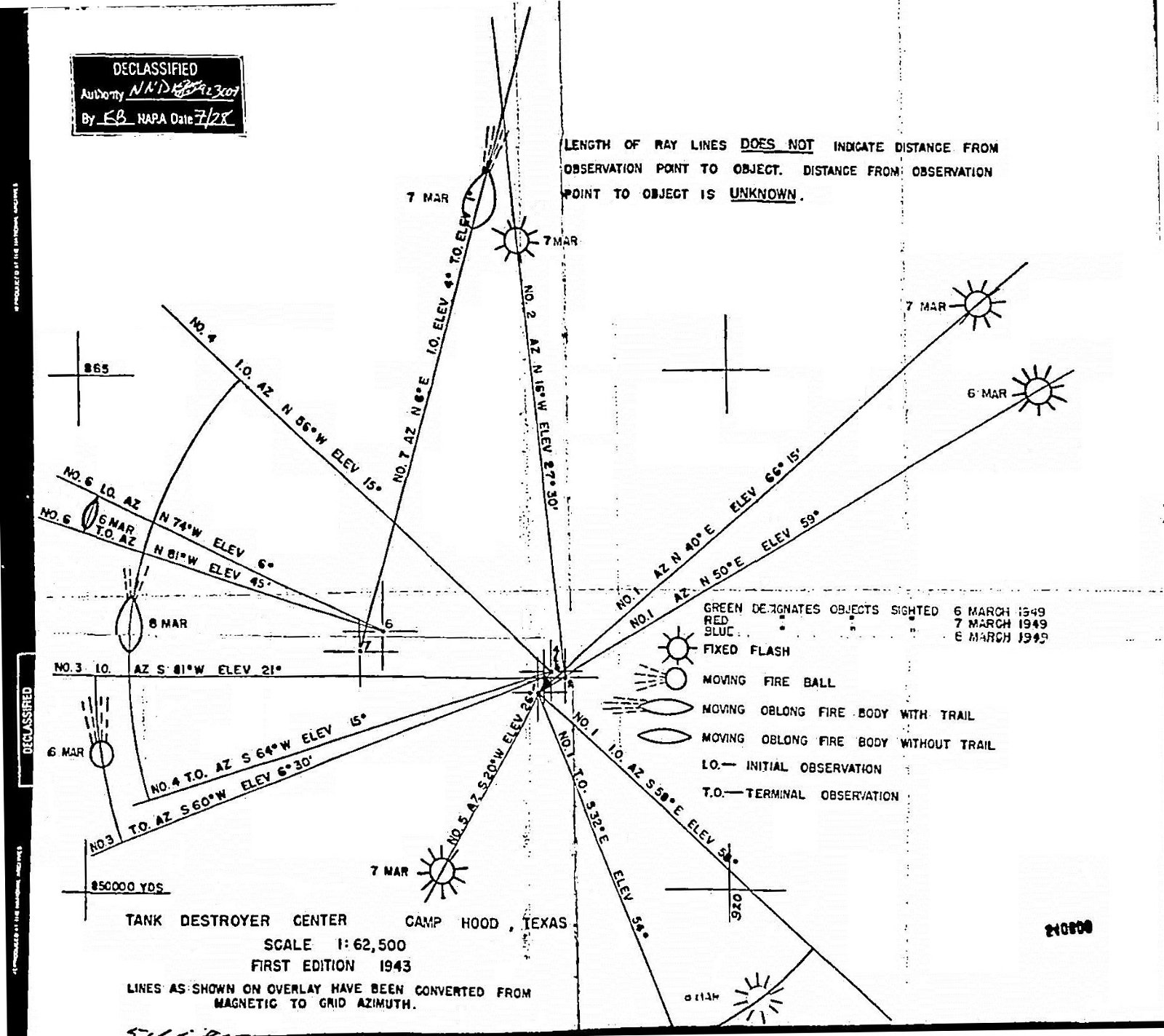
Indeed, the truth is precisely the opposite of what AARO suggests. Not only is there no evidence of outside civilians mistaking the Manhattan Project and successor operations for UAP, but we know that personnel working inside the US nuclear weapons program were sighting UAP, reporting them, and thereafter collecting hundreds of their own authentic UAP reports. The senior AFOSI (Air Force Office of Special Investigations) officer responsible for Los Alamos Scientific Laboratory compiled a detailed catalog of 209 recent “Unknown Aerial Phenomena” sightings and instrument tracking incidents in the Los Alamos area and surrounding regions (see sample p. 38 below). He sent the catalog with a classified memo to his superior, the agency director in Washington DC, General Joseph P. Carroll, on May 25, 1950, stating that security officials agreed:

“… the frequency of unexplained aerial phenomenon in the New Mexico area was such that an organized plan of reporting these observations should be undertaken…”

Other documents explain this “organized plan” included instrumented UFO / UAP tracking stations and networks that were set up by scientists and security officials in the Los Alamos Lab, Sandia Lab, Kirtland AFB, and Holloman AFB–White Sands areas, and put on base-wide alert, consisting of missile-tracking telescopic cameras, radars, nuclear radiation detectors, radio communication networks, aircraft for interception, etc. Yet, no AARO discussion of this.

“The observers of these phenomena include scientists, Special Agents of the Office of Special Investigations (IG), USAF, airline pilots, military pilots, Los Alamos Security Inspectors, military personnel, and many other persons of various occupations whose reliability is not questioned.”

Many of the UAPs reported by scientists and military personnel were described as either “green fireball phenomena” or flying “disks” (or “variation”). AARO has completely misrepresented the situation: The Manhattan Project and subsequent nuclear weapons activities were not causing spurious UAP sightings by civilians awed by “new technologies” they did not understand – the government scientists and military personnel themselves were actually seeing UAP and recording hundreds of UAP in authentic and well-documented reports.

These sightings officially reported by US Government personnel were consistent with what the external “unknowing” civilians (as AARO calls them) were reporting at the time – sometimes the government personnel and civilians sighted the same UAP at the same time, confirming each other.

word-image-24600-4.jpeg

Seemingly AARO is confusing secrecy-bred lurid rumors of aliens with a careful sighting of a UAP, up in the air, at an exact date, time, and location, having unexplainable motions and appearance, and backed up with scientifically valuable directional data involving speed, size, altitude, sensor data, radar tracking, etc. Yet AARO suggests that many of these documented sightings are just rumors or mistaken reports based on unwitting civilian observations of “new technologies” in classified US military activities.

AARO claims the first US satellite, Explorer 1 in 1958, and even the Apollo moon landings (pp. 41-42) caused UAP sighting misidentifications and were “formerly classified and sensitive … national security programs” (AAROR, pp. 39-40) – which they were not, and Apollo was just civilian NASA. AARO insinuates that the Apollo missions were “classified and sensitive”, and yet, apart from a limited number of contingency missions later revealed to have had classified components, the vast majority of NASA’s objectives with the missions were fully known to the public, with the moon landing broadcast to the entire planet on live television.

AARO states (pp. 10-11, 36):

“AARO assesses that some portion of [UAP] sightings since the 1940s have represented misidentification of never-before-seen experimental and operational space, rocket, and air systems… From the 1940s to the 1960s especially, the United States witnessed a boom in experimental technologies… Many of these technologies fit the description of a stereotypical Unidentified Flying Object (UFO). It is understandable how observers unfamiliar with these programs could mistake sightings of these new technologies as something extraordinary, even other-worldly.”

“AARO assesses that the incidents of UAP sightings reported to USG organizations … most likely are the result of a range of cultural, political, and technological factors. AARO bases this conclusion on the aggregate findings of all USG investigations to date [and] the misinterpretation of all reported named sensitive programs…”

What “new technology” let alone “many” was ever flown that “fit the description of a stereotypical … UFO” (e.g., a flying saucer)? Yet just before “naming” the Manhattan Project and Apollo as supposed “examples,” AARO reiterates the unsubstantiated point, claiming that many:

“… UAP sightings … were the result of misidentifications … of new technologies that [civilian] observers would have understandably reported as UFOs…. [O]bservers unknowingly … witnessed … and report[ed] as UFOs … classified and sensitive programs that involved … rocket launches … which AARO assess [sic] most likely were the cause of many UAP reports. AARO assesses that this common and understandable occurrence—the misidentification of new technologies for UAP— is present today [and] are reported as UAP.” (AAROR, p. 39)

Subsequently, AARO lists the Apollo program as one of 28 alleged examples (pp. 40, 42).

But no such UAP or “stereotypical UFO” sightings of a “misidentified” Apollo are known or cited by AARO and frankly, it is baffling to suggest anyone on Earth could see the Apollo moon landings with their eyes from 240,000 miles away or Apollo anywhere along the flight trajectory. AARO makes a point of stating that there were in the Apollo program “12 astronauts walking on the moon” without explaining how that is relevant or giving a single UAP sighting they seem to insinuate was caused by that. Are there any actual, serious UAP sightings misidentifying Apollo launches to the moon as UAP?

Scientific errors by AARO thus abound in its secret-project-inflated report, including those pointed out above regarding the miraculous feats of human vision sighting Apollo moon landings and Explorer 1 from outer space – besides insinuating apparent errors of logic and physics and injecting a non-issue of misleading irrelevancies (non-secret “secret” projects that did not and could not actually cause UAP sightings).

Did AARO Miss 64,000 Pages of Air Force Blue Book UAP Files?

AARO may have “partnered” with the National Archives in retrieving old Air Force Project Blue Book files but AARO seems to think there are only 65,778 pages of Blue Book files (within some 7,000 larger digital files), instead of the actual total of some 130,000 pages.

Is AARO aware there are 130,000 pages of Air Force UAP files on microfilm at the National Archives (and some additional files that were never microfilmed)?

All that anyone has to do is check the Fold3 Ancestry.com website, available on the Internet since 2007, to find its total Blue Book page count of 129,658 pages (round off to 130,000) that Fold3’s predecessor digitized from Blue Book microfilm at NARA (see Fold3 internet screenshot below). (Page count includes about 6,000 AFOSI pages, some duplicative of the files and released with Blue Book.) And again it is documented that many records and files are missing from Blue Book, many with exact file numbers that determined investigators such as Jan Aldrich have documented over the years.
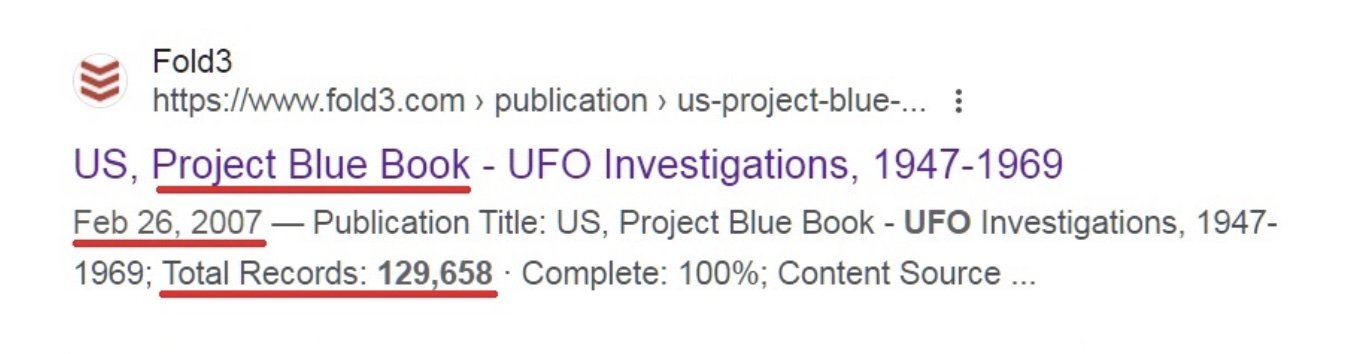
Fold3

Did AARO somehow miss half of Blue Book’s files–some 64,000 pages–in its supposedly “thorough”, “complete”, and “accurate” history (AAROR, p. 12)? Did someone lose 64,000 pages of Blue Book UFO files? Did AARO investigate where these apparently missing Blue Book files disappeared or how the accounting error arose if it is just that?

Even aside from missing half of Blue Book’s files, which therefore could not be reviewed for history, AARO’s review of Air Force Blue Book history is so cursory that AARO seems to merely rehash old Blue Book press releases (see AAROR, pp. 18-19).

AARO claims it established 6 Lines of Effort (“LOEs” they call them) to prepare a “complete” and “accurate” history of the UAP “record” of government investigations (just not of UAP sightings as Congress also wanted): (1) open source, (2) classified, (3) personal interviewing, (4) National Archives, (5) private companies, and (6) intelligence/nat sec agencies (AAROR, pp. 22-13).

But obviously, AARO’s Six Lines of Effort were unmindful of 64,000 missing pages of Blue Book UFO files that only they at AARO were missing – while the rest of the world has, and has had, access to the pages through the Fold3 website since 2007 or by going to the microfilms at the National Archives or buying copies (all available since 1976). Additionally, as will be explained further below, AARO seems completely unaware of the existence of numerous important US government UAP investigation programs, activities, sightings, and radar/sensor-tracking incidents.

{ https://thedebrief.org/category/uap/ }

Hoe vind je dit bericht?
Geschreven door peter om 23:36 Stuur door

Martian ‘Spiders’ Re-Created in Lab for First Time

Martian ‘Spiders’ Re-Created in Lab for First Time

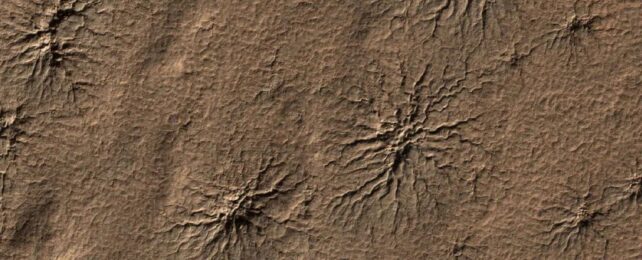
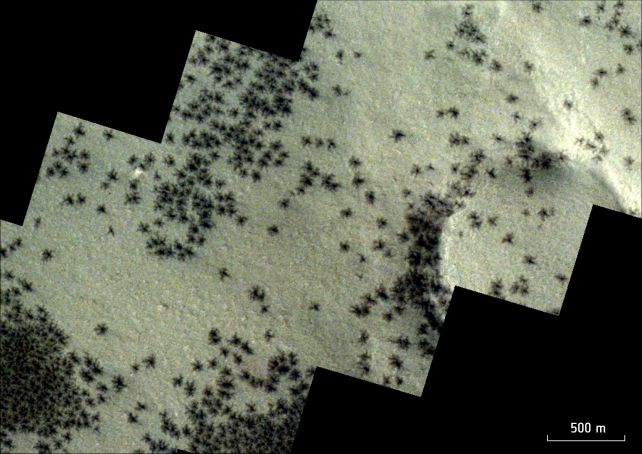
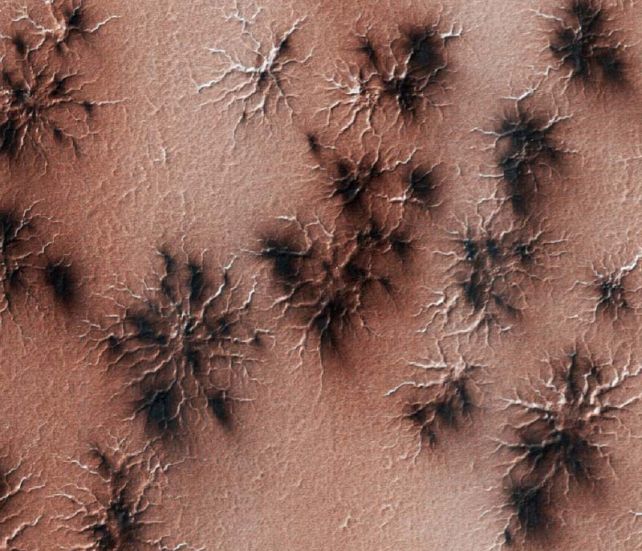
Martian ‘spiders’ are small, dark, spider-shaped features up to 1 km (0.6 miles) across. The leading theory is that they form when spring sunshine falls on layers of carbon dioxide deposited over the dark winter months. Thanks to new experiments, a team of scientists at NASA has, for the first time, re-created those formation processes in simulated Martian temperatures and air pressure.

Examples of the ‘Kieffer zoo’ features proposed to be formed by seasonal carbon dioxide sublimation dynamics on Mars: (a) ‘thin’ spiders within the south polar layered deposits; (b) dark spots on top of a layer of translucent carbon dioxide slab ice covering a cluster of ‘fat’ spiders at Martian ‘Inca City;’ (c) ‘fried eggs’ showing rings of dark dust surrounded by bright halos; (d) patterned ground within the high south polar latitudes with dark oriented fans indicative of wind direction and some bright, white fans; (e) bright halos surrounding Swiss cheese depressions; (f) ‘lace terrain,’ a type of patterned ground suggested to be polygonally patterned ground later scoured and eroded by surface-flowing carbon dioxide gas from the Kieffer model. Image credit: HiRISE / NASA’s Jet Propulsion Laboratory / University of Arizona.

Examples of the ‘Kieffer zoo’ features proposed to be formed by seasonal carbon dioxide sublimation dynamics on Mars: (a) ‘thin’ spiders within the south polar layered deposits; (b) dark spots on top of a layer of translucent carbon dioxide slab ice covering a cluster of ‘fat’ spiders at Martian ‘Inca City;’ (c) ‘fried eggs’ showing rings of dark dust surrounded by bright halos; (d) patterned ground within the high south polar latitudes with dark oriented fans indicative of wind direction and some bright, white fans; (e) bright halos surrounding Swiss cheese depressions; (f) ‘lace terrain,’ a type of patterned ground suggested to be polygonally patterned ground later scoured and eroded by surface-flowing carbon dioxide gas from the Kieffer model.

Image credit: HiRISE / NASA’s Jet Propulsion Laboratory / University of Arizona.

Present-day Mars is a dynamic planet, rich with surface change despite its tenuous atmosphere and cold climate.

In winter, a significant portion of Mars’ primarily carbon dioxide-atmosphere accumulates onto the surface as frost.

In the spring, it sublimes, revealing some morphologies that are unlike anything seen on Earth.

These include dark dalmatian spots and oriented fans, ‘fried eggs,’ gullies sometimes accompanied by dark digitate flows and bright ‘halos’ in spring, dendritic ‘spiders’, sand furrows on active dunes, and growing dendritic troughs.

These features have been detected on loose material around the south pole and on interdune material toward the south polar midlatitudes. However, some minor phenomena have been detected in the north.

NASA Can Finally Explain Why Creepy 'Spiders' on Mars Keep Appearing

Araneiform features on the surface of Mars, as imaged by the Mars Reconnaissance Orbiter in 2009. 

(NASA/JPL-Caltech/University of Arizona)

Many of these features compose the so-called ‘Kieffer zoo,’ a collection of surface expressions first described in 2003 and proposed to be created by the solid-state greenhouse effect.

“In the Kieffer model, sunlight penetrates translucent slab ice in spring and thermal-wavelength radiation gets trapped, heating the regolith beneath the ice and causing the impermeable ice slab to sublimate from its base,” explained Dr. Lauren Mc Keown of NASA’s Jet Propulsion Laboratory and colleagues.

“Through this process, spiders are proposed to be eroded via high-velocity gas scouring the sub-slab regolith, while fans and variations of spots are strewn on the ice surface, deposited by a plume of dust and gas.”

The study authors were able to create the full cycle of the Kieffer model in a lab and confirm the formation of several types of Kieffer zoo features.

“The hardest part of conducting the experiments was re-creating conditions found on the Martian polar surface: extremely low air pressure and temperatures as low as minus 185 degrees Celsius (minus 301 degrees Fahrenheit),” they said.

mars-spiders-body.jpg

Araneiforms imaged on the surface of Mars by the Trace Gas Orbiter. (ESA/TGO/CaSSIS) "The spiders are strange, beautiful geologic features in their own right,"

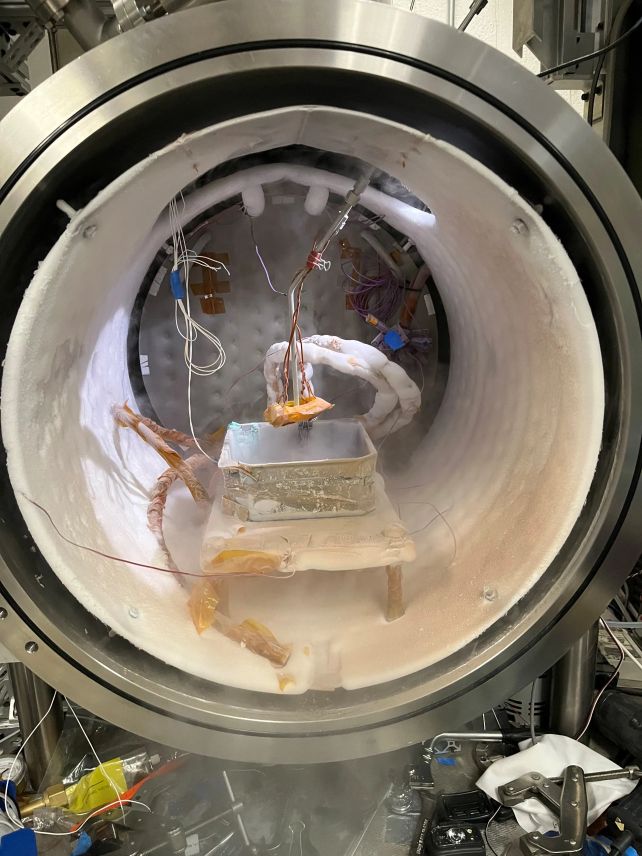
“To do that, we used a liquid-nitrogen-cooled test chamber: the Dirty Under-vacuum Simulation Testbed for Icy Environments (DUSTIE).”

“For the experiments, we chilled Martian soil simulant in a container submerged within a liquid nitrogen bath.”

“We placed it in the DUSTIE chamber, where the air pressure was reduced to be similar to that of Mars’ southern hemisphere.”

“Carbon dioxide gas then flowed into the chamber and condensed from gas to ice over the course of three to five hours.”

“It took many tries before we found just the right conditions for the ice to become thick and translucent enough for the experiments to work.”

araneiforms.jpg

Araneiform features imaged by HiRISE in 2009.

(NASA/JPL-Caltech/University of Arizona)

“Once we got ice with the right properties, we placed a heater inside the chamber below the simulant to warm it up and crack the ice.”

“We were ecstatic when we finally saw a plume of carbon dioxide gas erupting from within the powdery simulant.”

dustie-experiment.jpg

Inside the DUSTIE chamber. (NASA/JPL-Caltech) The researchers took a simulant of the Martian regolith – a mixture of minerals in size and composition to replicate the dirt on Mars – and cooled it in liquid nitrogen before placing it in the chamber, which had been tuned to the pressure and temperature conditions of Martian winter.

spiders.jpg

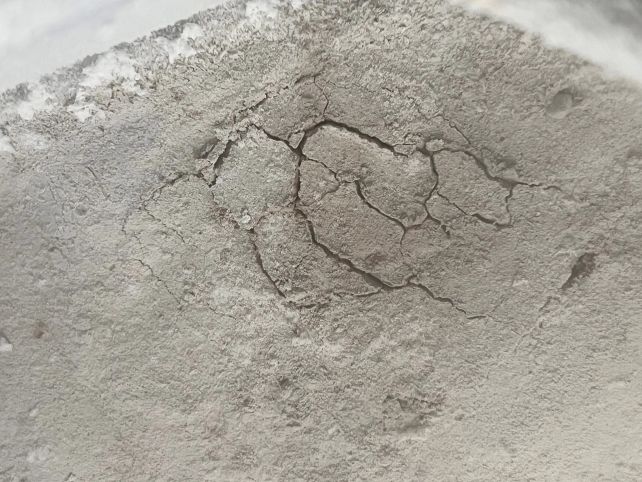
Crack formations similar to the Martian araneiforms that appeared in the DUSTIE experiment. (NASA/JPL-Caltech) Sure enough, the conditions in the chamber had produced, in miniature, the same spider-like shape seen at the south pole of Mars. The gas had streamed out, carrying dust with it, creating the tendrilled form on the surface. But there was a surprise.

  • A paper describing these experiments appears in the Planetary Science Journal.
  • Lauren E. Mc Keown et al. 2024. A Lab-scale Investigation of the Mars Kieffer Model. Planet. Sci. J 5, 195; doi: 10.3847/PSJ/ad67c8
VIDEOS
NASA reveals how spiders growing on Mars | Oneindia News

New NASA Image Shows Spiders Crawling Over Mars Surface | TIME

NASA reveals how spiders growing on Mars | Oneindia News

{ https://www.sci.news/ }

Hoe vind je dit bericht?
Geschreven door peter om 22:16 Stuur door

NASA’s Webb Reveals Distorted Galaxy Forming Cosmic Question Mark

NASA’s Webb Reveals Distorted Galaxy Forming Cosmic Question Mark

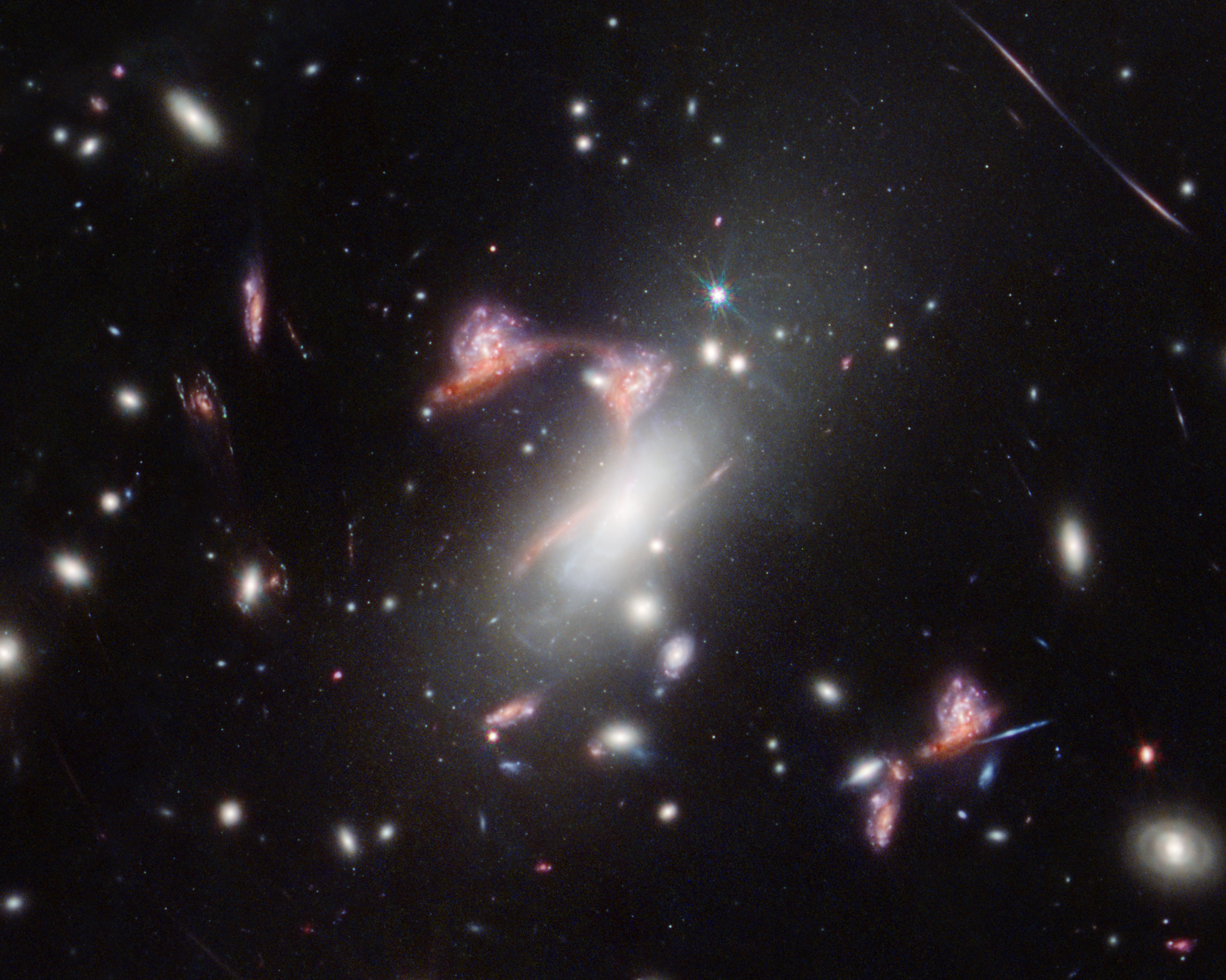
Amid a field of galaxies, a repeated, elongated red galaxy forms a shape like the top of a question mark, with another galaxy positioned like the question mark’s dot. In each occurrence, another white, clumpy galaxy with an overall circular shape appears perched on top of the red galaxy. A very bright foreground galaxy appears to the right of the bottom curve of the question mark shape. To the lower right, among other galaxies, another occurrence of the galaxy pair appears, unaffiliated with the question mark shape.

The galaxy cluster MACS-J0417.5-1154. Full image below.
Credits: NASA, ESA, CSA, STScI, V. Estrada-Carpenter (Saint Mary's University).

It’s 7 billion years ago, and the universe’s heyday of star formation is beginning to slow. What might our Milky Way galaxy have looked like at that time? Astronomers using NASA’s James Webb Space Telescope have found clues in the form of a cosmic question mark, the result of a rare alignment across light-years of space.

“We know of only three or four occurrences of similar gravitational lens configurations in the observable universe, which makes this find exciting, as it demonstrates the power of Webb and suggests maybe now we will find more of these,” said astronomer Guillaume Desprez of Saint Mary’s University in Halifax, Nova Scotia, a member of the team presenting the Webb results.

Image A: Lensed Question Mark (NIRCam)

Amid a field of galaxies, a repeated, elongated red galaxy forms a shape like the top of a question mark, with another galaxy positioned like the question mark’s dot. In each occurrence, another white, clumpy galaxy with an overall circular shape appears perched on top of the red galaxy. A very bright foreground galaxy appears to the right of the bottom curve of the question mark shape. To the lower right, among other galaxies, another occurrence of the galaxy pair appears, unaffiliated with the question mark shape.

The galaxy cluster MACS-J0417.5-1154 is so massive it is warping the fabric of space-time and distorting the appearance of galaxies behind it, an effect known as gravitational lensing. This natural phenomenon magnifies distant galaxies and can also make them appear in an image multiple times, as NASA’s James Webb Space Telescope saw here. Two distant, interacting galaxies — a face-on spiral and a dusty red galaxy seen from the side — appear multiple times, tracing a familiar shape across the sky. Active star formation, and the face-on galaxy’s remarkably intact spiral shape, indicate that these galaxies’ interaction is just beginning.
NASA, ESA, CSA, STScI, V. Estrada-Carpenter (Saint Mary's University).

While this region has been observed previously with NASA’s Hubble Space Telescope, the dusty red galaxy that forms the intriguing question-mark shape only came into view with Webb. This is a result of the wavelengths of light that Hubble detects getting trapped in cosmic dust, while longer wavelengths of infrared light are able to pass through and be detected by Webb’s instruments.

Astronomers used both telescopes to observe the galaxy cluster MACS-J0417.5-1154, which acts like a magnifying glass because the cluster is so massive it warps the fabric of space-time. This allows astronomers to see enhanced detail in much more distant galaxies behind the cluster. However, the same gravitational effects that magnify the galaxies also cause distortion, resulting in galaxies that appear smeared across the sky in arcs and even appear multiple times. These optical illusions in space are called gravitational lensing.

The red galaxy revealed by Webb, along with a spiral galaxy it is interacting with that was previously detected by Hubble, are being magnified and distorted in an unusual way, which requires a particular, rare alignment between the distant galaxies, the lens, and the observer — something astronomers call a hyperbolic umbilic gravitational lens. This accounts for the five images of the galaxy pair seen in Webb’s image, four of which trace the top of the question mark. The dot of the question mark is an unrelated galaxy that happens to be in the right place and space-time, from our perspective.

Image B: Hubble and Webb Side by Side

In addition to producing a case study of the Webb NIRISS (Near-Infrared Imager and Slitless Spectrograph) instrument’s ability to detect star formation locations within a galaxy billions of light-years away, the research team also couldn’t resist highlighting the question mark shape. “This is just cool looking. Amazing images like this are why I got into astronomy when I was young,” said astronomer Marcin Sawicki of Saint Mary’s University, one of the lead researchers on the team. 

“Knowing when, where, and how star formation occurs within galaxies is crucial to understanding how galaxies have evolved over the history of the universe,” said astronomer Vicente Estrada-Carpenter of Saint Mary’s University, who used both Hubble’s ultraviolet and Webb’s infrared data to show where new stars are forming in the galaxies. The results show that star formation is widespread in both. The spectral data also confirmed that the newfound dusty galaxy is located at the same distance as the face-on spiral galaxy, and they are likely beginning to interact.

“Both galaxies in the Question Mark Pair show active star formation in several compact regions, likely a result of gas from the two galaxies colliding,” said Estrada-Carpenter. “However, neither galaxy’s shape appears too disrupted, so we are probably seeing the beginning of their interaction with each other.”

“These galaxies, seen billions of years ago when star formation was at its peak, are similar to the mass that the Milky Way galaxy would have been at that time. Webb is allowing us to study what the teenage years of our own galaxy would have been like,” said Sawicki.

The Webb images and spectra in this research came from the Canadian NIRISS Unbiased Cluster Survey (CANUCS). The research paper is published in the Monthly Notices of the Royal Astronomical Society.

Image C: Wide Field - Lensed Question Mark (NIRCam)

At the center of a field of many colorful galaxies, three elongated red galaxies curve around to approximate the shape of the top of a question mark. Another reddish galaxy appears in about the right position to be the dot of the question mark. A bright white, oval foreground galaxy draws the eye from its position right next to the question mark shape.

Wide Field View: The galaxy cluster MACS-J0417.5-1154 is so massive it is warping the fabric of space-time and distorting the appearance of galaxies behind it, an effect known as gravitational lensing. This natural phenomenon magnifies distant galaxies and can also make them appear in an image multiple times, as NASA’s James Webb Space Telescope saw here. Two distant, interacting galaxies — a face-on spiral and a dusty red galaxy seen from the side — appear multiple times, tracing a familiar shape across the sky. Active star formation, and the face-on galaxy’s remarkably intact spiral shape, indicate that these galaxies’ interaction is just beginning.
NASA, ESA, CSA, STScI, V. Estrada-Carpenter (Saint Mary's University).
  • The James Webb Space Telescope is the world’s premier space science observatory. Webb is solving mysteries in our solar system, looking beyond to distant worlds around other stars, and probing the mysterious structures and origins of our universe and our place in it. Webb is an international program led by NASA with its partners, ESA (European Space Agency) and CSA (Canadian Space Agency).

Downloads

  • Right click any image to save it or open a larger version in a new tab/window via the browser's popup menu.

Media Contacts

VIDEOS


NASA spots cosmic question mark
NASA telescope spots cosmic question mark in deep space

{ https://www.nasa.gov/ }

Hoe vind je dit bericht?
Geschreven door peter om 21:29 Stuur door

Meer van UFO'S of UAP'S, ASTRONOMIE, RUIMTEVAART, ARCHEOLOGIE, OUDHEIDKUNDE, SF-SNUFJES EN ANDERE ESOTERISCHE WETENSCHAPPEN - DE ALLERLAATSTE NIEUWTJES

↑ Terug naar de berichten