Ontdek de Fascinerende Wereld van UFO's en UAP's: Jouw Bron voor Onthullende Informatie!
Ben jij ook gefascineerd door het onbekende? Wil je meer weten over UFO's en UAP's, niet alleen in België, maar over de hele wereld? Dan ben je op de juiste plek!
België: Het Kloppend Hart van UFO-onderzoek
In België is BUFON (Belgisch UFO-Netwerk) dé autoriteit op het gebied van UFO-onderzoek. Voor betrouwbare en objectieve informatie over deze intrigerende fenomenen, bezoek je zeker onze Facebook-pagina en deze blog. Maar dat is nog niet alles! Ontdek ook het Belgisch UFO-meldpunt en Caelestia, twee organisaties die diepgaand onderzoek verrichten, al zijn ze soms kritisch of sceptisch.
Nederland: Een Schat aan Informatie
Voor onze Nederlandse buren is er de schitterende website www.ufowijzer.nl, beheerd door Paul Harmans. Deze site biedt een schat aan informatie en artikelen die je niet wilt missen!
Internationaal: MUFON - De Wereldwijde Autoriteit
Neem ook een kijkje bij MUFON (Mutual UFO Network Inc.), een gerenommeerde Amerikaanse UFO-vereniging met afdelingen in de VS en wereldwijd. MUFON is toegewijd aan de wetenschappelijke en analytische studie van het UFO-fenomeen, en hun maandelijkse tijdschrift, The MUFON UFO-Journal, is een must-read voor elke UFO-enthousiasteling. Bezoek hun website op www.mufon.com voor meer informatie.
Samenwerking en Toekomstvisie
Sinds 1 februari 2020 is Pieter niet alleen ex-president van BUFON, maar ook de voormalige nationale directeur van MUFON in Vlaanderen en Nederland. Dit creëert een sterke samenwerking met de Franse MUFON Reseau MUFON/EUROP, wat ons in staat stelt om nog meer waardevolle inzichten te delen.
Let op: Nepprofielen en Nieuwe Groeperingen
Pas op voor een nieuwe groepering die zich ook BUFON noemt, maar geen enkele connectie heeft met onze gevestigde organisatie. Hoewel zij de naam geregistreerd hebben, kunnen ze het rijke verleden en de expertise van onze groep niet evenaren. We wensen hen veel succes, maar we blijven de autoriteit in UFO-onderzoek!
Blijf Op De Hoogte!
Wil jij de laatste nieuwtjes over UFO's, ruimtevaart, archeologie, en meer? Volg ons dan en duik samen met ons in de fascinerende wereld van het onbekende! Sluit je aan bij de gemeenschap van nieuwsgierige geesten die net als jij verlangen naar antwoorden en avonturen in de sterren!
Heb je vragen of wil je meer weten? Aarzel dan niet om contact met ons op te nemen! Samen ontrafelen we het mysterie van de lucht en daarbuiten.
Als we het hebben over invasieve uitheemse soorten, bedoelen we dieren die zijn geïntroduceerd in een ecosysteem waar ze geen deel van uitmaken, maar die daardoor een bedreiging vormen voor de lokale biodiversiteit. Er zijn veel voorbeelden, zoals de blauwe krab en de Louisiana rivierkreeft, of zoogdieren die door kolonisten naar verschillende delen van de wereld zijn gebracht. Heel anders is het geval van de gigantische hagedissen die onlangs in Florida zijn gespot, reptielen die vreemd zijn aan het lokale ecosysteem maar een potentieel gevaar vormen voor dieren en mensen. Laten we eens kijken wat het zijn en waarom ze in Florida voorkomen.
Gigantische hagedissen in Florida: een steeds vaker voorkomende waarneming
Over waarnemingen van reuzenhagedissen in Florida wordt met min of meer regelmatige tussenpozen gesproken, maar de laatste jaren steeds vaker. Een van de meest recente incidenten werd gedocumenteerd door een vrouw genaamd Renee Aland, die video's en foto's deelde van een waarneming op een paar meter afstand.
Op de beelden is een groot reptiel van bijna twee meter lang te zien dat bekend lijkt te zijn met de verharde wegen van Florida. Renee vertelt hoe het in een kanaal dook en kort daarna weer boven water kwam, zonder acht te slaan op de vrouw die filmde met haar mobiele telefoon en ondertussen haar dochter aanspoorde om niet uit de auto te stappen. Nadat ze de video en de beelden had gedeeld op sociale media, stuurde de vrouw de documentatie ook naar de Florida Fish and Wildlife Conservation Commission, die de waarneming zal afhandelen en het dier mogelijk zal vangen. Maar wat was het precies?
Wat zijn de gigantische hagedissen die in Florida werden gespot?
Volgens functionarissen van het FFWCC, en afgaande op Renee's beelden, zijn de reuzenhagedissen die in Florida zijn gezien Aziatische watervaranen, wetenschappelijke naam Varanus salvator. Het gaat om een reuzenhagedis die zelfs langer kan worden dan twee meter en iets kleiner is dan de Komodovaraan, een van zijn naaste verwanten. Aziatische watervaranen worden dan ook vaak verward met Komodovaranen, waar ze fysiek op lijken.
Net als Komodovaranen kunnen watervaranen zich voeden met grotere prooien en bezitten ze gifklieren in hun onderkaak. In de praktijk bijten ze hun prooi en kunnen hem dan zelfs uren of dagen volgen, wachtend tot het gif effect heeft. Deze reuzenhagedissen komen oorspronkelijk uit Zuidoost-Azië, maar waarom bevinden ze zich dan in Florida?
Waarom zijn er varanen in Florida?
Dat er Komodovaranen of watervaranen in Florida zijn is niet verrassend, omdat ze misschien te gast zijn in een dierentuin en dus geen invasieve uitheemse soorten zijn. Het probleem is een ander: watervaranen worden vaak geïntroduceerd als exotische huisdieren, en slagen er misschien in om uit gevangenschap te ontsnappen of worden vrijgelaten door hun eigenaars. Daardoor worden het uitheemse en invasieve dieren die de biodiversiteit van het gebied in gevaar kunnen brengen.
Dit is een wijdverspreid maar weinig besproken probleem, dat mogelijk een probleem vormt voor inheemse soorten en hun evenwicht. Aan de andere kant zijn Aziatische watervaranen echte reuzenhagedissen: ze vormen misschien geen echt gevaar, maar ze moeten zeker niet onderschat worden.
Discovery: it wasn't a comet that wiped out the dinosaurs, and it didn't come from Jupiter
Story by Cédric DEPOND
About 66 million years ago, a cataclysmic event marked the end of the dinosaur era. This episode is linked to the impact of a giant asteroid in the Chicxulub region of Mexico. Until now, the exact nature and origin of this celestial body remained subject to debate.
A new study published in Science sheds light on these mysteries by revealing that this asteroid originated from the outer Solar System, beyond Jupiter, and not from a comet as some had supposed.
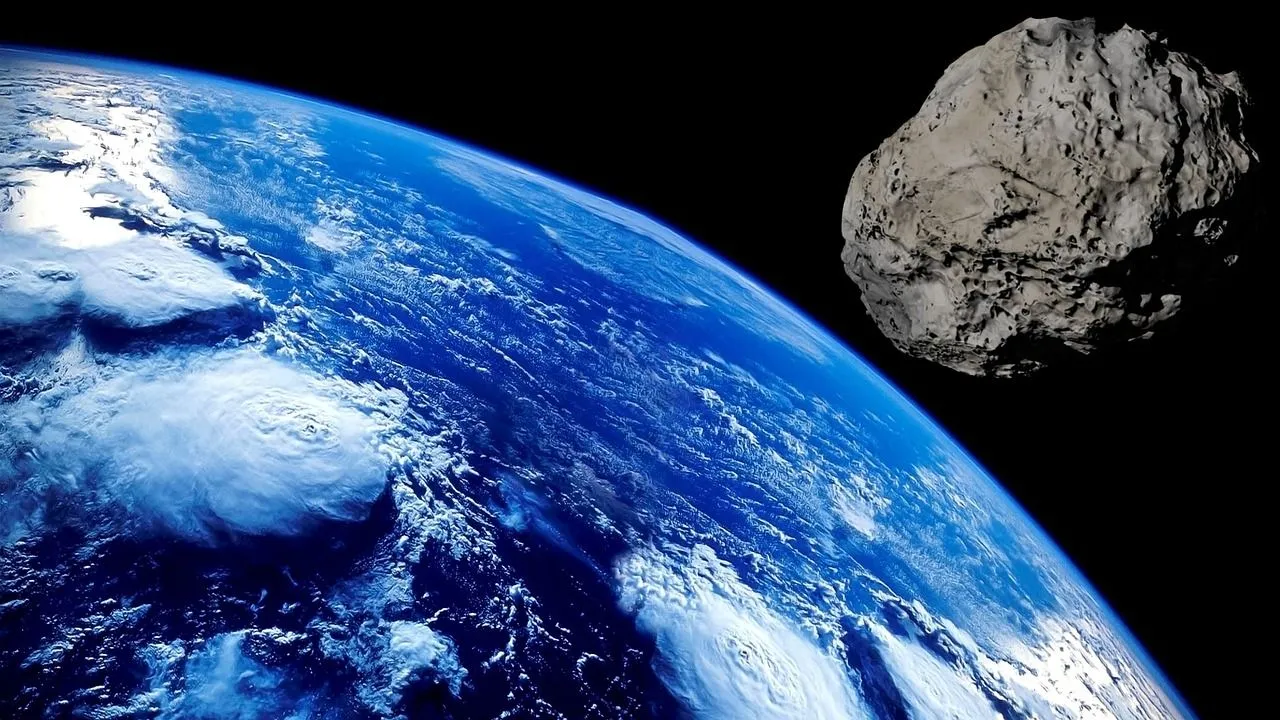
Illustration image Pixabay
Researchers employed an innovative method to analyze samples of ancient sediments. These contain ruthenium, a chemical element absent from terrestrial rocks. By comparing the isotopes of ruthenium in the samples with those from different classes of meteorites, they determined that the asteroid that struck Earth was a carbonaceous type (type C). This indicates it formed beyond Jupiter's orbit, in a region where asteroids contain more carbon and volatile elements.
This discovery challenges the hypothesis put forward in 2021 by two Harvard researchers, who proposed that the Chicxulub impactor was a long-period comet. According to their theory, the comet was fragmented by the Sun's gravitational influence before a fragment collided with Earth. However, the new data confirm that the celestial object was indeed a carbonaceous asteroid, thus refuting the comet idea.
Ruthenium played a key role in this identification. In fact, the isotopes of this element allow for distinguishing type C asteroids, formed in the outer Solar System, from type S asteroids, which are more common and originate from the inner Solar System. The fact that the Chicxulub asteroid is type C is particularly significant, as most meteorites found on Earth are type S, formed in regions closer to the Sun.
The implications of this discovery extend beyond dinosaur history. According to Mario Fischer-Gödde, a geochemist at the University of Cologne and lead author of the study, better understanding the nature of asteroids that have impacted Earth over time could provide clues about the origin of water on our planet. He also suggests that if other mass extinctions were caused by type C asteroids, it would be essential to closely monitor this type of celestial object in the future, as they could pose a significant threat to life on Earth.
Ismar de Souza Carvalho / Southern Methodist UniversityL.(L)
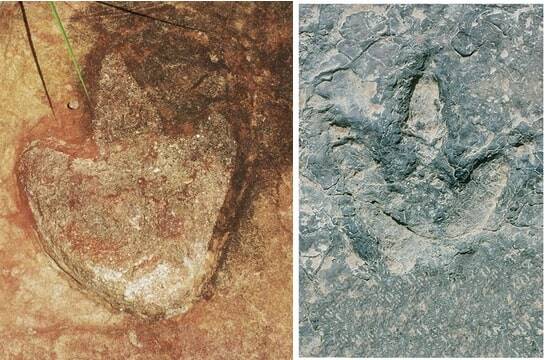
A footprint left by a Theropod dinosaur discovered in the Borborema region in northeastern Brazil in South America. (R) Theropod tracks located in theCameroon's Koum Basin from when South America and Africa were connected under the super continent of Gondwana. Brazil's and Cameroon's Koum Basin
For decades, a massive anomaly sprawling across 1.2 million square miles on the Indian Ocean floor has baffled scientists. This phenomenon, known as the “gravity hole,” has sparked endless debate and curiosity. Read on as we uncover this mystery, officially named the Indian Ocean Geoid Low.
The Indian Ocean’s Gravity Anomaly So, what’s the deal with this vast region of the Indian Ocean that sits up to 106 meters below the global average sea level? It turns out there’s a significant dip in Earth’s gravity here. This gravitational anomaly has puzzled scientists for years, but recent studies are shedding light on its origins and linking it to deep geological processes.
Understanding the Geoid Low Geologists have a term for this “hole”—a geoid low, where Earth’s gravity is weaker than average. It might sound alarming, but it’s just a natural part of our planet’s gravitational landscape. Recent research suggests that molten rock plumes rising from deep beneath Africa are responsible for this phenomenon; these plumes are at the edge of an ancient sea bed.
Earth’s Shape and Gravitational Variation Ideally, Earth would have uniform gravity, but it’s not a perfect sphere. It’s flatter at the poles and bulges at the equator, causing variations in gravity. Different regions exert varying gravitational pulls based on the crust, mantle, and core mass distribution. Such complexity contributes to gravitational anomalies like the low geoid of the Indian Ocean.
The Potsdam Gravity Potato To visualize these gravitational tugs, scientists use gravity measurements from sensors and satellites to create models like the “Potsdam gravity potato.” The model highlights Earth’s gravitational highs and lows, helping scientists understand the mass distribution beneath the surface. It’s like taking off each layer of an onion, discovering more with every peel.
Discovery and Confirmation of the IOGL The Indian Ocean Geoid Low (IOGL) was discovered by Dutch geophysicist Felix Andries Vening Meinesz in 1948 during a ship-based gravity survey. Since then, subsequent shipboard expeditions and satellite measurements have confirmed its presence. This IOGL is the planet’s most prominent gravitational anomaly, covering over three million square kilometers.
Investigating the Origins Researchers Attreyee Ghosh and Debanjan Pal compared various computer models of the region’s formation over the past 140 million years. Each model used different variables for the convection of molten material within the mantle. Their goal? To pinpoint the cause of the IOGL. Their findings point to a distinctive mantle structure influenced by ancient geological events.
The Role of the Mantle and the African Blob The study suggests that the IOGL is due to a unique mantle structure combined with an adjacent disturbance under Africa known as the “African blob.” This large low-shear velocity province (LLSVP) consists of hot, low-density material, thought to be remnants from ancient seafloor slabs, which influence the region’s gravitational characteristics.
Connection to the Tethys Ocean Geologists believe Tethyan slabs, remnants of an ancient seafloor from the Tethys Ocean, form the African blob. Over 200 million years ago, the Tethys Ocean existed between the supercontinents Laurasia and Gondwana. As India moved northward, it created the Indian Ocean and left behind these geological traces.
Evolution and Persistence of the IOGL Around 20 million years ago, the geoid low probably formed its current shape as plumes began spreading through the upper mantle. The mantle material flow from the African blob sustains this anomaly. As long as these flows continue, the geoid low will persist.
Future Implications The IOGL will eventually dissipate when temperature anomalies cause it to move, which could take many millions of years. Studying this geoid low provides valuable insights into Earth’s internal processes and the dynamic nature of its mantle.
5.5 million years ago the Mediterranean dried out, with sobering lessons for humanity today – new research
What would happen if humans dried out the Mediterranean sea, turning it into a giant salt lake? Would its wildlife survive, and if so, how long would it take to recover?
These may seem like wildly theoretical questions, but not for Herman Sörgel, a Bavarian architect who dedicated much of his life to this exact project: building a giant dam across the Strait of Gibraltar, letting the Mediterranean dry up, and colonising the land reclaimed from the sea.
Sörgel organised lectures and documentaries and raised funds until the 1950s for a project which, he believed, would promote cooperation between Africa and Europe, and power both continents through gigantic hydroelectric megaprojects.
What he did not know was that his dream had already come true at the end of the Miocene era, 5.5 million years ago, as a simple result of natural forces.
When the Mediterranean disappeared
Since the 1970s, several generations of marine geologists and geophysicists have confirmed the existence of a one to three kilometre thick layer of salt buried throughout most of the deeper parts of the Mediterranean Sea.
This is almost a million cubic kilometres of salt that testify to a brief period when the Mediterranean was isolated from the rest of the world’s oceans – brief in the geological sense, as the episode lasted about 190,000 years
The culprit was not, of course, an eccentric German architect, but plate tectonics. The Mediterranean basin, trapped between two continents that today continue to move closer by up to two centimetres every year, was cut off from the Atlantic. Its waters quickly evaporated due to the region’s arid climate, leaving behind vast amounts of salt.
This episode, known as the Messinian salinity crisis (the Messinian being the last period of the Miocene), is the biggest extinction event suffered by the Earth since the meteorite that wiped out the flightless dinosaurs and ended the Mesozoic era 65 million years ago.
Closure of the last connecting channel between the Mediterranean and the Atlantic, leading to the Messinian salinity crisis 5.96 million years ago. (B) and (C): the rivers that formerly drained into the Mediterranean carved deep gorges into the continent’s edges; (D) evaporation caused salt saturation in the waters and the precipitation of salt layers more than a kilometre thick; (E) lakes remained in the deepest parts of the sea. This illustration show how mammals, such as camelids and gerbils, were able to move across the Strait of Gibraltar.Pau Bahí y Daniel García Castellanos/Wikimedia Commons, CC BY-SA
As a result, no geoengineering experiments are needed to answer our initial question: how resilient is marine life in the face of an environmental crisis of this magnitude?
The answer has just been published in the journal Science, in a study led by Konstantina Agiadi of the University of Vienna in collaboration with the Spanish National Research Council and 28 other scientists from 25 European institutes.
After gathering all Mediterranean fossil data from between 12 and 3.6 million years ago, the results suggest that native marine life was virtually extinct when the Mediterranean was cut off, and that subsequent recolonisation by Atlantic species gave rise to a Mediterranean fauna more similar to the one we find there today.
Native, extinct and migrant species
By statistically analysing information from more than 750 scientific papers, we were able to document 22,932 presences of a total of 4,897 marine species living in the Mediterranean. Before the crisis, 779 species could be considered endemic species (i.e. documented only in the Mediterranean). Of those, only 86 were still present after the salinity crisis. All the tropical corals that were abundant in the Mediterranean before this cataclysmic environmental change disappeared.
A dugong feeding on the sea floor near Marsa Alam, Egypt. Metxitherium serresii, a closely related sirenians, is the only local Mediterranean mammal older than the salinity crisis that remained present after the event. Due to the limited paleontological record, however, it cannot be excluded that their survival took place out of this sea.Julien Willem, Wikimedia Commons, CC BY-SA
However, some apparently endemic sardine species managed to survive. The sirenian, a sea mammal related to today’s manatees and dugongs (also known as sea cows) also survived.
Because fossil records are limited and fragmented we cannot be certain that these species were all endemic, or that they would not have survived outside the Mediterranean, hence the value of basing our study on statistics from a large number of species. But for those that were endemic, where did they manage to survive, and what refuges did they find to avoid the radical increase in salt levels and temperature?
These questions remain unanswered, but we have been able to establish that changes in populations are the result of replacement by Atlantic species after the Mediterranean’s re-flooding, rather than rapid adaptation to the new hypersaline environment. In other words, life did not have enough time to adapt, and the extinct species were replaced by Atlantic species that migrated into the Mediterranean.
Several iconic species, such as the great white shark and the dolphin, only appeared in the Mediterranean after the crisis. Even more interestingly, the current richness of fauna in the western Mediterranean only came after the re-flooding – previously, the eastern Mediterranean (Ionian and Levantine Seas) had possessed a higher number of different species.
The impact of the Mediterranean’s isolation on its fauna and flora was catastrophic, destroying most of its ecosystems. Another significant finding from our research is that it took more than 1.7 million years for species numbers to recover. This slow recovery of the richness of Mediterranean ecosystems provides the first detailed quantification of how wildlife responds to an extinction event of this magnitude.
The Mediterranean’s biodiversity today is very high thanks to the presence of numerous endemic species. Our results suggest that this was also the case six million years ago, but that the vast majority of these endemic species disappeared when it was cut off from the Atlantic.
Perhaps another lesson learned from this study is that, however tempting it may be to believe that geoengineering projects can allow us to maintain our current rate of emissions and ecosystem destruction, the Earth’s geological past will reveal more than any experiment.
When the Mediterranean was reconnected to the Atlantic, it was repopulated by the huge reserve of species in the world’s oceans, yet it still took millions of years for the Mediterranean’s ecosystems to recover in terms of richness. No one knows yet how long it will take for marine life to recover from the kind of global-scale change that is currently underway.
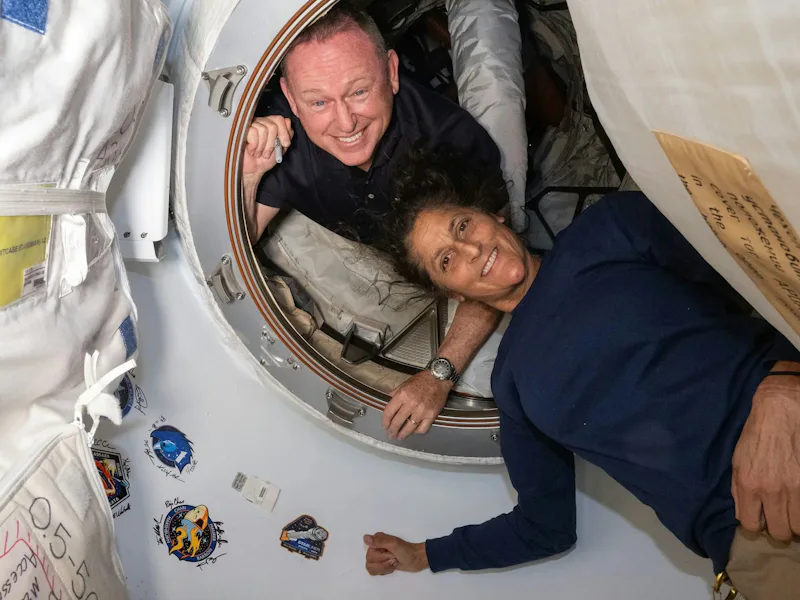
Two astronauts marooned in space may sound like the plot of a Hollywood blockbuster, but for two NASA crew members, it is now a reality. Commander Barry Wilmore and pilot Sunita Williams are currently in limbo on the International Space Station (ISS).
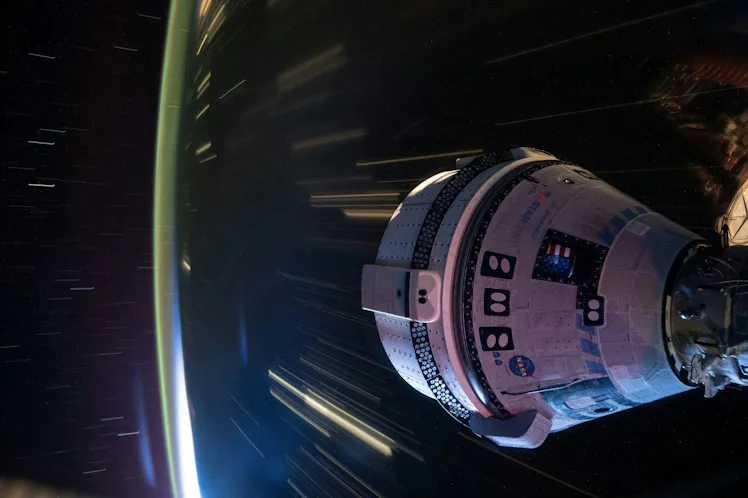
They arrived in the Boeing Starliner spacecraft — the first test of the spaceship with astronauts. Wilmore and Williams were supposed to stay on the ISS for around eight days and return on the same spacecraft. But there is now debate about the safety of Starliner after it experienced helium leaks and thruster problems on its way to the ISS.
In the coming days, NASA and Boeing may decide to clear Starliner to carry the astronauts back to Earth. This means their stay might not last too much longer. But if officials decide against Starliner, the astronauts face waiting an additional six months in orbit before returning. So how do astronauts cope with a potential six-month wait for a lift home?
Part of the reason that waiting is difficult is that it distorts our sense of time. Think of the last time you were waiting for a delayed train, test results or a text from a potential new partner. Did it fly by or drag? For most people, time spent waiting crawls at a glacial pace. As a result, delays and periods of anticipation often feel much longer than they actually are.
Waiting slows our perception of time because it changes the amount of time that we spend thinking about time. During normal daily life, we often ignore time, and our brains have a limited capacity. If time isn’t important, we simply don’t think about it, and this helps it to pass quickly.
When we are waiting, our desire to know when the wait is over increases how much we think about time. This “clock watching” can make the minutes and hours feel like they are passing at a snail’s pace. Stress, discomfort and pain exacerbate this effect, meaning that waiting in difficult situations can seem even longer.
Waiting also slows our perception of time because it is what we do and how we feel. Normal life is busy and full of ever-changing activities and interactions. The sudden need to wait halts the flow of life, often leaving us with nothing else to do, thus increasing levels of boredom and frustration.
In general, time filled with activity passes more quickly. We all got a taste of this during COVID lockdowns. When we were stuck inside, unable to see friends and engage in normal daily activities, the loss of routine and distractions caused time to drag for many.
For the astronauts stuck on the ISS, anxiety about when they will return, limited opportunities for activities and fewer opportunities to contact friends and families combine to make their wait to return home feel significantly longer than six months — if it should come to that.
However, as academics who research the effects of time on human psychology and biology, our ongoing work with crew members at research stations in Antarctica aims to shed light on whether waiting in extreme environments is different to waiting during normal daily life.
A year in Antarctica
While being stuck for six months on the ISS may sound like many people’s worst nightmare, it is not uncommon for scientists to spend long periods isolated and confined in extreme environments. Every year, organizations such as the Instituto Antártico Argentino (which uses the Belgrano II Antarctic station), the French Polar Institute and the Italian Antarctic Programme, in cooperation with the European Space Agency (which all use Antarctica’s Concordia station), send crews of people for up to 16 months to conduct research on the frozen continent.
During the March to October polar winter, teams spend six months in near darkness – and from May to August, in complete darkness – facing outside temperatures of up to -60C, wind speeds of 160 km/h (100 mph) and storms which prevent almost all outdoor activity. Limited internet coverage can also prevent constant communication with the outside world.
For the last year, we have researched how life in Antarctica influences people’s experience of time. Each month, we asked crew members how time felt like it was passing in comparison to before their mission. Trapped on base, with limited contact with the outside world, you might expect time to drag. However, our results suggest the opposite may be true.
Analysis of crew members’ experiences indicated that being constantly busy with complex tasks such as scientific research helped the time to pass swiftly, according to 80% of crew responses. Only 3% of responses indicated that time actually dragged, and these reports occurred when nights were long, and there was little to do.
These experiences may provide hope for those stuck on the ISS. Like life in an Antarctic station, these NASA astronauts have busy and mentally demanding lives. These factors may help time to pass quickly.
However, a key factor of their wait may be their ability to tolerate the uncertainty of when they will return. Wilmore and Williams will spend their time in a space equivalent to the inside of a Boeing 747 plane. However, better information about “when” things will happen and “why” delays are being incurred can help people tolerate waiting and reduce its impact on their wellbeing.
This article was originally published on The Conversation by Ruth Ogden at the Liverpool John Moores University and Daniel Eduardo Vigo at the Pontificia Universidad Católica de Argentina. Read the original article here.
Rogue planets may be more common than we thought, and they may form alone in the void in the same way stars do, suggests a recent study.
We think we know how the universe is structured: Moons orbit planets, and planets orbit stars. But rogue planets don’t play by the rules; they drift alone through the darkness, not bound to a star’s gravity. And these lonely rebel worlds may make up about 10 percent of celestial objects, not just rare flukes of nature.
The James Webb Space Telescope (JWST) peered into a nearby star cluster and found a handful of rogue gas giants — including one with its own disk of dust swirling around it. The results suggests that rogue planets may not only be worlds that got kicked out of their star systems, but worlds that coalesce out of clouds of interstellar gas in the same way stars do — just smaller.
Johns Hopkins University astrophysicist Adam Langeveld and his colleagues published their work in The Astronomical Journal.
This is JWST’s latest image of NGC 1333, a stellar cluster about 1,000 light years away, where new stars — and new rogue planets — are still being born.
STScI
Lonely Planets Club
Langeveld and his colleagues surveyed a cluster of stars called NGC 1333, which exists 1,000 light years away in the constellation Perseus, with JWST’s Near Infrared Imager and Slitless Spectrograph (NIRISS) instrument. They found six gas giants — each between five and 10 times more massive than Jupiter — drifting through space on their own, not orbiting a star. One of these lonely worlds even had a disk of dust orbiting it, as if in the process of forming its own little family of planets (or moons). And based on their observations, Langeveld and his colleagues say rogue planets, once thought to be rare flukes of nature, might make up about 10 percent of the objects in the cluster.
We know that stars form when dense clumps of gas and dust in clouds called nebulae collapse under their own gravity, creating enough heat and pressure at their centers to kickstart nuclear fusion. And we know that sometimes, a clump of material can form an object that’s just on the threshold of being able to start burning as a star, but doesn’t have quite enough mass to get there: a brown dwarf. But astronomers weren’t sure whether even smaller objects, like giant gas planets, could form the same way.
The team of astrophysicists used JWST “to search for the faintest members of a young star cluster, seeking to address a fundamental question in astronomy: how light an object can form like a star?” says Johns Hopkins University astrophysicist Ray Jayawardhana, the senior author of the recent paper, in a recent statement. “It turns out the smallest free-floating objects that form like stars overlap in mass with giant exoplanets circling nearby stars.”
The smallest rogue planet Langeveld and his colleagues spotted, a gas giant about 5 times the mass of Jupiter (or 1,600 times the mass of Earth, if you prefer), is an important clue. It sits at the heart of a swirling disk of gas and dust, which looks exactly like the disks that form around newborn stars, where material eventually coalesces into planets. That suggests that the planet probably formed like a star, just from a smaller cloud of gas and dust. And it may be forming its own miniature system, like Jupiter or Saturn with their swarms of moons.
In other words, rogue planets may not always be planets that formed in orbit around a star like our Sun, only to get kicked out of the star system by a close encounter with a sibling planet or a passing star (which may have happened at least once in our own Solar System’s history). Instead, they can apparently spawn all alone, from much smaller clouds of gas than the ones that form stars.
“This is important context for understanding both star and planet formation,” says Langeveld in a recent statement.
What’s Next?
Langeveld and his colleagues hope to learn more about these lonely planets’ atmospheres in their next round of observations with JWST. Once they have that information, they’ll compare the rogue gas giants’ atmospheres to brown dwarfs and to “normal” gas giants that orbit stars. That could offer clues about whether gas giants that coalesce alone in the middle of space contain a different mix of elements than those that form in the disks around newborn stars.
The astronomers also hope to find more objects like the small rogue planet with its own little protoplanetary disk. That could shed light on whether, or how, rogue planets might form their own systems of planets (or moons). Picture all the diverse worlds that orbit the gas giants in our Solar System — Jupiter’s icy moon Europa and volcanic hellworld Io, or Saturn’s Titan with its methane seas — orbiting a version of Jupiter all alone in deep space, unlit by any star, heated only by the tidal pull of their planet.
“The diversity of systems that nature has produced is remarkable and pushes us to refine our models of star and planet formation,” says Jayawardhana.
It feels like every few months, microplastics are cropping up someplace else they don’t belong: testicles, placentas, carotid artery plaque,lungs. These infinitesimally small plastic particles, which are smaller than 5 millimetersacross, have most recently been detected in brains, according to a new study.
A preprint study — which is a scientific study that has not yet been reviewed by other scientists for publication in a journal — was posted online in May by the National Institutes of Health looking at the amount of microplastics in human brain samples from autopsies. The study found that brains had higher concentrations of microplastics than other organs, and that these autopsy samples also had higher concentrations of microplastics than autopsy samples from a 2016 study. Though this paper is still under review to ensure the methods and findings are trustworthy, the key results of the study exemplify yet another vital organ affected by microplastics.
For the study, the authors examined livers, kidneys, and brains from autopsied cadavers. They found that concentrations of microplastics in the brain samples they examined “ranged from 7 to 30 times the concentrations seen in livers or kidneys.” They also found that brain samples collected and analyzed in 2024 contained significantly higher concentrations of microplastic, with over 3,000 micrograms per gram of human tissue in 2016 and over 4,800 micrograms per gram in 2024. Some samples ranged as high as more than 8,800 micrograms of plastic per gram of brain tissue.
We don’t know yet what effects, if any, microplastics could have on the brain, but this study does confirm that these bits of plastic can cross the blood-brain barrier, which is the protective membrane that helps regulate what molecules enter the brain from circulating blood.
“Based on our observations, we think the brain is pulling in the very smallest nanostructures, like 100 to 200 nanometers in length, whereas some of the larger particles that are a micrometer to five micrometers go into the liver and kidneys,” lead author of the study Matthew Campen, a toxicologist and professor of pharmaceutical sciences at the University of New Mexico in Albuquerque, told CNN.
While it seems like microplastics are omnipresent in today’s society, figuring out how to affect our health is key.
The team behind thefirst ever imageof a black hole can now observe the same celestial gargantuan with greater definition than ever before.
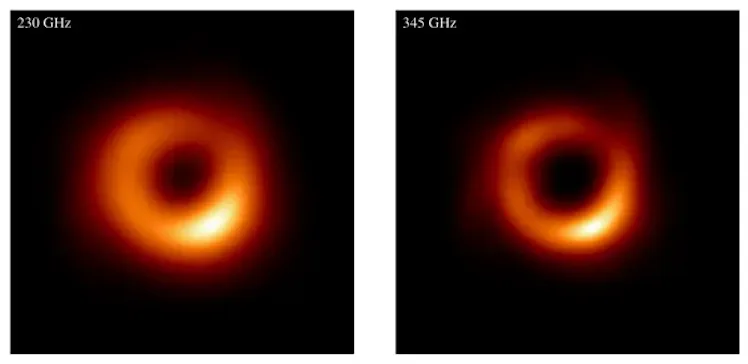
On Tuesday, the Event Horizon Telescope (EHT) team announced that their global network of radio telescopes, which turns Earth into one giant virtual telescope, can observe at a new radio frequency. This means a few things. First, the team can get crisper imagery of the supermassive black hole at the center of galaxy M87, which starred in the first ever image of a black hole, taken in 2017 and published in 2019. Second, having an additional frequency means the team can play with color.
“This new ‘color vision’ allows us to tease apart the effects of Einstein’s gravity from the hot gas and magnetic fields that feed the black holes and launch powerful jets that stream over galactic distances,” Sheperd “Shep” Doeleman, astrophysicist and Founding Director of the EHT, said in an announcement published Tuesday.
The supermassive black hole M87* seen two ways in two simulated images. The 345 GHz view is on the right, and represents the newest capability of the Event Horizon Telescope.
EHT, D. Pesce, A. Chael
Two is better than one
Doeleman tells Inverse that supermassive black holes are busy places. Seeing two frequencies would reveal more of its organized chaos. The team has published simulation images to depict how the new frequency changes the view.
“When you have two separate frequencies, you’re able to tease apart different effects around the black hole,” Doeleman says.
Albert Einstein predicted that gravity bends all light, across all wavelengths, in the same way. Right around the black hole’s shadow, where gravity is so strong that not even light can reflect back out, data across both frequencies may look the same.
But farther away from the event horizon, other phenomena like the black hole’s jets of superheated plasma will look differently from one frequency to the next.
Seeing in color
Having two sets of information allows for color. The data from the telescopes is radio, a wavelength of light invisible to human eyes. The single color of existing EHT images are packed with information at 230 GHz. But now that EHT can take observations at 345 GHz, imagery specialists can add a new color to the golden ring. This will be exciting to view not only as a still image, but eventually, as a motion picture.
This composite simulated image from the Event Horizon Telescope shows how the supermassive black hole M87* might look at different radio frequencies of 86 GHz (red), 230 GHz (green), and 345 GHz (blue).
EHT, D. Pesce, A. Chael
Doeleman and other researchers hope the telescopes in the EHT network will be able to take not just two radio wavelengths at the same time, but eventually three.
“The EHT's successful observation at 345 GHz is a major scientific milestone,” Lisa Kewley, Director of the Center for Astrophysics | Harvard & Smithsonian, said in the announcement. “By pushing the limits of resolution, we’re achieving the unprecedented clarity in the imaging of black holes we promised early on, and setting new and higher standards for the capability of ground-based astrophysical research.”
NASA's Endurance Rocket lifts off from Svalbard in 2022. The results are in and the rocket successfully measured Earth's global electric field. Image Credit: NASA/Brian Bonsteel
A NASA Rocket Has Finally Found Earth’s Global Electric Field
Scientists have discovered that Earth has a third field. We all know about the Earth’s magnetic field. And we all know about Earth’s gravity field, though we usually just call it gravity.
Now, a team of international scientists have found Earth’s global electric field.
It’s called the ambipolar electric field, and it’s a weak electric field that surrounds the planet. It’s responsible for the polar wind, which was first detected decades ago. The polar wind is an outflow of plasma from the polar regions of Earth’s magnetosphere. Scientists hypothesized the ambipolar field’s existence decades ago, and now they finally have proof.
“It’s like this conveyor belt, lifting the atmosphere up into space.”
Glyn Collinson, Heliophysics Science Division, NASA Goddard Space Flight Center
The Space Age gained momentum back in the 1960s as the USA and USSR launched more and more satellites. When spacecraft passed over the Earth’s poles, they detected an outflow of particles from Earth’s atmosphere into space. Scientists named this the polar wind, but for decades, it was mysterious.
Scientists expect some particles from Earth to “leak” into space. Sunlight can cause this. But if that’s the case, the particles should be heated. The wind is mysterious because many particles in it are cold despite moving at supersonic speeds.
“Something had to be drawing these particles out of the atmosphere,” said lead author Collinson.
Collinson is also the Principal Investigator for NASA’s “Endurance” Sounding Rocket Mission. “The purpose of the Endurance mission was to make the first measurement of the magnitude and structure of the electric field generated by Earth’s ionosphere,” NASA writes in their mission description. Endurance launched on May 22nd, 2022, from Norway’s Svalbard Archipelago.
This image shows NASA’s Endurance rocket launching from Ny-Ålesund, Svalbard, Norway. It flew for 19 minutes to an altitude of about 780 km (484 mi) above Earth’s sunlit polar cap. It carried six science instruments and could only be launched in certain conditions to be successful. Image Credit: NASA/Brian Bonsteel.
“Svalbard is the only rocket range in the world where you can fly through the polar wind and make the measurements we needed,” said Suzie Imber, a space physicist at the University of Leicester, UK, and co-author of the paper.
Svalbard is key because there are open magnetic field lines above Earth’s polar caps. These field lines provide a pathway for ions to outflow to the magnetosphere.
This figure from the research shows Endurance’s flight profile and its path over Earth. The rocket had to fly near the open magnetic field lines that exist at Svalbard’s high polar latitudes. Image Credit: Collinson et al. 2024.
After it was launched, Collinson said, “We got fabulous data all through the flight, though it will be a while before we can really dig into it to see if we achieved our science objective or not.”
Now, the data is in, and the results show that Earth has a global electric field.
Prior to its discovery, scientists hypothesized that the field was weak and that its effects could only be felt over hundreds of kilometres. Even though it was first proposed 60 years ago, scientists had to wait for technology to advance before they could measure it. In 2016, Collinson and his colleagues began inventing a new instrument that could measure the elusive field.
At about 250 km (150 mi) above the Earth’s surface, atoms break apart into negatively charged electrons and positively charged ions. Electrons are far lighter than ions, and the tiniest energetic jolt can send them into space. Ions are more than 1800 times heavier, and gravity draws them back to the surface.
If gravity were the only force at work, the two populations would separate over time and simply drift apart. But that’s not what happens.
Electrons and ions have opposite electrical charges. They’re attracted to one another and an electric field forms that keeps them together. This counteracts some of gravity’s power.
The field is called ambipolar because it’s bidirectional. That means it works in both directions. As ions sink down due to gravity, the electrical charges mean that the ions drag some of the electrons down with them. However, at the same time, electrons lift ions high into the atmosphere with them as they attempt to leave the atmosphere and escape into space.
The result of all this is that the ambipolar field extends the atmosphere’s height, meaning some of the ions escape with the polar wind.
After decades of hypothesizing and theorizing, the Endurance rocket measured a change in electric potential of only 0.55 volts. That’s extremely weak but enough to be measurable.
“A half a volt is almost nothing — it’s only about as strong as a watch battery,” Collinson said. “But that’s just the right amount to explain the polar wind.”
Hydrogen ions are the most plentiful particles in the polar wind. Endurance’s results show that these ions experience an outward force from the magnetic field that’s 10.6 times more powerful than gravity. “That’s more than enough to counter gravity — in fact, it’s enough to launch them upwards into space at supersonic speeds,” said Alex Glocer, Endurance project scientist at NASA Goddard and co-author of the paper.
Hydrogen ions are light, but even the heavier particles in the polar wind are lifted. Oxygen ions in the weak electrical field effectively weigh half as much, yet they’re boosted to greater heights, too. Overall, the ambipolar field makes the ionosphere denser at higher altitudes than it would be without the field’s lofting effect. “It’s like this conveyor belt, lifting the atmosphere up into space,” Collinson added.
“The measurements support the hypothesis that the ambipolar electric field is the primary driver of ionospheric H+ outflow and of the supersonic polar wind of light ions escaping from the polar caps,” the authors explain in their paper.
“We infer that this increases the supply of cold O+ ions to the magnetosphere by more than 3,800%,” the authors write. At that point, other mechanisms come into play. Wave-particle interactions can heat the ions, accelerating them to escape velocity.
These results raise other questions. How does this field affect Earth? Has the field affected the planet’s habitability? Do other planets have these fields?
Back in 2016, the European Space Agency’s Venus Express mission detected a 10-volt electric potential surrounding the planet. This means that positively charged particles would be pulled away from the planet’s surface. This could draw away oxygen.
Scientists think that Venus may have once had plentiful water. However, since sunlight splits water into hydrogen and oxygen, the electric field could’ve siphoned the oxygen away, eliminating the planet’s water. This is theoretical, but it begs the question of why the same thing hasn’t happened on Earth.
The ambipolar field is fundamental to Earth. Its role in the evolution of the planet’s atmosphere and biosphere is yet to be understood, but it must play a role.
“Any planet with an atmosphere should have an ambipolar field,” Collinson said. “Now that we’ve finally measured it, we can begin learning how it’s shaped our planet as well as others over time.”
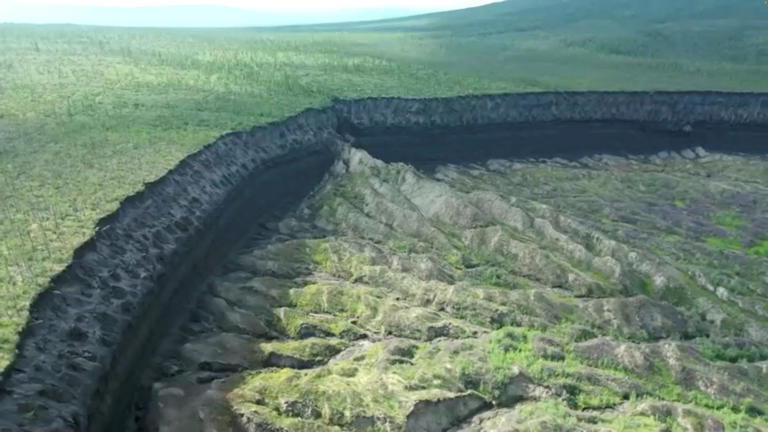
The Batagay megaslump is a result of the ground thawing and collapsing as Arctic temperatures rise.
It's an extreme case of a changing Arctic landscape accelerating the climate crisis.
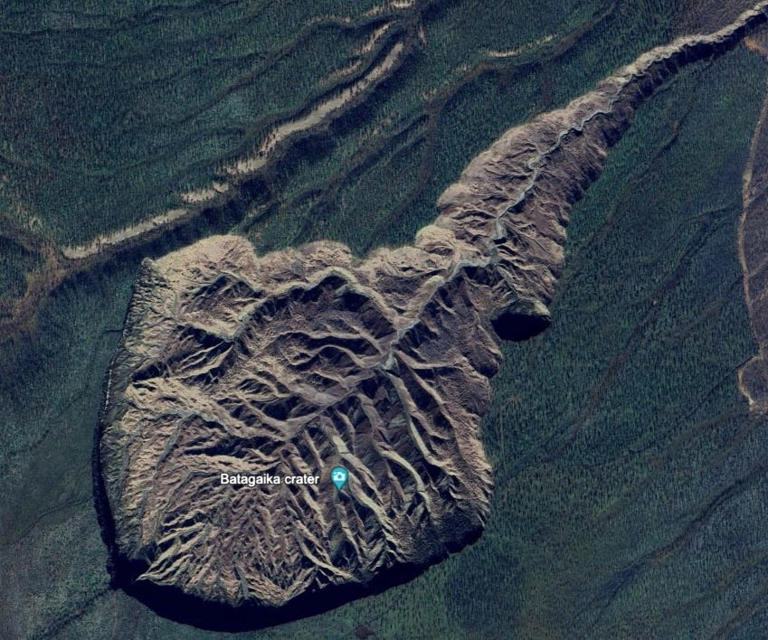
A giant hole in the earth is breaking open the land in Siberia, and photos from space show it's growing rapidly.
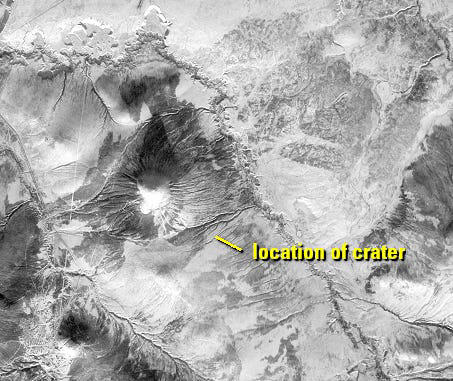
It resembles a stingray, a horseshoe crab, or a giant tadpole. It started as a sliver, barely visible in declassified satellite imagery from the 1960s.
Declassified satellite imagery from 1965 shows the very beginnings of the hole growing in Siberia.
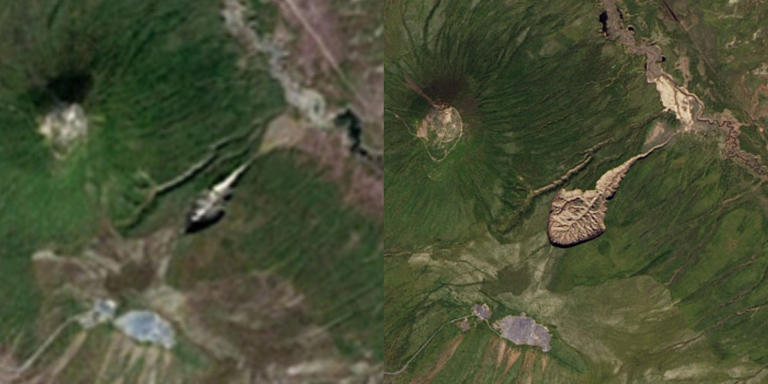
The hole tripled in size between 1991 and 2018, according to the US Geological Survey.
Satellite images from 1999 and 2017 show how much the Batagay megaslump has grown (and how much satellite imaging has improved). NASA Earth Observatory/Jesse Allen/Landsat data from the US Geological Survey
The Batagay crater, sometimes referred to as Batagaika or the "gateway to hell," represents a much larger, often invisible problem that affects the entire planet.
What is this hole in Siberia?
The Arctic is heating up faster than the rest of Earth, and that's quickly thawing the permafrost, which is a thick layer of soil that's permanently frozen — at least, it used to be.
The Batagay crater isn't actually a crater at all. It's the world's largest "retrogressive thaw slump," a pit that forms when permafrost thaw causes the ground to cave in, creating a landslide as the earth at its edges slumps into the pit.
There are thousands of thaw slumps across the Arctic. But the size of the Batagay "crater" has earned it the title of megaslump. It's named for the nearby town of Batagay.
A drone view of the head of the Batagay megaslump.
"Permafrost is not the most, let's say, photogenic of subjects," Roger Michaelides, a geophysicist at Washington University in St. Louis, told Business Insider. "You're talking mostly about frozen dirt underground, which by definition you often can't see unless it's been exposed somehow, like in this megaslump."
That makes the Batagay pit a bit of a permafrost celebrity and an omen of what lies ahead.
The Batagay megaslump could help decode our planet's future
As permafrost thaws, all the dead plants and animals that have been frozen inside it for centuries start to decompose, belching carbon dioxide and methane into the atmosphere.
Those are powerful heat-trapping gases, which cause global temperatures to rise even more, triggering even faster permafrost thaw.
This vicious cycle could have dire effects. Permafrost covers 15% of the land in the Northern Hemisphere and contains twice as much carbon as the atmosphere.
One study estimated that permafrost thaw could emit as much planet-warming gases as a large industrial nation by 2100 if industries and countries don't aggressively rein in their own emissions today.
"There's a lot we don't know about this feedback loop and how it will play out necessarily, but the potential is there for very large changes to the climate system occurring over very, very fast geologic timescales," Michaelides said.
In short, permafrost thaw could quickly make the climate crisis much worse. But it's still a mysterious process. Studying extreme sites like the Batagay megaslump can help scientists understand permafrost thaw and see into the future.
In a study published in the journal Geomorphology in June, researchers used satellite and drone data to construct 3D models of the megaslump and calculate its expansion over time.
They found that about 14 Pyramids of Giza's worth of ice and permafrost had thawed at Batagay. The crater's volume increases by about 1 million cubic meters every year.
"These values are truly impressive," Alexander Kizyakov, the study's lead author and a scientist at Lomonosov Moscow State University, told BI in an email.
"Our results demonstrate how quickly permafrost degradation occurs," he added.
The researchers also calculated that the megaslump releases about 4,000 to 5,000 tons of carbon each year. That's about as much as the annual emissions from 1,700 to 2,100 US homes' energy use.
Michaelides said those numbers didn't surprise him, but they can help inform models of future permafrost thaw and emissions.
"I think there is a lot we can learn from Batagaika, not only in terms of understanding how Batagaika will evolve with time, but also how similar features might develop and evolve over the Arctic," Michaelides said. "Even if they're a tenth or a hundredth the size of Batagaika, the physics is fundamentally the same."
If you enjoyed this story, be sure to follow Business Insider on Microsoft Start.
Meer van UFO'S of UAP'S, ASTRONOMIE, RUIMTEVAART, ARCHEOLOGIE, OUDHEIDKUNDE, SF-SNUFJES EN ANDERE ESOTERISCHE WETENSCHAPPEN - DE ALLERLAATSTE NIEUWTJES


 Waarnemingen van gigantische hagedissen in Florida komen steeds vaker voor: wat zijn het en waarom zijn ze daar?