Naar de inhoud

UFO'S of UAP'S, ASTRONOMIE, RUIMTEVAART, ARCHEOLOGIE, OUDHEIDKUNDE, SF-SNUFJES EN ANDERE ESOTERISCHE WETENSCHAPPEN - DE ALLERLAATSTE NIEUWTJES

UFO's of UAP'S in België en de rest van de wereld
akke.beakke.be
Ontdek de Fascinerende Wereld van UFO's en UAP's: Jouw Bron voor Onthullende Informatie! Ben jij ook gefascineerd door het onbekende? Wil je meer weten over UFO's en UAP's, niet alleen in België, maar over de hele wereld? Dan ben je op de juiste plek! België: Het Kloppend Hart van UFO-onderzoek In België is BUFON (Belgisch UFO-Netwerk) dé autoriteit op het gebied van UFO-onderzoek. Voor betrouwbare en objectieve informatie over deze intrigerende fenomenen, bezoek je zeker onze Facebook-pagina en deze blog. Maar dat is nog niet alles! Ontdek ook het Belgisch UFO-meldpunt en Caelestia, twee organisaties die diepgaand onderzoek verrichten, al zijn ze soms kritisch of sceptisch. Nederland: Een Schat aan Informatie Voor onze Nederlandse buren is er de schitterende website www.ufowijzer.nl, beheerd door Paul Harmans. Deze site biedt een schat aan informatie en artikelen die je niet wilt missen! Internationaal: MUFON - De Wereldwijde Autoriteit Neem ook een kijkje bij MUFON (Mutual UFO Network Inc.), een gerenommeerde Amerikaanse UFO-vereniging met afdelingen in de VS en wereldwijd. MUFON is toegewijd aan de wetenschappelijke en analytische studie van het UFO-fenomeen, en hun maandelijkse tijdschrift, The MUFON UFO-Journal, is een must-read voor elke UFO-enthousiasteling. Bezoek hun website op www.mufon.com voor meer informatie. Samenwerking en Toekomstvisie Sinds 1 februari 2020 is Pieter niet alleen ex-president van BUFON, maar ook de voormalige nationale directeur van MUFON in Vlaanderen en Nederland. Dit creëert een sterke samenwerking met de Franse MUFON Reseau MUFON/EUROP, wat ons in staat stelt om nog meer waardevolle inzichten te delen. Let op: Nepprofielen en Nieuwe Groeperingen Pas op voor een nieuwe groepering die zich ook BUFON noemt, maar geen enkele connectie heeft met onze gevestigde organisatie. Hoewel zij de naam geregistreerd hebben, kunnen ze het rijke verleden en de expertise van onze groep niet evenaren. We wensen hen veel succes, maar we blijven de autoriteit in UFO-onderzoek! Blijf Op De Hoogte! Wil jij de laatste nieuwtjes over UFO's, ruimtevaart, archeologie, en meer? Volg ons dan en duik samen met ons in de fascinerende wereld van het onbekende! Sluit je aan bij de gemeenschap van nieuwsgierige geesten die net als jij verlangen naar antwoorden en avonturen in de sterren! Heb je vragen of wil je meer weten? Aarzel dan niet om contact met ons op te nemen! Samen ontrafelen we het mysterie van de lucht en daarbuiten.

Archief

NASA’s Endurance Mission Measures Earth’s Ambipolar Electric Field for First Time

NASA’s Endurance Mission Measures Earth’s Ambipolar Electric Field for First Time

First hypothesized more than 60 years ago, the ambipolar electric field is a key driver of the polar wind, a steady outflow of charged particles into space that occurs above Earth’s poles. This electric field lifts charged particles in our upper atmosphere to greater heights than they would otherwise reach and may have shaped our planet’s evolution in ways yet to be explored.

Collinson et al. report the existence of a +0.55 ± 0.09 V electric potential drop between 250 km and 768 km from a planetary electrostatic field generated exclusively by the outward pressure of ionospheric electrons; they experimentally demonstrate that the ambipolar field of Earth controls the structure of the polar ionosphere, boosting the scale height by 271%. Image credit: NASA.

Collinson et al. report the existence of a +0.55 ± 0.09 V electric potential drop between 250 km and 768 km from a planetary electrostatic field generated exclusively by the outward pressure of ionospheric electrons; they experimentally demonstrate that the ambipolar field of Earth controls the structure of the polar ionosphere, boosting the scale height by 271%.

Image credit: NASA.

Since the 1960s, spacecraft flying over Earth’s poles have detected a stream of particles flowing from our atmosphere into space.

Theorists predicted this outflow, which they dubbed the polar wind, spurring research to understand its causes.

Some amount of outflow from our atmosphere was expected. Intense, unfiltered sunlight should cause some particles from our air to escape into space, like steam evaporating from a pot of water. But the observed polar wind was more mysterious.

Many particles within it were cold, with no signs they had been heated — yet they were traveling at supersonic speeds.

“Something had to be drawing these particles out of the atmosphere,” said Endurance principal investigator Dr. Glyn Collinson, a researcher at NASA’s Goddard Space Flight Center.

The hypothesized electric field, generated at the subatomic scale, was expected to be incredibly weak, with its effects felt only over hundreds of miles.

For decades, detecting it was beyond the limits of existing technology.

In 2016, Dr. Collinson and colleagues got to work inventing a new instrument they thought was up to the task of measuring Earth’s ambipolar field.

The team’s instruments and ideas were best suited for a suborbital rocket flight launched from the Arctic.

In a nod to the ship that carried Ernest Shackleton on his famous 1914 voyage to Antarctica, the researchers named their mission Endurance.

They set a course for Svalbard, a Norwegian archipelago just a few hundred miles from the north pole and home to the northernmost rocket range in the world.

“Svalbard is the only rocket range in the world where you can fly through the polar wind and make the measurements we needed,” said Dr. Suzie Imber, a space physicist at the University of Leicester.

On May 11, 2022, Endurance launched and reached an altitude of 768.03 km (477.23 miles), splashing down 19 minutes later in the Greenland Sea.

Across the 518.2-km (322-mile) altitude range where it collected data, Endurance measured a change in electric potential of only 0.55 volts (V).

“A half a volt is almost nothing — it’s only about as strong as a watch battery. But that’s just the right amount to explain the polar wind,” Dr. Collinson said.

Hydrogen ions, the most abundant type of particle in the polar wind, experience an outward force from this field 10.6 times stronger than gravity.

“That’s more than enough to counter gravity – in fact, it’s enough to launch them upwards into space at supersonic speeds,” said Endurance project scientist Dr. Alex Glocer, a researcher at NASA’s Goddard Space Flight Center.

Heavier particles also get a boost. Oxygen ions at that same altitude, immersed in this half-a-volt field, weigh half as much.

In general, the scientists found that the ambipolar field increases what’s known as the scale height of the ionosphere by 271%, meaning the ionosphere remains denser to greater heights than it would be without it.

“It’s like this conveyor belt, lifting the atmosphere up into space,” Dr. Collinson said.

Endurance’s discovery has opened many new paths for exploration.

The ambipolar field, as a fundamental energy field of our planet alongside gravity and magnetism, may have continuously shaped the evolution of our atmosphere in ways we can now begin to explore.

Because it’s created by the internal dynamics of an atmosphere, similar electric fields are expected to exist on other planets, including Venus and Mars.

“Any planet with an atmosphere should have an ambipolar field. Now that we’ve finally measured it, we can begin learning how it’s shaped our planet as well as others over time,” Dr. Collinson said.

  • The team’s results appear in the journal Nature.
  • G.A. Collinson et al. 2024. Earth’s ambipolar electrostatic field and its role in ion escape to space. Nature 632, 1021-1025; doi: 10.1038/s41586-024-07480-3
  • This article is a version of a press-release from NASA’s Goddard Space Flight Center.

{ https://www.sci.news/ }

Hoe vind je dit bericht?
Geschreven door peter om 22:56 Stuur door

This Mexican Scientist Claimed We Live in a Holographic Matrix, Disappears Mysteriously After It

Jacobo Grinberg

This Mexican Scientist Claimed We Live in a Holographic Matrix, Disappears Mysteriously After It

Jacobo Grinberg (1946-?), the Mexican scientist who explored the link between science and the paranormal, was a psychologist and consciousness researcher. He conducted experiments in telepathy and extraocular vision.

Dr. Grinberg raised the possibility that, through consciousness, the human brain could have control over the universe in which we live. In the field of physics, the Lattice is the structure in which space-time is found. For Jacobo, this concept acquired a new meaning, leading him to coin the term syntergy, a neologism combining “synthesis” and “energy.”

His theory proposes that through the process by which the human brain decodes perceptual reality, it is possible to establish links with the Lattice and thereby make changes in space-time. He postulated that we live in an informational matrix, which he called “the hologram,” where it is possible to interact with perceptual reality not just as spectators but as active participants in constructing that reality.

Jacobo GrinbergJacobo Grinberg

From his brain experiments, Dr. Grinberg developed the syntergic theory, a term formed from the Spanish words síntesis (synthesis) and energía (energy).

Dr. Grinberg also explored the implications of the EPR paradox, which asserts that if quantum theory is a complete model of reality, non-local interactions should exist between particles. He aimed to prove that a quantum system in the brain creates a non-local EPR correlation among human brains. He called this phenomenon transferred potential (TP), suggesting that a brain, suitably prepared through meditation, can interact with other brains, both near and far, by directly involving consciousness without sensory transmission or local effects.

“When consciousness is free, when sensitivity is optimal, we are what the universe is. Ultimately everything is a manifestation of the brain structure, which in turn is a model of the entire universe. When we see the other, we see ourselves,” said Jacobo Grinberg.

Dr. Grinberg further proposed that his syntergic theory could explain the emergence of conscious experience, which he saw as the result of complex multidimensional interactions. The brain initiates an interaction between an energetic field (neuronal field) and space structure, thus giving rise to consciousness.

Contrary to naïve realism, which suggests that reality exists externally to the observer, Dr. Grinberg, adopting an ideological stance, proposed that perception is neuropsychologically constructed, with information existing in space as “complex patterns of energy.” Conscious experience, he believed, occurs when we synthesize this information-energy in space, thereby becoming syntergic. Neuronal changes in the brain cause micro-distortions in the framework of the space-time continuum, which then interact to create a “hypercomplex macro-distortion” of the neuronal field. The outcome of this process is perceptual experience.

Regarding vision, the neuronal and quantum fields’ components “fit together” in experience, minimizing the noise produced by their interaction through a specific, emergent interference pattern (IP). This pattern represents the structure of experience and contains the perceptual components perceived as lines and geometric forms, conceived as energetic forms of high complexity. The percepts, or images, we “objectively” see as colors and objects are ultimately products of the IP.

Dr. Grinberg’s ideas are related to the implicate order theory developed by American physicist David Bohm, in which space is conceived as a holographic “sea of potentialities” from which the universe and consciousness unfold explicitly. Here, the quantum wave/particle duality paradox is resolved, while the “principle of nonlocality”—the capacity of one particle to influence another instantaneously—is preserved.

Jacobo Grinberg Jacobo Grinberg and two collaborators, Leah Attie (left) and Ruth Cerezo, at the entrance of Laboratory 23 of the Faculty of Psychology at UNAM, in August 1994. Image credit: elpais

During the 1980s, Dr. Grinberg traveled extensively across Mexico to interview shamans and psychic healers, hoping to recover the “native psychology” and “original wisdom” of the Mexican people. From his case studies, he concluded that shamans have highly neurosyntergic brains, enabling them to activate experiences in multiple locations in space and manipulate reality to create immediate, astounding effects, most notably materializations.

The syntergic theory both reaffirms and challenges quantum physics by reinterpreting the concept of the Lattice. Dr. Grinberg suggested that, through consciousness, the human brain could control the universe in which we live.

He explained that a person with a highly syntergic neuronal field—meaning a brain with greater coherence links—would have the ability to modify the hologram at will, achieving feats that defy the known laws of physics, much like the shaman Pachita did in her surgeries.

This theory opens the door to investigating other phenomena, such as telepathy. Grinberg conducted various experiments in which, through meditation, he demonstrated synchrony between two brains exposed to different stimuli, producing similar results.

This theory intersects with some fundamental ideas like the law of attraction, the influence of thought on reality, and linguistic relativity, among others.

The most enigmatic aspect of this theory suggests that if consciousness allows us to influence the informational matrix, and if everything is connected through the energetic interaction of atoms and thoughts, then we might inhabit a plane that is not the total reality—essentially, a Matrix into which we have been plTaced, with a brain capable of understanding its physical laws but not its origin.

Read also:

This idea gives rise to the concept of an awakening—of taking consciousness further and mastering the hologram. Under this premise, by fully understanding the matrix’s operation, we would simply disappear and reach a state of purity within the true reality.

Science often rejects new ideas because they don’t fit into what is currently understood. People like Jacobo Grinberg and Nikola Tesla, who were ahead of their time, are often criticized and disrespected because their ideas are not accepted by the scientific community. Even when there is evidence to support their work, they may still lose their reputation.

Dr. Grinberg tried to change the way we understand the connection between science and consciousness. He used the scientific method to explore this relationship. However, science should not be too proud to think it knows everything. It should not dismiss the unknown just because it doesn’t understand it.

This theory could not be verified, and like his studies on extraocular vision in children or telepathy, Dr. Grinberg’s projects remained unfinished after he disappeared at the most momentous point of his prodigious career.

Dr. Jacobo Grinberg disappeared on December 8, 1994, and all his work vanished with him. People have been trying to figure out what happened to him. Here are some ideas:

  1. Some think he was hurt by his wife, Teresa, because of a personal problem. But then she disappeared too.
  2. Others believe the CIA took him away to work for them. A judge found a clue that suggested Dr. Jacobo Grinberg was in North America, but the judge was suddenly removed from the case.
  3. Dr. Jacobo Grinberg’s brother thinks he might have escaped from the world, just like in one of his own theories.

It’s strange that it’s easier to make someone disappear than to recognize their work.

{ https://www.howandwhys.com/ }

Hoe vind je dit bericht?
Geschreven door peter om 22:44 Stuur door

AI focuses asteroid and moon photo, whats this white structure? UFO UAP Sighting News.

AI focuses asteroid and moon photo, whats this white structure? UFO UAP Sighting News.

UFO,%20UAP,%20moon%20base,%20aliens.png
1st source: 
2nd source:
Guys this is crazy cool. I was looking at an asteroid photo that was released this week and it had an alien ship that looked like nothing I have ever seen before...only visible with ai focusing. 
 
Also I found an intestine huge structure I estimate to be 1600 meters across on the moon. This moon photo was taken by the NASA JUICE mission also from this week. I put it though ai, but even without ai focusing...its still visible! Mind-blowing detail either way and 100% proof of intelligent aliens on Earths moon. 
Scott C. Waring 
  

{ https://www.ufosightingsdaily.com/ }

Hoe vind je dit bericht?
Geschreven door peter om 21:56 Stuur door

AI Corrects Three UFO Photos, Colorado, Florida, California 1995-6, UAP Sighting News.

AI Corrects Three UFO Photos, Colorado, Florida, California 1995-6, UAP Sighting News.

Screenshot%202024-08-29%20at%2011.15.06%E2%80%AFAM.png
1. Denver, Colorado Jan 1996 
2. Florida, USA 1996 
3. Borrego Desert, California Jan 1995
 
Hey everyone, hope all is well. I ran three more UFO photos from three sightings through ai and found the sharpened images very impressive. The objects were defiantly 100% proof a an actual flying craft. Who is flying it is another issue. They could be flown by aliens, US military, drones and so on. But I don't feel any US pilot would fly such top secret craft over public locations, so I rule that out. Aliens also have ai drones flying around our planet, because why risk their lives when they can risk a drone instead? 
Scott C. Waring 
 

{ https://www.ufosightingsdaily.com/ }

Hoe vind je dit bericht?
Geschreven door peter om 21:42 Stuur door

Hoe waarschijnlijk is het om intelligente levensvormen in het heelal te vinden? Een nieuwe studie probeert een antwoord te geven

Hoe waarschijnlijk is het om intelligente levensvormen in het heelal te vinden? Een nieuwe studie probeert een antwoord te geven

Janine imagedoor Janine
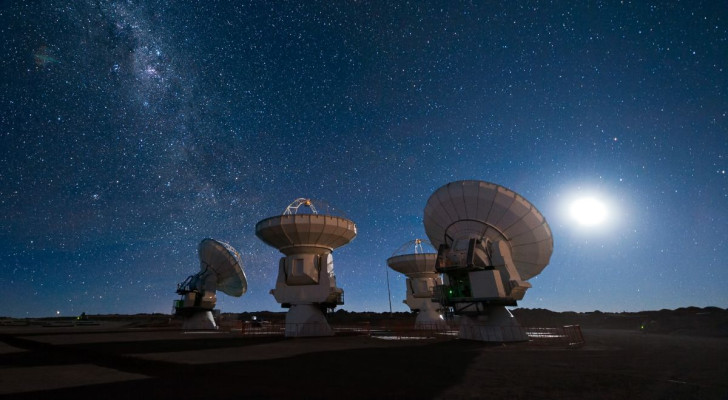
De antennes van het ALMA-project, die millimeter- en submillimeter-elektromagnetische golven kunnen opvangen

ESO/José Francisco Salgado/Wikimedia Commons - CC BY 4.0

Een van de existentiële vragen die we ons soms stellen, betreft de mogelijkheid dat er intelligent leven in het universum is. Geen andere levensvormen, ongeacht hun complexiteit, maar buitenaardse wezens die kunnen bogen op een intelligentieniveau dat gelijk is aan het onze... of hoger. In de loop der jaren heeft de zoektocht naar buitenaardse intelligentie, of SETI, verschillende critici en voorstanders opgeleverd, maar nooit enige bevestiging. Daarom hebben twee onderzoekers onlangs besloten om een nieuwe interpretatie naar voren te brengen: hoe waarschijnlijk is het om intelligente levensvormen in het heelal te vinden?

De zoektocht naar buitenaards leven tussen Drake en Jaynes

De hedendaagse zoektocht naar buitenaardse levensvormen is onlosmakelijk verbonden met de vergelijking van Drake, die in 1961 werd geformuleerd door de astronoom Frank Drake. Het is echter meer dan een feitelijke vergelijking, het is een maatstaf voor de uitdagingen waarmee onze onderzoekers worden geconfronteerd bij het zoeken naar buitenaardse beschavingen. Aan de ene kant bevat de formule parameters zoals de mate van stervorming, systemen met bewoonbare planeten, de waarschijnlijkheid van de ontwikkeling van intelligent leven, enzovoort. Maar aan de andere kant maakt de onzekerheid van de parameters elke berekening zinloos: zoals we al zeiden, dient de vergelijking alleen als filosofische horizon voor het onderzoek.

In hun studie besloten de twee onderzoekers ook gebruik te maken van de bevindingen van een andere academische figuur, de natuurkundige Edwin Jaynes. Door de verdeling van een onbekende chemische stof in water te bestuderen, laat Jaynes zien dat het onmogelijk is om waarschijnlijkheden te formuleren bij afwezigheid van gegevens. Bijgevolg kan een gebeurtenis ofwel bijna altijd ofwel bijna nooit voorkomen, zonder middenweg. Zou dit het geheim kunnen zijn van de zoektocht naar buitenaardse intelligentie?

Oorsprong en verdwijning van... buitenaardse beschavingen

Unsplash

Volgens David Kipping en Geraint Lewis, auteurs van de nieuwe studie, is het daarom mogelijk om het experiment van Jaynes toe te passen op de zoektocht naar intelligent buitenaards leven. In de praktijk is het onmogelijk dat dit laatste meer of minder vaak voorkomt: of het komt heel vaak voor of het is extreem zeldzaam. In het eerste geval zouden we een van de vele voorbeelden in het universum zijn; in het tweede geval zouden we een van de weinige zijn: het is niet eenvoudig om te zien welke van de twee hypotheses het meest verontrustend is.

Bovendien hebben de twee onderzoekers een nieuw formalisme voorgesteld dat de vergelijking van Drake bruikbaarder zou maken en de structuur ervan zou vereenvoudigen. De enige echt bruikbare parameter zouden de geboorte- en sterftecijfers van beschavingen zijn, waarmee hun ontstaan en verdwijnen wiskundig zou kunnen worden weergegeven. Maar zelfs dan is tertium non datur: ons universum moet vol intelligent leven zijn, of bijna leeg.

Hoe te zoeken naar buitenaardse levensvormen

Welke benadering ook wordt gekozen, we komen altijd terug bij de Fermiparadox, een impasse waar astronomen heel bekend mee zijn. Volgens sommigen weten buitenaardse wezens misschien al dat we bestaan, maar kunnen ze het ons niet vertellen of zitten ze misschien zelfs gevangen in hun eigen werelden. Geconfronteerd met de mogelijkheid dat zelfs zijn oplossing niet effectief is, blijft Kipping optimistisch:

Ik denk dat mijn favoriete uitweg is dat onze Melkweg gewoon rustig is. In plaats daarvan zijn de meeste druk en vol, maar wij zijn de eersten in de Melkweg. Het lijkt onwaarschijnlijk, maar misschien is geboren worden in een druk sterrenstelsel onmogelijk omdat de bewoonbare ruimte al is opgeslokt.

Kortom, het onderzoek van Kipping en Lewis bevestigt ook hoe moeilijk het niet zozeer is om intelligente levensvormen in het universum te vinden, maar om de parameters te definiëren voor onderzoek dat tot concrete resultaten leidt. Misschien bestaan ​​er al buitenaardse wezens, maar we kunnen niet weten of, waar en in welke mate: een fascinerende en niet noodzakelijkerwijs teleurstellende uitkomst.

{ https://www.curioctopus.nl/ }

Hoe vind je dit bericht?
Geschreven door peter om 21:28 Stuur door

Accidental Time Travelers: Unintended Journeys Through Time Slips

Accidental Time Travelers: Unintended Journeys Through Time Slips

Time slips; a curious phenomena where individuals unexpectedly find themselves transported across time, be it minutes, days, or even years, without any intention or control over the experience. Those who experience time slips often report feeling as though they’ve been transported to a different point in time. 
time%20slips%20time%20travelers.jpg

Imagine walking down a familiar street when suddenly everything changes. The asphalt beneath your feet transforms into cobblestone, cars vanish, replaced by horse-drawn carriages. The air fills with the scent of coal smoke and horse manure. 
People in Victorian-era clothing hurry past, glancing at you suspiciously. Panic sets in as you realize you're no longer in your own time. Then, just as quickly, you're back in the present day. 
You’ve just experienced a time slip, and you’re not alone. 
Thousands of people worldwide have reported similar experiences, brief moments of traveling through time, witnessing scenes from the past or future, only to return to the present moment. 
But what exactly are these experiences? Are they vivid hallucinations, or could time slips be real, offering us glimpses into the true nature of time and reality? 
Some theories suggest that if a portal existed between our universe and a parallel one, time slips could theoretically occur. However, it’s crucial to note that there is no concrete evidence to support the idea that we live in a multiverse. 
In the video below, we’ll explore a few famous time slip stories and the scientific theories that might help explain these mysterious events.
  

{ https://ufosightingshotspot.blogspot.com/ }

Hoe vind je dit bericht?
Geschreven door peter om 22:59 Stuur door

This Salt Lake City Tech CEO Found Dead After Eerie Calls: ‘It’s All a Game… We’re in the Matrix’

Erin Valenti

This Salt Lake City Tech CEO Found Dead After Eerie Calls: ‘It’s All a Game… We’re in the Matrix’

Erin Valenti was a highly accomplished 33-year-old CEO of a tech company called Tinker, which develops websites and smartphone apps. She was known for being very smart and kind (she worked as a volunteer to fight human trafficking) with a great sense of humor and a successful career. Originally from Fairport, NY, she resided with her husband in  Salt Lake City, UT.

Her company, with 120 employees mainly in Pakistan, designed, developed, and scaled technology products built for iOS, Android, and the web. Tinker built over 700 products, including mobile apps, SaaS applications, tech-enabled marketplaces, and consumer websites for Facebook, Skullcandy, LiveNation, Pearson, MetroPCS, and emerging startups.

Before founding Tinker, she was Director of Product Development at Overstock.com, supervising a team of 250 engineers. Her company website linked to CTRL- labs, Thomas Reardon’s “neuroscience and behavior” center.

Erin Valenti

CTRL-labs assembled scientists and technologists:

  • PhDs in computational neuroscience;
  • Biomechanics paired with hackers and coders;
  • Experts in signal processing, machine learning, and human-computer interaction;
  • Industrial designers.

CTRL- labs published: 

“The future of brain-machine interfaces is non-invasive. Instead of surgical implants, CTRL- labs uses state-of-the-art detection and machine learning to read your neurons from outside the body. The first step will be technology precisely picking up the signals from inside your body to control devices outside of it with little more than natural gestures. The next step – and we are already closer than most people realize – will be reading the intention directly from your brain.” (Source)

Valenti had no history of mental-health disorders or substance abuse. Scott Rafferty, a Utah entrepreneur, told Business Insider that Valenti spoke of quitting her million-dollar business, but never meant it. She told him she felt responsible for the welfare of more than 130 engineers and their families on the other side of the world. She also planned to finance a startup accelerator inside her company and start a clothing line for professional women. In late summer, Valenti spoke to Rafferty about wanting an executive coach. Rafferty’s coach was about to hold a retreat in California.

On October 1, 2019, Valenti flew from Salt Lake City to California to attend a three-day seminar called Create Powerful. The seminar was held in Laguna Niguel, a beach town, and was designed to help business owners grow personally and professionally.

The seminar was an intense, immersive experience that helped people connect with their personal power and overcome fears. It cost $6,500 and promised to change participants’ lives. After the seminar, Valenti flew to the Bay Area on October 3 to attend a two-day conference in Monterey for tech founders and investors.

Erin Valenti last words: We’re in the Matrix

Valenti is believed to have been last seen by Dean Jacobson, a former manager of hers at Summit Partners, in Palo Alto, on Monday, October 7, in the afternoon.

After the seminar, Valenti called her parents and said she couldn’t find her rental car, a gray Nissan Murano. Later, she found the car and started driving to the airport, but her parents noticed she sounded “manic and confused” on the phone. She talked about Thanksgiving plans, but wasn’t making sense and spoke fast and erratically.

Valenti also mentioned that she had refueled the car just 10 minutes prior, but now it was running out of gas, and she exclaimed, “I’m going to miss my flight!”

Her mother became concerned and called Valenti’s husband, Harrison Weinstein, asking him to contact her immediately.

For the next few hours, Valenti’s family took turns speaking with her on the phone, trying to calm her down and understand what was going on. However, Valenti continued to be agitated and disconnected.

At one point, she said something strange: “It’s all a game. It’s a thought experiment. We’re in  the Matrix.”

This statement further concerned her family, who didn’t know what to make of it. They continued to talk to her until almost midnight, trying to help her calm down and make sense of her situation.

“Matrix” is a mathematical term used in the movie  The Matrix to illustrate the code used to make up simulated reality. What is the “matrix”? It is a world created by computers, built to control and transform humans.

According to reports, Valenti asked her mother, “Are you in on it?” Her mother, a retired nurse, asked if she was drunk, had taken any drugs, or had somebody given her something. Valenti responded no. Weinstein also asked the police to conduct a welfare check.

According to the family, the police called Valenti on the phone, and she told an officer she was just joking around. The phone appeared to have died at some point, and calls went to voicemail.

On Saturday, October 12, a volunteer found Valenti’s rental car parked a few blocks from where her phone was last located – on the 6500 block of Bose Lane, a residential street near the Sam Jose airport.

Looking inside, the volunteer discovered Valenti’s body in the back seat. An investigation by San Jose police found no evidence of foul play, authorities said. There were no outward signs of trauma or physical harm.

Blood tests were negative for common prescription drugs and other substances. Her parents spoke to the media and said they believed she had suffered some kind of manic episode.

“Her thoughts were disconnected. She talked a mile a minute. She’d say ‘I’m coming home for Thanksgiving,’ then in the next she was saying she’s in the Matrix,” her mom, Whitey Valenti, said.

Valenti’s husband said she had no history of mental illness.

“There’s never any history of anything like this, no mental health diagnosis, no hospitalization, no substance use, no arrests — as clear of a record as you can get. This is incredibly unlike her. She is an extremely high-achievement, successful person,” he said.

Erin Valenti

It took months for the autopsy report. The San Jose medical examiner’s office’s autopsy report determined she died of “sudden death in the setting of an acute manic episode.” Though the report did not explain what killed her, other than she died of “natural causes.”

A manic episode, characterized by feelings of euphoria, racing thoughts, and feelings of connectedness, is typically followed by a period of depression or irritability.

Valenti had a previous diagnosis of a thyroid condition treated with medication. The autopsy report noted that her condition could have contributed to her death. Blood samples, however, were not satisfactory for analysis.

A police review of Valenti’s electronic communications in the days before her scheduled return showed symptoms of a “manic episode,” according to the San Jose medical examiner’s office.

Authorities also said a review of her medical records “suggests that the etiology of her final manic episode was related to an emerging, previously undiagnosed psychiatric disorder.”

A healthy 33-year-old woman, who was a successful tech CEO with no history of mental illness, attended an intense course meant to change her life and help her manage fear.

After telling her family she was excited to return home, she suddenly experienced a mental breakdown while driving to the airport. She went missing for days and was later found dead in her car, which was parked on a street where searchers had previously looked.

There are questions about what happened—whether the course triggered her breakdown, whether brain-machine interfaces were involved, or if she died from a sudden onset of mental illness as the autopsy suggests.

Notably, why did Valenti continue to mention in her last phone call that this was a thought experiment and that we are all living in a matrix Surprisingly, there are current-day scholars who do believe that the world is simulated.

In fact, humans have been trying to create a simulated world since long ago. If it is possible that humans could eventually create a “simulated world”, then how can we be sure that we are not already living in one?

-Professor Nick Bostrom from Oxford University who proposed a Simulation Hypothesis in 2003.
-NASA physicist Thomas Campbell also said he believes the world is definitely simulated and even Einstein once said: “Reality is merely an illusion.”
-Elon Musk, the world’s richest man, once said: “There’s a one in a billion chance we’re in base reality.”

Why are the leading figures of society making such absurd arguments? Are they suspecting and questioning that perhaps we have never lived in a “real” world?

Consider the following story. About 2,300 years ago, Zhuangzi, a renowned Chinese philosopher, entered into a dream and became a butterfly flying freely among the flowers. Suddenly, he woke up and a terrifying question arose in his mind: How can I be sure that I have really woken up? Could I actually be a butterfly dreaming that I am a human? The dream was so “real”!

Famous past-life regressionist Dolores Cannon once said that there are Akashic records in the universe that stores all life experiences. Some can use hypnosis to connect to the Akashic database to retrieve information about their past lives. Nikola Tesla, a genius Serbian-American inventor, also believed in the existence of the “Akashic database.” He claimed to have connected with it in his dreams, to see machines that are yet to be invented. Perhaps that was why he was able to invent machines without too much experimentation. (Source)

If what the above scientists stated is true, then could it be possible that we are actually living in a simulated world? The only question is, if one day you were given a choice, would you choose to learn the truth?

{ https://www.howandwhys.com/ }

Hoe vind je dit bericht?
Geschreven door peter om 00:00 Stuur door

Was the moon a blisteringly hot world? Our lunar neighbour was once covered with an ocean of molten rock, data from India's Chandrayaan-3 rover suggests

Was the moon a blisteringly hot world? Our lunar neighbour was once covered with an ocean of molten rock, data from India's Chandrayaan-3 rover suggests

  • India's Chandrayaan-3 moon mission has revealed the moon's mineral makeup
  • This supports the theory that the moon was once covered in an ocean of magma 

While the moon might now seem like a cold, dusty, desert, new evidence from India's Chandrayaan-3 mission has revealed this was not always the case.

Analysis of the lunar surface shows that the moon's south pole was once completely covered by an ocean of molten magma. 

When Chandrayaan-3 landed near the moon's south pole in August last year, India's space agency gathered 23 measurements of a never-before-studied region.

Their measurements discovered a uniform layer of ferroan anorthosite, a white rock believed to have floated to the surface of the molten rock during the moon's formation. 

This supports the 'Lunar Magma Ocean' (LMO) theory which claims the whole of the moon's surface was formed from a cooling layer of magma that formed 4.5 billion years ago.

New analysis of data from Indian's Chandrayaan-3 mission has revealed the moon was once covered in an ocean of molten lava (pictured: artist's impression)

New analysis of data from Indian's Chandrayaan-3 mission has revealed the moon was once covered in an ocean of molten lava

(pictured: artist's impression) 

The LMO theory is not new – it dates back to the 1970s – but the new findings now bolster the theory with evidence of molten rock at another region of the moon (its south pole).  

On August 23, 2023, the Vikram lander successfully touched down on a region of the moon's south pole as part of the Chandrayaan-3 mission.

Vikram's landing site, at about 70 degrees south, was the furthest south any landing craft had ever been.

Over 10 days, Vikram's smaller Pragyaan rover travelled over the lunar landscape, constantly recording and transmitting data back to Earth.

That data included 23 measurements from a device called the alpha particle X-ray spectrometer.

This lightweight instrument used a radioactive source to bombard the lunar surface with radiation, exciting the atoms in the ground, and measuring the energy they release.

By recording that emitted energy, researchers have been able to calculate the mineral composition of the lunar soil.

After landing in August last year at a site near the Moon's south pole (illustrated in yellow) the Vikram lander deployed a rover which collected data about the moon's mineral composition

After landing in August last year at a site near the Moon's south pole (illustrated in yellow) the Vikram lander deployed a rover which collected data about the moon's mineral composition 

That analysis revealed that the area around the Chandrayaan-3 landing site was relatively uniform and composed largely of ferroan anorthosite.

The researchers also found that the mineral composition at the Chandrayaan-3 site was similar to that found by NASA's Apollo 16 and the Soviet Luna-20 mission.

What is unusual about that finding is that those two landing sites are both in the moon's equatorial region, a long way away from where Chandrayaan-3 touched down.

The fact that these three distant sites all have roughly the same material composition suggests that they might have all come from the same lunar magma ocean.

The moon is believed to have been formed 4.5 billion years ago when a Mars-sized planet collided with Earth and knocked a chunk of material out into space.

As that material coalesced, the intense energies involved melted the rocks into a vast ocean of magma which covered the entire moon.

As the surface cooled over tens to hundreds of millions of years, the cooler ferroan anorthosite rose to the surface while heavier minerals like olivine and pyroxene sank deep below to form the moon's mantle.

The current lunar highlands are believed to be what remains of this ancient crust after billions of years.

The Pragyaan (pictured) found that the area around the landing site was uniform and made of ferroan anorthosite, a white rock believed to have formed the ancient moon's crust

The Pragyaan (pictured) found that the area around the landing site was uniform and made of ferroan anorthosite, a white rock believed to have formed the ancient moon's crust 

Experts believe the moon was formed when a Mars-sized planet called Theia collided with the Earth and knocked material out into space

Experts believe the moon was formed when a Mars-sized planet called Theia collided with the Earth and knocked material out into space 

The data collected by Chandrayaan-3 (pictured) suggests that the moon was once covered by an ocean of lava. As it cooled the lighter ferroan anorthosite rose to the surface and formed the ancient crust

The data collected by Chandrayaan-3 (pictured) suggests that the moon was once covered by an ocean of lava. As it cooled the lighter ferroan anorthosite rose to the surface and formed the ancient crust 

The Moon theories 

Astronomers have long suspected that the moon was created when a giant protoplanet called Theia struck the newly formed Earth - a theory first put forward in the 1970s.

It says the huge collision created a vast cloud of debris, which coalesced into the moon.

However, until now, astronomers have not been able to explain how this left the moon and Earth chemically identical.

Later, two hypotheses arose that could explain why the moon is Earth's chemical clone, but they predict radically different masses for Theia.

In one scenario, two half-Earths merged to form the Earth-moon system.

But the second hypothesis suggests Theia was a small, high-velocity projectile that smacked into a large and fast-spinning young Earth.

Co-author of the paper Dr Santosh Vadawale from the Physical Research Laboratory, told the BBC: 'The theory of early evolution of the moon becomes much more robust in the light of our observation.'

Alpha particle x-ray data also provides evidence for an enormous meteor strike near the lunar south pole.

The data gathered by the rover showed that the area around the landing site was much higher in magnesium than would have been expected for pure ferroan anorthosite.

In their paper, published in Nature, the researchers argue that this material could have been blasted out of the ground by a huge impact which excavated the magnesium-rich materials deep in the mantle.

The researchers believe that magnesium in the soil was deposited by the same impact which formed the South Pole-Aitken basin over 217 miles (350 km) away. This magnesium was then further mixed into the area by impacts like the Schomberger crater (impact illustrated)

The researchers believe that magnesium in the soil was deposited by the same impact which formed the South Pole-Aitken basin over 217 miles (350 km) away. This magnesium was then further mixed into the area by impacts like the Schomberger crater (impact illustrated) 

This impact could have been the same meteor strike which formed the 1,600-mile (2,500km) wide South Pole-Aitken basin over 217 miles (350 km) away from the Chandrayaan-3 landing site.

The mineral findings are consistent with the idea that magnesium-rich rocks were scattered over the site before being mixed by further meteor impacts.

These findings are also important to the future of India's space research because they provide a basis for future observations.

Previously, the Indian space agency had made observations of the lunar surface from orbit on Chandryaan-1 and 2.

However, without measurements from the ground, interpreting those observations required some scientific guess work.

Beautiful: Image provided by the Indian Space Research Organisation (ISRO) taken by the Pragyan rover shows the Vikram lander. Photo released on August 30, 2023

Beautiful: Image provided by the Indian Space Research Organisation (ISRO) taken by the Pragyan rover shows the Vikram lander. Photo released on August 30, 2023

This new data taken directly from the lunar surface provides researchers with a 'ground truth' against which they can compare future orbital observations. 

This could help the space agency narrow down their search for water which would be a huge support for any future effort to establish a future crewed base.

India plans to launch another lunar mission in 2025 or 2026 which aims to collect material and return it to Earth for analysis.

WILL HUMANS BE BORN ON THE MOON 'IN A FEW DECADES'?

Children will be born on the moon 'in a few decades', with whole families joining Europe's lunar colony by 2050, a top space scientist has claimed.

Professor Bernard Foing, ambassador of the European Space Agency-driven 'Moon Village' scheme, made the comments.

He said that by 2030, there could be an initial lunar settlement of six to 10 pioneers - scientists, technicians and engineers - which could grow to 100 by 2040.

'In 2050, you could have a thousand and then... naturally you could envisage to have family' joining crews there, he told AFP.

Speaking at this year's European Planetary Science Congress in Riga, Latvia, Professor Foing explained how humanity's moon colonies could quickly expand.

He likened human expansion on the moon to the growth of the railways, when villages grew around train stations, followed by businesses.

Potential moon resources include basalt, a volcanic rock that could be used as a raw material for 3D-printing satellites.

These could be deployed from the moon at a fraction of the cost of a launch from high-gravity Earth.

The moon also houses helium-3, a rare isotope on our planet, that could theoretically be used to generate cleaner, safer nuclear energy for Earth.

One of the main targets for moon colonies is water, locked up in ice on the moon's poles.

Water can be separated into hydrogen and oxygen, two gases which explode when mixed - providing rocket fuel.

{ https://www.dailymail.co.uk/ }

Hoe vind je dit bericht?
Geschreven door peter om 23:14 Stuur door

Pentagon Insider Reveals: Could UFOs Originate from Earth’s Oceans?

Pentagon Insider Reveals: Could UFOs Originate from Earth’s Oceans?

ufos

The debate over the origins of Unidentified Aerial Phenomena (UAPs), often referred to as UFOs, has taken a fascinating turn with insights from Luis Elizondo, a former Pentagon insider. Elizondo, who led the Pentagon’s Advanced Aerospace Threat Identification Program (AATIP), has been at the forefront of public discussions on UAPs. In recent interviews, he has proposed thought-provoking ideas about where these mysterious objects might come from, challenging the traditional view that they are extraterrestrial in origin.

Beyond Outer Space: Exploring New Possibilities

While many have speculated that UAPs are spacecraft from distant galaxies, Elizondo encourages a broader perspective. “They can be from outer space, inner space, or, frankly, the space in between,” he explained. This statement suggests that UAPs might not just be visitors from another planet. Instead, they could be natural phenomena or entities originating from environments closer to home, such as Earth’s oceans.

Elizondo highlights the possibility that UAPs could be linked to unknown forms of life or technology residing in the depths of our oceans. The ocean is one of the least explored regions of our planet, and it’s conceivable that advanced or unknown species could thrive there. This perspective aligns with recent reports of UAPs being observed near large bodies of water, raising questions about their connection to the deep sea

The USS Nimitz and USS Roosevelt Incidents

Two of the most well-known UAP encounters involving the U.S. military—the USS Nimitz in 2004 and the USS Roosevelt in 2015—offer compelling evidence of these mysterious objects’ capabilities. In both cases, Navy pilots observed and recorded UAPs that demonstrated extraordinary flight characteristics, such as rapid acceleration and abrupt changes in altitude. These objects, described as “tic-tac” shaped, were able to hover just above the ocean’s surface before rapidly ascending, further fueling speculation about their connection to Earth’s oceans.

Elizondo did not see the footage from the USS Nimitz encounter until 2009, and when similar incidents occurred with the USS Roosevelt in 2015, they caught the attention of other high-ranking officials, including Chris Mellon, a former Deputy Assistant Secretary of Defense. Mellon and others have expressed concern about the potential national security risks posed by these UAPs, particularly given their proximity to sensitive military assets.

Nuclear Connections and Military Concerns

Another intriguing aspect of UAP activity is their apparent interest in nuclear-powered facilities and weapons systems. Both the USS Nimitz and USS Roosevelt are nuclear-powered vessels, and Elizondo has noted that UAPs have often been observed near American nuclear sites. This recurring pattern suggests that UAPs might have a particular interest in nuclear technology, though the reasons for this remain unclear.

In response to these encounters, the Pentagon has explored various methods to counteract or capture UAPs. One proposal, known as Operation Interloper, involved creating a nuclear “footprint” to attract UAPs and then using electromagnetic pulses to disable them. However, this plan was ultimately shelved, leading to speculation that higher authorities may have been reluctant to pursue it, possibly due to already having knowledge about these phenomena or not wanting to provoke them.

The Search for Answers Continues

Elizondo’s insights challenge us to expand our thinking about UAPs and their possible origins. Whether they are advanced technologies from another world, natural phenomena from the depths of our oceans, or something entirely different, the mystery of UAPs remains unsolved. What is clear, however, is that these objects have captured the attention of the highest levels of the U.S. government and military, and the search for answers is far from over.

As investigations continue, Elizondo’s call to consider all possibilities reminds us that the truth about UAPs might be more complex—and closer to home—than we ever imagined.

{ https://www.latest-ufo-sightings.net/ }

Hoe vind je dit bericht?
Geschreven door peter om 22:54 Stuur door

Study Finds UFO Witnesses May Have Personality Traits That Increase Likelihood of Sightings

QVYUTBaa?format=jpg&name=900x900

Study Finds UFO Witnesses May Have Personality Traits That Increase Likelihood of Sightings

According to findings in a recent study, UFO witnesses may not be prone to misperceptions or related cognitive factors but instead may possess specific personality traits that increase their likelihood of encountering such phenomena. 

Clinical Psychologist Dr. Daniel Stubbings from Cardiff Metropolitan University and his team found there are numerous factors that contribute to an individual thinking they witnessed what the U.S. Department of Defense now calls unidentified anomalous phenomena (UAP). 

Their study, published in the Journal of Scientific Exploration, examines the big five personality traits: extraversion, neuroticism, openness, agreeableness, and conscientiousness, along with schizotypy traits (behaviors that resemble schizophrenia), to help determine if UAP experiencers could be distinguished from those who had not reported seeing a UAP.

The Big Five Personality Traits: What Are They? 

In the 1970s, two research teams—one led by Paul Costa and Robert R. McCrae of the National Institutes of Health and the other by Warren Norman and Lewis Goldberg of the University of Michigan at Ann Arbor and the University of Oregon—found that most human character traits can be explained by five dimensions. Surveys of thousands of individuals uncovered these mostly distinct traits:

Neuroticism: Emotional stability; individuals with high scores are characterized by anxiety, inhibition, moodiness, and lower self-assurance.

Extroversion: Encompasses cheerfulness, initiative, and communicativeness.

Openness: Fond of innovation and displays of creativity. 

Agreeableness: Dictates how they interact with others. Other traits include being friendly, empathetic, and warm.

Conscientiousness: Gauges a person’s level of organization. Individuals with high scores are motivated, disciplined, and trustworthy.

The Findings

Dr. Stubbings’ experiment involved 206 participants, including 103 who said they had witnessed or self-reported seeing a UAP. The team analyzed personality traits to see how participants naturally grouped together.

The study consisted of three groups. Group one had average traits, whereas the second group, designated the Neurotic/Schizotypy group, was high on neuroticism and schizotypy traits. The last controlled group, labelled O-ACE, was found to have high openness, agreeableness, conscientiousness, and extraversion but low neuroticism and schizotypy traits. 

“These were the groups that ‘emerged’ out of the data analysis,” Dr. Stubbings told The Debrief. “The latent profile analysis demonstrated these three patterns of personality profiles. Prior research looked at correlation and regression (predictive patterns) but not a latent (underlying) profile.”

“This was a new finding,” Stubbings told The Debrief.

The study concluded that the third group, O-ACE, was more likely to see UAPs. Over the years, stigma and stereotypes have helped create narratives that people who see UAPs are more than likely emotionally reactive; in other words, they may display neurotic behavior and are prone to perceptual and cognitive abnormalities.

However, the recent data does not appear to support this narrative. Instead, Dr. Stubbings and his coauthors state in their paper that the “descriptive UAP accounts by the general public were similar to the descriptions provided by military witnesses.” 

Stubbings, when asked why people with high conscientiousness see UFOs, said it is difficult to answer such a question based on the current data in-hand.

“Our data indicates that there is a small statistical relationship, but further research should explore why that relationship exists,” Stubings told The Debrief. “But my guess is that people who are high in conscientiousness might be more willing to admit to themselves that they have seen something and believe it is the right thing to do to admit it.” 

However, Stubbings notes that conscientiousness alone is probably not everything in this equation, but instead, combinations of other variables—specifically low scores in Neuroticism and higher scores in Openness, also contribute.

“We need further research to explore the nuances of these personality factors in the emergence of both belief and experience.”

Dr. Stubbings also noted that “only 28 percent of participants reported their sightings anywhere, and 14 percent used a UFO reporting organization, which suggests that events are vastly underreported.” His paper also suggested that stigma and a lack of proper reporting avenues were the main obstacles impacting their willingness to report their sightings.

Dr. Stubbings initiated his research by referencing an older academic paper on UAPs published in the Applied Cognitive Psychology Journal in 2011, which found that certain personality factors were predictors of an individual’s belief in UFOs. 

“This is relevant to the UFO topic more broadly because what people perceive and recall tends to be in line with their beliefs,” Stubbings told The Debrief. “If beliefs can be predicted by personality factors, then it supports the notion that it is a particular kind of person who is more prone to belief in UAPs, and in turn, they end up seeing and recalling what they believe to be true.” 

“In other words, people see UAP not because they are there but because of the conviction of their beliefs, which are influenced by their personality dispositions. 

“So the idea was born to change the dependent variable of ‘belief’ to ‘have you had a sighting.’ Those who believe in UFOs/UAP might not have the same characteristics [as] those that report to have seen what they believe to be a UAP.”

Fundamentally, Stubbings says that in addition to understanding the kinds of personality traits and psychological drivers that may contribute to a person’s likelihood of observing and reporting UAP, scientists need to be engaging in dialogue about the assessment, diagnosis, formulation, and treatment of mental health distress in individuals who claim to have observed UAP or even had direct contact with purported NHI. 

“This topic is one of the most fascinating areas,” Stubbings told The Debrief, “and I believe other scientists from around the world need to help address this mystery.”

Stubbings and his colleagues Sophie Ali and Alexander Wong’s new paper, “Who Sees UFOs? The Relationship Between Unidentified Anomalous Phenomena Sightings And Personality Factors,” appeared in the Spring 2024 issue of the Journal of Scientific Exploration.

 { https://thedebrief.org/category/uap/ }

Hoe vind je dit bericht?
Geschreven door peter om 01:39 Stuur door

Meer van UFO'S of UAP'S, ASTRONOMIE, RUIMTEVAART, ARCHEOLOGIE, OUDHEIDKUNDE, SF-SNUFJES EN ANDERE ESOTERISCHE WETENSCHAPPEN - DE ALLERLAATSTE NIEUWTJES

↑ Terug naar de berichten