Ontdek de Fascinerende Wereld van UFO's en UAP's: Jouw Bron voor Onthullende Informatie!
Ben jij ook gefascineerd door het onbekende? Wil je meer weten over UFO's en UAP's, niet alleen in België, maar over de hele wereld? Dan ben je op de juiste plek!
België: Het Kloppend Hart van UFO-onderzoek
In België is BUFON (Belgisch UFO-Netwerk) dé autoriteit op het gebied van UFO-onderzoek. Voor betrouwbare en objectieve informatie over deze intrigerende fenomenen, bezoek je zeker onze Facebook-pagina en deze blog. Maar dat is nog niet alles! Ontdek ook het Belgisch UFO-meldpunt en Caelestia, twee organisaties die diepgaand onderzoek verrichten, al zijn ze soms kritisch of sceptisch.
Nederland: Een Schat aan Informatie
Voor onze Nederlandse buren is er de schitterende website www.ufowijzer.nl, beheerd door Paul Harmans. Deze site biedt een schat aan informatie en artikelen die je niet wilt missen!
Internationaal: MUFON - De Wereldwijde Autoriteit
Neem ook een kijkje bij MUFON (Mutual UFO Network Inc.), een gerenommeerde Amerikaanse UFO-vereniging met afdelingen in de VS en wereldwijd. MUFON is toegewijd aan de wetenschappelijke en analytische studie van het UFO-fenomeen, en hun maandelijkse tijdschrift, The MUFON UFO-Journal, is een must-read voor elke UFO-enthousiasteling. Bezoek hun website op www.mufon.com voor meer informatie.
Samenwerking en Toekomstvisie
Sinds 1 februari 2020 is Pieter niet alleen ex-president van BUFON, maar ook de voormalige nationale directeur van MUFON in Vlaanderen en Nederland. Dit creëert een sterke samenwerking met de Franse MUFON Reseau MUFON/EUROP, wat ons in staat stelt om nog meer waardevolle inzichten te delen.
Let op: Nepprofielen en Nieuwe Groeperingen
Pas op voor een nieuwe groepering die zich ook BUFON noemt, maar geen enkele connectie heeft met onze gevestigde organisatie. Hoewel zij de naam geregistreerd hebben, kunnen ze het rijke verleden en de expertise van onze groep niet evenaren. We wensen hen veel succes, maar we blijven de autoriteit in UFO-onderzoek!
Blijf Op De Hoogte!
Wil jij de laatste nieuwtjes over UFO's, ruimtevaart, archeologie, en meer? Volg ons dan en duik samen met ons in de fascinerende wereld van het onbekende! Sluit je aan bij de gemeenschap van nieuwsgierige geesten die net als jij verlangen naar antwoorden en avonturen in de sterren!
Heb je vragen of wil je meer weten? Aarzel dan niet om contact met ons op te nemen! Samen ontrafelen we het mysterie van de lucht en daarbuiten.
Early humans appear to have experienced a sudden and rapid advance in technology around 600,000 years ago, according to new findings by a team of anthropologists exploring the use of ancient stone tools.
The researchers behind the findings say this likely represents a key inflection point in ancient human development, where the transfer of ancient knowledge from generation to generation, known as cumulative culture, resulted in increasing advances in society that propelled humanity’s biological, cultural and technological development.
“Our species, Homo sapiens, has been successful at adapting to ecological conditions — from tropical forests to arctic tundra — that require different kinds of problems to be solved,” said associate professor Charles Perreault, an anthropologist from Arizona State University’s School of Human Evolution and Social Change. and a research scientist with the Institute of Human Origins.“Cumulative culture is key because it allows human populations to build on and recombine the solutions of prior generations and to develop new complex solutions to problems very quickly.”
Toolmaking Suddenly Underwent a Rapid Advance in Technology
In their published study, “3.3 million years of stone tool complexity suggests that cumulative culture began during the Middle Pleistocene,” which appeared in the journal PNAS, Perreault and fellow author Jonathan Paige, a University of Missouri anthropologist, explain how their analysis of stone tools dating back to 3.3 million years ago revealed this sudden and unexpected technological leap.
The researchers analyzed tools collected from 57 separate ancient hominin sites. The oldest tool, dating back over 3 million years, came from an African site. However, the researchers also studied ancient stone tools discovered at ancient hominin sites in Eurasia, Greenland, Sahul, Oceania, and the Americas.
Next, the team ranked the tools’ complexity. This meant analyzing how many steps would need to be taken to create the tool in question. The researchers characterized and ranked 62 distinct tool-making sequences.
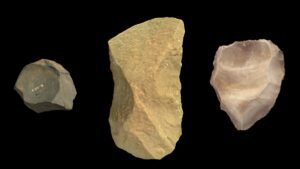
Above: Tools that become increasingly more complex over the course of 3 million years. Left: First time period studied — Oldowan core, Koobi Fora, Kenya; Center: Second time period studied — Acheulean cleaver, Algeria; Right: Characteristic of 600,000 years ago technology — Levallois core, late Pleistocene Algeria (Image credits: (left) Curry, Michael. 2020. Oldowan Core, Koobi Fora. Museum of Stone Tools LINK; (middle) Curry, Michael. 2020. Acheulean Cleaver, Morocco, Koobi Fora. Museum of Stone Tools. LINK; (right) Watt, Emma. 2020. Levallois Core, Algeria. Museum of Stone Tools. LINK).
After charting the tools’ complexity, the team saw some unexpected patterns. Tools made between 3.3 million years ago and 1.8 million years ago required somewhere between two and four procedural units to manufacture. The complexity of stone tools steadily increased over the next 1.2 million years, with the top samples requiring an impressive seven steps. While significantly more complex than tools made over a million years earlier, the researchers say this is still within the range of complexity for a single craftsman. This means knowledge from previous generations of toolmakers had most likely not been passed down over that span.
However, the researchers discovered that when they looked at tools made around 600,000 years ago, in the Middle Pleistocene, they began to see a sudden and unexpected increase in complexity. Tools from this time period were not only more complex, but more complex manufacturing processes were required to make these tools.
“We analyzed the stone tools made during the last 3.3 million years,” the researchers explain. “We found that these stone tools remained simple until about 600,000 B.P. After that point, stone tools rapidly increased in complexity.”
Where previous tools had required only a handful of procedural steps to manufacture, tools from this time often required as much as 18 steps. According to Paige and Perreault, this is way too many steps for a single generation of craftsmen to achieve without the knowledge passed down from previous generations.
This evidence, the researchers write, is consistent with findings from other research teams, suggesting that such a rapid transition “signals the development of cumulative culture in the human lineage.”
“By 600,000 years ago or so, hominin populations started relying on unusually complex technologies, and we only see rapid increases in complexity after that time as well,” said Paige. “Both of those findings match what we expect to see among hominins who rely on cumulative culture.”
Dawn of Cumulative Culture and the Evolution of Modern Humans
Although the evolution of stone toolmaking provides evidence for the dawn of cumulative culture, the researchers behind the findings say such a leap likely affected all aspects of early humans. This likely included changes in human culture, biology, and even the ability to adapt to a range of environments and habitats found across the globe.
“The human dependence on cumulative culture may have shaped the evolution of biological and behavioural traits in the hominin lineage,” Paige and Perreault explain, “including brain size, body size, life history, sociality, subsistence, and ecological niche expansion.”
Such changes can increase in complexity as genetic and cultural evolution happen concurrently. According to the researchers, this “gene-culture coevolution process” may explain increases in relative brain size, a prolonged life history, “and other keystone traits underlying human uniqueness.”
Notably, the researchers point out that the Middle Pleistocene shows many other examples of evolving technology. For example, studies of this era reveal consistent evidence of the controlled use of fire, hearths and other domestic spaces. This era also features the evolution of wooden structures constructed with logs hewn using hafted tools, which, the researchers explain, “are stone blades affixed to wooden or bone handles.”
In their conclusion, Paige and Perreault note that toolmaking is just one measure of cumulative culture, and further study could spot other increases in this behaviour that may have occurred in the past but are not immediately evident in the archaeological record. “It is possible that early hominins relied on cumulative culture to develop complex social, foraging, and technological behaviours that are archaeologically invisible,” they write.
Ultimately, the research team believes that their findings show how knowledge can be passed down through the generations without each successive generation having to rediscover the knowledge of the past. When enough knowledge makes it through, like what appears to have happened 600,000 years ago, this process can result in an ever-increasing and adaptive knowledge pool that allows for a consistent upward progression in cultural and technological evolution.
“Generations of improvements, modifications, and lucky errors can generate technologies and know-how well beyond what a single naive individual could invent independently within their lifetime,” the researchers conclude. “When a child inherits her parent’s generation’s culture, she inherits the outcome of thousands of years of lucky errors and experiments.”
“The result is, our cultures — from technological problems and solutions to how we organize our institutions — are too complex for individuals to invent on their own,” Perreault adds.
Christopher Plain is a Science Fiction and Fantasy novelist and Head Science Writer at The Debrief. Follow and connect with him on X, learn about his books at plainfiction.com, or email him directly at christopher@thedebrief.org.
The United States Air Force (USAF) and Lockheed Martin have announced the successful completion of tests involving their future intercontinental ballistic missile reentry vehicle, the Mk21A.
The planned test flight of the Mk21A vehicle took place over the Pacific Ocean on June 17, demonstrating a significant step forward in the development of future intercontinental ballistic missile (ICBM) technology.
The unarmed reentry vehicle was launched from Vandenberg Space Force Base, California, aboard a Minotaur I rocket at 11:01 p.m. Pacific Time.
In a press release, the American aerospace company said the test allowed engineering teams to evaluate several of the Mk21A’s technological capabilities and primary design components. The development of the Mk21A is part of a broader initiative that forms a critical component of the U.S. Air Force’s strategy to modernize its ICBM weapon systems.
“Test launches like these are crucial for protecting our nation’s defense,” said Col. Mark Shoemaker, Commander of Space Launch Delta 30, in a statement following Monday’s launch.
Presently, the Mk21A reentry vehicle represents the cutting-edge ICBM weapon technologies of the future, providing the basis for technologies that are already becoming integral to the U.S.’s deterrent posture.
Jay Watson, vice president of Strategic Reentry at Lockheed Martin, said his company’s more than six decades of involvement in the development of aerospace systems has “demonstrated exceptional performance in reentry technologies and a pioneering digital engineering approach on this program from its beginning.”
“We remain focused on delivering this capability for the warfighter as a trusted partner to the U.S. Air Force for ICBM reentry systems and modernization of the deterrent triad,” Watson said.
Monday’s test was part of an Engineering and Manufacturing Development contract the aerospace company presently has with the Air Force Nuclear Systems Center, based at Kirtland Air Force Base, New Mexico.
The company says that the data it collected during the test flight will provide potentially crucial information that it will use in the ongoing development and future testing of the Mk21A.
Presently, the reentry vehicle’s development remains on schedule, with assistance from modelling and simulation and the implementation of advanced digital engineering capabilities that have helped Lockheed Martin maintain an economical approach to the system’s development.
The Mk21A’s unique design includes the arming and fuzing subsystem and support elements, which contribute to ensuring the vehicle’s operational performance and overall effectiveness.
“As global threats evolve, it’s essential to support these launches and maintain access to space to safeguard our nation,” Col. Shoemaker said following Monday’s launch.
Researchers have uncovered unique graffiti on Barako Hill near Vari, Attica that may indicate there once stood a massive ancient Greek temple or structure on Athen’s famous Acropolis that has since been lost to history.
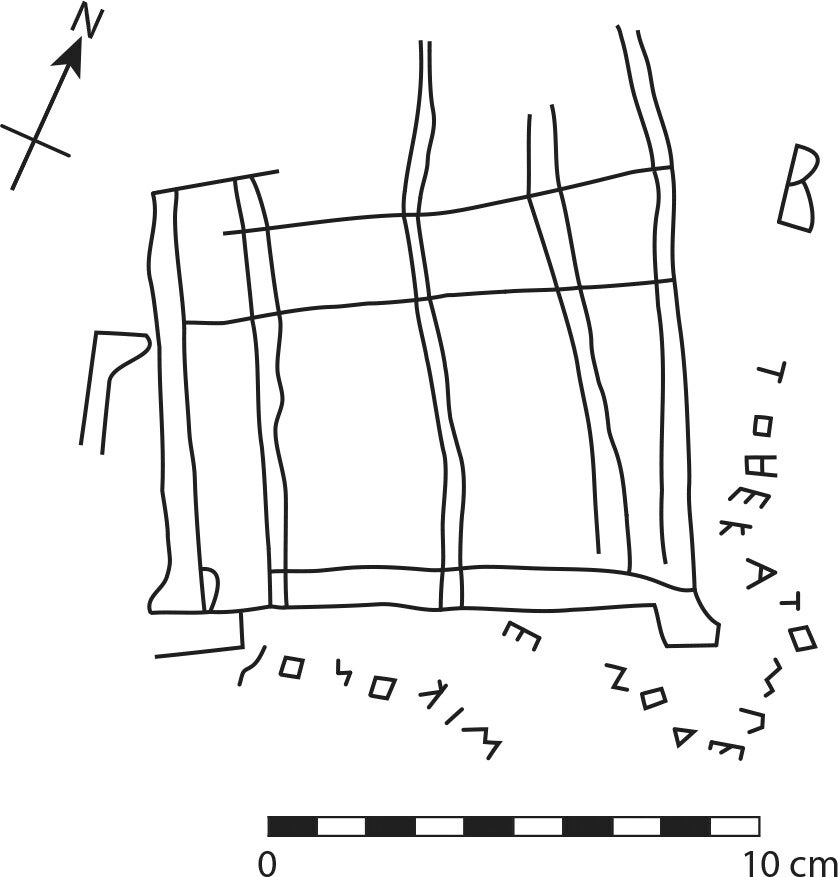
According to a new study published in the American Journal of Archaeology, this ancient drawing, attributed to a shepherd named Mikon, depicts a building identified as “the Hekatompedon,” a term historically associated with large temples.
“Mikon is not otherwise known, but he was most likely a shepherd who made the graffito while grazing his flocks,” explained Janric van Rookhuijzen, an archaeologist and co-author of the study, ina recent article. “The version of the Greek alphabet used is very ancient, making it clear that the drawing was made as early as the 6th century BCE.”
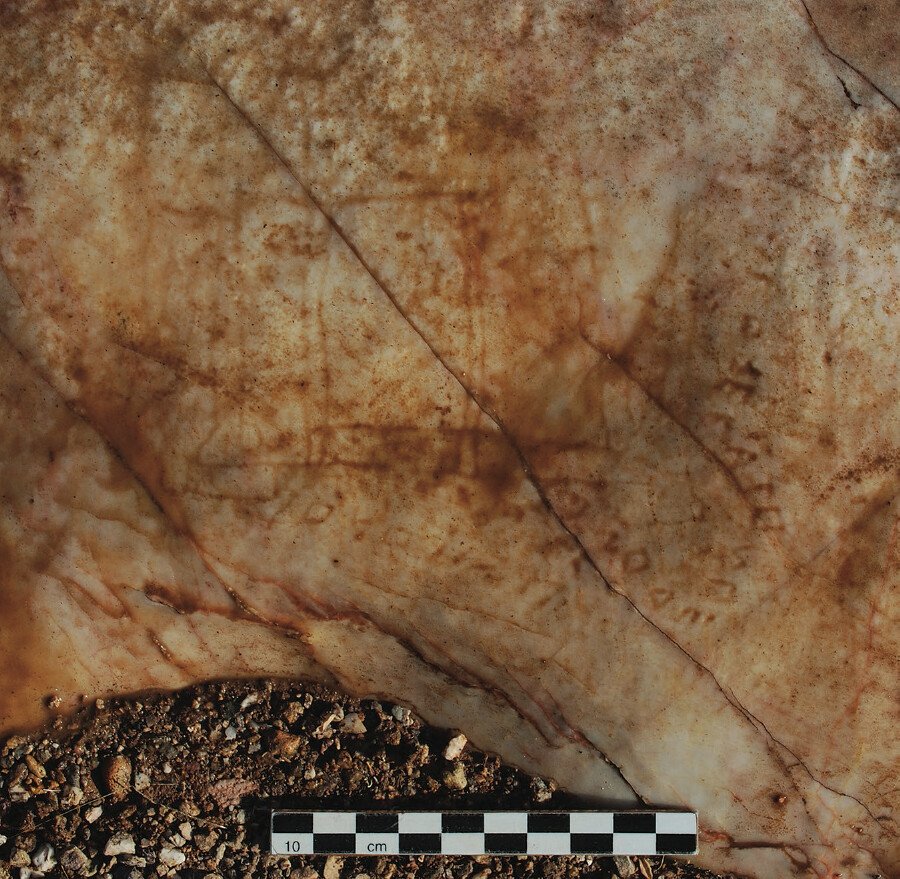
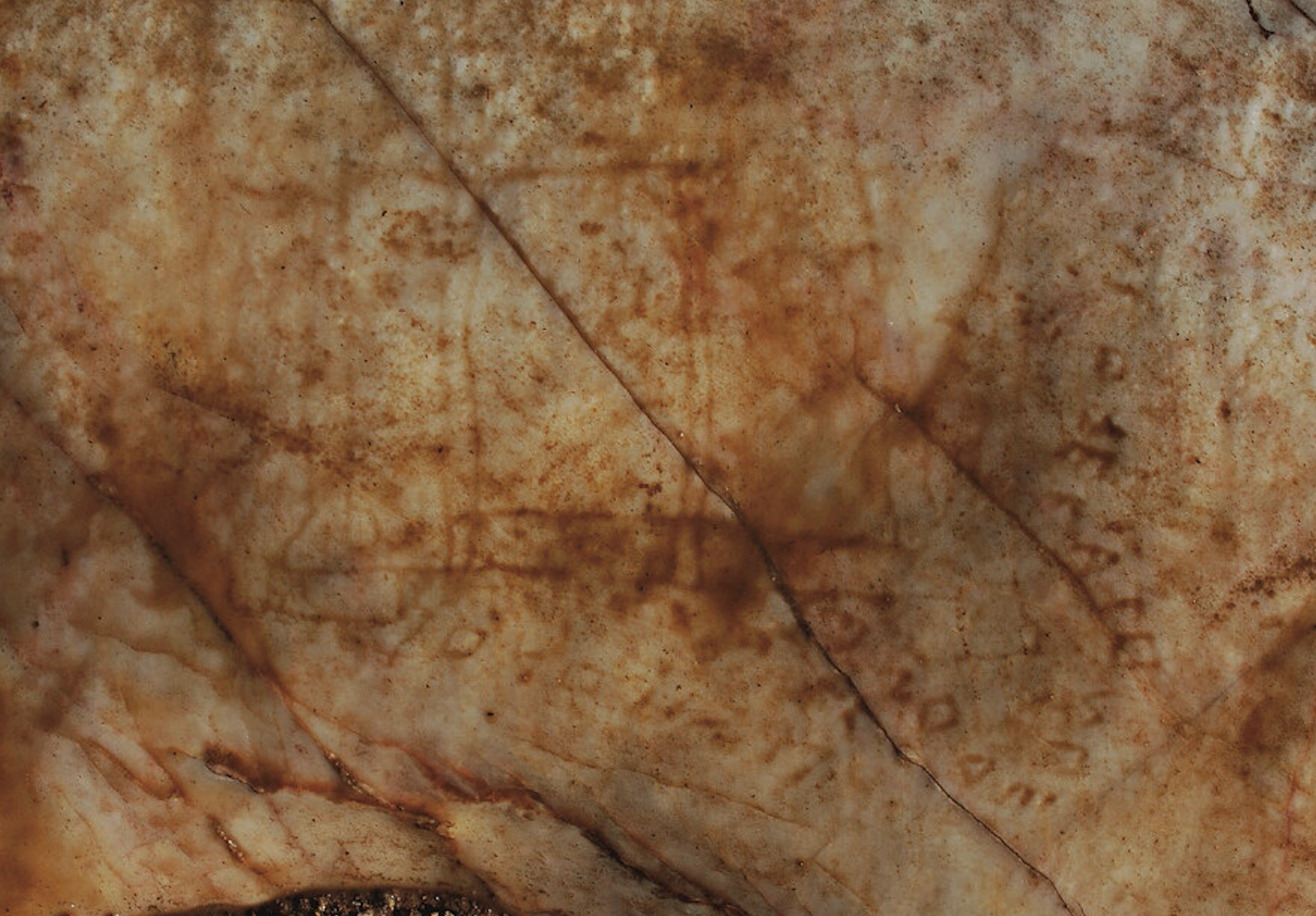
An image of Mikon’s graffiti showing a possible ancient temple. (Image: MERLE K. LANGDON & JAN Z. VAN ROOKHUIJZEN, AMERICAN JOURNAL OF ARCHAEOLOGY 2024)
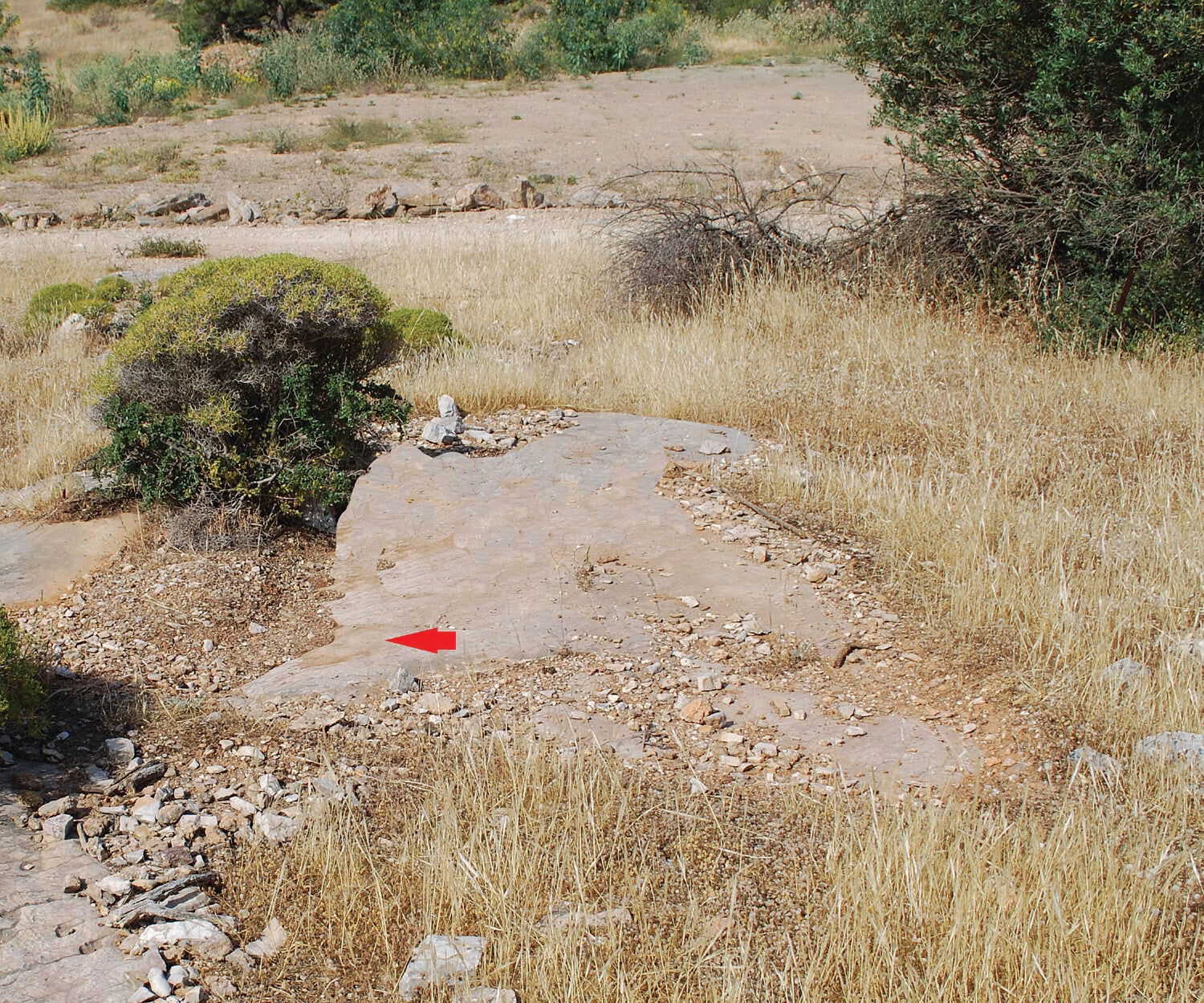
The graffito (a term sometimes used to describe a singular piece of graffiti) was found among over 2,000 ancient engravings on marble outcrops in the hills north and east of Vari. These engravings, typically created by local herders, include simple drawings of animals, ships, and buildings, as well as short inscriptions. The particular graffito in question looks like a building facade, showing at least five columns, and is accompanied by an inscription identifying it as “the Hekatompedon.”
The term “Hekatompedon” refers to a structure approximately 100 feet in length. In ancient Greek architecture, this term was often used to describe large temples. But, it also means something else.
Patch of bedrock where the graffito is located (arrow); the earthen road is visible in the background
(American Journal of Archaeology/Langdon et al)
Photograph of the graffiti
(American Journal of Archaeology/Langdon et al)
Sketch of the graffiti, indicating reasonably secure lines and letters
(American Journal of Archaeology/Langdon et al)
“The term is known to be the official ancient name of the famous temple dedicated to the Greek goddess Athena – later known as the Parthenon,” van Rookhuijzen explained. “It is likely that Mikon wanted to depict a building on the Acropolis of Athens.”
However, the inscriber, Mikon, pre-dated the Parthenon by several decades.
“Because the alphabet he used can be firmly dated to the 6th century BCE, the drawing must be at least 50 years older than the Parthenon, which was begun around 450 BCE,” van Rookhuijzen wrote.
According to the researchers, they believe that the graffito likely depicts an archaic temple on the Acropolis of Athens, possibly the so-called Bluebeard Temple or the Gigantomachy Temple. These temples are thought to have stood on the Acropolis at the end of the sixth century BCE, but were destroyed by the Persians in 480 BCE.
The Acropolis of Athens.
(Image: Unsplash)
Utilizing high-resolution photographs and detailed sketches, the work of this long-dead shepherd was analyzed for the various letter forms, orthography, and layout to determine its authenticity. The team compared this drawing and writing style to other known examples, as well as other known architectural drawings and inscriptions from the area.
Based on their research, they note this is the earliest written record of the term “Hekatompedon” being used to describe a large temple or building. Moreover, noting the style of the graffito, as it features lines for columns and a cross line that represents an entablature (the horizontal lintel that sits on top of the columns), the study argues that this was probably some kind of symbolic gesture of admiration for the temple.
In simple terms, Mikon probably just dug big buildings, and shepherds and herders were notorious for their graffiti. The hill where this drawing was discovered is covered in ancient shepherd graffiti, including images of horses, boats, and, of course, ancient erotica.
“Why the shepherds produced so many graffiti is not known – it may have simply been a form of escapism during the dull moments of their job,” van Rookhuijzen mused.
“However, the graffito made by Mikon shows how a small scribble may be the key to tackling the historical riddles behind one the world’s most iconic archaeological sites.”
MJ Banias covers space, security, and technology with The Debrief. You can email him at mj@thedebrief.org or follow him on Twitter @mjbanias.
Een koude waterstofwolk die plotseling oplicht door intense straling van een ster zou wel eens kunnen verklaren waar het signaal, dat onderzoekers al bijna 50 jaar in zijn greep houdt, vandaan kwam.
In de jaren zeventig van de vorige eeuw speuren astronomen van het Ohio State University Radio Observatory de hemel af, op zoek naar radiosignalen afkomstig van buitenaards leven. En op 15 augustus 1977 gebeurt het ongelofelijke: astronoom Jerry Ehman onderzoekt de gegevens die de radiotelescoop heeft verzameld en ziet plotseling een krachtig, smalbandig radiosignaal. Het signaal trekt onmiddellijk zijn aandacht. In zijn enthousiasme omcirkelt hij het signaal en schrijft in de kantlijn het veelzeggende ‘Wow!’ erbij. En zo is het Wow!-signaal geboren.
Wow!-signaal
Al tientallen jaren zoeken astronomen naar radiosignalen die mogelijk van (intelligent) buitenaards leven afkomstig zijn. Maar tot nu toe zonder resultaat. Behalve dan dat ene mysterieuze radiosignaal: het beruchte Wow!-signaal. Hoewel het al bijna vijftig jaar geleden is, blijft het Wow!-signaal, dat slechts één keer is opgevangen en waarvan de oorsprong nooit is achterhaald, de gemoederen bezighouden. Het is zelfs één van de meest raadselachtige radiosignalen die ooit zijn opgevangen. De sterke intensiteit en smalle bandbreedte nabij de 1420 MHz waterstoflijn maakten het tot een mogelijk teken van buitenaardse intelligentie. Maar was dit signaal écht afkomstig van een buitenaardse beschaving, of is er misschien toch een andere verklaring voor?
Wow! Aliens?
Hoewel men ‘hoopte’ dat het Wow!-signaal van buitenaardse wezens afkomstig zou zijn, is er nooit bewijs gevonden dat het signaal daadwerkelijk (opzettelijk) door aliens is verstuurd. Belangrijkste tegenargument voor dat idee is wel dat het slechts eenmalig is opgevangen. Als aliens het radiosignaal uitzenden om contact te maken, zou je verwachten dat ze dat herhaaldelijk doen. “Een andere mogelijkheid is dat het signaal niet bedoeld was voor de aarde, maar ‘weg is gelekt’ uit de communicatie tussen een beschaving en één van diens ruimtevaartuigen,” vertelde amateur-astronoom Alberto Caballero eerder. Het is trouwens ook niet de eerste keer dat wordt gesuggereerd dat het signaal misschien helemaal niet van buitenaardse wezens afkomstig is. Zo verscheen er een paar jaar geleden nog een studie die suggereerde dat kometen de oorzaak van het signaal waren – iets wat overigens door veel wetenschappers direct alweer in twijfel werd getrokken.
Om het Wow!-signaal te duiden, zijn onderzoekers het zogenoemde Arecibo Wow!-project, gestart; een ambitieus plan om naar soortgelijke signalen te zoeken in oude gegevens van het voormalige Arecibo-observatorium. Dit observatorium was één van de grootste en krachtigste radiotelescopen ter wereld. Van 2017 tot 2020 bestudeerde het team verschillende hemellichamen op frequenties van 1 tot 10 GHz met de beroemde 305-meter telescoop van het observatorium. In 2023 zette het project de waarnemingen voort met een 12-meter telescoop op 8 GHz, met een focus op rode dwergsterren die mogelijk bewoonbare planeten herbergen.
Soortgelijk signaal
En nu komen onderzoekers met groot nieuws. “Onze meest recente waarnemingen, uitgevoerd tussen februari en mei 2020, hebben soortgelijke smalbandige signalen nabij de waterstoflijn opgeleverd,” vertelt onderzoeker Abel Méndez. “Deze signalen waren overigens wel minder intens dan het oorspronkelijke Wow!-signaal.”
Geen ‘hallo’
Na analyse van de nieuwe gegevens, denken de onderzoekers dat het Wow!-signaal (helaas) geen ‘hallo’ van een alien was. Zo suggereert hun onderzoek dat het raadselachtige signaal is ontstaan door een bijzondere astrofysische gebeurtenis. Mogelijk is het signaal het gevolg van een plotselinge helderheid van een koude waterstofwolk door sterke straling van een tijdelijke bron, zoals een uitbarsting van een magnetar of een ‘soft gamma repeater’ (een astronomisch object dat af en toe, met onregelmatige tussenpozen van meerdere jaren, krachtige uitbarstingen van röntgen- en gammastraling produceert). Dergelijke zeldzame gebeurtenissen kunnen ervoor zorgen dat waterstofwolken tijdelijk veel feller stralen, wat de kortdurende aard van het Wow!-signaal zou kunnen verklaren.
Koude waterstofwolken in de Melkweg zenden zwakke radiosignalen uit, zoals te zien op deze foto van het Arecibo-observatorium uit 2020. Een plotselinge helderheid van zo’n wolk, veroorzaakt door sterke straling van een andere ster, zou het Wow!-signaal kunnen verklaren.
Afbeelding: Planetary Habitability Laboratory
Buitenaards leven
Deze hypothese verklaart niet alleen de unieke kenmerken van het Wow!-signaal. Het laat ook zien dat we voorzichtig moeten zijn om elk raadselachtige signaal meteen als een teken van buitenaards leven te bestempelen. “Ons onderzoek suggereert dat het Wow!-signaal waarschijnlijk de eerste keer was dat we een ‘maser-achtige’ emissie van de waterstoflijn hebben geregistreerd,” stelt Méndez. “Deze hypothese zou ons begrip van dergelijke signalen kunnen herdefiniëren en invloed kunnen hebben op hoe we in de toekomst naar buitenaards leven zoeken.”
Sisser
Al met al loopt het verhaal van het Wow!-signaal, als de onderzoekers het bij het juiste eind blijken te hebben, met een sisser af. De studie biedt namelijk een nieuwe, ‘natuurlijke’ verklaring voor het mysterieuze Wow!-signaal, dat onderzoekers al bijna 50 jaar in zijn greep houdt. Het team vermoedt zelfs dat de precieze bron van het Wow!-signaal – of soortgelijke signalen – kunnen worden opgespoord door te kijken naar de sterren en andere objecten in de buurt van koude waterstofwolken.
Het betekent dat we nog altijd geen bewijs hebben gevonden voor het bestaan van buitenaards leven. Voorlopig lijken we dus nog steeds alleen te zijn in de uitgestrektheid van het universum.
Meer wetenschap? Lees de nieuwste artikelen op Scientias.nl .
A rare landing on the south pole of the moon led to this scientific discovery
There was once a magma-filled ocean on the south pole of the moon, scientists recently discovered after analyzing lunar soil that revealed ancient information about the moon's origin.
The study of soil taken from a less-studied region of the moon suggests the presence of remnants of a former ocean of magma, according to a study published Wednesday in Nature.
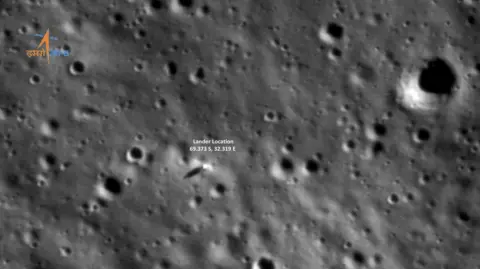
The researchers analyzed lunar soil extracted from high-latitude regions on the southern portion of the moon -- taken as part of the Chandrayaan-3 mission when India’s Vikram lander module made a historic touchdown near the south pole of the moon in August 2023. The mission is the southern-most landing that has ever taken place on the moon -- a difficult feat considering the lack of sunlight, which can create visibility and communication issues, Anil Bhardwaj, director of Physical Research Laboratory in Ahmedabad and co-author of the study, told ABC News. Most lunar landings, especially human landings, have taken place in the equatorial or low-latitude regions.
India's lunar mission found remnants of a magma ocean on the south pole
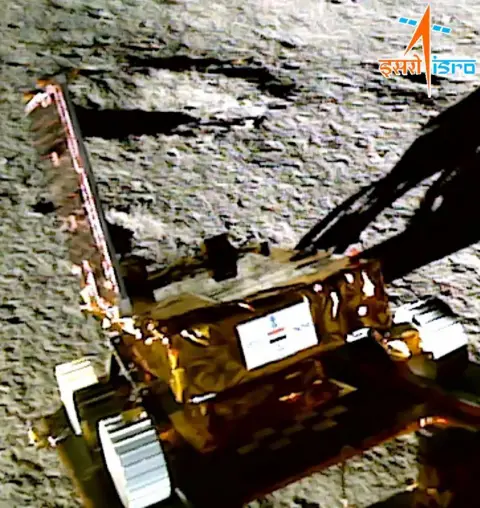
The mission embarked the use of new technology -- a particle access spectrometer -- an instrument aboard the rover that was able to make observations and collect data very close to the lunar surface, M. Shanmugam, the lead engineer of the alpha particle X-ray spectrometer at the Physical Research Laboratory in Ahmedabad, told ABC News.
The composition of the soil found on Vikram’s landing site is consistent with an ancient magma ocean, the authors conclude.
When analyzing the soil, the researchers found a relatively uniform elemental composition among 23 measurements at various spots along the lunar surface, primarily containing the rock-type ferroan anorthosite. The spectrum of elements also included all of the major and minor elements of the presence of magma, including sodium, aluminum, magnesium, carbon, silicon, sulfur, potassium, iron, titanium, chromium and manganese, Bhardwaj said.
The moon is believed to have formed after a body the size of Mars struck Earth about 4.24 billion years ago, Bhardwaj said. The material that formed as a result of the volatile impact was likely magma that was thrown into space that remained within the Earth's gravitational pull and eventually began forming a planetary-mass object.
The magma ocean is likely to have existed for tens to hundred million years, Santosh Vadawale, a professor in the Physical Research Laboratory and lead author of the study, told ABC News.
The moon lnder Vikram in the foreground and the orbiter of the Chandrayaan in the back ground as Indias moon shot is in the clean room at the Indian Space Research Organisation (ISRO) in Bengaluru, India, June 10, 2019.
Researchers believed the magma disappeared as the moon cooled throughout its formation, hypothesizing that, less dense ferroan anorthosite floated to the lunar surface while heavier minerals sank to form the mantle during the cool-down -- forming the lunar highlands as a result of the floatation of lighter anorthositic rock.
Previous research into the Moon’s geology has primarily relied on samples taken by missions to lunar mid-latitudes, such as the Apollo program, giving scientists a more nuanced look into the history of the moon's formation, according to the paper.
Chandrayaan-3's rover Pragyaan explored the south pole region for 10 days last August
While the lunar magma ocean hypothesis has existed for decades, ever since the Apollo mission placed humans on the moon in 1969, the new research has allowed researchers to confirm the evolutionary history of the moon from billions of years ago, Vadawale said.
"Our next mission, we would like to try to go as close as possible to poles, where there are these permanently shadowed regions where there is water is supposed to be there," he said.
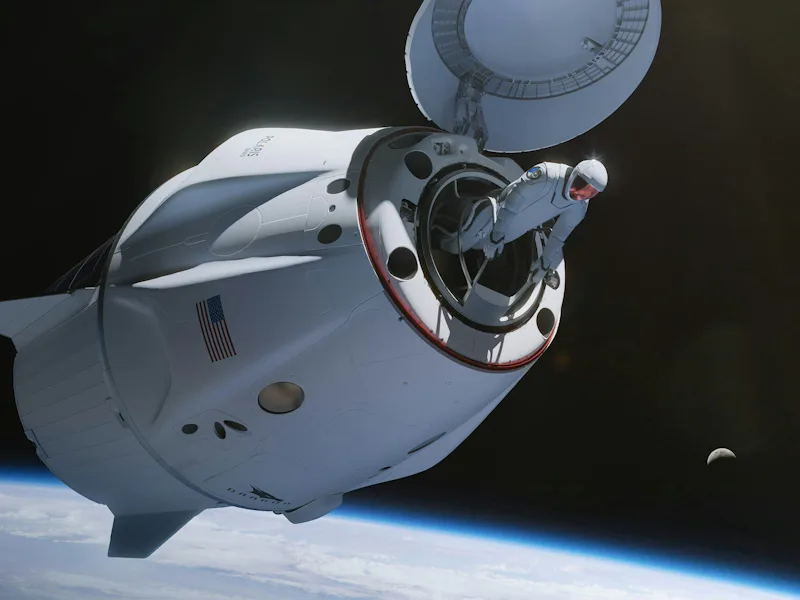
Polaris Dawn will launch on Monday, and the private space mission will do some ambitious and risky things.
In a time when we regularly see multiple commercial spacecraft docked at the ISS at the same time, it can be a little tough for any particular private space mission to stand out — but Polaris Dawn, a collaboration between SpaceX and Shift4 CEO Jared Isaacman, will be one to watch.
The mission is scheduled to launch Monday, August 26 from Kennedy Space Center, sending four astronauts in a SpaceX Crew Dragon capsule (like the one the stranded Starliner crew will ride home in) on a long, narrow orbit that will carry them through the innermost of the Van Allen belts — bands of high-energy radiation that surround our planet — making them the first people to cross the belts in 52 years. Midway through the 5-day mission, two crew members will leave the capsule for the first spacewalk by private astronauts.
Those plans might look like more space billionaire stunts — this is also the age of space tourism, after all — but Isaacman (who will fly on Polaris Dawn as the mission’s commander) insists the Polaris program has real science and technology development goals.
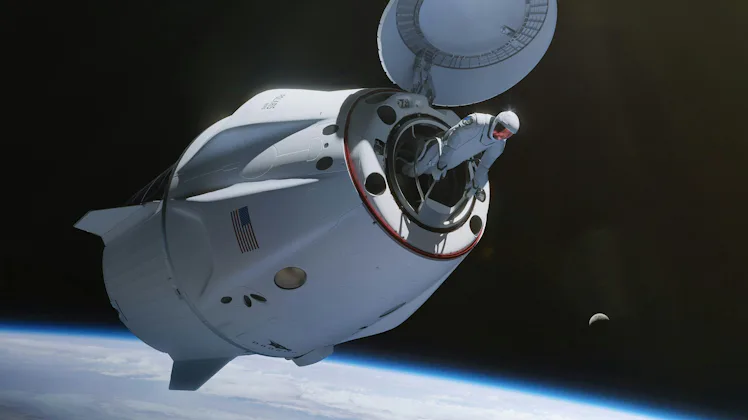
This illustration shows what it might look like when the first of two Polaris Dawn crew members ventures out of the Crew Dragon capsule. It will be the first time that corporate astronauts, instead of astronauts chosen, trained, and employed by a government space agency, will perform an extravehicular activity.
Polaris/SpaceX
Polaris Dawn Will Test SpaceX’s New EVA Suits
One goal of the Polaris Dawn mission is to test new technology for deep space travel. The mission will be the first flight test of SpaceX’s new pressure suits for extravehicular activities (EVAs), such as spacewalks. Isaacman and mission specialist Sarah Gillis are about to become the first non-government-employed astronauts to ever attempt a spacewalk, but they’re also about to depressurize their spacecraft, open the door, and step outside while wearing spacesuits that have never flown before.
The design is meant to be lighter and more maneuverable than the ones currently in use, and the helmet comes with a heads-up display that shows a mission clock alongside the suit’s pressure, temperature, and humidity. At the moment, neither NASA’s spacesuits nor SpaceX’s current generation “intervehicular activity” (IVA) suits have the heads-up display. Both the IVA suits and the new EVA suits are much less bulky than NASA’s version, but Isaacman and SpaceX claim the EVA suits flying on Polaris Dawn offer more mobility at the joints, and they’re also easier to get into and out of.
SpaceX previously took the new suits to White Sands Missile Range in New Mexico to fire tiny projectiles at them at thousands of miles an hour, arguably the most direct way to test whether the suits could endure strikes from micrometeorites or other tiny bits of orbital debris. Next week’s mission will be their first flight test — and since the mission calls for opening up the whole Crew Dragon cabin to the vacuum of space before Isaacman and Gillis venture outside, it will be a high-stakes test, and it carries more than the usual amount of risk that comes with flying to space.
The four astronauts will also test communications systems using laser links between the Crew Dragon capsule and SpaceX’s (increasingly problematic) constellation of StarLink satellites in low Earth orbit.
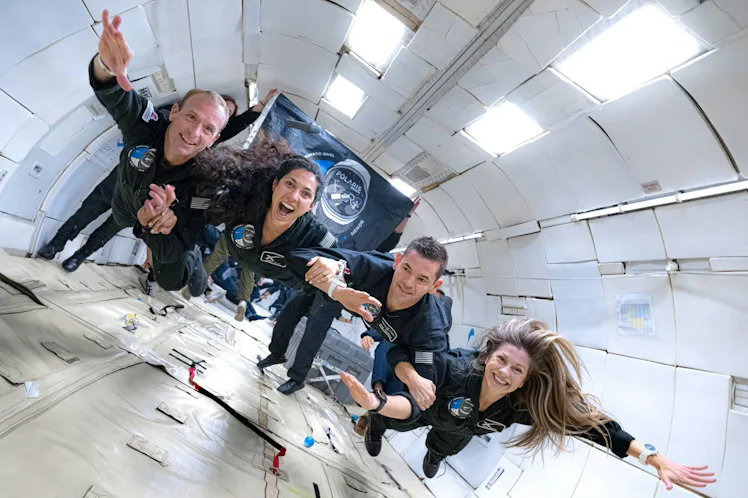
In this photo, the Plaris Dawn crew poses with their Crew Dragon capsule, sporting their new EVA suits.
Polaris/SpaceX
What Will Happen During Polaris Dawn’s Spacewalk?
While the spacesuits are very new and Polaris Dawn’s crew are about to be the first non-space-agency astronauts to ever attempt a spacewalk, the method they’ll be using for this test is extremely old-school. The Polaris Dawn spacewalk is going to look almost exactly like the very first American spacewalk back in 1965, except with twice the number of people and much sleeker spacesuits.
Astronauts aboard the International Space Station will breathe pure oxygen for about two hours before a spacewalk, then step into an airlock (a separate room that air can be let in and out of) and then into the vast vacuum of space — leaving the rest of the space station safely sealed and pressurized behind them. But the Crew Dragon capsule doesn’t have an airlock, just a main hatch, so in order to walk in space, the crew will have to open the hatch and expose the whole cabin to vacuum.
Isaacman and Gillis will float out the hatch, tethered to the capsule by umbilical cables that provide life support and keep them tethered to the ship. Pilot Scott Poteet and mission specialist and medical officer Anna Menon will be strapped into their seats, managing the umbilicals and the ship’s systems — but all four of them will be exposed to the unforgiving forces of vacuum, with nothing but their suits and open hatchway between them and eternity. That’s exactly how the crew of Gemini 4 — pilot Edward White and commander James McDivitt — did it 59 years ago, when White became the first American spacewalker.
Spacesuits keep astronauts’ bodies under enough air pressure to survive and function, but the pressure inside an EVA suit will still be very low compared to the normal air pressure in the room you’re sitting in now, or in the Crew Dragon’s cabin.
That’s why astronauts on the ISS spend a couple of hours “pre-breathing” oxygen before an EVA. The goal is to make sure there’s no nitrogen in their bloodstream, so they can avoid a painful and often fatal condition called decompression sickness (DCS), or the bends. Normal air is 78 percent nitrogen, which ends up in our bloodstream when we breathe. That’s not a problem, unless our bodies are suddenly under much lower pressure than normal. Then, it quickly becomes a big problem because all the nitrogen gas mixed with our blood comes fizzing out, like the bubbles in soda bottles when you take the lids off too quickly.
Polaris Dawn’s crew will spend a lot more time pre-breathing. They’ll start as soon as they reach orbit, and for the next two days, they’ll gradually turn the cabin pressure down and the oxygen concentration up. That will force the nitrogen out of their bodies even as they’re adjusting to lower pressure. By day 3, it will be time to open the hatch and hope it worked.
The Polaris Dawn crew will spend much of their 5 days in orbit gathering data on how microgravity and radiation impact the human body and its tissues.
Polaris/SpaceX
Medical Research in Space
Exploring how the human body responds to the physical weirdness of being in space — changing air pressure, microgravity, and radiation exposure — is another key goal of the Polaris Dawn mission (and pretty much every crewed mission, on some level). During their 5 days in orbit, the crew will gather data for more than 30 experiments on the human body.
When it launches, the Crew Dragon capsule will be carrying samples of human tissues and cells, which researchers at Baylor College of Medicine and Embry-Riddle Aeronautical University will compare with their “BioBank” samples here on Earth. The goal is to learn how deep space affects the tissues that make up the human body on a microscopic level, looking for changes on the cellular level.
Other experiments will study bone and muscle loss in microgravity — and test a couple of possible methods to track and prevent them. Still other experiments will study changes to astronauts’ vision, which are believed to be caused by changes in the amount of fluid in astronauts’ heads during spaceflight. The crew will measure the pressure on their eyes with portable ultrasound instruments, tiny sensors in contact lenses, and small cameras that measure the size of astronauts’ pupils.
A couple of other experiments are focused on how exposure to microgravity and cosmic radiation impacts medicines; a NASA study will track whether there are any physical or chemical changes to medicines stored on the Crew Dragon capsule during the flight, while a UTHealth Houston study will measure blood flow in the astronauts’ liver and kidneys (again with portable ultrasound devices) to build digital models of how the human body might process medicines taken during a space flight.
Meanwhile, NASA will be testing a nasal spray for space sickness, a type of motion sickness that happens to people in space. All of these tests will hopefully get us all one step closer to feeling safer and healthier in space.
UFO whistleblower Luis Elizondo is strengthening his longtime efforts to pressure the U.S. government into revealing its secretive knowledge about UAPs, or Unidentified Anomalous Phenomena. Now that the Pentagon has finallycleared him to tell the full truth about what he knows, Elizondo has dropped several stunning claims in his new book, Imminent: Inside the Pentagon’s Hunt for UFOs, including a story about the government setting up UAP traps to attract the supposed extraterrestrials.
“We had a plan to set up a real big nuclear footprint, something we knew would be irresistible for these UAP,” Elizondo says in a new video posted on Reddit.
Elizondo, a former Pentagon official, makes other startling claims about what he says the government knows about UAPs, including its stewardship of a “Legacy Program” that is “in possession of advanced technology made off-world by nonhuman intelligence.” In other words, the government is still holding on to evidence that aliens have visited us.
In another incident detailed in his book, “several mysterious and luminous orbs” appeared before a group of scientists as they tested a classified device at the White Sands Missile Range in Los Alamos, New Mexico, in 2013. “The orbs moved toward the test site, hovered over the device as if scanning it for intel, then zipped away, brashly flying over the heads of bewildered scientists.” Several eyewitnesses also saw multiple “disc-shaped objects that seemed to know precisely where the device being tested was located.” Elizondo wrote that the incident occurred several times over the following days.
As former head of the Advanced Aerospace Threat Identification Program—a secret government UFO program that monitored unexplained threats to Navy warships and nuclear silos—Elizondo has had some bizarre encounters of his own. He asserts, for example, that he once saw green “luminous orbs” in his house after he began directing the secret office investigating UAPs in 2010.
The Pentagon redacted some sections of the book before it was published, and it is not supporting Elizondo’s claims.
UAPs have a long history of attracting enthusiasts who want to believe there’s an extraterrestrial presence interested in Earth. However, no proof has yet been found of aliens from other worlds, and the vast majority of UAP sightings can be debunked as a number of other, more mundane occurrences. These typically include weather phenomena, drones or advanced human-made technology, or an illusion of super-fast motion.
Still-unexplained sightings remain mysteries simply because there isn’t enough data to analyze them properly, according to longtime UAP investigator Mick West. “The people who are into UFO investigations are so interested because they’re looking for something extraordinary,” West recently toldPopular Mechanics. It’s more important to perform a dispassionate analysis of quality evidence, he says. Then you know the truth is indisputable.
Now that the government is releasing more documentation and evidence, UAP enthusiasts hope a fuller picture about unexplained sightings will emerge. Whether Elizondo’s claims indicate a truly extraterrestrial presence or not is still up in the air. In the meantime, he believes the incidents he describes in his book are a “very serious national security issue.”
This is the true story of a man who was part of a secret government program. As a CIA psychic informant, he was tasked with viewing Jupiter and the far side of the Moon. He made wild claims about Jupiter, and they later came true…
INGO SWANN (1933-2013) was internationally known as an advocate and researcher of the exceptional powers of the human mind and as a leading figure in governmental and scientific projects to investigate and identify the scope of subtle human perceptions.
In the 1970s, Ingo was involved in remote viewing experiments established by the U.S. Army and the CIA in collaboration with the Stanford Research Institute. This clandestine initiative — code-named Project Stargate — later became the basis for the movie The Men Who Stare at Goats, starring George Clooney and Jeff Bridges. (Source)
Ingo Douglas Swann (1933-2013) Image in public domain
For Stargate, Ingo and a group of psychics used their abilities to spy on Russia from Palo Alto, California, even remotely discovering a downed Soviet spy plane under a jungle canopy in the African country of Zaire after the U.S. Department of Defense had deemed it lost.
Ingo’s various remote views of celestial bodies included: Jupiter (1973), Mercury (1974), the Moon (1975), and Mars (1975, 1976, and 1984). Selected information on these sessions is provided below. More can be found in his archives at the University of West Georgia.
In 1973, most scientists, academics, and media strongly opposed research into parapsychology or psychoenergetics. So, it was surprising when the country’s second-largest think tank started researching these topics. This caused a big reaction because the think tank, SRI, was highly respected and connected to the military and intelligence communities.
The idea of controlled remote viewing was a process in which viewers could view a location given nothing but its geographical coordinates and was developed and tested by Puthoff and Targ with CIA funding.
The experiment was controlled by Harold Puthoff and according to the account, during the experiment; Swann using the power of his thought visited the distant planet. The experiment was dated April 27, 1973.
According to Ingo, in the space to the right of the room, he could see Jupiter, remotely located many millions of miles away. (Source)
He could see how it was shining with a blinding light. He could look at it from all directions of his mind’s eye. At first, everything was seen in miniature and then everything was suddenly expanded.
“These visions are inside me, then outside. There is a yellow cast to space and seeming dark objects show through it. Can they be other moons of contrasting colors or densities? The impressions come to me that there are 17, some yet undiscovered by earth scientists, much closer to Jupiter, and the feeling also comes that some of them have been and are being spawned by the conclusive, volcanic action in the interior..,” Swann said, according to the document.”
Ingo also “saw” rings around Jupiter, but, he said that they were not as noticeable as that of Saturn. (Source)
Later, in 1979, the space probe Voyager confirmed the existence of the Jovian ring system; however, the hypothesis of its existence was put forward by the Soviet astronomer Sergey Vsehsvatskiy in the 1960s.
Perhaps, it was Swann who earlier provided the CIA with information regarding ancient civilizations on Mars. The Stargate project was launched in 1970 after the CIA stated that the Soviet Union reportedly spent more than $1 million a year on research into Psychotronics.
This experiment has been ridiculed by skeptics, who often haven’t reviewed its details. There are two key points that skeptics overlook: first, the Jupiter Probe was just an exploratory experiment, not a claim of any findings; second, it had prestigious sponsorship and scientific oversight.
The experiment’s focus on remote sensing of a distant planet was seen as radical, challenging not only mainstream academic views but also the usual practices in parapsychology.
Six of these thirteen factors were given scientific substantiation by 1975. Before Jupiter’s ring was “scientifically” discovered in 1979, most scientists flatly denounced the possibility of the RING. (Source)
In February 1975, he was contacted by a certain highly-placed figure from Washington, DC, who guardedly told Swann that he, Swann, would soon be receiving a telephone call from the aforementioned Mr. Axelrod
Ingo quickly agreed to a mysterious, last-minute meeting, despite feeling concerned. He met a man who resembled a Marine, exchanged brief formalities, and was then driven to a helicopter. Blindfolded for a 30-minute flight, Swann was taken to what seemed like a secret underground location. Once there, he met a man named Mr. Axelrod, who admitted the name was fake, adding to the secrecy of the situation.
Axelrod quickly got to the main point, asking Ingo many questions about remote viewing. He also made it clear that he wanted to use Swann’s skills for a secret mission and offered a large sum of money. It was an offer Swann couldn’t refuse, and he didn’t.
Axelrod then asked Ingo what he knew about the Moon, revealing the true purpose of their meeting. Someone in the government wanted the Moon to be remote-viewed, and Swann agreed to do it.
When Ingo began his work, he was shocked by what he saw. His mind focused on an image of a massive tower on the Moon, similar in size to the United Nations Secretariat Building. Swann was told that this structure wasn’t made by humans but by mysterious extraterrestrials. However, no one knew where they came from.
In later remote-viewing sessions, Ingo saw many unusual things on the Moon. He described domed structures, advanced machines, tall towers, large cross-shaped structures, and strange tubes spread across the landscape. He also saw signs of what looked like mining operations. It seemed that someone, or something, had secretly built a base on the Moon.
Ingo also focused on a group of people on the Moon who looked human. They were inside some kind of enclosure and were digging into a cliff. The strange thing was that they were all completely naked.
Suddenly, Axelrod, who was overseeing the experiment, stopped it. He hinted that the beings on the Moon might have noticed they were being watched and that Ingo could be in serious danger if they decided to confront him.
Axelrod asked Ingo if he knew a man named George Leonard. Ingo said no, he didn’t know him.
At the same time, Axelrod was asking him to investigate strange things on the Moon. Meanwhile, George Leonard was writing a book called “Somebody Else is on the Moon”.
In 1977, Leonard’s book was published. It talked about strange structures on the Moon, which was exactly what Axelrod was worried about —strange, possibly man-made structures on the Moon.
Ingo and Axelrod had several secretive meetings about strange events on the Moon. These meetings, which felt almost like a spy movie, ended suddenly in 1977, leaving Swann confused.
He wondered if he had psychically seen an advanced base on the Moon built by extraterrestrials. However, since the people he “saw” there looked like naked humans, he also considered it might be a secret Earth-based installation that Axelrod wanted to investigate.
The mystery remains unsolved, but there are more questions. The idea of aliens secretly using our Moon brings to mind similar claims about aliens on Earth.
In the 1997 book Remote Viewers, Jim Schnabel shared a story about the U.S. Intelligence community’s involvement in psychic spying, which started in the 1970s.
One remote viewer, Pat Price, believed that Alaska’s Mount Hayes housed one of the largest alien bases. He claimed the aliens looked human but had different hearts, lungs, blood, and eyes, and could control people through thought. Price also mentioned that this base caused problems for both U.S. and Soviet space missions.
From left: SRI researchers Hal Puthoff and Russell Targ, retired police commissioner Pat Price, and CIA contract monitor Christopher Green in 1974 at an airport immediately after testing Price’s remote viewing capabilities from a glider. Photo courtesy of Russell Targ.
There is a UFO/alien controversy surrounding Holloman Air Force Base in New Mexico, where one of three UFOs allegedly landed in May 1971. The incident has been recently discussed by “Moment of Contact” filmmaker James Fox, who says the full video of the UFO landing exists, including the alien entities walking out of the craft.
However, as it is so often in such cases, instead of the government releasing a film of the entire incident to author/filmmaker Robert Emenegger as promised, it only released 8 seconds of this special footage that ultimately made it into the film. Holloman Air Force Base is the United States Air Force base established in 1942 and located six miles southwest of the central business district of Alamogordo, New Mexico.
The story begins in 1971 when Emenegger and producer/director Allan Sandler were invited by US intelligence to Norton Air Force Base in California to discuss the significant UFO phenomenon that had occurred previously and create a documentary film about it.
Apparently, Mr. Fox recalls the Holloman incident on Julian Dorey Podcast, published on February 25, 2023. He says that he interviewed Sandler and Emenegger about it and they as well believe the UFO landing film footage exists. He points out this happened not far from Socorro, where Lonnie Zamora had his famous sighting roughly a year prior of a similarly shaped “tic tac” white craft and beings walking around the UFO.
There is no official record of the reason why the US government allowed giving secret UFO footage for a documentary film. It is believed that the administration of President Nixon did it to look strong in the science field for the upcoming 1972 re-election campaign.
Emenegger said that he was promised by the USAF officials to get the authentic UFO landing footage that happened at Holloman Air Force Base in New Mexico in 1971. It showed the alien visitors emerging out of the craft that met with the US military. Even though Emenegger was skeptical about it, the Air Force assured him that the footage was authentic.
One of the military’s officials named Paul Shartle, who was in charge of the audio-video department, said in a 1988 national television broadcast with Mike Farrell that he had watched the 16mm film of three disc-shaped craft. One of them landed and the others flew away.
“I saw footage of three disc-shaped crafts one of the crafts landed and two of them went away. It appeared to be in trouble because it oscillated all the way down to the ground. However, it did land on three pods, a sliding door open a ramp was extended, and out came three aliens. They were human-sized. They had an odd gray complexion and a pronounced nose. They wore tight-fitting jumpsuits, thin headdresses that appeared to be communication devices, and their hands in their hands they held a translator I was told.”
Robert Emenegger (Right) and Paul Shartle (Left)
Mr. Fox revealed on the podcast that Allan Sandler told him on the phone call that he had seen three discs escorted by a military jet. “He was not sure of the altitude, but he estimated that they were at roughly 10 to 12,000 feet,” Mr. Fox said. He continued: “Paul Shartle (One of the military’s officials at Norton Air Force Base in California who was in charge of the audio-video department) admitted that he had seen it and that it was not of Earth origin.”
Sandler told Mr. Fox that two of the discs peeled away while one wobbled to the ground. He said it was like a leaf floating down from the sky, and it looked like it was in trouble. Mr. Fox said that the wobbling movement was similar to the footage he had seen of a UFO before. He does not think that Allan knew how the UFO hovered. The disc eventually went to the ground.
“He said James, just like in a sci-fi movie, the seamless door opens and out come these beings that had very large noses, slits for mouths, and their eyes were almost like a vertical slit, like a cat’s eye, very, very big. They had… I’m just like… I [Fox] need to make this abundantly clear to your audience. I’m not saying what’s true or what’s not true, or if it happened or if it’s alien or whatever it is. I’m just telling you what I was told by people who saw it, and claimed to have seen it. They came out and they met with the base commanders, and then they either got into a Jeep or were about to get into a Jeep or do something and then the film footage just cuts.”
Emenegger claimed that he personally visited the landing site and inspected the area where the extraterrestrial craft had been stored, and that the US military and the alien visitors had held meetings that lasted for several days.
Additionally, Emenegger’s production team was granted access to highly classified documents at DoD facilities, and they received assistance from military officials who had expertise in UFO-related matters, such as Col. William Coleman of Project Blue Book and Col. George Weinbrenner, who headed Foreign Technology at Wright Patterson Air Force Base.
Paul Shartle, who showed the footage to Allan Sandler, faced some men in dark suits that showed up from an unknown location and warned him not to speak of the incident. They confiscated the footage, stating that it was not supposed to have happened. Sandler did not inform Emenegger for over 40 years.
Emenegger completed extensive research and film production only to feel cheated when the authorization to use real footage was withdrawn. Despite this setback, he went ahead and released his documentary “UFOs: Past, Present, and Future,” which was nominated for a Golden Globe in 1974. The documentary was groundbreaking because it provided information from the Department of Defense (DoD).
High Speed Test Track at Holloman Air Force Base
The United States Air Force (USAF) required Emenegger to add animated footage of the alleged Holloman UFO landing. According to Emenegger, some frames from the original footage were used during the editing stage with USAF authorization, which was not entirely missing from the frames. The viewers spotted a genuine bright disc coming down slowly in the distance against the backdrop of Holloman’s surrounding landscape.
David Cameron, a UFO researcher, shared in an interview that he was involved in confirming that the Pentagon was not covering up UFO sightings. He recounted the story of the Holloman Air Force Base film, where the government allowed producers to use eight seconds of footage of a landed alien ship in a documentary, but the classified part where an alien got out was removed.
Mr. Fox explains that the point of the story is that there is compelling evidence of an event occurring involving an unidentified object and that there may be film footage of the incident. Despite the existence of this evidence, the story has been overshadowed by other sensational claims, such as secret meetings between President Eisenhower and aliens.
While it is unclear what exactly happened, there is substance to the story and it should not be dismissed outright. However, the addition of other claims has muddied the waters and made it difficult to investigate the case of the president making contact with extraterrestrial life.
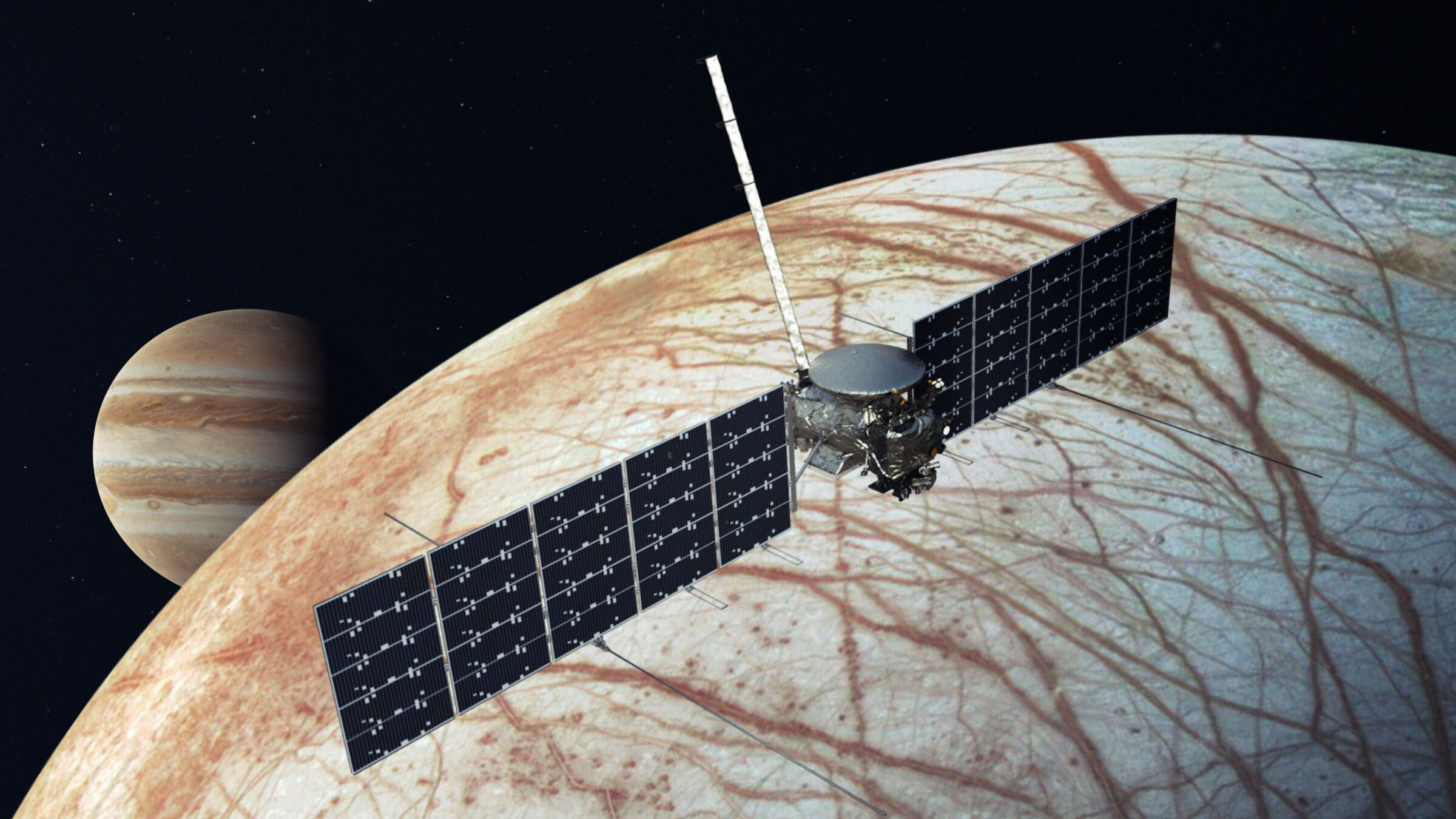
A series of experiments studying the sensitivity of life-hunting instruments to be employed in NASA’s forthcoming Europa Clipper Mission have revealed promising new capabilities that significantly raise its chances of being the first to detect lifeforms beyond Earth.
What will Europa Clipper do?
With a launch window that opens in October of this year and a planned insertion into Jupiter’s orbit sometime around April 2030, the Europa Clipper is equipped with a suite of science instruments. Based on recent experiments, one particular instrument, SUrface Dust Analyzer, was determined to be so sensitive that it could likely detect signs of alien life in individual grains of ice ejected by Jupiter’s icy moon.
“For the first time, we have shown that even a tiny fraction of cellular material could be identified by a mass spectrometer onboard a spacecraft,” said lead author Fabian Klenner, a University of Washington (UW) postdoctoral researcher in Earth and space sciences. “Our results give us more confidence that using upcoming instruments, we will be able to detect lifeforms similar to those on Earth, which we increasingly believe could be present on ocean-bearing moons.”
Oceans Beneath Surface of Icy Moons are Ideal Targets for Alien Lifeforms
While the search for life outside Earth has many targets, including the soil of Mars or the clouds of Venus, astrobiologists are increasingly optimistic about finding signs of past and present alien lifeforms within the subsurface oceans of the solar system’s icy moons. Along with Europa, these targets include Saturn’s moon Enceladus. Those hopes received even more fuel when researchers recently found evidence of phosphate on the surface of Enceladus.
The researchers explain, “This planetary body now appears to contain energy, water, phosphate, other salts, and carbon-based organic material, making it increasingly likely to support lifeforms similar to those found on Earth.”
This image shows red streaks across the surface of Europa, the smallest of Jupiter’s four large moons. The upcoming Europa Clipper mission will send instruments to investigate this moon.
Credit: NASA/JPL/Galileo
In the decade since NASA’s Cassini mission detected plumes of water and ice being ejected by Enceladus, mission planners and amateur enthusiasts alike have theorized about how such a life-hunting mission might actually take place. While some of the more exotic proposals include mini submarines or a snakelike probe that can crawl down into those subsurface oceans, the most popular involves flying a sample mission through those ejected plumes and scanning them for clues to alien lifeforms.
Now, an international team of researchers says instruments that might be included on upcoming missions should not only be able to detect signs of alien lifeforms, but they believe the conditions are ideal for such a finding as soon as the Europa Clipper.
Lab Study Shows Instruments Could Spot Signs of Life in a Single Grain of Ice
To see if instruments slated to join future missions would be able to detect signs of life in the plumes ejected from Enceladus and Europa, the UW research team selected a type of bacteria called Sphingopyxis alaskensis for study. That’s because this particular bacterium lives in cold environments on Earth and can survive on very little nutrients, making it a likelier analog of extraterrestrial bacteria that may thrive beneath the surface of these icy moons. The researchers also say this bacterium is just the right size for future probes to spot within a single grain of ice.
“They are extremely small, so they are, in theory, capable of fitting into ice grains that are emitted from an ocean world like Enceladus or Europa,” Klenner said.
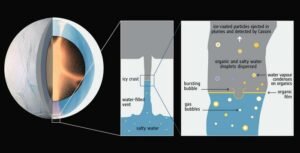
The drawing on the left depicts Enceladus and its ice-covered ocean, with cracks near the south pole that are believed to penetrate through the icy crust. The middle panel shows where authors believe life could thrive: at the top of the water, in a proposed thin layer (shown yellow) like on Earth’s oceans. The right panel shows that as gas bubbles rise and pop, bacterial cells could get lofted into space with droplets that then become the ice grains that were detected by Cassini. CREDIT: European Space Agency
After coming up with a lab experiment that would best simulate the conditions a future mission might experience these ejected ice grains, the team used a mass spectrometer to see if they could spot the life signs of their chosen bacterium in a single grain of ice. Significantly, they note that their instrument was less sensitive than the one planned for the Europa Clipper.
As hoped, their study was a success. An analysis of water injected into a vacuum showed that the right instruments could indeed detect alien lifeforms as they were ejected from Enceladus or Europa. In fact, the scientists behind the successful experiments say searching for life in this method “is more successful than averaging across a larger sample containing billions of individual grains.”
Instrument on NASA’s Europa Clipper Mission May Be First to Discover Alien Lifeforms
In their published study, the UW researchers supplemented their experiments by looking at the conditions on Earth that cause bacteria to collect on the ocean’s surface and cause a layer of “ocean scum.” They soon realized that a similar set of conditions likely exists on the surface of these extraterrestrial oceans. As a result, any subsurface water ejected into space would likely capture pieces of alien lifeforms and encapsulate them within grains of space ice, where NASA’s instruments could detect them.
“We here describe a plausible scenario for how bacterial cells can, in theory, be incorporated into icy material that is formed from liquid water on Enceladus or Europa and then gets emitted into space,” Klenner said.
The left panel shows the kilometers-thick icy crust believed to encapsulate Saturn’s moon Enceladus. Filling the crack is salty water with a proposed thin layer (shown orange) at its surface. The right panel shows that as gas bubbles rise and pop, they combine with organic material and get lofted into the spray. CREDIT: Postberg et al. (2018)/Nature.
Although they are not directly involved with the planning of NASA’s missions, the team notes that NASA’s Europa Clipper, thanks to its unique instrumentation, could be perfectly equipped to find alien lifeforms living beyond Earth.
“With suitable instrumentation, such as the SUrface Dust Analyzer on NASA’s Europa Clipper space probe, it might be easier than we thought to find life, or traces of it, on icy moons:” said senior author Frank Postberg, a professor of planetary sciences at the Freie Universität Berlin, “if life is present there, of course, and cares to be enclosed in ice grains originating from an environment such as a subsurface water reservoir.”
Christopher Plain is a Science Fiction and Fantasy novelist and Head Science Writer at The Debrief. Follow and connect with him on X, learn about his books at plainfiction.com, or email him directly at christopher@thedebrief.org.
Meer van UFO'S of UAP'S, ASTRONOMIE, RUIMTEVAART, ARCHEOLOGIE, OUDHEIDKUNDE, SF-SNUFJES EN ANDERE ESOTERISCHE WETENSCHAPPEN - DE ALLERLAATSTE NIEUWTJES


 600,000 Years Ago, A Transfer of Ancient Knowledge Kicked Off a Sudden and Rapid Advance in Technology