Ontdek de Fascinerende Wereld van UFO's en UAP's: Jouw Bron voor Onthullende Informatie!
Ben jij ook gefascineerd door het onbekende? Wil je meer weten over UFO's en UAP's, niet alleen in België, maar over de hele wereld? Dan ben je op de juiste plek!
België: Het Kloppend Hart van UFO-onderzoek
In België is BUFON (Belgisch UFO-Netwerk) dé autoriteit op het gebied van UFO-onderzoek. Voor betrouwbare en objectieve informatie over deze intrigerende fenomenen, bezoek je zeker onze Facebook-pagina en deze blog. Maar dat is nog niet alles! Ontdek ook het Belgisch UFO-meldpunt en Caelestia, twee organisaties die diepgaand onderzoek verrichten, al zijn ze soms kritisch of sceptisch.
Nederland: Een Schat aan Informatie
Voor onze Nederlandse buren is er de schitterende website www.ufowijzer.nl, beheerd door Paul Harmans. Deze site biedt een schat aan informatie en artikelen die je niet wilt missen!
Internationaal: MUFON - De Wereldwijde Autoriteit
Neem ook een kijkje bij MUFON (Mutual UFO Network Inc.), een gerenommeerde Amerikaanse UFO-vereniging met afdelingen in de VS en wereldwijd. MUFON is toegewijd aan de wetenschappelijke en analytische studie van het UFO-fenomeen, en hun maandelijkse tijdschrift, The MUFON UFO-Journal, is een must-read voor elke UFO-enthousiasteling. Bezoek hun website op www.mufon.com voor meer informatie.
Samenwerking en Toekomstvisie
Sinds 1 februari 2020 is Pieter niet alleen ex-president van BUFON, maar ook de voormalige nationale directeur van MUFON in Vlaanderen en Nederland. Dit creëert een sterke samenwerking met de Franse MUFON Reseau MUFON/EUROP, wat ons in staat stelt om nog meer waardevolle inzichten te delen.
Let op: Nepprofielen en Nieuwe Groeperingen
Pas op voor een nieuwe groepering die zich ook BUFON noemt, maar geen enkele connectie heeft met onze gevestigde organisatie. Hoewel zij de naam geregistreerd hebben, kunnen ze het rijke verleden en de expertise van onze groep niet evenaren. We wensen hen veel succes, maar we blijven de autoriteit in UFO-onderzoek!
Blijf Op De Hoogte!
Wil jij de laatste nieuwtjes over UFO's, ruimtevaart, archeologie, en meer? Volg ons dan en duik samen met ons in de fascinerende wereld van het onbekende! Sluit je aan bij de gemeenschap van nieuwsgierige geesten die net als jij verlangen naar antwoorden en avonturen in de sterren!
Heb je vragen of wil je meer weten? Aarzel dan niet om contact met ons op te nemen! Samen ontrafelen we het mysterie van de lucht en daarbuiten.
There is a UFO/alien controversy surrounding Holloman Air Force Base in New Mexico, where one of three UFOs allegedly landed in May 1971. The incident has been recently discussed by “Moment of Contact” filmmaker James Fox, who says the full video of the UFO landing exists, including the alien entities walking out of the craft.
However, as it is so often in such cases, instead of the government releasing a film of the entire incident to author/filmmaker Robert Emenegger as promised, it only released 8 seconds of this special footage that ultimately made it into the film. Holloman Air Force Base is the United States Air Force base established in 1942 and located six miles southwest of the central business district of Alamogordo, New Mexico.
The story begins in 1971 when Emenegger and producer/director Allan Sandler were invited by US intelligence to Norton Air Force Base in California to discuss the significant UFO phenomenon that had occurred previously and create a documentary film about it.
Apparently, Mr. Fox recalls the Holloman incident on Julian Dorey Podcast, published on February 25, 2023. He says that he interviewed Sandler and Emenegger about it and they as well believe the UFO landing film footage exists. He points out this happened not far from Socorro, where Lonnie Zamora had his famous sighting roughly a year prior of a similarly shaped “tic tac” white craft and beings walking around the UFO.
There is no official record of the reason why the US government allowed giving secret UFO footage for a documentary film. It is believed that the administration of President Nixon did it to look strong in the science field for the upcoming 1972 re-election campaign.
Emenegger said that he was promised by the USAF officials to get the authentic UFO landing footage that happened at Holloman Air Force Base in New Mexico in 1971. It showed the alien visitors emerging out of the craft that met with the US military. Even though Emenegger was skeptical about it, the Air Force assured him that the footage was authentic.
One of the military’s officials named Paul Shartle, who was in charge of the audio-video department, said in a 1988 national television broadcast with Mike Farrell that he had watched the 16mm film of three disc-shaped craft. One of them landed and the others flew away.
“I saw footage of three disc-shaped crafts one of the crafts landed and two of them went away. It appeared to be in trouble because it oscillated all the way down to the ground. However, it did land on three pods, a sliding door open a ramp was extended, and out came three aliens. They were human-sized. They had an odd gray complexion and a pronounced nose. They wore tight-fitting jumpsuits, thin headdresses that appeared to be communication devices, and their hands in their hands they held a translator I was told.”
Robert Emenegger (Right) and Paul Shartle (Left)
Mr. Fox revealed on the podcast that Allan Sandler told him on the phone call that he had seen three discs escorted by a military jet. “He was not sure of the altitude, but he estimated that they were at roughly 10 to 12,000 feet,” Mr. Fox said. He continued: “Paul Shartle (One of the military’s officials at Norton Air Force Base in California who was in charge of the audio-video department) admitted that he had seen it and that it was not of Earth origin.”
Sandler told Mr. Fox that two of the discs peeled away while one wobbled to the ground. He said it was like a leaf floating down from the sky, and it looked like it was in trouble. Mr. Fox said that the wobbling movement was similar to the footage he had seen of a UFO before. He does not think that Allan knew how the UFO hovered. The disc eventually went to the ground.
“He said James, just like in a sci-fi movie, the seamless door opens and out come these beings that had very large noses, slits for mouths, and their eyes were almost like a vertical slit, like a cat’s eye, very, very big. They had… I’m just like… I [Fox] need to make this abundantly clear to your audience. I’m not saying what’s true or what’s not true, or if it happened or if it’s alien or whatever it is. I’m just telling you what I was told by people who saw it, and claimed to have seen it. They came out and they met with the base commanders, and then they either got into a Jeep or were about to get into a Jeep or do something and then the film footage just cuts.”
Emenegger claimed that he personally visited the landing site and inspected the area where the extraterrestrial craft had been stored, and that the US military and the alien visitors had held meetings that lasted for several days.
Additionally, Emenegger’s production team was granted access to highly classified documents at DoD facilities, and they received assistance from military officials who had expertise in UFO-related matters, such as Col. William Coleman of Project Blue Book and Col. George Weinbrenner, who headed Foreign Technology at Wright Patterson Air Force Base.
Paul Shartle, who showed the footage to Allan Sandler, faced some men in dark suits that showed up from an unknown location and warned him not to speak of the incident. They confiscated the footage, stating that it was not supposed to have happened. Sandler did not inform Emenegger for over 40 years.
Emenegger completed extensive research and film production only to feel cheated when the authorization to use real footage was withdrawn. Despite this setback, he went ahead and released his documentary “UFOs: Past, Present, and Future,” which was nominated for a Golden Globe in 1974. The documentary was groundbreaking because it provided information from the Department of Defense (DoD).
High Speed Test Track at Holloman Air Force Base
The United States Air Force (USAF) required Emenegger to add animated footage of the alleged Holloman UFO landing. According to Emenegger, some frames from the original footage were used during the editing stage with USAF authorization, which was not entirely missing from the frames. The viewers spotted a genuine bright disc coming down slowly in the distance against the backdrop of Holloman’s surrounding landscape.
David Cameron, a UFO researcher, shared in an interview that he was involved in confirming that the Pentagon was not covering up UFO sightings. He recounted the story of the Holloman Air Force Base film, where the government allowed producers to use eight seconds of footage of a landed alien ship in a documentary, but the classified part where an alien got out was removed.
Mr. Fox explains that the point of the story is that there is compelling evidence of an event occurring involving an unidentified object and that there may be film footage of the incident. Despite the existence of this evidence, the story has been overshadowed by other sensational claims, such as secret meetings between President Eisenhower and aliens.
While it is unclear what exactly happened, there is substance to the story and it should not be dismissed outright. However, the addition of other claims has muddied the waters and made it difficult to investigate the case of the president making contact with extraterrestrial life.
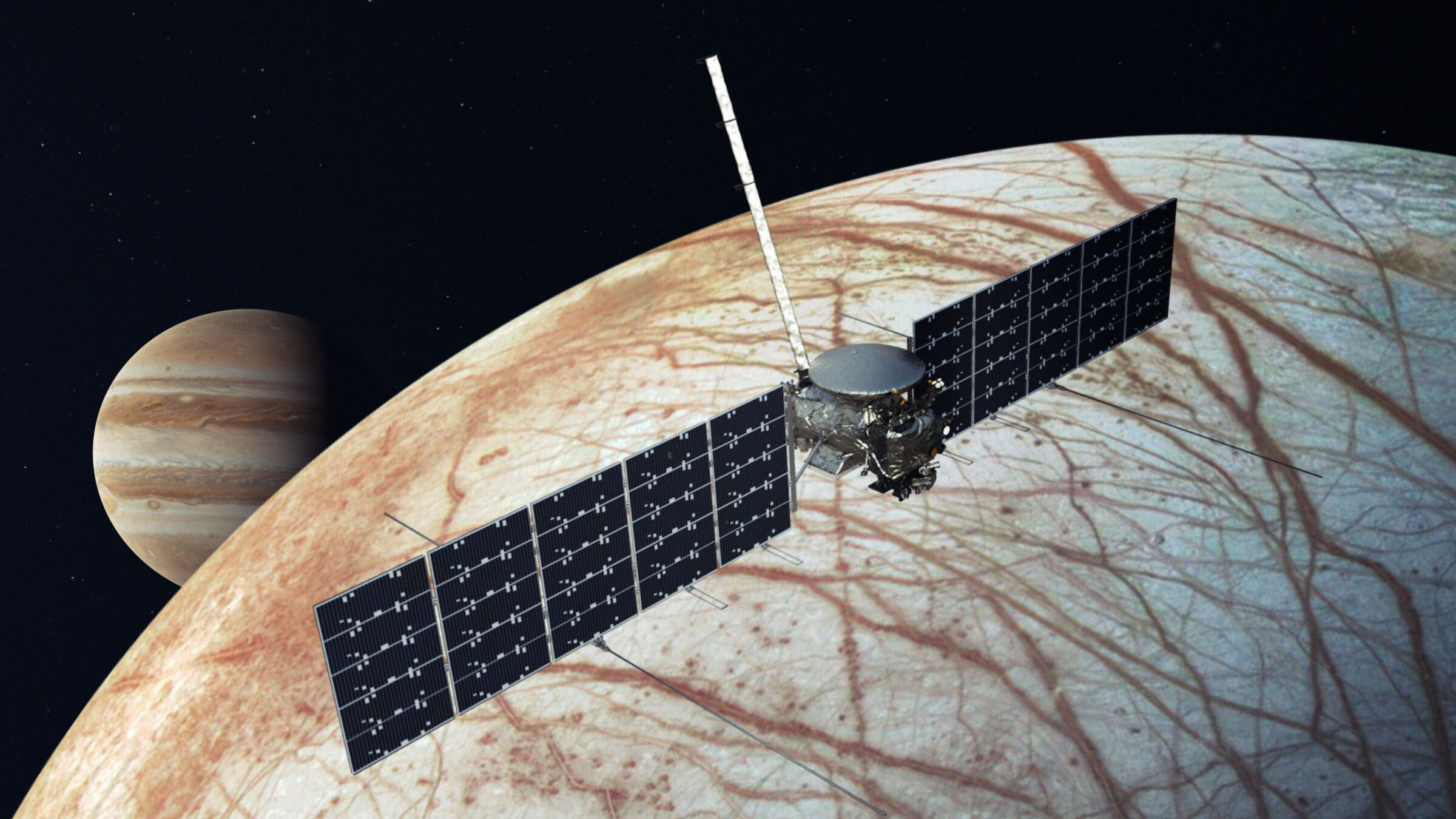
A series of experiments studying the sensitivity of life-hunting instruments to be employed in NASA’s forthcoming Europa Clipper Mission have revealed promising new capabilities that significantly raise its chances of being the first to detect lifeforms beyond Earth.
What will Europa Clipper do?
With a launch window that opens in October of this year and a planned insertion into Jupiter’s orbit sometime around April 2030, the Europa Clipper is equipped with a suite of science instruments. Based on recent experiments, one particular instrument, SUrface Dust Analyzer, was determined to be so sensitive that it could likely detect signs of alien life in individual grains of ice ejected by Jupiter’s icy moon.
“For the first time, we have shown that even a tiny fraction of cellular material could be identified by a mass spectrometer onboard a spacecraft,” said lead author Fabian Klenner, a University of Washington (UW) postdoctoral researcher in Earth and space sciences. “Our results give us more confidence that using upcoming instruments, we will be able to detect lifeforms similar to those on Earth, which we increasingly believe could be present on ocean-bearing moons.”
Oceans Beneath Surface of Icy Moons are Ideal Targets for Alien Lifeforms
While the search for life outside Earth has many targets, including the soil of Mars or the clouds of Venus, astrobiologists are increasingly optimistic about finding signs of past and present alien lifeforms within the subsurface oceans of the solar system’s icy moons. Along with Europa, these targets include Saturn’s moon Enceladus. Those hopes received even more fuel when researchers recently found evidence of phosphate on the surface of Enceladus.
The researchers explain, “This planetary body now appears to contain energy, water, phosphate, other salts, and carbon-based organic material, making it increasingly likely to support lifeforms similar to those found on Earth.”
This image shows red streaks across the surface of Europa, the smallest of Jupiter’s four large moons. The upcoming Europa Clipper mission will send instruments to investigate this moon.
Credit: NASA/JPL/Galileo
In the decade since NASA’s Cassini mission detected plumes of water and ice being ejected by Enceladus, mission planners and amateur enthusiasts alike have theorized about how such a life-hunting mission might actually take place. While some of the more exotic proposals include mini submarines or a snakelike probe that can crawl down into those subsurface oceans, the most popular involves flying a sample mission through those ejected plumes and scanning them for clues to alien lifeforms.
Now, an international team of researchers says instruments that might be included on upcoming missions should not only be able to detect signs of alien lifeforms, but they believe the conditions are ideal for such a finding as soon as the Europa Clipper.
Lab Study Shows Instruments Could Spot Signs of Life in a Single Grain of Ice
To see if instruments slated to join future missions would be able to detect signs of life in the plumes ejected from Enceladus and Europa, the UW research team selected a type of bacteria called Sphingopyxis alaskensis for study. That’s because this particular bacterium lives in cold environments on Earth and can survive on very little nutrients, making it a likelier analog of extraterrestrial bacteria that may thrive beneath the surface of these icy moons. The researchers also say this bacterium is just the right size for future probes to spot within a single grain of ice.
“They are extremely small, so they are, in theory, capable of fitting into ice grains that are emitted from an ocean world like Enceladus or Europa,” Klenner said.
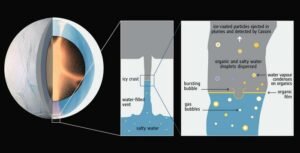
The drawing on the left depicts Enceladus and its ice-covered ocean, with cracks near the south pole that are believed to penetrate through the icy crust. The middle panel shows where authors believe life could thrive: at the top of the water, in a proposed thin layer (shown yellow) like on Earth’s oceans. The right panel shows that as gas bubbles rise and pop, bacterial cells could get lofted into space with droplets that then become the ice grains that were detected by Cassini. CREDIT: European Space Agency
After coming up with a lab experiment that would best simulate the conditions a future mission might experience these ejected ice grains, the team used a mass spectrometer to see if they could spot the life signs of their chosen bacterium in a single grain of ice. Significantly, they note that their instrument was less sensitive than the one planned for the Europa Clipper.
As hoped, their study was a success. An analysis of water injected into a vacuum showed that the right instruments could indeed detect alien lifeforms as they were ejected from Enceladus or Europa. In fact, the scientists behind the successful experiments say searching for life in this method “is more successful than averaging across a larger sample containing billions of individual grains.”
Instrument on NASA’s Europa Clipper Mission May Be First to Discover Alien Lifeforms
In their published study, the UW researchers supplemented their experiments by looking at the conditions on Earth that cause bacteria to collect on the ocean’s surface and cause a layer of “ocean scum.” They soon realized that a similar set of conditions likely exists on the surface of these extraterrestrial oceans. As a result, any subsurface water ejected into space would likely capture pieces of alien lifeforms and encapsulate them within grains of space ice, where NASA’s instruments could detect them.
“We here describe a plausible scenario for how bacterial cells can, in theory, be incorporated into icy material that is formed from liquid water on Enceladus or Europa and then gets emitted into space,” Klenner said.
The left panel shows the kilometers-thick icy crust believed to encapsulate Saturn’s moon Enceladus. Filling the crack is salty water with a proposed thin layer (shown orange) at its surface. The right panel shows that as gas bubbles rise and pop, they combine with organic material and get lofted into the spray. CREDIT: Postberg et al. (2018)/Nature.
Although they are not directly involved with the planning of NASA’s missions, the team notes that NASA’s Europa Clipper, thanks to its unique instrumentation, could be perfectly equipped to find alien lifeforms living beyond Earth.
“With suitable instrumentation, such as the SUrface Dust Analyzer on NASA’s Europa Clipper space probe, it might be easier than we thought to find life, or traces of it, on icy moons:” said senior author Frank Postberg, a professor of planetary sciences at the Freie Universität Berlin, “if life is present there, of course, and cares to be enclosed in ice grains originating from an environment such as a subsurface water reservoir.”
Christopher Plain is a Science Fiction and Fantasy novelist and Head Science Writer at The Debrief. Follow and connect with him on X, learn about his books at plainfiction.com, or email him directly at christopher@thedebrief.org.
NASA’s Global-scale Observations of the Limb and Disk (GOLD) mission has discovered a new phenomenon in the Earth’s upper atmosphere. The mission revealed unexpected X- and C-shaped structures in the ionosphere that have puzzled scientists.
The new findings suggest that our understanding of the ionosphere is far from complete and that more dynamics are at play in this region of Earth’s atmosphere than previously thought.
The ionosphere, a layer of the Earth’s atmosphere extending from about 50 to 400 miles above the surface, is a region where solar radiation ionizes atmospheric particles, creating a plasma of charged particles.
This layer plays a crucial role in long-distance radio communications, as it can reflect radio waves back to Earth. However, GOLD’s new observations have shown formations that challenge current scientific models.
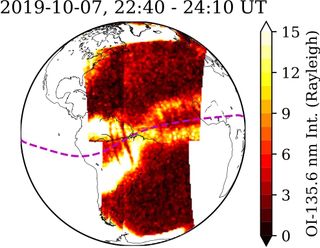
Observations from NASA’s GOLD mission shows charged particles in the ionosphere forming an X shape on Oct. 7, 2019. (The colors indicate the intensity of the ultraviolet light emitted, with yellow and white indicating the strongest emission, or highest ionospheric density.)
(Image credit: F. Laskar et al.)
“A unique phenomenon—A geomagnetically quiet time merging of Equatorial Ionization Anomaly (EIA) crests, leading to an X-pattern (EIA-X) around the magnetic equator—has been observed in the night-time ionospheric measurements by the Global-scale Observations of the Limb and Disk mission,” researchers wrote in the study published in the Journal of Geophysical Research: Space Physics.
Observations of these distinctive X-pattern structures had previously been noted only during geomagnetic disturbances, such as after solar storms or volcanic eruptions. However, these new sightings during geomagnetically calm conditions suggest that unknown processes from the lower atmosphere can affect the ionosphere, presenting a new scientific mystery.
Computer simulations showed that these bizarre X-shaped equatorial ionization anomalies are generated during pre-sunset hours and persist until after sunset at local times.
Models also propose that these X-shapes may develop when changes in the lower atmosphere draw plasma downward. However, this hypothesis requires further investigation.
Images from NASA's GOLD mission show C-shaped and reverse-C-shaped plasm
“The X is odd because it implies that there are far more localized driving factors,” Dr. Jeffrey Klenzing, a scientist at NASA’s Goddard Space Flight Center who studies the ionosphere, said in a statement. “This is expected during the extreme events, but seeing it during ‘quiet time’ suggests that the lower atmosphere activity is significantly driving the ionospheric structure.”
Additionally, GOLD identified C-shaped and reverse-C-shaped plasma bubbles near each other. C-shaped plasma bubbles are typically long and straight and form along magnetic field lines. However, on several occasions, GOLD found these structures a mere 400 miles apart, implying that strong turbulence or vortex-like activity in the lower atmosphere influences the ionosphere.
This discovery of closely linked C-shaped bubbles offers further evidence that more complex dynamics are at work in the Earth’s atmosphere than is currently understood.
Dr. Deepak Karan, a research scientist at the University of Colorado’s Laboratory for Atmospheric and Space Physics (LASP) and author of a 2023 study on these mysterious C-shaped bubbles, highlighted the significance of these recent discoveries.
“Within that close proximity, these two opposite-shaped plasma bubbles had never been thought of, never been imaged,” Dr. Karan said. “To have wind patterns change course in such a small area suggests some sort of strong turbulence — like a vortex, wind shear, or tornado-like activity — is likely at play in the atmosphere.”
“The fact that we have very different shapes of bubbles this close together tells us that the dynamics of the atmosphere is more complex than we expected,“ Dr. Klenzing added.
GOLD’s findings are notable for their clarity and consistency, thanks to the satellite’s geostationary orbit, which allows it to continuously monitor the same region of the Earth. This extended observation capability has enabled scientists to detect the persistent nature of these X- and C-shaped structures.
Since its launch in 2018, GOLD has only recorded two instances of C-shaped atmospheric structures being closely paired. Researchers say the bizarre X-shape anomaly has been detected “very clearly on one occasion and to some extent on other six occasions, during geomagnetically quiet periods.“ This suggests that this mysterious phenomenon, which researchers likened to atmospheric “alphabet soup,” is extremely rare.
Nevertheless, these findings are significant as they could impact our understanding of how the ionosphere interacts with communication and navigation signals, which can be disrupted by such plasma structures.
The presence of strong turbulence or localized disturbances in the ionosphere can lead to signal loss or degradation. Our reliance on technologies that depend on stable ionospheric conditions, such as GPS and satellite communications, makes understanding these influences increasingly critical.
The shape of Earth’s magnetic field (represented by orange lines in this data visualization) near the equator drive charged particles (blue) away from the equator, creating two dense bands just north and south of the equator known as the equatorial ionization anomaly. Credit: NASA’s Scientific Visualization Studio Download this visualization from NASA’s Scientific Visualization Studio.
Likewise, the mission’s findings underscore the complexity of the Earth’s atmosphere and the need for continued research to understand the various factors that influence its behavior.
NASA says ongoing observations by GOLD, alongside data from other heliophysics missions, are expected to provide more insights into these phenomena. Scientists hope to use this information to shed more light on these enigmatic structures and their implications for our technological world.
Researchers concluded their recent study by noting, “A comprehensive understanding of the dynamics during the pre- to post-sunset period will not only advance our knowledge of the ionosphere’s response to external (lower atmospheric or geomagnetic) drivers but also plays a crucial role in the development of space weather forecasting capability.”
NASA scientists have discovered some unusual shapes high up in the Earth’s ionosphere, which is a layer stretching from 50 to 400 miles above the planet.
Normally, the ionosphere can get electrically charged, especially when influenced by space weather.
In addition to the X shapes, scientists have also found C-shaped bubbles in the ionosphere. These shapes can appear close to each other, indicating that the dynamics of the atmosphere are more complex than previously thought.
Tim McMillan is a retired law enforcement executive, investigative reporter and co-founder of The Debrief. His writing typically focuses on defense, national security, the Intelligence Community and topics related to psychology. You can follow Tim on Twitter:@LtTimMcMillan. Tim can be reached by email: tim@thedebrief.org or through encrypted email:LtTimMcMillan@protonmail.com
Paranormal lore is replete with reports from witnesses who claim to have been visited by mysterious figures claiming to be with the government or the military and delivering threatening messages. Generically known as the Men In Black (or less commonly, Women in Black), they typically seek out witnesses to UFO sightings or other incidents that the government would prefer to keep hidden from the public. They seek to confiscate evidence and intimidate witnesses to prevent them from speaking about what they saw, warning that bad things might happen if they do and that loose lips can sometimes lead to far worse things than sinking ships. But is this something that really happens or could it all be misunderstandings on the part of the witnesses, or perhaps even hallucinations?
Rock-solid evidence is difficult to come by, but it does exist if you dig deeply enough. One example of a visit by the Men in Black can be found in the United States Government's own archival files. The encounter in question that started the entire affair took place on July 7, 1947, but it's not the one you are probably thinking of based on that famous (in ufology) date. In the suburbs of Phoenix, Arizona, there lived a young man named William A. Rhodes, a professional musician, amateur photographer, and electronics hobbyist. Late in the afternoon of the day in question, Rhodes was headed out to the workshop he had constructed in his backyard when he heard a strange sound coming from the skies. Looking to the northeast, he observed what he described as a flat, elliptical, gray object 20 to 30 feet across descending from a great height in a spiraling flight path. Amazed, he rushed into his shed and retrieved his Kodak Brownie 120 box camera. He returned outside and took two photographs of the object, one as it reached its lowest, closest point of approach and a second as it zoomed upward and away at a 45-degree angle.
Rhodes quickly contacted the Arizona Republic newspaper, sending them his photographs and giving them an interview. These remain some of the best photos of a UFO from the period, at least in my opinion. (You can view the photos here.) The report briefly generated some excitement locally in the press and among the public. The reason many of us may never have heard of Rhodes' encounter, however, was that it took place only two weeks after Kenneth Arnold's famous "flying saucer" sighting and on the same day that the infamous Roswell, New Mexico incident hit the national news and absorbed the media's attention. What William Rhodes didn't know at the time was that United States military and government officials were paying very close attention to his story. He would find out about that soon enough.
The Rhodes sighting and photographic evidence would go on to be recorded in the Project Grudge Archives under the humble name of "Incident 40." (You can read the full government record at the link.) The government's investigation into Mr. Rhodes would stretch on for more than five years and lead to multiple lawsuits. But the portion of interest for this discussion unfolded quickly. Air Materiel Command at Wright Patterson Air Force Base had been contacting the newspapers that had spoken to the witness and collecting all of the publicly available information about the sighting. Barely a month after the sighting, Wright Patterson assigned Special Agent George Fugate Jr. from the Counter Intelligence Corps (CIC) to arrange an interview with Rhodes at this home. CIC wanted some backup from the FBI to assist with the interview and a man identified as Special Agent Brower (no first name given) was detailed to travel with Fugate and help him. The interview was scheduled for August 29, 1947.
This is where the story takes an interesting twist. On their way to Rhodes' home, Fugate instructed Special Agent Brower to not reveal his name or produce his badge or any ID for the witness. He was only introduced as "a representative of the United States Government.” Brower complied, though when he was later debriefed he recounted that he found the request to conceal his identity to be “a peculiar procedure." But he also concluded that it was "none of his business," so he accomplished the mission and returned to his regular assignment. The agents informed Rhodes that he would need to turn over any copies of the photos he had in his possession as well as the negatives. Rhodes turned over the photographs but informed the agents that the negatives were not in his home. He would retrieve them and they could return the next day to collect them, which they did. That would be the last time that William Rhodes would ever see the photos or the negatives.
Rhodes pursued various legal methods to have his property returned to no avail. The government insisted that they could not find the evidence, at one point suggesting that they were unsure if the witness had ever turned them over in the first place. The government was obviously lying because the linked archival records contained multiple material transfer receipts showing the negatives being delivered to various offices, with the results of various technical tests done upon them being recorded. They also recorded investigations into William Rhodes' "character," including checks of his credit rating and background investigations revealing that his mother was a Russian immigrant, calling his loyalty to the nation into question. They seemed to be preparing a case against the witness more than anything else. But there was no question that they were very much interested in the sighting. One expert who was very impressed with the evidence was J. Allen Hynek, who wrote in his report that "Incident 40" was “one of the most crucial in the history of these objects.” That was because the photographs Rhodes provided so closely matched the actual description of the objects seen by Kenneth Arnold, which were later incorrectly described as "flying saucers."
Returning to our original subject of inquiry, that's most of what we know about Incident 40, William Rhodes, and his mysterious visitors in August of 1947. This leaves us with an obvious, glaring question. Was the enlistment of Agent Brower to help extract what the government wanted from the witness a one-off, random strategy that Special Agent Fugate cooked up on the spur of the moment, or was this a technique that they were already employing and Brower was unwittingly called in to play that role when they were short-handed? Keep in mind that all of this was unfolding very early in what is now considered the "modern era" of ufology. No matter which answer is the truth, it probably doesn't matter. If this was the only time the government ever did this, that would make the incident a unicorn, and those are deemed impossibly rare for a reason. Few things only happen once in our universe, with the possible exception of the Big Bang, and even that has been called into question recently.
The technique worked, and if it worked once, why wouldn't you try it again? Having spent time working in both military and government operations myself, I can assure you that this would be a very typical military mindset. You don't abandon your game plan when you're in the process of running up your score. The archived files of Project Blue Book are filled with stories of the American government diving deeply into reports of UFOs and associated phenomena while working strenuously to assure the media and the public at large that there was "nothing to see here" and it was all swamp gas, balloons, or ball lighting (which doesn't even exist according to my own research). The major stumbling blocks in their efforts were the eyewitnesses, particularly those who may have captured compelling photographic or video evidence. Finding a way to shut them up and prevent the spread of potential "public hysteria" would have been high on their priority list.
It's not as if the American government (and most other governments, for that matter) don't have long-established track records of keeping secrets when they felt it was in their best interest. In the United States, consider what happened during the Tuskegee syphilis experiments. That went on for decades and hundreds of unwitting Black Americans died as a result, believing that they were "helping the government" find a cure. Plenty of people knew it was going on but they remained silent and hid it from the public and the press. The United States Army conducted tests of hallucinogenic drugs on its own soldiers starting in the 1950s for years without informing them. Again, this was all known and records exist confirming it to this day, but nobody was told. Should we honestly believe that these same power brokers wouldn't engage in some "Men in Black" tactics to conceal what they really knew about potential extraterrestrial life if they believed it would benefit their long-term goals?
It's not as if we don't have plenty of other highly credible accounts of people who have described run-ins with these shadowy military or government entities under similar circumstances, even if their own accounts didn't wind up in the national archives. These reports come to us from the earliest days of the modern UFO era to the present. Back in the 1950s, Albert Bender reported encounters with extraterrestrials and being subsequently visited by Men in Black who may or may not have even been human. He went on to write a book about it and became the subject of numerous documentaries. He said that he was visited by three men dressed in black suits who warned him to stop his UFO research. His claims were quickly dismissed by skeptics because he later described them as "floating about a foot off the floor," suggesting that they may have been aliens themselves, but who is to say that this point?
In 1947, around the same time that William Rhodes was having his own experiences, Harold Dahl reported seeing mysterious flying objects near Maury Island, Washington. He later claimed he was visited by a man in a black suit who threatened him and his family if he spoke about the incident. In 1968, UFO researchers Jack and Mary Robinson reported Men in Black searching their apartment while they were out after being warned to avoid the topic. A friend of theirs even captured a picture of a stereotypical MIB sitting in a car outside their home.
Much more recently, in 2008, residents of Stephenville, Texas, called in to local media and the police reporting strange lights in the sky. Some of those same witnesses later told reporters that they had been "visited by men in black suits who instructed them not to discuss what they had seen." In another event in 2014, a man going by the pseudonym "Jack Smith" reported that the MIB had accosted him in New Orleans, threatening his life unless he stopped investigating the topic. So what is the logical explanation for all of this? If you wish to argue that some of these people were simply confused or they were making up stories to attract attention or sell books, that's fine. That's part of human nature and it happens. But all of them after so many years? We've already documented here that the American government has done this at least once. The idea that they wouldn't have kept doing it is even less plausible than the proposal that every UAP ever reported was nothing more than an errant weather balloon or the planet Venus. My wife and I have seen five UFOs and I can assure you that they were neither of those things. At this point, I'm literally waiting to hear a knock on our door.
"Vreemde" talen bestaan niet meer dankzij deze slimme Japanse innovatie.
Het spreken van een vreemde taal is een gewilde vaardigheid vanwege de binnenlandse culturele diversiteit en het aantal bedrijven dat zaken doet in het buitenland. Vreemde talenkennis kan je aan een baan helpen door je kwalificaties te verbeteren.
Het maakt niet uit of je maatschappelijk werker bent, geneeskunde beoefent, internationaal zaken doet, talen onderwijst/leert of gewoon naar het buitenland reist - de mogelijkheid om klanten in hun eigen taal aan te spreken en met hen te communiceren is een enorm voordeel.
Niet meertalig?
Gelukkig hebben twee beroemde Japanse uitvinders het vertalen van talen naar een hoger niveau getild en een instant vertaler gemaakt die luistert naar de naam Poliglu. Deze kan gemakkelijk spraak in realtime vertalen in meer dan 36 talen met slechts een paar vingertikken.
Je hoeft dus geen andere taal te kennen of te leren om erin te kunnen communiceren. Moeilijkheden, veroorzaakt door taalbarrières, behoren binnenkort tot het verleden! Wat kan er beter zijn dan dit?
Ontdek het in de praktijk!
Waarom dit kleine gadget zo bijzonder is?
Directe communicatie in een andere taal
Een nieuwe taal leren vergt maanden en zelfs jaren van toegewijde studie. Poliglu kan je onmiddellijk in een communicatieve meester veranderen!
Eerlijke en redelijke prijs
Poliglu is goedkoop. Een ervaren professionele vertaler of tolk kan duur zijn, en je moet meerdere keren betalen. Poliglu vereist slechts een eenmalige betaling voor een uitgebreide selectie talen.
Rembours: 100% risicovrij
Koop geen kat in een zak! Poliglu heeft een uiterst handige optie voor levering onder rembours. Je hoeft helemaal niets te betalen als je online bestelt, wat het kopen van Poliglu extreem veilig maakt (je hoeft geen gevoelige informatie in te voeren). Je kan het artikel bij aflevering inspecteren en contant betalen - kan het nog handiger dan dit?
Comfortabel en gebruiksvriendelijk
Met zijn lichtgewicht ontwerp en kleine formaat is Poliglu gemakkelijk mee te nemen in elke zak of tas en is het daar wanneer het nodig is. Vandaar de naam "draagbare spraakvertaler" die je elke dag zal willen gebruiken!
Perfecte geluidskwaliteit
Het is comfortabel te gebruiken op drukke plaatsen, omdat het geluid luid genoeg is om duidelijk gehoord te worden.
Ondersteunt meer dan 36 talen
De ingebouwde geavanceerde technologie kan een vertaling in beide richtingen ondersteunen. Bovendien is er ook een tekstvertaling beschikbaar.
Waarom maakt dit het leven zoveel gemakkelijker?
Hoewel Poliglu voornamelijk werd gemaakt voor reizigers, begon het massaal aan populariteit te winnen onder mensen met verschillende beroepen. Plots werd het een onmisbaar apparaat!
Wat ons verbaasde, is dat steeds meer sociale/hulpverleners en vrijwilligers kiezen voor Poliglu om hun werk te vergemakkelijken.
We vroegen mensen die de Poliglu vertaler hebben gebruikt om uitleg over hoe het voor hen werkt. Uit de resultaten bleek dat mensen de kwaliteit van hun werk drastisch hebben verbeterd nadat ze de Poliglu vertaler hadden aangeschaft.
Zou jij er ook één moeten aanschaffen?
Taalbarrière mag niet langer je bezorgdheid zijn, dus het antwoord is zeker JA! En dit is het beste moment om het te doen, want Poliglu vertalers kunnen binnenkort uit voorraad raken door hun wereldwijde populariteit.
Wil je in staat zijn gedurende een week of twee in een nieuw land uit de voeten te kunnen? Moet je met nieuwe vrienden of familieleden kunnen communiceren in hun moedertaal? Of moet je een taal voldoende beheersen om voltijds in een vreemd land te kunnen werken?
Welnu, Poliglu kan al die dingen leveren en nog veel meer!
Voor alle duidelijkheid: doe het zolang ze nog een superhandige en risicoloze optie voor rembours aanbieden. Ik voelde me VEEL veiliger bij het betalen voor dit handige hebbedingetje bij ontvangst en omdat ik NIET mijn gevoelige creditcardgegevens in een andere webwinkel hoefde in te voeren. Meer verkopers zouden zo'n handige optie moeten bieden. Gewoon een handige tip voor jou.
The Wow! Signal Deciphered. It Was Hydrogen All Along.
In 1977, astronomers received a powerful, peculiar radio signal from the direction of the constellation Sagittarius. Its frequency was the same as neutral hydrogen, and astronomers had speculated that any ETIs attempting to communicate would naturally use this frequency. Now the signal, named the Wow! Signal has become lore in the SETI world.
But what was it?
Beginning in the 1970s, the Ohio State University Big Ear radio telescope was used in the university’s Search for Extraterrestrial Intelligence (SETI) program, which ran from 1973 to 1995. This program is the longest-running SETI program in history.
In 1977, Big Ear detected a peculiar signal that’s taken on a life of its own: the Wow! Signal. The Wow! Signal was a strong narrowband radio signal right near the frequency of neutral hydrogen. The Big Ear telescope is long gone now, but the effort to understand what the signal is lives on.
The signal lasted the full 72-second window in which Big Ear was able to observe it. A few days later, astronomer Jerry R. Ehman was looking over the data when he saw the signal on a computer printout. Astronomers had never seen anything like it, and he wrote “Wow!” beside it, and the name has stuck ever since.
The Wow! signal from 1977 as discovered by astronomer Jerry R. Ehman. Image via Big Ear Radio Observatory and North American AstroPhysical Observatory (NAAPO).
The signal has another name: 6EQUJ5. This has been interpreted as a message hidden in the signal, but it really represents how the signal’s intensity varied over time.
This image is a plot of the Wow! signal’s intensity versus time. Image Credit: By Maxrossomachin – Own work, CC BY-SA 3.0, https://commons.wikimedia.org/w/index.php?curid=16197844
The signal generated a lot of excitement. Some thought it was extraterrestrial in origin, some thought it could come from some type of human-generated interference, and some thought it could be from an unexplained natural phenomenon.
New research shows that the Wow! Signal has an entirely natural explanation.
Arecibo Wow! is a new effort based on an archival study of data from the now-defunct Arecibo Radio Telescope from 2017 to 2020. The observations from Arecibo are similar to those from Big Ear but “are more sensitive, have better temporal resolution, and include polarization measurements,” according to the authors.
“Our latest observations, made between February and May 2020, have revealed similar narrowband signals near the hydrogen line, though less intense than the original Wow! Signal,” said Méndez.
Arecibo detected signals similar to the Wow! signal but with some differences. They’re far less intense and come from multiple locations. The authors say these signals are easily explained by an astrophysical phenomenon and that the original Wow! signal is, too.
“We hypothesize that the Wow! Signal was caused by sudden brightening from stimulated emission of the hydrogen line due to a strong transient radiation source, such as a magnetar flare or a soft gamma repeater (SGR),” the researchers write. Those events are rare and rely on precise conditions and alignments. They can cause clouds of hydrogen to brighten considerably for seconds or even minutes.
This simple schematic shows how the Wow! Signal was generated and detected. A radiative source such as a magnetar or a soft gamma repeater is positioned behind a cloud of cold neutral hydrogen. Energy from the source stimulates emission from the HI cloud, which brightens abruptly and is observable from Earth. Image Credit: Méndez et al. 2024.
The researchers say that what Big Ear saw in 1977 was the transient brightening of one of several H1 (neutral hydrogen) clouds in the telescope’s line of sight. The 1977 signal was similar to what Arecibo saw in many respects. “The only difference between the signals observed in Arecibo and the Wow! Signal is their brightness. It is precisely the similarity between these spectra that suggests a mechanism for the origin of the mysterious signal,” the authors write.
These signals are rare because the spatial alignment between source, cloud, and observer is rare. The rarity of alignment explains why detections are so rare.
The researchers were able to identify the clouds responsible for the signal but not the source. Their results suggest that the source is much more distant than the clouds that produce the hydrogen signal. “Given the detectability of the clouds as demonstrated in our data, this insight could enable precise location of the signal’s origin and permit continuous monitoring for subsequent events,” the researchers explain.
The Wow! Signal was originally interpreted as a technosignature by many. By explaining where the signal came from, this research outlines a new source of false positives.
“Our hypothesis explains all observed properties of the Wow! Signal, proposes a new source of false positives in technosignature searches, and suggests that the Wow! Signal could be the first recorded event of an astronomical maser flare in the hydrogen line,” the authors explain in their conclusion.
The asteroid Dimorphos was captured by NASA’s DART mission just two seconds before the spacecraft struck its surface on Sept. 26, 2022. Observations of the asteroid before and after impact suggest it is a loosely packed “rubble pile” object. Credit: NASA/JHUAPL
Debris from DART could Hit Earth and Mars Within a Decade
On Sept. 26th, 2022, NASA’s Double Asteroids Redirect Test (DART) collided with Dimorphos, the small moonlet orbiting the larger asteroid Didymos. In so doing, the mission successfully demonstrated a proposed strategy for deflecting potentially hazardous asteroids (PHAs) – the kinetic impact method. By October 2026, the ESA’s Hera mission will rendezvous with the double-asteroid system and perform a detailed post-impact survey of Dimorphos to ensure that this method of planetary defense can be repeated in the future.
However, while the kinetic method could successfully deflect asteroids so they don’t threaten Earth, it could also create debris that might reach Earth and other celestial bodies. In a recent study, an international team of scientists explored how this impact test also presents an opportunity to observe how this debris could someday reach Earth and Mars as meteors. After conducting a series of dynamic simulations, they concluded that the asteroid ejecta could reach Mars and the Earth-Moon system within a decade.
For their study, Peña-Asensio and his colleagues relied on data obtained by the Light Italian CubeSat for Imaging of Asteroids (LICIACube), which accompanied the DART mission and witnessed the kinetic impact test. This data allowed the team to constrain the initial conditions of the ejecta, including its trajectories and velocities – ranging from a few tens of meters per second to about 500 m/s (1800 km/h; ~1120 mph). The team then used the supercomputers at NASA’s Navigation and Ancillary Information Facility (NAIF) to simulate what will become of the ejecta.
These simulations tracked the 3 million particles created by the DART mission’s impact with Dimorphos. As Peña-Asensio told Universe Today via email:
“LICIACube provided crucial data on the shape and direction of the ejecta cone immediately following the collision. In our simulation, the particles ranged in size from 10 centimeters to 30 micrometers, with the lower range representing the smallest sizes capable of producing observable meteors on Earth with current technology. The upper range was limited by the fact that only ejected centimeter-sized fragments were observed.”
Their results indicated that some of these particles would reach Earth and Mars within a decade or more, depending on how fast they traveled after the impact. For example, particles ejected at velocities below 500 m/s could reach Mars in about 13 years, whereas those ejected at velocities exceeding 1.5 km/s (5,400 km/h; 3,355 mph) could reach Earth in as little as seven years. However, their simulations indicated that it will likely be up to 30 years before any of this ejecta is observed on Earth.
This illustration shows the ESA’s Hera spacecraft and its two CubeSats at the binary asteroid Didymos. Credit: ESA
“However, these faster particles are expected to be too small to produce visible meteors, based on early observations,” said Peña-Asensio. “Nevertheless, ongoing meteor observation campaigns will be critical in determining whether DART has created a new (and human-created) meteor shower: the Dimorphids. Meteor observing campaigns in the coming decades will have the last word. If these ejected Dimorphos fragments reach Earth, they will not pose any risk. Their small size and high speed will cause them to disintegrate in the atmosphere, creating a beautiful luminous streak in the sky.”
Peña-Asensio and his colleagues also note that future Mars observation missions will have the opportunity to witness Martian meteors as fragments of Didymos burn up in its atmosphere. In the meantime, their study has provided the potential characteristics these and any future meteors burning up in our atmosphere will have. This includes direction, velocity, and the time of the year they will arrive, allowing any “Dimorphids” to be clearly identified. This is part of what makes the DART mission and its companion missions unique.
In addition to validating a key strategy for planetary defense, DART has also provided an opportunity to model how ejecta caused by impacts could someday reach Earth and other bodies in the Solar System. As Michael Küppers, the Project Scientist of the ESA’s Hera mission and co-author of the paper, told Universe Today via email:
“A unique aspect of the DART mission is that it is a controlled impact experiment, i.e., an impact where the impactor properties (size, shape, mass, velocity) are accurately known. Thanks to the Hera mission, we will also know the target properties well, including those of the DART impact site. Data about the ejecta came from LICIACube and earth-based observations after the impact. There is probably no other impact on a planetary scale with that much information about the impactor, the target, and the ejecta formation and early development. This allows us to test and improve our models and scaling laws of the impact process and ejecta evolution. Those data provide the input data (source location, size, and velocity distribution) used by the ejecta evolution models.”
An SwRI-led team used NASA’s Webb telescope, shown in the bottom right corner of this illustration, to confirm the presence of hydrated minerals on the surface of Psyche, a massive and heavily metallic body in the main asteroid belt. These findings suggest a complex history for this interesting asteroid, which many scientists think could be the remnant core of a protoplanet, including impacts with hydrated asteroids.
There Might Be Water on the Surface of the Metal Asteroid Psyche
While a NASA probe heads for an asteroid known as Psyche, telescopes have been probing it to prepare for the arrival. Data from the James Webb Space Telescope has found something quite unexpected on the surface – hydrated molecules and maybe even water! The origin of the water is cause for much speculation, maybe it came from under the surface or from chemical interactions with the solar wind!
Asteroid Psyche was discovered in 1852 by the Italian astronomer Annibale de Gasparis. It was named after the Greek goddess of the soul who was born mortal and married Eros. It measures 225 km across and is one of the most massive objects in the asteroid belt between Mars and Jupiter. Most of the asteroids in the belt are composed of rock and ice but Psyche seems to be different being largely composed of metals, perhaps the exposed core of a protoplanet that lost its outer layers. Psyche is of immense interest to study because it provides an opportunity to study planetary cores which are usually inaccessible.
Illustration of the metallic asteroid Psyche. Credit: Peter Rubin/NASA/JPL-Caltech/ASU
Aptly named Psyche, the probe launched by NASA has already started its 3.5 billion km journey to the asteroid, due to arrive in August 2029. With its solar panels deployed, the probe measures 25 metres by 7.3 metres, about the size of a tennis court. It has a mass of 2,747 kg and is powered by five solar panel arrays. Once arrived at Psyche they can generate about 3 kilowatts of power.
While the probe is enroute, telescopes on Earth and in space have been exploring Psyche. Observations in different wavelengths of light have provided information that will aid and support the data collected by the Psyche spacecraft. The study was led by Dr. Stephanie Jarmak from the Southwest Research Institute and it was their observations that confirmed the hydroxyl molecules on the surface.
Image of NASA engineers preparing the Psyche spacecraft for launch within a clean room at the Astrotech Space Operations Facility located near the NASA Kennedy Space Center. Psyche is scheduled to launch in October 2023 on a SpaceX Falcon Heavy rocket from historic Launch Complex 39A at Kennedy. (Credit: NASA/Ben Smegelsky)
The data, which was collected using the James Webb Space Telescope revealed the telltale signs of hydroxyl but stopped short of explaining where they came from. There are two possible explanations and we can look to the origin of asteroids to understand them. They are the leftovers from the formation of planets and their make up is determined by the location in the solar nebula from which they formed. If the hydroxyl formed locally without interference from external process then it might suggest that Psyche is not a planetary core remnant. It might be that Psyche simply formed at a distance that volatile compounds like water condense to form solids like ice before migrating.
An alternative model explains the variability of the molecule distribution across the surface. This might indicate that impacts from carbonaceous chondrites (like the meteorites often found on Earth) could have provided the water molecules that have been observed.
It seems that for now, we will have to wait until the arrival of the Psyche spacecraft in 2029 to unravel the mystery. If we can get a better understanding of the origin of the asteroid Psyche it will help us to learn more about the distribution of elements in the nebula that the planets formed from. In particular, understanding more about the distribution of water will help us to develop a better insight to the origins of life.
NASA’s Parker Solar Probe, launched in 2018, dives into the Sun’s corona within ten times the radius of the Sun, placing it eight times closer to it than the orbit of Mercury. The spacecraft collects unprecedented data on the origin and evolution of the solar wind.
Suppose a spacecraft visiting from another civilization aimed to recharge its batteries. It could have approached the Sun similarly and used photovoltaic cells to maximize the energy harvest, since the solar power per unit area drops inversely with distance squared.
One way to diagnose the composition of interstellar space trash, like the anomalous interstellar object `Oumuamua, is by using the hot Sun to vaporize them. Suppose their trajectories are not maneuvered by artificial propulsion like the Parker Solar Probe. In that case, the rate of interstellar “Sun-divers” can be calculated from the statistics of interstellar objects near Earth.
The rate of Sun-divers is significant – not just because the Sun is 110 times bigger than Earth but also because of gravitational focusing. The gravitational potential at the surface of the Sun is deeper by a factor of 210 compared to its value at the Earth-Sun separation. A similar factor characterizes the ratio between the square of the escape speed from the surface of the Sun and the square of the characteristic speed of interstellar objects.
Taking account of gravitational focusing, I calculated in a paper with my former postdoc John Forbes that `Oumuamua-like objects would collide with the Sun once every 30 years. `Oumuamua had a diameter of about 160 meters, comparable to the pre-launch height of Starship, the largest rocket ever built by humans. The appearance rates of meteors, namely space objects impacting the Earth, imply that there are many more small ones than there are large ones. As a rule of thumb, the inferred abundance of solar system rocks scales as the inverse of their mass. If the same applies to interstellar objects, as argued in a paper I wrote with my former student Amir Siraj, then meter-scale interstellar Sun-divers are a few million times more abundant than `Oumuamua was.
Based on NASA’s CNEOS catalog of fireballs, the impact rate on Earth of meter-scale interstellar meteors, like IM1 or IM2, is once per decade. This suggests that a few million of them are within the Earth’s orbit around the Sun. In this case, their collision rate with the Sun would be once every 4 minutes!
Meter-size interstellar Sun-divers release the equivalent energy output of ten Hiroshima bombs upon impact on the Sun. But even before entering the Sun, they would get vaporized by the enormous radiation intensity of thousands of degrees Kelvin. By monitoring the spectrum of the evaporated gases with an Earth-based telescope, one could identify the spectral fingerprints of different elements and infer the composition of these interstellar Sun-divers.
The challenge of doing so is that only one in a thousand Sun-divers is interstellar in origin. However, one could separate interstellar objects from solar system rocks or comets by measuring their velocities and inferring whether they were unbound by the Sun’s gravity at large distances. A prime observatory for this purpose is the 4-meter Inouye Solar Telescope near the summit of Haleakala in Maui, Hawaii. Coincidentally, this is the same mountaintop where the Pan-STARRS observatory, which discovered `Oumuamua, is located. I was fortunate to visit this observatory in July 2017 when the solar telescope was constructed, just a few months before `The Pan-STARRS observatory spotted ‘Oumuamua. In principle, the Webb telescope might also be able to constrain the surface composition of interstellar objects from their infrared emission spectrum.
Alternative methods to study the composition of interstellar objects are much more expensive. The Pacific Ocean expedition I led in June 2023 targeted the chemical composition of the interstellar meteor IM1. This task cost 1.5 million dollars and required a full year of analysis, the findings of which were summarized in a detailed paper by our research team.
The discovery of an unusual chemical composition for BeLaU spherules at IM1’s site motivates our next expedition. Within a year, we hope to search for bigger pieces of IM1, which would allow us to study the material properties and nature of this anomalous interstellar meteor, which was moving faster than 95% of all stars in the vicinity of the Sun and had material strength tougher than that of iron meteorites.
Based on recent data about the fragmentation of iron meteorites of the same size, IM1’s fireball should have left behind an order of 10,000 fragments of mass ~0.5 grams (or a diameter of ~0.5 centimeter), about 1,000 fragments of mass ~15 grams (or a diameter of ~1.5 centimeters), about 100 fragments of mass ~0.5 kilogram (or a diameter of ~5 centimeters), about ten fragments of mass ~4 kilograms (or a diameter of ~9 centimeters), and one fragment of mass ~20 kilograms (or a diameter of ~16 centimeters). We hope to find some of these in our next expedition, which will cost 6.5 million dollars.
Another approach for studying the material composition of interstellar objects is to rendezvous with them along their trajectory as they approach Earth. Our detailed calculations indicate that a maneuvering speed of tens of kilometers per second would be required, well above the few kilometers per second capability offered by the European-Japanese Comet Interceptor, planned for lunch in 2029.
Finally, there is a possibility of observing maneuvering interstellar probes in the form of Unidentified Anomalous Phenomena (UAPs) near Earth. The Director of National Intelligence delivered three reports about UAPs, but it is unclear from publicly available data whether the reported UAPs cannot be all human-made. The main challenge in attending to data-poor reports is avoiding confusion with existing military programs to retrieve and reverse engineer technologies found in crash sites of flying objects manufactured by adversarial nations, which could involve bodies of human pilots. Government agencies might label classified data retrieved by these programs as UAPs to confuse adversaries or discredit the leakage of classified information.
Fortunately, science is better than politics. The Galileo Project observatories take a scientific approach to resolving any confusion. They are collecting data on UAPs in the sky and will soon release the findings in a series of papers. Also fortunate for science is that neither the sky nor our oceans are classified.
Avi Loeb is the head of the Galileo Project, founding director of Harvard University’s – Black Hole Initiative, director of the Institute for Theory and Computation at the Harvard-Smithsonian Center for Astrophysics, and the former chair of the astronomy department at Harvard University (2011-2020). He is a former member of the President’s Council of Advisors on Science and Technology and a former chair of the Board on Physics and Astronomy of the National Academies. He is the bestselling author of “Extraterrestrial:The First Sign of Intelligent Life Beyond Earth” and a co-author of the textbook “Life in the Cosmos”, both published in 2021. His new book, titled “Interstellar”, was published in August 2023.
New report claims human civilization could end in 2050
The end of humanity in 2050? Will human civilization die out by 2050? That is at least the claim of a recent report by the Breakthrough National Centre for Climate Restoration, a think tank based in Melbourne
The threat of climate change This research group describes climate change as “a short- and medium-term existential threat to human civilization” and emphasizes the need for a changed approach to avert catastrophe.
A point of no return The status quo would push the climate and humanity "to a point of no return by mid-century, and the prospect of a largely uninhabitable Earth will lead to the collapse of nations and the international order," according to the report, cited by Vice.
Continuous heating The experts assume that the current path leads to global warming of 3 degrees, which "could trigger feedbacks that amplify the triggering of further warming".
The collapse of ecosystems The first consequence would be the collapse of essential ecosystems on Earth, such as “the coral reef system, the Amazon rainforest and the Arctic.”
Unimaginable consequences The consequences of this shift would be so severe that they cannot be measured because they "go beyond human experience of the last thousand years," the report continues.
Unbearable living conditions For humans, this would lead to unbearable living conditions, with one billion people forced to leave their homes and two billion people facing water shortages.
The collapse of agriculture In addition, “agriculture in the subtropics would collapse and food production worldwide would be drastically reduced,” notes Vice magazine.
Underestimated risks Finally, the report's authors note that the risks of climate change are underestimated by policymakers, as the most pessimistic scenarios tend to be downplayed.
The unvarnished truth For Chris Barrie, a former Australian admiral who wrote the foreword to the report, the analysis "reveals the truth about the desperate situation of humanity and our planet and paints a disturbing picture of the concrete possibility that human life on Earth could be wiped out in the most horrific way."
The need for urgent mobilization The only hope that remains, according to experts, is an immediate limitation of human activities that cause global warming and an urgent mobilization to deal with the consequences of climate change.
Meer van UFO'S of UAP'S, ASTRONOMIE, RUIMTEVAART, ARCHEOLOGIE, OUDHEIDKUNDE, SF-SNUFJES EN ANDERE ESOTERISCHE WETENSCHAPPEN - DE ALLERLAATSTE NIEUWTJES


 Footage Of UFO Landing At Holloman AFB With Aliens Walking Out Exists, Producer Told James Fox


 High Speed Test Track at Holloman Air Force Base