Naar de inhoud

UFO'S of UAP'S, ASTRONOMIE, RUIMTEVAART, ARCHEOLOGIE, OUDHEIDKUNDE, SF-SNUFJES EN ANDERE ESOTERISCHE WETENSCHAPPEN - DE ALLERLAATSTE NIEUWTJES

UFO's of UAP'S in België en de rest van de wereld
akke.beakke.be
Ontdek de Fascinerende Wereld van UFO's en UAP's: Jouw Bron voor Onthullende Informatie! Ben jij ook gefascineerd door het onbekende? Wil je meer weten over UFO's en UAP's, niet alleen in België, maar over de hele wereld? Dan ben je op de juiste plek! België: Het Kloppend Hart van UFO-onderzoek In België is BUFON (Belgisch UFO-Netwerk) dé autoriteit op het gebied van UFO-onderzoek. Voor betrouwbare en objectieve informatie over deze intrigerende fenomenen, bezoek je zeker onze Facebook-pagina en deze blog. Maar dat is nog niet alles! Ontdek ook het Belgisch UFO-meldpunt en Caelestia, twee organisaties die diepgaand onderzoek verrichten, al zijn ze soms kritisch of sceptisch. Nederland: Een Schat aan Informatie Voor onze Nederlandse buren is er de schitterende website www.ufowijzer.nl, beheerd door Paul Harmans. Deze site biedt een schat aan informatie en artikelen die je niet wilt missen! Internationaal: MUFON - De Wereldwijde Autoriteit Neem ook een kijkje bij MUFON (Mutual UFO Network Inc.), een gerenommeerde Amerikaanse UFO-vereniging met afdelingen in de VS en wereldwijd. MUFON is toegewijd aan de wetenschappelijke en analytische studie van het UFO-fenomeen, en hun maandelijkse tijdschrift, The MUFON UFO-Journal, is een must-read voor elke UFO-enthousiasteling. Bezoek hun website op www.mufon.com voor meer informatie. Samenwerking en Toekomstvisie Sinds 1 februari 2020 is Pieter niet alleen ex-president van BUFON, maar ook de voormalige nationale directeur van MUFON in Vlaanderen en Nederland. Dit creëert een sterke samenwerking met de Franse MUFON Reseau MUFON/EUROP, wat ons in staat stelt om nog meer waardevolle inzichten te delen. Let op: Nepprofielen en Nieuwe Groeperingen Pas op voor een nieuwe groepering die zich ook BUFON noemt, maar geen enkele connectie heeft met onze gevestigde organisatie. Hoewel zij de naam geregistreerd hebben, kunnen ze het rijke verleden en de expertise van onze groep niet evenaren. We wensen hen veel succes, maar we blijven de autoriteit in UFO-onderzoek! Blijf Op De Hoogte! Wil jij de laatste nieuwtjes over UFO's, ruimtevaart, archeologie, en meer? Volg ons dan en duik samen met ons in de fascinerende wereld van het onbekende! Sluit je aan bij de gemeenschap van nieuwsgierige geesten die net als jij verlangen naar antwoorden en avonturen in de sterren! Heb je vragen of wil je meer weten? Aarzel dan niet om contact met ons op te nemen! Samen ontrafelen we het mysterie van de lucht en daarbuiten.

Archief

SpaceX is launching 4 people on a risky mission to fly through radiation belts and do the first commercial spacewalk

SpaceX is launching 4 people on a risky mission to fly through radiation belts and do the first commercial spacewalk

Story by mmcfalljohnsen@businessinsider.com (Morgan McFall-Johnsen)

The Polaris Dawn crew: Anna Menon, Scott Poteet, Jared Isaacman, and Sarah Gillis. SpaceX
The Polaris Dawn crew: Anna Menon, Scott Poteet, Jared Isaacman, and Sarah Gillis.
SpaceX© SpaceX

SpaceX is launching its most daring mission yet as soon as Monday morning.

Four private citizens — none of them professional astronauts — plan to climb aboard SpaceX's Crew Dragon spaceship and roar into orbit atop a Falcon 9 rocket.

Their mission, called Polaris Dawn, was drawn up and funded by the billionaire Jared Isaacman, who is acting as the mission's commander.

SpaceX is also taking the opportunity to advance Elon Musk's greatest ambition: sending people to Mars.

This isn't the space-tourist joyride you might imagine. The Polaris Dawn crew plans to conduct experiments and test technologies for Mars, including the first-ever attempt at a new spacewalk method.

"We're really starting to push frontiers with the private sector and learning new things that we would not be able to learn by staying in the risk-free environment here on Earth," Bill Gerstenmaier, who is SpaceX's vice president of build and flight reliability, said in a briefing on August 19.

"It's time to go out, it's time to explore, it's time to do these big things and move forward," Gerstenmaier added.

Polaris Dawn plans to fly through a radiation belt

Along with Isaacman, the crew includes a former US Air Force pilot named Scott Poteet and two SpaceX engineers, Sarah Gillis and Anna Menon.

The Polaris Dawn crew tries out their new spacesuits. SpaceX

The Polaris Dawn crew tries out their new spacesuits.

SpaceX© SpaceX

They're scheduled to spend about five days in space, soaring further from Earth than anybody has gone since the Apollo era more than 50 years ago.

As they travel up to 1,400 kilometers (870 miles) from Earth's surface, they should pass through the Van Allen radiation belts, which are two donuts of intense radiation surrounding Earth.

An artist's concept of the Van Allen belts with a cutaway section of the two giant donuts of radiation. NASA Goddard Space Flight Center/Scientific Visualization Studio

An artist's concept of the Van Allen belts with a cutaway section of the two giant donuts of radiation. NASA Goddard Space Flight Center/Scientific Visualization Studio

© NASA Goddard Space Flight Center/Scientific Visualization Studio

They plan to study how that environment affects their bodies since future missions to Mars would expose passengers to immense amounts of space radiation for months.

A first-of-its-kind spacewalk plan

On day three, if everything goes according to plan, they'll do a spacewalk. About 700 kilometers (435 miles) above Earth, the crew plans to don a set of new spacesuits, open the Crew Dragon's hatch, and send Isaacman and Gillis into space on umbilical cables, each of them keeping contact with handholds on the spaceship.

Because Dragon has no airlock, this will depressurize the spacecraft's cabin and expose its entire interior to the void.

The Polaris Dawn crew will have to open Dragon's nosecone with no airlock to keep its cabin pressurized. Polaris via X

The Polaris Dawn crew will have to open Dragon's nosecone with no airlock to keep its cabin pressurized. Polaris via X

© Polaris via X

A Dragon spaceship has never been opened up to the vacuum of space like that.

"You are taking on a lot of risk at that point," Isaacman said, adding that he thought SpaceX had mitigated the risks well through testing and spaceship upgrades.

He said the spacewalk was the main focus of the mission preparations, almost to the point that he worried about being "way too focused" on it. SpaceX also subjected every part of the mission to "paranoia reviews," starting over to double-check everything, he said.

When astronauts conduct spacewalks from the space station, they do a "pre-breathe" process: They breathe pure oxygen for a few hours to pull nitrogen out of their bloodstream. Otherwise, the decrease in air pressure from the spacewalk could cause the nitrogen to form bubbles in their blood and give them a dangerous condition called the "bends."

Polaris Dawn also plans to do a pre-breathe, but stretch it over 48 hours as they slowly depressurize the cabin. They've already practiced this in a two-day simulation on the ground.

Polaris Dawn crew members train for depressurization and changing oxygen levels. Polaris Program / John Kraus

Polaris Dawn crew members train for depressurization and changing oxygen levels. Polaris Program / John Kraus
© Polaris Program / John Kraus

"I like the plan," Abhi Tripathi, a former Dragon mission director at SpaceX, who now directs mission operations at UC Berkeley's Space Sciences Laboratory, told BI in an email. "It's a rational and incremental step, partially paid for by a private individual."

He added that Crew Dragon was designed "from the beginning" to withstand unplanned depressurization events and that he doesn't see "any special risks."

New SpaceX spacesuits

A major goal of the spacewalk is to test out SpaceX's first extravehicular spacesuits, which use new textiles and joint designs for increased mobility. The suits also feature a "heads-up" display in the mask, which shows the wearer real-time information about the suit's internal pressure, temperature, and humidity.

"You're throwing away all the safety of your vehicle," Isaacman said of the spacewalk.

"Your suit becomes your spaceship," he added.

Crew Dragon has a strong spaceflight record, except for the toilet

Dragon spaceships have flown eight crews of astronauts to and from the space station for NASA, as well as four private missions.

The vehicle's first private mission — which was also the world's first all-tourist spaceflight — was also sponsored and led by Isaacman. That flight, called Inspiration4, carried its four passengers through Earth's orbit for three days.

It went smoothly, except for a toilet malfunction aboard Dragon. A tube carrying urine broke loose in a compartment beneath the spaceship's cabin floor.

The pee didn't make it into the cabin where the passengers were living. Other than fixing a toilet system fan that set off an alarm, the crew said they didn't notice the contamination until they'd landed.

Isaacman and his new Polaris Dawn crew are flying on that same spaceship.

Isaacman's Polaris program plans to fly the first people on Starship

This is just the first mission of SpaceX's and Isaacman's Polaris program. The project has not yet announced details for its second mission.

The program's third mission, however, is set to be the first crewed flight of SpaceX's gargantuan Starship. That's the workhorse rocketship that Musk plans to one day use to ferry a million people to Mars.

SpaceX's Starship lifts off from the company's facilites in Boca Chica, Texas. PATRICK T. FALLON/Getty Images

SpaceX's Starship lifts off from the company's facilites in Boca Chica, Texas. PATRICK T. FALLON/Getty Images
© PATRICK T. FALLON/Getty Images

Starship, which stands taller than the Statue of Liberty, flew to space and returned in one piece for the first time in June. It has many more test flights ahead before SpaceX plans to put a Polaris crew on board.

  • If you enjoyed this story, be sure to follow Business Insider on Microsoft Start.
Hoe vind je dit bericht?
Geschreven door peter om 21:18 Stuur door

EXCLUSIVEUS Congress to investigate controversial Peru 'alien' mummies amid fears they could be linked to UFOs

EXCLUSIVE - US Congress to investigate controversial Peru 'alien' mummies amid fears they could be linked to UFOs

Peru's famous 'alien mummies' are set for the US, where Congress has pledged to crack the mysterious cases once and for all. 

Republican Tim Burchett, known for his outspoken criticism of the US government's UFO secrecy, vowed to assemble 'the most important people in the world' to examine the bodies, which some scientists claim harbor '30 percent unknown' DNA.

The congressman said he would initiate this new analysis at the University of Tennessee, Knoxville in his home state.

The team at Tennessee have obtained half-a-million dollars from the Department of Justice late last year to better understand skeletal remains and 'relic DNA.'

But Rep. Burchett had caveats to his promise to help scientifically analyze the seven-and-counting, so-called 'tridactyl' mummy specimens (like the one pictured), which Maussan maintains could be extraterrestrial: analysis must be 'independent of the federal government'

But Rep. Burchett had caveats to his promise to help scientifically analyze the seven-and-counting, so-called 'tridactyl' mummy specimens (like the one pictured), which Maussan maintains could be extraterrestrial: analysis must be 'independent of the federal government'

Though Rep. Burchett has not called the bodies 'alien' yet, his plan is sure to spark furor akin to the firestorm that accompanied the mummies' debut before Mexico's Congress last September.

Legal experts also told DailyMail.com that, despite Rep. Burchett's best efforts, US treaty agreements with Peru could delay transnational shipping of the eerie remains.

The Republican lawmaker made his pledge to veteran Mexican broadcast journalist and prolific UFO researcher Jaime Maussan in a new interview, which aired Monday. 

'I will gladly help you,' Rep. Burchett said during his appearance on Maussan's 'No Humano' ('Non-Human'), 'help you find someone that would analyze them.' 

'I would also be interested in getting some people to analyze those bodies that are independent of the federal government,' the congressman added, echoing myriad past comments in which he has accused federal officials of a UFO 'cover up.' 

'We will look for the most important people in the world,' Rep Burchett said, in the Spanish-translated interview, 'right here in Tennessee.'

The University of Tennessee, Knoxville — the school that the congressman referenced as a likely candidate for this work — is home to an internationally recognized center for the forensic examination of human remains: the 'Body Farm.'

Last December, the US Department of Justice's R&D agency, the National Institute of Justice (NIJ), awarded two grants to the Farm, more formally known as UT's Forensic Anthropology Center, totaling more than $580,000.

One of these grants, amounting to $229,000, will help forensic researchers better grasp (and one day correct for) the phenomena of so-called 'relic DNA,' which can linger on a site of forensic interest and thus contaminate dig sites and crime scenes.

Tennessee Congressman Tim Burchett (left) has vowed to assemble 'the most important people in the world' to finally crack the mystery of Peru's infamous 'alien' mummies. The GOP lawmaker made the pledge to Mexican journalist and UFO researcher Jaime Maussan (right)

Tennessee Congressman Tim Burchett (left) has vowed to assemble 'the most important people in the world' to finally crack the mystery of Peru's infamous 'alien' mummies. The GOP lawmaker made the pledge to Mexican journalist and UFO researcher Jaime Maussan (right)

A third project at the Body Farm connected to DOJ's NIJ will spend $660,000 hoping to improve the genotyping of older and long-decomposed skeletal remains' DNA.

'There are well-established, validated, practices for SNP Genotyping from recently deceased, fully fleshed human remains,' as one UT assistant anthropology professor, Dr. Amy Mundorff, put it to the local NBC affiliate. 

'This project seeks to validate these procedures to achieve similar results from skeletonized remains,' she explained.

Both projects could bring forensic anthropology's latest tech and methodology to bear on the elusive origins of Maussan's now seven-and-counting, 'tridactyl' mummies, which the UFO researcher maintains could be extraterrestrial. 

Maussan, whose research has courted controversy for nearly a decade, has floated the idea that the mummies might be alien-human 'hybrids' — and he's now suing Peru's government for the right to ship the bodies to more advanced labs in the US.

'So far we have tomographies [CT scans] and fluoroscopy analysis,' Maussan told DailyMail.com earlier this spring, describing the x-ray and ultrasound data on the mummies that he unveiled at a March 12, 2024 press event. 

And at the conference, he pushed for more analysis on the specimens in a plea for continued inquiry into the bodies' true origins.

'If I were faking this, I wouldn't put it available to everyone,' Maussan said at this March press conference. 'It's open to everyone.'

Maussan has pushed for wider scientific interest in the apparently alien bodies, including a presentation before Mexico's Congress in September of 2023 (pictured)

Maussan has pushed for wider scientific interest in the apparently alien bodies, including a presentation before Mexico's Congress in September of 2023 (pictured)

In Peru last April - as part of another event hosted by Maussan - a new 'alien' specimen named Montserrat (above) was presented. This photo was taken by Colorado attorney Josh McDowell who told DailyMail.com, one mummies' 'fingerprints weren't consistent with human prints'

In Peru last April - as part of another event hosted by Maussan - a new 'alien' specimen named Montserrat (above) was presented. This photo was taken by Colorado attorney Josh McDowell who told DailyMail.com, one mummies' 'fingerprints weren't consistent with human prints'

During his interview with the Tennessee lawmaker, Maussan called Rep. Burchett 'a hero' for his public advocacy on the declassification of America's UFO files, adding that efforts to study his mummified tridactyl specimens also needed 'a champion.' 

For well over a year, Rep. Burchett has become a vocal and prominent member of what has been called the 'House UAP Caucus' - a bipartisan effort to get to the truth behind what are now technically referred to as Unidentified Aerial Phenomena (UAP).

Undaunted by push back that led to the passage of a 'disappointing,' watered-down version of Congress's 2023 UFO disclosure act, Rep. Burchett also said he will keep pressing for 'complete declassification' of the government's UFO files.

He also confirmed that fellow Rep. Anna Paulina Luna plans to launch new open hearings on these otherworldly mysteries 'before the end of the year.'

'I don't want there to be a hearing every week [...] We are going to have one, hopefully, before the end of the year,' Rep Burchett told Maussan. 'That is what [Rep. Anna Paulina] Luna and others have expressed,' he explained (Above, Rep. Luna)

'I don't want there to be a hearing every week [...] We are going to have one, hopefully, before the end of the year,' Rep Burchett told Maussan. 'That is what [Rep. Anna Paulina] Luna and others have expressed,' he explained (Above, Rep. Luna)

'l'm not going to give into the pressure from any of the parties that say we have to do this hearing right now or the people who say we are not going to do it,' he explained.

'We are going to have one' the congressman added in his translated interview. 'That is what Luna and others have expressed.' 

Rep. Burchett attributed the ongoing secrecy and the efforts to thwart public access to the government's records on UFOs, UAP and 'aliens' as nothing more than 'greed, power, and arrogance' from career bureaucrats in the US national security sector. 

'We are going to continue until we have complete declassification,' Rep. Burchett said. 'Nothing less, year after year.'

His words come amid a summer of quiet but diligent efforts on Capitol Hill to keep the pursuit of UFO secrets alive — including new efforts by Senators Mike Rounds and Chuck Schumer to pass a more robust version of their UFO disclosure act.

Earlier this year, Rep. Burchett (center) and his colleague Rep. Anna Paulina Luna (right) joined a House Oversight hearing held inside a 'Sensitive Compartmented Information Facility' (SCIF) as part of their efforts to get to the bottom for what the government knows about UFOs

Earlier this year, Rep. Burchett (center) and his colleague Rep. Anna Paulina Luna (right) joined a House Oversight hearing held inside a 'Sensitive Compartmented Information Facility' (SCIF) as part of their efforts to get to the bottom for what the government knows about UFOs

Above, veteran broadcast journalist and prolific UFO researcher Jaime Maussan this Monday

Above, veteran broadcast journalist and prolific UFO researcher Jaime Maussan this Monday

In mid-July, Senators Schumer and Rounds doubled-down on their proposed amendment from last year, reintroducing it as the 'Unidentified Anomalous Phenomena Disclosure Act of 2024.' 

The new proposal seeks to codify into law many of the robust oversight powers stripped from last year's version, including the presidentially appointed, Senate-confirmed UAP Records Review Board, to be granted broad subpoena power and 'eminent domain' authority to seize UAP evidence from private contractors.

The 2024 version of the amendment also includes much of the precisely defined new language that has become synonymous with wild allegations of a UFO cover-up in the past few years: terms like 'non-human intelligence,' and 'legacy program.'

Such legal intricacies have increased in significance on the twin issues of UAP and alleged visitations by otherworldly 'non-human' beings — a direct consequence of these topics moving from the fringe into the mainstream.

Former Colorado prosecutor Josh McDowell, who led a team of US medical examiners to investigate the 'alien' mummies this April, told DailyMail.com that any effort to have these specimens studied stateside would face diplomatic hurdles.

'So far we have tomographies [CT scans] and fluoroscopy analysis,' Maussan told DailyMail.com describing the x-ray and ultrasound data he unveiled at West Hollywood's Mondrian Hotel at a March 12 press event (pictured above)

'So far we have tomographies [CT scans] and fluoroscopy analysis,' Maussan told DailyMail.com describing the x-ray and ultrasound data he unveiled at West Hollywood's Mondrian Hotel at a March 12 press event (pictured above)

Thus far, Maussan and his research partners report that they have had X-rays (above), DNA, and other laboratory examinations conducted on one of the apparently mummified bodies, filmed in collaboration with scientists from the United States on location in Mexico and Peru

Thus far, Maussan and his research partners report that they have had X-rays (above), DNA, and other laboratory examinations conducted on one of the apparently mummified bodies, filmed in collaboration with scientists from the United States on location in Mexico and Peru

Former Colorado prosecutor Josh McDowell, who led a team of US medical examiners to investigate the 'alien' mummies this April, told DailyMail.com that any efforts to have these specimens studies stateside 'would need to be completed with the approval of Peru'

Former Colorado prosecutor Josh McDowell, who led a team of US medical examiners to investigate the 'alien' mummies this April, told DailyMail.com that any efforts to have these specimens studies stateside 'would need to be completed with the approval of Peru'

'The big question I get from people is 'Why the hold up on tests?'' McDowell explained. 'And the reality is that there are federal laws and a Memorandum of Understanding between Peru and the US about the importation of archaeological artifacts that require State approval.'

For over 25 years, in fact, the US and Peruvian governments have worked in concert to reduce the illicit trafficking of priceless Peruvian cultural and historical artifacts. 

As of 2017, according to the US State Department, over 2,000 'looted and stolen items' have been returned to Peru under this 'Memorandum of Understanding.'

'Ideally you'd want to test the bodies with the best methods [and] modalities in a state of the art laboratory environment,' McDowell elaborated. 'And that means removing them from Peru, for an agreed upon time period, to a facility that can employ the best scientific methods.'

'Any study of the bodies would need to be completed with the approval of Peru,' he emphasized, 'and the country in which further scientific studies were completed.'

{ https://www.dailymail.co.uk/ }

Hoe vind je dit bericht?
Geschreven door peter om 20:32 Stuur door

This Woman Nearly Died & Found Humans Are a Temporary Symbiosis Between TWO Beings: One Mortal, One Immortal. Death Does Not Exist, Only Transition

highcompress_fischer-420x280.jpg

This Woman Nearly Died & Found Humans Are a Temporary Symbiosis Between TWO Beings: One Mortal, One Immortal. Death Does Not Exist, Only Transition

This Woman nearly Died in the ICU. She claims she watched herself lying in bed & found that Humans are a temporary symbiosis between TWO beings: one mortal, one immortal. Death does not exist, only transition.

Her name is Julia Fischer (from Vienna) and she had a near-death experience at the age of 6. She recalled the incident from 2003 when she was six years old. She describes waking up with a severe headache, which led to her collapsing shortly afterward.

This event marked the beginning of a life-threatening cerebral hemorrhage, resulting in her being taken to the hospital and placed in intensive care for two weeks.

While in intensive care, Fisher had a near-death experience. She describes the sensation of “slipping out” of her body, feeling as though a layer was lifted off her.

She found herself floating about two meters above her bed, observing her own body lying with tubes connected to her head. Initially, she did not fully understand what was happening but soon realized that something was not right. This realization led her to the conclusion that she might be dead.

Fisher explains how the experience differed from looking at herself in a mirror. As a small child, being two meters above herself was an unusual perspective.

She observed herself and the surrounding medical equipment with a sense of detachment and lightness, a feeling she describes as being as light as a feather. Despite trying to look at her feet or hands, she could not see them, emphasizing the disembodied nature of her experience.

She said, “The most impressive part was the unbelievable silence—a silence that I don’t think we can experience at all in this world. It was like pressing a pause button; no background noise. You see everything in slow motion—that’s how I perceived it. It’s a silence we cannot experience on Earth in the same way.“

Fisher recalls moving towards a door frame filled with light, which had a unique frequency, unlike any light on Earth. She felt drawn to this light but was suddenly stopped by a voice asking if she wanted to go further.

This voice did not belong to any visible person, adding to the mysterious nature of the experience. As she contemplated the question, thoughts of her parents pulled her back to her body with great force.

I had the feeling it was a slightly bluish tint, a mix of white and blue light. I was drawn to it; it was something I had never seen in my life on Earth. I slowly moved toward this light, very slowly, at a walking pace. Then, I heard a voice—a voice that asked me, “Girl, do you want to go?” I was asked this question, but I didn’t see anybody or anything, just a voice asking, “Do you want to go?” That was really the exciting part. I was standing in this dark room in front of a doorframe filled with white light and this blue color, this unique light frequency.

I slowly moved toward this light, and I was asked again, “Girl, would you like to go on?” At that moment, I reflected on the whole situation, if you can put it that way. I thought about it and had only one thought: my parents. They dominated my mind. I immediately thought of my parents—Mom and Dad. As I was having this thought, it was like a force pulled me back, like Mom and Dad were pulling me back to my body at an incredible speed. That was the kind of near-death experience I had.

She described the light as evoking feelings of love, security, and being in good hands. The decision to return to her body seemed influenced by her thoughts of her parents, and she felt no pressure from any external force to stay or go.

Read also:

After spending two weeks in intensive care and another two weeks in a regular ward, Fisher chose not to immediately share her experience with her parents. She felt they were too emotionally fragile at the time. It took her two years to process the event herself before discussing it with her mother, who reacted openly and supportive.

She discussed how the near-death experience has influenced her life. She mentions that, although the experience was clear to her, she understands that others might view her as crazy. She also shares her belief that humans are not truly afraid of death but rather of their own greatness and immortality.

The experience led Fisher to explore spiritual topics from a young age. She attended seminars with her mother and became deeply interested in the meaning of life and what happens after death. She believes that souls come to Earth to experience various aspects of existence, such as forgiveness, by living through specific life events.

Fisher notes that since her near-death experience, she has become more sensitive to energies and emotions around her. This heightened sensitivity affects her interactions with people and her ability to handle mass gatherings.

She also explains that her spiritual orientation influences her professional choices, leading her to train as a kinesiologist, though she seeks to integrate spirituality more deeply into her work.

There is definitely something after Death. Jeffrey Long, a radiation oncologist in Kentucky studied more than 5,000 near-death experiences and his research has convinced him without a doubt that there’s life after death. (Source)

He claims that he found a pattern of events in NDEs.

About 45% of people who have an NDE report an out-of-body experience. When this happens, their consciousness separates from their physical body, usually hovering above the body. The person can see and hear what’s happening around them, which usually includes frantic attempts to revive them. One woman even reported a doctor throwing a tool on the floor when he picked up the wrong one—something the doctor later confirmed.

After the out-of-body experience, people say they’re transported into another realm. Many pass through a tunnel and experience a bright light. Then, they’re greeted by deceased loved ones, including pets, who are in the prime of their lives. Most people report an overwhelming sense of love and peace. They feel like this other realm is their real home.

Dr. Long said, “These experiences may sound cliché: the bright light, the tunnel, the loved ones. But over twenty-five years of studying NDEs, I’ve come to believe that these descriptions have become cultural tropes because they’re true. I even worked with a group of children under five who had NDEs. They reported the same experiences that adults did—and at that age, you’re unlikely to have heard about bright lights or tunnels after you die.

Other people report seemingly unbelievable events, which we can later confirm. One woman lost consciousness while riding her horse on a trail. Her body stayed on the trail while her consciousness traveled with her horse as he galloped back to the barn. Later, she was able to describe exactly what happened at the barn because she had seen it despite her body not being there. Others who hadn’t spoken to her confirmed her account.”

American scientist Robert Lanza, MD also believes that death is not real. He introduced the concept of biocentrism, suggesting that we, as living beings, are the center of everything around us. According to him, death exists because we identify ourselves with our bodies, but he argues that the human mind continues to work even when the body stops functioning. (Source)

To support his ideas, Lanza refers to quantum mechanics, suggesting that consciousness is immortal and exists outside of space and time. He explains that in the realm of quantum possibilities, various outcomes can occur, and human consciousness can smoothly transition to another reality after death.

{ https://www.howandwhys.com/ }

Hoe vind je dit bericht?
Geschreven door peter om 18:06 Stuur door

Ex-Pentagon Official Reveals U.S. UFO Retrieval Program and Alien Bodies

Ex-Pentagon Official Reveals U.S. UFO Retrieval Program and Alien Bodies

UFO Retrieval

In a groundbreaking revelation, former Pentagon official Luis Elizondo has made startling claims regarding the U.S. government’s involvement in a UFO retrieval program. According to Elizondo, this program not only deals with unidentified aerial phenomena (UAP) but also involves the recovery of non-human biological specimens, suggesting the presence of extraterrestrial life.

UFO Crash Retrieval Program

Elizondo, who previously headed the Pentagon’s Advanced Aerospace Threat Identification Program (AATIP), has brought to light information that has long been speculated by UFO enthusiasts and researchers. He asserts that the Department of Defense has been actively involved in retrieving crashed spacecraft, some of which are believed to be of non-human origin. These claims, if proven true, would mark one of the most significant disclosures in the history of extraterrestrial research.

During a NewsNation special, Elizondo elaborated on the existence of this program, stating that the U.S. government has been engaged in these activities for decades. He also named various government agencies and aerospace companies that allegedly possess these spacecraft. The implications of such a program are profound, as it suggests that the government has been reverse-engineering alien technology for potential use in defense and other sectors.

The Roswell Incident and Beyond

Elizondo’s revelations also touch on the infamous Roswell incident of 1947, one of the most well-known UFO events in history. He claimed that not just one, but two unidentified aerial phenomena crashed during the Roswell event. While one managed to escape, the other was reportedly recovered by the U.S. government. This aligns with long-standing rumors that Roswell was a cover-up for the recovery of alien technology and possibly even extraterrestrial beings.

These allegations point to a legacy of UAP retrieval and reverse engineering that has spanned multiple decades. The U.S. government’s interest in these phenomena, according to Elizondo, is not merely scientific curiosity but a deep-seated pursuit of advanced technology that could potentially change the course of human history.

Alien Bodies and Biological Specimens

Perhaps the most shocking aspect of Elizondo’s claims is the mention of non-human biological specimens. He suggests that alongside the recovery of spacecraft, the U.S. government has also retrieved alien bodies. These biologics, as he refers to them, are evidence of non-human intelligences that have been interacting with humanity.

VIDEO:

Elizondo emphasizes that this is not a recent discovery; the U.S. government has allegedly been aware of the existence of these non-human entities for decades. This revelation raises numerous questions about the nature of these beings, their intentions, and the extent of their interactions with humanity.

The Implications of Elizondo’s Claims

If Elizondo’s statements are accurate, they could lead to a paradigm shift in how we understand our place in the universe. The idea that we are not alone, and that other intelligences have been engaging with us, challenges many of our fundamental beliefs about life, technology, and even security.

The potential existence of a UFO retrieval program also raises ethical and legal questions. If the government has indeed been hiding such information, it could lead to calls for greater transparency and accountability. Moreover, the prospect of reverse-engineering alien technology could have far-reaching consequences, both beneficial and potentially dangerous, for global security.

In conclusion, Luis Elizondo’s claims about a U.S. UFO retrieval program and the recovery of alien bodies open up a vast array of possibilities and concerns. While these revelations are yet to be fully verified, they undoubtedly add fuel to the ongoing debate about UFOs and extraterrestrial life. As more information emerges, the world will be watching closely to see how these claims unfold and what they mean for the future of humanity.

{ https://www.latest-ufo-sightings.net/ }

Hoe vind je dit bericht?
Geschreven door peter om 17:49 Stuur door

EXCLUSIVE - Former head of secret government UFO program reveals why he is certain Pentagon has material from crashed 'nonhuman' spacecraft

The former head of a secret government UFO program has spoken out in an interview with DailyMail.com – before revealing in a new book why he is certain the Pentagon has material from crashed ‘nonhuman’ spacecraft.

Luis Elizondo, 52, helped run the Advanced Aerospace Threat Identification Program (AATIP) from 2009 to 2017, investigating UFOs that harassed Navy warships and nuclear silos.

DailyMail.com obtained an advance copy of his book, Imminent, in which he shockingly and unequivocally stated that a ‘Legacy Program’ is ‘in possession of advanced technology made off-world by nonhuman intelligence’.

The memoir is bursting with other jaw-dropping revelations and claims, including a 2016 plan Elizondo and colleagues hatched to catch a UFO in the ocean, and his family’s own disturbing experience with ‘green orbs’ floating through their house.

The ex-Defense Intelligence Agency (DIA) official revealed Donald Trump was briefed on the government’s UFO program during his presidency, and detailed in his book some intriguing and previously unknown UFO incidents.

Luis Elizondo, 52, helped run the Advanced Aerospace Threat Identification Program (AATIP) from 2009 to 2017, investigating UFOs that harassed Navy warships and nuclear silos

Luis Elizondo, 52, helped run the Advanced Aerospace Threat Identification Program (AATIP) from 2009 to 2017, investigating UFOs that harassed Navy warships and nuclear silos

The former head of a secret government UFO program has spoken out in an interview with DailyMail.com ¿ before revealing in a new book why he is certain the Pentagon has material from crashed ¿nonhuman¿ spacecraft

The former head of a secret government UFO program has spoken out in an interview with DailyMail.com – before revealing in a new book why he is certain the Pentagon has material from crashed ‘nonhuman’ spacecraft

These included a 2013 dramatic saucer sighting at the secretive Los Alamos missile test range; laser-precise holes cut through armored tanks in the Kuwaiti desert in 2003; a giant craft beneath the waters of Puerto Rico in 1999; and foreign biological implants found in servicemembers after they encountered UFOs.

Some sections of the book were redacted by the Pentagon, which reviewed it before publication to prevent unauthorized spilling of secrets. Their review does not mean they are vouching for Elizondo’s claims.

A career senior defense intelligence officer who played a major role running Guantanamo Bay in the 2010s, Elizondo was long a creature of the shadows.

His father, who fought alongside young Fidel Castro and joined Americans in the 1961 Bay of Pigs invasion, taught Florida-raised Elizondo to assemble an AR-15 at age seven. Soon after he showed him how to ride a motorcycle and fly a plane.

Elizondo thought he’d seen it all, serving in Afghanistan alongside General James Mattis and running antiterrorism missions against ISIS, Al Qaeda and Hezbollah.

But when top DIA rocket scientist James Lacatski called him in for a meeting in 2008, he got let in on something altogether stranger.

‘He looked over his glasses at me and he said, “What do you think about UFOs?”’ Elizondo told DailyMail.com.

‘I paused for a moment, and I said “I don’t have the luxury to think about them. I’m too busy chasing bad guys.”

‘He said to me: “Don't let your own personal bias get the best of you, because what you learn here may challenge any preconceived notions.”

‘That’s really when I first learned what this program was about.’

DailyMail.com obtained an advance copy of Elizondo's book, Imminent, in which he shockingly and unequivocally stated that a ¿Legacy Program¿ is ¿in possession of advanced technology made off-world by nonhuman intelligence¿

DailyMail.com obtained an advance copy of Elizondo's book, Imminent, in which he shockingly and unequivocally stated that a ‘Legacy Program’ is ‘in possession of advanced technology made off-world by nonhuman intelligence’

Pictured: an old photograph of Luis Elizondo, author of the new book Imminent: Inside the Pentagon's Hunt for UFOs, when he was in the military

Pictured: an old photograph of Luis Elizondo, author of the new book Imminent: Inside the Pentagon's Hunt for UFOs, when he was in the military 

Lacatski recruited Elizondo to manage security for the Advanced Aerospace Weapon System Applications Program (AAWSAP), a $22 million DIA initiative that chased down servicemembers’ reports of UFOs, and researched ways to replicate their unearthly technology.

After funding ran out in 2012, Elizondo and his colleagues continued their work using resources cobbled together from their other jobs at DIA and varied military and defense agencies, under the new name AATIP.

In his memoir, Elizondo described some of the strange incidents he investigated while in government.

He said scientists were testing a classified device at the White Sands missile test range in Los Alamos, New Mexico in 2013, when ‘witnesses spotted several mysterious and luminous orbs moving over a nearby ridge’.

‘The orbs moved toward the test site, hovered over the device as if scanning it for intel, then zipped away, brashly flying over the heads of bewildered scientists,’ the ex-official wrote.

‘Later, several eyewitnesses saw a formation of disc-shaped objects that seemed to know precisely where the device being tested was located. This occurred several times over a few days.’

He described another case from 1999, in which a Navy chopper flew over Puerto Rican waters to retrieve a dummy cruise missile they were test-launching.

‘As the frogman dangled from his hoist, a large, circular object the size of a small island began to rise to the surface,’ Elizondo wrote.

‘The pilot told me that it was black as the devil and the water began to churn and roll like a witch’s brew. The crew panicked.

‘As the helicopter rose, the pilot noticed the missile getting sucked underwater.’

DailyMail.com obtained an advance copy of Elizondo's book, Imminent, in which he shockingly and unequivocally stated that a ¿Legacy Program¿ is ¿in possession of advanced technology made off-world by nonhuman intelligence¿

DailyMail.com obtained an advance copy of Elizondo's book, Imminent, in which he shockingly and unequivocally stated that a ‘Legacy Program’ is ‘in possession of advanced technology made off-world by nonhuman intelligence’

Elizondo is a former senior intelligence official and special agent who was recruited into a strange and highly sensitive US Government program to investigate UAP / UFO incursions into sensitive military installations and air space

Elizondo is a former senior intelligence official and special agent who was recruited into a strange and highly sensitive US Government program to investigate UAP / UFO incursions into sensitive military installations and air space

While serving with the US Army in Kuwait in 2003, Elizondo said he had an inexplicable experience.

Military police told him a Bedouin goat herder saw a ‘brilliant green flash’ over tanks stationed at the remote desert base of Arifjan one night.

When Elizondo came to investigate, they showed him a heavily armored M1 battle tank – designed to withstand a direct missile hit – with ‘a small hole punched through the armored side’ that was ‘perfectly round, no rough edges.’

‘The tank next to it showed precisely the same sabotage,’ Elizondo wrote. ‘Whatever caused this seemed to penetrate the sides of two of our best tanks with one clean hole through both.

‘It was as if someone had used a supersharp cookie cutter to take a core sample of the vehicle. The energy required to do such a thing would have been enormous.’

Things got weirder from there.

He described ‘implants’ found in military servicemembers who had a run-in with a UFO.

‘I once handled one of these implants myself, provided to me by a hospital in the Department of Veterans Affairs, where it had been removed from a US military servicemember who had encountered a UAP [Unidentified Anomalous Phenomena, the government term for UFOs],’ Elizondo wrote.

‘The material, no longer or wider than a joint of one of your fingers, looked more like a microchip encapsulated by a slimy semitranslucent casing of tissue… Under a microscope, it was still moving somehow.

‘AAWSAP/AATIP had also obtained photographs of these sorts of tiny objects from living foreign military pilots.’

Pictured: Elizondo speaking about his new book about the Pentagon's hunt for UFOs

Pictured: Elizondo speaking about his new book about the Pentagon's hunt for UFOs 

Pictured: Aerial view of the United States military headquarters, the Pentagon

Pictured: Aerial view of the United States military headquarters, the Pentagon 

Elizondo claimed samples were sent to ‘the Centers for Disease Control and Prevention, the Food and Drug Administration, the National Institutes of Health, and a US Army research facility at Fort Detrick in Maryland.’

Elizondo and his colleagues’ ultimate goal was to get access to an alleged longstanding program hidden by defense contractors working with the Pentagon, that had recovered crashed UFOs – some dating back to the infamous reported flying saucer crash in Roswell, New Mexico, in 1947.

And in an interview with DailyMail.com, Elizondo revealed that his team got a meeting with this shadowy program’s administrators.

‘We were told by the people who had the material,’ he said. ‘They sat there and said “We’re happy to have this conversation with you. There’s some things you’re going to need to do if you want more access to it. But we’re happy to give this stuff to you.”

‘That’s a holy cow moment. That’s a seismic revelation.

‘There are countless examples of this type of material being collected, that when analyzed and scrutinized by scientific experts – I'm talking about US government top secret-cleared scientists – substantiate that what we're dealing with is something that was not made by us.’

But he said these ‘gatekeepers’ tied his team up in red tape and ultimately failed to open their books – or secret bunkers – to the scrappy Pentagon team.

Elizondo added that for now he is unable to back up his claims with further evidence, as the rest, he says, is classified.

His claims echo those of Pentagon whistleblower David Grusch, a former National Geospatial-Intelligence Agency official, who told Congress in a public hearing last year that the government is covering up a UFO crash retrieval program that has half a dozen spacecraft and even alien bodies.

While working on AATIP, Elizondo said he and his family had their own close encounter.

‘My wife was a complete skeptic on all this – that is, until she saw an orb in our house for herself,’ he wrote in his book.

‘We had a long main hallway in the house, and one evening a green, glowing ball, probably about the size of a basketball, with soft edges that weren’t defined, floated down slowly from the kitchen to our bedroom door just below ceiling height, then disappeared into a wall.’

‘If it was just me that saw these things, I probably wouldn’t have said anything. But the fact is, my whole family saw them,’ the intelligence officer told DailyMail.com. ‘And other members in AATIP experienced this same thing as well.

He said he, his family and even neighbors saw these luminous green orbs repeatedly – but only while he worked in the UFO program.

‘There was a lot of weird stuff. The more you got involved with the portfolio, the more bizarre it got,’ he said. ‘I don’t talk too much about it because it just seems so bizarre.

‘It was only happening when we were involved with AATIP. It never happened before, never happened after.’

Elizondo and fellow AATIP member Jay Stratton hatched a plan in 2015 to catch a UFO.

He told DailyMail.com that their investigations pointed to these craft having an apparent interest in military operations, nuclear power, and were often seen around bodies of water.

So they coordinated with the Navy and other branches to create ‘Project Interloper’: an attempt to lure these mysterious craft and record them with high-tech equipment.

‘You take a nuclear carrier strike group, a nuclear powered aircraft carrier, you have a nuclear powered submarine and other nuclear equities in the area, and you put it on the water,’ he told DailyMail.com.

‘So you have the military, nuclear and water nexus. We were very, very confident we were going to get UAP encounters, because we had them all the time. That’s what they were attracted to, like flies to fly paper.’

The idea was to gather warships in the ocean, focusing their radar, sonar, and cameras where they believed the UFOs would appear.

‘There was an official plan that had support. It got briefed all the way to the Joint Staff,’ Elizondo said. ‘We had a lot of interest from the intelligence community. A lot of agencies were part of this. They were ready to put their effort and assets into it. And at the last minute it got denied.

‘That, for me, was one of the last straws. I was very, very frustrated. Despite our best efforts to get this up the chain of command, someone kept cutting this off and saying “we don’t want to talk about UFOs”.’

In 2017 he decided to quit in protest and publicly revealed AATIP’s existence to the New York Times – and the fact that Navy fighter pilots were routinely encountering craft with capabilities far surpassing known human technology.

The revelation sparked a renewed interest in UFOs, and a series of better-funded but equally jargon-filled successors to Elizondo’s AATIP, the most recent being the All-domain Anomaly Resolution Office (AARO).

In between contracting for Space Force, as he did last year, Elizondo is working as part of an effort to persuade lawmakers to add new protections for more whistleblowers to come forward.

That is the only route, he believes, for bringing to light what the government really knows about UFOs.

{ https://www.dailymail.co.uk/ }

Hoe vind je dit bericht?
Geschreven door peter om 00:52 Stuur door

Book Review: Former Pentagon insider says U.S. unwilling to release all its UFO info

Book Review: Former Pentagon insider says U.S. unwilling to release all its UFO info

A procession of books in recent years have explored the UFO phenomenon but few perhaps with the authority Luis Elizondo brings as a Defense Department insider, laboring for decades to learn who the visitors are, where they are from and what they want.

In the 275 pages of "Imminent: Inside the Pentagon´s Hunt for UFOs," Elizondo provides evidence of what the U.S. Department of Defense knows with this somewhat surprising conclusion - Defense Department higher-ups often thwart Elizondo and his team´s efforts.

Why? Elizondo writes that the defense establishment doesn´t want to present a problem it neither can explain nor offer a solution. But are these visitors a threat? Elizondo concludes that the visitors´ capabilities make them a "very serious national security issue."

Earliest documented UFO sightings go back to before World War II and since then, many UFOs have violated sensitive military airspace but no one appears to have been deliberately hurt by a UFO in the United States. However, perhaps given his combat experiences and long association with Defense Department work, Elizondo worries about another 9-11-type attack, a threat we should have anticipated but did not.

Elizondo deploys way too many government acronyms - consider AAWSAAP/AATIP, for example - but he´s undeniably thorough in presenting what he has worked on and learned over two decades. Pages of diagrams and explanations suggest how UFOs might propel themselves.

Elizondo became so alarmed at what he was learning about UFOs that the Defense Department refused to disclose to the public that he ultimately resigned his job with the Defense Department so he could go public with much of what he knows about the presence of visitors whose vehicles are far more advanced than what we earthlings have built. Several passages in the book are redacted and Elizondo writes multiple times that he cannot say more about certain subjects.

This cover image released by William Morrow shows "Imminent: Inside the Pentagon's Hunt for UFOs" by Luis Elizondo. (William Morrow via AP)

This cover image released by William Morrow shows "Imminent: Inside the Pentagon's Hunt for UFOs" by Luis Elizondo.

(William Morrow via AP)

Perhaps more alarmingly, as he points out, the Defense Department and other government entities at every level tend to regard our elected representatives as "temporary hires" who need to be managed and fed information as the departments see fit. The Defense bureaucracy, for example, didn´t trust President Nixon, so it didn´t tell him much about UFOs.

The Defense Department recently has released more information on UFOs, thanks largely to Elizondo and his colleagues, but given the reluctant government pace, the bureaucracy doesn´t appear to judge UFOs as an "imminent" threat.

Meantime, the American people - make that the world - seem to regard the proven-beyond-reasonable-doubt arrival of visitors from far away as news eliciting little more than a shrug.

A Defense Department briefing detailing much more of what it knows might change that. A good starting point might be what happened to the remains of non-human bodies that have been recovered from crash sites.

Elizondo fears the Defense Department never will disclose what it knows about that.

AP book reviews: 

{ https://www.dailymail.co.uk/ }

Hoe vind je dit bericht?
Geschreven door peter om 00:37 Stuur door

This Woman Slowed Down Light to 17 m/s, Stopped It Completely, and Manipulated It & did Something Einstein Theorized was Impossible.

Dr. Lene Hau

This Woman Slowed Down Light to 17 m/s, Stopped It Completely, and Manipulated It & did Something Einstein Theorized was 

In 1999, the Danish physicist Lene Hau managed to slow down the Speed of  Light to 17 meters/second. Later she stopped the  light completely and not this only, she could also manipulate the light and did something Einstein theorized was impossible. She stopped light cold using atoms and lasers in her Harvard lab.

According to Albert Einstein, light or photons cannot travel faster than 299791,819 Km/sec. Dr. Hau said that the famous genius would “probably be shocked” by the results of her experiments. In 1999, while working at the Rowland Institute for Science in Boston, she and her team slowed down light by 20 million times, making it move at just 38 miles an hour. They achieved this by shining a light beam through a tiny cloud of atoms that were cooled to incredibly low temperatures, much colder than the empty space between stars. The cloud of atoms was held in place by magnets inside a chamber with almost no air, far emptier than the air in the room you’re in right now.

When atoms get extremely cold, a few millionths of a degree above absolute zero, they lose their identities and blend. At low enough temperatures, a collection of millions of atoms can behave like a single “superatom.” This collection is known as the “Bose-Einstein Condensate,” after the two physicists whose work predicted its existence in 1924. “I was so curious to see what this new state of matter was like,” Dr. Hau said. (Source)

In June 1997, Hau and her co-workers finally cooled atoms enough to form a Bose-Einstein Condensate. “We were incredibly happy,” she said. “We had succeeded.” They were among the first people in the world to see those condensates.

She explained that scientists made a special substance called a condensate. They used lasers to change it, making it slow down light passing through. They suspended the condensate in a vacuum and shot laser pulses through it. The pulses slowed down and even stopped completely. When they turned the lasers back on, the light pulses returned. This means they can “store” light for a short time, like pausing a video.

In 2001, she made a big breakthrough. Using a special device she built, which looks like a big pinball machine with mirrors and lasers, she took a bunch of sodium atoms and cooled them to just above absolute zero. Then, she shot a beam of light into these sodium atoms, and amazingly, the light stopped.

The light paused inside the sodium atoms. This happened because at the moment the light hit the sodium, it was also hit by another laser called a coupling laser.

This might sound complicated, but it has a useful computer application. If you can control, stop, and manipulate light, you could create a new type of super-fast computer called a quantum computer. Instead of storing information on a disk, these quantum computers would use  light to store and send information through optical fibers.

What happens to light when it stops?

Basically, when light is stopped, it does disappear for a moment. It gets stuck. You can make it move again by, in a way, opening a gate To stop the light, a special laser has to mix with a cloud of sodium atoms. The laser hits the sodium atoms, stopping the light. When the laser is turned off, the light starts moving again. That’s the basic idea of how it works. In 2018, a study published that says  Light completely stopped for a record-breaking minute. (Source)

Dr. Lene Hau was asked: Are you changing reality? Are you taking this basic fundamental property of all reality — light — and obliterating what exists in existing light?

Dr. Lene Hau

Dr. Lene Hau

She said what they are doing is a kind of magic, but on the other hand, it needs to be understood that we are dealing with very, very tiny quantities of light. It’s not as if this can be extrapolated to mean that the light flowing off a person’s face or off a tree could ultimately be captured or stopped — almost like some kind of science-fiction manipulation of light.

This is a very limited control of light involving this super-cooled sodium that eventually may have implications for super-fast computers.

Manipulating Light

In 2014, Dr. Hau said that she not only stopped the light but also moved it around, manipulating it for half a minute before making it reappear.

”We can hold on to the light, move it around, or even save it for later. We can actually manipulate it, “ said Dr. Hau in an interview with ScienceNordic after her talk at the annual Hans Christian Andersen (HCA) lecture at The University of Southern Denmark.

With a coupling laser, Dr. Hau shone a beam of light — a light wave — through the Bose-Einstein condensate. The cold environment of the condensate not only slows down the light but also compresses it.

Coupling laser light is special because it couples together two energy levels of the molecule to make a superposition. Inside the condensate, the light from the coupling laser is compressed from being one kilometer long to only 0.02 millimeters.

“Once the lightwave is inside the Bose-Einstein condensate, we turn off the laser. Though the light is gone, it leaves a distinct imprint behind in the atom cloud,” said Dr. Hau. This process creates a sort of cast of light in the actual matter — an imprint.

Using such an imprint, Dr. Hau had shown that it is possible to save the light wave and even move it around for up to half a minute. This also means moving it out of the condensate where is was created. “We can slow it [the light] down, stop it, and move it around, and then create a copy of it in a new place,” explained Dr. Hau.

It is possible to manipulate the cast of the light, said Dr. Hau. “We can make changes to the cast of  light, which will then become apparent when we make it into light again. So it’s not just a way to store light but also to manipulate it.”.

How can you manipulate the light wave? Could you for example change the color of the light? “In principle, you could change the color of the light, yes. But for information processing it’s probably more important to change the shape of the light pulse so you get a different amplitude variation or a different phase,” said Dr. Hau.

What can we use it for?

“The aim has been fundamental research, that is, learning new things about nature. In the long term, I think, we might be able to use it for areas such as information processing in both areas of classical information and quantum information,” said Dr. Hau.

The manipulation and storing of light could prove to be a step towards the development of quantum computers. We all know that Quantum computers exist. The list of laboratories with functioning quantum systems includes IBM, Google, Microsoft, D-Wave, QuEra and scores more. There are several functioning quantum computers in both Europe and China.

{ https://www.howandwhys.com/ }

Hoe vind je dit bericht?
Geschreven door peter om 00:31 Stuur door

Is this proof the Turin Shroud IS real? Scientists make startling discovery after analysing cloth 'Jesus was buried in'

Is this proof the Turin Shroud IS real? Scientists make startling discovery after analysing cloth 'Jesus was buried in'

  • Scientists claim the Turin Shroud can be dated back to the time of Jesus' life
  • A Wide-Angle X-ray scattering technique was used to re-date the shroud  
  • Experts make 'groundbreaking' discovery where Jesus performed miracles 

A controversial linen shroud - regarded by some to be the one Jesus was buried in - has baffled the world for more than centuries.

When it was first exhibited in the 1350s, the Shroud of Turin was touted as the actual burial shroud used to wrap the mutilated body of Christ after his crucifixion.

Also known as the Holy Shroud, it bears a faint image of the front and back of a bearded man, which many believers is Jesus' body miraculously imprinted onto the fabric.

But research in the 1980s appeared to debunk the idea it was real after dating it to the Middle Ages, hundreds of years after Christ's death.

Now, Italian researchers who used a new technique involving x-rays to date the material have confirmed it was manufactured around the time of Jesus about 2,000 years ago.

Scientists have used a technique called Wide-Angle X-ray scattering to predict that the age of the shroud of Turin is close to 2000 years old

Scientists have used a technique called Wide-Angle X-ray scattering to predict that the age of the shroud of Turin is close to 2000 years old 

Italian researchers used a special X-ray technique to look at how the Shroud of Turin's threads (pictured) have aged, revealing it was manufactured around the time of Christ

Italian researchers used a special X-ray technique to look at how the Shroud of Turin's threads (pictured) have aged, revealing it was manufactured around the time of Christ

They say the fact the timelines add up lends credence to the idea that the faint, bloodstained pattern of a man with his arms folded in front were left behind by Jesus' dead body.

The Bible states that Joseph of Arimathea wrapped the body of Jesus in a linen shroud and placed it inside the tomb.

Matthew 27:59-60 reads: 'Then Joseph took the body and wrapped it in a new linen cloth. He put Jesus’ body in a new tomb that he had dug in a wall of rock. Then he closed the tomb by rolling a very large stone to cover the entrance. After he did this, he went away.' 

The burial cloth has captivated the imagination of historians, church chiefs, skeptics and Catholics since it was first presented to the public in the 1350s. 

French knight Geoffroi de Charny gave it to the dean of the church in Lirey, France, proclaiming it as the Holy Shroud.

The Bible states that, Joseph of Arimathea wrapped the body of Jesus in a linen shroud and placed it in a new tomb

The Bible states that, Joseph of Arimathea wrapped the body of Jesus in a linen shroud and placed it in a new tomb

It has been preserved since 1578 in the royal chapel of the cathedral of San Giovanni Battista in Turin, Italy.

The cloth appears to show faint, brownish images on the front and back, depicting a gaunt man with sunken eyes who was about 5ft 7 to 6ft tall. 

Markings on the body also correspond with crucifixion wounds of Jesus mentioned in the Bible, including thorn marks on the head, lacerations on the back and bruises on the shoulders.

Historians have suggested that the cross he carried on his shoulders weighed around 300 pounds, which would have left contusions.

The Bible states Jesus was whipped by the Romans, aligning with the lacerations on the back, who also placed crown of thorns on his head before the crucifixion. 

The 14-foot-long Shroud of Turin is touted as wrapping used for Jesus' body after the crucifixion, which shows a faint, bloodstained pattern of a man with his arms folded in front

The 14-foot-long Shroud of Turin is touted as wrapping used for Jesus' body after the crucifixion, which shows a faint, bloodstained pattern of a man with his arms folded in front

In 1988, a team of international researchers analyzed a small piece of the shroud using carbon dating and determined the cloth seemed to have been manufactured sometime between 1260 and 1390 AD. 

This technique used the decay of a radioactive isotope of carbon (14C) to measure the time and date objects containing carbon-bearing material. 

Some experts have said that the linen's authenticity should no longer be disputed, claiming it was made from flax grown in the Middle East and features a helmet-style crown of thorns on the man's face.

However, others have held on to the notion that it is fake due to the 1988 radiocarbon dating analysis conducted at three different laboratories, which all determined it was only seven centuries old.

The Shroud of Turin features the image of a man with sunken eyes, which experts have analyzed under different filters to study it (pictured)

The Shroud of Turin features the image of a man with sunken eyes, which experts have analyzed under different filters to study it (pictured) 

For the new study, scientists at Italy's Institute of Crystallography of the National Research Council conducted a recent study using wide-angle X-ray scattering (WAXS).

The technique measures the natural aging of flax cellulose and converts it to time since manufacture.

The team studied eight small samples of fabric from the Shroud of Turin, putting them under an X-ray to uncover tiny details of the linen's structure and cellulose patterns.

Cellulose is made up of long chains of sugar molecules linked together that break over time, showing how long a garment or cloth has been around.

To date the shroud, the team used specific aging parameters, including temperature and humidity, which cause significant breakdown of cellulose.

The scientists obtained small samples of the shroud of Turin (left) and exposed it to Wide-Angle X-ray radiation to create an image of the linen sample (right) which was used for dating

The scientists obtained small samples of the shroud of Turin (left) and exposed it to Wide-Angle X-ray radiation to create an image of the linen sample (right) which was used for dating 

What is the Shroud of Turin?

The Shroud of Turin is a 14-foot-long linen cloth with a faint image of a crucified man.

The image on the shroud is believed to reflect the story of Jesus' crucifixion, giving rise to the belief that the cloth is the burial shroud of Jesus himself.

The authenticity of the shroud has been frequently brought into question over the years but there are also many studies claiming to validate its origin.

It is considered to be one of the most intensely studied human artefacts in history.

Since it first emerged in 1354 Vatican authorities have repeatedly gone back and forth on whether it should be considered the true burial shroud.

The shroud is currently stored at the Cathedral of St. John the Baptist in Turin but is only publicly displayed on special occasions.

Based on the amount of breakdown, the team determined that the shroud of Turin was likely kept at temperatures at about 72.5 degrees Fahrenheit and a relative humidity of around 55 percent for about 13 centuries before it arrived in Europe.

If it had been kept in different conditions, the aging would be different. 

Researchers then compared the cellulose breakdown in the shroud to other linens found in Israel that date back to the first century.

'The data profiles were fully compatible with analogous measurements obtained on a linen sample whose dating, according to historical records, is 55-74 AD, found at Masada, Israel [Herod's famous fortress built on a limestone bedrock overlooking the Dead Sea],' reads the study published in the journal Heritage.

The team also compared the shroud with samples from linens manufactured between 1260 and 1390 AD, finding none were a match. 

'To make the present result compatible with that of the 1988 radiocarbon test, the Shroud of Turn should have been conserved during its hypothetical seven centuries of life at a secular room temperature very close to the maximum values registered on the earth,' the study reads.

Lead author Dr Liberato De Caro said in a statement that the 1988 test should be deemed as incorrect because 'Fabric samples are usually subject to all kinds of contamination, which cannot be completely removed from the dated specimen.'

'If the cleaning procedure of the sample is not thoroughly performed, carbon-14 dating is not reliable,' he added. 

The shroud has been preserved since 1578 in the royal chapel of the cathedral of San Giovanni Battista in Turin, Italy

The shroud has been preserved since 1578 in the royal chapel of the cathedral of San Giovanni Battista in Turin, Italy

Previous studies have also used X-ray analysis to confirm that the flax used to make the linen in the shroud (pictured) was grown in the Middle East

Previous studies have also used X-ray analysis to confirm that the flax used to make the linen in the shroud (pictured) was grown in the Middle East 

'This may have been the case in 1988, as confirmed by experimental evidence showing that when moving from the periphery towards the center of the sheet, along the longest side, there is a significant increase in carbon-14.'

Scientists have long been studying the Shroud of Turin with hopes of solving the centuries-old mystery.

More than 170 peer-reviewed academic papers have been published about the mysterious linen since the 1980s, with many concluded it to be genuine. 

Testing in the 1970s looked at whether the images were made through painting, scorching or other agents, but they none could be confirmed. 

Another group of experts from the Institute of Crystallography announced in 2017 that they had found evidence that the shroud featured the blood of a torture victim.

They claimed to have identified substances like creatinine and ferritin that are usually found in patients who suffer forceful traumas.

The alleged findings contradicted claims the face of Jesus was painted on by forgers in medieval times.

WHAT IS CARBON DATING AND HOW IS IT USED?

Carbon dating, also referred to as radiocarbon dating or carbon-14 dating, is a method that is used to determine the age of an object. 

Carbon-14 is a carbon isotope that is commonly used by archaeologists and historians to date ancient bones and artefacts.

The rate of decay of carbon-14 is constant and easily measured, making it ideal for providing age estimates for anything over 300 years old.  

It can only be used on objects containing organic material - that was once 'alive' and therefore contained carbon.    

The element carbon apears in nature in a few slightly different varieties, depending on the amount of neutrons in its nucleus. 

Called isotopes, these different types of carbon all behave differently.  

Most of the stable, naturally occurring carbon on Earth is carbon 12 - it accounts for 99 per cent of the element on our planet. 

While carbon-14 is a radioactive version of carbon.

Carbon-14 occurs naturally in the atmosphere as part of carbon dioxide, and animals absorb it when they breathe. 

Animals stop taking it in when they die, and a finite amount of the chemical is stored in the body. 

Radioactive substances all have a half-life, the length of time it takes for a material to lose half of its radioactivity. 

Carbon-14 has a long half-life, 5,370 years to be exact. 

This long half-life can be used to find out how old objects are by measuring how much radioactivity is left in a specimen.

Due to the long half-life, archaeologists have been able to date items up to 50,000 years old.  

Radiocarbon dating was first invented in the 1940s by an American physical chemist called Willard Libby. He won the 1960 Nobel Prize in Chemistry for his discovery.

{ https://www.dailymail.co.uk/ }

Hoe vind je dit bericht?
Geschreven door peter om 00:15 Stuur door

Inside NASA's $1 BILLION plan to obliterate the ISS: Step-by-step graphic reveals how the doomed space station will be destroyed in 2030 - with up to 100 TONNES expected to slam into Earth

Inside NASA's $1 BILLION plan to obliterate the ISS: Step-by-step graphic reveals how the doomed space station will be destroyed in 2030 - with up to 100 TONNES expected to slam into Earth

  • In 2030 the ISS will be tugged into Earth's atmosphere and destroyed
  • Experts say that the ISS is no longer useful for NASA and is a growing liability 

The International Space Station (ISS) is not just a remarkable feat of scientific progress but, for many, is humanity's crowning achievement.

For the last 24 years, this football field-sized testament to human ambition and cooperation has whizzed silently over our heads 16 times a day without fail.

But it will soon be time to say goodbye to our outpost among the stars as NASA begins to lay out its $1 billion plan to bring the ISS crashing back to Earth.

By 2030, a SpaceX-operated tugboat will drag the space station back into Earth's atmosphere where it will burn up and, hopefully, fall harmlessly into the ocean.

However, while it might be sad to see the station go, experts say the ISS is already long past its expiry date.

After 24 years in orbit, NASA has now revealed its plans to bring the ISS crashing back to Earth in 2030

After 24 years in orbit, NASA has now revealed its plans to bring the ISS crashing back to Earth in 2030 

article image

How will the ISS be brought back to Earth? 

Since 1998 when construction began on the first modules, the ISS has hosted more than 250 visitors from 20 different countries.

In that time, astronauts have produced over 400 research papers and have studied everything from how mice embryos develop in microgravity to more efficient ways to recycle urine.

But after roughly 146,000 orbits, the systems and hardware installed on the ISS are beginning to show their age.

Weighing 400 tonnes (880,000 lbs), equivalent to more than 400 elephants, the ISS is so large that it can't actually stay in such a low-Earth orbit unassisted.

As it orbits, the station constantly hits particles from Earth's atmosphere which gradually but inevitably drag it back toward the planet.  

This means that the station's thrusters need to be regularly fired in order to keep it at a stable orbit of around 250 miles (400km) above Earth.

The ISS (pictured) was initially constructed in 1998 and has been home to more than 250 visitors from 20 different countries

The ISS (pictured) was initially constructed in 1998 and has been home to more than 250 visitors from 20 different countries 

How will the ISS be brought back to Earth?

  1. Starting from 2026 the ISS will be allowed to gradually fall from 250 miles to 200 miles above Earth.
  2. Meanwhile, the last human crew will depart the ISS and take anything of historical importance they can carry.
  3. As the ISS falls from 200 miles to 175 miles, a modified SpaceX Dragon capsule will dock with the station.
  4. Once the station hits the point of no return at 175 miles, the Dragon capsule will begin to guide the ISS into an elliptical orbit.
  5. When the time is right, the space tug will deliver one last kick and push the station into Earth within less than half an orbit.
  6. The ISS and tug will hit the atmosphere at 17,000 mph and be destroyed.  
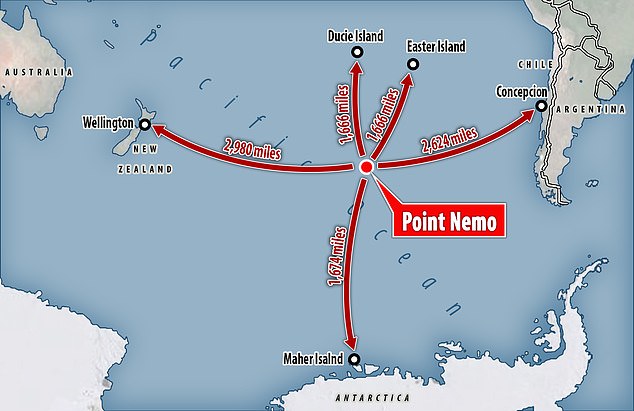
  7. Hopefully, whatever doesn't burn up in the atmosphere will splash harmlessly into the Pacific Ocean near Point Nemo. 

If these thrusters failed, the station would gradually fall out of orbit and crash, uncontrolled down to Earth.

To avoid the station falling of its own accord and potentially threatening a populated area, NASA unveiled its plan to deorbit the station in 2022.

Starting from 2026, the ISS will be allowed to fall under the effects of atmospheric drag until it reaches a height of about 200 miles (320km).

At this point, the last human crew will depart the station on a regular crew capsule, taking with them whatever equipment or items are deemed most historically important.

Once the last crew have gone, the station will continue to fall over several months until it reaches the 'point of no return' at an altitude of 175 miles (280 km).

When the station hits this point NASA deems that there is no way the ISS could be boosted back up to its old orbit and it now must be brought safely down to Earth.

To deliver the finishing blow, NASA has commissioned a 'space tug' which will launch from Earth, dock with the ISS, and then push the station out of orbit.

Speaking in a recent NASA press conference, Dana Weigel, NASA’s ISS manager, explained that the tug would do this over several stages over 18 months.

Ms Weigel says: 'At the right time it will perform a complex series of actions... over several days to deorbit the space station.

NASA now plans to use a SpaceX tug to push the station out of orbit so that most of the station will burn up in Earth's atmosphere upon reentry

NASA now plans to use a SpaceX tug to push the station out of orbit so that most of the station will burn up in Earth's atmosphere upon reentry

'First, the deorbit vehicle will perform orbit shaping burns to put the station in a low elliptical orbit and then, eventually, it will perform a final reentry burn'.

Most of the space station will be destroyed as it hits the thicker parts of the atmosphere at speeds of around 18,000 miles per hour (29,000km/h).

However, between 40 and 100 tonnes of material, mainly made up of the station's denser components, are still expected to slam into a remote region of Earth.

NASA hopes that its careful planning will bring the remaining pieces down at Point Nemo, a spot in the Pacific Ocean so remote that astronauts on the ISS are often the closest living people.

So far, between 260-300 space objects have already been brought down at Point Nemo, earning it the nickname 'the spaceship graveyard'. 

If all goes to plan, any remaining debris will fall near Point Nemo (pictured) in the Pacific Ocean, this is the furthest place on earth from any living person

If all goes to plan, any remaining debris will fall near Point Nemo (pictured) in the Pacific Ocean, this is the furthest place on earth from any living person 

However, developing a spaceship capable of bringing this monumental station safely to Earth will not be easy or cheap.

Ms Weigel said: 'The deorbit vehicle will need six times the usable propellant and three to four times the power generations and storage of today's Dragon spacecraft.

'The thing that I think is most complex and challenging is that this burn must be powerful enough to fly the entire space station all the while resisting the torques and forces caused by increasing atmospheric drag.'

NASA had originally suggested that it would employ a Russian Progress spacecraft to deliver the final push.

NASA has commissioned SpaceX to develop a modified version of their Dragon Capsule (pictured). The difference is that the Trunk section (bottom) will need to function as its own spaceship

NASA has commissioned SpaceX to develop a modified version of their Dragon Capsule (pictured). The difference is that the Trunk section (bottom) will need to function as its own spaceship 

But as geopolitical tensions escalated, Russian officials have gone back and forth on whether they will commit to the ISS beyond 2024. 

Perhaps spooked by their partner's lack of commitment, the space agency has now commissioned Elon Musk's SpaceX to provide the space tug instead.  

The final tug will be based on the SpaceX Dragon with an enhanced trunk section.

That trunk will essentially be a spaceship in its own right complete with navigational equipment, a huge fuel supply, and an enormous array of engines. 

NASA now estimates that the total cost of developing this new system will be $1 billion (£800 million).  

NASA estimates it will cost $1bn (£800m) to convert a Dragon capsule (pictured) into a vehicle capable of pushing the ISS out of orbit

NASA estimates it will cost $1bn (£800m) to convert a Dragon capsule (pictured) into a vehicle capable of pushing the ISS out of orbit 

Is the plan safe?

Bringing satellites out of orbit is always somewhat risky but, thanks to improved modelling, has become a fairly routine part of the space industry.

While there is room for error at every step of the mission, the most critical moment will come as the space tug begins its final deorbit burn.

Dr Jonathan McDowell, an astronomer at the Harvard–Smithsonian Center for Astrophysics, told MailOnline: 'You can lower the ISS down to maybe 250km (150 miles) and still fly it the way you are now, but below that you're flying 17,000 miles per hour through the upper atmosphere so you need much more muscle power.'

The biggest concern is that when the ISS reaches an altitude of 100 miles (150km), the rocket won't be able to keep it pointed in the right direction.

To bring the ISS safely out of orbit will require a massive amount of thrust. Even carrying a spaceship that powerful into orbit will require SpaceX to upgrade from the Falcon 9 rocket (pictured) to the currently experimental Falcon Heavy

To bring the ISS safely out of orbit will require a massive amount of thrust. Even carrying a spaceship that powerful into orbit will require SpaceX to upgrade from the Falcon 9 rocket (pictured) to the currently experimental Falcon Heavy

Dr McDowell says: 'Now you're firing the rocket in the wrong direction and you're tumbling end over end so you end up.

'You end up with a space station that is in a very, very low orbit that's going to reenter somewhere in a matter of days but you don't know where.'    

However, that station was only one-fifth the size of the ISS so the space tug will need to be significantly stronger.

To make matters worse, space weather conditions can cause the Earth's atmosphere to fluctuate, changing the amount of resistance on the space station.

This could potentially trigger the station to tumble out of control, falling past the point of no return earlier than NASA anticipated. 

Unfortunately,  NASA already has a clear example of what can happen when deorbiting a space station goes wrong.

In 1979, NASA tried to deorbit their 75-tonne space station Skylab (pictured), the resulting disaster saw pieces of debris slam into populated regions of Western Australia

In 1979, NASA tried to deorbit their 75-tonne space station Skylab (pictured), the resulting disaster saw pieces of debris slam into populated regions of Western Australia 

In 1979, NASA's first space station, Skylab, had been slipping from its intended orbit for months and the space agency made the decision to push into a dive over an uninhabited region of the Indian Ocean.

The 75-tonne structure tore itself apart as it crashed through the atmosphere sending debris falling over parts of populated parts of Western Australia.

Most of the debris did fall in the ocean as intended and no one was hurt, but the Australian town of Esperance did fine NASA for littering.

NASA's new space tug will need to deliver one final kick which is strong enough to bring the station down in less than half an orbit while not being so powerful that it tears the station apart. 

Over recent years there has also been a worrying trend of more space material surviving re-entry than intended.

Laura Forczyk, founder of space consultancy firm Astrolytical, told MailOnline: 'One thing that is popping up as a bit of a concern is that our modelling for what gets burned up in the atmosphere is proving to be a little off.'

Since the Skylab disaster, NASA has also miscalculated whether objects will burn up in orbit more often than expected. This led to pieces of an ISS battery (pictured) slamming through the roof of someone's house

Since the Skylab disaster, NASA has also miscalculated whether objects will burn up in orbit more often than expected. This led to pieces of an ISS battery (pictured) slamming through the roof of someone's house 

Fragments of SpaceX Dragon trunk sections have scattered over farms in Canada and the US and part of an ISS battery array even crashed through the roof of a house in Florida. 

'But this shouldn't be too much of a concern since it's just going over the Pacific Ocean,' Ms Forczyk adds.

Ultimately, since 1979 when Skylab crashed to Earth, NASA has gotten a lot better at bringing material out of orbit and the risk of the ISS missing its target is exceptionally low.

Ms Forczyk also points out that NASA is giving itself an extremely long mission time which should help mitigate any unexpected interference from space weather.  

Provided SpaceX's tug meets the specifications NASA provides and doesn't suffer any kind of software glitch in flight, the ISS should return to Earth with minimal risk.  

Large pieces of a SpaceX Crew-1 have also been found in a field in Australia in 2022. Hopefully, any debris from the ISS will land safely in the Pacific Ocean

Large pieces of a SpaceX Crew-1 have also been found in a field in Australia in 2022. Hopefully, any debris from the ISS will land safely in the Pacific Ocean 

Why is it time to destroy the ISS?

While it might be sad to see the ISS go, the hard truth is that the ISS's time is finally up.

Ms Forczyk said: 'The bottom line is that the ISS is getting older, some of that hardware's been up there for almost 25 years.'

The ISS was initially meant to be deorbited in 2016 but has had its lifespan extended several times in the intervening years.

This means that many of the systems and equipment on the station are now out of date and increasingly incompatible with modern technology.

More worryingly, the very structure of the ISS is beginning to show troubling signs of deterioration.

Each day the exterior of the station shifts from -120°C (-184°F) to 120°C (248°F) as it moves in and out of the sun's rays.

The ISS (pictured) has served humanity well for over two decades but the station is now old, outdated, and increasingly at risk of failure

The ISS (pictured) has served humanity well for over two decades but the station is now old, outdated, and increasingly at risk of failure 

The ISS was originally coated with materials designed to reflect most of the heat, but constant exposure to UV radiation has degraded these coatings in some areas.

This has created uneven expansion which is putting an intense strain on the station's structure which has now created leaks.

In 2021, former cosmonaut Vladimir Solovyov told state media that at least 80 per cent of the in-flight systems on the Russian section had passed their expiry date and could soon suffer irreparable failures. 

Then in February this year, NASA said it was monitoring a growing leak in the Russian section of the ISS which doubled in size over the course of a week. 

Ms Forczyk says that these risks are dangerous but that the costs of keeping the station safe are simply no longer worth it.

'I don't believe it's a risk worthy of evacuating early, but as we're seeing with Boeing's Starliner you can never tell when equipment is going to go in another direction,' Ms Forczyk says.

'There's nothing saying we absolutely have to retire the ISS by 2030, it's simply budgets and balancing logistics.' 

Beyond these structural concerns, some argue that the ISS is now outdated in terms of what NASA wants to get out of its space programme.

As NASA turns its attention to projects like the Lunar Gateway orbital station, the ISS has served its purpose and is no longer needed to further the space agency's ambitions

As NASA turns its attention to projects like the Lunar Gateway orbital station, the ISS has served its purpose and is no longer needed to further the space agency's ambitions 

Dr McDowell explains: 'There's an argument to be had that we've learned most of what we need to from the ISS.

'Now, NASA wants to spend their human spaceflight on going to the moon, and you can't fund both.'

Dr McDowell says that the true legacy of the ISS is that it has taught us how to operate a large facility in space for a long period of time.

That is knowledge which will be critical for NASA's future missions to the moon and Mars, but the ISS has now simply outlived its usefulness.

Mr McDowell concludes: 'NASA is an agency that does the frontier, and the frontier is moving out.

'Now, low earth orbit is just another place where humans do business and that's not where NASA should be - NASA should be at the frontier.'

{ https://www.dailymail.co.uk/ }

Hoe vind je dit bericht?
Geschreven door peter om 23:46 Stuur door

NASA spots mysterious object moving 1million mph through space

NASA spots mysterious object moving 1million mph through space

A rogue, hyper-speed object — over 27,306 times the size of Earth — is hurtling so fast through our galaxy that it might break free of the Milky Way, according to NASA.

Scientists determined the mysterious object was cruising at a breakneck one million miles per hour when they spotted it more than 400 light years from Earth - one light-year is equal to six trillion miles.

While experts have not determined what the newfound celestial body is, they speculated it is a 'brown dwarf,' a star which is larger than a planet but lacks the mass to sustain long-term nuclear fusion in its core like Earth's sun.

If the object confirmed as a brown dwarf, it would be first-ever to be documented in a chaotic, hyper-speed orbit capable of breaking free from our home galaxy. 

A rogue, hyper-speed object - over 27,306 times the size of Earth - is hurtling so fast through our galaxy that it might break free of the Milky Way, according to NASA. The fast-moving object (NASA artist's image above, right) is estimated to be cruising at  1 million miles-per hour

A rogue, hyper-speed object - over 27,306 times the size of Earth - is hurtling so fast through our galaxy that it might break free of the Milky Way, according to NASA. The fast-moving object (NASA artist's image above, right) is estimated to be cruising at  1 million miles-per hour

A coalition of citizen-scientists with NASA's 'Backyard Worlds: Planet 9' project were the first to spot the celestial body, the US space agency confirmed this week.

'I can't describe the level of excitement,' German citizen-scientist Martin Kabatnik, a long-time member of NASA's Backyard Worlds program, said in statement. 

'When I first saw how fast it was moving,' the Nuremberg-based researcher confessed, 'I was convinced it must have been reported already.' 

Backyard Worlds citizen-scientists Martin Kabatnik, Thomas P. Bickle and Dan Caselden were the first to spot this million mph object a few years ago, earning the hyper-speed object the catalogued name CWISE J124909.08+362116.0.

According to astronomer Dr Kyle Kremer, who has collaborated with them on better understanding the object, several astrophysics theories could explain how the object, CWISE J1249 for short, could have gotten to its incredible speed. 

In one theory, CWISE J1249 rocketed out of a two star or binary star system after its 'white dwarf' sister star died off — collapsing in an explosive runaway nuclear fusion reaction called a supernova.

Another viable theory has it that CWISE J1249 originated inside a tight cluster of starts called a 'globular cluster' where it was flung free via the pull of a black hole. 

'When a star encounters a black hole binary,' Dr Kremer said in a NASA statement on the discovery, 'the complex dynamics of this three-body interaction can toss that star right out of the globular cluster.'

The volunteers who make up NASA's 'Backyard Worlds' work with interstellar image data taken by NASA's Wide-field Infrared Survey Explorer (WISE) - a huge 'all sky' survey that ran from 2009-2011 and again from 2013-2024. Above, the WISE telescope (artist's concept)

The volunteers who make up NASA's 'Backyard Worlds' work with interstellar image data taken by NASA's Wide-field Infrared Survey Explorer (WISE) - a huge 'all sky' survey that ran from 2009-2011 and again from 2013-2024. Above, the WISE telescope (artist's concept)

NASA's WISE telescope scans led to the discovery of thousands of minor planets in our galaxy and the first Earth 'trojan asteroid,' a rock that orbits the same ring around the sun as our own planet. Above, a WISE mosaic 'the Heart and Soul nebulae' about 6,000 light-years from Earth

NASA's WISE telescope scans led to the discovery of thousands of minor planets in our galaxy and the first Earth 'trojan asteroid,' a rock that orbits the same ring around the sun as our own planet. Above, a WISE mosaic 'the Heart and Soul nebulae' about 6,000 light-years from Earth

A host of university academics and government scientists, including members of the NASA Goddard Space Flight Center, have now drafted up a report on these volunteer citizen-scientists' observations, awaiting peer review at Cornell's arXiv site. 

article image

These experts, including an astronomer from the University of Leicester and an astrophysicist with the American Museum of Natural History, have made their own case that the object is a 'hypervelocity L subdwarf.' 

That would make it among the smallest objects to qualify as a brown dwarf ever documented.

The international group of volunteers who make up NASA's 'Backyard Worlds' work with interstellar image data taken by NASA's Wide-field Infrared Survey Explorer (WISE) — a huge 'all sky' survey that ran from 2009-2011 and again from 2013-2024.

NASA's WISE telescope scans led to the discovery of thousands of minor planets in our galaxy, multiple star clusters and the first Earth 'trojan asteroid,' meaning a rock that orbits the same ring around the sun as our own planet.

It has been NASA's hope that members of the general public, like Backyard Worlds' team, will make even more discoveries with this vast haul of outer space data.

The researchers tested 100 scenarios to see where high-speed CWISE J1249 might go next. The team found multiple scenarios (straight grey lines above) where this L subdwarf is likely to fling itself out of the Milky Way (the blue-dotted circle is the boundary of our Milky Way)

The researchers tested 100 scenarios to see where high-speed CWISE J1249 might go next. The team found multiple scenarios (straight grey lines above) where this L subdwarf is likely to fling itself out of the Milky Way (the blue-dotted circle is the boundary of our Milky Way)

According to NASA, scientists plan to train further equipment on CWISE J1249 in an effort to get a better sense of its chemical make-up or 'elemental composition.'

The chemistry of this high-speed object could hold 'clues about which of these scenarios is more likely,' whether it was flung by a black hole or a collapsing white dwarf, whether it is a gas giant or a burning brown dwarf. 

Using open source software for modeling galactic orbits of celestial bodies, called galpy, these researchers tested '100 random initial conditions' alongside the identifying data they already know about CWISE J1249 to see where it might go next.

As published in their arXiv paper, which is awaiting peer-review with the Astrophysical Journal Letters, the team found multiple scenarios where this suspected 'hypervelocity L subdwarf' is likely to fling itself out of the Milky Way.

'Given the uncertainties in the inferred velocities and potential models,' the team wrote in their study, 'we find that [WISE] J1249+3621 has a significant probability of being unbound to the Milky Way.' 

'17 percent of our simulated orbits are unbound over 10 gigayears,' they added, meaning that the object could eject itself into the unknown in about 10 billion years.

{ https://www.dailymail.co.uk/ }

Hoe vind je dit bericht?
Geschreven door peter om 21:48 Stuur door

Meer van UFO'S of UAP'S, ASTRONOMIE, RUIMTEVAART, ARCHEOLOGIE, OUDHEIDKUNDE, SF-SNUFJES EN ANDERE ESOTERISCHE WETENSCHAPPEN - DE ALLERLAATSTE NIEUWTJES

↑ Terug naar de berichten