Ontdek de Fascinerende Wereld van UFO's en UAP's: Jouw Bron voor Onthullende Informatie!
Ben jij ook gefascineerd door het onbekende? Wil je meer weten over UFO's en UAP's, niet alleen in België, maar over de hele wereld? Dan ben je op de juiste plek!
België: Het Kloppend Hart van UFO-onderzoek
In België is BUFON (Belgisch UFO-Netwerk) dé autoriteit op het gebied van UFO-onderzoek. Voor betrouwbare en objectieve informatie over deze intrigerende fenomenen, bezoek je zeker onze Facebook-pagina en deze blog. Maar dat is nog niet alles! Ontdek ook het Belgisch UFO-meldpunt en Caelestia, twee organisaties die diepgaand onderzoek verrichten, al zijn ze soms kritisch of sceptisch.
Nederland: Een Schat aan Informatie
Voor onze Nederlandse buren is er de schitterende website www.ufowijzer.nl, beheerd door Paul Harmans. Deze site biedt een schat aan informatie en artikelen die je niet wilt missen!
Internationaal: MUFON - De Wereldwijde Autoriteit
Neem ook een kijkje bij MUFON (Mutual UFO Network Inc.), een gerenommeerde Amerikaanse UFO-vereniging met afdelingen in de VS en wereldwijd. MUFON is toegewijd aan de wetenschappelijke en analytische studie van het UFO-fenomeen, en hun maandelijkse tijdschrift, The MUFON UFO-Journal, is een must-read voor elke UFO-enthousiasteling. Bezoek hun website op www.mufon.com voor meer informatie.
Samenwerking en Toekomstvisie
Sinds 1 februari 2020 is Pieter niet alleen ex-president van BUFON, maar ook de voormalige nationale directeur van MUFON in Vlaanderen en Nederland. Dit creëert een sterke samenwerking met de Franse MUFON Reseau MUFON/EUROP, wat ons in staat stelt om nog meer waardevolle inzichten te delen.
Let op: Nepprofielen en Nieuwe Groeperingen
Pas op voor een nieuwe groepering die zich ook BUFON noemt, maar geen enkele connectie heeft met onze gevestigde organisatie. Hoewel zij de naam geregistreerd hebben, kunnen ze het rijke verleden en de expertise van onze groep niet evenaren. We wensen hen veel succes, maar we blijven de autoriteit in UFO-onderzoek!
Blijf Op De Hoogte!
Wil jij de laatste nieuwtjes over UFO's, ruimtevaart, archeologie, en meer? Volg ons dan en duik samen met ons in de fascinerende wereld van het onbekende! Sluit je aan bij de gemeenschap van nieuwsgierige geesten die net als jij verlangen naar antwoorden en avonturen in de sterren!
Heb je vragen of wil je meer weten? Aarzel dan niet om contact met ons op te nemen! Samen ontrafelen we het mysterie van de lucht en daarbuiten.
An artist’s concept of the InSight lander on Mars after the lander’s robotic arm deployed a seismometer (domed object to the left of the lander) and a heat probe directly onto the ground. The lander stopped recording data in 2022, but scientists are still mining the data for information about Mars’ interior.
Credit: NASA / JPL-Caltech
Mid-Crust of Mars May Contain ‘Oceans of Liquid Water’
New data about the Martian crust gathered by NASA’s InSight lander allowed geophysicists at the University of California San Diego and the University of California Berkeley to estimate that the amount of groundwater could cover the entire planet to a depth of between 1 and 2 km. It’s located in tiny cracks and pores in rock in the planet’s mid-crust, between 11.5 and 20 km below the surface.
A cutout of the Martian interior beneath NASA’s Insight lander. The top 5 kilometers of the crust appear to be dry, but a new study provides evidence for a zone of fractured rock 11.5-20 km below the surface that is full of liquid water — more than the volume proposed to have filled hypothesized ancient Martian oceans.
Credit: James Tuttle Keane and Aaron Rodriquez / Scripps Institution of Oceanography
“Liquid water existed at least episodically on Mars in rivers, lakes, oceans, and aquifers during the Noachian and Hesperian, more than 3 billion years ago,” said Dr. Vashan Wright from the Scripps Institution of Oceanography at the University of California San Diego and colleagues.
“Mars lost its ability to host persistent bodies of liquid water on its surface after the planet lost most of its atmosphere during this time period.”
“The ancient surface water may have been incorporated in minerals, buried as ice, sequestered as liquid in deep aquifers, or lost to space.”
For the study, Dr. Wright and his colleagues used data that InSight collected during a four-year mission ending in 2022.
The lander collected information from the ground directly beneath it on variables such as the speed of marsquake waves from which scientists can infer what substances reside beneath the surface.
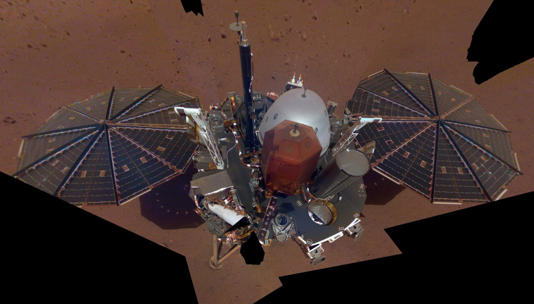
NASA InSight's first full selfie on Mars. It displays the lander's solar panels and deck. On top of the deck are its science instruments, weather sensor booms and UHF antenna. The selfie was taken on Dec. 6, 2018 (sol 10). The selfie is made up of 11 images which were taken by its Instrument Deployment Camera, located on the elbow of its robotic arm. Those images are then stitched together into a mosaic.
Credit: NASA/JPL-Caltech
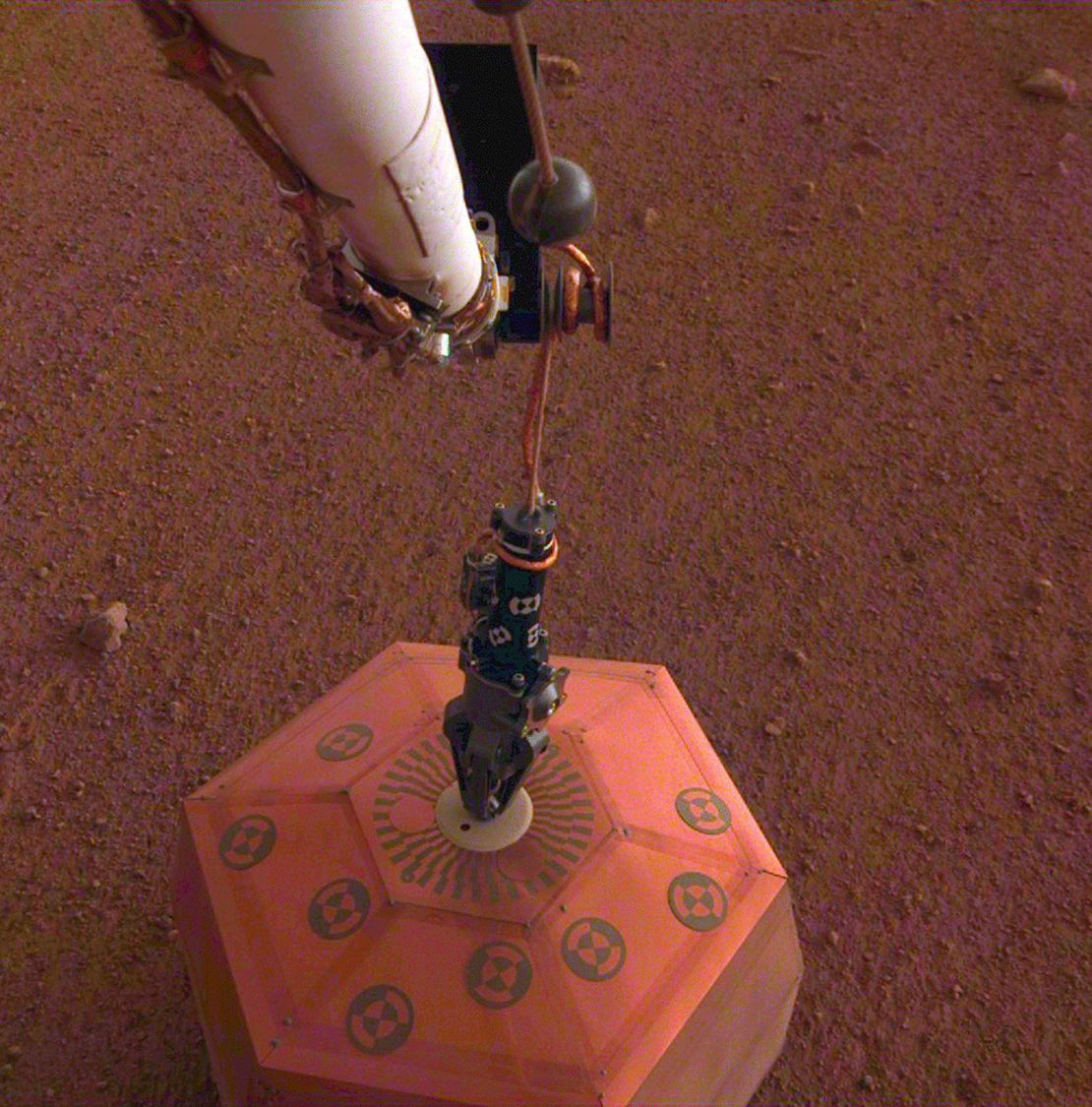
InSight's white robotic arm and black handlike grapple deployed the first seismometer on another planet on December 19, 2018.
NASA/JPL-Caltech
The data were fed into a model informed by a mathematical theory of rock physics.
From it, the researchers determined that the presence of liquid water in the crust most plausibly explained the data.
“Establishing that there is a big reservoir of liquid water provides some window into what the climate was like or could be like,” said University of California Berkeley’s Professor Michael Manga.
“And water is necessary for life as we know it. I don’t see why the underground reservoir is not a habitable environment. It’s certainly true on Earth — deep, deep mines host life, the bottom of the ocean hosts life.”
“We haven’t found any evidence for life on Mars, but at least we have identified a place that should, in principle, be able to sustain life.”
“Lots of evidence — river channels, deltas and lake deposits, as well as water-altered rock – support the hypothesis that water once flowed on the planet’s surface.”
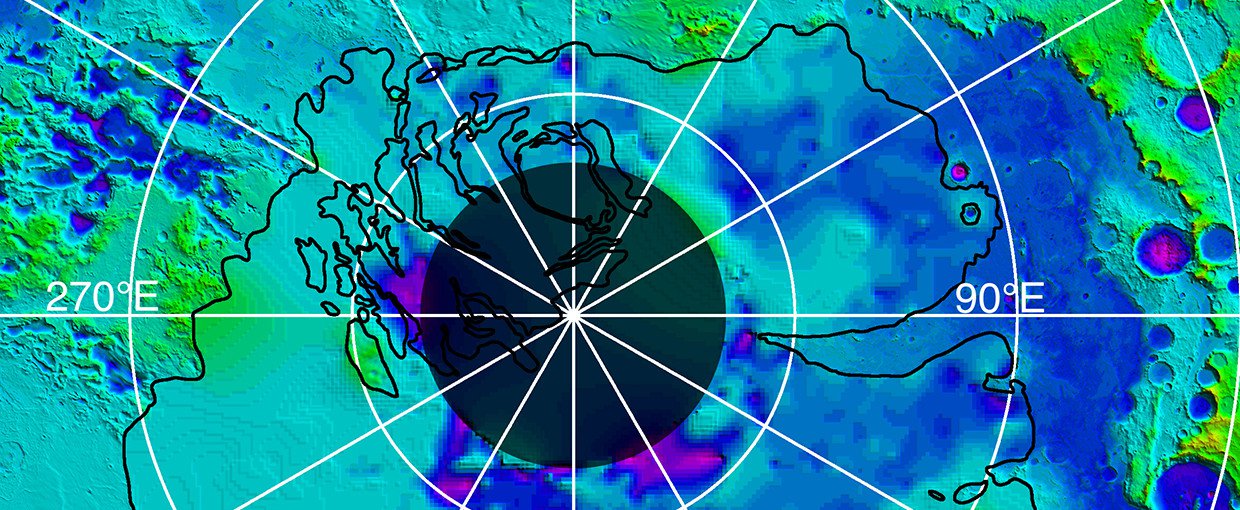
A 2018 photo of Mars during a dust storm, snapped by the Hubble Space Telescope. More than 3 billion years ago, the dusty red planet had oceans and rivers. That water disappeared, leaving only ice on the surface, most of it in the polar caps. A new analysis of Mars’ interior suggests that much of the liquid water still exists in the pores of rocks 10-20 kilometers below the surface.
Credit: NASA / ESA / STScI
“But that wet period ended more than 3 billion years ago, after Mars lost its atmosphere.”
“Planetary scientists on Earth have sent many probes and landers to the planet to find out what happened to that water — the water frozen in Mars’ polar ice caps can’t account for it all — as well as when it happened, and whether life exists or used to exist on the planet,” the authors said.
“The new findings are an indication that much of the water did not escape into space but filtered down into the crust.”
“The new paper analyzed the deeper crust and concluded that the available data are best explained by a water-saturated mid-crust below Insight’s location.”
“Assuming the crust is similar throughout the planet, there should be more water in this mid-crust zone than the volumes proposed to have filled hypothesized ancient Martian oceans.”
Large Reservoir of Liquid Water Found Deep Below the Surface of Mars
The findings appear in the Proceedings of the National Academy of Sciences.
Vashan Wrightet al. 2024. Liquid water in the Martian mid-crust. PNAS 121 (35): e2409983121; doi: 10.1073/pnas.2409983121
Now this was just a few miles away from me. It was 96F that day so I didn't go out. But a person in my area caught it and shared it with everyone. It's a fantastic catch of a real UFO disguising itself as a cloud. The dimensions, size, color and smoothness all indicate it's a real UAP. When alien ships want to come closer to the surface of earth, they cloak as clouds, to fool the inferior humans below, who never suspect a thing.
A Facebook friend sent this into me today. A glowing disk seen over dark clouds in Taiwan last week. This looks very much like a light ship...a ship that was created by transcended beings that are now pure energy. It's a rare sight and the aliens like to come as close as possible to see humans and the Earths surface with their own eyes.
Van de meteorieten die de aarde sinds haar ontstaan hebben getroffen, slaagt een klein percentage erin het oppervlak van de planeet te bereiken, en wordt misschien zelfs door mensen gevonden. In de meeste gevallen beperkt het onderzoek zich echter tot de analyse van de compositie, en weinig anders. Het ontdekken van de exacte oorsprong van een meteoriet is niet eenvoudig, en daarom heeft een recent onderzoek liefhebbers en professionals verbaasd. Onderzoekers zijn erin geslaagd om een meteoriet te linken aan een gloed die zich voordeed in de atmosfeer... bijna 50 jaar geleden.
De vondst van de meteoriet… bijna 50 jaar geleden
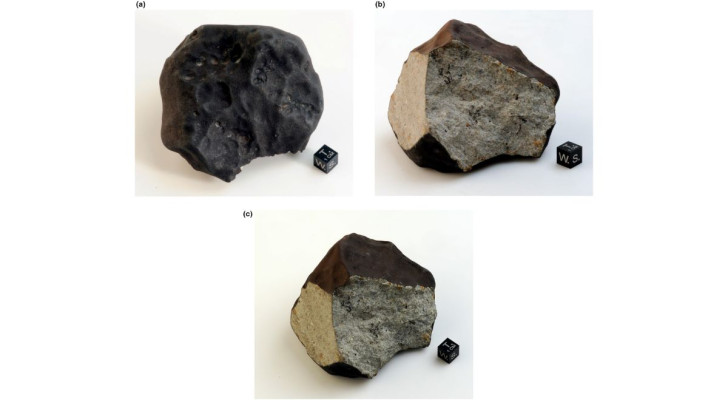
Het is 1976 en Josef Pfefferle is een boswachter die de overblijfselen van een lawine bij het dorp Ischgl in Oostenrijk opruimt. Op een gegeven moment ziet hij echter een steen die heel anders is dan de andere die hij verwijdert: het is een zwarte steen ter grootte van een vuist en lijkt geen aardse oorsprong te hebben. Pfefferle besluit dit vreemde souvenir van zijn werk mee naar huis te nemen en bergt de steen 32 jaar lang op in een doos.
Het is nu 2008 en eindelijk, na het horen van het nieuws over een meteorietvondst, herinnert de bejaarde boswachter zich de vreemde steen die hij mee naar huis nam. Hij besluit de experts van de universiteit te raadplegen en die vinden de vondst inderdaad buitengewoon. Het is een meteoriet die, te oordelen naar de staat waarin hij bewaard is gebleven, niet in de oudheid op aarde moet zijn gevallen. Maar hoe begrijp je zoiets?
Op zoek naar de ruimtelijke oorsprong van de meteoriet
Gritsevich et al./Meteoritics & Planetary Science - 2024
Het onderzoek naar de meteoriet wordt uitgevoerd door een team van wetenschappers onder leiding van Maria Gritsevich van de Universiteit van Helsinki, die de resultaten publiceerde in het tijdschrift Meteoritics & Planetary Science. Gritsevich en haar collega's veronderstellen dat de meteoriet onlangs op aarde is gevallen, en dat er daarom ook videobewijs van de gebeurtenis zou kunnen zijn.
Om deze reden beginnen onderzoekers beelden te analyseren van 25 hemelobservatiecamera's in Zuid-Duitsland. Het lijkt een eenvoudige zoektocht, maar dat is slechts tot op zekere hoogte zo: in de afgelopen 50 jaar zijn er meer dan 2000 "vuurballen" waargenomen die meteorieten zouden kunnen zijn, maar welke trof Ischgl vóór 1976? Maria Gritsevich en haar team vinden bewijs van de inslag: een enorme flits die, laag aan de horizon, bij zonsopgang op 24 november 1970 de Oostenrijkse hemel verlicht. De meteoriet die Pfefferle vond is meer dan 50 jaar oud en heeft het grootste deel van zijn leven in een doos opgesloten gezeten.
De impact van de ontdekking op de studie van meteorieten
Als je het verhaal van de meteoriet van Ischgl leest, is het normaal om je af te vragen welk doel het dient om zijn ontdekking in verband te brengen met zijn oorsprong. Hoewel complex, is dit zeer belangrijk onderzoek, dat kan helpen cruciale informatie te begrijpen, zoals het gebied van het zonnestelsel waar het vandaan komt, zijn baan, zijn “verwantschap” met andere hemellichamen, enzovoort.
Toch is niet iedereen het erover eens dat de ontdekking van de meteoriet te wijten is aan de crash van 1970. Volgens andere wetenschappers had de door Pfefferle gevonden steen eeuwenlang op aarde kunnen wachten, goed beschermd door de gunstige omstandigheden in de Oostenrijkse Alpen. Wat de waarheid ook is, het is verbazingwekkend hoe je oude gegevens kunt raadplegen om antwoorden te vinden over gebeurtenissen die beginnen in het zonnestelsel en eindigen in een Oostenrijks bos, wachtend om gevonden te worden.
Towering over the Tibetan plateau, Mount Kailash stands as a majestic pyramid of rock and ice. This sacred peak transcends geographical boundaries, holding immense significance for Hinduism, Buddhism, Bon, and Jainism. For centuries, pilgrims have undertaken arduous journeys to circumambulate its base, seeking spiritual fulfillment and a connection to the divine. Beyond its breathtaking beauty, Mount Kailash harbors a multitude of unsolved mysteries that continue to intrigue and mystify. Join us as we delve into 20 enigmas that shroud this sacred mountain, fueling our imagination and sparking a deeper exploration of its secrets.
1. The Unexplored Summit: A Peak Untouched: Mysteries of Mount Kailash
Unlike most Himalayan giants that have succumbed to the will of determined climbers, Mount Kailash remains unconquered. No expedition has ever successfully reached its summit. Religious reverence for the mountain plays a significant role in this. Hindus believe it to be the abode of Lord Shiva, the destroyer and regenerator, and consider climbing it disrespectful. Similarly, Buddhists revere it as the earthly manifestation of Mount Meru, the mythical axis mundi. The challenging terrain, characterized by extreme weather conditions, steep icy slopes, and unpredictable crevasses, further discourages attempts. However, some believe a more profound reason lies behind the mountain’s inviolability. Legends whisper of an unseen force that prevents human intrusion, protecting the sanctity of the peak.
2. Vanishing Acts: Where Do They Go?
The legend of disappearances on Mount Kailash adds another layer of mystery. Stories abound of pilgrims and adventurers venturing onto the circumambulation route, the Kora, and simply vanishing. Search efforts often yield no trace, leaving behind a chilling sense of the unknown. Are these disappearances due to the harsh environment and treacherous terrain? Do they fall victim to accidents or succumb to the unforgiving elements? Or could there be something more at play? Some believe the mountain itself has a role, perhaps transporting those deemed unworthy to another realm. The truth remains shrouded in the mists that cling to the mountain’s slopes.
3. Magnetic Anomalies: Compasses Gone Wild
Modern technology seems to malfunction in the shadow of Mount Kailash. Reports from pilgrims and trekkers detail compasses spinning wildly or pointing in erratic directions. While some attribute this to unusual mineral deposits in the surrounding rocks, others believe it’s a sign of a powerful energy vortex emanating from the mountain itself. This supposed energy vortex is said to have a profound effect on those who visit, influencing their thoughts, emotions, and even their physical well-being. Science may offer explanations based on magnetic field variations, but for many, the experience remains deeply mystical.
4. The Face of Shiva: A Divine Illusion or Geological Wonder?
Legends associated with Mount Kailash are deeply intertwined with its physical characteristics. One such legend claims that a natural formation on the south face of the mountain resembles the face of Lord Shiva. As pilgrims circumambulate the peak, the light and shadow play create a captivating image, seemingly confirming the legend. However, is this a divine message etched into the mountain’s surface or a trick of light and perspective? Geological explanations point to natural rock erosion patterns, but for the faithful, it remains a powerful symbol of the mountain’s connection to the Hindu deity.
5. The Unmelting Snow Cap: A Perpetual Crown of White
Despite its high altitude and harsh climate, the snow cap of Mount Kailash appears to defy nature. Even during warmer months, when surrounding peaks lose their white mantle, Kailash remains crowned with pristine snow. This has sparked various theories. Some believe unusual weather patterns create a microclimate around the mountain, preserving the snow. Others propose the existence of a self-regulating mechanism within the mountain itself, ensuring a perpetual icy cap. The scientific basis for this phenomenon remains elusive, adding to the mountain’s mystique.
6. The Perfect Pyramid: A Creation of Nature or Man?
Unlike other jagged, snow-capped peaks of the Himalayas, Mount Kailash boasts an almost geometrically perfect pyramid shape. Its four near-equal sides and sharp ridges rise majestically towards the sky. This unique form has fueled speculation for centuries. Is it a marvel of nature, sculpted by millions of years of geological processes? Or could it be the work of an advanced civilization, a forgotten pyramid built for a purpose yet unknown? Theories abound, ranging from comparisons to the Egyptian pyramids to suggestions of extraterrestrial intervention.
7. The Mythical Mount Meru: Earthly Abode of the Divine
In Hinduism and Buddhism, Mount Kailash is considered the earthly manifestation of Mount Meru, the mythical axis mundi. This sacred mountain is believed to be the center of all physical and spiritual universes. It serves as a bridge between the earthly realm and the celestial heavens. Whether Mount Kailash is purely a symbolic representation of this cosmic axis or if it has a more literal connection to another dimension remains a mystery. For pilgrims, circumambulating the peak is akin to journeying around the entire cosmos, a powerful act of devotion and spiritual purification.
8. The Alignment with Mount Fuji: A Bridge Across Continents?
Some researchers have noted an intriguing alignment between Mount Kailash and Mount Fuji in Japan. These two sacred peaks, separated by thousands of kilometers, are said to be positioned on a ley line, a hypothetical line of energy that connects various geographical locations with spiritual significance. This alignment could be purely coincidental, a result of our planet’s spherical geometry. However, some believe it holds deeper meaning, suggesting a connection between seemingly disparate cultures and their reverence for mountains as sacred places. Could these peaks be anchors for a vast energy grid that encircles the Earth? The answer remains elusive, but the possibility sparks the imagination.
9. The Singing Sands: A Symphony of the Natural World?
The remote region around Mount Kailash is known for its vast sand dunes. Travelers report hearing strange sounds emanating from these dunes, often described as a low humming or a melodic chanting. Some attribute these sounds to the wind whistling through the sand grains, creating a natural resonance. Others believe the sand itself possesses mystical properties, causing it to “sing” under certain conditions. The true nature of these sounds remains a mystery, adding to the otherworldly aura surrounding Mount Kailash.
10. Celestial Connections: A Gateway to Other Realms?
Legends associated with Mount Kailash often weave a narrative of celestial connections and portals to other realms. The mountain is said to be a point of convergence for cosmic energies, where the veil between dimensions is thinnest. This belief has led some to speculate that the peak serves as a gateway to otherworldly abodes or higher planes of existence. While such ideas may seem fantastical, they highlight the deep human fascination with the unknown and the potential for sacred mountains to act as bridges between the physical and the spiritual.
11. The Footprint of Shiva: A Divine Mark on the Earth
A natural rock formation near Mount Kailash bears a remarkable resemblance to a giant footprint. For Hindus, this is a powerful symbol, believed to be the footprint of Lord Shiva himself. The presence of this formation reinforces the mountain’s association with the deity and serves as a constant reminder of his presence in the region. Whether this is a divinely placed mark or a product of natural processes is a matter of interpretation. For pilgrims, it’s a tangible connection to the divine, a sign that they walk in the footsteps of their god.
12. The Lakes of Yin and Yang: A Duality Reflected in Nature
Two sacred lakes lie nestled near Mount Kailash: Rakshas Tal (Lake of Demons) and Manasarovar (Mind Lake). These lakes are believed to represent Yin and Yang, the opposing and complementary forces that exist in the universe. Rakshas Tal, with its dark, brackish water, embodies the destructive and chaotic aspects of nature. Manasarovar, with its crystal-clear, turquoise water, represents purity, creation, and compassion. The proximity of these lakes and their contrasting qualities highlight the interconnectedness of all things and the balance that exists within the cosmos.
13. The Unexplored Caves: Secrets Waiting to be Unveiled?
Numerous caves dot the landscape surrounding Mount Kailash. These hidden chambers have remained largely unexplored, their depths shrouded in mystery. Legends abound about these caves, some believed to hold hidden treasures or be the dwelling place of mythical beings like yetis or kinnaras (celestial musicians). The harsh environment and the spiritual significance of the caves have deterred extensive exploration. However, the possibility of these caves holding secrets from the past or harboring unique ecosystems fuels the imagination and beckons future exploration.
14. The Language of the Stones: A Code Waiting to be Cracked?
Some researchers have proposed that the rock formations and natural patterns around Mount Kailash may hold a hidden language or set of symbols waiting to be deciphered. These patterns could be remnants of an ancient civilization or a form of communication left behind by a higher intelligence. Deciphering this “language” could unlock secrets about the mountain’s history, its purpose, or even the origins of humanity. While this theory remains highly speculative, it highlights the enduring human desire to find meaning in the natural world and to connect with the past through symbols and patterns.
15. The Energy Vortex: A Conduit for Spiritual Transformation
Mount Kailash is often described as a powerful energy vortex, a place where the earth’s energy field intensifies and interacts with the human body in profound ways. Pilgrims report experiencing heightened states of awareness, increased clarity of thought, and a deep sense of peace while circumambulating the mountain. Some believe this is due to the mountain itself acting as a conduit for spiritual energy, facilitating a connection to something greater than oneself. While the scientific basis for such claims remains elusive, the undeniable impact that Mount Kailash has on many visitors suggests a powerful force at play. Perhaps it’s a combination of the mountain’s majestic presence, the demanding physical journey, and the deep faith of the pilgrims that creates this transformative experience.
16. The Sacred Sounds: A Symphony of the Divine
Many pilgrims report hearing unusual sounds during their circumambulation of Mount Kailash. These sounds can range from ethereal chanting to melodious music, often described as beautiful and otherworldly. Some believe these sounds are a manifestation of the mountain’s energy, a way for it to communicate with those who are open to receiving its message. Others attribute them to the natural world, the wind whistling through the rocks or the calls of unseen birds. Regardless of the source, these sounds add to the mystical aura of Mount Kailash and contribute to the sense of awe and wonder experienced by pilgrims.
17. The Changing Colors: A Play of Light or an Illusion?
Some visitors to Mount Kailash report witnessing the mountain change colors throughout the day. The peak, typically a stark white or gray, is said to shift through hues of gold, pink, and even purple depending on the time of day and the angle of the sunlight. While this phenomenon could be attributed to the interplay of light and shadow on the snow and rock, some believe it’s a sign of the mountain’s inherent dynamism, a way for it to reveal its hidden beauty to those who are worthy. The ever-changing nature of Mount Kailash reflects the impermanence of all things and the constant flux of the universe.
18. The Legends of Shangri-La: A Paradise Lost or a Realm Unseen?
For centuries, the mythical paradise of Shangri-La has captivated imaginations. This hidden utopia, said to be a place of eternal youth and peace, has been variously located in the Himalayas. Some believe the region around Mount Kailash is the true home of Shangri-La, its entrance veiled by the mountain’s mystical energies. While the existence of such a physical paradise remains unproven, the legend speaks to humanity’s yearning for a perfect world and the potential for sacred mountains to serve as gateways to these idealized realms.
19. The Unexplained Lights: A Glimpse into the Unknown?
Reports of strange lights appearing in the night sky near Mount Kailash have fueled speculation about UFO activity or other unexplained phenomena. These lights, often described as orbs or streaks of colorful light, have been witnessed by pilgrims and trekkers alike. While some dismiss them as natural phenomena like meteors or ball lightning, others believe they are signs of intelligent extraterrestrial life or evidence of interdimensional travel. The unexplained nature of these lights adds to the mystery surrounding Mount Kailash and reinforces its reputation as a place where the veil between worlds might be thin.
20. The Personal Transformation: A Journey Within
Perhaps the greatest mystery of Mount Kailash is not something external or readily explained. It lies in the profound personal transformation experienced by many who undertake the pilgrimage. The arduous journey, the breathtaking scenery, and the deep spiritual significance of the location all contribute to a transformative experience. Pilgrims often report a renewed sense of purpose, a deeper connection to their faith, and a greater understanding of themselves. This internal transformation is the ultimate takeaway from a journey to Mount Kailash, a testament to the mountain’s power to influence not just the physical landscape, but also the human spirit.
A Beacon of Mystery and Wonder
Mount Kailash stands as a powerful symbol of the unknown, a place where the boundaries between the physical and the spiritual blur. The 20 mysteries we have explored are just a glimpse into the mountain’s enigmatic aura. Whether you approach it from a religious perspective, a scientific one, or simply as a place of breathtaking beauty, Mount Kailash has the power to inspire, challenge, and transform. The journey to unravel its secrets is an ongoing one, a testament to humanity’s enduring curiosity and our desire to connect with something greater than ourselves.
Mount Kailash – “Precious Jewel of the Eternal Show”.
Rising at an elevation of 6656 meters, Mount Kailash is the most mysterious and sacred mountain in the world. It is the highest peak of Kailash Range which spread in Tibet, Nepal and India. Also, it is a part of the Trans-Himalaya in the Tibetan Autonomous Region of China.
Due to the surroundings of mountains, it is like a majestic creation of nature.
Mount Kailash lies around the origin of the four longest rivers of Asia the Indus River, Sutlej, Brahmaputra and Karnali River.
Strangely but its shape is like the pyramid of Egypt. Therefore, it is known as the “Biggest Man-made Pyramid”. It is rated as “Pillar of the World”. And like this, there are many interesting things about Mount Kailash that will surprise and force you to visit this mystic creation of nature. So grab a cup of tea and take a look at the 13 unsolved mysteries of Mount Kailash:
13 Unsolved Mysteries of Mount Kailash:
1: Who lives at Kailash?
The Hindus consider the Kailash Parvat is the abode of great Lord Shiva and his wife Parvati. While the Tibetan Buddhist believes that Kailash is the abode of the tantric meditational deity Demchog.
And Jains consider the Kailash as the site at which their first Tirthankar attained nirvana. But Bon believes it is a sacred mountain and center of the world and home of all gods.
All of them have a different perspective about who lives at Kailash and that makes it more mysterious and sacred. But hikers from the world goes over oh their for doing parikrama. Back to Top
2: Geographical location of Kailash Parvat
According to some strange disbelief, axis Mundi is the center of the earth and the connection between the physical world to the spiritual world.
It is on the axis of the earth and to keep all living beings alive it maintains the atmosphere. Its location is in synchronization with all other ancient monuments in the universe and earth poles. And it is located at an exact 6666 km from the monument of Stonehenge.
3: Why No One Able to Climb at Mount Kailash?
Mount Kailash is a sacred mountain in all four religions and trekking at the top could hurt the religious sentiments of people. The fear of trespassing the sanctity of the mountain and disturbing the divine energizes residing there makes it unclimbable as according to Hindus Mount Kailash is the abode of Lord Shiva.
Even though number of people tried to climb on Kailash Parvat but till now no one gets succeeds. According to a scientific hypothesis, the mountain keep changes its position for those who want to climb it. Afterward, many people’s journeys have failed to climb its peak.
Till the 21st century, no one reaches the peak of Mount Kailash. Keeps changing position make it more strange and scary.
This 32 L backpack is perfect for casual weekend trips or month-long backpacking. It offers convenient and efficient ways to carry essentials. Moreover, it encourages minimalism, as limited space requires careful packing. With this backpack, you will always stay organized, prepared, and can focus on enjoying the journey.
4: The Mysterious shapes of Manasarovar and other lakes
The word Manasarovar comes from Sanskrit and a combination of two words Mans means mind and Sarovar means lake.
Mansarovar lake is famous for its amazing beauty and the color of the water that changes blue from around the shores to emerald green at the center.
Located southeast of Mount Kailash, Lake Manasarovar is rated as the adobe of Purity. According to legends before it creating on earth, its image was incepted in the mind of Bharma.
This lake is very sincere and calms irrespective of weather.
The Manasarovar lake is the highest freshwater lake in the world but strange as well because of its round shape and its twin named Rakshas Tal Lake which is located next to it.
Rakshas Tal is also known as the devil’s lake while Manasarovar lake is known as God Lake. Rakhast Tal lake is one of the biggest saltwater lakes in the world. And its shape like the moon.
The other two lakes represent solar and lunar forces, bad and good energy respectively.
5: Time Travel on Kailash Parvat
Many passengers reported that time travels quickly around the Kailash Parvat which is not witnessed anywhere in the world.
Many Hikers have reported that they feel like their nails and hairs are growing quickly within 12 hours. But in the normal environment, the same growth of hair and nails takes 2 around week time.
This is very strange, isn’t it?
6: Man-Made Pyramid
According to a Russian theory, “Mount Kailash could be the biggest ancient Man-Made pyramid, the center of an entire complex of the smaller pyramid (100 in total) and is linked with Pyramid of Giza and Teotihuacan.
Mount Kailash could be the center of the world that connecting other monuments or sites from where the paranormal activates have been observed.
7: Importance of Kailash Parikrama
Kailash Parvat is one of the most mysterious, religious and sacred mountains in the world. The one circumambulation (Parikarma) of Mount Kailash symbolizing the phases of life, death, refinement, and resurrection.
Jains and Buddhists refer to this circumambulation as Kora and Hindus refer as parikrama. A single circumambulation is equaled to the one turn of the wheel of life that will clean away the guilt of whole life. But the circumambulation of Kailash Parvat is very difficult and dangerous.
8: The magical Gauri Kund
Gauri Kund that is also known as Lake of Compassion, a water body that lies in transit while going on downwards from Dolma.
This lake is famous as Parvati Sarovar where goddess Parvati had procured her child Ganesha.
According to Hindus Scripture, Goddess Parvati had framed her child Lord Ganesh from the cleanser foam of her body and breathed life into it.
9: A link between Earth to Heaven
According to Hinduism, Buddhism and Jainism Mount Kailash could be the gateway to heaven. And Vedas also describe the same that Mount Kailash is a link between earth to heaven. If we consider the story of Mahabharata then Pandavas along with Draupadi are believed to have achieved moksha.
10: Om Parvat
Om Parvat is another interesting mystery, as the snow falls on the peak and takes the shape of OM.
11: Formation of Swastika
During sunset, the mountain is said to cast a shadow, which has a striking likeness to the religious symbol of Swastika, which is rated as an auspicious sign by Hindus.
12. The Yam Dwar
Yam Dwar is one of the most prominent destinations in the Kailash Manasarovar Yatra which is situated in Tarboche 30 minutes drive from Darchen.
The meaning of Yam Dwar is “The Gateway of God of Death”. It is also known as Chorten Kang Ngyi which means two legged stupas in Tibet.
Yam Dwar is more associated with heaven and the soul.
13. No Mortals allowed to climb atop Mount Kailash
According to some ancient text, no one allowed to climb at the top of Mount Kailash. And who dare to climb to see the face of God will be put to death. And due to its religious significance, government don’t allow anyone to climb it.
10 Interesting Facts About Mount Kailash:
1. The Russian Theory
The biggest mystery of mount Kailash is its Shape. According to Russian scientists, it’s not a mountain rather than it’s a Man-Made Pyramid.
2. Twin Lake
There are two lakes surrounding mount Kailash – The first one is Mansarovar or the God Lake and the second one is Rakshas Tal or the devil lake. Many ancient texts claim that Mount Kailash stands as the balance between the two and teach us that there isn’t any evil external to us; we are the evil.
3. Who Climb at Mount Kailash?
The interesting fact about Mount Kailash that it has never been climbed by anyone apart from a person named Milarepa. There are many stories claimed that mystic Tibetan seer and poet name Milarepa is the only person who successfully climbed atop of Mount Kailash.
4. Source of 4 Major River
The origin of the four most religious rivers of Asia lies around 50 KM radius of Mount Kailash and in four different directions:
Through west flows the great Ganges.
Through south flows the great Karnali.
Through east flows Maa Brahmaputra.
And through north flows river Indus.
5. Place of Ultimate Nirvana
Jain claims Mount Kailash as Mt. Asthapada and believe that their religious originator, Rishadev, achieved Nirvana – State of Happiness or Another form of Moksha.
6. Ancient Monasteries and Caves
As per the Buddhists and Hindus scriptures, around Mount Meru inside the existing caves and ancient monasteries the blessed sages live in their material and unpretentious bodies. Only few lucky ones can see them.
7. Kailash Parikarma
Every year, a number of pilgrims come Tibet for Pilgrimage to the sacred mount Kailash (Kailash Parikarma) but only some of them able to finish outflank the Mount Kailash.
8. Journey of Lifetime
Mount Kailash is one of the most sacred places in the world and known as the Navel of the Universe. Therefore, it attracts many scholars and researchers from all over the world. And Mount Kailash provides a spiritual, enriching, unique and truly rewarding journey of a lifetime.
9. Kang Rimpoche:
Buddhism religion has a special religious connection with Mount Kailash. For them, it is known as Kang Rimpoche or “Precious One of Glacial Snow”.
10. Four faces:
Mount Kailash has four different faces and each of them aligned with four directions. According to Puranas, it is a spiritual center of the earth and also says that each face is made of Gold, Ruby, Lapis Lazuli and Crystal. Back to Top
Here is the list of strange mysteries of mount Kailash: So come; visit the abode of the Gods (Lord Shiva and Parvati) and receive their blessings! And share it with your friend.
Most Frequently Asked Questions About Mount Kailash
Q1: Why no one has climbed mount Kailash?
It’s not that mountaineers from different part of the world have not tried to climb the mount Kailash but they couldn’t because according to some strange believes the mountain keeps changes its position for them who wants to climb it. Truly there is something which not be understandable for common men.
Q2: Is anyone climbed mount Kailash?
Yes, Buddhist monk, Milarepa is said to have climbed atop Mount Kailash.
Q3: What is inside Mount Kailash?
According to Hindus Mount Kailash is the adobe of Lord Shiva but Tibetan Buddhists believe that Kailash is the abode of the tantric meditational deity Demchog. Jains consider the Kailash as the site at which their first Tirthankar attained nirvana. But recently Russain put has an idea that Mount Kailash could be the biggest ancient man-made pyramid.
Q4: Does Lord Shiva live in Mount Kailash
Yes, according to Hindus Kailash Parvat is the adobe of great Lord Shiva and his wife Parvati. And the death of Atheists and Adharmis proved that Mount Kailash is not a normal mountain that can be climbed. According to Russian Research, Mount Kailash is the center of the earth and could be the biggest man-made pyramid.
Q5: Can Plane fly over Mount Kailash?
No, no planes can fly over Mount Kailash. If you talk about scientific reason then the main reason is the elevation of the Himalayan Mount range which is around 30000 ft and the highest cruising altitude that is allowed to planes is around 25 to 35000 ft. And there could be another reason as well like supernatural theories, India-China relation and many more.
Q6: How old is Mount Kailash?
The Kailash range is around 30 million years old.
Q7: Is Mount Kailash a Pyramid?
Yes, according to the Russian report Mount Kailash could be the biggest Man-Made pyramid and the center of the earth.
Q8: Why is Mount Kailash sacred?
Mount Kailash is one the most sacred place in the world not for only one religion but for all 4 religions Hindu, Buddhists, Jain and Bon. Hindus considered this is the home of Lord Shiva and Goddess Parvati while Tibetan Buddhists believe that Kailash is the abode of the tantric meditational deity Demchog. Jains consider the Kailash as the site at which their first Tirthankar attained nirvana.
Mystery at Mount Kailash: Strange ancient anomaly found near the summit
Mount Kailash is a mountain in Ngari Prefecture, Tibet Autonomous Region of China. It lies in the Kailash Range of the Transhimalaya, in the western part of the Tibetan Plateau. The peak of Mount Kailash is located at an elevation of 6,638 m, near the trijunction between China, India and Nepal.
In Tibetan Buddhism, Mount Kailash holds a special place as the Axis Mundi, or the center of the universe. Imagine it as the heart of everything, where heaven and earth meet. This sacred mountain isn't just a random peak; it's like the cosmic hub, connecting different realms together.
In the year 1999, an expedition of Russian Scientists led by Dr Ernst Muldashev claimed that Mount Kailash is too perfectly shaped for a natural mountain. They have discovered that the top of Mt. Kailash is actually a man-made vacuum pyramid. It is surrounded by more than 100 other small pyramids. According to preliminary estimates, the direct height of the pyramid complex is between 100 and 1,800 meters, while the Egyptian pyramid is only 146 meters
It is also believed to be the site of Lord Shiva, the god of destruction and rebirth as well as where the first human beings were created.
According to the legend Shiva has left a giant footprint on the summit of the mountain. Despite extensive searches, no concrete evidence of this footprint has ever been found.
While exploring Mount Kailash on Google Earth, I spotted a large, unusual anomaly near the summit. It resembles two hands, each with four visible fingers, positioned opposite each other and seemingly carved into the rock.
Could these huge hands be a kind of a 'footprint' of Shiva that people have been searching for?
As for climbing up the summit, some daring mountaineers have attempted to do so, but with no luck. It also is said that who climb Mount Kailash age quickly. The time that human takes to age two weeks only take 12 hours in the mountain. Numerous hikers have detailed that they feel like their nails and hairs are developing rapidly within 12 hours.
Trekking all the way up to the peak of Mount Kailash is held to be a forbidden act among Hindus for the fear of trespassing the sanctity of the mountain and disturbing the divine energies residing there.
Even planes don't fly over Kailash as Mount Kailash is said to possess a mysterious magnetic anomaly that disrupts navigational instruments and disrupts compass readings. This phenomenon has puzzled scientists with no concrete explanation offered to date.
Coordinates: 31° 4'4.83"N 81°18'24.47"E
Mount Kailash is still a mystery. The unconquered peak remains wrapped in myths, legends, and spiritual tales.
A Hopper Could Explore Over 150km of Triton’s Surface In Two Years
Neptune’s largest moon, Triton, is one of the most biologically interesting places in the solar system. Despite being hard to reach, it appears to have active volcanoes, a thin atmosphere, and even some organic molecules called tholins on its surface. However, Voyager only visited it once, in passing, 35 years ago. Technology has advanced a lot in the intervening decades, and a new push for a lander on Triton specifically has been garnering attention. One such mission was described by Steve Oleson and Geoffrey Landis of NASA’s Glenn Research Center. Their concept mission, known as Triton Hopper, was funded by NASA’s Institute for Advanced Concepts (NIAC) back in 2018 and utilized a cryogenic pump to extract propellant from Triton’s surface to power a “hopper” that could travel up to 5 km a month, and do some fascinating science along the way.
The first challenge to any mission on Triton is getting there. As part of the NIAC final report for the Triton Hopper, the authors performed a preliminary study examining different propulsion methods. Solar electric propulsion and aerobraking in Neptune’s larger atmosphere came out on top. The Hopper would have to hitch a ride with a larger orbital spacecraft responsible for trajectory planning of the “hops” and communicating with Earth.
Once safely deposited on Triton’s surface, a hopper could do lots of exciting science. The instrument payload described in the mission brief included ground-penetrating radar, spectroscopy equipment, a microscope, and even a seismometer. In total, the whole system weighed just under 300 kg—relatively light for an interplanetary mission.
Video describing the Triton Hopper mission in detail. Credit – Dreksler Astral YouTube Channel
But most of that weight wouldn’t be in the instrumentation—it would be in the Hopper’s unique propulsion system. The concept behind the propulsion system is simple enough: Get some propellant material into the spacecraft, then heat that material to a point where it is pressurized. Once enough pressure is built up, release it as a jet stream that would allow the 300 kg spacecraft to overcome the relatively weak gravity of Titan, which is only ½ the gravity of our own Moon.
The study focused on two main ways to get material into the Hopper – a shovel and a cryogenic pump. Each has its advantages, though the pump was more effective, at least in the theoretical simulations run as part of the Phase I project. The shovel suffered from potential contamination by other material being loaded into the propellant collection hopper and either blocking the nitrogen-rich ice and snow from entering it or itself being absorbed into the thermal chamber and sucking up some of the heat intended to melt the propellant.
On the other hand, a cryopump could use waste heat from the rover’s normal power-generating operations to directly melt the ice and snow the Hopper landed on and absorb that into a heating chamber, where it would be further heated before being used as a propellant. This methodology can be effective at gathering the best propellant options and providing an outlet for the lander’s waste heat that doesn’t just radiate into Triton’s thin atmosphere.
Fraser discusses why Triton is so interesting with Dr. Jason Hofgartner
Once enough pressure is built up by heating the propellant, the Hopper can take off from the moon’s surface and “hop” a short distance using its six power and four steering thrusters. The authors estimate about 50 seconds of specific impulse once a month. While that might not seem like a lot, it would allow the Hopper to cover about 150 kilometers over the course of a two-year mission.
It could find plenty of interesting scientific spots in those two years. However, the mission, which is also competing for resources with plenty of other mission concepts for Triton landers, appears to be on hold. It hasn’t received a Phase II, and there haven’t been any development updates in the last few years. But given the general popularity of the hopper concept even on other worlds in our solar system and the desirability of Triton as an exploration destination, it seems likely that someday some form of this mission will soar above the ice surface of Neptune’s biggest moon. It might just be a while before it does.
Most of us associate sinkholeswith frightening abysses, but in China, they’re considered “heavenly” for good reason.
Far from being mouths of doom, a number of these have been discovered containing pristine ancient forests.
Most recently, in August last year, cave explorers stumbled upon one of these giant holes, which experts said likely contained species of small animals that were unknown to science.
This extraordinary hole reportedly measures a whopping 300 metres (1,000 feet) in length, 150 metres (500 feet) in width and is more than 190 metres (630 feet deep).
It is located in China’s southwestern karst landscape and is now one of 30 such holes known as “tiankeng” – which translates as “heavenly pits” – in the region.
The reason for the trenches’ otherworldly name is that they are some of the last-remaining natural refuges for ancient forests and are home to species unseen anywhere else in the world.
Indeed, describing his own encounter with a tiankeng back in 2016, researcher Tang Jianmin wrote: “The scene down there was stunning: an underground pristine forest with no trace of human activities, with 40 metre-high ancient trees and a group of endangered wild plants from the times of dinosaurs.”
Given their depth, very little light reaches the bottom of the tiankeng, and yet, they harbour an abundance of plants.
For years it remained unclear how this was possible, but a new study, published on 20 July, has revealed how a number of species have been able to thrive in their depths.
The researchers found that nettles, ferns and other plants that live inside them thrive off of abundant stocks of nitrogen, phosphorus, potassium, calcium and magnesium.
These elements limit plant growth in other environments, where they are scarce, but because they are so bountiful in the tiankeng, the plants have evolved to devour them, enabling them to grow tall and benefit from the trickles of sunlight that reach them.
"Plants can adapt to adverse environments by adjusting their nutrient content," the study’s authors wrote, according to a translation by Live Science.
"Due to the towering cliffs and steep terrain of the tiankeng, it has been less disturbed by human activities.”
The deep holes host plants that favour moisture and shade, including species unique to the region, the researchers add. These include modern karst forest plants, such as the Nepali hog plum (Choerospondias axillaris) and the Chinese rain bell (Strobilanthes cusia).
So how do these tiankeng and their forests form?
These remarkable sinkholes emerge when the roof of an underground chamber enlarges and collapses, according to Jianmin.
Some 30 per cent of the world’s tiankeng are found in China’s Guangxi Zhuang Autonomous region among its World Heritage listed karst formations.
Karst landscapes are shaped by the erosion of soluble carbonate rocks such as limestone, creating features such as sinkholes, caves and underground rivers.
The South China Karst are a UNESCO World Heritage site
(Ko Hon Chiu Vincent via UNESCO)
In a piece for The UNESCO Courier, Jianmin further explains the formation of these sinkholes, writing: “Karst tiankeng is a relatively closed environment with high humidity, low temperature and a high concentration of negative oxygen ions.
“Its bottom is connected with underground water flow, nurturing a lush green oasis all year round.
“Primitive ecosystems with unique animal, plant and microbial resources are formed there.”
In total, 300 tiankeng have been discovered across the globe, with China home to two-thirds of them. They have also been found in Papua New Guinea, Malaysia and Madagascar, Slovenia, Croatia, Italy and Spain, among other countries.
Why are they important?
More than just a jaw-dropping natural phenomenon, these sinkholes are important ecological havens.
Jianmin noted that he and fellow researchers have discovered many rare and endemic plants in the tiankeng area, cementing its status as a “refuge for endangered plants and primitive forest ecosystems”.
“There is also a good chance that previously unknown species will be discovered in these environments,” he added.
Video released of Seffner sinkhole that claimed life of Jeff Bushyoutu.be
On July 8, 2023, one of the greatest UFO stories was told by Ross Coulthart to Project Unity host Jay Anderson. The investigative journalist claimed that there is ahuge UFO in the possession of the United States that could not be moved, and he knows the location of the craft. Coulthart clarified that the immovable craft is not in the US.
In the interview, Coulthart discussed the potential implications of the new US Senate intelligence bill. He referenced Douglas Dean Johnson’s writings about the bill, which purportedly mandate holders of non-earth origin or exotic UAP (Unidentified Aerial Phenomena) material to make it accessible to the All Domain Anomaly Resolution Office (AARO) within six months.
Anderson raised concerns that this six-month window might offer enough time for those holding such materials to hide or conceal them. Coulthart acknowledged the possibility but suggested that certain UAP materials could be so large that relocating them is not feasible. He mentioned the existence of a building constructed over such a massive object in a foreign country, which might sound implausible to some.
This revelation left the UFO community curious about the place where the craft might be situated. Interestingly, the late former CIA pilot John Lear previously mentioned the existence of buried crafts too massive to move. In 2018, Lear posted on Facebook, recounting the enigmatic tale of a massive buried UFO near Garrison, Utah. This peculiar incident became a topic of discussion at a UFO conference in Las Vegas, piquing Lear’s curiosity.
The incident dates back to 1953 when a large UFO, measuring between 150 to 200 feet in diameter, crashed near Garrison, Utah. Lear explained that the UFO was so large that even the United States Air Force Security Forces’ “Blue Berets” could not relocate it. Consequently, a decision was made to bury the UFO on the spot. Lear wrote that a team of hundreds of soldiers dug the ground and managed to bury the craft 50 feet below ground level. (Earthfile source)
“While all of the digging to bury the saucer was going on, they also dug a tunnel from the saucer several hundred feet to the south, where they built 2 or 3 houses. The houses were constructed to appear about 75 years old, using old, weathered wood, nails, window frames, and roofing. The only hint that these houses might not be so old were the brand-new padlocks on the doors.
I don’t recall the exact description of the interior, except for a door leading to a stairwell that connected to the tunnel leading to the craft. Everything I’m telling you is from my recollection of the report, likely written by the person who accessed the buildings. My memory isn’t perfect. One of the houses contained a logbook in which visitors from various organizations like Air Force, Navy, Army, and others would inscribe their names.”
Lear and his associates intended to visit Garrison to witness this buried craft. They planned to use a helicopter, a fuel truck, and specialized equipment to explore underground. However, the trip never materialized for reasons unknown. Lear maintained his belief that the craft remains in place. He even shared Google Earth images indicating the potential location. He marked the houses on the images, but they no longer appear on Google Earth.
“About 300 yards east from this claim, there was an alleged Spanish treasure location. This treasure spot had been discovered by an individual from the Phoenix area with access to Spanish treasure maps, and this location was marked on one of the maps.
In a pile of rocks, there was a precisely square cutout approximately 10 inches wide and 16 inches deep. The bottom seemed like concrete. I had the underground radar team scan the area and found only a few potential returns. The area is now in an ACEC (Area of Critical Environmental Concern). Nevertheless, we were all set to convene for the Garrison expedition in 2 weeks, but somehow it never took off.”
Lear even provided the coordinates of the location: Latitude 38 degrees 37 minutes 40 seconds North, Longitude 113 degrees 40 minutes 40 seconds West. This further deepens the mystery, leaving people intrigued about the truth surrounding the buried UFO near Garrison, Utah.
Moreover, there is alleged John Lear’s statement on the alien presence, posted to Paranet on December 29, 1987. Here are the paragraphs published by UFOmind.com discussing the buried craft: [this page was first archived on January 31, 1997]
“Moore is also in possession of more Aquarius documents a few pages of which leaked out several years ago and detailed the supersecret NSA project which had been denied by them until just recently. In a letter to Senator John Glenn NSA’s Director of Policy Julia B. Wetzel wrote, “Apparently there is or was an Air Force project by that name Aquarius) which dealt with UFO’s. Coincidentally, there is also an NSA project by that name.”
NSA’s project Aquarius deals specifically with the ‘communications with aliens’ (the EBE’s). Within the Aquarius program was project ‘Snowbird’ a project to test fly A recovered alien aircraft at Groom Lake, Nevada. This project continues today at that location. In the words of an individual who works at Groom Lake ‘our people are much better at taking things apart than they are at putting them back together’. Another saw a saucer being trucked into the Nevada Test Site in March of 1988. Still another informant witnessed a saucer being buried at that location (for God knows whatever reason) during the second week of August 1988.”
There is another version of this statement: (Source)
“Germany may have recovered a flying saucer as early as 1939. General James H. Doolittle went to Sweden in 1946 to inspect a flying saucer that had crashed there in Spitzbergen…
In July of 1952, a panicked government watched helplessly as squadron of “flying saucers” flew over Washington, D.C., and buzzed the White House, the Capitol Building, and the Pentagon. It took all the imagination and intimidation the government could muster to force that incident out of the memory of the public.
Thousands of sightings occurred during the Korean war and several more saucers were retrieved by the Air Force. Some were stored at Wright-Patterson Air Force Base, some were stored at Air Force bases near the location of the crash sight.
One saucer was so enormous and the logistic problems in transportation so enormous that it was buried at the crash sight and remains there today. The stories are legendary on transporting crashed saucers over long distances, moving only at night, purchasing complete farms, slashing through forests, blocking major highways, sometimes driving 2 and 3 lo-boys in tandem with an extraterrestrial load a hundred feet in diameter.”
Meer van UFO'S of UAP'S, ASTRONOMIE, RUIMTEVAART, ARCHEOLOGIE, OUDHEIDKUNDE, SF-SNUFJES EN ANDERE ESOTERISCHE WETENSCHAPPEN - DE ALLERLAATSTE NIEUWTJES


 Mid-Crust of Mars May Contain ‘Oceans of Liquid Water’