Naar de inhoud

UFO'S of UAP'S, ASTRONOMIE, RUIMTEVAART, ARCHEOLOGIE, OUDHEIDKUNDE, SF-SNUFJES EN ANDERE ESOTERISCHE WETENSCHAPPEN - DE ALLERLAATSTE NIEUWTJES

UFO's of UAP'S in België en de rest van de wereld
akke.beakke.be
Ontdek de Fascinerende Wereld van UFO's en UAP's: Jouw Bron voor Onthullende Informatie! Ben jij ook gefascineerd door het onbekende? Wil je meer weten over UFO's en UAP's, niet alleen in België, maar over de hele wereld? Dan ben je op de juiste plek! België: Het Kloppend Hart van UFO-onderzoek In België is BUFON (Belgisch UFO-Netwerk) dé autoriteit op het gebied van UFO-onderzoek. Voor betrouwbare en objectieve informatie over deze intrigerende fenomenen, bezoek je zeker onze Facebook-pagina en deze blog. Maar dat is nog niet alles! Ontdek ook het Belgisch UFO-meldpunt en Caelestia, twee organisaties die diepgaand onderzoek verrichten, al zijn ze soms kritisch of sceptisch. Nederland: Een Schat aan Informatie Voor onze Nederlandse buren is er de schitterende website www.ufowijzer.nl, beheerd door Paul Harmans. Deze site biedt een schat aan informatie en artikelen die je niet wilt missen! Internationaal: MUFON - De Wereldwijde Autoriteit Neem ook een kijkje bij MUFON (Mutual UFO Network Inc.), een gerenommeerde Amerikaanse UFO-vereniging met afdelingen in de VS en wereldwijd. MUFON is toegewijd aan de wetenschappelijke en analytische studie van het UFO-fenomeen, en hun maandelijkse tijdschrift, The MUFON UFO-Journal, is een must-read voor elke UFO-enthousiasteling. Bezoek hun website op www.mufon.com voor meer informatie. Samenwerking en Toekomstvisie Sinds 1 februari 2020 is Pieter niet alleen ex-president van BUFON, maar ook de voormalige nationale directeur van MUFON in Vlaanderen en Nederland. Dit creëert een sterke samenwerking met de Franse MUFON Reseau MUFON/EUROP, wat ons in staat stelt om nog meer waardevolle inzichten te delen. Let op: Nepprofielen en Nieuwe Groeperingen Pas op voor een nieuwe groepering die zich ook BUFON noemt, maar geen enkele connectie heeft met onze gevestigde organisatie. Hoewel zij de naam geregistreerd hebben, kunnen ze het rijke verleden en de expertise van onze groep niet evenaren. We wensen hen veel succes, maar we blijven de autoriteit in UFO-onderzoek! Blijf Op De Hoogte! Wil jij de laatste nieuwtjes over UFO's, ruimtevaart, archeologie, en meer? Volg ons dan en duik samen met ons in de fascinerende wereld van het onbekende! Sluit je aan bij de gemeenschap van nieuwsgierige geesten die net als jij verlangen naar antwoorden en avonturen in de sterren! Heb je vragen of wil je meer weten? Aarzel dan niet om contact met ons op te nemen! Samen ontrafelen we het mysterie van de lucht en daarbuiten.

Archief

Climate Tipping Points Are Unpredictable And Miss The Point, Says New Study

Climate Tipping Points Are Unpredictable And Miss The Point, Says New Study

Trying to make precise time estimates for major tipping points may be completely futile.

 
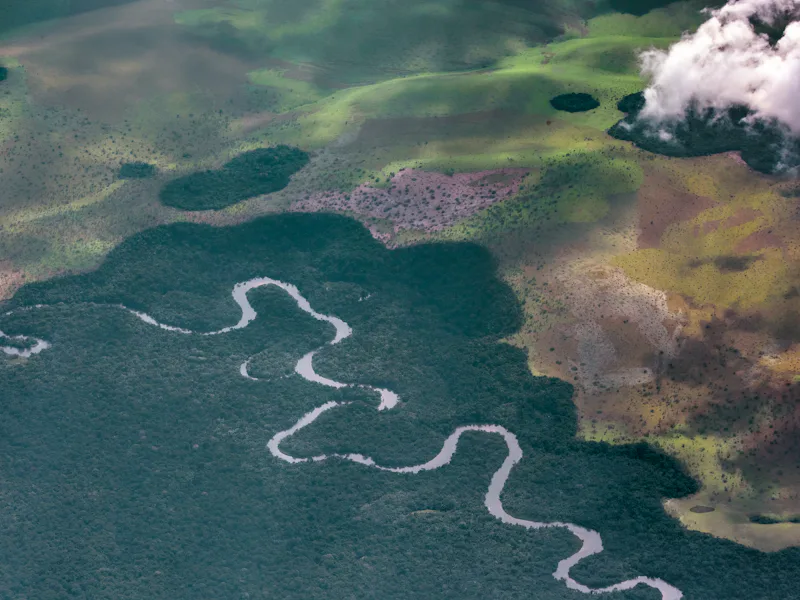
Aerial view of the congo basin,where a meandering river winds through tropical rainforest. republic ...
guenterguni/E+/Getty Images

Bad tidings for crystal ball enthusiasts: the future is unknowable. Even our best, data-based attempts to predict exactly what’s to come are far from certain, as highlighted in new research. Climate models that offer timing predictions for critical tipping points are woefully imprecise, according to a study published August 2 in the journal Science Advances.

There are many certainties in climate sciences: It’s certain that climate change is occurring and that it’s having serious negative impacts on Earth’s equilibrium and ecosystems. As human-caused greenhouse gas emissions continue and global warming unfolds, it’s also well-established that we’re getting closer to crossing important thresholds, or tipping points, past which we face inevitable collapse of planetary stabilizing systems like the major forests or ice sheets. At a tipping point, a small change in one variable like atmospheric temperature or precipitation triggers a big fall-out, such as the irreversible changeover of the world’s largest tropical rainforest into dry grassland or unstoppable polar melt and sea level rise. We know that by continuing to burn fossil fuels, we’re increasing the risk that these things could happen.

But what’s far less definite is when, exactly, we’ll plummet off those precipices, according to the new analysis. A subset of recent climate science has focused on developing models to predict the timing of future major events. Yet these projections are subject to too much variance to be meaningful — in large part because of the many assumptions modelers have to make to come to any one number or range.

“The uncertainties are too large to reliably estimate tipping times.”

“Even under the assumption that a given Earth system component has an approaching tipping point, the uncertainties are too large to reliably estimate tipping times,” write the study authors.

The researchers focus in on the particular example of the gulf stream, known to scientists as the Atlantic meridional overturning circulation (AMOC). Broadly: the AMOC is a massive marine current that moves cold, deep water south and warm, surface water north on either side of the Atlantic Ocean. The thermal conveyor belt helps to equalize global temperatures, rainfall, and sea levels. Without it, Europe would be much colder, the southern hemisphere would be much warmer with longer dry seasons, and parts of the U.S. eastern seaboard would be under water.

Worrying data on sea surface temperature and ocean sediments published in 2018 indicates that AMOC has slowed to a 1,500 year low. Other research indicates AMOC is showing early warning signs of destabilization. Most alarming of all was a 2023 study published in the journal Nature Communications that predicted AMOC would collapse around the middle of this century (i.e. within decades). That paper prompted lots of media coverage and both supportive and skeptical responses from the scientific community.

The new study is, in a way, another response to the 2023 article — but also to the field of tipping point modeling broadly. The researchers identified four uncertainties inherent in current modeling processes, which they say makes homing in on accurate time estimates impossible. First, models are simplified and we don’t have a perfect understanding of all of the variables involved in these systems. Second, models often rely on assuming past warming and emissions will continue following the same pattern as the past, which isn’t reflective of reality. Third, indirect indicators like sea surface temperature might not be 1:1 assessments of the stability of complex systems like AMOC. Finally, sparse historic data or contemporary data from multiple sources often leaves scientists filling in gaps and processing data to align — inevitably introducing errors.

Will the Atlantic Meridional Overturning Circulation collapse? Maybe — but it’s truly impossible to predict.

shunli zhao/Moment/Getty Images

They revisited the models used to come up with that mid-century AMOC collapse prediction published in 2023, and made adjustments in accordance with the above uncertainties, testing how slightly different parameters or inputs would change the outcome. The scientists found that, under certain scenarios, their altered models predict AMOC collapse by 2050. But in others, their timing predictions stretched more than 6,000 years in the future to an AMOC collapse forecast in the year 8065.

“The conclusions of this study are certainly in line with my understanding of the current state of the art,” says Gavin Schmidt, a climate scientist and professor at Columbia University and the director of NASA’s Goddard Institute for Space Studies (GISS). Schmidt was not involved in the new work, but has extensively researched climate variability and systems like AMOC. “I have not been impressed by previous or recent efforts to predict upcoming tipping points in either AMOC or ice sheets — there is more going on than just patterns in time series and we still don’t have sufficiently complex and calibrated models to have a robust idea of what will happen,” he tells Inverse.

“I have not been impressed by previous or recent efforts to predict upcoming tipping points,” says Gavin Schmidt, director of NASA’s GISS

Additional research and longer-term data collection could improve modeling moving forward, the study authors note, but there will always be some degree of uncertainty. And in the present, models that can tell us an Earth-changing tipping point will come tomorrow or in 6,000 years aren’t particularly useful.

“Our research is both a wake-up call and a cautionary tale,”said Maya Ben-Yami, lead study author and a doctoral researcher at the Potsdam Institute for Climate Impact Research in Germany, in a press statement. “There are things we still can’t predict, and we need to invest in better data and a more in-depth understanding of the systems in question. The stakes are too high to rely on shaky predictions.”

At the base of climate modeling is the idea that, if we could know for sure we’re headed towards imminent catastrophe, we might redouble our efforts to shift course. Yet we already know plenty to understand that moving away from fossil fuels is critical to avoid ever-worsening consequences.

The new study doesn’t mean that AMOC won’t collapse this century, nor that the Amazon rainforest isn’t on track to become a savannah, nor that Greenland and Antarctica aren’t headed towards runaway melting. All it means is that any of those things could happen and we aren’t able to know when.

“The large uncertainties imply that we need to be even more cautious than if we were able to precisely estimate a tipping time,” said Niklas Boers, study co-author and a professor of Earth system modeling at the Technical University of Munich, in the press release. “We still need to do everything we can to reduce our impact on the climate, first and foremost by cutting greenhouse gas emissions. Even if we can’t predict tipping times, the probability for key Earth system components to tip still increases with every tenth of a degree of warming.”

{ https://www.inverse.com/ }

Hoe vind je dit bericht?
Geschreven door peter om 19:51 Stuur door

Augustus MUFON eNewsletter- met de maandelijkse waarnemingsstatistieken!!

 Augustus MUFON eNewsletter- met de maandelijkse waarnemingsstatistieken!!

NATIONS OF THE WORLD

UNITED STATES 327

CANADA 19

UNITED KINGDOM 13

GERMANY 11

FRANCE 10

AUSTRALIA 7

ITALY 2

SLOVENIA 2

MEXICO 2

IRELAND 2

INDIA 2

BRAZIL 2

INDONESIA 1

ARGENTINA 1

NETHERLANDS 1

PHILIPPINES 1

POLAND 1

ROMANIA 1

GIBRALTAR 1

SWEDEN 1

AUSTRIA 1

VIRGIN ISLANDS, U.S. 1

YEMEN 1  

TOTAL:410

SHAPE

Circle 69

Sphere 60

Other 32

Triangle 29

Unknown 28

Oval 25

Disc 24

Cigar 17

Tic Tac 15

Star-like 13

Square/Rectangular 12

Cylinder 10

Diamond 7

Bullet/Missile 6

Boomerang 6

Flash 5

Chevron 4

Fireball 4

N/A 3

Teardrop 2

Cone 2

Egg 1

Cross 1

Blimp 1

STATES OF THE USA

California 36

Texas 23

Florida 22

Arizona 15

Pennsylvania 13

New York 13

Michigan 13

Colorado 12

Virginia 10

Ohio 10

Nevada 10

Missouri 9

Wisconsin 9

Georgia 9

New Mexico 8

Massachusetts 8

Minnesota 8

Tennessee 7

New Jersey 7

Indiana 6

Washington 5

North Carolina 5

Illinois 5

Oregon 5

Kentucky 5

Utah 5

Alabama 4

Oklahoma 4

South Dakota 4

Idaho 4

New Hampshire 3

South Carolina 3

Nebraska 3

Montana 3

Maryland 3

Iowa 3

West Virginia 2

Arkansas 2

Maine 2

Louisiana 2

Alaska 1

Connecticut 1

Rhode Island 1

Delaware 1

Mississippi 1

Kansas 1

DISTANCE

< 100 ft 55

101-500 ft 39

501 ft - 1 Mile 82

Over 1 Mile 75

Unknown 59

NO VALUE 9

Most impressively there were 11 Landings, Hovering, or Takeoffs reported and 25 Entities observed.

{  https://mufon.com }

Hoe vind je dit bericht?
Geschreven door peter om 19:37 Stuur door

Video Appears To Show ‘UFO’ Flying By Air Force One At Los Angeles International Airport

Video Appears To Show ‘UFO’ Flying By Air Force One At Los Angeles International Airport

US-POLITICS-BIDEN

(Photo by SAUL LOEB / AFP) (Photo by SAUL LOEB/AFP via Getty Images)

Kay Smythe - News and Commentary Writer

A report published Thursday claims a UFO was spotted in the skies above President Joe Biden while he flew into LAX on Air Force One on October 10.

A video shared on social media in December apparently shows a silvery white object flying extremely close to Air Force One as Biden landed in LAX for a fundraiser back in October, according to the Daily Mail. The outlet published several still photographs of the object, which whizzes past the President

The clip was taken by airplane enthusiasts Joshua and Peter Solorzano, who filmed the orb going over at around 10:18am local time while live-streaming on their YouTube channel. The first flies over around the 1:26 mark, and then comes back two more times at 4:38 and 6:58.

Many users noted its resemblance to a UFO which flew over the Middle East in 2022. Footage of the event was released by the Pentagon’s All-Domain Anomaly Resolution office. A report noted the orb had “characteristics and behaviors consistent with other ‘metallic orb’ observations in the region,” but gave little indication to what they actually were.

Despite the Pentagon’s interest in UFOs, apparently no Men in Black showed up to hassle the Solorzano brothers for the footage.

Another witness, Chris Cullari, apparently saw the object around 12:30pm on the same day while in Culver City, according to Daily Mail. A Los Angeles Police Department (LAPD) helicopter circled near the object, Cullari said, and he shared photos with the Daily Mail.

So either this thing is real … or the government wants you to think it is because of all the negative press they’ve been getting about UFO/UAP disclosure in 2023. After a year of promises to reveal the truth about what we know, our lawmakers decided that actually, we don’t get to know what UFOs really are, according to their data and research. If the people who really control our government want us to know something, we’ll know it. But otherwise, we will always be left in the dark.

Once again, the timing on this latest UFO appearance feels a little too convenient. But that’s just my opinion.

{ https://dailycaller.com/ }

Hoe vind je dit bericht?
Geschreven door peter om 19:24 Stuur door

Two Major UFO Mysteries May Have Been ‘Solved’ After Decades BLOG

Two Major UFO Mysteries May Have Been ‘Solved’ After Decades

pexels-stijn-dijkstra-1306815-16747816

CREDIT: Pexels / Stijn Dijkstra

A British UFO researcher claimed Monday that he had finally “solved” two of Great Britain’s biggest mysteries.

UFO researcher Mark Christopher Lee told the Express he believes the Rendlesham UFO incident and Calvine UFO photographs may be the result of early prototype aircraft used by both British and U.S. military, despite Ufologists describing them as two shining examples of unexplained events.

“From going through all these documents there seems to have been a lot of sightings of diamond shaped crafts since the 1970’s and especially around UK military bases,” Lee told the outlet, claiming he’s gone through some other dude’s UFO files, so … yeah … reliable (not really). “There seems to be a connection — is the Calvin UFO a secret military technology either of ours or an adversary that has been kept secret? Why is this diamond shaped craft seemingly accompanied by military jets?”

The Calvine UFO incident is literally just six photographs taken by two hikers in Scotland in 1990 of a diamond-shaped craft hurtling through the skies, followed closely by two Harrier jets. The photos entered UFO lore after the hikers sent them to the Scottish Daily Record, which never published them. The photos only reach public knowledge in 1996 after former Ministry of Defense civil servant Nick Pope revealed them.

“Calvine was only about a hundred miles from the secretive RAF base at Machrihanish, on the Kintyre Peninsula, and this was where a US spy plane codenamed Aurora was rumoured to be operating,” Pope said of the photographs. “It’s noteworthy that the Calvine UFO was spotted just two days after Saddam Hussein invaded Kuwait, so that may be a big clue.”

“Here are just a few examples of this diamond-shaped craft that started appearing in the late 1970s into the 1980s and was maybe the same craft or type of craft that was photographed at Calvine in Scotland,” Lee continued. “Are we dealing with our technology that is still secret or is it extra terrestrial but the MOD and the military know about it?” 

Here’s the issue, though: There are no real reports of a diamond-shaped craft during the Rendlesham UFO incident.

Rendlesham UFO Encounter

The story of Rendlesham is basically that a bunch of military personnel working at the Twin Bases in the U.K., most of whom were actually American troops, allegedly saw a UFO. In all likelihood, British soldiers who were bored over the Christmas holidays in 1980 pranked the troops.

Pentagon Releases UFO Videos

Was the Vegas Alien Incident Real?

Family Claims UFO Crashed Their Yard With 9-Feet Tall Aliens

“He said there was a sighting prior to [Rendlesham] by two men standing on the seafront at night in Suffolk about 20 miles from RAF Coltishall when they sighted what appears to be the same diamond shaped craft fly over the coast and this too was silent. Their sighting was about 12 months after mine,” said British police officer Brett Lyne, who witnessed what he believes was a diamond UFO just before the Rendlesham incident. 

In all likelihood, the diamond-shaped UFO was almost definitely just prototypical military tech. Most UFO sightings are probably linked to global militaries. And until the little green men come on down, I’ll remain a skeptic about it all.

{ https://dailycaller.com/ }

Hoe vind je dit bericht?
Geschreven door peter om 18:21 Stuur door

The Surface of Dimorphos is Surprisingly New

Simulation of Dimorphos. Credit: University of Michigan/Yun Zhang and Johns Hopkins APL/Olivier Barnouin

The Surface of Dimorphos is Surprisingly New

When NASA’s DART mission intentionally slammed into Dimorphos in September 2022, the orbit of the moonlet was altered. Researchers have studied the photos and data taken by DART before its impact, learning more about the geology of the Didymos/Dimorphos system. They have now estimated the surface age of both the asteroid and its moon. The asteroid Didymos has a surface age of 12.5 million years, while the moon Dimorphos is only 300,000 years old.

Additionally, the DART researchers concluded both Didymos and Dimorphos are rubble piles, with Dimorphos likely inheriting its boulders from Didymos.

“It’s a pile of gravel and boulders (and some sand/dust) held together by its own gravity, and really not anything else,” said Andy Rivkin, DART investigation team co-lead at the Johns Hopkins Applied Physics Lab (APL), on Bluesky. “There’s really no cohesion between different pieces of gravel or rocks on Dimorphos.”

That makeup explains why DART’s impact made such a such a surprising change in Dimorphos’ orbital period, decreasing it by about 34 minutes. A collection of boulders is easier to shift than a solid object.

Several DART researchers published five papers in Nature Communications, looking at the geology and geophysics of Didymos and Dimorphos as seen by DART.

“These findings give us new insights into the ways that asteroids can change over time,” said Thomas Statler, lead scientist for Solar System Small Bodies at NASA Headquarters in Washington, in a NASA press release. “This is important not just for understanding the near-Earth objects that are the focus of planetary defense, but also for our ability to read the history of our Solar System from these remnants of planet formation. This is just part of the wealth of new knowledge we’ve gained from DART.”

In “The geology and evolution of the Near-Earth binary asteroid system (65803) Didymos,” Olivier Barnouin, Ronald-Louis Ballouz, also of APL, and their team were able to determine the disparate ages of Didymos and Dimorphos. They also found that both objects have weak surface characteristics, which very likely contributed to DART’s significant impact on the moonlet’s orbit.

“The images and data that DART collected at the Didymos system provided a unique opportunity for a close-up geological look at a near-Earth asteroid binary system,” said Barnouin, in a press release from APL. “From these images alone, we were able to infer a great deal of information on geophysical properties of both Didymos and Dimorphos, and expand our understanding of the formation of these two asteroids. We also better understand why DART was so effective in moving Dimorphos.”

Based on the internal and surface properties described in Barnouin et al. (2024), this video demonstrates how the spin-up of asteroid Didymos could have led to the growth of its equatorial ridge and the formation of the smaller asteroid Dimorphos, seen orbiting the former near the end of the clip. Particles are colored according to their speeds, with the scale shown at the top, along with the continually changing spin period of Didymos. Credit: University of Michigan/Yun Zhang and Johns Hopkins APL/Olivier Barnouin

Images captured by DART and its cubesat companion the LICIACube – contributed by the Italian Space Agency (ASI)  — showed Dimorphos’ topography covered with boulders of varying sizes, while the larger asteroid Didymos was smoother at lower elevations, though rocky at higher elevations. It also had more craters than Dimorphos. The authors inferred that Dimorphos likely spun off from Didymos in a large mass shedding event.

This was confirmed in another paper, “Evidence for multi-fragmentation and mass shedding of boulders on rubble-pile binary asteroid system (65803) Didymos.” Maurizio Pajola, of the National Institute for Astrophysics (INAF) in Rome, and team show how both Didymos and Dimorphos are mainly comprised of a collection of boulders. This team concluded that the formation of Dimorphos likely came as Didymos shed material, creating a new asteroid moonlet.

“The size-frequency distribution of boulders larger than 5 meters on Dimorphos and larger than 22.8 meters on Didymos confirms that both asteroids are piles of fragments produced in the catastrophic disruption of their progenitors,” the team wrote. “This finding supports the hypothesis that some asteroid binary systems form through the spin up and mass shedding of a fraction of the primary asteroid.”

In another paper, “Fast boulder fracturing by thermal fatigue detected on stony asteroids” Alice Lucchetti, also of INAF, and colleagues found that the size and distribution of boulders on Dimorphos is consistant with thermal fatigue, which is the gradual weakening and cracking of a material caused by heat. This could rapidly break up boulders on the surface of Dimorphos, generating surface lines and altering the physical characteristics of this type of asteroid more quickly than previously thought. The DART mission was likely the first observation of such a phenomenon on this type of asteroid.

Thermal fatigue could also have a bearing on what happens if this type of asteroid would need to be deflected for planetary defense.

“The presence of boulder fields affected by thermal fracturing on near-Earth asteroid surfaces may contribute to an enhancement in the ejected mass and momentum from kinetic impactors when deflecting asteroids,” the authors wrote.

a. The approximate equator (dashed magenta line), example boulder tracks (magenta arrows) and likely boulders (white arrows) on the surface of Didymos. b. The 15 boulder tracks identified on the surface of Didymos are indicated by the magenta lines.  Credit: Bigot, Lombardo et al.

Another paper, “The bearing capacity of asteroid (65803) Didymos estimated from boulder tracks” led by students Jeanne Bigot and Pauline Lombardo of ISAE-SUPAERO in Toulouse, France show that the bearing capacity — the surface’s ability to support applied loads of asteroid Didymos’ surface is only 0.1% that of dry sand on Earth. NASA said that this is considered an important parameter for understanding and predicting the response of a surface, including for the purposes of displacing an asteroid.

Finally, “Mechanical properties of rubble pile asteroids through surface boulder morphological analysis” by Colas Robin, also of ISAE-SUPAERO, and co-authors analyzed the surface boulders on Dimorphos, comparing them with those on other rubble pile asteroids, including Itokawa, Ryugu and Bennu. The researchers found “stiking similarities” the boulders on all four asteroids, suggesting they all formed and evolved in a similar fashion, and were also changed by impacts. This data, too, informs future planetary defense missions or attempts at impactor missions.

“Planetary defense efforts rely on estimates of the mechanical properties of asteroids, which are difficult to constrain accurately from Earth,” the team wrote. “The mechanical properties of asteroid material are also important in the interpretation of the DART impact.”  

All the DART researchers team will continue to observe and study DART’s impact. Additionally, another spacecraft will launch in 2024 to study Dimorphos even closer. ESA’s Hera mission should arrive at Didymos and Dimorphos in December 2026. Hera will undertake a detailed study of Dimorphos to understand more deeply how the impact affected it.

{ https://www.universetoday.com/ }

Hoe vind je dit bericht?
Geschreven door peter om 17:38 Stuur door

Bell-Shaped UFO Spotted Over Götzis, Austria 1-Aug-2024

Bell-Shaped UFO Spotted Over Götzis, Austria 1-Aug-2024

Bell-shaped UFO sighting in Götzis

In an intriguing development for UFO enthusiasts, a bell-shaped UFO was reportedly sighted over Götzis in Vorarlberg, Austria, on August 1, 2024. The sighting has sparked curiosity and discussion, adding another entry to the growing list of UFO sightings worldwide.

Witness Account of the UFO Sighting

The witness, a local resident, initially thought the object might be a hot air balloon, which is not uncommon in the area. However, upon closer inspection, they noticed distinct differences. “It didn’t look like a hot air balloon because it was too straight on the sides and not really round,” the witness explained. “I’m no expert, but I just thought it was interesting.”

Despite being unable to capture footage due to a prior engagement, the witness described the object as bell-shaped, a form not typically associated with traditional aircraft or known aerial phenomena. This unique shape adds to the mystery, prompting questions about the object’s origins and purpose.

A Closer Look at the Sighting

UFO sightings in Austria, particularly in Vorarlberg, are relatively rare, making this event noteworthy. The area is known for its scenic landscapes and tranquil environment, not for unexplained aerial phenomena. This latest sighting over Götzis contributes to the ongoing global conversation about the existence of extraterrestrial life and unidentified flying objects.

Public Reaction and Speculation

The sighting has led to widespread speculation among UFO enthusiasts and skeptics alike. While some suggest it could be a misidentified aircraft or drone, others believe it might be evidence of extraterrestrial activity. The bell-shaped design is reminiscent of past UFO sightings, further fueling debates and theories.

Local residents have expressed mixed reactions. Some are intrigued and hopeful for more information, while others remain skeptical, attributing the sighting to a more conventional explanation. The lack of additional reports or video evidence adds to the enigma, leaving room for various interpretations.

VIDEO:

As this story continues to unfold, the UFO sighting over Götzis, Austria, remains an exciting topic for UFO enthusiasts and researchers. Whether it’s a case of misidentification or a genuine extraterrestrial encounter, the sighting adds to the ever-growing list of UFO sightings worldwide. As we await further details and potential corroboration, this incident serves as a reminder of the vastness and mystery of our skies.

Be sure to watch the accompanying video to witness the account firsthand and join the conversation about this fascinating sighting. Keep your eyes on the skies, as the truth might just be out there.

{ https://www.latest-ufo-sightings.net/ }

Hoe vind je dit bericht?
Geschreven door peter om 17:36 Stuur door

China's Lunar Samples Contain Graphene Flakes

Artist’s impression of the graphenes (C24) and fullerenes found in a Planetary Nebula. The detection of graphenes and fullerenes around old stars as common as our Sun suggests that these molecules and other allotropic forms of carbon may be widespread in space. Credits: IAC; original image of the Helix Nebula (NASA, NOAO, ESA, the Hubble Helix Nebula Team, M. Meixner, STScI, & T.A. Rector, NRAO.)

China's Lunar Samples Contain Graphene Flakes

In 2004, scientists at the University of Manchester first isolated and investigated graphene, the supermaterial composed of single-layer carbon atoms arranged in a hexagonal honeycomb lattice. Since then, it has become a wonder, with properties that make it extremely useful in numerous applications. Among scientists, it is generally believed that about 1.9% of carbon in the interstellar medium (ISM) exists in the form of graphene, with its shape and structure determined by the process of its formation.

As it happens, there could be lots of this supermaterial on the surface of the Moon. In a recent study, researchers from the Chinese Academy of Science (CAS) revealed naturally formed graphene arranged in a special thin-layered structure on the Moon. These findings could have drastic implications for our understanding of how the Moon formed and lead to new methods for the manufacture of graphene, with applications ranging from electronics, power storage, construction, and supermaterials. They could also prove useful for future missions that will create permanent infrastructure on the lunar surface.

The team was led by professors Wei Zhang and Meng Zou from the Key Laboratory of Bionic Engineering and the Jilin Provincial International Cooperation Key Laboratory of High-Efficiency Clean Energy Materials at Jilin University, Jilin University senior engineer Xiujuan Li, and Wencai Ren from the CAS’ Institute of Metal Research (CAS-ISM). They were joined by colleagues from multiple Key Laboratories at Jilin University, the CAS-ISM, the Deep Space Exploration Lab, and the Lunar Exploration and Space Engineering Center. The paper that describes their findings appeared in the National Science Review.

For decades, scientists have speculated that the Earth-Moon system was formed from a massive collision – the Giant Impact Hypothesis – between a Mars-sized body (Theia) and Earth roughly 4.4 billion years ago. This theory is supported by analyses of the moon rocks returned by the Apollo astronauts, which led to the notion of a carbon-depleted. However, recent findings have come to challenge this consensus based on the observation of global carbon ion fluxes on the Moon, which suggest the presence of indigenous carbon.

These observations are consistent with the analysis of one of the Apollo 17 samples that showed the presence of graphite. For their study, the team conducted a spectroscopic analysis of an olive-shaped sample of lunar soil (measuring about 2.9 mm by 1.6 mm) retrieved by the Chang’e 5 mission in 2020. This was China’s third robotic mission to reach the lunar surface and its first sample return from the Moon. From the spectra they obtained, they found an iron compound in a carbon-rich section of the sample that is closely related to the formation of graphene.

Upon further analysis using advanced microscopic and mapping technologies, they confirmed that the carbon in the sample was graphene flakes two to seven layers thick. In terms of how it got there, the team proposed that the graphene may have formed during a period of volcanic activity early in the Moon’s history when it was still geologically active. They further hypothesize that the graphene was catalyzed by solar winds that kicked up the lunar regolith and its iron-containing minerals, which could have helped transform the carbon’s atomic structure.

They also allow for the possibility of meteorite impacts, which are also known to create high-temperature and high-pressure environments similar to volcanic activity. As they state in their paper:

“Graphene is embedded as individual flakes or formed as part of a carbon shell enclosing the mineral particles. Our result reveals one typical structure of indigenous carbon in the Moon and its formation mechanism has been proposed. This finding may reinvent the understanding of chemical components, geography episodes and the history of the Moon.”

Artist’s impression of the interior of the Moon. Credit: Hernán Cañellas/Benjamin Weiss

These findings could also have a tremendous impact on research here on Earth, where graphene is being investigated for applications ranging from electronics and mechanics to materials science. As they indicate in their study, this study could lead to new methods for inexpensively producing the material and offer additional opportunities for lunar exploration:

“The identification of graphene in the core–shell structure suggests a bottom-up synthesis process rather than exfoliation, which generally involves a high-temperature catalytic reaction. Therefore, a formation mechanism of few-layer graphene and graphitic carbon is proposed here…

“In turn, the mineral-catalysed formation of natural graphene sheds light on the development of low-cost scalable synthesis techniques for high-quality graphene. Therefore, a new lunar exploration program may be promoted and some forthcoming breakthroughs can be expected.”

These findings could also prove useful for future missions that will lead to the development of permanent infrastructure on the lunar surface. This includes NASA’s Artemis Program, which aims to create a “sustained program of lunar exploration and development.” There’s also the ESA’s Moon Village initiative and China and Russia’s plan for an International Lunar Research Station (ILRS). In addition to exploration and scientific research, these programs could conduct experiments on the properties and uses of graphene, which could include the manufacture of lunar habitats!

Further Reading: EurekAlert!, National Science Review

{ https://www.universetoday.com/ }

Hoe vind je dit bericht?
Geschreven door peter om 16:56 Stuur door

How many galaxies are in the universe?

How many galaxies are in the universe?

Story by Ashley Hamer
How many galaxies are in the universe? 
How many galaxies are in the universe?
© NASA, ESA, CSA, STScI, J. Diego (Instituto de Física de Cantabria, Spain), J. D’Silva (U. Western Australia), A. Koekemoer (STScI), J. Summers & R. Windhorst (ASU), and H. Yan (U. Missouri)

The Milky Way is just a speck in a universe filled with an untold number of galaxies. But if we had to take an educated guess, how many galaxies are in the universe?

That sounds like a simple question, but it's anything but. The first problem is that even with our most powerful telescopes, we can see only a tiny fraction of the universe.

"The observable universe is only that part of the universe from which the light has had time to reach us," astrophysicist Kai Noeske, now outreach officer at the European Space Agency, told Live Science.

the interacting galaxies Arp 273

Arp 273 is a pair of spiral galaxies, which may have collided in the past. Their gravitational interaction pulled the galaxies into the sweeping shapes we see; it also produced a burst of star formation, which is visible as blue splotches in the spiral arms of both galaxies.

Credit: NASA

The universe is 13.8 billion years old, but the observable universe stretches more than 13.8 light-years in every direction. That's because the universe is expanding and light got a head start early on, when the universe was smaller

"Now, the total size in each direction is about 46 billion light-years," Noeske said.

That's much smaller than even our smallest estimates of the entire universe. "We see at most 3% of the universe," Pamela Gay, a senior scientist at the Planetary Science Institute, told Live Science.

Related: 

The second problem is that there are so many galaxies that we can only make estimates of the total number based on what we can observe in small regions of the universe.

"You look at a small patch of the sky, and you count everything in that small patch and then multiply over the size of the sky," Gay said.

But even that requires a cutoff. "What do we define [as] a galaxy?" Noeske said. "We have really giant galaxies that have to have a factor of 10 more" the mass of our galaxy, "and we have a lot of small galaxies, from lower-mass galaxies that have about 10 times less mass … down all the way to dwarf galaxies."

At some point, scientists need to define a minimum mass for a galaxy to make estimates possible.

the Antennae Galaxies

The Antennae Galaxies have been colliding and merging into a single galaxy for roughly 100 million years. This image combines X-ray, infrared, and visible light to show how the collision is making new stars and churning the gas in the galaxies into marvelous shapes.

Credit: X-ray: NASA/CXC/SAO/J.DePasquale; IR: NASA/JPL-Caltech; Optical: NASA/STScI

"If we set a mass cutoff and try to make this conservative, like a million solar masses, we end up with an average number of galaxies in the universe from the beginning to today of about 1 to 2 trillion," Noeske said. Scientists think there were more galaxies earlier in the universe's history than there are today, which is why galaxy estimates are an average over time.

"But those results come from the Hubble [telescope] — the James Webb Space Telescope is starting to speak to these results — which are near Earth, inside of our solar system, and are limited on what they can see by all the stuff in our solar system that adds light to the sky," Gay said. "We do have one spacecraft with a camera that has gotten beyond all the garbage within our solar system, and that's the New Horizons spacecraft."

A 2021 study used the camera aboard New Horizons to measure the total amount of light in various patches of sky and estimated how many galaxies would be needed to create that much light.

"And suddenly, as they're outside of all the light sources in our solar system, they realize we don't need as many galaxies as we thought," Gay said. "And so their estimates put us at, like, 200 billion, maybe even 100 billion galaxies in the visible universe.

"So somewhere between 2 trillion galaxies at the top edge and 100 billion at the lower edge is the number of galaxies in our observable universe," she said.

If you assume that's 3% — at most — of our universe, you can multiply that range of galaxies to get the total number of galaxies in the universe. If we're seeing less of the universe than we think, there will be a smaller total number of galaxies.

But considering we don't actually know the size of the universe, those estimates are murky. "If it's an infinite universe, you're going to have infinite galaxies," Gay said.

{ https://www.msn.com/en-us/channel/topic/Science/ }

Hoe vind je dit bericht?
Geschreven door peter om 01:35 Stuur door

Evidence of Ancient Life on Mars Confirmed by NASA Rover

Evidence of Ancient Life on Mars Confirmed by NASA Rover

Story by Nicole McFadden

Evidence of Ancient Life on Mars Confirmed by NASA Rover

©NASA / JPL-Caltech / MSSS

Evidence of Ancient Life on Mars Confirmed by NASA Rover
A discovery made by NASA’s Perseverance rover may have just confirmed ancient life on Mars.

Because of the rover’s Mars exploration, scientists have discovered an extremely exciting rock. This rock has evidence suggesting the presence of ancient tiny martians!

A Necessary Clarification

©NASA / JPL / MSSS

A Necessary Clarification
The NASA scientists working on the Perseverance rover mission wish to clarify that they are not claiming to have definitely found life on Mars. However, the rover has just found a rock that is very likely to have fossilized remains of microbial martians within it.

Kathryn Stack Morgan, the mission’s deputy project scientist, explains, “What we are saying is that we have a potential biosignature on Mars.”

What is a Biosignature?

©NASA / JPL-Caltech / MSSS

What is a Biosignature?
According to Morgan, a biosignature is a structure, composition, or texture in a rock that has the potential of being of biological origin.

The rock that Perseverance has just discovered is being dubbed Cheyava Falls by scientists. Cheyava Falls was likely part of an ancient martian river delta. It has features left behind from microbes—from when the area was wet and warm several billion years ago.

The Possibility of Finding Life on Mars

©Getty Images via Canva / buradaki

The Possibility of Finding Life on Mars
Martian rocks could hold important clues about ancient life on Mars. Scientists have long-wondered if there was life on the planet when it had flowing water and a dense atmosphere.

Kenneth Farley, the mission’s project scientist and a professor of geochemistry at the California Institute of Technology, said that the Cheyava Falls discovery “is, for me at least, the most compelling rock that we have collected so far.” The scientists hope to bring the rock to Earth for study. According to Dr. Farley, if a sample is successfully brought back home, “it has the potential to really get at the question.”

Finding Organic Compounds

©Pexels / Rudy Kirchner

Finding Organic Compounds
Organic compounds provide the building blocks for life. Perseverance’s instruments detected organic compounds within Cheyava Falls.

Mineral deposits of calcium sulfate in the rock appear to have been deposited by flowing water. Liquid water is another necessary component for life as we know it.

Leopard Spotted Rocks

©NASA / JPL-Caltech / MSSS

Leopard Spotted Rocks
Another interesting find on the rock are small leopard-spot-like shapes. These rock spots are small whitish splotches—about a millimeter in size—that have black rings around them.

The spots’ black rings contain iron phosphate. Additionally, the ancient chemical reactions that created the leopard spots could also have provided energy for microbes.

The Importance of Organic Compounds

©Pixabay / BlenderTimer

The Importance of Organic Compounds
Molecules that contain carbon and hydrogen are called organic compounds. The detection of organic compounds means that the presence of life is likely.

However, the presence of organic compounds in the Cheyava Falls rock could have many possible explanations. For example, organic compounds can also be created by geological processes like hydrothermal events, which are not connected to the presence of life.

Collecting Rock Samples

©NASA / Perseverance Mars Rock Samples

Collecting Rock Samples

An important part of Perseverance’s mission is to drill samples of a variety of interesting Mars rocks. Then, a future mission is planned to bring samples back to Earth for scientists to study.

The variety of rocks that have been collected by Perseverance have the potential to answer a wide variety of questions about the Red Planet. Dr. Farley made sure to note that just because they hadn’t found biosignatures until now, it doesn’t mean that the mission had been a disappointment.

A Long and Costly Trip Home

©NASA / Goddard Space Flight Center

A Long and Costly Trip Home
Unfortunately, getting the samples back to Earth is turning out to be a herculean task. The Mars sample return mission has hit major developmental and cost difficulties. It is years behind schedule and billions of dollars over budget.

Bill Nelson, the NASA administrator, explained, “The bottom line is that $11 billion is too expensive… and not returning samples until 2040 is unacceptably too long.” What NASA chooses to do about the sample return mission will affect the future of Mars exploration. “We’re all in the same holding pattern waiting to see what might transpire,” Dr. Farley said.

Eventual Further Research

©NASA / JPL-Caltech / MSSS

Eventual Further Research
The Perseverance rover’s movements are limited, so scientists cannot give a more definite answer about the presence of life on Mars… until they are able to get the samples back to Earth. However, Perseverance is continuing to traverse Mars.

This discovery of a potential biosignature is very exciting, and the Perseverance rover’s findings may have just changed what we know about Mars. Alas, until the NASA scientists come up with a plan to get the samples back to Earth, we’ll just have to wait for upcoming updates.

{ https://www.msn.com/en-us/channel/topic/Science/ }

Hoe vind je dit bericht?
Geschreven door peter om 01:19 Stuur door

Academics Unite to Bring Humanities to the Study of Aerial Mysteries at Society for UAP Studies Event

u0B0dAKX?format=jpg&name=900x900

Academics Unite to Bring Humanities to the Study of Aerial Mysteries at Society for UAP Studies Event

Academic involvement in the study of unidentified anomalous phenomena (UAP) is helping to progress the once-taboo subject beyond the realm of speculation, according to a group of humanities scholars who are now pushing for deeper involvement from professionals across a diverse range of disciplines.

The study of UAP, once largely avoided by the academic community, has recently seen the entry of a growing number of scholars from the humanities, social sciences, and natural sciences. Further bolstered by the United States Department of Defense’s renewed engagement in UAP investigations, studies of aerial mysteries have recently seen a pronounced increase in serious academic inquiry, driven by the desire to understand the implications of reported incidents and their impact across various disciplines.

Now, the Society for UAP Studies, a nonprofit 501 (c)(3) organization that aims to unite academics and professionals who, according to its website, “are committed to advancing the study of the UAP through rigorous scholarly engagement,” will be hosting an online summer symposium that will address how professionals can help advance our understanding of these perplexing phenomena.

“The purpose of this is to organize a broad array of academic fields, perspectives, and discourses that are in various ways concerned with understanding—more deeply and more rigorously—the subject of UAP,” said Dr. Michael Cifone, a professor of philosophy and founder of the Society for UAP Studies, who also serves as its CEO and editor of its official publication, Limina -The Journal of UAP Studies.

According to Cifone, one of the society’s goals is to encourage interdisciplinary dialog between humanists and scientists who approach the UAP phenomenon in different ways and unite researchers on what he calls “the more metatheoretical questions of how to study the phenomenon.”

Despite the recent focus on scientific and military engagement with UAP, Cifone told The Debrief that the phenomenon presents challenges that also impact the humanities and political science, as well as the inquiries of historians, anthropologists, and professionals in a variety of other disciplines.

“With an event like this, we have an opportunity for more involvement from the humanities,” Cifone said, which he believes will provide an opportunity to learn ways those who work in this academic area can contribute to our growing knowledge of the topic.

Dr. Christian Peters, Managing Director at Bremen International Graduate School of Social Sciences (BIGSSS) and a member of the Society’s board of advisors, says another of the challenges of bringing the humanities more deeply into investigations of UAP involves not only identifying and characterizing UAP, but also to a degree the discipline’s own past challenges with self-identification.

“The thing with us in the social sciences is we haven’t really decided whether we belong to the humanities or to the sciences,” Peters said. “We’re kind of a mixed breed.”

Peters told The Debrief that many of the current processes and approaches being applied in the study of UAP are shaped by the contexts of military and scientific institutions, which are driven by various ambitions and interests that, according to Peters, highlight the influence of social sciences in understanding what is considered truth and reality.

“We do have something in the social sciences, which is called social constructivism that relates to the fact that basically everything that is dealing with realities and truths and ambitions is socially constructed,” Peters said. “There are a lot of arguments going on looking at the current processes about concepts like disclosure, which has become some sort of a ‘signal word’ for the discussion that takes place at the moment.”

“But you can look at disclosure from a more distant political theory perspective,” Peters told The Debrief, “and looking at that as being the play between the unveiling and the hiding in modern and in ancient statehood.”

“There’s a lot that needs to be said about these processes,” he added. In line with these perspectives, Peters will coordinate a workshop for the Society’s summer event with historian Greg Eghigian, which examines the UAP issue from the perspectives of history, political science, and political theory.

“There is a big movement going on with serious people working in different fields,” Peters told The Debrief. “I don’t think we’re going to find an interdisciplinary approach, but we will start to facilitate the discussion that needs to take place.”

Along with interdisciplinary dialogue, Eghigian told The Debrief that another aim of the Society’s event involves another of the subject’s most enduring problems.

“Speculation about UAP is often unmoored from any empirically sound and self-critical research,” Eghigian said. “The conference seeks to address this shortcoming by placing multidisciplinary scholarship about the subject center stage.”

Along with Peters and Eghigian’s workshop, several others that address various approaches toward studying UAP will be featured, including a session that focuses on the application of citizen science.

“The UAP Citizen Science Workshop is bringing together scientists from the UAP field and surveying the available resources and best practices for citizen science in general,” said Dan Williams, who coordinates the Society’s official Citizen Science Working Group.

Williams, who will lead the workshop, says such resources include SciStarter, Zooniverse, the NASA Citizen Science Seed Funding Program, commercial satellite Earth Observation imagery and analytics, ground-based instrumentation, smartphone apps, and self-supervised machine learning, or what he calls “needle-in-a-haystack” technologies.

“We hope the workshop participants can then author a paper on best practices and identify several citizen science projects of general interest. We have several members from the recent National Science Foundation’s ASTRO-ACCEL-sponsored UAP workshop participating, and we hope our workshop also advances their goal of forming a UAP citizen science working group,” Williams told The Debrief.

“The study of UAP deals with incomplete, inaccurate, and even at times deceptive information,” said Joshua Pierson, D.S.S., a career investigator who is also an advisor to the Society for UAP Studies. “The beauty of having a conference and an organization that focuses on bringing the social sciences and the humanities to bear is really where we start being able to assess what is inaccurate and incomplete,” Pierson said.

“Except now, instead of taking a practitioner’s approach, we have people who can think deeply on the subject to help inform some of the best models and methods to approach the information that we get on UAP,” Pierson told The Debrief.

Pierson says that in addition to applying the best models and research methods, a collective aim of academic groups like the Society for UAP Studies is also to define the phenomena more accurately. However, along with framing the phenomenon in academic terms, part of the aim of studying UAP from a humanities perspective also involves recognizing how people relate to UAP experiences and what overall impact the subject has on individuals, as well as at the societal level. 

“UAP have profound effects on the lives of those who witness them, and they also stimulate important questions about the nature of knowledge itself and the limitations of ourselves as knowers,” said Dr. Kim Engels, an Associate Professor of Philosophy at Molloy University who is also on the Society’s Advisory Board. “Our conference is offering a space for philosophers and theologians to weigh in on these important dimensions of the UAP conversation.”

“One of the most important things I think the humanities supplies—at least the philosophy of science, my own tradition—is a sort of critical perspective on the ways in which people have come to interpret and study UAP,” Professor Cifone told The Debrief.

“I think we’re at an interesting moment here in terms of the science of UAP. There’s a kind of a turning point right here that I think we’re witnessing, and a science is forming out of a history of kind of abortive and failed attempts to bring to bear some kind of systematic scientific engagement with the question,” Cifone said.

If Cifone is correct, and the efforts by organizations like his, as well as those currently being undertaken by other academic groups and government agencies, are pointing to the emergence of a new area of study in the sciences, then groups like the Society may be some of the best-equipped to help guide the process.

“You know, there’s this in-between space that I think the humanities is really good at negotiating,” Cifone told The Debrief, adding that academics like those who will participate in the Society’s forthcoming conference could be particularly well suited to help the scientific community navigate the various challenges presented by such a complex field of study.

“This is, I think, where humanists can bring the scientists together,” Cifone said, “to discuss that kind of a difficult aspect to the phenomenon.”

The Society for UAP Studies will hold its online Summer Conference 2024, titled “Varieties and Trajectories of Contemporary UAP Studies,” from August 16 to August 18, 2024. Registration details and other information about the event can be found on the Society’s website.

{ https://thedebrief.org/category/uap/ }

Hoe vind je dit bericht?
Geschreven door peter om 00:34 Stuur door

Meer van UFO'S of UAP'S, ASTRONOMIE, RUIMTEVAART, ARCHEOLOGIE, OUDHEIDKUNDE, SF-SNUFJES EN ANDERE ESOTERISCHE WETENSCHAPPEN - DE ALLERLAATSTE NIEUWTJES

↑ Terug naar de berichten