Naar de inhoud

UFO'S of UAP'S, ASTRONOMIE, RUIMTEVAART, ARCHEOLOGIE, OUDHEIDKUNDE, SF-SNUFJES EN ANDERE ESOTERISCHE WETENSCHAPPEN - DE ALLERLAATSTE NIEUWTJES

UFO's of UAP'S in België en de rest van de wereld
akke.beakke.be
Ontdek de Fascinerende Wereld van UFO's en UAP's: Jouw Bron voor Onthullende Informatie! Ben jij ook gefascineerd door het onbekende? Wil je meer weten over UFO's en UAP's, niet alleen in België, maar over de hele wereld? Dan ben je op de juiste plek! België: Het Kloppend Hart van UFO-onderzoek In België is BUFON (Belgisch UFO-Netwerk) dé autoriteit op het gebied van UFO-onderzoek. Voor betrouwbare en objectieve informatie over deze intrigerende fenomenen, bezoek je zeker onze Facebook-pagina en deze blog. Maar dat is nog niet alles! Ontdek ook het Belgisch UFO-meldpunt en Caelestia, twee organisaties die diepgaand onderzoek verrichten, al zijn ze soms kritisch of sceptisch. Nederland: Een Schat aan Informatie Voor onze Nederlandse buren is er de schitterende website www.ufowijzer.nl, beheerd door Paul Harmans. Deze site biedt een schat aan informatie en artikelen die je niet wilt missen! Internationaal: MUFON - De Wereldwijde Autoriteit Neem ook een kijkje bij MUFON (Mutual UFO Network Inc.), een gerenommeerde Amerikaanse UFO-vereniging met afdelingen in de VS en wereldwijd. MUFON is toegewijd aan de wetenschappelijke en analytische studie van het UFO-fenomeen, en hun maandelijkse tijdschrift, The MUFON UFO-Journal, is een must-read voor elke UFO-enthousiasteling. Bezoek hun website op www.mufon.com voor meer informatie. Samenwerking en Toekomstvisie Sinds 1 februari 2020 is Pieter niet alleen ex-president van BUFON, maar ook de voormalige nationale directeur van MUFON in Vlaanderen en Nederland. Dit creëert een sterke samenwerking met de Franse MUFON Reseau MUFON/EUROP, wat ons in staat stelt om nog meer waardevolle inzichten te delen. Let op: Nepprofielen en Nieuwe Groeperingen Pas op voor een nieuwe groepering die zich ook BUFON noemt, maar geen enkele connectie heeft met onze gevestigde organisatie. Hoewel zij de naam geregistreerd hebben, kunnen ze het rijke verleden en de expertise van onze groep niet evenaren. We wensen hen veel succes, maar we blijven de autoriteit in UFO-onderzoek! Blijf Op De Hoogte! Wil jij de laatste nieuwtjes over UFO's, ruimtevaart, archeologie, en meer? Volg ons dan en duik samen met ons in de fascinerende wereld van het onbekende! Sluit je aan bij de gemeenschap van nieuwsgierige geesten die net als jij verlangen naar antwoorden en avonturen in de sterren! Heb je vragen of wil je meer weten? Aarzel dan niet om contact met ons op te nemen! Samen ontrafelen we het mysterie van de lucht en daarbuiten.

Archief

US Congressman Says Revealing UFO Technology Is a Threat to Energy Sector: It Can Disrupt World Economy

b74R0hDf?format=jpg&name=900x900

US Congressman Says Revealing UFO Technology Is a Threat to Energy Sector: It Can Disrupt World Economy

A thought-provoking interview has recently been conducted between Project Unity host Jay Anderson and the U.S. Congressman Andy Ogles. The discussion focused on the implications of complete UAP (Unidentified Aerial Phenomena) disclosure. Anderson asked serious questions to Rep. Ogles about UFOs, revealing that the release of extraterrestrial technology could potentially disrupt the world economy and energy sector.

Rep. Andy Ogles spoke about the difficulty in gathering information due to the compartmentalization of special access projects, emphasizing the need for a methodical and persistent approach to uncover the truth. In the interview, he expressed his concern about UAPs operating in both military and commercial airspace, raising questions about the potential national security threats. He said, “I’m not going to assume I know what it may or may not be. What I do know is there’s a national security issue here.”

He considers various possibilities, including the involvement of experimental aircraft, joint ventures, or foreign adversaries. He emphasizes the importance of avoiding predetermined conclusions and encourages an open-minded investigation to determine the true nature of the UAP phenomenon.

When asked about his personal understanding of UAPs, Rep. Ogles talks about the hope that it might be advanced technology possessed by the United States. He says, “My hope would be… some new technology that we possess… puts us that next generation above our adversaries.” However, he acknowledges the mysterious aspects of UAPs, saying they seem to “defy physics.”

Rep. Ogles then considers the energy implications of the advanced propulsion technology displayed by UAPs. He wonders about the amount of energy needed for such rapid movements and how it could impact the energy sector.

He says, “That being said, these UAPs seem to defy physics. They seem to have some sort of propulsion technology that’s unknown to man as we understand it. So, what does that do to the energy sector? If there’s a new way of thinking about the amount of energy it takes to take a craft that’s hovering and suddenly it’s going Mach one in a matter of seconds – the human body can’t sustain that as we understand it, right? So that craft would have to have next-level technology to protect tissue, if you will, or it’s an unmanned type of craft. Again, there are just a lot of questions that have to be probed. But, if there is this propulsion technology out there and this energy capability out there, not only are we in a renaissance when it comes to aircraft, but we’re in a renaissance in terms of propulsion and energy production consumption. So, again, huge implications across the economic scale, both domestically and internationally.”

He mentions his inquiries in committee about the DOE (Department of Energy), suggesting it could be an ideal place to house top-secret technologies. He says, “If you’re going to house a top-secret Next Level technology, what better place to have it and house it than… nuclear facilities.”

“Everybody knows about Area 51. It’s a testing area… You’ve got this super top-secret, super secure facility that, again, would be ideal to have and to house some new technology, emerging technology that we want to fully master for ourselves and quite frankly control. Because again, as you look at that next generation of warfare, it’s not just tanks and planes. It’s drones. It’s unmanned aircraft. It’s economic. There’s a lot that’s about to happen as we go forward as a superpower and our competitive edge on the global stage.”

Later in the interview, Jay Anderson brings up Congressman Burchett’s positive impression of David Grusch’s testimony during classified briefings. Rep. Ogles says that credible sources have vouched for Grusch’s reliability. He suggests believing what Grusch said, thinking about it carefully, and not trying to say it is wrong without some good proof. Ogles says it is important to keep an open mind, focus on getting answers, and not to try finding faults without good reasons.

Rep. Ogles explains that it does not require unanimous congressional support but rather the speaker’s will to initiate action. He emphasizes the bipartisan interest in addressing the issue and expresses the need for a select committee to ensure transparency and accountability in the investigation. He, along with Congressman Burchett, acknowledges the likelihood of a multi-decade cover-up or compartmentalization due to the secretive nature of special access programs (SAPs) and classified information related to national security.

When asked about evidence suggesting reverse engineering or more exotic propositions, Rep. Ogles mentions the classification of such information and the need for careful consideration. He discusses questions about the origin of technology, whether it is our own creation or recovered from elsewhere, and the potential for reverse engineering.

Read also:

Stephen Bassett, the only registered lobbyist of Washington and founder of Paradigm Research Group, shares the same UFO disclosure concerns that will pose serious implications for the world’s economy.

The PRG researchers claim they have known the reasons why the US authorities were hiding information about UFOs. According to them, disclosing UFO data would lead to the collapse of the entire world economy. Bassett added that all so-called “flying saucers” do not use oil, gasoline, gas, or coal. “They have a different energy system. Without a doubt, a much more complex and deep system based on anti-gravity,” he said.

“Some programs have been removed from the jurisdiction of the White House and Congress and are working somewhere very, very deep, in a ‘hidden mode,'” the researcher emphasized. “I assure you, when the head of state finally officially admits this fact and presents evidence, people will start to worry and want to know more.” But even if the economy stops developing in the current way, it will have new opportunities, Bassett believes.

During an interview with uInterview, he said that UFOs are not unidentified flying objects, as the acronym suggests, but rather alternative energy and propulsion devices. The technology behind UFOs was heavily studied by a team headed by Dr. Vannevar Bush in the 1940s, 1950s, and 1960s, and by 1954, they had developed what is known as “gravity control” and “zero-point energy.”

[Editor’s note] In January 2015, former NASA astronaut Edgar Mitchell sent an email to Podesta, asking him to have an urgent meeting to discuss Disclosure and Zero Point Energy (ZPE). He was concerned about the peace in space. Mitchell wrote: “My Catholic colleague Terri Mansfield will be there too, to bring us up to date on the Vatican’s awareness of ETI. Another colleague is working on a new Space Treaty, citing involvement with Russia and China. However, with Russia’s extreme interference in Ukraine, I believe we must pursue another route for peace in space and ZPE on Earth.” (Click here to read the full article)

However, Dr. Greer stated that the secrecy surrounding this technology went off the rails and became deeply entrenched in compartmented intelligence operations, even causing President Eisenhower to become frustrated with being denied information on the projects.

“The problem became to be, and this is what President Eisenhower warned us about, the secrecy became so enmeshed and compartmented in intelligence operations, that even he as president lost control over it,” Dr. Greer said.

He further stated: “One of our military witnesses, he was a young man working at the White House – which I’m looking at from my place here in Washington, he told us, Mr. Lubkin, who is an attorney, said that Eisenhower was very frustrated that he was being denied information on the projects controlling this issue. So the secrecy went off the rails into these unacknowledged special access projects.”

The disclosure of UFOs would mean the end of oil, gas, coal, and public utilities, as the technology would completely transform the world. Those with trillions of dollars invested in these industries would not be enthused about this possibility. This is the reason for the secrecy, and it has been maintained for 70 years, according to Dr. Greer.

{ https://www.howandwhys.com/ }

Hoe vind je dit bericht?
Geschreven door peter om 23:24 Stuur door

NASA’s Curiosity Rover Just Smashed Open a Martian Stone, Revealing an Unusual Red Planet Discovery

fg4q1pyg?format=jpg&name=900x900

NASA’s Curiosity Rover Just Smashed Open a Martian Stone, Revealing an Unusual Red Planet Discovery

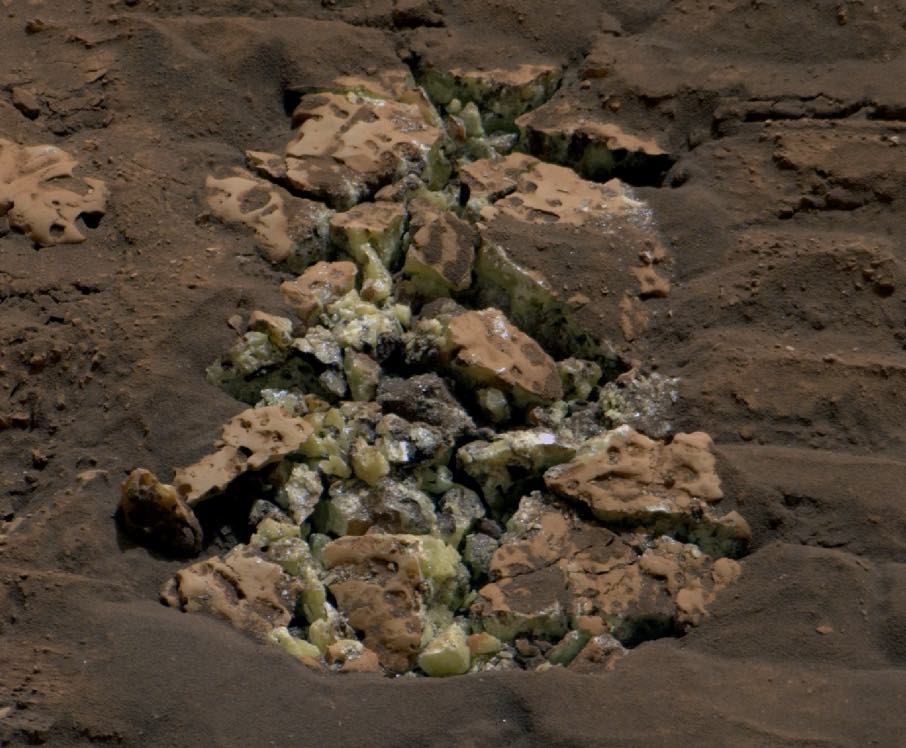
NASA’s Curiosity rover has made an uncharacteristically colorful discovery on the Red Planet. It revealed a small pocket of yellow crystals hidden within a stone on the Martian surface.

The colorful stones, composed of sulfur, were found on May 30 during the rover’s exploration of a sulfate-rich region of the Martian surface. However, the discovery of the bright yellow crystalline mineral was an unexpected find for the Curiosity team, marking a colorful first that, to date, has never been previously encountered on the Red Planet.

The discovery raises several intriguing questions about Mars and its history, as well as what environmental factors could have led to the formation of the crystals.

A Chance Discovery

Since October 2023, Curiosity has been scouring the Gediz Vallis channel on Mount Sharp, an area where scientists believe ancient lava flows occurred in the planet’s early history. The Martian rover has concentrated its explorations in the area, given the region’s promising potential for having once been home to microbial life or even the possibility that it may still be a present-day refuge for such simple organisms.

sulfur on Mars The sulfur was revealed in a chance discovery as NASA’s Curiosity rover smashed open a rock by driving over it (Credit: NASA/JPL-Caltech/MSSS).

The discovery of the colorful mineral was made by chance, as Curiosity cracked open a rock while driving over it. To the Curiosity team’s surprise, the yellow interior of the stone revealed what is likely to be pure sulfur, whereas the sulfates that are normally encountered in the area are salts comprised of combinations of sulfur and other minerals.

Unveiling Mount Sharp’s Mysteries

Since 2014, NASA’s Curiosity rover has made its ascent of Mount Sharp, where its explorations of the Gediz Vallis channel have revealed a portion of the landscape once shaped by ancient water flows on the planet. Curiosity’s present mission is to investigate whether this ancient channel and its surrounding terrain could have supported microbial life, particularly at a time when water was more abundant on Mars.

“This was not a quiet period on Mars,” according to Becky Williams, a scientist at the Planetary Science Institute and deputy principal investigator of Curiosity’s Mast Camera. “There was an exciting amount of activity here.

“We’re looking at multiple flows down the channel, including energetic floods and boulder-rich flows,” Williams said.

Going forward, the Curiosity team hopes to conduct drilling on larger rocks in the area to determine if they may also contain sulfur crystals. Presently, the relationship between elemental sulfur and other sulfur-based minerals in the area remains unclear to scientists studying the Martian environment.

“Finding a field of stones made of pure sulfur is like finding an oasis in the desert,” said Ashwin Vasavada, Curiosity’s project scientist at NASA’s Jet Propulsion Laboratory.

“It shouldn’t be there, so now we have to explain it,” Vasavada said in a statement.

“Discovering strange and unexpected things is what makes planetary exploration so exciting.”

{ https://thedebrief.org/category/space/ }

Hoe vind je dit bericht?
Geschreven door peter om 23:11 Stuur door

Mysterious Gigantic Features Discovered Beneath Antarctica’s Dotson Ice Shelf by Underwater Robotic Survey

x42CTaJD?format=jpg&name=900x900

Mysterious Gigantic Features Discovered Beneath Antarctica’s Dotson Ice Shelf by Underwater Robotic Survey

New imagery from beneath Antarctica’s Dotson Ice Shelf obtained by an underwater robot has revealed previously unseen features, some of them hundreds of feet long, that provide scientists an unprecedented look at the dynamics of the southernmost continent’s ice shelves.

A red boat floating in blue ocean against a blue sky. Ice bergs are seen in the far distance.

Ran, an undersea robot that uses sonar to collect data of the underside of the Dotson Ice Shelf in Antarctica, surfacing after a dive into a Dotson cavity in January 2022.

Credit...Li Ling/KTH Royal Institute of Technology

The recent findings reveal how ocean temperature and circulation are changing, which contributes to the steady increase in melting observed on Antarctica’s ice shelves in recent years, as well as to the rise of global sea levels.

With the help of advanced capabilities that include the use of undersea robots, scientists are now assembling a clearer picture than ever before of the dynamics of melt occurring at the ice base of West Antarctica’s Dotson Ice Shelf.

Visualization of the sand dune shaped ice structures, with three large and three small curves of dark under the ice

Visualization of the sand dune shaped ice structures found on the underside of the Dotson Ice Shelf. 

(Image credit: Filip Stedt / University of Gothenburg)

Basal Melt Processes and Ice Shelf Stability

Melt rates beneath Antarctic ice shelves often show remarkable variability. One factor that influences this process, one that scientists have focused on in recent years, is how warmer salt water interacts with the ice along the base of the continent’s ice sheets.

One significant mechanism that contributes to this mixing of warm water into the ice-ocean boundary is turbulence resulting from shear-driven mixing. Another is vertical convection, which includes a process known as double-diffusive convection, although these generally produce lower melt rates. However, when combined, these processes have now been revealed to produce uniquely shaped features on the base of the ice, which include the formation of what are sometimes very large basal channels and terraces.

Due to varying oceanic conditions, ice can sometimes melt at different rates even along the same ice shelf. This appears to be caused by factors that include not only ocean temperature but also the speed of ocean water’s movement, both of which contribute to diverse formations of natural features along the base of Antarctica’s ice.

According to new findings detailed in a study published in Science Advances, researchers have successfully mapped these changes with the help of an autonomous underwater vehicle (AUV), revealing remarkable and never-before-seen details about the processes that are driving accelerated melt along the continent’s ice shelves.

A grayish-blue image with what looks like streaks of water in a random pattern.

Structures mapped by an undersea robot named Ran on the underside of the Dotson Ice Shelf in Antarctica. The streaks, etched by currents, are up to 60 feet deep and miles long.

Credit...Filip Sted/University of Gothenburg

The Dotson Ice Shelf Mapped in Detail

In the team’s study, the researchers produced high-resolution maps of the underside of the Dotson Ice Shelf, made possible by an AUV that produced data covering close to 140 square kilometers. The new data revealed features such as plateaus, teardrop-shaped formations, and erosion patterns that appear to correlate with the variety of different conditions that contribute to ice melt.

Overall, the research team found that the basal topography of the Dotson Ice Shelf varies significantly between its eastern and western portions. While the ice is thicker and appears to be melting more slowly to the east, on the opposite end, the opposite is the case, with noticeably thinner ice indicating higher melt rates.

In their study, the research team links these variances in ice melt rates to the presence of what is called modified Circumpolar Deep Water (mCDW), which refers to Pacific and Indian Ocean water mixing with other nearby water masses and interacting with the ice base. Faster-moving currents in the western region revealed smooth features on the base of the ice, accompanied by higher melt rates.

In contrast, the central and eastern regions of the ice sheet bore evidence of terraced features, which the research team attributes to warm water intrusions that occur closer to these areas.

Dotson Ice Sheet Visualization of features located beneath the Dotson Ice Sheet, obtained with the aid of an underwater robot (Credit: Filip Stedt / University of Gothenburg).

Ultimately, the presence of remnant winter water and mCDW mixtures was revealed to produce streaks of temperature and meltwater that significantly influence overall melt rates. The team’s findings through AUV observations help to reveal how future missions may be able to reveal further details about the Antarctic ice base and how shear-driven turbulence and the presence of warm water accelerate melting in the western outflow region.

“This new wealth of processes, all active under a single ice shelf, must be considered to accurately predict future Antarctic ice shelf melt,” the team writes in their recent study. Going forward, ongoing mapping and study of the ice shelf will be crucial in order to refine existing models, in addition to improving our understanding of ice-ocean interactions and their relationship to rising sea levels in the years ahead.

The team’s new study, “Swirls and scoops: Ice base melt revealed by multibeam imagery of an Antarctic ice shelf,” by Anna Wahlin, et al., appeared in Science Advances on July 31, 2024.

A visualization of an area in the east, where the water eroded several layers of ice. The structures are carved 20 meters deep into the ice, and they are several kilometers long.CreditCredit...

Filip Stedt/University of Gothenburg

A span of white ice with a large crack running through it seen against a blue sky.

A top level view, taken by the researchers from a helicopter survey, of a crack along the front of the Dotson Ice Shelf.

Credit...Clare Eayrs/Korea Polar Research Institute

{ https://thedebrief.org/category/science/ }

Hoe vind je dit bericht?
Geschreven door peter om 22:55 Stuur door

The Day After Tomorrow? A climate disaster could occur at ANY time in the next 6,000 years, scientists warn

The Day After Tomorrow? A climate disaster could occur at ANY time in the next 6,000 years, scientists warn

  • Researchers say it's almost impossible to predict timing of climate tipping points
  • They warn catastrophe could strike at any time in the next 6,000 years

It's the film that left us all wary of disastrous and abrupt climate change.

But The Day After Tomorrow is probably not when we're going to experience apocalyptic weather events, according to a study.

Researchers argue that it's almost impossible to predict the timing of climate tipping points – and that catastrophe could strike at any time in the next 6,000 years.

A team from the Technical University of Munich and the Potsdam Institute for Climate Impact Research provided the Atlantic Meridional Overturning Circulation (AMOC) as an example.

This system circulates water from north to south and back in a long cycle within the Atlantic Ocean, carrying warm water from the tropics northwards.

It's the film that left us all wary of disastrous and abrupt climate change. But The Day After Tomorrow is probably not when we're going to experience apocalyptic weather events, according to a study

It's the film that left us all wary of disastrous and abrupt climate change. But The Day After Tomorrow is probably not when we're going to experience apocalyptic weather events, according to a study 

Climate models suggest the AMOC will weaken over the 21st century due to increases in greenhouse gases and melting ice.

If the system collapsed the Northern Hemisphere would get colder, causing temperatures in Europe to drop dramatically.

Wet seasons in the Amazon rainforest would be reversed to dry seasons, and in coastal cities the sea would rise even faster.

Previous predictions from historical data suggest a collapse could occur between 2025 and 2095.

However, the new study revealed that uncertainties are so large that these predictions are not reliable.

Using different data sets and analysis, tipping times for the AMOC ranged from 2050 to 8065 – a 6,000-year window which isn't particularly useful, the researchers said.

Writing in the journal Science Advances they said the timing of other climate tipping points – such as the melting of the polar ice sheets or the collapse of tropical rainforests – are also too uncertain.

This is because there is too much still unknown about the underlying physical mechanisms of climate change, a lack of direct observations of the climate system, and incomplete history data, they explained.

Lead author Maya Ben-Yami said: 'Our research is both a wake-up call and a cautionary tale.

Climate models suggest the AMOC will weaken over the 21st century due to increases in greenhouse gases and melting ice. If the system collapsed the Northern Hemisphere would get colder, causing temperatures in Europe to drop dramatically

Climate models suggest the AMOC will weaken over the 21st century due to increases in greenhouse gases and melting ice. If the system collapsed the Northern Hemisphere would get colder, causing temperatures in Europe to drop dramatically 

'There are things we still can't predict, and we need to invest in better data and a more in-depth understanding of the systems in question.

'The stakes are too high to rely on shaky predictions.'

While the study shows we cannot reliably predict tipping events, the possibility of such events cannot be ruled out either, the team said.

They also stressed that statistical methods are still very good at telling us which parts of the climate have become more unstable.

'We still need to do everything we can to reduce our impact on the climate, first and foremost by cutting greenhouse gas emissions,' co-author Niklas Boers said.

'Even if we can't predict tipping times, the probability for key Earth system components to tip still increases with every tenth of a degree of warming.'

{ https://www.dailymail.co.uk/ }

Hoe vind je dit bericht?
Geschreven door peter om 22:30 Stuur door

Flakes of Natural Graphene Found in Lunar Soil Samples

Flakes of Natural Graphene Found in Lunar Soil Samples

 by Natali Anderson

In lunar regolith samples collected by China’s Chang’e-5 probe, planetary scientists have identified few-layer graphene formed together with complex minerals. The finding provides new insights into the origin of the Moon, supporting the hypothesis of a carbon-containing Moon.

Structural and compositional characterization of few-layer graphene in the Chang’e-5 lunar soil sample. Image credit: Zhang et al., doi: 10.1093/nsr/nwae211.

Structural and compositional characterization of few-layer graphene in the Chang’e-5 lunar soil sample.

Image credit: Zhang et al., doi: 10.1093/nsr/nwae211.

“Graphene has revolutionized the research of condensed matter physics and materials science with its novel physical phenomena and extraordinary properties,” said Jilin University Professor Wei Zhang and colleagues.

“It plays an increasingly important role in extensive areas including planetary and space science.”

“It is estimated that around 1.9% of total interstellar carbon is in the form of graphene and protosolar graphene has been identified in carbonaceous chondrite meteorites.”

The researchers analyzed an olive-shaped sample of lunar soil, about 2.9 mm by 1.6 mm, collected by the Chang’e 5 mission in 2020.

Using a special spectrometer, they found an iron compound that is closely related to the formation of graphene in a carbon-rich section of the sample.

They then used advanced microscopic and mapping technologies to confirm that the carbon content in the sample comprised ‘flakes’ that have two to seven layers of graphene.

The scientists proposed that the few-layer graphene may have formed in volcanic activity in the early stages of the Moon’s existence, and been catalyzed by solar winds that can stir up lunar soil and iron-containing minerals that helped transform the carbon atoms’ structure.

Meteorite impacts, which create high-temperature and high-pressure environments, may also have led to the formation of graphene.

Scientists have discovered graphene on the Moon, in a lunar sample returned to Earth

Scientists have discovered graphene on the Moon, in a lunar sample returned to Earth

“This is the first study to verify the presence of natural few-layer graphene in lunar soil samples by examining its microstructure and composition,” the authors said.

“Our finding provides new insights into the origin of the Moon, supporting the hypothesis of a carbon-containing Moon.”

“Moreover, the exotic properties of graphene are highly structurally and environmentally dependent.”

“Further in-depth property investigation of natural graphene would provide more information on the geologic evolution of the Moon.”

“In turn, the mineral-catalysed formation of natural graphene sheds light on the development of low-cost scalable synthesis techniques for high-quality graphene.”

“Therefore, a new lunar exploration program may be promoted and some forthcoming breakthroughs can be expected.”

555b9ec4-d107-4e3a-99b3-e6c0ec46ee34_36747344.jpg?itok=oEQWUpav&v=1719375771

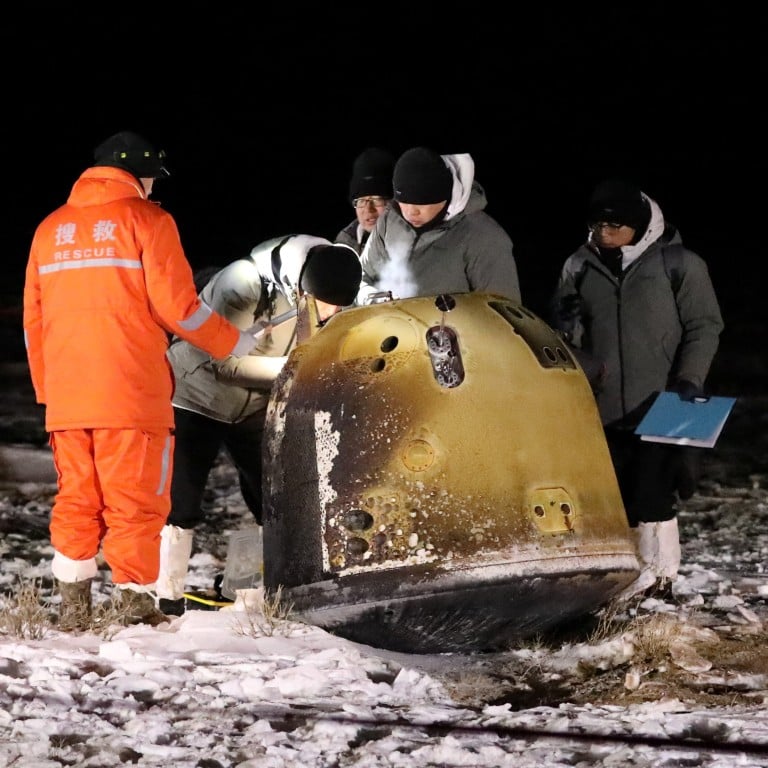
Chinese researchers have discovered a form of carbon in lunar soil samples collected in 2020 which could overturn the theory that the moon was formed by a cosmic collision between Earth and a smaller planet.

Photo: Reuters

  • The findings were published in the journal National Science Review.
  • Wei Zhang et al. Discovery of natural few-layer graphene on the Moon. National Science Review, published online June 17, 2024; doi: 10.1093/nsr/nwae211

{ https://www.sci.news/ }

Hoe vind je dit bericht?
Geschreven door peter om 21:39 Stuur door

Study: Lunar soil has the right stuff for “extraterrestrial photosynthesis”

Study: Lunar soil has the right stuff for “extraterrestrial photosynthesis”

It could pave a way for plants, fuel, and so much more.

 
Photo taken in Berlin, Germany
Rainer Fuhrmann / EyeEm/EyeEm/Getty Images

Fresh lunar powder collected less than two years ago shows promising — albeit early — signs that it could support humans in space for long periods.

As part of a recent study published Thursday in the journal Joule, Chinese scientists opened Moon parcels from the country’s Chang’e-5 mission. In December 2020, this spacecraft performed a quick rendezvous with Earth’s natural satellite, collecting lunar soil from the Moon’s "Ocean of Storms" plain (Oceanus Procellarum) and bringing it back to our planet. In the new research, a team analyzed the moondust’s basic building blocks to see how it might serve as a cornerstone for life-sustaining chemical reactions on a future lunar base.

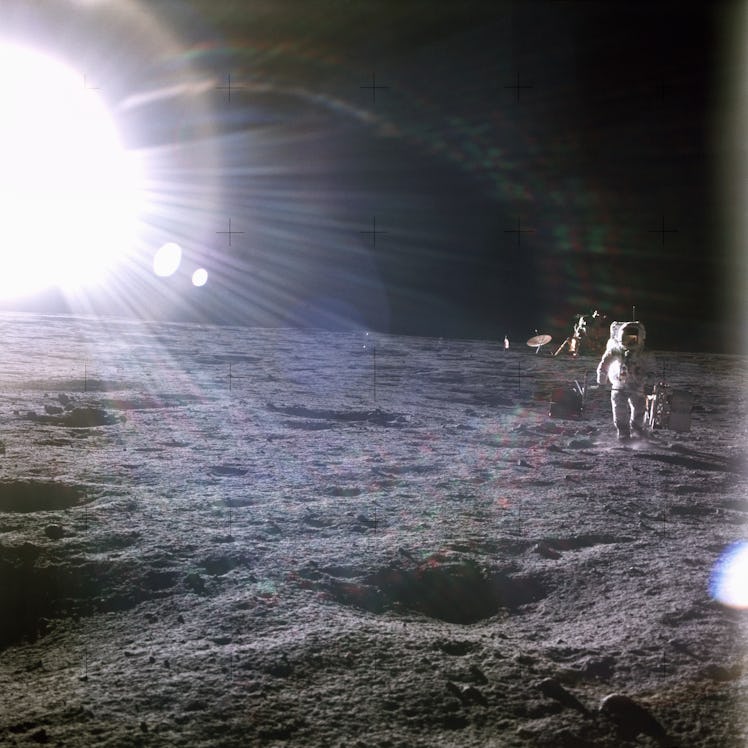
A brilliant sun shines above the Apollo 12 base on the Moon's surface. One of the astronauts walks a...

An Apollo 12 astronaut walking on the Moon’s “Ocean of Storms” region.

NASA./Corbis Historical/Getty Images

What’s new — The new study proposes “extraterrestrial photosynthesis,” a process by which humans in space can draw on just two simple, out-of-this-world ingredients — lunar soil and sunlight — to produce fuel and recycle carbon dioxide back into breathable oxygen on long-duration crewed missions to the Moon and Mars.

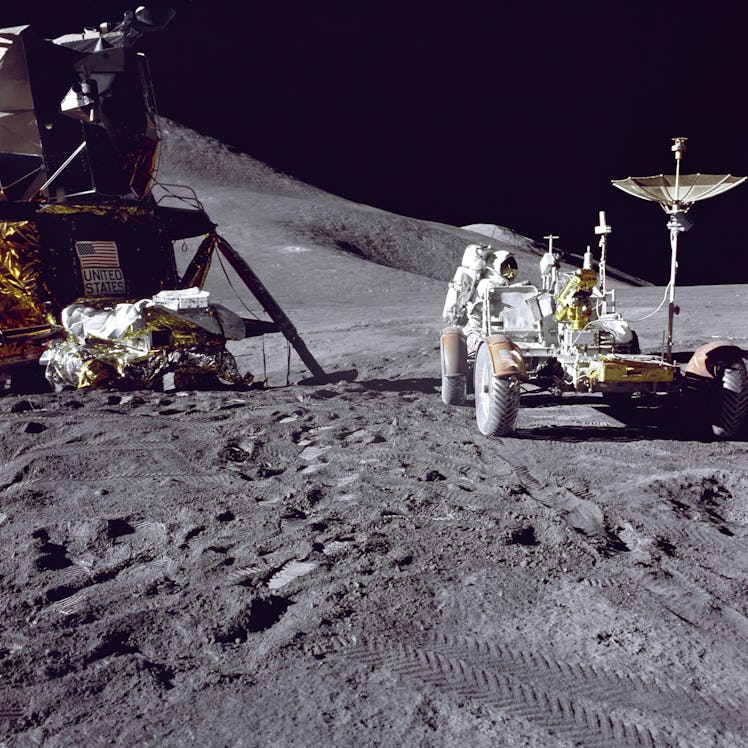
One major talking point for space agencies with their eyes to the skies: How do you power a trip far from Earth? The longest crewed lunar mission to date — NASA’s Apollo 15 flight in 1971 — lasted 12 days. They maintained themselves on the supplies they brought along, which had the heaviest payload in a lunar orbit at about 107,000 pounds.

Digging into the details — The study looks at ways to replenish water, oxygen, and fuel by using human byproducts, solar radiation, and local lunar soil called regolith. If this is successfully achievable, space agencies can save on cargo weight and vehicle space for crewed missions lasting weeks or even months.

Their preliminary findings inspired them to propose a model for how a self-sustaining Moon outpost could work.

Apollo 15 - NASA, 1971. Apollo 15 launched on July 26, 1971. Here Apollo 15 lunar module pilot Jim I...

Apollo 15 lunar module pilot Jim Irwin loads the lunar rover. 

Heritage Images/Hulton Archive/Getty Images

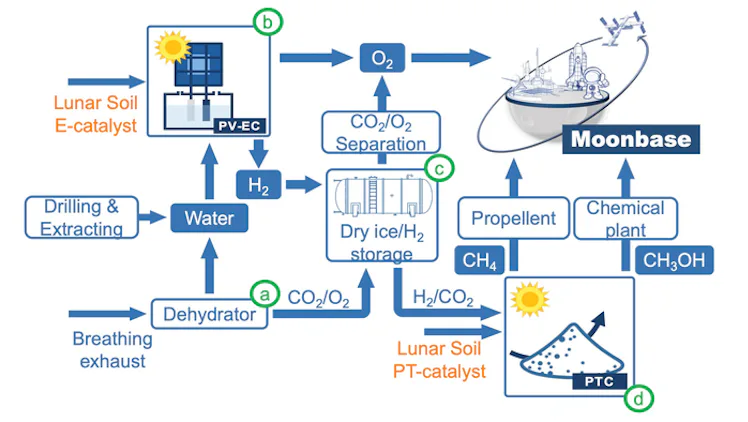
The team analyzed the Chang’e-5, or “CE-5,” regolith samples to see what chemicals they contained and then investigated how well these components could catalyze carbon dioxide into oxygen. Exhaled breath might be used for potable water, or turned into hydrogen or methane for fuel.

Their experiments yielded some positive results. They saw bubbles of hydrogen and oxygen gas, for example. The paper reports that compounds in lunar regolith catalyzed a reaction during a photovoltaic-driven water electrolytic (PV-EC) test, which takes light and water and turns the liquid into those two gases. On the Moon, the water used here would come from lunar ice and human breath that would have previously gone through a dehydrating process. The astronauts would use the water for drinking.

A diagram shows a series of arrows and boxes, outlining the sequence of processes to turn human exha...

A diagram for “extraterrestrial photosynthesis.” 

Yingfang Yao (CC BY-SA)

What’s next — A lot more needs to be done before the research is Moon-ready. The researchers wrote that “the current catalytic performance from the CE-5 lunar sample cannot fully satisfy the requirement of extraterrestrial survival,” adding that their findings weren’t on par with the efficiency of existing catalyst systems on Earth.

They wrote that researching the compounds on the Moon more thoroughly could lead to more success.

{ https://www.inverse.com/ }

Hoe vind je dit bericht?
Geschreven door peter om 21:36 Stuur door

UFO over Spain? Tourist video captures strange object vanishing in seconds, UAP Sighting News.

UFO over Spain? Tourist video captures strange object vanishing in seconds, UAP Sighting News.

The UFO was spotted in Ibiza, Spain.
© Provided by Hindustan Times
UFO,%20Spain.png

UFO,%20UAP.png
Date of sighting: July 31, 2024
Location of sighting: Ibiza, Spain

Watch the video here:

Introduction

Unidentified flying objects (UFOs) have intrigued humanity for decades, sparking countless debates and discussions about the existence of extraterrestrial life. These sightings often stir the imagination and provoke questions about what lies beyond our planet. The latest UFO sighting comes from the picturesque island of Ibiza, Spain, where a group of tourists captured a mysterious object in the sky that vanished within seconds. This astonishing video has now gone viral, captivating the attention of UFO enthusiasts and skeptics alike.
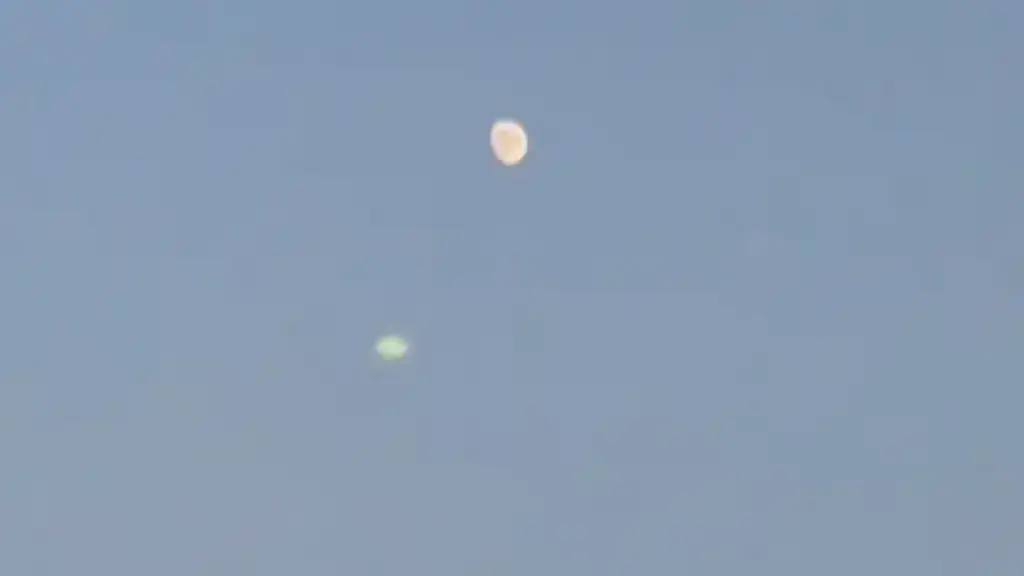
Green light UFO sighting near the moon in the sky over Es Vedrà, Ibiza.

Green Light in Ibiza Skies: UFO or Illusion?

The Incident

The incident occurred on a clear day near the coastline of Ibiza, a popular tourist destination known for its stunning beaches and vibrant nightlife. A group of tourists, enjoying the scenic beauty near a cliff, inadvertently became witnesses to an unusual phenomenon. The video, recorded by one of the tourists, begins with a serene view of the landscape, capturing the natural beauty of the area.

Suddenly, the tranquility is interrupted by a girl running and pointing towards the sky, drawing the attention of the others. The camera follows her gesture, panning to reveal a bright, clear sky with the moon prominently visible. Beside the moon, an unidentified object appears, hovering momentarily before it disappears within seconds. The object’s sudden vanishing act leaves the onlookers stunned and puzzled.

Public Reaction

The video quickly gained traction on social media, with users from around the world sharing and commenting on the mysterious sighting. UFO enthusiasts were particularly excited, viewing the footage as potential evidence of extraterrestrial activity. Skeptics, on the other hand, offered various explanations ranging from natural atmospheric phenomena to sophisticated drones or even a hoax.

Regardless of one’s stance on the existence of UFOs, the video has undeniably sparked curiosity and debate. Many people are fascinated by the possibility of encountering something beyond the realm of known science, while others enjoy the mystery and intrigue that such sightings bring.

Expert Opinions

To gain a deeper understanding of the sighting, several experts were consulted. Dr. Laura Mendes, an astronomer and UFO researcher, analyzed the footage and provided her insights.

“The video is intriguing, and while it does show an unidentified object, it’s important to approach such sightings with a scientific mindset. There are many plausible explanations, including atmospheric distortions, reflections, or man-made objects. Without more data, it’s difficult to draw any definitive conclusions,” Dr. Mendes stated.

Aviation expert Carlos Rodriguez also weighed in on the sighting. “Given the proximity to a tourist area, it’s possible that what was seen could be a drone or another type of aircraft. However, the rapid disappearance is unusual and warrants further investigation,” he remarked.

Historical Context of UFO Sightings

UFO sightings have been reported for centuries, with varying levels of credibility and detail. From ancient texts describing celestial events to modern-day videos captured on smartphones, the phenomenon has persisted through time. One of the most famous incidents is the Roswell incident of 1947, where an alleged UFO crash in New Mexico spurred widespread speculation and conspiracy theories.

In recent years, the U.S. government has declassified numerous reports and videos of unidentified aerial phenomena (UAP), reigniting interest in the topic. These disclosures have lent some credibility to the notion that there are aerial objects that defy conventional explanations.

The Science Behind UFOs

While the idea of extraterrestrial visitors is captivating, scientists urge caution and critical thinking. Most UFO sightings can be attributed to natural phenomena or human activities. For instance, weather balloons, experimental aircraft, and atmospheric conditions can create optical illusions that mislead observers.

The scientific method relies on reproducibility and evidence. For a UFO sighting to be considered credible, it must be corroborated by multiple witnesses, radar data, and other forms of empirical evidence. In the case of the Ibiza sighting, while the video is compelling, more information would be needed to reach a conclusive explanation.

The Cultural Impact of UFO Sightings

UFO sightings often capture the public’s imagination and inspire various forms of media, including movies, books, and television shows. The idea of encountering alien life forms has become a staple of science fiction, reflecting humanity’s curiosity and desire to explore the unknown.

Movies like "Close Encounters of the Third Kind" and "Independence Day" have popularized the concept of UFOs and alien encounters, blending entertainment with speculative science. These cultural artifacts shape our perception of UFO sightings, often blurring the lines between fiction and reality.

Personal Accounts and Eyewitness Testimonies

Eyewitness testimonies play a crucial role in the study of UFO sightings. Personal accounts, like the one from Ibiza, provide valuable insights into how these phenomena are experienced and perceived by individuals. However, eyewitness accounts are also subject to cognitive biases and memory distortions, which can affect the accuracy of the observations.

In the Ibiza case, the tourists’ reactions and the immediate recording of the event add a layer of authenticity to the sighting. Their spontaneous responses and genuine astonishment suggest that they truly witnessed something unexpected.

The Role of Technology in UFO Sightings

Advancements in technology have significantly impacted the documentation and analysis of UFO sightings. High-resolution cameras, drones, and satellite imagery provide new tools for capturing and investigating aerial phenomena. These technologies can help distinguish between known objects and genuinely unidentified ones.

The Ibiza video, recorded on a smartphone, benefits from modern technology, offering clear footage that can be analyzed frame by frame. This level of detail was not available in earlier UFO sightings, making contemporary reports more credible and easier to scrutinize.

Government Involvement and Disclosure

Governments worldwide have historically shown interest in UFO sightings, often conducting secret investigations. The U.S. government’s recent release of UAP reports has highlighted the importance of transparency and scientific inquiry in addressing these phenomena.

In Spain, the government has not released any official statements regarding the Ibiza sighting. However, the increasing public interest in UFOs may prompt authorities to take a more proactive role in investigating and disclosing information about such incidents.

Conclusion

The UFO sighting in Ibiza has captured the imagination of people around the world, reigniting debates about the existence of extraterrestrial life and the nature of unidentified flying objects. While the video offers a tantalizing glimpse of something unexplained, it also underscores the need for rigorous scientific investigation and critical thinking.

As technology continues to advance and more sightings are documented, the mystery of UFOs may eventually be unraveled. Until then, incidents like the one in Ibiza will continue to intrigue and inspire, reminding us of the vastness and wonder of the universe.

Whether you are a skeptic or a believer, the sighting serves as a reminder that there is still much to explore and discover in our world and beyond. The quest for understanding UFOs is not just about finding answers but also about embracing the unknown and celebrating the human spirit of curiosity and exploration.


{ https://www.ufosightingsdaily.com/ }

Hoe vind je dit bericht?
Geschreven door peter om 21:10 Stuur door

Cryptoterrestrials: Are Aliens Already Living Among Us?

Cryptoterrestrials: Are Aliens Already Living Among Us?

aliens among us

The concept of extraterrestrial life has long captivated the human imagination, often depicted as beings visiting Earth from distant galaxies. However, a compelling hypothesis suggests an alternative possibility: aliens might already be living among us, hiding in plain sight as “cryptoterrestrials.” This theory challenges traditional views of alien life and opens up intriguing discussions about the nature of extraterrestrial existence on Earth.

Understanding the Cryptoterrestrials Hypothesis

The cryptoterrestrials hypothesis proposes that extraterrestrials are not just visiting Earth but have been residing here, possibly for millennia. Unlike the typical depiction of aliens arriving in spaceships from far-off planets, cryptoterrestrials are thought to be integrated into human society, cleverly disguised to avoid detection. This idea shifts the focus from outer space exploration to a more introspective examination of life on Earth.

Four Categories of Cryptoterrestrials

The hypothesis can be divided into four distinct categories, each presenting a unique perspective on how aliens might be living among us:

  1. Ancient Super Civilization: This theory suggests that an advanced civilization once thrived on Earth but was destroyed by a catastrophic event, such as a flood. The survivors of this civilization, possibly connected to legends like Atlantis, might still be present today, blending into human society.
  2. Animal-Like Alien Civilization: Another possibility is that a complex civilization of aliens exists, resembling more animal-like beings rather than humanoid forms. These creatures might have developed unique ways to coexist with humans, perhaps living in remote or hidden locations.
  3. Hidden Underground Aliens: Some theorists propose that aliens are hiding underground, utilizing Earth’s vast subterranean environments to remain concealed. This notion aligns with various myths and legends of underground worlds inhabited by mysterious beings.
  4. Magical or Mythical Beings: The final category encompasses the idea that aliens could be perceived as mythical creatures, such as sprites, fairies, or goblins. These beings might possess abilities that enable them to exist undetected, contributing to folklore and mythical narratives.

Speculation and Skepticism

The cryptoterrestrials hypothesis, while intriguing, is primarily speculative. It seeks to expand the boundaries of thought and academic discussion, challenging established notions about extraterrestrial life. However, it’s important to note that proponents of this hypothesis acknowledge the lack of concrete evidence supporting the idea of aliens walking among us. The hypothesis is intended to provoke thought and encourage exploration of alternative possibilities rather than make definitive claims.

The Role of Media and Public Perception

Media plays a significant role in shaping public perception of the cryptoterrestrials hypothesis. Sensationalist headlines and exaggerated claims can often distort the original intentions of speculative discussions. While some media outlets may present the idea humorously or dismissively, it is crucial to approach such topics with an open mind and a critical eye.

A Historical Perspective

Throughout history, many revolutionary scientific ideas have initially been met with skepticism and ridicule. The notion of a round Earth, once considered absurd, eventually became a widely accepted fact. Similarly, the cryptoterrestrials hypothesis challenges us to reconsider our understanding of life on Earth and the potential for hidden civilizations.

Conspiracy Theories and Cultural Influences

The cryptoterrestrials hypothesis intersects with various conspiracy theories and cultural beliefs about non-human entities living among us. Concepts like “lizard people” or “skinwalkers” have circulated for decades, often rooted in folklore and mythology. The hypothesis serves as a framework to explore these longstanding ideas and examine their plausibility in a modern context.

The Possibility of Alien Integration

While the cryptoterrestrials hypothesis remains speculative, it raises thought-provoking questions about the potential motivations and methods of extraterrestrial life integrating into human society. If aliens are indeed living among us, what could they gain from such integration? Would their presence have an impact on human culture, technology, or evolution?

The Age of the Galaxy and Earth’s History

Considering the vast age of the galaxy, estimated to be around 13 billion years, and Earth’s 4.5 billion-year history, there is ample time for the development and evolution of intelligent life forms. If cryptoterrestrials do exist, they might have arrived on Earth long before humans, potentially influencing the course of human history in ways we have yet to understand.

VIDEO:

  • Cryptoterrestrials: Aliens Walking Among Us? | Strange & Suspicious TV Show

The cryptoterrestrials hypothesis invites us to expand our perspective on extraterrestrial life, challenging the conventional narrative of aliens as distant visitors. While evidence supporting the existence of cryptoterrestrials is currently lacking, the hypothesis encourages curiosity and exploration of alternative explanations for unexplained phenomena. As scientific understanding evolves, the possibility of discovering hidden civilizations or new forms of life continues to inspire both intrigue and skepticism. Ultimately, the cryptoterrestrials hypothesis serves as a reminder of the boundless mysteries that the universe, and perhaps even our own planet, still holds.

{ https://www.latest-ufo-sightings.net/ }

Hoe vind je dit bericht?
Geschreven door peter om 18:55 Stuur door

20 Years Later, MESSENGER Is Still Giving Us Strange Hidden Gems

20 Years Later, MESSENGER Is Still Giving Us Strange Hidden Gems

A recent study looking decades-old data suggests Mercury may have a 10-mile-thick layer of diamond deep in its interior.

 
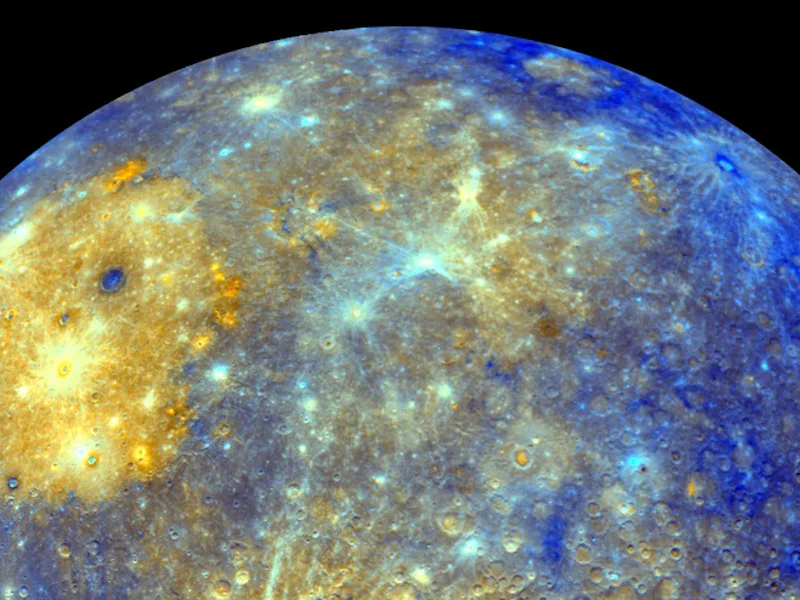
False color image of Mercury from NASA
NASA

Diamonds aren't the traditional 20th anniversary gift, but we're not going to complain, since these came from a spacecraft that crashed into the surface of Mercury back in 2015.

NASA's MESSENGER spacecraft launched 20 years ago, on August 2, 2004, and although its mission ended in 2015, MESSENGER's observations of the Sun-scorched planet are still yielding new discoveries today. A recent study of MESSENGER data suggests that a 10-mile-thick layer of diamond might lie deep inside Mercury, between the planet's mantle and its core. That's a heck of a find from a defunct spacecraft!

Yongjiang Xu, of the Center for High Pressure Science and Technology Advanced Research in Beijing, and his colleagues published their work in the journal Nature Communications.

The surface of Mercury, as photographed by the Mariner 10 craft, circa 1974. (Photo by Space Frontie...

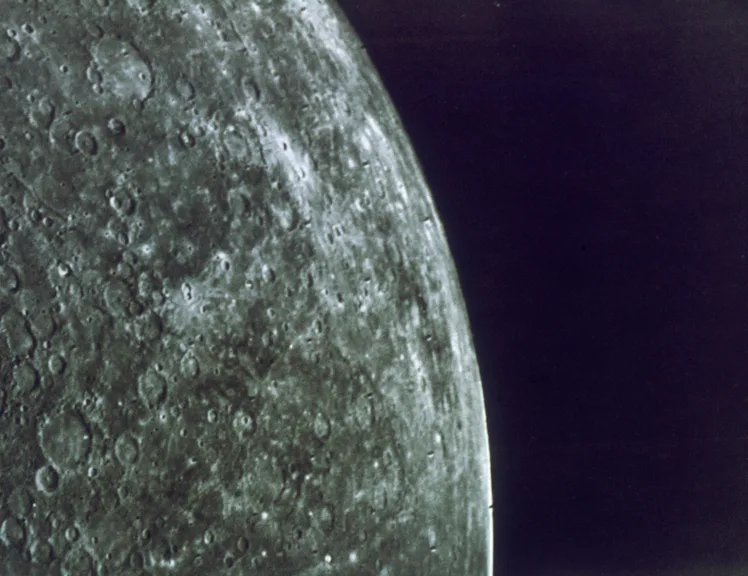
The dark patches on Mercury’s surface, seen in this photo from Mariner 10 in 1974, are graphite.

Space Frontiers/Archive Photos/Getty Images

Diamonds In The Rough

Like most rocky planets, Mercury was once a seething, churning ball of magma. Over time, that magma cooled and solidified, and in the process, it settled into layers — giving the planet a dense inner core, a slightly lighter and mostly fluid mantle, and a light, rocky outer crust. To simulate that process, Xu and his colleagues made digital models using data from MESSENGER that offered clues about Mercury's inner structure. They also squashed a lot of carbon samples in the lab to see how the material behaved under tremendous heat and pressure.

According to Xu and his colleagues’ simulations, there should be a layer of diamond lying atop Mercury's core and just beneath its mantle — and it could be between 9 and 11 miles thick. The diamond would have crystallized out of an ocean of carbon-rich magma that once covered Mercury billions of years ago.

Meanwhile, on the surface, carbon crystallized into a different (and much less sparkly) form called graphite. Graphite and diamond are both pure carbon, but the atoms are arranged in different crystal structures, which gives the two materials very different properties. At the surface, where pressures and temperatures were much lower, the carbon formed dark, soft graphite. Deep below, the intense pressure beneath Mercury's mantle pressed carbon into diamond — if Xu and his colleagues are right.

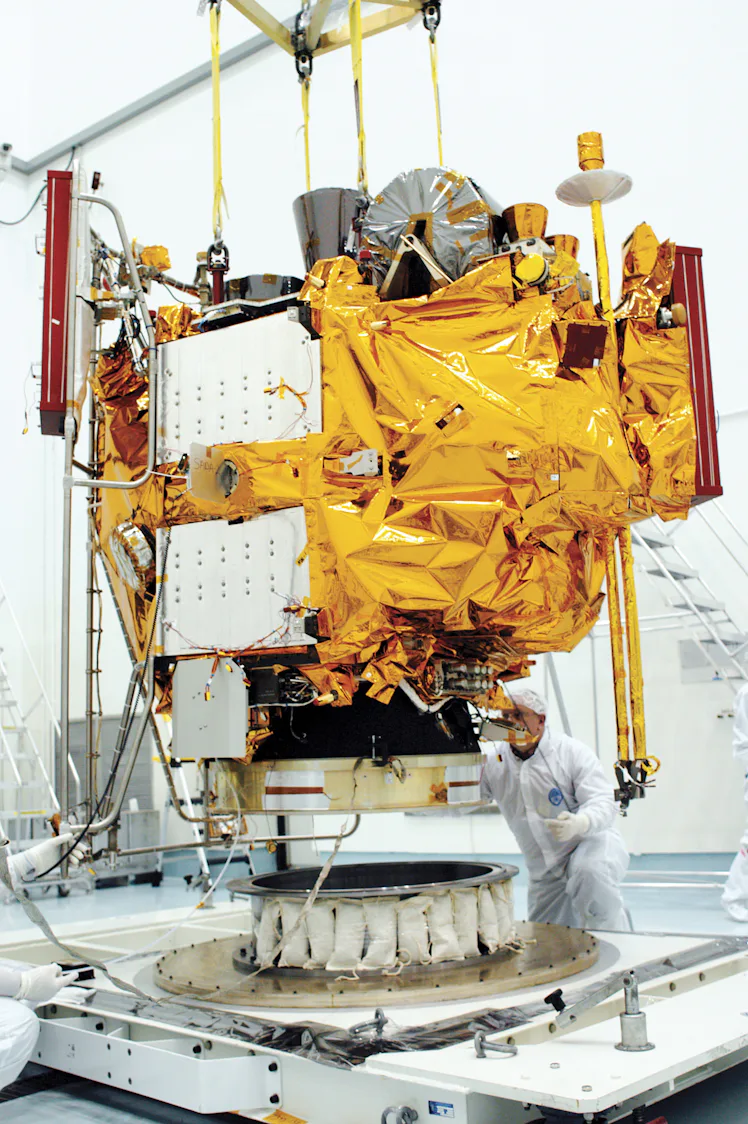
Nasa'S Messenger Spacecraft, Nasa Technicians Carefully Lift The Messenger Spacecraft In Order To Mo...

In this photo, Messenger prepares for prelaunch testing.

Encyclopaedia Britannica/Universal Images Group/Getty Images

Don’t Shoot The Messenger

The finding is just the latest scientific gem MESSENGER has laid at our feet since its launch 20 years ago. It took four years just to reach Mercury in 2008, and then the spacecraft had to make a carefully-planned series of flybys to slow down enough to enter Mercury's orbit without also accidentally getting pulled into the Sun. (Trying to maneuver a spacecraft that close to the Sun's gravitational influence is a challenge.) MESSENGER settled into Mercury's orbit in 2011.

During its four years in orbit around Mercury, MESSENGER revealed some surprising things about our Solar System's innermost planet. One of those is the graphite that dusts its surface, which gives the planet's surface its dark, patchy appearance — and gave Xu and his colleagues the idea for their recent simulations.

MESSENGER also revealed that Mercury has tectonic quakes, similar to the quakes that happen on Earth and Mars, and that the already-small planet is actually shrinking a little bit every year. The mission found evidence of frozen water deep in the permanent shadows of some of Mercury’s polar craters. And there's even a hint that some organic chemistry, and maybe even very simple cells, once could have eked out an existence beneath the planet's surface.

Xu and his colleagues’ simulations may help explain another of MESSENGER's most important discoveries: Mercury's surprisingly strong magnetic field.

For such a small planet, Mercury boasts a disproportionately powerful magnetic field. If Xu and his colleagues are right, the layer of diamond lying beneath the mantle could be changing how heat flows from the core to the mantle (because diamond transfers heat very efficiently). That, in turn, could be changing how convection, currents driven by hot liquid rising and cool liquid sinking, happens in the molten outer layers of Mercury's core. And since all that flowing molten metal is part of what generates the magnetic field, the diamond layer could be a big part of the explanation.

The MESSENGER mission came to a dramatic end on April 30, 2015, when the spacecraft smashed into Mercury's surface at more than 8,000 miles per hour. Because MESSENGER was on the far side of the planet at the time, its human team back on Earth didn't witness its final moments; they heard only the silence of the dead spacecraft failing to resume radio contact a few moments later.

MESSENGER set the foundation for the European Space Agency's BepiColombo mission, and it may also shed light on the interiors of other rocky planets.

"The processes that led to the formation of a diamond layer on Mercury might also have occurred on other planets, potentially leaving similar signatures," says Yanhao Lin, also of the Center for High Pressure Science and Technology Advanced Research in Beijing and a coauthor of the recent study, in a recent statement. The riches of the Universe seem to only grow with time.

{ https://www.inverse.com/ }

Hoe vind je dit bericht?
Geschreven door peter om 18:44 Stuur door

Oorlog in de ruimte: VS voelen hete adem van Rusland en China

Oorlog in de ruimte: VS voelen hete adem van Rusland en China

Oorlog in de ruimte: VS voelen hete adem van Rusland en China

Oorlog in de ruimte: VS voelen hete adem van Rusland en China
© Pixabay

Volgens de New York Times zet het Pentagon spoed achter de voorbereidingen om oorlog in de ruimte te kunnen voeren.  

Washington is ervan overtuigd dat de snelle vooruitgang van China en Rusland op het gebied van ruimteoperaties een groeiende bedreiging vormt voor de Amerikaanse troepen en andere militaire middelen op de grond en satellieten in een baan om de aarde.

De details van de inspanningen van het Pentagon blijven zeer vertrouwelijk. Bepaalde documenten zijn echter onlangs vrijgegeven en gepubliceerd door de New York Times.

Daarin erkennen functionarissen van het Ministerie van Defensie in toenemende mate dat het initiatief een grote verschuiving in militaire operaties weerspiegelt, waarbij de ruimte een echt slagveld zal worden.

De VS zal niet langer alleen vertrouwen op militaire satellieten om te communiceren, navigeren, traceren en te richten op terrestrische bedreigingen, instrumenten die het Pentagon decennialang een aanzienlijk voordeel hebben gegeven in conflicten.

Het ministerie van Defensie wil een nieuwe generatie instrumenten op de grond en in de ruimte verwerven waarmee het zijn satellietnetwerk kan verdedigen tegen aanvallen en, indien nodig, vijandelijke ruimtevaartuigen in een baan om de aarde kan verstoren of uitschakelen, aldus functionarissen van het Pentagon in een reeks interviews, toespraken en verklaringen

De strategie verschilt fundamenteel van eerdere militaire ruimteprogramma's door de uitbreiding van het scala aan offensieve capaciteiten, wat heel anders is dan het voorstel voor het Strategisch Defensie-initiatief uit de jaren tachtig, dat nooit het daglicht zag en dat tot doel had satellieten te gebruiken om de Verenigde Staten te beschermen tegen aanvallen met nucleaire raketten.

  • (SR and MaSi for Tagtik/Source: New York Times/Photo: Pixabay)

{ https://www.msn.com/nl-be/ }

Hoe vind je dit bericht?
Geschreven door peter om 18:31 Stuur door

Meer van UFO'S of UAP'S, ASTRONOMIE, RUIMTEVAART, ARCHEOLOGIE, OUDHEIDKUNDE, SF-SNUFJES EN ANDERE ESOTERISCHE WETENSCHAPPEN - DE ALLERLAATSTE NIEUWTJES

↑ Terug naar de berichten