Naar de inhoud

UFO'S of UAP'S, ASTRONOMIE, RUIMTEVAART, ARCHEOLOGIE, OUDHEIDKUNDE, SF-SNUFJES EN ANDERE ESOTERISCHE WETENSCHAPPEN - DE ALLERLAATSTE NIEUWTJES

UFO's of UAP'S in België en de rest van de wereld
akke.beakke.be
Ontdek de Fascinerende Wereld van UFO's en UAP's: Jouw Bron voor Onthullende Informatie! Ben jij ook gefascineerd door het onbekende? Wil je meer weten over UFO's en UAP's, niet alleen in België, maar over de hele wereld? Dan ben je op de juiste plek! België: Het Kloppend Hart van UFO-onderzoek In België is BUFON (Belgisch UFO-Netwerk) dé autoriteit op het gebied van UFO-onderzoek. Voor betrouwbare en objectieve informatie over deze intrigerende fenomenen, bezoek je zeker onze Facebook-pagina en deze blog. Maar dat is nog niet alles! Ontdek ook het Belgisch UFO-meldpunt en Caelestia, twee organisaties die diepgaand onderzoek verrichten, al zijn ze soms kritisch of sceptisch. Nederland: Een Schat aan Informatie Voor onze Nederlandse buren is er de schitterende website www.ufowijzer.nl, beheerd door Paul Harmans. Deze site biedt een schat aan informatie en artikelen die je niet wilt missen! Internationaal: MUFON - De Wereldwijde Autoriteit Neem ook een kijkje bij MUFON (Mutual UFO Network Inc.), een gerenommeerde Amerikaanse UFO-vereniging met afdelingen in de VS en wereldwijd. MUFON is toegewijd aan de wetenschappelijke en analytische studie van het UFO-fenomeen, en hun maandelijkse tijdschrift, The MUFON UFO-Journal, is een must-read voor elke UFO-enthousiasteling. Bezoek hun website op www.mufon.com voor meer informatie. Samenwerking en Toekomstvisie Sinds 1 februari 2020 is Pieter niet alleen ex-president van BUFON, maar ook de voormalige nationale directeur van MUFON in Vlaanderen en Nederland. Dit creëert een sterke samenwerking met de Franse MUFON Reseau MUFON/EUROP, wat ons in staat stelt om nog meer waardevolle inzichten te delen. Let op: Nepprofielen en Nieuwe Groeperingen Pas op voor een nieuwe groepering die zich ook BUFON noemt, maar geen enkele connectie heeft met onze gevestigde organisatie. Hoewel zij de naam geregistreerd hebben, kunnen ze het rijke verleden en de expertise van onze groep niet evenaren. We wensen hen veel succes, maar we blijven de autoriteit in UFO-onderzoek! Blijf Op De Hoogte! Wil jij de laatste nieuwtjes over UFO's, ruimtevaart, archeologie, en meer? Volg ons dan en duik samen met ons in de fascinerende wereld van het onbekende! Sluit je aan bij de gemeenschap van nieuwsgierige geesten die net als jij verlangen naar antwoorden en avonturen in de sterren! Heb je vragen of wil je meer weten? Aarzel dan niet om contact met ons op te nemen! Samen ontrafelen we het mysterie van de lucht en daarbuiten.

Archief

How Oumuamua Changes Our Perspective on Galactic Panspermia

Artist’s impression of the first interstellar asteroid/comet, "Oumuamua". This unique object was discovered on 19 October 2017 by the Pan-STARRS 1 telescope in Hawaii. Credit: ESO/M. Kornmesser

How Oumuamua Changes Our Perspective on Galactic Panspermia

Panspermia is an innately attractive idea that’s gained prominence in recent decades. Yet, among working scientists, it gets little attention. There are good reasons for their relative indifference, but certain events spark renewed interest in panspermia, even among scientists.

The appearance of Oumuamua in our Solar System in 2017 was one of them.

Panspermia is the hypothesis that life can travel throughout the Universe by hitching an unintended ride with space dust, meteoroids, asteroids, comets, and even rogue planets.

It’s an ancient idea, which only increases its resonance for some. The Greek philosopher Anaxagoras was the first to propose it. He coined the term ‘panspermia’ and said that the Universe was full of life and that some of it fell to Earth. It remains on the fringe of science because it can’t explain how life started, and it’s not testable. But it is enduring.

Oumuamua’s appearance sparked renewed interest in Panspermia. After the object came and went rapidly in 2017, scientists attempted to determine what it actually was. Maybe it was a comet, maybe it was an asteroid, maybe it was a chunk of frozen hydrogen. Many hypotheses were presented. Now, we simply call it an interstellar object, or ISO.

From the perspective of panspermia, Oumuamua’s classification isn’t the most pressing concern. It was a visitor to our Solar System from elsewhere, and that’s the most salient point.

In a new paper, a trio of researchers examine how many of these types of objects might exist and what properties they’d need to protect and transport life throughout the galaxy. The paper is titled “The Implications of ‘Oumuamua on Panspermia.” The lead author is David Cao, a high school student who also served as an intern at the Johns Hopkins University Applied Physics Laboratory.

“Panspermia is the hypothesis that life originated on Earth from the bombardment of foreign interstellar ejecta harbouring polyextremophile microorganisms,” the authors write. “By utilizing ‘Oumuamua’s properties as an anchor, we estimate the mass and number density of ejecta in the ISM.”

Throughout their work, they acknowledge that “panspermia is an extraordinarily difficult theory to quantitatively model and assess.” But it’s still worth an attempt because of Oumuamua. “The recently discovered ‘Oumuamua merits a reexamination for the possibility of panspermia, the hypothesis that life seeded on Earth from the bombardment of life-bearing interstellar ejecta and that life can be transferred from one celestial body to another.”

Panspermia is the idea that life is spread throughout the galaxy, or even the Universe, by asteroids, comets, and even minor planets. Credit: NASA/Jenny Mottor Panspermia is the idea that life is spread throughout the galaxy, or even the Universe, by asteroids, comets, and even minor planets. Credit: NASA/Jenny Mottor

The trio determined the minimum size of ejecta needed to protect extremophiles from radiation, especially from supernovae. Intense gamma rays can sterilize ejecta if they’re not large enough for extremophiles to survive in their interiors, shielded by rock or water ice. Ejecta also needs to be large enough to protect any lifeforms from impact with another body. But the size depends on the nature of the ejecta.

“We consider the four most common elemental compositions of asteroids (chondritic, stony and metallic) and comets (water-ice) in our own Solar System: silicate, nickel, iron, and water-ice,” they write. Nickel has the highest attenuation and the smallest minimum size needed to shelter life. Water-ice requires the maximum size.

The authors explain, “We make an assumption that the number density abundances and varying compositions of interstellar ejecta mirror the content of minor bodies in our own Solar System.” Based on that, they settled on a minimum size of 6.6 meters.

They also tried to determine the likelihood that extremophiles could have seeded Earth, though they acknowledge that many of the factors involved are poorly understood and poorly constrained. In order to seed life, an ejecta carrying extremophiles had to have arrived at Earth early, before the earliest evidence of fossilized life. “Second, we estimate the total number of impact events on Earth after its formation and prior to the emergence of life (? 0.8 Gyr).”

They calculate impact rates for objects of different sizes. For objects at least 10 meters in diameter, they calculate that about 40,000 of them could’ve impacted Earth in its first 800,000 years.

This figure from the study shows the total number of collisions by minimum shielding depth for Earth's first 800,000 years. The different dotted, dashed, and solid lines represent distribution slopes. Image Credit: Cao et al. 2024 This figure from the study shows the total number of collisions by minimum shielding depth for Earth’s first 800,000 years. The different dotted, dashed, and solid lines represent distribution slopes. Image Credit: Cao et al. 2024

Existing estimates of the number of Earth-like planets in the Milky Way are available. Based on those, here’s what it all adds up to, keeping in mind all of the poorly constrained factors involved. “However, we find that panspermia is a plausible potential life-seeding mechanism for (optimistically) potentially up to ~ 105 (100,000) of the ~ 109 (one billion) Earth-sized habitable zone worlds in our Galaxy,” the authors write.

But the prospects that Earth itself was seeded by panspermia are very weak. “For the Earth in particular, we conclude that, independent of other hypotheses for the origins of life on Earth, panspermia remains improbable (< 0.001%).” In a way, it’s more of a thought experiment. The authors say that “the true relative probability for panspermia remains unknown.”

The panspermia idea will not disappear. It’s simply too compelling to discard, even though it cannot be tested.

Another way of looking at it is that Earth could be a source of panspermia rather than a receiver.

“The fraction of these rocky planets that possess magnetic fields, atmospheres, and liquid surface water capable of supporting life is currently unconstrained and unknown, but our work implies as many as 104 of these worlds in our Galaxy could be populated with life today via panspermia under the most optimistic assumptions that all of these worlds are capable of supporting ejecta-transported life, with Earth as one of the potential source planets.” The number could rise to 104 under the most optimistic conditions.

There are other factors to consider. We’re only beginning to determine the number of rogue planets or free-floating planets (FFPs). As we learn more about them and their abundance, the panspermia hypothesis will change. “The discovery of rogue-free floating planets (FFPs) suggests a significantly higher ISM ejecta number density than expected for large objects,” the authors explain.

This illustration shows a rogue planet travelling through space. Credit: NASA/JPL-Caltech/R. Hurt (Caltech-IPAC) This illustration shows a rogue planet travelling through space. Credit: NASA/JPL-Caltech/R. Hurt (Caltech-IPAC)

Also, the number of ejecta and their mass haven’t been constant. For example, during the hypothesized Late Heavy Bombardment, a much larger number of objects were crashing into the Earth and the other Solar System bodies. How would that have affected panspermia?

“~4 Gyr ago, the Earth is thought to have experienced an unprecedented number of impact events
that consequently ejected matter into the ISM, the era of Late Heavy Bombardment,” the authors write. The rate of bombardment was between 100 to 500 times greater than the present rate. If other solar systems experienced similar events, there would be substantially more potential for panspermia.

Artist concept of Earth during the Late Heavy Bombardment period. Credit: NASA's Goddard Space Flight Center Conceptual Image Lab. Artist concept of Earth during the Late Heavy Bombardment period. Credit: NASA’s Goddard Space Flight Center Conceptual Image Lab.

The star formation rate also plays a role. “As more stars are formed, more mass will be ejected into the ISM in star formation regions, increasing the production of ISM ejecta number density,” the authors explain.

There are so many unknowns and so much conjecture that many scientists avoid the panspermia theory completely. But more and more data will keep coming our way, and as it does, the idea will be revised and reconsidered.

The Rubin Observatory Large Synoptic Survey Telescope will hopefully see its long-anticipated first light in early 2025. That telescope will undoubtedly detect many more ISOs and FFPs, filling in important gaps in our knowledge.

As that data comes in, expect more attention to be focused on the panspermia theory

{ https://www.universetoday.com/ }

Hoe vind je dit bericht?
Geschreven door peter om 01:45 Stuur door

Starliner Successfully Fires its Thrusters, Preparing to Return to Earth

Boeing’s Starliner crew capsule docked to the Harmony module’s forward port at the International Space Station on July 3, 2024. Photo credit: NASA

Starliner Successfully Fires its Thrusters, Preparing to Return to Earth

Being trapped in space sounds like the stuff of nightmares. Astronauts on board the International Space Station have on occasion, had their return delayed by weather or equipment malfunction. We find ourselves again, watching and waiting as two astronauts; Juni Williams and Butch Wilmore have been stuck for months instead of their week long mission. The delays came as the Starliner system required fixes to be implemented. NASA successfully fired up 27 of its 28 thrusters in a hot-firing test and now, ground teams are preparing finally, to bring them home.

The Boeing Starliner spacecraft is officially known as the CST-100 Starliner. It was developed by Boeing as part of NASA’s Commercial Crew Program. Its purpose is to transport astronauts to the International Space Station and other low orbit craft. Starliner hit the headlines with its reusable design aimed at reducing costs and increasing launch frequency. It was first launched on 20 December 2019 as an uncrewed test flight to demonstrate docking capability with ISS. 

Boeing’s CTS-100 Starliner taking off from Cape Canaveral, Florida, on June 5th, 2024. Credit: NASA

Since 2019 Starliner has had issues along the way but has largely seen a successful progression to becoming a key part of NASA’s launch capability. Just recently however there have been issues with the manoeuvring jets used to adjust the attitude. Engineering teams at NASA and Boeing have been working on and running tests with Mexico a new configuration. Part of the thruster system controls the flow of helium, these are the helium manifolds and they were opened to allow engineers to monitor any helium supply issues and leaks. 

The team ran a hot fire test of the reaction control system jets on 27 July to see if there were any problems with the propulsion system. They test fired 27 out of 28 jets while astronauts Wilmore and Williams sat inside the docked Starliner. The tests involved firing the jets for short bursts, one at a time. They revealed that all thrusters were back to performing well and the helium manifolds were within operational margins that were needed for a return trip from ISS. The engineering teams closed the manifolds ahead of undocking and returning the astronauts home. 

The work is not over for the engineering teams however as they are now reviewing data from the tests and from ground based testing at the White Sands Test Facility in New Mexico. Once the review of data is complete, NASA and Boeing will identify a date to return the astronauts. 

Meanwhile back on board the ISS Wilmore and Williams wait. They have been checking other Starliner systems in preparation for return, working with other Boeing teams to prepare and have been undertaking pressure tests of their space suits. They have been working alongside Expedition 71 members and have recently helped setup the BioServe centrifuge in the Harmony Module. The centrifuge supports a wide range of biological, physical and materials science projects. Facilitating the separation of substances with different densities it can work with cell cultures, DNA, protein, blood and sedimentary samples.

Source : 

{ https://www.universetoday.com/ }

Hoe vind je dit bericht?
Geschreven door peter om 01:36 Stuur door

Astronomers Spotted a Disk Orbiting a Star in Another Galaxy

Astronomers Spotted a Disk Orbiting a Star in Another Galaxy

Story by Michelle Starr

Astronomers Spotted a Disk Orbiting a Star in Another Galaxy

Astronomers Spotted a Disk Orbiting a Star in Another Galaxy
© Provided by ScienceAlert

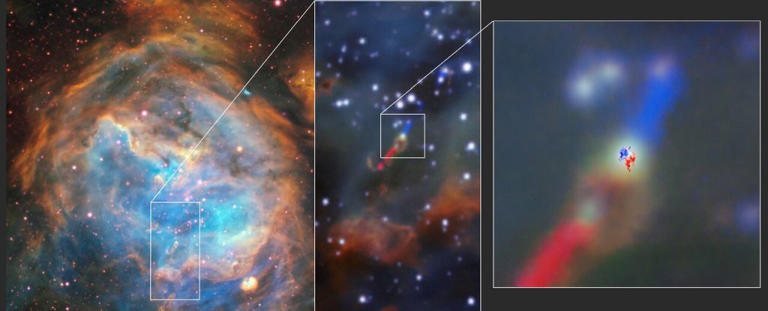
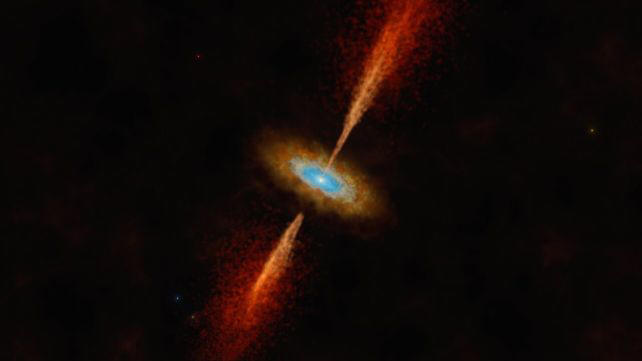
Astronomers have recently spotted signs of an extended disk of dust and gas, whirling in orbit around a distant star.

While this phenomenon is a normal stage in the development of a star and its planetary system, what makes this find so spectacular is that it's the first one we've seen around a star in a whole other galaxy, outside of our own.

The feature was spotted in the Large Magellanic Cloud, a dwarf galaxy some 179,000 light-years away from the Milky Way. And, although it might seem like common sense to suppose that star formation processes are universal, we've not been able to observe their vagaries outside of our home galaxy before.

"When I first saw evidence for a rotating structure in the ALMA data I could not believe that we had detected the first extragalactic accretion disc, it was a special moment," said astronomer Anna McLeod of Durham University in the UK, when the findings were published in November.

"We know discs are vital to forming stars and planets in our galaxy, and here, for the first time, we're seeing direct evidence for this in another galaxy."

An artist's impression of the recently discovered disk. ( ESO/M. Kornmesser )

An artist's impression of the recently discovered disk.
( ESO/M. Kornmesser )
© Provided by ScienceAlert

Stars are born from dense clumps in clouds of molecular gas and dust that hang out in interstellar space. When a clump grows dense enough, it collapses under gravity; spinning, it starts to draw in more material from the cloud around it. This material doesn't just fall onto the protostar any old how, though; it arranges into a disk around the star's equator, and falls down onto it in a more controlled, steady stream, like water down a drain.

Once the star is done forming, what remains of the disk stays there, clumping together to form all the other elements of a planetary system: the planets, the asteroids and meteors, the comets, the dust. That's why the Solar System's planets are more or less orbiting the Sun in a flat plane. We ourselves are like the sentient mold that grew on the leftovers of the Sun's breakfast.

The Atacama Large Millimeter/submillimeter Array (ALMA), a powerful radio telescope, has imaged quite a few such disks throughout the Milky Way, in various stages of development; some have clear gaps that are thought to be cleared by planets clumping together as they orbit. But the farther away something is, the harder it is to resolve, even with a powerful telescope.

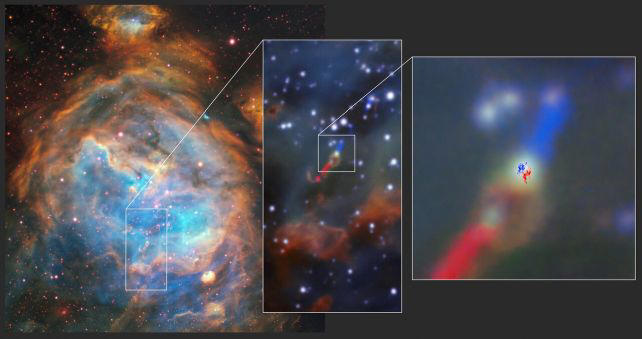
The location and orientation of the jets and disk identified in HH 1177. ( ESO/ALMA (ESO/NAOJ/NRAO)/A. McLeod et al. )

The location and orientation of the jets and disk identified in HH 1177.
( ESO/ALMA (ESO/NAOJ/NRAO)/A. McLeod et al. )
© Provided by ScienceAlert

McLeod and her colleagues embarked on their campaign to find an extragalactic stellar disk when data obtained by the Multi Unit Spectroscopic Explorer (MUSE) instrument on the Very Large Telescope revealed signs of a jet, in a system named HH 1177.

These, too, are a signature of star formation: some of the material swirling around the forming star gets whisked away along its magnetic field lines to the poles, where it is launched into space in the form of a powerful jet.

The researchers wanted to see if they could spot the disk in the dusty heart of star formation, so they used ALMA to look for signs of rotation. This can be seen in the way wavelengths of light are shortened as the source is pushed towards us, and lengthened as they are pulled away.

"The frequency of light changes depending on how fast the gas emitting the light is moving towards or away from us," explained astronomer Jonathan Henshaw of Liverpool John Moores University in the UK. "This is precisely the same phenomenon that occurs when the pitch of an ambulance siren changes as it passes you and the frequency of the sound goes from higher to lower."

Interestingly, the ALMA data showed clear signs of this rotation. The star, the team's analysis revealed, is very young and massive, still feeding from the disk around it. This is pretty normal. But there was a difference between it and the protostellar disks found in the Milky Way: the HH 1177 disk can be seen in optical wavelengths.

This, the researchers explain, has to do with the interstellar environment in the Large Magellanic Cloud. There is much less dust there; so the HH 1177 star is not as shrouded in a curtain of material as young, massive Milky Way stars usually are.

This makes the discovery an important one for studying, not just how stars form in different environments, but the limits those environments can place on star formation in general.

"We are in an era of rapid technological advancement when it comes to astronomical facilities," McLeod said. "Being able to study how stars form at such incredible distances and in a different galaxy is very exciting."

  • The research has been published in Nature.
  • A version of this article was first published in December 2023.

{ https://www.msn.com/en-us/channel/topic/Science/ }

Hoe vind je dit bericht?
Geschreven door peter om 22:46 Stuur door

When Black Holes Die, They Are Reborn As White Holes

When Black Holes Die, They Are Reborn As White Holes

Story by The Physics arXiv Blog
 
When Black Holes Die, They Are Reborn As White Holes

In recent years, black holes have morphed from highly theoretical exotic possibilities to well-observed astrophysical objects. The observational evidence has come from sources such as the first observation of ripples in spacetime caused by black hole collisions and the first image of a black hole published in 2019.

Black holes are predicted by Einstein's theory of general relativity, which describes the universe on the largest scale. But these objects must also distort spacetime on the tiniest scale, meaning that black holes must also have interesting quantum properties. The challenge for theorists is to find ways to unite the disparate theories of relativity and quantum mechanics in a theory of ‘loop' quantum gravity that correctly predicts observations.

And these theorists have been busy. Over the last decade, they have developed an increasingly sophisticated theoretical understanding of black holes that could explain some of the biggest mysteries of cosmology.

Now the physicist and popular science writer Carlo Rovelli with Francesca Vidotto, both at Western University in Canada, review this progress and highlight some of its jaw-dropping conclusions. The new work suggests that when black holes die, they turn into white holes. That myriads of tiny white holes could be passing through the Earth at any time. And that these objects are an ideal candidate for the dark matter that cosmologists believe fills the universe but have never directly observed.

Related video: 
  • What If Earth Fell Into a Black Hole? (Dailymotion)

Astrophysicists have long believed that black holes cannot be large static objects that remain unchanged over the lifetime of the universe. Instead, their work suggests that black holes evolve. Now theoreticians' work with loop quantum gravity has thrown the details of this evolution into stark relief.

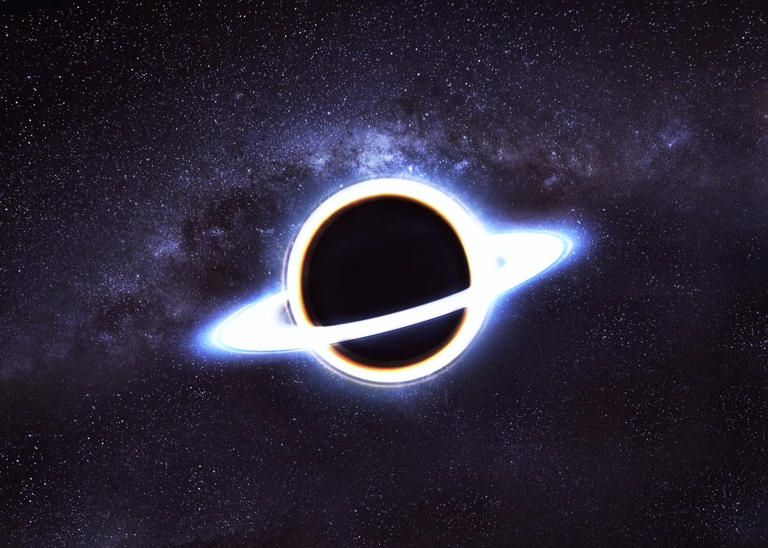
For a start, black holes gradually evaporate by emitting Hawking radiation. This causes the black hole horizon to shrink, while the volume of the interior does not. "This implies that an old evaporated black hole has a small horizon but a huge internal volume," say Rovelli and Vidotto.

This shrinking continues until the hole reaches the tiniest possible size at the Planck Scale. At this point, the quantum energy density becomes great enough to resist further shrinkage. The hole rebounds and undergoes a strange quantum personality change. "At the end of the evaporation, a black hole undergoes a quantum transition to a white hole with a Planckian-size horizon and a vast interior," say the researchers.

This is what cosmologists call a "remnant" of a black hole and understanding the properties of these remnants has been an important part of their work.

White holes have been studied for some time. Like black holes, they are legitimate solutions to Einstein's field equations. "A white hole spacetime is simply the time reversal of a black hole spacetime," say Rovelli and Vidotto.

And like black holes, white holes were not thought likely to play a major role in the universe. This view now needs to change, say Rovelli and Vidotto, just as it has for black hole because the two are intrinsically linked.

One potential stumbling block has always been that the solutions giving rise to white holes are unstable. But Rovelli and Vidotto point out that any instability should lead to the formation of a superposition of both black and white holes that is stable.

The difference is largely academic anyway. To a casual observer, a white hole is indistinguishable from a black hole. It is only their past and future that differ, albeit in a way that is inaccessible to most observers.

An important question is how long remnants last. Rovelli and Vidotto point out that for the remnant itself, the process of full dissipation must happen very quickly. But time dilation means that for a distant observer, it could take the lifetime of the universe.

"Time slows down near high density mass," say the researchers. "An observer (capable of resisting the tidal forces) landing on a Planck matter distribution will find herself nearly immediately in the distant future, at the time where the black hole ends its evaporation." In other words: "A black hole is a shortcut to the distant future," they say.

If all this is accurate, the universe should be full of black hole remnants (or white holes). And their mass should have a gravitational effect on all the visible matter in the universe. That's why remnants are good candidates for dark matter.

"Remnants are a dark matter candidate that does not require exotic assumptions of new forces, or particles or corrections to the Einstein equations, or physics beyond the standard model," say Rovelli and Vidotto. "It only requires general relativity and quantum theory to hold together."

Quantum Detector

But these particles will be very hard to detect because gravity is such a meagre force on this tiny scale. Yet Rovelli and Vidotto say there may be a way.

The idea is to create a mass that exists in two different locations at the same time in a quantum superposition of both states. Then, as a remnant flies past, it will interact via gravity more strongly with the nearer mass, causing the superposition to change in character. Detecting this change would be a sign that a dark matter particle has passed by.

Whether this would uniquely indicate the presence of a black hole remnant is another question yet to be decided. But the important point is that this kind of experiment is close to being possible today.

All that makes this an exciting area of physics to be in. And one that is likely to change as physicists gather more detailed observations of black hole collisions and other quantum gravity phenomenon. So watch this space - black holes, white holes and Planck stars are set to become the coolest things in astrophysics (as if they were ever anything else)!

Ref:

Hoe vind je dit bericht?
Geschreven door peter om 22:36 Stuur door

Where Did Life Come From, Exactly? The Answer Is Out There

Where Did Life Come From, Exactly? The Answer Is Out There

The latest research shows lightning, meteors, and far-off nebulae all played a role in assembling the ingredients for life on early Earth.

 
Abdulaziz Alghmdi / 500px/500px/Getty Images

Several studies in recent years have found amino acids, some of the molecules that make up cell membranes, and other key pieces of the chemistry of life floating on grains of interstellar dust. But a recent experiment also found that the reactions that make nitrogen and carbon available for that kind of chemistry could have happened on early Earth — with remarkable efficiency. So which is it? Did life crash-land on our planet or did arise from a bubbling cauldron of planetary ingredients? A growing body of evidence explains how the answer is, well, both. As the researchers explain to Inverse, it’s complicated — and a little bit mind-blowing.

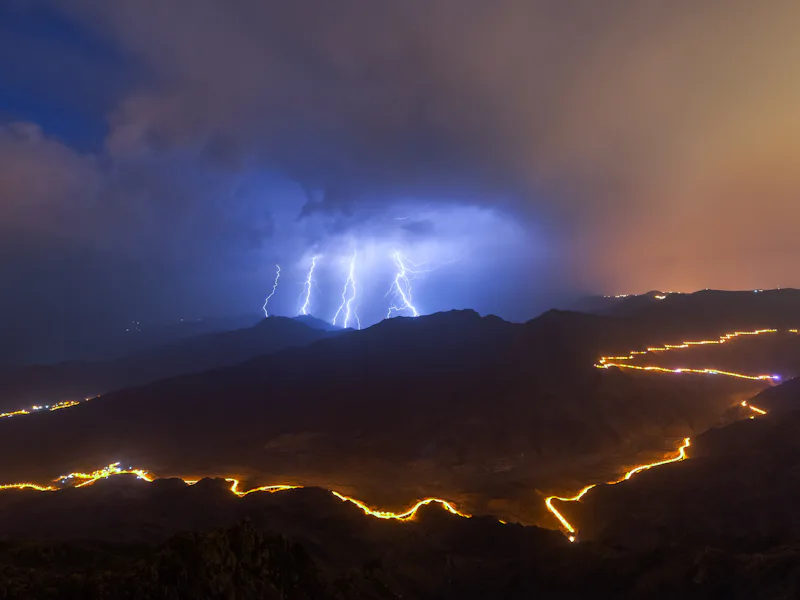
lightning and mesocyclones in the US

Lightning striking the ground may have kickstarted some of the chemistry that made nitrogen available for the development of life.

LAURA HEDIEN/MOMENT/GETTY IMAGES

RIDE THE LIGHTNING

Nitrogen is an essential ingredient for life — an element that is found in proteins, amino acids, and DNA. But not just any nitrogen will do. Most of the time, nitrogen atoms are locked together in close-knit pairs, held together by very strong chemical bonds, which means neither atom is available for chemical reactions. So it needs a little jolt to shake it loose.

Harvard University chemist Hahui Jiang and her colleagues’ recent experiments showed that lightning, especially if it struck wet soil near rivers or lakes, can break these bonds, splitting the coupled-up nitrogen into free atoms. That, in turn, could have set the stage for chemical reactions that produced more complex molecules — including important ingredients for living cells and the nutrients they crave.

Jiang and her colleagues published their work in the Proceedings of the National Academy of Sciences, but Sasselov tells Inverse that it’s only one piece of a much larger puzzle. Exactly where the chemical building blocks of life came from is a puzzle that chemists, astronomers, and biologists are still trying to solve. The answer could help explain our own origins, but it also could help us figure out how likely it is that we’re not alone in the universe.

A 1952 experiment by scientists Harold Urey and Stanley Miller found that lightning can jumpstart chemical reactions that, eventually lead to organic chemistry: the types of molecules that eventually become the building blocks of life. But the story of how a planet full of inert chemicals turned into a planet teeming with life, is a lot more complicated than Urey and Miller ever imagined.

“The origin of life question is more of a puzzle, consisting of multiple pieces that need to fit together, rather than a single breakthrough,” Harvard University astronomer Dimitar Sasselov, a coauthor of the recent study, tells Inverse.

IT’S ALIVE!

Some of the chemical ingredients for life form around deep-sea vents where water and rock meet, and where intense heat provides the energy for chemical reactions. Others can be found in erupting volcanoes. More of the chemistry of life probably happens anytime ultraviolet light hits water, according to another recent study. And most astrobiologists also assume comets and meteors delivered some of the ingredients for life to early Earth.

But some of the stuff cells are made of — including some of the most complex chemical compounds on the ingredients list — may have been part of the starter pack for our newly-formed Solar System 4.6 billion years ago. Astronomers have spotted the telltale spectrum of light emitted by an animo acid called tryptophan in a nearby cloud of interstellar gas and dust, and a chemical called ethanolamine, which is a key part of cell membranes, formed in a cold, dark interstellar cloud more than 100,000 light years away. Other organic chemistry — like the ring-shaped molecule benzene, on which most other organic chemistry is based — has been spotted forming in the cloud of gas and dust around a pair of newborn stars, in chemical reactions powered by shock waves.

The reality is that the chemicals that made up the earliest life on Earth may have take a little from column A and a little from column B — a mixture of deep space feedstock and home-grown biochemistry.

“We cannot limit ourselves to think that the answer to the origin of life comes from a single source,” Arhaus University astronomer Sergio Ioppolo, one of the researchers whose team discovered ethanolamine in deep space last year, tells Inverse. “We should also consider that lightning-induced electrochemistry alone cannot explain the onset of life on the early Earth. It is likely that our planet got the building blocks of life by multiple endogenic [local] as well as exogenic [from space] routes.”

RAW MATERIALS ABOUND

Sasselov says that even if the Solar System formed with a starting supply of building blocks — amino acids, ethanolamine, and more — those building blocks couldn’t just assemble themselves into working cells. Instead, according to Sasselov, those complex molecules probably got provided things like phosphorus and carbon to the early Earth.

But even a starting supply of several tons of, say, amino acids, delivered by meteors or baked into Earths’ crust, wouldn’t be enough to sustain organic chemistry long enough for life to emerge. Whatever amino acids and benzene rings found their way to early Earth from deep space, they were more useful for their raw materials than as preassembled components for cells. That’s because the chemistry that led to life needed a constant supply of things like carbon, phosphorus, sulfur, and nitrogren.

“[Those molecules] themselves cannot be directly incorporated into the cells which produce life,” says Sasselov, adding, “We now know that some of those chemical reactions which happen in interstellar space are very different from the ones which can sustainably occur on the surface of the Earth later on.”

So the ethanolamine in your cell membranes probably didn’t form on the surface of a distant bit of interstellar dust, but the ingredients were likely there — being carried through the universe to do their thing on the petri dish that is Earth.

PUTTING IT ALL TOGETHER

“The work of Jiang and her colleagues is one of the many pieces of the puzzle which we should build on,” says Ioppolo.

And the particular piece of the puzzle Jiang and her colleagues were interested in was small but vital: how early Earth got enough nitrogen, in a usable form, to fuel the chemical machinery that eventually produced — and sustained — life. They found that lightning was the solution to that particular piece of the puzzle, especially when it struck water or wet soil, where a wider selection of minerals could get in on the resulting chemical reactions. (In contrast, Urey and Miller just studied the effects of lightning in midair back in 1952, because that’s easier to simulate in a lab.)

Sasselov emphasizes that we shouldn’t picture a single lightning strike spawning life here on Earth. It took a very long time, and a lot of small events adding up, before life finally arose.

“The origin of life is not a single event, or a number of single events, in which the chemistry happened once, almost miraculously, somewhere on the surface of the planet, and then everything went on afterwards,” says Sasselov. “That kind of scenario doesn't work.”

Because the story of life’s origins is so complex, it takes scientists from a wide range of disciplines to put the whole puzzle together.

“In my view, our only chance to address the fundamental question of the origin of life is to put different scientific communities together and tackle the issue from many different perspectives including astronomy, astrochemistry, astrobiology, planetary science, volcanology, and biology,” says Ioppolo.

{ https://www.inverse.com/ }

Hoe vind je dit bericht?
Geschreven door peter om 22:27 Stuur door

An Underwater Drone Helped Scientists Explore the Final Glacial Frontier

An Underwater Drone Helped Scientists Explore the Final Glacial Frontier

Peeking beneath ice shelves is key for predicting sea level rise.

 
Peeking beneath ice shelves is key for predicting sea level rise.
Anna Wåhlin

There are few places on Earth more remote and mysterious than the underside of Antarctica’s ice shelves. These floating tongues of ice that extend off the continent’s vast, land-bound glaciers are at the front line of polar melt and sea level rise. But we know relatively little about them — how they’re melting, changing, and moving — beyond the surface level, because it’s hard to get a good look.

Ice shelves are often hundreds of meters thick. Through satellite data and radar measurements of the surface, glaciologists can make inferences and estimates about shifts in sea ice behavior unfolding under climate change. Yet a new perspective can offer a whole lot more information, as demonstrated in a study published July 31 in the journal Science Advances. A team of scientists deployed an autonomous underwater vehicle (AUV) to explore beneath Dotson ice shelf, on the western side of Antarctica.

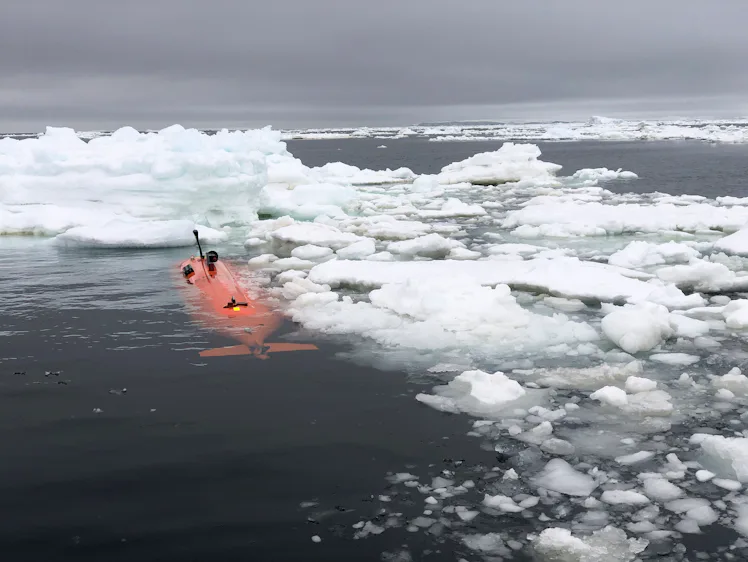
The unmanned submarine traveled more than 600 miles over 27 days, collecting ocean temperature, salinity, and current data while also scanning the bottom of the ice shelf using sonar for the first time. The resulting, detailed measurements allowed the researchers to construct the most detailed maps of the Dotson ever, revealing exactly how the shelf is changing and even new types of ice-shelf formations never seen before.

“It's a bit like seeing the back of the moon,” said Anna Wåhlin, lead study author and a professor of oceanography at the University of Gothenburg in Sweden, in a press statement.

The Dotson shelf is an outflow of the West Antarctic Ice Sheet, the continent’s largest contributor to sea level rise (and second only worldwide to the Greenland Ice Sheet, when it comes to melt volume). Though ice shelves don’t directly contribute to sea level rise, as they’re already floating, ice shelf losses contribute to ice loss on land, as glacial flow moves outward and the shelves and sheets fail to recover under ever-warmer conditions. Shrinking marine ice shelves can destabilize sheets on land.

As climate change progresses, Antarctica is set to become an even larger factor in globally rising tides. Understanding ice sheets is key to improving our predictions of how that melt is likely to unfold, and its subsequent impacts. And the new work offers a deeper understanding of Dotson than scientists have ever had before. The observations could help inform not only how glaciologists assess this one ice shelf but every Antarctic ice shelf.

ran-i-polarisen_foto-filip_stedt.jpg?w=374&h=281&fit=crop&crop=faces&q=50&dpr=2

The unmanned submarine traveled more than 600 miles over 27 days, collecting ocean temperature, salinity, and current data while also scanning the bottom of the ice shelf using sonar for the first time.

FILIP STEDT

Past estimates of ice loss have failed to meet reality. This new information, combined with a wave of other recent analyses, will hopefully make for clearer, more accurate forecasts. “These new observations will help the community of ice modelers to reduce the large uncertainties in future sea level,” said Karen Heywood, a study co-author and professor of oceanography at the University of East Anglia in England in the news release.

This is not the first study to use an unmanned submarine to make measurements beneath an ice shelf; the method has been deployed for a few years. However, these are the first sub-shelf AUV data on Dotson, and it’s one of relatively few expeditions to have occurred in a growing field. For now, every mission below an Antarctic ice shelf is notable, and brings new information. Many of the new observations confirmed estimates from surface analyses: Researchers had inferred that the western portion of Dotson is thinning faster than the eastern and central sections. Data collected on currents also bolsters previous hypotheses about why that is. Water is flowing faster beneath the western part of the shelf. Yet some of the observations were totally novel.

Per the AUV scans, the underside of the eastern and central regions of the Dotson Ice Shelf is characterized by large, flat terrace-like topography, bordered by steep walls. The researchers note this melt pattern is likely the result of periodic intrusions of sea water below the ice shelf’s grounding line. In contrast, the western side of the shelf is mostly smooth on the bottom with shallow, odd features like swirling, teardrop-shaped imprints.

“There were cracks and swirls in the ice that we weren’t expecting. It looked more like art,” said Heywood. Initially, the scientists had no idea what was causing these patterns, but they’ve homed in on one hypothesis related to a known ocean current phenomenon called the Ekman spiral.

Yet still, there’s much more to uncover in the massive trove of data compiled by the solo sub. These initial maps are just the tip of the proverbial iceberg. Unfortunately, to make future observations, the researchers will need a new AUV. The marine drone the expedition had been using, dubbed Ran, disappeared below the ice during another expedition, cut woefully short. The observations on Dotson are a final transmission from a lost ship.

{ https://www.inverse.com/ }

Hoe vind je dit bericht?
Geschreven door peter om 22:20 Stuur door

UFO Sightings Are Spiking. This Man Has Unraveled the Truth Behind Hundreds of Them

stylized portrait of mick west

Getty/Photo Illustration Popular Mechanics Staff

UFO Sightings Are Spiking. This Man Has Unraveled the Truth Behind Hundreds of Them

The longtime UFO debunker explains his methods, his obsession with solving every case, and the reasons why we should be skeptical of alien sightings.

ON A CLEAR, SUNNY DAY IN JULY, Mick West, a former video game programmer, was flying from his home in Sacramento, California, down to Pasadena. From the aircraft, he spied a small, white, elongated object that seemed to be passing over the mountains. Intrigued, he took a short video with his phone. Though he assumed the anomaly was just another airplane, West just couldn’t help himself; he needed to investigate.

When he got to his hotel room, West did what he so often does: a bit of digital sleuthing. First, he uploaded the raw footage to Photoshop to drill down into the image until it resembled a mosaic of zoomed-in pixels. “You have to be very careful about what you’re looking at … for me, that’s the very first step in investigating a case,” he explains. He also downloaded the GPS routes of his plane and a few nearby ones from FlightAware.com, a real-time worldwide flight tracker.

West is a longtime UFO debunker. Retired from the gaming industry in the early 2000s, he’s dealt with about 1,000 UFO cases over nearly a decade, ultimately completing a deeper analysis of about 100 on a pro-bono basis. He examines scoops from official and leaked government reports, sightings trending on social media, emails people send to him, and anomalies posted on popular UFO databases like Enigma and MUFON. He’s even appeared on a History Channel show, The Proof Is Out There, as a forensic video analyst.

He’s found that most skyward curiosities have a logical explanation. No aliens required.

And yet, reports of Unidentified Anomalous Phenomena (UAPs)—a term the U.S. government’s National Defense Authorization Act of 2023 established to replace the term “UFO”—are on the rise, according to data from the All-Domain Anomaly Resolution Office, established in 2022. West believes in using logic and common sense while investigating such claims. That means following the clues and cross-referencing them with simultaneous events such as flights, weather phenomena like saucer-shaped lenticular clouds, ground camera images, and satellite data from companies like Starlink.

That may not necessarily lead to thrilling discoveries of alien encounters, but for West, chipping away at the puzzle to reveal the truth is enormously satisfying.

WEST USES A THOUGHTFUL, methodical process every time he investigates a UAP. His investigation of the white mystery object spotted during his flight to Southern California is the perfect example.

First, he pulled data from the original video. To do so, West used programs like Invisor, an app that displays and compares technical information about video, audio, and photo files. “You drag in the video and you get all this information, things like the original date it was recorded, the resolution, the frame rates … sometimes you get location as well,” he explains, sharing his screen via Zoom, displaying a long column of dozens of datasets.

Understanding the physical perspective of the camera shot is crucial, too. Since West’s video was taken from an airplane, he consulted the free online tool FlightRadar24. A green and brown map depicting U.S. physical features popped up, dotted with dozens of tiny yellow airplane symbols. “You can figure out what’s actually in the air at a particular time,” West explains.

page showing airplane flight paths on the online tool flightradar24

Mick West
Mick West demonstrates using FlightRadar24, an online tool that allows you to track every flight path and its historical data. This aids in recreating an encounter with a UAP.

When he zoomed in on his own flight, West could see exactly where his plane was at the particular time he spotted the mysterious, white airborne object, as well as the positions of every other plane nearby. So, he connected the dots. “I knew I was sitting on the right side of the plane,” he says, moving his cursor over another nearby plane, “so this is a likely contender.” He could see that the plane had taken off from Los Angeles’ Van Nuys Airport shortly before his video and that it was ascending. “That matches what we see in the video,” he says.

Then, West turned to a tool he designed himself, called Sitrec. An organization that prefers to remain anonymous paid West to continue developing the app and to help make it freely and publicly available on his website, Metabunk.org, a hub for UAP news, forum discussions, and debunking resources. West simply dragged and dropped his video into Sitrec—a “situation recreation” tool which integrates flight data and video from any source—and used satellite imagery to recreate situations.

“I set the camera to point from my plane to the other two. One of them matched exactly. It was a small Cessna,” he says. “This confirms that this was the plane I was actually looking at.”

MEET THE PEOPLE SEARCHING FOR UAPS 

WEST USED TO CODE FOR Tony Hawk’s Pro Series™ skater video games, a billion-dollar franchise. He likes to joke that it was his “baptism by fire,” because he would sometimes “spend an inordinate amount of time on this trivial little thing, this one intractable little bug that is just causing this problem. It can be very difficult to figure out … but you have no choice.”

It’s this passion and rigor that ignited his first foray into UAP investigations. That, and a fascination with conspiracy theories.

It all began with the “chemtrails” conspiracy theory that claims airplane vapor trails secretly contain chemical or biological agents meant to control people. To debunk that far-fetched idea, West launched the website ContrailScience.com. Eventually, he started debunking other conspiracy theories including those about 9/11, Earth being flat, and finally UFO alien sightings.

The most important element of maintaining accuracy is to hold on to reasonable—albeit mundane—explanations. “This is a big, big issue in UFO investigations. Instead of trying to eliminate something, you just move possibilities up and down the list,” West explains. Perhaps the list of possibilities for a UAP includes a bird, a weather balloon, an alien spaceship, a hallucination, or a camera glitch. “Which one’s the most important one? The most likely one,” West says. “If you eliminate something, you’ve thrown it away, and you might never get it back.”

That’s what happened during a UAP investigation in Chile—one that would permanently cement West’s interest in UAPs.

In 2014, the Chilean Navy caught video footage of overlapping mysterious black blobs leaving black streaks behind them. Chile’s military studied the recording for two years, but ruled out several different possibilities, leaving behind only the tantalizing chance of aliens. On Metabunk, you can watch West’s analysis of the recording. He discovered that the thermal camera responsible for the footage made the blobs appear hot. In reality, they were just hotter than the surrounding sky that day. Likewise, the streaks were also warmer than the surrounding sky. It’s the same effect as looking through a regular camera at an object with a very bright background, West says—the object appears black.

“It’s not an intuitive thing, and if you don’t delve too deeply into it, [you’ll be wrong,]” he says. In fact, after removing the radiating heat effects around the object, the shape of a regular airplane emerges. The blobs were the four engines of an airplane, and the streaks its contrails.

a screen shot of a computer program that analyzes ufo reports
Mick West
A screenshot from Mick West’s free online Sitrec tool showing the Chilean Navy UAP video, with a flight path analysis and additional information about the November 11, 2014 incident on the left-hand side of the screen.

Another aspect the original investigation got wrong was the blob’s flight path. The footage originated from a helicopter and seemed to indicate a UAP over a nearby bay. “They thought they were looking at an object that was moving left to right, here,” says West, pointing out the flight track path on the video via Sitrec. “In fact, what they were looking at was this plane, just departed from San Diego Airport.” As the plane looped around to gain height over the nearby mountains, it banked in such a way that it appeared to be over the bay and so—apparently—didn’t match any flight records. West was able to simulate the blob’s actual movements by accounting for the camera angle and the relative movement of the blob, and overlaid it successfully with official flight records, matching the paths.

DESPITE HIS DEDICATION, West does have a few unsolved cases on his list. Sometimes, there’s just not enough information to draw a conclusion. For example, in 2017, The New York Times published a video that appeared to depict a flying saucer. West deeply investigated it, checking out how the camera could have been moving, how the UFO could have matched the rotation of the camera, and how there could’ve been a glare in the camera lens. But the analysis took West a long time, and the case is still puzzling. Ideally, West needs the original radar data instead of the analysis the government actually released. The original would have allowed him to recreate the scenario in three dimensions.

“In most cases, what you really want is to have two videos from two different angles. Multiple sensor data is kind of the gold standard,” he explains.

Now that the National Defense Authorization Act requires the government to declassify many UAP documents, West hopes he can get his hands on more original evidence. So far, it’s been a slog, and until there’s fuller disclosure of past UAPs, some of those cases will likely remain open.

DIVE DEEPER 

Not all of West’s investigations take place on a computer, though. Sometimes he needs to do a little detective work on the side. Once, when somebody reported to him that they’d seen mysterious lights in the sky, West followed his hunch that they might be searchlights and called the local town. He was right: a tree farm in the suspicious location had just installed attention-grabbing searchlights.

Even though West has solved many UAP analysis requests over the years, his conclusions—so far, always mundane—can be unwelcome. People want to believe extraterrestrial aliens are making contact with us. And in the rush to find answers, even other investigators often jump to the wrong conclusions, he says.

There’s also this fact: “The people who are into UFO investigations are so interested because they’re looking for something extraordinary,” West says. “I’m just looking to find out what something actually is, whether it’s extraordinary or not. I don’t have a preference.”

{ https://www.popularmechanics.com/ }

Hoe vind je dit bericht?
Geschreven door peter om 22:12 Stuur door

The real government conspiracy isn’t about UFOs

The real government conspiracy isn’t about UFOs

The authorities are just embarrassed to admit that they don't know if they are real

While the Pentagon dismisses UFO evidence as inconclusive, the U.S. Senate Intelligence Committee has pushed back and demanded further investigation.

While the Pentagon dismisses UFO evidence as inconclusive, the U.S. Senate Intelligence Committee has pushed back and demanded further investigation.
GETTY IMAGES

Earlier this year, following last summer’s congressional hearings on UFOs, the Pentagon’s All-Domain Anomaly Resolution Office (AARO) issued a 63-page report evaluating almost 80 years of evidence. Its conclusion — not altogether surprising, given the name of the office — can be summarized as follows: Not much to see here. Please move on.

The Senate Intelligence Committee isn’t buying it. The Intelligence Authorization Act, which it passed recently, among other things calls for review of the All-Domain Anomaly Resolution Office. The bill would also limit research into what are now called UAPs (for unidentified anomalous phenomena) unless Congress is informed and add whistleblower protections for anyone who might wish to step forward and speak their minds.

Less plausible claims about UAPs have been achieving greater circulation in part because of the efforts of David Grusch, who testified before Congress last year about hidden alien bodies, crashed vehicles and secret conspiracies. Those claims, which primary witnesses have not corroborated, defy belief and the ensuing controversy has helped make concerns about UAPs appear silly.

Nonetheless, the truth remains that there are systematic sightings and sensor data of fast-moving entities that the government cannot explain. You don’t have to think they are space aliens to realize that they are threats to national security. At the very least, the mere fact that some experienced military pilots entertain the more speculative alien-linked hypotheses suggests that the military is not processing information effectively. Does it make anyone feel better when reports from pilots are dismissed as crazy?

UAPs will remain an issue as long as China and Russia (and possibly other nations) remain national security threats, because the U.S. military will always want to identify possible entrants to its airspace. No report or bureaucratic process can make those concerns go away. And so there is a kind of paralyzed equilibrium, where a very strong force — the desire to know — has met an immoveable object — a lack of knowledge.

In this sense, the frustration of the Senate Intelligence Committee — as expressed by its unanimous 17-0 vote — is understandable. The Pentagon’s report presents many of the weaker UAP allegations and notes that there is no serious evidence to back them up. And it simply dismisses some of the stronger UAP puzzles, such as the Nimitz or Gimbal incidents.

It is not until Page 26 that the report concedes: "A small percentage of cases have potentially anomalous characteristics or concerning characteristics. AARO has kept Congress fully and currently informed of its findings. AARO’s research continues on these cases.” Those sentences should have been on the first page and then the report should have presented the evidence about those cases. If this were an undergraduate term paper, I would have given it a D+.

The chatter among insiders, some of which surely reaches senators, is that some of the data is very hard to explain. Some people, such as John Brennan, former head of the CIA, have even speculated that the available evidence might imply contact with a nonhuman civilization. Agree or disagree, the admission is a marker of our ignorance.

The conspiracy, to the extent there is one, is not to suppress evidence of different life forms; it is to avoid admitting the embarrassing absence of any real answers. So at the very least, the Senate Intelligence Committee deserves credit for reopening the issue.

It can be hard to wrap your head around such huge questions. People are often more concerned with dismissing the possibility of alien life than with admitting the possibility of genuine uncertainty. And since even partial evidence of aliens might scare the public too much, there is an overriding incentive to keep matters under wraps.

When I think about all this, I try to keep two questions separate. First, is there a major puzzle to account for? And second, what is the best explanation for that puzzle? It helps to focus on the first question in isolation, since we can’t seem to keep our heads on straight when it comes to the second.

By admitting that there is a real puzzle to be solved, the Senate Intelligence Committee has moved decisively to answer the first question. Once we clarify exactly what the puzzle is, maybe we’ll be able to make some progress explaining it.

  • Tyler Cowen is a Bloomberg Opinion columnist, a professor of economics at George Mason University and host of the Marginal Revolution blog

{ https://www.japantimes.co.jp/ }

Hoe vind je dit bericht?
Geschreven door peter om 21:57 Stuur door

HOW WOULD HUMANS REACT TO CONTACT WITH EXTRATERRESTRIALS? UK RESEARCHERS SEEK ANSWERS IN NEW SURVEY

contact with extraterrestrials

HOW WOULD HUMANS REACT TO CONTACT WITH EXTRATERRESTRIALS? UK RESEARCHERS SEEK ANSWERS IN NEW SURVEY

The question of whether humans are alone in the universe and whether we may one day make contact with extraterrestrials has tantalized philosophers and scientists for centuries.

Astronomers continue to scour the cosmos for signs of biosignatures in far-distant atmospheres that could reveal the planetary home of simple lifeforms or possibly even technosignatures that would indicate an intelligent extraterrestrial civilization not unlike us. Meanwhile, some also speculate that signs of extraterrestrials—particularly in the form of their technologies—might be discovered far closer to home than most would ever expect and that perhaps the search for alien technosignatures should include studies of nearby asteroids, planets, Earth’s Moon, and even sightings of unusual phenomena that occasionally occur within our own atmosphere.

Now, a new survey being conducted by researchers in the United Kingdom is asking the public for answers about people’s attitudes toward the idea that humans could one day contact intelligent extraterrestrials or even the controversial notion that some form of contact might have already occurred.

The survey, led by Professor Michael Bohlander, Chair in Global Law and SETI Policy at Durham Law School in the United Kingdom, along with Dr. Andreas Anton, also a Research Fellow at Durham Law School, in cooperation with Dr John Elliott, Honorary Research Fellow in the School of Computer Science at the University of St Andrews, aims to gauge participants’ attitudes toward the Search for Extraterrestrial Intelligence (SETI), as well as reports in recent years involving what the United States military now calls Unidentified Anomalous Phenomena (UAP), or what have traditionally been known as UFOs.

Bohlander and the team hope to learn how participants would react to such a contact event and what its global societal implications would be for humankind.

While the idea of contact with extraterrestrials has long been an area of focus in both science fiction as well as astronomers’ ongoing search for signs of intelligent life elsewhere in the universe, Bohlander recently told The Debrief that he and his colleagues hope to learn more about the human side of the question of alien life: namely how people would likely react to such an event, and therefore how scientists can better prepare for what Bohlander and his colleagues view as the eventuality of some form of contact.

“Such an event would likely pose an existential risk to humanity, regardless of whether the contact were to be hostile or peaceful,” Bohlander said in an email to The Debrief. “In the words of former NASA chief historian Steven J. Dick, we need to work on a unilateral metalaw to determine by which principles humanity should be guided in the process.”

Bohlander says the survey aims to collect data that ranges from the ethical and moral to political, religious, and even legal perspectives from people in all parts of the world on questions related to the prospect of contact with extraterrestrials. Primarily, the questions contained within the survey will aim to inform what Bohlander describes as “the coming debate about the foundations for such a globally accepted metalaw.”

“It actively addresses the traditional geopolitical imbalance of the SETI and UAP debate,” Bohlander told The Debrief, “where the voices of the so-called Global South, or of Earth’s Eastern Hemisphere are not routinely heard.”

Unlike many past surveys that have looked at people’s attitudes or beliefs toward the possible existence of alien life, Bohlander and his colleagues also incorporated the recent interest in unidentified anomalous phenomena (UAP) into the questions they ask of participants, although he notes that they approach the topic from a slightly different angle than the standard questions involving whether we are alone in the universe.

“The UAP/UFO aspect is of a slightly different nature,” Bohlander explains. “Apart from all the recent controversies about cover-ups and conspiracies, about crash site retrievals or reverse engineering, as well as political and constitutional issues of the public’s right to disclosure versus national or indeed global security, UAP/UFOs represent a fait accompli.”

The revelation that some UAP sightings could be related to extraterrestrials, if ever proven, would mean that humankind could soon face an unexpected development of historic proportions. Currently, the Pentagon’s All-domain Anomaly Resolution Office (AARO) maintains there is still no evidence that is suggestive of any links between UAP and off-planet technologies, but for Bohlander and his team, the question alone is worthy of addressing from an academic perspective.

“If some of them are of extraterrestrial origin, then humanity is for all intents and purposes unprepared,” Bohlander told The Debrief. “This is especially the case given the apparent massive difference in technological capacities in some of the observed objects.”

Also, given the recent advancements in artificial intelligence that have seen a sudden surge in recent years, many researchers have begun to question whether intelligence from off-planet, if it were to be encountered, would necessarily even be biological life as we know it. For Bohlander, whatever the nature or form any prospective non-human intelligence may take, the biggest question for humanity has to do with its intentions.

“There is, however, still the question of how to deal with the intelligence behind them—biological or AI—once they reveal themselves,” Bohlander said. “Questions of negotiations and possibly armed response do remain,” he added.

Prospective participants can find the team’s survey, “Contact with Extraterrestrial Intelligence: A study of projected perceptions and reactions among the world’s societies,” available at the website of Durham University’s Durham Law School.

{ https://thedebrief.org/category/uap/ }

Hoe vind je dit bericht?
Geschreven door peter om 21:29 Stuur door

ACADEMICS UNITE TO BRING HUMANITIES TO THE STUDY OF AERIAL MYSTERIES AT SOCIETY FOR UAP STUDIES EVENT

Unidentified Aerial Phenomena (UAP) - Atmospheric Lights

ACADEMICS UNITE TO BRING HUMANITIES TO THE STUDY OF AERIAL MYSTERIES AT SOCIETY FOR UAP STUDIES EVENT

Academic involvement in the study of unidentified anomalous phenomena (UAP) is helping to progress the once-taboo subject beyond the realm of speculation, according to a group of humanities scholars who are now pushing for deeper involvement from professionals across a diverse range of disciplines.

The study of UAP, once largely avoided by the academic community, has recently seen the entry of a growing number of scholars from the humanities, social sciences, and natural sciences. Further bolstered by the United States Department of Defense’s renewed engagement in UAP investigations, studies of aerial mysteries have recently seen a pronounced increase in serious academic inquiry, driven by the desire to understand the implications of reported incidents and their impact across various disciplines.

Now, the Society for UAP Studies, a nonprofit 501 (c)(3) organization that aims to unite academics and professionals who, according to its website, “are committed to advancing the study of the UAP through rigorous scholarly engagement,” will be hosting an online summer symposium that will address how professionals can help advance our understanding of these perplexing phenomena.

“The purpose of this is to organize a broad array of academic fields, perspectives, and discourses that are in various ways concerned with understanding—more deeply and more rigorously—the subject of UAP,” said Dr. Michael Cifone, a professor of philosophy and founder of the Society for UAP Studies, who also serves as its CEO and editor of its official publication, Limina -The Journal of UAP Studies.

According to Cifone, one of the society’s goals is to encourage interdisciplinary dialog between humanists and scientists who approach the UAP phenomenon in different ways and unite researchers on what he calls “the more metatheoretical questions of how to study the phenomenon.”

Society for UAP Studies

Despite the recent focus on scientific and military engagement with UAP, Cifone told The Debrief that the phenomenon presents challenges that also impact the humanities and political science, as well as the inquiries of historians, anthropologists, and professionals in a variety of other disciplines.

“With an event like this, we have an opportunity for more involvement from the humanities,” Cifone said, which he believes will provide an opportunity to learn ways those who work in this academic area can contribute to our growing knowledge of the topic.

Dr. Christian Peters, Managing Director at Bremen International Graduate School of Social Sciences (BIGSSS) and a member of the Society’s board of advisors, says another of the challenges of bringing the humanities more deeply into investigations of UAP involves not only identifying and characterizing UAP, but also to a degree the discipline’s own past challenges with self-identification.

“The thing with us in the social sciences is we haven’t really decided whether we belong to the humanities or to the sciences,” Peters said. “We’re kind of a mixed breed.”

Peters told The Debrief that many of the current processes and approaches being applied in the study of UAP are shaped by the contexts of military and scientific institutions, which are driven by various ambitions and interests that, according to Peters, highlight the influence of social sciences in understanding what is considered truth and reality.

“We do have something in the social sciences, which is called social constructivism that relates to the fact that basically everything that is dealing with realities and truths and ambitions is socially constructed,” Peters said. “There are a lot of arguments going on looking at the current processes about concepts like disclosure, which has become some sort of a ‘signal word’ for the discussion that takes place at the moment.”

“But you can look at disclosure from a more distant political theory perspective,” Peters told The Debrief, “and looking at that as being the play between the unveiling and the hiding in modern and in ancient statehood.”

“There’s a lot that needs to be said about these processes,” he added. In line with these perspectives, Peters will coordinate a workshop for the Society’s summer event with historian Greg Eghigian, which examines the UAP issue from the perspectives of history, political science, and political theory.

“There is a big movement going on with serious people working in different fields,” Peters told The Debrief. “I don’t think we’re going to find an interdisciplinary approach, but we will start to facilitate the discussion that needs to take place.”

Along with interdisciplinary dialogue, Eghigian told The Debrief that another aim of the Society’s event involves another of the subject’s most enduring problems.

“Speculation about UAP is often unmoored from any empirically sound and self-critical research,” Eghigian said. “The conference seeks to address this shortcoming by placing multidisciplinary scholarship about the subject center stage.”

Along with Peters and Eghigian’s workshop, several others that address various approaches toward studying UAP will be featured, including a session that focuses on the application of citizen science.

“The UAP Citizen Science Workshop is bringing together scientists from the UAP field and surveying the available resources and best practices for citizen science in general,” said Dan Williams, who coordinates the Society’s official Citizen Science Working Group.

Williams, who will lead the workshop, says such resources include SciStarter, Zooniverse, the NASA Citizen Science Seed Funding Program, commercial satellite Earth Observation imagery and analytics, ground-based instrumentation, smartphone apps, and self-supervised machine learning, or what he calls “needle-in-a-haystack” technologies.

“We hope the workshop participants can then author a paper on best practices and identify several citizen science projects of general interest. We have several members from the recent National Science Foundation’s ASTRO-ACCEL-sponsored UAP workshop participating, and we hope our workshop also advances their goal of forming a UAP citizen science working group,” Williams told The Debrief.

“The study of UAP deals with incomplete, inaccurate, and even at times deceptive information,” said Joshua Pierson, D.S.S., a career investigator who is also an advisor to the Society for UAP Studies. “The beauty of having a conference and an organization that focuses on bringing the social sciences and the humanities to bear is really where we start being able to assess what is inaccurate and incomplete,” Pierson said.

“Except now, instead of taking a practitioner’s approach, we have people who can think deeply on the subject to help inform some of the best models and methods to approach the information that we get on UAP,” Pierson told The Debrief.

Pierson says that in addition to applying the best models and research methods, a collective aim of academic groups like the Society for UAP Studies is also to define the phenomena more accurately. However, along with framing the phenomenon in academic terms, part of the aim of studying UAP from a humanities perspective also involves recognizing how people relate to UAP experiences and what overall impact the subject has on individuals, as well as at the societal level. 

“UAP have profound effects on the lives of those who witness them, and they also stimulate important questions about the nature of knowledge itself and the limitations of ourselves as knowers,” said Dr. Kim Engels, an Associate Professor of Philosophy at Molloy University who is also on the Society’s Advisory Board. “Our conference is offering a space for philosophers and theologians to weigh in on these important dimensions of the UAP conversation.”

“One of the most important things I think the humanities supplies—at least the philosophy of science, my own tradition—is a sort of critical perspective on the ways in which people have come to interpret and study UAP,” Professor Cifone told The Debrief.

“I think we’re at an interesting moment here in terms of the science of UAP. There’s a kind of a turning point right here that I think we’re witnessing, and a science is forming out of a history of kind of abortive and failed attempts to bring to bear some kind of systematic scientific engagement with the question,” Cifone said.

If Cifone is correct, and the efforts by organizations like his, as well as those currently being undertaken by other academic groups and government agencies, are pointing to the emergence of a new area of study in the sciences, then groups like the Society may be some of the best-equipped to help guide the process.

“You know, there’s this in-between space that I think the humanities is really good at negotiating,” Cifone told The Debrief, adding that academics like those who will participate in the Society’s forthcoming conference could be particularly well suited to help the scientific community navigate the various challenges presented by such a complex field of study.

“This is, I think, where humanists can bring the scientists together,” Cifone said, “to discuss that kind of a difficult aspect to the phenomenon.”

The Society for UAP Studies will hold its online Summer Conference 2024, titled “Varieties and Trajectories of Contemporary UAP Studies,” from August 16 to August 18, 2024. Registration details and other information about the event can be found on the Society’s website.

{ https://thedebrief.org/category/uap/ }

Hoe vind je dit bericht?
Geschreven door peter om 21:19 Stuur door

Meer van UFO'S of UAP'S, ASTRONOMIE, RUIMTEVAART, ARCHEOLOGIE, OUDHEIDKUNDE, SF-SNUFJES EN ANDERE ESOTERISCHE WETENSCHAPPEN - DE ALLERLAATSTE NIEUWTJES

↑ Terug naar de berichten