Ontdek de Fascinerende Wereld van UFO's en UAP's: Jouw Bron voor Onthullende Informatie!
Ben jij ook gefascineerd door het onbekende? Wil je meer weten over UFO's en UAP's, niet alleen in België, maar over de hele wereld? Dan ben je op de juiste plek!
België: Het Kloppend Hart van UFO-onderzoek
In België is BUFON (Belgisch UFO-Netwerk) dé autoriteit op het gebied van UFO-onderzoek. Voor betrouwbare en objectieve informatie over deze intrigerende fenomenen, bezoek je zeker onze Facebook-pagina en deze blog. Maar dat is nog niet alles! Ontdek ook het Belgisch UFO-meldpunt en Caelestia, twee organisaties die diepgaand onderzoek verrichten, al zijn ze soms kritisch of sceptisch.
Nederland: Een Schat aan Informatie
Voor onze Nederlandse buren is er de schitterende website www.ufowijzer.nl, beheerd door Paul Harmans. Deze site biedt een schat aan informatie en artikelen die je niet wilt missen!
Internationaal: MUFON - De Wereldwijde Autoriteit
Neem ook een kijkje bij MUFON (Mutual UFO Network Inc.), een gerenommeerde Amerikaanse UFO-vereniging met afdelingen in de VS en wereldwijd. MUFON is toegewijd aan de wetenschappelijke en analytische studie van het UFO-fenomeen, en hun maandelijkse tijdschrift, The MUFON UFO-Journal, is een must-read voor elke UFO-enthousiasteling. Bezoek hun website op www.mufon.com voor meer informatie.
Samenwerking en Toekomstvisie
Sinds 1 februari 2020 is Pieter niet alleen ex-president van BUFON, maar ook de voormalige nationale directeur van MUFON in Vlaanderen en Nederland. Dit creëert een sterke samenwerking met de Franse MUFON Reseau MUFON/EUROP, wat ons in staat stelt om nog meer waardevolle inzichten te delen.
Let op: Nepprofielen en Nieuwe Groeperingen
Pas op voor een nieuwe groepering die zich ook BUFON noemt, maar geen enkele connectie heeft met onze gevestigde organisatie. Hoewel zij de naam geregistreerd hebben, kunnen ze het rijke verleden en de expertise van onze groep niet evenaren. We wensen hen veel succes, maar we blijven de autoriteit in UFO-onderzoek!
Blijf Op De Hoogte!
Wil jij de laatste nieuwtjes over UFO's, ruimtevaart, archeologie, en meer? Volg ons dan en duik samen met ons in de fascinerende wereld van het onbekende! Sluit je aan bij de gemeenschap van nieuwsgierige geesten die net als jij verlangen naar antwoorden en avonturen in de sterren!
Heb je vragen of wil je meer weten? Aarzel dan niet om contact met ons op te nemen! Samen ontrafelen we het mysterie van de lucht en daarbuiten.
Milky Way’s Thin Disk Formed Less Than One Billion Years from Big Bang, New Study Suggests
Using data fromESA’s Gaia mission, astronomers have found a large number of metal-poor stars older than 13 billion years on orbits similar to that of our Sun.
Rotational motion of young (blue) and old (red) stars similar to the Sun (orange).
Image credit: NASA / JPL-Caltech / R. Hurt / SSC / Caltech.
“The Milky Way Galaxy has a large halo, a central bulge and bar, a thick disk and a thin disk,” said Dr. Samir Nepal from the Leibniz Institute for Astrophysics Potsdam and colleagues.
“Most stars are located in the so-called thin disk of our Milky Way and follow an organised rotation around the Galactic center.”
“Middle-aged stars such as our 4.6-billion-year-old Sun belong to the thin disk, which was generally thought to have started forming around 8 to 10 billion years ago.”
Using the new Gaia dataset, the astronomers studied stars within around 3,200 light-years from the Sun.
They discovered a surprising number of very old stars in thin disk orbits; the majority of these are older than 10 billion years, some of them even older than 13 billion years.
These ancient stars show a wide range of metal compositions: some are very metal-poor (as expected), while others have twice the metal content of our much younger Sun, indicating that a rapid metal enrichment took place in the early phase of the Milky Way’s evolution.
“These ancient stars in the disk suggest that the formation of the Milky Way’s thin disk began much earlier than previously believed, by about 4-5 billion years,” Dr. Nepal said.
“This study also highlights that our Galaxy had an intense star formation at early epochs leading to very fast metal enrichment in the inner regions and the formation of the disk.”
“This discovery aligns the Milky Way’s disk formation timeline with those of high-redshift galaxies observed by the NASA/ESA/CSA James Webb Space Telescope and the Atacama Large Millimeter Array (ALMA).”
“It indicates that cold disks can form and stabilize very early in the Universe’s history, providing new insights into the evolution of galaxies.”
“Our study suggests that the thin disk of the Milky Way may have formed much earlier than we had thought, and that its formation is strongly related to the early chemical enrichment of the innermost regions of our Galaxy,” said Dr. Cristina Chiappini, an astronomer at the Leibniz Institute for Astrophysics Potsdam.
“The combination of data from different sources and the application of advanced machine learning techniques have enabled us to increase the number of stars with high quality stellar parameters, a key step to lead our team to these new insights.”
Samir Nepal et al. 2024. Discovery of the local counterpart of disc galaxies at z > 4: The oldest thin disc of the Milky Way using Gaia-RVS. A&A, in press; arXiv: 2402.00561
Warp Drive Collapse Should Generate Gravitational Waves, Theoretical Astrophysicists Claim
The principle idea behind a warp drive is that instead of exceeding the speed of light directly in a local reference frame, a ‘warp bubble’ could traverse distances faster than the speed of light — as measured by some distant observer — by contracting spacetime in front of it and expanding spacetime behind it.
Clough et al. proposed a formalism for studying warp drive spacetimes dynamically and produced the first fully consistent numerical-relativity waveforms for the collapse of a warp drive bubble.
Despite originating in science fiction, warp drives have a concrete description in general relativity, with University of Wales astrophysicist Miguel Alcubierre first proposing a spacetime metric that supported faster-than-light travel.
Whilst there are numerous practical barriers to their implementation in real life, such as the requirement for an exotic type of matter with negative energy, computationally, one can simulate their evolution in time given an equation of state describing the matter.
In a new work, theoretical astrophysicists studied the signatures arising from a warp drive ‘containment failure.’
“Even though warp drives are purely theoretical, they have a well-defined description in Einstein’s theory of general relativity, and so numerical simulations allow us to explore the impact they might have on spacetime in the form of gravitational waves,” said Dr. Katy Clough, a researcher at Queen Mary University of London.
“The results are fascinating. The collapsing warp drive generates a distinct burst of gravitational waves, a ripple in spacetime that could be detectable by gravitational wave detectors that normally target black hole and neutron star mergers.”
“Unlike the chirps from merging astrophysical objects, this signal would be a short, high-frequency burst, and so current detectors wouldn’t pick it up.”
“However, future higher-frequency instruments might, and although no such instruments have yet been funded, the technology to build them exists.”
“This raises the possibility of using these signals to search for evidence of warp drive technology, even if we can’t build one ourselves.”
“In our study, the initial shape of the spacetime is the warp bubble described by Alcubierre,” said Dr. Sebastian Khan, a researcher at Cardiff University.
“While we were able to demonstrate that an observable signal could in principle be found by future detectors, given the speculative nature of the work this isn’t sufficient to drive instrument development.”
The authors also delve into the energy dynamics of the collapsing warp drive.
The process emits a wave of negative energy matter, followed by alternating positive and negative waves.
This complex dance results in a net increase in the overall energy of the system, and in principle could provide another signature of the collapse if the outgoing waves interacted with normal matter.
“It’s a reminder that theoretical ideas can push us to explore the Universe in new ways,” Dr. Clough said.
“Even though we are sceptical about the likelihood of seeing anything, I do think it is sufficiently interesting to be worth looking.”
“For me, the most important aspect of the study is the novelty of accurately modeling the dynamics of negative energy spacetimes, and the possibility of extending the techniques to physical situations that can help us better understand the evolution and origin of our Universe, or the processes at the centre of black holes,” said University of Potsdam’s Professor Tim Dietrich.
“Warp speed may be a long way off, but this research already pushes the boundaries of our understanding of exotic spacetimes and gravitational waves.”
“We plan to investigate how the signal changes with different warp drive models.”
Katy Clough et al. 2024. What no one has seen before: gravitational waveforms from warp drive collapse. Open Journal of Astrophysics 7; doi: 10.33232/001c.121868
At the end of 2017, The New York Times broke the story of a secretive Pentagon program with a budget of $22 million to investigate UFOs called the Advanced Aerospace Threat Identification Program (AATIP). The man who exposed the existence of the program, Luis Elizondo, was the former head of the project. Elizondo’s ongoing efforts to investigate the UFO mystery with his new employer, the To the Stars Academy (TTSA), will be featured in a History Channel series premiering May 31 called Unidentified: Inside America’s UFO Investigation.
However, what The New York Times apparently did not know when they published their story is that the program went by a different name at its inception, and the scope of the program was much broader than just UFOs. In fact, according to a senior manager on the project, the investigations included “bizarre creatures, poltergeist activity, invisible entities, orbs of light, animal and human injuries and much more.”
It is unknown whether Unidentified will cover the paranormal aspects of the program. Although Elizondo did work with this paranormal project, he only worked in the UFO division. By the time he was the head of the entire program, the UFO division was all that was left. The rest of the program had been shut down, and you will never guess why. It wasn’t because people inside the Department of Defense (DoD) thought the program was too weird, although some did. It was shut down because of demonic forces.
Don’t worry, demons didn’t attack the Pentagon, but apparently, some people inside the government were afraid the potentially paranormal incidents being investigated could be demonic, especially scary occurrences taking place at a ranch in Utah, and they wanted no part of it. They didn’t want the government messing with demons either, so they lobbied for the program to be ended and it was.
This may sound extremely odd, but according to those involved, it’s true.
The New York Timesstory that broke the Pentagon UFO program began when an official with the Defense Intelligence Agency (DIA) approached Las Vegas billionaire Robert Bigelow “to visit Mr. Bigelow’s ranch in Utah, where he conducted research.”
That sounds innocent enough, but what the article did not cover is what Bigelow researched at this ranch in Utah. Bigelow was known for his interest in the paranormal and UFOs, and by the time the DIA official had approached him, Bigelow had already spent decades and large sums of money researching the paranormal. Bigelow’s first significant foray into the unknown was an organization created in 1995 called the National Institute for Discovery Sciences (NIDS). Its purpose was to conduct scientific investigations of the paranormal.
After hearing rumors about paranormal phenomena occurring in the Uintah Basin in Utah, primarily focused on Skinwalker Ranch, Bigelow bought the ranch in 1996. It was the perfect place to conduct NIDS investigations. The ranchers who owned the property stayed for a while but left because they did not feel comfortable there. If their stories are to be believed, they had good reason to go.
The family, using the pseudonym Gorman, said they had several terrifying experiences. Among them was the sighting of a giant wolf-like creature that attacked cattle, could withstand multiple point-blank gunshots and seemed to disappear into thin air. The incident that caused them to leave for good, however, was when their beloved dogs chased glowing orbs of light into the forest at night never to be seen again.
The NIDS investigators had their share of experiences as well. As detailed in Knapp and Kelleher’s book, the strangest occurred in the middle of the night while two researchers were observing the ranch from the edge of a bluff. As they were packing up to leave at around 2:30 am, one of them noticed a light in the forest below. At first, they thought it might be a reflection. However, as they watched, the light began to grow. Once it became a couple of feet wide, they say it looked like a tunnel opening up, and they saw a creature within. It was large and black with no face. It crawled out of the light and into the dark forest. The light then began to disappear until it was gone.
Kelleher said years ago he felt whatever was going on at the Skinwalker Ranch outsmarted them and anticipated their actions.
PHOTOGRAPH: TOM BRENNER/GETTY IMAGES
John Alexander, a retired Colonel in U.S. Army Intelligence who also spent time working at Los Alamos Laboratories and still does some work as a defense consultant, helped organize NIDS investigations. In a YouTube interview for OpenMinds.tv in 2013, he describes what they encountered at the ranch as a “precognitive sentient phenomena.”
“What we learned was that the events were real and tangible, and definitely occurring,” Alexander explained. “These weren’t figments of someone’s imagination, or folklore or any of these sorts of things.”
“But, as for the etiology, nope,” says Alexander. ”We remained mystified.”
According to a recent interview with Knapp, Investigations into the ranch petered as the paranormal phenomena occurring on the ranch also waned. By the early 2000s, not much was going on. It was during this lull that Bigelow allowed Knapp to begin working on the book. Once the book was published, it brought a lot of attention to the ranch, but paranormal experiences were still rare.
So when the DIA official approached Bigelow in 2007 to visit the ranch, no one thought there would be anything to worry about. However, precognitive sentient forces on the ranch had other plans. Soon after arriving at the ranch, the DIA official had a paranormal encounter that Knapp described as “remarkable, and it made a very big impression on this guy.”
The New York Times says shortly after this visit, DIA officials met with Senator Harry Reid because they wanted to start a research program. It turns out Reid, a friend of Bigelow’s, was kept in the loop regarding Bigelow’s work researching the paranormal because he shared Bigelow’s interest in the topic.
Reid then found bipartisan support from a couple of fellow members of Congress, secured the funding, and got the project launched – all within 2007. Soon after, a requisition for a contractor to conduct research for the program was posted, and Bigelow’s Bigelow Aerospace won it. Bigelow created Bigelow Aerospace Advanced Space Studies (BAASS), lead by Kelleher, to manage the contract.
However, the project was not called AATIP, as The New York Times reported. Per Knapp and documents he obtained, it was called the Advanced Aerospace Weapons System (AAWSAP), and it was set up to investigate not just UFOs, but primarily all of the weird stuff going on at the Skinwalker Ranch, including that list of weirdness at the beginning of this story.
Due to the nature of the project, it was kept as quiet as possible. Few in Congress knew it existed. However, it didn’t take long for religious factions within the government to raise concerns.
IMAGE: DEVRIMB VIA GETTY
“They’re basically high-level people in different intelligence agencies who are fundamentalist Christians; who think that anything involving UFOs and the paranormal is satanic,” says Knapp.
“Certain senior government officials thought our collection of facts on Unidentified Aerial Phenomena (UAP) was dangerous to their philosophical beliefs,” Elizondo wrote in a post on Medium. “They decided the data was a threat to their belief system.”
Elizondo explained to Den of Geek that by 2008, the negative attention their paranormal investigations received caused them to create a sub-group inside of AAWSAP that only focused on military UFO cases. This was AATIP. When Elizondo joined AAWSAP (the paranormal program), it was to work with AATIP (the UFO division). Eventually, the DIA closed AAWSAP, and only AATIP remained. Elizondo took over leadership of AATIP in 2010.
As for The New York Times, one of the authors of the article, Leslie Kean, told me via email “at the time, our focus was AATIP. This was the name on the documents that we had, and this is what Lue Elizondo had talked to us about in interviews with him, as did others associated with the program.” Elizondo says that since his involvement was primarily with AATIP and the UFO side of things, he did not feel at liberty to share AAWSAP information with them.
Filmmaker Jeremy Corbell has recently completed a documentary titled Hunt for the Skinwalker. He worked with Knapp, who intended to make a film when the book came out in 2005. The footage Knapp obtained back then is a large part of the new documentary.
“That $22 million that was created to study the phenomenon was really inspired wholly by Skinwalker Ranch and what Bigelow had been doing there privately with NIDS,” Corbell told this reporter in a recent podcast interview. “The public is going to see by watching this film that connection very clearly and yes, our Department of Defense, specifically the intelligence organization within the Department of Defense, the Defense Intelligence Agency (DIA), they took this very seriously…Secrets have been kept, big secrets about this ranch for more than, I would say, two decades, and everybody wondered what has been going on there,” says Corbell. “This has been embargoed, this information. All of that has changed, and this story can now be told.”
These stories, although they sound fictional, are accounts from credible sources, and according to Corbell, Knapp, and Elizondo, there are still more shocking revelations to come. Elizondo recently told Den of Geek, “You ain’t seen nothing yet, baby!”
Those of us following this story have been wondering when the time will come for us to find out more. Elizondo says much of what we have been waiting for will be included in the History Channel series Unidentified: Inside America’s UFO Investigation premiering May 31.
Thirty years ago, thousands of Belgian citizens reported mysterious platforms flying silently over rooftops. The Royal Belgian Air Force got involved and cooperated fully with civilian investigators. To this day, however, the origins of these craft remain unknown.
It’s hard to convey the excitement caused by the Belgian UFO wave if you were not following UFO news back in 1989 and the early 1990s. There was no shortage of UFO reports back then, and interest in the phenomenon was at a high. The sightings and photos from Gulf Breeze, Florida, dominated the American scene, wild UFO reports and stories coming out of the old Soviet Union received huge international media attention, and the Mexican video wave took off in 1991. Yet the Belgian wave seemed to top all of these stories for awhile. The reports out of this small country, headquarters of both the European Commission and NATO, received unprecedented coverage, making even the front page of the Wall Street Journal on October 10, 1990, with a story entitled, “Belgium Scientists Seriously Pursue A Triangular UFO.”
The classic triangular-shaped UFO described by hundreds of eyewitnesses during the Belgium wave: sketch by witness used to create reconstruction of the object seen at the top of story. Credit: SOBEPS
There were many reasons for the interest generated by the Belgian wave. One was the quality of the reports themselves, the bulk of which were registered in the French-speaking region of Wallonia. There were no landings or humanoid sightings but lots of detailed multiple-witness sightings of flying platforms moving slowly and silently above rooftops. Shapes varied, but the predominant form was triangular or delta-shaped crafts. Some of the descriptions were so precise that traditional explanations of misidentified natural phenomena or conventional aircraft were ruled out. Instead, stealth fighters and other U.S. secret military aircraft became the favorite explanations suggested by skeptics, but these were quickly ruled out by the Royal Belgian Air Force (RBAF). Another reason for the wave’s importance was that it was carefully investigated and documented by a local UFO organization called SOBEPS (Belgian society for the study of space phenomena).
SOBEPS was formed in 1971 by Lucien Clerebaut, Michel Bougard, and others, and built a small but highly dedicated cadre of field investigators. By the end of the wave in 1993, SOBEPS had collected over two thousand eyewitness reports comprising twenty thousand pages, four hundred hours of audio tapes, and six hundred full inquiries. Five hundred and forty cases remained unexplained. SOBEPS also had the assistance of top-notch scientists, including Léon Brenig, a nonlinear dynamics theorist at the Free University in Brussels, and Professor Auguste Meessen, a physicist from Catholic University at Louvain. Regarding his work with SOBEPS, Dr. Brenig has said, “here is an opportunity where we can apply the scientific method.” Brenig himself became a witness of the so-called Belgian triangle while driving in the Ardennes on March 18, 1990. The whole dossier was eventually published by SOPEPS in two massive volumes, five hundred pages each, entitled Vague d’OVNI sur la Belgique (UFO Wave ver Belgium), published in 1991 and 1994 respectively. Due to financial difficulties, SOBEPS dissolved on December 31, 2007, but some of its members formed a new, smaller organization called COBEPS (Belgian committee for the study of space phenomena) to preserve the archives and work done for thirty-six years.
The two volumes published by SOBEPS entitled, “UFO Wave Over Belgium.” Credit: SOBEPS
A final and key element in the credibility of the Belgian UFO wave was the participation and validation by the RBAF, which showed an unusual degree of openness. As the Belgian wave gained steam, the Belgian Ministry of Defence was deluged with queries from the public and the media. The task fell upon the chief of operations of the air force, Col. Wilfried De Brouwer, who was later promoted to major general and deputy chief of the RBAF. Now retired from the service, Gen. De Brouwer has continued to speak about the wave. He was one of the many international officials who spoke at the famous event at the National Press Club (NPC) in Washington, DC, in November 2007, organized by filmmaker James Fox and journalist Leslie Kean. “The Belgian UFO wave was exceptional and the air force could not identify the nature, origin and intentions of the reported phenomena,” said De Brouwer at the NPC. He also gave a detailed presentation on the wave at the MUFON International UFO Symposium in San Jose, California, in July 2008, and was one of five generals to write an essay in Leslie Kean’s new book, UFOs: Generals, Pilots, and Government Officials Go On the Record.
Although the RBAF scrambled jets on three occasions during the wave, Gen. De Brouwer has explained on various occasions that they didn’t have the manpower or resources to mount a full-fledged investigation of their own, so instead they took the unusual route of cooperating fully with SOBEPS. The radar data was turned to Prof. Meessen for analysis, and Gen. De Brouwer agreed to write the postface for SOBEPS’s first volume when he was still in the service. “I must acknowledge that I somewhat hesitated when SOBEPS asked me to contribute my share to this book,” he wrote. “Indeed, I am not a UFO specialist and, moreover, it is quite delicate for somebody who occupies an official function to put on paper his personal ideas on such a disputed issue. However, I estimate that I would not have been honest towards the SOBEPS if I had refused. The air force always played a fair game on this subject and I regard this postface as a complementary element to the exceptional file written by the people of SOBEPS.”
THE EUPEN INCIDENT
Although some sightings were reported in October 1989, the first important incident of the Belgian wave took place a month later on November 29 around the small town of Eupen, which is in a region of Belgium near the German border. This initial case put the so-called “Belgian triangle” on the map and led to the start of the RBAF’s involvement. There were both daytime and nighttime sightings, although the latter were lengthier and more detailed. Gen. De Brouwer explained in his essay for Leslie Kean’s book, “a total of seventy reported sightings made on November 29 were fully investigated and none of these sightings could be explained by conventional technology. The team of investigators and I estimate that approximately fifteen hundred people must have seen the phenomenon at more than seventy different locations from different angles during this afternoon and evening.” There were a total of thirteen gendarmes (policemen) who saw the UFO from eight different locations around Eupen. Prof. Meessen summarized the case in SOBEPS’s book:
On November 29, 1989, a large craft with triangular shape flew over the town of Eupen. The gendarmes von Montigny and Nicol found it near the road linking Aix-la-Chapelle and Eupen. It was stationary in the air, above a field which it illuminated with three powerful beams. The beams emanated from large circular surfaces near the triangle’s corners. In the center of the dark and flat understructure there was some kind of “red gyrating beacon.” The object did not make any noise. When it began to move, the gendarmes headed towards a small road in the area over which they expected the object to fly. Instead, it made a half-turn and continued slowly in the direction of Eupen, following the road at low altitude. It was seen by different witnesses as it flew above houses and near City Hall.
In his 2008 MUFON lecture, Gen. De Brouwer provided additional details on this sighting: “The UAP [Unidentified Aerial Phenomenon] emitted repeatedly and simultaneously two red light beams with a red light ball at the spearhead of the beam. Subsequently, the red balls returned to the craft.” There was also apparently a second triangular craft, which made “a forward tilting maneuver, exposing the upper side of the fuselage,” continued De Brouwer. “They [gendarmes] saw a dome with rectangular windows, lighted up at the inside. It then disappeared to the North.” Two more gendarmes saw one of the craft from a monastery nearby; “one is currently the head of the police in that area, he was scared like hell,” added De Brouwer.
Statistical chart of Belgian sightings between October 1989 and September 1990, showing peaks in the November-December period and a second one in April. Credit: SOBEPS
The Eupen incident was followed by many other UFO sightings, including several reported on December 11, 1989. One of the witnesses that evening was a personal acquaintance of Gen. De Brouwer, Col. André Amond, a civil engineer in the Belgian Army. Col. Armond worked next door to Gen. De Brouwer and wrote a detailed report for the Ministry of Defence. Col. Armond was driving with his wife around 6:45 p.m., when they noticed a strange object with flashing red lights. They stopped the car and got out to see it better. “Suddenly, they saw a giant spotlight, about twice the size of the full moon, which approached them to an estimated distance of 100 meters,” wrote De Brouwer, adding that “the colonel’s wife was frightened and asked to leave.” In his report to the Ministry, Armond “ascertained that this craft was not a hologram, helicopter, military aircraft, balloon, motorized Ultra Light, or any other known aerial vehicle.”
Various shapes were reported throughout the wave, including round, rectangular, and cigar-shaped, but the majority were triangular objects. Gen. De Brouwer notes that the differences may also be due to the eyewitnesses’ viewing angles. Researcher Marc Valckenaers listed some of the characteristics of the UFOs in SOBEPS’s second volume about the wave, including: irregular displacement (zig-zag, instantaneous change of trajectory, etc.), displacement following the contours of the terrain; varying speeds of displacement (including very slow motion), stationary flight (hovering), overflight of urban and industrial centers, and sound effects (faint humming to total silence).
Reconstruction of the incredible rectangular flying platform seen by two factory workers on April 22, 1990, described as “an aircraft carrier turned upside down.” Credit: SOBEPS
One of the strangest reports came from two factory workers from the town of Basècles, southwest of Brussels, who saw a huge trapezoid flying platform (330 x 200 feet) just before midnight on April 22, 1990. The object moved slowly and silently, covering the entire factory courtyard. In the SOBEPS report, the factory workers described the UFO as “an aircraft carrier turned upside down.” Despite the science-fiction quality of this sighting, an almost identical report was filed nearly a year later, on March 15, 1991, by an electronic engineer in Auderghem, near Brussels, who woke up in the middle of the night when he “heard a barely audible, high-frequency whistling tone. He looked out the window and saw a large rectangular craft at very low altitude with irregular structures on the bottom,” wrote Gen. De Brouwer.
One characteristic of the Belgian wave was how close the objects were flying above the rooftops, as shown with this flying rectangular platform. Credit: SOBEPSAnother view of the rectangular flying platform above the rooftop and sketch showing where the witness saw it. Credit: SOBEPS
THE F-16 SCRAMBLE EPISODE
If the Eupen multiple-witness sightings of November 1989 triggered the Belgian wave, the jet fighter scramble incident during the night of March 30, 1990 marked the peak of public interest and global media coverage. The Belgian Air Force had scrambled jets on two prior occasions without positive results. The December 5, 1989 scramble was unsuccessful; when the jet reached the sky, the UFO was gone. Additionally, the December 16, 1989 case turned out to be a false alarm; the authorities quickly determined that it was a laser projection reflected by a cloud layer. Following these two fiascos, the RBAF implemented a new policy that jets would be scrambled only when a sighting was detected on radar and was visually confirmed on the ground by the police.
The SOBEPS team visiting the Royal Belgian Air Force radar facility at Glons: in the center group, left, the Society’s chairman Lucien Clerebaut and right, physicist Prof. Auguste Meessen, next to military officer. Credit: SOBEPS
As put in a preliminary report prepared by Major P. Lambrechts of the RBAF, entitled “Report Concerning the Observation of UFOs During the Night of March 30 to 31, 1990,” the incident began at 10:50 p.m. on March 30 when the gendarmerie telephoned the radar “master controller at Glons” to report “three unusual lights forming an equilateral triangle.” More gendarmes confirmed the lights. When the NATO facility at Semmerzake detected an unknown target at 11:49 p.m., a decision to scramble two F-16 fighters was made. The jets took off at 12:05 a.m. from Beauvechain, the nearest air base, and flew for just over an hour. According to Major Lambrechts’s report:
The aircraft had brief radar contacts on several occasions, [but the pilots]…at no time established visual contact with the UFOs…each time the pilots were able to secure a lock on one of the targets for a few seconds, there resulted a drastic change in the behavior of the detected targets…[During the first lock-on at 12:13 a.m.] their speed changed in a minimum of time from 150 to 970 knots [170 to 1,100 mph] and from 9,000 to 5,000 feet, returning then to 11,000 feet in order to change again to close to ground level.
When Col. De Brouwer showed the computerized radar images of the UFO tracked by the F-16 onboard radar system in a heavily attended press conference at the Ministry of Defence on July 11, 1990, the international media went into a frenzy. Transcripts of the radio communications between ace fighter pilots, Capt. Yves Meelbergs, Lt. Rudy Verrijt, and the Glons Control Reporting Center near Liege, were also released and provide some dramatic moments. The transcripts paint a picture of the jets chasing ghost radar echoes that appear and disappear and then reappear again, but at no time are the pilots able to establish visual contact with the supposed objects. Belgium’s Electronic War Center (EWC) eventually undertook a detailed technical analysis of the F-16 computerized radar tapes, completed by Col. Salmon and physicist M. Gilmard in 1992, and later reviewed by Prof. Meessen.
An F-16 jet fighter of the Royal Belgian Air Force like the ones scrambled on the night of March 30-31, 1990. Credit: Bernard Thouanel
Although some aspects of this case still remain unexplained, Meessen and SOBEPS accepted the Gilmard-Salmon hypothesis that most of the radar contacts were really echoes caused by a rare meteorological phenomenon. This became evident in four lock-ons, explained Meessen, “where the object descended to the ground with calculations showing negative altitude…. It was evidently impossible that an object could penetrate the ground, but it was possible that the ground could act as a mirror.” Meessen explained how the high velocities measured by the Doppler radar of the F-16 fighters might result from interference effects. He pointed out, however, that there was another radar trace for which there is no explanation to date. As for the visual sightings of this event by the gendarmes and others, Meessen suggested that they could possibly have been caused by stars seen under conditions of “exceptional atmospheric refraction.”
One frame from the F-16 onboard radar system showing the UFO lock-on during the March 1990 scramble episode, shown by the RBAF at a famous press conference in July 1990. Credit: RBAF/ Bernard Thouanel
In a 1995 telephone interview, Gen. De Brouwer summarized his reflections on this complex case: “We always look for possibilities which can cause errors in the radar systems. We can not exclude that there was electromagnetic interference, but of course we can not exclude the possibility that there were objects in the air. On at least one occasion there was a correlation between the radar contacts of one ground radar and one F-16 fighter. This weakens the theory that all radar contacts were caused by electromagnetic interference. If we add all the possibilities, the question is still open, so there is no final answer.” De Brouwer took a more detached view of the F-16 scramble episode, however, in his 2008 MUFON lecture and his 2010 essay included in Kean’s book: “The conclusion of the Air Force, therefore, was that the evidence was insufficient to prove that there were real crafts in the air on that occasion.”
Seldom has the old saying that a picture is worth a thousand words become more true than in the case of the extraordinary photograph of a flying triangle taken in the small town of Petit-Rechain in April 1990. This color slide became the emblematic symbol of the Belgian UFO wave. It has been published and broadcast in television programs all over the world, and it appears on the cover of the two SOBEPS volumes on the Belgian wave. It’s also one of the most analyzed UFO photos in the history of ufology. During my trip to Brussels in 1995, I had the opportunity to talk at length with Patrick Ferryn, the investigator who researched the case initially and wrote the chapter about it in the SOBEPS book. Ferryn gave me copies of the photo and samples of computer enhancements made by Marc Acheroy, professor of electricity at the Royal Military School, where the image was analyzed by the Signal Treatment Center. The details of how the photo was taken are fairly simple and straightforward.
The photographer, P.M. (who wants privacy, but has fully cooperated with SOBEPS), was a twenty-year-old factory worker, who lived in the small community of Petit-Rechain, near Verviers. He was at home with his girlfriend on the night of either April 4 or 7, 1990 (he can’t pin down the exact date), when his girlfriend first noticed the object between 11:00 and 11:30 p.m. as she took the dog to the courtyard. According to P.M.’s statement to Ferryn, he was alerted by his girlfriend, went outside, and “saw the object practically stationary towards the southwest, at about a forty-five-degree elevation. It consisted of three white round lights on a barely perceptible triangular surface. In the center there was a blinking spot of the same color, or maybe a bit more reddish than the other lights.” P.M. grabbed his camera, a Praktica model BX20 with a 55-200 mm zoom and a “Cokin” 1A 52 mm skylight filter. He shot the last two frames of a roll of 36-200 ASA Kodak color slide film. The UFO then moved slowly towards Petit-Rechain, until it was hidden by the roofs in the village. The entire episode took about five minutes.
The roll of film was sent by mail to a development house offering a special discount, and when P.M. received the slides, he noticed only frame #35 had captured the UFO; frame #36 was entirely black. Ferryn estimated that “the photo was probably taken with a focal distance between 55 and 200 mm, and with exposition time ranging from 1 to 2 seconds.” P.M. showed the photo to his factory coworkers (all of whom were later interviewed by Ferryn), but otherwise didn’t do anything to analyze or commercialize the picture. One of his coworkers knew a local photo-journalist from Verviers, Guy Mossay, who immediately saw the image’s potential value. P.M. sold the photo rights to Mossay for a small fee. Mossay then proceeded to copyright it with SOFAM (Belgium’s multimedia society for visual arts authors).
Skeptics have naturally pointed to the possibility of a hoax with profit motive. However, if that is the case, why did P.M. sell the rights to Mossay for a minor fee? Moreover, hoaxers never supply original slides or negatives for scientific analysis, as was done by P.M. Having checked his background, interviewed acquaintances, and so on, Ferryn noted that “the account of the main witnesses was coherent.” Gen. De Brouwer spent quite a bit of time explaining the details of this case during his MUFON lecture, saying of the witness that, “this guy is genuine, he is a guy who would not fake at all, I can assure you of that.” More importantly, the Petit-Rechain photo has been subjected to more scientific analysis than practically any other UFO photo in history.
The list of experts and institutions that have analyzed this photo include Prof. Acheroy of Belgium’s Royal Military Academy; Prof. François Louange, an expert in photo interpretation of satellite images for the French space agency, CNES; Dr. Richard Haines, a retired senior NASA scientist and respected UFO researcher; Belgium’s Royal Institute of Artistic Patrimony; and André Marion, a nuclear physicist with France’s National Center for Scientific Research (CNRS), who conducted an analysis in 2002 with improved technology. The technical details of these analyses are too numerous for this article, but suffice it to say that evidence of photographic trickery has never been found. Furthermore, of several efforts to duplicate the photo using a dark cardboard triangular model with holes and light bulbs, only one made by members of the Astrophysics Institute at Liege University somewhat resembled the Petit-Rechain photo. But the luminosity of the spots in the replica was uniform, while those in the original exhibited different shapes and spectral effects. The most recent CNRS study by Dr. Marion confirmed the previous analysis and found, as put by Gen. De Brouwer, a “halo around the craft with patterned structure,” which could have been caused by the object’s “propulsion system” of “magnetoplasma dynamic.” Marion also stated that “it would be extremely difficult to fake such a photograph.”
In the end, it’s almost impossible to guarantee the authenticity of a UFO image. There will always be a difference of opinions, but the verdict in the Petit-Rechain case appears highly favorable. Triangular UFOs were seen throughout Belgium during the early 1990s. Dozens of fuzzy videos and grainy photos were taken, but they were generally not impressive. Petit-Rechain was the great exception.
Note: Since the writing of this article, the photo turned out to be an admittedhoax.
NO EVIDENCE OF SECRET AIRCRAFT
Due to the high credibility of most witnesses in the Belgian wave and their descriptions of a silent, triangular craft being so precise, trying to explain the wave in terms of hoaxes, misidentified natural phenomena, or conventional aircraft seemed fruitless. Therefore, a number of skeptics and aviation journalists focused on trying to prove the hypothesis of secret U.S. aircraft flying over Belgium. A series of candidates were proposed, from the Airborne Warning and Control System (AWACS) to secret airships, from the F-117A stealth fighter to some other revolutionary U.S. secret military aircraft such as the alleged TR-3A Black Manta. First, you have to ponder why the U.S. would conduct tests of their most-secret aircraft in such a highly populated area like Wallonia, which is not only a U.S. ally, but also headquarters of the NATO alliance. Gen. De Brouwer put it bluntly in a 1991 interview with the French magazine, OVNI Présence: “Why would the Americans conduct tests here in Europe, without permission and with the risk of having an accident that could create a diplomatic incident on a global scale? This doesn’t involve only Belgium, but NATO, where its concept itself could be put in question. I don’t believe that the Americans could take such a risk, it’s evident.”
Major General (Ret.) Wilfried De Brouwer, who was the Royal Belgian Air Force point man for the UFO wave, during his trip to Washington, DC to participate at the National Press Club event in 2007. Credit: Bernard Thouanel
Guy Coeme and Leo Delcroix, the two Belgian Ministers of Defence during the wave, denied emphatically the theory that the UFOs were actually U.S. aircraft and based their denial on official inquiries with the U.S. Embassy in Brussels. In a 1993 letter to French researcher Renaud Marhic, Minister Delcroix wrote: “Unfortunately, no explanation has been found to date. The nature and origin of the phenomenon remain unknown. One theory can, however, be definitely dismissed since the Belgian Armed Forces have been positively assured by American authorities that there has never been any sort of American aerial test flight.” A declassified 1990 document from the U.S. Defense Intelligence Agency (DIA) entitled, “Belgium and the UFO Issue,” supports Delcroix’s position. After describing the basic events of the wave that had transpired up to that point, the unnamed U.S. official wrote at the very end of this memo: “The [U.S. Air Force (USAF)] did confirm to the [Belgian Air Force] and Belgian [Ministry of Defence] that no USAF stealth aircraft were operating in the Ardennes area during the periods in question. This was released to the Belgian press and received wide dissemination.”
Thirty years have now passed since the Belgian UFO wave, and no new significant evidence has been produced to prove that the sightings were caused by secret military aircraft. The reported cases remain unexplained. It seems certain that something massive and technologically advanced flew over Belgian territory during the 1989-93 period. Why and who was behind it are questions that remain to be answered. A suitable conclusion, for now, is to repeat what Gen. De Brouwer wrote at the end of his famous postface to the SOBEPS’s first volume: “The day will come undoubtedly when the phenomenon will be observed with technological means of detection and collection that won’t leave a single doubt about its origin. This should lift a part of the veil that has covered the mystery for a long time. A mystery that continues thus present. But it exists, it is real, and that in itself is an important conclusion.”
The author (left) with SOBEPS’ chairman Lucien Clerebaut at the Society’s headquarters in Brussels in 1995. The map in the background shows the locations of sightings in Belgium. Credit: Antonio Huneeus
A version of this article originally appeared in Issue #5 (December/January 2011) of Open Minds UFO Magazine. Back issues can be found here.
Hoewel het op het eerste gezicht misschien niet zo lijkt, is onkruid een van de grootste problemen voor boeren over de hele wereld. Onkruid groeit snel en wordt traditioneel bestreden met onkruidverdelgers, die echter verschillende nadelen hebben, zoals verhoogde resistentie van planten en negatieve gevolgen voor het milieu. Juist daarom hebben een aantal onderzoekers een mogelijk revolutionaire oplossing getest: het gebruik van een robothond uitgerust met een brander om onkruid veiliger en effectiever te bestrijden. Zal dit de juiste oplossing zijn? Laten we het samen ontdekken!
Kan een robot echt het probleem van onkruid oplossen?
Om te begrijpen hoe belangrijk het is om het onkruidprobleem op te lossen, moet eerst worden erkend dat het toenemende gebruik van onkruidverdelgers heeft geleid tot een verhoogde resistentie van planten tegen deze bestrijdingsmethoden. In feite kan onkruid, zodra het aan dezelfde producten wordt blootgesteld, generatie na generatie resistentie beginnen te ontwikkelen. En dan hebben we het nog niet eens over de mogelijke gevolgen voor het milieu van de productie en het gebruik van deze herbiciden. Dus wat te doen?
Onderzoekers van de Texas A&M University hebben een project gepresenteerd dat het mogelijk maakt om Spot, de robothond van Boston Dynamics, te gebruiken om onkruid effectiever te bestrijden. Spot is speciaal aangepast en is nu uitgerust met een echte steekvlam. Daarnaast is de robot getraind om onkruid te identificeren en aan te pakken, met een effectiviteit van meer dan 95 procent. Maar hoe is dit mogelijk?
Robothond uitgerust met een steekvlam om onkruid te bestrijden
Ten eerste moeten we de voordelen van Spot erkennen in vergelijking met traditionele machines en robots op wielen. De robothond van Boston Dynamics is minder omvangrijk en wendbaarder en kan zich rustig voortbewegen in gecultiveerde velden, zelfs met een hoge gewasdichtheid. Nu zouden we in de verleiding kunnen komen om de hele effectiviteit van deze oplossing toe te schrijven aan de kracht van de steekvlam: wel kracht maar geen precisie, toch?
De werkelijkheid is anders, want de robot die de onderzoekers gebruiken, detecteert en verbrandt niet alleen onkruid, maar is ontworpen om het midden van de plant te verhitten. Op deze manier vertraagt hij de groei en kan het gewas zich ontwikkelen zonder op bepaalde obstakels te stuiten. Met een efficiëntie van 95% en een nauwkeurigheid die simpelweg onbereikbaar is voor andere methoden, belooft Spot een nieuwe revolutie in de landbouw. Een robotrevolutie, letterlijk.
Vooruitzichten en grenzen van het gebruik van robots in de landbouw
Spot is met een breedte van bijna 50 centimeter geschikt voor de onkruidbestrijding in even brede rijen. Katoen, broccoli, sla en aardappelen zijn allemaal gewassen die kunnen profiteren van de robothond van Boston Dynamics, zoals aangepast door onderzoekers. Tegelijkertijd moeten we echter ook rekening houden met de beperkingen van de technologie: Spot kan maar maximaal 40 minuten werken voordat hij weer moet worden opgeladen. Andere nadelen zijn de slechte werking in regenachtige omstandigheden en de onmogelijkheid om het te gebruiken in ondergelopen velden of met kruipend onkruid.
Aan de andere kant staan we nog maar aan het begin van dit potentiële keerpunt in de landbouw en net als op elk ander gebied waarin robotica zich ontwikkelt, zal de toekomst zeer interessant zijn. Of ze nu worden gebruikt om onze dagelijkse activiteiten te ondersteunen of ons gewoon gezelschap te houden, de impact op ons leven lijkt niet te overzien. Om nog maar te zwijgen van die op onkruid.
Venus, de tweede planeet van het zonnestelsel, lijkt qua omvang en massa sterk op de aarde, maar verder is het een van de meest onherbergzame plaatsen die we tot nu toe kennen. De atmosfeer, die bestaat uit gassen die giftig voor ons zijn, is het onderwerp geweest van recente ontdekkingen die de aanwezigheid lijken te suggereren van twee gassen die door levende organismen worden geproduceerd. Kunnen we daarom spreken van sporen van leven op Venus? Laten we het samen ontdekken!
Zoeken naar leven op andere planeten: het belang van biomarkers
Zoals we in de inleiding zeiden, is Venus een plek die net zo fascinerend is om te bestuderen als onherbergzaam, voor welke vorm van leven dan ook die ons bekend is. Het oppervlak bereikt temperaturen van 450°C, terwijl de atmosfeer ongeveer 90 keer dichter is dan die van de aarde. Een onherbergzame plek, waar echter leven zou kunnen voorkomen op hoogten van minstens 50 kilometer boven het oppervlak, waar de omstandigheden minder extreem zijn. Maar hoe kom je erachter of er organismen op Venus leven?
Een van de methoden die wetenschappers gebruiken, bestaat uit het analyseren van de chemische samenstelling van de planeten. Meestal is het inderdaad mogelijk om verbindingen te identificeren die geen verband houden met het leven, maar soms is het mogelijk om zogenaamde biomarkers te vinden, dat wil zeggen chemische verbindingen die op aarde door bepaalde organismen worden geproduceerd. En die zouden kunnen duiden op een soortgelijk proces op andere planeten of andere hemellichamen. Op Venus beweren sommige wetenschappers bijvoorbeeld sporen van fosfine en ammoniak te hebben gevonden. Maar wat betekent dat?
Fosfine en ammoniak in de atmosfeer van Venus: wat betekent het?
Unsplash - Not the actual photo
Er zijn twee specifieke biomarkers gedetecteerd in de atmosfeer van Venus, tijdens observaties die al een paar jaar duren en die, zo lijkt het, zijn bevestigd. De eerste biomarker is fosfine, een verbinding die op aarde door sommige microben wordt geproduceerd in zuurstofvrije omgevingen en in kleine hoeveelheden door vulkanen. Sommige wetenschappers beweren al jaren dat fosfine een teken van buitenaards leven op Venus zou kunnen vertegenwoordigen. In het bijzonder vestigde Dave Clements van Imperial College London in een onderzoek uit 2023 opnieuw de aandacht op de kwestie en ontdekte dat fosfine wordt vernietigd door de werking van de zon. Maar over zijn vorming is nog niets bekend: zou het leven kunnen zijn?
De tweede biomarker is ammoniak, onlangs geïdentificeerd door Jane Greaves van Cardiff University, die samen met Dave Clements een conferentie gaf op de National Astronomy Meeting 2024. Beiden betogen hoe de aanwezigheid van fosfine en ammoniak ons kan helpen de atmosfeer van Venus beter te begrijpen en, waarom niet, ook de mogelijke aanwezigheid van leven.
Sporen van leven op Venus?
Veel geleerden zijn het erover eens dat Venus in het verleden mogelijk omstandigheden heeft gehad die meer leken op die op aarde, inclusief de mogelijkheid om leven te huisvesten. Het is echter moeilijker om de aanwezigheid van fosfine en ammoniak in de atmosfeer van de planeet te verklaren met bekende chemische processen. Hier op aarde worden de twee stoffen geproduceerd door biologische of hoogstens industriële processen, maar op Venus?
Het is duidelijk dat het te vroeg is om conclusies te trekken, maar het onderzoek van Clements en Greaves heeft tenminste de verdienste dat het met de vinger in de juiste richting wijst. Er zullen veel preciezere detecties nodig zijn door de James Clerk Maxwell-telescoop, gericht op Venus, en veel meer tijd. Tegelijkertijd is het normaal om verbaasd te zijn over de mogelijkheid om iets te ontdekken dat nog nooit eerder is gezien, ook al is het een klein organisme dat op 50 kilometer hoogte zweeft, op een verder onherbergzame planeet.
Rancher’s Nightmare: UFO Drains 10,000 Gallons of Water Overnight
In the early hours of September 30, 1980, George Blackwell, a ranch hand in Rosedale, Victoria, Australia, experienced an event that would leave him and his community puzzled and concerned. Awakened by the frantic noises of his livestock, Blackwell initially suspected cattle rustlers, a persistent threat in the region. However, what he encountered that night was far beyond any conventional explanation.
As Blackwell rushed to the source of the commotion, he was confronted with an extraordinary sight: a hovering object above a large water tank. This unidentified flying object (UFO) emitted a loud, piercing sound and deployed a black tube-like extension that appeared to be siphoning water from the tank. In a matter of moments, the UFO departed, leaving the previously full 10,000-gallon water tank completely empty.
The detailed description of the object provided by Blackwell included its substantial size, approximately 25 feet in diameter and 12 to 15 feet in height, with a distinct black band encircling its base. This was not an aircraft or helicopter as there were no wings, propellers, or any other recognizable features. The object’s advanced and unknown technology was evident in its ability to silently and efficiently drain the water.
In the immediate aftermath, Blackwell experienced severe physical symptoms including vomiting, diarrhea, and headaches, which were indicative of potential radiation exposure. Despite these alarming health effects, subsequent soil samples taken from the site revealed no signs of unnatural contamination, adding to the mystery.
This incident attracted the attention of both local and national investigators. The following day, it was discovered that a neighbor had seen a bright, colorful object in the sky around the same time as Blackwell’s sighting. This additional witness testimony lent further credibility to Blackwell’s account.
The physiological effects experienced by Blackwell, coupled with the complete drainage of a large water tank, make this case particularly significant. It suggests a level of interaction between the UFO and its environment that goes beyond mere observation. The implications of such technology and the motivations behind it remain subjects of intense speculation and concern.
In the broader context of UFO sightings, the Rosedale incident stands out due to the detailed eyewitness account, the immediate physical effects on the environment and the witness, and the subsequent investigation. While many UFO sightings can be debunked or explained through conventional means, this case remains one of the few that defies simple explanation, adding to the 5% of UFO encounters that are categorized as truly unexplained.
The Rosedale UFO incident not only underscores the potential reality of advanced, non-human technology interacting with our world but also highlights the profound impact such encounters can have on individuals and communities. As investigations continue and more information comes to light, the hope is that one day, the mysteries of the skies will be fully understood.
Runaway Star Might Explain Mysterious Black Hole Disappearing Act
ByJET PROPULSION LABORATORY
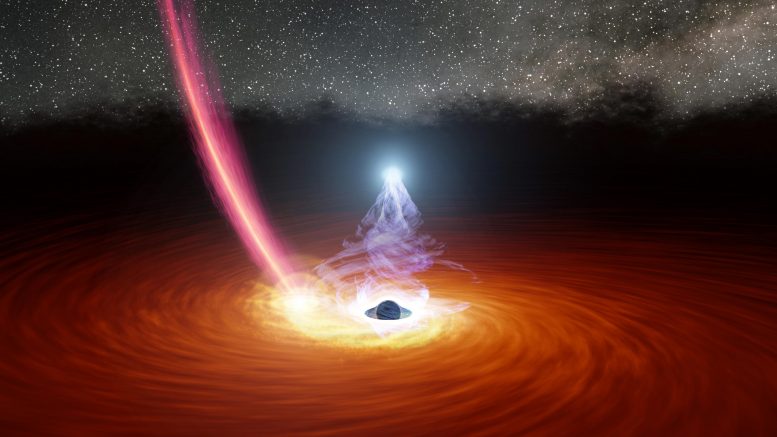
The two illustrations on this page show a black hole surrounded by a disk of gas, before (above) and after (below) the disk is partially dispersed. In this top image, the ball of white light above the black hole is the black hole corona, a collection of ultra-hot gas particles that forms as gas from the disk falls into the black hole. The streak of debris falling toward the disk is what remains of a star that was torn apart by the black hole’s gravity.
Credit: NASA/JPL Caltech
The telltale sign that the black hole was feeding vanished, perhaps when a star interrupted the feast. The event could lend new insight into these mysterious objects.
At the center of a far-off galaxy, a black hole is slowly consuming a disk of gas that swirls around it like water circling a drain. As a steady trickle of gas is pulled into the gaping maw, ultrahot particles gather close to the black hole, above and below the disk, generating a brilliant X-ray glow that can be seen 300 million light-years away on Earth. These collections of ultrahot gas, called black hole coronas, have been known to exhibit noticeable changes in their luminosity, brightening or dimming by up to 100 times as a black hole feeds.
But two years ago, astronomers watched in awe as X-rays from the black hole corona in a galaxy known as 1ES 1927+654 disappeared completely, fading by a factor of 10,000 in about 40 days. Almost immediately it began to rebound, and about 100 days later had become almost 20 times brighter than before the event.
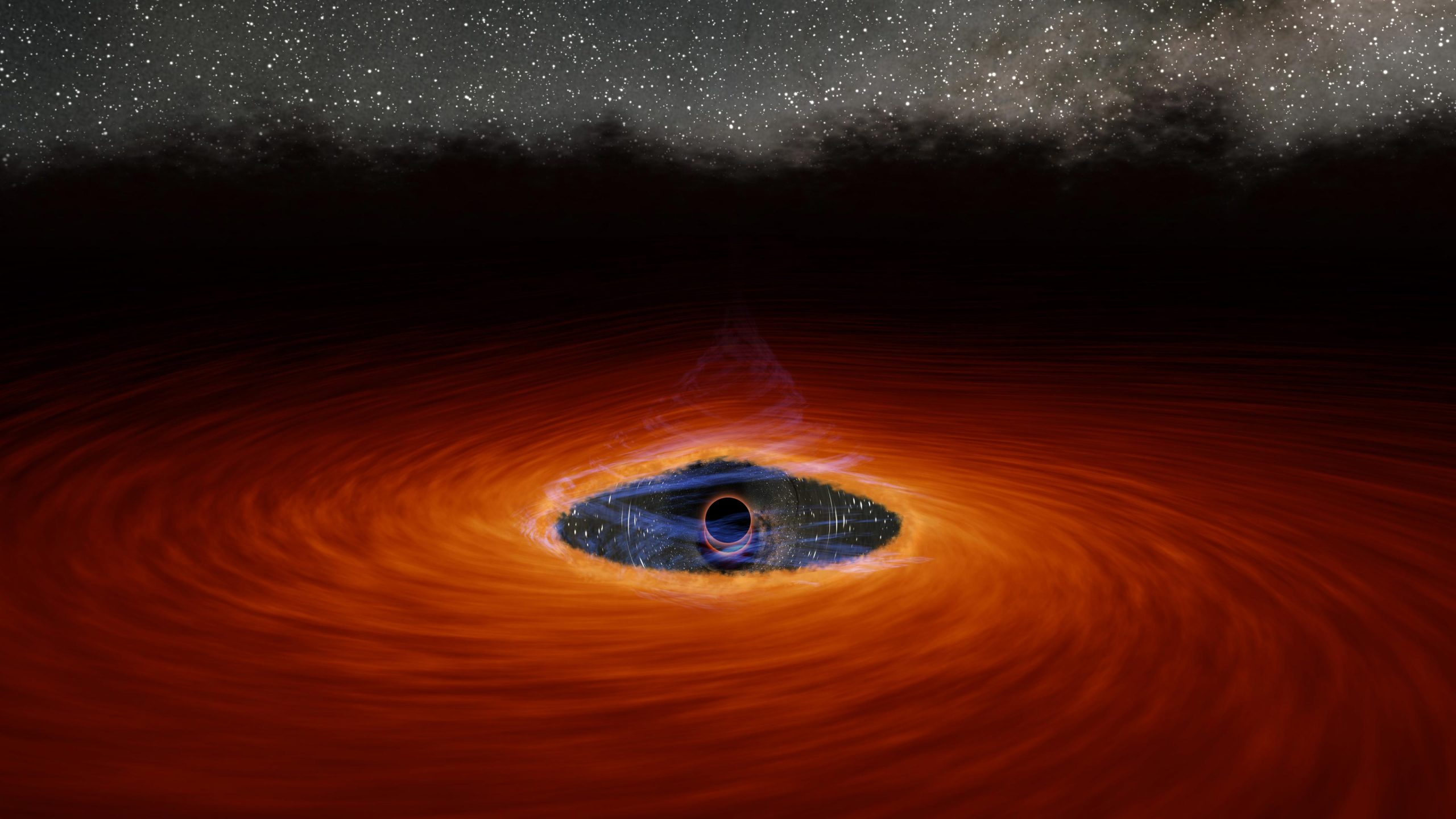
The X-ray light from a black hole corona is a direct byproduct of the black hole’s feeding, so the disappearance of that light from 1ES 1927+654 likely means that its food supply had been cut off. In a new study in the Astrophysical Journal Letters, scientists hypothesize that a runaway star might have come too close to the black hole and been torn apart. If this was the case, fast-moving debris from the star could have crashed through part of the disk, briefly dispersing the gas.
This illustration shows the black hole after the debris from the star has dispersed some of the gas in the disk, causing the corona to disappear.
Credit: NASA/JPL Caltech
“We just don’t normally see variations like this in accreting black holes,” said Claudio Ricci, an assistant professor at Diego Portales University in Santiago, Chile, and lead author of the study. “It was so strange that at first we thought maybe there was something wrong with the data. When we saw it was real, it was very exciting. But we also had no idea what we were dealing with; no one we talked to had seen anything like this.”
Nearly every galaxy in the universe may host a supermassive black hole at its center, like the one in 1ES 1927+654, with masses millions or billions of times greater than our Sun. They grow by consuming the gas encircling them, otherwise known as an accretion disk. Because black holes don’t emit or reflect light, they can’t be seen directly, but the light from their coronas and accretion disks offers a way to learn about these dark objects.
The authors’ star hypothesis is also supported by the fact that a few months before the X-ray signal disappeared, observatories on Earth saw the disk brighten considerably in visible-light wavelengths (those that can be seen by the human eye). This might have resulted from the initial collision of the stellar debris with the disk.
Digging Deeper
The disappearing event in 1ES 1927+654 is unique not only because of the dramatic change in brightness, but also because of how thoroughly astronomers were able to study it. The visible-light flare prompted Ricci and his colleagues to request follow-up monitoring of the black hole using NASA’s Neutron star Interior Composition Explorer (NICER), an X-ray telescope aboard the International Space Station. In total, NICER observed the system 265 times over 15 months. Additional X-ray monitoring was obtained with NASA’s Neil Gehrels Swift Observatory — which also observed the system in ultraviolet light — as well as NASA’s Nuclear Spectroscopic Telescope Array (NuSTAR) and the ESA (the European Space Agency) XMM-Newton observatory (which has NASA involvement).
When the X-ray light from the corona disappeared, NICER and Swift observed lower-energy X-rays from the system so that, collectively, these observatories provided a continuous stream of information throughout the event.
Although a wayward star seems the most likely culprit, the authors note that there could be other explanations for the unprecedented event. One remarkable feature of the observations is that the overall drop in brightness wasn’t a smooth transition: Day to day, the low-energy X-rays NICER detected showed dramatic variation, sometimes changing in brightness by a factor of 100 in as little as eight hours. In extreme cases, black hole coronas have been known to become 100 times brighter or dimmer, but on much longer timescales. Such rapid changes occurring continuously for months was extraordinary.
“This dataset has a lot of puzzles in it,” said Erin Kara, an assistant professor of physics at the Massachusetts Institute of Technology and a co-author of the new study. “But that’s exciting because it means we’re learning something new about the universe. We think the star hypothesis is a good one, but I also think we’re going to be analyzing this event for a long time.”
It’s possible that this kind of extreme variability is more common in black hole accretion disks than astronomers realized. Many operating and upcoming observatories are designed to search for short-term changes in cosmic phenomena, a practice known as “time domain astronomy,” which could reveal more events like this one.
“This new study is a great example of how flexibility in observation scheduling allows NASA and ESA missions to study objects that evolve relatively quickly and look for longer-term changes in their average behavior,” said Michael Loewenstein, a coauthor of the study and an astrophysicist for the NICER mission at the University of Maryland College Park and NASA’s Goddard Space Flight Center (GSFC) in Greenbelt, Maryland. “Will this feeding black hole return to the state it was in before the disruption event? Or has the system been fundamentally changed? We’re continuing our observations to find out.”
More About the Missions
NICER is an Astrophysics Mission of Opportunity within NASA’s Explorer program, which provides frequent flight opportunities for world-class scientific investigations from space utilizing innovative, streamlined, and efficient management approaches within the heliophysics and astrophysics science areas.
NuSTAR recently celebrated eight years in space, having launched on June 13, 2012. A Small Explorer mission led by Caltech and managed by NASA’s Jet Propulsion Laboratory in Southern California for the agency’s Science Mission Directorate in Washington, NuSTAR was developed in partnership with the Danish Technical University and the Italian Space Agency (ASI). The spacecraft was built by Orbital Sciences Corp. in Dulles, Virginia. NuSTAR’s mission operations center is at the University of California, Berkeley, and the official data archive is at NASA’s High Energy Astrophysics Science Archive Research Center at GSFC. ASI provides the mission’s ground station and a mirror data archive. Caltech manages JPL for NASA.
ESA’s XMM-Newton observatory was launched in December 1999 from Kourou, French Guiana. NASA funded elements of the XMM-Newton instrument package and provides the NASA Guest Observer Facility at GSFC, which supports the use of the observatory by U.S. astronomers.
GSFC manages the Swift mission in collaboration with Penn State in University Park, Pennsylvania, the Los Alamos National Laboratory in New Mexico, and Northrop Grumman Innovation Systems in Dulles, Virginia. Other partners include the University of Leicester and Mullard Space Science Laboratory of the University College London in the United Kingdom, Brera Observatory in Italy, and the Italian Space Agency.
Reference:“The Destruction and Recreation of the X-Ray Corona in a Changing-look Active Galactic Nucleus” by C. Ricci, E. Kara, M. Loewenstein, B. Trakhtenbrot, I. Arcavi, R. Remillard, A. C. Fabian, K. C. Gendreau, Z. Arzoumanian, R. Li, L. C. Ho, C. L. MacLeod, E. Cackett, D. Altamirano, P. Gandhi, P. Kosec, D. Pasham, J. Steiner and C.-H. Chan, 16 July 2020, Astrophysical Journal Letters. DOI: 10.3847/2041-8213/ab91a1
"This discovery mainly opens up a new pathway to studying brown dwarfs that are in remote regions of the Milky Way. If they get thrown at us, it's much easier!""
An illustration shows a runaway brown dwarf escaping a spiral galaxy.
(Image credit: Robert Lea (created with Canva)/NASA)
A newly discovered rogue stellar body may well be a "failed star," but it certainly isn't a failure when it comes to velocity!
The potential brown dwarf is racing through our Milky Way galaxy at 1.2 million mph (1.9 million kph). That's about 1,500 times faster than the speed of sound! Thankfully, this cosmic runaway is heading toward the center of the Milky Way and not toward us. However, the object is traveling so fast that it could eventually escape our galaxy entirely.
The incredible speed of this newly uncovered stellar body, designated CWISE J1249+3621, isn't the only fascinating thing about the object, which is currently around 400 light-years from Earth.
The stellar body has a mass that is just around 8% that ofthe sun, or 80 times the mass ofJupiter, which puts it right on the dividing line between a star and a fascinating group of objects called "brown dwarfs," often (somewhat unfairly) labeled "failed stars."
After several citizen scientists flagged the object, a team of astronomers followed up using the Keck I Telescope, one of two 10-meter twin telescopes located on the dormant volcano Maunakea, in Hawai'i.
"We discovered a very low-mass object, right on the star/brown dwarf mass boundary, that has an extreme velocity, moving fast enough that it may actually be unbound to the Milky Way galaxy," study team leader Adam Burgasser, of the University of California San Diego, told Space.com. "It joins a collection of 'hypervelocity' stars that have been found over the past few decades, most of which are thousands of light-years from the sun, whereas this source is a 'mere' 400 light-years away."
Burgasser added that the team's observations included an analysis of CWISE J1249+3621's atmosphere. This indicated that the potential brown dwarf also has an unusual chemical composition. The team aimed to use the information they gathered about the motion and composition of CWISE J1249+3621 to speculate on its possible origins.
"This discovery mainly opens up a new pathway to studying brown dwarfs that are in remote regions of the Milky Way, including its center, its halo and its various globular clusters and satellites," Burgasser said. "All of these systems are too far away to study brown dwarfs in detail directly, but if they get thrown at us, it's much easier!"
A young star, similar to the renegade star PG 1610+062, gets ejected from the Milky Way by a hungry black hole. So long!
(Image credit: A. IRRGANG, FAU)
What is this rogue star running from?
Brown dwarfs form just like stars do — from giant clouds of gas and dust, called molecular clouds, that develop overly dense patches that collapse under the influence of their own gravity. However, unlike a regular star such as the sun, brown dwarfs fail to gather enough material from the remains of the cloud that birthed them to reach the mass needed to generate the pressures and temperatures in their cores that kickstart the fusion of hydrogen to helium. This is the process that defines a "main sequence" star. Hence, the "failed star" moniker foisted on brown dwarfs.
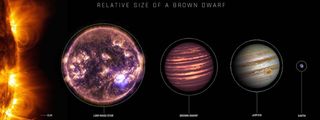
Brown dwarfs have masses ranging from around four times that of Jupiter to around 80 times that of the gas giant. (For comparison, the sun is 1,000 times more massive than Jupiter.) The mass of CWISE J1249+3621 is exciting because it puts it right at the hypothetical boundary between a star and a brown dwarf.
"The low mass is significant because it's by far the lowest-mass, high-velocity 'star' found to date. The original hypervelocity stars found about 20 years ago were massive O stars [around 50 times as massive as the sun] and B stars [up to 16 times as massive as the sun], a likely selection bias because these stars are rare and would need to be found at large distances," Burgasser said. "Our discovery indicates that whatever process (or processes) causes these stars to run away must operate at both high and low masses."
An illustration of a brown dwarf with an aurora, compared to the sizes of some other space objects. (Image credit: NASA/CC)
The UC San Diego researcher explained that the team is really excited to try to answer what sent this stellar body careening through the Milky Way.
"The star could have been kicked out of the center of Milky Way by our supermassive black hole, Sagittarius A*, a process commonly used to explain the origins of other hypervelocity stars," Burgasser said. "Notably, our star is moving into the center, not away, but it might be on a return trip after being ejected previously."
He added that it is also possible that the brown dwarf is on the run from a "cosmic vampire." The rogue stellar body may have been part of a binary system with a white dwarf stellar corpse that was ripping material away from it. This gruesome feeding eventually causes the white dwarf to erupt in a cosmic explosion called a Type Ia supernova. This would destroy the white dwarf and provide the "kick" that sent this runaway racing through the Milky Way at incredible speeds.
"Another possibility is that the star was launched out of a globular cluster through dynamical interactions with black holes in the center of the cluster; recent simulations show that this should happen several times over the age of the Milky Way," Burgasser said. "Any of these processes above, given a fast enough kick, could have launched it out, or in the case of an 'extragalactic' star, it just happens to be passing through."
He added that, currently, the team can't rule out the possibility that this potential brown dwarf is an intruder in our galaxy that came from outside the Milky Way. But the fact that it's passing through the plane of our Milky Way makes that a less likely case.
"The orbit is certainly the most surprising aspect of this object; it is moving radially in and out of the center of the Milky Way and almost perfectly in the plane," Burgasser said. "Most of the high-velocity stars we see are on much more chaotic or inclined orbits. I think this is a real clue to its real origin."
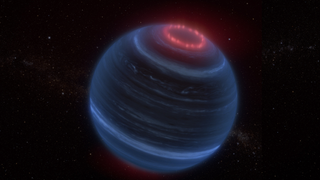
An illustration of a faint brown dwarf and its infrared emissions . (Image credit: NASA, ESA, CSA, LEAH HUSTAK (SPACE TELESCOPE SCIENCE INSTITUTE))
Runaway brown dwarfs, if that is indeed what CWISE J1249+3621 is, appear to be rare, but this could be because of their cool and faint nature, which makes them difficult to detect. This means that the population of rogue brown dwarfs could be much larger than current detection rates indicate.
"These types of stars are exceedingly rare; only a few dozen have been found out of billions of stars examined, and, as noted, this is the first low-mass one. And this object in particular is difficult to see because it's a very cool and dim star, nearly 10,000 times fainter than the sun and emitting most of its light at infrared wavelengths," Burgasser said. "It's hard to say how common these bodies are, with only one found so far, but since this is so close, we speculate that there may be many more.
"That speculation is informed partly by the fact that the majority of stars in the Milky Way are low mass, and about one in five are brown dwarfs, and that these objects are the easiest to 'throw around' since they are so low mass."
The team now intends to follow up on the investigation of CWISE J1249+3621's atmosphere in greater detail to see if its chemical abundances reveal something about its origin. They will also attempt to discover more of these low-mass stellar runaways, a hunt in which citizen scientists will play an integral role.
"We definitely want to find more of these objects, and our citizen scientists have identified several more high-velocity candidates to follow up," Burgasser concluded. "Citizen scientists were absolutely essential to this study! They were the ones who identified this source as an interesting target worth investigating. Without them, we'd still have hundreds of thousands of faint little dots to sort through."
The team's research is discussed in a pre-peer-reviewed paper featured on the repository site arXiv.
"Notice the cranes and vehicles at the bottom, which show off just how enormous the ELT is!"
Protective cladding being installed on the sides of the Extremely Large Telescope (ELT) dome.
(Image credit: ESO)
The dome enclosing the world's largest telescope is taking shape, with the installation of protective siding and supports for the primary mirror.
The European Southern Observatory's (ESO) Extremely Large Telescope (ELT) is currently under construction on the Cerro Armazones mountain in Chile's Atacama Desert and is expected to see its first light by 2028.
Recent progress photos from the construction site taken in June 2024 show cladding being installed on the outside of the ELT dome. This layer of material serves as a thermal insulation barrier and provides weather resistance to help protect the telescope from the extreme environment of the Chilean deser
Part of the dome will have large sliding doors, which will remain closed during the day and open at night, allowing the telescope to survey the sky. Once complete, the telescope will hunt for Earth-like exoplanets in search of signs of life outside of our own solar system and probe the early universe to study the first galaxies that formed after the Big Bang, among other tasks.
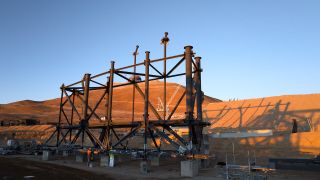
Assembly has begun on the beam structure for the sliding doors, which will help protect the telescope from the high daytime temperatures and dusty desert environment.
The frame of the dome’s sliding doors that will protect the Extremely Large Telescope (ELT) during the day and open at night for observations. (Image credit: ESO)
Construction photos from June also show progress on the support structure in the center of the dome that will eventually hold the ELT's 128-foot-wide (39 meters) primary mirror (M1), which weighs a whopping 200 tons. The mirror will rest on the white lattice structure, which will allow M1 to move smoothly during observations and compensate for varying gravity loads, wind conditions, vibrations or changes in temperature.
"Notice the cranes and vehicles at the bottom, which show off just how enormous the ELT is!" ESO officials said in a statement releasing the updated images.
The support structure is assembled in the center of the dome, which will eventually hold the Extremely Large Telescope’s (ELT) 200-ton primary mirror. (Image credit: ESO)
The primary mirror will be made up of 798 individual hexagonal segments, making it the largest segmented mirror ever built for a telescope. The ELT will have a total of five mirrors, all of which have different shapes, sizes and roles but will work together to observe the cosmos.
The secondary mirror, M2, will hang above M1, reflecting the light collected by it to the tertiary mirror, M3. The hole in the middle of the white lattice structure will house the central tower, which will hold the M3, M4 and M5 mirrors.
Meer van UFO'S of UAP'S, ASTRONOMIE, RUIMTEVAART, ARCHEOLOGIE, OUDHEIDKUNDE, SF-SNUFJES EN ANDERE ESOTERISCHE WETENSCHAPPEN - DE ALLERLAATSTE NIEUWTJES





 Milky Way’s Thin Disk Formed Less Than One Billion Years from Big Bang, New Study Suggests