Naar de inhoud

UFO'S of UAP'S, ASTRONOMIE, RUIMTEVAART, ARCHEOLOGIE, OUDHEIDKUNDE, SF-SNUFJES EN ANDERE ESOTERISCHE WETENSCHAPPEN - DE ALLERLAATSTE NIEUWTJES

UFO's of UAP'S in België en de rest van de wereld
akke.beakke.be
Ontdek de Fascinerende Wereld van UFO's en UAP's: Jouw Bron voor Onthullende Informatie! Ben jij ook gefascineerd door het onbekende? Wil je meer weten over UFO's en UAP's, niet alleen in België, maar over de hele wereld? Dan ben je op de juiste plek! België: Het Kloppend Hart van UFO-onderzoek In België is BUFON (Belgisch UFO-Netwerk) dé autoriteit op het gebied van UFO-onderzoek. Voor betrouwbare en objectieve informatie over deze intrigerende fenomenen, bezoek je zeker onze Facebook-pagina en deze blog. Maar dat is nog niet alles! Ontdek ook het Belgisch UFO-meldpunt en Caelestia, twee organisaties die diepgaand onderzoek verrichten, al zijn ze soms kritisch of sceptisch. Nederland: Een Schat aan Informatie Voor onze Nederlandse buren is er de schitterende website www.ufowijzer.nl, beheerd door Paul Harmans. Deze site biedt een schat aan informatie en artikelen die je niet wilt missen! Internationaal: MUFON - De Wereldwijde Autoriteit Neem ook een kijkje bij MUFON (Mutual UFO Network Inc.), een gerenommeerde Amerikaanse UFO-vereniging met afdelingen in de VS en wereldwijd. MUFON is toegewijd aan de wetenschappelijke en analytische studie van het UFO-fenomeen, en hun maandelijkse tijdschrift, The MUFON UFO-Journal, is een must-read voor elke UFO-enthousiasteling. Bezoek hun website op www.mufon.com voor meer informatie. Samenwerking en Toekomstvisie Sinds 1 februari 2020 is Pieter niet alleen ex-president van BUFON, maar ook de voormalige nationale directeur van MUFON in Vlaanderen en Nederland. Dit creëert een sterke samenwerking met de Franse MUFON Reseau MUFON/EUROP, wat ons in staat stelt om nog meer waardevolle inzichten te delen. Let op: Nepprofielen en Nieuwe Groeperingen Pas op voor een nieuwe groepering die zich ook BUFON noemt, maar geen enkele connectie heeft met onze gevestigde organisatie. Hoewel zij de naam geregistreerd hebben, kunnen ze het rijke verleden en de expertise van onze groep niet evenaren. We wensen hen veel succes, maar we blijven de autoriteit in UFO-onderzoek! Blijf Op De Hoogte! Wil jij de laatste nieuwtjes over UFO's, ruimtevaart, archeologie, en meer? Volg ons dan en duik samen met ons in de fascinerende wereld van het onbekende! Sluit je aan bij de gemeenschap van nieuwsgierige geesten die net als jij verlangen naar antwoorden en avonturen in de sterren! Heb je vragen of wil je meer weten? Aarzel dan niet om contact met ons op te nemen! Samen ontrafelen we het mysterie van de lucht en daarbuiten.

Archief

Eyewitness Accounts: Real UFO Encounters that Defy Explanation

Eyewitness Accounts: Real UFO Encounters that Defy Explanation

ALIEN WITNESSES of Real UFO Encounters

Fans of Ancient Apocalypse and Ancient Aliens will find this exploration of real UFO encounters intriguing. With increasing public interest and growing belief in the existence of UFOs and extraterrestrial beings, this article delves into the extraordinary experiences of ordinary people who have witnessed alien phenomena firsthand. From strange lights in the sky to encounters with mysterious beings, these accounts challenge our understanding of reality.

Mysterious Black Triangles

One witness recounts a chilling experience from Northern California. While driving on a highway, they encountered a black triangular object hovering by the roadside, emitting a buzzing sound. Initially mistaken for a blimp, the object displayed unusual characteristics that hinted at something far more advanced. This sighting, corroborated by multiple motorists, opened the door for the witness to explore the vast possibilities of extraterrestrial technology and its implications.

Saucer in the Sky

In El Dorado Hills, a group of friends witnessed a classic UFO— a saucer with green lights hovering silently in the night sky. This close encounter, occurring while they played frisbee in a suburban neighborhood, left a lasting impact. The sheer size and silence of the object ruled out conventional explanations like helicopters or airplanes. This sighting, shared among friends, became a memorable, if unsettling, part of their lives.

Childhood Encounters in Utah

A particularly harrowing account comes from a small town in Utah. A young girl, only six or seven at the time, awoke to find a figure with large, black, wet-looking eyes standing by her bed. This encounter repeated over two nights, leaving her frozen in fear. Years later, she experienced a loss of time while riding a horse with a friend, further deepening her belief in a connection between her childhood encounters and possible extraterrestrial presence.

Unexplained Lights and Snow in California

A musician driving home late at night witnessed a strange light emanating from a low cloud. As the light vanished, an unexpected snowfall blanketed the area, a rare occurrence in that region. This incident, coupled with the silent, mysterious light, convinced the witness of a UFO’s presence. The subsequent snowfall, witnessed by neighbors, added a bizarre twist to this unexplained phenomenon.

Close Encounters in Reno

In Reno, a worker experienced multiple UFO sightings, including a green star-like object and a diamond-shaped craft. These encounters, witnessed alongside a coworker, were further validated by the appearance of military jets seemingly investigating the objects. The witness’s belief in extraterrestrial technology grew stronger as these sightings continued, reinforcing the notion of UFO presence in our skies.

The Kecksburg Incident

A historical account from 1965 details a significant event near Kecksburg, Pennsylvania. Witnesses described a sonic boom and a sky illuminated by an unusual bluish-green glow. The object, reminiscent of a meteor or spaceship, left a lasting impression on those who saw it. The subsequent military presence in the area fueled speculation about the nature of the object and the possibility of a government cover-up.

Silent Triangle Over Lake Conroe

In 1977, a father and son witnessed a triangular formation of lights hovering silently above Lake Conroe, Texas. The object, described as being the size of a large aircraft, displayed no conventional signs of flight. Its sudden, silent departure left the witnesses in awe, cementing their belief in advanced, possibly extraterrestrial, technology.

Photographing the Unknown

A freelance photographer in California captured an unexplained cigar-shaped object in the sky while covering an event at Thunderhill Raceway. The clear blue sky provided a stark backdrop for the mysterious object, which defied conventional identification. This photographic evidence adds to the growing body of visual documentation supporting the existence of UFOs.

VIDEO:

  • ALIEN WITNESSES of Real UFO Encounters | We Are Not Alone | Full SCI-FI Documentary HD

These accounts, spanning decades and diverse locations, provide compelling evidence of UFO encounters. While skeptics may seek conventional explanations, the consistency and detail in these stories suggest something beyond our current understanding. As public interest grows and more witnesses come forward, the quest to unravel the mystery of UFOs and alien encounters continues, urging us to reconsider our place in the universe.

In this vast, unexplored cosmos, these testimonies remind us that we are not alone and that the truth, as elusive as it may be, is out there.

{ https://www.latest-ufo-sightings.net/  }

Hoe vind je dit bericht?
Geschreven door peter om 21:48 Stuur door

AI Enhanced UAP Video of Tom Delonge Of Blink-182 UAP Photo, UFO Sighting News.

AI Enhanced UAP Video of Tom Delonge Of Blink-182 UAP Photo, UFO Sighting News.

UAP,%20%E0%A4%89%E0%A4%AB%E0%A5%8C%20,%20%E0%A6%87%E0%A6%89%E0%A6%8F%E0%A6%AB%E0%A6%93,%20%C4%91i%CC%83a%20bay,%20MUFON,%20%E7%9B%AE%E6%92%83%E3%80%81%E3%82%A8%E3%82%A4%E3%83%AA%E3%82%A2%E3%83%B3,%20%20UFO,%20UFOs,%20%D0%9D%D0%9B%D0%9E%20,%20NLO,%20sighting,%20sightings,%20alien,%20aliens,%20ET,%20anomaly,%20anomalies,%20ancient,%20astrobiology,%20vreemdelinge,%20%203%20copy%205.png

Hey all, I was looking over Tom Delonge Instagram posts and noticed one where it looks like he got out of a car and started recording this glowing object in the desert. The UFO begins to hover over another car, with a beam of light coming down, hitting the cars back trunk area, then the UAP shoots away. Tom is a bit shy at telling us the details of where, when and if he recorded it or not, but he has often stated that he has friends high up in the government that shows him and gives him videos of top secret UFO sightings. 
Scott C. Waring 
 
Please hit subscribe and like, link to Tom Delonge UFO here at https://www.instagram.com/reel/CoPsVUttJLc/?utm_source=ig_web_copy_link

{ https://www.ufosightingsdaily.com/ }

Hoe vind je dit bericht?
Geschreven door peter om 17:29 Stuur door

NASA rover finds place where 'exciting' events occurred on Mars

NASA rover finds place where 'exciting' events occurred on Mars

Story by Mark Kaufman
 

Great floods once poured down a towering Martian mountain.

And NASA's dust-covered Curiosity rover has proof.

The car-sized NASA robot has spent much of 2024 exploring the Gediz Vallis channel, a dried-up waterway that travels down the three-mile-high Mount Sharp. Although Mars today is 1,000 times drier than the driest desert on Earth, the rover has spotted clues that long ago the Red Planet experienced momentous floods. It was a wet world.

"This was not a quiet period on Mars," Becky Williams, a scientist at the Planetary Science Institute who researches Mars using the rover's Mast Camera, said in a statement. "There was an exciting amount of activity here. We’re looking at multiple flows down the channel, including energetic floods and boulder-rich flows."

The images below show what Curiosity has recently found.

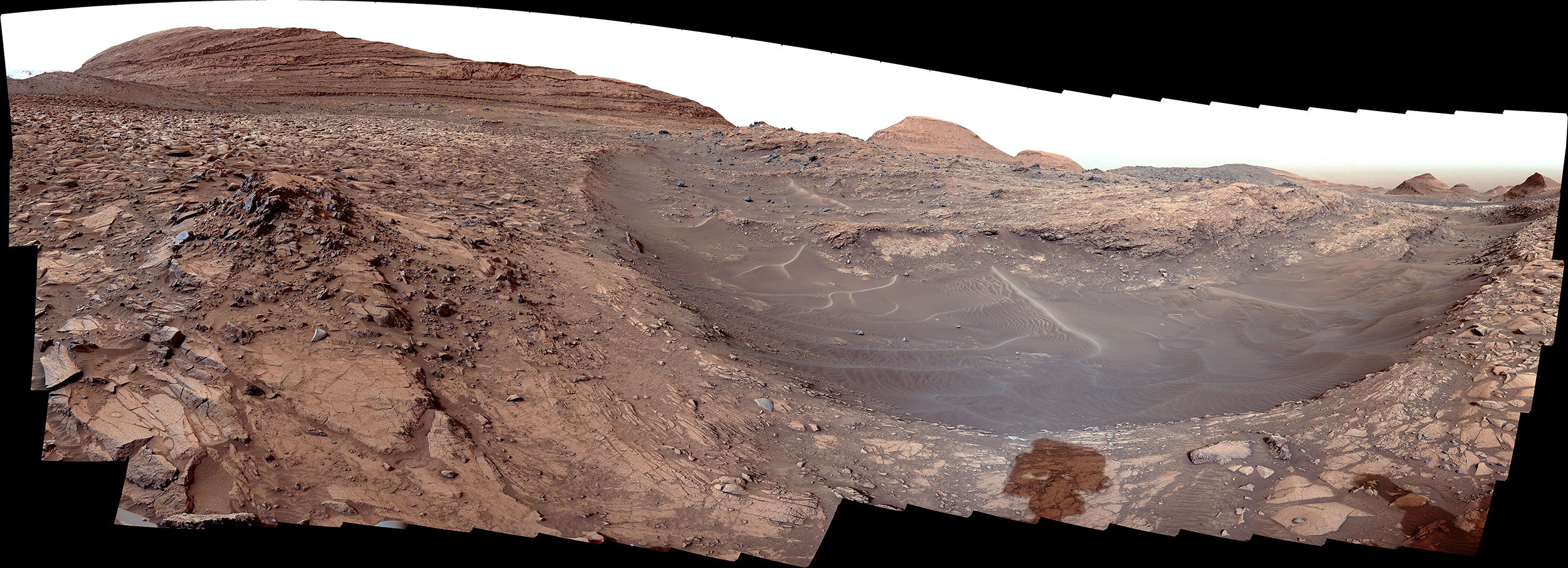
Below is a wide-view photo of a section of Gediz Vallis as it winds down Mount Sharp. You can see prominent buildups of rocks and boulders, such as those in the foreground on left. "This area was likely formed by large floods of water and debris that piled jumbles of rocks into mounds within the channel," NASA explained. Impressively, this debris pile-up extends some two miles down the mountain (though some of this was likely caused by landslides, too).

Mars' Gediz Vallis channel with large buildups of rocky debris.
© Provided by Mashable

Curiosity also closely examined these water-tumbled rocks. A number of them contain telltale "halo" markings, as seen in the image below. "Finally, water soaked into all the material that settled here," the space agency explained. "Chemical reactions caused by the water bleached white 'halo' shapes into some of the rocks."

At center, a Martian rock displaying a clear

At center, a Martian rock displaying a clear "halo" created by ancient interactions with water.
© Provided by Mashable

Unlike Earth, Mars no longer harbors an insulating atmosphere. The Red Planet's hot metallic core deep below its surface cooled long ago, and without a heated interior to generate a protective magnetic field, the once water-rich world was exposed to a relentless flow of particles from the sun, called the solar wind. The solar wind progressively stripped Mars of its thick atmosphere, leaving it the frigid, callous, irradiated desert we see today.

imagesmsl20170117pia21261-16.width-1024.jpg

The network of cracks in this Martian rock slab called "Old Soaker" may have formed from the drying of a mud layer more than 3 billion years ago. The view spans about 3 feet (90 centimeters) left-to-right and combines three images taken by the MAHLI camera on the arm of NASA's Curiosity Mars rover.› Full image and caption
Credit: NASA/JPL-Caltech/MSSS

Although it's clear that Mars once hosted bounties of water, robotic Martian explorers have spotted no evidence, so far, that this rocky world ever hosted life.

Pan around this 360-degree video to explore Gediz Vallis channel, the location where NASA’s Curiosity Mars rover discovered sulfur crystals and drilled its 41st rock sample. The images that make up this mosaic were captured by the rover’s MastCam in June.

Credit: NASA/JPL-Caltech/MSSS

NASA-rover ontdekt mysterieus rotsblok op Mars: 'deze kent geen competitie'

Credit: NASA / JPL-Caltech / ASU / MSSS

images-1_js73.jpg

Credit: NASA / JPL-Caltech / ASU

images-2_1p4m.jpg

Credit: NASA / JPL-Caltech / University of Arizona

Hoe vind je dit bericht?
Geschreven door peter om 17:23 Stuur door

NASA’s Curiosity Rover Discovers a Surprise in a Martian Rock

NASA’s Curiosity Rover Discovers a Surprise in a Martian Rock

These yellow crystals were revealed after NASA's Curiosity happened to drive over a rock and crack it open on May 30. Using an instrument on the rover's arm, scientists later determined these crystals are elemental sulfur—and it's the first time this kind of sulfur has been found on the Red Planet.

Credit: NASA/JPL-Caltech/MSSS© Provided by Phys.org

NASA’s Curiosity captured this close-up image of a rock nicknamed “Snow Lake” on June 8, 2024, the 4,209th Martian day, or sol, of the mission. Nine days earlier, the rover had crushed a similar-looking rock and revealed crystalline textures—and elemental sulfur—inside.

Credit: NASA/JPL-Caltech/MSSS© Provided by Phys.org

Among several recent findings, the rover has found rocks made of pure sulfur — a first on the Red Planet.

Scientists were stunned on May 30 when a rock that NASA’s Curiosity Mars rover drove over cracked open to reveal something never seen before on the Red Planet: yellow sulfur crystals.

Since October 2023, the rover has been exploring a region of Mars rich with sulfates, a kind of salt that contains sulfur and forms as water evaporates. But where past detections have been of sulfur-based minerals — in other words, a mix of sulfur and other materials — the rock Curiosity recently cracked open is made of elemental, or pure, sulfur. It isn’t clear what relationship, if any, the elemental sulfur has to other sulfur-based minerals in the area.

While people associate sulfur with the odor from rotten eggs (the result of hydrogen sulfide gas), elemental sulfur is odorless. It forms in only a narrow range of conditions that scientists haven’t associated with the history of this location. And Curiosity found a lot of it — an entire field of bright rocks that look similar to the one the rover crushed.

Pan around this 360-degree video to explore Gediz Vallis channel, the location where NASA’s Curiosity Mars rover discovered sulfur crystals and drilled its 41st rock sample. The images that make up this mosaic were captured by the rover’s MastCam in June. Credit: NASA/JPL-Caltech/MSSS

“Finding a field of stones made of pure sulfur is like finding an oasis in the desert,” said Curiosity’s project scientist, Ashwin Vasavada of NASA’s Jet Propulsion Laboratory in Southern California. “It shouldn’t be there, so now we have to explain it. Discovering strange and unexpected things is what makes planetary exploration so exciting.”

It’s one of several discoveries Curiosity has made while off-roading within Gediz Vallis channel, a groove that winds down part of the 3-mile-tall (5-kilometer-tall) Mount Sharp, the base of which the rover has been ascending since 2014. Each layer of the mountain represents a different period of Martian history. Curiosity’s mission is to study where and when the planet’s ancient terrain could have provided the nutrients needed for microbial life, if any ever formed on Mars.

NASA’s Curiosity Mars rover captured this view of Gediz Vallis channel
NASA’s Curiosity Mars rover captured this view of Gediz Vallis channel on March 31. This area was likely formed by large floods of water and debris that piled jumbles of rocks into mounds within the channel.
NASA/JPL-Caltech/MSSS

Floods and Avalanches

Spotted from space years before Curiosity’s launch, Gediz Vallis channel is one of the primary reasons the science team wanted to visit this part of Mars. Scientists think that the channel was carved by flows of liquid water and debris that left a ridge of boulders and sediment extending 2 miles down the mountainside below the channel. The goal has been to develop a better understanding of how this landscape changed billions of years ago, and while recent clues have helped, there’s still much to learn from the dramatic landscape.

Since Curiosity’s arrival at the channel earlier this year, scientists have studied whether ancient floodwaters or landslides built up the large mounds of debris that rise up from the channel’s floor here. The latest clues from Curiosity suggest both played a role: some piles were likely left by violent flows of water and debris, while others appear to be the result of more local landslides.

Mars rocks that show a pale color near their edges. These rings, also calle
While exploring Gediz Vallis channel in May, NASA’s Curiosity captured this image of rocks that show a pale color near their edges. These rings, also called halos, resemble markings seen on Earth when groundwater leaks into rocks along fractures, causing chemical reactions that change the color.
NASA/JPL-Caltech/MSSS

Those conclusions are based on rocks found in the debris mounds: Whereas stones carried by water flows become rounded like river rocks, some of the debris mounds are riddled with more angular rocks that may have been deposited by dry avalanches.

Finally, water soaked into all the material that settled here. Chemical reactions caused by the water bleached white “halo” shapes into some of the rocks. Erosion from wind and sand has revealed these halo shapes over time.

“This was not a quiet period on Mars,” said Becky Williams, a scientist with the Planetary Science Institute in Tucson, Arizona, and the deputy principal investigator of Curiosity’s Mast Camera, or Mastcam. “There was an exciting amount of activity here. We’re looking at multiple flows down the channel, including energetic floods and boulder-rich flows.”

A Hole in 41

All this evidence of water continues to tell a more complex story than the team’s early expectations, and they’ve been eager to take a rock sample from the channel in order to learn more. On June 18, they got their chance.

While the sulfur rocks were too small and brittle to be sampled with the drill, a large rock nicknamed “Mammoth Lakes” was spotted nearby. Rover engineers had to search for a part of the rock that would allow safe drilling and find a parking spot on the loose, sloping surface.

After Curiosity bored its 41st hole using the powerful drill at the end of the rover’s 7-foot (2-meter) robotic arm, the six-wheeled scientist trickled the powderized rock into instruments inside its belly for further analysis so that scientists can determine what materials the rock is made of.

Curiosity has since driven away from Mammoth Lakes and is now off to see what other surprises are waiting to be discovered within the channel.

More About the Mission

Curiosity was built by NASA’s Jet Propulsion Laboratory, which is managed by Caltech in Pasadena, California. JPL leads the mission on behalf of NASA’s Science Mission Directorate in Washington.

For more about Curiosity, visit:

News Media Contacts

{ https://www.nasa.gov/ }

Hoe vind je dit bericht?
Geschreven door peter om 23:42 Stuur door

Marsrover Curiosity stuit onverwacht op een bijzondere vondst onder zijn wielen

th?id=OVFT.QhqL1yYxyHrkrb4qEUEZLy&pid=News&w=300&h=186&c=14&rs=2&qlt=90&dpr=1.5

Marsrover Curiosity stuit onverwacht op een bijzondere vondst onder zijn wielen

Wetenschappers waren verbaasd toen een steen waar Marsrover Curiosity overheen reed, barstte en iets onthulde dat nog nooit eerder op de rode planeet is gezien: gele zwavelkristallen.

Sinds oktober 2023 verkent het Marswagentje Curiosity een gebied op Mars dat rijk is aan sulfaten, een type zout dat zwavel bevat en ontstaat wanneer water verdampt. Toch waren onderzoekers zeer verrast toen ze een betere blik wierpen op een steen die Curiosity per ongeluk had opengebroken. Curiosity had onverwacht gesteenten gevonden die uit puur zwavel bestaan – een unicum op de rode planeet.

Gele zwavelkristallen
Hieronder is de foto van de gele zwavelkristallen te aanschouwen. Waar eerdere ontdekkingen zwavelhoudende mineralen betroffen – dus een mix van zwavel en andere materialen – bestaat het gesteente dat hieronder te zien is uit elementaire, oftewel pure, zwavel. Het is nog onduidelijk welke relatie, als die er is, deze pure zwavel heeft met de andere zwavelhoudende mineralen in het gebied.

De nieuw ontdekte gele zwavelkristallen die aan het licht kwamen toen Marsrover Curiosity per ongeluk over een steen reed en deze openbrak. Met een instrument aan de arm van de rover hebben wetenschappers later vastgesteld dat het om pure zwavel gaat — de eerste keer dat deze vorm van zwavel op Mars is ontdekt. Afbeelding: NASA/JPL-Caltech/MSSS

Zwavel
Curiosity hoeft in de buurt van deze gele zwavelkristallen gelukkig zijn neus niet dicht te houden. Hoewel zwavel vaak wordt geassocieerd met de geur van rotte eieren (door waterstofsulfidegas), is pure zwavel geurloos. Het opmerkelijke is alleen dat het zich vormt onder een beperkte reeks omstandigheden die wetenschappers nog niet eerder hadden gekoppeld aan de geschiedenis van de vindplaats. Bovendien vond Curiosity er veel van: het lag verspreid over een veld van heldere gesteenten die lijken op het gesteente waar de rover overheen reed.

Oase
Missieleden kunnen hun geluk niet op. “Het ontdekken van een veld met stenen van puur zwavel is vergelijkbaar met het vinden van een oase in de woestijn,” legt missie-lid Ashwin Vasavada uit. “Het zou daar eigenlijk niet moeten zijn, dus we moeten nu uitzoeken hoe dat zo is gekomen. Het vinden van zulke vreemde en onverwachte dingen maakt planetaire verkenning zo opwindend.”

Ontdekkingen
De ontdekking van de gele zwavelkristallen kan worden toegevoegd aan de toch al indrukwekkende lijst van bijzondere vondsten die Curiosity heeft gedaan. Tijdens zijn verkenning van het Gediz Vallis-kanaal, een sleuf die langs een deel van de vijf kilometer hoge Mount Sharp slingert en waarvan de rover de basis sinds 2014 beklimt, stuitte hij al op veel verrassingen. Elke laag van de berg vertegenwoordigt een verschillende periode in de geschiedenis van Mars. Curiosity’s missie is om te onderzoeken waar en wanneer het oude oppervlak van de planeet mogelijk de voedingsstoffen heeft geboden die nodig zijn voor microbiologisch leven, mocht er ooit leven op Mars zijn geweest.

Gediz Vallis-kanaal
Het Gediz Vallis-kanaal werd jaren vóór de lancering van Curiosity al vanuit de ruimte opgemerkt en is een van de belangrijkste redenen waarom het wetenschappelijk team dit deel van Mars wilde verkennen. Wetenschappers geloven dat het kanaal is gevormd door stromen van vloeibaar water en puin, die een richel van keien en sediment hebben achtergelaten die zich ongeveer drie kilometer langs de berghelling onder het kanaal uitstrekt. Het doel is om beter te begrijpen hoe dit landschap miljarden jaren geleden is veranderd. Hoewel recente ontdekkingen nuttig zijn geweest, is er nog veel te leren van dit indrukwekkende landschap.

Door Curiosity vervaardigde foto van het Gediz Vallis-kanaal. Dit gebied is waarschijnlijk ontstaan door grote overstromingen van water en puin, die hopen rotsen in stapels binnen het kanaal hebben afgezet. Afbeelding: NASA/JPL-Caltech/MSSS

Grote hopen puin
Sinds Curiosity dit jaar bij het kanaal arriveerde, hebben wetenschappers onderzocht of oude overstromingen of aardverschuivingen verantwoordelijk zijn voor de grote hopen puin die vanuit de bodem van het kanaal omhoog komen. De meest recente gegevens van Curiosity wijzen erop dat beide factoren een rol hebben gespeeld: sommige hopen zijn waarschijnlijk ontstaan door heftige water- en puinstromen, terwijl andere mogelijk het gevolg zijn van meer lokale aardverschuivingen. Deze conclusies zijn gebaseerd op de stenen die in de puinhopen zijn aangetroffen: stenen die door waterstromen zijn meegenomen, zijn vaak afgerond zoals rivierstenen, terwijl sommige puinhopen juist vol zitten met hoekigere stenen die mogelijk zijn afgezet door droge lawines.

Water
Uiteindelijk heeft water zich door al het materiaal dat hier is neergeslagen, verspreid. Chemische reacties door het water hebben in sommige stenen witte ‘halo’-vormen veroorzaakt. Erosie door wind en zand heeft deze halo-vormen door de tijd heen zichtbaar gemaakt. “Dit was geen rustige periode op Mars,” zegt onderzoeker Becky Williams. “We zien verschillende stromen door het kanaal, waaronder krachtige overstromingen en stromen vol puin.” Kortom, deze bevindingen suggereren dat Mars in het verleden een veel actievere planeet was dan eerder werd aangenomen, met periodes van gewelddadige overstromingen en aardverschuivingen die het landschap vormden.

Mammoth Lakes
Al dit watergerelateerde bewijs onthult een complexer verhaal dan het team aanvankelijk had verwacht. Ze waren dan ook enthousiast om een gesteentemonster uit het kanaal te halen om meer te ontdekken. Hoewel de zwavelstenen te klein en breekbaar waren om met de boor te worden bemonsterd, werd in de buurt een grote steen met de bijnaam ‘Mammoth Lakes’ gevonden. Missieleden moesten een geschikt gedeelte van de steen vinden om veilig te kunnen boren en een geschikte plek op het losse, hellende oppervlak zoeken om te parkeren. Nadat Curiosity zijn 41e gat had geboord met de krachtige boor aan het einde van de twee meter lange robotarm, werd het poederige gesteente verzameld in de instrumenten in de rover voor verdere analyse. Dit stelt wetenschappers in staat om te bepalen uit welke materialen het gesteente is samengesteld.

Al met al hebben de ontdekkingen van de Curiosity rover in het Gediz Vallis-kanaal het inzicht in de geologische geschiedenis van Mars aanzienlijk verdiept. En elke nieuwe vondst brengt wetenschappers dichter bij het ontrafelen van de vraag of Mars ooit de voorwaarden heeft gekend die nodig zijn voor microbiologisch leven. Curiosity heeft Mammoth Lakes inmiddels verlaten en is nu op pad om te kijken welke andere verrassingen er in het kanaal op ontdekking wachten.

Bronmateriaal

{ https://scientias.nl/ }

Hoe vind je dit bericht?
Geschreven door peter om 23:26 Stuur door

De aarde draait steeds trager om haar as. En dat komt door klimaatverandering

De aarde draait steeds trager om haar as. En dat komt door klimaatverandering

Hoe hard de aarde om haar as draait, wordt normaal gesproken voornamelijk geregeld door de maan, die al miljarden jaren de lengte van een dag bepaalt. Maar dat gaat veranderen: klimaatverandering heeft straks een nog grotere invloed op de rotatiesnelheid van onze planeet.

De opwarming van de aarde zorgt ervoor dat de ijskappen in Groenland en op Antarctica smelten. Dit water stroomt van de poolgebieden naar de oceanen, vooral richting de evenaar. “Dat betekent dat er een enorme verschuiving van massa plaatsvindt, die de rotatie van de aarde beïnvloedt”, legt hoogleraar Benedikt Soja van de ETH Zurich uit.

De pirouettes van een kunstschaatsster
“Het is net als wanneer een kunstschaatsster een pirouette maakt: eerst houdt ze haar armen dicht bij haar lichaam en vervolgens strekt ze ze uit”, vertelt Soja metaforisch. Daardoor gaat ze steeds langzamer ronddraaien, omdat de massa – in dit geval haar armen – zich verder van de rotatie-as, haar lichaam dus, bevindt. Zo gaat ook de aarde steeds langzamer draaien, doordat de massa verder wegdrijft van de polen richting de evenaar, het breedste punt van de aardbol.

In de natuurkunde noemen ze dat de wet van behoud van het hoekmoment, en die geldt ook voor de rotatie van de aarde. Als de aarde langzamer draait, worden de dagen langer. Klimaatverandering verandert dus de lengte van een dag, zij het minimaal. Volgens de Zwitserse onderzoekers scheelt het enkele milliseconden, maar toch.

Niet alleen de maan
Dit komt dus enerzijds doordat water van de polen naar lagere breedtegraden stroomt en zo de rotatiesnelheid vertraagt. Een andere oorzaak is het effect van de getijden, veroorzaakt door de maan. Ooit was dat de enige invloed, nu lijkt het van secundair belang te worden. De studie komt namelijk tot de conclusie dat als we niets doen, klimaatverandering uiteindelijk een grotere impact heeft op de rotatiesnelheid van de aarde dan de maan, die al miljarden jaren de daglengte bepaalt. “Wij mensen hebben een grotere impact op onze planeet dan we ons realiseren”, reageert Soja. “Dit geeft ons uiteraard een enorme verantwoordelijkheid voor de toekomst van de aarde.”

Smeltende polen zorgen voor een enorme verschuiving van massa.

De massaverschuivingen op het aardoppervlak, veroorzaakt door het smeltende ijs, veranderen niet alleen de rotatiesnelheid en de daglengte, maar ook de as van de aarde. De punten waar de rotatieas het oppervlak bereikt, zijn aan het verschuiven. Op de lange termijn leidt dit tot een verplaatsing van de as van 10 meter per 100 jaar. Dat komt overigens niet alleen door de smeltende ijskappen, ook de bewegingen in het binnenste van de aarde spelen een rol.

Stroperig gesteente
Diep in de aardmantel, waar het gesteente door hoge druk stroperig wordt, verschuift eveneens het een en ander in de loop van duizenden jaren. Verder zorgen hittestromen van vloeibaar metaal in de buitenkern van de aarde voor massaverschuivingen. De verplaatsing van de polen en de afnemende rotatiesnelheid worden dus veroorzaakt door processen in de aardkern, de mantel en door het klimaat aan het oppervlak, blijkt uit het grootste model tot nu toe.

“Voor het eerst is er een volledige verklaring voor de oorzaken van de polaire beweging”, zegt hoofdonderzoeker Mostafa Kiani Shahvandi. “Met andere woorden, we weten nu waarom en hoe de rotatie-as van de aarde verschuift ten opzichte van de aardkorst.”
Een opvallende bevinding is dat de processen op en in de aarde met elkaar verbonden zijn en elkaar beïnvloeden. “Klimaatverandering zorgt ervoor dat de as van de aarde beweegt, en het lijkt erop dat de terugkoppeling van het behoud van het hoekmoment ook de dynamiek van de aardkern verandert”, legt Soja uit. Kiani Shahvandi voegt toe: “Aanhoudende klimaatverandering kan dus zelfs de processen diep in de aarde beïnvloeden en een grotere reikwijdte hebben dan eerder aangenomen.”

Nieuwe AI geeft kijkje in de toekomst
Voor hun studie gebruikten de onderzoekers nieuwe AI-methoden waarbij ze de wetten en principes van de natuurkunde toepasten om bijzonder krachtige en betrouwbare algoritmen voor machinelearning te ontwikkelen. Daarmee was het voor het eerst mogelijk om alle verschillende effecten op het aardoppervlak, in de mantel en in de kern vast te stellen en hun mogelijke interacties in kaart te brengen. Het resultaat van de berekeningen laat zien hoe de rotatiepolen van de aarde sinds 1900 zijn verschoven. Dit sluit uitstekend aan bij satellietwaarnemingen van de afgelopen dertig jaar, waardoor er nu ook goede prognoses voor de toekomst kunnen worden gemaakt.

Hoewel een kleine verschuiving niet erg lijkt, is het ook niet geheel zonder gevolgen. “Zelfs als de rotatie van de aarde maar langzaam verandert, moet daarmee rekening worden gehouden bij het navigeren in de ruimte, bijvoorbeeld als een ruimtevaartuig op een andere planeet moet landen. Een kleine afwijking van slechts 1 centimeter op aarde kan al leiden tot een afwijking van honderden meters over de enorme afstanden in de ruimte. Anders zal het niet mogelijk zijn om in een specifieke krater op Mars te landen”, klinkt het.      

De invloed van klimaatverandering is dus complexer dan gedacht, stellen de onderzoekers. Zelfs bij landingen op andere planeten miljoenen kilometers hiervandaan moeten we er rekening mee houden.

Bronmateriaal

{ https://scientias.nl/ }

Hoe vind je dit bericht?
Geschreven door peter om 23:12 Stuur door

Webb Completes Its Second Year of Operations

This “penguin party” (called Arp 142) is loud! The distorted spiral galaxy at center, the Penguin, and the compact elliptical galaxy at left, the Egg, are locked in an active embrace. A new near- and mid-infrared image from the Webb Space Telescope, taken to mark its second year of science, shows that their interaction is marked by a faint upside-down U-shaped blue glow. The blue galaxy at upper right (near bright star) is a closer galaxie teeming with new stars. It's not part of the collision and lies closer to Earth than Arp 142.

Webb Completes Its Second Year of Operations

What happens when a spiral and an elliptical galaxy collide? To celebrate the second anniversary of the “first light” for the Webb telescope, NASA released an amazing infrared view of two galaxies locked in a tight dance. They’re called the Penguin and the Egg and their dance will last hundreds of millions of years.

“In just two years, Webb has transformed our view of the universe, enabling the kind of world-class science that drove NASA to make this mission a reality,” said Mark Clampin, director of the Astrophysics Division at NASA Headquarters in Washington. “Webb is providing insights into longstanding mysteries about the early Universe.”

Webb Witnesses a Galactic Dance

The telescope targeted a collision scene named Arp 142 containing both galaxies—a scene that the Hubble Space Telescope has also explored. They lie about 326 million light-years away. Their first close encounter began somewhere between 25 and 75 million years ago. That’s when two partner galaxies had the first of many passages that will distort their shapes more than they already appear here.

The Hubble Space Telescope captured visible light when observing Arp 142, nicknamed the Penguin and the Egg, in 2013.  At right is the James Webb Space Telescope’s near-infrared light view of the same region. Courtesy NASA, ESA, CSA, STScI

The Hubble Space Telescope captured visible light when observing Arp 142, nicknamed the Penguin and the Egg, in 2013. The Webb view (right) shows the near-infrared view. Courtesy NASA, ESA, CSA, STScI

Webb’s observations, which combine near- and mid-infrared light from Webb’s NIRCam (Near-Infrared Camera) and MIRI (Mid-Infrared Instrument), respectively, clearly show that a hazy cloud of gas and stars (blue) links them together. The close approach also set off tremendous bursts of star birth in the colliding clouds of gas and dust.

Eventually, after several close approaches in their cosmic dance, these two galaxies will merge completely. Observers hundreds of millions of years in the future will look at Arp 142 and see one massive elliptical galaxy.

Interestingly, Webb’s sharp infrared eyes also picked out very distant galaxies. Some lie beyond this cosmic collision, although at least one lies about a hundred million light-years closer to Earth. It bristles with hot, young, newborn stars.

How The Arp 142 Galaxies Experience a Merger

The Penguin and Egg galaxies lie about 100,000 light-years apart but they affect each other. The Egg’s gravitational pull distorts the spiral and that interaction is “sculpting” the Penguin. The core makes up the eye of a penguin. The slowly unwinding spiral arms form a beak, head, backbone, and tail.

Webb’s infrared view reveals otherwise unseen activity between the two. For example, the Penguin is rich in dust. Webb’s view shows us how gravitational interactions pull that dust away from the Penguin. There are also scads of new stars in the galaxy, surrounded by what looks like smoke. Webb’s view shows this hydrogen cloud. It’s rich in carbon-based molecules called polycyclic aromatic hydrocarbons (PAHs). These are incredibly abundant in the Universe and astronomers find them just about everywhere they point a telescope.

Webb’s mid-infrared view of interacting galaxies Arp 142 seems to sing in primary colors. The background of space is like a yawning darkness speckled with bright, multi-colored beads.  This image was taken by MIRI, the telescope’s Mid-Infrared Instrument, which astronomers use to study cooler and older objects, dust, and extremely distant galaxies.  Here, the Egg appears as an exceptionally small teal oval with gauzy layers. Mid-infrared light predominantly shows the oldest stars in the elliptical galaxy, which has lost or used up most of its gas and dust. This is why the view is so different from the combined image, which includes near-infrared light.NASA, ESA, CSA, STScI Webb’s mid-infrared MIRI image shows the Egg as a small teal oval. Mid-infrared light predominantly shows the oldest stars in the elliptical galaxy, which has lost or used up most of its gas and dust. This is why the view is so different from the combined image, which includes near-infrared light. Courtesy: NASA, ESA, CSA, STScI

By contrast, in Webb’s view, the Egg looks like it’s hardly been touched—it’s still an egg-shaped elliptical. It has much older stars than the Penguin. Past epochs of star birth have pretty much used up the available star-making material. So, even though the two galaxies have about the same mass, the Egg just doesn’t have as much material to get stretched out or turned into stars.

Zeroing in on Webb’s Two Views

If you look at both of Webb’s infrared views of the galaxy collision, you can see marked differences in them. That’s because each one prioritizes a different set of infrared wavelengths. In the mid-infrared view, the egg looks tiny and washed out. That’s because the instrument sees only the old stars in the Egg. By contrast, the Penguin’s distorted core and spiral arms are brimming with young stars embedded in the PAH-rich hydrogen clouds.

The combined near- and mid-infrared view shows more of the gas clouds as the Egg tears them away from the Penguin. These regions will glitter in the future with the light of newly formed stars. For now, however, only cooler, older stars are visible in the combined image. The younger ones are there, but the mid-infrared-sensitive instrument doesn’t spot them.

Here’s a flythrough visualization of Arp 142. NASA, ESA, CSA, Ralf Crawford (STScI), Joseph DePasquale (STScI), Christian Nieves (STScI), Joseph Olmsted (STScI), Alyssa Pagan (STScI), Frank Summers (STScI), Greg Bacon (STScI)

Why Does Webb Study Galaxy Collisions?

By studying this galactic collision site, the Webb telescope further probes the activity as galaxies evolve. Collisions are an integral part of this process. Our Milky Way Galaxy will dance with the nearby Andromeda Galaxy, starting in about 5 billion years. Images and data from observations of other galaxies doing the same thing give astronomers a chance to understand the process and forecast the distant future when something called “Milkdromeda” will contain the stars and planets of two spirals that once were close neighbors.

For More Information

{ https://www.universetoday.com/ }

Hoe vind je dit bericht?
Geschreven door peter om 22:51 Stuur door

A Walking Balloon Could One Day Explore Titan – Or Earth’s Sea Floor

A Walking Balloon Could One Day Explore Titan – Or Earth’s Sea Floor

Novel ways to move on other celestial bodies always draw the attention of the space exploration community. Here at UT, we’ve reported on everything from robots that suspend themselves from the walls of Martian caves to robots that hop using jets of locally mined gas. But we haven’t yet reported on the idea of a balloon that “walks.” But that is the idea behind the BALloon Locomotion for Extreme Terrain, or BALLET, a project from Hari Nayar, a Principal Roboticist at NASA’s Jet Propulsion Laboratory, and his colleagues.

How exactly does a balloon “walk,” you might ask? By picking up and moving one of its six feet. BALLET’s architecture involves a positively buoyant balloon supporting six “feet” attached to adjustable cables. The “feet” are small science packages capable of taking small surface samples or analyzing the chemical composition of the part of the surface it touches.

Each foot is attached to three cables, individually controlled by pulleys. When a foot is done doing its science work at a given location, BALLET retracts the cables for the foot, lifting it off the surface. It then extends the cables using different lengths for the cables to place the foot in a new location.

Balloons have been an integral part of NASA’s explorations, as SciShow describes in this video.
Credit – SciShow

Preliminary research on the concept was done as part of a NASA Institute for Advanced Concepts (NIAC) grant in 2018. That research showed that it was better to lift two opposing feet off the ground at the same time to ensure the balloon’s stability. It also demonstrated where the concept would be most useful—Titan.

Balloon locomotion is typically considered somewhere like Venus, where it could float in the atmosphere in conditions similar to Earth. However, that altitude would make controlling a payload placed on the ground exceedingly tricky. Additionally, the harsh conditions close enough to the ground to be feasible would make the material requirements of the system untenable.

Similarly, a balloon could also work on Mars, but the high wind speeds of the sparse atmosphere would make controlling the balloon difficult. Titan offers the best of both worlds – a relatively stable, thick atmosphere where a negatively buoyant balloon would be feasible and stable environmental conditions that wouldn’t blow BALLET everywhere.

The current plan for exploring Titan – a helicopter named Dragonfly.

It also has many interesting places to explore, including cryovolcanoes and methane lakes. BALLET would allow traversal over even some of the most difficult terrain without accounting for considerations that would dramatically affect the capabilities of either a rover or a helicopter, such as the planned Dragonfly mission. 

There are still plenty of design considerations, though, such as the difficulty of controlling all the different variables, such as balloon orientation, cable length for each of the 18 cables, and pathfinding, simultaneously. After the completion of the Phase I project, the concept appears to be on hold in terms of receiving further funding from NASA at this point.

However, in terms of applications, BALLET also has some obvious ones on Earth. One that immediately sprang to mind is the collection of “nodules” as part of an undersea mining operation. Given the increased need for cobalt and other materials provided in those nodules and the bad image that comes from the destruction of the seabed that comes with traditional mining techniques, this idea might be one of those rare space exploration ideas that sooner sees an application on Earth than off of it.

Learn More:

Lead Image:

  • Artist’s conception of the BALLET concept mission architecture, including a “single step” action.
    Credit – Nayar et al.

{ https://www.universetoday.com/ }

Hoe vind je dit bericht?
Geschreven door peter om 22:37 Stuur door

Experimental Radar Technique Reveals the Composition of Titan’s Seas

This colorized mosaic from NASA's Cassini mission shows the most complete view yet of Titan's northern land of lakes and seas. Saturn's moon Titan is the only world in our solar system other than Earth that has stable liquid on its surface. The liquid in Titan's lakes and seas is mostly methane and ethane. New bistatic radar data from Cassini is revealing even more detail about Titan's hydrocarbon seas. Image Credit: NASA / JPL-Caltech / Agenzia Spaziale Italiana / USGS

Experimental Radar Technique Reveals the Composition of Titan’s Seas

The Cassini-Huygens mission to Saturn generated so much data that giving it a definitive value is impossible. It’s sufficient to say that the amount is vast and that multiple scientific instruments generated it. One of those instruments was a radar designed to see through Titan’s thick atmosphere and catch a scientific glimpse of the moon’s extraordinary surface.

Scientists are still making new discoveries with all this data.

Though Saturn has almost 150 known moons, Titan attracts almost all of the scientific attention. It’s Saturn’s largest moon and the Solar System’s second largest. But Titan’s surface is what makes it stand out. It’s the only object in the Solar System besides Earth with surface liquids.

Cassini’s radar instrument had two basic modes: active and passive. In active mode, it bounced radio waves off surfaces and measured what was reflected back. In passive mode, it measured waves emitted by Saturn and its moons. Both of these modes are called static modes.

But Cassini had a third mode called bistatic mode that saw more limited use. It was experimental and used its Radio Science Subsystem (RSS) to bounce signals off of Titan’s surface. Instead of travelling back to sensors on the spacecraft, the signals were reflected back to Earth, where they were received at one of NASA’s Deep Space Network (DNS) stations. Critically, after bouncing off of Titan’s surface, the signal was split into two, hence the name bistatic.

A team of researchers has used Cassini’s bistatic data to learn more about Titan’s hydrocarbon seas. Their work, “Surface properties of the seas of Titan as revealed by Cassini mission bistatic radar experiments,” has been published in Nature Communications. Valerio Poggiali, a research associate at the Cornell Center for Astrophysics and Planetary Science, is the lead author.

This schematic shows how Cassini's bistatic radar experiment worked. The orbiter used its Radio Science Subsystem to send signals to Titan's surface. The signals then reflected off of Titan to Earth, where they were received by either the DNS receiver at Canberra, Goldstone, or Madrid. The signals are either Right Circularly Polarized (RCP) or Left Circularly Polarized (LCP.) Image Credit: Poggiali et al. 2024. This schematic shows how Cassini’s bistatic radar experiment worked. The orbiter used its Radio Science Subsystem to send signals to Titan’s surface. The signals then reflected off Titan to Earth, where they were received by one of the DNS receivers at Canberra, Goldstone, or Madrid. The signals are either Right Circularly Polarized (RCP) or Left Circularly Polarized (LCP). Image Credit: Poggiali et al. 2024.

The signals that reach the DNS are polarized, which reveals more information about the hydrocarbon seas on Titan. While Cassini’s radar instrument revealed how deep the seas are, the bistatic radar data tells researchers about both their compositions and surface textures.

This image of the hydrocarbon seas on Titan is well-known and was radar-imaged by Cassini. That radar data told us how deep the seas are. New bistatic radar data can reveal more about the composition and surface texture of the seas. Image Credit: [JPL-CALTECH/NASA, ASI, USGS] This image of the hydrocarbon seas on Titan is well-known and was radar-imaged by Cassini. That radar data told us how deep the seas are. New bistatic radar data can reveal more about the composition and surface texture of the seas. Image Credit: [JPL-CALTECH/NASA, ASI, USGS]

“The main difference,” Poggiali said, “is that the bistatic information is a more complete dataset, and is sensitive to both the composition of the reflecting surface and to its roughness.”

“It’s like on Earth, when fresh-water rivers flow into and mix with the salty water of the oceans.”

Valerio Poggiali, lead author, Cornell Center for Astrophysics and Planetary Science

The experimental bistatic radar required meticulous cooperation.

Philip Nicholson, a professor in the Department of Astronomy at Cornell, is one of the study’s co-authors. “The successful execution of a bistatic radar experiment requires exquisite choreography between the scientists who design it, Cassini mission planners and navigators, and the team who collects the data at the receiving station,” Nicholson said.

These results are based on bistatic radar data from four Cassini flybys from 2014 to 2016. In this work, the researchers focused on three large seas on the surface of Titan’s polar regions: Kraken Mare, Ligeia Mare and Punga Mare.

The bistatic radar data revealed new information about the three seas. Though they’re all hydrocarbon seas, their composition varies based on latitude and their proximity to other features like estuaries and rivers. The bistatic radar measured the dielectric constant of Titan’s seas. The dielectric constant is a material’s capacity to store electrical energy. In practical terms, it’s a measure of a surface’s reflectivity, so it reveals the composition. Earth’s water has a dielectric constant of about 80. Titan’s methane and ethane seas have a dielectric constant of only about 1.7. Kraken Mare’s southernmost region had the highest dielectric constant.

This figure from the study shows Titan's polar regions with the three large seas labelled. The colour key on the right and the text on the image show the dielectric constants of different regions. The white lines labelled T101, T102, T106, and T124 are the four flybys. Image Credit: Poggiali et al. 2024. This figure from the study shows Titan’s polar regions with the three large seas labelled. The colour key on the right and the text on the image show the dielectric constants of different regions. The white lines labelled T101, T102, T106, and T124 are the four flybys. Image Credit: Poggiali et al. 2024.

Bistatic radar data also showed all three seas had calm surfaces during the four flybys. Waves were no more than 3.3 mm, about 0.13 of an inch. Near estuaries, straits, and coastal areas, the waves were slightly larger: 5.2 mm or 0.2 of an inch. So small they barely merit the name ‘wave.’

This figure from the study is similar to the previous image but shows wave height instead of dielectric constant. Image Credit: Poggiali et al. 2024. This figure from the study is similar to the previous image but shows wave height instead of dielectric constant. Image Credit: Poggiali et al. 2024.

The bistatic radar data also revealed the composition of some of the rivers that flow into the seas.

“We also have indications that the rivers feeding the seas are pure methane,” Poggiali said, “until they flow into the open liquid seas, which are more ethane-rich. It’s like on Earth, when fresh-water rivers flow into and mix with the salty water of the oceans.”

These results agree with scientific models of Titan’s hydrocarbon seas and thick atmosphere. Models show that methane rains down from Titan’s atmosphere and then flows into its lakes and seas. They also show that the rain contains only tiny amounts of ethane and other hydrocarbons and almost completely consists of methane.

“This fits nicely with meteorological models for Titan,” Nicholson said, “which predict that the ‘rain’ that falls from its skies is likely to be almost pure methane, but with trace amounts of ethane and other hydrocarbons.”

The Cassini mission is very instructive for future missions. Though it ended its mission when it plunged into Saturn in 2017, scientists are still making new discoveries with its vast trove of data. The same will be true of missions like Juno when they end.

The researchers behind this work say there’s lots left to learn from all of Cassini’s data.

“There is a mine of data that still waits to be fully analyzed in ways that should yield more discoveries,” Poggiali said. “This is only the first step.”

{ https://www.universetoday.com/ }

Hoe vind je dit bericht?
Geschreven door peter om 21:12 Stuur door

ESA is Building a Mission to Visit Asteroid Apophis, Joining it for its 2029 Earth Flyby

ESA's Ramses mission to asteroid Apophis. Credit: ESA

ESA is Building a Mission to Visit Asteroid Apophis, Joining it for its 2029 Earth Flyby

According to the ESA’s Near-Earth Objects Coordination Center (NEOCC), 35,264 known asteroids regularly cross the orbit of Earth and the other inner planets. Of these, 1,626 have been identified as Potentially Hazardous Asteroids (PHAs), meaning that they may someday pass close enough to Earth to be caught by its gravity and impact its surface. While planetary defense has always been a concern, the comet Shoemaker-Levy 9 slamming into Jupiter in 1994 sparked intense interest in this field.

In 2022, NASA’s Double-Asteroid Redirect Test (DART) mission successfully tested the kinetic impact method when it collided with Dimorphos, the small asteroid orbiting Didymos. Today, the ESA Space Safety program is taking steps to test the next planetary defense mission – the Rapid Apophis Missin for Space Safety (RAMSES). In 2029, RAMSES will rendezvous with the Near Earth Asteroid (NEA) 99942 Apophis and accompany it as it makes a very close (but safe) flyby of Earth in 2029. The data it collects will help scientists improve our ability to protect Earth from similar objects that could pose an impact risk.

Discovered in 2004, Apophis is an irregularly shaped asteroid measuring about 375 m (410 yards) across. At the time, observations indicated there was a small risk that it would impact Earth in 2029, 2036, or 2068. Given its size and the devastating effect an impact would have, astronomers decided to name it after the Egyptian god of chaos and destruction. While astronomers have since ruled out the possibility of a collision for at least the next century, Apophis will pass within 32,000 km (~19,885 mi) of Earth’s surface on April 13th, 2029.

New_radar_observations_of_Apophis_rule_out_future_impact-1-1024x449.png

Radar observations of Apophis rule out future impact. Credit: NASA/JPL-Caltech and NSF/AUI/GBO

At this distance, the asteroid will be close enough to be visible to the naked eye to roughly two billion people across much of Europe, Africa, and parts of Asia. Based on analyses of the size and orbits of all known asteroids, astronomers believe that objects this large pass this close to Earth only once every 5,000 to 10,000 years. The RAMSES spacecraft will rendezvous with Apophis before it makes its closest pass to Earth and follow behind, monitoring it with a suite of scientific instruments to see how Earth’s gravity changes it.

This will consist of conducting before-and-after surveys of the asteroid’s shape, surface, orbit, rotation, and orientation. Based on this comparative analysis, scientists will learn more about how an asteroid’s fundamental characteristics – its composition, interior structure, cohesion, mass, density, and porosity – respond to external forces. These properties are vital for determining how to knock a PHA off course so it does not collide with Earth. Patrick Michel, the Director of Research at the Centre national de la recherche scientifique (CNRS) and the Observatoire de la Côte d’Azur in Nice, explained in an ESA press release:

“There is still so much we have yet to learn about asteroids but, until now, we have had to travel deep into the Solar System to study them and perform experiments ourselves to interact with their surface. For the first time ever, nature is bringing one to us and conducting the experiment itself. All we need to do is watch as Apophis is stretched and squeezed by strong tidal forces that may trigger landslides and other disturbances and reveal new material from beneath the surface.”

The ESA recently secured permission from the Space Safety Program board to begin preparatory work on the mission so it can launch by April 2028. This deadline is necessary, so the mission is to be ready to launch and rendezvous with Apophis in orbit by February 2029. The final decision to commit to the mission will be made at the ESA’s Ministerial Council Meeting in November 2025. In the meantime, NASA has redirected its newly renamed OSIRIS-APEX spacecraft towards Apophis, which will arrive one month after the asteroid makes its flyby.

Apophis_orbit_diverted_by_Earth_s_gravity_-_NEO_Toolkit.gif

Apophis orbit diverted by Earth’s gravity – NEO Toolkit Space Safety Apophis orbit diverted by Earth’s gravity, Credit: ESA

Since asteroids are leftover material from the formation of the Solar System (ca. 4.5 billion years ago), this rendezvous is also an opportunity to obtain data that could provide new insights into planetary formation and evolution. This makes the 2029 flyby an extremely rare opportunity for astronomy, asteroid science, planetary defense, and for engaging billions of people worldwide. It will also be an opportunity for international collaboration, as previously demonstrated by the DART and the ESA’s Hera missions – the former redirected Didymos while the latter confirmed a change in orbit.

Last, but not least, the RAMSES mission will test the ability of space agencies to build and deploy an asteroid response quickly. As Richard Moissl, heading ESA’s Planetary Defence Office, explained:

“Ramses will demonstrate that humankind can deploy a reconnaissance mission to rendezvous with an incoming asteroid in just a few years. This type of mission is a cornerstone of humankind’s response to a hazardous asteroid. A reconnaissance mission would be launched first to analyse the incoming asteroid’s orbit and structure. The results would be used to determine how best to redirect the asteroid or to rule out non-impacts before an expensive deflector mission is developed.”

Further Reading: 

{ https://www.universetoday.com/ }

Hoe vind je dit bericht?
Geschreven door peter om 20:58 Stuur door

Meer van UFO'S of UAP'S, ASTRONOMIE, RUIMTEVAART, ARCHEOLOGIE, OUDHEIDKUNDE, SF-SNUFJES EN ANDERE ESOTERISCHE WETENSCHAPPEN - DE ALLERLAATSTE NIEUWTJES

↑ Terug naar de berichten