Naar de inhoud

UFO'S of UAP'S, ASTRONOMIE, RUIMTEVAART, ARCHEOLOGIE, OUDHEIDKUNDE, SF-SNUFJES EN ANDERE ESOTERISCHE WETENSCHAPPEN - DE ALLERLAATSTE NIEUWTJES

UFO's of UAP'S in België en de rest van de wereld
akke.beakke.be
Ontdek de Fascinerende Wereld van UFO's en UAP's: Jouw Bron voor Onthullende Informatie! Ben jij ook gefascineerd door het onbekende? Wil je meer weten over UFO's en UAP's, niet alleen in België, maar over de hele wereld? Dan ben je op de juiste plek! België: Het Kloppend Hart van UFO-onderzoek In België is BUFON (Belgisch UFO-Netwerk) dé autoriteit op het gebied van UFO-onderzoek. Voor betrouwbare en objectieve informatie over deze intrigerende fenomenen, bezoek je zeker onze Facebook-pagina en deze blog. Maar dat is nog niet alles! Ontdek ook het Belgisch UFO-meldpunt en Caelestia, twee organisaties die diepgaand onderzoek verrichten, al zijn ze soms kritisch of sceptisch. Nederland: Een Schat aan Informatie Voor onze Nederlandse buren is er de schitterende website www.ufowijzer.nl, beheerd door Paul Harmans. Deze site biedt een schat aan informatie en artikelen die je niet wilt missen! Internationaal: MUFON - De Wereldwijde Autoriteit Neem ook een kijkje bij MUFON (Mutual UFO Network Inc.), een gerenommeerde Amerikaanse UFO-vereniging met afdelingen in de VS en wereldwijd. MUFON is toegewijd aan de wetenschappelijke en analytische studie van het UFO-fenomeen, en hun maandelijkse tijdschrift, The MUFON UFO-Journal, is een must-read voor elke UFO-enthousiasteling. Bezoek hun website op www.mufon.com voor meer informatie. Samenwerking en Toekomstvisie Sinds 1 februari 2020 is Pieter niet alleen ex-president van BUFON, maar ook de voormalige nationale directeur van MUFON in Vlaanderen en Nederland. Dit creëert een sterke samenwerking met de Franse MUFON Reseau MUFON/EUROP, wat ons in staat stelt om nog meer waardevolle inzichten te delen. Let op: Nepprofielen en Nieuwe Groeperingen Pas op voor een nieuwe groepering die zich ook BUFON noemt, maar geen enkele connectie heeft met onze gevestigde organisatie. Hoewel zij de naam geregistreerd hebben, kunnen ze het rijke verleden en de expertise van onze groep niet evenaren. We wensen hen veel succes, maar we blijven de autoriteit in UFO-onderzoek! Blijf Op De Hoogte! Wil jij de laatste nieuwtjes over UFO's, ruimtevaart, archeologie, en meer? Volg ons dan en duik samen met ons in de fascinerende wereld van het onbekende! Sluit je aan bij de gemeenschap van nieuwsgierige geesten die net als jij verlangen naar antwoorden en avonturen in de sterren! Heb je vragen of wil je meer weten? Aarzel dan niet om contact met ons op te nemen! Samen ontrafelen we het mysterie van de lucht en daarbuiten.

Archief

Research Suggests all Humans Share One Single Ancestor—and it's not Adam

Research Suggests all Humans Share One Single Ancestor—and it's not Adam

Story by May Man
Research Suggests all Humans Share One Single Ancestor—and it's not Adam 

©Freepik

Research Suggests all Humans Share One Single Ancestor—and it's not Adam
Diversity is often hailed as the essence of beauty—an observation that is readily apparent when we consider the vibrant array of flowers, animals, landscapes, and humans that populate our world.

Yet, this remarkable diversity wasn’t always the norm. In fact, all life on Earth traces its lineage back to a singular origin.

The True Ancestor Humans: LUCA

©New Scientist

The True Ancestor Humans: LUCA
Contrary to popular beliefs—like those found in biblical texts—the progenitor of all living organisms wasn’t named God or Adam but is known as LUCA.

LUCA stands for "Last Universal Common Ancestor," a term used by scientists to describe a fundamental, primitive organism from which all life has descended.

Gathering Purple Bacteria

©Wikimedia

The Ancient Root of All Life

This tiny, rudimentary life form is considered the root of the entire tree of life, encompassing everything from the tiniest bacteria to the most massive creatures that have ever existed.

Recent research, however, has revealed that LUCA’s existence may date back even further than previously thought

Insights into Planetary Formation

©Wikimedia

New Findings Suggest LUCA Predates Earlier Estimates
For a long time, scientists estimated that LUCA emerged approximately 4 billion years ago—around 600 million years after the Earth was formed.

But new findings, detailed in a recent study published in Nature Ecology & Evolution, suggest that LUCA might have appeared even earlier.

Ancient Planet Theia Is Buried Deep Inside the Earth

©Alexander Gerst/ESA via Getty Images

Detailed Insights into LUCA and Early Earth
The research not only pushes back the timeline of LUCA’s existence but also provides fascinating insights into its characteristics and the conditions of early Earth.

An international team of researchers from the UK, Netherlands, Hungary, and Japan undertook the challenge of pinpointing LUCA’s exact appearance on Earth.

A Combination of Factors

©Sangharsh Lohakare/Unsplash

Genetic Analysis
To achieve this, they employed a technique that involved analyzing genetic data from modern species and tracking the mutations that have accumulated since these species diverged from their common ancestor—LUCA.

By applying a genetic equation to estimate the separation time between species, the team concluded that LUCA may have been around as early as 400 million years after Earth’s formation.

Why Is the Crater so Dangerous?

©Hellbus/Wikimedia

Life Amidst Earth’s Fiery Beginnings
This new timeframe places LUCA squarely within the Hadean Eon, a tumultuous period named after Hades, the Greek god of the underworld.

The Hadean Eon, which also draws from the Hebrew word for "hell," was characterized by extreme conditions, including a molten surface, relentless volcanic eruptions, and frequent asteroid impacts.

A Desperate Plan

©flydime/Wikimedia

Surviving the Extreme
The fact that LUCA managed to survive in such a harsh environment is remarkable.

The researchers were keen to understand how this early ancestor endured these brutal conditions.

Before the Change in the Magnetic Field

©iStock

LUCA's Primitive Immunity
Their investigation revealed that, despite LUCA’s simplicity as a prokaryote—a single-celled organism lacking a nucleus and membrane-bound organelles—it likely possessed a primitive immune system.

This early immune system would have enabled LUCA to fend off the primordial viruses that were pervasive at the time.

Microbes Play Key Role in Ecosystem

©Wikimedia

Early Microbial Ecosystems and Recycling
Tim Lenton, a co-author of the study from the University of Exeter, noted, “It’s clear that LUCA was exploiting and changing its environment, but it is unlikely to have lived alone.”

“Its waste would have been food for other microbes, like methanogens, that would have helped to create a recycling ecosystem.”

The Purpose of SLC30A9

©Wikimedia

Ongoing Research
Although LUCA remains the oldest known common ancestor, the path from this primordial life form to the complex organisms we see today is still a subject of ongoing research.

Scientists continue to delve into our primordial past to uncover the intricate processes that led to the evolution of complex life and the remarkable diversity that defines our world today.

Birth Rate Plummets To Lowest in 40 Years in Worrisome Trend

©Jakub Hałun/Wikimedia Commons

Unraveling the Evolution from LUCA to Modern Diversity
Further exploration is needed to fully understand how life evolved from its earliest beginnings.

Additionally, this research will help clarify how these early forms of life gave rise to the extraordinary variety of organisms we see today.

{ https://www.msn.com/en-us/channel/topic/Science/ }

Hoe vind je dit bericht?
Geschreven door peter om 21:09 Stuur door

The 'Son of Blackbird' Takes Shape: Lockheed's Hypersonic SR-72 Unveiled

The 'Son of Blackbird' Takes Shape: Lockheed's Hypersonic SR-72 Unveiled

Story by Mike Brown

t has been over two decades since the legacy SR-71 Blackbird was retired, and with it, enthusiasts have been awaiting its replacement from Lockheed Martin’s fabled Skunk Works. Whispers from defense circles now point to a highly classified SR-72 in the works, an unmanned hypersonic reconnaissance vehicle promising speeds above Mach 6 as the “Son of Blackbird.”

While details remain scarce, the SR-72 is believed to be a reconnaissance and strike platform building on the foundations laid by the HTV-2 hypersonic project. “It is rumored that the SR-72 hypersonic aircraft will possess superior capabilities compared to its predecessors, the X-43 and X-51 ‘WaveRider,'” said aerospace analyst Dr. John Doe.

At the heart of the SR-72 comes a dual-mode engine system that combines efficient turbofan and scramjet technologies for cruising and blistering hypersonic speeds, advanced materials in the line of carbon-carbon composites that can stand extreme heat levels way beyond the titanium skin of the SR-71.

“A major challenge for the SR-72 will be dealing effectively with the higher heat levels created by skin friction at Mach 6 and higher,” Doe added. “It’s a challenge Lockheed seems confident of overcoming.”

Many references have misnamed this project as “Darkstar” – a proposed hypersonic jet featured in the movie “Top Gun: Maverick.” According to Lt. Col. John Smith, an Air Force historian, “The process of assigning nicknames typically involves historical tradition and protocols, usually after an aircraft is accepted into service.”

Lockheed built a 69.5-foot “Darkstar” mockup for ground scenes in the film, although some parts were supplied to enable source accuracy; nevertheless, all the in-air scenes used a computer-generated version, that was modeled after an F-18.

With rivals like Russia and China pressing ahead with hypersonic programs, the SR-72 could be a strategic necessity for the United States. “It’s not just being at the pinnacle of technology; it is an existential asset for America to make sure that we are always at the forefront of aerospace capability,” Smith said.

Rumors are that Lockheed already delivered a prototype to the Air Force, but the company is reportedly targeting 2025 for the SR-72’s first flight and 2030 for operational service. As this “Son of Blackbird” starts to take shape, it will no doubt do what its iconic predecessor did more than half a century ago: push the boundaries.

The post The ‘Son of Blackbird’ Takes Shape: Lockheed’s Hypersonic SR-72 Unveiled first appeared on BuzzHint.

th?id=ORMS.daa66cda5be313ad3eaa3ee24ad686f1&pid=Wdp&w=295&h=160&dpr=1&c=8&rs=2

{ https://www.msn.com/en-us/feed?ocid=nl_article_link }

Hoe vind je dit bericht?
Geschreven door peter om 18:42 Stuur door

Archaeologists uncover 'monumental' structure in Israel from the Bible

Archaeologists uncover 'monumental' structure in Israel from the Bible

Archaeologists uncover 'monumental' structure in Israel from the Bible

©Facebook

Archaeologists uncover 'monumental' structure in Israel from the Bible
Archaeologists have uncovered a 'monumental' structure in Jerusalem that is mentioned in two books of the Bible. They uncovered ruins of an ancient moat that was built more than 3,000 years ago in the City of David, which is considered one of the oldest cities in history. For 150 years, researchers have worked to prove the city was split in two - as described in the Bible - and they have now uncovered the moat that separated the southern residential region from the upper city in the north.

Archaeologists uncover 'monumental' structure in Israel from the Bible

©Facebook

Archaeologists uncover 'monumental' structure in Israel from the Bible
The moat measured about 30 feet deep and nearly 100 feet wide with perpendicular cliffs on each side that made it impassable. The team said the findings confirmed that the moat was created during the Iron Age - the same period when the Book of Kings and the Book of Samuel were written to describe the City of David being split into Ophel and Millo. 'This is a dramatic discovery that opens up a renewed discussion about the terms from the biblical literature that refers to the topography of Jerusalem, such as the Ophel and the Millo,' Researchers at the Israel Antiquities Association (IAA) said.

Archaeologists uncover 'monumental' structure in Israel from the Bible

©Facebook

Archaeologists uncover 'monumental' structure in Israel from the Bible
Ophel and Millo are terms used in scripture to describe different parts of the City of David. One reference can be found in the first Book of Kings (11:27), as King Solomon is described as building the construction, which was dubbed the 'Millo.': '… Solomon built up the 'Millo' and closed up the breach in the wall of the City of David his father.'

Archaeologists uncover 'monumental' structure in Israel from the Bible

©pen news

Archaeologists uncover 'monumental' structure in Israel from the Bible
The ancient city was the birthplace of Jerusalem and built by King David to unite Israel around one captial. The location was built on top of a narrow, steep ridge overlooking hills and valleys that divided the land and made it difficult to move from one area to another.

Archaeologists uncover 'monumental' structure in Israel from the Bible

©Facebook

Archaeologists uncover 'monumental' structure in Israel from the Bible
'It is not known when the moat was originally cut, but evidence suggests it was used during the centuries when Jerusalem was the capital of the Kingdom of Judah, almost 3,000 years ago, beginning with King Josiah,' Dr Yiftah Shalev (pictured), the excavation director said. 'During those years, the moat separated the southern residential part of the city from the ruling Acropolis in the north; the upper city where the palace and the temple were located.'

Archaeologists uncover 'monumental' structure in Israel from the Bible

©Facebook

Archaeologists uncover 'monumental' structure in Israel from the Bible
The IAA confirmed that construction plans like this one typically date back to the Middle Bronze Age - about 3,800 years ago. 'We are confident that [the moat] was used at the time of the First Temple and the Kingdom of Judah [in the ninth century BC], so it created a clear buffer between the residential city in the south and the upper city in the north,' Dr Shalev said.

Archaeologists uncover 'monumental' structure in Israel from the Bible

©Facebook

Archaeologists uncover 'monumental' structure in Israel from the Bible
According to the researchers, the moat was designed to change the City of David's topography to display Jerusalem's ruler's powers over others who entered their gates and emphasized their strength and capability to defend their walls at the time. The structure was first discovered in the 1960s by British archaeologist Kathleen Kenyon who noticed the moat was slightly east of today's Givati Parking Lot.

Archaeologists uncover 'monumental' structure in Israel from the Bible

©Provided by Daily Mail

Archaeologists uncover 'monumental' structure in Israel from the Bible
Kenyon thought the formation was just a natural valley, however, her discovery turned out to be a continuation of the moat as it curved to the west. 'Once again, discoveries are being revealed that shed new and vivid light on the biblical literature,' said Eli Escusido, Director of the IAA.

Archaeologists uncover 'monumental' structure in Israel from the Bible

©Provided by Daily Mail

Archaeologists uncover 'monumental' structure in Israel from the Bible
He added: 'When you stand at the bottom of this giant excavation, surrounded by enormous hewn walls, it is impossible not to be filled with wonder and appreciation for those ancient people who, about 3,800 years ago, literally-moved mountains and hills.'

Archaeologists uncover 'monumental' structure in Israel from the Bible

©Provided by Daily Mail

Archaeologists uncover 'monumental' structure in Israel from the Bible
Want more stories like this from the Daily Mail? Hit the follow button above for more of the news you need.

{ https://www.msn.com/en-us/channel/topic/Science/ }

Hoe vind je dit bericht?
Geschreven door peter om 18:35 Stuur door

Why is Jupiter’s Great Red Spot Shrinking? It’s Starving.

Hubble’s 2021 image of Jupiter shows the Great Red Spot, along with smaller storms that may be affecting its size over time. Courtesy NASA/ESA/STScI.

Why is Jupiter’s Great Red Spot Shrinking? It’s Starving.

The largest storm in the Solar System is shrinking and planetary scientists think they have an explanation. It could be related to a reduction in the number of smaller storms that feed it and may be starving Jupiter’s centuries-old Great Red Spot (GRS).

This storm has intrigued observers from its perch in the Jovian southern hemisphere since it was first seen in the mid-1600s. Continuous observations of it began in the late 1800s, which allowed scientists to chart a constant parade of changes. In the process, they’ve learned quite a bit about the spot. It’s a high-pressure region that generates a 16,000 km-wide anticyclonic storm with winds clocking in at more than 321 km per hour. The storm extends down through the atmosphere to a depth of about 250 km below the mainly ammonia cloud tops.

A zoomed-in view of the Great Red Spot based on Juno observations. Courtesy Kevin Gill. A zoomed-in view of the Great Red Spot based on Juno observations. Courtesy Kevin Gill.

Modeling a Shrinking and Growing Great Red Spot

Over the past century, scientists noticed the GRS shrinking, leaving them with a puzzle on their hands. Yale Ph.D. student Caleb Keaveney had the idea that perhaps smaller storms that feed the GRS could play a role in starving it. He and a team of researchers focused on their influence and conducted a series of 3D simulations of the Spot. They used a model called the Explicit Planetary Isentropic-Coordinate (EPIC) model, which is used in studying planetary atmospheres. The result was a suite of computer models that simulated interactions between the Great Red Spot and smaller storms of varying frequency and intensity.

A separate control group of simulations left out the small storms. Then, the team compared the simulations. They saw that the smaller storms seemed to strengthen the Great Red Spot and make it grow. “We found through numerical simulations that by feeding the Great Red Spot a diet of smaller storms, as has been known to occur on Jupiter, we could modulate its size,” Keaveney said.

If that’s true, then the presence (or lack thereof) of those smaller storms could be what’s changing the spot’s size. Essentially, a lot of smaller spots cause it to grow larger. Fewer little ones cause it to shrink. Furthermore, the team’s modeling supports an interesting idea. Without forced interactions with these smaller vortices, the Spot can shrink over a period of about 2.6 Earth years.

Using Earth Storms as a Comparison

The Great Red Spot isn’t the only place in the Solar System that sports such a long-lived high-pressure system. Earth experiences plenty of them, usually called “heat domes” or “blocks.” Most of us are familiar with heat domes because we experience them during the summer months. They happen frequently in the upper atmosphere jet stream that circulates across our planet’s mid-latitudes. We can blame them for some of the extreme weather people experience—such as heat waves and extended droughts. They tend to last a long time, and they are linked to interactions with smaller transient weather such as high-pressure eddies and anticyclones.

Given that the Great Red Spot is an anticyclonic feature, it has interesting implications for similar atmospheric structures on both planets, according to Keaveney. “Interactions with nearby weather systems have been shown to sustain and amplify heat domes, which motivated our hypothesis that similar interactions on Jupiter could sustain the Great Red Spot,” he said. “In validating that hypothesis, we provide additional support to this understanding of heat domes on Earth.”

The Ever-changing Great Red Spot

In addition to the changing size of the Great Red Spot, observers also notice shifts in its color. It’s mainly reddish-orange but has been known to fade to a pinkish-orange hue. The colors suggest some complex chemistry occurring in the region spurred by solar radiation. It has an effect on a chemical compound called ammonium hydrosulfide as well as the organic compound acetylene. That creates a substance called a tholin, which gives a reddish color wherever it exists.

At times the spot has nearly disappeared altogether due to some complex interaction with a feature called the Southern Equatorial Belt (SEB). The SEB is where the spot is located, and when it is bright and white, the spot goes dark. At other times, the reverse color change happens. In some cases, the SEB itself has disappeared at various times. No one is quite sure why this is happening, but it’s one more piece of the Jovian atmospheric puzzle.

These Hubble images of Jupiter taken 11 months apart show the Southern Equatorial Belt has disappeared. Note the presence of the Great Red Spot.  Credit:  NASA, ESA, M. H. Wong (University of California, Berkeley, USA), H. B. Hammel (Space Science Institute, Boulder, Colorado, USA), A. A. Simon-Miller (Goddard Space Flight Center, Greenbelt, Maryland, USA) and the Jupiter Impact Science Team. These Hubble images of Jupiter taken 11 months apart show the Southern Equatorial Belt has disappeared. Note the presence of the Great Red Spot. Credit: NASA, ESA, M. H. Wong (University of California, Berkeley, USA), H. B. Hammel (Space Science Institute, Boulder, Colorado, USA), A. A. Simon-Miller (Goddard Space Flight Center, Greenbelt, Maryland, USA) and the Jupiter Impact Science Team.

Changes to the Great Red Spot have been studied extensively not just from the ground, but also by spacecraft missions, beginning with Voyager and extending through the Galileo, Cassini, and Juno missions. Each spacecraft used specialized instruments to probe the spot, measure its windspeeds and temperatures, and sample the gas and compounds in the upper atmosphere. All of that data feeds models like the ones used at Yale to model the smaller storms’ contributions to the Great Red Spot’s growth and shrinkage.

For More Information

1-s2.0-S0019103524002562-ga1_lrg.jpg

Graphical abstract

{ https://www.universetoday.com/ }

Hoe vind je dit bericht?
Geschreven door peter om 18:10 Stuur door

SpaceX Reveals the Beefed-Up Dragon That Will De-Orbit the ISS

Artist's impression of the U.S. Deorbit Vehicle currently being developed by SpaceX. Credit: NASA

SpaceX Reveals the Beefed-Up Dragon That Will De-Orbit the ISS

The International Space Station (ISS) has been continuously orbiting Earth for more than 25 years and has been visited by over 270 astronauts, cosmonauts, and commercial astronauts. In January 2031, a special spacecraft designed by SpaceX – aka. The U.S. Deorbit Vehicle – will lower the station’s orbit until it enters our atmosphere and lands in the South Pacific. On July 17th, NASA held a live press conference where it released details about the process, including a first glance at the modified SpaceX Dragon responsible for deorbiting the ISS.

As usual, the company shared details about the press conference and an image of the special Dragon via their official X account (formerly Twitter). As they indicated, SpaceX will deploy a modified spacecraft that will have six times the propellant and four times the power of “their “today’s Dragon spacecraft.” The image shows that the U.S. Deorbit Vehicle will have a robust service module in place of the trunk used by the standard Crew Dragon vehicle. This module is larger and has additional fold-out solar arrays in addition to hull-mounted solar panels.

It also appears to have more Draco engines than the standard Crew Dragon vehicle – which has 18 engines capable of generating 400 Newtons (90 lbf) each – for a total of 7,200 N (360 lbf) of thrust. Presumably, this means the U.S. Deorbit Vehicle will have 72 Draco thrusters (arranged concentrically) and be capable of generating close to 30,000 Newtons (1,440 lbf) of thrust. The image also shows the spacecraft docking with the Kibo module operated by the Japan Aerospace Exploration Agency (JAXA).

NASA announced the selection of SpaceX in late June to develop the vehicle as part of a single-award contract with a total potential value of $843 million. While SpaceX is responsible for developing the spacecraft, NASA will take ownership once it is complete and operate it throughout the mission. Both the spacecraft and ISS are expected to break up during re-entry, and the remains will land in the “spacecraft cemetery” in the South Pacific. The contract for the launch services has not yet been awarded but is expected to be announced shortly.

SpaceX is also responsible for developing the Human Landing System (HLS) – the Starship HLS – that will transport astronauts to the lunar surface as part of the Artemis III and IV missions. SpaceX has also been contracted to launch the core elements of the Lunar Gateway – the Power and Propulsion Element (PPE) and the Habitation and Logistics Outpost (HALO) – into lunar orbit using a Falcon Heavy rocket in November 2025.

The International Space Station (ISS) in orbit. Credit: NASA

Since 1998, the ISS has served as a unique scientific platform where crew members from five space agencies – including NASA, the Canadian Space Agency), the European Space Agency (ESA), JAXA, and the Russian State Space Corporation (Roscosmos). During its operational lifetime, crew members have performed experiments ranging from the effects of microgravity and space radiation on human, animal, and plant physiology. This research will play a vital role as NASA and its international partners conduct long-duration missions to the Moon and Mars in the coming decades.

The station has also allowed for extensive research into space science, biology, the physical sciences, and technology demonstrations that are not possible on Earth. Above all, the ISS has served as a symbol of international cooperation, consistent with the Outer Space Treaty and its core philosophy of “space is for all.” NASA, the CSA, the ESA, and JAXA have all committed to operating the station through 2030, while Roscomos has committed to continue operations until 2028 at least. The safe deorbit of the ISS is the responsibility of all five space agencies.

Further Reading: 

{ https://www.universetoday.com/ }

Hoe vind je dit bericht?
Geschreven door peter om 17:49 Stuur door

The Entrance of a Lunar Lava Tube Mapped from Space

Topography of a lavatube

LRO_in_Orbit-f45cad0aeda09d07c69b1f1a46b36c51.jpg

Artist’s rendering of Lunar Reconnaissance Orbiter (LRO) in orbit. Credit: ASU/LROC

A team of scientists from around the world have been working together to make a breakthrough in the quest to understand these tubes. The research was led by the University of Trento in Italy and the results published in Nature Astronomy. They have identified the first, confirmed tunnel just under the surface of the Moon that seems to be an empty lava tube. Until now, their existence was just a theory, now they are a reality. 

The discovery would not have been possible without the LRO and its Miniature Radio-Frequency instrument. In 2010 it surveyed Mare Tranquilitatis – location for Apollo 11’s historic lunar landing in 1969 – capturing data which included the region around a pit. As part of this new research the data was reanalysed with modern complex signal processing techniques. The analysis revealed previously unidentified radar reflections that can best be explained by an underground cave or tunnel. Excitingly perhaps is that this represents an underground tunnel on the surface of the Moon but it is an accessible tunnel too.

Buzz Aldrin Gazes at Tranquility Base during the Apollo 11 moonwalk in an image taken by Neil Armstrong. Credit: NASA

The discovery highlights the importance of continued analysis of historical data, even from decades ago for hidden information that modern techniques can reveal. It also highlights the importance of further remote sensing and lunar exploration from orbit to identify more lava tubes as potential safe havens for lunar explorers. 

Travellers to the Moon can experience temperatures on the illuminated side of 127 degrees down to -173 degrees on the night time side. Radiation from the Sun can rocket – pardon the pun – to 150 times more powerful than here on Earth and that’s not even considering the threat of meteorite impacts. We are protected from thousands of tonnes of the stuff thanks to the atmosphere but there is no protective shield on the Moon. If we build structures on the surface of the Moon then they must be built to withstand such a hostile environment but look to lava tubes and many of the problems naturally go away making it a far safer and cheaper prospect to establish a lunar presence. 

Artistic representation of the main discovery of the paper. A lunar pit on the Mare Tranquillitatis hides an accessible cave conA views of the 3D model of the detected accessible cave conduit on the Moon's subsurface.A view of the Moon.Optical image of the Lunar pit crater in Mare Tranquillitatis analyzed in the study. The analysis of radar images reveals the pr

Source : 

{ https://www.universetoday.com/ }

Hoe vind je dit bericht?
Geschreven door peter om 17:06 Stuur door

The 4 biggest questions about alien life, answered by an astrobiologist

The 4 biggest questions about alien life, answered by an astrobiologist

Scientists are becoming increasingly optimistic that extraterrestrial life is out there. Could we finally be on the brink of finding it?

Two aliens on a white background.

Photo credit: Getty

Prof Lewis Dartnell

There’s never been a more exciting time than right now in the search for life beyond Earth. This fast-paced field is called astrobiology and it’s one of the more interdisciplinary branches of science, combining biology, chemistry, planetary science and astronomy.

Most life in the Milky Way is expected to be single-celled microbial lifeforms, like Earth’s bacteria, but perhaps some worlds support more complex forms of life, such as plants and animals. 

Recent advances in three main areas have boosted astrobiologists’ optimism that we could be on the brink of discovering the first signs of extraterrestrial life: extremophiles, exoplanets and robotic exploration.

1. What three things are making astrobiologists so optimistic about finding life beyond Earth?

1.1. Extremophiles

The more we learn about micro-organisms on Earth, the more we’re surprised by the incredible adaptability of life.

The hardiest lifeforms are known as extremophiles and they’ve been discovered surviving in some very inhospitable environments.

They’ve been found in boiling-hot hydrothermal vents, beneath freezing-cold glaciers, in acidic pools of volcanic water, deep under Earth’s crust, and even in high-radiation zones.

Extremophiles teach astrobiologists about the outer limits for life and what sort of extraterrestrial environments might be habitable.
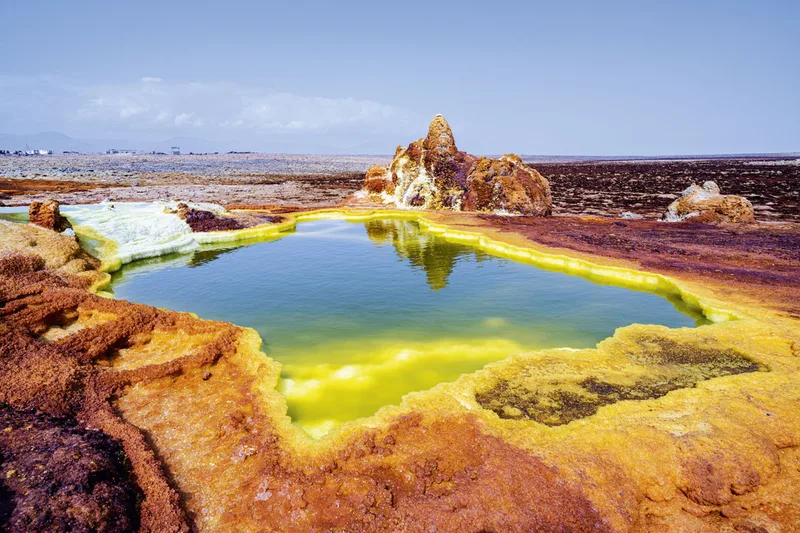
A bright blue body of water surrounded by strange yellow, orange and red rock. An acidic pond in Ethiopia is the kind of harsh environment that could exist on other planets. Life has been found in such environments on Earth, so why not elsewhere? - Image credit: Getty

1.2. Exoplanets

Before 1992, the only planets we knew existed in the entire galaxy were the ones in our Solar System. Since then, our telescopes have discovered almost 5,400 worlds orbiting other stars – so-called extrasolar planets, or exoplanets.

Most of the first exoplanets detected were bloated gas giants orbiting exceedingly closely to their suns – not the sort of world we believe could harbour life. But these were just the easiest to detect; we’ve since discovered smaller and smaller exoplanets orbiting further from their stars

Moon photography guide
For astrobiology, the most exciting exoplanets are small, rocky, Earth-like ones orbiting the right distance from their stars so that their surface temperatures allow oceans of liquid water.

These are potentially habitable worlds and would offer the best chances for extraterrestrial life. Future space-based telescopes would hopefully be able to detect signs of life – called biosignatures – in their atmosphere, such as the presence of oxygen gas released by photosynthesis.

Read more:

1.3. Robotic exploration of the Solar System

Over recent decades, advances in robotics and the sophistication of scientific instruments have made our space probes more and more capable.

There has been a fleet of orbiter, lander and rover missions launched to Mars, as well as probes sent to explore the outer planets, Jupiter and Saturn, and their families of moons. 
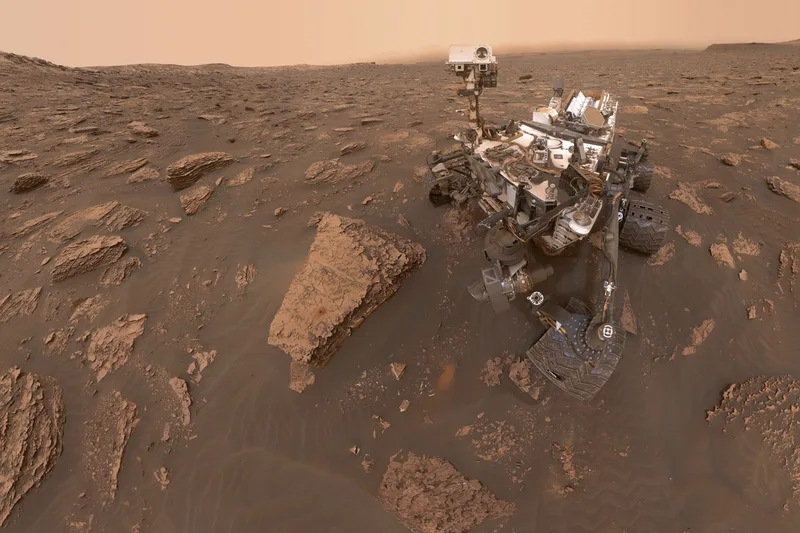
A wheeled rover explores a rusty, rocky planet.

Advances in robotics mean we don't have to send people to other planets to explore them properly. Rovers have been hunting for signs of life on Mars for over two decades. Image credit: NASA/JPL

Every time we visit another world we learn an enormous amount about its environment, active processes and its history – and invariably spark a whole slew of new questions to answer. 

These space probes (as well as telescopes like Hubble) have revealed that a handful of planets and moons in the Solar System have potentially habitable environments that could support extraterrestrial life.

2. Could aliens be silicon-based? 

All life on Earth needs liquid water to survive – it’s very good at dissolving chemicals to support the reactions of biochemistry. Life here is also organic (built from complex molecules based on carbon atoms).

It makes most sense for astrobiology to search for the sort of life we know is possible and we have a good idea how to detect. But could extraterrestrial life be based on a completely different kind of chemistry?

The element silicon sits just below carbon on the periodic table and so, in many ways, its chemistry is similar. But compared to carbon, silicon isn’t nearly as good at forming stable chemical bonds and large, complex molecules. Alien life could be based on solvents other than liquid water, however: perhaps ammonia.

3. Where in the Solar System could there be alien life?

3.1. Venus

Today, the surface of Venus is a hellish landscape, hotter than an oven due to the greenhouse effect of the planet’s thick carbon-dioxide atmosphere.

But early Venus may have been more like Earth and there’s a chance that any Venusian microbial life may have been able to survive by migrating high into the atmosphere.

At altitudes of 50-60km (30-40 miles) the temperature is cooler and an aerial biosphere may exist in the clouds. The clouds are highly acidic, though, so Venusian life is probably unlikely.   

3.2. Mars

While the modern surface of Mars is a freeze-dried desert, blasted by ultraviolet rays from the Sun, around 3.8 billion years ago it’s thought to have been much warmer and wetter. There’s evidence of ancient lakes, river valleys and possibly even a large ocean covering the northern hemisphere.

Organic molecules – the building blocks of life – are also thought to have been present on the Martian surface and so maybe the Red Planet developed life of its own. Any Martian microbes are probably long since extinct on the surface but may survive deeper underground.

3.3. Europa

Europa is one of the large moons orbiting Jupiter. Although its surface is hard-frozen ice, there’s a deep ocean of liquid water beneath it, kept warm by ‘tidal heating’ from the moon flexing and distorting as it orbits in the gas giant’s powerful gravitational field.

This process may also drive hydrothermal vents on the Europan seafloor, which serve as oases for life in Earth’s oceans.

The key question for exploring Europa is, just how thick is its icy shell? And, would it be possible to get some kind of submersible probe beneath it to search for marine life?
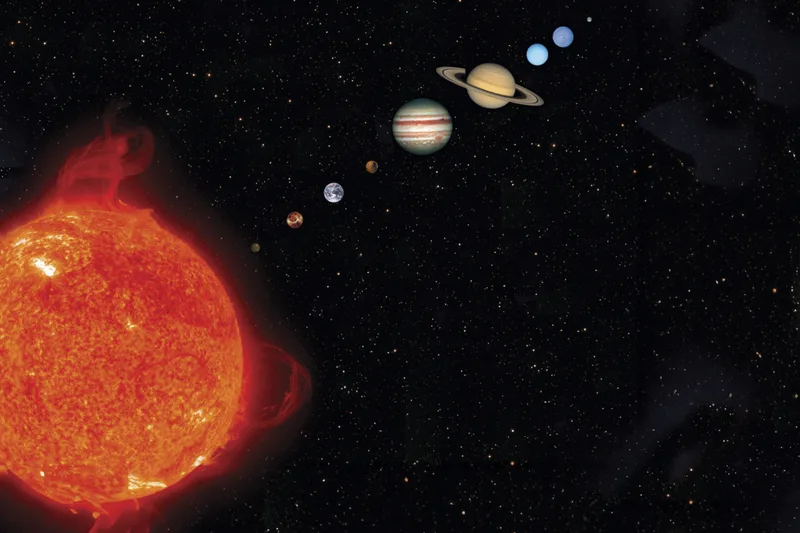
A map of the Solar System, with the large, red Sun in the bottom left and a line of planets extending out to the upper right. While we don't think other intelligent life could exist in our Solar System, more simple alien life could be lurking out there. Image credit: Getty

3.4. Enceldaus

Enceladus is a moon of Saturn, but in many ways is like Europa. It has a cold, icy surface and an ocean of liquid water laying underneath that’s in contact with the moon’s rocky core.

Jets of water squirt out of long fractures in the icy crust around the south pole and analysis of these has revealed the water is salty. Organic molecules have also been detected in these plumes and there’s evidence for hydrothermal activity.

So even though this alien ocean is thought to be pretty alkaline, it could still be habitable for life. 

3.5. Titan

Titan orbits Saturn. It’s a giant of a moon, and is the only moon in the Solar System to have a thick atmosphere that is rich with organic chemistry.

Large lakes have been discovered around Titan’s north pole, but these are filled with liquid ethane and methane, rather than water. It’s still an open question as to whether life could be ethane-based rather than water-based, but Titan is a complex world and may harbour lifeforms with a biochemistry very different to those on Earth.

4. Could aliens be intelligent?

Astrobiology is mostly focused on searching the Solar System for signs of hardy, single-celled life, or detecting atmospheric biosignatures in exoplanets.

But could there be more complex life in the galaxy – alien plants and animals, or even intelligent, space-faring beings? 
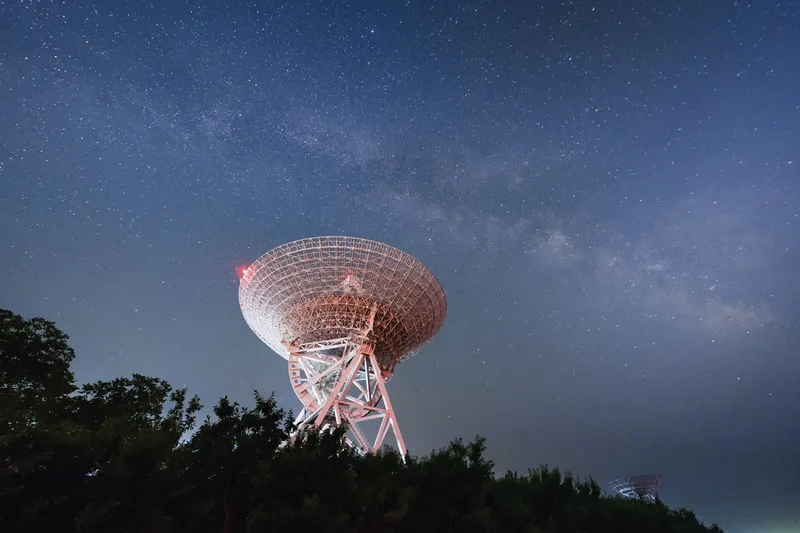
A large white radio dish pokes out above the tree line and looks up to the stars. If there is other intelligent life out there in the cosmos, it might use radio waves to communicate too. Telescopes like this search the skies for signs of life. Image credit: Getty

The galaxy is very old, and intelligent life could have evolved on another habitable world many millions of years before us, and potentially spread across the whole galaxy.

But despite over 60 years of sporadic programmes listening for artificial radio transmissions or looking for signs of technological structures, we’ve not found any convincing evidence of intelligent life out there… yet

Read more:

{ https://www.sciencefocus.com/ }

Hoe vind je dit bericht?
Geschreven door peter om 16:52 Stuur door

Alien Agenda Unveiled: What Do Extraterrestrials Want from Earth?

Alien Agenda Unveiled: What Do Extraterrestrials Want from Earth?

In the realm of science fiction and ufology, the question of what aliens want from humanity and Earth has long intrigued and mystified us. The documentary “Alien Agenda into the Future” delves into this topic, exploring the potential motives and objectives of extraterrestrial visitors. Here, we will examine the key points raised in the documentary, presenting a comprehensive and informative overview of the alien agenda as theorized by researchers and enthusiasts.

The Attraction of Earth

Earth is a unique planet teeming with life, abundant liquid water, and a variety of essential resources. This makes it an attractive target for any space-faring species. Unlike other planets where water might be locked in ice, Earth offers liquid water and a diverse range of living organisms, from simple amoebas to complex humans. This abundance of resources could be why extraterrestrial entities might be interested in our planet. For a species looking to colonize or explore, Earth is a treasure trove of essential materials.

Historical Context and the Anunnaki Theory

The sudden appearance of modern humans, often referred to as “The Missing Link,” has puzzled scientists and sparked various theories. Ancient Sumerian texts describe the Anunnaki, a group of deities who allegedly created humans to serve them. According to authors like Erich von Däniken and Zecharia Sitchin, the Anunnaki were an advanced extraterrestrial species from the planet Nibiru. They came to Earth to mine gold and created humans as a slave species through genetic engineering.

Evidence of Extraterrestrial Contact

Throughout history, there have been numerous references to extraterrestrial beings. From medieval art to Egyptian hieroglyphs, evidence of non-human entities is widespread. Modern UFO sightings suggest that these beings continue to visit Earth. Significant incidents, such as the Roswell crash and the abduction of Betty and Barney Hill, provide compelling evidence of ongoing extraterrestrial interest in humanity. These cases reveal advanced technology and medical procedures that were not known to humans at the time, hinting at a deeper, long-term extraterrestrial agenda.

The Abduction Phenomenon

Alien abductions are a recurring theme in ufology. These incidents often involve invasive medical examinations, with a particular focus on human reproductive systems. Researchers like David M. Jacobs and Budd Hopkins suggest that aliens are engaged in creating human-alien hybrids. Abduction reports are not limited to one region; they are a global phenomenon, though they are most frequently reported in English-speaking countries.

Missing Persons and Alien Involvement

Every year, hundreds of thousands of people go missing, and a significant number are never found. Some theorists speculate that these missing individuals might be abducted by aliens for various purposes, including genetic experiments or as part of a larger extraterrestrial agenda. This theory raises disturbing questions about the fate of these individuals and the potential scale of alien activities on Earth.

Alien Perspectives on Humanity

From an extraterrestrial viewpoint, humans might appear undisciplined and destructive. Our history of warfare, environmental pollution, and resource mismanagement could lead advanced beings to view us as an inferior or dangerous species. The development of nuclear weapons in 1945 likely intensified extraterrestrial scrutiny, as such technology poses a significant threat not only to humanity but potentially to other civilizations as well.

Spiritual and Technological Advancements

While humanity has made significant technological advancements, there has also been a growing interest in spirituality and self-awareness. The New Age movement often incorporates extraterrestrials as spiritual guides, suggesting a union between science and spirituality. This dual approach to understanding our place in the universe reflects a broader search for meaning and connection beyond our planet.

Government Involvement and Secret Agreements

There are claims that governments, particularly the United States, have made secret agreements with extraterrestrial beings. These agreements allegedly involve the exchange of advanced technology for permission to abduct humans. One such story involves President Eisenhower meeting with extraterrestrials in 1954. Although officially denied, these claims persist and fuel speculation about ongoing covert interactions between governments and aliens.

The Technological Marvel of UFOs

UFOs exhibit advanced capabilities that surpass current human technology. These craft can defy gravity, perform rapid maneuvers, and operate in various environments, including underwater. Recent sightings, such as the Tic Tac-shaped UFOs observed by Navy pilots, highlight their superior technology and possible interest in Earth’s resources.

VIDEO:

  • ALIEN AGENDA INTO THE FUTURE | What Do They Want? | Full SCI-FDocumentary HD

The true nature of the alien agenda remains a mystery. Whether aliens are here to help, study, or exploit us is unknown. Governments might possess more information than is publicly available, but full disclosure seems unlikely. Until extraterrestrials choose to reveal their intentions openly, we can only speculate and hope that their agenda is ultimately benevolent. The question of what aliens want from us and our planet continues to captivate and challenge us, prompting further exploration and reflection on our place in the universe.

{ https://www.latest-ufo-sightings.net/ }

Hoe vind je dit bericht?
Geschreven door peter om 16:15 Stuur door

Enorm zwart gat ontdekt in de Melkweg: het bevindt zich achter enkele sterren die er niet zouden moeten zijn

Enorm zwart gat ontdekt in de Melkweg: het bevindt zich achter enkele sterren die er niet zouden moeten zijn

Door JanineJanine image
De weergave van een zwart gat, zoals degene die zich in de Omega Centauri-cluster zou moeten bevinden

NASA Hubble Space Telescope

Zwarte gaten ontsnappen aan de normale classificaties: we weten dat ze bestaan, misschien zelfs waar we ze niet verwachten, maar verder weten we er weinig van. Door de ruimte te observeren kunnen we doorgaans relatief gemakkelijk twee soorten zwarte gaten identificeren: sterrenmassa's gevormd door de ineenstorting van sterren en superzware, zoals het zwarte gat in het centrum van de Melkweg. Toch zijn er ook zwarte gaten met een middelzware massa, zeer zeldzaam maar ongelooflijk nuttig om de vorming en evolutie van deze hemellichamen te begrijpen. Een aantal onderzoekers hebben er misschien één ontdekt, verborgen achter een paar sterren die er niet zouden moeten zijn.

Het belang van zwarte gaten met middelzware massa

Zoals we in de inleiding al zeiden, vinden we in de ruimte meestal alleen zwarte gaten met stellaire massa en superzware zwarte gaten. Terwijl de eerstgenoemden een massa hebben die enkele tientallen malen groter is dan die van een ster, hebben de laatstgenoemden een massa die miljarden malen groter is dan die van de zon, net als Sagittarius A*. In het midden bevinden zich echter de zogenaamde Intermediate Mass Black Holes of IMBH, zwarte gaten met een massa tussen de ongeveer 100 en 100 duizend zonnemassa’s. Ze zijn essentieel voor het begrijpen van de overgang van kleinere naar grotere zwarte gaten en zijn zo zeldzaam dat het vinden ervan helemaal niet eenvoudig is. Zelfs als je het letterlijk voor ogen hebt.

Om deze reden is de ontdekking van astronomen van het Max Planck Instituut voor Astronomie in Duitsland historisch. Na twintig jaar aan gegevens van de Hubble-ruimtetelescoop te hebben geanalyseerd, merkten onderzoekers iets vreemds op in de Omega Centauri-regio, een cluster op 17.000 lichtjaar van ons verwijderd, waarin sommige sterren snel bewogen. Misschien wel te snel.

Zwart gat met middelzware massa gevonden in Omega Centauri

De zoektocht naar het zwarte gat met middelzware massa in Omega Centauri, dankzij de Hubble-telescoop

NASA Goddard/Youtube

Om te begrijpen hoe we een zwart gat met middelzware massa kunnen vinden, moeten we eerst begrijpen wat een bolvormige sterrenhoop is. Het is in feite een bolvormige formatie waarbinnen miljoenen sterren naast elkaar bestaan, maar over wiens oorsprong alleen maar vermoedens bestaan. Omega Centauri heeft bijvoorbeeld een doorsnede van 150 lichtjaar en zou kunnen vertegenwoordigen wat er overblijft van een dwergstelsel dat zich nu in de Melkweg bevindt. Net zoals de sterren van ons sterrenstelsel rond Sagittarius A* draaien, kunnen de sterren van Omega Centauri dus ook rond een zwart gat draaien. Maar welke?

In een studie gepubliceerd in Nature hebben onderzoekers van het Max Planck Instituut voor Astronomie bewijs gevonden voor deze dynamiek. Dankzij de door Hubble verzamelde beelden ontdekten ze vooral dat zeven sterren in de sterrenhoop zich met een grotere snelheid bewogen dan die van de sterrenhoop. Wat is de reden voor dit verschil? Het enige antwoord dat verenigbaar is met de waarnemingen is een zwart gat, maar met een middelzware massa.

Sterren die er niet zouden moeten zijn en zwarte gaten die niet gezien kunnen worden

Uit de uitgevoerde waarnemingen blijkt dat de nieuwe IMBH een massa heeft die minstens 8200 keer zo groot is als die van de zon, en kan helpen de vorming en evolutie van zwarte gaten in onze Melkweg te begrijpen. Dit zijn de woorden van de hoofdauteur van de studie, Maximilian Häberle:

We hebben zeven sterren ontdekt die er niet zouden moeten zijn. Ze bewegen zo snel dat ze de sterrenhoop zouden verlaten en nooit meer terugkeren. De meest waarschijnlijke verklaring is dat een zeer massief object deze sterren door de zwaartekracht aantrekt en ze dicht bij het centrum houdt. Het enige object dat zo massief kan zijn, is een zwart gat, met een massa die minstens 8200 keer zo groot is als die van onze zon.

Kortom, in Omega Centauri bevindt zich een zwart gat met een middelzware massa dat de ruimtetijd voldoende kan buigen om de relatieve snelheid van de sterren te vergroten. De ontdekking door het team van astronomen bevestigt verder de verscheidenheid aan zwarte gaten in onze Melkweg, maar vertegenwoordigt slechts het begin. Wie weet ontdekken we wel dat er een zwart gat dicht bij ons in de buurt is, aan de rand van het zonnestelsel of net daarbuiten.

{ https://www.curioctopus.nl/ }

Hoe vind je dit bericht?
Geschreven door peter om 22:18 Stuur door

NASA's Perseverance Rover Captures Snowman-Like Rock Formation on Mars

NASA's Perseverance Rover Captures Snowman-Like Rock Formation on Mars

Story by Mike Brown

Though this was not a predicted finding, NASA’s Perseverance rover has just snapped a picture of a snowman-like rock formation standing on Mars. This fanciful discovery, captured by the Right Mastcam-Z camera on 13 July 2024, set many minds racing at the imagination.

Since landing in Jezero Crater in February 2021, Perseverance has been studying the Martian surface relentlessly, taking pictures, and gathering rock samples. The latest picture, taken during Sol 1208 of the mission, contains the stack of rocks that are in the lower left corner, looking remarkably like a snowman. Though this “snowman” is made from dry, dusty Martian rock rather than fluffy snow, it serves to remind one that even in the desolate landscapes on Mars, sometimes familiar shapes can arise.

The discovery comes at a time when the Mars sample-return mission, a crucial component in the search for extraterrestrial life, faces budget overruns and significant delays. Notwithstanding that, the mission keeps returning insights regarding the geological history of Mars and its potential to support life.

NASA experts have, for a long time, proposed that there might be water on Mars. Because the atmosphere is extremely thin, very little water can stay in its liquid form on the surface. However, there are pieces of evidence of water ice existing at subsurface levels in the polar regions and briny water that flows down hillsides and crater walls seasonally, which opens up some very exciting possibilities regarding the past life of this planet and its ability to support life.

More than just the wacky “snowman” formation, this is something a bit more, a window into the dynamic climate and weather events taking place on Mars. It is the Red Planet, a place of dust storms, and extreme weather, and where an atmosphere thick enough once existed that liquid water could flow for long periods across its surface.

As Perseverance continues in its quest, it will leave behind the Jezero Crater, climb up the rim, and explore other areas. Every discovery, from a rock sample to some odd formation, helps to increase our knowledge of Mars and its habitability for future human exploration.

Another observer compared attaching sentimental shapes to Martian rocks with identifying animals in overhead clouds. Moments of imagination and wonder like this remind us of the endless possibilities that space exploration holds, even when technical and financial challenges for interplanetary missions come into play.

The post NASA’s Perseverance Rover Captures Snowman-Like Rock Formation on Mars first appeared on BuzzHint.

{ https://www.msn.com/en-us/ }

Hoe vind je dit bericht?
Geschreven door peter om 21:58 Stuur door

Meer van UFO'S of UAP'S, ASTRONOMIE, RUIMTEVAART, ARCHEOLOGIE, OUDHEIDKUNDE, SF-SNUFJES EN ANDERE ESOTERISCHE WETENSCHAPPEN - DE ALLERLAATSTE NIEUWTJES

↑ Terug naar de berichten
