Naar de inhoud

UFO'S of UAP'S, ASTRONOMIE, RUIMTEVAART, ARCHEOLOGIE, OUDHEIDKUNDE, SF-SNUFJES EN ANDERE ESOTERISCHE WETENSCHAPPEN - DE ALLERLAATSTE NIEUWTJES

UFO's of UAP'S in België en de rest van de wereld
akke.beakke.be
Ontdek de Fascinerende Wereld van UFO's en UAP's: Jouw Bron voor Onthullende Informatie! Ben jij ook gefascineerd door het onbekende? Wil je meer weten over UFO's en UAP's, niet alleen in België, maar over de hele wereld? Dan ben je op de juiste plek! België: Het Kloppend Hart van UFO-onderzoek In België is BUFON (Belgisch UFO-Netwerk) dé autoriteit op het gebied van UFO-onderzoek. Voor betrouwbare en objectieve informatie over deze intrigerende fenomenen, bezoek je zeker onze Facebook-pagina en deze blog. Maar dat is nog niet alles! Ontdek ook het Belgisch UFO-meldpunt en Caelestia, twee organisaties die diepgaand onderzoek verrichten, al zijn ze soms kritisch of sceptisch. Nederland: Een Schat aan Informatie Voor onze Nederlandse buren is er de schitterende website www.ufowijzer.nl, beheerd door Paul Harmans. Deze site biedt een schat aan informatie en artikelen die je niet wilt missen! Internationaal: MUFON - De Wereldwijde Autoriteit Neem ook een kijkje bij MUFON (Mutual UFO Network Inc.), een gerenommeerde Amerikaanse UFO-vereniging met afdelingen in de VS en wereldwijd. MUFON is toegewijd aan de wetenschappelijke en analytische studie van het UFO-fenomeen, en hun maandelijkse tijdschrift, The MUFON UFO-Journal, is een must-read voor elke UFO-enthousiasteling. Bezoek hun website op www.mufon.com voor meer informatie. Samenwerking en Toekomstvisie Sinds 1 februari 2020 is Pieter niet alleen ex-president van BUFON, maar ook de voormalige nationale directeur van MUFON in Vlaanderen en Nederland. Dit creëert een sterke samenwerking met de Franse MUFON Reseau MUFON/EUROP, wat ons in staat stelt om nog meer waardevolle inzichten te delen. Let op: Nepprofielen en Nieuwe Groeperingen Pas op voor een nieuwe groepering die zich ook BUFON noemt, maar geen enkele connectie heeft met onze gevestigde organisatie. Hoewel zij de naam geregistreerd hebben, kunnen ze het rijke verleden en de expertise van onze groep niet evenaren. We wensen hen veel succes, maar we blijven de autoriteit in UFO-onderzoek! Blijf Op De Hoogte! Wil jij de laatste nieuwtjes over UFO's, ruimtevaart, archeologie, en meer? Volg ons dan en duik samen met ons in de fascinerende wereld van het onbekende! Sluit je aan bij de gemeenschap van nieuwsgierige geesten die net als jij verlangen naar antwoorden en avonturen in de sterren! Heb je vragen of wil je meer weten? Aarzel dan niet om contact met ons op te nemen! Samen ontrafelen we het mysterie van de lucht en daarbuiten.

Archief

99-Million-Year-Old Burmese Amber Reveals Oldest Known Skink

99-Million-Year-Old Burmese Amber Reveals Oldest Known Skink

Paleontologists have found the remains of a previously unknown species of lizard in a piece of mid-Cretaceous amber excavated in northern Myanmar.

Life reconstruction of Electroscincus zedi; areas of the lizard not represented in the material available are depicted as blurred. Image credit: Stephanie Abramowicz.

Life reconstruction of Electroscincus zedi; areas of the lizard not represented in the material available are depicted as blurred.

Image credit: Stephanie Abramowicz.

The newly-discovered species was a small lizard with an estimated snout-vent length of 3 cm (1.2 inches).

Named Electroscincus zedi, it lived during the mid-Cretaceous period, approximately 99 million years ago.

It differs from all other known squamates (lizards and snakes) from the Mesozoic by the presence of imbricate, compound osteoderms arranged in a staggered pattern around the body, supporting its placement in the skink family Scincidae.

“Scincidae is a megadiverse clade of squamates, which today has attained a near cosmopolitan distribution in temperate and tropical regions worldwide,” said Dr. Juan Daza of Sam Houston State University and his colleagues.

“It is represented by more than 1,745 described living species, comprising nearly 15% of all living lizards.”

“Typical skinks have cylindrical bodies and relatively short limbs and, in over 50 skink lineages, evolutionary transitions towards limb reduction or loss have occurred.”

“Among living scincoids (Xantusiidae, Gerrhosauridae, Cordylidae, Scincidae), members of Scincidae exhibit the greatest range in body length, including some miniaturized forms having a body length of only a few centimeters to the extinct Tiliqua frangens, which may have reached half a meter or more.”

“Skinks also show great variation in the number of presacral vertebrae, ranging from 26 to 108, which, in combination with cycloid scales and compound osteoderms, may have facilitated the repeated evolution of fossorial and limbless morphotypes.”

“Most skinks are characterized by possession of smooth, cycloid scales underlain by compound osteoderms — bony plates in the dermis that are made up of several articulated osteodermites per scale.”

Electroscincus zedi, fossil in ventral (a) and dorsal (b) views; detail of the right foot (c, e) and osteoderms (d); X-ray of the whole specimen showing the skeletal remains, and several articulated and scattered osteoderms (f). Image credit: Daza et al., doi: 10.1038/s41598-024-66451-w.

Electroscincus zedi, fossil in ventral (a) and dorsal (b) views; detail of the right foot (c, e) and osteoderms (d); X-ray of the whole specimen showing the skeletal remains, and several articulated and scattered osteoderms (f).

Image credit: Daza et al., doi: 10.1038/s41598-024-66451-w.

A piece of Burmese amber (Burmite) that preserves Electroscincus zedi was found in the mid-Cretaceous outcrops in the Myitkyina district, Kachin province, northern Myanmar, approximately 100 km west of the town of Myitkyina.

The specimen includes two disconnected parts of the skink, containing the scales and mostly appendicular bones, but is clearly part of a single individual

“Currently over 100 specimens of squamates are known from Burmite,” the paleontologists said.

“In this large sample, this new fossil is the only one that preserves this osteodermal morphology which makes it diagnosable to the Scincidae, and differentiates it from all known fossil squamates from the Cretaceous.”

“The specimen is incomplete, but it does retain both postcranial skeletal elements and integumentary structures and, though less than ideal, it provides a basis for comparison with any putative scincid material that might be found in the future.”

“The specimen has a combination of compound osteoderms and overlapping cycloid scales that is limited to skinks.”

“We propose that this type of osteoderm evolved as a response to an increased overlap of scales, and to reduced stiffness of the dermal armor,” the researchers concluded.

  • Their paper was published in the journal Scientific Reports.
  • J.D. Daza et al. 2024. Compound osteoderms preserved in amber reveal the oldest known skink. Sci Rep 14, 15662; doi: 10.1038/s41598-024-66451-w

{ https://www.sci.news/ }

Hoe vind je dit bericht?
Geschreven door peter om 18:47 Stuur door

Curiosity Finds Pure Sulfur on Mars

Curiosity Finds Pure Sulfur on Mars

Yellow crystals of elemental sulfur were revealed after NASA’s Curiosity rover happened to drive over a rock and crack it open on May 30, 2024, according to the Curiosity team.

Yellow crystals of elemental sulfur on Mars. Image credit: NASA.

Yellow crystals of elemental sulfur on Mars.

Image credit: NASA.

While people associate sulfur with the odor from rotten eggs, elemental sulfur is odorless.

It forms in only a narrow range of conditions that scientists haven’t associated with the history of this location.

And Curiosity found a lot of it — an entire field of bright rocks that look similar to the one the rover crushed.

“Finding a field of stones made of pure sulfur is like finding an oasis in the desert,” said Curiosity’s project scientist Dr. Ashwin Vasavada, a researcher at NASA’s Jet Propulsion Laboratory.

“It shouldn’t be there, so now we have to explain it. Discovering strange and unexpected things is what makes planetary exploration so exciting.”

It’s one of several discoveries Curiosity has made while off-roading within Gediz Vallis channel, a groove that winds down part of the 5-km-tall (3-mile-tall) Mount Sharp, the base of which the rover has been ascending since 2014.

Spotted from space years before the rover’s launch, the channel is one of the primary reasons the science team wanted to visit this part of Mars.

They think that the channel was carved by flows of liquid water and debris that left a ridge of boulders and sediment extending 3.2 km (2 miles) down the mountainside below the channel.

The goal has been to develop a better understanding of how this landscape changed billions of years ago, and while recent clues have helped, there’s still much to learn from the dramatic landscape.

Since Curiosity’s arrival at the channel earlier this year, scientists have studied whether ancient floodwaters or landslides built up the large mounds of debris that rise up from the channel’s floor here.

The latest clues from the rover suggest both played a role: some piles were likely left by violent flows of water and debris, while others appear to be the result of more local landslides.

hose conclusions are based on rocks found in the debris mounds: whereas stones carried by water flows become rounded like river rocks, some of the debris mounds are riddled with more angular rocks that may have been deposited by dry avalanches.

Finally, water soaked into all the material that settled here.

Chemical reactions caused by the water bleached white ‘halo’ shapes into some of the rocks.

Erosion from wind and sand has revealed these halo shapes over time.

“This was not a quiet period on Mars,” said Dr. Becky Williams, a scientist with the Planetary Science Institute in Tucson, Arizona, and the deputy principal investigator of Curiosity’s Mast Camera.

“There was an exciting amount of activity here. We’re looking at multiple flows down the channel, including energetic floods and boulder-rich flows.”

  • This article is a version of a press-release provided by NASA.

{ https://www.sci.news/ }

Hoe vind je dit bericht?
Geschreven door peter om 18:39 Stuur door

“De sterkte van de polaire vortex en straalstroom bepalen in grote mate ons weer”: wat zijn de gevolgen van de stratosferische opwarming boven de Zuidpool?

PREMIUM
© Thinkstock / Gregory Van Gansen / Photo News

“De sterkte van de polaire vortex en straalstroom bepalen in grote mate ons weer”: wat zijn de gevolgen van de stratosferische opwarming boven de Zuidpool?

Terwijl het in ons noordelijk halfrond zomer is, heerst de winter in het zuidelijk halfrond. Maar daar is op grote hoogte voorlopig weinig van te merken, want boven de Zuidpool is er een plotse opwarming in de stratosfeer. Dat verstoort de zuidelijke ‘polaire vortex’ sterk, en dat kan de komende weken en maanden weleens tot atypisch weer leiden. Maar wat is zo’n stratosferische opwarming precies? Wat doet dit met het weer? En gaan wij hier ook de gevolgen van merken? Klimatoloog Samuel Helsen legt uit.

{ https://www.hln.be/ }

Hoe vind je dit bericht?
Geschreven door peter om 18:31 Stuur door

Kunstmatige intelligentie is "grappiger" dan mensen: de resultaten van een merkwaardig onderzoek

Kunstmatige intelligentie is "grappiger" dan mensen: de resultaten van een merkwaardig onderzoek

Janine imageDoor Janine

Freepik

Kunstmatige intelligentie heeft veel mogelijkheden, maar volgens een nieuw onderzoek is het zelfs in staat om leuker te zijn dan mensen. Dit is waarom.

ChatGPT en mensen: grappen met elkaar vergeleken

Het gebruik van kunstmatige intelligentie heeft in de maatschappij nogal wat twijfels opgeroepen, te beginnen met de vrees dat het veel banen zal vervangen die nu door mensen worden uitgevoerd. Dit is zeker geen aantrekkelijk vooruitzicht, ook al heeft AI aan de andere kant veel wetenschappelijke disciplines in staat gesteld hun horizon te verbreden en de onderzoekstijd te verkorten.

Er is echter iets waarin het ons al voorbijgestreefd lijkt te zijn: volgens een onderzoek is Chat GPT leuker dan wij. Het team van de University of Southern California vergeleek de reactie van mensen op grappen verteld door AI en mensen. Het resultaat? Ongeveer 70 procent van de deelnemers aan de test vond de door ChatGPT gegenereerde moppen grappiger dan die van hun soortgenoten. En de anderen?

De creatieve en grappige kant van AI

Freepik

Vijfentwintig procent vond de door mensen geschreven moppen grappiger, terwijl de overige vijf procent geen duidelijke voorkeur had: zowel AI als mensen zijn op dezelfde manier “komisch”. Drew Gorenz, een promovendus in de psychologie en een van de auteurs van het onderzoek, legde uit dat de creatieve kant van kunstmatige intelligentie nog onontdekt en onduidelijk is, in tegenstelling tot de analytische capaciteiten.

Gorenz, die veel van humor houdt, vroeg zich af wat het verschil was tussen de comiciteit  van ChatGPT en die van mensen, geïntrigeerd door het verborgen potentieel van de chatbot. Aan de andere kant hebben taalmodellen geen emoties en kennen ze niet het plezier dat een goed gemaakte grap kan opleveren, maar “gebruiken ze vooral patroonherkenning. De resultaten vertellen ons veel interessante dingen over de productie van humor: misschien hoeven we de emoties die we ervaren bij een goede grap niet te voelen om een goede grap te vertellen”. Met andere woorden, juist het feit dat we emoties voelen - in tegenstelling tot kunstmatige intelligentie - zou ons vermogen om grappig te zijn benadelen. Of, in ieder geval, om dat nog meer te zijn.

AI zou ook de entertainmentindustrie kunnen ontwrichten

Freepik

Tijdens het onderzoek vroeg het team zowel mensen als ChatGPT om moppen te schrijven, waaronder het maken van grappige acroniemen, het opvullen van gaten tussen woorden om grappige zinnen te genereren en het komisch beschrijven van een onaangename situatie. Een tweede groep van tweehonderd mensen evalueerde vervolgens wat er door zowel kunstmatige intelligentie als mensen werd geproduceerd. “In beide onderzoeken beoordeelden menselijke deelnemers de komische aard van door mensen en AI geproduceerde reacties zonder zich bewust te zijn van de bron ervan”, aldus de auteurs van het onderzoek.

Vervolgens observeerden de onderzoekers de reactie op satirische teksten geproduceerd door het taalleermodel en professionele komieken: in dit geval waren de scores gelijk. Uiteindelijk zijn deze resultaten volgens Gorenz een duidelijke indicatie dat AI een revolutionaire rol zou kunnen spelen op het gebied van entertainment: kortom, als je zin hebt om even lekker te lachen, zal ChatGPT je niet teleurstellen.

{ https://www.curioctopus.nl/ }

Hoe vind je dit bericht?
Geschreven door peter om 18:02 Stuur door

NASA's Curiosity rover ontdekt iets dat nog nooit eerder op Mars is gezien, verborgen in een rots

NASA's Curiosity rover ontdekt iets dat nog nooit eerder op Mars is gezien, verborgen in een rots

Janine imageDoor Janine
Artistiek concept van de Curiosity rover van NASA's Mars Science Laboratory

Jet Propulsion Laboratory / NASA/JPL-Caltech - Wikimedia commons - Public domain

Rots bevat iets dat nog nooit eerder op Mars is gezien

NASA's Curiosity rover, gelanceerd in november 2011 en geland op Mars op 6 augustus 2012, is nog steeds aan het werk op de rode planeet. Hoewel zijn missie ongeveer twee jaar zou duren, is hij nog steeds in de operationele fase. De rover zwerft over het oppervlak van de rode planeet op zoek naar monsters om te verzamelen en plaatsen om te graven. Eind mei 2024 kwam hij een rots tegen die er anders uitzag dan alle andere. Binnenin de rots zaten gele kristallen, geïdentificeerd als pure zwavel.

Het team van Curiosity maakte het nieuws in juli bekend op sociale media en schreef: “Ik passeerde een rots en vond er kristallen in! Het is pure zwavel. (En nee, het stinkt niet.) Elementaire zwavel is iets wat we nog nooit eerder op Mars hebben gezien. We weten nog niet veel over deze gele kristallen, maar mijn team kan niet wachten om het te onderzoeken."

Nooit eerder geziene gele kristallen van pure zwavel op Mars

Gele kristallen van pure zwavel gevonden op Mars door de Curiosity rover

NASA/JPL-CALTECH/MSSS

De verrassing van de wetenschappers, zoals NASA aankondigde, was onbeschrijflijk: sulfaten, zouten die zwavel bevatten, komen veel voor in het gebied van de krater Gale waar Curiosity zich momenteel bevindt, maar het gesteente dat de rover vond heeft een andere bijzonderheid: “Waar eerdere waarnemingen betrekking hadden op zwavelhoudende mineralen, oftewel een mix van zwavel en andere materialen, is het gesteente dat Curiosity onlangs heeft gevonden samengesteld uit elementaire, oftewel pure zwavel”, verklaarde de Amerikaanse ruimtevaartorganisatie.

In tegenstelling tot de zwavel waar wij aan denken, ruikt elementaire zwavel echter niet naar “rotte eieren”. Het is gewoon reukloos. Maar dit lijkt niet de enige rots te zijn die zuivere zwavel bevat op de rode planeet: de rover identificeerde een veld met zeer vergelijkbare, lichtgekleurde rotsblokken, waarin andere gele kristallen te vinden waren.

Ashwin Vasavada van het Jet Propulsion Laboratory, een wetenschapper van het project Curiosity, zei: "Het vinden van een veld met rotsen bestaande uit pure zwavel is als het vinden van een oase in de woestijn. Het zou er niet moeten zijn, dus nu moeten we het verklaren." Andrew Good, woordvoerder van JPL, voegde eraan toe dat "er geen reden is om pure zwavel te verwachten in deze specifieke regio, dus we zijn behoorlijk verrast."

Curiosity, op een missie om de geschiedenis van water op Mars te bestuderen

Hoewel Curiosity in alle opzichten een bewegend laboratorium is dat kan boren en graven, zijn de gele kristallen te klein om ze te kunnen onderzoeken. Wetenschappers zijn echter van plan uit te zoeken waarom en hoe ze zijn gevormd. Good brengt een hypothese naar voren: "Een idee zou kunnen zijn dat zoiets als warmwaterbronnen deze zwavel hebben gevormd,  maar we hebben geen bewijs gezien dat wijst op hun aanwezigheid in dit gebied.

Om meer te weten te komen, zullen we moeten wachten tot onderzoekers de elementen kunnen onderzoeken die zijn verzameld door de zeswielige rover, die twaalf jaar geleden landde op Mount Sharp, de gigantische berg in het midden van de krater Gale. Onlangs richtte Curiosity zich op het Gediz Vallis kanaal, waar mogelijk ooit een rivier was. De missie van de rover is juist om de geschiedenis van het water op Mars te ontdekken en daarmee ook bewijs voor mogelijk microbieel leven in het verleden.

INFO PETER2011

Learn more about Curiosity’s 10th year on Mars from the mission’s deputy project scientist, Abigail Fraeman.
Credits: NASA/JPL-Caltech


{ https://www.curioctopus.nl/ }

Hoe vind je dit bericht?
Geschreven door peter om 17:26 Stuur door

Analyze of a possible REAL UFO caught on camera in Costa Rica

Analyze of a possible REAL UFO caught on camera in Costa Rica

With today's technology, including CGI, Artificial Intelligence, and other similar programs, it is not difficult to create fake UFO videos. It is currently a challenge to distinguish a fake UFO video from a real one. 
UFO%20flying%20saucer%20Costa%20Rica.jpg

Additionally, you also need to ask yourself whether a observed UFO is a craft made by certain organizations here on Earth or if it is a real alien UFO. 
So far, the most reliable recordings of UFO sightings come from the time before the advent of Artificial Intelligence. 
The following recording is a UFO sighting from 2007. Marvin Badilla, a carpenter from Acosta, Costa Rica, filmed an extraordinary video of a metallic, disc-shaped object hovering momentarily before flipping vertically and departing. 
Captured on a Motorola Razr, this footage has fascinated both enthusiasts and experts for years. 
In the video below, we delve into a detailed analysis of this compelling UFO sighting, compare the original and enhanced footage, and listen to expert opinions on its authenticity.
  

{ https://ufosightingshotspot.blogspot.com/ }

Hoe vind je dit bericht?
Geschreven door peter om 17:04 Stuur door

Evidence of Alien Life May Lie on the Surface of Europa and Enceladus, A New Study Reveals

Evidence of Alien Life May Lie on the Surface of Europa and Enceladus, A New Study Reveals

Chemicals that hint at the presence of life, like amino acids, aren't destroyed by cosmic radiation nearly as quickly as we thought, and that's good news.

 
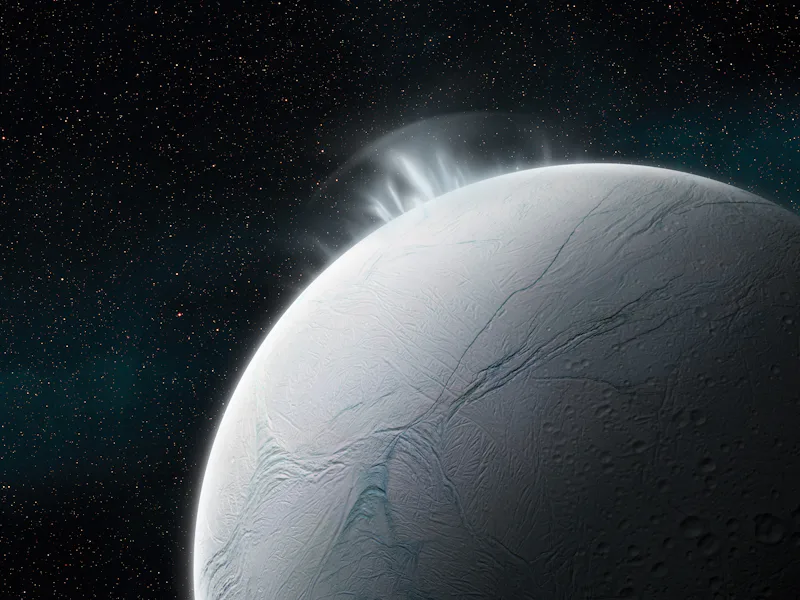
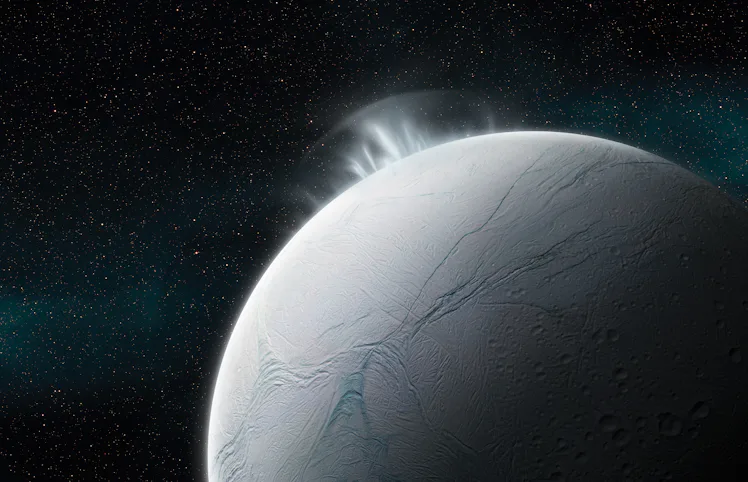
Illustration of vapour plumes erupting from the surface of Enceladus, Saturns sixth largest moon, cr...
All About Space Magazine/Future/Getty Images

It could be easier than we thought to find evidence of life on the icy surfaces of moons like Europa and Enceladus.

Far from the Sun, in the outer Solar System, a small handful of icy moons orbiting gas giants are hiding whole oceans beneath their frozen crusts. On Jupiter’s moon Europa and Saturn’s moon Enceladus, some of that hidden seawater finds its way to the surface through geysers or cracks on the ice — and it could contain traces of whatever lives in the alien oceans beneath. The organic material that washes up onto the surface could contain molecules, or even whole cells, from a hidden alien ecosystem thriving below the ice.

According to recent experiments at NASA’s Goddard Space Flight Center, evidence of alien life could be preserved on the surface of Enceladus, and just a few inches below the surface of Europa, despite the heavy bombardment of radiation that scours the surface of both moons.

Planetary scientist Alexander Pavlov, of NASA Goddard, and his colleagues published their work in the journal Astrobiology.

Illustration of vapour plumes erupting from the surface of Enceladus, Saturns sixth largest moon, cr...

This illsutration shows plumes of water and ice — and maybe alien cells — erupting from beneath the ice of Enceladus, an icy moon of Saturn.

ALL ABOUT SPACE MAGAZINE/FUTURE/GETTY IMAGES

SIMULATING AN IRRADIATED ICY WASTELAND

In their lab at Goddard, Pavlov and his colleagues mixed up several simulated versions of the slush — laden with organic matter — that ends up smeared and spattered across the ice atop Enceladus and Europa’s oceans, all chilled to -321 degrees Fahrenheit. Then they bombarded the chilly cocktails with gamma radiation, to simulate the radiation that constantly blasts the surfaces of Enceladus and Europa. And it turns out that most of the evidence of life survived higher doses of radiation than the researchers had expected.

High-energy radiation can trigger chains of chemical reactions, which eventually break down the molecules associated with life including DNA, amino acids, and proteins, among others. Amino acids are the building blocks of proteins (which are the building blocks of pretty much everything that makes life actually work). Some amino acids can form through chemical reactions that have nothing to do with life, but others are what scientists call biosignatures: If you see these particular chemicals, especially if you see them along with other biosignatures, they probably came from a living cell at some point.

Pavlov and his colleagues wanted to know how long it would take the harsh radiation to break amino acids down into something useless to astrobiologists — a molecule that wouldn’t clearly point back to alien life as its source. They also wanted to know how deep future missions would have to drill into the ice to find signs of life, if they exist at all.

That’s something astrobiologists, planetary scientists, and mission planners have been trying to figure out for both Europa and Enceladus. Some studies suggest that the tremendous geysers of Enceladus could blast whole microbes out into space, where a passing spacecraft could just scoop them up. At the other end of the spectrum, some researchers predict that landers might have to drill all way through Europa’s ice to the ocean beneath.

But thanks to cryovolcanism — a phenomenon that happens in very cold places like Europa and Enceladus, where water or partially-frozen slush behaves like magma here on Earth, so it either oozes out of cracks in the ice or erupts in geysers — there’s organic material splattered across the moon’s frozen surface. The only question is whether it’s too damaged by radiation to actually reveal anything about whether there’s life beneath the ice.

The answer, it turns out, is probably good news for future missions.

RIGHT THERE ON THE SURFACE

Once Pavlov and his colleagues had calculated how quickly their amino acids broke down under different radiation doses, they combined that with everything we know about how much radiation hits different regions of Europa and Enceladus, along with how old the ice is in those regions. That information let the researchers predict where future missions would stand the best chance of finding evidence of life — and how deep they would need to drill.

On Europa, future missions should find intact, recognizable amino acids about eight inches beneath the surface, especially in the high latitudes near the north and south poles of the moon. And on Enceladus, future missions will just need to scrape away the top fraction of an inch of ice to find usable samples.

That could make it much easier for eventual landers — which could reach Europa sometime in the 2040s, if NASA’s planned Europa Clipper mission finds anything interesting when it arrives in orbit around Europa in a few years — to get samples that might (or, alas, might not) contain evidence of alien life swimming in the dark water beneath the icy crust.

{ https://www.inverse.com/ }

Hoe vind je dit bericht?
Geschreven door peter om 16:53 Stuur door

Are We Not Alone? Seven Stars Cloaked by Enigmatic Dyson Spheres

Are We Not Alone? Seven Stars Cloaked by Enigmatic Dyson Spheres

Story by John Beale
 Are We Not Alone? Seven Stars Cloaked by Enigmatic Dyson Spheres

©Faithzodiac / Illustration

Are We Not Alone? Seven Stars Cloaked by Enigmatic Dyson Spheres
Recent research has sparked excitement in the scientific community with claims that at least seven stars in the Milky Way might be encircled by advanced alien technology known as Dyson spheres. Although these claims are not definitive proof of extraterrestrial civilizations, they present a tantalizing possibility that has captured the imaginations of astronomers and enthusiasts alike.

Dyson spheres, as initially theorized by physicist Freeman Dyson in 1960, are hypothetical structures that could be built by technologically advanced civilizations. They would encompass a star or black hole to harness its energy output. The concept ranges from a complete spherical shell to more feasible ring-like structures.

What Is a Dyson Sphere?

©LoveEmployee on Wikipedia Commons

What Is a Dyson Sphere?
The Dyson sphere is a theoretical construct designed to capture the energy output of a star. Freeman Dyson suggested that a highly advanced civilization might build such a structure to maximize energy collection for their needs. The idea includes both solid spheres and more practical designs like rings or swarms of solar collectors.

While the most extreme version would fully enclose a star, other variants might include extensive networks of mirrors or collectors orbiting the star. This diversity of designs reflects the immense range of possibilities for harnessing stellar energy.

Identifying Potential Dyson Spheres

©European Space Agency

Identifying Potential Dyson Spheres
Using data from the Gaia satellite, which maps the positions and movements of over a billion stars, researchers have identified seven stars showing unusual infrared emissions. These emissions might suggest the presence of large-scale energy-harvesting structures. The data were analyzed to filter out natural explanations for these anomalies.

The Gaia mission's comprehensive survey provided the basis for this analysis, allowing scientists to focus on stars exhibiting abnormal energy signatures. Although these findings are preliminary, they represent a significant step in the search for extraterrestrial megastructures.

Challenges in Proving Dyson Spheres

©European Space Agency

Challenges in Proving Dyson Spheres
Despite the intriguing evidence, scientists face significant challenges in proving the existence of Dyson spheres. The primary hurdle is distinguishing between potential megastructures and natural astrophysical phenomena that could cause similar emissions. Further observations and more refined data are required to validate these claims.

The potential for false positives remains high, and researchers must carefully differentiate between these and genuine technological artifacts. As detection methods improve, the ability to confirm or refute the presence of Dyson spheres will advance accordingly.

Theoretical Implications

©John Beale using Ai Perchance

Theoretical Implications
If Dyson spheres were confirmed, they would have profound implications for our understanding of advanced civilizations. They could indicate that extraterrestrial societies have reached a stage of technological development far beyond our current capabilities. This discovery would dramatically alter our perspective on the search for extraterrestrial life.

The presence of such structures would suggest that advanced civilizations are not only possible but may also be more common than previously thought. This could lead to new theories about the distribution and nature of intelligent life in the universe.

The Search for Extraterrestrial Life

©John Beale using Ai Perchance

The Search for Extraterrestrial Life
The quest to find extraterrestrial life often includes searching for signs of advanced technology. Dyson spheres represent a theoretical benchmark for detecting such technologies. Their existence would support the idea that advanced civilizations might utilize methods of energy collection similar to our own, but on a much grander scale.

Researchers use a variety of methods to search for extraterrestrial life, including monitoring for unusual emissions or unexplained phenomena. The idea of Dyson spheres offers a tangible target in this search, providing a clear criterion for identifying advanced civilizations.

Technological Feasibility

©Wikimedia Commons (GFDL)

Technological Feasibility
Constructing a Dyson sphere remains far beyond our current technological capabilities. The scale of such a project would require resources and engineering advancements that are not yet feasible. However, the concept stimulates discussions about the future of space technology and what might be achievable with continued progress.

While we may not be able to build Dyson spheres today, the concept drives innovation and research in space technology. It challenges engineers and scientists to think beyond current limitations and consider what might be possible in the distant future.

The Concept of the Mythological Dyson Sphere

©Freeman Dyson via Jacob Appelbaum/ Wikimedia Commons (CC BY-SA 2.0 DEED)

The Concept of the Mythological Dyson Sphere
The Dyson sphere concept has been a part of science fiction and theoretical discussions since the 1960s. Its origins in Freeman Dyson's work have inspired numerous scientific and popular culture explorations of advanced civilizations and their potential technologies.

Over the decades, the idea of Dyson spheres has evolved, influencing our understanding of what might be possible in the realm of space technology. This historical context provides insight into the ongoing fascination with megastructures and their role in science and fiction.

Future Research Directions

©Mikhail Nilov on Pexels

Future Research Directions
Future research will focus on refining detection methods and analyzing new data to verify or refute the presence of Dyson spheres. Advancements in observational technology and data analysis will be crucial in this ongoing quest.

Scientists will continue to use advanced telescopes and computational models to improve our understanding of potential Dyson sphere candidates. This research is essential for determining whether these theoretical structures could actually exist.

Public Interest and Media Coverage

©Lucas Pezeta from Pexels

Public Interest and Media Coverage
The concept of Dyson spheres has captivated the public and media, often being featured in articles, documentaries, and science fiction. This widespread interest helps to promote scientific literacy and curiosity about advanced technologies and extraterrestrial life.

The fascination with Dyson spheres reflects a broader interest in space exploration and the search for alien life. It encourages discussions about our place in the universe and the potential for discovering advanced civilizations.

Implications for Space Exploration

©Soltan Gahramanow from Pexels

Implications for Space Exploration
Discovering a Dyson sphere would have significant implications for space exploration. It would indicate that advanced civilizations have developed technologies that could potentially be studied or even replicated, advancing our own technological capabilities.

Understanding such megastructures could provide insights into the future of human space exploration and the technologies that might be developed. It would also shape future missions and research priorities in the search for extraterrestrial intelligence.

The Elusiveness that Lingers

©Jakub Novacek from Pexels

The Elusiveness that Lingers
The possibility of Dyson spheres in our galaxy continues to intrigue scientists and the public alike. While definitive proof remains elusive, ongoing research and advancements in technology may one day confirm or refute their existence.

The search for Dyson spheres is not just about finding alien technology but also about pushing the boundaries of our understanding and capabilities. It represents a critical intersection of science fiction and scientific inquiry, inspiring continued exploration and discovery.

{ https://www.msn.com/en-us/channel/topic/Science/ }

Hoe vind je dit bericht?
Geschreven door peter om 16:19 Stuur door

Unveiling the Secrets: Lue Elizondo’s Explosive Book Leak on UFOs

Unveiling the Secrets: Lue Elizondo’s Explosive Book Leak on UFOs

Lue Elizondo Book Leak EXPOSED

The world of UFO research and disclosure has been set abuzz with the recent unauthorized leak of the first four chapters of Lue Elizondo’s highly anticipated book. The leak, which appeared on Google Books on July 22nd, has been confirmed by sources close to Elizondo as an accidental release by the publisher. Despite the premature exposure, the content has sparked significant discussion and interest within the community.

A Bold Stance Against Government Secrecy

Elizondo’s book, based on the leaked chapters, appears to take a bold and confrontational stance against long-standing government secrecy surrounding UFO phenomena. The tone is one of defiance, as Elizondo reveals intricate details about the cover-up of UFO information by the U.S. government. He delves into the involvement of various industries, including aerospace, and discusses the infamous Wilson-Davis memo. His narrative is interpreted by many as a figurative “middle finger” to governmental bodies that have kept the truth from the public for decades.

Personal Insights and Early Life

The leaked chapters also offer a glimpse into Elizondo’s personal life and the experiences that shaped his perspective. He provides intimate details about his childhood and the challenges he faced, painting a picture of a man deeply committed to uncovering the truth. This personal narrative adds depth to his professional journey, showcasing the evolution of his beliefs and motivations.

The Roswell Revelation

One of the most compelling aspects of the leak is Elizondo’s discussion of the Roswell incident. He unequivocally states that the 1947 crash did indeed involve non-human entities. According to Elizondo, four deceased non-human bodies were recovered from the crash site. This confirmation adds a new layer of credibility to the longstanding Roswell mystery and emphasizes the extent of government secrecy.

Elizondo discusses the limited briefing of elected officials, highlighting that many are kept in the dark due to the perceived temporary nature of their positions. This systemic secrecy has led to a situation where even high-ranking officials and scientists are often unaware of the true extent of UAP (unidentified anomalous phenomena) activities.

Encounters in Northeastern Brazil

Chapter 2 of Elizondo’s book, titled “Callaris,” focuses on bizarre encounters reported by residents of the small island of Callaris in Brazil during the mid-1970s. These encounters often resulted in injuries and, in some cases, death. Elizondo describes various types of unidentified craft and their interactions with the local population. The detailed accounts suggest a targeted and intentional engagement by non-human intelligence, raising questions about their motives and intentions.

The descriptions of beings involved in these encounters—ranging from tall, pale humanoids to smaller entities with disproportionately large heads—mirror many global reports of UFO sightings. This consistency across different cultures and geographies adds weight to the argument that these phenomena are not merely figments of imagination or mass hysteria.

Remote Viewing and Human Potential

Elizondo also touches on the controversial topic of remote viewing, a practice he was introduced to during his time with the Stargate program. He argues for the scientific exploration of remote viewing and other psychic phenomena, challenging the skepticism often associated with these topics. Elizondo criticizes religious and scientific dogma that dismisses these abilities as mere superstition, suggesting that they represent untapped human potential.

He recounts his experiences and the opposition faced by the Stargate program, including accusations of dealing with the occult. Elizondo’s perspective is that these abilities are part of the natural construct of the universe and should be studied scientifically rather than scorned.

The Call for Disclosure

Throughout the leaked chapters, Elizondo makes a compelling case for greater transparency and public disclosure regarding UFOs and non-human intelligence. He emphasizes the need for a whole-of-government approach, increased funding, and the involvement of the brightest minds to understand and address these phenomena. Elizondo argues that the secrecy surrounding UFOs is not only a disservice to the scientific community but also to the public, who deserve to know the truth about humanity’s place in the universe.

VIDEO:

  • Lue Elizondo Book Leak EXPOSED – Detailed Breakdown & Insights

The unauthorized leak of the first four chapters of Lue Elizondo’s book has provided a tantalizing glimpse into a narrative that is both personal and revelatory. Elizondo’s courageous stance and detailed accounts promise a significant contribution to the ongoing discourse on UFOs and government transparency. As the full release of the book approaches, it is expected to further ignite discussions and possibly inspire more whistleblowers and officials to come forward. For those eager to explore these mysteries, Elizondo’s book is shaping up to be an essential read.

{ https://www.latest-ufo-sightings.net/ }

Hoe vind je dit bericht?
Geschreven door peter om 15:32 Stuur door

AI Focused UFO over Phoenix, Arizona, July 2020, They Are Watching! UFO Sighting News.

AI Focused UFO over Phoenix, Arizona, July 2020, They Are Watching! UFO Sighting News.

UAP,%20%E0%A4%89%E0%A4%AB%E0%A5%8C%20,%20%E0%A6%87%E0%A6%89%E0%A6%8F%E0%A6%AB%E0%A6%93,%20%C4%91i%CC%83a%20bay,%20MUFON,%20%E7%9B%AE%E6%92%83%E3%80%81%E3%82%A8%E3%82%A4%E3%83%AA%E3%82%A2%E3%83%B3,%20%20UFO,%20UFOs,%20%D0%9D%D0%9B%D0%9E%20,%20NLO,%20sighting,%20sightings,%20alien,%20aliens,%20ET,%20anomaly,%20anomalies,%20ancient,%20astrobiology,%20vreemdelinge,%20%203%20copy%205.png
Here is a sighting from 2020 and wow does ai sharpen it. Not only  that, I take the ai version and have it sharpen it a second time. What I saw was just like I imagined alien drones would look like close up and personal. AI allows us to see the truth, but the real question is...are we ready for the truth?
Scott C. Waring 

{ https://www.ufosightingsdaily.com/ }

Hoe vind je dit bericht?
Geschreven door peter om 23:51 Stuur door

Meer van UFO'S of UAP'S, ASTRONOMIE, RUIMTEVAART, ARCHEOLOGIE, OUDHEIDKUNDE, SF-SNUFJES EN ANDERE ESOTERISCHE WETENSCHAPPEN - DE ALLERLAATSTE NIEUWTJES

↑ Terug naar de berichten