Ontdek de Fascinerende Wereld van UFO's en UAP's: Jouw Bron voor Onthullende Informatie!
Ben jij ook gefascineerd door het onbekende? Wil je meer weten over UFO's en UAP's, niet alleen in België, maar over de hele wereld? Dan ben je op de juiste plek!
België: Het Kloppend Hart van UFO-onderzoek
In België is BUFON (Belgisch UFO-Netwerk) dé autoriteit op het gebied van UFO-onderzoek. Voor betrouwbare en objectieve informatie over deze intrigerende fenomenen, bezoek je zeker onze Facebook-pagina en deze blog. Maar dat is nog niet alles! Ontdek ook het Belgisch UFO-meldpunt en Caelestia, twee organisaties die diepgaand onderzoek verrichten, al zijn ze soms kritisch of sceptisch.
Nederland: Een Schat aan Informatie
Voor onze Nederlandse buren is er de schitterende website www.ufowijzer.nl, beheerd door Paul Harmans. Deze site biedt een schat aan informatie en artikelen die je niet wilt missen!
Internationaal: MUFON - De Wereldwijde Autoriteit
Neem ook een kijkje bij MUFON (Mutual UFO Network Inc.), een gerenommeerde Amerikaanse UFO-vereniging met afdelingen in de VS en wereldwijd. MUFON is toegewijd aan de wetenschappelijke en analytische studie van het UFO-fenomeen, en hun maandelijkse tijdschrift, The MUFON UFO-Journal, is een must-read voor elke UFO-enthousiasteling. Bezoek hun website op www.mufon.com voor meer informatie.
Samenwerking en Toekomstvisie
Sinds 1 februari 2020 is Pieter niet alleen ex-president van BUFON, maar ook de voormalige nationale directeur van MUFON in Vlaanderen en Nederland. Dit creëert een sterke samenwerking met de Franse MUFON Reseau MUFON/EUROP, wat ons in staat stelt om nog meer waardevolle inzichten te delen.
Let op: Nepprofielen en Nieuwe Groeperingen
Pas op voor een nieuwe groepering die zich ook BUFON noemt, maar geen enkele connectie heeft met onze gevestigde organisatie. Hoewel zij de naam geregistreerd hebben, kunnen ze het rijke verleden en de expertise van onze groep niet evenaren. We wensen hen veel succes, maar we blijven de autoriteit in UFO-onderzoek!
Blijf Op De Hoogte!
Wil jij de laatste nieuwtjes over UFO's, ruimtevaart, archeologie, en meer? Volg ons dan en duik samen met ons in de fascinerende wereld van het onbekende! Sluit je aan bij de gemeenschap van nieuwsgierige geesten die net als jij verlangen naar antwoorden en avonturen in de sterren!
Heb je vragen of wil je meer weten? Aarzel dan niet om contact met ons op te nemen! Samen ontrafelen we het mysterie van de lucht en daarbuiten.
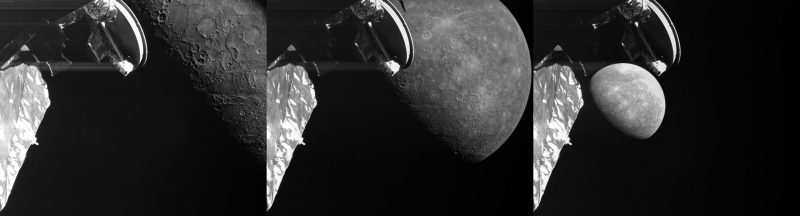
In this new video, we see a series of images as BepiColombo speeds away from the closest planet to the sun during the 3rd Mercury flyby. The spacecraft captured these images in a span of about 50 minutes.
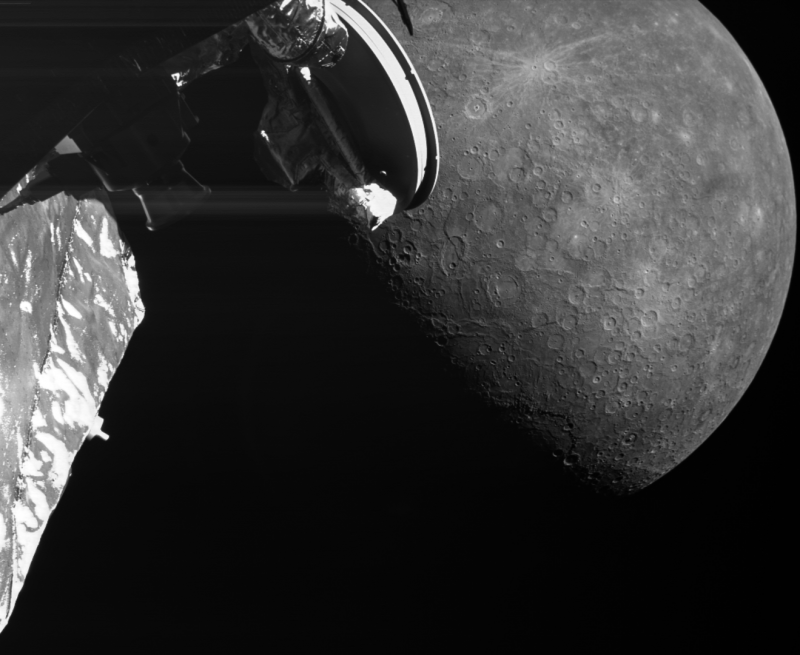
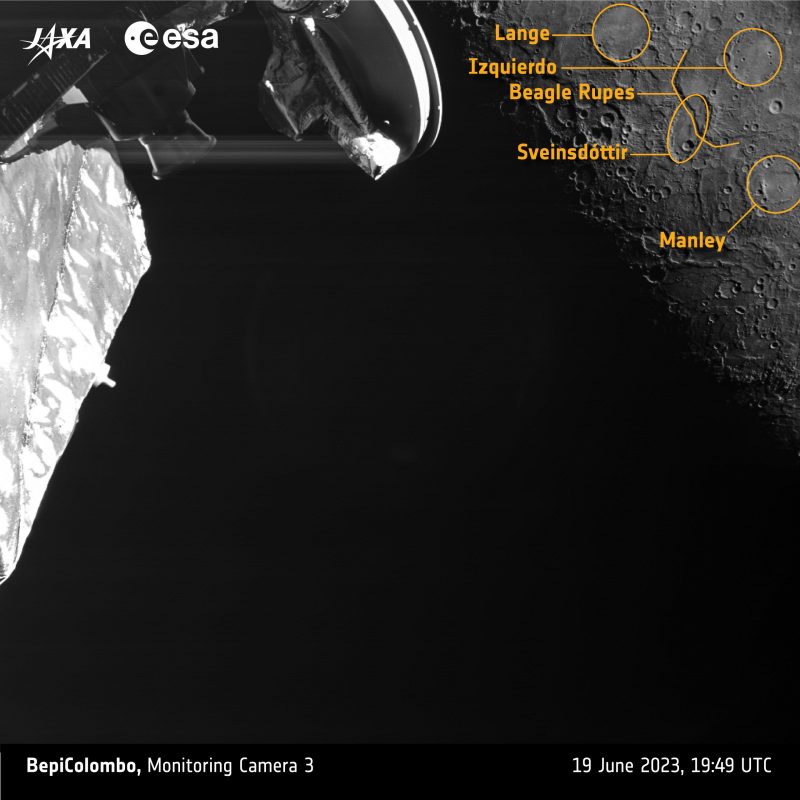
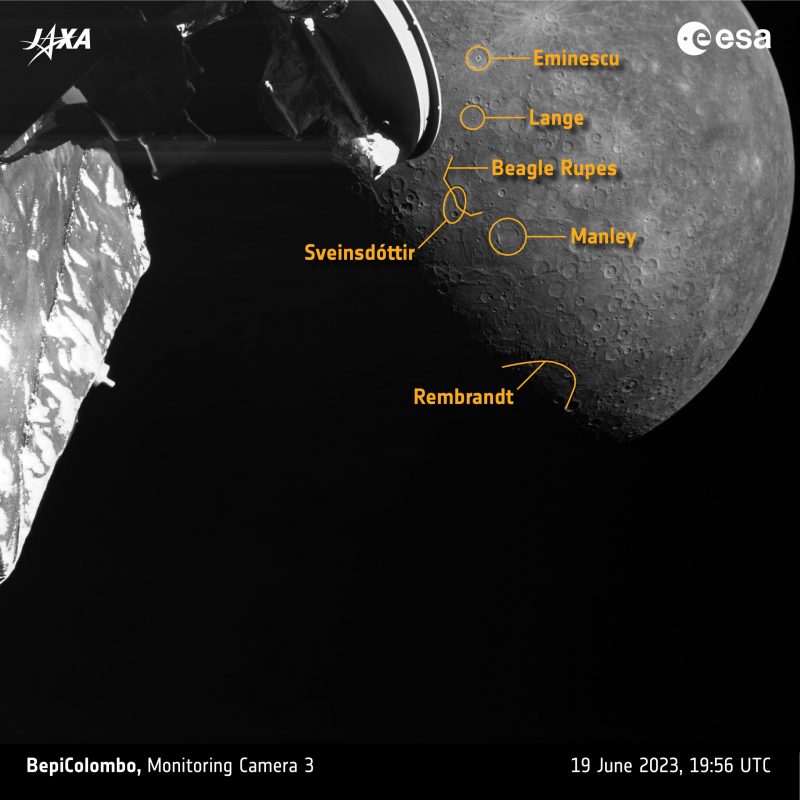
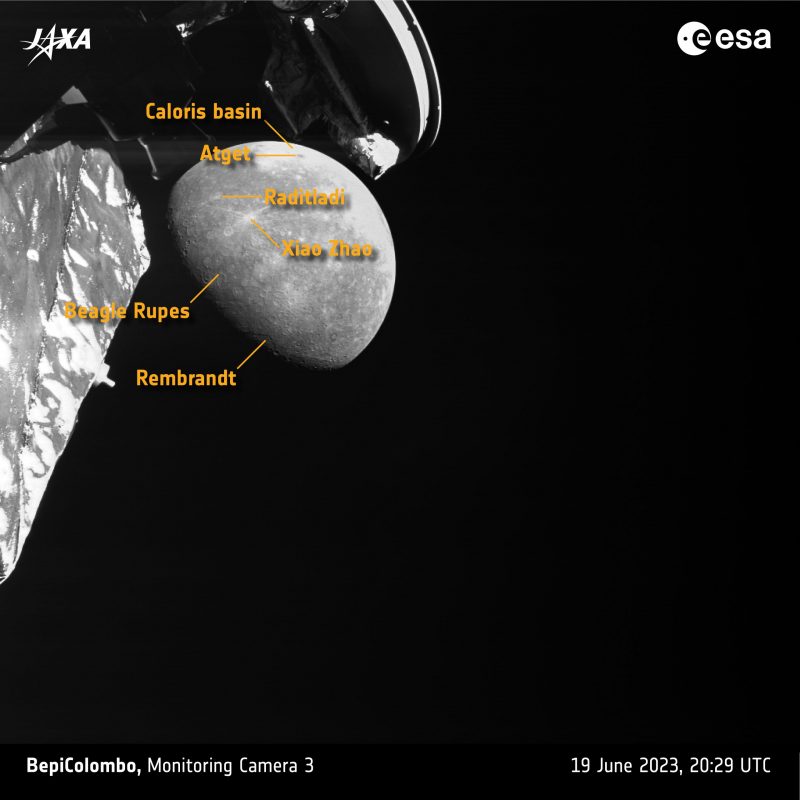
On June 20, 2023, ESA released new images of Mercury after BepiColombo spacecraft flew past the closest planet to the sun the day prior. In these images, we get to see a part of BepiColombo with cratered Mercury in the background. ESA released a trio of images as the spacecraft zoomed away during a gravity assist maneuver. It also released annotated images to point out important surface features.
Here’s 1 of the newest images of the closest planet to the sun from the 3rd Mercury flyby of the BepiColombo spacecraft. Image via ESA/ BepiColombo/ MTM.View larger. | These 3 images show the BepiColombo spacecraft with Mercury in the background as it zooms away after a gravity assist. Image via ESA/ BepiColombo/ MTM.This view of Mercury includes labels to point out some of its landmarks, including a scarp named Beagle Rupes. Image via ESA/ BepiColombo/ MTM.In the 2nd image released, we see labeled features such as the newly named Manley crater. Image via ESA/ BepiColombo/ MTM.In this 3rd image of Mercury, BepiColombo captures bright volcanic plains and the large impact basin named the Caloris basin. You can also see bright Xiao Zhao impact crater with its starlike ejecta pattern. It is 1 of the more recent craters on the planet. Image via ESA/ BepiColombo/ MTM.
Reactions from the BepiColombo team
The team involved with the BepiColombo mission were satisfied with the flyby and resulting images. Ignacio Clerigo, ESA’s BepiColombo Spacecraft Operations Manager, said:
Everything went very smoothly with the flyby, and images from the monitoring cameras taken during the close approach phase of the flyby have been transmitted to the ground. While the next Mercury flyby isn’t until September 2024, there are still challenges to tackle in the intervening time: our next long solar electric propulsion ‘thruster arc’ is planned to start early August until mid-September. In combination with the flybys, the thruster arcs are critical in helping BepiColombo brake against the enormous gravitational pull of the sun before we can enter orbit around Mercury.
One of the craters visible in the images is the newly named Manley crater. The International Astronomical Union (IAU) named this crater for Jamaican artist Edna Manley (1900–1987). David Rothery of the BepiColombo team said:
During our image planning for the flyby, we realized this large crater would be in view, but it didn’t yet have a name. It will clearly be of interest for BepiColombo scientists in the future because it has excavated dark ‘low reflectance material’ that may be remnants of Mercury’s early carbon-rich crust. In addition, the basin floor within its interior has been flooded by smooth lava, demonstrative of Mercury’s prolonged history of volcanic activity.
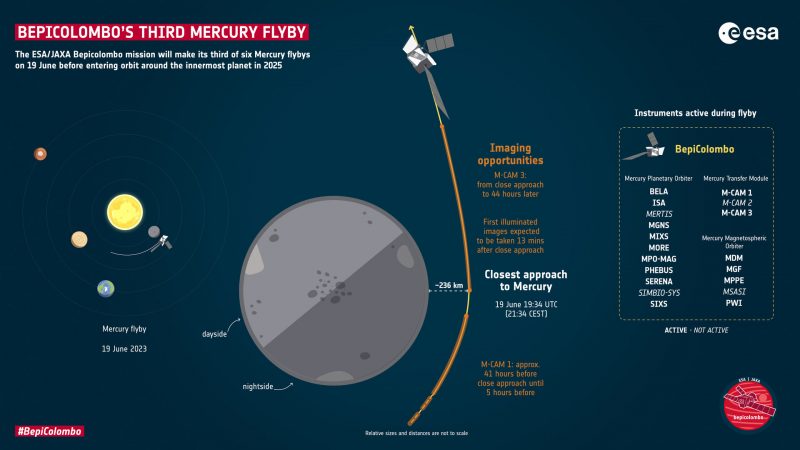
BepiColombo made its third flyby of the planet Mercury on June 19, 2023. The spacecraft swept closest to Mercury at 19:34 UTC (2:34 p.m. CDT).
BepiColombo is a joint Mercury mission, launched in October 2018 by the European Space Agency (ESA) and the Japan Aerospace Exploration Agency (JAXA). For the past several years, our sun’s inner planets have been giving BepiColombo gravity assists, needed to enable the spacecraft to achieve a stable orbit around Mercury.
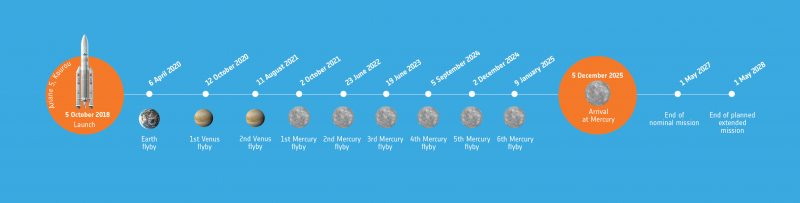
BepiColombo is due to enter Mercury’s orbit on December 5, 2025. In the meantime, there will be three more flybys after Monday’s close approach.
Why the gravity assists?
Why can’t BepiColombo just shoot on over to Mercury and go into orbit around it? It can’t because Mercury is so near the sun.
The flyby maneuvers will keep the craft from being pulled into the sun’s gravity well. With one Earth flyby, two Venus flybys, and six eventual Mercury flybys, the spacecraft will lose enough energy that Mercury will capture it in its orbit. That’s right, we said “lose.” We typically think of a gravity assist as a way to boost a spacecraft’s energy. But a gravity assist can either speed up or slow down a spacecraft. Or it can simply change a craft’s direction.
ESA flight dynamics expert Frank Budnik explained more about this 3rd flyby:
As BepiColombo starts feeling Mercury’s gravitational pull, it will be traveling at 3.6 km/s [2.2 mi/s] with respect to the planet. That’s just over half the speed it approached with during the previous two Mercury flybys.
And this is exactly what the point of such events is. Our spacecraft began with far too much energy because it launched from Earth and, like our planet, is orbiting the sun. To be captured by Mercury, we need to slow down, and we’re using the gravity of Earth, Venus and Mercury to do just that.
View larger. | BepiColombo is making a number of flybys on its way to entering orbit around Mercury. The June 19, 2023, flyby was the 3rd Mercury flyby. Image via ESA.
Tricky maneuvering
Even though BepiColombo’s flight to Mercury was meticulously mapped in advance, controllers will have to make corrections during the seven years it’ll take the spacecraft to get there. In May, mission control performed a course correction that otherwise would have put BepiColombo 15,000 miles (24,000 km) too far from Mercury and on the wrong side of the planet.
Santa Martinez Sanmartin, ESA’s BepiColombo mission manager, explained more about the methods used to get BepiColombo in orbit:
This is the first time scientists are using the complex solar electric propulsion method to get a spacecraft to Mercury. And it represents a big challenge during the remaining part of the cruise phase. We have already adapted our operations concept to have additional communications passes with our ground stations, enabling us to recover faster from thruster interruptions and to improve orbit determination.
And all the while this is working with communications delays of more than 10 minutes due to the time it currently takes light signals to travel between Earth and the spacecraft.
As ESA said, the most demanding part of its journey is still to come:
After this flyby, the mission will enter a very challenging part of its journey to Mercury, gradually increasing the use of solar electric propulsion through additional propulsion periods called ‘thrust arcs’ to continually brake against the enormous gravitational pull of the sun. These thrust arcs can last from a few days up to two months, with the longer arcs interrupted periodically for navigation and maneuver optimization.
This challenging journey is one of the reasons that Mercury is one of the least explored planets in our solar system.
The images from the 3rd Mercury flby
BepiColombo got as close as 146 miles (235 km) from Mercury’s surface during this flyby. However, closest approach was past the unlit portion of Mercury, so scientists didn’t capture any images until a bit later. At about 13 minutes past closest approach, when the spacecraft was 1,143 miles (1,840 km) away, it reached the illuminated part of Mercury. Then it began sending back black-and-white images, including part of the craft itself. A Mercurial selfie, if you will.
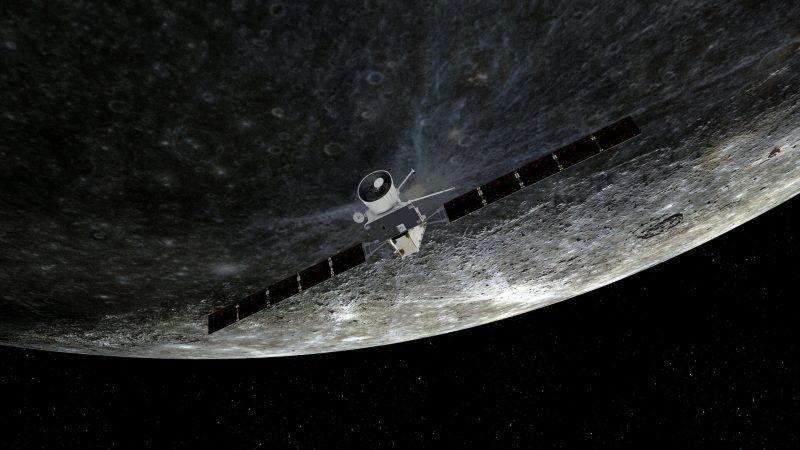
Artist’s concept of BepiColombo flying past Mercury. BepiColombo’s 3rd flyby of the closest planet to the sun was on June 19, 2023. Image via ESA/ ATG medialab.
Testing the instruments
The team uses these flybys as a chance to test some of the instruments. During Monday’s flyby, the magnetic, plasma and particle monitoring instruments sampled the environment. Johannes Benkhoff, project scientist, said:
Collecting data during flybys is extremely valuable for the science teams to check their instruments are functioning correctly ahead of the main mission. It also provides a novel opportunity to compare with data collected by NASA’s MESSENGER spacecraft during its 2011–2015 mission at Mercury from complementary locations around the planet not usually accessible from orbit. We are delighted to already have data published based on our previous flybys that generated new science results, which makes us even more excited to get into orbit!
View larger. | Here are the key moments in the 3rd flyby of BepiColombo past Mercury. BepiColombo saw the lit side of Mercury about 13 minutes after close approach. Image via ESA (acknowledgement: work performed by ATG under contract to ESA)/ CC BY-SA 3.0 IGO.
Bottom line:BepiColombo had its 3rd flyby of Mercury on June 19, 2023. The spacecraft will eventually go into orbit around the closest planet to the sun. ESA released three new images of Mercury taken during the encounter.
NASA's MESSENGER mission has revealed that Mercury, the solar system's tiniest planet and the closest to the sun, hides a big secret.
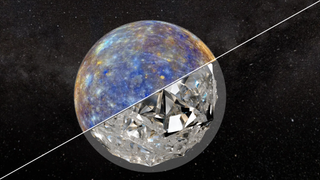
(Left) A colorful view of Mercury produced using images from the color base map imaging campaign during MESSENGER's primary mission (Right) what Mercury may look like were its outer layers stripped to expose its 10-mile-thick layer of diamond
(Image credit: Robert Lea (created with Canva)/NASA/Johns Hopkins University Applied Physics Laboratory/Carnegie Institution of Washington)
The solar system's tiniest planet may be hiding a big secret. Using data from NASA's MESSENGER spacecraft, scientists have determined that a 10-mile-thick diamond mantle may lie beneath the crust of Mercury, the closest planet to the sun.
Mercury has long puzzled scientists as it possesses many qualities that aren't common to other solar system planets. These include its very dark surface, remarkably dense core, and the premature end of Mercury's volcanic era.
Also among these puzzles are patches of graphite, a type (or "allotrope") of carbon on the surface of the innermost planet of the solar system. These patches have led scientists to suggest that in Mercury's early history, the tiny planet had a carbon-rich magma ocean. This ocean would have floated to the surface, creating graphite patches and the dark-shaded hue of Mercury's surface.
In this new video, we see a series of images as BepiColombo speeds away from the closest planet to the sun during the 3rd Mercury flyby. The spacecraft captured these images in a span of about 50 minutes.
The same process would have also led to the formation of a carbon-rich mantle beneath the surface. The team behind these findings thinks that this mantle isn't graphene, as previously suspected, but is composed of another much more precious allotrope of carbon: diamond.
"We calculate that, given the new estimate of the pressure at the mantle-core boundary, and knowing that Mercury is a carbon-rich planet, the carbon-bearing mineral that would form at the interface between mantle and core is diamond and not graphite," team member Olivier Namur, an associate professor at KU Leuven, told Space.com. "Our study uses geophysical data collected by the NASA MESSENGER spacecraft."
MESSENGER (Mercury Surface, Space Environment, Geochemistry, and Ranging) launched in Aug. 2004 and became the first spacecraft to orbit Mercury. The mission, which ended in 2015, mapped the entire tiny world, discovering abundant water ice in shadows at the poles and gathering crucial data about Mercury's geology and magnetic field.
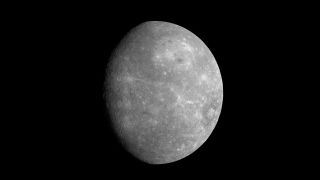
A high-resolution mosaic of images of Mercury captured by NASA's MESSENGER as the spacecraft departed the planet following the mission's first flyby of Mercury. (Image credit: NASA/Johns Hopkins University Applied Physics Laboratory/Carnegie Institution of Washington)
Under pressure!
This new study also relates to a major surprise that came a few years ago when scientists re-evaluated the distribution of mass on Mercury, discovering the mantle of this tiny planet is thicker than previously thought.
"We directly thought that this must have a huge implication for the speciation [the distribution of an element or an allotrope amongst chemical species in a system] of carbon, diamond vs graphite, on Mercury," Namur said.
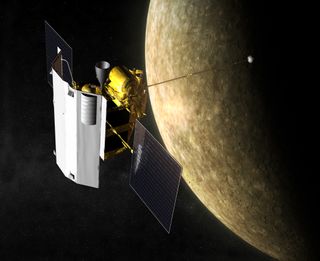
Artist's impression of NASA's MESSENGER spacecraft in orbit at Mercury. MESSENGER arrived at the solar system's innermost planet in March 2011. (Image credit: NASA/Johns Hopkins University Applied Physics Laboratory/Carnegie Institution of Washington)
The team investigated this here on Earth by using a large-volume press to replicate the pressures and temperatures that exist within the interior of Mercury. They applied incredible amounts of pressure, over seven gigapascals, to a synthetic silicate acting as a proxy for the material found in the mantle of Mercury, achieving temperatures of up to 3,950 degrees Fahrenheit (2,177 degrees Celsius).
This allowed them to study how minerals like those that would have been found in Mercury's mantle in its early existence changed under these conditions. They also used computer modeling to assess data about Mercury's interior, which gave them clues to how the diamond mantle of Mercury could have been created.
"We believe that diamond could have been formed by two processes. First is the crystallization of the magma ocean, but this process likely contributed to forming only a very thin diamond layer at the core/mantle interface," Namur explained. "Secondly, and most importantly, the crystallization of the metal core of Mercury."
Namur said that when Mercury formed around 4.5 billion years ago, the core of the planet was fully liquid, progressively crystallizing over time. The exact nature of the solid phases forming in the inner core is not currently well known, but the team believes that these phases must have been low in carbon or "carbon-poor."
"The liquid core before crystallization contained some carbon; crystallization, therefore, leads to carbon enrichment in the residual melt," he continued. "At some point, a solubility threshold is reached, meaning the liquid cannot dissolve more carbon, and diamond forms."
Diamond is a dense mineral but not as dense as metal, meaning that during this process, it would have floated to the top of the core, stopping at the boundary of Mercury's core and its mantle. This would have resulted in the formation of an around 0.62-mile (1 km) thick diamond layer that then continued to grow over time.
As the MESSENGER spacecraft drew closer to Mercury for its historic first flyby, the spacecraft acquired this mosaic of the sunlit portion of the planet. (Image credit: NASA/JHUAPL/CIW)
The discovery highlights the differences between the birth of the closest planet to the sun when compared with the creation of the solar system's other rocky planets, Venus, Earth, and Mars.
"Mercury formed much closer to the sun, likely from a carbon-rich cloud of dust. As a consequence, Mercury contains less oxygen and more carbon than other planets, which led to the formation of a diamond layer," Namur added. "However, Earth's core also contains carbon, and diamond formation in the Earth's core has already been suggested by various researchers."
The researcher hopes that this discovery could help reveal clues to some of the other mysteries surrounding the solar system's smallest planet, including why its volcanic phase was cut short around 3.5 billion years ago.
"A major question that I have about Mercury's evolution is why the major phase of volcanism lasted only a few hundred million years, much shorter than other rocky planets. This must mean that the planet cooled down very fast," Namur said. "This is partly related to the small size of the planet, but we are now working with physicists to try to understand if a diamond layer could have contributed to very fast heat removal, therefore terminating major volcanism very early."
Namur said that the team's next step will be to investigate the thermal effect of a diamond layer at the mantle/core boundary. This study could be supported by data from a mission that will follow in the footsteps of MESSENGER.
"We are also eagerly waiting for the first data collected by BepiColombo, hopefully in 2026, to refine our understanding of Mercury's internal structure and evolution," Namur concluded.
A team of researchers from the Technical University of Denmark (DTU) has announced the creation of a so-called super battery made from rocks, a technology that may one day replace Lithium Ion batteries used in electric vehicle production.
The team claims their discovery would lead to cleaner, safer, and longer-lasting batteries that don’t rely on rare metals or end up as toxic waste. According to the DTU team behind the battery’s creation, the key to their entry into energy storage lies in the simplicity of the materials involved. More specifically, their super battery is based on potassium and sodium silicates, which are commonly found in rocks.
“These are rock silicates, which are some of the most common minerals in the Earth’s crust,” explains the press release announcing the new battery. “It is found in the stones you pick up on the beach or in your garden.”
WITH LITHIUM ION’S DAYS NUMBERED, SUPER BATTERY WILL LIKELY POWER THE VEHICLES OF THE FUTURE
Today, the vast majority of electric devices, including phones, computers, and cars, are powered by lithium-ion batteries. Unfortunately, lithium is a rare earth mineral and is also considered toxic. Batteries using lithium-ion energy storage have also proven to be dangerous under the right conditions. In some cases, electric cars or even commercial airlines have experienced lithium-ion batteries bursting into flames.
While consumers have somewhat tolerated these issues due to the longer drive times and relatively short device charge times lithium-ion batteries provide, industry experts often state that one way or another, the end of this class of batteries is coming sooner rather than later.
Now, DTU researchers say they may have developed and patented a commercially viable alternative that mitigates nearly all of the largest concerns regarding current technologies while also offering equally impressive drive times and shorter recharge times for electric vehicles.
TEAM SAYS SOLID STATE BATTERIES MADE FROM ROCKS OFFER COMPELLING ADVANTAGES
In developing their futuristic ‘super battery,’ the DTU team knew there was untapped potential in potassium-based silicates. The material is not only good at energy storage but also eco-friendly, inexpensive to extract, and available from material that covers 90 percent of the surface. Still, the research team says it has largely been ignored due to perceived limitations that they believe could be surmounted.
“The potential of potassium silicate as a solid-state electrolyte has been known for a long time, but in my opinion, has been ignored due to challenges with the weight and size of the potassium ions,” explained DTU researcher Mohamad Khoshkalam. “The ions are large and therefore move slower.”
When ions move slowly in a battery, it adversely affects everything from charge times and lifespan to safety. Still, Khoshkalam believed that the huge number of benefits offered by batteries essentially made from rocks were valuable enough that they could prove a nearly perfect medium for their new super battery.
This belief led to the testing of various formulas of potassium silicate-based electrolytes, with an eye on maintaining the material’s benefits while mitigating its weaknesses. According to Khoshkalam, this effort was a success.
After numerous trials, the team was able to create a superionic material of potassium silicate and a separate “process” that combined to make the ions move even faster than they do in lithium-based electrolytes. However, the researchers are keeping the exact formula a secret, although they have received a patent for it.
“The first measurement with a battery component revealed that the material has a very good conductivity as a solid-state electrolyte,” said Khoshkalam. “I cannot reveal how I developed the material, as the recipe and the method are now patented,”
TEAM ACKNOWLEDGES SOLID STATE ROCK BATTERIES ARE A HIGH-RISK TECHNOLOGY
In the DTU team’s formal announcement, they highlight previous announcements by car manufacturers that have promised to develop solid-state batteries “only to subsequently pull out.” Toyota recently announced plans for a 2027-2028 launch of a lithium-based solid-state-powered electric vehicle, but few details have been made available.
The DTU also projects what a solid-state super battery based on potassium silicate would look like, as well as the impressive performance and safety benefits it could offer.
“A single battery cell can be made as thin as a piece of cardboard, where the anode, cathode, and solid-state electrolyte are ultra-thin layers of material,” they explain. “This means that we can make more powerful batteries that take up less space. This offers benefits on the road, as you will be able to drive up to 1,000 km on a single 10-minute charge. In addition, a solid-state battery is more fireproof, as it does not contain combustible liquid.”
In their summary, the team concedes that moving their discovery from a lab invention to the commercial market won’t be easy, as “the chance of commercial success is small, and the technical challenges are many.” In fact, they say that the soonest people could even expect to see this type of technology powering a car is at least ten years away.
Still optimistic, Khoshkalam said he hopes to use his patent and his new company, K-Ion, to create a prototype solid-state super battery based on his science. If successful, he can show it to investors looking to help pave the way for his technology to power devices and EVs of the future.
“We have shown that we can find a material for a solid-state electrolyte that is cheap, efficient, eco-friendly, and scalable,” he explained, “and that even performs better than solid-state lithium-based electrolytes.”
Christopher Plain is a Science Fiction and Fantasy novelist and Head Science Writer at The Debrief. Follow and connect with him onX,learn about his books atplainfiction.com, or email him directly atchristopher@thedebrief.org.
Are robots poised to soon become our overlords? Maybe not yet, although billionaire technologist Elon Musk says they could soon take over Tesla production facilities as the company moves forward with plans to begin producing humanoid robots called Optimus as soon as next year.
In a post on X, Musk said, “Tesla will have genuinely useful humanoid robots in low production for Tesla internal use next year and, hopefully, high production for other companies in 2026.”
First named the “Tesla Bot” and revealed in 2021 at a Tesla AI Day event, the robot’s design has drastically changed over the last few years. Recently renamed Optimus, the humanlike robot was designed to perform dangerous work and repetitive tasks.
At 170 centimeters in height and weighing around 123 pounds, the robot’s new design is sleek compared to its appearance while in the initial prototype phase.
Tesla’s development of Optimus is not the first time robots designed to mimic human capabilities have made news. Other automotive and robotics companies, including Honda and Boston Dynamics, have made progress in recent years in the development of robots that include those with humanoid designs.
In 2015, DARPA hosted the Robotics Challenge, and many of the designs looked similar to the robots currently under development by Tesla.
The event, held at the Fairplex in Pomona, California, aimed to have participants create robot systems and software teams to help humans under conditions of natural and man-made disasters.
Team Kaist of Daejeon, Republic of Korea, won first place and the $2 million prize with their robot DRC-Hubo, while Team IHMC Robotics from Pensacola, Florida, secured second place and $1 million with their robot Running Man.
The prize for third place went to Tartan Rescue of Pittsburgh and their robot CHIMP, along with a $500,000 prize.
Musk initially speculated that Optimus would be ready for deployment in Tesla’s factories by the end of 2024. Similarly, Musk had said as early as 2019 that Tesla would have its long-awaited self-driving taxis in operation by the following year.
The company’s self-driving taxis are reportedly being unveiled later this year, although no official date has been confirmed.
Producing Oxygen From Rock Is Harder In Lower Gravities
One of the challenges engineers face when developing technologies for use in space is that of different gravities. Mostly, engineers only have access to test beds that reflect either Earth’s normal gravity or, if they’re fortunate, the microgravity of the ISS. Designing and testing systems for the reduced, but not negligible, gravity on the Moon and Mars is much more difficult. But for some systems, it is essential. One such system is electrolysis, the process by which explorers will make oxygen for astronauts to breathe on a permanent Moon or Mars base, as well as critical ingredients like hydrogen for rocket fuel. To help steer the development of systems that will work in those conditions, a team of researchers led by computational physicist Dr. Paul Burke of the Johns Hopkins University Applied Physics Laboratory decided to turn to a favorite tool of scientists everywhere: models.
Before we explore the model, examining the problem they are trying to solve is helpful. Electrolysis immerses an electrode in a liquid and uses an electrical current and subsequent chemical reaction to split atoms apart. So, for example, if you put an electrode in water, it would separate that water into hydrogen and oxygen.
The problem comes from reduced gravity. As part of electrolysis, bubbles form on the surface of the electrode. On Earth, those bubbles typically detach and float to the surface, as the density difference between them and the remaining liquid forces them to.
Dr. Burke presented alongside other experts at the Space Resources Week Workshop back in March. Credit – ESRIC YouTube Channel
However, in reduced gravity, the bubbles either take much longer to detach or don’t do so at all. This creates a buffer layer along the electrode’s length that decreases the electrolysis process’s efficiency, sometimes stalling it out entirely. Electrolysis isn’t the only fluidic process that has difficulty operating in reduced gravity environments – many ISS experiments also have trouble. This is partly due to a lack of complete understanding of how liquids operate in these environments – and that in itself is partly driven by a dearth of experimental data.
Which is where the modeling comes in. Dr. Burke and his colleagues use a technique known as Computational Fluid Dynamics to attempt to mimic the forces the fluids will undergo in a reduced gravity environment while also understanding bubble formation.
Electrolysis on Earth is typically done with water, but why stop there? The team used their CFD to model two other liquids that might be used in electrolyzers – molten salt (MSE) and molten regolith (MRE). Molten salt is used on Earth, but less commonly than regular water, and has successfully produced oxygen. However, molten regolith electrolysis is still somewhat of a novel use case and has yet to be thoroughly tested. MOXIE, the experiment that famously created oxygen on Mars in 2021, used the carbon dioxide in Mars’ atmosphere and a solid-state electrode – neither representative of molten regolith.
Fraser discusses MOXIE electrolysis with Dr. Michael Hect.
Dr. Burke and his team found that, computationally, at least, MRE has the most challenging conditions in reduced gravity. It has also never been tested in any reduced gravity environment, so for now; these simulations are all engineers have to go on with if they are going to design a system.
There were a few key takeaways from the modeling, though. First, engineers should design horizontal electrodes into MRE systems, as the longer a bubble spreads across an electrode (i.e., as it goes “up” it), the longer it takes for that bubble to detach. In a horizontal configuration, the electrode has less surface area to attach to, making it more likely for the bubbles to detach and float to the surface.
Additionally, the amount of time bubbles remain attached to an electrode scales exponentially with decreasing gravity. That means bubbles on the Moon will take longer to detach than those on Mars, which will take longer than those on Earth. Consequently, electrolysis on the Moon will be less efficient than that on Mars, which will again be less efficient than that on Earth, and mission planners will need to account for these discrepancies if they plan on getting something as mission-critical as oxygen from this process. The smoothness of the electrodes also seems to matter, with rougher electrodes more likely to hold onto their bubbles and, therefore, end up less efficient.
SciShow Space explores the world of MRE. Credit – SciShow Space YouTube Channel
Other engineering solutions can overcome all these challenges, such as a vibratory mechanism on the electrode to shake the bubbles loose. However, it’s a good idea to consider all the additional complications operations in a reduced gravity environment have before launching a mission. That’s why modeling is so important, but humanity will ultimately have to experimentally test these systems, perhaps on the Moon itself, if we plan to utilize its local resources to sustain our presence there.
This AI-generated image of the Pope in a puffer jacket went viral in 2023 and many were fooled into thinking it was real. It was generated with the AI tool Midjourney and was posted on Reddit by a user whose account is now gone. On the right is a Hubble Space Telescope image of the Antennae Galaxies. Image Credit: Midjourney/NASA/ESA
Astronomers Have Tools That Can Help Detect Deepfake Images
There’s a burgeoning arms race between Artificial Intelligence (AI) deepfake images and the methods used to detect them. The latest advancement on the detection side comes from astronomy. The intricate methods used to dissect and understand light in astronomical images can be brought to bear on deepfakes.
The word ‘deepfakes’ is a portmanteau of ‘deep learning’ and ‘fakes.’ Deepfake images are called that because they’re made with a certain type of AI called deep learning, itself a subset of machine learning. Deep learning AI can mimic something quite well after being shown many examples of what it’s being asked to fake. When it comes to images, deepfakes usually involve replacing the existing face in an image with a second person’s face to make it look like someone else is in a certain place, in the company of certain people, or engaging in certain activities.
Deepfakes are getting better and better, just like other forms of AI. But as it turns out, a new tool to uncover deepfakes already exists in astronomy. Astronomy is all about light, and the science of teasing out minute details in light from extremely distant and puzzling objects is developing just as rapidly as AI.
In a new article in Nature, science journalist Sarah Wild looked at how researchers are using astronomical methods to uncover deepfakes. Adejumoke Owolabi is a student at the University of Hull in the UK who studies data science and computer vision. Her Master’s Thesis focused on how light reflected in eyeballs should be consistent, though not identical, between left and right. Owolabi used a high-quality dataset of human faces from Flickr and then used an image generator to create fake faces. She then compared the two using two different astronomical measurement systems called the CAS system and the Gini index to compare the light reflected in the eyeballs and to determine which were deepfakes.
CAS stands for concentration, asymmetry, and smoothness, and astronomers have used it for decades to study and quantify the light from extragalactic stars. It’s also used to quantify the light from entire galaxies and has made its way into biology and other areas where images need to be carefully examined. Noted astrophysicist Christopher J. Conselice was a key proponent of using CAS in astronomy.
The Gini index, or Gini coefficient, is also used to study galaxies. It’s named after the Italian statistician Corrado Gini, who developed it in 1912 to measure income inequality. Astronomers use it to measure how light is spread throughout a galaxy and whether it’s uniform or concentrated. It’s a tool that helps astronomers determine a galaxy’s morphology and classification.
In her research, Owolabi successfully determined which images were fake 70% of the time.
These eyes are all from deepfake images with inconsistent light reflection patterns. The ones on the right are coloured to highlight the inconsistencies. Image Credit: Adejumoke Owolabi (CC BY 4.0)
For her article, Wild spoke with Kevin Pimbblet, director of the Centre of Excellence for Data Science, Artificial Intelligence and Modelling at the University of Hull in the UK. Pimblett presented the research at the UK Royal Astronomical Society’s National Astronomy Meeting on July 15th.
“It’s not a silver bullet, because we do have false positives and false negatives,” said Pimbblet. “But this research provides a potential method, an important way forward, perhaps to add to the battery of tests that one can apply to try to figure out if an image is real or fake.”
This is a promising development. Open democratic societies are prone to disinformation attacks from enemies without and within. Public figures are prone to similar attacks. Disturbingly, the majority of deepfakes are pornographic and can depict public figures in private and sometimes degrading situations. Anything that can help combat it and bolster civil society is a welcome tool.
But as we know from history, arms races have no endpoint. They go on and on in an escalating series of countermeasures. Look at how the USA and the USSR kept one-upping each other during their nuclear arms race as warhead sizes reached absurd levels of destructive power. So, inasmuch as this work shows promise, the purveyors of deepfakes will learn from it and improve their AI deepfake methods.
Wild also spoke to Brant Robertson in her article. Robertson is an astrophysicist at the University of California, Santa Cruz, who studies astrophysics and astronomy, including big data and machine learning. “However, if you can calculate a metric that quantifies how realistic a deepfake image may appear, you can also train the AI model to produce even better deepfakes by optimizing that metric,” he said, confirming what many can predict.
This isn’t the first time that astronomical methods have intersected with Earthly issues. When the Hubble Space Telescope was developed, it contained a powerful CCD (charge-coupled device.) That technology made its way into a digital mammography biopsy system. The system allowed doctors to take better images of breast tissue and identify suspicious tissue without a physical biopsy. Now, CCDs are at the heart of all of our digital cameras, including on our mobile phones.
Might our internet browsers one day contain a deepfake detector based on Gini and CAS? How would that work? Would hostile actors unleash attacks on those detectors and then flood our media with deepfake images in an attempt to weaken our democratic societies? It’s the nature of an arms race.
It’s also in our nature to use deception to sway events. History shows that rulers with malevolent intent can more easily deceive populations that are in the grip of powerful emotions. AI deepfakes are just the newest tool at their disposal.
We all know that AI has downsides, and deepfakes are one of them. While their legality is fuzzy, as with many new technologies, we’re starting to see efforts to combat them. The United States government acknowledges the problem, and several laws have been proposed to deal with it. The “DEEPFAKES Accountability Act” was introduced in the US House of Representatives in September 2023. The “Protecting Consumers from Deceptive AI Act” is another related proposal. Both are floundering in the sometimes murky world of subcommittees for now, but they might breach the surface and become law eventually. Other countries and the EU are wrestling with the same issue.
But in the absence of a comprehensive legal framework dealing with AI deepfakes, and even after one is established, detection is still key.
Astronomy and astrophysics could be an unlikely ally in combatting them.
The Mars Curiosity rover rolled over this rock containing pure sulfur crystals in May. Planetary scientists are still trying to figure out how the sulfur got there. NASA/JPL-Caltech/MSSS
Curiosity Drives Over a Rock, Cracking it Open and Revealing an Amazing Yellow Crystal
On May 30th, the Mars Curiosity rover was just minding its own business exploring Gediz Vallis when it ran over a rock. Its wheel cracked the rock and voila! Pure elemental sulfur spilled out. The rover took a picture of the broken rock about a week later, marking the first time sulfur has been found in a pure form on Mars.
After Curiosity’s encounter with the broken rock and its pure sulfur innards, the rover trundled over to another rock, called “Mammoth Lakes” for a little drilling session. Before it left to explore other rocks, the rover managed to cut into that rock and take samples for further study to find out its chemical composition.
It’s not that sulfur isn’t prevalent on Mars. It is, but in different forms. The stuff is highly abundant in the Solar System, so this find isn’t as surprising as you’d think. However, Curiosity finding pure sulfur in the middle of broken rocks is a new experience in Mars exploration. So, of course, that’s raising questions about how it got there and its implications for habitable environments in Mars’s long history.
Curiosity’s Peregrinations
At the moment, the Curiosity rover is making its way through the Gediz Vallis. That’s a flow channel winding its way down a section of Mount Sharp (aka Aeolis Mons). That’s the central peak of Gale Crater. The rover has been heading up since 2014, charting different surface layers as it goes. Each layer was put down during a different era of Mars’s history. They could contain clues to the planet’s habitability in the past.
NASA’s Curiosity Mars rover captured this view of Gediz Vallis channel on March 31. Floods of water and debris piled rocks and sand into mounds within the channel. The rock the rover broke lies in a channel in this region. Credit: NASA/JPL-Caltech/MSSS
Fast-moving liquid water raged over the surface and carved Gediz. The floods carried a lot of rocks and sand and deposited them all along the way. Other piles of flood debris lie around the region, bearing witness to other ancient floods and landslides. “This was not a quiet period on Mars,” said Becky Williams, a scientist with the Planetary Science Institute in Tucson, Arizona, and the deputy principal investigator of the Mast Camera, or Mastcam on Curiosity. “There was an exciting amount of activity here. We’re looking at multiple flows down the channel, including energetic floods and boulder-rich flows.”
Understanding Sulfur’s Presence
The surface materials in Gediz contain high amounts of sulfates. Those are sulfur-bearing salts that appear as water evaporates. They are a chemical clue that water existed in the region. Judging by some parts of the surface, it also appears the water ponded at some times, in addition to the floods that scoured the landscape and then deposited debris.
Now the planetary science team has to explain how a pure form of elemental sulfur got stuck in the middle of rocks, according to project scientist Ashwin Vasavada. “Finding a field of stones made of pure sulfur is like finding an oasis in the desert,” said Vasavada. “It shouldn’t be there, so now we have to explain it. Discovering strange and unexpected things is what makes planetary exploration so exciting.”
Putting Sulfur in Context
Sulfur, of course, exists on Earth, which helps scientists understand its behavior and the environments where it’s found. The presence of sulfur can be a result of various geological processes. The sulfur “cycle” includes the flow of sulfur from the core to the surface through volcanism. That’s not unusual. Sulfur commonly appears around volcanic vents. Mt Ijen in Indonesia is a good example. It sports extensive elemental sulfur deposits that are mined.
The volcanic moon Io in the Jupiter system features patches of different allotropes of sulfur. They’re also volcanic in origin, spewed out along with widespread lava flows. This moon has more than 400 volcanic features, making it the most volcanically active (and sulfurous) place in the Solar System.
The Jovian moon Io is seen by the New Horizons spacecraft. The mission’s camera caught a view of one of this moon’s volcanos erupting. The region that Curiosity is investigating shows evidence of different kinds of sulfur-bearing minerals. Courtesy: NASA Goddard Space Flight Center Scientific Visualization Studio.
The pure sulfur in the Mars rock most likely came from volcanic processes. They occurred sometime in the past, but that doesn’t answer how the crystals got inside the rock it crushed. Scientists have known for years that Mars was extremely volcanically active in the past. For a long time, they also thought it was dead, or at least dormant. The planet has no plate tectonics like we see on Earth, either. However, the Mars InSight mission found evidence of some seismic activity on the planet in 2021.
In 2023, planetary scientists at the University of Arizona offered up evidence of a giant mantle plume under Elysium Planitia that drove some kinds of activity in the more recent past. Gale Crater lies in this region and could well have experienced related volcanic and seismic activity during the recent geologic past. If so, that could help explain the presence not only of pure sulfur but also the flood-related sulfates deposited on the surface.
Now DailyMail.com has spoken to a former Colorado prosecutor and current defense attorney, who has examined one of the over half-a-dozen 'alien' specimens with the help of three independent forensic medical examiners from the United States.
'These were not traditional human fingerprint patterns,' that attorney, Joshua McDowell, told DailyMail.com.
Above, a photo of one of the mummy's unusual fingerprints posted to social media by Jose Baizan and attributed to the Mexican Naval surgeon Dr Jose de Jesus Zalce Benitez, who has also examined the Peruvian 'alien' mummies on behalf of ufologist Jaime Maussan
In Peru last April - as part of another event hosted by Maussan - a new 'alien' specimen named Montserrat (above) was presented. This photo was taken by Colorado attorney Josh McDowell who told DailyMail.com, one mummies' 'fingerprints weren't consistent with human prints'
The use of fingerprints — or what are technically known as 'friction ridge' skin impressions — dates back as far as 300 BC in China according to the US Department of Justice's Fingerprint Sourcebook.
And criminal forensic investigators in America have long systematized the hunt for unique features ever since these patterns first came into use by US law enforcement in 1902, beginning with three broad types of fingerprint: arches, loops and whorls.
But 'María,' the so-called 'alien' mummy that McDowell and his forensic doctors examined, appeared to have fingerprints that matched no known human pattern.
'We did not see any loops or whorls on the prints of the fingers or on the toes,' McDowell, now principal at the McDowell Law Firm, told DailyMail.com.
'I'm a former prosecutor. I'm a criminal defense attorney. I've seen lots of fingerprints. And these were not classic fingerprints,' the attorney added.
'María's fingerprints weren't consistent with human prints.'
Criminal forensic investigators in America have long systematized the hunt for unique features ever since these patterns first came into use by US law enforcement in 1902, beginning with three broad types of fingerprint: arches, loops and whorls (pictured)
'We did not see any loops or whorls on the prints of the fingers or on the toes,' McDowell, now principal at the McDowell Law Firm, told DailyMail.com. Above an image of the specific, so-called 'alien' mummy in question, known as María, who was first made public in 2019
Like most of the well over half-a-dozen 'alien' mummy specimens brought to light by Jaime Maussan in the past year, María was discovered caked in diatomaceous earth: white, powdery aquatic fossils left behind by a type of plankton known as diatoms.
'Much of her body is covered in diatomaceous earth,' McDowell explained, 'however, on the fingers that were exposed, the epidermal ridges I saw appeared to be in mostly straight lines.'
McDowell and the three US medical examiners who journeyed with him to Peru to examine the bodies last April have emphasized that it would be 'extremely premature' to make any definitive statements about these mysterious mummies.
McDowell told DailyMail.com that there may yet be a terrestrial explanation for the unusually straight 'friction ridge' skin patterns on María's fingers and toes.
'It could possibly have something to do with the way her skin was preserved,' he advised. 'It's very odd.'
McDowell, previously a deputy district attorney for Colorado's Fourth Judicial District Attorney's Office, brought a city coroner from Denver as well as a forensic anthropologist from Maryland's State Medical Examiner to Peru to inspect María.
The third expert, McDowell's father Dr John McDowell, is a forensic odontologist and retired professor at the University of Colorado — who once worked to identify victims of the 9/11 terrorist attacks on the World Trade Center via their dental records.
Joshua McDowell emphasized to DailyMail.com that 'no determination has been made about what the nature of the specimens is at this date,' adding that his teams' effort to identify the true nature of these 'alien' mummies is very much still active.
'I've been to Mexico a couple times, spent a week in Peru,' the attorney said. 'Two to three hours a day, I'm dealing with something on this.'
'So far we have tomographies [CT scans] and fluoroscopy analysis,' Maussan told DailyMail.com describing the x-ray and ultrasound data on the mummies that he unveiled at West Hollywood's Mondrian Hotel at a prior March 12, 2024 press event (pictured above)
Above, two of Maussan's collaborators, documentarians Serena DC (right) and Michael Mazzola (left), pose with a new 'alien' mummy from this March - which they said has 30 percent 'unknown' DNA
This past January - after two mummies were seized by Peruvian customs - Flavio Estrada (right), a forensic archaeologist with Peru's Institute of Legal Medicine and Forensic Sciences of Lima, said that the alien bodies are 'dolls' made of animal parts
María is one several specimens that have been dubbed 'the Nazca mummies,' after the province in southwestern Peru where these bodies were allegedly unearthed.
Most of these specimens have gained fame and infamy, in part, due to their elongated heads and their three-fingered hands which resemble decades of anecdotal accounts and UFO lore about extraterrestrial 'grey' beings.
Maussan and his colleagues have had an eventful year pushing for wider scientific interest in the apparently alien bodies, including two bitter clashes with Peru's Ministry of Culture, who have described the mummies and man-made hoaxes.
In January, Flavio Estrada, a forensic archaeologist of the Institute of Legal Medicine and Forensic Sciences of Lima of the Public Ministry, told a press conference that two of the alien bodies seized by Peruvian customs were 'dolls.'
'The conclusion is simple,' Estrada said, 'they are dolls assembled with bones of animals from this planet, with modern synthetic glues, therefore they were not assembled during pre-Hispanic times.'
But María, like several of the other Nazca mummies, does not resemble the smaller, more doll-like specimens seized at the border or presented to Mexican congress.
The new — albeit provisional — fingerprint analysis suggests some of the Nazca mummies are either not dolls or were constructed of more grim, unusual material.
In March 2024, Maussan published a report on the DNA of the Nazca 'tridactyl' mummies - a report that he described as having been performed by 'the top specialist in Molecular Biology and Genetics of Peru' (page one above)
Ten scientists with San Luis Gonzaga National University of Ica (UNICA), according to Maussan's statement in March, concluded 'their DNA [i.e. the Nazca mummies' DNA] contains 29 percent that does not belong to the evolutionary chain of the Earth' (page two above)
But the larger Nazca mummy specimens also have their critics.
'The Spanish, when they arrived in the 16th Century observed and commented on individuals walking around with very specifically shaped skulls,' as Heaney told DailyMail.com, 'and they recognized and saw them doing it using these bandages.'
This specific 'alien' mummy, María, was first debuted at a November 6, 2019 press event held at Peru's San Luis Gonzaga National University of Ica (UNICA) alongside three other Nazca 'tridactyls' (three-fingered bodies): 'Wawita,' 'Albert' and 'Victoria.'
Maussan, who was a party to McDowells' trip to UNICA to inspect these mummies, unveiled a new 'alien' specimen named Montserrat during the recent April 2024 trip.
Maussan has pushed for wider scientific interest in the apparently alien bodies, including a presentation before Mexico's Congress (pictured)
'Would you consider I would take the bodies to the Mexican Congress putting in danger 50 years of [my journalism] career to present fake bodies?' he asked at a press event this March
The previous month, Maussan published a report on the Nazca 'tridactyls' DNA that he described as having been performed by 'the top specialist in Molecular Biology and Genetics of Peru.'
Ten scientists with UNICA, according to Maussan's statement that March, concluded 'their DNA [i.e. the Nazca mummies' DNA] contains 29 percent that does not belong to the evolutionary chain of the Earth.'
McDowell's US team of forensic medical examiners were more circumspect in their analysis after their trip to UNICA the following month.
'We would want actual, very definitive DNA studies done at high complexity laboratories,' the US team said at their mid-April 2024 press conference.
'The carbon dating needs to be repeated with more sophisticated methods. Those are things that we're looking for,' they added. 'Our preliminary investigation really just led to the fact that more investigation is needed.'
Tucker Carlson thinks they're biblical entities. Others say they are humans from the future coming back to study us.
Now, a new film proposes an even stranger theory about UFOs.
The Cosmic Joker investigates the idea that these entities may be 'tricksters' that deliberately shape themselves into what people want to see or into forms that people may be familiar with, director Mark Christopher Lee told DailyMail.com.
The movie concentrates on two infamous alien encounter tails: the Robert Taylor incident and the Pascagoula abduction of fishermen Charles Hickson and Calvin Parker.
The Pascagoula abduction of fishermen Charles Hickson (left) and Calvin Parker (right) and occurred in 1973
Mr Hickson and Mr Parker reported being experimented on by aliens with crab-like claws
It asks the question: Did the aliens who made contact with the men deliberately shape shift themselves into forms reminiscent of something in their personal lives?
The film also suggests aliens might not be from space at all - and that this might be behind alleged cover-ups of UFO evidence.
Mr Taylor was a forest worker in Scotland who described seeing a UFO resembling a naval sea mine in 1979.
The Cosmic Joker suggests the entity deliberately take this form to resemble something Mr Taylor was familiar with from his time in the military.
In 1973 in Pascagoula, Mississippi, Mr Hickson and Mr Parker reported being experimented on by aliens with crab-like claws.
Did alien intelligence shape itself to a form familiar to the two Deep South fishermen?
Lee told DailyMail.com: ‘What piqued my interest for this film was interviews about the Pascagoula Encounter in the US in 1973. Calvin Parker and Charles Hickson had an alleged abduction experience whilst fishing near the Pascagoula River.
‘They claimed they were taken onboard an alien craft and examined and physically handled by two aliens which had crab-like pincers. I just thought - why would the aliens have crab like pincers?’
The two men reported to the sheriff's department they had been abducted by gray-skinned aliens while fishing - with the aliens having ‘crab-like’ hands and ‘robotic’ mouths.
The men each had a puncture wound in their arm.
Hickson told The Washington Post: 'I was just getting ready to get some more bait, when I heard a kind of zipping sound. I looked up and saw a blue flashing light. Calvin turned around too.
'We saw a 30-foot-long object with a little dome on top.'
The two Pascagoula witnesses had physical injuries from the encounter
The police officers interviewing the men secretly left a tape recorder in the room with the witnesses after law enforcement left.
While they may have been hoping to catch the men drop their act and admit they made up the encounter, they only recorded them saying the experience scared them to death.
Lee told this website: ‘The police placed a hidden tape recorder, which captured them talking about how the experience scared them out of their lives. So that begs the question: if the experience was real, what were these creatures?
'Did they actually adapt themselves to what a couple of Deep South fishermen might expect to see? Why did they see the same thing?’
In the film, Lee also speaks to UFO author Malcolm Robinson, who describes the strange encounter World War II veteran Mr Taylor had with a UFO in the Dechmont Woods in Scotland.
Lee told DailyMail.com: ‘Mr Taylor encountered and was attacked by an alien or intelligence that was similar in appearance to a naval sea mine with sharp protruding limbs coming off the sides.
'Again I thought did the intelligence, whatever it may be, take this from as it would be familiar to Robert Taylor having served in the military?’
Mr Taylor's reported sighting was investigated by police after two spiked spheres rolled at him - leaving him unconscious for 20 minutes with ripped clothing.
Director Mark Christopher Lee spoke to DailyMail.com
The war hero and churchgoer was believed by locals - and police found strange marks on the ground which could not be explained by machinery in the vicinity.
Lee said others have suggested Taylor’s encounter may have been triggered by an epileptic episode.
The idea of aliens as shape-shifting ‘tricksters’ was first proposed in a book by late author John Keel, whose work inspired the Richard Gere film The Mothman Prophecies, Lee told this website.
He said: ‘Keep was the first to really study in minute detail UFO and alien encounters. From his research he noted that there was always this mischievous trickster element in these sightings.’
Keel’s book suggests aliens may not be from other planets, or from space at all - but may instead be ‘ultra-terrestrials’ who manipulate human beliefs.
Lee added: ‘Of course if this theory is true it is probably far more disturbing than being visited by other beings from other planets.
'Are we as humans the playthings of a far superior intelligence that lives alongside us?
‘Some modern Ufologists like Blink 182 musician Tom DeLonge believe that this intelligence has always been with us and that the US government knows this and is using the extraterrestrial hypothesis as a smokescreen to divert the public from the wilder truth.’
Chandra Marks 25 Years in Space with Collection of 25 Stunning Images
To celebrate the 25th anniversary of NASA’s Chandra X-ray Observatory, the Chandra team has released a set of 25 new images of cosmic objects and phenomena.
This collection of images was released to commemorate the 25th anniversary of Chandra.
Image credit: NASA / CXC / SAO.
On July 23, 1999, the space shuttle Columbia launched into orbit carrying Chandra, which was then the heaviest payload ever carried by the shuttle.
With Commander Eileen Collins at the helm, the astronauts aboard Columbia successfully deployed Chandra into its highly elliptical orbit that takes it nearly one-third of the distance to the Moon.
“For a quarter century, Chandra has made discovery after amazing discovery,” said Dr. Pat Slane, director of the Chandra X-ray Center located at the Smithsonian Astrophysical Observatory.
“Astronomers have used Chandra to investigate mysteries that we didn’t even know about when we were building the telescope — including exoplanets and dark energy.”
“Chandra has been a great success story for humanity and its pursuit of knowledge,” said Dr. Andrew Schnell, acting project manager of Chandra at NASA’s Marshall Space Flight Center.
“The telescope’s incredible accomplishments are made possible by the team’s hard work and dedication.”
The new set of images is a sample of almost 25,000 observations Chandra has taken during its quarter century in space.
In 1976, Riccardo Giacconi and Harvey Tananbaum first proposed to NASA the mission that would one day become Chandra.
Eventually, Chandra was selected to become one of NASA’s Great Observatories, along with the Hubble Space Telescope and the now-retired Compton Gamma Ray Observatory and Spitzer Space Telescope, each looking at different types of light.
In 2002, Giacconi was awarded the Nobel Prize in physics for pioneering contributions to astrophysics, which have led to the discovery of cosmic X-ray sources, laying the foundation for the development and launch of Chandra.
Today, astronomers continue to use Chandra data in conjunction with other powerful telescopes including the NASA/ESA/CSA James Webb Space Telescope, NASA’s Imaging X-ray Polarimetry Explorer (IXPE), and many more.
“On behalf of the STS-93 crew, we are tremendously proud of the Chandra X-ray Observatory and its brilliant team that built and launched this astronomical treasure,” said Eileen Collins, commander of the space shuttle Columbia mission that launched Chandra into space in 1999.
“Chandra’s discoveries have continually astounded and impressed us over the past 25 years.”
This article is a version of a press-release provided by NASA.
Top 10 Facts About Chandra
10. Chandra flies 200 times higher than Hubble - more than 1/3 of the way to the moon!
Explanation: For the planned operational orbit of Chandra, the closest approach to Earth and the most distant point from Earth will be as follows: Altitude at Perigee (closest approach) = 10,000 km = 6,214 (statute) mile = 5,400 nautical mile Altitude at Apogee (most distant point from Earth) = 140,000 km = 86,992 (statute) mile = 75,594 nautical mile For reference, Mean radius of Earth = 6,371 km = 3,959 (statute) mile = 3,440 nautical mile
9. Chandra can observe X-rays from clouds of gas so vast that it takes light five million years to go from one side to the other!
Explanation: If we assume conservatively that a cluster extends out to a radius of 1 Mpc, then it has a diameter of 2 Mpc, or 6 million light years.
8. During maneuvers from one target to the next, Chandra slews more slowly than the minute hand on a clock.
Explanation: According the CXC Observatory Guide, it takes Chandra 31 minutes to slew 90 degrees. It takes the minute hand on a clock 15 minutes to slew 90 degrees.
7. At 45 feet long, Chandra is the largest satellite the shuttle has ever launched. See also: Top 10 Facts Infographic
Explanation: For comparison, the Hubble Space Telescope was just over 43 feet long.
6. If Colorado were as smooth as Chandra's mirrors, Pikes Peak would be less than one inch tall!
Explanation: Numbers: Assume optics size = 84 cm Assume rms low frequency figure errors are < 100a = 1e-6 cm Assume size of Colorado= 600 km = 6 E7 cm Then the ratio of the (rms errors)/(optics size) < 1.2 e-8 Assuming that there will be one 3 sigma peak in 1000 trials (the approx. number of measurements of the figure), then the ratio is < 3.6e-8. Then the largest mountain (which is not Pikes Peak, but is not much taller than Pikes Peak) in Colorado would be < 2.2 cm < 1 inch.
5. Chandra's resolving power is equivalent to the ability to read a stop sign at a distance of twelve miles.
Explanation: The letters on a stop sign are 25 cm high. Assuming that we need a 5 x 5 pixel square, then the resolution element is 5 cm high, which would subtend an angle = 0.5 arcsec at a distance D = 5/2.5E-6 = 2 E6 cm = 20 km = 12 miles.
4. The electrical power required to operate the Chandra spacecraft and instruments is 2 kilowatts, about the same power as a hair dryer.
Explanation: A standard hair dryer uses 1600-1800 watts (slightly less than 2 kilowatts) on its high setting.
3. The light from some of the quasars observed by Chandra will have been traveling through space for ten billion years.
Explanation: If we take a Hubble constant of 60 km/sec-Mpc, then the Hubble time is approx 16 billion years, so for a quasar at z > 3, the look back time, depending on Omega, is greater than 10 billion years.
2. STS-93, the space mission that deployed Chandra, was the first NASA shuttle mission commanded by a woman.
Explanation: Commander Eileen Collins was the first woman to command a NASA shuttle mission.
Chandra can observe X-rays from particles up to the last second before they fall into a black hole!!!
Explanation: The last stable orbit for a Schwarzchild metric is 6GM/c^2 ~ 10^7 cm for a 10 solar mass black hole. The time to fall in from this point on is ~ 0.001-.01 seconds, depending on the details of the orbit of the infalling particle.
Meer van UFO'S of UAP'S, ASTRONOMIE, RUIMTEVAART, ARCHEOLOGIE, OUDHEIDKUNDE, SF-SNUFJES EN ANDERE ESOTERISCHE WETENSCHAPPEN - DE ALLERLAATSTE NIEUWTJES


 Images from the 3rd Mercury flyby of BepiColombo!