Naar de inhoud

UFO'S of UAP'S, ASTRONOMIE, RUIMTEVAART, ARCHEOLOGIE, OUDHEIDKUNDE, SF-SNUFJES EN ANDERE ESOTERISCHE WETENSCHAPPEN - DE ALLERLAATSTE NIEUWTJES

UFO's of UAP'S in België en de rest van de wereld
akke.beakke.be
Ontdek de Fascinerende Wereld van UFO's en UAP's: Jouw Bron voor Onthullende Informatie! Ben jij ook gefascineerd door het onbekende? Wil je meer weten over UFO's en UAP's, niet alleen in België, maar over de hele wereld? Dan ben je op de juiste plek! België: Het Kloppend Hart van UFO-onderzoek In België is BUFON (Belgisch UFO-Netwerk) dé autoriteit op het gebied van UFO-onderzoek. Voor betrouwbare en objectieve informatie over deze intrigerende fenomenen, bezoek je zeker onze Facebook-pagina en deze blog. Maar dat is nog niet alles! Ontdek ook het Belgisch UFO-meldpunt en Caelestia, twee organisaties die diepgaand onderzoek verrichten, al zijn ze soms kritisch of sceptisch. Nederland: Een Schat aan Informatie Voor onze Nederlandse buren is er de schitterende website www.ufowijzer.nl, beheerd door Paul Harmans. Deze site biedt een schat aan informatie en artikelen die je niet wilt missen! Internationaal: MUFON - De Wereldwijde Autoriteit Neem ook een kijkje bij MUFON (Mutual UFO Network Inc.), een gerenommeerde Amerikaanse UFO-vereniging met afdelingen in de VS en wereldwijd. MUFON is toegewijd aan de wetenschappelijke en analytische studie van het UFO-fenomeen, en hun maandelijkse tijdschrift, The MUFON UFO-Journal, is een must-read voor elke UFO-enthousiasteling. Bezoek hun website op www.mufon.com voor meer informatie. Samenwerking en Toekomstvisie Sinds 1 februari 2020 is Pieter niet alleen ex-president van BUFON, maar ook de voormalige nationale directeur van MUFON in Vlaanderen en Nederland. Dit creëert een sterke samenwerking met de Franse MUFON Reseau MUFON/EUROP, wat ons in staat stelt om nog meer waardevolle inzichten te delen. Let op: Nepprofielen en Nieuwe Groeperingen Pas op voor een nieuwe groepering die zich ook BUFON noemt, maar geen enkele connectie heeft met onze gevestigde organisatie. Hoewel zij de naam geregistreerd hebben, kunnen ze het rijke verleden en de expertise van onze groep niet evenaren. We wensen hen veel succes, maar we blijven de autoriteit in UFO-onderzoek! Blijf Op De Hoogte! Wil jij de laatste nieuwtjes over UFO's, ruimtevaart, archeologie, en meer? Volg ons dan en duik samen met ons in de fascinerende wereld van het onbekende! Sluit je aan bij de gemeenschap van nieuwsgierige geesten die net als jij verlangen naar antwoorden en avonturen in de sterren! Heb je vragen of wil je meer weten? Aarzel dan niet om contact met ons op te nemen! Samen ontrafelen we het mysterie van de lucht en daarbuiten.

Archief

Failed Thrusters, Helium Leaks, and a Hard Deadline: Inside NASA’s Decision to Keep Boeing’s Starliner At the ISS

Failed Thrusters, Helium Leaks, and a Hard Deadline: Inside NASA’s Decision to Keep Boeing’s Starliner At the ISS

Does it still count as being "grounded" when you're in space?

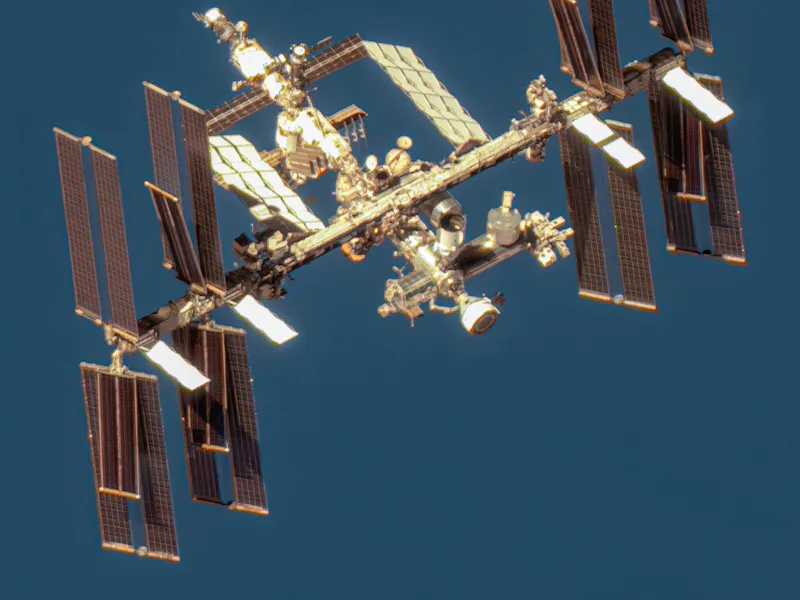
BOEING SSTARLINER SPACECRAFT, INTERNATIONAL SPAPCE STATION -- JUNE 6, 2024:  Amazing Maxar satellite...
Maxar/Getty Images

The Starliner crew is on the International Space Station for the long haul, according to NASA in a press conference today.

Boeing’s Starliner spacecraft is already on day 35 of what was originally supposed to be a nine-day mission, and it won’t leave the International Space Station (ISS) before the end of July, NASA commercial crew program manager Steve Stich and Boeing VP for commercial crew Mark Nappi told the press during a call earlier today. Engineers and technicians on the ground are finishing tests — and analyzing a mountain of data — on the spacecraft’s thrusters and a helium leak, and it could be at least another two or three weeks before they’re ready to bring Starliner home for anything short of an (unlikely) emergency evacuation from ISS.

Inverse has all the details about why it’s taking so long to bring Starliner home, how the not-stranded-but-definitely-delayed crew is spending their time in orbit, and why the spacecraft has to leave ISS by mid-August.
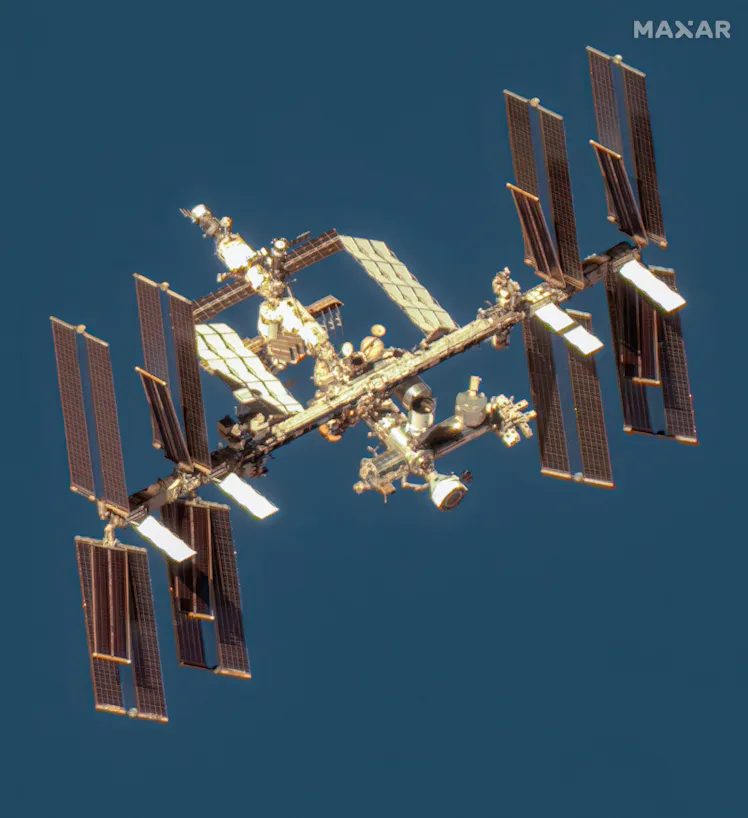
BOEING SSTARLINER SPACECRAFT, INTERNATIONAL SPAPCE STATION -- JUNE 6, 2024:  Amazing Maxar satellite...

A satellite in orbit took this photo of the Starliner capsule docked to the forward port of the International Space Station. We live in the future. 

MAXAR/MAXAR/GETTY IMAGES

AN ABUNDANCE OF CAUTION

Boeing and NASA don’t believe that any of Starliner’s thrusters are damaged, say Stich and Nappi speaking at a press conference on Wednesday. If Starliner had to leave the International Space Station immediately (maybe because of a collision with a piece of satellite debris, like the near-miss that caused the crew to take shelter aboard Starliner earlier this week), the ship could get its crew home safely, according to Nappi.

“If we were to have to do that today, we would just perform a nominal undocking and return,” Nappi told reporters during a press conference on Wednesday.

The extensive tests keeping the spacecraft docked at ISS, they said at the press conference, are a chance for engineers to figure out exactly why five of Starliner’s 28 maneuvering thrusters (technically called the Reaction Control System, or RCS) failed while the spacecraft was docking with the International Space Station on June 6. Starliner’s service module — which houses the thrusters — is designed to burn up during re-entry to Earth’s atmosphere, so once the ship heads home, engineers will lose their chance to poke at the problem.

Boeing and NASA also want to be extremely sure there’s actually nothing wrong. “We don’t believe that we have damaged thrusters, but we want to fill in the blanks and run these tests to assure ourselves of this,” Nappi says.

Stich adds, “Really, what we're doing is just taking the time to make sure that we have looked under every rock and every stone, just to make sure that there's nothing that would surprise us.”

STARLINER RECAP: FAILED THRUSTERS AND HELIUM LEAKS

During its rendezvous with ISS on June 6, five of Starliner's 28 maneuvering thrusters failed. The crew and mission control managed to get four of them back online, but one (thruster B1A3) refused to cooperate, first sputtering out just 11 percent of its normal thrust, and then nothing at all. B1A3 will remain shut off for the rest of the mission.

The thruster issues appeared after Starliner had to fire its thruster more — and more often, in several short pulses — than engineers had expected.

And then there are the helium leaks. Starliner uses helium to pressurize its thrusters, and some of that helium is leaking out around the O-rings used to seal the area where the helium — and two lines that carry rocket propellant — pass through a flange and into the thruster.

"Helium was getting out from that flange area and somehow getting around that O-ring," says Nappi "The design should have been sufficient, but there's obviously something going on in that cavity that we don't understand."

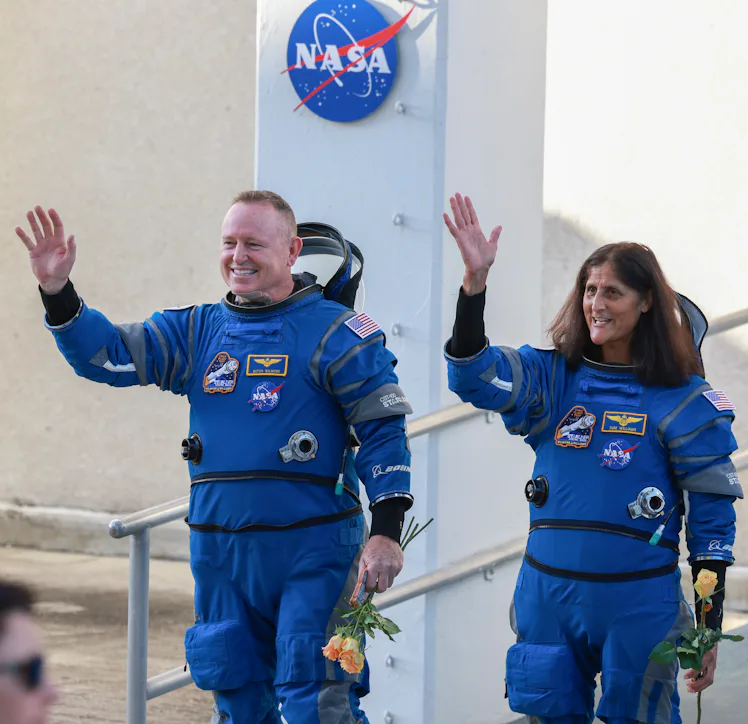
CAPE CANAVERAL, FLORIDA - JUNE 05:  NASA’s Boeing Crew Flight Test Commander Butch Wilmore (L) and P...

Butch Wilmore and Suni Williams are the first crew to fly aboard Starliner. 

JOE RAEDLE/GETTY IMAGES NEWS/GETTY IMAGES

SO MUCH TESTING, SO LITTLE TIME

Last week, Starliner test-fired its thrusters while docked to the ISS, using the station’s flight control system to measure how much thrust the thrusters were actually thrusting (Inverse would certainly not like to apologize for that sentence, thank you).

Meanwhile, at White Sands Missile Range in New Mexico, engineers have test fired several thrusters, trying to re-create the extreme temperatures and workload Starliner’s thrusters faced during flight. Those tests are now complete, but engineers still need to physically check the tested thrusters for damage and analyze a tremendous collection of data about their performance. Next, engineers will be repeating the process — but this time they’ll be simulating the “downhill” phase of the mission, or the return to Earth.

“We really wanted to get that testing completed and actually physically inspect the thruster before we committed to the nominal undocking,” says Stich. “I think there's ways from what we've learned from this flight to change the number of pulses required for the rendezvous and docking phase to not put such demand on the thrusters.”

Engineers are also working on the helium leak, which means smearing grease on spare flanges, tossing debris into them, and blasting them with heat to test possible causes for the leak. They also need to make sure that the thrusters are still getting enough helium to keep them pressurized — at least enough to work reliably and safely.

“We would like to duplicate that flange design on the ground under a controlled test and see if we can't make it leak, and experiment with some larger seals or maybe a different seal material that might not be as susceptible to degradation from the propellant,” said Nappi.

“THE NATURE OF WHAT WE DO”

To bystanders, it seems like an alarming situation: a new spacecraft launches with its first crew, only for its thrusters to fail and start leaking helium pressurizer. But for test pilots like Starliner test commander Butch Wilmore, it’s another day at the office.

“Human spaceflight is not easy. There have been multiple issues with every spacecraft that has ever been designed, and that's the nature of what we do,” said Wilmore.

Nappi and Stich repeated a similar message to reporters.

“We knew that there would be some learning from this flight test. We've learned a great deal from how the hardware works, how our processes work, and how we can improve the things that we're doing,” said Nappi. “As engineers, we test, we learn, we fix, and that’s exactly what we’re going through.”

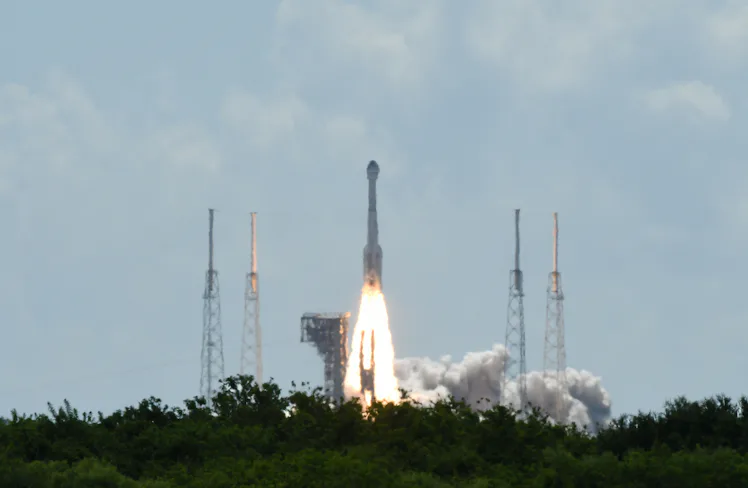
CAPE CANAVERAL, FLORIDA, UNITED STATES - JUNE 5: After a series of delays, a United Launch Alliance ...

Starliner launched on a United Launch Alliance Atlas V rocket on June 5, following several delays.

ANADOLU/ANADOLU/GETTY IMAGES

MAKE ROOM, MAKE ROOM!

The testing and analysis are likely to take another couple of weeks, at least, which means Wilmore and Starliner test pilot Suni Williams probably won’t be bidding farewell to the ISS until at least the end of July – and Stich described that possible timeframe as optimistic. But Starliner needs to be on its way by mid-August, when a SpaceX Crew Dragon is set to bring a new quartet of spacefarers (astronauts Zena Cardman, Nick Hague, and Stephanie Wilson, as well as Russian cosmonaut Aleksandr Gorbunov) to the ISS.

The SpaceX Crew Dragon spacecraft that carried Crew-8 (astronauts Matthew Dominick, Michael Barratt, and Jeanette Epps, as well as Russian cosmonaut Alexander Grebenkin) to the ISS is still docked at the station, waiting for Crew-8 to hop aboard and fly it home. Before they leave, though, they need to meet and brief their replacements, a process NASA calls a handover. Crew-9 will dock their Crew Dragon with ISS and come aboard before Crew-8 leaves. At the moment, that’s a problem, because Starliner is sitting in Crew-9’s parking spot.

That gives NASA and Boeing a deadline for finishing their tests and either deeming Starliner fit to fly home or making other arrangements.

“The beautiful thing about the commercial crew program is that we have two vehicles, two different systems, that we could use to return the crew,” said Stich, referring to Starliner and Crew Dragon. “We have a little more time to go through the data and decide whether we need to do anything different but the prime option today is to return Butch and Suni on Starliner.”

“LIKE COMING BACK HOME”

For now, Wilmore and Williams are safe and sound on the ISS, where they’ve been pitching in with maintenance and science experiments.

“Butch and I have been up here before, and it feels like coming back home,” says Williams. “We've been integrated right into Expedition 71. We've been doing science with them, maintenance, and some major maintenance that has been waiting for a little while.”

Wilmore recently tested NASA’s Moon Microscope, a handheld 3D-printed microscope that’s part of a medical kit that could help future lunar explorers diagnose illnesses and make sure their food, water, and quarters aren’t contaminated. And Williams sequenced DNA while zipping around Earth at 17,500 miles per hour. The pair also helped swap out a urine processor pump. (Never a dull moment aboard ISS, and no lack of variety, either.)

Stich says the whole ISS crew is comfortable and has plenty of supplies — including things like food and clothing — to last the duration. A Northrop-Grumman Cygnus cargo spacecraft is scheduled to launch in early August, bringing new supplies and probably some extra items from home for the Starliner crew, if they’re still aboard. Meanwhile, this isn’t even close to the most crowded the ISS has ever been.

In fact, situations like this one may become more common over the next few years. Stich, paraphrasing retired astronaut Ken Bowersox, said earlier today that now that ISS can provide electricity to docked spacecraft, it can serve as a sort of temporary hangar for engineers to troubleshoot spacecraft in orbit.

Meanwhile, Williams and Wilmore sound calm and confident – which is also part of their job.

“I have a really good feeling in my heart that the spacecraft will bring us home,” says Williams.

{ https://www.inverse.com/ }

Hoe vind je dit bericht?
Geschreven door peter om 23:43 Stuur door

James Webb ontdekt unieke ijswereld: “Beste kans op water tot nu toe”

55154d32-4203-ae49-720f-dac9ccfd06e7.jpg

James Webb ontdekt unieke ijswereld: “Beste kans op water tot nu toe”

Astronomen hebben niet al te ver weg een veelbelovende superaarde ontdekt, waar het in ieder geval best lekker weer is. De exoplaneet is een ijs- of waterwereld, dat weten ze nog niet.

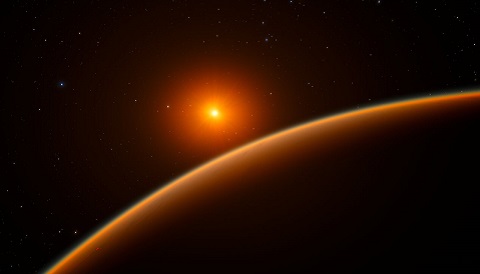
Artist's concept of super-Earth LHS 1140b orbiting red dwarf star

An artist’s impression of exoplanet LHS 1140 orbiting a red dwarf star 41 light-years distant.
ESO/SpaceEngine.org

LHS 1140 b, die op zo’n 48 lichtjaar van de aarde staat, is een van de meest veelbelovende exoplaneten met een leefbare zone. Hij heeft zelfs mogelijk een atmosfeer en een oceaan met vloeibaar water, blijkt uit de data van de James Webb-telescoop.

Mogelijk water
“Dit is de eerste keer dat we een hint van een atmosfeer hebben gezien op een rotsachtige of ijzige exoplaneet met een bewoonbare zone. Het vinden van een  atmosfeer op kleine, rotsachtige werelden is een belangrijk doel voor James Webb, maar dat is veel moeilijker dan op grote planeten”, vertelt Ryan MacDonald van NASA. “LHS 1140 b is een van de beste kleine exoplaneten met een bewoonbare zone waar een dikke atmosfeer kan zijn, en we hebben daar mogelijk net bewijs van gevonden.”

LHS 1140 b, een exoplaneet die om een rode dwergster draait die ongeveer een vijfde zo groot is als onze zon, is zo interessant, omdat het een van de dichtstbijzijnde exoplaneten is die binnen de bewoonbare zone van zijn ster ligt. Dat wil zeggen dat de temperatuur dusdanig gematigd is dat er vloeibaar water kan bestaan, een cruciaal element voor leven.

Superaarde of mini-Neptunus?
De vraag was in eerste instantie of LHS 1140 b een mini-Neptunus zou zijn of een superaarde, dus een kleine ijsreus met een waterstofrijke atmosfeer of een rotsachtige, waterrijke planeet, die groter is dan de aarde. Maar uit het onderzoek blijkt dat de pas ontdekte exoplaneet eigenlijk geen ijsreus kan zijn. Het lijkt er veel meer op dat LHS 1140 b inderdaad een superaarde is met mogelijk zelfs een stikstofrijke atmosfeer, zoals onze planeet ook heeft.

Maar er is meer: volgens de eerste metingen is de dichtheid van de planeet kleiner dan verwacht, wat erop kan wijzen dat 10 tot 20 procent van zijn massa uit water bestaat. Het maakt LHS 1140 b een overtuigende kandidaat als waterwereld. Mogelijk lijkt de planeet op een sneeuwbal of ijsplaneet met een vloeibare oceaan op het stuk dat altijd naar zijn ster wijst.

Beste gok op water
“Van alle momenteel bekende gematigde exoplaneten zou LHS 1140 b wel eens onze beste gok kunnen zijn om op een dag vloeibaar water op het oppervlak van een wereld buiten ons zonnestelsel te vinden”, aldus hoofdonderzoeker Charles Cadieux van de Université de Montréal. “Dit zou een belangrijke mijlpaal zijn in de zoektocht naar potentieel bewoonbare exoplaneten.”

De aanwezigheid van stikstof toont aan dat de planeet wellicht een substantiële atmosfeer heeft behouden, waardoor omstandigheden ontstaan die vloeibaar water mogelijk maken. De huidige modellen laten zien dat als LHS 1140 b een aarde-achtige atmosfeer heeft, het een sneeuwbalplaneet zou zijn met een oceaan met een diameter van zo’n 4000 kilometer, ongeveer half zo groot als de Atlantische Oceaan. De oppervlaktetemperatuur in het midden van deze buitenaardse oceaan zou zelfs een comfortabele 20 graden Celsius kunnen zijn.

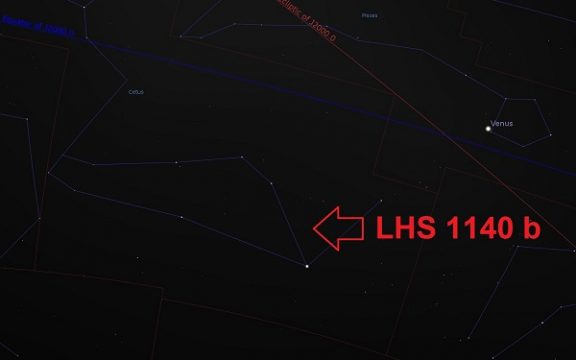
Location of LHS 1140 system

The location of LHS 1140 in the sky.
Stellarium

Uitzonderlijke planeet
De potentiële atmosfeer en gunstige omstandigheden voor vloeibaar water maken de planeet een uitzonderlijk goede kandidaat voor mogelijk leven. “Dit is onze eerste glimp van een atmosfeer op een superaarde in de bewoonbare zone. Vergeleken met andere bekende exoplaneten, zoals die in het TRAPPIST-1-systeem, lijkt de ster LHS 1140 rustiger en minder actief, waardoor het minder ingewikkeld is om de atmosfeer te onderscheiden van signalen die worden veroorzaakt door sterrenvlekken”, vertelt MacDonald.

Volgens de wetenschapper is LHS 1140 b misschien wel de beste planeet met een bewoonbare zone die tot nu toe bekend is. “Hoewel we meer James Webb-waarnemingen nodig hebben om de stikstofrijke atmosfeer te bevestigen en om naar andere gassen te zoeken, is dit een heel veelbelovende start.”

Bronmateriaal

{ https://scientias.nl/ }

Hoe vind je dit bericht?
Geschreven door peter om 23:20 Stuur door

SpaceX Falcon 9 rocket suffers failure during Starlink satellite launch (video)

SpaceX Falcon 9 rocket suffers failure during Starlink satellite launch (video)

SpaceX's workhorse Falcon 9 rocket suffered a rare anomaly on Thursday night (July 11).

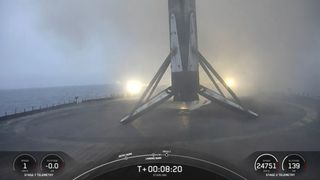
The incident occurred during a launch of SpaceX's Starlink internet satellites from Vandenberg Space Force Base in California. The Falcon 9 performed well initially; its two stages separated on time, and the first stage came down for a landing on a drone ship about eight minutes after liftoff as planned.

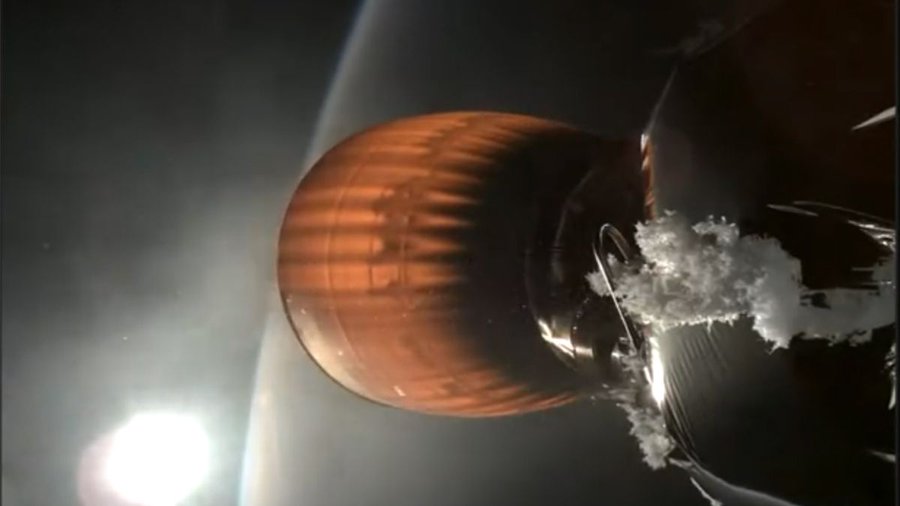
But the rocket's upper stage, which was hauling 20 Starlink spacecraft to low Earth orbit, encountered a problem — a leak of liquid oxygen, which had serious repercussions for the mission.

Image

Screenshot from the webcast of a SpaceX Starlink satellite launch on July 11, 2024, showing a buildup of liquid-oxygen ice on the upper stage of a Falcon 9 rocket.  (Image credit: SpaceX)

"After a planned relight of the upper-stage engine to raise perigee — or the lowest point of orbit — the Merlin Vacuum engine experienced an anomaly and was unable to complete its second burn," SpaceX wrote in an update today (July 12). (The Falcon 9's upper stage is powered by that single engine; the first stage sports nine Merlins, which explains the rocket's name.) 

"Although the stage survived and still deployed the satellites, it did not successfully circularize its orbit, but it did passivate itself as normally performed at the end of each mission," the company added. "This left the satellites in an eccentric orbit with a very low perigee of 135 km [84 miles], which is less than half the expected perigee altitude."

SpaceX engineers worked to get the 20 Starlink satellites — 13 of which were capable of beaming service directly to cell phones — to raise their orbits using their onboard ion thrusters. But the hill was too steep to climb, according to the company.

"At this level of drag, our maximum available thrust is unlikely to be enough to successfully raise the satellites," SpaceX wrote in the update. "As such, the satellites will reenter Earth’s atmosphere and fully demise. They do not pose a threat to other satellites in orbit or to public safety."

A SpaceX Falcon 9 rocket rests on the deck of a ship at sea shortly after launching 20 Starlink satellites to orbit from California on July 11, 2024.  (Image credit: SpaceX)

The Falcon 9 is the most prolific rocket flying today, with 69 launches under its belt already in 2024. It's known for its reliability; before Thursday night, the Falcon 9 had suffered only one full in-flight failure in its storied history, which occurred during the launch of a robotic Dragon cargo capsule toward the International Space Station (ISS) in June 2015.

The Falcon 9 is also human-rated; it has launched 13 crewed missions to date, nine of which have sent astronauts to the ISS for NASA. It's unclear how Thursday's failure will affect the rocket and its manifest at this point; SpaceX will first need to figure out exactly what happened and how to address the issue — an effort that's already underway.

"SpaceX will perform a full investigation in coordination with the FAA [Federal Aviation Administration], determine root cause, and make corrective actions to ensure the success of future missions," SpaceX wrote in today's update. "With a robust satellite and rocket production capability, and a high launch cadence, we’re positioned to rapidly recover and continue our pace as the world’s most active launch services provider."

Most Falcon 9 missions these days service the giant and ever-growing Starlink megaconstellation, which currently consists of more than 6,100 operational satellites; 49 of the 69 Falcon 9 launches so far in 2024 have been dedicated Starlink missions.

Editor's note: This story was updated at 4:30 p.m. ET on July 12 with the news from SpaceX that all 20 Starlink satellites will be lost due to the Falcon 9 upper-stage failure.

20240405_Starlink_Direct-to-Cell_small.jpg

A stack of SpaceX Starlink satellites, which included the first six featuring Direct to Cell capabilities. The batch launched on the Starlink 7-9 mission, which lifted off from Vandenberg Space Force Base on Jan. 2, 2024.

Image: SpaceX

{ https://www.space.com/ }

Hoe vind je dit bericht?
Geschreven door peter om 23:00 Stuur door

Pentagon Publishes Report on Material From an Alleged Alien Aircraft

Pentagon Publishes Report on Material From an Alleged Alien Aircraft

Hoe vind je dit bericht?
Geschreven door peter om 22:37 Stuur door

Former Area-51 Pilot Claimed He Flew Re-Engineered UFO To 500 Feet But It Crashed & Broke His Legs

Area 51 pilot Flew Re-Engineered UFO

Former Area-51 Pilot Claimed He Flew Re-Engineered UFO To 500 Feet But It Crashed & Broke His Legs

Before 2013,  Area-51 had only been in the conspiracies. People ridiculed those who claimed to have worked in this highly classified US Air Force facility. Thanks to archivist Jeffrey Richelson who made it possible for the government to finally admitted that  Area-51 is a real place in the Mojave Desert about 100 miles north of Las Vegas. A few years back, ApexTV, famous for their mysterious content, did an interview with a fellow named Robert Miller who piloted an alien spacecraft at Area-51 telepathically, before crashing and breaking both his legs.

His story is worth reading as who knows what secrets may open up later in the future and become the reality in our life.  Area-51 is one of the world’s most secretive places controlled by the US Air Force, which is claimed to be the storehouse of alien spacecraft, where their technology is being developed. It has been actively working since 1955 (as officially stated), which was the study point of UFOs in the 50s. Since then, the place has become a pilgrimage for alien hunters and UFO researchers.

In December 2017, Robert Miller did an interview with ApexTV where he revealed secrets of the inner workings of  Groom Lake. According to Miller, aliens and extraterrestrial crafts are being kept inside  Area-51, and he alleged to have been part of a top-secret project in which he was chosen to pilot a reverse-engineered UFO.

The video shows a bald man in cargo shorts claiming he flew an alien spaceship telepathically, but the sound quality is terrible. Miller cliamed to have hidden the fact that he worked in  Area-51 from his closest relatives, but his mother had the slightest that idea about his job. His purpose for recording the video is to remove this secret from his conscience, and he knew the circumstances of the reveal that the government would come after him.

Robert Miller Area 51 worker

Robert Miller claimed he worked at Area 51 as a testing pilot for a re-engineered alien spacecraft. Image credit: YouTube screencap

Miller grew up in a small town in Southern Nevada, and his father was an aerospace engineer who taught him to fly aircraft which helped him become a licensed pilot at the age of 15. He later joined Marine Corps as a pilot, where he was considered one of the top pilots. By the time he became 18, he was planning to retire from the Marine Corps and find a normal job back home and thinking to start a family.

Everything changed when he received an offer letter about his new job as a test pilot in a secret program. “I thought, great. It also said, a plane would be picking me up at the Las Vegas airport Friday the second at three AM to take me there. So we flew out there in the middle of the night and two men in black suits escorted me into an underground building. It was built on the side of a hill and yes, the men in black are real. Believe me, they’re real,” Miller said.

He continued explaining the place which had long hallways and many doors on each side. Miller added: “We went down several flights of stairs, must have been far underground at that point. They showed me into a small room with a single bed and a desk.” He was then locked inside the room by those men.

Miller looked in one of his drawers and found a booklet, titled something like “Working at Grim Lake” that mentioned that there were 1,200 other employees. He claimed only insiders decide whom to recruit to work in  Area-51. “I assumed that my father invited me and this is where he had been working when I was a kid. He had long, long since retired by the time I got there, and I wasn’t sure what was in store for me now.”

Miller was appointed as a test pilot for the so-called alien technology that was allegedly recovered from the crafts that crashed in 1947. Like any other whistleblower, he also said that they had already reversed engineering the alien spacecraft technology. He was going to be the first person to pilot the craft.

“Also, they threatened me again, if I told anybody, even my family, there would be dire consequences for all. I asked them what were the origins of the craft they found and they really thought it just was from another country. They told me not of this world and the beings that engineered it were extra-dimensional. They said the beings were still alive and were being kept in an undisclosed location in a facility,” Miller revealed.

Miller described a large disc-shaped craft about “50 feet from end to end, edge to edge” standing in the middle of the warehouse. It had a transparent dome at the top. He assumed that it was his testing vehicle. The engineers who worked on the craft technology told him that it was powered by an anti-matter reactor. The reactor produced bursts of dense energy that could generate wormholes and make the craft travel near the speed of light.

Read also:

“They then said that my test flight was going to be delayed until the next day because they had to explain to me everything I needed to know in order to be able to pilot this thing. Now I’m just going off of what I can remember. There was a lot of specifics, gauges, and things but as I’ve gotten older, so I’m telling you as much as I can possibly remember. I do remember they brought me inside the craft.”

According to Miller, the alien spacecraft had a room for only one person. The cockpit had a seat, no joystick, no steering wheel, and no other controls, only a helmet. He told that the craft operates only telepathically.

bushman area 51 ufo

American scientist Boyd Bushman with a display of alleged UFO pictures from Area 51. Image Credit: YouTube screencap

“The helmet measured my brainwaves and

was to control the craft by simply thinking about it. After a hard night of trying to sleep, thinking about this, morning came. And it was finally time to take the craft for the first test flight. They brought out a tarp and ordered everyone working on the base to go inside. They wanted to keep everybody not knowing about this secret technology to a bare minimum.”

He put on the helmet and followed the guidance as the craft was only going to operate by analyzing his brain waves. He had to imagine the craft floating off the ground but instead, he imagined being a part of the craft. After that, he began thinking of himself floating off the ground. “I felt vibrations from the anti-matter reactor below me as it started to fire up.”

He was instructed to take the craft up to 1000 feet. He succeeded in taking it to 500 feet but shockingly, the engine stopped and Miller started losing altitude. He found no safety feature, and no seat ejection system was there in the craft. He kept imaging the craft floating but eventually, it hit the ground and Miller received serious injuries.

Miller said he fell unconscious and then woke up in the medical ward, where he was told by another man in a black suit that the craft mysteriously disappeared just before crashing and everyone at the base simply “called it a day” and went inside. Then in the middle of the night, they heard a loud crashing noise outside. Running out to see what happened, they saw the craft had crashed in the spot it was about to crash a while earlier during the day.

“I was inside the pilot’s seat unconscious, both my legs were shattered. The scientists had hypothesized that the craft had actually time traveled to a point in time, several hours later. They had me sign a non-disclosure, the third one, stating, since the first meeting, I would not tell anybody as long as I lived and making this video. Well, as you can see, I have gone against this NDA contract because I feel that the public needs to know about this.”

A similar claim of testing a re-engineered ET craft has another witness named Bill Uhouse who testified that it required a good amount of time for a person to train in order to operate the disc. Besides, its design was so exacting that nothing could be externally installed on it such as machine guns and bombs like in traditional aircraft.

{ https://www.howandwhys.com/ }

Hoe vind je dit bericht?
Geschreven door peter om 21:47 Stuur door

Former Area-51 Pilot Claimed He Flew Re-Engineered UFO To 500 Feet But It Crashed & Broke His Legs

Area 51 pilot Flew Re-Engineered UFO

Former Area-51 Pilot Claimed He Flew Re-Engineered UFO To 500 Feet But It Crashed & Broke His Legs

Before 2013,  Area-51 had only been in the conspiracies. People ridiculed those who claimed to have worked in this highly classified US Air Force facility. Thanks to archivist Jeffrey Richelson who made it possible for the government to finally admitted that  Area-51 is a real place in the Mojave Desert about 100 miles north of Las Vegas. A few years back, ApexTV, famous for their mysterious content, did an interview with a fellow named Robert Miller who piloted an alien spacecraft at Area-51 telepathically, before crashing and breaking both his legs.

His story is worth reading as who knows what secrets may open up later in the future and become the reality in our life.  Area-51 is one of the world’s most secretive places controlled by the US Air Force, which is claimed to be the storehouse of alien spacecraft, where their technology is being developed. It has been actively working since 1955 (as officially stated), which was the study point of UFOs in the 50s. Since then, the place has become a pilgrimage for alien hunters and UFO researchers.

In December 2017, Robert Miller did an interview with ApexTV where he revealed secrets of the inner workings of  Groom Lake. According to Miller, aliens and extraterrestrial crafts are being kept inside  Area-51, and he alleged to have been part of a top-secret project in which he was chosen to pilot a reverse-engineered UFO.

The video shows a bald man in cargo shorts claiming he flew an alien spaceship telepathically, but the sound quality is terrible. Miller cliamed to have hidden the fact that he worked in  Area-51 from his closest relatives, but his mother had the slightest that idea about his job. His purpose for recording the video is to remove this secret from his conscience, and he knew the circumstances of the reveal that the government would come after him.

Robert Miller Area 51 worker

Robert Miller claimed he worked at Area 51 as a testing pilot for a re-engineered alien spacecraft. Image credit: YouTube screencap

Miller grew up in a small town in Southern Nevada, and his father was an aerospace engineer who taught him to fly aircraft which helped him become a licensed pilot at the age of 15. He later joined Marine Corps as a pilot, where he was considered one of the top pilots. By the time he became 18, he was planning to retire from the Marine Corps and find a normal job back home and thinking to start a family.

Everything changed when he received an offer letter about his new job as a test pilot in a secret program. “I thought, great. It also said, a plane would be picking me up at the Las Vegas airport Friday the second at three AM to take me there. So we flew out there in the middle of the night and two men in black suits escorted me into an underground building. It was built on the side of a hill and yes, the men in black are real. Believe me, they’re real,” Miller said.

He continued explaining the place which had long hallways and many doors on each side. Miller added: “We went down several flights of stairs, must have been far underground at that point. They showed me into a small room with a single bed and a desk.” He was then locked inside the room by those men.

Miller looked in one of his drawers and found a booklet, titled something like “Working at Grim Lake” that mentioned that there were 1,200 other employees. He claimed only insiders decide whom to recruit to work in  Area-51. “I assumed that my father invited me and this is where he had been working when I was a kid. He had long, long since retired by the time I got there, and I wasn’t sure what was in store for me now.”

Miller was appointed as a test pilot for the so-called alien technology that was allegedly recovered from the crafts that crashed in 1947. Like any other whistleblower, he also said that they had already reversed engineering the alien spacecraft technology. He was going to be the first person to pilot the craft.

“Also, they threatened me again, if I told anybody, even my family, there would be dire consequences for all. I asked them what were the origins of the craft they found and they really thought it just was from another country. They told me not of this world and the beings that engineered it were extra-dimensional. They said the beings were still alive and were being kept in an undisclosed location in a facility,” Miller revealed.

Miller described a large disc-shaped craft about “50 feet from end to end, edge to edge” standing in the middle of the warehouse. It had a transparent dome at the top. He assumed that it was his testing vehicle. The engineers who worked on the craft technology told him that it was powered by an anti-matter reactor. The reactor produced bursts of dense energy that could generate wormholes and make the craft travel near the speed of light.

Read also:

“They then said that my test flight was going to be delayed until the next day because they had to explain to me everything I needed to know in order to be able to pilot this thing. Now I’m just going off of what I can remember. There was a lot of specifics, gauges, and things but as I’ve gotten older, so I’m telling you as much as I can possibly remember. I do remember they brought me inside the craft.”

According to Miller, the alien spacecraft had a room for only one person. The cockpit had a seat, no joystick, no steering wheel, and no other controls, only a helmet. He told that the craft operates only telepathically.

bushman area 51 ufo

American scientist Boyd Bushman with a display of alleged UFO pictures from Area 51. Image Credit: YouTube screencap

“The helmet measured my brainwaves and

was to control the craft by simply thinking about it. After a hard night of trying to sleep, thinking about this, morning came. And it was finally time to take the craft for the first test flight. They brought out a tarp and ordered everyone working on the base to go inside. They wanted to keep everybody not knowing about this secret technology to a bare minimum.”

He put on the helmet and followed the guidance as the craft was only going to operate by analyzing his brain waves. He had to imagine the craft floating off the ground but instead, he imagined being a part of the craft. After that, he began thinking of himself floating off the ground. “I felt vibrations from the anti-matter reactor below me as it started to fire up.”

He was instructed to take the craft up to 1000 feet. He succeeded in taking it to 500 feet but shockingly, the engine stopped and Miller started losing altitude. He found no safety feature, and no seat ejection system was there in the craft. He kept imaging the craft floating but eventually, it hit the ground and Miller received serious injuries.

Miller said he fell unconscious and then woke up in the medical ward, where he was told by another man in a black suit that the craft mysteriously disappeared just before crashing and everyone at the base simply “called it a day” and went inside. Then in the middle of the night, they heard a loud crashing noise outside. Running out to see what happened, they saw the craft had crashed in the spot it was about to crash a while earlier during the day.

“I was inside the pilot’s seat unconscious, both my legs were shattered. The scientists had hypothesized that the craft had actually time traveled to a point in time, several hours later. They had me sign a non-disclosure, the third one, stating, since the first meeting, I would not tell anybody as long as I lived and making this video. Well, as you can see, I have gone against this NDA contract because I feel that the public needs to know about this.”

A similar claim of testing a re-engineered ET craft has another witness named Bill Uhouse who testified that it required a good amount of time for a person to train in order to operate the disc. Besides, its design was so exacting that nothing could be externally installed on it such as machine guns and bombs like in traditional aircraft.

{ https://www.howandwhys.com/ }

Hoe vind je dit bericht?
Geschreven door peter om 21:47 Stuur door

What Are Wormholes, and Could They Be the Answer to Time Travel?

What Are Wormholes, and Could They Be the Answer to Time Travel?

Story by Paul M. Sutter
What Are Wormholes, and Could They Be the Answer to Time Travel?
© Provided by Discover Magazine

The sci-fi landscape is littered with wormholes. From Douglas Adam's Hitchhiker's Guide to the Galaxy and Rick and Morty to the Marvel Cinematic Universe, these theoretical constructs allow characters to zip between distant points in the universe as easy as stepping through a doorway.

An Einstein-Rosen bridge is the simplest kind of wormhole. And while it can, in theory, allow you to meet a new friend from a distant part of the universe, there are some important reasons why it won’t let you travel back in time.

Black Holes, White Holes and Wormholes

Let’s start with everybody’s favorite astronomical mystery: a black hole. Despite their fearsome reputation, they’re actually rather simple creature. They have a point of infinite density, known as the singularity, in their centers. They are surrounded by a boundary called the event horizon.

The event horizon doesn’t exist in the same way that the surface of a planet exists. Instead it’s just a mathematical line in the sand that tells you one thing: if you cross within that special distance, you’re trapped forever, because you’ll have to travel faster than the speed of light to escape.

Read More: 

And that’s it. That’s a black hole. A singularity and an event horizon. All things that cross the event horizon will never escape back into the universe – things go in and never come out.

Mathematically we can also define the polar opposite of a black hole, which is conveniently called a white hole. White holes also have a singularity, but their event horizons act differently. Anything already on the outside of a white hole (like, the entire universe) can never, ever cross within it, no matter how hard it tries. And anything already inside the white hole will find itself ejected from it faster than the speed of light.

Now when we take a black hole and a white hole and connect their singularities together, we get an entirely new kind of object: an Einstein-Rosen bridge, better known as a wormhole.

Read More:

What Is a Wormhole?

Wormholes are essentially hollow tubes through space and time that can connect very distant regions of the universe. A star may be thousands of light-years away, but a wormhole can connect that star to us with a tunnel only a few steps long.

Wormholes also have the somewhat mystical ability to allow backwards time travel. If you take one end of the wormhole and accelerate it to a speed close to that of light, it will experience time dilation — its internal “clock” will run slower than the rest of the universe.

That will cause the two ends of the wormhole to no longer be synchronized in time. Then you could walk in one end and end up in your own past. Voilà: time travel.

Read More: 

Can Humans Travel Through Wormholes?

There's just one, tiny, teensy problem with this setup: Einstein-Rosen bridges are indeed wormholes, but the entrance to the wormhole sits behind the black hole event horizon. And the number one rule of black hole event horizons is that once you cross them, you’re never allowed to escape. Ever.

Once you pass through a black hole event horizon, you are forced towards the singularity, where you are guaranteed to meet your gruesome end. In other words, once you enter an Einstein-Rosen bridge, you will never escape.

So, the unfortunate truth with Einstein-Rosen bridges is that while they appear to be magical doorways to distant reaches of the universe, they are just as deadly as black holes. When you enter you can meet other travelers who have fallen in from the other side, and you could even carry on a conversation…briefly, before you both struck the singularity.

There have been attempts to stabilize Einstein-Rosen bridges and make them traversable by somehow getting their entrances to sit outside the event horizon. So far the only way we know how to do this is with exotic matter. If you threaded the wormhole tunnel with matter that had negative mass, then in principle you could have a not-deadly-at-all wormhole.

Alas, negative matter does not appear to exist in the universe, and so our wormhole — and time travel — dreams will have to remain as mere mathematical fantasies.

Read More: 

{ https://www.msn.com/en-us/ }

Hoe vind je dit bericht?
Geschreven door peter om 21:29 Stuur door

Milky Way's rarest black hole may lurk behind 7 stars that 'shouldn't be there'

Milky Way's rarest black hole may lurk behind 7 stars that 'shouldn't be there'

Story by Harry Baker

Astronomers may have found a rare "missing link" black hole in the Milky Way after spotting a group of improbably fast-moving stars at the heart of a nearby stellar cluster. If confirmed, the cosmic juggernaut, known as an intermediate-mass black hole (IMBH), would be the second-largest black hole ever found in our galaxy. 

IMBHs are an extremely rare subset of black holes that are larger than stellar-mass black holes but smaller than supermassive black holes. This means they can be anywhere between 100 and 100,000 times the mass of the sun, according to NASA.

In theory, IMBHs should be just as common as other black hole types. However, astronomers have struggled to locate potential IMBHs or confirm their existence — and they aren't sure why. As a result, IMBHs are often referred to as missing link black holes. While several promising candidates have been detected, none have been proven to be the real deal.

Now, in a recent study uploaded April 4 to the preprint server arXiv, researchers may have uncovered evidence of a large IMBH in the globular cluster Omega Centauri — a compact group of around 10 million stars in the Milky Way located around 17,000 light-years from Earth.

The team compared 500 photographs of Omega Centauri taken by the Hubble Space Telescope and mapped the movements of around 1.4 million stars at the cluster's center. This revealed at least seven stars that "should not be there," researchers wrote in a statement.

Omega Centauri is the largest globular cluster in the Milky Way. (Image credit: ESA/Hubble & NASA, M. Häberle)

Omega Centauri is the largest globular cluster in the Milky Way.

(Image credit: ESA/Hubble & NASA, M. Häberle)© Provided by Live Science

This is because these stars were spotted whizzing around fast enough to escape the cluster's gravity and fly off into intergalactic space. But despite this, the stars continue to orbit at breakneck speed near the cluster's center.

"The most likely explanation [for this] is that a very massive object is gravitationally pulling on these stars and keeping them close to the [cluster's] centre," study lead author Maximilian Häberle, a doctoral candidate at the Max Planck Institute for Astronomy (MPIA) in Germany, said in the statement. "The only object that can be so massive is a black hole, with a mass at least 8,200 times that of our sun."

Related: 

The Milky Way's second-biggest black hole?

Researchers have narrowed down a likely location for the IMBH. (Image credit: ESA/Hubble & NASA, M. Häberle)

Researchers have narrowed down a likely location for the IMBH.
(Image credit: ESA/Hubble & NASA, M. Häberle)© Provided by Live Science

Omega Centauri is an unusual entity: It is around 10 times larger than most other globular clusters and is surprisingly flat. It is so massive that you can even see it with the naked eye on dark, clear nights, when it takes up almost as much of the night sky as the moon when viewed from Earth.

Researchers suspect that the cluster likely used to be a dwarf galaxy that orbited the Milky Way, before being pulled into the galaxy's middle. As a result, scientists have often wondered if there could have been a sizable black hole at its heart.

Researchers first proposed the idea of an IMBH in Omega Centauri in 2008, when Hubble revealed how tightly the cluster's stars are bunched at its center. However, at the time, other researchers argued that this could be caused by a swarm of several smaller, stellar-mass black holes.

But the superfast stars highlighted in the new study indicate the existence of an IMBH, the study authors argue.

"This discovery is the most direct evidence so far of an IMBH in Omega Centauri," study co-author Nadine Neumayer, an astronomer at MPIA, said in the statement. If confirmed, it would be the Milky Way's second-largest known black hole behind Sagittarius A* — the supermassive black hole at the heart of our galaxy, she added. "This is exciting because there are only very few other black holes known with a similar mass."

However, the presence of an IMBH in Omega Centauri is not confirmed, and more data is needed to know for certain if it is really there. It is also unclear exactly how large the cosmic entity might be and where it is.

The researchers have been granted time in the future to use the powerful James Webb Space Telescope to peer deeper into the cluster, which means we may not have to wait too long for more evidence of the black hole's existence.

{ https://www.msn.com/en-us/ }

Hoe vind je dit bericht?
Geschreven door peter om 18:39 Stuur door

De geur van een planeet niet ver van de aarde ontdekt, waar gesmolten glas naar beneden regent: het ruikt naar “rotte eieren”

De geur van een planeet niet ver van de aarde ontdekt, waar gesmolten glas naar beneden regent: het ruikt naar “rotte eieren”

Door Janine
Artistieke afbeelding van exoplaneet HD 189733 b

ESA/Hubble/Wikimedia commons - CC BY 4.0

We kunnen exoplaneten, die zich buiten ons zonnestelsel bevinden, niet bereiken, maar we kunnen hun geur wel waarnemen: een van hen ruikt naar rotte eieren, zo heeft een nieuw onderzoek ontdekt.

HD 189733 b, de “warme Jupiter" op 64 lichtjaar afstand van ons

Mensen associëren de geur van zwavel met die van rotte eieren, en zouden hun neus moeten dichtknijpen voor de exoplaneet die volgens wetenschappers een atmosfeer heeft die aan deze “geur” doet denken. De buitenaardse wereld in kwestie is een hete exoplaneet van Jupiter genaamd HD 189733 b en is 64 lichtjaar van de aarde verwijderd: een relatief korte afstand, gezien de locatie buiten ons zonnestelsel.

Dankzij de James Webb-telescoop was het mogelijk om te ontdekken dat het omgeven is door een atmosfeer gevuld met waterstofsulfide, waardoor je je gemakkelijk de geur kunt voorstellen die je zou kunnen inademen. HD 189733 b staat dertien keer dichter bij zijn moederster dan Mercurius bij de zon, waardoor het een “helse” planeet is, zoals beschreven. Een bijzonder hete en gasvormige Jupiter in het sterrenbeeld Vosje, die in slechts twee aardse dagen een baan rond zijn ster voltooit. Dit betekent dat de temperatuur bijna 925°C bedraagt: uiteraard onleefbaar voor mensen, afgezien van de geur die het afgeeft. Maar dit is niet de enige bizarre eigenaardigheid van de exoplaneet in kwestie.

De exoplaneet die naar rotte eieren ruikt en waarop het gesmolten glas regent

Artistieke impressie door HD 189733 b

Roberto Molar Candanosa/Johns Hopkins Univeristy

Voordat ze in het nieuwe onderzoek de geur van HD 189733 b ontdekten, hadden wetenschappers al onthuld dat er een grote kans bestaat dat er op de exoplaneet buien van gesmolten glas ontstaan, die het gevolg zouden kunnen zijn van winden die het materiaal met een snelheid die kan oplopen tot 800 km per uur zijwaarts duwen, drie keer zo snel als een orkaan van categorie 5 op aarde. Het zijn precies de “eigenaardigheden” van deze buitenaardse wereld die onderzoekers ertoe hebben aangezet er nieuwe aandacht aan te besteden met behulp van de James Webb.

De nieuwe waarnemingen maakten het mogelijk om koolstofdioxide, zware metalen in de atmosfeer, de hoeveelheid water en zuurstof te meten. Zo ontdekten ze de aanwezigheid van waterstofsulfide, dat op onze planeet wordt uitgestoten door vulkanen en ontbindend organisch materiaal. Het is een licht ontvlambaar, schadelijk en kleurloos gas. Voor wetenschappers was het geen echte verrassing: men vermoedde al dat HD 189733 b, als zijnde gasreus, dit molecuul zou kunnen bevatten, dat ook op Uranus en Jupiter aanwezig is. Tot nu toe is dit gas echter zelden buiten het zonnestelsel gedetecteerd, behalve in de ruimte tussen de sterren.

Op zoek naar andere werelden met waterstofsulfide

Guangwei Fu, een astrofysicus aan de Johns Hopkins University, Maryland, noemde de ontdekking van waterstofsulfide op de exoplaneet een belangrijke "opstap naar het vinden van dit molecuul op andere planeten en om beter te begrijpen hoe verschillende soorten werelden ontstaan." Zwavel, zo legde Fu uit, is een essentieel element voor het bouwen van complexe moleculen en is van fundamenteel belang voor de overgrote meerderheid van de levensvormen op aarde.

De aanwezigheid van buitenaards leven op HD 189733 b kan echter vrijwel zeker worden uitgesloten, vanwege de extreem hoge temperaturen, maar ook vanwege de meteorologische omstandigheden. Het feit dat er waterstofsulfide aanwezig is op de exoplaneet doet ons echter denken dat andere werelden buiten ons zonnestelsel dit zouden kunnen bevatten, samen met mogelijke buitenaardse levensvormen. De volgende stap van de onderzoekers zal zijn om andere hete planeten vergelijkbaar met Jupiter te observeren met behulp van de James Webb om de aanwezigheid van hetzelfde gas te evalueren.

{ https://www.curioctopus.nl/ }

Hoe vind je dit bericht?
Geschreven door peter om 17:56 Stuur door

Yalçin Yalman Speaks: Unveiling the Turkey UFO Phenomenon

Yalçin Yalman Speaks: Unveiling the Turkey UFO Phenomenon

Inside the Turkey UFO Phenomenon

The enigmatic Kumburgaz UFO sightings, recorded between 2007 and 2009, have captivated the imaginations of UFO enthusiasts worldwide. At the heart of this phenomenon is Yalçin Yalman, the man behind the camera. In a recent groundbreaking interview, Yalman has broken his silence, providing new insights into his extraordinary experiences, the beings he encountered, and his predictions for future sightings. This article delves into Yalman’s journey and the broader implications of the Turkey UFO phenomenon.

A Journey Begun in Childhood

Yalçin Yalman’s fascination with UFOs began at the tender age of 12. His early years were marked by vivid dreams and astral journeys, during which he claimed to encounter beings from the Zeta Reticuli star system. These experiences left a profound impact on him, laying the foundation for a lifelong quest to understand and document extraterrestrial phenomena.

At the age of 20, while serving in the military, Yalman had a pivotal encounter. He reported seeing a hexagonal craft in the sky that communicated with him telepathically, urging him to follow it. This incident, coupled with his earlier experiences, cemented his belief in the existence of extraterrestrial life and set him on a path of relentless pursuit.

The Kumburgaz UFO Footage

Between 2007 and 2009, Yalman captured several significant UFO sightings in Kumburgaz, Turkey. Using a Canon XL1 mini DV camera and later a Sony handicam with a telescoping lens, he recorded footage of hexagonal and triangular crafts, some of which appeared to have humanoid figures inside. This footage gained substantial attention and was validated by Turkish authorities and scientists, including TÜBİTAK, Turkey’s scientific and technological research council.

Despite the recognition, Yalman’s journey was fraught with challenges. He faced severe financial difficulties and homelessness, which hindered his ability to continue his work. However, he felt an irresistible compulsion to document these sightings, often feeling as though he was under some form of hypnosis or guided influence.

Astral Contact and Beings from Zeta Reticuli

Yalman claimed to have had ongoing astral contact with beings from Zeta Reticuli. According to him, these beings chose him for a mission to share their existence and information with humanity. He believed these beings protected him from malevolent entities, specifically reptilians from the Orion constellation.

One of Yalman’s most startling revelations was a vision suggesting that an ancient spacecraft was buried under Mount Nemrut in Turkey. This vision, he claimed, could have profound implications for our understanding of extraterrestrial life and ancient human history.

Predictions for Future Sightings

In his interview, Yalman made bold predictions about future UFO sightings. He stated that two large spacecraft would be visible in regions such as Peru, Chile, Brazil, or northern New Mexico by specific dates: July 28 and between August 15-20. He believed these sightings would occur in cloudy weather and hoped that their occurrence would validate his experiences and insights.

Challenges and Validation

Yalman’s claims have been met with skepticism from some quarters. Detractors question the authenticity of his footage, suggesting it could be hoaxed. However, Yalman and his supporters emphasize the multiple witnesses and expert validations that corroborate his accounts.

Throughout his life, Yalman faced numerous personal hardships, including health issues like epilepsy and legal troubles that led to imprisonment. These challenges, however, did not deter him from his mission. He continued to document his experiences and share them with the world, driven by a deep-seated belief in the significance of his work.

VIDEO:

  • Chris Lehto – Yalçin Yalman Breaks Silence: Inside the Turkey UFO Phenomenon

Yalçin Yalman’s message to those interested in UFO phenomena is clear: faith and a pure heart are essential for making contact or capturing footage of extraterrestrial entities. He expressed a strong desire to share his knowledge and experiences with humanity before he dies, highlighting the potential role of extraterrestrial beings in shaping human history and future.

In conclusion, Yalçin Yalman’s revelations provide a fascinating glimpse into the Turkey UFO phenomenon. His experiences, while controversial, offer valuable insights into the potential existence of extraterrestrial life and its interaction with humanity. As the dates of his predicted sightings approach, the world will be watching closely to see if his extraordinary claims hold true.

{ https://www.latest-ufo-sightings.net/ }

Hoe vind je dit bericht?
Geschreven door peter om 16:53 Stuur door

Meer van UFO'S of UAP'S, ASTRONOMIE, RUIMTEVAART, ARCHEOLOGIE, OUDHEIDKUNDE, SF-SNUFJES EN ANDERE ESOTERISCHE WETENSCHAPPEN - DE ALLERLAATSTE NIEUWTJES

↑ Terug naar de berichten