Naar de inhoud

UFO'S of UAP'S, ASTRONOMIE, RUIMTEVAART, ARCHEOLOGIE, OUDHEIDKUNDE, SF-SNUFJES EN ANDERE ESOTERISCHE WETENSCHAPPEN - DE ALLERLAATSTE NIEUWTJES

UFO's of UAP'S in België en de rest van de wereld
akke.beakke.be
Ontdek de Fascinerende Wereld van UFO's en UAP's: Jouw Bron voor Onthullende Informatie! Ben jij ook gefascineerd door het onbekende? Wil je meer weten over UFO's en UAP's, niet alleen in België, maar over de hele wereld? Dan ben je op de juiste plek! België: Het Kloppend Hart van UFO-onderzoek In België is BUFON (Belgisch UFO-Netwerk) dé autoriteit op het gebied van UFO-onderzoek. Voor betrouwbare en objectieve informatie over deze intrigerende fenomenen, bezoek je zeker onze Facebook-pagina en deze blog. Maar dat is nog niet alles! Ontdek ook het Belgisch UFO-meldpunt en Caelestia, twee organisaties die diepgaand onderzoek verrichten, al zijn ze soms kritisch of sceptisch. Nederland: Een Schat aan Informatie Voor onze Nederlandse buren is er de schitterende website www.ufowijzer.nl, beheerd door Paul Harmans. Deze site biedt een schat aan informatie en artikelen die je niet wilt missen! Internationaal: MUFON - De Wereldwijde Autoriteit Neem ook een kijkje bij MUFON (Mutual UFO Network Inc.), een gerenommeerde Amerikaanse UFO-vereniging met afdelingen in de VS en wereldwijd. MUFON is toegewijd aan de wetenschappelijke en analytische studie van het UFO-fenomeen, en hun maandelijkse tijdschrift, The MUFON UFO-Journal, is een must-read voor elke UFO-enthousiasteling. Bezoek hun website op www.mufon.com voor meer informatie. Samenwerking en Toekomstvisie Sinds 1 februari 2020 is Pieter niet alleen ex-president van BUFON, maar ook de voormalige nationale directeur van MUFON in Vlaanderen en Nederland. Dit creëert een sterke samenwerking met de Franse MUFON Reseau MUFON/EUROP, wat ons in staat stelt om nog meer waardevolle inzichten te delen. Let op: Nepprofielen en Nieuwe Groeperingen Pas op voor een nieuwe groepering die zich ook BUFON noemt, maar geen enkele connectie heeft met onze gevestigde organisatie. Hoewel zij de naam geregistreerd hebben, kunnen ze het rijke verleden en de expertise van onze groep niet evenaren. We wensen hen veel succes, maar we blijven de autoriteit in UFO-onderzoek! Blijf Op De Hoogte! Wil jij de laatste nieuwtjes over UFO's, ruimtevaart, archeologie, en meer? Volg ons dan en duik samen met ons in de fascinerende wereld van het onbekende! Sluit je aan bij de gemeenschap van nieuwsgierige geesten die net als jij verlangen naar antwoorden en avonturen in de sterren! Heb je vragen of wil je meer weten? Aarzel dan niet om contact met ons op te nemen! Samen ontrafelen we het mysterie van de lucht en daarbuiten.

Archief

NASA HAS LITTLE TO SAY ABOUT UFOS AS ANNIVERSARY OF STUDY TEAM REPORT’S RELEASE NEARS

th?id=OVFT.IiRLcYsirWkJpGRpMMHw3i&pid=News&w=300&h=186&c=14&rs=2&qlt=90&dpr=1.3

NASA HAS LITTLE TO SAY ABOUT UFOS AS ANNIVERSARY OF STUDY TEAM REPORT’S RELEASE NEARS

Last September, the results of an assessment by an independent study team assembled by NASA, intended to provide recommendations on how the agency could better contribute to the U.S. government’s ongoing evaluation of unidentified anomalous phenomena (UAP), concluded that better data and more of it will be required to make significant progress toward understanding mysterious aerial phenomena.

Coinciding with the release of the UAP Independent Study Team’s (UAPIST) report, NASA also revealed that it had appointed a new NASA Director of UAP Research to help lead the agency’s efforts and coordinate with the Department of Defense, whose All-domain Anomaly Resolution Office is currently tasked with collection and analysis of UAP incidents reported by U.S. government personnel.

Notably, at the time of the NASA report’s release, the UAP Independent Study Team said that it had not examined or attempted to evaluate any actual incident reports. Instead, it focused on providing recommendations that could help improve future UAP studies while highlighting resources NASA can provide that may assist with such investigations.

Since the NASA report’s publication last year, little additional information has been made publicly available about what progress—if any—the American space agency and its recently appointed Director of UAP Research have made and to what degree NASA will remain involved in the U.S. government’s evaluation of UAP.

Now, almost a year after the NASA team’s findings were released, follow-up inquiries made by The Debrief appear to convey NASA officials’ reluctance to discuss the agency’s status regarding the UAP issue.

Beginning in June, The Debrief inquired with several NASA officials involved with the agency’s recent UAP efforts, seeking clarity on any progress that had been made since the release of the independent study team’s report.

“NASA continues to review the unidentified anomalous phenomena (UAP) independent study team’s report recommendations and determine next steps,” a NASA spokesperson told The Debrief in an official statement provided on June 5, 2024.

The spokesperson provided no additional guidance on why several months had been required for additional review of the report’s findings, nor any further indication of what the agency’s “next steps” on UAP might entail or whether any had already been determined by NASA at this time.

The Debrief also reached out to Mark McInerney, who was officially revealed as the agency’s new Director of UAP Research last September, shortly after NASA Administrator Bill Nelson announced the new position within his agency last year. However, McInerney did not respond to The Debrief’s requests for an update on his agency’s progress on the matter.

Mark-McInerney.jpg

Mark McInerney, NASA’s current Director of UAP Research, who has held the position since his appointment in September 2023

(Credit: NASA).

Altogether, few NASA officials The Debrief reached out to responded or were willing to speak on the record about any progress the agency has made regarding UAP since the release of last year’s report, although one individual speaking on background did acknowledge that the agency is not historically recognized for having significant involvement in the study of what have traditionally been called unidentified flying objects (UFOs).

The study team’s 36-page report issued last year, which featured several entire pages displaying colorful images of lightning, aurorae, and other luminous phenomena that may occasionally be mistaken for UAP, provided guidance on the types of information that the study team deemed to be most useful in helping to determine the nature and origin of UAPs.

The report also emphasized the importance of improving sensor calibration, obtaining multiple measurements, and leveraging NASA’s expertise in a comprehensive data acquisition strategy within a whole-of-government framework.

“Currently, UAP data analysis is hindered by poor sensor calibration, lack of multiple measurements, insufficient sensor metadata, and absence of baseline data,” the report states. To address these issues, the UAPIST members said NASA should contribute to data collection efforts, using well-calibrated sensors and possibly utilizing multispectral or hyperspectral data in a rigorous acquisition campaign.

The study team’s assessment also advocates for the use of artificial intelligence (AI) and machine learning (ML) as essential tools for identifying and potentially resolving UAP occurrences, although emphasizing that better data will be needed than what currently exists in data made available publicly by both government and civilian agencies. Notably absent from the NASA report had been any investigations or analyses related to recent or past UAP sightings.

Coinciding with the release of its report last year, Daniel Evans, assistant deputy associate administrator for research with NASA’s Science Mission Directorate and one of the UAPIST team members, emphasized NASA’s commitment to understanding what UAP might represent.

“We at NASA believe that understanding UAP is vital,” Evans said last September at a press conference announcing the release of his team’s findings.

Daniel Evans Daniel Evans speaks at a public meeting held by NASA’s UAP Independent Study Team in 2023 (Credit: NASA)

“The presence of UAP raises serious concerns about the safety of our skies,” Evans said, adding that “by understanding the nature of UAP, we can ensure that our skies remain a safe space for all.”

The Debrief also contacted Evans last month for feedback on any progress NASA officials have made following the report’s release last September, but as of the time of publication, it had not yet received a response.

“The top takeaway from the study is that there is a lot more to learn,” NASA Administrator Bill Nelson said following the report’s release. “We will use NASA’s expertise to work with other agencies to analyze UAP,” Nelson added, stressing the importance of shifting the UAP dialogue from sensationalism to science and sharing findings globally.

Nelson also said that his agency will remain committed to transparency on the issue and to attempting to better understand what UAP might represent.

“We are open, and we’re going to be open about this,” Nelson also said in response to a question from filmmaker James Fox, who attended last September’s press conference.

“We don’t know what these UAP are,” Nelson said, “but we’re gonna try to find out.”

Bill Nelson NASA Administrator Bill Nelson (Credit: NASA/Bill Ingalls)

However, in contrast to Nelson’s statements at the time, NASA has remained mostly silent on the UAP issue since the report’s release last year, providing few indications publicly that it plans to maintain any degree of active engagement with the matter, a reality that appeared to be reflected in the limited guidance agency officials and former members of NASA’s UAP study team were willing to provide in response to The Debrief’s inquiries over the last several weeks.

Following the publication of the UAPIST report last year, a short article published by Boston University’s Photonics Center quoted Joshua Semeter, a professor with the school’s Department of Electrical and Computer Engineering and a member of NASA’s UAP study team who was appointed to the group for his specialization in imaging and remote sensing observations.

“Even Professor Semeter was surprised to find the report focused more on mapping out next steps,” the article said of Semeter, who called UAP “a strangely polarizing topic.”

“One way to think about it is that whenever you’re faced with incomplete data, your brain fills in the rest, that’s our tendency,” Semeter was quoted saying of people’s tendency to exhibit biases regarding UAP, even when it involves academics studying the phenomenon. “The tendency of people looking into UAP is to fall on one side or the other with respect to an incomplete picture,” he added.

The Debrief reached out to Professor Semeter for further comment, but like with other study team members we contacted, received no response to our requests.

Earlier this year, astrophysicist David Spergel, President of the Simons Foundation and chair of NASA’s UAP study team, also spoke briefly about the group’s assessment during a NASA Future In-Space Operations seminar that was streamed on February 7, 2024.

NASA UAP David Spergel, chair of NASA’s independent study on unidentified anomalous phenomena (Credit: (NASA/Joel Kowsky)

Weeks later, in a document published online detailing the proceedings of the NASA Advisory Council Science Committee Spring Meeting on March 25, 2024, details outlining an earlier NASA Earth Science Advisory Committee (ESAC) meeting included a summary of the UAP report’s findings, given that UAPIST was a subcommittee formed under the ESAC.

“The ESAC finds that the UAPIST Subcommittee has addressed the questions outlined in the Statement of Task, and thereby has met its Terms of Reference,” the summary states. “The ESAC finds that the scope of the Subcommittee report, including any recommendations, is beyond NASA’s Earth Science program.”

A brief ESAC Procedural Recommendation also states that “The ESAC does not have the expertise to make detailed recommendations to ESD regarding the report,” concluding that “The ESAC accordingly recommends that the report be conveyed to agency leadership.”

No additional information has currently been made available by NASA regarding any data collection plan the agency may have implemented, nor any research methods, systems integration, budget appropriation, staffing, or other efforts being undertaken by NASA’s current Director of UAP Research. Further specific requests for updates on all these issues by The Debrief remained unanswered in our communications with NASA officials.

NASA’s lack of communication on the UAP subject following the release of last year’s report leaves more questions than answers about the agency’s current stance on the issue, as well as what plans, if any, it may have in terms of ongoing engagement and coordination with other federal agencies.

While the UAP Independent Study Team concluded its report last year by emphasizing there is currently no evidence credibly linking UAP sightings to extraterrestrial technologies, the authors nonetheless conceded that such possibilities at least remain on the table.

“At this point there is no reason to conclude that existing UAP reports have an extraterrestrial source. However, if we acknowledge that as one possibility, then those objects must have traveled through our solar system to get here,” the report’s authors wrote.

“Just as the galaxy does not stop at the outskirts of the solar system, the solar system also includes Earth and its environs. Thus, there is an intellectual continuum between extrasolar technosignatures, solar system SETI, and potential unknown alien technology operating in Earth’s atmosphere.”

“If we recognize the plausibility of any of these,” the authors concluded, “then we should recognize that all are at least plausible.”

{ https://thedebrief.org/category/uap/ }

Hoe vind je dit bericht?
Geschreven door peter om 21:54 Stuur door

A Way to Solve the UFO Mystery

th?id=OVFT.gg1CAMJ5pCQWzuJIglIxqi&pid=News&w=300&h=186&c=14&rs=2&qlt=90&dpr=1.3

A Way to Solve the UFO Mystery

Here's how to identify Unidentified Anomalous Phenomena (previously UFOs).

Chris Gilbert

KEY POINTS
  • Unidentified Flying Objects (UFOs) now called Unidentified Anomalous Phenomena (UAPs) are still a mystery.
  • Many people have learned helplessness, thinking they can't make a difference in solving that mystery.
  • In reality, everyone has the potential to help by filming what puzzles humanity in the sky.

Can any of us make a difference in finding an explanation for UFOs (Unidentified Flying Objects), which are now called Unidentified Anomalous Phenomena (UAP), or have we learned helplessness?

It seems that many people think in their heart of hearts that they cannot make a difference in helping identify UFOs or UAPs. Many even giggle when thinking about UFOs.

But what if we could help figure out what the mysterious UFOs are? For that, let’s examine what we know about UFOs:

  • UFOs or UAPs have been described as objects like orbs, spheres, ovals, tic-tac-shaped items, triangles, or simply lights that can go faster than the speed of sound without any sonic boom.
  • They can have sudden accelerations and decelerations with thousands of times the force of gravity, whereas the most agile jet fighters today can accelerate only at nine times the force of gravity.
  • They can go from one medium to another—underwater to midair to space and vice versa.
  • No detectable source of propulsion (no flaps, no rudder) has been detected to explain their movements.
  • They have mostly been observed at altitudes between 5,000 and 35,000 feet.
  • They have been reported around military bases and nuclear facilities. The Pentagon has had UFO or UAP reports from several states of the United States and also from the Middle East and Asia. Other reports have originated from England, Italy, Argentina, Peru, Uruguay, and many other countries

Announcing a New Plan for Solving the Mystery of Unidentified Aerial ...

What can be some possible explanations for UFOs?

In our recently released book, The New Science of UFOs, Dr. Eric Haseltine and I examine most of the possible explanations for UFOs, including optical illusions, natural phenomena, advanced human technology either from the U.S. or from a foreign country, deliberate fakes, and extraterrestrials. We also note that probably not all UAPs have the same explanation.

NASA and other parts of our government say they need more data to reach conclusions.

Could each of us help?

We definitely can help if we get over our learned helplessness and stigma about UFOs.

All over the world, billions of cell phone users can take photographs and videos of what they see. By paying attention to what we see in the sky, each of us can help solve the UFO mystery.

Because as Yogi Berra said, “You can observe a lot by just watching.”

So, let’s be open to learning more about our universe, and let’s get over our learned helplessness. Let’s not make fun of people who say they have seen UFOs or UAPs. Instead, let’s be open to all possibilities. Let’s observe the sky, document what we see, and report our videos of UFOs to the National UFO Reporting Center, making sure that all the imagery has a date, time, and place stamped so that reporting can be cross-correlated with other reportings.

Awareness of ourselves, of others, of our surroundings, of what we see on Earth and in the sky during day and night is important for solving mysteries, whether those mysteries are about our body, about our Earth, or about the universe.

Decoding the US Navy’s ‘confirmed’ UFO sightings - Hindustan Times

References

{ https://www.psychologytoday.com/gb }

Hoe vind je dit bericht?
Geschreven door peter om 21:23 Stuur door

THE VATICAN HIDDEN UFO SECRETS?!?

THE VATICAN HIDDEN UFO SECRETS?!?

There's some interesting paintings inside the Vatican ... and it's worth taking a closer look at what's being depicted in the sky.

TMZ Studios has a new series, "Strange & Suspicious," now airing on a dozen FOX stations, where we explore unexplained and downright weird stories, and now we're combing over the artwork inside the headquarters of the Roman Catholic Church.

In several paintings that are centuries old, there are some mysterious shapes in the heavens above ... sparking comparisons to flying saucers.

The potential references to extraterrestrial craft are hidden in plain sight ... some are subtle, and some are seemingly obvious ... like the objects appearing to shoot beams down from the sky.

Of course, there were no flying objects of any kind way back when painters were creating these works ... making this phenomenon even more interesting.

Some inside the Vatican are open to the possibility of alien life ... making these mysterious paintings worth another look.

We try to answer all these UFO questions and more on "Strange & Suspicious" ... plus bizarre phenomena and true crime.

{ https://www.tmz.com/ }

Hoe vind je dit bericht?
Geschreven door peter om 21:10 Stuur door

Tachyons: Facts about these faster-than-light particles

Tachyons: Facts about these faster-than-light particles

Tachyons are hypothetical particles that move faster than the speed of light and travel backwards through time.

Tachyons are hypothetical particles that move faster than the speed of light and travel backwards through time.
(Image credit: Yuichiro Chino via Getty Images)

Traveling faster than light and time-travel could be real for tachyons. If one thing science fiction excels at, it's allowing us to marvel at the breaking of the physical laws of the universe. We watch and read in wonder as the warp engines of the starship Enterprise push it to beyond the speed of light, or as Barry or Wally  —  whoever is carrying the name of the Flash at the time  —  does the same in no more than a pair of yellow boots. 

An illustration conveying the idea of a space-based quantum internet, which would seem, like the hypothetical particle of a tachyon, to outpace light.

Likewise, we enjoy tales of adventurers like the Doctor, or Doc Brown, using weird seemingly antiquated machinery to violate the laws of causality. What if there was a fundamental particle that could do all these things? Moving faster than light like the Flash, and traveling back through time without the need for a TARDIS or a Delorian or yellow boots. 

That’s a tachyon. But make no mistake, these particles aren’t just the idling's of science fiction writers. Tachyons are the stuff of "hard" science. 

Related: 

WHAT IS A TACHYON?

Tachyons are one of the most interesting elements arising from Einstein’s theory of special relativity. The 1905 theory is based on two postulates, nothing with mass moves faster than the speed of light (c), and physical laws remain the same in all non-inertial reference frames. A significant consequence of special relativity is the fact that space and time are united into a single entity; spacetime. That mean’s a particle’s journey through speed is linked to its journey through time. 

The term "tachyon" first entered scientific literature in 1967, in a paper entitled "Possibility of faster-than-light particles" by Columbia University physicist Gerald Feinberg. Feinberg posited that tachyonic particles would arise from a quantum field with “imaginary mass” explaining why the first populate of special relativity doesn’t restrain their velocity.

This would lead to two types of particles existing in the universe; bradyons that travel slower than light and compose all the matter we see around us, and tachyons traveling faster than light, according to the University of Pittsburgh. One of the key differences between these particle types is as energy is added to bradyons, they speed up. But, with tachyons, as energy is taken away, their speed increases. 

particle

Xuanyu Han//Getty Images

TACHYONS AND TIME TRAVEL

One of the most important and meaningful results from Einstein’s theory of special relativity is the establishing universal speed limit of c; the speed of light in a vacuum. 

Einstein suggested that as an object approaches c its mass becomes near-infinite, as does the energy required to accelerate it. This should mean that nothing can travel faster than light. But, imagine an anti-mass particle like a tachyon, its lowest energy state would see it speeding at c. But, why would this lead to backward time travel?

That all hinges on the concept that puts the "relative" into "special relativity."

A common tool used to explain special relativity is the spacetime diagram. 

Spacetime is filled with events ranging from the cosmically powerful and violent, like the supernova explosion of a distant star, or the mundane, such as the cracking of an egg on your kitchen floor. And these are mapped onto the spacetime diagram. This diagram shows as a particle whizzes through spacetime, it traces out a worldline that maps its progress.

Also filling spacetime are observers, each of whom has their own reference frame. These observers may see the events that fill spacetime occurring in different orders. Observer 1 may see event A, the supernova, occur before event B the egg crack. Observer 2 however may see event B happening before event A. 
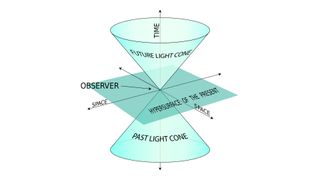
Events within an observer's light cone can be linked by a signal slower than light.   (Image credit: By SVG version: K. Aainsqatsi at en.wikipediaOriginal PNG version: Stib at en.wikipedia - Transferred from en.wikipedia to Commons.(Original text: self-made), CC BY-SA 3.0, https://commons.wikimedia.org/w/index.php?curid=2210907)

Each event has a light cone associated with it. If event B falls within the lightcone of event A then the two could be causally linked. The supernova could have knocked the egg off the kitchen counter  —  or maybe the falling breakfast item caused the complete gravitational collapse of a dying star, somehow. That’s because in the light cone a signal traveling slower than light can link the events. The edges of the light cone represent the speed of light. Linking an event outside the light cone with one inside it requires a signal that travels faster than light.

If event A is in the light cone and event B is outside it, then the supernova and egg-related tragedy can't be causally related. But, a tachyon traveling at a speed greater than the speed of light could violate causality by linking these events. 

To see why this is a problem, consider it like this. Image event A is the sending of a signal, and event B is the receiving of that signal. If that signal is traveling at the speed of light, or slower all observers in different reference frames agree that A preceded B.

But, if that signal is carried by a tachyon and thus moves faster than light, there will be reference frames that say the signal was received before it was sent. Thus, to an observer in this frame, the tachyon traveled backward in time.

One of the fundamental postulates of special relativity is that the laws of physics should be the same in all non-accelerating reference frames. That means if tachyons can violate causality and move backward in time in one reference frame, it can do it in them all.  
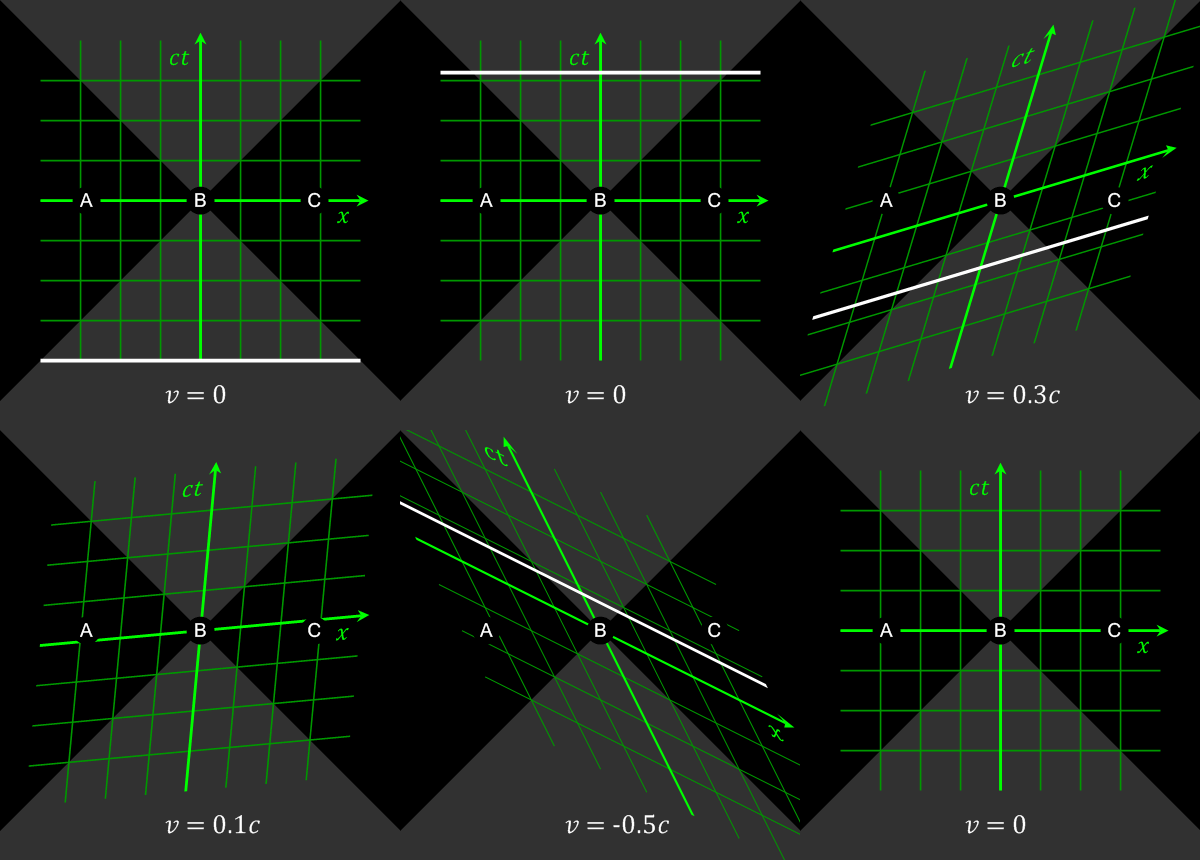
A diagram showing how events are viewed at different times in different reference frames.    (Image credit: By User:Acdx - Self-made, based on Image:Relativity_of_Simultaneity.svg, source code: en:User:Acdx/Relativity_of_Simultaneity_Animation, CC BY-SA 4.0, https://commons.wikimedia.org/w/index.php?curid=5560059)

TACHYONS PARADOXES

To see how this leads to problems called paradoxes, consider two observers, Stella aboard a spacecraft orbiting Earth, and Terra based on the surface of the planet. The two are communicating by sending messages with tachyons. 

This means that if Stella sends a signal to Terra which moves faster than light in Stella’s frame but backward in time in Terra’s frame. Terra then sends a reply as ordered which moves faster than light in her frame but backward in time in Stella’s frame, Stella could receive the reply before sending the original signal. 

What if this response signal from Terra says "do not send any signals"? Then Stella does not send the original signal, and Terra then has nothing to respond to and never sends the tachyon signal that says "don’t send any signals." 

So not only do tachyons violate causality in every frame they open the door to severe logical paradoxes.

There are suggestions as to how these paradoxes could be avoided. Of course, the most simple solution is that tachyons don’t exist. 

A less draconian suggestion is that observers in different reference frames can’t tell the difference between the emission and absorption of tachyons. 

That means a tachyon traveling back in time could always be interpreted as a tachyon moving forward in time because receiving a tachyon from the future always creates the same tachyon and sends it forwards in time.

Another suggestion is that tachyons aren’t like any other particle we know of, in that they don't interact and can never be detected or observed. Meaning that the tachyon communication system used by Stella and Terra in the above example can’t exist. 

Along similar lines, other researchers say that tachyons can’t be controlled. The receipt and emission of tachyons just happen at random. Thus, there’s no way to send a tachyon with a causality violating message. 

A animation showing how a hypothetical particle moving faster than light, like a tachyon, will only be visible after it's already passed.

A animation showing how a particle moving faster than light will only be visible after it’s already passed. © Gif: Tx Alien / Wikimedia Commons

TACHYONS. COULD WE EVER DETECT THEM?

Aside from the fact that like other particles, they are likely incomprehensibly tiny, because tachyons always travel faster than light it isn’t possible to detect one on its approach. That’s because it’s moving faster than any associated photons. 

After it passes, an observer would see the image of the tachyon split into two distinct images. These would show it simultaneously arriving in one direction and disappearing in the opposite direction.

If detecting tachyons, at least of their approach, with light is out of the picture, is there another way we could detect these faster than light particles?

Possibly. Tachyons are proposed to have an "anti-mass" but this still constitutes mass energy. That means these particles should still have some gravitational effect. It’s possible highly sensitive detectors could spot this effect.

An alternative detection method could arise from their faster-than-light nature.

While the speed of light in a vacuum c is a universal speed limit, particles have been made to travel faster than light in other mediums. When electrically charged particles are accelerated up to and beyond the speed of light in certain mediums like water, they release a form of radiation called Cherenkov radiation, according to the International Atomic Energy Agency.

That means that if tachyons are electrically charged, one way of detecting them would be measuring Cherenkov radiation in the near-vacuum of space. 

THE POWER OF IMAGINATION IN SCIENCE

What tachyons really demonstrate is the importance of imagination in our ongoing quest to understand the universe. They may not exist, and if they do we may have no hope of ever measuring one.

But what our technology can’t capture, our minds can. We can consider the possibility of a particle that journeys back through time and what that says about the nature of time, and the Universe, and the events that fill them.

In an interview with George Sylvester Viereck published in "The Saturday Evening Post" in 1929, Albert Einstein is believed to have said: "Imagination is more important than knowledge. Knowledge is limited. Imagination encircles the world."

ADDITIONAL INFORMATION

{ https://www.space.com/ }

Hoe vind je dit bericht?
Geschreven door peter om 21:01 Stuur door

Do Tachyons Exist as Particles?

Do Tachyons Exist as Particles?

Tachyons are hypothetical particles that always travel faster than light. Until recently, they were generally regarded as entities that did not fit into the special theory of relativity. According to a new paper in the journal Physical Review D, these faster-than-light particles are ‘not only not ruled out by the theory, but allow us to understand its causal structure better.’

An AI impression of tachyons.

An AI impression of tachyons.

“Motion at speeds beyond the speed of light is one of the most controversial issues in physics,” said Professor Andrzej Dragan from the University of Warsaw and National University of Singapore and his colleagues.

“Hypothetical particles that could move at superluminal speeds, called tachyons, are the enfant terrible of modern physics.”

“Until recently, they were widely regarded as creations that do not fit into the special theory of relativity.”

“At least three reasons for the non-existence of tachyons within quantum theory were known so far,” they added.

"The first is the ground state of the tachyon field was supposed to be unstable, which would mean that such superluminal particles would form avalanches.”

“The second is a change in the inertial observer was supposed to lead to a change in the number of particles observed in his reference system, yet the existence of, say, seven particles cannot depend on who is looking at them.”

“The third reason is the energy of the superluminal particles could take on negative values.”

“The difficulties with tachyons so far had a common cause,” the physicists said.

“It turned out that the boundary conditions that determine the course of physical processes include not only the initial state but also the final state of the system.”

“To put it simply: in order to calculate the probability of a quantum process involving tachyons, it is necessary to know not only its past initial state but also its future final state.”

“Once this fact was incorporated into the theory, all the difficulties mentioned earlier completely disappeared and tachyon theory became mathematically consistent.”

“It’s a bit like Internet advertising — one simple trick can solve your problems,” Professor Dragan said.

“The idea that the future can influence the present instead of the present determining the future is not new in physics.”

“However, until now, this type of view has at best been an unorthodox interpretation of certain quantum phenomena, and this time we were forced to this conclusion by the theory itself.”

“To make room for tachyons we had to expand the state space.”

“We also predict that the expansion of the boundary conditions has its consequences: a new kind of quantum entanglement appears in the theory, mixing past and future, which is not present in conventional particle theory.”

The team’s paper also raises the question of whether tachyons described in this way are purely a mathematical possibility or whether such particles are likely to be observed one day.

“Tachyons are not only a possibility but are, in fact, an indispensable component of the spontaneous breaking process responsible for the formation of matter,” the authors said.

“This hypothesis would mean that Higgs field excitations, before the symmetry was spontaneously broken, could travel at superluminal speeds in the vacuum.”

  • Jerzy Paczos et al. 2024. Covariant quantum field theory of tachyons. Phys. Rev. D 110 (1): 015006; doi: 10.1103/PhysRevD.110.015006
  • This article is a version of a press-release provided by the University of Warsaw

{ https://www.sci.news/ }

Hoe vind je dit bericht?
Geschreven door peter om 20:31 Stuur door

Ancient Mars was Cool and Relatively Wet, New Study Suggests

Ancient Mars was Cool and Relatively Wet, New Study Suggests

In a new study, planetary scientists found strong similarities between soils found in Gale Crater on Mars and those of Canada’s Newfoundland, a cold subarctic climate.

X-ray amorphous material comprises 15-73 wt.% of sedimentary rocks and eolian sediments in Gale Crater. This material is variably siliceous and iron rich but aluminum poor. The presence of volatiles is consistent with the existence of incipient weathering products. To better understand the implications of this material for past aqueous conditions on Mars, Feldman et al. investigated X-ray amorphous material formation and longevity within terrestrial iron rich soils with varying ages and environmental conditions using bulk and selective dissolution methods, X-ray diffraction, and transmission electron microscopy. Image credit: M. Kornmesser / ESO.

X-ray amorphous material comprises 15-73 wt.% of sedimentary rocks and eolian sediments in Gale Crater. This material is variably siliceous and iron rich but aluminum poor. The presence of volatiles is consistent with the existence of incipient weathering products. To better understand the implications of this material for past aqueous conditions on Mars, Feldman et al. investigated X-ray amorphous material formation and longevity within terrestrial iron rich soils with varying ages and environmental conditions using bulk and selective dissolution methods, X-ray diffraction, and transmission electron microscopy.

Image credit: M. Kornmesser / ESO.

Scientists often use soil to depict environmental history, as the minerals present can tell the story of landscape evolution through time.

Understanding more about how these materials formed could help answer long-standing questions about historical conditions on the red planet.

The soils and rocks of Gale Crater provide a record of Mars’ climate between 3 and 4 billion years ago, during a time of relatively abundant water on the planet — and the same time period that saw life first appear on Earth.

“Gale Crater is a paleo lakebed — there was obviously water present. But what were the environmental conditions when the water was there?” said Dr. Anthony Feldman, a soil scientist and geomorphologist at Desert Research Institute.

“We’re never going to find a direct analog to the Martian surface, because conditions are so different between Mars and Earth. But we can look at trends under terrestrial conditions and use those to try to extrapolate to Martian questions.”

NASA’s Curiosity Rover has been investigating Gale Crater since 2011, and has found a plethora of soil materials known as X-ray amorphous materials.

These components of the soil lack the typical repeating atomic structure that defines minerals, and therefore can’t be easily characterized using traditional techniques like X-ray diffraction.

When X-rays are shot at crystalline materials like a diamond, for example, the X-rays scatter at characteristic angles based on the mineral’s internal structure.

However, X-ray amorphous material does not produce these characteristic fingerprints.

This X-ray diffraction method was used by the Curiosity Rover to demonstrate that X-ray amorphous material comprised between 15 and 73% of the soil and rock samples tested in Gale Crater.

“You can think of X-Ray amorphous materials like Jello. It’s this soup of different elements and chemicals that just slide past each other,” Dr. Feldman said.

Curiosity also conducted chemical analyses on the soil and rock samples, finding that the amorphous material was rich in iron and silica but deficient in aluminum.

Beyond the limited chemical information, scientists don’t yet understand what the amorphous material is, or what its presence implies about Mars’ historical environment.

Uncovering more information about how these enigmatic materials form and persist on Earth could help answer persistent questions about the red planet.

Dr. Feldman and his colleagues visited three locations in search of similar X-ray amorphous material: the Tablelands of Gros Morne National Park in Newfoundland, Northern California’s Klamath Mountains, and western Nevada.

These three sites had serpentine soils that the researchers expected to be chemically similar to the X-ray amorphous material at Gale Crater: rich in iron and silicon but lacking in aluminum.

The three locations also provided a range of rainfall, snowfall, and temperature that could help provide insight into the type of environmental conditions that produce amorphous material and encourage its preservation.

At each site, the research team examined the soils using X-ray diffraction analysis and transmission electron microscopy, which allowed them to see the soil materials at a more detailed level.

The subarctic conditions of Newfoundland produced materials chemically similar to those found in Gale Crater that also lacked in crystalline structure. The soils produced in warmer climates like California and Nevada did not.

“This shows that you need the water there in order to form these materials,” Dr. Feldman said.

“But it needs to be cold, near-freezing mean annual temperature conditions in order to preserve the amorphous material in the soils.”

Amorphous material is often considered to be relatively unstable, meaning that at an atomic level, the atoms haven’t yet organized into their final, more crystalline forms.

“There’s something going on in the kinetics — or the rate of reaction — that is slowing it down so that these materials can be preserved over geologic time scales,” Dr. Feldman said.

“What we’re suggesting is that very cold, close to freezing conditions, is one particular kinetic limiting factor that allows for these materials to form and be preserved.”

“This study improves our understanding of the climate of Mars.”

“The results suggest that the abundance of this material in Gale Crater is consistent with subarctic conditions, similar to what we would see in, for instance, Iceland.”

  • The team’s work appears in the journal Communications Earth and Environment.
  • A.D. Feldman et al. 2024, Fe-rich X-ray amorphous material records past climate and persistence of water on Mars. Commun Earth Environ 5, 364; doi: 10.1038/s43247-024-01495-4
  • This article is based on a press-release from Desert Research Institute.

{ https://www.sci.news/ }

Hoe vind je dit bericht?
Geschreven door peter om 20:23 Stuur door

Ariane 6 Rocket’s Debut Puts Europe Back in the Launch Game

The European Space Agency's Ariane 6 rocket rises for the first time from its launch pad in French Guiana. Credit: ESA via YouTube

Ariane 6 Rocket’s Debut Puts Europe Back in the Launch Game

Europe’s next-generation Ariane 6 rocket rose today for the first time from its South American spaceport, ending a yearlong launch gap caused by the Ariane 5’s retirement.

The heavy-lift launch vehicle’s demonstration flight began with liftoff at 4 p.m. local time (19:00 GMT) from the Kourou spaceport in French Guiana, and continued with satellite deployments in orbit.

“A completely new rocket is not launched often, and success is far from guaranteed,” Josef Aschbacher, the European Space Agency’s director general, said in a statement. “I am privileged to have witnessed this historic moment when Europe’s new generation of the Ariane family lifted off – successfully – effectively reinstating European access to space.”

ESA and its partners have been working on the two-stage Ariane 6 since the early 2010s as an upgrade to the Ariane 5 series, which lofted more than 100 spacecraft (including NASA’s James Webb Space Telescope) into orbit beginning in 1998. Ariane 6 development cost is estimated at nearly $4 billion.

The first Ariane 6 was originally planned for 2020, but technical issues and the COVID-19 pandemic forced delays. After last year’s final Ariane 5 mission, Europe’s launch industry could offer only the Vega small-lift launch vehicle, leaving a gap in the medium- to heavy-lift market.

The market for the Ariane 6 is dramatically different from what it was when the Ariane 5 entered service more than a quarter-century ago. Thanks to SpaceX and other commercial ventures, rocket reusability is becoming the standard in the industry — raising questions about how competitive non-reusable rockets like the Ariane 6 can be.

ArianeGroup, a joint venture between Airbus and Safran, is counting on Ariane 6’s success. But in January, The Financial Times quoted Aschbacher as saying “there is no guarantee” that ArianeGroup would continue to be Europe’s launch company of choice.

The Ariane 6 line features a modular design that can be adapted for missions to low Earth orbit or to deep space. For today’s mission, known as VA262, the rocket’s core stage was augmented by two side-mounted solid rocket boosters. Another configuration calls for four strap-on boosters for heavy-lift missions. The four-booster configuration can deliver up to 21.6 metric tons to low Earth orbit.

Ariane 6 at a glance An overview of Europe’s new rocket Ariane 6. Credit: ESA

Today’s launch sent the Ariane 6’s upper stage to an altitude of about 600 kilometers (373 miles). Nine satellites were deployed, and five onboard experiments were activated.

Another objective involved demonstrating the upper stage’s ability to relight its Vinci engine for orbital adjustments and deorbiting. Two experimental re-entry capsules were supposed to be released as the mission wound down. But in an update posted to the X social-media platform, ESA said the technology demonstration phase showed “an unexpected result which will only affect the end of the mission.”

During a follow-up briefing, mission managers said the upper stage’s auxiliary power unit suffered an anomaly that caused a premature engine shutdown. As a result, the re-entry capsules were not released, and the upper stage remained in orbit.

The next Ariane 6 mission is scheduled to put France’s CSO-3 spy satellite into orbit later this year. About 30 Ariane 6 launches are said to be booked already, including 18 launches for Amazon’s Project Kuiper satellites. Arianespace CEO Stéphane Israël said today’s end-of-mission anomaly would have “no consequence on the next launches.”

“We are perfectly on track now to make a second launch this year,” Israël said.

{ https://www.universetoday.com/ }

Hoe vind je dit bericht?
Geschreven door peter om 18:40 Stuur door

A Hopping Robot Could Explore Europa Using Locally Harvested Water

A Hopping Robot Could Explore Europa Using Locally Harvested Water

Various forms of hopping robots have crept into development for us[e in different space exploration missions. We’ve reported on their use on asteroids and even our own Moon. But a study funded by NASA’s Institute for Advanced Concepts (NIAC) in 2018 planned a mission to a type of world where hopping may not be as noticeable an advantage—Europa.

The mission, developed by engineers at NASA’s Jet Propulsion Laboratory, Purdue University, and Honeybee Robotics, is known as the Steam Propelled Autonomous Retrieval Robot for Ocean Worlds, or SPARROW. It’s about the size and shape of a soccer ball, with the logic, power, and control systems inside a spherical outer hollow shell. 

SPARROW wouldn’t be able to operate on its own, however. It would require a lander to deposit it onto the surface and serve as a refueling and sample collection storage base. Europa Clipper, the only currently planned NASA mission to the icy moon, would have been good for hitching a ride, but its lack of a lander made it unsuitable for SPARROW.

Budget constraints are always a problem for innovative missions – as Fraser explains with Dr. Manasvi Lingam.

However, the hopping robot itself is well suited for the environment in Europa. Its designers intended to make it “terrain agnostic,” meaning it could traverse even the harshest terrain the icy moon could throw at it. These would include penitentes, shards of ice that could be meters tall, and difficult for ground-based robots to traverse.

SPARROW could fly over them, collect interesting samples, and return to the lander to refuel and deposit them. Then, it could go out again in a different direction. To model this system architecture, the JPL team spent Phase I trying to determine the best propulsion system for the robot and modeling control algorithms for the flights.

First, let’s tackle the propulsion system. The lander accompanying SPARROW would have to mine ice off the moon’s surface, then heat it and store it as water. When SPARROW returned from a hop, it would use the water to refuel. Five different propulsion methods were considered as part of the study. Still, the best turned out to be a “hot water thruster,” where SPARROW would internally heat the water supplied by the lander, then eject that out in a burst of propulsive force to launch the robot off the surface.

Exploring the surface of Europa is only one part of its mystery – as Fraser explains.

The second major part of the paper was controlling that propulsion. Trajectory correction is critical to mission success, but in this case, the designers believe that no matter where the robot ends up, it will be able to collect a sample and return to the lander. This is due to its gimballed design, which allows the robot to consistently orient correctly, even after bouncing along a frozen surface for a while.

There is still much work to do before the mission is ready to go, though. Some of the most pressing questions are how to stop ice from forming in the robot’s propulsion nozzle and throughout its structural cage. Such blockages could easily throw off any existing trajectory calculations and theoretically immobilize the hopper entirely if they were severe enough.

However, no work is planned to solve those problems for now as the project has yet to receive Phase II funding from NIAC, and work on it appears to have stalled. Dr. Gareth Meirion-Griffith, the primary investigator on the project, has moved on from JPL to take a job at Collins Aerospace. Even so, someday, the author’s ideas might be integrated into a Europa lander mission—we’ll have to wait and see.

Learn More:

Lead Image:

  • Artist’s depiction of SPARROW and it’s lander operating on an ocean world.
    Credit – NASA JPL / Caltech

{ https://www.universetoday.com/ }

Hoe vind je dit bericht?
Geschreven door peter om 18:33 Stuur door

AI Focuses UFO Over Las Vegas, Nevada On Feb 23, 2021, UAP Sighting News.

AI Focuses UFO Over Las Vegas, Nevada On Feb 23, 2021, UAP Sighting News. 

UAP,%20%E0%A4%89%E0%A4%AB%E0%A5%8C%20,%20%E0%A6%87%E0%A6%89%E0%A6%8F%E0%A6%AB%E0%A6%93,%20%C4%91i%CC%83a%20bay,%20MUFON,%20%E7%9B%AE%E6%92%83%E3%80%81%E3%82%A8%E3%82%A4%E3%83%AA%E3%82%A2%E3%83%B3,%20%20UFO,%20UFOs,%20%D0%9D%D0%9B%D0%9E%20,%20NLO,%20sighting,%20sightings,%20alien,%20aliens,%20ET,%20anomaly,%20anomalies,%20ancient,%20astrobiology,%20vreemdelinge,%20%203%20copy%205.png
Guys please subscribe and visit the eyewitness Franc Pierre at https://www.youtube.com/watch?v=otyF8dBkHP4 
 
Ok, this is from 2021 in Las Vegas. I took a few screenshots of this strange dark UFO moving across the sky that Franc Pierre recorded and wow, it sent chills down my spine. This was not what I thought I would find. It's a rare jellyfish UFO and it looks bio-mechanical in form. Meaning it's part biological and part machine. It even changes shape as it moves...and at one point it looked like a dragon with its head looking outward...in the last screenshot in my video. Scary looking stuff, but 100% real. As I said, AI doesn't prove a UFO is real or not, it only cleans up the photos, so we as researchers can analyze them. But thats why I'm here...to tell you if this is or isn't a real jellyfish UFO from my decades of experience. Yes...it is real. 
Scott C. Waring - Utah

{ https://www.ufosightingsdaily.com/ }

Hoe vind je dit bericht?
Geschreven door peter om 17:34 Stuur door

AI Focused Photo of Tom Delonge Of Blink UAP Photo, UFO Sighting News. Video.

AI Focused Photo of Tom Delonge Of Blink UAP Photo, UFO Sighting News. Video.

ET,%20UFO,%20UFOs,%20sighting,%20sightings,%20alien,%20aliens,%20W56,%20SOHO,%20NASA,%20solar,%20LASCO,%20top%20secret,%20news,%20paranormal,%20.png
Please hit subscribe friends. I wanted to look at the Tom Delonge photo due to him saying that he has inside information, video and photos of actual alien craft so much so that he wants to make a movie about it. I admit this photo looks legit to me, but ai doesn't tell us if it's real or not, it only focuses and sharpens the image. It's up to us to decide for ourselves if it's real or not. 
Scott C. Waring

{ https://www.ufosightingsdaily.com/ }

Hoe vind je dit bericht?
Geschreven door peter om 17:30 Stuur door

Meer van UFO'S of UAP'S, ASTRONOMIE, RUIMTEVAART, ARCHEOLOGIE, OUDHEIDKUNDE, SF-SNUFJES EN ANDERE ESOTERISCHE WETENSCHAPPEN - DE ALLERLAATSTE NIEUWTJES

↑ Terug naar de berichten