Ontdek de Fascinerende Wereld van UFO's en UAP's: Jouw Bron voor Onthullende Informatie!
Ben jij ook gefascineerd door het onbekende? Wil je meer weten over UFO's en UAP's, niet alleen in België, maar over de hele wereld? Dan ben je op de juiste plek!
België: Het Kloppend Hart van UFO-onderzoek
In België is BUFON (Belgisch UFO-Netwerk) dé autoriteit op het gebied van UFO-onderzoek. Voor betrouwbare en objectieve informatie over deze intrigerende fenomenen, bezoek je zeker onze Facebook-pagina en deze blog. Maar dat is nog niet alles! Ontdek ook het Belgisch UFO-meldpunt en Caelestia, twee organisaties die diepgaand onderzoek verrichten, al zijn ze soms kritisch of sceptisch.
Nederland: Een Schat aan Informatie
Voor onze Nederlandse buren is er de schitterende website www.ufowijzer.nl, beheerd door Paul Harmans. Deze site biedt een schat aan informatie en artikelen die je niet wilt missen!
Internationaal: MUFON - De Wereldwijde Autoriteit
Neem ook een kijkje bij MUFON (Mutual UFO Network Inc.), een gerenommeerde Amerikaanse UFO-vereniging met afdelingen in de VS en wereldwijd. MUFON is toegewijd aan de wetenschappelijke en analytische studie van het UFO-fenomeen, en hun maandelijkse tijdschrift, The MUFON UFO-Journal, is een must-read voor elke UFO-enthousiasteling. Bezoek hun website op www.mufon.com voor meer informatie.
Samenwerking en Toekomstvisie
Sinds 1 februari 2020 is Pieter niet alleen ex-president van BUFON, maar ook de voormalige nationale directeur van MUFON in Vlaanderen en Nederland. Dit creëert een sterke samenwerking met de Franse MUFON Reseau MUFON/EUROP, wat ons in staat stelt om nog meer waardevolle inzichten te delen.
Let op: Nepprofielen en Nieuwe Groeperingen
Pas op voor een nieuwe groepering die zich ook BUFON noemt, maar geen enkele connectie heeft met onze gevestigde organisatie. Hoewel zij de naam geregistreerd hebben, kunnen ze het rijke verleden en de expertise van onze groep niet evenaren. We wensen hen veel succes, maar we blijven de autoriteit in UFO-onderzoek!
Blijf Op De Hoogte!
Wil jij de laatste nieuwtjes over UFO's, ruimtevaart, archeologie, en meer? Volg ons dan en duik samen met ons in de fascinerende wereld van het onbekende! Sluit je aan bij de gemeenschap van nieuwsgierige geesten die net als jij verlangen naar antwoorden en avonturen in de sterren!
Heb je vragen of wil je meer weten? Aarzel dan niet om contact met ons op te nemen! Samen ontrafelen we het mysterie van de lucht en daarbuiten.
50-Minute Global UFO Sightings Compilation: Explore the Unexplained
Explore an incredible collection of UFO sightings from around the world! This 50-minute compilation features stunning videos and photos that capture mysterious objects in the sky. Witness firsthand accounts and unexplained phenomena that have intrigued and puzzled experts for decades. Dive into the unknown and join the quest to uncover the truth about UFOs!
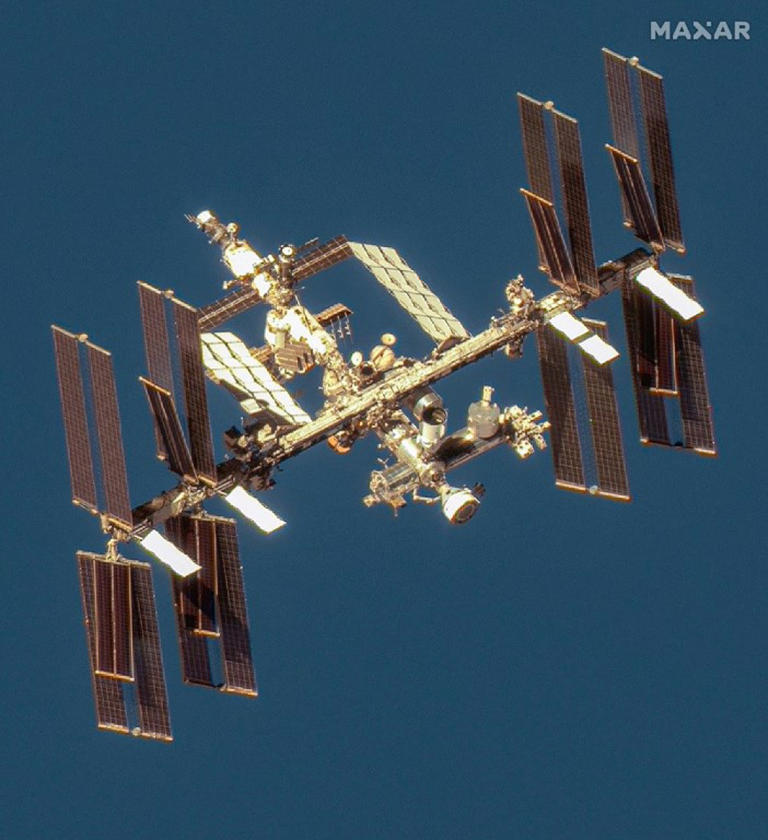
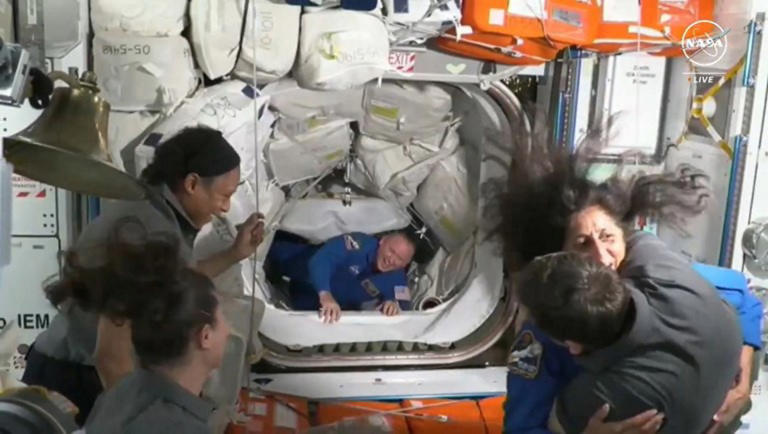
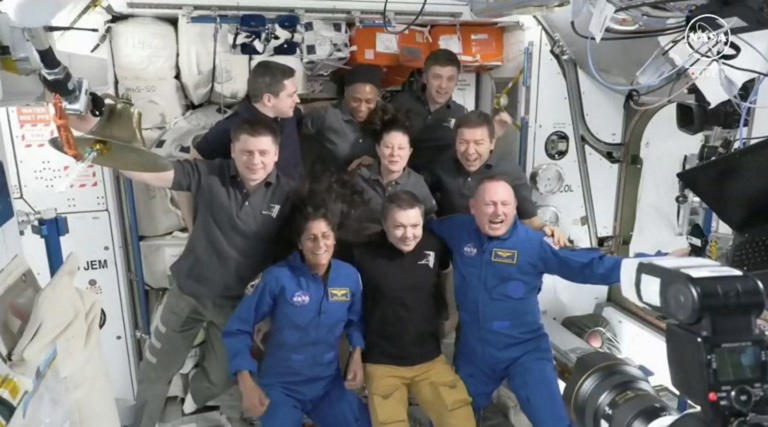
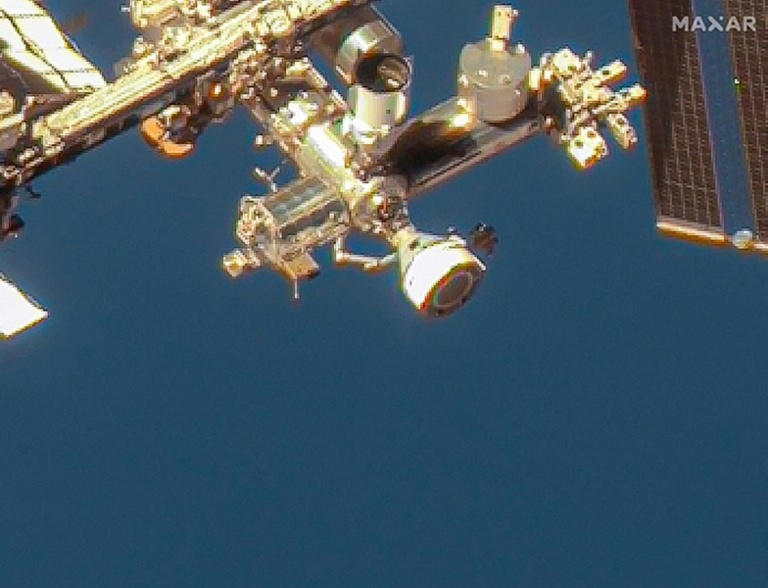
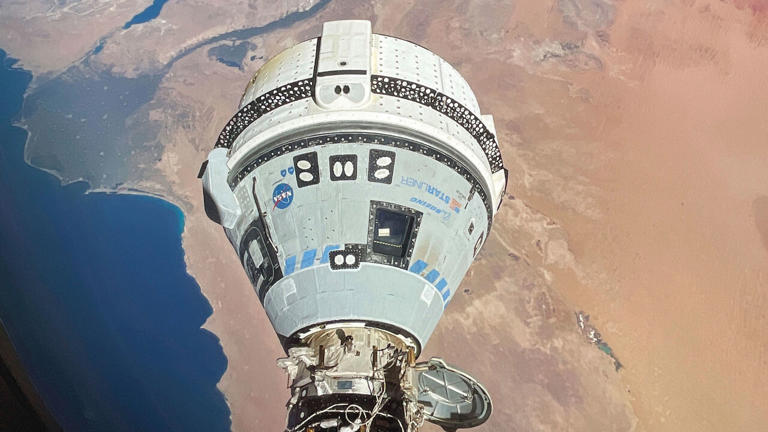
De twee astronauten die met de Boeing-ruimtecapsule Starliner drie weken geleden aankwamen in het internationale ruimtestation ISS, zitten daar "niet geblokkeerd". Dat heeft het Amerikaanse ruimteagentschap NASA vrijdag benadrukt. De terugkeer van de Starliner naar de aarde is ondertussen herhaaldelijk uitgesteld en zal er nu pas komen na nieuwe tests.
NASA benadrukt dat astronauten Starliner niet geblokkeerd zitten in ISS
De terugvlucht was aanvankelijk ten laatste op 26 juni gepland. NASA gaf geen nieuwe datum, maar liet eerder al weten dat de terugkeer van de Starliner met de twee astronauten Butch Wilmore en Suni Williams niet meer voor juni zou zijn.
Onderweg naar het ISS had de Starliner te maken gekregen met talrijke technische problemen. Er waren bijvoorbeeld heliumlekken opgetreden. Na problemen met de motoren slaagde het ruimteschip er pas bij de tweede poging in om aan te meren bij het ISS.
"Butch en Suni zijn niet geblokkeerd in de ruimte", benadrukte Steve Stich, een hoge verantwoordelijke van NASA, vrijdag tijdens een ongewoon gespannen persconferentie. De twee astronauten zouden aanvankelijk slechts iets meer dan een week in de ruimte blijven. In Amerikaanse media werd dan ook de vraag gesteld of de astronauten nog wel konden terugkeren naar aarde.
NASA benadrukt dat astronauten Starliner niet geblokkeerd zitten in ISS
"We kunnen Starliner op elk moment terughalen", benadrukte Mark Nappi, een hoge verantwoordelijke bij Boeing. De eerste bemande vlucht van de Starliner was de ultieme testvlucht van de Boeing-ruimtecapsule, alvorens er reguliere vluchten mee uitgevoerd kunnen worden van en naar het ISS.
De Starliner, ontwikkeld en gebouwd door de Amerikaanse vliegtuigbouwer Boeing, maakte zijn eerste succesvolle onbemande vlucht in 2022.
NASA benadrukt dat astronauten Starliner niet geblokkeerd zitten in ISS
NASA benadrukt dat astronauten Starliner "niet geblokkeerd" zitten in ISS, al is er voorlopig geen nieuwe datum voor terugkeer
Artikel door Belga
De terugvlucht was aanvankelijk ten laatste op 26 juni gepland. NASA gaf geen nieuwe datum, maar liet eerder al weten dat de terugkeer van de Starliner met de 2 astronauten Butch Wilmore en Suni Williams niet meer voor juni zou zijn.
Onderweg naar het ISS had de Starliner te maken gekregen met talrijke technische problemen. Er waren bijvoorbeeld heliumlekken opgetreden. Na problemen met de motoren slaagde het ruimteschip er pas bij de tweede poging in om aan te meren bij het ISS.
De capsule kon pas bij een tweede poging aanmeren bij het ISS
"Butch en Suni zijn niet geblokkeerd in de ruimte", benadrukte Steve Stich, een hoge verantwoordelijke van NASA, vrijdag tijdens een ongewoon gespannen persconferentie. De 2 astronauten zouden aanvankelijk slechts iets meer dan een week in de ruimte blijven. In Amerikaanse media werd dan ook de vraag gesteld of de astronauten nog wel konden terugkeren naar aarde.
"We kunnen Starliner op elk moment terughalen", benadrukte Mark Nappi, een hoge verantwoordelijke bij Boeing. De eerste bemande vlucht van de Starliner was de ultieme testvlucht van de Boeing-ruimtecapsule, alvorens er reguliere vluchten mee uitgevoerd kunnen worden van en naar het ISS.
De Starliner, ontwikkeld en gebouwd door de Amerikaanse vliegtuigbouwer Boeing, maakte zijn eerste succesvolle onbemande vlucht in 2022.
Microfossils, tiny fossil fragments also known as palynomorphs that are only visible under a microscope, can be found almost anywhere on the Earth one chooses to look. Although these ubiquitous fossils play an essential role in telling the geological and organic story of Earth’s ancient past, studying them is no simple matter, mainly because there are billions of them.
Artist's reconstruction of Gangtoucunia aspera as it would have appeared in life on the Cambrian seafloor, circa 514 million years ago. The individual in the foreground has part of the skeleton removed to show the soft polyp inside the skeleton. Reconstruction by Xiaodong Wang.
Credit: Reconstruction by Xiaodong Wang.
An exceptionally well-preserved collection of fossils discovered in eastern Yunnan Province, China, has enabled scientists to solve a centuries-old riddle in the evolution of life on earth, revealing what the first animals to make skeletons looked like. The results have been published today inProceedings of the Royal Society B.
The first animals to build hard and robust skeletons appear suddenly in the fossil record in a geological blink of an eye around 550-520 million years ago during an event called the Cambrian Explosion. Many of these early fossils are simple hollow tubes ranging from a few millimeters to many centimeters in length. However, what sort of animals made these skeletons was almost completely unknown, because they lack preservation of the soft parts needed to identify them as belonging to major groups of animals that are still alive today.
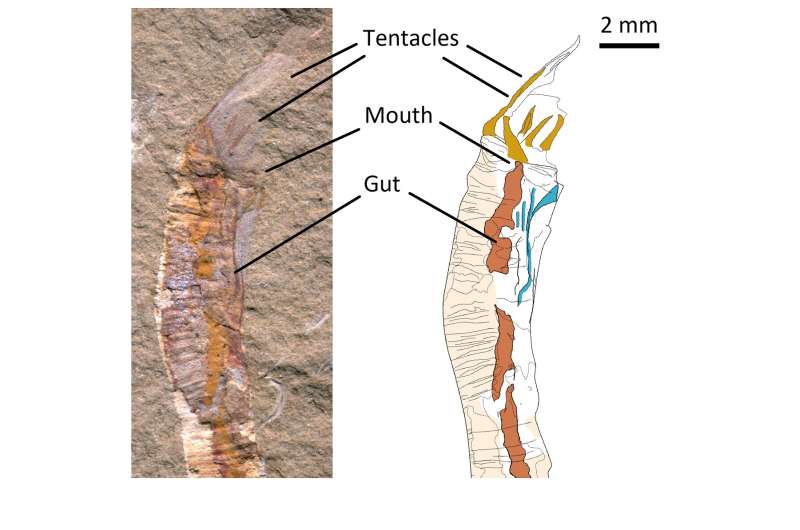
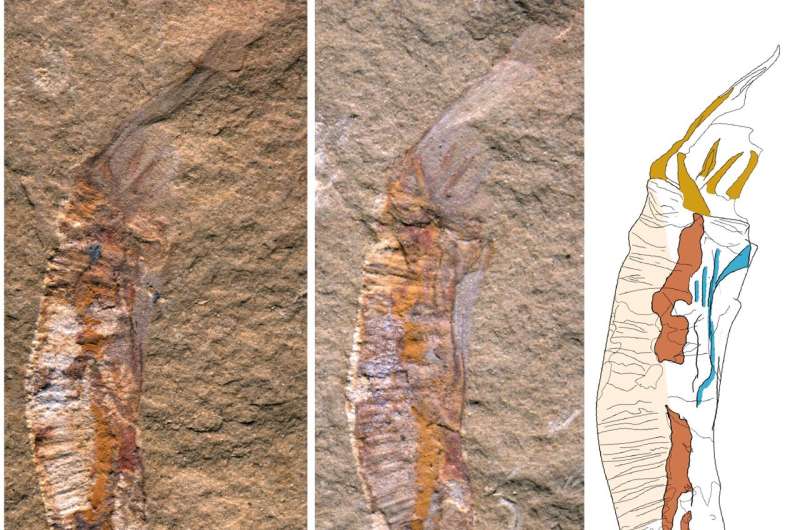
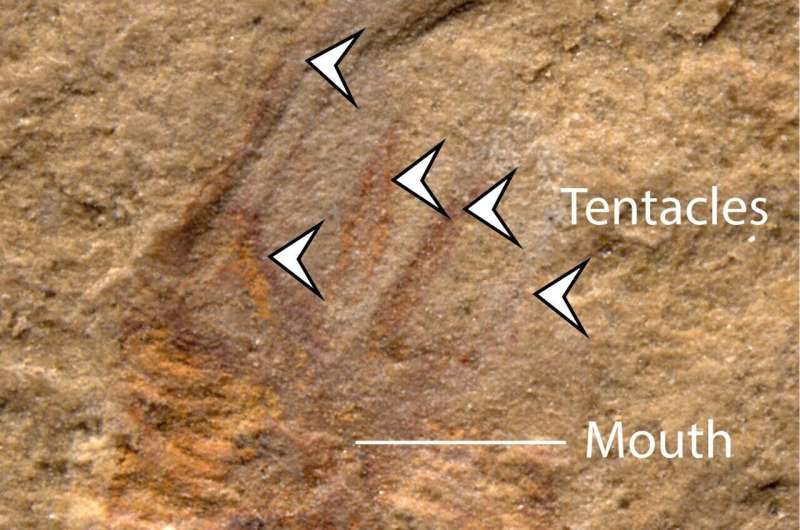
The new collection of 514 million year old fossils includes four specimens of Gangtoucunia aspera with soft tissues still intact, including the gut and mouthparts. These reveal that this species had a mouth fringed with a ring of smooth, unbranched tentacles about 5 mm long. It's likely that these were used to sting and capture prey, such as small arthropods. The fossils also show that Gangtoucunia had a blind-ended gut (open only at one end), partitioned into internal cavities, that filled the length of the tube.
These are features found today only in modern jellyfish, anemones and their close relatives (known as cnidarians), organisms whose soft parts are extremely rare in the fossil record. The study shows that these simple animals was among the first to build the hard skeletons that make up much of the known fossil record.
Because of this, researchers are now turning to artificial intelligence for help in classifying these minuscule preserved remnants of Earth’s ancient past.
Typically ranging from 5 to 500 micrometers in size and anywhere from a couple of million years to over 500 million years old, these tiny fossils are found mostly in sedimentary rocks, making them invaluable both to geologists and paleontologists. They help determine the age of rock layers, reconstruct past environments, and understand the evolutionary history of life on Earth. For instance, the presence of certain microfossils can indicate whether a rock layer was formed in a marine or terrestrial environment, providing insights into past climate conditions and geological events. Simply put, they offer a glimpse into what a specific area was like all those years ago.
Fossil specimen (left) and diagram (right) of Gangtoucunia aspera preserving soft tissues, including the gut and tentacle. Image credit: Luke Parry and Guangxu Zhang.
Credit: Luke Parry and Guangxu Zhang.
Fossil specimen of Gangtoucunia aspera preserving soft tissues, including the gut and tentacles (left and middle). The drawing at the right illustrates the visible anatomical features in the fossil specimens. Image credit: Luke Parry and Guangxu Zhang.
Credit: Luke Parry and Guangxu Zhang.
According to the researchers, Gangtoucunia would have looked similar to modern scyphozoan jellyfish polyps, with a hard tubular structure anchored to the underlying substrate. The tentacle mouth would have extended outside the tube, but could have been retracted inside the tube to avoid predators. Unlike living jellyfish polyps however, the tube of Gangtoucunia was made of calcium phosphate, a hard mineral that makes up our own teeth and bones. Use of this material to build skeletons has become more rare among animals over time.
Corresponding author Dr. Luke Parry, Department of Earth Sciences, University of Oxford, said, "This really is a one-in-million discovery. These mysterious tubes are often found in groups of hundreds of individuals, but until now they have been regarded as 'problematic' fossils, because we had no way of classifying them. Thanks to these extraordinary new specimens, a key piece of the evolutionary puzzle has been put firmly in place."
The new specimens clearly demonstrate that Gangtoucunia was not related to annelid worms (earthworms, polychaetes and their relatives) as had been previously suggested for similar fossils. It is now clear that Gangtoucunia's body had a smooth exterior and a gut partitioned longitudinally, whereas annelids have segmented bodies with transverse partitioning of the body.
The fossil was found at a site in the Gaoloufang section in Kunming, eastern Yunnan Province, China. Here, anaerobic (oxygen-poor) conditions limit the presence of bacteria that normally degrade soft tissues in fossils.
Ph.D. student Guangxu Zhang, who collected and discovered the specimens, said, "The first time I discovered the pink soft tissue on top of a Gangtoucunia tube, I was surprised and confused about what they were. In the following month, I found three more specimens with soft tissue preservation, which was very exciting and made me rethink the affinity of Gangtoucunia. The soft tissue of Gangtoucunia, particularly the tentacles, reveals that it is certainly not a priapulid-like worm as previous studies suggested, but more like a coral, and then I realized that it is a cnidarian."
Although the fossil clearly shows that Gangtoucunia was a primitive jellyfish, this doesn't rule out the possibility that other early tube-fossil species looked very different. From Cambrian rocks in Yunnan province, the research team have previously found well-preserved tube fossils that could be identified as priapulids (marine worms), lobopodians (worms with paired legs, closely related to arthropods today) and annelids.
Co-corresponding author Xiaoya Ma (Yunnan University and University of Exeter) said, "A tubicolous mode of life seems to have become increasingly common in the Cambrian, which might be an adaptive response to increasing predation pressure in the early Cambrian. This study demonstrates that exceptional soft-tissue preservation is crucial for us to understand these ancient animals."
The paper "Exceptional soft tissue preservation reveals a cnidarian affinity for a Cambrian phosphatic tubicolous enigma' will be published inProceedings of the Royal Society Bon Nov. 2.
Traditionally, the classification of microfossils has been a manual, time-consuming process requiring expert knowledge, with scientists staring into a microscope or at a computer screen for hours at a time. Given the sheer volume of data—potentially billions of microfossils from numerous slides—manual classification is tedious work, and attempting to classify all these microfossils is an insurmountable and impossible task. There are just too many of them, hence the advantage of letting AI assist in that process.
Spearheaded by a team from the University of Tromsø, The Arctic University of Norway, researchers have developed a novel method to automate the classification of microfossils.
The study introduces a two-stage AI-driven pipeline to automate the detection and classification of microfossils from microscope images.
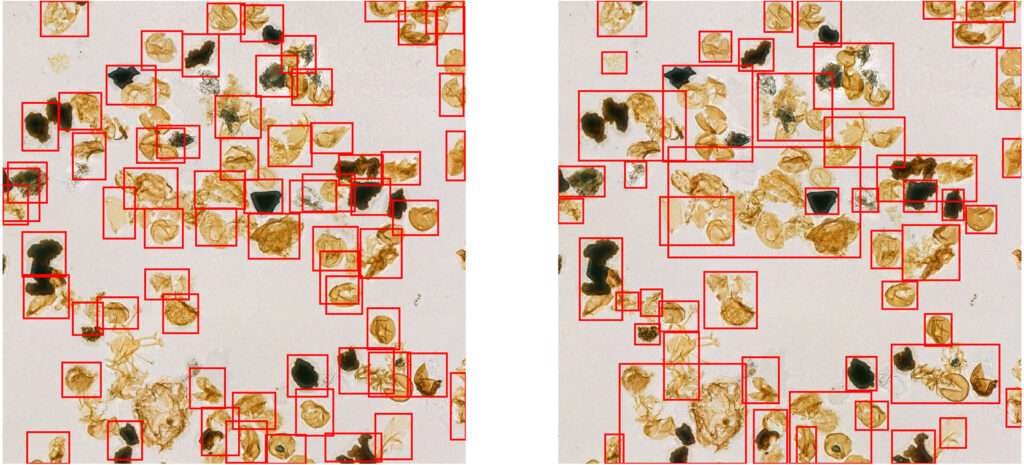
The first stage involves using a pre-trained object detection model, YOLOv5, to identify and extract individual microfossils from high-resolution slide images. This model efficiently generates bounding boxes around each microfossil, a task that would be labor-intensive if done manually.
In the second stage, the researchers employ self-supervised learning (SSL) techniques to train models that can extract features from the detected microfossils. SSL is particularly advantageous in scenarios with limited labeled data, as it allows the model to learn useful representations from unlabeled data. The study compares two SSL frameworks, SimCLR and DINO, and finds that both significantly improve classification performance.
An image of the same slide of microfossils. On the left, the Machine learning approach. On the right, the pipeline of standard image processing methods. As the study notes, more fossils are separated with the machine learning approach as it is better able to differentiate the various fossil types.
(Image: Artificial Intelligence in Geosciences)
Basically, the AI is able to differentiate between different fossils and classify them. According to the study, this method is fast and computationally light, making it feasible to process and classify millions of microfossils efficiently. This scalability is crucial for handling the vast datasets typical in geological research. Moreover, as the AI classifies more fossils, it labels them and learns from its data, continuously adding to its own knowledge base.
“This work shows that there is great potential in utilizing AI in this field,” explained Iver Martinsen, one of the study’s authors, in a press statement. “By using AI to automatically detect and recognize fossils, geologists might have a tool that can help them better utilize the enormous amount of information that wellbore samples provide.”
The ability to automate microfossil classification has profound implications for earth sciences. It can accelerate research in subsurface exploration, aiding in oil and gas exploration and carbon capture and storage projects. Moreover, the insights gained from microfossil analysis can contribute to broader scientific inquiries, such as studying past climate changes and mass extinction events. Understanding these historical patterns is essential for predicting future environmental changes and developing strategies to mitigate their impacts.
Close up photograph of the mouth region of Gangtoucunia aspera showing the tentacles that would have been used to capture prey. Image credit: Luke Parry and Guangxu Zhang.
Credit: Luke Parry and Guangxu Zhang.
“We are very happy with our results,” Martinsen concluded. “Our model exceeds previous benchmarks available out there. We hope that the present work will be beneficial for geologists both in industry and academia.”
MJ Banias covers space, security, and technology with The Debrief. You can email him at mj@thedebrief.org or follow him on Twitter @mjbanias.
Researchers in Antarctica report a concerning new discovery that had not been anticipated in their existing models involving ice melting on Earth’s southernmost continent.
According to new findings, relatively warm water that can make its way beneath Antarctica’s ice sheets can cause additional melting from below that had not been previously known to scientists.
The new research, undertaken by scientists with the British Antarctic Survey (BAS), reveals the problems posed by warm seawater. This water seeps into the lower portions of ground-based ice, thereby accelerating not only ice melt but also its movement into the surrounding ocean.
Additionally, the results could help climate researchers develop a clearer picture of how Antarctic ice melt contributes to rising sea levels and other changes that could impact far-reaching areas around the world in the years ahead.
BAS researcher Alex Bradley, who specializes in ice dynamics and served as lead author of the new study, says his team has identified what they believe could be “a new tipping point in Antarctic ice sheet melting.”
“This means our projections of sea level rise might be significant underestimates,” Bradley recently warned in a statement.
CHILLING DISCOVERIES WITHIN THE GROUNDING ZONE
Bradley and his team’s study focuses on the grounding zone, which describes an area beneath the Antarctic ice sheet where the ground-based ice on the continent meets the sea.
Land-based ice in Antarctica moves gradually over long periods, making its way into the ocean, where it begins to melt once it meets the seawater. However, over time, climate change has been accelerating both the movement of the ice sheets and warming the surrounding seawater. Such processes are identified as major contributors to sea level rise, which can affect coastlines all around the world.
“We reveal a sensitive dependence of the grounding-zone dynamics,” the team writes in their new paper, noting that “as the grounding zone widens in response to melting, both temperature and flow velocity in the region increase, further enhancing melting.”
“We find that increases in ocean temperature can lead to a tipping point being passed, beyond which ocean water intrudes in an unbounded manner beneath the ice sheet, via a process of runaway melting.”
“Additionally,” they add, “this tipping point may not be easily detected with early warning indicators.”
SEAWATER WORKING ITS WAY BENEATH ANTARCTICA
In the team’s new study, they modeled how seawater makes its way into the areas between the land and the ice sheet above, effectively lubricating the ice bed and quickening its movement toward the nearby ocean.
This process of speeding along the movement of Antarctica’s ice is further quickened by the presence of warmer seawater.
“Ice sheets are very sensitive to melting in their grounding zones,” Bradley recently said, adding that grounding zone melt he and his colleagues have observed “displays a ‘tipping point like’ behaviour, where a very small change in ocean temperature can cause a very big increase in grounding zone melting, which would lead to a very big change in flow of the ice above it.”
When warm water begins to seep into the grounding zone, cavities open up, allowing additional water into the area, precipitating the melt. Even a small increase in water temperature would likely significantly impact the amount of melting that occurs.
“Our results point towards a stronger sensitivity of ice-sheet melting,” Bradley and his co-author write in their recent study, emphasizing that such dynamics contribute to “higher sea-level-rise contribution in a warming climate” than scientists had previously been able to discern from past studies.
Satellite image of the ice surface from Radarsat with the valleys and ridges of the buried ancient mountains mapped.
(Supplied: Stewart Jamieson, Durham University)
ABSENT FROM EXISTING MODELS
Given that such factors are currently absent from models scientists rely on to determine the amount of melt that can occur, it seems likely that warm seawater and its impact on ice within the grounding zone can account for some of the accelerated shrinkage of ice sheets observed by the Intergovernmental Panel on Climate Change (IPCC) and others. This would also relate to ice sheets in other parts of the world apart from Antarctica such as Greenland, where similar ice melt has been observed to occur at rates faster than scientists expected based on existing models.
Bradly called the new data “missing physics” that, while remaining absent from current models, prohibits scientists from accurately projecting the potential impact of ice melt in the Earth’s polar regions.
“They don’t have the ability to simulate melting beneath grounded ice, which we think is happening,” Bradley says, adding that he and his colleagues are “working on putting that into our models now.”
This illustration shows what Antarctica would look like if the ice sheet were lifted from the continent. Highland A is a series of three hills in the East Antarctic.
(Supplied: Stewart Jamieson, Durham University)
Bradley and his team’s findings were detailed in a new study, “Tipping point in ice-sheet grounding-zone melting due to ocean water intrusion,” co-authored with Ian J. Hewitt and published in the journal Nature Geoscience on June 25, 2024.
Samples retrieved from an asteroid during NASA’s OSIRIS-REx mission have undergone analysis, revealing the presence of components hinting at the origins of life on Earth.
Launched on September 8, 2016, the OSIRIS-REx spacecraft traveled to the near-Earth asteroid Bennu, where it retrieved a sample of rocks and dust and successfully brought them back to Earth for study.
Scientists were eager to analyze the 4.3-ounce (121.6-gram) sample, and now, less than a year after its arrival on Earth, a new study published in Meteoritics & Planetary Science has revealed the discovery of vital prebiotic compounds and minerals on Bennu’s rocky surface.
Jason Dworkin, OSIRIS-REx project scientist at NASA’s Goddard Space Flight Center and a co-author of the new paper, said the OSIRIS-REx mission “gave us exactly what we hoped: a large pristine asteroid sample rich in nitrogen and carbon from a formerly wet world.”
The asteroid’s composition, represented in the samples retrieved by OSIRIS-REx, offers scientists a look into the formation of the solar system and the components that may have played a role in the formation of life on Earth.
The analysis is key to confirming carbon and nitrogen-rich dusts and organic compounds essential for life. However, the sample also revealed a few surprises, including the presence of magnesium-sodium phosphate, which had not been detected in data obtained from the asteroid through remote sensing.
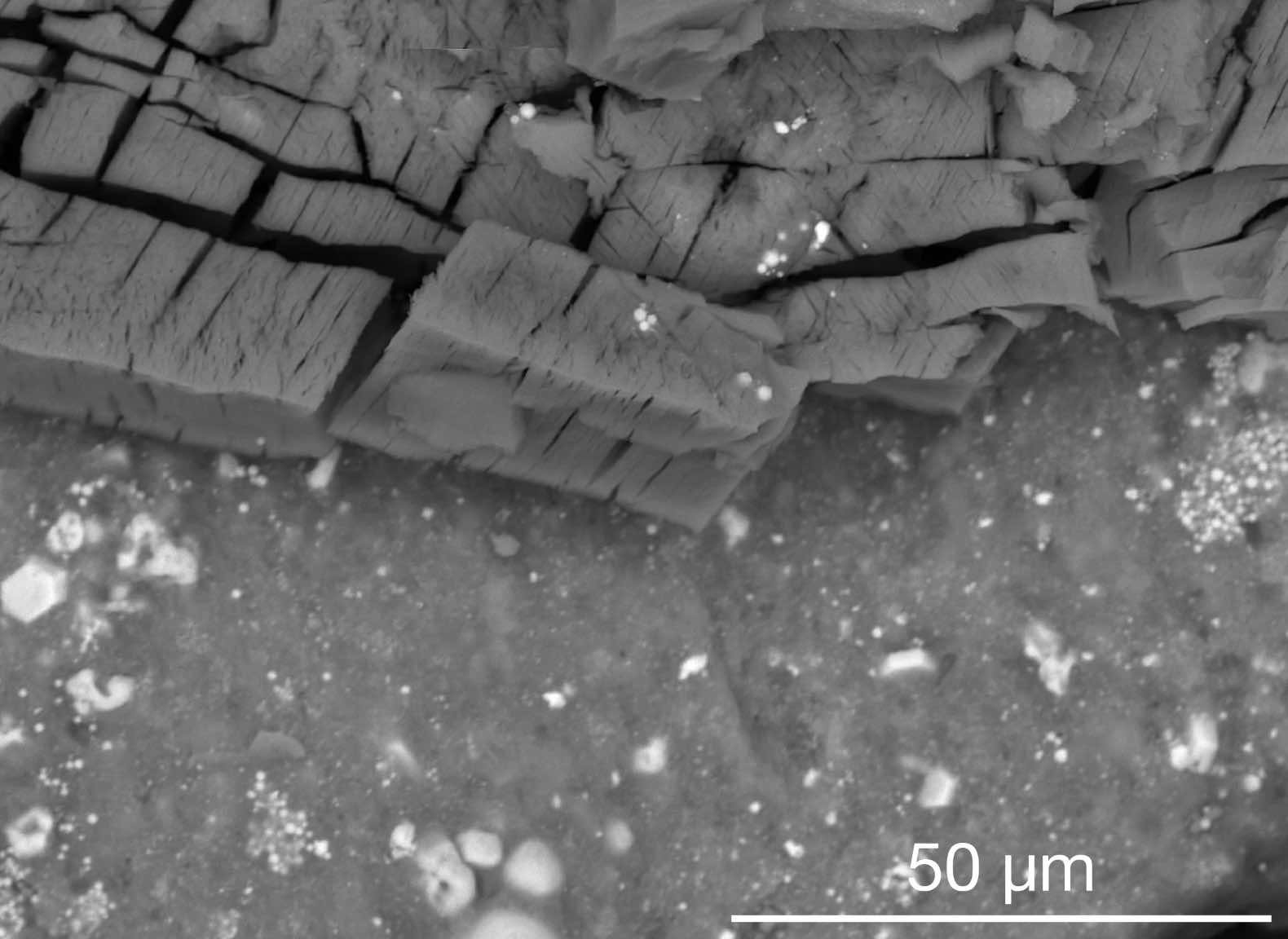
Microscopic view of samples obtained from asteroid Bennu by OSIRIS-REx, revealing a bright vein containing phosphate (Credit: Lauretta & Connolly et al. (2024) Meteoritics & Planetary Science, doi:10.1111/maps.14227.)
This significant finding points to the likelihood that Bennu may have its origins in a small, primitive ocean world since magnesium-sodium phosphate is a water-soluble phosphate that plays a crucial role in Earth’s biochemistry. The detections made in the Bennu samples were also very pure and of a size that set them apart from similar phosphates found in asteroid samples retrieved by JAXA’s Hayabusa2 mission.
Although it seems likely, based on the new data, that Bennu has a history involving interactions with water, the asteroid is still relatively chemically primitive, and somewhat paradoxically, researchers compare the elements it possesses to those of the Sun.
Confirming the presence of carbon and nitrogen in the asteroid samples obtained from Bennu’s surface allows researchers to glean new insights into environments where those elements formed, as well as how they became complex molecules over time. These processes would have once occurred early in Earth’s history, also a process that would have been fundamental in the formation of life.
Retrieving the samples directly from the surface of an asteroid also offered NASA scientists access to a veritable “time capsule” where the materials remained preserved for billions of years. Given their low density, such materials are destroyed when asteroids collide with Earth’s atmosphere, burning up during reentry.
Studying the preserved samples retrieved by OSIRIS-REx has already provided new insights toward understanding the intricate processes of solar system formation and prebiotic chemistry, but researchers involved in the ongoing analysis believe there will likely be more surprises in the near future.
“Each week, analysis by the OSIRIS-REx Sample Analysis Team provides new and sometimes surprising findings,” said Harold Connolly, co-lead author of the new study and OSIRIS-REx mission sample scientist at Rowan University.
Connolly said the ongoing discoveries Bennu’s samples are revealing “are helping place important constraints on the origin and evolution of Earth-like planets.”
The new paper by lead-author Dante Lauretta and colleagues, “Asteroid (101955) Bennu in the laboratory: Properties of the sample collected by OSIRIS-REx,” was published on June 26. Additional information about NASA’s OSIRIS-REx mission can be found on its official web page.
Trump Claims He Has Access To UFO Files. Here's What Experts Say
Donald Trump suggested in a recent interview with celebrity influencer Logan Paul that he has access to UFO files after being asked about what information he had about the existence of alien life.
The former president, appearing on Paul's ImPaulsive podcast, was asked what files or documents he was privy to on unidentified anomalous phenomena (UAP)—the term used by defense officials referring, in part, to sightings of what are colloquially called UFOs.
Trump's conversation comes amid heightened interest in the topic, following thePentagon's release of declassified documents detailing instances reported to it by airmen and other service personnel.
Donald Trump recently claimed he had received briefings about alien life and UFOs while in office. The president was pressed during an interview with celebrity influencer Logan Paul.
REUTERS/GETTY IMAGES
Last summer, 36-year-old Air Force veteran David Grusch caused a media storm after he said that a top-secret U.S. military program had found the wreckage of several fully intact unidentified aerial craft, claiming some of which contained dead nonhuman pilots.
A 2023 report from the Office for the Director of National Intelligence found that there were 510 UAP sightings in 2022, higher than the 366 seen in 2021. Of these, 171 were considered to "appear to have demonstrated unusual flight characteristics or performance capabilities, and require further analysis."
During the podcast, when asked about aliens, Trump said he had spoken to Air Force personnel who had claimed to see aircraft "round in form, going like four times faster than my super jet fighter plane."
"I have met with people that are serious people that say there are some really strange things they see flying around out there," he added.
Pressed whether he had access to information on alien life and UAPs, Trump replied, "I have access...and I speak to people about it, I've had actually meetings on it, and they will tell you there's something going on.
"When they say things, things are going four times faster than my beautiful top-of-the-line airplane that goes, you know, real fast, Mach 2, right?"
Newsweek has contacted media representatives for Donald Trump via email for comment.
Newsweek has also spoken to experts on what access Trump may have and if that privileges him to any information about UFOs while he is no longer in office.
What can Trump access?
The answer to this has been addressed, in part, through the discussion that followed Trump's handling of confidential documents, claiming that he had the authority as a former president to hold on to papers—a claim that Newsweek has previously explored.
There is no evidence to suggest that information on UAPs was among the documents at Mar-a-Lago or otherwise.
Jason R. Baron, former director of litigation at the National Archives and Records Administration (NARA) and a University of Maryland professor, told Newsweek that at the end of a president's time in office, all official presidential records by law come into legal, physical custody of NARA, with any classified documents stored to protect unauthorized access. A former president may request to access records with additional clearances for classified information.
However, Baron said, "Former presidents do not have the right to request presidential records of the incumbent president or records created in presidential administrations other than their own."
Furthermore, under NARA regulations, the incumbent president also has the right to assert executive privilege to withhold records from the former president, with the archivist providing notice of any request made by a former president to the incumbent.
President Joe Biden has restricted Trump from some information, specifically intelligence briefings, arguing the former president could reveal sensitive information. Speaking to CBS Evening News in February 2021, Biden said the decision had been motivated by Trump's "erratic behavior, unrelated to the insurrection."
Asked what his worst fear was if Trump continued to receive the briefings, Biden said: "I'd rather not speculate out loud."
"What value is giving him an intelligence briefing? What impact does he have at all, other than the fact he might slip and say something?"
'Unidentified aerial phenomena' filmed by US Navy pilots. Pic: US Dept of Defence
While this restricts some documentation, these briefings are usually only offered as a courtesy and, in any case, are unlikely to contain information about UAPs unless they present an immediate or near-future security risk.
However, under the Presidential Records Act, Trump can only access material that originated in his four years as president per the archivist's approval, according to Gail Helt, a former CIA official and a professor of political science at King University.
"These would be documents that originated inside his White House, not the intelligence community or DOD," Helt told Newsweek.
"He would have no continued access, nor the right to such continued access, to any classified documents that originated with the CIA, FBI, DOD, etcetera, at all. Those are not his property; those belong to the intelligence community (IC) or, rather, to the nation, which trusts the IC to keep them secret."
Helt added that "if he wanted a briefing on a particular national security issue, or to access the classified intelligence record on UAPs from his four years in office, he would need to request that access from the White House."
There has been no suggestion that the documents found at Mar-a-Lago contained any information on UAPs.
Though Helt said, "I don't think that the fact that classified documents related to UAPs were not mentioned as having been present in the Mar-a-Lago stash suggests that they were not there.
"We don't know exactly what was in that trove of documents, and given the sensitivity of the topic of UAPs generally, I doubt anyone would call out the existence of such documents even in vague terms.
"Such documents could well have been present, and we may never know."
"Reporting and evidence suggests that there are still missing documents or boxes that were not found or searched, perhaps at Bedminster," Lindsay Chervinsky, an award-winning presidential historian, told Newsweek.
"Accordingly, there is no evidence to suggest he has those documents among the items that were collected and returned, but we don't really know what he has that we don't know about."
Some documents released by the Pentagon and NASA on UAPs are declassified and Trump requesting these would be no different from any other member of the public accessing them, with no additional privileges granted to presidents.
An anomalous object shows up on video captured by a Navy fighter jet in 2021.
Credit: AARO / DoD
So what's left?
Based on the descriptions given to experts about Trump's privileges, and the fact that the only papers he could access would be those created in the White House while he was in office—and not from security agencies that are coordinating investigations into UAP sightings—it is not entirely clear what information he could have, if any.
In 2023, Trump told podcast host Hugh Hewitt that he had been briefed about UAPs while in office, saying that he interviewed "a couple of people from the Air Force" without elaborating. This could be the information he may be referring to, but what more those briefings would have revealed beyond the reports that have already been declassified and investigated by the Pentagon isn't clear.
In December 2020, Trump signed a $2.3 trillion government funding bill that also compelled intelligence services to provide Congressional committees with an unclassified report about UAPs, helping the topic's popularity to skyrocket. However, that effort was engineered by Congress, not the president, and Trump was out of office for more than a year by the time it was released.
While it's feasible that Trump may have held notes or information that passed through the White House at some point, when pressed for detail Trump has remained vague.
Considering what little he has said, his limited access to White House documents, no access to Pentagon documents, and the fact that the great deal of Congressional and Washington attention to UAPs has occurred during the Biden presidency, it seems unlikely that Trump is holding on to any wild truths or information not already revealed through committee hearings and Pentagon reports. That does not mean he has nothing, but in all likelihood, whatever he possesses may be pretty slim and inconsequential.
New insights into the function of the world’s oldest analog computer, the famous Antikythera mechanism, have been made with help from an unlikely source: technology developed for the study of gravitational waves.
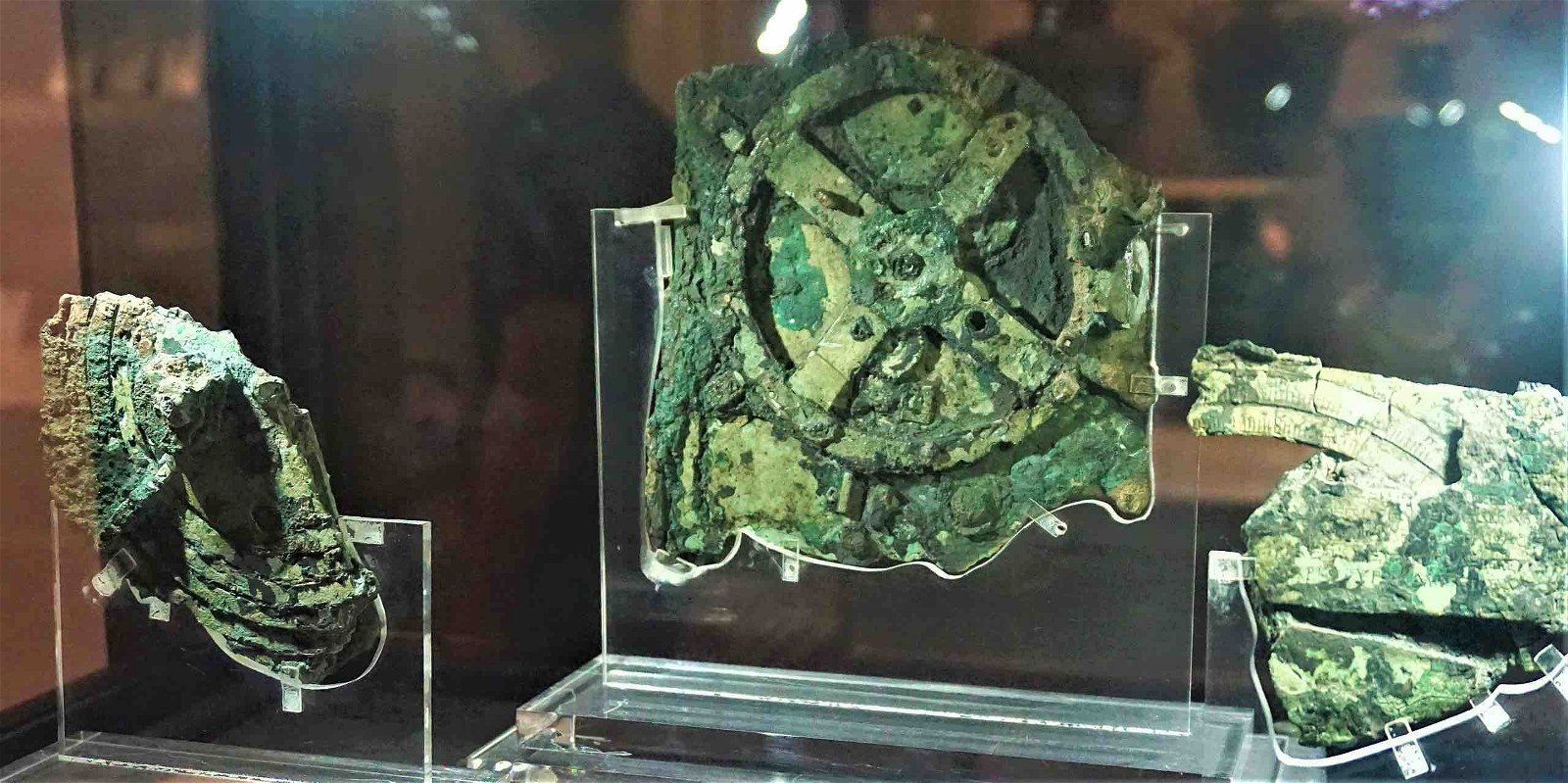
The Antikythera mechanism is regarded as the world’s oldest known analog computing device. An example of precocious “lost” ancient technology, the early science instrument dates back more than 2000 years and was used by astronomers to predict the positions of celestial objects by as much as decades.
Originally discovered among the wreckage of a shipwreck along the Greek island of Antikythera in 1901, the mysterious mechanism has long intrigued modern scientists and engineers, primarily because it appears to be a singular invention, with no other similar devices from this period known to exist.
Now, researchers with the University of Glasgow have employed statistical modeling techniques originally developed for analyzing ripples in spacetime to determine how many holes likely existed in one of the famous Antikythera mechanism’s broken rings.
At the time of its discovery, the Antikythera mechanism was in a highly eroded state, having spent close to two thousand years amidst the wreckage of a ship that sank near the Aegean Island of Antikythera, the device’s namesake.
Roughly the size of a shoebox, the device features an array of intricately tooled gears that are surprisingly complex for any innovation from the second century BCE. Over the decades, studies of the device have revealed that it likely functioned as a hand-operated computer that would have allowed its operator to predict the arrival of eclipses, as well as calculate the positions of planets over time.
The Antikythera mechanism was recovered from a shipwreck in 1901 (Credit: Wikimedia Commons.)
Fast forward to 2020, when X-ray images of one of the device’s components, which researchers identify as its calendar ring, unveiled new features that included a series of regularly spaced holes beneath the ring. Given its highly eroded state, the presence of rings could be discerned, although the number remained unclear, with estimates suggesting anywhere between 347 and 467 of the holes having once existed along this damaged portion of the device.
Now, in new research published in the Horological Journal, Glasgow researchers outline their use of a pair of statistical techniques in a new effort to refine the previously estimated number of holes that once existed in this region of the Antikythera mechanism. Applying Bayesian analysis and, notably, new techniques from gravitational wave research, the team determined that the ring likely contained 354 holes.
This is significant since the 354 holes on the device would have perfectly aligned with the Greek lunar calendar, as opposed to the Egyptian calendar’s 365 holes. Based on the new analysis, the presence of 354 holes is hundreds of times more probable than the previously considered 360-hole count.
Professor Graham Woan, a co-author of the paper, explained that he became interested in the problem after being introduced to data by YouTuber Chris Budiselic, who was creating a replica of the calendar ring.
“Towards the end of last year, a colleague pointed to me to data acquired by YouTuber Chris Budiselic, who was looking to make a replica of the calendar ring and was investigating ways to determine just how many holes it contained.”
Woan said Budiselic’s conundrum “struck me as an interesting problem, and one that I thought I might be able to solve in a different way during the Christmas holidays.” Woan then went to work employing statistical techniques to see if a definitive answer could be obtained.
Dr. Joseph Bayley, a colleague of Woan’s at the University’s Institute for Gravitational Research, further refined the research by adapting techniques used in analyzing LIGO gravitational wave data to study the calendar ring. Their combined approaches, including Markov Chain Monte Carlo and nested sampling, confirmed the probability of 354 or 355 holes with a precision of about 1/3 mm.
Additionally, the new analysis also reveals the extraordinary accuracy of the holes’ placement, with an average radial variation of just 0.028mm. According to Bayley, the use of these dual approaches to resolving the lingering questions about the Antikythera mechanism showcases the truly remarkable skill employed by the device’s mysterious builder(s).
“It’s given me a new appreciation for the Antikythera mechanism and the work and care that Greek craftspeople put into making it,” Bayley said. “[T]he precision of the holes’ positioning would have required highly accurate measurement techniques and an incredibly steady hand to punch them.”
Professor Woan says using contemporary techniques to study an ancient device designed to track celestial events will enhance the research community’s appreciation of ancient technological achievements like the Antikythera mechanism, which represents a singularly unique and innovative construction.
“We hope that our findings about the Antikythera mechanism, although less supernaturally spectacular than those made by Indiana Jones, will help deepen our understanding of how this remarkable device was made and used by the Greeks,” Woan said in a statement.
Woan and Bayley’s study, “An Improved Calendar Ring Hole-Count for the Antikythera Mechanism,” appeared in the July 2024 issue of The Horological Journal.
A couple were left stunned after they spotted UFOs 'as bright as the sun' hovering above a river in Canada.
Justin Stevenson and his wife Danielle Daniels-Stevenson were driving through Fort Alexander on May 14 when they saw the bright lights above the Winnipeg River.
Several sun-like flying objects were spotted above the Winnipeg River in Canada.Kennedy News & Media
Kennedy News and Media
He pulled over at a clearing where Danielle, 32, filmed two 'sun-like' balls of light floating above the tree line without making a sound.
Justin, 49, can be heard declaring 'I think we're seeing some aliens' as another two appear 'from nowhere' and begin moving downwards.
Other clips show two UFOs continuing to hover while the bemused pair sit in their vehicle for half an hour to watch them.
Observers called the footage a “strange anomaly” and “a clear shot of UFOs.
”Kennedy News & Media
Justin, previously a sceptic of extraterrestrial life, said the experience felt 'like he was in a sci-fi movie' and it's given him 'proof there's something out there other than humans'.
Danielle posted one of the clips on Facebook later that night where it's been viewed more than 650,000 times with users calling it a 'strange anomaly' and 'a clear shot of UFOs'.
Others have claimed they're helicopters, drones or flares dropped from planes but mechanic Justin disagrees and is adamant there's no explanation for the sighting.
Justin, from Manitoba, Canada, said: 'My wife saw lights and we were confused at what they were so we drove to a clearing where we could see properly.
'There were two really bright lights above the river almost like the sun shining but the sun had set by this time. They were super bright like a fire in the sky.
'They were sitting above the tree line for the longest time then they started to move down and then two more popped up right out of nowhere.
'There were six all together and they didn't even make a sound.
'I just thought 'what the f**k?'. That's when I realized it wasn't a fire and I questioned if it was aliens.
Justin Stevenson and his wife Danielle Daniels-Stevenson were driving through Fort Alexander on May 14 when they spotted bright lights above the Winnipeg River
He pulled over at a clearing where Danielle, 32, filmed two 'sun-like' balls of light floating above the treeline without making a sound
Justin, 49, can be heard declaring 'I think we're seeing some aliens ' as another two appear 'from nowhere' and begin moving downwards
'It was pretty surreal and it felt like we were in a sci-fi movie.
'I was skeptical before I saw this but now this has given me the proof I need that there's something out there other than humans.
'There's no explanation so we posted it because we wanted people to describe for themselves what that is.
'The naysayers can have their opinion but I disagree.'
Danielle's post read: 'We saw this just a few mins ago. What is it? It lasted like half an hour.'
Social media users were quick to offer their thoughts on what the UFO could be
One social media user commented: 'Oh wow!! You're brave to record this. I would've taken off.'
A second wrote: 'Oh my word! What is that? Pretty scary that it's so close to home, yikes!'
A third added: 'That is one strange anomaly.'
A fourth said: 'UFO that's a nice clear shot ... Wow.'
However some disagreed and wrote: 'Looks like helicopters.'
Another commented: 'It could be flares that planes drop.'
Australian intelligence officials met with their United States counterparts to discuss "unidentified anomalous phenomenon collection planning", documents released under freedom of information laws show.
WATCH: An unidentified object has illuminated the sky in Northern Territory on Thursday, May 25, 2023.
The meeting was held at the Pentagon in May 2023 and involved the so-called Five Eyes - US, Australia, Canada, UK, New Zealand - to brief the alliance about UAPs, the modern term for UFOs.
The Australian Defence Force previously denied attending the briefing, however the agenda released by the US government shows the Five Eyes alliance met for a "caucus working group" to "cultivate shared awareness of allies' UAP issues, detection, and mitigation activities and challenges".
The allies discussed the need for "networks to share Five Eyes UAP reporting", including documents marked "top secret" and "special intelligence".
"The intention is to develop a framework for future UAP collaboration," one document said.
The document also highlighted the need to share databases "showing known objects using various sensors".
It's unclear if the "UAP collection planning" discussion was related to the collection of data or crashed craft.
It should be noted the term UAP can apply to objects such as drones or the Chinese surveillance balloon, which caused an international incident when it flew over the US and Canada, and was subsequently shot down, in early 2023.
Australia discussed future UAP collobration plans with its Five Eyes allies.
Image digitally altered
In November, it was reported a wing of the CIA - the Office of Global Access - coordinated the retrieval of crashed UAPs around the world.
The briefing flagged sharing "Talent Keyhole" data, which is among the USA's most highly-classified data and refers to the information collected by satellites, spy planes and other sensor data.
Each country, including Australia, presented their allies with an update on their latest internal UAP information.
The meeting closed with a conversation about the future UAP meeting scheduling, along with talks about what other Five Eye forums the issue could be tied into, such as "emerging and disruptive technologies".
Australian Defence Force quiet on UAPs
WATCH: NASA held its first public meeting to show footage of UAPs.
The Australian Defence Force has refused to officially acknowledge any interest in the subject, and says it does not collect UAP reports, as "there was no scientific or other compelling reason to continue to devote resources to the recording and investigation of unidentified aerial phenomena".
ACM, publisher of this masthead, asked Defence Minister Richard Marles if Australia had discussed sharing UAP data and reports, or a UAP collaboration plan with its allies.
However, Mr Marles declined to respond to questions. Instead, the Department of Defence pointed to the Australian representative attending the Five Eyes meeting.
Last year, the Department of Defence denied attending the Five Eyes UAP briefing multiple times, including in a response to a question on notice by Greens senator Peter Whish-Wilson in the May Senate estimates
Internal talking points prepared the day after the The Canberra Times' story (February 11), and secured under freedom of information, reveal Defence was unaware it had a representative at the Five Eyes briefing when responding to questions and FOI requests.
"On 2 November 2023, Senator [Peter] Whish-Wilson submitted a question on notice asking whether Defence attended the UAP Forum ... in responding to this QoN, Defence identified a Defence representative from the Australian Embassy in Washington had attended the UAP Forum," the memo stated.
It's also understood the representative was from one of Australia's intelligence agencies.
An FOI request relating to the Washington representative was refused under Section 7(2A), which states intelligence agencies are exempt from the FOI Act.
Freedom of information reveals department briefings
Briefing notes prepared for Air Marshal Robert Chipman and Defence Chief Science Professor Tanya Monro state "the United States has shared intelligence on UAP".
"Defence will continue to monitor and engage with the [All-domain Anomaly Resolution Office] on UAP, especially if they are deemed to be a security or safety threat," the document stated.
The FOI dossier also revealed the Australian Space Agency requested information from the Defence Space Command to prepare a brief on "unidentified aerial phenomenon".
The Canberra Times asked ASA who the brief was prepared for, if it was internal or for a minister, to what extent the ASA leadership had been brief on UAPs and if the organisation had engaged with NASA on the topic of UAPs.
However, ASA refused to respond to questions.
"The Australian Space Agency does not comment on internal briefings," a spokesperson said.
Meer van UFO'S of UAP'S, ASTRONOMIE, RUIMTEVAART, ARCHEOLOGIE, OUDHEIDKUNDE, SF-SNUFJES EN ANDERE ESOTERISCHE WETENSCHAPPEN - DE ALLERLAATSTE NIEUWTJES


 50-Minute Global UFO Sightings Compilation: Explore the Unexplained