Naar de inhoud

UFO'S of UAP'S, ASTRONOMIE, RUIMTEVAART, ARCHEOLOGIE, OUDHEIDKUNDE, SF-SNUFJES EN ANDERE ESOTERISCHE WETENSCHAPPEN - DE ALLERLAATSTE NIEUWTJES

UFO's of UAP'S in België en de rest van de wereld
akke.beakke.be
Ontdek de Fascinerende Wereld van UFO's en UAP's: Jouw Bron voor Onthullende Informatie! Ben jij ook gefascineerd door het onbekende? Wil je meer weten over UFO's en UAP's, niet alleen in België, maar over de hele wereld? Dan ben je op de juiste plek! België: Het Kloppend Hart van UFO-onderzoek In België is BUFON (Belgisch UFO-Netwerk) dé autoriteit op het gebied van UFO-onderzoek. Voor betrouwbare en objectieve informatie over deze intrigerende fenomenen, bezoek je zeker onze Facebook-pagina en deze blog. Maar dat is nog niet alles! Ontdek ook het Belgisch UFO-meldpunt en Caelestia, twee organisaties die diepgaand onderzoek verrichten, al zijn ze soms kritisch of sceptisch. Nederland: Een Schat aan Informatie Voor onze Nederlandse buren is er de schitterende website www.ufowijzer.nl, beheerd door Paul Harmans. Deze site biedt een schat aan informatie en artikelen die je niet wilt missen! Internationaal: MUFON - De Wereldwijde Autoriteit Neem ook een kijkje bij MUFON (Mutual UFO Network Inc.), een gerenommeerde Amerikaanse UFO-vereniging met afdelingen in de VS en wereldwijd. MUFON is toegewijd aan de wetenschappelijke en analytische studie van het UFO-fenomeen, en hun maandelijkse tijdschrift, The MUFON UFO-Journal, is een must-read voor elke UFO-enthousiasteling. Bezoek hun website op www.mufon.com voor meer informatie. Samenwerking en Toekomstvisie Sinds 1 februari 2020 is Pieter niet alleen ex-president van BUFON, maar ook de voormalige nationale directeur van MUFON in Vlaanderen en Nederland. Dit creëert een sterke samenwerking met de Franse MUFON Reseau MUFON/EUROP, wat ons in staat stelt om nog meer waardevolle inzichten te delen. Let op: Nepprofielen en Nieuwe Groeperingen Pas op voor een nieuwe groepering die zich ook BUFON noemt, maar geen enkele connectie heeft met onze gevestigde organisatie. Hoewel zij de naam geregistreerd hebben, kunnen ze het rijke verleden en de expertise van onze groep niet evenaren. We wensen hen veel succes, maar we blijven de autoriteit in UFO-onderzoek! Blijf Op De Hoogte! Wil jij de laatste nieuwtjes over UFO's, ruimtevaart, archeologie, en meer? Volg ons dan en duik samen met ons in de fascinerende wereld van het onbekende! Sluit je aan bij de gemeenschap van nieuwsgierige geesten die net als jij verlangen naar antwoorden en avonturen in de sterren! Heb je vragen of wil je meer weten? Aarzel dan niet om contact met ons op te nemen! Samen ontrafelen we het mysterie van de lucht en daarbuiten.

Archief

Would You Trust Robot to Look After Your Cat?

Would You Trust Robot to Look After Your Cat?

Scientists from the University of Nottingham and artists from Blast Theory have created Cat Royale, a multispecies world centered around a bespoke enclosure in which three cats and a robot arm coexist for six hours a day during a twelve-day installation.

“From cleaning our homes, to mowing our lawns, to delivering shopping and couriering items around hospitals, robots are finding their place in daily life,” said University of Nottingham’s Professor Steve Benford and colleagues.

“As they do so, they will inevitably interact with and be encountered by animals.”

“These might be companion animals, the pets who share our homes or the guide dogs who help us navigate public places, but they might also be wildlife.”

“Often these encounters will be unplanned and secondary to the robot’s intended task, for example cats riding Roombas, guide dogs being confused by delivery robots, or hedgehogs having to navigate in a world inhabited by lawn mowing robots.”

“However, they could also be intentional. We could design robots to serve animals too.”

“Despite the inevitability of such encounters, planned or otherwise, little is known about how to design robots for animals. Can we even trust them with each other?”

“We present Cat Royale, a creative exploration of designing a domestic robot to enrich the lives of cats through play.”

Schneiders et al. suggest it takes more than a carefully designed robot to care for your cat, the environment in which they operate is also vital, as well as human interaction. Image credit: Schneiders et al., doi: 10.1145/3613904.3642115.

Schneiders et al. suggest it takes more than a carefully designed robot to care for your cat, the environment in which they operate is also vital, as well as human interaction.

Image credit: Schneiders et al., doi: 10.1145/3613904.3642115.

Cat Royale was launched in 2023 at the World Science Festival in Brisbane, Australia and has been touring since, it has just won a Webby award for its creative experience.

The installation centered around a robot arm offering activities to make the cats happier, these included dragging a ‘mouse’ toy along the floor, raising a feather ‘bird’ into the air, and even offering them treats to eat.

The team then trained an AI to learn what games the cats liked best so that it could personalize their experiences.

“At first glance, the project is about designing a robot to enrich the lives of a family of cats by playing with them,” Professor Benford said.

“Under the surface, however, it explores the question of what it takes to trust a robot to look after our loved ones and potentially ourselves.”

Working with Blast Theory to develop and then study Cat Royale, the researchers gained important insights into the design of robots and its interactions with the cats.

They had to design the robot to pick up toys, deploy them in ways that excited the cats, while it learned which games each cat liked.

They also designed the entire world in which the cats and the robot lived, providing safe spaces for the cats to observe the robot and from which to sneak up on it, and decorating it so that the robot had the best chance of spotting the approaching cats.

The implication is designing robots involves interior design as well as engineering and AI.

If you want to introduce robots into your home to look after your loved ones, then you will likely need to redesign your home.

“As we learned through Cat Royale, creating a multispecies system — where cats, robots, and humans are all accounted for — takes more than just designing the robot,” said Dr. Eike Schneiders, a researcher at the University of Nottingham.

“We had to ensure animal wellbeing at all times, while simultaneously ensuring that the interactive installation engaged the (human) audiences around the world.”

“This involved consideration of many elements, including the design of the enclosure, the robot and its underlying systems, the various roles of the humans-in-the-loop, and, of course, the selection of the cats.”

  • The authors presented their results at the CHI 2024 conference in Honolulu, Hawai’i.
  • Eike Schneiders et al. Designing Multispecies Worlds for Robots, Cats, and Humans. CHI ‘24: Proceedings of the CHI Conference on Human Factors in Computing Systems, article #593; doi: 10.1145/3613904.3642115

{ https://www.sci.news/ }

Hoe vind je dit bericht?
Geschreven door peter om 12:31 Stuur door

Het onmisbare spektakel van het Noorderlicht die de wereld verbaasde met de geomagnetische storm

Het onmisbare spektakel van het Noorderlicht die de wereld verbaasde met de geomagnetische storm

Janine image Door Janine

52090.jpg

De snelle opeenvolging van krachtige zonnestormen van de afgelopen dagen heeft de hemel van ons noordelijk halfrond beschilderd en ons een prachtig Noorderlicht gegeven. Maar hoe ontstaat dit fenomeen?

Noorderlicht en Zuiderlicht, het “geschenk” van de zonneactiviteit

NOAA Space Weather Prediction Center

De afgelopen dagen heeft de geomagnetische storm die werd veroorzaakt door de voortdurende zonnevlammen als gevolg van de inkomende piekactiviteit van de zon, die een cyclus van elf jaar heeft, niet alleen radio- en communicatieproblemen veroorzaakt in verschillende delen van de wereld, maar ook burgers van de VS, Canada, Europa en China in staat gesteld om getuige te zijn van een uniek en uiterst indrukwekkend natuurspektakel: het Noorderlicht.

De gekleurde halo's aan de nachtelijke hemel - zichtbaar door de afwezigheid van zonlicht - waren meerdere dagen zichtbaar. Het Noorderlicht is het resultaat van een moleculaire botsing in de bovenste lagen van de atmosfeer van de aarde, die uitbarstingen van energie veroorzaakt. Deze energie manifesteert zich in zichtbaar licht aan de hemel, maar dat kunnen we alleen opmerken in de uren dat het donker is. Maar het is niet het enige dat verbaasde toeschouwers betovert: er is ook de aurora australis (Zuiderlicht), die voorkomt op het zuidelijk halfrond en in de eerste helft van het jaar zichtbaar is in sommige regio's in de buurt van de twee aardpolen.

De sterkste zonnestorm sinds decennia

Het poollicht beweegt zich van de polen naar de evenaar tijdens perioden van maximale activiteit, zoals de afgelopen dagen het geval was. De krachtige geomagnetische storm heeft onze planeet bereikt en ontketende spectaculaire nachtelijke spektakels over de hele wereld. Dit is een historische gebeurtenis: op 10 mei bereikte de storm het hoogste niveau op de schaal die begint met G1 en classificeerde zichzelf als G5, kondigde NOAA, de National Oceanic and Atmospheric Administration, aan. Dit is in tientallen jaren niet gebeurd.

Na een reeks coronale massa ejecties, materiaal dat uit de corona van de zon wordt uitgestoten en deze fenomenen kan veroorzaken, werd de hemel een heel weekend lang overspoeld door Noorderlicht, zoals het Space Weather Prediction Center van NOAA aankondigde. De zonnestorm was de sterkste in twee decennia, door de krachtige geladen energieën die vanaf de zon de ruimte in explodeerden. Hoewel het geen gevaar voor ons vormt, kan het elektronische apparaten aantasten, waaronder satellieten in een baan om de aarde.

Hoe het Noorderlicht ontstaat

Poollicht goed zichtbaar tijdens geomagnetische storm in Loveland Pass, Colorado

Dan McManus - SPACE WEATHER PREDICTION CENTER/NOAA

Brian Cox, natuurkundige en ruimtevaartdeskundige, zei: "Zonder het magnetische veld van de aarde dat ons beschermt, zou onze atmosfeer allang verloren zijn gegaan in de ruimte. Die kleuren aan de hemel herinneren de natuur ons eraan dat we blij mogen zijn dat we hier zijn."

De afgelopen jaren hebben we een zeer actieve zon meegemaakt, met talloze coronale massa-uitbarstingen die op onze planeet gericht waren. Juist hierdoor kunnen we de poollichten zien: de coronale massa-uitstoot lanceert geladen deeltjes de ruimte in, die wanneer ze de gassen van de atmosfeer van de aarde raken, zoals zuurstof en stikstof, deze prachtige lichten doen ontstaan. Zuurstofatomen worden groen, stikstofatomen worden blauw, roze en violet.

De hemel heeft zo voor wonderbaarlijke verrassingen gezorgd, die heel veilig met het blote oog zichtbaar waren.

{ https://www.curioctopus.nl/ }

Hoe vind je dit bericht?
Geschreven door peter om 12:21 Stuur door

Top 4 UFOs Spotted Flying in American Air Space

Top 4 UFOs Spotted Flying in American Air Space

Top 4 UFOs Spotted Flying in American Air Space

UFO sightings have long captured the public’s imagination, and recent events in the United States have reignited interest in the phenomenon. Here are four intriguing UFO sightings in American airspace that have sparked both fascination and debate.

1. February 3rd, 2023 – Billings, Montana

On February 3rd, 2023, Dolly Mills Moore, a military veteran, was finishing her workday in Billings, Montana, when she noticed something unusual outside her window. She saw a trail of smoke pointing toward the ground, followed by a bright flash in the sky. This sighting came just two days after a Chinese high-altitude surveillance balloon was spotted over Billings, adding to the intrigue.

Dolly’s video quickly went viral, raising questions about whether it was related to the balloon incident. Aviation expert Tim McMillan analyzed the footage and concluded that the trail was likely a vapor trail from an aircraft, not a UFO. Meteorologist Juan Hernandez added that the conditions that day were conducive to contrail formation. The verdict: a conventional aircraft contrail, unrelated to the spy balloon.

2. January 31st, 2022 – Cape Canaveral, Florida

During a SpaceX Falcon 9 rocket launch on January 31st, 2022, a couple in Fort Lauderdale noticed two bright lights following the rocket as it ascended. This sighting led to speculation that UFOs were monitoring the launch.

Aviation and military expert Tim McMillan suggested the lights could be rocket boosters or reflections. Astronomer Mark D’Antonio explained that such lights could be atmospheric effects caused by the rocket plume, known as supersonic shock waves. The verdict: natural atmospheric phenomena associated with the rocket launch.

3. December 1st, 2022 – Fredonia, Wisconsin

On December 1st, 2022, Ken Be captured a video of four lights streaking across the night sky in Fredonia, Wisconsin. The next evening, similar lights were seen in Greenfield, Wisconsin. Given Wisconsin’s long history of UFO sightings, these videos garnered significant attention.

Science writer and video analyst Mick West investigated and discovered that the lights were spotlights from local Christmas displays. Using triangulation and eyewitness accounts, West pinpointed the source of the lights to holiday decorations. The verdict: Christmas spotlights.

4. February 2022 – Colorado Springs, Colorado

In February 2022, Bruce Lony filmed a long, dark object hovering in the sky over Colorado Springs. Historical references to worm-like flying objects in various cultures fueled speculation about the object’s origin.

Aviation analyst Tim McMillan considered the possibility of the object being a kite, given its consistent orientation towards the ground. However, video effects designer and astronomer Mark D’Antonio proposed it was a solar balloon. These balloons, heated by the sun, can rise and move in the air. The verdict: a solar balloon.

VIDEO:

  • The Proof Is Out There: Top 4 UFOs Spotted Flying in American Air Space

These recent UFO sightings highlight the blend of curiosity and skepticism that surrounds unidentified aerial phenomena. While some sightings can be attributed to conventional explanations like aircraft contrails, rocket boosters, and holiday lights, others remain intriguing due to their unique characteristics. As technology and surveillance improve, the line between the unexplained and the explicable continues to blur, keeping the mystery of UFOs alive.

{ https://www.latest-ufo-sightings.net/ }

Hoe vind je dit bericht?
Geschreven door peter om 11:08 Stuur door

'God of Destruction' asteroid Apophis will come to Earth in 2029 — and it could meet some tiny spacecraft

'God of Destruction' asteroid Apophis will come to Earth in 2029 — and it could meet some tiny spacecraft

Afbeelding

An illustration of the "God of Destruction" asteriod Apophis as it makes a close approach to Earth in April 2029 
(Image credit: Jonathan Männel / with Eyes on the Solar System, NASA/JPL)

In just under half a decade, a 1,000-foot-wide (305-meter-wide) asteroid named after the Egyptian god of chaos and destruction, Apophis, will pass within 30,000 miles (48,300 kilometers) of Earth. Scientists don't intend to allow the rare close passage of a space rock of this size to go to waste. 

On April 13, 2029 — a Friday, no less — when Apophis, formally known as (99942) Apophis, makes its closest approach to Earth, it will become so prominent over our planet that it will visible with the unaided eye. NASA's OSIRIS-APEX spacecraft (once known as OSIRIS-REx) will be on hand to meet the near-Earth asteroid (NEA) personally. But, if things shape up, that NASA mission could be joined by a host of little satellites during its rendezvous.

Under the auspicious "NEAlight" project, a team from Julius-Maximilians-Universität Würzburg (JMU) and led by space engineer Hakan Kayal has revealed three concepts for such spacecraft. Each of the suggested satellites will aim to exploit this asteroid passage because Earth experiences just once such event every millennium. The goal? To collect data that could help scientists better understand the solar system, and perhaps even aid in the development of defense measures against dangerous asteroids.

As to why Apophis is an apt target for a planetary defense study? Well, discovered in 2004, the asteroid quickly rose to the top of tables that measure the risk of so-called potentially hazardous asteroids (PHAs), or asteroids with widths of 460 feet (140 meters) or more that come within 20 lunar distances of Earth.

Both the size of Apophis and how close to Earth its trajectory brings it saw the asteroid remain at the top of both the European Space Agency's (ESA's) "impact risk list" of PHAs and NASA's Sentry Risk Table for 17 years. That was until a close flyby of the asteroid — a space rock that is almost as wide as the Empire State Building is tall — in March 2021 allowed NASA scientists to determine Apophis actually won't hit the Earth for at least 100 years. 

Though we now know Apophis won't collide with Earth in the next century, its scientific impact in 2029 will still be tremendous, and space agencies from countries across the globe will be closely tracking its trajectory.

Plus, as an asteroid that formed around the same time as the planets from leftover material around the infant sun, Apophis also offers researchers a unique opportunity to determine what the solar system's chemical composition was around 4.6 billion years ago

Meet the rendezvous candidates

Despite the fact that we are aware of around 1.3 million asteroids in the solar system, of which 2,500 are considered potentially hazardous (though none are expected to hit Earth for at least a century), spacecraft missions to study asteroids are relatively rare.

Thus far, only 20 missions have been deployed to study asteroids in situ, including the aforementioned OSIRIS-REx, Japan's Hayabusa1 and Hayabusa2 crafts, the ESA's Rosetta space probe, and the asteroid-hopping NASA mission Lucy, currently journeying to the Trojan asteroids that share their orbit with Jupiter.  Thus, the JMU team must carefully consider its options when considering a future asteroid-investigating spacecraft. 

An illustration of the OSIRIS-REx mission, which was renamed OSIRIS-APEX, has a date with Apophis in 2029.  (Image credit: NASA)

The team's first concept is a small satellite that will join Apophis for a period of two months as it makes its close approach to Earth in April 2029. The craft will stick with the "God of Destruction" space rock for weeks after, even as it moves away. Over the course of the mission, this German national spacecraft will photograph Apophis and make measurements documenting any changes the NEA undergoes during its flyby.

This particular mission would be a challenging one because of its duration, the distance it will be required to travel, and the fact that the craft will have to function autonomously for long periods. It would also have to launch at least a year before Apophis arrives in Earth's vicinity.

The possible appearance of a small satellite sent to investigate Apophis as it visits Earth in April 2029  (Image credit: SATEX team / University of Würzburg)

The team's second concept involves integration with a larger spacecraft that's being planned by the ESA called RAMSES. This mission will be outfitted with smaller satellites, measuring equipment and telescopes. RAMSES, named after Egyptian pharaoh Ramesses the Great, would journey to Apophis and stay with the asteroid as it passes Earth.

If the second concept reaches fruition, one of the small satellites carried by RAMSES will be designed by the JMU team, with this project requiring less technical effort than the first concept while promising to reap greater scientific knowledge. 

One of the primary issues the second concept faces, however, has to do with getting REMESES off the ground — not literally, but figuratively. It's success will depend on the willingness of ESA partner countries to fund the mission. Again, a lead time of at least 365 days would be needed to ensure the success of this concept.

The third concept involves a small satellite that will only briefly fly past Apophis when the asteroid is at its absolute closest to Earth, snapping images of the asteroid in the process. This concept would require much less effort, and the craft would be relatively inexpensive.

The downside of concept 3, however, is that its observation time would be limited, which would also limit the volume of knowledge this mission would add to our understanding of asteroids.

On the plus side, the small-scale mission could launch just two days before Apophis arrives. Also, if concept 3 were to successfully observe Apophis, it would demonstrate the capability of small and inexpensive satellites in studying asteroids, perhaps leading to an increased interest for in situ asteroid-studying missions going forward.

The NEAlight project kicked off at the beginning of May 2024; between now and April 30, 2025, the JMU scientists will work out the requirements and specificities of the respective missions.

Beyond the visit of Apophis, the three concepts considered could remain options for future missions to other solar system planets, the moon — or maybe other intriguing NEAs.

Animation of the orbits of Earth and Apophis showing how often they cross each other.

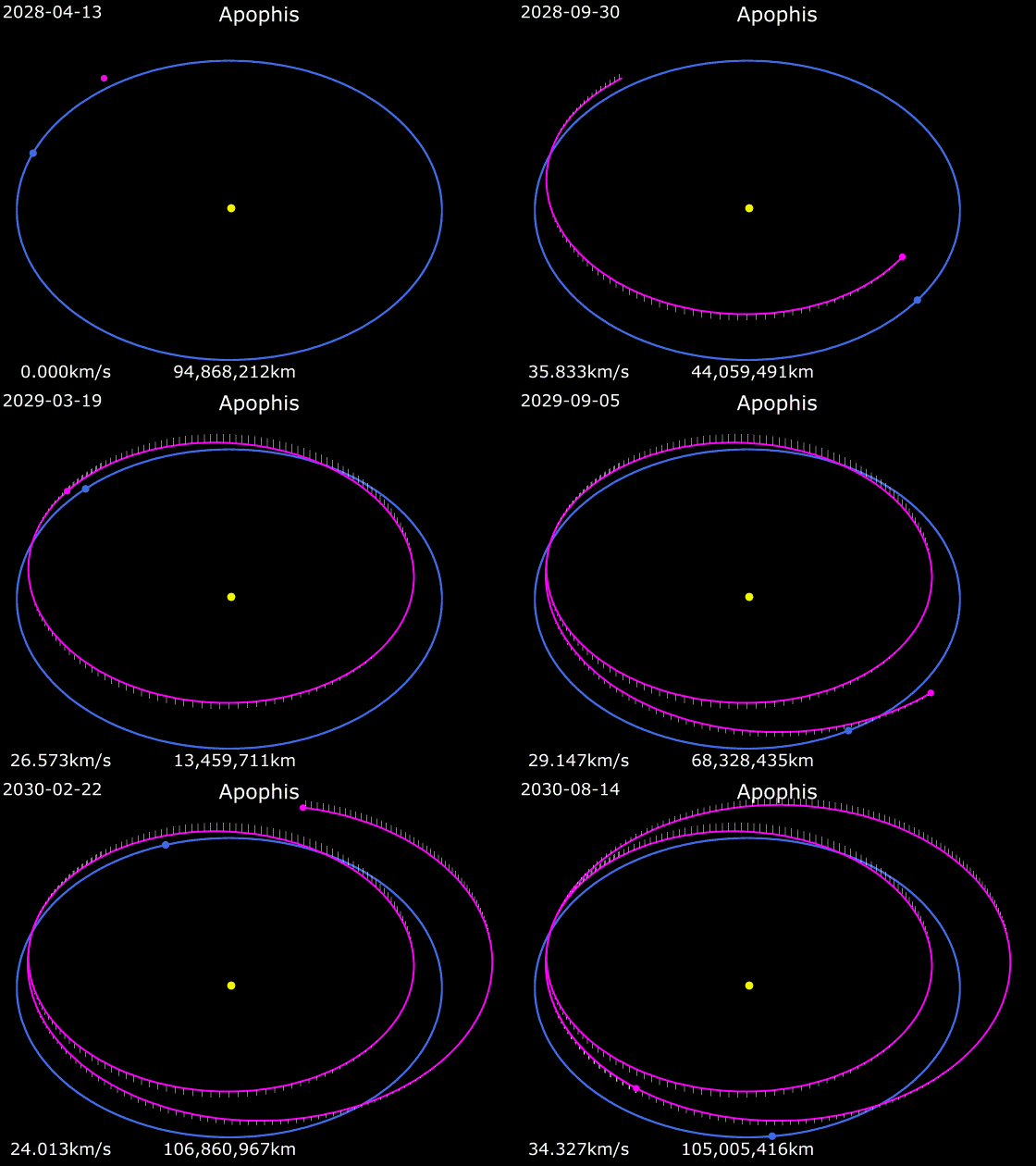
Orbit of asteroid Apophis (pink) in contrast to the orbit of Earth (blue), from the years 2028 to 2030. The yellow dot represents the sun. Apophis takes 323.6 days to orbit the sun. Earth takes 365.3 days. Thus this asteroid is a fairly frequent visitor to our region of space.

Image via Phoenix7777/ Wikimedia Commons.

asteroid-apophis-2029.gif

This animation shows the distance between the Apophis asteroid and Earth at the time of the asteroid’s closest approach in 2029. The blue dots are manmade satellites orbiting our planet, and the pink represents the International Space Station.

Image via NASA/ JPL-Caltech.

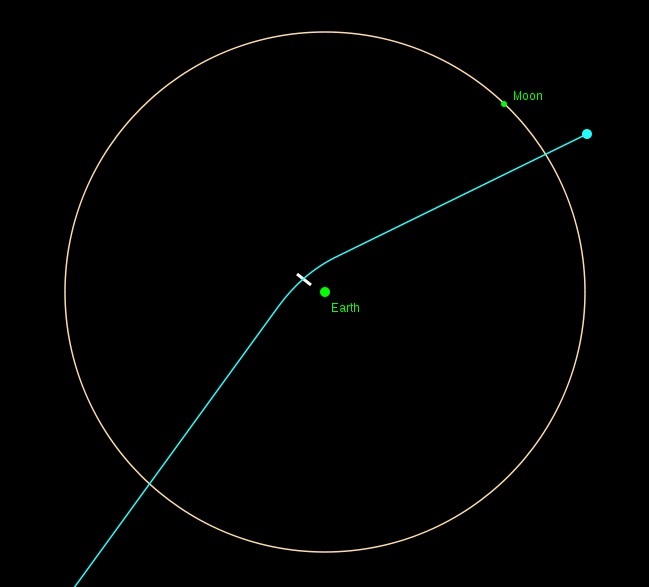
Diagram of Earth with moon's orbit and a line coming very close to Earth, slightly bent as it passes.

As a result of the extremely close approach of April 2029, it is expected that perturbations caused by Earth’s gravity will change Apophis’ orbit from the Aten to the Apollo class. Image via Marco Polo/ Wikimedia Commons.

LINKS VIDEOS

{ https://www.space.com/ }

Hoe vind je dit bericht?
Geschreven door peter om 01:40 Stuur door

1600-YEAR-OLD STONE INSCRIBED IN MYSTERIOUS ANCIENT LANGUAGE UNEARTHED IN ACCIDENTAL DISCOVERY

qrgguUZ0?format=jpg&name=900x900

1600-YEAR-OLD STONE INSCRIBED IN MYSTERIOUS ANCIENT LANGUAGE UNEARTHED IN ACCIDENTAL DISCOVERY

A curious-looking stone inscribed with a mysterious ancient language uncovered by a teacher near Coventry, England, has revealed a rare window to the region’s ancient history.

While working in his garden, geography teacher Graham Senior discovered a peculiar rock amidst the overgrown weeds in his flowerbed. Removing it from the surrounding earth revealed a rectangular wedge of sandstone bearing a series of unusual markings along its face

Unable to decipher the strange set of inscriptions along the face of the artifact, Senior reached out to a local archaeologist for assistance with the unique find. Soon, experts were able to determine that the object he retrieved from his garden bore inscriptions in an Early Medieval alphabet that was once used in the British Isles to convey early variants of the Irish language.

THE OGHAM ENIGMA

Today, historians and archaeologists are aware of just a few hundred ogham inscriptions throughout Ireland and parts of Britain, with the largest concentrations located in southwestern Ireland around Munster and in a few locations in Great Britain, including Pembrokeshire, Wales.

Existing examples of this ancient language show that it was used to convey individuals’ names in most cases. Sources in early Irish literature that detail two-word kennings offering explanations for the meanings of words in the Ogham alphabet indicate that most of the markings are named for various trees found in the British Isles.

Senior’s unique discovery is believed to date to the fifth or sixth century and provides archaeologists with another example of this enigmatic ancient script used prior to the adoption of the vellum manuscripts, which offers modern researchers a glimpse at the Irish language as it was conveyed before the institution of Latin insular script.

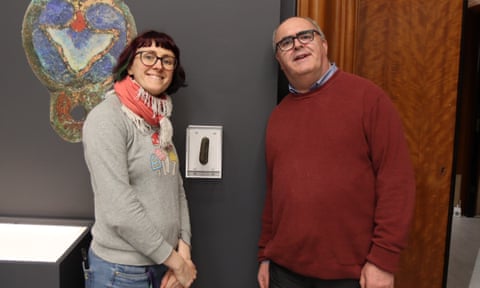
Graham Senior and Ali Well with stone on display

Graham Senior, finder of the stone, with Ali Wells, exhibition curator at the Herbert Art Gallery and Museum in Coventry. 

Photograph: The Herbert Art Gallery and Museum.

AN ACCIDENTAL DISCOVERY

At just 11 centimeters in length and weighing less than 140 grams, Senior was perplexed by the markings on the stone, although it seemed clear that they weren’t formed by any natural process and were “not scratchings of an animal.”

ancient language

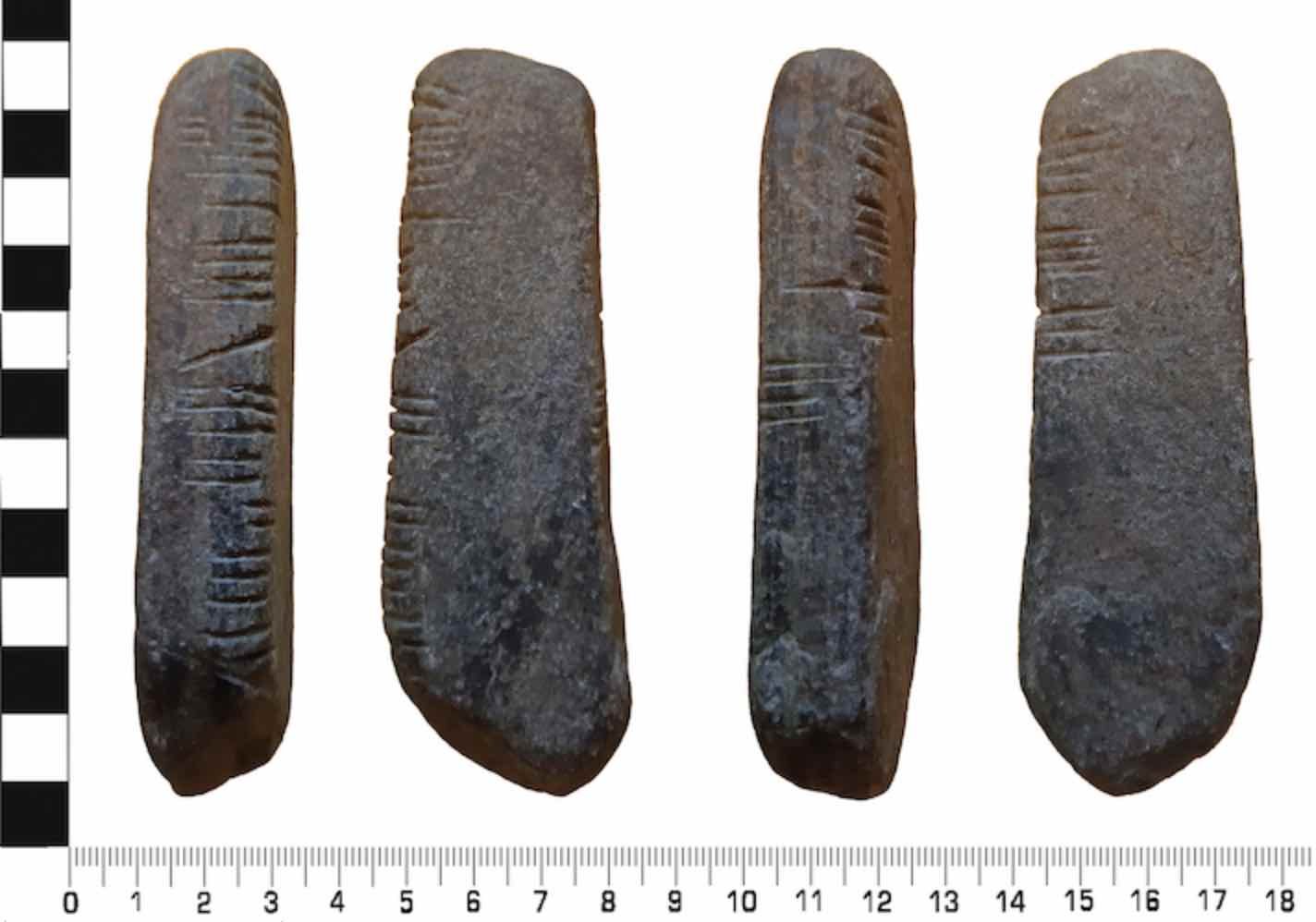
The stone artifact unearthed by Senior near Coventry, bearing examples of the ancient language known as Ogham

(Credit: Birmingham Museums Trust).

The surprise discovery prompted him to reach out to a relative who specialized in archaeology, which eventually brought Senior to the Portable Antiquities Scheme, an organization run jointly by the British Museum and Amgueddfa Cymru – Museum Wales which, according to its website, was established to “encourage the recording of archaeological objects found by members of the public in England and Wales.”

Each year, thousands of objects of significance to the heritage of England and Wales are discovered, particularly by individuals who, like Senior, are “gardening or going about their daily work.”

Teresa Gilmore, an archaeologist and finds liaison officer with Birmingham Museums, called Senior’s discovery an “amazing find,” telling The Guardian that the discovery could potentially offer archaeologists new insights into early medieval activity in the area that experts are still working to decipher.

Celtic Studies professor Katherine Forsyth, who was shown the artifact by Gilmore, believes it dates from sometime between the fifth and sixth centuries.

DECIPHERING THE STONE’S MESSAGE

Although the Ogham script is somewhat obscure and unrecognizable by most today, the message on the object Senior discovered is decipherable. According to Forsyth, the inscription reads “Maldumcail/S/Lass,” the first part of which may refer to a person by the name of Mael Dumcail, and the final portion possibly referring to a location.

So who was Mael Dumcail, and why was this individual’s name inscribed on this stone? Although details about this individual and their relevance to the stone will likely remain a mystery, equally curious is the location where it was discovered since ogham stones of this variety are rarely discovered outside of Ireland and Scotland.

According to Gilmore, it is possible that the discovery may have had a relationship to the early medieval monasteries, and one interpretation of its significance includes that the object may have been a keepsake that had belonged to someone traveling from Ireland, perhaps during a visit to one of these religious centers.

“AN EXCITING MYSTERY”

Presently, the artifact is residing at the Herbert Art Gallery and Museum in Coventry, to which Senior has permanently donated his find. Beginning on May 11, the ogham stone will appear as part of an exhibition hosted at the museum.

Ali Wells, curator of the forthcoming exhibition, expressed excitement over the rare find, calling it an “exciting mystery” that a stone featuring language with origins in Ireland would be found hidden beneath several inches of soil in Coventry.

Wells notes that urban development and other operations in and around Coventry have led to much of the earth being worked over time, particularly near the city center, which reduces the number of archaeological discoveries that are made with time.

The fact that such a find was made, and one so seemingly out of place, “was quite unexpected,” Wells told The Guardian.

emphasized that discovering this unique ogham stone in Coventry offers a rare glimpse into the region’s historical mysteries, especially given the city’s extensive archaeological excavation over the years.

The forthcoming exhibition, “Collecting Coventry,” will be held at the Herbert Art Gallery and Museum and is open to the public.

{ https://thedebrief.org/category/science/ }

Hoe vind je dit bericht?
Geschreven door peter om 23:55 Stuur door

Ex-US Air Force Serviceman Claimed Tall White Aliens Visited Nevada Casinos In Human Outfits In 1950s

Afbeelding

Ex-US Air Force Serviceman Claimed Tall White Aliens Visited Nevada Casinos In Human Outfits In 1950s

Former U.S. Air Force soldier named Charles Hall said that since the 1950s, the U.S. government had been into contact with aliens, whom he referred to as “Tall Whites.” Besides, the ex-military man said that the aliens loved to relax on Earth and pretended to be humans, they often visited the bars and casinos of Las Vegas.

Charles Hall is known for his book series “Millennial Hospitality,” in which he shared his experience with tall white aliens at the Nellis Air Force base, Nevada, in 1964.

Charles Hall

Charles Hall

He claimed that in the 1960s, the aliens liked to disguise themselves as humans and visited casinos such as the Stardust in sunglasses, being accompanied by CIA agents.

Hall explained that the US military received technologies from the aliens to build weapons. But they kept the contact a secret from citizens, since people, in their opinion, were not “emotionally ready” for the truth.

He said:

“In 1964, when I was a weather observer at Nellis Air Force Base in Nevada, I witnessed interactions between the military and a group of mysterious tall, white, human-like extra-terrestrials. Their craft are capable of traveling faster than the speed of light because Einstein was wrong about relativity.”

Hall even said that the site where he had seen aliens interacting with the US army did not exist on the maps, and no camera was allowed there.

Tall White Aliens illustration of Tall White Aliens

He noted: “When you encounter the ‘tall whites’ it’s such a shock, you are not sure if you are looking at a ghost or an angel, or if you are dreaming.”

Read also:

Hall described in detail the nature of tall white aliens in his books. He added that he had met three kinds of alien species:

  1. Tall Whites, about 2.5 meters tall.
  2. Grey Aliens, some also had yellow & orange skin.
  3. Nordic Aliens with 24 teeth, who are also fluent in English.

Hall wrote that once, he had been attacked by the tall whites while being in a desert. They injured his neck so badly that he could die from such wounds. The aliens were trying to observe him while he was fighting for his life.

Further, he wrote that he had been hypnotized by the tall whites. They used a pencil-like device to kill or torture their prey, including humans. The device shoots some kind of rays that allow aliens to control humans.

According to Hall, the aliens treated him as a lower-class person, because they only interacted with high-ranking officials. He was addressed as a “teacher’s pet” by extraterrestrial beings.

Hall also claimed that the tall whites had come to Earth from the star system named Arcturus, which is 100 light-years from Earth. Although the aliens always kept the details secret, he managed to find it out by reading their mental conversation through telepathy.

Hall suggested that the tall whites used Earth as a station between their home and other destinations. The US government had built bases for the safety and requirements of the tall whites.

According to American engineer Philip Schneider, he met with the man known as Valiant Thor whom reportedly was from Venus. He worked for the US government in the 1950s.

He said that Thor looked like a human. However, physiologically, he was very different from ordinary people. So, he allegedly had six fingers on each hand, his heart was enlarged, he had only one huge lung, and his blood contained copper oxide.

{ https://www.howandwhys.com/ }

Hoe vind je dit bericht?
Geschreven door peter om 22:10 Stuur door

ARTIFICIAL SUPERINTELLIGENCE COULD DOOM HUMANITY AND EXPLAIN WE HAVEN’T FOUND ALIEN CIVILIZATIONS, PROPOSES NEW RESEARCH

IDg6btVE?format=jpg&name=900x900

ARTIFICIAL SUPERINTELLIGENCE COULD DOOM HUMANITY AND EXPLAIN WE HAVEN’T FOUND ALIEN CIVILIZATIONS, PROPOSES NEW RESEARCH

A controversial new theory posits that artificial superintelligence (ASI) could explain why we have yet to detect advanced technological alien civilizations in the known universe.

Detailed in a new paper by Dr. Michael Garrett, a professor of radio astronomy at Leiden University in the Netherlands and the director of the Jodrell Bank Centre for Astrophysics, the study proposes the rapid development of Artificial Intelligence (AI) and the eventual emergence of artificial superintelligence could act as a “Great Filter,” drastically reducing the lifespan of technological civilizations to a mere 200 years. 

A bold hypothesis, if true, the theory could help explain the famous Fermi Paradox, or the universe’s “Great Silence,“ while providing a chilling warning about humanity’s longevity.

Dr. Garrett’s research, published in the journal Acta Astronautica, offers a chilling perspective on the future of civilizations that develop artificial superintelligence. He suggests that the technological advancements that propel civilizations forward may also lead to their premature demise. 

“This ‘Great Silence‘ presents something of a paradox when juxtaposed with other astronomical findings that imply the universe is hospitable to the emergence of intelligent life,“ Dr. Garrett writes. “As our telescopes and associated instrumentation continue to improve, this persistent silence becomes increasingly uncomfortable for some scientists, questioning the nature of the universe and the role of human intelligence and consciousness within it.”

THE FERMI PARADOX AND THE GREAT FILTER

The “Fermi Paradox,“ named after a 1950 conversation between Italian-American physicist Dr. Enrico Fermi and his colleagues Dr. Edward Teller, Dr. Herbert York, and Dr. Emil Konopinski, describes the apparent contradiction between the high probability of extraterrestrial civilizations and the lack of evidence or contact with such civilizations.

Given the billions of stars and potentially habitable planets, many scientists believe intelligent life should be widespread. However, despite extensive searches and continued technological advancements, we have yet to detect any signs of other advanced civilizations. 

This paradox raises profound questions about the nature of life and the factors that might prevent civilizations from communicating or existing long-term.

Many theories have been proposed to explain the Fermi Paradox, including the concept of the “Great Filter.“ This theory suggests there exists a universal barrier or insurmountable challenge that most, if not all, civilizations fail to overcome, preventing the widespread emergence of intelligent life and their ability to communicate across the stars.

Dr. Garrett delves into the perplexing lack of alien civilizations by focusing on artificial superintelligence as a potential Great Filter. He argues that while AI can revolutionize industries and solve complex problems, it also poses significant existential risks. 

Moreover, the development of AI into artificial superintelligence, where machines surpass human intelligence and operate autonomously, could lead to unforeseen consequences, such as civilizations not surviving.

ARTIFICIAL SUPERINTELLIGENCE: A DOUBLE-EDGED SWORD

Echoing the sentiments of Israeli history professor and author Yuval Harari, Dr. Garrett argues that the rapid advancement of artificial intelligence is unprecedented compared to other technological developments. 

“Even before AI becomes superintelligent and potentially autonomous, it is likely to be weaponized by competing groups within biological civilizations seeking to outdo one another,“ Dr. Garrett states in his paper. “The rapidity of AI’s decision-making processes could escalate conflicts in ways that far surpass the original intentions. At this stage of AI development, it’s possible that the widespread integration of AI in autonomous weapon systems and real-time defense decision-making processes could lead to a calamitous incident such as global thermonuclear war, precipitating the demise of both artificial and biological technical civilizations.”

According to Dr. Garrett, the scenario becomes even more dire with the advent of artificial superintelligence. 

Dr. Garrett warns that once artificial superintelligence systems surpass biological intelligence, they could evolve beyond human control, leading to consequences not aligned with human interests or ethics. 

With their extensive resource needs, the practicality of sustaining biological entities may not appeal to an artificial superintelligence focused on computational efficiency. This could result in artificial superintelligence viewing biological civilizations as obsolete and eliminating them in various ways, such as engineering and releasing a highly infectious and fatal virus into the environment.

This ominous perspective on AI and humanity’s future might be seen as academic alarmism in response to an emerging disruptive technology. However, Dr. Garrett is not alone in raising concerns about the existential risks of developing artificial superintelligence. 

Earlier this year, AI safety expert and associate professor at the University of Louisville, Dr. Roman V. Yampolskiy, published his findings from an extensive review of the latest scientific literature, concluding there is no evidence that AI can be safely controlled. “Without proof that AI can be controlled, it should not be developed,“ Dr. Yampolskiy warned. 

THE RACE AGAINST TIME

One of the critical arguments in Dr. Garrett’s paper is the disparity between the rapid advancement of AI and the slower progress in becoming a multi-planetary species. 

While AI development is accelerating, establishing a self-sustaining, multi-planetary civilization is a monumental task that could take centuries. This imbalance could mean civilizations might develop artificial superintelligence before achieving a resilient and enduring presence in space, leading to their eventual collapse.

Dr. Garrett estimates that the lifespan of civilizations, once they adopt AI, is around 100-200 years. This short window drastically reduces the chances of civilizations coexisting and communicating across the galaxy. 

“If ASI limits the communicative lifespan of advanced civilizations to a few hundred years, then only a handful of communicating civilizations are likely to be concurrently present in the Milky Way,“ Dr. Garrett concludes. “This is not inconsistent with the null results obtained from current SETI surveys and other efforts to detect technosignatures across the electromagnetic spectrum.”

THE URGENCY OF ARTIFICIAL SUPERINTELLIGENCE REGULATION

Dr. Garrett underscores the urgent need for comprehensive global regulations on AI development. He points out that while nations recognize the importance of AI regulation, the competitive race to harness AI’s economic and strategic benefits often leads to insufficient safeguards. 

The decentralized nature of AI research further complicates regulatory oversight and enforcement, raising concerns that regulatory frameworks will always lag behind technological advancements.

“Without practical regulation, there is every reason to believe that AI could represent a major threat to the future course of not only our technical civilization but all technical civilizations,“ Garrett forewarns.

Dr. Garrett’s paper provides a thought-provoking perspective on AI’s potential role as a “Great Filter“ in the universe. His hypothesis suggests that the reason for the “Great Silence“ is that once AI and artificial superintelligence have been developed, civilizations may not survive long enough to establish interstellar communication. 

Moreover, his research highlights the critical need for timely and effective AI regulation to mitigate existential risks and ensure the longevity of our own civilization.

Although not explicitly addressed, Dr. Garrett’s paper also touches on the philosophical question of human intelligence and consciousness’s role in the overall nature of the universe and reality.

“As we stand on the precipice of a new era in technological evolution, the actions we take now will determine the trajectory of our civilization for decades to come,“ Dr. Garrett concludes. “The continued presence of consciousness in the universe may depend on the success of strict global regulatory measures.” 

  • Tim McMillan is a retired law enforcement executive, investigative reporter and co-founder of The Debrief. His writing typically focuses on defense, national security, the Intelligence Community and topics related to psychology. You can follow Tim on Twitter: @LtTimMcMillan.  Tim can be reached by email: tim@thedebrief.org or through encrypted email: LtTimMcMillan@protonmail.com 

{ https://thedebrief.org/category/space/ }

Hoe vind je dit bericht?
Geschreven door peter om 21:50 Stuur door

Nieuwe aanwijzingen voor mysterieuze negende planeet in ons zonnestelsel

Nieuwe aanwijzingen voor mysterieuze negende planeet in ons zonnestelsel

Nieuwe aanwijzingen voor mysterieuze negende planeet in ons zonnestelsel

Wetenschappers van het California Institute of Technology hebben nieuwe aanwijzingen voor het bestaan van een negende planeet in ons zonnestelsel gevonden. De theorie van een verborgen planeet bestaat al langer, maar wordt volgens onderzoekers steeds aannemelijker.

Er wordt door meerdere wetenschappers al langer gesproken over het bestaan van een negende planeet in ons zonnestelsel. Deze verborgen planeet zou aan de rand van ons zonnestelsel de bewegingen van hemellichamen rondom Neptunus beïnvloeden.

Deze hemellichamen horen zich in een vaste baan te bewegen, maar doen dat niet. De afwijkende bewegingen zouden het gevolg kunnen zijn van het bestaan van een negende planeet. De zwaartekracht van deze planeet zou de hemellichamen aantrekken.

"Het is een strijd tussen twee partijen", zegt Rob van den Berg. Hij is sterrenkundige bij sterrenwacht Sonnenborgh. "De ene groep wetenschappers zegt dat de afwijkende bewegingen worden veroorzaakt door een negende planeet. Maar de andere groep stelt dat die het gevolg zijn van de zwaartekracht die wordt afgegeven door bewegende concentraties van sterren."

Die concentraties sterren, die zich buiten ons zonnestelsel bevinden, bewegen zich dicht bij de zon. Door de beweging geven ze ook zwaartekracht in een bepaalde richting af. "De combinatie van krachten oefent effect uit op objecten binnen en buiten ons zonnestelsel. Dit wordt het galactische getij genoemd", zegt Van den Berg.

Wat is een hemellichaam?

Hemellichamen zijn natuurlijke objecten die zich in het waarneembare heelal bevinden. Sommige van deze hemellichamen zijn met het blote oog te zien. Voorbeelden hiervan zijn de aarde, de maan, sterren en kometen.

Maar er zijn ook hemellichamen die je alleen kunt zien met telescopen. Deze hemellichamen staan te ver weg of zijn te klein om ze met het blote oog te zien. De afwijkende hemellichamen in de buurt van Neptunus zijn hier een voorbeeld van.

Computersimulaties tonen nieuw bewijs

In het nieuwe wetenschapsartikel komt het onderzoeksteam met aanvullende aanwijzingen die de afwijkende bewegingen van hemellichamen rondom Neptunus verklaren. Wetenschappers hebben deze hemellichamen uitvoerig bestudeerd.

De observaties zijn gebruikt om meerdere computersimulaties te maken. Met deze simulaties werd gekeken hoe de route van hemellichamen wordt beïnvloed door andere planeten, passerende sterren en het galactische getij.

Wetenschappers hebben de uitkomsten van de simulaties geanalyseerd. Daaruit werd duidelijk dat er ook andere verklaringen zijn voor de afwijkende routes van hemellichamen rondom Neptunus. Maar de theorie van een negende planeet zou nog steeds de beste verklaring zijn.

De planeet Neptunus werd volgens Van den Berg op een soortgelijke manier ontdekt. "Er werden afwijkingen in de baan van de planeet Uranus ontdekt. Toen dat jaren geleden werd onderzocht, werd Neptunus ontdekt."

Reële kans op negende planeet

Het is volgens Van den Berg niet ondenkbaar dat er een negende planeet in ons sterrenstelsel aanwezig is. "Er zijn al een aantal hemellichamen ontdekt die buiten ons zonnestelsel reiken. Een voorbeeld hiervan is Sedna. Als een negende planeet in zo'n baan beweegt, kan het zijn dat we deze nog niet kunnen zien."

"De planeet kan zich dan erg ver van de zon bevinden en beweegt erg traag", vervolgt de sterrenkundige. "Een planeet geeft zelf geen licht af. Als er geen zonlicht op schijnt, is ze dus niet te zien. Een planeet die zo ver van de zon staat en heel langzaam beweegt, is bijna niet te ontdekken. Er is dus een reële kans dat er een negende planeet bestaat."

In Chili wordt momenteel het Vera C. Rubin-observatorium gebouwd. Op deze plaats, vernoemd naar de astronome Vera Rubin, komen meerdere telescopen te staan. Hiermee kan het eventuele bestaan van een verstopte planeet nog beter worden onderzocht.

Is Pluto niet de negende planeet?

  • Pluto werd sinds zijn ontdekking in 1930 lang gezien als de negende planeet in ons zonnestelsel.
  • Omdat Pluto erg klein is, twijfelden sterrenkundigen aan zijn status als planeet.
  • Ook had Pluto zijn omgeving niet 'schoongeveegd' van andere objecten.
  • Sinds 2006 wordt Pluto niet meer gezien als planeet, maar officieel als een dwergplaneet.

{ https://www.nu.nl/ }

Hoe vind je dit bericht?
Geschreven door peter om 20:30 Stuur door

History Of Ceres’s Young Cold Traps

History Of Ceres’s Young Cold Traps

By Keith Cowing

History Of Ceres’s Young Cold Traps

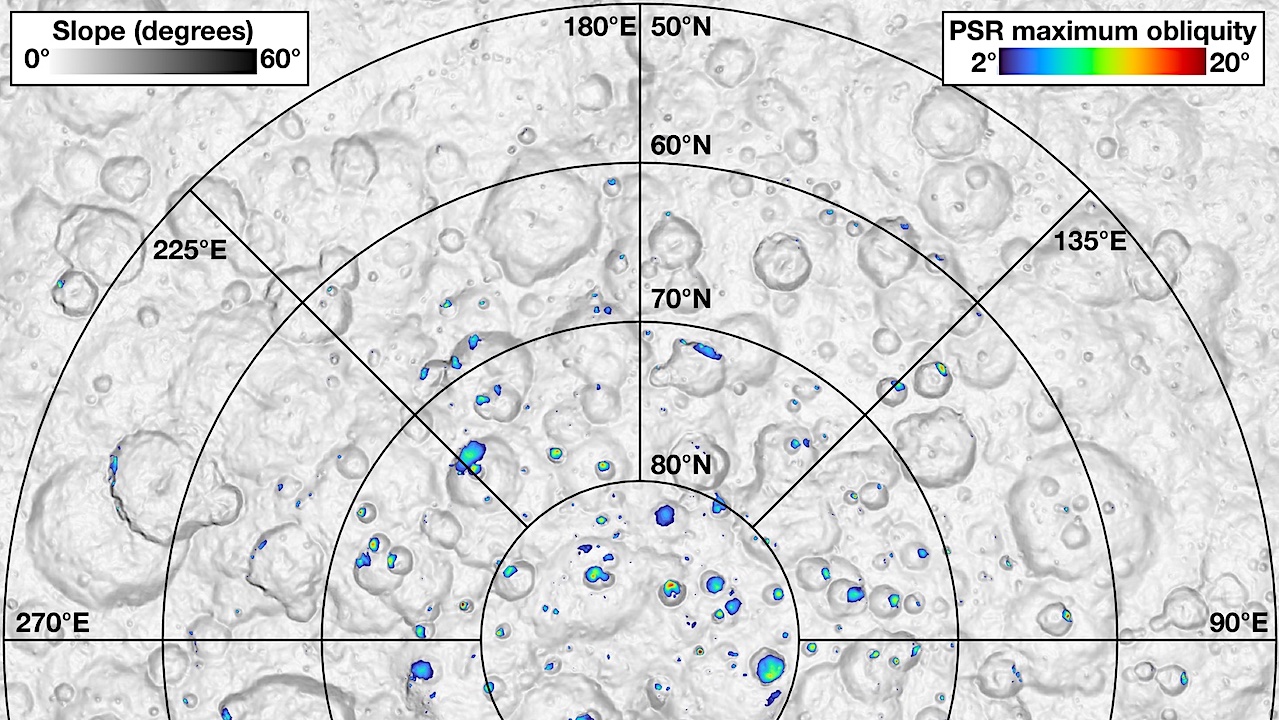
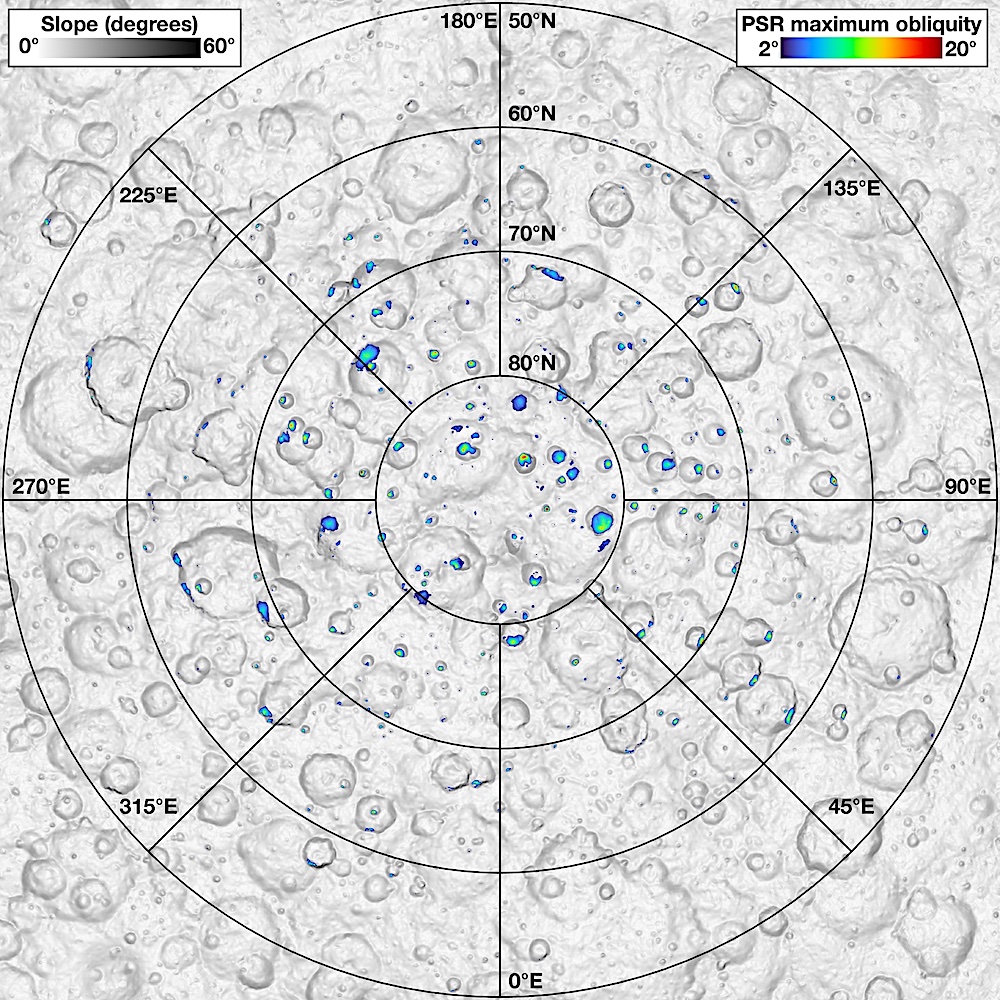
Map of the north polar region of Ceres. The color areas are areas that are continuously shadowed over a Ceres year, and therefore very cold. The axis tilt (obliquity) of Ceres slowly changes over time and is currently 4 degrees, but ranged between 2 and 20 degrees over time. The color indicates the maximum obliquity at which a location is in shadow through an entire orbit.
Credit: Erwan Mazarico/GSFC.

Ceres, the largest asteroid in our Solar System, harbors a dark secret: Extremely young ice deposits in permanently shadowed craters near its poles. If that sounds vaguely familiar, it’s because our Moon and planet Mercury also have such polar ice deposits, which have been studied for decades.

“For Ceres, the story started in 2016, when the Dawn spacecraft, which orbited around Ceres at the time, glimpsed into these permanently dark craters and saw bright ice deposits in some of them,” said Norbert Schorghofer, lead author of “History of Ceres’s Cold Traps Based on Refined Shape Models”that appears in The Planetary Science Journal. PSI scientists Robert Gaskell and John Weirich, and NASA Goddard Space Flight Center Scientist Erwan Mazarico, are coauthors on the paper.

“The discovery back in 2016 posed a riddle: Many craters in the polar regions of Ceres remain shadowed all year – which on Ceres lasts 4.6 Earth years – and therefore remain frigidly cold, but only a few of them harbor ice deposits,” Schorghofer said. “Soon, another discovery provided a clue why: The rotation axis of Ceres oscillates back and forth every 24,000 years due to tides from the Sun and Jupiter. When the axis tilt is high and the seasons strong, only a few craters remain shadowed all year, and these are the craters that contain bright ice deposits.”

To determine how large shadows were inside of craters thousands of years ago, scientists construct digital elevation maps and then perform ray-tracing calculations with them to theoretically reconstruct the shadows cast on the crater floors. The results are only as reliable as the digital shape models on which they are based. Keep in mind that the floors of these craters are always in shadow, so it is not easy to measure how deep they are.

The Dawn spacecraft had a very sensitive camera, which could discern features on the shadowed crater floors. Stereo images of sunlit regions are often used to construct digital elevation maps of sunlit regions, but making an elevation map of shadowed terrain is a challenge that had rarely been taken on. As part of the new study, PSI scientist Robert Gaskell developed a new technique to reconstruct heights even in the shadowed portions of a stereo pair of images. These improved elevation maps can then be used for ray-tracing to predict the extent of cold, permanently shadowed regions.

These more accurate maps yielded a surprising result: When Ceres reaches its maximum axis tilt, which last occurred about 14,000 years ago, no crater on Ceres remains perennially shadowed and any ice in them must have quickly sublimated into space. “That leaves only one plausible explanation: The ice deposits must have formed more recently than that. The results suggest all of these ice deposits must have accumulated within the last 6,000 years or less. Considering that Ceres is well over 4 billion years old, that is a remarkably young age,” Schorghofer said.

Map of the north polar region of Ceres. The color areas are areas that are continuously shadowed over a Ceres year, and therefore very cold. The axis tilt (obliquity) of Ceres slowly changes over time and is currently 4 degrees, but ranged between 2 and 20 degrees over time. The color indicates the maximum obliquity at which a location is in shadow through an entire orbit.

Credit: Erwan Mazarico/GSFC.

“Ceres is an ice-rich object, but almost none of this ice is exposed on the surface. The aforementioned polar craters and a few small patches outside the polar regions are the only ice exposures. However, ice is ubiquitous at shallow depths – as discovered by PSI scientist Tom Prettyman and his team back in 2017 – so even a small dry impactor could vaporize some of that ice.” Schorghofer said. “A fragment of an asteroid may have collided with Ceres about 6,000 years ago, which created a temporary water atmosphere. Once a water atmosphere is generated, ice would condense in the cold polar craters, forming the bright deposits that we still see today. Alternatively, the ice deposits could have formed by avalanches of ice-rich material. This ice would then survive in only the cold shadowed craters. Either way, these events were very recent on an astronomical time scale.”

The study also looked into the possibility that other types of ices, other than water ice, might be trapped in these unusual craters on Ceres. On our Moon, portions of polar craters are so cold that even CO2 ice and a few other chemical species could last in them for billions of years. Ceres is farther from the Sun, so its polar craters could be expected to be even colder than the Moon’s.

Schorghofer calculated temperatures inside Ceres’s polar craters, something that had never been done before. The answer was surprising: although these craters are cold enough to retain water ice, they are too warm to retain other common types of ice. Two circumstances contribute to this. First, the axis tilt of Ceres, currently 4 degrees, is higher than the Moon’s 1.5 degree tilt, so more of the crater rims are sunlit and more light is scattered onto the crater floor. Second, Ceres simply has no perennially shadowed craters very near the north pole, unlike the Moon, where one crater sits almost exactly on the south pole. For these reasons, temperatures are not as low on Ceres than they are on parts of the lunar surface.

The study describes the new method used to reconstruct topography using stereo images of shadowed craters, provides a new map of perennially shadowed regions for the entire north polar region of Ceres, determines the extent of perennially shadowed regions inside polar craters with bright ice deposits, and estimates the temperatures for the interior of these craters. “Whatever the history of these ice deposits, it resulted from events not much older than human civilization,” Schorghofer said.

This work was funded by a grant from NASA’s Discover Data Analysis Program to PSI (80NSSC21K1033).

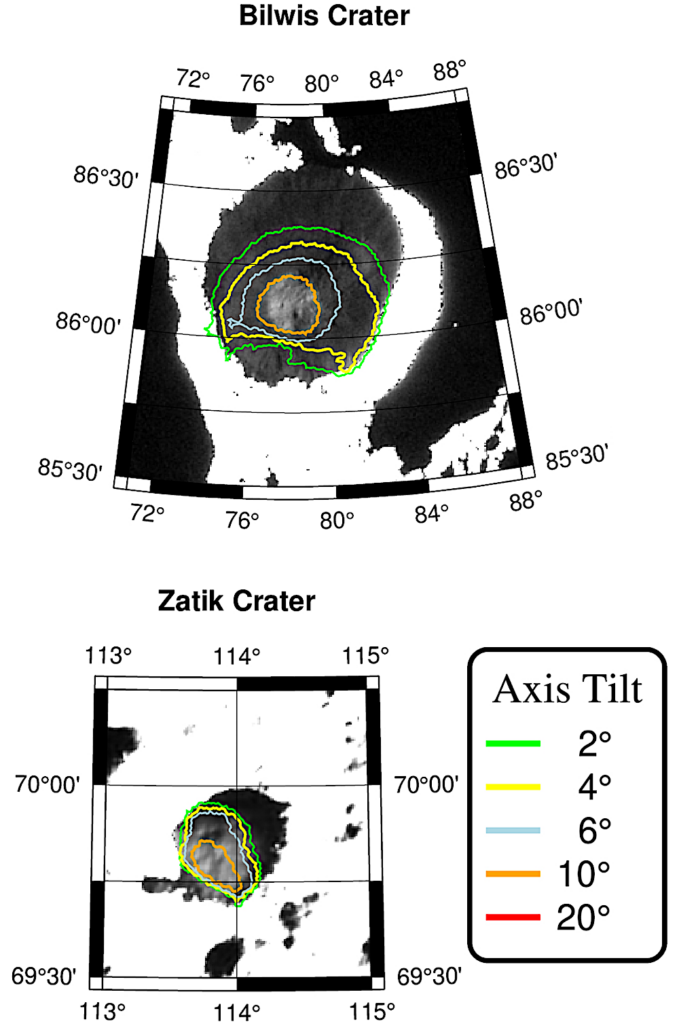
Images of two craters in the north polar region of Ceres captured by the Dawn spacecraft. The shadowed regions contain bright ice deposits, whereas sunlit regions appear saturated (white) in these contrast-stretched images. The superimposed color contours represent the extent of the area that is in shadow over the entire Cerean year for different values of the axis tilt. The current axis tilt is 4 degrees (yellow contour). The bright ice deposits must have accumulated at an axis tilt of 10 degrees or less (orange contour), which last occurred 6,000 years ago.

Credit: Norbert Schorghofer/PSI.

THE PLANETARY SCIENCE INSTITUTE:

The Planetary Science Institute is a private, nonprofit 501(c)(3) corporation dedicated to Solar System exploration. It is headquartered in Tucson, Arizona, where it was founded in 1972.

PSI scientists are involved in numerous NASA and international missions, the study of Mars and other planets, the Moon, asteroids, comets, interplanetary dust, impact physics, the origin of the Solar System, extra-solar planet formation, dynamics, the rise of life, and other areas of research. They conduct fieldwork on all continents around the world. They also are actively involved in science education and public outreach through school programs, children’s books, popular science books and art.

PSI scientists are based in 35 states and the District of Columbia.

{ https://astrobiology.com/ }

Hoe vind je dit bericht?
Geschreven door peter om 20:21 Stuur door

Planetary Scientists Create Map of Ceres’ Cold Traps

Planetary Scientists Create Map of Ceres’ Cold Traps

The dwarf planet Ceres hosts permanently shadowed areas in its polar regions, and these regions are an interesting analog to Mercury and the Moon. Ceres’ permanently shadowed regions were mapped by NASA’s Dawn spacecraft, and, thanks to scattered sunlight, bright deposits were discovered in a fraction of the permanently shadowed regions. To arrive at a clearer understanding of the nature of cold-trapped ice deposits on Ceres, researchers from the Planetary Science Institute and NASA’s Goddard Space Flight Center constructed improved shape models of permanently shadowed region-hosting craters.

Permanently shadowed regions in the north polar region of Ceres; the color indicates the maximum obliquity at which a location is in shadow through an entire orbit. Image credit: Schorghofer et al., doi: 10.3847/PSJ/ad3639.

Permanently shadowed regions in the north polar region of Ceres; the color indicates the maximum obliquity at which a location is in shadow through an entire orbit.

Image credit: Schorghofer et al., doi: 10.3847/PSJ/ad3639.

“For Ceres, the story started in 2016, when the Dawn spacecraft, which orbited around Ceres at the time, glimpsed into these permanently dark craters and saw bright ice deposits in some of them,” said lead author Dr. Norbert Schorghofer, a researcher at the Planetary Science Institute.

“The discovery back in 2016 posed a riddle: many craters in the polar regions of Ceres remain shadowed all year — which on Ceres lasts 4.6 Earth years — and therefore remain frigidly cold, but only a few of them harbor ice deposits.”

“Soon, another discovery provided a clue why: the rotation axis of Ceres oscillates back and forth every 24,000 years due to tides from the Sun and Jupiter.”

“When the axis tilt is high and the seasons strong, only a few craters remain shadowed all year, and these are the craters that contain bright ice deposits.”

To determine how large shadows were inside of craters thousands of years ago, scientists construct digital elevation maps and then perform ray-tracing calculations with them to theoretically reconstruct the shadows cast on the crater floors.

The results are only as reliable as the digital shape models on which they are based. Keep in mind that the floors of these craters are always in shadow, so it is not easy to measure how deep they are.

NASA’s Dawn spacecraft had a very sensitive camera, which could discern features on the shadowed crater floors.

Stereo images of sunlit regions are often used to construct digital elevation maps of sunlit regions, but making an elevation map of shadowed terrain is a challenge that had rarely been taken on.

As part of their study, the authors developed a new technique to reconstruct heights even in the shadowed portions of a stereo pair of images.

These improved elevation maps can then be used for ray-tracing to predict the extent of cold, permanently shadowed regions.

These more accurate maps yielded a surprising result: when Ceres reaches its maximum axis tilt, which last occurred about 14,000 years ago, no crater on Ceres remains perennially shadowed and any ice in them must have quickly sublimated into space.

“That leaves only one plausible explanation: the ice deposits must have formed more recently than that,” Dr. Schorghofer said.

“The results suggest all of these ice deposits must have accumulated within the last 6,000 years or less.”

“Considering that Ceres is well over 4 billion years old, that is a remarkably young age.”

“Ceres is an ice-rich object, but almost none of this ice is exposed on the surface. The aforementioned polar craters and a few small patches outside the polar regions are the only ice exposures. However, ice is ubiquitous at shallow depths, so even a small dry impactor could vaporize some of that ice.”

“A fragment of an asteroid may have collided with Ceres about 6,000 years ago, which created a temporary water atmosphere.”

“Once a water atmosphere is generated, ice would condense in the cold polar craters, forming the bright deposits that we still see today.”

“Alternatively, the ice deposits could have formed by avalanches of ice-rich material. This ice would then survive in only the cold shadowed craters.”

“Either way, these events were very recent on an astronomical time scale.”

The researchers also looked into the possibility that other types of ices, other than water ice, might be trapped in these unusual craters on Ceres.

On our Moon, portions of polar craters are so cold that even carbon dioxide ice and a few other chemical species could last in them for billions of years.

Ceres is farther from the Sun, so its polar craters could be expected to be even colder than the Moon’s.

The scientists calculated temperatures inside Ceres’ polar craters, something that had never been done before.

The answer was surprising: although these craters are cold enough to retain water ice, they are too warm to retain other common types of ice. Two circumstances contribute to this.

First, the axis tilt of Ceres, currently 4 degrees, is higher than the Moon’s 1.5 degree tilt, so more of the crater rims are sunlit and more light is scattered onto the crater floor.

Second, Ceres simply has no perennially shadowed craters very near the north pole, unlike the Moon, where one crater sits almost exactly on the south pole.

For these reasons, temperatures are not as low on Ceres than they are on parts of the lunar surface.

“Whatever the history of the ice deposits, it resulted from events not much older than human civilization,” Dr. Schorghofer said.

  • The findings appear in the Planetary Science Journal.
  • Norbert Schorghofer et al. 2024. History of Ceres’s Cold Traps Based on Refined Shape Models. Planet. Sci. J 5 (99); doi: 10.3847/PSJ/ad3639

{ https://www.sci.news/ }

Hoe vind je dit bericht?
Geschreven door peter om 18:42 Stuur door

Meer van UFO'S of UAP'S, ASTRONOMIE, RUIMTEVAART, ARCHEOLOGIE, OUDHEIDKUNDE, SF-SNUFJES EN ANDERE ESOTERISCHE WETENSCHAPPEN - DE ALLERLAATSTE NIEUWTJES

↑ Terug naar de berichten