Naar de inhoud

UFO'S of UAP'S, ASTRONOMIE, RUIMTEVAART, ARCHEOLOGIE, OUDHEIDKUNDE, SF-SNUFJES EN ANDERE ESOTERISCHE WETENSCHAPPEN - DE ALLERLAATSTE NIEUWTJES

UFO's of UAP'S in België en de rest van de wereld
akke.beakke.be
Ontdek de Fascinerende Wereld van UFO's en UAP's: Jouw Bron voor Onthullende Informatie! Ben jij ook gefascineerd door het onbekende? Wil je meer weten over UFO's en UAP's, niet alleen in België, maar over de hele wereld? Dan ben je op de juiste plek! België: Het Kloppend Hart van UFO-onderzoek In België is BUFON (Belgisch UFO-Netwerk) dé autoriteit op het gebied van UFO-onderzoek. Voor betrouwbare en objectieve informatie over deze intrigerende fenomenen, bezoek je zeker onze Facebook-pagina en deze blog. Maar dat is nog niet alles! Ontdek ook het Belgisch UFO-meldpunt en Caelestia, twee organisaties die diepgaand onderzoek verrichten, al zijn ze soms kritisch of sceptisch. Nederland: Een Schat aan Informatie Voor onze Nederlandse buren is er de schitterende website www.ufowijzer.nl, beheerd door Paul Harmans. Deze site biedt een schat aan informatie en artikelen die je niet wilt missen! Internationaal: MUFON - De Wereldwijde Autoriteit Neem ook een kijkje bij MUFON (Mutual UFO Network Inc.), een gerenommeerde Amerikaanse UFO-vereniging met afdelingen in de VS en wereldwijd. MUFON is toegewijd aan de wetenschappelijke en analytische studie van het UFO-fenomeen, en hun maandelijkse tijdschrift, The MUFON UFO-Journal, is een must-read voor elke UFO-enthousiasteling. Bezoek hun website op www.mufon.com voor meer informatie. Samenwerking en Toekomstvisie Sinds 1 februari 2020 is Pieter niet alleen ex-president van BUFON, maar ook de voormalige nationale directeur van MUFON in Vlaanderen en Nederland. Dit creëert een sterke samenwerking met de Franse MUFON Reseau MUFON/EUROP, wat ons in staat stelt om nog meer waardevolle inzichten te delen. Let op: Nepprofielen en Nieuwe Groeperingen Pas op voor een nieuwe groepering die zich ook BUFON noemt, maar geen enkele connectie heeft met onze gevestigde organisatie. Hoewel zij de naam geregistreerd hebben, kunnen ze het rijke verleden en de expertise van onze groep niet evenaren. We wensen hen veel succes, maar we blijven de autoriteit in UFO-onderzoek! Blijf Op De Hoogte! Wil jij de laatste nieuwtjes over UFO's, ruimtevaart, archeologie, en meer? Volg ons dan en duik samen met ons in de fascinerende wereld van het onbekende! Sluit je aan bij de gemeenschap van nieuwsgierige geesten die net als jij verlangen naar antwoorden en avonturen in de sterren! Heb je vragen of wil je meer weten? Aarzel dan niet om contact met ons op te nemen! Samen ontrafelen we het mysterie van de lucht en daarbuiten.

Archief

US Air Force base swarmed by mysterious drones 'houses nuclear assets'

US Air Force base swarmed by mysterious drones 'houses nuclear assets'

Details are only now emerging of a major incident centred on Langley Air Force Base, where assets from NASA were called in to help identify a 'swarm' of unidentified flying objects

By Michael Moran / Audience Writer

0_Pentagon-bosses-pushed-panic-button-after-US-Air-Force-base-was-swarmed-for-weeks-by-unidentified.jpg

The 'drone swarm' provoked a massive response from the US military  (Image: Wikipedia/Sgt. Ben Bloker) For out-of-this-world news, sign up for the Spaced Out newsletter","buttonText":"Sign Up","contentId":24590334,"newsletterImage":"https://i2-prod.dailystar.co.uk/incoming/article25100368.ece/ALTERNATES/s615d/1_UFO-Beaming-up-a-Man.jpg","endpointUrl":"https://status.data-services.tm-awx.com","profile":"Daily_Star","isPure360NewsLetter":false,"pure360MailingListId":"Daily Star - Spaced Out Newsletter","isDoubleOptIn":false,"newsletterSiteName":"Daily Star","ConsentDate":"06/08/2021"}" data-observed="false" data-init="true">

Podcaster Chris Lehto, who has commented extensively on the UFO phenomenon, says that one of NASA's WB-57F high-flying research planes was called in in an attempt to identify the mysterious craft.

The objects seen in December are currently believed to have been operated by a foreign power gathering intelligence on America's most sensitive defence installations. A spokesperson for Langley Air Force Base told the War Zone blog "none of the incursions appeared to exhibit hostile intent but anything flying in our restricted airspace can pose a threat to flight safety.”

READ MORE: 

Ryan Graves has repeatedly warned about the danger of UAPs in and around the US
Ryan Graves has repeatedly warned about the danger of UAPs in and around the US  (Image: Michael Brochstein/SOPA Images/REX/Shutterstock)

Chris pointed out that the object’s apparent target – Langley Air Force Base – regularly uses an area of sea off the coast of Virgina where former Navy fighter pilot Ryan Graves claimed to have detected multiple "unknown objects" in US airspace.

He added: “Graves said one of the objects was visually reported as ‘a cube within a transparent sphere.’ I'm a retired F-16 pilot I flew for 18 years and I've never heard of anything of that description – particularly if it's flying in high winds.”

Chris said the area around Langley Air Force Base, including the US Navy shipyards at Norfolk, are home to some of America’s most advanced warships.

A NASA high-altitude reconnaissance aircraft was pulled in to help with the situation
A NASA high-altitude reconnaissance aircraft was pulled in to help with the situation  (Image: NASA)

READ MORE

He explains: “The incidents got so bad that additional assets were called in including the Whiskey Bravo 57F high-flying research plane that NASA owns.

"According to The War Zone this spate of bizarre drone incursions deeply underscores the still growing threats that uncrewed aerial systems [UAS] present on and off traditional battlefields.”

Plane spotters tracked two combat air patrols over the area in mid-December, as well as the advanced NASA plane displaying its ability to fly in absolutely perfect circles around Langley even in the face of high winds.

The area is also home to one of America's most vital naval bases
The area is also home to one of America's most vital naval bases  (Image: Wikipedia)

READ MORE

It’s only now that the purpose of these air patrols has emerged. A USAF spokesperson said: "To protect operational security, we do not discuss impacts to operations.

"We don’t discuss our specific force protection measures but retain the right to protect the installation. Langley continues to monitor our air space and work with local law enforcement and other federal agencies to ensure the safety of base personnel, facilities, and assets."

Chris noted that the exact reason for all this activity, in what is a militarily sensitive location, has not been revealed. He continued: “There's tons of important assets here; nuclear assets as well just an amazing amount of military hardware is it actually China on the east coast of the United States? because that would be quite interesting. Or is it people operating drones just in the general area? Is that what sparked all this activity?

“Or, is it UAPs? Could it actually be UAP incursions are picking up or now they're actually taking them seriously?”

Plane spotters were quick to identify the two combat air patrols near Langley
Plane spotters were quick to identify the two combat air patrols near Langley  (Image: Twitter/X/The New Area 51)

READ MORE

Either way, Chris claimed this is an embarrassing incident for the USAF. “Its airspace getting penetrated for weeks on end is clearly not the best look – especially after major lapses in domain awareness and air defence capabilities were recently spotlighted by the Chinese ‘spy balloon’ saga,” he continued.

Langley is home to some of the USAF’s super-advanced F-22 fighters and one of their particular responsibilities is guarding the airspace around Washington DC.

Chris pointed out that there is a wealth of high-value military hardware located in the area. He explained: "Naval Station Norfolk the largest naval base on the east coast.

"It's home to roughly half of America's carrier Fleet and it's located just to the southeast a host of other military installations are also dotted throughout the broader area including Naval Air Station Oceana – that's where Ryan Graves operated out of and that's the Navy's Master tactical jet base on the East Coast also has Navy special warfare's East Coast headquarters."

Langley AFB is the base for fighter aircraft protecting the White House

READ MORE

The War Zone noted that unexplained drone incursions have been logged at military bases across the US. They wrote: “Military aircraft are also routinely encountering drones in various test and training ranges and other restricted military operating areas. America's nuclear power plants have had very troubling encounters with drone swarms.

“Yet the frequency and nature of the incursions in Virginia sound eerily similar to the bizarre claims of unidentified drone swarms roving over the plains of Colorado in the Winter of 2019-2020.

"The government response to those incidents was something of a meek sideshow compared to what clearly occurred regarding the Langley incidents — a sign of just how much more seriously these incidents are being taken.”

{ https://www.dailystar.co.uk/ }

Hoe vind je dit bericht?
Geschreven door peter om 23:50 Stuur door

'Intelligent aliens will make contact soon' – and boffins reveal how they might find us

'Intelligent aliens will make contact soon' – and boffins reveal how they might find us

We could be in contact with aliens within the next few years as our technology continues to improve – and they could be looking for us in the same ways we look for them

By Adam Aiken

It might be only a few more years until we're in touch with people from other worlds

It might be only a few more years until we're in touch with people from other worlds (Image: Getty Images)

The Search for Extraterrestrial Intelligence (SETI) project has been looking for aliens since the 1980s, and one of the top geeks working there is as confident as he’s ever been that they’ll soon strike gold.

Seth Shostak, who has been the senior astronomer at SETI for nearly a quarter of a century, seems to be pretty confident that we’ll come across intelligent aliens by 2036.

READ MORE: 

He apparently bases this prediction on our rapidly improving technology, with massive strides being taken in terms of our telescopes and computers, reports Mail Online.
We could be in touch with aliens soon, apparently
We could be in touch with aliens soon, apparently  (Image: Getty Images)

On Reddit recently, Seth said: “The trend of improving hardware - mostly computers -- has proceeded unabated. I'm still betting on a signal by 2036.”

And he reckons that once we’ve broken the seal, we could be blown away by how many other places could sustain life as we know it. In fact, he reckons there could be billions of Earth-like worlds out there.

An upcoming NASA trip to Jupiter's moon has created excitement for those who think it could be home to alien life
An upcoming NASA trip to Jupiter's moon has created excitement for those who think it could be home to alien life  (Image: Getty Images/iStockphoto)

“That may be the strongest argument for life in space,” he said. “If there isn't any, there's something really exceptional about what's happened here on Earth.

“While that's not ruled out by the data, it does seem a little self-centred.

Seth has also revealed the team at SETI have a firm protocol to follow if (or when) they finally confirm the existence of alien life – and it’s all remarkably matter-of-fact.

“There is a document,” said Seth. “Briefly, it says, check the signal to make sure it is truly extraterrestrial. Then announce it to the world, and consult internationally before transmitting a reply.”

Aliens could be looking for us, too
Aliens could be looking for us, too  (Image: Getty Images)

We won’t know until it happens what contact from aliens looks like, but some geeks think they’ll be looking for us in the same ways we look for them. For instance, they could spot Earth’s shadow as we pass between them and the Sun.

There are 1,715 star systems which could have spotted Earth within the past 5,000 years, and more than 300 others that will be able to spot us in that way during the next 5,000 years.

Jackie Faherty, an Astrophysicist based at the American Museum of Natural History in New York City, said any aliens living on those worlds would have a “front-row seat to finding Earth”.

{ https://www.dailystar.co.uk/ }

Hoe vind je dit bericht?
Geschreven door peter om 23:28 Stuur door

'Intelligent aliens will make contact soon' – and boffins reveal how they might find us

'Intelligent aliens will make contact soon' – and boffins reveal how they might find us

We could be in contact with aliens within the next few years as our technology continues to improve – and they could be looking for us in the same ways we look for them

By Adam Aiken

It might be only a few more years until we're in touch with people from other worlds

It might be only a few more years until we're in touch with people from other worlds (Image: Getty Images)

The Search for Extraterrestrial Intelligence (SETI) project has been looking for aliens since the 1980s, and one of the top geeks working there is as confident as he’s ever been that they’ll soon strike gold.

Seth Shostak, who has been the senior astronomer at SETI for nearly a quarter of a century, seems to be pretty confident that we’ll come across intelligent aliens by 2036.

READ MORE: 

He apparently bases this prediction on our rapidly improving technology, with massive strides being taken in terms of our telescopes and computers, reports Mail Online.
We could be in touch with aliens soon, apparently
We could be in touch with aliens soon, apparently  (Image: Getty Images)

On Reddit recently, Seth said: “The trend of improving hardware - mostly computers -- has proceeded unabated. I'm still betting on a signal by 2036.”

And he reckons that once we’ve broken the seal, we could be blown away by how many other places could sustain life as we know it. In fact, he reckons there could be billions of Earth-like worlds out there.

An upcoming NASA trip to Jupiter's moon has created excitement for those who think it could be home to alien life
An upcoming NASA trip to Jupiter's moon has created excitement for those who think it could be home to alien life  (Image: Getty Images/iStockphoto)

“That may be the strongest argument for life in space,” he said. “If there isn't any, there's something really exceptional about what's happened here on Earth.

“While that's not ruled out by the data, it does seem a little self-centred.

Seth has also revealed the team at SETI have a firm protocol to follow if (or when) they finally confirm the existence of alien life – and it’s all remarkably matter-of-fact.

“There is a document,” said Seth. “Briefly, it says, check the signal to make sure it is truly extraterrestrial. Then announce it to the world, and consult internationally before transmitting a reply.”

Aliens could be looking for us, too
Aliens could be looking for us, too  (Image: Getty Images)

We won’t know until it happens what contact from aliens looks like, but some geeks think they’ll be looking for us in the same ways we look for them. For instance, they could spot Earth’s shadow as we pass between them and the Sun.

There are 1,715 star systems which could have spotted Earth within the past 5,000 years, and more than 300 others that will be able to spot us in that way during the next 5,000 years.

Jackie Faherty, an Astrophysicist based at the American Museum of Natural History in New York City, said any aliens living on those worlds would have a “front-row seat to finding Earth”.

{ https://www.dailystar.co.uk/ }

Hoe vind je dit bericht?
Geschreven door peter om 23:28 Stuur door

'Tic Tac' UFO exposed by US whistle blowers 'hovered above USO emerging from ocean'

'Tic Tac' UFO exposed by US whistleblowers 'hovered above USO emerging from ocean'

Researcher Mark Christopher Lee claims the 'Tic Tac' UFO exposed by US whistle blowers 'hovered above a USO emerging from the ocean' 

(Image: Youtube/Nub TV)

The infamous 'Tic-Tac' UFO exposed by US whistle blowers was "hovering above an unidentified submerged object (USO) emerging from the ocean".

This is the claim by UFO researcher and filmmaker Mark Christopher Lee who said the US Military and Navy have been inundated with UFO and USO confrontations since the 1950s, with the navy dubbing USOs their "biggest threat" yet.

The infamous interaction with the Tic-Tac UFO captured by crew members from the USS Nimitz in 2004 marked a significant turning point in human history – with two former Navy pilots having come forward to share their discomforting encounters with the alien craft.

READ MORE: 

But now expert Lee has thrown more questions into the mix as he boldly claimed the Tic-Tac UFO was seen hovering above a USO, something not previously addressed.

Researcher Mark Christopher Lee claims the 'Tic Tac' UFO exposed by US whistle blowers 'hovered above a USO emerging from the ocean'

The infamous interaction with the Tic-Tac UFO captured by crew members from the USS Nimitz in 2004  (Image: DoD/AFP via Getty Images)

"USOs have been seen coming from the oceans for hundreds of years," Lee told the Daily Star. "Even Christopher Columbus saw a USO on his voyage to the new world and the US Navy has had plenty of confrontations with USOs since the 50s and have identified them as the biggest threat.

"Note that the Tic-Tac UFO reported by the recent US whistle blowers was seen hovering above a USO emerging from the ocean. [This makes me think UFOs and USOs] are linked and the tic tac and other UFOs are all able to enter the oceans at will.

{ https://www.dailystar.co.uk/news/ }

Hoe vind je dit bericht?
Geschreven door peter om 21:19 Stuur door

Manganese-Rich Sandstones Point to Earth-Like Environment on Ancient Mars

Manganese-Rich Sandstones Point to Earth-Like Environment on Ancient Mars

In May 2017, NASA’s Curiosity rover observed higher than usual amounts of manganese in the lakebed rocks within Gale crater, Mars. These sedimentary rocks have larger grain sizes than what is typical for the lakebed rocks in the crater. This may indicate that the original sediments were formed in a river, delta, or near the shoreline in the ancient lake. In a new paper, Dr. Patrick Gasda from Los Alamos National Laboratory and his colleagues discuss how manganese could have been enriched in these rocks — for example, by percolation of groundwater through the original sediments or through the rock afterward — and what oxidant could be responsible for the precipitation of manganese in the rocks. On Earth, manganese becomes enriched because of oxygen in the atmosphere and this process is often sped up by the presence of microbes. Microbes on Earth can use the many oxidation states of manganese as energy for metabolism; if life was present on ancient Mars, the increased amounts of manganese in these rocks along the lake shore would be a helpful energy source for life.

Mastcam mosaic from the Sol 1686 rover location looking behind the rover (downslope) at the transition point between the Sutton Island and Blunts Point Murray members. Images from Sols 1685-1689 display sedimentary textures of dark-toned manganese-rich sandstones and nearby rocks. Dashed line boxes in the large mosaic are shown as insets along the bottom of figure. Small red outlines show the approximate locations and extent of ChemCam observations. Throughout this transition area, dark-toned sandstones (presumably manganese-rich based on ChemCam observations at three locations) overlie light-toned materials. Insets from left to right: (a) Denning Brook, a manganese-rich fine-grained dark-toned sandstone ChemCam observation; (b) and (c) two light-toned blocks with cross-stratified textures, highlighted with yellow lines, 6 m away from Denning Brook and to the upper left in the large mosaic; (d) dark-toned materials (center of mosaic); and (E1) Newport Ledge, (E2) AEGIS post 1685a, (E3) Sugarloaf Mountain, three thin planar laminated dark-toned sandstones. Image credit: NASA / Caltech-JPL / MSSS.

Mastcam mosaic from the Sol 1686 rover location looking behind the rover (downslope) at the transition point between the Sutton Island and Blunts Point Murray members. Images from Sols 1685-1689 display sedimentary textures of dark-toned manganese-rich sandstones and nearby rocks. Dashed line boxes in the large mosaic are shown as insets along the bottom of figure. Small red outlines show the approximate locations and extent of ChemCam observations. Throughout this transition area, dark-toned sandstones (presumably manganese-rich based on ChemCam observations at three locations) overlie light-toned materials. Insets from left to right: (a) Denning Brook, a manganese-rich fine-grained dark-toned sandstone ChemCam observation; (b) and (c) two light-toned blocks with cross-stratified textures, highlighted with yellow lines, 6 m away from Denning Brook and to the upper left in the large mosaic; (d) dark-toned materials (center of mosaic); and (E1) Newport Ledge, (E2) AEGIS post 1685a, (E3) Sugarloaf Mountain, three thin planar laminated dark-toned sandstones.

Image credit: NASA / Caltech-JPL / MSSS.

“It is difficult for manganese oxide to form on the surface of Mars, so we didn’t expect to find it in such high concentrations in a shoreline deposit,” Dr. Gasda said.

“On Earth, these types of deposits happen all the time because of the high oxygen in our atmosphere produced by photosynthetic life, and from microbes that help catalyze those manganese oxidation reactions.”

“On Mars, we don’t have evidence for life, and the mechanism to produce oxygen in Mars’ ancient atmosphere is unclear, so how the manganese oxide was formed and concentrated here is really puzzling.”

“These findings point to larger processes occurring in the Martian atmosphere or surface water and shows that more work needs to be done to understand oxidation on Mars.”

To measure manganese abundances in lakebed rocks within Gale crater, Dr. Gasda and co-authors used the ChemCam instrument onboard NASA’s Curiosity rover.

“ChemCam is an atomic emission spectroscopy instrument that uses laser-induced breakdown spectroscopy (LIBS) to quantify elemental abundances present in a target,” they explained.

“The ChemCam LIBS uses a pulsed laser emitting a 1,067 nm beam that is focused onto a target up to 7 m from the rover, which produces an analytical footprint of 350-550 μm.”

2024-05-01

NASA’s Curiosity rover continues to search for signs that Mars’ Gale Crater conditions could support microbial life. 

Photo credit: NASA/JPL-Caltech/MSSS.

“Each laser pulse ablates and ionizes a small (nanograms to micrograms) amount of material.”

“Light emitted from the plasma formed by each laser pulse is collected by the ChemCam telescope, and spectra are recorded by the ultraviolet, violet, and visible to near infrared spectrometers.”

The sedimentary rocks explored by the Curiosity rover are a mix of sands, silts, and muds.

The sandy rocks are more porous, and groundwater can more easily pass through sands compared to the muds that make up most of the lakebed rocks in Gale crater.

The researchers looked at how manganese could have been enriched in these sands — for example, by percolation of groundwater through the sands on the shore of a lake or mouth of a delta — and what oxidant could be responsible for the precipitation of manganese in the rocks.

On Earth, manganese becomes enriched because of oxygen in the atmosphere, and this process is often sped up by the presence of microbes.

imagesmsl20160627pia20752-16.width-1024.jpg

This scene shows NASA's Curiosity Mars rover at a location called "Windjana," where the rover found rocks containing manganese-oxide minerals, which require abundant water and strongly oxidizing conditions to form.› Full image and caption
 Credit: NASA/JPL-Caltech/MSSS

Microbes on Earth can use the many oxidation states of manganese as energy for metabolism; if life was present on ancient Mars, the increased amounts of manganese in these rocks along the lake shore would have been a helpful energy source for life.

“The Gale lake environment, as revealed by these ancient rocks, gives us a window into a habitable environment that looks surprisingly similar to places on Earth today,” said ChemCam principal investigator Dr. Nina Lanza, a researcher at Los Alamos National Laboratory.

“Manganese minerals are common in the shallow, oxic waters found on lake shores on Earth, and it’s remarkable to find such recognizable features on ancient Mars.”

  • The team’s paper was published in the Journal of Geophysical Research: Planets.
    • P.J. Gasda et al. 2024. Manganese-Rich Sandstones as an Indicator of Ancient Oxic Lake Water Conditions in Gale Crater, Mars. JGR: Planets 129 (5): e2023JE007923; doi: 10.1029/2023JE007923

{ https://www.sci.news/ }

Hoe vind je dit bericht?
Geschreven door peter om 20:54 Stuur door

Webb Probably Didn’t Detect Biosignature Gas on K2-18b

Webb Probably Didn’t Detect Biosignature Gas on K2-18b

James Webb Space Telescope

This illustration depicts NASA’s James Webb Space Telescope – the largest, most powerful, and most complex space science telescope ever built – fully unfolded in space.

(Credits: NASA/Adriana Manrique Gutierrez)

In 2023, astronomers reported a tentative detection of dimethyl sulfide — which is predominately produced by marine microbes on Earth and regarded as a biosignature gas — in the atmosphere of the super-Earth exoplanet K2-18b. In a paper published in the Astrophysical Journal Letters, University of California, Riverside astronomer Shang-Min Tsai and colleagues challenge this finding, but also outline how the NASA/ESA/CSA James Webb Space Telescope might verify the presence of dimethyl sulfide.

Rendering of the likely view on a Hycean world. Image credit: Shang-Min Tsai / UCR.

Rendering of the likely view on a Hycean world.

Image credit: Shang-Min Tsai / UCR.

K2-18 is a red dwarf located approximately 111 light-years away in the constellation of Leo.

Also known as EPIC 201912552, the star hosts two massive exoplanets: K2-18b and K2-18c.

First discovered in 2015, K2-18b has a radius of 2.2 times that of Earth and is about 8 times as massive.

The planet orbits its star every 33 days at a distance of approximately 0.15 AU and has an Earth Similarity Index of 0.73.

It receives 1.28 times the light intensity of Earth, and its equilibrium temperature is 28 degrees Fahrenheit (minus 2 degrees Celsius).

K2-18c, discovered in 2017, has a mass about 7.5 times that of Earth, orbits the host star one every 9 days, and is probably too hot to be in the habitable zone.

In 2023, astronomers reported a tentative detection of dimethyl sulfide (DMS) in the atmosphere of K2-18b.

“K2-18b gets almost the same amount of solar radiation as Earth,” Dr. Tsai said.

“And if atmosphere is removed as a factor, K2-18b has a temperature close to Earth’s, which is also an ideal situation in which to find life.”

“K2-18b’s atmosphere is mainly hydrogen, unlike our nitrogen-based atmosphere.”

“But there was speculation that K2-18b has water oceans, like Earth. That makes K2-18b a potentially Hycean world, which means a combination of a hydrogen atmosphere and water oceans.”

“What was icing on the cake, in terms of the search for life, is that last year researchers reported a tentative detection of DMS in the atmosphere of that planet, which is produced by ocean phytoplankton on Earth.”

“DMS is the main source of airborne sulfur on our planet and may play a role in cloud formation.”

Because the telescope data were inconclusive, Dr. Tsai and co-authors wanted to understand whether enough DMS could accumulate to detectable levels on K2-18b.

“The DMS signal from Webb was not very strong and only showed up in certain ways when analyzing the data,” Dr. Tsai said.

“We wanted to know if we could be sure of what seemed like a hint about DMS.”

This artist’s impression shows planets K2-18b and c and their host star. Image credit: NASA / ESA / Hubble / M. Kornmesser.

This art’s tisimpression shows planets K2-18b and c and their host star.

Image credit: NASA / ESA / Hubble / M. Kornmesser.

Based on computer models that account for the physics and chemistry of DMS, as well as the hydrogen-based atmosphere, the researchers found that it is unlikely the data show the presence of DMS.

“The signal strongly overlaps with methane, and we think that picking out DMS from methane is beyond this instrument’s capability,” Dr. Tsai said.

However, the scientists believe it is possible for DMS to accumulate to detectable levels.

For that to happen, plankton or some other life form would have to produce 20 times more DMS than is present on Earth.

Detecting life on exoplanets is a daunting task, given their distance from Earth.

To find DMS, Webb would need to use an instrument better able to detect infrared wavelengths in the atmosphere than the one used last year.

Fortunately, the telescope will use such an instrument later this year, revealing definitively whether DMS exists on K2-18b.

“The best biosignatures on an exoplanet may differ significantly from those we find most abundant on Earth today,” said Dr. Eddie Schwieterman, an astrobiologist at the University of California, Riverside.

“On a planet with a hydrogen-rich atmosphere, we may be more likely to find DMS made by life instead of oxygen made by plants and bacteria as on Earth.”

  • Shang-Min Tsai et al. 2024. Biogenic Sulfur Gases as Biosignatures on Temperate Sub-Neptune Waterworlds. ApJL 966, L24; doi: 10.3847/2041-8213/ad3801

LINKS VIDEOS

{ https://www.sci.news/ }

Hoe vind je dit bericht?
Geschreven door peter om 20:38 Stuur door

Vera Rubin’s Primary Mirror Gets its First Reflective Coating

A drone's view of the Rubin Observatory under construction in 2023. The 8.4-meter is getting closer to completion and first light in 2025. The primary/tertiary mirror has its first reflective coating. Image Credit: Rubin Observatory/NSF/AURA/A. Pizarro D

Vera Rubin’s Primary Mirror Gets its First Reflective Coating

First light for the Vera Rubin Observatory (VRO) is quickly approaching and the telescope is reaching milestone after milestone. A few weeks ago, the observatory announced that its digital camera, the largest one ever made, is complete.

Now the observatory has announced that its unique primary/tertiary mirror has its first reflective coating.

The Rubin’s massive digital camera has an important job and garners a lot of attention. But it’s powerless without the telescope’s innovative primary/tertiary mirror. Primary mirrors are always the most critical and time-consuming part of modern observatories. The VRO’s primary/tertiary mirror took seven years to make.

The mirror is called a primary/tertiary mirror because it comprises two optical surfaces with different curvatures. The primary mirror is 8.4 meters, while the tertiary mirror is 5 meters in diameter. The pair of surfaces are combined into one large structure. The unique design reduces the telescope’s engineering complexity without reducing its impressive light-gathering capability. It can be rotated quickly and also settles quickly.

The VRO's unique primary/tertiary mirror is two mirrors in one. It's mounted on lightweight honeycomb material for strength. Image Credit: VRO The VRO’s unique primary/tertiary mirror is two mirrors in one. It’s mounted on lightweight honeycomb material for strength. Image Credit: VRO

The outer surface forms the primary mirror. It captures light from space first, then that light reflects upwards to the 3.4-meter secondary mirror. After that, it’s reflected back down to the inner 5.0-meter surface that forms the tertiary mirror. Then, the light is sent to the camera.

The primary mirror’s size is critical because it determines how much light the telescope can collect. More light means astronomers can study very faint or distant objects. The VRO’s design allows the camera to capture a large area of sky the size of 7 full moons across in a single image.

via GIPHY

Only meticulous engineering and construction can build a telescope like this. One of the stages is putting the reflective and protective coatings on the mirrors. The VRO announced that the primary/tertiary mirror has its first coating.

“This was a very well-conducted project from every angle, thanks to a combination of careful planning and the technical skills of our excellent team.”

Tomislav Vucina, Senior Coating Engineer, VRO

The VRO has a special onsite coating chamber built just for this purpose. It’s a 128-ton chamber on the observatory’s maintenance floor. It uses a process called magnetron sputtering to apply coatings. The chamber will be reused during the telescope’s lifetime whenever the mirror needs re-coating.

The chamber can apply coatings of different reflective materials alone or in combinations. It took a lot of work to determine the perfect coating for reflectivity and durability. Researchers tested different coatings on a steel stand-in mirror.

The first layer was an adhesive layer of nickel-chromium. Next came an incredibly thin layer of silver weighing only 64 grams spread over the 8.4-meter mirror. On top of that, another nickel-chromium adhesive layer, then a protective layer of silicon nitride to shield the reflective layer.

The person in charge of these precision coatings is Tomislav Vucina, the Senior Coating Engineer. Vucina describes the coatings as a balancing act. “This outer layer needs to be thick enough that it’s not worn off by cleaning,” said Vucina, “but not so thick that it absorbs too many photons and prevents the mirror from meeting Rubin’s scientific requirements.”

This image shows the Rubin Observatory's 8.4-meter combined primary/tertiary mirror after being coated with protected silver in April 2024. The reflective coating was applied using the observatory's onsite coating chamber, which will also be used to re-coat the mirror as necessary during Rubin's 10-year Legacy Survey of Space and Time. Image Credit: RubinObs/NOIRLab/NSF/AURA This image shows the Rubin Observatory’s 8.4-meter combined primary/tertiary mirror after being coated with protected silver in April 2024. The reflective coating was applied using the observatory’s onsite coating chamber, which will also be used to re-coat the mirror as necessary during Rubin’s 10-year Legacy Survey of Space and Time. Image Credit: RubinObs/NOIRLab/NSF/AURA

Until these coatings were applied, the glass was just glass. Highly specialized glass, but glass nonetheless. Now that the glass has received its reflective silver coating, it’s truly a mirror.

The application process took only 4.5 hours, nothing compared to the 7 years required to build the primary/tertiary mirror. Vucina and his team subjected the mirror to a battery of tests: reflectivity, adhesion, pinhole, and cosmetic. According to Vucina, the application process was successful.

“This was a very well-conducted project from every angle,” said Vucina, “thanks to a combination of careful planning and the technical skills of our excellent team.”

It’s been a long road to completion for the VRO. But after a long wait, first light is rapidly approaching. Excitement and anticipation for the observatory’s unique and powerful scientific contribution is growing. Its main output is the decade-long Legacy Survey of Space and Time.

“We’re extremely excited that both mirrors are now coated and will be installed on the telescope very soon,” said Sandrine Thomas, Deputy Director for Rubin Construction. “The combined reflectivity of these mirrors will enable Rubin to detect very faint and far-away objects, leading to great science!”

{ https://www.universetoday.com/ }

Hoe vind je dit bericht?
Geschreven door peter om 18:29 Stuur door

Did You Hear Webb Found Life on an Exoplanet? Not so Fast…

Artist rendering of the view on a Hycean world. The recent detection of a biosignature on the Hycean world K2-18b attracted a lot of attention. Image Credit: Shang-Min Tsai/UCR

Did You Hear Webb Found Life on an Exoplanet? Not so Fast…

The JWST is astronomers’ best tool for probing exoplanet atmospheres. Its capable instruments can dissect the light passing through a distant world’s atmosphere and determine its chemical components. Scientists are interested in everything the JWST finds, but when it finds something indicating the possibility of life it seizes everyone’s attention.

That’s what happened in September 2023, when the JWST found dimethyl sulphide (DMS) in the atmosphere of the exoplanet K2-18b.

K2-18b orbits a red dwarf star about 124 light-years away. It’s a sub-Neptune with about 2.5 times Earth’s radius and 8.6 Earth masses. The exoplanet may be a Hycean world, a temperate ocean-covered world with a large hydrogen atmosphere.

In October 2023, researchers announced the tentative detection of dimethyl sulphide in K2-18b’s atmosphere. They found it in JWST observations of the planet’s atmospheric spectrum. “The spectrum also suggests potential signs of dimethyl sulphide (DMS), which has been predicted to be an observable biomarker in Hycean worlds, motivating considerations of possible biological activity on the planet,” the researchers wrote.

The DMS caught people’s attention because it’s produced by living organisms here on Earth, mostly by marine microbes. So, finding it on an ocean world is cause for a deeper look. A team of researchers from the USA, Germany, and the UK examined the detection to see how it fits with atmospheric models.

“The best biosignatures on an exoplanet may differ significantly from those we find most abundant on Earth today.”

Eddie Schwieterman, astrobiologist, University of California, Riverside

They published their results in a paper in the Astrophysical Journal Letters. It’s titled “Biogenic Sulfur Gases as Biosignatures on Temperate Sub-Neptune Waterworlds.” The lead author is Shang-Min Tsai, a University of California Riverside project scientist.

Most of the thousands of exoplanets we’ve discovered are nothing like Earth. Habitability is impossible according to every known metric. But some are more intriguing. Some, like K2-18b, are more difficult to understand regarding habitability.

There’s some disagreement over what type of planet K2-18b is. It was the first exoplanet scientists ever detected water vapour on. It may be the first example of a Hycean world if they exist.

Artist depiction of the mini-Neptune K2-18 b. Credit: NASA, CSA, ESA, J. Olmstead (STScI), N. Madhusudhan (Cambridge University)

There are some clear differences between K2-18b and Earth. Our atmosphere is dominated by nitrogen, which makes up about 78%. K2-18b’s atmosphere is dominated by hydrogen. But it’s enough like Earth in some ways that scientists are keen to understand it better.

“This planet gets almost the same amount of solar radiation as Earth. And if atmosphere is removed as a factor, K2-18b has a temperature close to Earth’s, which is also an ideal situation in which to find life,” said lead author Shang-Min Tsai.

The researchers who found DMS in K2-18b’s atmosphere also found carbon dioxide and methane. Finding CO2 and CH4 is noteworthy, but finding DMS with them is even more intriguing.

“What was icing on the cake, in terms of the search for life, is that last year these researchers reported a tentative detection of dimethyl sulfide, or DMS, in the atmosphere of that planet, which is produced by ocean phytoplankton on Earth,” Tsai said. DMS is oxidized in Earth’s oceans and is the planet’s main source of atmospheric sulphur.

K2-18b's atmospheric composition as measured by the JWST's near-infrared instruments. The detection of Dimethyl Sulphide is not holding up under increased scrutiny. Image Credit: NASA/CSA/ESA/STScI K2-18b’s atmospheric composition as measured by the JWST’s near-infrared instruments. The detection of Dimethyl Sulphide is not holding up under increased scrutiny. Image Credit: NASA/CSA/ESA/STScI

However, the 2023 findings were not conclusive. There were hints of DMS but nothing strong enough to convince scientists and overcome their professional skepticism. “The potential inference of DMS is of high importance, as it is known to be a robust biomarker on Earth and has been extensively advocated to be a promising biomarker for exoplanets,” the authors of the 2023 paper explained.

“The DMS signal from the Webb telescope was not very strong and only showed up in certain ways when analyzing the data,” Tsai said. “We wanted to know if we could be sure of what seemed like a hint about DMS.”

The JWST has no alarm bell and flashing indicator that lights up and says, ‘Biomarker Detected!’ It produces data that must be processed to tease out its secrets. Scientists also rely on battle-tested climate and atmospheric chemistry models to understand what the JWST sees.

“In this study, we explore biogenic sulphur across a wide range of biological fluxes and stellar UV environments,” the researchers write. They performed experiments with a 2D photochemical model and a 3D general circulation model (GCM.) According to Tsai and his co-researchers, the data is unlikely to show the presence of DMS in K2-18b’s atmosphere.

“The signal strongly overlaps with methane, and we think that picking out DMS from methane is beyond this instrument’s capability,” Tsai said.

That doesn’t mean that DMS is ruled out. It’s possible that the chemical could build up to detectable levels if plankton or some other life form were producing it. But, they’d have to produce about 20 times more DMS than there is on Earth.

Professor Madhusudhan from Cambridge University is the lead author of the 2023 paper on K2-18b’s atmosphere. He’s being touted in the media as the man who discovered alien life on another planet. He’s clearly uncomfortable with some of the hyperbole, but the message is becoming bigger than the messenger.

This study will probably put a damper on the media’s enthusiasm. But for people who follow science, this is just another instance of science correcting itself.

The fact is, we’re only groping our way toward understanding exoplanet atmospheres. Scientists have a powerful tool in the JWST, but it has limitations. It measures light in extreme detail and leaves the rest up to us. “We find that it is challenging to identify DMS at 3.4 ?m where it strongly overlaps with CH4,” the authors explain. But, they continue, “it is more plausible to detect DMS … in the mid-infrared between 9 and 13 ?m,” the authors explain.

This figure from the research compares how detectable DMS is in NIR (left) vs MIR (right.) We're mostly interested in the 20xSorg (20 x organic sulphur.) Its presence at that concentration is muddy in NIR but stands out more clearly in simulated MIR data. Image Credit: Left: Madhusudhan et al. 2023. Right: Batalha et al. 2017. This figure from the research compares how detectable DMS is in NIR (left) vs MIR (right.) We’re mostly interested in the 20xSorg (20 x organic sulphur.) Its presence at that concentration is muddy in NIR but stands out more clearly in simulated MIR data. Image Credit: Left: Madhusudhan et al. 2023. Right: Batalha et al. 2017.

That means there’s hope for K2-18b. These observations were taken with the JWST’s near-infrared instruments, the NIRISS and the NIRSpec. Sometime next year, the JWST will examine the exoplanet’s atmosphere again, this time with its mid-infrared instrument MIRI. This instrument should tell us definitively whether DMS is present.

This figure shows the wavelength ranges of its instruments and the modes available to them. Image Credit: NASA/STScI This figure shows the wavelength ranges of its instruments and the modes available to them. Image Credit: NASA/STScI

Scientists’ understanding of biosignatures has grown more detailed. Instead of searching for biosignatures like the ones on Earth, scientists are taking a larger, more holistic view of biosignatures and the nature of the atmospheres they might be present in.

“The best biosignatures on an exoplanet may differ significantly from those we find most abundant on Earth today. On a planet with a hydrogen-rich atmosphere, we may be more likely to find DMS made by life instead of oxygen made by plants and bacteria as on Earth,” said UCR astrobiologist Eddie Schwieterman, a senior author of the study.

The team’s work does show that sulphur could be a detectable biomarker for Hycean worlds. “The moderate threshold for biological production suggests that the search for biogenic sulphur gases as one class of potential biosignature is plausible for Hycean worlds,” they conclude.


{ https://www.universetoday.com/ }

Hoe vind je dit bericht?
Geschreven door peter om 18:16 Stuur door

What Can AI Learn About the Universe?

Will AI become indispensable in an age of "big data" astronomy? Credit: DALL-E

What Can AI Learn About the Universe?

Artificial intelligence and machine learning have become ubiquitous, with applications ranging from data analysis, cybersecurity, pharmaceutical development, music composition, and artistic renderings. In recent years, large language models (LLMs) have also emerged, adding human interaction and writing to the long list of applications. This includes ChatGPT, an LLM that has had a profound impact since it was introduced less than two years ago. This application has sparked considerable debate (and controversy) about AI’s potential uses and implications.

Astronomy has also benefitted immensely, where machine learning is used to sort through massive volumes of data to look for signs of planetary transits, correct for atmospheric interference, and find patterns in the noise. According to an international team of astrophysicists, this may just be the beginning of what AI could do for astronomy. In a recent study, the team fine-tuned a Generative Pre-trained Transformer (GPT) model using observations of astronomical objects. In the process, they successfully demonstrated that GPT models can effectively assist with scientific research.

The study was conducted by the International Center for Relativistic Astrophysics Network (ICRANet), an international consortium made up of researchers from the International Center for Relativistic Astrophysics (ICRA), the National Institute for Astrophysics (INAF), the University of Science and Technology of China, the Chinese Academy of Sciences Institute of High Energy Physics (CAS-IHEP), the University of Padova, the Isfahan University of Technology, and the University of Ferrera. The preprint of their paper, “Test of Fine-Tuning GPT by Astrophysical Data,” recently appeared online.

Illustration of an active quasar. New research shows AI can identify and classify them. Credit: ESO/M. Kornmesser

As mentioned, astronomers rely extensively on machine learning algorithms to sort through the volumes of data obtained by modern telescopes and instruments. This practice began about a decade ago and has since grown by leaps and bounds to the point where AI has been integrated into the entire research process. As ICRA President and the study’s lead author Yu Wang told Universe Today via email:

“Astronomy has always been driven by data and astronomers are some of the first scientists to adopt and employ machine learning. Now, machine learning has been integrated into the entire astronomical research process, from the manufacturing and control of ground-based and space-based telescopes (e.g., optimizing the performance of adaptive optics systems, improving the initiation of specific actions (triggers) of satellites under certain conditions, etc.), to data analysis (e.g., noise reduction, data imputation, classification, simulation, etc.), and the establishment and validation of theoretical models (e.g., testing modified gravity, constraining the equation of state of neutron stars, etc.).”

Data analysis remains the most common among these applications since it is the easiest area where machine learning can be integrated. Traditionally, dozens of researchers and hundreds of citizen scientists would analyze the volumes of data produced by an observation campaign. However, this is not practical in an age where modern telescopes are collecting terabytes of data daily. This includes all-sky surveys like the Very Large Array Sky Survey (VLASS) and the many phases conducted by the Sloan Digital Sky Survey (SDSS).

To date, LLMs have only been applied sporadically to astronomical research, given that they are a relatively recent creation. But according to proponents like Wang, it has had a tremendous societal impact and has a lower-limit potential equivalent to an “Industrial Revolution.” As for the upper limit, Wang predicts that that could range considerably and could perhaps result in humanity’s “enlightenment or destruction.” However, unlike the Industrial Revolution, the pace of change and integration is far more rapid for AI, raising questions about how far its adoption will go.

The Sloan Digital Sky Survey telescope stands out against the breaktaking backdrop of the Sacramento Mountains. 234 stars out of the Sloan's catalogue of over 2.5 million stars are producing an unexplained pulsed signal. Image: SDSS, Fermilab Visual Media Services The Sloan Digital Sky Survey telescope stands out against the breathtaking backdrop of the Sacramento Mountains. Credit: SDSS/Fermilab Visual Media Services

To determine its potential for the field of astronomy, said Wang, he and his colleagues adopted a pre-trained GPT model and fine-tuned it to identify astronomical phenomena:

“OpenAI provides pre-trained models, and what we did is fine-tuning, which involves altering some parameters based on the original model, allowing it to recognize astronomical data and calculate results from this data. This is somewhat like OpenAI providing us with an undergraduate student, whom we then trained to become a graduate student in astronomy. 

“We provided limited data with modest resolution and trained the GPT fewer times compared to normal models. Nevertheless, the outcomes are impressive, achieving an accuracy of about 90%. This high level of accuracy is attributable to the robust foundation of the GPT, which already understands data processing and possesses logical inference capabilities, as well as communication skills.”

To fine-tune their model, the team introduced observations of various astronomical phenomena derived from various catalogs. This included 2000 samples of quasars, galaxies, stars, and broad absorption line (BAL) quasars from the SDSS (500 each). They also integrated observations of short and long gamma-ray bursts (GRBs), galaxies, stars, and black hole simulations. When tested, their model successfully classified different phenomena, distinguished between types of quasars, inferred their distance based on redshift, and measured the spin and inclination of black holes.

“This work at least demonstrates that LLMs are capable of processing astronomical data,” said Wang. “Moreover, the ability of a model to handle various types of astronomical data is a capability not possessed by other specialized models. We hope that LLMs can integrate various kinds of data and then identify common underlying principles to help us understand the world. Of course, this is a challenging task and not one that astronomers can accomplish alone.”

The Vera Rubin Observatory at twilight on April 2021. It’s been a long wait, but the observatory should see first light later this year. Credit: Rubin Obs/NSF/AURA

Of course, the team acknowledges that the dataset they experimented with was very small compared to the data output of modern observatories. This is particularly true of next-generation facilities like the Vera C. Rubin Observatory, which recently received its LSST camera, the largest digital camera in the world! Once Rubin is operational, it will conduct the ten-year Legacy Survey of Space and Time (LSST), which is expected to yield 15 terabytes of data per night! Satisfying the demands of future campaigns, says Wang, will require improvements and collaboration between observatories and professional AI companies.

Nevertheless, it’s a foregone conclusion that there will be more LLM applications for astronomy in the near future. Not only is this a likely development, but a necessary one considering the sheer volumes of data astronomical studies are generating today. And since this is likely to increase exponentially in the near future, AI will likely become indispensable to the field of study.

Further Reading: 

{ https://www.universetoday.com/ }

Hoe vind je dit bericht?
Geschreven door peter om 17:59 Stuur door

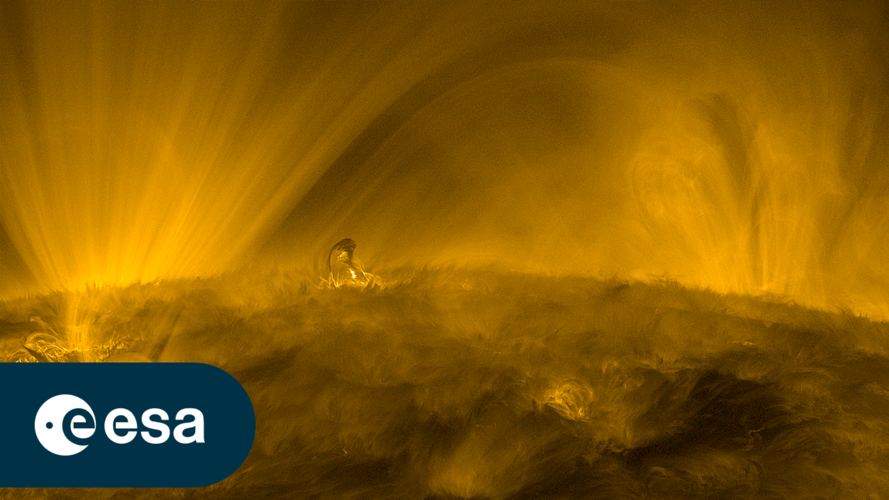
Solar Orbiter Takes a Mind-Boggling Video of the Sun

The 'fuzzy' Sun. Credit: ESA & NASA/Solar Orbiter/EUI Team

Solar Orbiter Takes a Mind-Boggling Video of the Sun

You’ve seen the Sun, but you’ve never seen the Sun like this. This single frame from a video captured by ESA’s Solar Orbiter mission shows the Sun looking very …. fluffy!  You can see feathery, hair-like structures made of plasma following magnetic field lines in the Sun’s lower atmosphere as it transitions into the much hotter outer corona. The video was taken from about a third of the distance between the Earth and the Sun.

See the full video below, which shows unusual features on the Sun, including coronal moss, spicules, and coronal rain.  

Solar Orbiter recorded this video on September 27, 2023 using its Extreme Ultraviolet Imager (EUI) instrument.

ESA said the brightest regions are around one million degrees Celsius, while cooler material looks darker, as it absorbs radiation.

So, just what is coronal moss? It’s what gives the Sun its fluffy appearance here. These peculiar structures on the Sun resemble the moss we find on Earth, in that it appears like fine, lacy features. But on the Sun, they usually can be found around the center of sunspot groups, where magnetic conditions are strong and large coronal loops are forming. The moss is so hot, most instruments can’t detect them. The moss spans two atmospheric layers, the chromosphere and corona.

Features on the Sun’s surface, as seen by Solar Orbiter. Credit: ESA & NASA/Solar Orbiter/EUI Team

Spicules, as their name implies, are tall spires of gas seen on the solar horizon that reach up from the Sun’s chromosphere. These can reach up to a height of 10,000 km (6,000 miles).

At about 0:30 in the video, you’ll see coronal rain. This material is cooler than the rest of the solar surface (probably less than 10,000 °C) versus the one million degrees C of the coronal loops. The rain is made of higher-density clumps of plasma that fall back towards the Sun under the influence of gravity.

Did you see the small eruption in the center of the field of view at about 0:20 seconds in the video? , with cooler material being lifted upwards before mostly falling back down. It’s not small at all — this eruption is bigger than Earth!

Missions like Solar Orbiter, the Parker Solar Probe and the Solar Dynamics Observatory are giving us unprecedented views of the Sun, helping astronomers to learn more about the dynamic ball of gas that powers our entire Solar System.

Further reading: 

{ https://www.universetoday.com/ }

Hoe vind je dit bericht?
Geschreven door peter om 17:45 Stuur door

Meer van UFO'S of UAP'S, ASTRONOMIE, RUIMTEVAART, ARCHEOLOGIE, OUDHEIDKUNDE, SF-SNUFJES EN ANDERE ESOTERISCHE WETENSCHAPPEN - DE ALLERLAATSTE NIEUWTJES

↑ Terug naar de berichten