Naar de inhoud

UFO'S of UAP'S, ASTRONOMIE, RUIMTEVAART, ARCHEOLOGIE, OUDHEIDKUNDE, SF-SNUFJES EN ANDERE ESOTERISCHE WETENSCHAPPEN - DE ALLERLAATSTE NIEUWTJES

UFO's of UAP'S in België en de rest van de wereld
akke.beakke.be
Ontdek de Fascinerende Wereld van UFO's en UAP's: Jouw Bron voor Onthullende Informatie! Ben jij ook gefascineerd door het onbekende? Wil je meer weten over UFO's en UAP's, niet alleen in België, maar over de hele wereld? Dan ben je op de juiste plek! België: Het Kloppend Hart van UFO-onderzoek In België is BUFON (Belgisch UFO-Netwerk) dé autoriteit op het gebied van UFO-onderzoek. Voor betrouwbare en objectieve informatie over deze intrigerende fenomenen, bezoek je zeker onze Facebook-pagina en deze blog. Maar dat is nog niet alles! Ontdek ook het Belgisch UFO-meldpunt en Caelestia, twee organisaties die diepgaand onderzoek verrichten, al zijn ze soms kritisch of sceptisch. Nederland: Een Schat aan Informatie Voor onze Nederlandse buren is er de schitterende website www.ufowijzer.nl, beheerd door Paul Harmans. Deze site biedt een schat aan informatie en artikelen die je niet wilt missen! Internationaal: MUFON - De Wereldwijde Autoriteit Neem ook een kijkje bij MUFON (Mutual UFO Network Inc.), een gerenommeerde Amerikaanse UFO-vereniging met afdelingen in de VS en wereldwijd. MUFON is toegewijd aan de wetenschappelijke en analytische studie van het UFO-fenomeen, en hun maandelijkse tijdschrift, The MUFON UFO-Journal, is een must-read voor elke UFO-enthousiasteling. Bezoek hun website op www.mufon.com voor meer informatie. Samenwerking en Toekomstvisie Sinds 1 februari 2020 is Pieter niet alleen ex-president van BUFON, maar ook de voormalige nationale directeur van MUFON in Vlaanderen en Nederland. Dit creëert een sterke samenwerking met de Franse MUFON Reseau MUFON/EUROP, wat ons in staat stelt om nog meer waardevolle inzichten te delen. Let op: Nepprofielen en Nieuwe Groeperingen Pas op voor een nieuwe groepering die zich ook BUFON noemt, maar geen enkele connectie heeft met onze gevestigde organisatie. Hoewel zij de naam geregistreerd hebben, kunnen ze het rijke verleden en de expertise van onze groep niet evenaren. We wensen hen veel succes, maar we blijven de autoriteit in UFO-onderzoek! Blijf Op De Hoogte! Wil jij de laatste nieuwtjes over UFO's, ruimtevaart, archeologie, en meer? Volg ons dan en duik samen met ons in de fascinerende wereld van het onbekende! Sluit je aan bij de gemeenschap van nieuwsgierige geesten die net als jij verlangen naar antwoorden en avonturen in de sterren! Heb je vragen of wil je meer weten? Aarzel dan niet om contact met ons op te nemen! Samen ontrafelen we het mysterie van de lucht en daarbuiten.

Archief

Psyche is Still Sending Data Home at Broadband Speeds

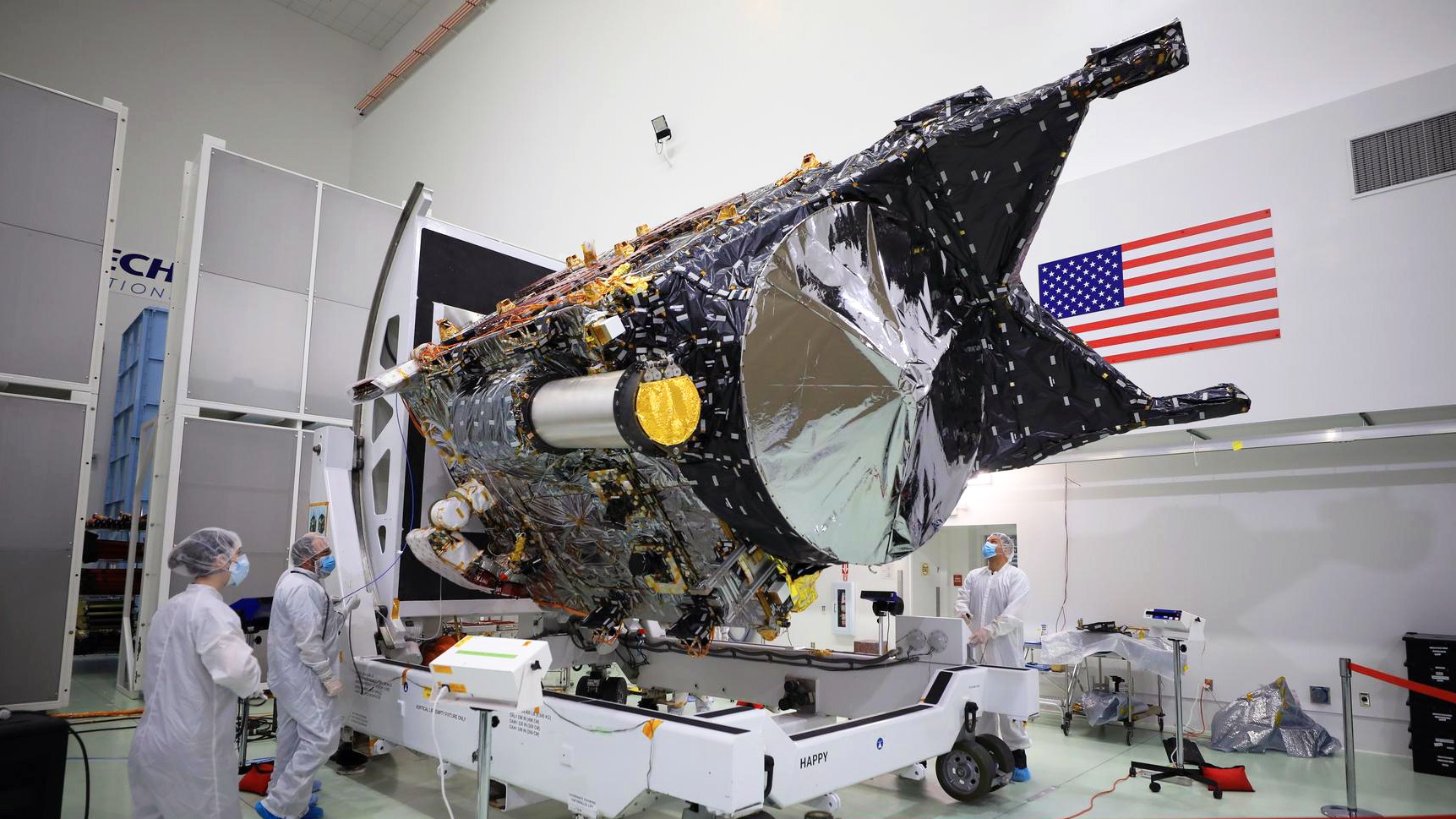
NASA’s Psyche spacecraft is shown in a clean room at the Astrotech Space Operations facility near the agency’s Kennedy Space Center in Florida on Dec. 8, 2022. DSOC’s gold-capped flight laser transceiver can be seen, near center, attached to the spacecraft. NASA/Ben Smegelsky

Psyche is Still Sending Data Home at Broadband Speeds

When I heard about this I felt an amused twinge of envy. Over the last year I have been using an unimpressive 4G broadband service and at best get 20 Mbps, NASA’s Psyche mission has STILL been getting 23 Mbps at 225 million km away! It’s all thanks to the prototype optical transmission system employed on the probe. It means it can get up to 100 times more data transmission rate than usual radio. 

NASA’s Pysche mission is on its way to explore the metal rich asteroid between the orbits of Mars and Jupiter called, not surprisingly Psyche. The intriguing thing about the asteroid is that it seems to be the iron rich core of an unformed planet. The spacecraft carried a wealth of scientific instruments to explore the asteroid including an imaging rig, gamma ray and neutron spectrometer, magnetometer and an X-band Gravity platform. 

It began its two year journey on 13 October with its destination, a tiny world that may help us unravel some of the mysteries of the formation of our Solar System. The theory that Psyche is a failed planetary core is not certain so this will be one of the first of its mission objectives; is it simply unmelted metal or was it a core. In order to understand this it’s necessary to work out its age. Secondary to the origin, other objectives are to explore the composition and its topography across the surface. 

Asteroid Psuche was discovered in March 1852 by Italian astronomer Annibale de Gasparis. Because he discovered it, he was allowed to name it and settled on Psyche after the Greek goddess of the soul. It orbits the Sun at a distance of between 378 million to 497 million kilometres and takes about 5 Earth years to complete an orbit. Shaped like a potato, or perhaps more accurately classed as ‘irregular’ it is actually a little ellipsoid in shape measuring 280 km across wide at its widest part and 232 km across long. 

Illustration of the metallic asteroid Psyche. Credit: Peter Rubin/NASA/JPL-Caltech/ASU

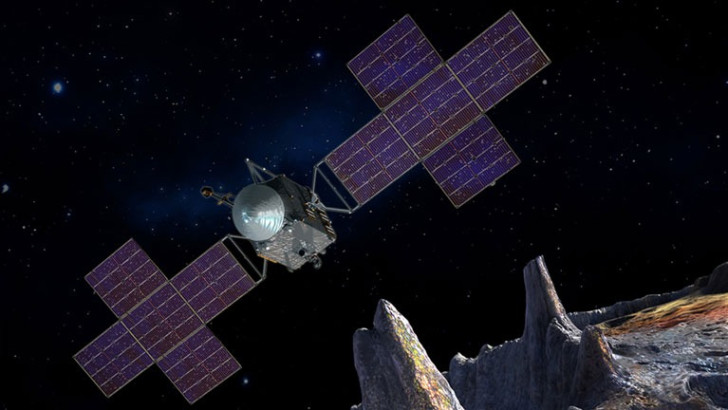
Of more interest than the objectives perhaps (although I for one am looking forward to learn more about this wonderful asteroid) was the trial communication system. The newly developed Deep Space Optical Communications technology (DSOC) is not the primary communications platform but it is there as a prototype. 

The optical system which relies upon laser technology successfully sent back engineering data at a distance of 226 million kilometres. Perhaps more impressively though, the spacecraft has shown that it can transmit at a rate of 267 Mbps (YES you read that right, just over quarter of a Gbps!) The impressive download speed was achieved on 11 December last year when a 15 second ultra high definition video was sent to Earth. Sadly though, as the spacecraft recedes, its data transmission capability will reduce. Still far better than normal radio communications though. 

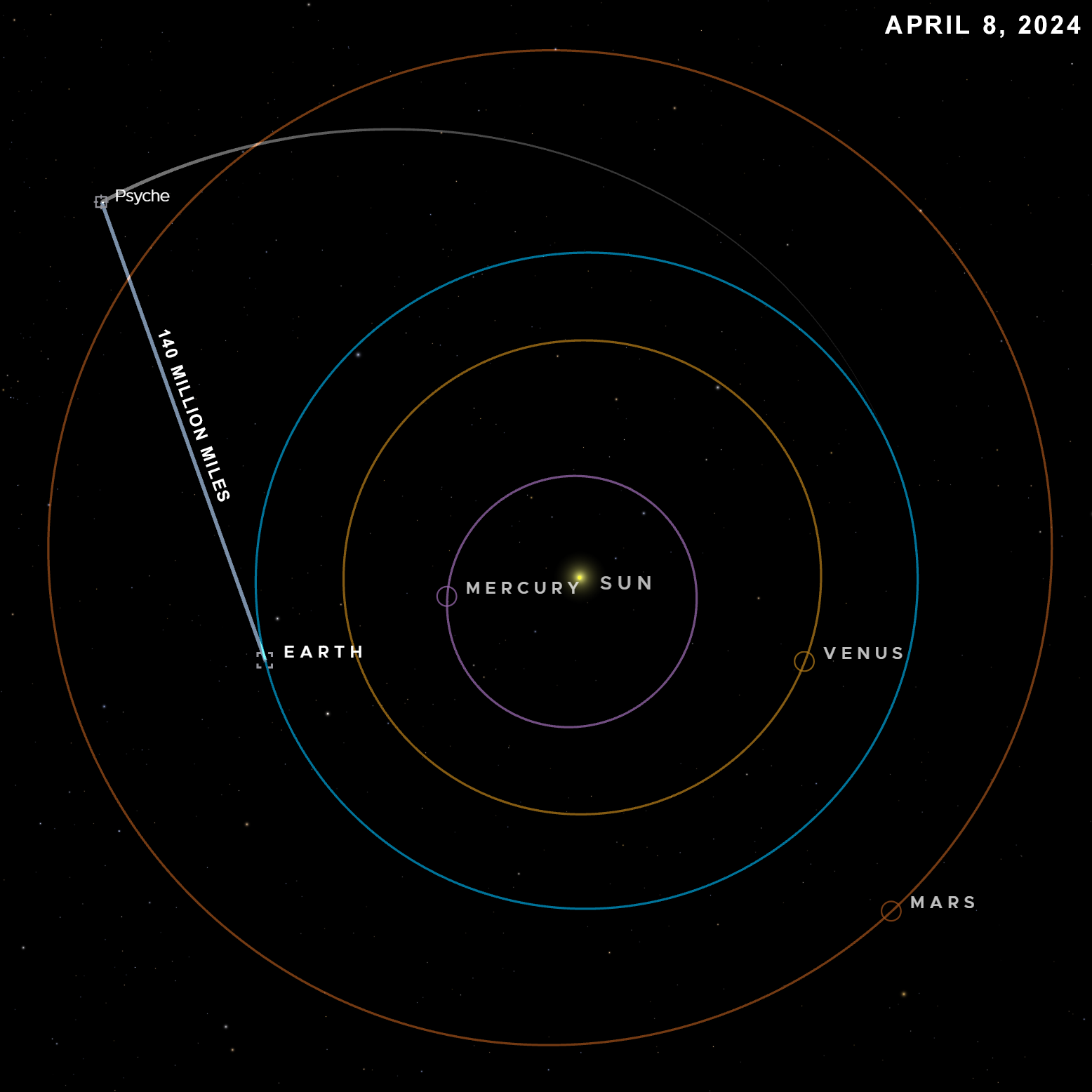
This visualization shows the Psyche spacecraft’s position on April 8

This visualization shows the Psyche spacecraft’s position on April 8 when the DSOC flight laser transceiver transmitted data at a rate of 25 Mbps over 140 million miles to a downlink station on Earth.
NASA/JPL-Caltech

Using a powerful modulated laser, the Optical Communication Telescope Laboratory in California will be able to send data at a low rate to Psyche. To receive data, a photon counting receiver has been installed at the Caltech Palomar Observatory to pickup information sent by the spacecraft. Communication has always been a great challenge in space exploration and, whilst we cannot reduce transit time for data, we can improve the amount of data sent at any one time. A great step forward in space exploration. 

Source : 

{ https://www.universetoday.com/ }

Hoe vind je dit bericht?
Geschreven door peter om 21:47 Stuur door

Did Aliens Land on Earth in 1945? A Defense Bill Seeks Answers.

Did Aliens Land on Earth in 1945? A Defense Bill Seeks Answers.

The Defense Department’s annual spending bill requires it to review U.F.O. sightings dating to 1945, the year some believe an object from space crashed in the New Mexico desert.

A sign bearing an image of a flying saucer and the message “U.F.O. Crash Site 1947” stands in a desert setting in New Mexico.
A 1947 crash in the desert near Roswell, N.M., became legendary among flying-saucer fans and conspiracy theorists. The object turned out to be a top-secret U.S. military balloon. Credit...Eric Draper/Associated Press

For the casual student of U.F.O. history, the modern idea of life beyond our planet usually dates to 1947, when a top-secret U.S. military balloon crashed in the desert near Roswell, N.M. The wreckage prompted decades of conspiracy theories and gave rise to the idea that Roswell was the site of an alien crash landing.

Now, thanks to a new congressional spending bill, U.F.O. enthusiasts may look to 1945 as the beginning of that era.

An amendment tucked into this year’s $858 billion National Defense Authorization Act, which funds the Defense Department’s annual operating budget, requires the department to review historical documents related to unidentified aerial phenomena — government lingo for U.F.O.s — dating to 1945. That is the year that, according to one account, a large, avocado-shaped object struck a communication tower in a patch of New Mexico desert now known as the Trinity Site, where the world’s first atomic bomb was detonated that July.

Experts said the bill, which President Biden signed into law in December, could be a game changer for studying unidentified phenomena.

“The American public can reasonably expect to get some answers to questions that have been burning in the minds of millions of Americans for many years,” said Christopher Mellon, a former deputy assistant secretary of defense for intelligence. “If nothing else, this should either clear up something that’s been a cloud hanging over the Air Force and Department of Defense for decades or it might lead in another direction, which could be truly incredible. There’s a lot at stake.”

A man wearing a suit and tie is sitting behind a nameplate and microphone.
Representative Mike Gallagher of Wisconsin, who introduced the amendment to the Pentagon spending bill, said a “comprehensive timeline” of U.F.O. sightings in U.S. government records was needed.Credit... Stefani Reynolds for The New York Times

The amendment was introduced by Representative Mike Gallagher, a Wisconsin Republican and a member of the Armed Services Committee. Mr. Gallagher, who declined an interview request, said in a brief statement that a “comprehensive timeline” of unidentified aerial phenomena in U.S. government records was needed, and that the amendment would ensure a full review of “all U.S. government classified and unclassified information.”

“This is an important step that will give us a more comprehensive understanding of what we know — and don’t know — about incidents impacting our military,” he said.

The U.S. government has dabbled in public-facing programs that have explored the possibility of alien life. In 2021, the Pentagon announced it would form a task force to look at the issue after a congressionally mandated report found that the government had no explanation for 143 sightings of strange phenomena by military pilots and others since 2004. NASA said in June that it would finance a study to look at unexplained sightings.

In 2022, the Defense Department established the All-domain Anomaly Resolution Office, which succeeded the Airborne Object Identification and Management Synchronization Group, after facing scrutiny from the public and lawmakers. Sean M. Kirkpatrick, a former chief scientist at the Missile and Space Intelligence Center, which is part of the Defense Intelligence Agency, was named director.

The introduction of drones and other airborne clutter has led to an increase in sightings of unidentified objects in recent years. The government, which delivered its most recent update on Thursday, has found that weather balloons and surveillance operations by foreign powers accounted for most of the recent sightings of unidentified aerial phenomena, though dozens remain officially unexplained.

The defense funding bill requires the new office to work with the intelligence community to identify any nondisclosure agreements related to possible U.F.O. sightings. It also requires the office to create a process for people to share information, regardless of classification, and to share its findings with the highest levels of the Defense Department. It also mandates that the All-domain Anomaly Resolution Office be fully staffed.

“This is an office now that has a voice and resources, and it has authority,” Mr. Mellon, the former Defense Department official, said.

Susan Gough, a spokeswoman for the agency, said in an email that “the department is reviewing the enacted legislation.”

Jacques Vallée, a longtime ufologist, astronomer and computer scientist, said the amendment’s inclusion in the defense bill was “an absolute turning point.”

Two men standing next to a white car in the New Mexico desert. The man at right, wearing sunglasses and a red sweatshirt, is pointing to his left at something in the distance.
Jacques Vallée with Jose Padilla in 2020. Mr. Padilla said he witnessed a U.F.O. crash as a child in the New Mexico desert in 1945. Credit...Paola Harris

“This is what all scientists and my colleagues have always dreamed of,” said Dr. Vallée, who has helped study reports of U.F.O.s for the Centre National d’Études Spatiales, the French space agency. He said that the U.S. government’s agreement to dig into the past meant “the stigma has been removed.”

Dr. Vallée began studying the Trinity incident several years ago alongside a journalist, Paola Harris, and interviewed people who claimed to have witnessed the crash. Dr. Vallée and Ms. Harris chronicled their research in a book, “Trinity: The Best-Kept Secret,” including the details of the avocado-shaped object. They also spoke to witnesses who said they came across the object as children and found what they described as “little creatures.”

In the United States, Dr. Vallée said, “there has always been, on the part of the government, especially the Pentagon,” a sense that civilian sightings are unreliable. “The reason,” he said, “is that civilians don’t have the technology to really document what happens, and of course the Pentagon does.”

But, Dr. Vallée said, there’s no reason that “a farmer in his field” isn’t qualified to give a quality observation of a possible U.F.O. “The civilian observations tend to be longer, they tend to be more detailed, they tend to leave a trace that we can analyze,” he said.

He said he was working with a team at Stanford University to analyze samples of minerals and debris that were left after U.F.O. crashes or landings.

“I would hope that the new project would continue to do that because I think we’ve shown the way to do that scientifically,” Dr. Vallée said. He added, “We don’t have proof that a biologist can look at, but we have considerable statistical and now observational evidence that there must be life out there, that the Earth is not unique.”

At 83, Dr. Vallée still holds out hope for tangible evidence in his lifetime.

“Science is a moving frontier,” he said. “I want to have the right answers, even if they are small answers, rather than more speculation.”

A version of this article appears in print on Jan. 15, 2023, Section A, Page 22 of the New York edition with the headline: Defense Bill Asks if Aliens Visited the Earth in 1945. Order Reprints | Today’s Paper | Subscribe

{ https://www.nytimes.com/ }

Hoe vind je dit bericht?
Geschreven door peter om 18:53 Stuur door

Unveiling the Shadows: The 1945 Avocado-Shaped UFO Crash – A Prelude to Roswell

Unveiling the Shadows: The 1945 Avocado-Shaped UFO Crash – A Prelude to Roswell

avocado-shaped-ufo

In the vast expanse of the New Mexico desert, a mystery older than the famed Roswell incident has beckoned the curious and the skeptical alike. In 1945, years before Roswell became synonymous with UFOs, an event unfolded near San Antonio, New Mexico, that would later be dubbed as the “Roswell before Roswell.” This event involved the crash of a mysterious “avocado-shaped” UFO—an incident that has intrigued UFO enthusiasts and researchers for decades.

President Biden’s recent signing of a military spending bill has thrust this enigmatic 1945 UFO crash back into the limelight, commanding the Pentagon’s All-domain Anomaly Resolution Office (AARO) to re-investigate the occurrence. This directive marks a significant moment in the annals of UFO investigations, promising to potentially unveil new insights into an event that predates the official narrative of UFO sightings in the United States.

At the heart of this resurgence in interest are the eyewitness accounts and the painstaking research of Jacques Vallée, a renowned scientist and UFO investigator, whose work inspired the character of François Truffaut in Steven Spielberg’s Close Encounters of the Third Kind. Alongside Italian UFO journalist Paola Harris, Vallée co-authored Trinity: The Best-Kept Secret, delving deep into the 1945 incident through the eyes of those who first encountered the wreckage.

The narrative of the crash is as fascinating as it is mysterious. Witnesses described an object with a dull metallic sheen, embedded in the ground, alongside accounts of strange, shadowy beings near the site. The subsequent military response, quickly securing and explaining away the incident as a downed weather balloon, did little to quell speculation, leading many to suspect a cover-up.

As the Pentagon embarks on this renewed investigation, the world watches with bated breath. The implications of uncovering new evidence or insights into the 1945 crash could be profound, challenging our understanding of human history and our place in the cosmos. The commitment to re-examine this case reflects a broader, more transparent approach to UFO sightings and encounters, signaling an era where the search for truth transcends the bounds of skepticism and secrecy.

With each passing year, the interest in UFO sightings continues to grow, fueled by a combination of technological advancements, increasing numbers of declassified documents, and a global community ever eager for answers. The re-investigation of the 1945 UFO crash not only serves as a testament to the enduring fascination with the unknown but also as a beacon, guiding us closer to the elusive truth that lies hidden among the stars.

{ https://www.latest-ufo-sightings.net/ }

Hoe vind je dit bericht?
Geschreven door peter om 18:37 Stuur door

Pentagon’s UFO Office Releases Report On Air Force Incident Over Gulf Of Mexico

Pentagon’s UFO Office Releases Report On Air Force Incident Over Gulf Of Mexic

UFO in the morning forest twilight

The Pentagon has released a new report by the All-domain Anomaly Resolution Office (AARO) about a UFO encounter by a pilot over the Gulf of Mexico.

The UFO encounter occurred on January 26th, 2023 and was reported by a United States Air Force fighter jet pilot that was based at Eglin Air Force Base in Florida.

The incident was first made public by Congressman Matt Gaetz during a July 2023 hearing when he revealed that he had seen evidence of a UFO that he was “not able to attach to any human capability.”

In March, through a Freedom of Information Act request, documents pertaining to the UFO encounter revealed that one of the UFOs encountered by the Air Force pilot had a “orange-reddish” illuminated bottom, a “three-dimensional cone shape” top composed of “gunmetal gray segmented panels,” and was similiar in shape to an “Apollo spacecraft.”

The UFO encounter was significant enough for Congresswoman Anna Paulina Luna and Representative Tim Burchett to visit Eglin Air Force Base to conduct an investigation. Luna claimed that the Air Force and the Pentagon tried to cover up the incident and stop them from gaining clearance.

“You don’t tell Congress that we don’t have the authorized clearance, especially members of House Armed Services, Oversight, and Judiciary,” she said.

Now, the All-domain Anomaly Resolution Office – the Pentagon’s office tasked with investigating UFO sightings by the U.S. military – has filed an official report, claiming to have solved the mystery of the Elgin Air Force Base UFO.

“On 26 January 2023, a military pilot reported four potential unidentified anomalous phenomena (UAP) while operating in the Eglin Air Force Base training range off the coast of Florida. Through the onboard radar system, the pilot initially observed that the four objects were aloft between 16,000 – 18,000 feet and appeared to be flying in formation,” the report begins.

The pilot reported to the AARO “that they thought they saw a vertically oriented engine affixed to the side of the object that was nearly the height of the object.”

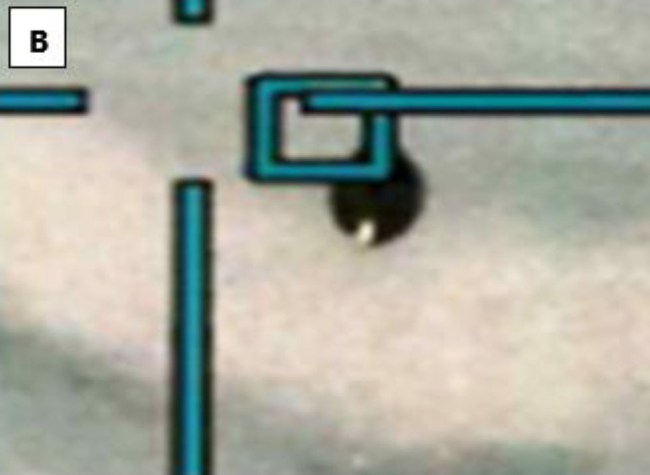
UFO sensor imagery captured by the Eglin-based fighter pilot

They also claimed that “upon closing to within 4,000 feet of the object, the radar on the aircraft malfunctioned and remained disabled for the remainder of the training exercise.”

Each and every claim made by the Air Force pilot was supposedly debunked or explained away by the AARO.

“AARO assesses the reported UAP very likely was an ordinary object and was not exhibiting anomalous or exceptional characteristics or flight behaviors,” the office concluded. “AARO has moderate confidence in this assessment due to the limited data provided.”

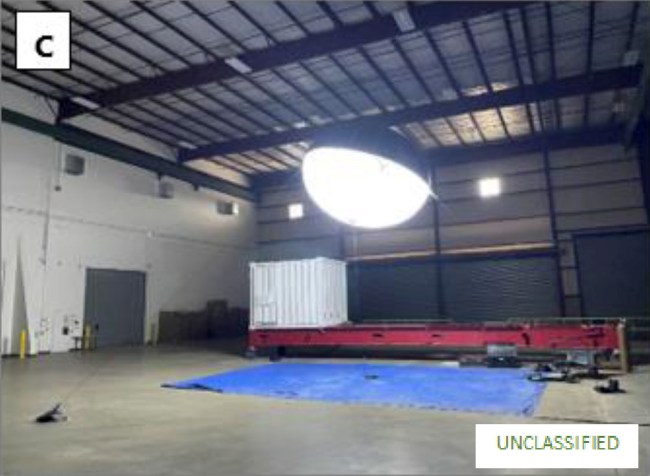
Based on a “thorough review of the data collected, official pilot accounts of the object’s description and behavior, laboratory testing of a commercial lighting balloon determined to have similar physical characteristics to the object described in the pilot’s report, a reconstruction of the flight geometry, and the sun angle at the time of the observation,” the AARO concluded “the object was a lighter-than-air (LTA) object, such as a large form-factor balloon; a meteorological balloon; a large Mylar balloon; or a large, commercial, outdoor, helium-filled, lighting balloon.”

pentagon lighting balloon aaro ufo

AARO

It’s always just a balloon, isn’t it?

{ https://brobible.com/ }

Hoe vind je dit bericht?
Geschreven door peter om 18:24 Stuur door

Bestaan er levensvormen op de maan van Jupiter? Een nieuw instrument zal ons dat eindelijk kunnen vertellen

Bestaan er levensvormen op de maan van Jupiter? Een nieuw instrument zal ons dat eindelijk kunnen vertellen

Door JanineJanine image

Bestaan er levensvormen op de maan van Jupiter? Een nieuw instrument zal ons dat eindelijk kunnen vertellen

Zijn er levensvormen op Europa, een van de manen van Jupiter? Volgens wetenschappers is er een manier om daar achter te komen dankzij een nieuwe techniek: laten we eens kijken waar het uit bestaat.

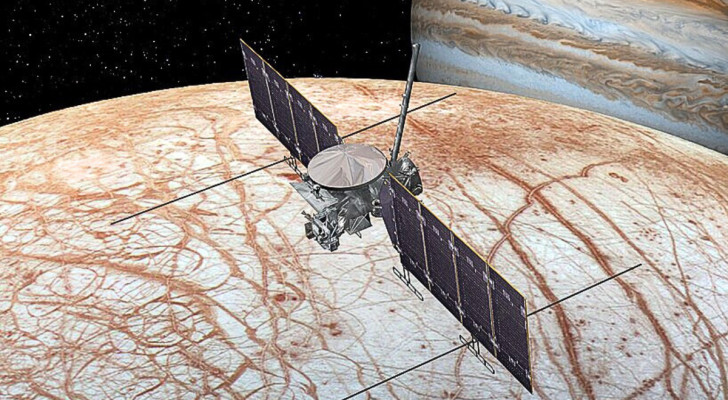
Een sonde vliegt over Europa en pikt ijskorrels op

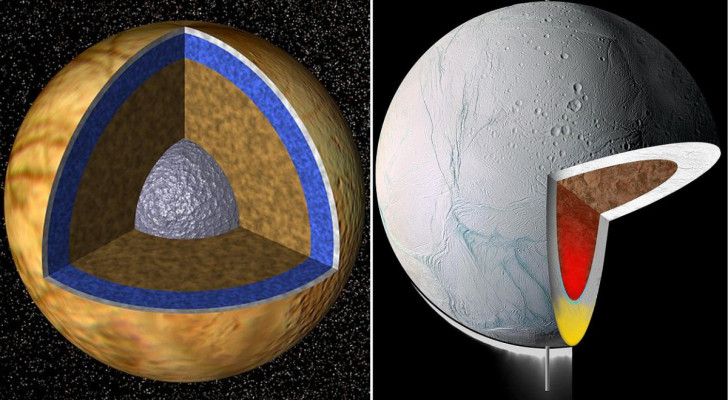
De interne structuur van Europa en Enceladus

unknown author of the NASA - NASA/JPL/Space Science Institute/Wikimedia commons - Public domain

Het zou voldoende zijn om één enkele ijskoude korrel die Europa bedekt te analyseren om te ontdekken of de satelliet cellulair leven herbergt. Makkelijker gezegd dan gedaan, maar wetenschappers hebben een manier gevonden die in de nabije toekomst getest kan worden, wanneer Europa Clipper, de sonde van NASA, over Europa vliegt.

In de praktijk zetten wetenschappers alles in op een van de instrumenten van de sonde, genaamd SUDA, Surface Dust Analyser, die ijskorrels moet oppikken als hij door de bevroren waterpluimen op het oppervlak van de satelliet vliegt en deze vervolgens moet analyseren. Fabian Klenner, planeetwetenschapper aan de Universiteit van Washington en hoofdauteur van het onderzoek naar deze methode, zei: "Het is verbazingwekkend hoe de analyse van deze kleine ijskorrels ons kan vertellen of er leven is op een ijskoude maan. We weten nu in ieder geval dat SUDA over deze mogelijkheden beschikt."

SUDA en de analyse van een enkele ijskorrel van Europa

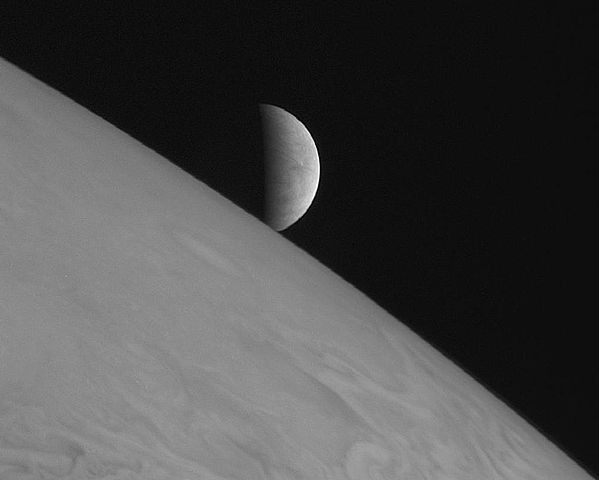
Zicht op de ijzige maan van Jupiter, Europa

NASA-JPL/Wikimedia commons - Public domain

SUDA zal in staat zijn om de chemische elementen in het verzamelde materiaal direct te onderzoeken, dankzij een proces dat bekend staat als “impact ionisatie massaspectrometrie”. Het unieke aan deze techniek is dat het instrument een enkele ijskorrel kan analyseren in plaats van een grote massa ijsdeeltjes. Hierdoor kunnen onderzoekers ontdekken of een enkele korrel hoge percentages ingrediënten van een enkele cel bevat.

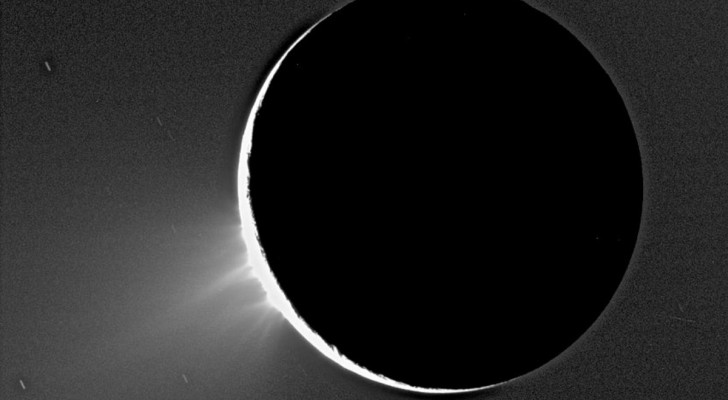
Wetenschappers geloven dat verschillende manen van zowel Jupiter als Saturnus, waaronder Europa, Enceladus, Ganymedes en Callisto, reservoirs van vloeibaar water bedekt met ijs bevatten. NASA's missie Cassini naar Saturnus heeft ontdekt dat pluimen ijskorrels die via het ijsoppervlak uit de verborgen zeeën van Enceladus spuwen verschillende organische verbindingen bevatten (en een hoge aanwezigheid van fosfor). Dit leidde tot de hypothese dat hetzelfde zou kunnen gebeuren op Europa.

Volgens Klenner zou de grote hoeveelheid ijskorrels rond de satelliet Jupiter het gevolg zijn van interplanetaire meteoroïden die het oppervlak raken, "waardoor er een vage wolk van ijskorrels rond de maan ontstaat - een paradijs voor een instrument als SUDA".

Is er cellulair leven in het ijs van Europa?

IJspluimen van Enceladus

NASA/JPL/Space Science Institute/Wikimedia commons - Public domain

Het idee dat Europa levensvormen zou kunnen herbergen, is niet nieuw: in de jaren negentig opperde de natuurkundige Freeman Dyson de aanwezigheid van “gevriesdroogde vis” in de ring van ruimtepuin rond Jupiter: hoewel dit een ver verwijderde hypothese is, zou er cellulair leven, zelfs in gefragmenteerde vorm, kunnen worden gevonden in de ijskorrels van de maan. Voordat ze SUDA op hun missie stuurden, testten Klenner en zijn team de capaciteiten door middel van laboratoriumsimulaties met experimentele apparatuur, die in staat bleek om bacteriën in afzonderlijke waterdruppels te onderscheiden. De sonde Europa Clipper wordt volgens de planning in oktober gelanceerd en komt in 2030 in een baan om Jupiter, waar hij ongeveer vier jaar zal blijven.

Een ander recent onderzoek suggereerde dat de ijzige schil van Europa meer dan 20 km dik zou kunnen zijn, wat een voortdurend omvallen van de ijslagen zou kunnen veroorzaken en dus een uitwisseling van het oppervlak met de oceaan. Sascha Kempf, de hoofdonderzoeker van SUDA, legde uit: “Als Europa Clipper de uitwisselingsprocessen tussen ijs en oceaan zou bevestigen, dan heeft deze maan een mechanisme om materiaal van de oceaan naar het oppervlak te transporteren, en zouden instrumenten aan boord van de sonde materiaal kunnen analyseren dat ooit uit de oceaan kwam – misschien zelfs celmateriaal, indien aanwezig."

Bestaat er echt leven in het water van deze maan van Jupiter? Er rest ons niets anders dan afwachten.

Source:

{ https://www.curioctopus.nl/ }

Hoe vind je dit bericht?
Geschreven door peter om 18:09 Stuur door

NASA reist naar een asteroïde van onschatbare waarde: hij is rijk aan kostbare metalen en dat niet alleen

NASA reist naar een asteroïde van onschatbare waarde: hij is rijk aan kostbare metalen en dat niet alleen

Janine image Door Janine

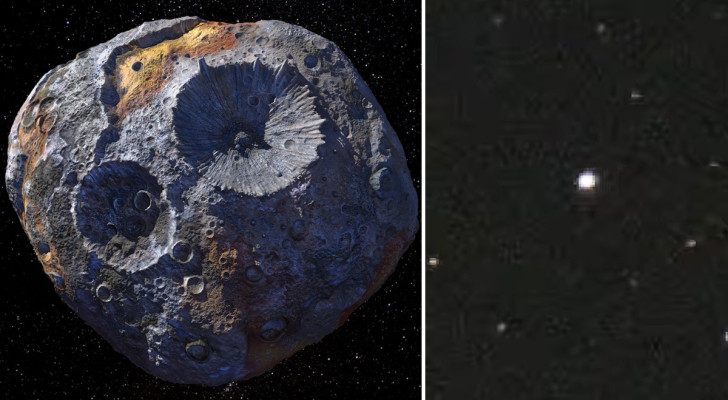
Aan de linkerkant een artistieke reproductie van de asteroïde 16 Psyche, rechts genomen door een aardse telescoop

In de familie van asteroïden die de kosmos bevolken, heeft er één in het bijzonder de aandacht getrokken van wetenschappers vanwege zijn mogelijk onschatbare waarde. Hier lees je waarom en waar hij te vinden is.

De belangrijke asteroïde Psyche

Een artistieke weergave van het ruimteschip Psyche

NASA

Psyche zou niet alleen een gigantische, maar ook een “zeer rijke” asteroïde kunnen zijn, die indrukwekkende hoeveelheden edelmetalen zou kunnen bevatten. Het bevindt zich ongeveer drie keer verder van de zon dan onze planeet en heeft een onregelmatige vorm, die doet denken aan een aardappel. Het breedste punt meet 280 km, terwijl het hoogste punt 232 km lang is, met een totaal van 165.800 vierkante kilometer.

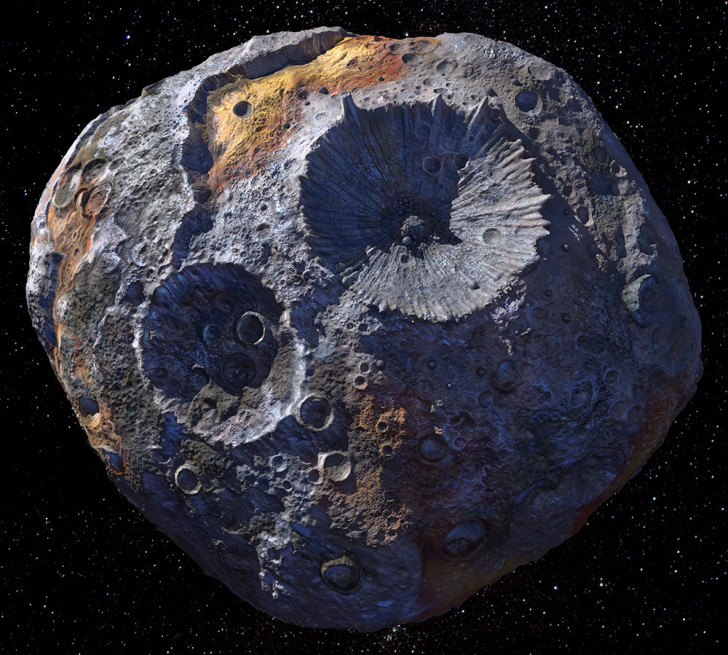
De samenstelling ervan wordt geschat op een mix van 30% rotsen en 60% metal. Het 3D-model van de asteroïde suggereert de aanwezigheid van twee kraters, wat zou kunnen wijzen op een grote verandering in het metaalgehalte en de uiterlijke kleur van Psyche. Dit kan echter pas worden bevestigd als NASA's missie Pysche het voor het eerst van dichtbij kan zien. Wetenschappers geloven dat zijn oorsprong voortkomt uit een reeks talrijke en gewelddadige botsingen, die hij heeft overleefd sinds de vorming van het zonnestelsel. Om deze reden zou het kunnen onthullen hoe de kern van de aarde en die van andere planeten is gevormd.

Hoe lang zal NASA's missie Psyche duren?

Asteroïde 16 Psyche vastgelegd door het Ray Astrophotographic Observatory

Raysastrophotograhy/Wikimedia commons - CC BY-SA 4.0 DEED

Psyche is een ontdekking van de Italiaanse astronoom Annibale de Gasparis, die de asteroïde op 17 maart 1852 voor het eerst zag en hem de naam gaf van de Griekse godin van de ziel die trouwde met Eros, de god van de liefde. Omdat het de zestiende ontdekte asteroïde is, is de volledige naam 16 Psyche en vertegenwoordigt het een belangrijk doelwit voor NASA: het gelijknamige ruimtevaartuig werd op 13 oktober 2023 gelanceerd vanaf NASA's Kennedy Space Center in Cape Canaveral, Florida, en zal over Mars vliegen om in augustus 2029 zijn bestemming te bereiken. In totaal zes jaar en 3,6 miljard kilometer.

De missie is van plan het oppervlak en de eigenschappen van het hemellichaam in kaart te brengen, dat een blootliggende kern van een planeet lijkt te zijn. Maar dit is niet de enige reden van belangstelling die Psyche omhult: er wordt geschat dat de kostbare metalen die het bevat, waaronder ijzer, nikkel en goud, ongeveer 10.000 biljoen dollar waard zijn.

Wat zal er gebeuren na de lange reis naar Psyche?

Artistieke weergave van de planetoïde Psyche

NASA /JPL-Caltech/ASU/Peter Rubin/Wikimedia commons - Public domain

Deskundigen werkten dag en nacht om het ruimtevaartuig te lanceren en het een baanbrekende reis naar de asteroïde te laten maken, die niet alleen de geheimen van de oorsprong van de aarde kon bevatten, maar ook een onschatbare economische waarde zou kunnen hebben. Er zal echter nog een lange weg te gaan zijn voordat deze voorspellingen worden bevestigd.

Constante monitoring van de orbiter zorgt ervoor dat deze zijn reis naar de diepe ruimte kan voortzetten, met mogelijke koersaanpassingen. Tegen de tijd dat het ruimtevaartuig Psyche bereikt in de belangrijkste asteroïdengordel tussen Jupiter en Mars, zal het ongeveer twee jaar rond de asteroïde draaien en verschillende aspecten onderzoeken, zoals de magnetische eigenschappen, de zwaartekracht en de samenstelling. In 2026 zal het ruimtevaartuig Mars naderen om een ​​zwaartekrachtboost te krijgen, waardoor het zijn reis kan voortzetten. De missie zou in 2031 moeten eindigen.

{ https://www.curioctopus.nl/ }

Hoe vind je dit bericht?
Geschreven door peter om 17:50 Stuur door

Comprehensive 3D map of the universe fills 11-billion-year gap

onvEJ66i?format=jpg&name=900x900

Comprehensive 3D map of the universe fills 11-billion-year gap

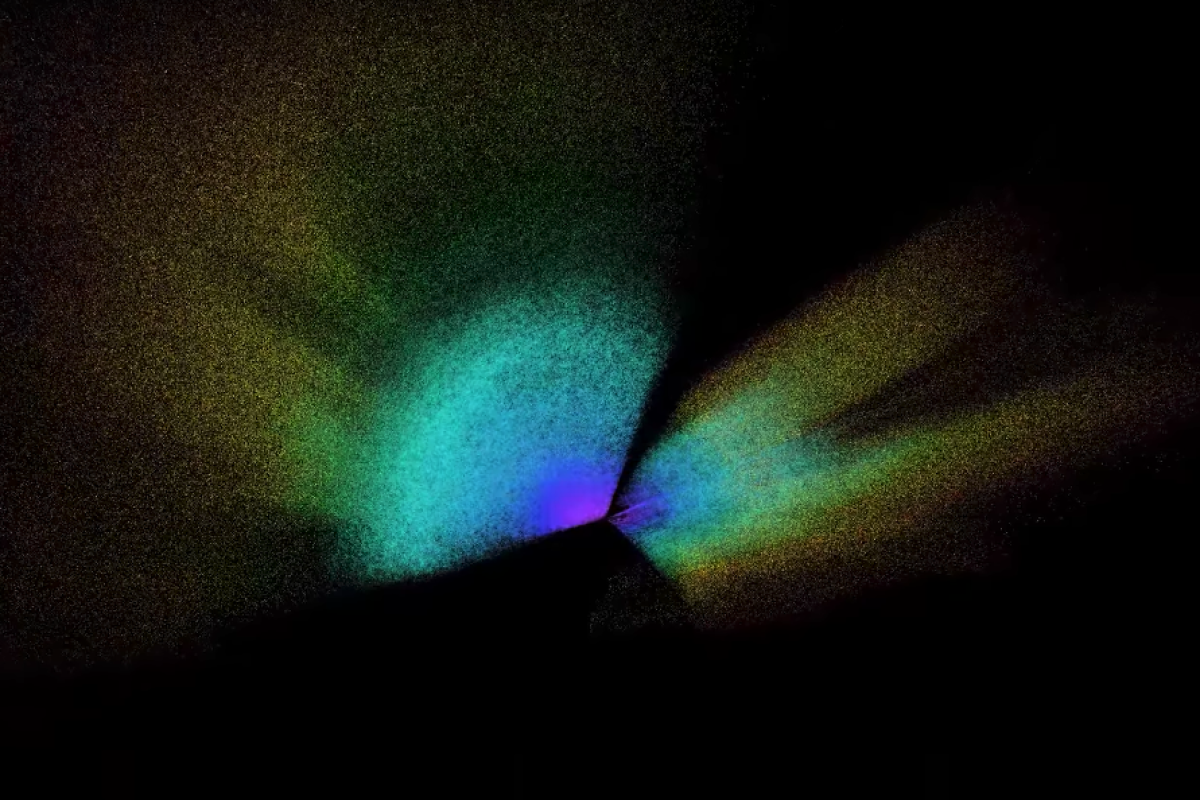
The new SDSS map of the universe is the result of over 20 years of data, and reveals new details about the cosmos
A 20-year study of the night sky has allowed astronomers to produce a comprehensive 3D map of the universe, covering 11 billion years of expansion. A new analysis of this map has highlighted a mismatch in the Hubble Constant, and revealed when the expansion of the universe began to accelerate.

The Sloan Digital Sky Survey (SDSS) has been collecting data for over 20 years now, with each data release resulting in more and more detailed maps of the cosmos. Now, scientists have combined it all into one huge three-dimensional map that covers almost the entire history of the universe. Importantly, the team says that the new study fills in a massive gap in the middle that has long bothered astronomers.

“We know both the ancient history of the universe and its recent expansion history fairly well, but there’s a troublesome gap in the middle 11 billion years,” says Kyle Dawson, a lead researcher on the project. “For five years, we have worked to fill in that gap, and we are using that information to provide some of the most substantial advances in cosmology in the last decade."

The new map uses data from different phases of the Sloan survey to chart objects at different distances from Earth – therefore representing different time periods in the universe’s history. In this map, Earth is the dot at the very center, and the differently colored rings represent different data sets, circulating outwards in ever greater distances in space and time.

The new SDSS map of the universe, with the different colored rings representing different data sets, gathered of objects at different distances from Earth
Anand Raichoor (EPFL), Ashley Ross (Ohio State University) and the SDSS Collaboration

The green section highlights galaxies closest to Earth, from data gathered during the first two SDSS runs. The pink and red circles cover the region up to about six billion light-years away, from observations of large, old, red galaxies. A little beyond that, the data comes from younger blue galaxies. To map even further out, to about 11 billion years ago, data was collected from quasars, which are bright galaxies with very active supermassive black holes at their centers.

DESI

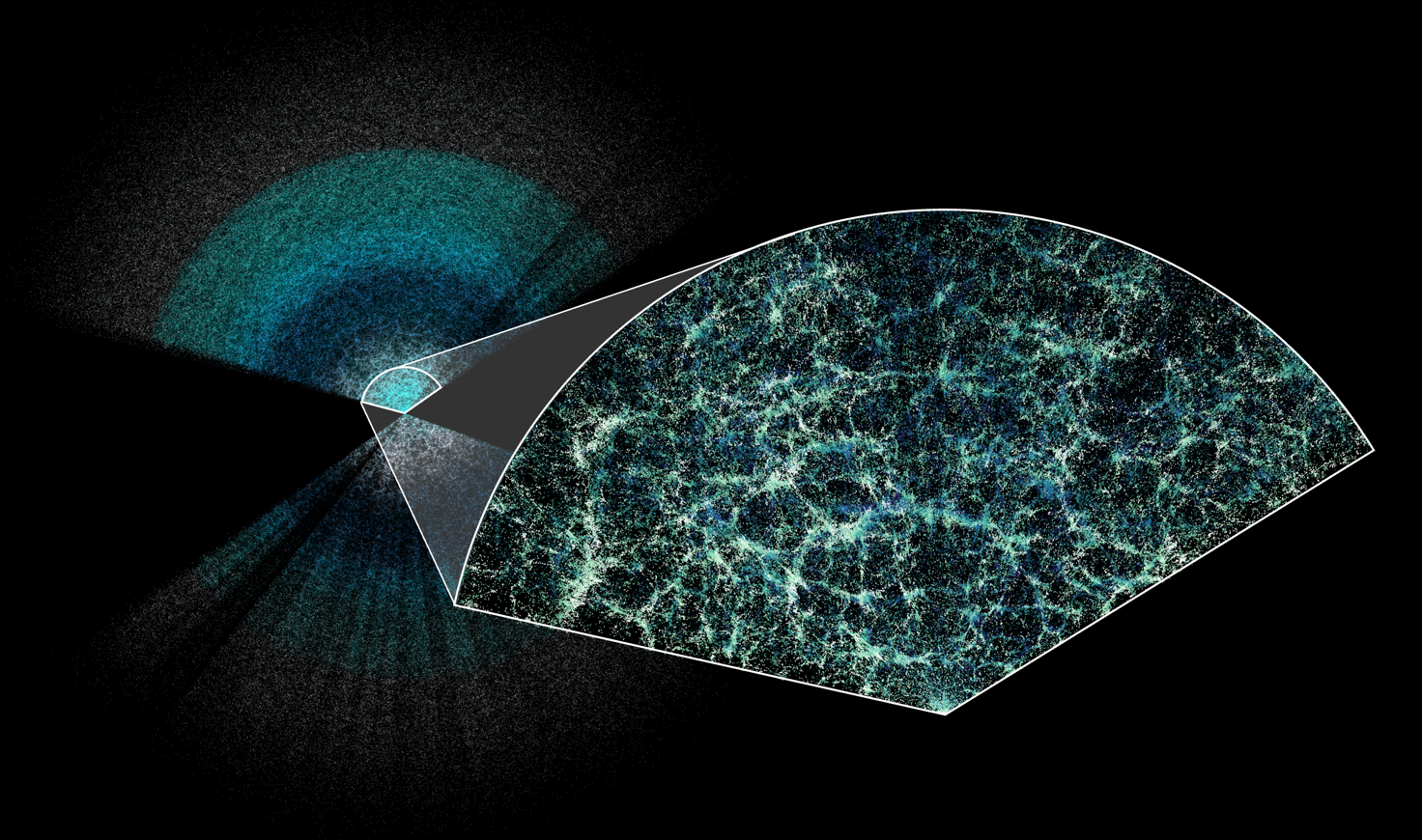
DESI has made the largest 3D map of our universe to date. Earth is at the center of this thin slice of the full map. In the magnified section, it is easy to see the underlying structure of matter in our universe (Credit: Claire Lamman/DESI collaboration; custom colormap package by cmastro).

The resulting map revealed a few new tidbits of information for astronomers. The researchers were able to use the map to measure the rate that the universe is expanding – a value known as the Hubble Constant. Strangely enough, they found the current value to be about 10 percent lower than when it’s calculated by measuring distances to nearby galaxies.

The team says that the data from the map is very precise, and made up of different data sets that all have the same conclusion. Exactly why there’s a mismatch for the Hubble Constant is a mystery that will require further study, the researchers say.

The study also showed that the expansion of the universe seemed to speed up about six billion years ago. It’s well known that the rate of expansion is accelerating, but nailing down when this began has been tricky in the past. Previous studies have suggested it started some four billion years ago, but the new data indicates it was earlier. A force dubbed "dark energy" is our current best guess for what is causing this acceleration.

And finally, since the study covers such a large section of space and time, it’s able to give one of the clearest pictures of what “shape” the universe is. Whether it’s flat or curved is the subject of ongoing argument for astrophysicists, but the new SDSS map adds evidence to it being flat.

The SDSS will continue to study the cosmos in ever more detail, with a new phase of operations due to begin later this year.

The research was published in a series of studies, as Sloan’s 16th data release. The team discusses the work in the video below.

The eBOSS 3D map of the Universe

Source: 

{https://newatlas.com/ }

Hoe vind je dit bericht?
Geschreven door peter om 01:13 Stuur door

Why is it so hard to send humans back to the moon?

Why is it so hard to send humans back to the moon?

the orion spacecraft above the moon
An illustration of NASA's Orion spacecraft in orbit around the moon. 
(Image credit: Lockheed Martin)

Between 1969 and 1972, the Apollo missions sent a total of a dozen astronauts to the surface of the moon — and that was before the explosion of modern technology. So why does it seem like our current efforts, as embodied by NASA's Artemis program, are so slow, halting and complex? 

There isn't one easy answer, but it comes down to money, politics and priorities.

Let's start with the money. Yes, the Apollo missions were enormously successful — and enormously expensive. At its peak, NASA was consuming around 5% of the entire federal budget, and more than half of that was devoted to the Apollo program. Accounting for inflation, the entire Apollo program would cost over $260 billion in today's dollars. If you include project Gemini and the robotic lunar program, which were necessary precursors to Apollo, that figure reaches over $280 billio

Related: 

In comparison, today NASA commands less than half a percent of the total federal budget, with a much broader range of priorities and directives. Over the past decade, NASA has spent roughly $90 billion on the Artemis program. Naturally, with less money going to a new moon landing, we're likely to make slower progress, even with advancements in technology.

Closely tied to the financial realities are the political realities. In the 1960s, America was in the midst of the space race, a competition with the Soviet Union to achieve as many firsts in space, especially landing humans on the moon. The public was on board and energized by this idea, as were lawmakers who directed NASA's expansive budget. 

That kind of spending, however, was deeply unsustainable. As soon as America "won," the public quickly lost interest and NASA funding tumbled. There simply isn't the political or public will to spend that amount of money for a second shot at the moon.

This combination of lower political will and fewer financial resources forced NASA to make some critical decisions in the late 1990s and early 2000s — decisions that still affect Artemis today. 

The four Artemis 1 Space Launch System RS-25 engines found on the vehicle's core stage previously flew on 21 space shuttle missions.  (Image credit: Josh Dinner)

Namely, as the space shuttle program was winding down, NASA administrators didn't know what to do with the industrial capabilities and partnerships that led to the shuttle. They decided to keep that infrastructure in place by reusing many shuttle parts, especially the engines, and folding them into the Artemis design.

On the other hand, one could argue that it was the right call to keep that infrastructure in place and aerospace engineers employed, because it was exactly that technical base that we needed to launch the recent renaissance in private spaceflight companies — but that's a separate discussion.

Lastly, the modern Artemis concept has a much different set of priorities than the Apollo missions did. For example, our risk tolerance is much, much lower than it was in the 1960s. The Apollo missions were outright dangerous, with a significant chance of failure. Indeed, several missions did encounter disasters: the Apollo 1 fire that killed three astronauts, an engine shutdown during Apollo 6, and the near-fatal design flaw that nearly led to the deaths of the Apollo 13 astronauts. NASA, lawmakers and the public are not willing to take on that level of risk again, especially after the Challenger and Columbia disasters.

The Apollo missions expended enormous sums of money to send astronauts to the lunar surface for a few dozen hours. They went, collected some samples, set up some simple experiments, and left. 

The Artemis missions are designed around a completely different set of goals. For one, the astronauts will spend up to a week on the lunar surface, which requires more food, water, fuel and scientific instruments. Second, while the Apollo missions treated science as an afterthought — the main goal was to beat the Soviets — scientific investigation will take center stage in the Artemis program, meaning it entails a longer, more complex mission design.

Lastly, the intent of the Artemis program isn't just to return humans to the moon; it's to begin building the infrastructure to maintain a permanent human presence there. Everything from orbiting refueling depots to site selection for future colonies falls under the umbrella of the Artemis project. It is a much more involved program because it provides the framework for achieving dreams for generations to come.

{ https://www.space.com/ }

Hoe vind je dit bericht?
Geschreven door peter om 00:48 Stuur door

ASTRONOMERS REVEAL AN ‘ACTIVE MOON’ MAY BE HIDING IN ORBIT NEAR THIS RECENT JAMES WEBB SPACE TELESCOPE DISCOVERY

iRA9xAUQ?format=jpg&name=900x900

(NASA, ESA, CSA, and L. Hustak (STScI))

ASTRONOMERS REVEAL AN ‘ACTIVE MOON’ MAY BE HIDING IN ORBIT NEAR THIS RECENT JAMES WEBB SPACE TELESCOPE DISCOVERY

Astronomers have detected emissions from a brown dwarf with help from the James Webb Space Telescope that suggests it may produce aurorae like those seen near Earth’s poles, and that it could also possess an active moon in its orbit.

Brown dwarfs are larger than planets but possess less mass than stars and appear frequently throughout the universe. Of the many thousands known to exist, last year, a study led by research scientist Jackie Faherty with the American Museum of Natural History investigated a dozen of these celestial objects with the powerful eye of the Webb telescope.

Located approximately 47 light years from Earth, one of these brown dwarfs, CWISEP J193518.59–154620.3 (also known simply as W1935), possesses a surface temperature of about 400° Fahrenheit and a likely mass of somewhere between six and 35 times that of Jupiter.

During their studies, Faherty and her team found that W1935 was unlike other brown dwarfs they had observed; specifically, it appeared to be emitting methane. This is unusual since methane is most often associated with larger planets like gas giants.

“We were confused about what we were seeing at first but ultimately that transformed into pure excitement at the discovery,” Faherty said.

The initial detection of methane emanating from W1935 was reported in January, baffling astronomers at the time since the object is relatively cold and lacks any host star to provide its upper atmosphere with the energy that usually drives such methane emissions.

Faherty and her team relied on computer modeling in their observations of W1935, which revealed that it also appears to possess a temperature inversion, which is fairly common for planets orbiting stars. However, without any external heat source, it seemed odd that W1935 would possess this characteristic due to its isolation.

Ben Burningham, a researcher from the University of Hertfordshire and co-author of a new paper describing the team’s findings, says the team was “pleasantly shocked” by this discovery and went to work on trying to locate the source of the extra heat in W1935’s upper atmosphere.

Looking at our own solar system, they initially made comparisons to Jupiter and Saturn, both of which are similar to W1935 in that they emit methane and also have temperature inversions, which astronomers link to the presence of aurorae on these planets.

In other words, all evidence seemed to point to the existence of aurorae on W1935 as well. This luminous phenomenon occurs due to the interaction between high-energy particles emitted by the Sun and the magnetic fields surrounding Jupiter, Saturn, and Earth.

However, without a nearby star to contribute particle emissions that contribute to the aurorae we observe in our own solar system, scientists wondered what the cause may be on a brown dwarf like W1935.

Another factor contributing to the generation of aurorae in our solar system is volcanically active moons encircling larger planets like Jupiter and Saturn. These moons eject material into space that also interacts with their magnetic fields. Hence, it seems possible that W1935 may also possess a volcanic moon that has not yet been directly observed.

“Every time an astronomer points JWST at an object, there’s a chance of a new mind-blowing discovery,” Faherty recently said of her team’s findings.

Faherty and her colleagues’ new paper, “Methane emission from a cool brown dwarf,” appeared on April 17, 2024, in the journal Nature.

{ https://thedebrief.org/category/space/ }

Hoe vind je dit bericht?
Geschreven door peter om 00:27 Stuur door

Kingman UFO Crash: Man Worked At Area 51 Said Alien Survivor Helped Re-Engineering UFO

Kingman UFO Crash

Kingman UFO Crash: Man Worked At Area 51 Said Alien Survivor Helped Re-Engineering UFO

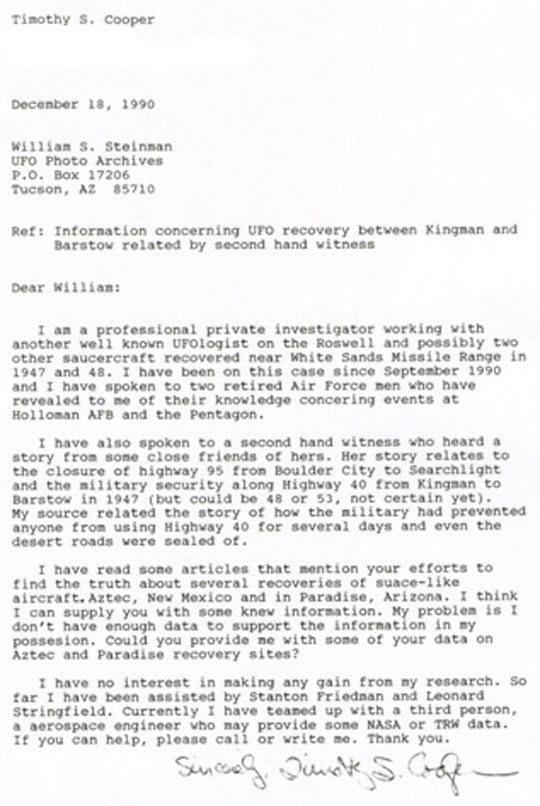
In 1953, the Atomic Energy Commission conducted a series of powerful explosions at the Nevada Test Site, known as “Upshot Knothole.” During the same period, witnesses reported seeing eight unidentified flying objects engaged in a dogfight near Arizona. Historian and former museum curator Harry Drew spent ten years investigating the incident and discovered that three of the craft had crashed on the outskirts of Kingman, Arizona in May 1953.

Drew did not expect to find evidence of the Kingman UFO and was surprised to learn about the third crashed craft. Mystery Wire reports he researched old records and interviewed original witnesses to uncover a complicated story that was more intricate than the Roswell UFO crash story.

In 1973, a retired Nevada Test Site technician named Arthur Stansel revealed that he and his team were taken to a remote desert location in Arizona to recover a secret experimental craft that had crashed. The team found a perfectly intact 40-foot diameter disc-shaped craft with four alien beings associated with it, and it was shipped to Groom Lake, Nevada, where Area 51 was later built around it.
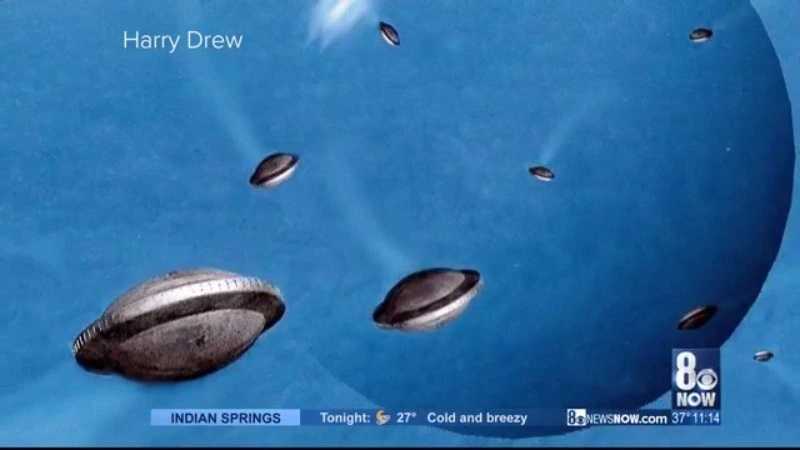
1953 Kingman UFO Crash An artist’s rendition of the 1953 Kingman UFO Crash. Credit: Harry Drew via Mystery Wire

In his book, “7 Days in May: The Kingman UFO Story,” Drew describes what happened to the three crashed crafts. One was destroyed when it crashed into a mountain near Kingman, another was found intact miles away from the crash site, and the third one crashed next to a small reservoir after clipping a rocky butte. The military took the last unknown craft back to a Nevada base. He found military-issued food containers dating back to 1953 around the exact crash site, proving that military teams camped there.

UFO enthusiasts have speculated that the Kingman UFO incident might be linked to the nuclear tests conducted in Nevada. However, Drew’s research suggests that the cause was a trio of powerful experimental radar sites set up around Kingman.

Drew claimed that he was able to document the crashes and the secret transport of the crafts to Nevada. He also asserted that one of the crafts was entirely intact when discovered. Despite the hotly contested nature of the story, Drew has evidence to support his findings.

According to MUFON researcher Richard Hall, in April 1964, the first report of a crash near Kingman was relayed to him by a future Vietnam commander. However, it was not until June 1973 that the case of the Kingman UFO retrieval was brought to the public’s attention by renowned UFO researcher Raymond Fowler.

The incident involved an engineer, Arthur G. Stancil (also known as “Fritz Werner”), who took preliminary measurements to assess the momentum of the crashed craft, which could prove useful in any reverse engineering attempts. Stancil, an Ohio University mechanical engineering graduate, who worked at Wright-Patterson Air Force Base in Dayton, Ohio, first made the story public.

Dr. Eric Wang, who was suspected of leading a reverse engineering team on alien craft, headed the Installations Division within the Office of Special Studies where Stancil worked. Stancil provided an affidavit in April 1976 vouching for the honesty of his testimony, which was released by Ray Fowler in the UFO Magazine. In his statement, Stancil revealed that he was loaned out to the Atomic Energy Commission and designated as a project engineer on some atomic bomb tests referred to as “Operation Upshot Knothole.”

The craft was reported to have a brushed aluminum exterior finish, measuring approximately 30 feet in diameter, and contained two swivel seats, instruments, and display panels. The hatch was five feet high and three feet wide. Additional reports from the book “Majic Eyes Only,” written by Ryan S. Wood, indicate that the craft was embedded 20” into the desert sand on impact.

Re-Engineered UFO And Four Aliens

There are varying reports about the number of extraterrestrial biological entities (EBEs) recovered at the crash site. Some sources claim that four small EBEs were recovered, while others state that only one was found. Despite these discrepancies, there is evidence to suggest that a military blockade was set up along Highway 40, possibly in 1953, to secure the area leading to and from the potential crash site.

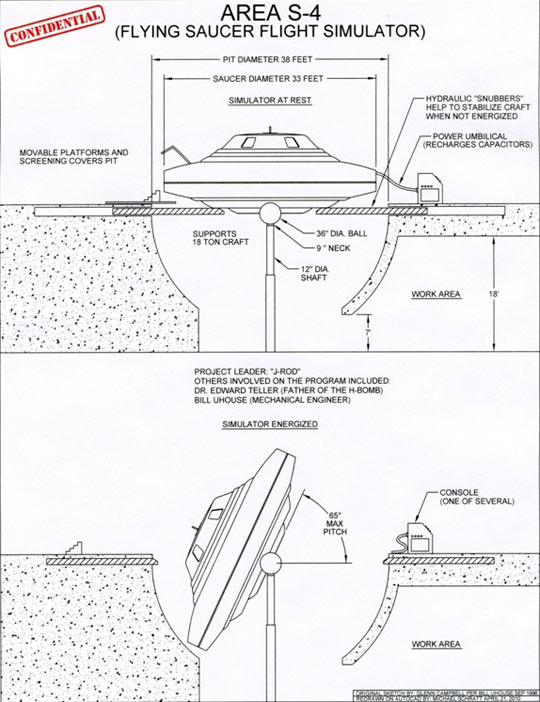
It is unclear whether the military recovered objects of extraterrestrial origin and transported them to a clandestine hangar, but there are reports of crashed discs being housed at a top-secret facility known as Area S-4, located 12 miles south of Area 51.

According to Wendelle Stevens, a retired US Air Force pilot-turned-UFO researcher, the disc that crashed near Kingman was transported to Area 51 via a U.S. Army tank transporter. The recovery crew attempted to tilt the craft on end to facilitate transportation across the country but abandoned this procedure when it became clear that it was impossible. Telephone poles had to be removed when the main road intersected with unimproved surfaces or dirt roads due to the oversized load of the disc on the trailer.

Read also:

Bill Uhouse, a retired mechanical engineer, claimed to have been part of a top-secret program to design and build flight simulators used to teach American test pilots how to control flying saucers. He stated that the origin of the program came from the UFO crash at Kingman.

Mr. Uhouse claimed to have served in the Marine Corps and Air Force for a total of 14 years as a fighter pilot and flight tester of experimental aircraft. Later in his career, he worked as an engineer for defense contractors, focusing on antigravity propulsion systems and flight simulators for exotic aircraft, as well as actual flying discs.

According to his testimony, the first disc they tested was a re-engineered ET craft. Mr. Uhouse was invited to work on a flying disc simulator by an unknown man. He was reassigned to link aviation and worked on building the F-102 simulator and B-47 simulator. He claimed that extraterrestrials presented a craft to the US government which was taken to Area 51, and the four ETs were taken to Los Alamos. His specialty was the flight deck and instruments, and he met with an ET called J-rod who helped engineers with the craft’s engineering.

“There was only one of them (alien) that would talk to scientists in the lab with them and the rest wouldn’t talk to anybody or even have a conversation with them. First, they thought it was mental telepathy but it is kind of a joke to me because they actually speak maybe not like we do but uh they actually speak,” Mr. Uhouse said on Sirius Disclosure.

In his 2013 interview, Mr. Uhouse discussed his work on a craft that was different from Bob Lazar’s alleged reactor. He explained that the simulator he worked on had six capacitors charged with a million volts each, which created a gravitational field that allowed the craft to lift off and turn left to right.

The craft had no windows, and visibility was through cameras, and there were no seat belts as the craft had its own gravitational field. Uhouse mentioned that it took a significant amount of training to operate the craft, and its design did not allow for the installation of external weapons like traditional aircraft. He also claimed that Area-51’s secrecy was due to a peace pact signed between the US and the United Nations during the time of President Eisenhower.

Old newspaper clipping of Bill Uhouse. Old newspaper clipping of Bill Uhous Credit: Richard Geldreich, Jr.

In 1977, UFO researcher Len Stringfield shared another account supporting the Kingman UFO crash. According to this new story, a man who served in the National Guard at Wright Patterson claimed to have witnessed the delivery of three bodies packed in dry ice, measuring four feet tall with large heads and brownish skin. The bodies were reportedly recovered from a crash site in Arizona in 1953. Since then, several other witnesses have come forward, but further details are currently unavailable. (Source)

Interestingly, UFO expert Charles Wilhelm heard a strikingly similar story in 1966 from a man who claimed that his father had shared the account on his deathbed. In 1995, an individual who went by the name of Jarod-2 contacted The Groom Lake Desert Rat, an Internet publication, and revealed that he had worked on a secret project for the USAF. The project aimed to construct a flying saucer simulator and had gathered materials from the Roswell and Kingman crash sites.

{ https://www.howandwhys.com/ }

Hoe vind je dit bericht?
Geschreven door peter om 23:15 Stuur door

Meer van UFO'S of UAP'S, ASTRONOMIE, RUIMTEVAART, ARCHEOLOGIE, OUDHEIDKUNDE, SF-SNUFJES EN ANDERE ESOTERISCHE WETENSCHAPPEN - DE ALLERLAATSTE NIEUWTJES

↑ Terug naar de berichten