Ant-like alien creature seen in Perseverance Mars rover image
.png)
Ant-like alien creature seen in Perseverance Mars rover image.png)
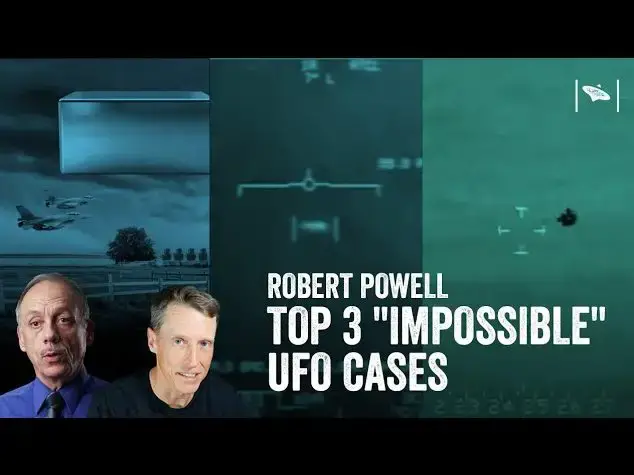
Exploring the Unexplained: Top 3 Impossible UFO Cases with Scientist Robert Powell
In the realm of unidentified flying objects (UFOs), few cases have perplexed and intrigued both the public and experts as much as the ones involving seemingly impossible maneuvers and speeds. Scientist Robert Powell, a seasoned researcher with decades of experience in the semiconductor industry and an avid investigator of UFO phenomena, sheds light on three such encounters. These instances not only challenge our understanding of physics but also hint at the existence of technology far beyond our current capabilities.
One of the most compelling cases occurred near Stephenville, Texas, where numerous witnesses, including local law enforcement, reported seeing an unusually large object in the sky. This object displayed extraordinary agility and speed, moving at velocities calculated to be as much as 1,900 miles per hour without any accompanying sonic booms – a feat that remains unexplained by conventional aircraft technology. Radar data corroborated these observations, showing an object executing movements that would require G-forces far beyond the tolerance of human pilots. Powell’s analysis, supported by radar and eyewitness accounts, underscores the case’s strangeness and its challenge to current aerospace technology.
This case involved an unidentified object captured on thermal imaging cameras by U.S. Customs and Border Protection in Aguadilla, Puerto Rico. The video footage shows the object traveling at high speed across the screen and even splitting into two separate objects without any noticeable change in velocity or trajectory. Skeptics have proposed theories such as balloons or small unmanned aerial vehicles, but the object’s ability to maintain coherence in high winds and perform maneuvers like splitting in two challenges these explanations. Powell points out the technical limitations of such theories and emphasizes the calculated speeds and behaviors that align more closely with a technologically advanced, unknown aerial vehicle.
Arguably one of the most famous UFO encounters, involving the USS Nimitz Carrier Strike Group, showcases multiple radar contacts with high-speed aerial objects that defied known aviation technology. Fighter pilots witnessed a “Tic Tac”-shaped object that could hover over the sea and then accelerate to supersonic speeds within seconds, far outpacing the capabilities of the pursuing jets. The encounter was thoroughly documented through both radar data and multiple pilot testimonies. The object’s ability to perform extreme accelerations, estimated to be several thousand G-forces, suggests technology that is not only unknown but far beyond current engineering paradigms.
These cases, thoroughly investigated by experts like Robert Powell, challenge the conventional understanding of what is possible in terms of speed, acceleration, and aerodynamics. Each case offers a glimpse into the potential existence of advanced technology controlled by intelligence beyond human capabilities. While these encounters remain unexplained, they encourage a continued and open-minded investigation into the unknown, pushing the boundaries of current science and technology. Powell’s analysis emphasizes the need for a scientific approach to studying these phenomena, one that could potentially reveal new understandings of physics and technology.
Unexplained anomaly near Antarctica moving North causing 80 foot waves
Unveiling UFO Secrets: Dr. Steven Greer's Perspective
NASA’s Next Solar Sail is About to Go to Space

Everyone knows that solar energy is free and almost limitless here on Earth. The same is true for spacecraft operating in the inner Solar System. But in space, the Sun can do more than provide electrical energy; it also emits an unending stream of solar wind.
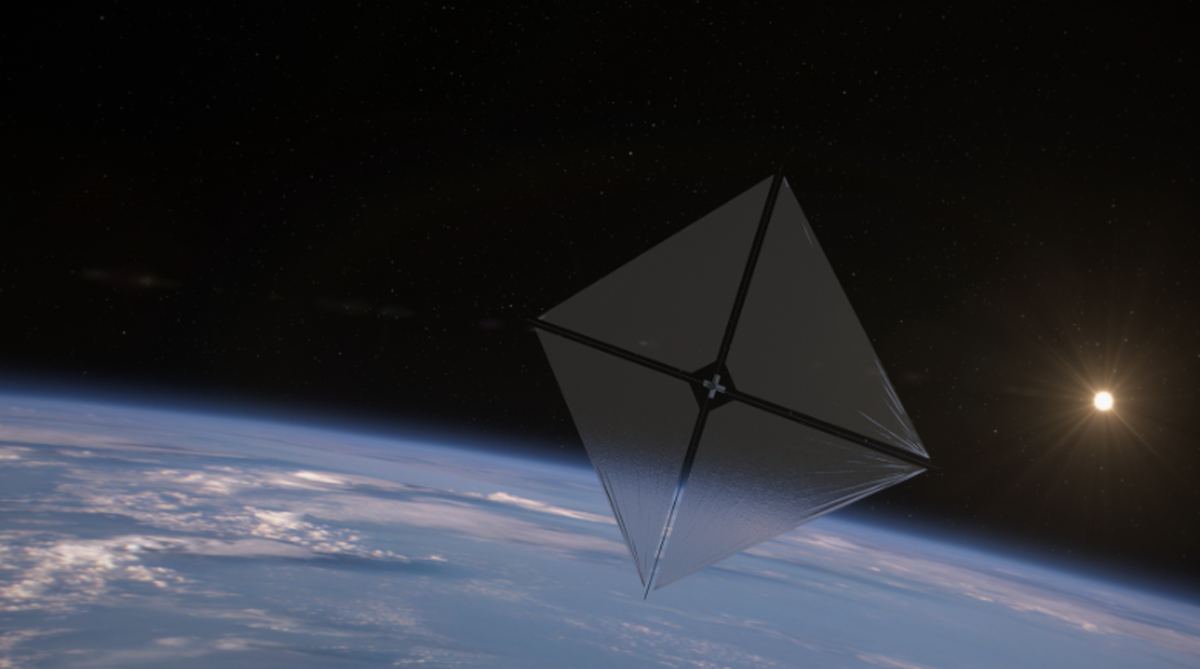
Solar sails can harness that wind and provide propulsion for spacecraft. NASA is about to test a new solar sail design that can make solar sails even more effective.
Solar pressure pervades the entire Solar System. It weakens with distance, but it’s present. It affects all spacecraft, including satellites. It affects longer-duration spaceflights dramatically. A spacecraft on a mission to Mars can be forced off course by thousands of kilometres during its voyage by solar pressure. The pressure also affects a spacecraft’s orientation, and they’re designed to deal with it.
Though it’s a hindrance, solar pressure can be used to our advantage.
A few solar sail spacecraft have been launched and tested, beginning with Japan’s Ikaros spacecraft in 2010. Ikaros proved that radiation pressure from the Sun in the form of photons can be used to control a spacecraft. The most recent solar sail spacecraft is the Planetary Society’s LightSail 2, launched in 2019. LightSail 2 was a successful mission that lasted over three years.
The Red Sea and the Nile River, from the LightSail 2 spacecraft. LightSail 2 was a successful demonstration mission that lasted more than two years.
Image Credit: The Planetary Society.
Solar sail spacecraft have some advantages over other spacecraft. Their propulsion systems are extremely lightweight and never run out of fuel. Solar sail spacecraft can perform missions more cheaply than other spacecraft and can last longer, though they have limitations.
The solar sail concept is now proven to work, but the technology needs to advance for it to be truly effective. A critical part of a solar sail spacecraft is its booms. Booms support the sail material; the lighter and stronger they are, the more effective the spacecraft will be. Though solar sails are much lighter than other spacecraft, the weight of the booms is still a hindrance.
“Booms have tended to be either heavy and metallic or made of lightweight composite with a bulky design – neither of which work well for today’s small spacecraft.”
Keats Wilkie, ACS3 principal investigator, NASA
NASA is about to launch a new solar sail design with a better support structure. Called the Advanced Composite Solar Sail System (ACS3), it’s stiffer and lighter than previous boom designs. It’s made of carbon fibre and flexible polymers.
Though solar sails have many advantages, they also have a critical drawback. They’re launched as small packages that must be unfurled before they start working. This operation can be fraught with difficulties and induces stress in the poor ground crew, who have to wait and watch to see if it’s successful.
This image shows the ACS3 being unfurled at NASA’s Langley Research Center. The solar wind is reliable but not very powerful. It requires a large sail area to power a spacecraft effectively. The ACS2 is about 9 meters (30 ft) per side, requiring a strong, lightweight boom system.
Image Credit: NASA
ACS3 will launch with a twelve-unit (12U) CubeSat built by NanoAvionics. The primary goal is to demonstrate boom deployment, but the ACS3 team also hopes the mission will prove that their solar sail spacecraft works.
To change direction, the spacecraft angles its sails. If boom deployment is successful, the ACS3 team hopes to perform some maneuvers with the spacecraft, angling the sails and changing the spacecraft’s orbit. The goal is to build larger sails that can generate more thrust.
“The hope is that the new technologies verified on this spacecraft will inspire others to use them in ways we haven’t even considered.”
Alan Rhodes, ACS3 lead systems engineer, NASA’s Ames Research Center
The ACS3 boom design is made to overcome a problem with booms: they’re either heavy and slim or light and bulky.
“Booms have tended to be either heavy and metallic or made of lightweight composite with a bulky design – neither of which work well for today’s small spacecraft,” said NASA’s Keats Wilkie. Wilke is the ACS3 principal investigator at Langley Research Center. “Solar sails need very large, stable, and lightweight booms that can fold down compactly. This sail’s booms are tube-shaped and can be squashed flat and rolled like a tape measure into a small package while offering all the advantages of composite materials, like less bending and flexing during temperature changes.”
ACS3 will launch from Rocket Lab’s launch complex 1 on New Zealand’s north island.
Image Credit: Rocket Lab
ACS3 will be launched on an Electron rocket from Rocket Lab’s launch complex in New Zealand. It’ll head for a Sun-synchronous orbit 1,000 km (600 miles) above Earth. Once it arrives, the spacecraft will unroll its booms and deploy its sail. It’ll take about 25 minutes to deploy the sail, with a photon-gathering area of 80 square meters, or about 860 square feet. That’s much larger than Light Sail 2, which had a sail area of 32 square meters or about 340 square feet.
As it deploys itself, cameras on the spacecraft will watch and monitor the shape and symmetry. The data from the maneuvers will feed into future sail designs.
“Seven meters of the deployable booms can roll up into a shape that fits in your hand,” said Alan Rhodes, the mission’s lead systems engineer at NASA’s Ames Research Center. “The hope is that the new technologies verified on this spacecraft will inspire others to use them in ways we haven’t even considered.”
ACS3 is part of NASA’s Small Spacecraft Technology program. The program aims to deploy small missions that demonstrate unique capabilities rapidly. With unique composite and carbon fibre booms, the ACS3 system has the potential to support sails as large as 2,000 square meters, or about 21,500 square feet. That’s about half the area of a soccer field. (Or, as our UK friends mistakenly call it, a football field.)
With large sails, the types of missions they can power change. While solar sails have been small demonstration models so far, the system can potentially power some serious scientific missions.
“The Sun will continue burning for billions of years, so we have a limitless source of propulsion. Instead of launching massive fuel tanks for future missions, we can launch larger sails that use “fuel” already available,” said Rhodes. “We will demonstrate a system that uses this abundant resource to take those next giant steps in exploration and science.”
A solar flare as it appears in extreme ultraviolet light. The Sun is a free source of energy that’s not going away anytime soon, yet it’s also hazardous.
Credit: NASA/SFC/SDO
Solar sail spacecraft don’t have the instantaneous thrust that chemical or electrical propulsion systems do. But the thrust is constant and never really wavers. They can do things other spacecraft struggle to do, such as taking up unique positions that allow them to study the Sun. They can serve as early warning systems for coronal mass ejections and solar storms, which pose hazards.
The new composite booms also have other applications. Since they’re so lightweight, strong, and compact, they could serve as the structural framework for lunar and Mars habitats. They could also be used to support other structures, like communication systems. If the system works, who knows what other applications it may serve?
“This technology sparks the imagination, reimagining the whole idea of sailing and applying it to space travel,” said Rudy Aquilina, project manager of the solar sail mission at NASA Ames. “Demonstrating the abilities of solar sails and lightweight, composite booms is the next step in using this technology to inspire future missions.”
ould Life Exist in Water Droplet Worlds in Venus’ Atmosphere?

It’s a measure of human ingenuity and curiosity that scientists debate the possibility of life on Venus. They established long ago that Venus’ surface is absolutely hostile to life. But didn’t scientists find a biomarker in the planet’s clouds? Could life exist there, never touching the planet’s sweltering surface?
It seems to depend on who you ask.
We’ll start with phosphine.
Phosphine is a biomarker, and in 2020, researchers reported the detection of phosphine in Venus’ atmosphere. There should be no phosphine because phosphorous should be oxidized in the planet’s atmosphere. According to the paper, no abiotic source could explain the quantity found, about 20 ppb.
Subsequently, the detection was challenged. When others tried to find it, they couldn’t. Also, the original paper’s authors informed everyone of an error in their data processing that could’ve affected the conclusions. Those authors examined the issue again and mostly stood by their original detection.
At this point, the phosphine issue seems unsettled. But if it is present in Venus’ atmosphere and is biological in nature, where could it be coming from? Venus’s surface is out of the question.
That leaves Venus’ cloud-filled atmosphere as the only abode of life. While the idea might seem ridiculous at first glance, researchers have dug into the idea and generated some interesting results.
In a new paper, researchers examine the idea of microscopic life that lives and reproduces in water droplets in Venus’s clouds. The title is “Necessary Conditions for Earthly Life Floating in the Venusian Atmosphere.” The lead author is Jennifer Abreu from the Department of Physics and Astronomy, Lehman College, City University of New York. The paper is currently in pre-print.
Spacecraft have struggled to contend with the harsh conditions on Venus’s surface. The Soviet Venera 13 lander captured this image of the planet’s surface in March of 1982.
NASA/courtesy of nasaimages.org
“It has long been known that the surface of Venus is too harsh an environment for life,” the authors write. “Contrariwise, it has long been speculated that the clouds of Venus offer a favourable habitat for life but regulated to be domiciled at an essentially fixed altitude.” So, if life existed in the clouds, it wouldn’t be spread throughout. Only certain altitudes appear to have what’s needed for life to survive.
The type of life the authors envision aligns with other thinking about Venusian atmospheric life. “The archetype living thing <being> the spherical hydrogen gasbag isopycnic organism,” they state. (Isopycnic means constant density; the other terms are self-explanatory.)
Here’s how the authors think it could work.
Venus is shrouded in clouds so thick we can only see the surface with radar. The clouds reach all the way around the globe. The cloud base is about 47 km (29 miles) from the surface, where the temperature is about 100 C (212 F.) At equatorial and mid-latitudes, they extend up to a 74 km (46 miles) altitude, and at the poles, they extend up to about 65 km (40 miles.)

The clouds can be subdivided into three layers based on the size of aerosol particles: the upper layer from
56.5 to 70 km altitude, the middle layer from 50.5 to 56.5 km, and the lower layer from 47.5 to 50.5 km. The smallest droplets can float in all three layers. But the largest droplets, which the authors call type 3 droplets with a radius of 4 µm, are only present in the middle and lower layers.
“It has long been suspected that the cloud decks of Venus offer an aqueous habitat where microorganisms can grow and flourish,” the authors write. Everything life needs is there: “Carbon dioxide, sulfuric acid compounds, and ultraviolet (UV) light could give microbes food and energy.”
Because of temperature, life in Venus’ clouds would be restricted to a specific altitude range. At 50 km, the temperature is between 60 and 90 degrees Celsius (140 and 194 degrees Fahrenheit). The pressure at that altitude is about 1 Earth atmosphere.
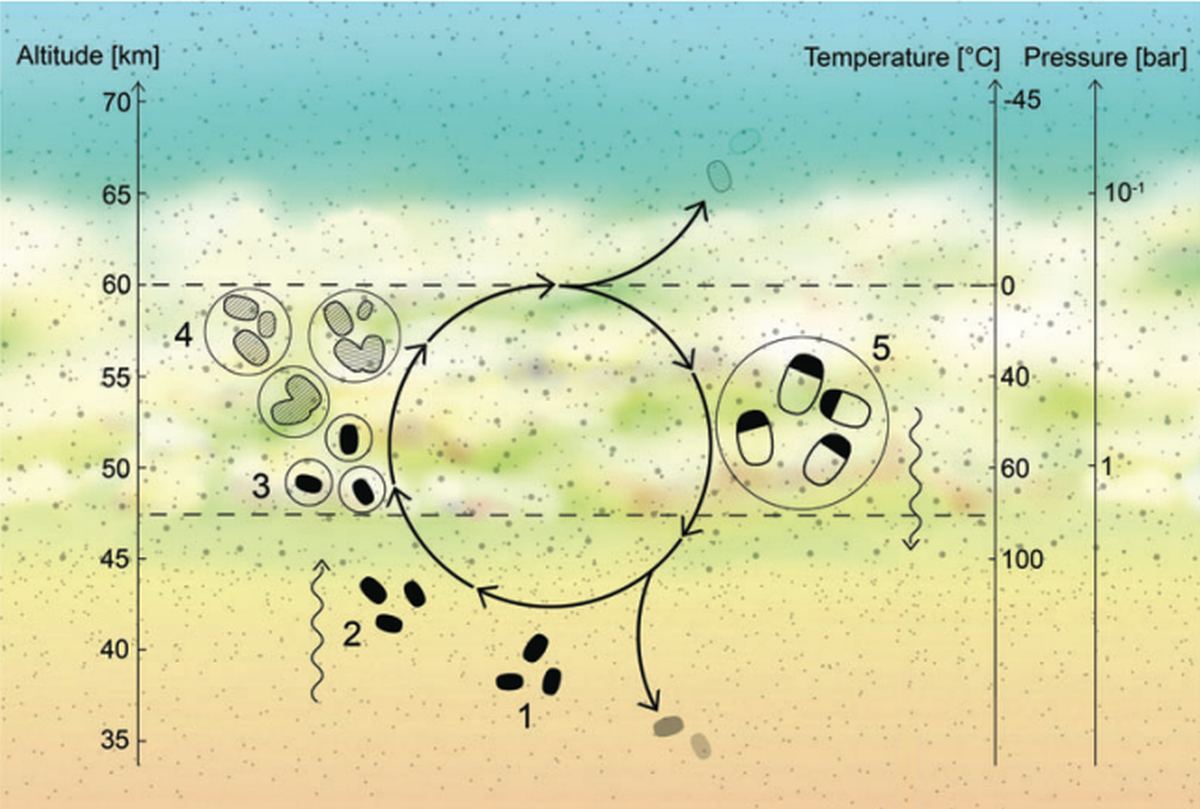
This figure from the research shows the temperature and pressure throughout Venus’s atmosphere.
Image Credit: Image Credit: S. Seager et al. 2021. doi:10.1089/ast.2020.2244
There’s a precedent for life existing in the clouds. It happens here on Earth, where scientists have observed bacteria, pollen, and even algae at altitudes as high as 15 km (9.3 miles.) There’s even evidence of bacteria growing in droplets in a super-cooled cloud high in the Alps. The understanding is that these organisms were carried aloft by wind, evaporation, eruptions, or even meteor impacts. But there’s an important difference between Earth’s and Venus’ clouds.
Earth’s clouds are transient. They form and dissolve constantly. But Venus’ clouds are long-lasting. They’re a stable environment compared to Earth’s clouds. In Earth’s clouds, aerosol particles are sustained for only a few days, while in Venus’ clouds, the particles can be sustained for much longer periods of time.
Add it all up, and you get stable cloud environments where aerosol particles can sustain themselves in an environment where energy and nutrients are available. The researchers say that though eventually aerosol particles and the life within them will fall to the surface, they have time to reproduce before that happens.

The idea of a microbial life cycle in Venusian clouds was developed by other researchers in their 2021 paper “The Venusian Lower Atmosphere Haze as a Depot for Desiccated Microbial Life: A Proposed Life Cycle for Persistence of the Venusian Aerial Biosphere.”
There are five steps in Venus’s proposed cloud lifecycle:
In this new work, the researchers focus on time.
“One of the key assumptions of the aerial life cycle put forward in Seager et al. 2021 is the timescale on which droplets would persist in the habitable layer to empower replication,” the authors write. “It is this that we now turn to study.”
This table from the research shows generation times for some common Earth bacteria.
Image Credit: Abreu et al. 2024.
The authors used E. Coli generation times under optimal conditions in their work. In aerobic and nutrient-rich conditions, E. Coli can reproduce in 20 minutes. So, the E. Coli population will double three times in one hour. Bacteria must reproduce faster than they fall to the surface to sustain itself. They need to form a colony.
The researchers calculated that to sustain itself, the time it takes for bacteria to fall from the habitable part of the atmosphere to the inhabitable has to be longer than half an Earth day. As droplet size increases, the droplets would begin to sink. “As the droplet size approaches 100 µm, the droplets would start sinking to the lower haze layers,” they explain. However, their detailed calculations show that reproduction outpaces the fallout rate.
According to the team’s work, a population of bacteria could sustain itself in Venus’ clouds.
There are, obviously, still some questions. How certain are we that nutrients are available? Is there enough energy? Are there updrafts that can loft spores into the right layer of the atmosphere?
But the real big question is how was this all set in motion?
“An optimist might even imagine that the microbial life actually arose in a good-natured surface habitat, perhaps in a primitive ocean, before the planet suffered a runaway greenhouse, and the microbes lofted into the clouds,” the authors write. If that’s the case, this unique situation arose billions of years ago. Is there any other possibility? Could life have originated in the clouds?
Much scientific investigation into Venus, phosphine, clouds, and life relies on scant evidence. Few are willing to go out on a limb and proclaim that Venus can and does support life. We need more evidence.
For that, we have to wait for missions like the Venus Life Finder Mission. It’s a private mission being developed by Rocket Lab and a team from MIT. Who knows what VLF and other missions like DAVINCI and VERITAS will find? Stronger evidence of phosphine? Better data on Venus’ atmospheric layers and the conditions in them?
Life itself?
Artist’s impression of the Rocket Lab Mission to Venus.
Credit: Rocket Lab
id An Ancient Icy Impactor Create the Martian Moons?

The Martian moons Phobos and Deimos are oddballs. While other Solar System moons are round, Mars’ moons are misshapen and lumpy like potatoes. They’re more like asteroids or other small bodies than moons.
Because of their odd shapes and unusual compositions, scientists are still puzzling over their origins.
Two main hypotheses attempt to explain Phobos and Deimos. One says they’re captured asteroids, and the other says they are debris from an ancient impactor that collided with Mars. Earth’s moon was likely formed by an ancient collision when a planetesimal slammed into Earth, so there’s precedent for the impact hypothesis. There’s also precedent for the captured object scenario because scientists think some other Solar System moons, like Neptune’s moon Triton, are captured objects.
Phobos and Deimos have lots in common with carbonaceous C-type asteroids. They’re the most plentiful type of asteroid in the Solar System, making up about 75% of the asteroid population. The moons’ compositions and albedos support the captured asteroid theory. But their orbits are circular and close to Mars’ equator. Captured objects should have much more eccentric orbits.
This illustration shows Phobos and Deimos’ orbits along with the orbits of spacecraft at Mars. The moons’ near-circular orbits don’t support the captured asteroid theory.
Image Credit: By NASA/JPL-Caltech – http://photojournal.jpl.nasa.gov/jpeg/PIA19396.jpg, Public Domain, https://commons.wikimedia.org/w/index.php?curid=39982795
The moons are less dense than silicate, the most abundant material in Mars’ crust. That fact works against the impact theory. A powerful impact would’ve blasted material from Mars into space, forming a disk of material rotating around the planet. Phobos and Deimos would’ve formed from that material. If they result from an ancient planetesimal impact, they should contain more Martian silica.
Here’s the problem in a nutshell. The captured asteroid theory can explain the moons’ observed physical characteristics but not their orbits. The impact theory can explain their orbits but not their compositions.

In research presented at the 55th Lunar and Planetary Science Conference, three researchers proposed a different origin story for Phobos and Deimos. They suggest that an impactor is responsible for creating the moons, but the impactor was icy.
The research is titled “THE ICY ORIGINS OF THE MARTIAN MOONS.” The first author is Courteney Monchinski from the Earth-Life Science Institute at the Tokyo Institute of Technology.
If a rocky impactor slammed into Mars, it would’ve created a massive debris disk around the planet. Previous researchers have examined the idea using simulations and found that an impact could’ve created the moons. But the disk created by the impact would’ve been far more massive than Phobos and Deimos combined. The simulations showed that there would’ve been a third, much more massive moon created within Phobos’ orbit that would’ve fallen back down to Mars. But there’s no strong evidence of something that massive striking Mars.
This illustration shows how a giant impact could’ve created Phobos and Deimos. The collision would’ve created a massive debris disk where a third more massive moon formed before falling back to Mars.
Image Credit: Antony Trinh / Royal Observatory of Belgium
Other impact studies used basaltic impactors. But those showed that the temperature in the debris disk would’ve been so high it would’ve melted the disk material and destroyed ancient chondritic materials. Since the pair of moons appear to contain those materials, a basaltic impactor is ruled out.
According to the research presented at the conference, an icy impactor can explain Phobos and Deimos’ origins. There are three reasons for that.
The extra disk mass created by a rocky impactor would not be present. Instead, much of the mass in the impactor would’ve been vapourized on impact and escaped the system rather than persisting in the disk and being taken up by the formation of moons. There would’ve been no large third moon and no need to explain how it fell back to Mars.
The second reason concerns the composition of the moons. With abundant water ice in the collision, the temperature in the debris disk would’ve been lower. That would’ve preserved the carbonaceous materials in Phobos and Deimos today. It also can help explain their density and possible porosity. An icy impactor could’ve also delivered water to Mars, and we know Mars was wetter in its past.
The third reason concerns Deimos’ orbit. It’s not synchronous with Mars, and an icy impactor can explain that. With more water ice in the disk, there would’ve been a viscous interaction between the disk’s dust and vapour that extended the disk, allowing Deimos to occupy its orbit.
The researchers used Smoothed Particle Hydrodynamic (SPH) simulations to test the icy impactor idea. They simulated giant impactors with varying quantities of water ice and watched as disks formed around Mars and moons formed in the disk.
They first found that an impactor with any amount of water ice produced a more massive debris disk. It could be because an impactor containing water ice would be larger, though less massive, than one without any ice. That allowed more material to spray from the planet into the disk. It could also be because the water ice absorbs some of the impact energy when it vapourizes. That would cool the disk temperature, lowering the velocities of particles in the disk and making them less likely to escape.
This figure from the research shows that any amount of ice in an impactor increases the size of the debris disk.
Image Credit: Monchinski et al. 2024. LPSC
Varying the ice content in the impactor also affected the makeup of the disk. Different amounts of ice lead to disks with different amounts of Martian rock and impactor rock in the disk.
This graph from the study shows impactor ice content (x-axis) affects the debris disk composition.
Image Credit: Monchinski et al. 2024. LPSC
The temperature in the disk is a critical part of this. Different amounts of water ice in the impactor change the disk temperature and what types of materials in the disk would melt. Impactors with more than 30% ice create disk temperatures too low to melt silicates. Perhaps more tellingly, impactors with more than 70% ice result in a disk temperature too low to alter or destroy chondritic material, which both Phobos and Deimos are expected to contain.
According to the researchers, an icy impactor can also explain other features. “The existence of water in the impact-generated disk also suggests that water may condense, accounting for the possible water-ice content of the moons,” they write.
Ultimately, the researchers say an icy impactor with 70% to 90% water ice mantles can explain the pair of moons.
“The best case for reproducing the moons’ proposed compositions are the 70% and 90% water-ice mantle impactor cases, as they allow for low disk temperatures and more chances for chondritic materials to survive,” they explain.
Unfortunately, that may not be realistic. “In our current solar system, an object with around 70% or 90% water-ice content is not exactly realistic, as the object with the highest amount of water content in our current solar system, Ganymede, is only about 50% water,” they write.
The ESA’s Mars Express orbiter captured this image of Phobos over the Martian landscape in this image taken in November 2010. Irregularly shaped and only 27 km long, Phobos is actually much darker (due to its carbon-rich surface) than is apparent in this contrast-enhanced view.
Image Credit: ESA / DLR / G. neukum
But could things have been different in the past? Samples from asteroid Ryugu suggest that its parent body could’ve been up to 90% water. That number is based on the types of minerals in Ryugu. But unfortunately, scientists don’t now for sure. Ryugu’s parent body could have contained as little as 20% water.
But it’s at least plausible that early in the Solar System’s life, an impactor with 70% water ice could have existed. If so, then the icy impactor scenario could be a robust theory to explain the origins of Phobos and Deimos.
“This impactor would have come from the outer solar system around the time of giant planet instability,” the authors write. During that time, outer Solar System bodies were perturbed and sent flying into the inner Solar System. But in this case, the impact’s timing needs to be constrained by Phobos’ and Deimos’ formation ages.
Scientists need more evidence to deepen their understanding of Mars and its moons. Japan’s Martian Moons eXploration (MMX) mission will provide that. MMX’s mission is to return a sample of Phobos to Earth. The goal is to determine if it is a captured asteroid or the result of an impact.
Unfortunately, JAXA just delayed MMX’s launch. It was scheduled to launch in September 2024 but has been delayed until 2026. That means we won’t get samples until 2031 instead of 2029.
JAXA has completed successful sample return missions, so they have the expertise to bring a piece of Phobos back to Earth. If scientists can determine how Phobos and Deimos formed, it’ll be part of a much larger, detailed picture of how the Solar System formed.
It’ll be worth it if we have to wait a couple extra years.
Watch a Satellite Reaction Wheel Melt in a Simulated Orbital Re-Entry

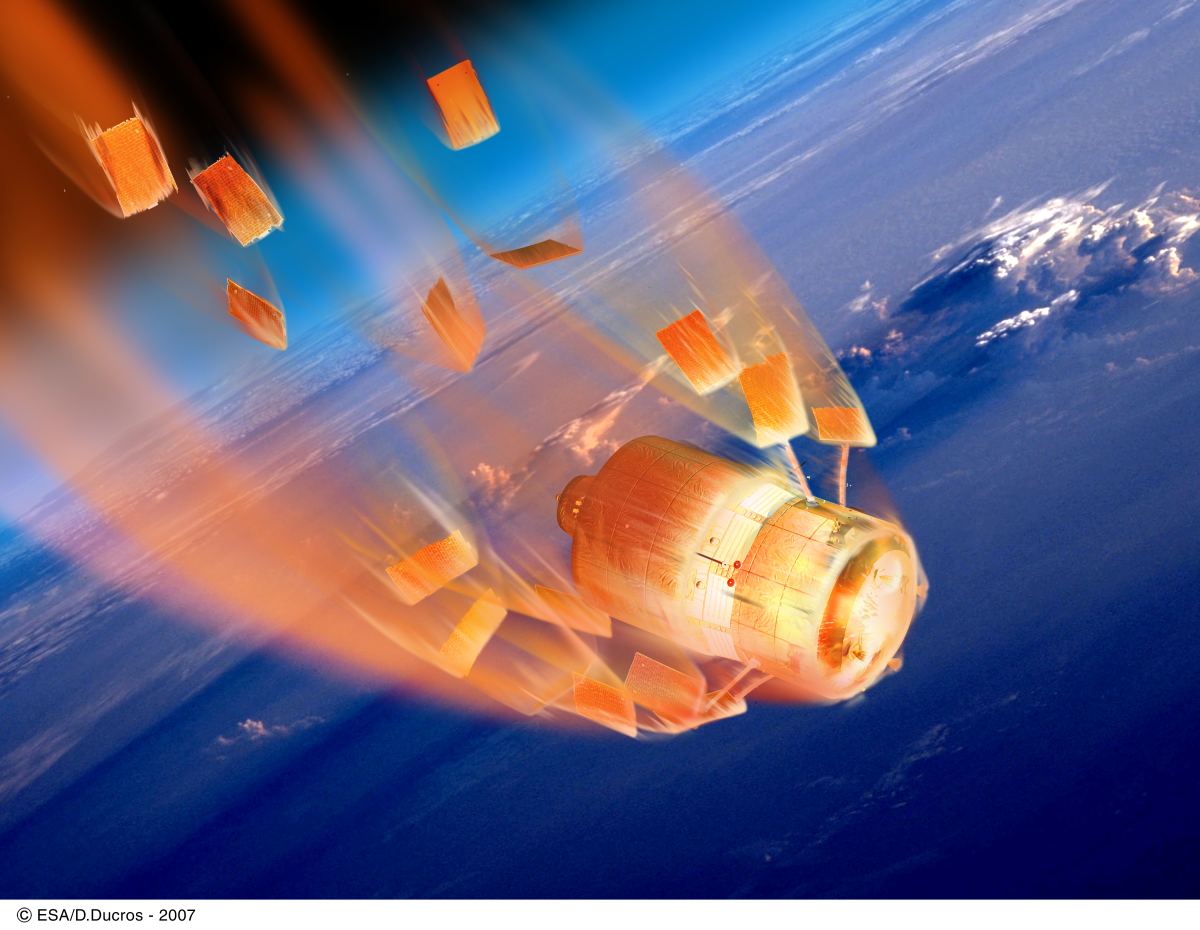
Most satellites share the same fate at the end of their lives. Their orbits decay, and eventually, they plunge through the atmosphere toward Earth. Most satellites are destroyed during their rapid descent, but not always
Heavy pieces of the satellite, like reaction wheels, can survive and strike the Earth. Engineers are trying to change that.
Satellite debris can strike Earth and is a potential hazard, though the chances of debris striking anything other than ocean or barren land are low. Expired satellites usually just re-enter the atmosphere and burn up. But there are a lot of satellites, and their number keeps growing.
In February 2024, the ESA’s European Remote Sensing 2 (ERS2) satellite fell to Earth. The ESA tracked the satellite and concluded that it posed no problem. “The odds of a piece of satellite falling on someone’s head is estimated at one in a billion,” ESA space debris system engineer Benjamin Bastida Virgili said.
That would be fine if ERS 2 was an isolated incident. But, according to the ESA, an object about as massive as ERS 2 reenters Earth’s atmosphere every one to two weeks. The statistics may show there’s no threat to people, but statistics are great until you’re one of them.
The ESA’s ERS-2 Earth observation satellite was destroyed when it re-entered Earth’s atmosphere on February 21st, 2004. Heavy parts of satellites, like reaction wheels, don’t always burn up in the atmosphere and can pose a hazard. ESA engineers are working on reaction wheels that will break into pieces to reduce the hazard.
Image Credit: Fraunhofer FHR
The risk of being struck by chunks of a satellite isn’t zero. In 1997, a piece of mesh from a Delta II rocket struck someone’s shoulder in Oklahoma. It was a light piece of debris, so the person was okay. But it was an instructive event.
The heaviest parts of satellites, like reaction wheels, can be hazardous because they may not be destroyed during re-entry. Reaction wheels provide three-axis control for satellites without the need for rockets. They give satellites fine pointing accuracy and are useful for rotating satellites in very small amounts.
Reaction wheels can be quite massive. The Hubble Space Telescope has four reaction wheels weighing 45 kg (100 lbs) each. Other satellites don’t have such massive wheels, but the Hubble’s hefty wheels indicate the extent of the hazard. ESA engineers are designing reaction wheels that will break up during re-entry to reduce the hazard of one striking Earth.
“… the need is becoming urgent as more and more satellites are placed in space.”
Kobyé Bodjona, Mechanisms Engineer at the ESA
As part of the design process, they’re testing their wheels in a plasma wind tunnel at the University of Stuttgart Institute of Space Systems. The heated plasma in the tunnel moves at several km/sec, mimicking the friction a satellite is exposed to when it plunges through Earth’s atmosphere. The wheel is rotated inside the tunnel as if tumbling through the atmosphere.
At a recent Space Mechanisms Workshop at ESA’s ESTEC technical center in the Netherlands, engineers showed a clip of the blow-torch effect that the atmosphere has on falling debris.
“Space mechanisms cover everything that enables movement aboard a satellite, from deployment devices to reaction wheels,” explains workshop co-organizer Geert Smet.
“But these mechanisms often use materials such as steel or titanium that are more likely to survive reentry into the atmosphere. This is a problem because our current regulations say reentering satellites should present less than one in 10,000 risks of harming people or property on the ground or even one in 100 000 for large satellite constellations. ESA’s Clean Space group is reacting by D4D—devising methods to make total disintegration of a mission more likely, including mechanisms.”
The effort to make satellites disintegrate completely goes back a few years. The ESA program Design for Demise (D4D) is helping satellite manufacturers comply with the Space Debris Mitigation (SDM) requirements. It’s aimed at eliminating debris falling to Earth, removing debris already in orbit, and designing satellites that don’t linger in orbit after their missions have ended.
At the recent workshop, the ESA revealed more of its plans for active debris removal. There’s a push to develop dedicated spacecraft that can attach themselves to derelict satellites and force them into reentry. This will help remove dead satellites from the congested Low Earth Orbit.
“The idea behind this event is to present the mechanisms community with the latest research on space debris to see how they might contribute to the work going on,” said Kobyé Bodjona, Mechanisms Engineer at the ESA. “It’s important because large system integrators—the big companies that lead satellite projects—are going to need systems that are fully compliant with debris mitigation regulations. And the need is becoming urgent as more and more satellites are placed in space.”
Martian Mysteries: Exploring the Phobos Incident, Monoliths, and Ancient Ruins

The intrigue surrounding Mars and its moons has captivated scientists and space enthusiasts for decades. Mars, with its stark, reddish landscape, and its moon Phobos, named after the Greek god of fear, present a fascinating study in celestial phenomena and potential extraterrestrial mysteries.
One of the most intriguing events in the exploration of space is the Phobos incident involving the Soviet Union’s Phobos 2 mission in 1989. This mission was primarily aimed at exploring Mars and its moon but ended in mystery. Phobos 2 operated successfully until it approached Phobos, at which point it suddenly ceased transmission and lost contact with Earth. The last data sent by Phobos 2 included images that showed a strange shadow cast on Phobos’s surface. This led to widespread speculation about the cause, ranging from technical failures to extraterrestrial interference.
Adding to the enigmatic nature of Phobos is the presence of the so-called Phobos Monolith—a large, irregularly shaped object that stands out against the barren, cratered surface of the moon. This monolith, and others like it, have sparked debates about their origin, with some suggesting they might be natural formations, while others speculate about ancient alien technologies.
The presence of the monolith was popularized by American astronaut Buzz Aldrin, who mentioned it in the context of human space exploration and the curiosity it generates among the public and scientific community. Its origins, whether natural or artificial, remain a subject of debate and fascination.
The surface of Mars itself offers further mysteries. High-resolution images from various Mars orbiters have revealed formations that resemble structures, such as the infamous “Face on Mars” in the Cydonia region. These images often show what appear to be pyramidal structures and rectilinear shapes that some interpret as remnants of ancient civilizations.
Critics argue that these formations are simply the result of pareidolia—where the human brain interprets random images as significant patterns. However, the consistent flow of new data and images from Mars continues to fuel speculation and theories about past life and civilizations on the red planet.
Some theorists draw parallels between the formations on Mars and ancient Earth structures, such as the pyramids of Egypt. They speculate about a forgotten era of solar system-wide civilization that utilized advanced technology, potentially for energy generation through the manipulation of cosmic forces, such as the hypothetical “zero-point energy.”
These theories extend into broader propositions of an “electric universe” where celestial bodies are interconnected through vast electric currents, influencing the formation and evolution of planets and moons through electrical rather than purely gravitational forces.
The mysteries of Phobos, Mars, and their anomalous features continue to be a significant focus for scientific inquiry. Missions continue to be planned and executed, such as Japan’s upcoming probe to Phobos, aiming to gather more data and, potentially, to bring samples back to Earth. Each mission brings with it the hope of solving some of these persistent mysteries or, at the very least, providing new data to refine our understanding of Mars and its moons.
As we continue to explore these celestial neighbors, the combination of scientific data and imaginative theorization keeps our quest for knowledge about Mars and its features as vibrant and compelling as ever. Whether future missions will confirm or debunk the lingering mysteries of Mars remains one of the most tantalizing questions in space exploration today.
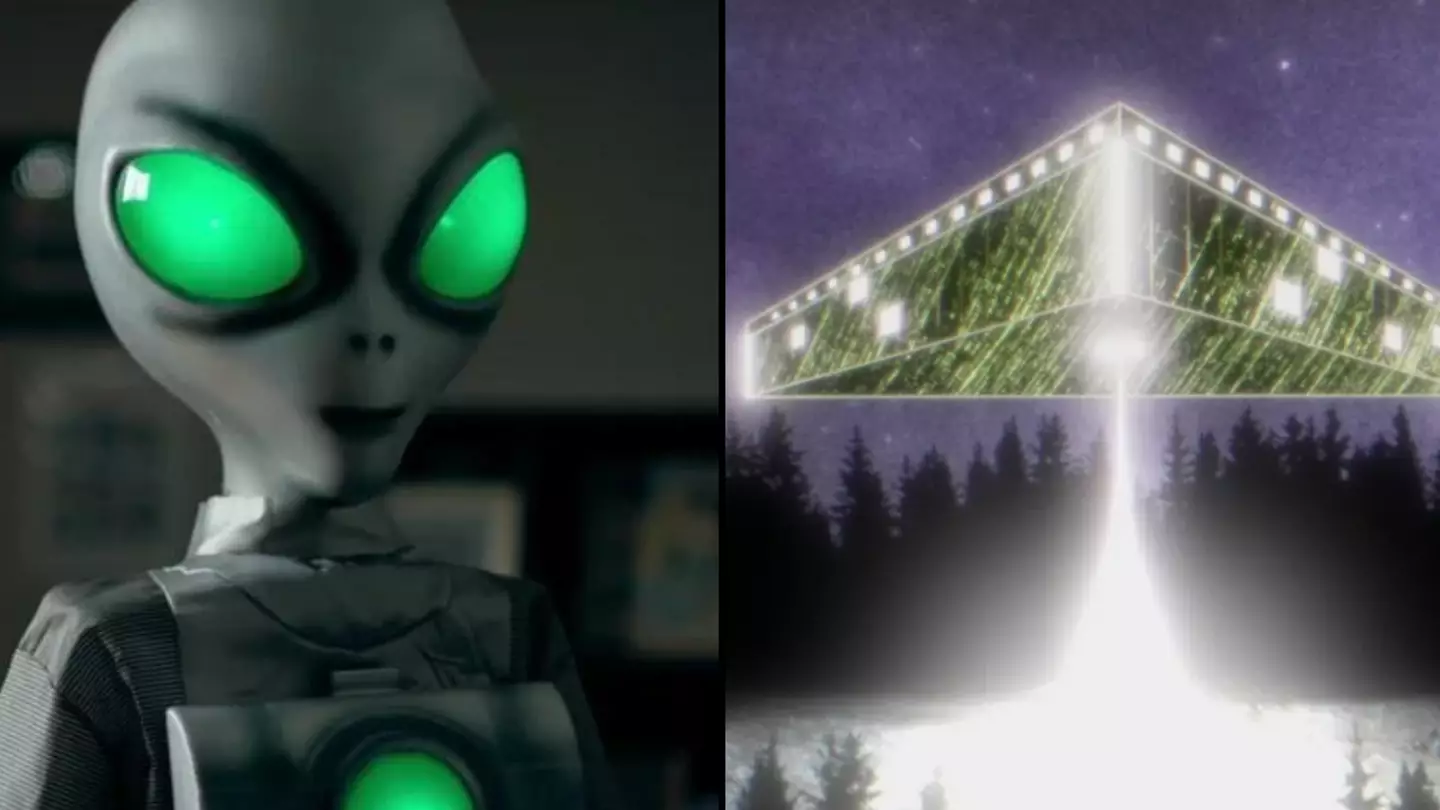
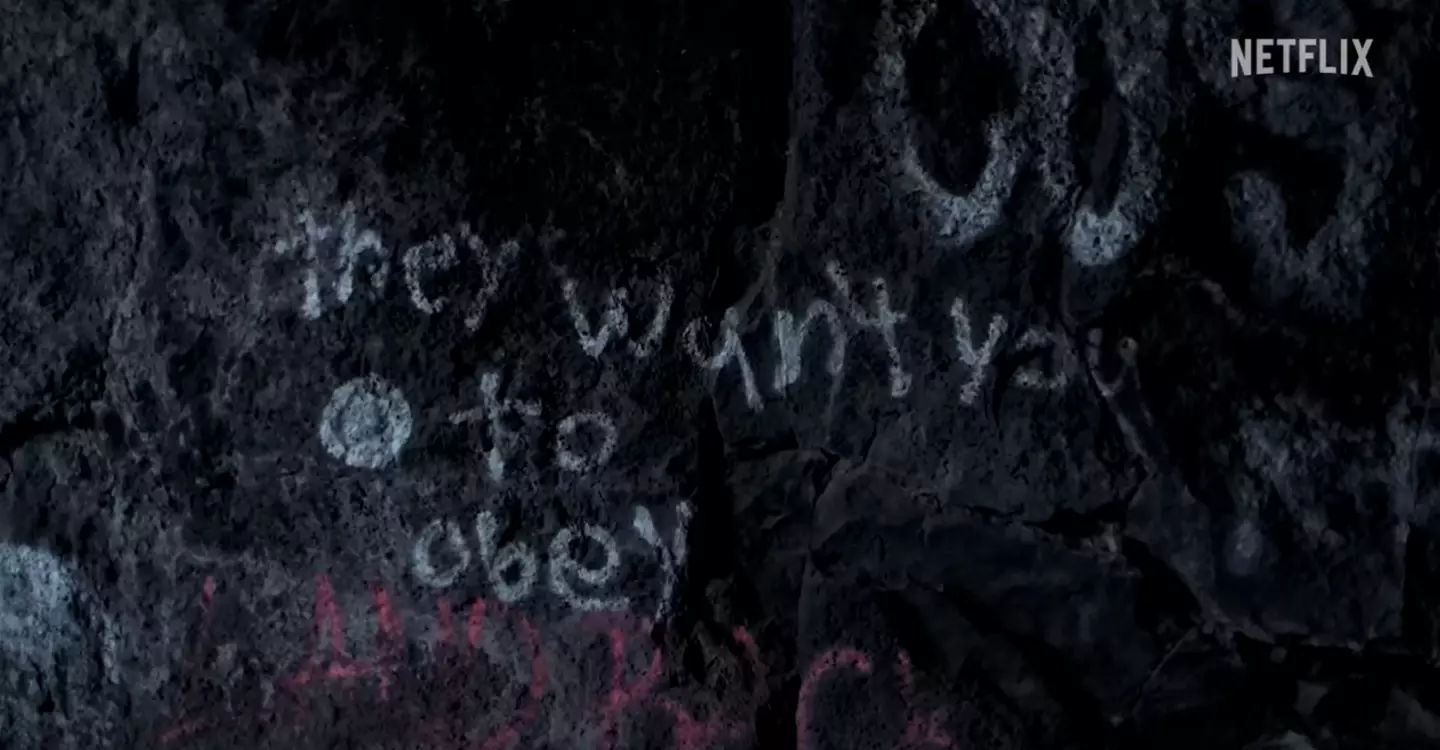
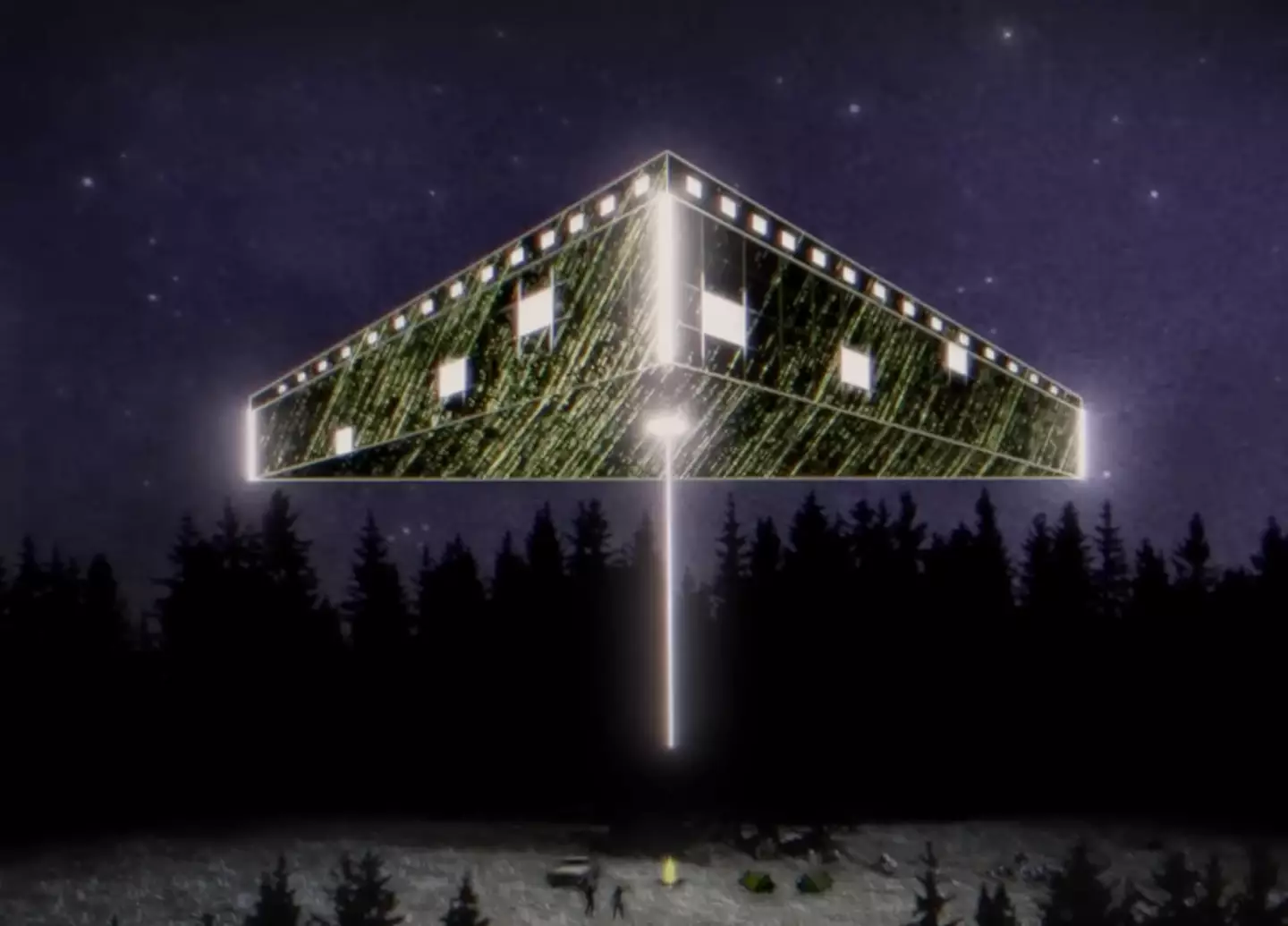
Netflix viewers are hooked on eerie new series which may tell us truth about alien life