Naar de inhoud

UFO'S of UAP'S, ASTRONOMIE, RUIMTEVAART, ARCHEOLOGIE, OUDHEIDKUNDE, SF-SNUFJES EN ANDERE ESOTERISCHE WETENSCHAPPEN - DE ALLERLAATSTE NIEUWTJES

UFO's of UAP'S in België en de rest van de wereld
akke.beakke.be
Ontdek de Fascinerende Wereld van UFO's en UAP's: Jouw Bron voor Onthullende Informatie! Ben jij ook gefascineerd door het onbekende? Wil je meer weten over UFO's en UAP's, niet alleen in België, maar over de hele wereld? Dan ben je op de juiste plek! België: Het Kloppend Hart van UFO-onderzoek In België is BUFON (Belgisch UFO-Netwerk) dé autoriteit op het gebied van UFO-onderzoek. Voor betrouwbare en objectieve informatie over deze intrigerende fenomenen, bezoek je zeker onze Facebook-pagina en deze blog. Maar dat is nog niet alles! Ontdek ook het Belgisch UFO-meldpunt en Caelestia, twee organisaties die diepgaand onderzoek verrichten, al zijn ze soms kritisch of sceptisch. Nederland: Een Schat aan Informatie Voor onze Nederlandse buren is er de schitterende website www.ufowijzer.nl, beheerd door Paul Harmans. Deze site biedt een schat aan informatie en artikelen die je niet wilt missen! Internationaal: MUFON - De Wereldwijde Autoriteit Neem ook een kijkje bij MUFON (Mutual UFO Network Inc.), een gerenommeerde Amerikaanse UFO-vereniging met afdelingen in de VS en wereldwijd. MUFON is toegewijd aan de wetenschappelijke en analytische studie van het UFO-fenomeen, en hun maandelijkse tijdschrift, The MUFON UFO-Journal, is een must-read voor elke UFO-enthousiasteling. Bezoek hun website op www.mufon.com voor meer informatie. Samenwerking en Toekomstvisie Sinds 1 februari 2020 is Pieter niet alleen ex-president van BUFON, maar ook de voormalige nationale directeur van MUFON in Vlaanderen en Nederland. Dit creëert een sterke samenwerking met de Franse MUFON Reseau MUFON/EUROP, wat ons in staat stelt om nog meer waardevolle inzichten te delen. Let op: Nepprofielen en Nieuwe Groeperingen Pas op voor een nieuwe groepering die zich ook BUFON noemt, maar geen enkele connectie heeft met onze gevestigde organisatie. Hoewel zij de naam geregistreerd hebben, kunnen ze het rijke verleden en de expertise van onze groep niet evenaren. We wensen hen veel succes, maar we blijven de autoriteit in UFO-onderzoek! Blijf Op De Hoogte! Wil jij de laatste nieuwtjes over UFO's, ruimtevaart, archeologie, en meer? Volg ons dan en duik samen met ons in de fascinerende wereld van het onbekende! Sluit je aan bij de gemeenschap van nieuwsgierige geesten die net als jij verlangen naar antwoorden en avonturen in de sterren! Heb je vragen of wil je meer weten? Aarzel dan niet om contact met ons op te nemen! Samen ontrafelen we het mysterie van de lucht en daarbuiten.

Archief

US government wanted to reverse-engineer alien ships — but never found any, Pentagon UFO report reveals

US government wanted to reverse-engineer alien ships — but never found any, Pentagon UFO report reveals

Aerial view of a military building, The Pentagon, Washington DC, USA.

The Pentagon, Washington DC, USA. 
(Image credit: Glowimages via Getty Images)

The U.S. government is not hiding aliens or their spaceships — although it did once propose a program to reverse-engineer any hypothetical alien technology it found, a Department of Defense (DOD) report reveals.

The Pentagon report, a highly anticipated review of classified documents from 1945 to 2023 that was submitted to Congress Friday (March 8), found no evidence that the U.S. government has encountered aliens or covered up their existence.

Instead, the report blames UFO sightings in the 1960s on top-secret flights of prototype American spy planes and spacecraft. And while the U.S. government did consider a program to reverse-engineer any captured alien ships in the 2010s, no craft were ever found and the proposal was rejected for "lacking merit," according to the report.

Related: 

There is "no verifiable evidence for claims that the U.S. government and private companies have access to or have been reverse-engineering extraterrestrial technology," Maj. Gen. Pat Ryder, the Pentagon press secretary, said in a statement after the report's release. The report also found "no evidence that any U.S. government investigation, academic-sponsored research, or official review panel has confirmed that any sighting of a UAP [unidentified aerial phenomenon] represented extraterrestrial technology."

"All investigative efforts, at all levels of classification, concluded that most sightings were ordinary objects and phenomena and the result of misidentification," Ryder added.

The 63-page review was made by the Pentagon's All-domain Anomaly Resolution Office (AARO), which was established in 2022 to investigate and manage reports of UFO sightings from the U.S. Army, Navy and Air Force. The review included classified and unclassified archical evidence, full access to all secretive government programs related to UFOs, and 30 interviews with intelligence personnel.

The U.S. government's renewed interest in UFOs came after a 2017 leak of three now-infamous video clips that appeared to show mysterious, wingless aircraft flying at hypersonic speeds past dumbfounded U.S. Navy pilots. In 2020, the U.S. Senate Select Committee on Intelligence called for an inquiry into UFOs, and in June 2021, the Pentagon released a report on more than 140 UFO sightings by Navy pilots. That report concluded there was no evidence of alien activity in any of the instances.

Despite those findings, the government's interest in UFOs drove news outlets and social media sites into frenzies of speculation. The conspiracy theories reached their apex when, in July 2023, David Grusch, a former U.S. intelligence official and whistleblower, claimed that the government had been secretly investigating crashed UFOs. In his congressional hearing, Grusch told the House Committee on Oversight and Reform that not only had spaceships been recovered but that "nonhuman" beings had been found inside.

Despite bluntly contradicting many of Grusch's claims, the report does mention a brief period when the Pentagon considered a program to reverse-engineer alien technology. Called Kona Blue, it was proposed to the Department of Homeland Security (DHS) by individuals who suspected the U.S. government was hiding crashed UFOs.

"This proposal gained some initial traction at DHS to the point where a 35 Prospective Special Access Program (PSAP) was officially requested to stand up this program, but it was eventually rejected by DHS leadership for lacking merit," the report said. "It is critical to note that no extraterrestrial craft or bodies were ever collected — this material was only assumed to exist by Kona Blue advocates and its anticipated contract performers."

The AARO said that later this year it will publish a second volume of the report covering sightings made between November 2023 and April 2024. The office also announced that the DOD is working on a portable sensor kit called the "Gremlin system" to investigate UFO sightings as they occur.

{ https://www.livescience.com/space }

Hoe vind je dit bericht?
Geschreven door peter om 01:01 Stuur door

NASA Scientists Unveil Design for Europa Clipper’s ‘Golden Record’

NASA Scientists Unveil Design for Europa Clipper’s ‘Golden Record’

NASA’s Europa Clipper spacecraft will carry a triangular metal plate with a special message when it launches in October 2024 and heads toward Jupiter’s moon Europa.

This side of a commemorative plate mounted on NASA’s Europa Clipper spacecraft features U.S. Poet Laureate Ada Limón’s handwritten In Praise of Mystery: A Poem for Europa. Image credit: NASA / JPL-Caltech.

This side of a commemorative plate mounted on NASA’s Europa Clipper spacecraft features U.S. Poet Laureate Ada Limón’s handwritten In Praise of Mystery: A Poem for Europa.

Image credit: NASA / JPL-Caltech.

Made of the metal tantalum and about 18 by 28 cm (7 by 11 inches), Europa Clipper’s metal plate features graphic elements on both sides.

At its heart is an engraving of U.S. Poet Laureate Ada Limón’s handwritten In Praise of Mystery: A Poem for Europa, along with a silicon microchip stenciled with more than 2.6 million names submitted by the public.

The microchip will be the centerpiece of an illustration of a bottle amid the Jovian system — a reference to NASA’s Message in a Bottle campaign.

The outward-facing panel features art that highlights Earth’s connection to Europa.

Linguists collected recordings of the word ‘water’ spoken in 103 languages, from families of languages around the world.

The audio files were converted into waveforms (visual representations of sound waves) and etched into the plate.

The waveforms radiate out from a symbol representing the American Sign Language sign for ‘water.’

In the spirit of the Voyager spacecraft’s Golden Record, which carries sounds and images to convey the richness and diversity of life on Earth, the layered message on Europa Clipper aims to spark the imagination and offer a unifying vision.

“The content and design of Europa Clipper’s vault plate are swimming with meaning,” said Dr. Lori Glaze, director of the Planetary Science Division at NASA Headquarters.

“The plate combines the best humanity has to offer across the Universe — science, technology, education, art, and math.”

“The message of connection through water, essential for all forms of life as we know it, perfectly illustrates Earth’s tie to this mysterious ocean world we are setting out to explore.”

In 2030, after a 2.6-billion-km (1.6-billion-mile) journey, Europa Clipper will begin orbiting Jupiter, making 49 close flybys of Europa.

To determine if there are conditions that could support life, the spacecraft’s powerful suite of science instruments will gather data about the moon’s subsurface ocean, icy crust, thin atmosphere, and space environment.

The electronics for those instruments are housed in a massive metal vault designed to protect them from Jupiter’s punishing radiation. The commemorative plate will seal an opening in the vault.

Because searching for habitable conditions is central to the mission, the Drake Equation is etched onto the plate as well — on the inward-facing side.

Astronomer Frank Drake developed the mathematical formulation in 1961 to estimate the possibility of finding advanced civilizations beyond Earth.

The equation has inspired and guided research in astrobiology and related fields ever since.

In addition, artwork on the inward-facing side of the plate will include a reference to the radio frequencies considered plausible for interstellar communication, symbolizing how humanity uses this radio band to listen for messages from the cosmos.

These particular frequencies match the radio waves emitted in space by the components of water and are known by astronomers as the ‘water hole.’ On the plate, they are depicted as radio emission lines.

Finally, the plate includes a portrait of one of the founders of planetary science, Ron Greeley, whose early efforts to develop a Europa mission two decades ago laid the foundation for Europa Clipper.

“We’ve packed a lot of thought and inspiration into this plate design, as we have into this mission itself,” said Europa Clipper project scientist Robert Pappalardo, a researcher at NASA’s Jet Propulsion Laboratory.

“It’s been a decades-long journey, and we can’t wait to see what Europa Clipper shows us at this water world.”

{ https://www.sci.news/ }

Hoe vind je dit bericht?
Geschreven door peter om 00:00 Stuur door

Ariane 6 is Coming Together

ESA/CNES/Arianespace/Arianegroup.

Ariane 6 is Coming Together

The European Space Agency (ESA)’s next generation heavy lift rocket is just months away from its first flight, and its major components are now being assembled for launch at the Vehicle Assembly Building in Kourou, French Guiana.

The new rocket is Europe’s upgrade to the retired Ariane 5, which flew for the last time in 2023. With a large payload fairing and lift capacity, Ariane 6 will be able to carry seriously heavy satellites (or multiple smaller ones). The heavy lift capability of the Ariane 6 is achieved using Hydrolox engines on both the first and second stages, assisted by up to four solid rocket boosters, enabling it to bring up to 11,000kg to geostationary transfer orbit.

The Ariane 6’s upper stage features the capability to relight its engine multiple times, giving it plenty of flexibility in the types of missions it can carry out, and improving the precision of the orbits it can reach. That makes it useful for both interplanetary missions and for unique orbital requirements around Earth.

Part of the first Ariane 6 rocket inside the Vehicle Assembly Building, Kourou, French Guiana. Credit: ESA/CNES/Arianespace/Arianegroup.

What it won’t be is reusable.

Ariane 6 is an expendable rocket, bringing critics to wonder if it can keep up with notable competitors pursuing reusability like SpaceX. But Ariane 6 has different capabilities and caters to different launch parameters than SpaceX, giving it a market share that the Falcon Heavy isn’t tuned for. Perhaps more importantly, independent access to space is a priority for Europe, making Ariane 6 a strategic imperative as much as a technological or competitive advancement. Still, Ariane 6 may not remain ESA’s workhorse rocket long-term – they are already investigating reusable alternatives that should come onto the scene in the 2030s.

The rocket stages themselves aren’t the only place where ESA can make eco-and-budget-friendly innovations, and some changes are happening now. The support and logistics infrastructure for the Ariane 6, for example, includes shipping the rocket stages aboard the Canopée, a wind-assisted hybrid cargo ship that can cut emissions by more than 20% – up to 30% depending on its speed – compared to a conventionally powered ship.

the Canopée, arriving in French Guiana in February, carrying the first Ariane 6 rocket for launch later this summer. 7 Credit: ESA/CNES/Arianespace/Arianegroup/Optique Vidéo du CSG – S. Martin.

The Canopée delivered the first Ariane 6 to Kourou last month, arriving at port after a 10-day, 7,000km journey from mainland Europe in February.

The rocket now being prepared for flight within the vehicle assembly building will go vertical on the pad in the coming months.

Ariane 6’s first flight is set for no earlier than June 15. It will carry out a rideshare mission bringing multiple small spacecraft into orbit.

After that, the vehicle will have a steady launch cadence, with a series of flights scheduled for 2025 to carry upgraded satellites for Europe’s Galileo constellation (an independent GPS system). There are also plans to launch several deep space missions in the next few years, including ESA’s exoplanet hunting telescope PLATO, components of the Mars Sample Return infrastructure, and ESA’s Comet Interceptor mission.

{ https://www.universetoday.com/ }

Hoe vind je dit bericht?
Geschreven door peter om 22:04 Stuur door

Satellite Measurements Show That Global Carbon Emissions are Still Rising

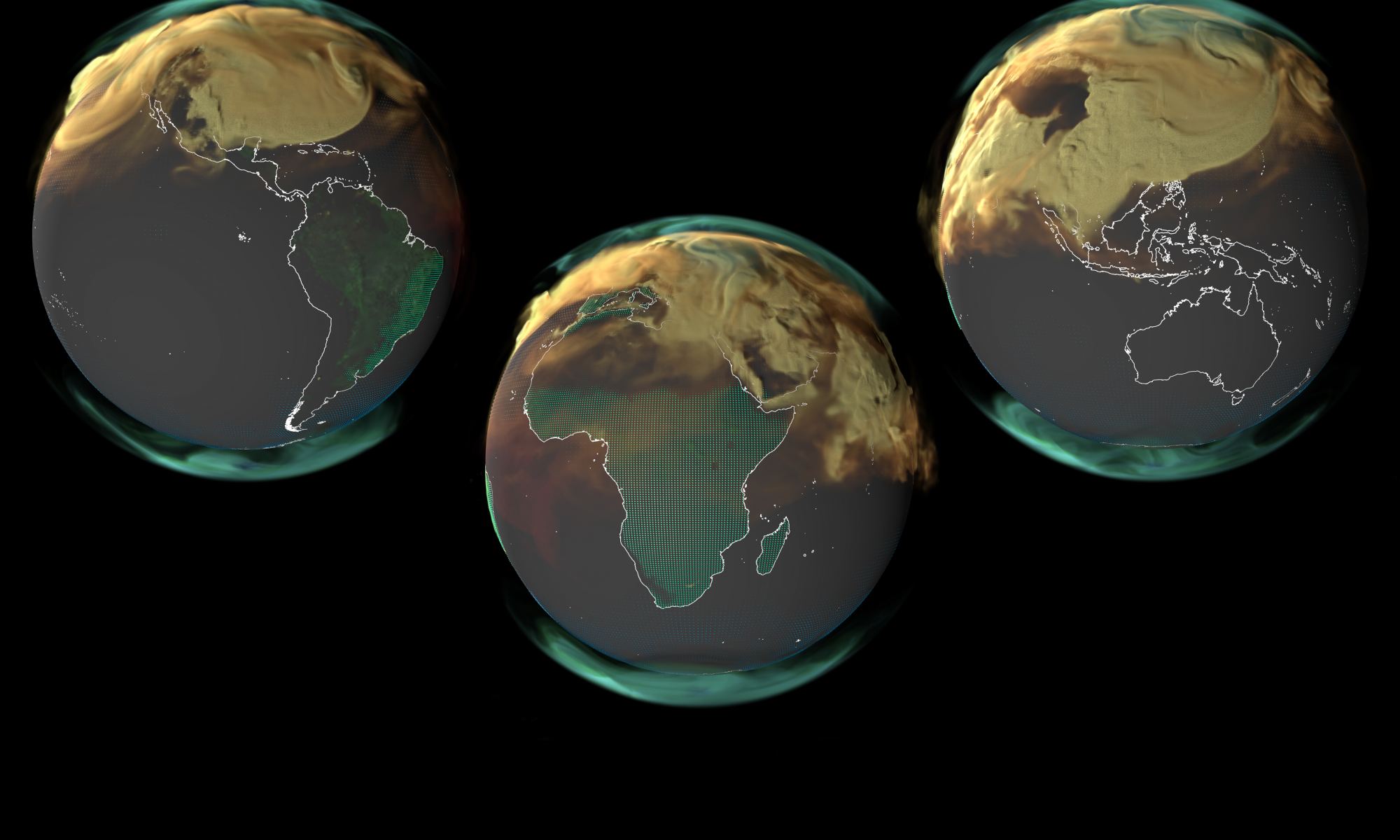
CO2_gmao_202102_lrg-2000x1200.jpg

Tracking carbon emissions and sinks to determine Earth's annual Global Carbon Budget. Credit: NASA GEOS

Satellite Measurements Show That Global Carbon Emissions are Still Rising

According to the Intergovernmental Panel on Climate Change (IPCC) Sixth Assessment Report (AR6), human activities have significantly impacted the planet. As global greenhouse gas emissions (mainly carbon dioxide) have continued to increase, so too have global temperatures – with severe ecological consequences. Between 2011 and 2020, global surface temperatures rose by an estimated 1.07 °C (2.01 °F) above the average in 1850–1900. At this rate, temperatures could further increase by 1.5 to 2 °C (2.7 to 3.6 °F) in the coming decades, depending on whether we can achieve net zero by 2050.

Unfortunately, the data for the past year is not encouraging. According to the 2023 Global Carbon Budget (GCB), an annual assessment of Earth’s carbon cycle, emissions in 2023 continued to rise by 1.1 percent compared to the previous year. This placed the total fossil fuel emissions from anthropogenic sources at 36.8 billion metric tons (over 40 US tons) of carbon dioxide, with an additional 4.1 billion metric tons (4.5 US tons) added by deforestation, extreme wildfires, and other sources. This trend indicates we are moving away from our goals and that things will get worse before they get better!

Carbon budgets are essential for assessing humanity’s impact on the planet and implementing mitigation strategies. The budget quantifies how much carbon was added to the atmosphere from fossil fuel use, land-use change, and other factors relative to how much carbon was removed by the planet’s carbon cycle. This refers to how our planet and its ecosystems recycle carbon, which keeps carbon dioxide levels in our atmosphere within certain parameters and ensures temperatures remain stable over time.

EarthAtmosphere-CarbonDioxide-FutureRoleInGlobalWarming-Simulation-20151109-1024x497.jpg

Carbon dioxide in Earth’s atmosphere if half of global-warming emissions are not absorbed. Credit: NASA/JPL/GSFC

For eons, this balance was maintained by photosynthetic plants, organisms, and Earth’s oceans, which absorbed CO2 from the atmosphere. Meanwhile, geological forces (i.e., mantle convection) sequestered it in the Earth’s crust as carbonate rocks. Since the Industrial Revolution, fossil fuel consumption has sharply increased, which has become exponentially worse since the mid-20th century. In addition, the growth of global populations since the 19th century has also seen a commensurate increase in land clearance and ecological destruction.

In short, emissions increased rapidly while Earth’s natural sequestration mechanisms were simultaneously being disrupted. The Global Carbon Budget was established to analyze these trends and prepare reports that inform organizations and help guide climate policy development. This year’s report relied on several data sources, the most notable of which were inventories of emissions collected by governments and energy agencies. Satellite data was provided by NASA’s Orbiting Carbon Observatory-2 (OCO-2) instrument to estimate the flux of carbon between the land and atmosphere.

CO2 concentrations have increased from 278 parts per million (ppm) in 1750 to 420 ppm in 2023. In addition to carbon emissions from transportation, power generation, and manufacturing, major contributors this year included the extreme wildfire season in Canada. The data also indicates that the average global surface temperature in 2023 was 1.2 °C (2.1 °F) warmer than the average for NASA’s baseline period (1951-1980), making it the hottest year on record. This is part of a trend where the past ten years (2014-2023) were either the hottest year on record or tied with another year during that same period.

Based on climate modeling and data from the Goddard Earth Observing System (GEOS), researchers at NASA also create visualizations that illustrate how carbon dioxide is produced and stored every year. The visualization below is based on the most recent full year of available information (2021) and includes data on vegetation, human population density, infrastructure, and wildfires to depict how carbon dioxide was added and removed from the atmosphere. The carbon dioxide emissions are color-coded based on source to show the two main contributors and removal systems.

These include fossil fuel emissions (yellow), burning biomass (red), land ecosystems (green), and the ocean (blue). The Earth’s crust and its oceans are both carbon sinks, meaning they remove more carbon from the atmosphere (and store it) than they emit. However, as the visualization shows, they can also be sources under certain circumstances, depending on the time and place. Surprisingly, the proportion of carbon dioxide that remains in the atmosphere (the airborne fraction) has remained remarkably stable over the past 60 years, even with the continued increase in anthropogenic greenhouse gas emissions.

However, scientists question whether and for how long that stability will continue. Ben Poulter, a co-author of the report and scientist at NASA’s Goddard Space Flight Center, summarized in a recent NASA press release:

“Emissions are heading [in] the wrong direction that we need to limit global warming. Amazingly, the ocean and land continue to absorb about half of the carbon we emit. Only about 44 percent of emissions stay in the atmosphere each year, slowing the rate of climate change, but causing ocean acidification and altering how land ecosystems function.”

In 2023, a study led by the National Oceanic and Atmospheric Administration (NOAA) analyzed carbon storage in the ocean over two decades. Titled “Decadal Trends in the Oceanic Storage of Anthropogenic Carbon From 1994 to 2014,” this study indicated that this crucial carbon sink could be losing some of its storage capacity. The authors concluded that the ocean has likely slowed its absorption because it has already accumulated substantial amounts of CO2 and that changes in global ocean circulation (due to temperature increases) may be reducing the amount transferred from subsurface waters to the ocean floor.

The chart below, taken from the 2023 GCB report, illustrates how the absorption rates of carbon sinks have changed over time. The report also emphasizes how carbon dioxide emissions are declining slightly in some regions, including Europe and the United States, but are still rising globally. The countries with the largest increase in emissions in 2023 were India and China, reflecting the ongoing “economic miracle” these nations have undergone in recent decades. Based on these latest numbers, there is doubt that world governments will meet their climate goals, as spelled out in the Paris Agreement.

Visualization of annual carbon emissions vs. storage worldwide. Credit: NASA Goddard

Signed in December 2015, delegates from the 196 signatory countries committed to keeping average global temperature increases “well below 2 degrees Celsius above pre-industrial levels” while “pursuing efforts to limit the temperature increase to 1.5 °C.” According to the GCB team, the current emissions level suggests that the planet’s current carbon budget for keeping temperatures within this range is running out. They also claim that, at present, “there is a 50 percent chance global warming will exceed 1.5°C consistently in about seven years.”

While it may not sound like a lot, this represents an average increase (both annually and globally), and the difference between these two scenarios is stark. As the IPCC explained in its A6 report, an increase of 1.5 °C would lead to more extreme weather (heavy rains and severe flooding), mass die-offs, and the extinction of many animal species. It would also mean that 8% of all farmland and 3 to 41% of fisheries worldwide would be lost due to increased famine and disruption to Earth’s oceans. These risks increase sharply with an average increase of 2 °C, with the projected extinction of up to 18% of all species on land.

Above all, it is important to note that this is not the worst-case scenario. According to the AR6 report, a temperature increase of 4 °C (7.2 °F) would result in irreversible damage to the planet and its species:

“[M]ass mortalities and extinctions are expected that will irreversibly alter globally important areas, including those that host exceptionally rich biodiversity such as tropical coral reefs and cold-water kelp forests and the world’s rainforests. Even at lower levels of warming of 2°C or less, polar fauna (including fish, penguins, seals, and polar bears), tropical coral reefs and mangroves will be under serious threat.”

Data collected by NASA and other federal agencies are now available through the recently launched U.S. Greenhouse Gas Center. This multi-agency effort consolidates information from observations and models to provide decision-makers with one location for data and analysis.

Further Reading: 

{ https://www.universetoday.com/ }

Hoe vind je dit bericht?
Geschreven door peter om 21:43 Stuur door

VIDEO – UFO Over Oklahoma City: Witness Describes Mysterious Smoky Circle

VIDEO – UFO Over Oklahoma City: Witness Describes Mysterious Smoky Circle

UAP over Oklahoma City

In a recent, captivating interview on “NewsNation Prime,” Steve Aragona shared his extraordinary experience of witnessing an unidentified aerial phenomenon (UAP) in the skies over Oklahoma City. This event, occurring on the evening of March 4, has added to the growing collection of UAP sightings that continue to intrigue both the public and researchers alike.

The Encounter

Steve, a Navy veteran, was enjoying a casual evening outside with his children and neighbors when their attention was abruptly drawn to the sky by an unexpected sight. A bright, stationary object appeared overhead, its brilliance and stillness in stark contrast to familiar aerial objects like aircraft or celestial bodies such as shooting stars and comets.

The object’s behavior became even more intriguing when it began to move, emitting what Steve described as a “smoky type circle.” This phenomenon defied the witnesses’ expectations, as conventional understanding suggests that any natural object, such as a meteor entering the Earth’s atmosphere, would move away from such a formation, not towards it.

Expert Insights

The sighting prompted discussions with experts who acknowledged that this event strongly aligns with numerous other UAP encounters reported not just in the United States but globally. These encounters often share a common thread of exhibiting behaviors and characteristics that challenge our current understanding of physics and aeronautics.

Speculation and Skepticism

The mention of a SpaceX launch earlier that day added a layer of complexity to the sighting. SpaceX clarified that if the launch were related to the observed phenomenon, it would have been visible in a completely different direction, thereby ruling out a direct connection. This detail further deepens the mystery, as it suggests that the sighting cannot be easily dismissed as a misidentified human-made object.

Broader Implications

Steve’s experience and subsequent reflection on the possibility of extraterrestrial life highlight a significant shift in the public discourse surrounding UAPs. Once a topic relegated to the fringes of serious conversation, the increasing number of credible witnesses and official investigations into UAPs has brought it into mainstream consideration.

VIDEO:

  • ‘Smoky type circle’: Man describes seeing UAP over Oklahoma City | NewsNation Prime

The sighting over Oklahoma City underscores the need for continued research and open dialogue about UAPs. As we gather more evidence and testimonies, we inch closer to understanding the true nature of these phenomena. Whether they are natural, extraterrestrial, or something else entirely, stories like Steve Aragona’s play a crucial role in unraveling the mysteries that lie beyond our current comprehension.

{ https://www.latest-ufo-sightings.net/ }

Hoe vind je dit bericht?
Geschreven door peter om 20:49 Stuur door

Who Owns the Moon? The Race For Lunar Real Estate Is An Impending Ethical Nightmare

Who Owns the Moon? The Race For Lunar Real Estate Is An Impending Ethical Nightmare

More missions to the Moon mean more chances for values, cultures, and priorities to collide.

Afew weeks before he died, President William G. Harding toured Yellowstone National Park. He said bluntly, “Commercialism will never be tolerated here as long as I have the power to prevent it.” The U.S. National Park system exists, in part, to protect some of our country’s most pristine wilderness from being destroyed by ventures like construction, mining, and logging.

While we’ve been able to create National Parks here in the U.S., nobody has the legal right to do that on the Moon. So what happens to the once-pristine Moon when the space miners show up?

Along with private missions like the recent Intuitive Machines’ lander IM-1, several countries’ space agencies all have their eyes on the same real estate around the Moon’s south pole, where water ice may lie waiting in permanently shadowed craters. Until recently, debates about what should and shouldn’t happen on the Moon have been abstract. Only one country’s space agency had ever sent humans to the Moon, and they didn’t stay long. That’s on the brink of changing. The next decade may see the once-pristine lunar landscape dotted with bases and riddled with mines, all jostling for space (and bandwidth) with telescopes and other scientific exploration. But is the lunar environment worth preserving, for science or in its own right, and who gets to decide?

photo of an astronaut standing on a gray rocky surface, holding a science instrument, with a gold-fo...

There’s no life on the Moon, but the scenery is breathtaking (astronaut Harrison Schmitt for scale).

NASA

WHO OWNS THE MOON?

A recent (failed) mission to land cremated human remains on the Moon raised a high-profile example of the kind of ethical issues space ethicists say we should be considering. Astrobotic’s Peregrine One lander was scheduled to deliver the cremated remains of Gene Roddenberry and several members of the original Star Trek cast, and others to the Moon.

The Navajo Nation formally protested the mission’s launch; in Navajo beliefs, the Moon is a sacred object, and placing human remains there would be a desecration. In the end, a fuel leak forced the mission to return to Earth, where it ended in a fiery plunge into the upper atmosphere, but it drew attention to a larger debate about who gets to decide — for everyone — how we as a species relate to the Moon now.

“Every culture on Earth has conceptions about the Moon,” Santa Clara University space ethicist Brian Green tells Inverse. “There are lots of groups on Earth who have thoughts on how the Moon should be treated. This is why we need to have a larger conversation.”

Part of the unfolding discussion centers on what, if anything, we should try to protect on the Moon. Several groups here on Earth, such as For All Moonkind, have spent years arguing that the first crewed lunar landing sites are an important part of human history and should be preserved, but at the moment there’s no law or treaty preventing someone from erasing the rover tracks or astronauts’ footprints.
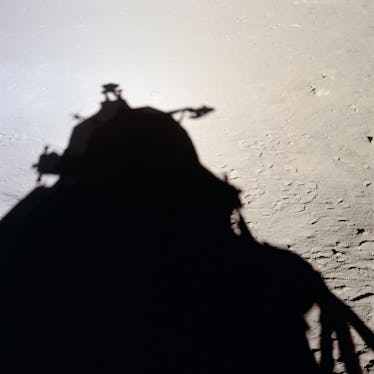
photo of a gray dusty surface with footprints, with the silhouette of a lunar lander part of shadowi...

The Apollo 11 Lunar Module casts a long shadow over the surface of the Moon — and the footprints of Neil Armstrong and Buzz Aldrin — in July 1968.

NASA

The Navajo aren't the only people who consider the Moon sacred. Cultures around the world have always tended to connect the Moon with the divine. For Hindus, the Moon represents the god Chandra, who is associated with plants and the night. Shinto believers see the Moon as the god Tsukuyomi, and for the Inuit, it's Alignak, a god whose domain includes weather, tides, and earthquakes. In ancient times, the Greeks worshiped the virginal huntress and nature goddess Artemis, while the Egyptians worshiped the god Khonsu, a healer and protector of nighttime travelers.

These deities' domains reveal a lot about how people have seen the moon over the millennia. It's been something pure, a bright light in the darkness, sometimes protective but other times belonging more to wild things than to people.

But the Moon is also a place; in the late 1500s, Galileo pointed his early telescopes at the Moon and discovered mountains, valleys, and craters. Today, we know the Moon as a dusty landscape marked by ancient volcanoes and billions of years of meteors. We've crashed spacecraft into its surface (both accidentally and on purpose), a few people have walked and even driven around small parts of it, and most of them left behind bags of waste and piles of dead-weight junk. But most of the Moon is still what astrophysicist and space ethicist Erika Nesvold calls a “space wilderness." She acknowledges that it's hard to think of wilderness in a place with no life, but argues that perhaps we should.

“We also have to ask questions about things like resource overuse,” says Nesvold. “If we mine out all the water on the moon in the next three generations, what are future generations going to do? Do we need to make sure we're preserving any of that?”

Increasingly, national governments and private companies are seeing the Moon not as a deity, a symbol, or a scientific puzzle: they're beginning to see it as a resource: a source of fuel and water on the way to Mars, a site for radio telescopes, or a source of geopolitical clout.

And that's sparking an urgent debate about whether some parts of the Moon remain pristine -- and if so, which parts. Whose faith and traditions, whose scientific curiosity, whose sense of aesthetics, or whose billion-dollar business plan should decide the fate of the Moon's ancient landscape?

QINGZHOU, CHINA - NOVEMBER 10, 2023 - Students experience an immersive "artificial moon landing" in ...

China is the Unites States’ main competitor in the current “space race,” with India close behind.

FUTURE PUBLISHING/FUTURE PUBLISHING/GETTY IMAGES

IF YOU’RE NOT FIRST, YOU’RE LAST

Part of the challenge of “space ethics” is to figure out what to do about these issues, but the really difficult part will be figuring out who gets to have a say. Can anyone tell a private company where, or whether, they can mine the Moon, open a lunar landfill, or turn a crater into a cemetery? How can countries with wildly differing values agree on the value – commercial, scientific, or ideological – of the Moon?

“At the more international level, that’s what international law is for,” says Nesvold.

At the moment, only the absolute basics are covered, starting with the Outer Space Treaty, in which most of the world’s nations have agreed that no one can claim territory in space, the Moon is to be used only for peaceful purposes, and nuclear weapons aren’t allowed in space. The Registration Convention requires states to register the orbital paths of their spacecraft with the UN to help prevent collisions. And the Rescue Agreement requires states to help spacefarers in distress, regardless of where they’re from.

Another treaty, the Space Liability Convention, says that spacecraft are the responsibility of the country they’re launched from — whether they’re publicly or privately owned. That means it’s up to an individual country to decide whether a company can launch human remains, soda cans, tardigrades, or anything else to the Moon (under U.S. regulations, any payload can go as long as it’s safe to launch and not a threat to national security).

What’s not covered by those laws is whether it’s okay to carve a giant advertising logo into a lunar basin, inter human remains or leave branded trinkets on the Moon, mine iconic lunar landmarks, or send tourists to the Apollo 11 landing site to walk in Neil Armstrong’s footsteps. And those are all very real possibilities in the near future. Space law, and space ethics, are urgent works in progress.

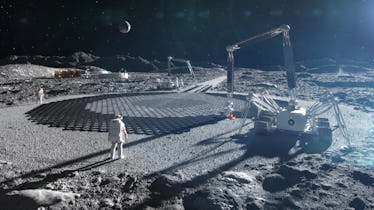
illustration of futuristic construction equipment, solar arrays, and astronauts on the rocky lunar s...

This artist’s illustration shows what future construction projects on the Moon might look like.

NASA

Meanwhile, the power to make those decisions is a big reason countries like the U.S., China, India, and Russia are all scrambling to get a foothold on the lunar surface before their rivals. Being the first to set up shop on the Moon is a huge way for a nation to show off its power, wealth, and technological chops. But on a practical level, being first also means first pick of landing sites, first dibs on lunar resources, and the first chance to choose which pieces of the lunar environment to protect.

“Ultimately, the people who get to make the decisions are the ones who are there,” says Green. “So that's why you hope that the people who are making the decisions and who are there are going to be ethical and actually considerate of other people's opinions.”

But that space race mentality can have its own problems.

“The space race dynamic always makes ethics more complicated,” says Green.

For one thing, there’s the question of what ethical shortcuts a nation or company might be willing to take to get there first. That could mean exploiting workers, taking undue risks with astronauts, or damaging the environment here on Earth.

“People who are arguing for more space telescopes, or people who are arguing for space launch centers on the path towards settling space often have really noble-sounding rhetoric: The idea of rocket launches and building more human civilization in space, versus the concerns about potential pollutants in local wetlands – the sorts of things you hear about in places like Boca Chica,” Nesvold tells Inverse. “I think that's very similar to the sort of manifest destiny rhetoric that you would see during colonization.”

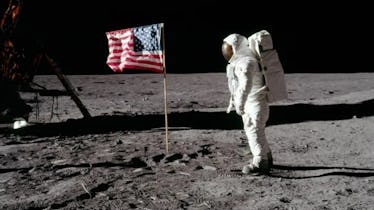
An astronaut stands beside an American flag on the Moon.

Humans will go to great lengths to plant their country’s flag.

NASA

America’s crewed space program was built on a major ethical shortcut: the work of Nazi officer Werner von Braun, who also designed the V2 rockets that killed around 9,000 British civilians during World War II (thousands more forced laborers died building them). Operation Paperclip, which brought von Braun and his team of engineers to the U.S., might have been unthinkable without the pressure to stay ahead of the USSR in space.

What space ethicists like Green and Nesvold want to avoid is a future where we plow blindly forward, with whoever gets there first imposing their will on a satellite that has, for all of human history until now, belonged to everyone – but at the same time, to no one. Nesvold warns that if we do that, we risk repeating the injustices of colonialism here on Earth.

IS ANTARCTICA A BLUEPRINT FOR SPACE?

Nations whose interests and values often clash will have to agree on how to manage a commons: "a broad set of resources, natural and cultural, that are shared by many people," as the International Association for the Study of the Commons puts it. We've already done that here on Earth, to some extent. The future of the Moon and Mars may owe a lot to the system of treaties that protect Antarctica and the set of laws that apply in international waters.

ANTARCTICA - FEBRUARY 15: Adelie penguins are seen on Horseshoe Island during the 8th National Antar...

The international agreements that protect these adorable penguins could provide a framework for cooperation on the Moon.

ANADOLU/ANADOLU/GETTY IMAGES

The 1959 Antarctic Treaty reserves the entire Antarctic continent for peaceful, scientific use. No commercial mining is allowed, and there are strict rules protecting plants, wildlife, and landscapes. Tourists, scientists, and even some military personnel are allowed to visit (or live there for months at a stretch), but only if the expedition or tour operator has a permit from one of the 56 countries that have signed the treaty.

Countries that issue permits have regulations about the type of activity and the number of people they'll allow; some of those rules are to protect the fragile polar environment, but others are for safety. For example, "the UK will also not normally authorize the use of helicopters for recreational purposes in areas with concentrations of wildlife, including the Antarctic Peninsula region." (As a side note, "for safety reasons the UK will not authorize snorkeling activities in the Antarctic." The more you know.)

Eight of the countries who signed the treaty claim sectors of territory in Antarctica, and some of them overlap. In theory, no one is allowed to claim new territory in Antarctica; the eight countries that claim sectors today had already made their claims before the Antarctic Treaty was written, and part of the treaty forbids anyone from making new claims. But both the U.S. and Russia argue that they've reserved the right to claim territory in Antarctica in the future.

On the other hand, several countries, including the U.S., have research stations in other countries' sectors without any major conflict.

If someone wants to violate the Antarctic Treaty, it's going to be hard to stop them without resorting to military force. That's even more true on the Moon. But so far, the Antarctic Treaty has worked fairly well.

"If we can look at what's worked and what hasn't in terms of preventing conflicts and protecting the environment, then we can apply those in space," says Nesvold.

{ https://www.inverse.com/ }

Hoe vind je dit bericht?
Geschreven door peter om 01:29 Stuur door

The 4 Big Questions the Pentagon’s New UFO Report Fails to Answer

The 4 Big Questions the Pentagon’s New UFO Report Fails to Answer

The Pentagon says it’s not hiding aliens, but it stops notably short of saying what it is hiding. Here are the key questions that remain unanswered—some answers could be weirder than UFOs.
Aerial view of the United States Pentagon building
PHOTOGRAPH: TOM BRENNER/GETTY IMAGES

After a year of eyebrow-raising headlines about government whistleblowers alleging that the military was running secret programs focused on alien spaceships and a months-long study and dogged investigative work through the shadows of classified Pentagon programs, the United States Defense Department announced Friday that it found no evidence that the government is covering up contact with extraterrestrials.

The first sentence of the 63-page report on the government’s involvement with unidentified anomalous phenomenon—a report mandated and driven by Congress—seemingly left no wiggle room: The study “found no evidence that any USG [US government] investigation, academic-sponsored research, or official review panel has confirmed that any sighting of a UAP represented extraterrestrial technology. All investigative efforts, at all levels of classification, concluded that most sightings were ordinary objects and phenomena and the result of misidentification.”-

The report was issued by the Pentagon’s All-domain Anomaly Resolution Office (AARO), the unit created and tasked in recent years with studying UAP sightings and untangling the truth of the government’s knowledge and understanding of generations of UFO reports. It follows media interviews and a blockbuster congressional hearing last summer where whistleblower David Grusch testified that the government was engaged in a decades-long cover-up of crashed alien spacecraft and in possession even of “non-human biologics,” e.g., alien bodies. Grusch and other witnesses and whistleblowers came forward to congressional committees and Pentagon investigators and hinted at astounding possibilities, including that the government was running secret UFO crash-retrieval programs, and defense contractors were running covert programs, hidden even from budget appropriators, to reverse-engineer captured alien technology.

There were many reasons to doubt the full expanse of the testimony by Grusch and others. Much of it was second-hand, and after spending two years writing a book on the government, UFOs, and the search for extraterrestrial life, I said last summer that many of the claims seemed more like an “intergalactic game of telephone,” where people with limited visibility into secret Pentagon and intelligence programs were misidentifying or misinterpreting more mundane program. But that’s not to say that the new AARO report is the end of the story nor that its conclusion should be the end of public interest in UFOs, UAPs, and the secret frontiers of government science.

In fact, while the report’s conclusion surprised almost no one except the most ardent of believers—people who might not be all that inclined to believe the Pentagon’s disavowal anyway—the report in its own way raises as many new questions as it answers, questions that could, with time, prove revolutionary to technology and science.

AARO investigators, for instance, dug through the claims of witnesses and whistleblowers and successfully traced back the underlying research projects, Special Access Programs (SAPs), and classified compartments. As the report says, “AARO investigated numerous named, and described, but unnamed programs alleged to involve UAP exploitation conveyed to AARO through official interviews,” and ultimately, “conclude[d] many of these programs represent authentic, current and former sensitive, national security programs, but none of these programs have been involved with capturing, recovering, or reverse-engineering off-world technology or material.”

But what, then, were those programs? Herein lies the most intriguing—and potentially ground-breaking—question that the Pentagon study leaves us wondering: What exactly are the secret compartmentalized programs that the whistleblowers and government witnesses misidentified as being related to UAP technology? What, exactly, are the Pentagon, intelligence community, or defense contractors working on that, from a concentric circle or two away inside the shadowy world of SAPs, looks and sounds like reverse-engineering out-of-this-world technology or even studying so-called “non-human biologics”?

There are at least four clear possibilities.

Secret Tech From Foreign Nations

First, what exotic technological possibilities have been recovered from unknown terrestrial sources? For example, if the government is working on reverse-engineering technologies, those technologies are likely from advanced adversary nation-states like China, Russia, and Iran, and perhaps even quasi-allies like Israel that may be more limited in their technology-sharing with the US. What have other countries mastered that we haven’t?

A Question of ‘Peculiar Characteristics’

Second, what technologies has the US mastered that the public doesn’t know about? One of the common threads of UFO sightings across decades have been secret military aircraft and spacecraft in development or not yet publicly acknowledged. For example, the CIA estimated that the U-2 spy plane in the 1950s accounted for as much as half of reported UFO sightings. And the AARO report spends a half-dozen pages documenting how confusion over subsequent generations of secret US government aircraft appear to have also contributed to the great intergalactic game of telephone of UFO programs inside the government, including modern Predator, Reaper, and Global Hawk drones. AARO investigated one claim where a witness reported hearing a former US military service member had touched an extraterrestrial spacecraft, but when they tracked down the service member, he said that the conversation was likely a garbled version of the time he touched an F-117 Nighthawk stealth fighter at a secret facility.-

There are surely other secret craft still in testing and development now, including the B-21 stealth bomber, which had its first test flight in November and is now in testing at Edwards Air Force Base in California, as well as others we don’t know about. The government can still surprise us with unknown craft—like the until-then-unknown modified stealthy helicopter left behind on the Pakistan raid to kill Osama bin Laden. And some of these still-classified efforts are likely causing UFO confusion too: AARO untangled one witness’s claim of spotting a UAP with “peculiar characteristics” at a specific time and place and were able to determine, “at the time the interviewee said he observed the event, the DOD was conducting tests of a platform protected by a SAP. The seemingly strange characteristics reported by the interviewee match closely with the platform’s characteristics, which was being tested at a military facility in the time frame the interviewee was there.” So what was that craft—and what were its “peculiar characteristics?”

Relatedly, the US military has a classified spaceship, the X-37B, that has regularly orbited around the Earth since its first mission in 2010—it just blasted off on its seventh and most recent mission in December—and its previous, sixth, mission lasted a record-breaking 908 days in orbit. The Pentagon has said remarkably little about what it does up there for years at a time. What secret space-related or aviation-related programs is the government running that outsiders confuse as alien spacecraft?

A Material Matter

The third likely area of tech development that might appear to outsiders to be UFO-related is more speculative basic research and development: What propulsion systems or material-science breakthroughs are defense contractors at work on right now that could transform our collective future? Again, AARO found such confusion taking place: After one witness reported hearing that “aliens” had observed one secret government test, AARO traced the allegation back to find “the conversation likely referenced a test and evaluation unit that had a nickname with ‘alien’ connotations at the specific installation mentioned. The nature of the test described by the interviewee closely matched the description of a specific materials test conveyed to AARO investigators.” So what materials were being tested there?

There are some puzzling materials-science breadcrumbs wrapped throughout the AARO report. It found one instance where “a private sector organization claimed to have in its possession material from an extraterrestrial craft recovered from a crash at an unknown location from the 1940s or 1950s. The organization claimed that the material had the potential to act as a THz frequency waveguide, and therefore, could exhibit ‘anti-gravity’ and ‘mass reduction’ properties under the appropriate conditions.” Ultimately, though, the new report concluded, “AARO and a leading science laboratory concluded that the material is a metallic alloy, terrestrial in nature, and possibly of USAF [US Air Force] origin, based on its materials characterization.”

A Knowledge Limit

Fourth and lastly is the category of the truly weird: Scientists at the forefront of physics point out that we should be humble about how little of the universe we truly understand; as Harvard astronomy chair Avi Loeb explains, effectively all that we’ve learned about relativity and quantum physics has unfolded in the span of a single human lifespan, and astounding new discoveries continue to amaze scientists. Just last summer, scientists announced they’d detected for the first time gravitational waves criss-crossing the universe that rippled through space-time, and astrophysicists continue to suspect that the universe is far weirder than we think. (Italian astrophysicist Carlo Rovelli last year posited the existence of “white holes” that would be related to black holes, which, he pointed out, were still a mystery just 25 years ago when he was starting his career.)

Answers here could be almost unfathomably weird—think parallel dimensions or the ability to travel at a fraction of the speed of light. And one of the most intriguing questions left by the UAP “game of telephone” is whether there are truly astounding advances in physics that government scientists, defense contractors, or research laboratories or centers could be feeling around that could also appear from the outside to be UFO-related.

Indeed, the AARO report references that at least some chunk of the “alien confusion” inside government may have grown out of a now well-known but then-secret effort in the late 2000s and early 2010s by Nevada entrepreneur Robert Bigelow’s aerospace company to study UAPs and paranormal activity by the Defense Intelligence Agency, through $22 million in funding secured by then-Senate majority leader Harry Reid. That effort, known as the Advanced Aerospace Weapons System Application Program (AAWSAP), included digging—without official authorization—into paranormal activity at a ranch out west, among other activities. Not much came out of that effort—and the AARO report dismissively notes that AAWSAP’s “scientific papers were never thoroughly peer-reviewed.” But people in and around the world of “ufology” have long noted that one of those papers intriguingly studied “Warp Drive, Dark Energy, and the Manipulation of Extra Dimensions.” Did the Pentagon know more about the outer boundaries of physics than it let on?

While other physicists who have reviewed that speculative 34-page AAWSAP report have said it had little real-world utility, it hints at how our modern understanding of the world around us may still be transformed by the unknown and future discoveries.

After reading thousands of pages of government studies, extraterrestrial research, and scientific papers related to the possibility of intelligent life elsewhere in the universe, I’ve come to believe that in some ways aliens might be the least interesting answer to the questions around UAPs and UFOs. Similarly, the AARO report may one day be seen as closing the door on alien spacecraft while opening the door to something even more fantastical.

{ https://www.wired.com/ }

Hoe vind je dit bericht?
Geschreven door peter om 00:00 Stuur door

There is DVD of US Intelligence Members Communicating with Extraterrestrials, Former US Military Claims

Intelligence Community and Aliens

There is DVD of US Intelligence Members Communicating with Extraterrestrials, Former US Military Claims

Former US intelligence officer David Grusch testified before Congress during the July 2023 UAP hearing, stating that we have numerous spacecraft of non-human origin. If this is the case, one might wonder if any contact has been established between humans and these extraterrestrial species. There have been persistent rumors suggesting that the US government may have signed treaties with these extraterrestrials and has been engaged in collaborative efforts with them over an extended period.

According to a rather extraordinary claim made by former US government consultant Timothy Good, it is alleged that the 34th President of the United States, Dwight D. Eisenhower, had three clandestine meetings with extraterrestrials. Good claimed Eisenhower met aliens at a remote air base in New Mexico in 1954. In more recent times, former Israeli Space Head Haim Eshed stated that aliens and the U.S. government had reached some type of deal to stay quiet about their experiments on Earth and secret facilities on Mars. Eshed went on to claim the existence of a “Galactic Federation” and implied that then-President Trump was on the brink of making significant revelations in this regard.

Video Evidence

During a podcast with former Fox News anchor Clayton Morris on his show Redacted, Joshua Reid, a former United States Navy serviceman with a background in missile weapons defense systems, brought a wealth of knowledge and experience to the table. He opened the conversation by referencing his personal experiences in the Navy, specifically during the years 2004 to 2006. Reid’s background made him intimately familiar with topics related to secret space projects, a subject that has piqued his interest for over two and a half decades.

It is worth noting that Joshua Reid’s extensive research in the field of UAPs and classified information has led him to the inner workings of certain government activities. His extensive four-year investigation revealed a disconcerting pattern. It appeared that military technology, particularly in special access programs, was unintentionally making its way to foreign adversaries, including China. This exchange of classified information seemed to involve universities and professors who were receiving grants to reverse engineer technologies from these programs.

The remarkable twist in this story was that Hillary Clinton’s emails were potentially facilitating the sale of this classified information to China and other foreign entities. China would fund universities, enticing professors to divulge information on special access programs. This enabled them to advance their technology rapidly, potentially reaching parity with the United States.

Former Inspector General I. Charles McCullough III, well-versed in these special access programs, played a crucial role in this unfolding drama. He represented David Grusch and became a central figure in the whistleblower saga. According to Reid, multiple whistleblowers were involved, with two possessing firsthand information and tangible evidence. The fear of repercussions led these individuals to testify in front of congressmen, notably, Indiana Congressman André Carson. However, it was not until these whistleblowers presented video evidence of intelligence community members communicating with extraterrestrials that congressmen took their claims seriously.

The impact of these videos was profound. Congressmen were visibly shaken, with one trembling and another drinking water profusely. This sudden shift in demeanor signified that the evidence was both extraordinary and unsettling. The whistleblowers were introduced to Inspector General McCullough, who had an extensive background in the very special access programs at the center of the controversy.

“I’ve heard that we can confirm this later, but from what I’m hearing, André Carson is this Congressman that they testified in front of, along with a few others. The Congressman didn’t take these guys seriously, but what ended up happening is they pulled out the evidence, a DVD, and they showed these congressmen video evidence of intelligence community members communicating with extraterrestrials. After these videos were shown to congressmen, they were noticeably shaken in fear. One of them was holding a piece of paper and could not stop shaking. Another was drinking water profusely, and this is when they began to take this very, very seriously and introduce these gentlemen to the former Inspector General of the Intelligence Community, McCullough. Hence, he enters the picture as someone who understands these SAP programs, has been read into these programs from back in the day, and is now representing these gentlemen.”

Morris was eager to learn more about the DVDs and the physical evidence related to the astounding claims made by the whistleblowers. He posed the question of where this evidence was currently held and whether the public would ever have the opportunity to view it.

Joshua Reid responded by revealing that the evidence, in the form of DVDs and other materials, was regarded as an “insurance policy.” This meant that the evidence was securely in the hands of two prominent UFO researchers. Furthermore, Reid confirmed that these researchers had not only seen the evidence but also verified its authenticity, which was a significant factor contributing to the growing interest in this matter.

Morris was eager to learn more about the DVDs and the physical evidence related to the astounding claims made by the whistleblowers. He asked Reid where this evidence was currently held and whether the public would ever have the opportunity to view it.

Joshua Reid responded by revealing that the evidence, in the form of DVDs and other materials, was regarded as an “insurance policy.” This meant that the evidence was securely in the hands of two prominent UFO researchers. Furthermore, Reid confirmed that these researchers had not only seen the evidence but also verified its authenticity, which was a significant factor contributing to the growing interest in this matter.

One of the prominent UFO researchers who has been sharing insider knowledge on UAPs is investigative journalist Ross Coulthart. It is quite uncertain if Coulthart possesses this DVD evidence but he did reveal that there exists a huge UFO in the possession of the United States that cannot be moved, and he knows the location of the craft. Ross mentioned the existence of non-human intelligence engaging with Earth for a long time and the recovery of certain objects, but he could not disclose specific details due to concerns about revealing advanced technologies.

Read also:

In a recent episode of “The UFO Podcast,” host Andy engaged in a thought-provoking conversation with Ross. The discussion centered around the secrecy surrounding UFO sightings and government knowledge. Ross, who has deep insights into the matter, shared his perspective on why certain details remain undisclosed.

Andy began by addressing a critical question that has been on the minds of many UFO enthusiasts: the location of the mysterious craft. He asked Ross whether he could reveal where the craft was being held.

Ross responded: “Let me tell you, I can’t tell you the country it’s in; it’s not America. But what I can tell you is that the place where it is kept is used for another purpose that is a laudatory purpose that’s as much in your interests in your country in the UK as it is in mine in Australia and as it is in America. The simple reasons are that there are other uses for the place where this object is stored, and we could end up with a storm Area 51-type scenario if you came out and announced it.”

Ross went on to explain the potential consequences of revealing such information, including international incidents and threats to the safety of personnel at the facilities. He also emphasized the importance of protecting sources, drawing on his experience as a journalist dealing with sensitive intelligence.

Interestingly, Steve Sprague, a UFO researcher who studied the UAP phenomenon for 30 years, claimed that an aerospace executive would come forward and share the information during the July 2023 Congressional Hearing on UAPs. This unidentified insider is described as a C-level executive within the United States-based company, which, according to Sprague, is a top firm reverse-engineering alien technology.

According to the insider, aliens not only exist but have been present on Earth for at least five millennia, if not longer. Startlingly, the individual revealed the existence of at least two civilizations currently residing on our planet: humans and a group known as the “Ganzi,” originating from a distant part of our galaxy, roughly forty light years away. The Ganzi are characterized as technologically advanced beings who possess knowledge far surpassing humanity’s capabilities.

The insider also touched upon significant presidential briefings that have taken place, shedding light on the United States government’s awareness of these developments. On various occasions, President Biden was reportedly briefed on advanced technologies recovered from the Ganzi. The briefings included demonstrations of lasers capable of remarkable feats, such as extracting elements directly from ore and analyzing biological and geological data.

Videos of these briefings purportedly exist, with one showing Biden interacting with three Ganzi beings through a small device placed in his ear. Notably, one of the individuals accompanying the beings was John Podesta, who later assumed the role of Senior Advisor for Clean Energy Innovation. The insider also linked breakthroughs in fusion energy and laser technology to the company’s efforts in reverse-engineering Ganzi technology.

Sprague wrote, “Date 4 – May 19, 2022, Biden is now in Alaska and stopped off to refuel at Joint Base Elmendorf-Richardson. This video is the most incredible of all. Biden meets with three of the Ganzi. Biden puts a small device in his ear and a conversation occurs without sound. The video lasts for nine minutes and then four people enter the area. One of the people is John Podesta. The other three are unknown. The beings leave and the video ends. In September of 2022, Biden names Podesta as the Senior Advisor for Clean Energy Innovation. December 14, 2022, America has a breakthrough in fusion. To achieve this scientific feat – a laser is used. This laser has ‘unique’ properties.” (Source)

Sprague’s claims cannot be verified; however, it is certain that there exists an alien craft, and the United States has successfully accessed its interior. Dr. James Lacatski, a retired DIA intelligence officer who established the UFO program that operated from 2008 to 2010, has confirmed this. He stated that the craft possesses a streamlined configuration suitable for aerodynamic flight but lacks conventional features such as an engine, wings, intakes, exhaust, or fuel tanks.

{ https://www.howandwhys.com/ }

Hoe vind je dit bericht?
Geschreven door peter om 23:58 Stuur door

“Something doesn’t add up”: The Webb Telescope Identified Premature Supermassive Back Holes

“Something doesn’t add up”: The Webb Telescope Identified Premature Supermassive Back Holes

These objects could shed light on how supermassive black holes evolve — and where they came from in the first place.

 
Deep space image showing numerous stars and galaxies with a highlighted section focusing on a specif...
MATTHEE AT AL. 2024

A team of astronomers recently discovered that little red dots in the distant universe were actually baby quasars, the precursors to the supermassive black holes at the center of galaxies like our Milky Way. Astrophysicist Jorryt Matthee, of Austria’s Institute of Science and Technology, and his colleagues published their work in The Astrophysical Journal.

image of a field of stars and galaxies in space, with a section zoomed in two show two very faint ga...

The small orange-red objects with the six refraction spikes are small, early galaxies with actively-feeding supermassive black holes, about 13 billion light years away.

MATTHEE AT AL. 2024

CONNECTING THE DOTS

Matthee and his colleagues used the James Webb Space Telescope (JWST) to peer deep into a tiny slice of the sky. In older images from the Hubble Space Telescope, the faint red dots in the cosmic distance (13 billion light years away) had looked like very ancient, but otherwise ordinary, galaxies. However, JWST’s instruments picked up something else: specific wavelengths of light associated with hot, fast-moving hydrogen.

“These spectra tell us that we are looking at a very small gas cloud that moves extremely rapidly and orbits something very massive, like a supermassive black hole,” says Matthee in a recent statement.

The supermassive black holes in these “little red dot” galaxies are small: about 10 to 100 million times more massive than our Sun, which is tiny for a supermassive black hole. And if Matthee is right, they’re still young.

“My intuition says these are fairly young systems of maximally a few hundred million years old that are rapidly evolving (at least, on "astronomical timescales" of millions of years),” Matthee tells Inverse. To be sure about that, he and his colleagues will need to measure the ages of the stars around the black holes. Meanwhile, these “little red dots” look like small, early versions of the type of supermassive black holes that Matthee calls “problematic quasars.” (A quasar is an actively-feeding supermassive black hole at the center of a galaxy.)

SOMETIMES SPACE IS PROBLEMATIC

Matthee’s problematic quasars are problematic because they’re too big to exist where and when they exist: between 11 and 12 billion light years away, when the universe was just a couple of billion years old. If supermassive black holes formed the way astrophysicists have long assumed — starting with a giant star collapsing into a black hole, then growing larger as it pulls in more material — then black holes that are billions of times more massive than our Sun shouldn’t have existed 11 billion years ago. Black holes that started as 30 times our Sun’s mass shouldn’t have had time to grow so large in less than a couple of billion years.

“It’s like looking at a 5-year-old child that is 2 meters tall,” says Matthee. “Something doesn’t add up.”

And yet there they are. Earlier this year, a team of astronomers announced that they had spotted a supermassive black hole about the same mass as the behemoth at the center of the Milky Way – dating to 13.4 billion years ago.

So either black holes grow faster than the laws of physics suggest they do, or they started as something more massive than an ordinary collapsed star. One possibility is that the “seeds” of supermassive black holes were already thousands of times our Sun’s mass, spawned by enormous clouds of gas collapsing under their gravity.

Much of what JWST has revealed about the early universe seems to support the idea that supermassive black holes formed from more massive “seeds,” not ordinary collapsed stars, but there’s not enough evidence yet to settle the debate.

“In my view, we currently can not yet discriminate between these scenarios,” Matthee tells Inverse.

WHAT’S NEXT?

To do that, astrophysicists will need more data. Matthee and his team want to measure the conditions in which these early black holes formed: the mass of the stars in their host galaxies, the amount of heavy elements in the galaxy’s ingredients list, and whether there’s galactic wind. They’re also curious about whether these precociously-large supermassive black holes tend to form in galaxy clusters or less-populated cosmic neighborhoods.

Over the next couple of years, Matthee and his team have booked more time on JWST, which they’ll use to search for more “little red dots” even farther away — and farther back in time.

“We want to extend the population of ‘baby quasars’ that we know of,” says Matthee. “By finding new ones even earlier in time, we should witness them closer to their birth, meaning we can learn more about their formation conditions. The same may be learned by finding even lower mass supermassive black holes, with masses ~100,000-1,000,000 times the Sun, and characterizing the properties of the galaxies they formed in.”

{ https://www.inverse.com/ }

Hoe vind je dit bericht?
Geschreven door peter om 22:53 Stuur door

KONA BLUE: Top-Secret Government Program To Investigate “Human Consciousness Anomalies” Doesn’t Exist, New Report Says

KONA BLUE: Top-Secret Government Program To Investigate “Human Consciousness Anomalies” Doesn’t Exist, New Report Says

The 63-page-long document is part of an investigation into U.S. government programs that have been a springboard for alleged paranormal-related activity.

ARLINGTON, VIRGINIA - AUGUST 31: Defense Department spokesman Brig. Gen. Patrick Ryder holds a press...
Kevin Dietsch
Getty Images News

No, the United States government does not have alien bodies hiding somewhere, nor has it ever tried to reverse-engineer flying saucers. Really.

That’s one of the main stances that the All-domain Anomaly Resolution Office (AARO), an organization created in 2022 to resolve sightings of Unidentified Anomalous Phenomena (UAP), asserts in a report published Friday.

UAP is the modern moniker for UFO. Intelligence officials avoided reusing the popular term because it’s too closely associated, nowadays, with little green men.

UAP refers to sightings from pilots and members of the military, who haven’t been able to explain why they’ve seen objects that appear to reject the laws of motion and physics. Many have been proven to be weather balloons and tricks of perception. Several, however, remain unexplained. That has given credence to people who believe the U.S. government is hiding aliens.

The 63-page-long document is the first volume in a series of investigations into U.S. government programs through history that have been a springboard for alleged paranormal-related activity. “Analyzing and understanding the historical record on UAP is an ongoing collaborative effort involving many departments and agencies,” AARO officials wrote in an announcement published on Friday.

“To date, AARO has found no verifiable evidence for claims that the U.S. government and private companies have access to or have been reverse-engineering extraterrestrial technology,” the statement says.

KONA BLUE NEVER EXISTED

The report makes several assertions, including a debunking of KONA BLUE.

KONA BLUE, as the report explains, was allegedly a top-secret program to investigate “human consciousness anomalies,” retrieve and exploit “non-human biologics,” and reverse engineer any alien craft they found.

“It is critical to note that no extraterrestrial craft or bodies were ever collected — this material was only assumed to exist by KONA BLUE advocates and its anticipated contract Performers,” the report authors emphasized.

As the authors do throughout the report, they take an instance of a program and explain where the pseudoscience claims may be emerging. In the case of KONA BLUE, the contract for a $22 million program, greenlit in 2008 to assess aerospace threats on the horizon — and which was never explicitly tasked with researching UFOs — was awarded to a private sector organization. But the U.S. Defense Intelligence Agency canceled it in 2012, “due to lack of merit and the

utility of the deliverables,” though this didn’t stop non-government program advocates, who renamed the proposal as KONA BLUE, from seeking to investigate paranormal activity.

“KONA BLUE’s advocates were convinced that the USG [U.S. government] was hiding UAP technologies. They believed that creating this program under DHS would allow all of the technology and knowledge of these alleged programs to be moved under the KONA BLUE program,” according to the report.

This program was never rubber stamped, and as the report says, “was never approved or stood up, and no data or material was transferred to DHS [Department of Homeland Security].”

In the Friday announcement, AARO officials stipulate that they’ve approached their review of KONA BLUE and other topics “with the widest possible aperture,” that it is committed to reaching conclusions based on verifiable evidence, willing to “follow the evidence where it leads, wherever it leads.”

{ https://www.inverse.com/ }

Hoe vind je dit bericht?
Geschreven door peter om 22:34 Stuur door

Meer van UFO'S of UAP'S, ASTRONOMIE, RUIMTEVAART, ARCHEOLOGIE, OUDHEIDKUNDE, SF-SNUFJES EN ANDERE ESOTERISCHE WETENSCHAPPEN - DE ALLERLAATSTE NIEUWTJES

↑ Terug naar de berichten