Naar de inhoud

UFO'S of UAP'S, ASTRONOMIE, RUIMTEVAART, ARCHEOLOGIE, OUDHEIDKUNDE, SF-SNUFJES EN ANDERE ESOTERISCHE WETENSCHAPPEN - DE ALLERLAATSTE NIEUWTJES

UFO's of UAP'S in België en de rest van de wereld
akke.beakke.be
Ontdek de Fascinerende Wereld van UFO's en UAP's: Jouw Bron voor Onthullende Informatie! Ben jij ook gefascineerd door het onbekende? Wil je meer weten over UFO's en UAP's, niet alleen in België, maar over de hele wereld? Dan ben je op de juiste plek! België: Het Kloppend Hart van UFO-onderzoek In België is BUFON (Belgisch UFO-Netwerk) dé autoriteit op het gebied van UFO-onderzoek. Voor betrouwbare en objectieve informatie over deze intrigerende fenomenen, bezoek je zeker onze Facebook-pagina en deze blog. Maar dat is nog niet alles! Ontdek ook het Belgisch UFO-meldpunt en Caelestia, twee organisaties die diepgaand onderzoek verrichten, al zijn ze soms kritisch of sceptisch. Nederland: Een Schat aan Informatie Voor onze Nederlandse buren is er de schitterende website www.ufowijzer.nl, beheerd door Paul Harmans. Deze site biedt een schat aan informatie en artikelen die je niet wilt missen! Internationaal: MUFON - De Wereldwijde Autoriteit Neem ook een kijkje bij MUFON (Mutual UFO Network Inc.), een gerenommeerde Amerikaanse UFO-vereniging met afdelingen in de VS en wereldwijd. MUFON is toegewijd aan de wetenschappelijke en analytische studie van het UFO-fenomeen, en hun maandelijkse tijdschrift, The MUFON UFO-Journal, is een must-read voor elke UFO-enthousiasteling. Bezoek hun website op www.mufon.com voor meer informatie. Samenwerking en Toekomstvisie Sinds 1 februari 2020 is Pieter niet alleen ex-president van BUFON, maar ook de voormalige nationale directeur van MUFON in Vlaanderen en Nederland. Dit creëert een sterke samenwerking met de Franse MUFON Reseau MUFON/EUROP, wat ons in staat stelt om nog meer waardevolle inzichten te delen. Let op: Nepprofielen en Nieuwe Groeperingen Pas op voor een nieuwe groepering die zich ook BUFON noemt, maar geen enkele connectie heeft met onze gevestigde organisatie. Hoewel zij de naam geregistreerd hebben, kunnen ze het rijke verleden en de expertise van onze groep niet evenaren. We wensen hen veel succes, maar we blijven de autoriteit in UFO-onderzoek! Blijf Op De Hoogte! Wil jij de laatste nieuwtjes over UFO's, ruimtevaart, archeologie, en meer? Volg ons dan en duik samen met ons in de fascinerende wereld van het onbekende! Sluit je aan bij de gemeenschap van nieuwsgierige geesten die net als jij verlangen naar antwoorden en avonturen in de sterren! Heb je vragen of wil je meer weten? Aarzel dan niet om contact met ons op te nemen! Samen ontrafelen we het mysterie van de lucht en daarbuiten.

Archief

Europa Produce Less Oxygen than Previously Thought

Europa Produce Less Oxygen than Previously Thought

Using data from the Jovian Auroral Distributions Experiment (JADE) instrument onboard NASA’s Juno spacecraft, planetary scientists have calculated the rate of oxygen being produced at Jupiter’s icy moon Europa to be substantially less than most previous studies.

This illustration shows charged particles from Jupiter impacting Europa’s surface, splitting frozen water molecules into oxygen and hydrogen molecules; scientists believe some of these newly created oxygen gases could migrate toward the moon’s subsurface ocean, as depicted in the inset image. Image credit: NASA / JPL-Caltech / SWRI / PU.

This illustration shows charged particles from Jupiter impacting Europa’s surface, splitting frozen water molecules into oxygen and hydrogen molecules; scientists believe some of these newly created oxygen gases could migrate toward the moon’s subsurface ocean, as depicted in the inset image.

Image credit: NASA / JPL-Caltech / SWRI / PU.

With an equatorial diameter of 3,100 km (1,940 miles), Europa is the fourth largest of Jupiter’s 95 known moons and the smallest of the four Galilean satellites.

The moon hosts an internal liquid ocean with potentially habitable conditions below a frozen crust.

Its surface is constantly bombarded by radiation that breaks the icy crust into oxygen and hydrogen, most of which are freed from the surface, escaping into space, or remain behind to form Europa’s atmosphere.

The abundance of these atmospheric gases and ions — and consequently their production rate at the surface — has mostly been inferred by remote sensing observations and has large uncertainties.

“Europa is like an ice ball slowly losing its water in a flowing stream,” said JADE scientist Dr. Jamey Szalay, a researcher at Princeton University.

“Except, in this case, the stream is a fluid of ionized particles swept around Jupiter by its extraordinary magnetic field.”

“When these ionized particles impact Europa, they break up the water-ice molecule by molecule on the surface to produce hydrogen and oxygen.”

“In a way, the entire ice shell is being continuously eroded by waves of charged particles washing up upon it.”

In the new study, Dr. Szalay and colleagues analyzed data from a flyby of Europa performed by the Juno spacecraft on September 29, 2022, which saw the spacecraft fly 353 km (219 miles) above Europa’s surface.

Using the JADE instrument, they extracted the abundance of various pickup ions, which are charged particles generated by the breakup of atmospheric neutrals when they collide with energetic radiation or other particles.

From these data, they calculate that approximately 12 kg of oxygen are produced at Europa’s surface every second.

This is at the lower end of the expectations inferred from previous models that ranged from 5 to 1,100 kg per second.

The results indicate there may be less oxygen on Europa’s surface than previously thought, and that this implies a narrower range to support habitability in Europa’s ocean.

“Our ability to fly close to the Galilean satellites during our extended mission allowed us to start tackling a breadth of science, including some unique opportunities to contribute to the investigation of Europa’s habitability,” said Juno’s principal investigator Dr. Scott Bolton, a researcher at the Southwest Research Institute.

“And we’re not done yet. More moon flybys and the first exploration of Jupiter’s close ring and polar atmosphere are yet to come.”

  • The findings were published in the journal Nature Astronomy.
  • J.R. Szalay et al. Oxygen production from dissociation of Europa’s water-ice surface. Nat Astron, published online March 4, 2024; doi: 10.1038/s41550-024-02206-x

{ https://www.sci.news/ }

Hoe vind je dit bericht?
Geschreven door peter om 00:23 Stuur door

The Global Aviation Encounter with Unidentified Aerial Phenomena

 The Global Aviation Encounter with Unidentified Aerial Phenomena

UFOs Investigating the Unknown

In the vast expanse of our skies, pilots navigate not only the complexities of modern aviation but also, occasionally, the mysteries of the unexplained. Among these enigmas, Unidentified Aerial Phenomena (UAPs) present a perplexing challenge, sparking intense discussions on aviation safety and the need for a concerted global response. Far from being confined to the realm of science fiction, encounters with UAPs have been reported by credible witnesses across the globe, igniting concerns about the potential risks they pose to flight safety.

One of the most compelling cases that underscore the seriousness of these encounters occurred in 1986, involving Japan Airlines Flight 1628 over Alaska. The crew reported an inexplicably large object, several times the size of their aircraft, trailing them for a considerable duration. The incident, characterized by the pilot’s vivid description of the object’s enormity and his own fear, is far from isolated. Similar encounters have been documented worldwide, suggesting that the phenomenon of UAPs is not only real but also widespread.

VIDEO:

  • The Global Threat (Full Episode) | UFOs: Investigating the Unknown

These encounters often share common characteristics: highly advanced maneuverability that defies conventional aviation technology, the ability to appear and disappear from both sight and radar, and, most alarmingly, the potential to come dangerously close to commercial aircraft. Such near misses raise legitimate concerns over passenger safety and the need for a deeper understanding of UAPs.

Despite the growing body of evidence, the official response has been tepid at best. In the United States, the government’s formal study of UFOs (an earlier term for UAPs) concluded in 1969, leaving a vacuum filled by civilian researchers and a handful of dedicated organizations. However, the lack of official acknowledgment or investigation into these phenomena means that many near misses go unreported or are dismissed, leaving pilots and air traffic controllers without the support they need to understand or mitigate these risks.

Internationally, the response has been varied. Some countries have taken the initiative to study UAPs more openly. For example, France has established a governmental agency within its space studies center to investigate UAPs, bringing together experts from various fields to analyze sightings. Similarly, Chile and Peru have recognized the importance of these investigations, often focusing on the implications for aviation safety.

The need for a unified approach to understanding and addressing UAPs is evident. The establishment of organizations like the National Aviation Reporting Center on Anomalous Phenomena (NARCAP) is a step in the right direction, offering a confidential reporting system for aviation professionals. Yet, the challenge remains global, and the response must be equally comprehensive.

The implications of these unexplained encounters extend beyond the immediate safety concerns. They challenge our understanding of the skies we navigate and the technologies we’ve mastered. As we continue to explore the boundaries of aviation, the conversation around UAPs serves as a reminder of the mysteries that still lie beyond our grasp.

A global, collaborative effort to investigate UAPs could not only enhance aviation safety but also expand our scientific horizons. By embracing the unknown with an open mind and a rigorous scientific approach, we may one day unlock the secrets of these phenomena, turning today’s mysteries into tomorrow’s knowledge. Until then, the skies remain a frontier of both exploration and uncertainty, a reminder of the endless quest for understanding in the vast expanse above us.

{ https://www.latest-ufo-sightings.net/ }

Hoe vind je dit bericht?
Geschreven door peter om 23:47 Stuur door

NASA Tests the New Starship Docking System

12467_v_2-1000x1200.jpg

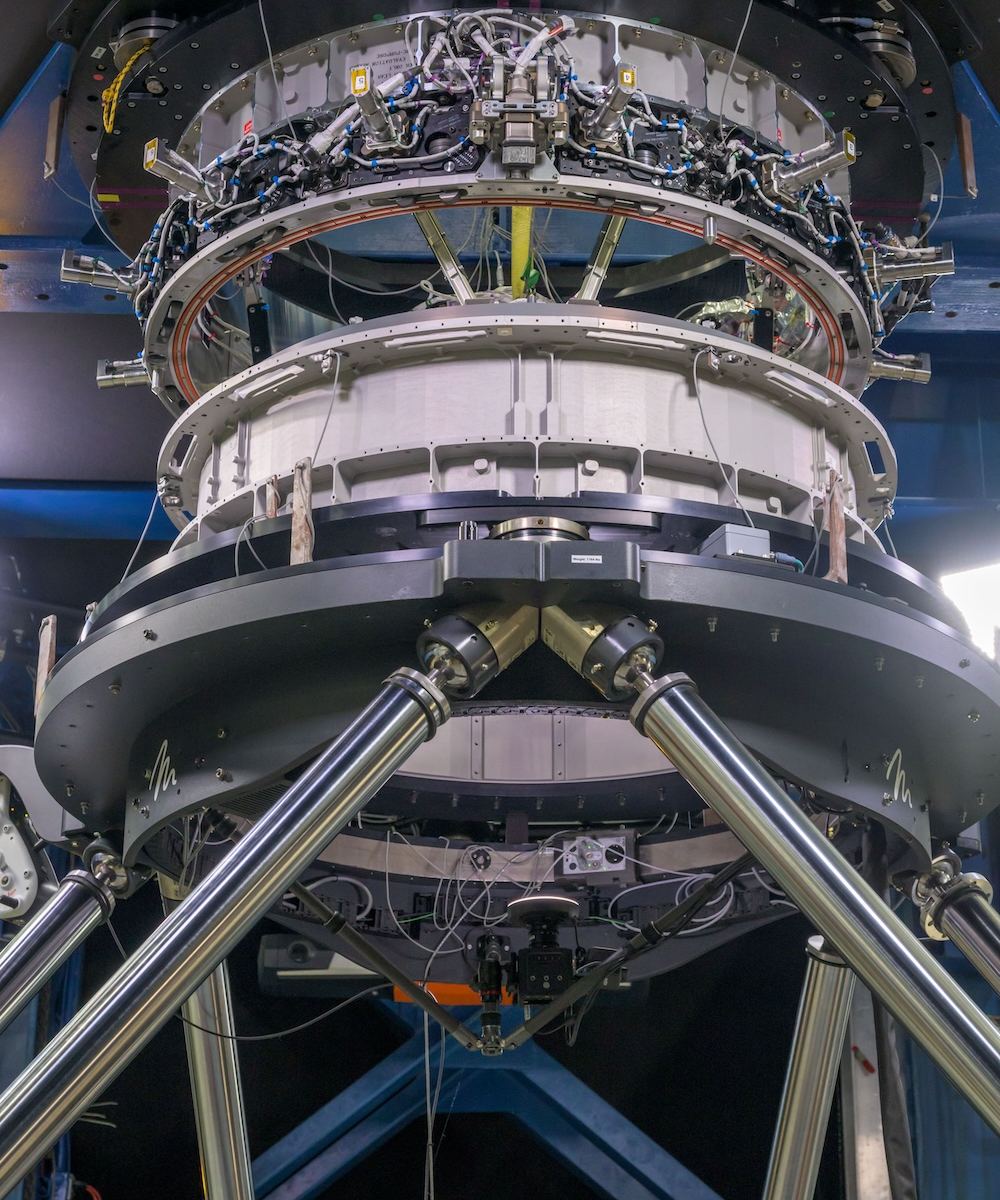
SpaceX and NASA recently performed full-scale qualification testing of the docking system that will connect SpaceX’s Starship Human Landing System (HLS) with Orion and later Gateway in lunar orbit during future crewed Artemis missions. Based on the flight-proven Dragon 2 active docking system, the Starship HLS docking system will be able to act as an active or passive system during docking. Image Credit: SpaceX

NASA Tests the New Starship Docking System

The Apollo Program delivered 12 American astronauts to the surface of the Moon. But that program ended in 1972, and since then, no human beings have visited. But Artemis will change that. And instead of just visiting the Moon, Artemis’ aim is to establish a longer-term presence on the Moon. That requires more complexity than Apollo did. Astronauts will need to transfer between vehicles.

All of that activity requires a reliable spacecraft docking system.

When Artemis astronauts blast off from Earth, they’ll be in the four-seat Orion spacecraft. Orion will take them to lunar orbit, where two will transfer into the Starship HLS, and two will remain in Orion. Starship HLS will deliver them to the lunar surface. In the future, the Lunar Gateway will be in orbit around the Moon, and astronauts will move from Orion to the Gateway to the Starship HLS.

These transfers are complicated and risky maneuvers. The docking system that will make this work is called SpaceX’s Starship HLS docking system. It’s based on SpaceX’s successful Dragon 2 docking system. The Dragon 2 system allows the Dragon 2 spacecraft to dock with the ISS so crew and equipment can be transferred. It’s been in use since 2020.

NASA and SpaceX are busy testing the new Starship HLS docking system. They recently completed ten days of testing at the Johnson Space Centre in Houston, Texas. They conducted more than 200 different docking scenarios involving different speeds and angles. The results from this full-scale testing will feed into ongoing computer models of the system, which will, in turn, feed into future testing and design.

This graphic shows the Artemis III Concept of Operations. Docking and crew transfers are a critical stage in the missions. Image Credit: NASA This graphic shows the Artemis III Concept of Operations. Docking and crew transfers are a critical stage in the missions. Image Credit: NASA

The system has both an active and a passive mode. When two spacecraft dock, one is active, and the other is passive. The active one is called the chaser, and the other is the target.

During this round of tests, NASA and SpaceX demonstrated the soft capture procedure. In passive capture, the chaser extends its soft capture system (SCS) while the target spacecraft’s system remains retracted. The chaser does all the work, employing latches and other mechanisms to grab the target spacecraft and complete the docking.

HLS requirements state that there must be redundancy in crew egress/ingress. The soft capture procedure seems to address this if the docking system works while one docking system remains retracted.

This is just the latest round of tests. SpaceX has already reached a series of important milestones for the Starship HLS. Those milestones involved power generation, communications, guidance and navigation, propulsion, life support, and space environments protection.

While watching powerful rockets being tested and launched takes up a lot of attention, there’s far more to successful missions than just launch vehicles. According to NASA, “the Human Landing System program is at the center of Artemis, designed to yield groundbreaking science, develop and utilize lunar
surface resources and leverage what we learn at the Moon for future Mars missions.” Docking systems might not garner much attention, but they’re obviously a critical part of success.

Through that lens, any progress on Artemis is good news because, on other fronts, the news is not always good. Artemis was initially scheduled to launch in 2025. But it’ll be at least a year late, and NASA says that SpaceX will need to perform more launches before the Artemis mission is given the go-ahead.

{ https://www.universetoday.com/ }

Hoe vind je dit bericht?
Geschreven door peter om 01:33 Stuur door

How Startups on Earth Could Blaze a Trail for Cities on Mars

Illustration: 3D-printed habitats on Mars

An artist's conception shows 3D-printed habitats in a Mars settlement. (Credit: Team SEArch+/Apis Cor via NASA)

How Startups on Earth Could Blaze a Trail for Cities on Mars

If future explorers manage to set up communities on Mars, how will they pay their way? What’s likely to be the Red Planet’s primary export? Will it be Martian deuterium, sent back to Earth for fusion fuel? Raw materials harvested by Mars-based asteroid miners, as depicted in the “For All Mankind” TV series? Or will future Martians be totally dependent on earthly subsidies?

In a new book titled “The New World on Mars,” Robert Zubrin — the president of the Mars Society and a tireless advocate for space settlement — says Mars’ most valuable product will be inventions.

“We’re talking about creating a new and potentially extremely inventive branch of human civilization, which will benefit humanity as a whole enormously,” he says in the latest episode of the Fiction Science podcast. “But moreover, we’ll play from that strength to make money.”

Zubrin isn’t waiting until humans step foot on Mars to get started.

“We are in the process of drawing up business plans for two major initiatives — one in the artificial intelligence area and the other in the synthetic food production area,” he says. “And the idea is, fairly soon we’re going to be presenting these business plans to investors, with the idea of starting companies devoted to these two different technological ideas that we have put together.”

Zubrin says it’s too early to reveal exactly what these companies would do, but he claims the ventures have the potential to become extremely profitable. The AI concept could be “a billion-dollar idea,” he says.

“They’re both addressing critical questions for Mars that have tremendous terrestrial spin-off potential,” Zubrin says.

Income from the ventures would be split between investors and the Mars Society, which would use the funds to support a Mars Technology Institute. “We just did a fundraising drive and raised $150,000 to get this thing started,” Zubrin says.

Robert Zubrin is the founder and president of the Mars Society. (Credit: Mars Society CC BY-SA 3.0)

Once things get rolling, Zubrin envisions setting up a headquarters for the institute — perhaps in the Pacific Northwest or in Colorado (where the Mars Society is currently based).

The concept of using earthly ventures to support off-Earth adventures is by no means new. Back in 2015, when SpaceX founder Elon Musk was recruiting engineers for the Starlink satellite internet network, he said the profits from Starlink would go toward funding a city on Mars.

“Looking in the long term, and saying what’s needed to create a city on Mars — well, one thing’s for sure: a lot of money,” Musk told an audience of about 400 techies (including prospective employees) in Seattle. “So we need things that will generate a lot of money.”

Zubrin says the challenge of establishing settlements on Mars will promote invention in the same way that the challenges facing pioneers in the United States led to innovations ranging from steamboats to light bulbs to iPhones.

“Mars is even going to be much more technologically selective in terms of who goes there, and also a much more challenging environment,” he says. “It’s going to be America to the third power in terms of what it will be able to invent.”

He argues that settlers will be forced to innovate when it comes to developing nuclear fission and fusion plants for energy, finding ways to conserve and recycle resources for sustaining Martian communities, and maximizing food production amid the planet’s harsh conditions. All those innovations can then be exported back to Earth.

Zubrin has laid out the case for Mars settlement in a series of books that goes back to, well, “The Case for Mars” in 1996. He also wrote a fictional account of a crewed mission to Mars, titled “First Landing.” And he has appeared in more than a dozen TV shows about Mars and space exploration, including “Mars,” a National Geographic series that blends science fiction and science fact.

“The New World on Mars” deals with thematic territory that spreads out much more broadly than what was covered in “The Case for Mars.” And Zubrin says SpaceX’s rise is the reason why.

For years, Musk and his team have been focusing on development of a reusable super-heavy-lift launch system known as Starship. The next test flight could take place within weeks — and it’s likely to be only a matter of time before Starship offers a reliable way to get to Earth orbit and beyond.  Musk envisions building a fleet of the rockets to send thousands of settlers to Mars, in line with his long-term ambition to make humanity a multiplanet species.

“The New World on Mars: What We Can Create on the Red Planet” by Robert Zubrin. (Diversion Books)

Zubrin assumes that Starship or something like it will be a success — which means there’s less need to dwell on the nuts and bolts of interplanetary transport in “The New World on Mars.”

“This book essentially says, ‘Look, it’s soon going to be possible for humans to go to Mars,’” he says. “So the key question is not how do we do that, but what do we do when we get there?”

Zubrin goes into great detail about how Mars’ harsh realities could affect every aspect of daily life, from energy production and terraforming to marriage and parenthood. For example, he suggests that Martians might clean their clothes simply by airing them out in the Red Planet’s low-pressure, bacteria-killing environment.

Zubrin went so far as to test the technique by stuffing dirty clothes into a laboratory vacuum chamber. “The only downside is that stains are not removed, so they don’t look clean. One remedy for this would be to use camo coloration for clothes, as it does not show stains,” he writes. “I predict this will be the style.”

“The New World on Mars” is more optimistic about Red Planet settlement than “A City on Mars,” a book by Kelly and Zach Weinersmith that was featured on Fiction Science last November. That book argues that the drive to create space settlements is premature — and that a host of uncertainties need to be cleared up first. For example, the Weinersmiths say that much more research should be done on the potential effects of Mars’ reduced gravity on human reproduction and development. They also raise concerns about the potential international conflicts over property rights in space.

As you’d expect, Zubrin strongly disagrees with such views — in his book, on the podcast, and in a book review published by Quillette. “They say there’s no point going into space. There’s nothing to be gained from it, and therefore, there should be laws to stop it, which makes no sense whatsoever,” he says.

In Zubrin’s view, the 1967 Outer Space Treaty’s prohibition on claims of national sovereignty won’t tie the hands of Mars settlers. Instead, it would make it easier for them to stake their own claims. “If a Martian colony is set up, and declares property rights within its vicinity, [governments on Earth] have no jurisdiction to contradict it,” Zubrin says. “They have explicitly signed away their rights to interfere with Mars settlement.”

And what about the health effects of living on Mars? “OK, so yeah, we don’t know about the long-term effects of one-third gravity on people, but we’ll find that out,” Zubrin says. “When we send our first exploration missions to Mars, I believe it’ll be OK.”

The way Zubrin sees it, the main attraction for Mars settlers won’t be deuterium, or asteroid riches, or shiny red obsidian. It’ll be something money can’t buy: the freedom to create.

“I believe that there’s nothing more powerful than the creative power of life,” he says. “The grass finds a way to break through the pavement. Life finds a way. … And freedom is going to find a way.”

Check out the original version of this posting on Cosmic Log for Red Planet reading recommendations from Robert Zubrin.

My co-host for the Fiction Science podcast is Dominica Phetteplace, an award-winning writer who is a graduate of the Clarion West Writers Workshop and lives in San Francisco. To learn more about Phetteplace, visit her website, DominicaPhetteplace.com, and read “The Ghosts of Mars,” her novella in Asimov’s Science Fiction magazine.

Stay tuned for future episodes of the Fiction Science podcast via Apple, Google, Overcast, Spotify, Player.fm and Pocket Casts. If you like Fiction Science, please rate the podcast and subscribe to get alerts for future episodes.


{ https://www.universetoday.com/ }

Hoe vind je dit bericht?
Geschreven door peter om 01:05 Stuur door

US Government Researched About UFOs Disguised As Clouds, UFO Sighting News.

US Government Researched About UFOs Disguised As Clouds, UFO Sighting News.

Screenshot%202024-03-03%20at%2010.29.22%E2%80%AFAM.png
Now here is an interesting situation. The US Gov department of defense and the USAF both considered that UFOs could be cloaking within disk shaped clouds and did research recording the craft in the once top secret UFO report call the Condon Reports. 
Scott C. Waring

{ https://www.ufosightingsdaily.com/ }

Hoe vind je dit bericht?
Geschreven door peter om 23:15 Stuur door

Some Intelligent Civilizations Will Be Trapped on their Worlds

With thousands of exoplanets discovered so far, astronomers are learning how different planets can be. What if intelligent alien civilizations arise on extremely different habitable worlds? Some civilizations could develop space exploration technologies, but others would be trapped underwater, under ice, or in enormous gravity wells. How could they escape? Image Credit: DALL-E

Some Intelligent Civilizations Will Be Trapped on their Worlds

Evolution has produced a wondrously diverse variety of lifeforms here on Earth. It just so happens that talking primates with opposable thumbs rose to the top and are building a spacefaring civilization. And we’re land-dwellers. But what about other planets? If the dominant species on an ocean world builds a technological civilization of some sort, would they be able to escape their ocean home and explore space?

A new article in the Journal of the British Interplanetary Society examines the idea of civilizations on other worlds and the factors that govern their ability to explore their solar systems. Its title is “Introducing the Exoplanet Escape Factor and the Fishbowl Worlds (Two conceptual tools for the search of extra-terrestrial civilizations).” The sole author is Elio Quiroga, a professor at the Universidad del Atlántico Medio in Spain.

We have no way of knowing if other Extraterrestrial Intelligences (ETIs) exist or not. There’s at least some possibility that other civilizations exist, and we’re certainly in no position to say for sure that they don’t. The Drake Equation is one of the tools we use to talk about the existence of ETIs. It’s a kind of structured thought experiment in the form of an equation that allows us to estimate the existence of other active, communicative ETIs. Some of the variables in the Drake Equation (DE) are the star formation rate, the number of planets around those stars, and the fraction of planets that could form life and on which life could evolve to become an ETI.

In his new research article, Quiroga comes up with two new concepts that feed into the DE: the Exoplanet Escape Factor and Fishbowl worlds.

Planets of different masses have different escape velocities. Earth’s escape velocity is 11.2 km/s (kilometres per second), which is more than 40,000 km/h. The escape velocity is for ballistic objects without propulsion, so our rockets don’t actually travel 40,000 km/h. But the escape velocity is useful for comparing different planets because it’s independent of the vehicle used and its propulsion.

“It could therefore be the case that an intelligent species on these planets would never be able to travel into space due to sheer physical impossibility.”

Elio Quiroga, Universidad del Atlántico Medio

Super-Earths have much greater masses and much higher escape velocities. While there’s no exact definition of a Super-Earth’s mass, many sources use the upper bound of 10 Earth masses to define them. So, an ETI on a Super-Earth would be facing a different set of conditions than we do here on Earth when it comes to space travel.


This simple graph from the research article shows the relationship between planetary mass and escape velocity. The x-axis shows Earth masses, and the y-axis shows the required escape velocity. Image Credit: Quiroga, 2024. This simple graph from the research article shows how escape velocity rises with planetary mass. The x-axis shows Earth masses, and the y-axis shows the required escape velocity. Image Credit: Quiroga, 2024.

In this work, Quiroga implements the Exoplanet Escape Factor (Fex) and the Exoplanet Escape Velocity (Vex.) By working with them, he arrives at a sample of escape velocities for some known exoplanets. Note that the composition of the planets isn’t critical, only their masses.

This figure from the research shows how easy or difficult it would be to reach space from some known exoplanets. Green indicates that escape is possible, orange indicates likely problems, and red indicates the practical impossibility of space travel. Image Credit: Quiroga 2024. This figure from the research shows how easy or difficult it would be to reach space from some known exoplanets. Green indicates that escape is possible, orange indicates likely problems, and red indicates the practical impossibility of space travel. Image Credit: Quiroga 2024.

Quiroga points out that a planet with a Fex value of <0.4 would struggle to hold onto any atmosphere anyway, making life unlikely. Conversely, a Fex value of >2.2 would make space travel unlikely. “Values of Fex > 2.2 would make space travel unlikely for the exoplanet’s inhabitants: they would not be able to leave the planet using any conceivable amount of fuel, nor would a viable rocket structure withstand the pressures involved in the process, at least with the materials we know (as far as we know, the same periodic table of elements and the same combinations of them govern the entire universe).”

“It could, therefore, be the case that an intelligent species on these planets would never be able to travel into space due to sheer physical impossibility,” Quiroga writes. In fact, they may never conceive of the idea of any type of space travel at all. Who knows?

Of course, space exploration isn’t a one-way street. Astronauts have to return from space, and a planet’s mass affects that. Re-entry imposes its own difficulties on a Super-Earth ten times more massive than our planet. The atmospheric density also plays a role. A spacecraft needs to control its velocity and frictional heating when re-entering, and that’s more difficult on a more massive planet, just as escaping is.

Quiroga also talks about the idea of the Fishbowl Worlds. These are the planets above Fex 2.2 from which escape is physically impossible. What could life for an intelligent species be like on a Fishbowl world?

Artist's impression of the surface of a "Hycean" world. According to Quiroga, if a civilization arose on an ocean world, it could end up being a Fishbowl World where the inhabitants have no chance of ever exploring space. Image Credit: University of Cambridge Artist’s impression of the surface of a “Hycean” world. According to Quiroga, if a civilization arose on an ocean world, it could end up being a Fishbowl World where the inhabitants have no chance of ever exploring space. Image Credit: University of Cambridge

In his research article, Quiroga invites us to be speculative with a nod to science fiction. Imagine an ocean world that’s home to an intelligent species. In a fluid environment, unaided communication travels much further than in an atmosphere like Earth’s. Unaided signals could travel for hundreds of kilometres. In an environment like that, “… communication between individuals could be feasible without the need for communication devices,” Quiroga explains. So, the impetus to develop communication technologies might not be there. In that case, Quiroga says, the technology may not have developed and the civilization might not be considered “communicative” at all, one of the keys to the definition of an ETI.

“Telecommunications technology might never emerge on such a world, even though it could be home to a fully developed civilization,” Quiroga writes. “Such a civilization would not be “communicative” and would not be contemplated in the Drake equation.”

Other circumstances could effectively trap civilizations on their homeworlds. On a planet with continuous, unbroken cloud cover, the starry sky would never be visible. How would that affect a civilization? Can you wonder about the stars if you can’t see them and don’t know they’re there? Of course not. A similar thing is true in a binary star system with no nighttime. Stars would never be visible and would never be objects and sources of wonder.

Ocean worlds present a similar conundrum. On ocean worlds or moons with warm oceans and frozen ice shells kilometres thick, any inhabitants would have extremely limited views of the Universe they inhabit. It’s difficult to imagine a technological civilization arising in an ocean under several kilometres of ice. But we’re in no position to judge whether that’s possible or not.

Jupiter's moon, Europa, has a warm ocean under a thick icy shell. Are there other worlds out there like Europa? What would it be like for intelligent creatures that lived in a world like this? They would never see the stars in the sky, their own stars, or any other planets in their solar systems. (Credit: NASA/JPL/Galileo spacecraft) Jupiter’s moon, Europa, has a warm ocean under a thick icy shell. Are there other worlds out there like Europa? What would it be like for intelligent creatures that lived in a world like this? They would never see the stars in the sky, their own stars, or any other planets in their solar systems. (Credit: NASA/JPL/Galileo spacecraft)

Quiroga’s Exoplanet Escape Factor (Fex) can help us imagine what kinds of worlds could host ETIs. It can help us anticipate the factors that prevent or at least inhibit space travel, and it brings more complexity into the Drake Equation. It leads us to the idea of Fishbowl Worlds, inescapable planets that could keep a civilization planet-bound forever.

Without the ability to ever escape their planet and explore their solar systems, and without the ability to communicate beyond their worlds, could entire civilizations rise and fall without ever knowing the Universe they were a part of? Could it happen right under our noses, so to speak, and we’d never know?

{ https://www.universetoday.com/ }

Hoe vind je dit bericht?
Geschreven door peter om 22:55 Stuur door

The Search for an Alien Base Off the California Coast

The Search for an Alien Base Off the California Coast

The Search for an Alien Base Off the California Coast

In recent years, the quest to understand the unknown has taken researchers to the depths of the ocean, particularly off the California coast, where an extraordinary discovery has sparked widespread intrigue. This area, often compared to the infamous Bermuda Triangle for its mysterious electromagnetic anomalies, has become the focal point of investigations into unidentified submerged objects (USOs) and potential extraterrestrial activity.

The Investigation Begins

Led by researcher Ben Hanson, a team embarked on a daring exploration to uncover the secrets hidden beneath the waves. Their journey took them to the Farallon Trench, a deep-sea canyon on the southwest side of Catalina Island, known for its unusual electromagnetic signatures. The trench, reaching depths of over a mile, lies within a dozen miles of numerous USO sightings, suggesting a connection between the location and unexplained phenomena.

Diving into the Unknown

Hanson and his team planned a dive to 120 feet below the surface to observe the trench’s abrupt descent. The objective was to explore the possibility of an underwater alien base in these waters. Equipped with diving gear and communication devices, they ventured into the depths, aiming to gather evidence and document their findings.

Encountering Anomalies

As they approached the undersea ledge, the team encountered unexpected challenges. Communication with the surface became sporadically unavailable, and Hanson reported a significant deviation in his compass readings—a 45-degree shift, an anomaly nearly three times stronger than that caused by a lightning strike. Such a drastic change in magnetic orientation is rare, with the largest known natural magnetic anomaly on Earth, located in Russia, affecting compasses by only 15 degrees.

The Magnetic Hotspot

Further analysis revealed that the area they were exploring was one of the most intense electromagnetic hotspots on the planet, marked by a small red dot on the backside of Catalina Island. This discovery raised questions about whether these anomalies were natural or indicative of something more extraordinary.

Speculations and Theories

The investigation proposed that extraterrestrial visitors might utilize the area’s natural magnetism to conceal their activities. The presence of military facilities nearby added to the intrigue, suggesting that the location’s geological features could be strategically advantageous for hiding advanced technology or bases.

Broader Implications

The findings from Hanson’s exploration contribute to a growing body of evidence suggesting that our planet may host more secrets than we realize. The idea of an alien base off the California coast, while speculative, opens the door to fascinating discussions about extraterrestrial life, advanced technology, and the mysteries lying in the depths of our oceans.

VIDEO:

  • UFO Investigation Exposes “Mini Bermuda Triangle” Off California Coast | UFO Witness

Watch this video created by "Fade to Black" radio host Jimmy Church about the Malibu underwater anomaly.

The search for an alien base off the California coast has unveiled a “mini Bermuda Triangle” marked by intense electromagnetic anomalies and unexplained phenomena. While definitive evidence of extraterrestrial activity remains elusive, the investigation into this mysterious region challenges our understanding of the natural world and the possibility of otherworldly visitors. As research continues, the quest for answers only deepens the mystery of what lies beneath the waves.

{ https://www.latest-ufo-sightings.net/ }

Hoe vind je dit bericht?
Geschreven door peter om 22:08 Stuur door

Mysterious Black Ring Filmed In Sky Over Argentina Leads To UFO Speculation

Mysterious Black Ring Filmed In Sky Over Argentina Leads To UFO Speculation

BY DOUGLAS CHARLES

UFOs alien spaceships approaching planet Earth

ISTOCKPHOTO

A mysterious black ring filmed in the sky moving slowly from side to side over Argentina had some locals wondering if a UFO was visiting their town.

The footage, taken from a farm in Argentina’s Tucuman province, had many area residents stumped as they tried to guess what it was that they were seeing.

Some believed it was some sort of smoke ring. Others thought it may have had something to do with the weather. Another hypothesis was that it was some sort of swarm of insects. A few even thought perhaps it was a signal from aliens.

The strange black ring was estimated by some to measure over 1,600 feet in size.

Then it vanished without a trace.

There was good reason for concern because Argentina has been a bit of a hotspot for UFO and alien rumors over the past few years.

In 2022, an alien abduction was reported in same Argentinian province twice in four months

This also isn’t the first time that a mysterious black ring has appeared in the sky over Argentina.

In 2019, a construction worker was working in Buenos Aires when he and his crew spotted a similar black, circular UFO in the sky.

It also happened in 2015 when a giant black, circular ring appeared in the sky above Puertos del Fruto.

That particular black ring was eventually blamed on a fireworks display that was set off during a performance at the Parque de la Costa amusement park for a performance called “Zombie Invasion.”

While some plausible explanations have been given for all of these sightings, one man in Argentina named Werner Jaisli constructed a “landing strip” for UFOs called the “Star of Hope.”

He built the UFO monument in the middle of the Argentinian desert between 2008 and 2012, but shortly after it was built he disappeared. It was eventually learned that he had passed away in December 2021 without ever seeing the aliens who he says telepathically ordered him to create the ovniport.

{ https://brobible.com/ }

Hoe vind je dit bericht?
Geschreven door peter om 23:41 Stuur door

Miniature Cyprinid Fish Can Produce Sounds over 140 dB, Ichthyologists Say

Miniature Cyprinid Fish Can Produce Sounds over 140 dB, Ichthyologists Say

Danionella cerebrum, a translucent fish species of only 12 mm length, produces high amplitude sounds exceeding 140 dB (re. 1 µPa, at a distance of one body length) — comparable to a jet engine during take-off in 100 m distance.

Danionella cerebrum has a pair of extrinsic, indirect sonic muscles that house the drumming cartilage. When a sonic muscle contracts, the fifth rib is pulled anteriorly and builds tension as it pulls the cartilage. The sudden release of the cartilage causes it to rapidly strike the swim bladder, producing a short, loud pulse. A burst of pulses is generated with either bilaterally alternating or unilateral muscle contractions. In sum, this mechanism enables loud and stereotyped sounds that can be elicited in structured sequences, making it a unique solution for acoustic communication and ultrafast skeletal motion in vertebrates surpassing the limitation of muscle contraction speed. Image credit: Ralf Britz, Senckenberg Natural History Collections.

Danionella cerebrum has a pair of extrinsic, indirect sonic muscles that house the drumming cartilage. When a sonic muscle contracts, the fifth rib is pulled anteriorly and builds tension as it pulls the cartilage. The sudden release of the cartilage causes it to rapidly strike the swim bladder, producing a short, loud pulse. A burst of pulses is generated with either bilaterally alternating or unilateral muscle contractions. In sum, this mechanism enables loud and stereotyped sounds that can be elicited in structured sequences, making it a unique solution for acoustic communication and ultrafast skeletal motion in vertebrates surpassing the limitation of muscle contraction speed. Image credit: Ralf Britz, Senckenberg Natural History Collections.

“The snapping shrimp can generate a popping sound of up to 250 dB with its claws,” said Dr. Ralf Britz, an ichthyologist at the Senckenberg Natural History Collections.

“The mating calls of the flightless kakapo reach 130 dB, and elephants can produce noise of up to 125 dB with their trunks.

“Fishes, on the other hand, are generally considered to be rather quiet members of the animal kingdom.”

“However, there are certain fish species that can be surprisingly loud. For example, the male plainfin midshipman fish attracts its females with an audible vibrato of around 100 Hz and 130 dB.”

In the new study, Dr. Britz and his colleagues examined Danionella cerebrum, a miniature teleost fish with the smallest known vertebrate brain.

“This tiny fish can produce sounds of over 140 dB at a distance of 10 to 12 mm — this is comparable to the noise a human perceives of an airplane during take-off at a distance of 100 m and quite unusual for an animal of such diminutive size,” Dr. Britz said.

“We tried to understand how the fish manages this and what mechanisms are responsible for this achievement.”

Using a combination of high-speed video, micro-computed tomography, gene expression analysis, and finite difference methods, the researchers found that Danionella cerebrum males possess a unique sound-generating apparatus that includes drumming cartilage, a specialized rib, and a fatigue-resistant muscle.

“This apparatus accelerates the drumming cartilage with a force of over 2,000g and shoots it against the swim bladder to produce a rapid, loud pulse,” Dr. Britz said.

“These pulses are strung together to produce calls with either bilaterally alternating or unilateral muscle contractions.”

Due to its small size and lifelong optical transparency, Danionella cerebrum is an emerging model organism in biomedical research.

The species is native to shallow and turbid waters of Myanmar.

“We assume that the competition between the males in this visually restrictive environment contributed to the development of the special mechanism for acoustic communication,” Dr. Britz said.

The study’s results challenge the conventional notion that the speed of skeletal movement in vertebrates is limited by muscle movement.

“Understanding the extraordinary adaptation of Danionella cerebrum expands our knowledge of animal locomotion and highlights the remarkable diversity of propulsion mechanisms in different species,” the authors said.

“This contributes to a broader understanding of evolutionary biology and biomechanics.”

“The sounds produced by other Danionella species have not yet been studied in detail; it would be interesting to learn how their mechanism of sound production differs and how these differences relate to evolutionary adaptation.”

“In combination with its lifelong transparency, the genus Danionella offers a unique opportunity to compare the neural mechanisms underlying the sound generation between the different species.”

  • The study was published in the Proceedings of the National Academy of Sciences.
  • Verity A.N.O. Cook et al. 2024. Ultrafast sound production mechanism in one of the smallest vertebrates. PNAS 121 (10): e2314017121; doi: 10.1073/pnas.2314017121

{ https://www.sci.news/  }

Hoe vind je dit bericht?
Geschreven door peter om 22:50 Stuur door

Meer van UFO'S of UAP'S, ASTRONOMIE, RUIMTEVAART, ARCHEOLOGIE, OUDHEIDKUNDE, SF-SNUFJES EN ANDERE ESOTERISCHE WETENSCHAPPEN - DE ALLERLAATSTE NIEUWTJES

↑ Terug naar de berichten